




Abstract
This article explores why women miss out in the transition from the educational system to the labour market. Using nationally representative longitudinal data (2001–18) from the Household Income and Labour Dynamics in Australia (HILDA) survey, we compare how long after graduation it takes men and women with tertiary qualifications (n = 2030) to achieve key labour market milestones: (1) getting a full-time job; (2) getting a permanent contract; (3) earning an average wage; (4) finding a job that matches their skill level. We find significant gender differences in reaching these milestones, confirming that time is a critical dimension for understanding gendered inequalities in the returns to education. We attribute findings to incompatible ‘timescapes’ across the institutions of education, family and employment. The more flexible timescape of education allows women to succeed, but the inflexible timescape of employment (particularly when combined with family responsibilities) impedes them from turning educational achievement into labour market progress.
Global investment in educating girls and women has been growing for decades. Since the mid-1970s, there have been concerted efforts by governments worldwide to increase women's participation in education. It is widely viewed as a vital key to women's economic equality (Karam, 2013). Over the last fifty years, rising female education and workforce participation has indeed been a transformational social revolution (Goldin, 2021). Women's gains in education have been so strong that in many countries, females now graduate at significantly higher rates than males (Becker, 2014; DiPrete et al., 2017; Nakavachara, 2010).
Framing education as the route to economic opportunity encourages young people (and their parents) to invest heavily in increasingly expensive university degrees in the expectation of higher lifetime earnings and job success. Research finds that young people not only see higher education as a pathway to a better job but also assume gender parity in education gives equal advantage in the labour market (Wyn et al., 2017). This accords with ideas that economic equality relies on individual accomplishment and encourages people to take responsibility for their own employability through human capital development (Tadiar, 2013). The economic emergence of women since the 1970s coincided with the spread of neoliberalism, which espouses individual responsibility, reliance on the market, and state and corporate disinvestment from social welfare (Cooper, 2017). From this perspective it is argued that girls’ educational performance is ‘evidence that individual success is attainable and educational policies are working in contexts of globalization, marketization and economic insecurity’ (Ringrose, 2007, p. 45).
However, economic equality and educational equality have not moved in sync (Wyn et al., 2017). Even where women's education gains have outstripped men's, women's relative financial gains are much more modest, and wide earnings gaps remain. This pattern has been found for example in Israel (Stier & Yaish, 2014), Australia (Craig, 2020), Thailand (Nakavachara, 2010), the UK (Kupfer, 2014) and Germany (Leuze & Strauß, 2016). Hence, as education numbers boom and degree costs rise, the promise of secure well-paid employment is fading (Bessant et al., 2017; Kalleberg, 2018). When more people are highly qualified, they lose relative advantage over others (Graeber, 2019; Horowitz, 2018), particularly if they lack cultural capital and sponsoring networks (Ware, 2015). The assumption that the benefits of education will flow to boys and girls equally elides structural issues which mean that networks, cultural capital and organisational policies do not operate in the same way for women as for men.
Despite general recognition that there are different levels of gender equity across the social institutions of education, work, and family (e.g. McDonald, 2003; Stoet & Geary, 2018), many suggest that to improve women's economic returns to education, what is required is more, or different, education (e.g. Blossfeld et al., 2015; Correll, 2004; Jones et al., 2000; Unterhalter, 2014). But recommendations that more women study science, technology, engineering, maths and medicine (STEM) subjects or enter male-dominated fields locate the problem in the education sphere, or in the choices of individual women, rather than in structural, institutional incompatibilities. As Wyn et al. note, advancing women's economic security is now almost entirely framed in relation to their educational and occupational choices, yet ‘the idea that transitions from education to work are driven by educational credentials can only be sustained if women's experiences are ignored’ (Wyn et al., 2017, p. 494).
In this article, we attend to this criticism by analysing women's and men's transitions from education to the labour market following the completion of a tertiary qualification (e.g. Bachelor's, Master's, or Doctoral degree). We examine the experiences of this group because, despite acknowledgement that the nexus between education and employment is breaking down for women (Wyn et al., 2017), there has been little focus on why this occurs among the most qualified women and what barriers stop them from capitalising on their educational achievements. We also foreground structural factors through what we term ‘institutional timescapes’, that is, the time regimes that dominate the three main institutions relevant to our study – the education system, the labour market and the family. We introduce this term below.
Our article draws on large-scale longitudinal Australian data. Australia is an interesting case because it has a particularly wide gender difference between education attainment and economic outcomes. On the World Economic Forum (WEF) Gender Gap Index (GGI) (World Economic Forum, 2021), Australia ranks equal first in the world for gender equality in educational attainment, yet only 70th on gender equality in economic participation. While no country currently meets the United Nations’ sustainable development goal (SDG) to achieve gender equality the education/economic participation mismatch is wider in Australia than in comparable OECD countries, despite the outstanding academic achievements of girls and women. Hence, Australia can be viewed as a ‘critical case’ (Flyvbjerg, 2006) for women's ability to turn educational credentials into labour market outcomes.
The Australian context
The rise in tertiary education in Australia has been steep. At the start of the 1980s, only 8 per cent of Australian women aged between 25 and 34 held a tertiary qualification compared to 13 per cent of men in the same age group (ABS, 2018). By 2017, over 40 per cent of young women aged between 25 and 34 years of age held a tertiary qualification compared to 32 per cent of young men. The gender reversal has not been limited to the young. In part reflecting a rising trend to later-life education, in 2017 more women than men aged 35–54 had tertiary qualifications (ABS, 2018).
During the same period, Australian women's labour force participation went from 49.5 per cent to 60.5 per cent (ABS, 2018). Some groups have gained more than others. Young unmarried women have made barely any progress in labour market participation over the last five decades, which might reflect their higher participation in the education system. Younger married women, in contrast, increased their participation rate from 55 per cent in 1978 to 74 per cent in 2018 (ABS, 2018), reflecting wider shifts in women's social roles and underpinning the rise of the dual-breadwinner family model (Pocock et al., 2012). At the same time, many older women were retraining in mature age, and they also became significantly more likely to be employed (Craig & Churchill, 2021b). Notwithstanding the gains, Australian women's overall participation remains 10 per cent lower than men's (ABS, 2018).
Beyond overall participation, there are significant gender differences in work hours. In comparison to other countries, the prevalence of part-time work for Australian women is high across all age groups (OECD, 2022). Lower overall earnings are also engendered by wage gaps. For recent graduates, the full-time per hour gender pay gap is around 5 per cent. This widens at later career stages, averaging around 14 per cent for the whole working population (WGEA, 2019). These factors accumulate over the life course and impact upon economic security later in life: due to both lower hourly wages and lower lifetime working hours, Australian women have much lower retirement savings than men (Feng et al., 2019). For many, this is far too little; older Australian women are the fastest-growing group of homeless people in the country (Feng et al., 2019).
Gender equity, institutional incoherence and institutional time regimes
Unequal economic outcomes over the life course are frequently attributed to incompatibility between the social institutions of work and family. Both are gendered, in that actors within them perform gender, the experiences of individuals within them vary by gender, they have gendered cultures and they both produce and reproduce gender norms (West & Zimmerman, 1987; Connell, 2004; Lovenduski, 1998). Workplaces have historically been designed for men, by men (Wajcman, 2013), based around the ideological construct of the ‘ideal worker’ who is able to work long hours and to prioritise work over other commitments, including family care obligations (Hampson, 2018; Kelly et al., 2010; Williams, 2001). The ideal worker construct has particularly significant implications for mothers’ workforce outcomes in societies where women do large amounts of caring labour. This is the case for Australia, with OECD figures showing Australian women's unpaid work exceeds that of all but four other member states (OECD, 2017). Conversely, Australian men's average working hours are long in world terms (Craig et al., 2020). Long work hours are associated with work intensification, work extension and work–family conflict (Wajcman, 2013; Kelliher & Anderson, 2010). Berdahl et al. describe the dominant workplace culture as a ‘masculinity contest: A zero sum competition played according to rules defined by masculine norms’ (Berdahl et al., 2018, p. 424). In contrast, the family has historically been characterised as a feminine space, in which women provide care and nurturing. Although norms are shifting, gendered behaviours in relation to the division of domestic labour persist (e.g. Van Egmond et al., 2010).
Education as an institution has in common with market employment that it deals with people as individuals rather than as part of families (McDonald, 2003). However, while the organisation of the workplace favours men, the structural organisation of education differs from workplaces in ways that seemingly create the space for girls and women to succeed (Wyn et al., 2017). Indeed, the reversal in male and female educational achievement has led to concern among some commentators that education systems are now too feminised, and disadvantage boys and men (King, 2000; Drudy, 2008). This concern can be countered by evidence that education, particularly tertiary education, is still gendered in its values, norms, processes and employment regimes in ways that serve men, even when women are in the majority as undergraduate students (Morley, 2011).
In this article, we focus explicitly on temporal dimensions of men's and women's entry into and first years in the labour market. Time is recognised as a critical dimension for understanding inequalities between men and women. For instance, scholars have studied how national ‘working-time regimes’ affect not only the time worked, but also the time left for other activities (Fudge, 2011; Zbyszewska, 2016). ‘Working-time regimes’ refers to the regulation of paid work time (annual hours, daily work limits, vacation time, flexibility, higher hourly rates for non-standard work schedules) (Lewis, 2009; Zbyszewska, 2016). Combined with family policies such as childcare or paid parental leave, these factors influence workforce participation by making it more (or less) possible for parents to share the load and to reconcile the demands of work and family (Rubery et al., 1998; Williams, 2001).
However, while the concept of working-time regimes is very useful for understanding and comparing national labour market conditions, in this article we are interested in comparing across institutions, not countries, to start considering why women are able to be successful in the education system but not in the labour market. We do this empirically, by studying the pace at which they meet specific milestones in the labour market, and conceptually by focusing on the ways in which institutions are structured temporally. We introduce here Barbara Adam's notion of ‘timescape’ (Adam, 2004) to propose that institutions operate according to specific, temporal logics. We follow Wyn et al. (2017), who take a relational, sociological approach, and suggest that different institutions (or fields in their terms, following Bourdieu) have different time economies. Compared to the labour market, (higher) education is much more flexible timewise in the sense that individuals are more in charge of their own time management and planning. Students have some choice in how to manage their study schedules. In the labour market, in contrast, one's time is organised according to organisational logics, with little or limited say.
We add to Wyn et al.'s approach by also including the family as an institution that is relevant in a relational approach. Further, to unpack the relation between these institutions (education, labour market, family), we draw inspiration from Lewis and Weigert's (1981) work on the social structures of time and, more specifically, their concepts of temporal embeddedness and temporal stratification. By temporal embeddedness, Lewis and Weigert refer to the fact that ‘all social acts are temporally fitted inside of larger social acts’ (1981, p. 437). For instance, self-time is embedded in interaction time (time with family and friends), while interaction time is embedded in the macro-level order of institutional time such as work. Temporal stratification on the other hand refers to the hierarchy between these temporal orders, meaning that ‘organizational time demands precedence over interaction time, and interaction time, in turn, demands precedence over self-time’ (1981, p. 444).
In this sense, then, the family as an institution is subjected to the temporal demands of ‘organizational time’, that is, the labour market and the educational system, which leads to potential conflicts: ‘For married persons, especially women, managing the cross-pressures between organizational time and family time is a difficult problem in temporal juggling’ (1981, p. 446). Finally, we also consider the temporal orientation of each institution. Lewis and Weigert distinguish between linear time and cyclic time and suggest that ‘most organizations operate on linear time’ (1981, p. 438), which sits in contrast to the cyclic time structuring the day, week and year. We can think of the family as an institution which historically operated on the basis of cyclic time while the labour market and the education system are structured by linear time. Kaufman-Scarborough (2006) points out that although ‘cyclical time’ is associated with ‘harvest cycles, birth, death and the seasons of the year [it] essentially involves activities that are repeated throughout one's day’ (2006, p. 69), which is the case for family care. In sum, our temporal lens sheds light on the temporal logics of each of the institutions that we consider in this analysis and we return to these concepts in the discussion as we reflect on the findings.
We address the following research questions: Are there gender differences in how long it takes tertiary graduates to reach key labour market milestones? If so, which (men and) women are most affected by lags in reaching those milestones? What do the results reveal about the time economies of education, family and work?
Approach and method
Blossfeld et al. (2015, p. 75) argue that studying individuals’ transition from education to reaching markers in paid employment ‘permits an adequate understanding of whether gender-specific patterns in the labour market emerge early in men's and women's working lives or at more of a later stage instead’. It can also identify factors that intensify or mitigate gender gaps. Therefore, we follow this lead to look at whether Australian gender differences already exist at labour market entry; and, if this proves to be the case, whether such differences have changed over time and how they vary for people in different socio-economic circumstances, including parenthood. More specifically, we measure how long it takes tertiary graduates to achieve key labour market milestones: getting (1) a full-time job; (2) a permanent contract; (3) an average wage; and (4) a job that matches their skill level. We take the view that equally qualified tertiary graduates would have similar capacity to perform suitable jobs that pay commensurately with their skills. Therefore, significant gender differences in reaching these labour market milestones in Australia will indicate under utilisation of women's education compared to men's. We expect that socio-demographic characteristics that are associated with taking longer to hit these milestones will differ by gender. In particular, we expect parenthood to be associated with higher underutilisation for women but not men, because having children underlines the temporal incoherence, noted above, between the institutions of employment and family. This article uses the Household, Income and Labour Dynamics in Australia (HILDA) survey, which has tracked approximately 17,000 individuals in some 9,500 Australian households annually since 2001. The sample for this study is drawn from survey waves 2001 to 2018.
This article restricts its focus to individuals who have obtained or completed a tertiary degree during the HILDA survey years. This includes all those who completed a Bachelor's degree, an honours degree, a graduate diploma or certificate, a Master's degree or a PhD. Available data at the individual level include age, gender, marital and parenthood status, health, ethnicity, education and employment. On the latter, HILDA provides details about the individuals’ jobs, such as occupation type, industry type, broad conditions of contract as well as periods and reasons for unemployment or voluntary absence from the labour market. The total number of people in the pooled sample is 14,192 which is equivalent to approximately 2030 unique individuals with a varying number of years of presence in the HILDA database. The number of years that individuals are observed in the sample ranges from 1 to 17 years, with a median of 6.5 years.
Using these data, we first use survival analysis to compare by gender the likelihood of entering a permanent job, earning the average wage, and finding a job that matches skill level by a certain point in time. Survival analysis shows the time from a well-defined time origin until the occurrence of a particular event or endpoint. It is ideal for this study because we are studying economic outcomes that take time to eventuate. The technique can estimate survival rates for different population groups and so is appropriate for comparing outcomes between men and women. It is also well suited to analysis of duration data, where the occurrence of the event of interest may not be observed in some cases. The Survival Function defines the probability that the event of interest has not occurred at time t. It can also be interpreted as the probability of survival after time t.
The Kaplan-Meier Estimate is used to measure the fraction of subjects who survived for a certain amount of survival time t under the same circumstances. It is used to give an average view of the sample population. It allows a table called a life table, and a graph, called a survival curve, to be produced for a better view of the population at risk. Survival Time is defined as the time starting from a predefined point to the occurrence of the event of interest. The Kaplan-Meier Survival Curve is the probability of surviving in each length of time where time is considered in small intervals. For the Survival Curve for the Kaplan-Meier Estimate, the y-axis represents the probability the subject still hasn't experienced the event of interest after time t, where time t is on the x-axis. The Hazard Function is defined as the probability that the subject will experience an event of interest within a time interval, provided that the individual has survived until the beginning of that interval.
Survival regression analysis provides a mechanism for utilising not only the duration but also additional data as covariates. We use the Cox Proportional Hazard Regression Model, which is like multiple regression analysis, but with the key difference that the dependent variable is the Hazard Function at a given time t, rather than the conventional y variable. The model works such that the log-hazard of an individual subject is a linear function of their static covariates and a population-level baseline Hazard Function that changes over time.
The covariates or the regression coefficients x give the proportional change that can be expected in the hazard. We ‘regress’ these covariates against the duration variable. The sign of the regression coefficients, βi, plays a role in the hazard of a subject. A change in these regression coefficients or covariates will either increase or decrease the baseline hazard. A positive sign for βi means that the risk of an event is higher, and thus the prognosis for the event of interest for that particular subject is higher. Similarly, a negative sign means that the risk of the event is lower. The magnitude of the coefficients also provides useful information. A hazard ratio of 1.0 means that the covariate regressor has no effect on the hazard; a value less than 1.0 means that the covariate regressor reduces the hazard; and a value greater than 1.0 implies that the covariate regressor increases the hazard. This is relative to a reference group (see notes under tables for relevant reference groups for covariates in each model). These regression coefficients, β, are estimated by maximising the partial likelihood.
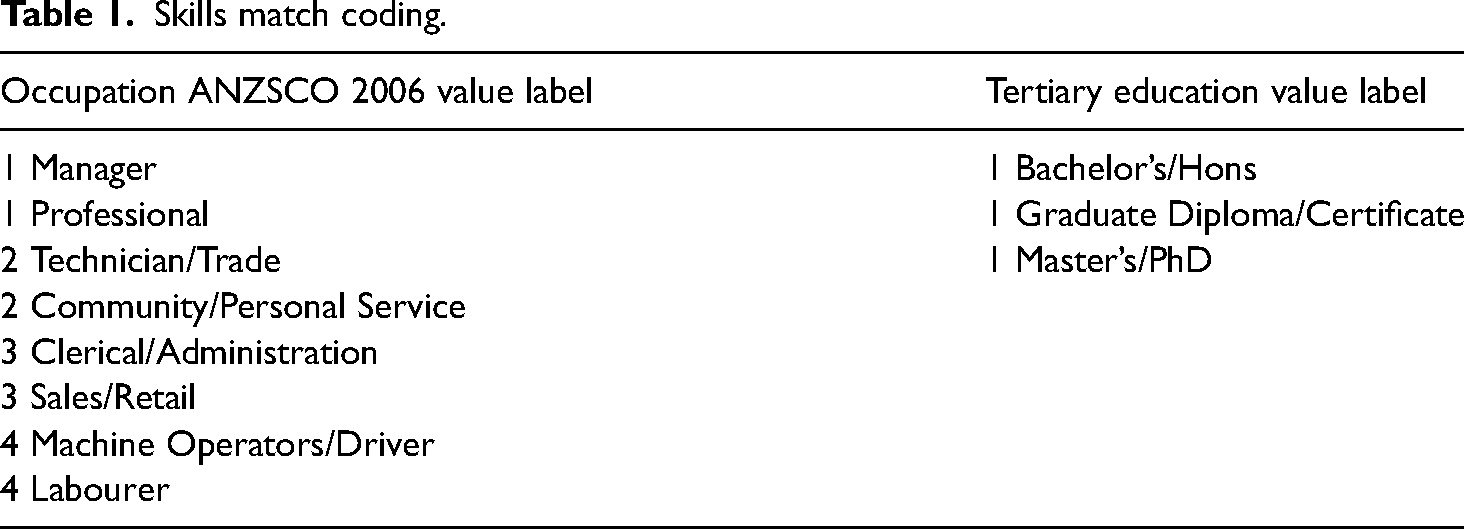
The dependent variable capturing job–skill match needed to be derived from the HILDA data. The scores are determined by matching respondents’ highest level of education with their occupation, using the job analysis method approach used in McDonald and Valenzuela (2017). The educational requirements of the person's occupation are compared to their educational qualifications, and we identify a mismatch if the former is less than the latter. In determining the educational requirements of particular occupations, guidance is taken from the Australian and New Zealand Standard Classification of Occupations (ANZSCO) 2006 system which, at its broadest level, identifies four occupation skill levels and the educational qualifications required for each (see Table 1). Given our sample, a match occurs if they are either a manager or a professional. Anything coded 2 or higher in the ANZSCO value label is a mismatch, and a higher value indicates a higher degree of occupational mismatching.
Skills match coding.
Results
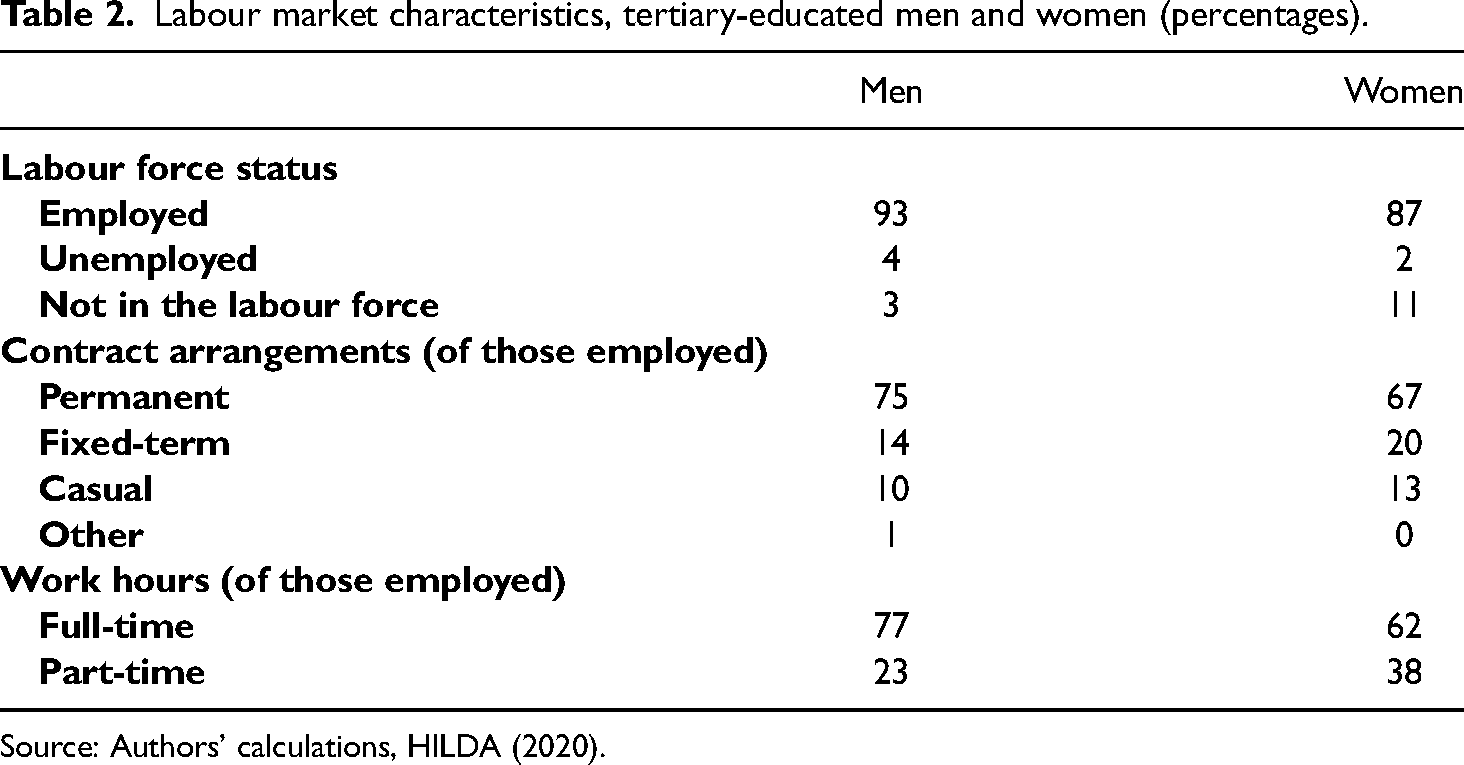
Table 2 shows that although tertiary-educated men and women have high levels of workforce participation (93 and 87 per cent respectively), more women (11%) than men (3%) are out of the labour force. Similarly, in our tertiary-qualified sample, women are less likely than men to be in a permanent job (67% vs 75%), more likely than men to be in fixed-term positions (20% vs 14%) and slightly more likely to be employed casually than men (13% vs 10%). There is also a large gender difference in hours worked, with over 77 per cent of men in full-time employment vs 6 per cent of women, and 38 per cent of women in part-time work vs 23 per cent of men. Gender gaps in all these measures are wider in the general Australian population (ABS, 2018; WGEA, 2019), but these results show that even in our highly educated sample, women work fewer hours and experience greater job insecurity than men.
Labour market characteristics, tertiary-educated men and women (percentages).
Source: Authors’ calculations, HILDA (2020).
We calculated job–skills match scores for our sample by gender across industries. Scores closer to 1 indicate a better match between occupation and education and scores closer to 4 indicate a poorer match. As can be seen in Figure 1, in 15 of the 19 industries, average skill-match scores are lower (i.e. are more closely matched) for men than women. However, some differences are marginal, and in several industries men and women are both well matched in terms of occupation and education. The relatively well-matched occupations include both female-dominated (education and training, and health care and social assistance) and male-dominated (mining, professional, scientific and technical services, electric, gas and water supply) sectors (WGEA, 2019). This suggests that skills mismatch may be a matter of job supply – that women (and men) apply for jobs they are over-qualified for when they cannot find employment in a job that matches their qualifications. For instance, we find that both men and women experience their greatest mismatches in retail trade and rental, hiring and real estate services, which are female- and male-dominated industries, respectively, but what they have in common is that they contain a high proportion of low-skilled jobs. That is, when women (and men) with tertiary qualifications work in these sectors, they are very likely to be over-qualified for the job.
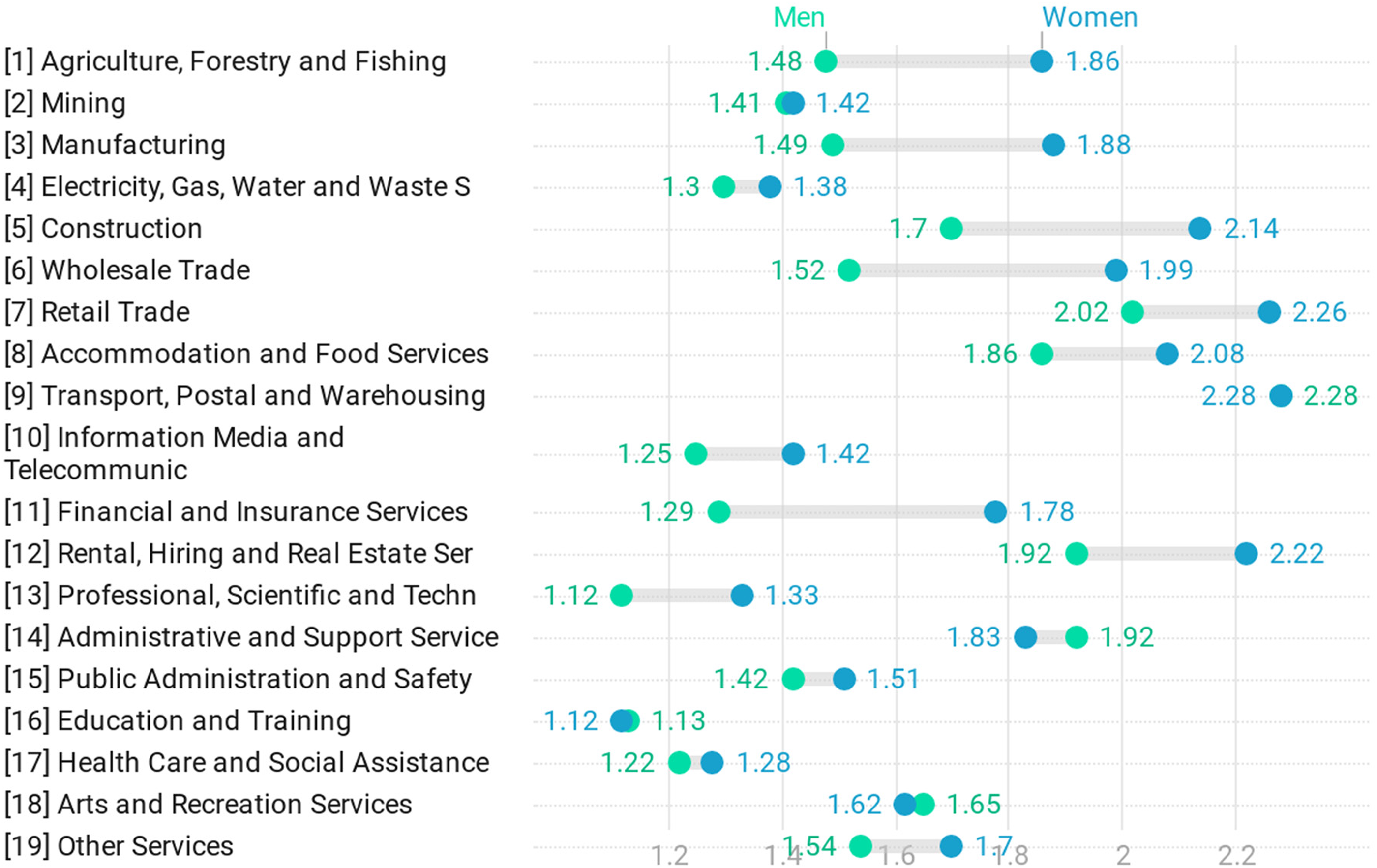
Skills mismatch by industry, tertiary-educated men and women
We now turn to the question of whether there are gender differences in how long it takes tertiary graduates to reach labour market milestones. In Figure 2 we present survival probability curves from Kaplan-Meier Estimation showing the amount of time it takes men and women from tertiary graduation to finding; (i) a permanent job, (ii) a job that exceeds the median level of income, or (iii) a job that matches their skills, respectively.
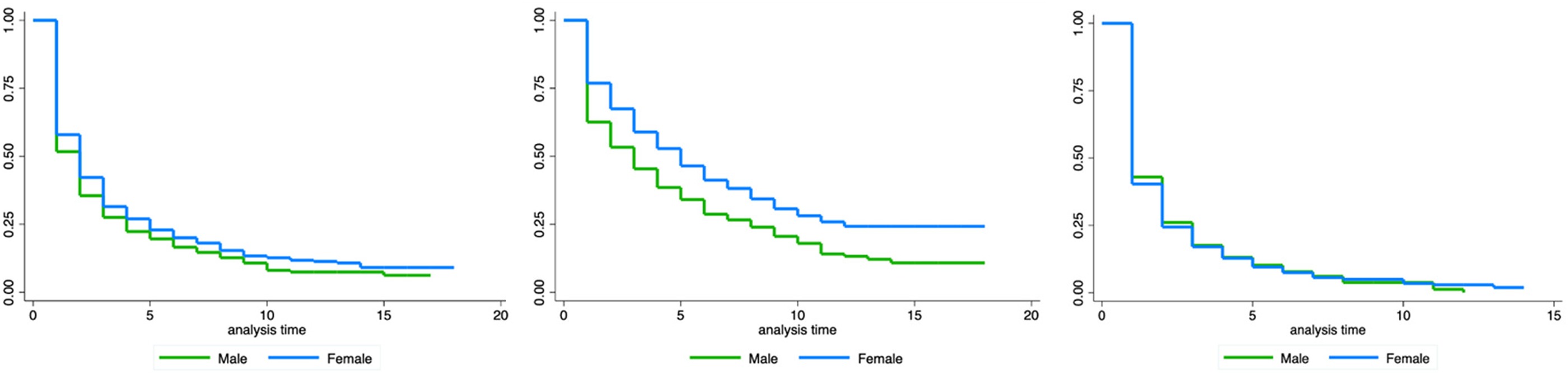
Survival probability curves: permanent job, earn above the mean, job–skills match
Women with tertiary qualifications take longer than men to find a permanent job and to exceed the mean level of income in the years following graduation (this was the case for median income also). Women are slightly quicker than men in finding a job that matches their skills, but this advantage is relatively small and diminishes three years after graduation, while the advantages men have in the labour market (finding a permanent job or exceeding mean income) continue even after five years of graduation. This is important as the early years are critical to women's future work and earnings trajectories. Also, that women's slight job–skills match advantage disappears, despite the evidence earlier that on average men are better matched across industries, may be due to demographic variation, with some people more affected than others.
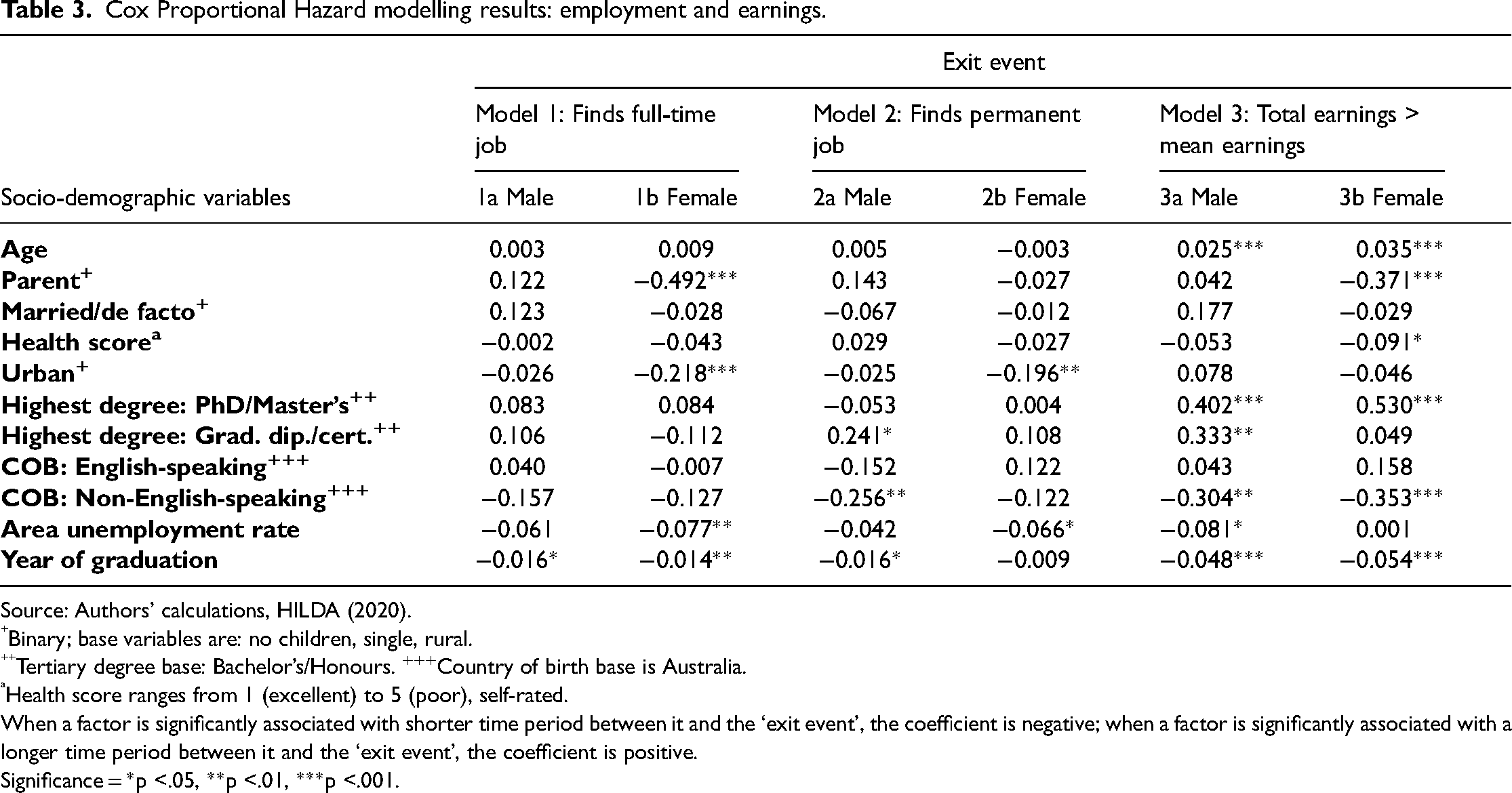
To address the question of which demographic groups are most affected by lags in reaching labour market milestones, we run Cox Proportional Hazard Models. Having compared men and women directly, we now compare within each gender, to identify characteristics that influence the length of time spent in different employment statuses. We first examine whether key socio-demographic characteristics affect the time it takes after graduation to move into full-time employment, secure employment and earn above the average wage.
The socio-demographic factors which predict faster or slower entry into full-time work following graduation are not the same for men and women (see Models 1a and 1b in Table 3). The only significant factor for men is the year of graduation, which indicates that more recent male graduates have taken longer to find full-time employment than those who graduated earlier. This is true for women too. Together, this suggests the job market has become more difficult for young graduates over time.
Cox Proportional Hazard modelling results: employment and earnings.
Source: Authors’ calculations, HILDA (2020).
Binary; base variables are: no children, single, rural.
Tertiary degree base: Bachelor’s/Honours. +++Country of birth base is Australia.
Health score ranges from 1 (excellent) to 5 (poor), self-rated.
When a factor is significantly associated with shorter time period between it and the ‘exit event’, the coefficient is negative; when a factor is significantly associated with a longer time period between it and the ‘exit event’, the coefficient is positive.
Significance = *p <.05, **p <.01, ***p <.001.
Other factors influence how long women (but not men) take to enter full-time work. The most important is parenthood. Compared to childless women, mothers are significantly slower to enter full-time employment. There is also a geographic dimension: women living in urban areas stay out of full-time employment longer than women in rural areas. Also, women who live in areas with higher local unemployment rates spend longer not employed in full-time work than women who live in areas where there are lower local rates of unemployment. Neither parenthood nor geography influences men's entry into full-time work.
The factors which predict faster or slower entry into a permanent job also differ between men and women (see Models 2a and 2b in Table 3). Women living in urban areas or areas where there is high local unemployment take longer to enter a permanent job than women living in rural areas or areas where the unemployment rate is low. For men, predictors of taking longer to find a permanent job are being born overseas in non-English-speaking countries and graduating later in our period of observation. Men with a graduate diploma or graduate certificate are likely to find a permanent job more quickly than men with higher qualifications.
Mothers take significantly longer to earn the average income than non-mothers. Older men and women are both more likely than their younger counterparts to earn above the average income more quickly post-graduation (Models 3a and 3b in Table 3). This may be because people who graduate at older ages already have work experience, and perhaps also prior training or tertiary qualifications. Similarly, men and women who hold PhD or Master’s-level qualifications earned above the mean income more quickly than those without PhD or Master’s-level qualifications, again consistent with having prior training and work experience. This effect is larger for women, suggesting that they are more advantaged compared to their peers, than men with PhD or Master’s-level qualifications are compared to their peers. This may reflect women having more need of higher qualifications to achieve workplace outcomes that men can obtain without them. Men (but not women) who hold a graduate diploma or graduate certificate are also quicker to earn above the mean income than men who do not. Together with the finding mentioned earlier that men with this level of qualification enter a permanent job more quickly, this may be because, in occupations that require certification to enter, the male-dominated (e.g. trades) offer both more security and better pay than the female-dominated (e.g. care-giving work).
We find longer periods of below-average earnings for those who report poor health (women), live in an area with high unemployment (women), or were born overseas in a non-English-speaking country (both men and women). As on the measures discussed earlier, recent graduates are also slower to exceed average earnings.
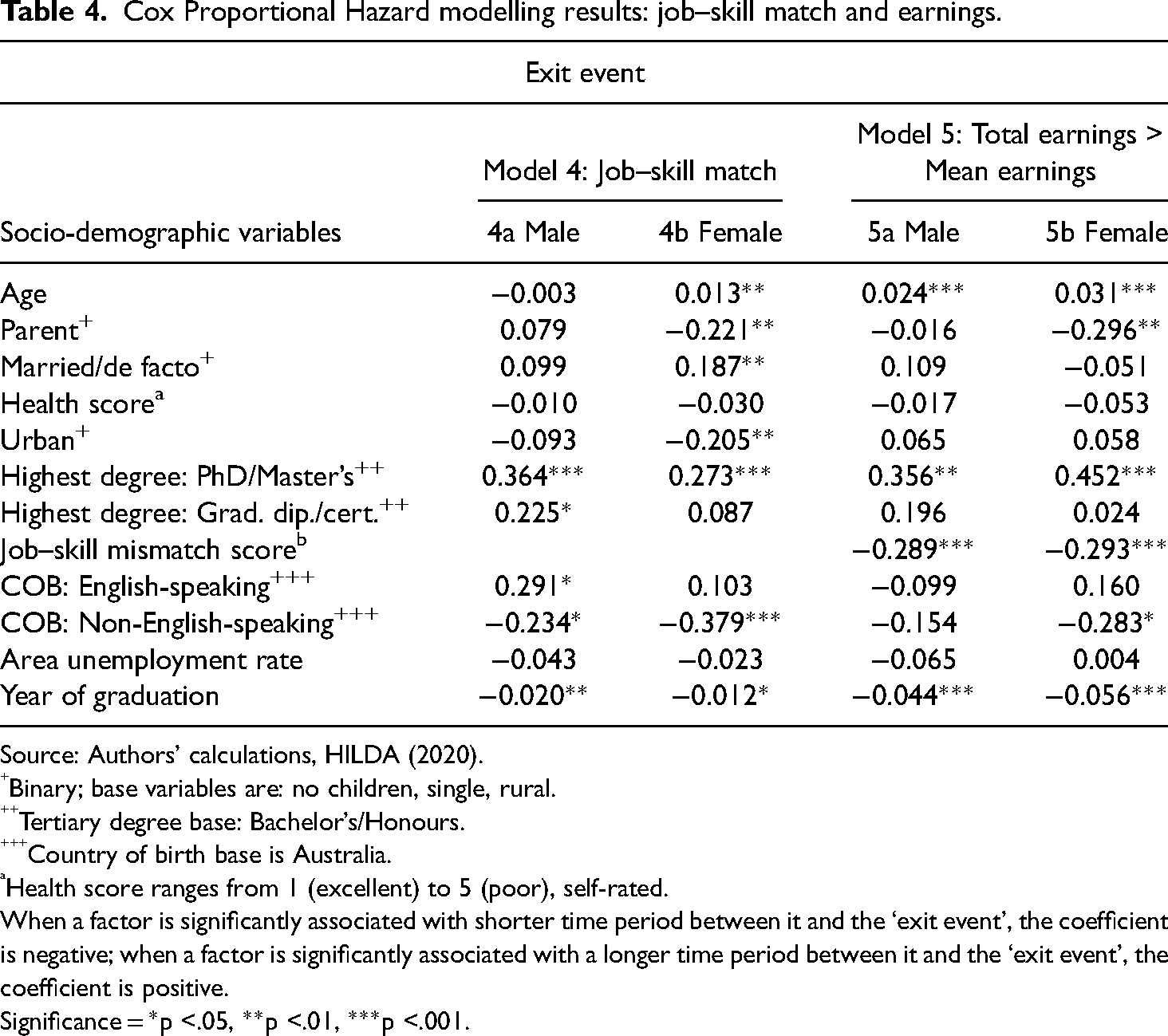
The factors that affect the time it takes for men and women to find a job that matches their skill level also differ by gender (Models 4a and 4b in Table 4). Mothers, older and partnered women are quicker to find a job that matches their qualifications than childless, younger and single women, respectively. Both men and women who hold a PhD or a Master's qualification find a job that matches their educational qualifications more quickly than their counterparts without these qualifications. The effect is larger for men. Men with a graduate diploma or graduate certificate and men born overseas in an English-speaking-country also find jobs that match their educational qualifications more quickly than those born in Australia and those with the same level of qualification. This is likely because certificates and diplomas are oriented to particular occupations, and Australia's migrant program prioritises those who bring scarce skills to the country (Hugo, 2014), so they may be specially recruited. It is the case, however, that the opposite applied to those from a non-English-speaking background. Graduates of either gender born in recent years take longer to find a job that matches their educational qualifications than earlier graduates did. Again, this suggests that the labour market has worsened for this cohort.
Cox Proportional Hazard modelling results: job–skill match and earnings.
Source: Authors’ calculations, HILDA (2020).
Binary; base variables are: no children, single, rural.
Tertiary degree base: Bachelor’s/Honours.
Country of birth base is Australia.
Health score ranges from 1 (excellent) to 5 (poor), self-rated.
When a factor is significantly associated with shorter time period between it and the ‘exit event’, the coefficient is negative; when a factor is significantly associated with a longer time period between it and the ‘exit event’, the coefficient is positive.
Significance = *p <.05, **p <.01, ***p <.001.
In Models 5a and 5b in Table 4 we use the measure of skill match as an independent variable to examine whether it influences the time it takes for men and women to exceed mean earnings. All else being equal, both men and women who are employed in jobs which do not match their educational/skills level take significantly longer to reach above-average earnings.
Discussion
In Australia, as in many other Western countries, a huge increase in the proportion of women in the education system since the 1970s (Carrington & Pratt, 2003) has not translated into gender equality in the labour market (Wyn et al., 2017). However, while previous research has identified the gender gap among the general population, less is known about how highly qualified women do in direct comparison with highly qualified men. To explore this, this article focused on the trajectories of women and men with tertiary qualifications from graduating to their first years in the graduate employment market. Through an analysis of the time required to reach specific labour market milestones following graduation, we found that in Australia gender gaps emerge immediately following graduation, and most persist over time, even for those with tertiary education. On almost all the measures assessed, women took longer to reach these milestones than men. This indicates that tertiary qualifications do not level the playing field between men and women, even in the immediate post-graduation years. Here we return to the temporal lens introduced earlier to discuss our findings.
The different pace at which men and women with tertiary qualifications move into the labour market and reach specific milestones suggests that ‘something’ is slowing women down. Unsurprisingly, our analysis showed that having children has the strongest and most significant effect on women's chances of meeting labour market milestones. Conceptualising the labour market and the family as institutional timescapes with separate temporal logics, we can understand this as not simply temporal stratification but a clash between the linear temporal logic of the labour market and the residual cyclical temporal logic of the family as an institution. Care of young children involves behaviours that are ‘often started, stopped, switched and interspersed with each other, and follow cyclical patterns of repetition and multiple enactment’ (Kaufman-Scarborough, 2006, p. 69). Also, in contrast to the education system (where these women appeared to do well), the labour market as an institution offers less flexibility and control over how one structures time, including the pace at which one moves through the institution. That is, while the value of one's educational credentials will be the same regardless of the time spent to complete them, one's ‘value’ in the workplace may depend on whether or not one moves forward ‘in sync’ with the organisation.
Barbara Adam (2004) writes about the concept of timescapes that ‘the notion of “scape” is important here as it indicates, first, that time is inseparable from space and matter, and second, that context matters’ (2004, p. 143). Thinking about time and space as inseparable and as interacting with each other can help us understand why we found that living in an urban area slowed the pace at which women (but not men) graduates were able to leverage their qualifications into full-time work, permanent work or work that matches their skill level. This may be a counter-intuitive finding, as cities are often seen as progressive spaces conducive to gender equality. However, in Australian cities high housing costs force young families to the urban fringes, resulting in lengthy commutes to work (Craig, 2020). In rural and regional areas such time imposts are lower and the barriers to women's employment hence smaller. Another potential underlying time-space factor may be the connection between geography and specific institutional timescapes. That is, industries with a high proportion of insecure and variable-hours jobs are clustered in metropolitan areas, for instance retail, hospitality and the arts sector, providing fewer opportunities for progressing to work that is full-time, permanent or matches one's skill level. Thus, it is likely that women in these areas have to accept a job lower in status. Further, more gender-segregated work in rural areas may help high qualified women to find a better job fit. This also suggests that thinking about the labour market as one homogeneous, institutional timescape may not be sufficient – that is, that there are sub-timescapes within this broader institution, driven by slightly different temporal logics.
Our analysis also found a temporal cohort effect, whereby recent cohorts took longer to hit labour market milestones than older cohorts. This was a consistent pattern across all outcomes for both men and women and confirms that the graduate labour market has become a more challenging environment for new entrants (de Fontenay et al., 2020). It also points to ‘credential inflation’, where the level of educational qualifications required for a job increases despite there being no change in the level of skill required (Graeber, 2019; Horowitz, 2018). Our results suggest this is a bigger problem for those from non-English-speaking backgrounds, young people and women. Disadvantaged groups may need more credentials as signifiers of capability to counter employer bias, but also to make up for a relative lack of cultural capital and sponsoring networks, which assist in employment and career progression (Ware, 2015). The need to provide strong external evidence of their employability, for these reasons, may be a factor behind more Australian women seeking higher tertiary qualifications.
It is important to acknowledge that despite women seeing fewer labour market returns for their investment in education than men, they would be more disadvantaged without it. Research on the relative economic advantage that a qualification confers usually compares women with women and men with men, and consistently finds that, in relative terms, private returns to female education exceed those to male education (Lee & Ihm, 2020). A recent review of the international literature calculated the overall within-gender difference in comparative earnings was about two percentage points higher for women that for men (Psacharopoulos & Patrinos, 2018). However, as the authors point out, ‘this does not imply that earnings are higher for females, but only that education makes a relatively larger difference for women than for men’ (Psacharopoulos & Patrinos, 2018, p. 17).
The results of this article suggest that while some women fare better than others, narrowing the difference between tertiary-qualified men and women's workplace success lies in changing institutional factors beyond the control of individuals. The implication of the patterns we identify is that workplace policies, including shorter full-time working hours, would be more effective for promoting women's economic security than more upskilling. As noted earlier, Australia's poor performance on women's ability to turn educational credentials into labour market outcomes make it a critical case (Flyvbjerg, 2006). Underutilisation is very costly, not only for women themselves but also for the nation. Currently, Australian state and federal governments spend over $114 billion a year on education and training (ABS, 2020). Adjusting the time economy of workplaces to be less inimical to the time economy of the family seems prerequisite to fully capitalising on this heavy investment.
Conclusion
To sum up, rather than seeking to understand persistent inequalities in labour market outcomes as the result of individuals’ ‘poor choices’, we argue for approaching this at the institutional and structural level. By paying attention to institutional time regimes we can also start looking at how these time regimes are not easily ‘synchronised’, that is, their temporal dynamics do not work easily together. Focusing attention on temporal incompatibilities between the institutions of education, the labour market, and the family problematises the dominance of organisational time in the hierarchy of temporal stratification (Lewis & Weigert, 1981). Framing education as primarily to meet employers’ needs for skills and labour ensures workplace demands prevail. Similarly, cyclic family timescapes have long been subordinated to the needs of the market, and ‘temporally embedded’ families have had to adapt to linear time (Wyn et al., 2017). There are limits to most women's capacity to do this, which underlies the slow workplace progress we have identified.
Most workplaces have resisted taking steps that would make the temporal logics of work and family more compatible by ‘desevering time and space’ (Jensen & de Neergaard, 2016, p. 2). However, the insight that both the workplace and the education system operate in linear time, yet women can succeed more in the latter than the former, implies that the greater flexibility of the education timescape could usefully be extended to workplaces. This accords with recent research showing that Covid-19 pandemic lockdowns disrupted rigid institutional timescapes, including by making the temporal embeddedness of interaction time, family time and working time more literal. A small gain during the lockdowns was fewer temporal constraints upon those who could work from home, who reported relief at avoiding the daily commute, and at the enhanced worker control over scheduling (Craig 2020; Craig & Churchill, 2021a). Retaining flexible work options, including work from home could make the temporal logics of the workplace and the family slightly more compatible in future. More broadly, however, our analysis suggests that to substantially improve Australian women's ability to turn their educational achievement into workplace success requires thinking about enabling working families to operate more according to their own temporal logic, and re-ordering the dominant institutional time hierarchy.
Footnotes
Acknowledgement
We acknowledge the research assistance including statistical modelling and analyses of Maria Rebecca Valenzuela.
Declaration of Conflicting Interests
The author(s) declared no potential conflicts of interest with respect to the research, authorship, and/or publication of this article.
Funding
The author(s) disclosed receipt of the following financial support for the research, authorship, and/or publication of this article: This work was supported by the Lord Mayor's Charitable Foundation, Australian Research Council, (grant number FT150100067).

Author biographies
Lyn Craig is a Professor in Sociology and Social Policy. Her area of research is time use, women, work, and care, with focus on intersections between the family and the economy, and social change.
Signe Ravn is a Senior Lecturer in Sociology. Her main area of research includes marginalisation processes, risk, gender, identities, time and temporality.
Brendan Churchill is a Senior Lecturer in Sociology and ARC DECRA Senior Research Fellow. His area of research is the sociology work and employment with a specific focus on young people, women and families and how changing nature of work impacts these groups.
Maria Rebecca Valenzuela holds a PhD in Econometrics. Her area of research is (a) quantitative modelling of consumption behaviour and firm performance and (b) measurement of disadvantage, inequality and poverty.