



Abstract
This article explores the affective dimensions of social media platform TikTok, and its potential as a novel form of political participation among young people. It draws on data from a sample of 24 TikToks focused on the 2019/20 Australian bushfires, as well as seven interviews with young people who create, view and share TikToks. Building on Ash’s notion of ‘affective design’, the article demonstrates how the memetic qualities of juxtaposition, whimsy and humour are utilised to enable escape and/or connection. As young people grappled with the intensity of emotions from the Australian bushfires, TikTok gave them space for the expression of complex affects through humour, whimsy, and juxtaposition.
Background
In the summer of 2019/20 bushfires devastated Australia. Over 17 million hectares of the country was burnt, and approximately 1 billion animals were lost (Richards et al., 2020). During this period young people took to TikTok, creating and sharing the type of short-looping video content that the app is designed to produce. Images and videos of the burning Australian landscape were combined with the short dances, lip syncs and comedy that have come to define the app, raising awareness of the relationship between the bushfires and climate change, and urging action to redress the impacts of climate-related environmental degradation. In this respect, youth who produced, viewed, and shared bushfire TikToks engaged in ‘digital micro-practices of citizenship’ (Third et al., 2019, p. 181), challenging normative notions of young people as disengaged and passive political subjects.
While TikTok is a relatively new phenomenon, scholarly work on the platform has grown significantly in recent years. A proportion of this literature has been centred around the platform's political and social potentialities, alongside its design features and affordances (see Abidin, 2020; Kennedy, 2020; Literat and Kliger-Vilenchik, 2021; Schellewald, 2021; Weimann and Masri, 2020). Collectively this work has shown, as argued by Serrano et al. (2020), that the platform offers a ‘novel way of conducting politics’ (2020, p. 264). This assertion has been demonstrated in studies on young people, climate change and TikTok. According to Basch et al. (2021, p. 165), climate change is a ‘legitimate and anxiety provoking issue’ in young people's TikToks and, more broadly, the platform can be utilised to provide insight into public understandings of pressing social issues. Hautea et al.'s (2021, p. 12) multimodal discourse analysis of climate change TikToks reports that they are ‘vehicles for personal narratives’, providing opportunities for youth to express their concerns and frustrations on social and political issues that are important to them.
At first glance, the imagery of a young person playfully dancing against the backdrop of a natural disaster may seem absurd and purposeless; however, TikToks function similarly to memes by creating a ‘shared cultural framework of cultivated senselessness’, which is used by young people to ‘define themselves and their experiences in relation to … the state of the world around them’ (Burton, 2019, p. 9). Memes have been defined as ‘units of popular culture that are circulated, imitated, and transformed by individual internet users, creating a shared cultural experience’ (Shifman, 2013, p. 367). Zulli and Zulli (2020, p. 11) make the link between a meme and a TikTok explicit, describing the latter as a ‘memetic text’ as it ‘encourages imitation and replication at the platform level’. Memetic texts are popular means of ‘expression and public discussion’ (Shifman, 2014, p. 123), as they not only amuse audiences but are also utilised to ‘disseminate political arguments and ideologies’ (Hakoköngäs et al., 2020, p. 2).
Collectively, the literature discussed has begun to build a picture of the affordances of TikTok, particularly as a political medium for young people, while also noting its limitations. In this article we further TikTok scholarship in two ways. First, following Hautea et al.'s (2021, p. 12) call, we give voice to the young people who constitute the TikTok community, reporting on seven interviews with Australian youth who consume this mode of social media. Second, in these interview narratives and an analysis of 24 TikToks made by young people about the bushfires, we centre affect theory, opening up to scrutiny how affects ‘stick’ and ‘move’, ‘shape[ing] the “surfaces” of individual and collective bodies’ of young people as political subjects (Ahmed, 2004, p. 1). We utilise Ash’s (2012, pp. 3–4) notion of ‘affective design’, which he defines as: ‘the process of attempting to indirectly generate particular kinds of affects or responses through the material and aesthetic design of products in order to capture and hold users’ attention’. Ash (2012) explores the ways in which video games are designed to modulate and amplify affect. We argue that TikTok creators use affective design in the same way as those who make video games, drawing on memetic qualities to help modulate affects.
We begin the article by situating the study in the literature on theories of affect, particularly as they speak to research on social media, before providing an overview of our methodological approach. In the next two sections of the article, we build on Ash’s (2012) notion of ‘affective design’ and explorations of the memetic features of visual content on social media to explore bushfire TikToks and young people's response to them. We demonstrate how the ways in which TikToks are designed by young people generate affective political engagements and reveal how those affects are experienced by other young people.
Theorising affect and social media
The past few decades have seen a ‘turn to affect’ (e.g. Fox, 2015; Hillis et al., 2015; Lünenborg and Majer, 2018), shifting conceptual attention away from human action and placing focus on ‘the interactivity between human bodies and other physical, social and abstract entities in their physical and social environment’ (Fox, 2015, p. 5). This turn has encouraged researchers to investigate the ‘intensities’ that circulate between bodies and objects by attempting to create an ‘ontology of surfaces and ways of knowing’ that exist beyond language (Fullagar et al., 2018, p. 40). These ‘non-conscious experience[s] of intensity’ lie between the mind, body, and the material, acting as a visceral force (Shouse, 2005, p. 5).
Affect studies on social media have explored how ‘individual, collective, and discursive and networked bodies, human and machine, affect one another and how they move and modify’ (Hillis et al., 2015, p. 5). This work has recognised social media platforms as ‘affect generators’ (Reckwitz, 2017, as cited in Lünenborg and Majer, 2018), providing a different affective experience to each individual user. In this vein Dean (2010, p. 21) defines each piece of content shared on social media platforms as an ‘affective nugget’ which has the capacity to attach itself to the user, creating a ‘binding technique’ between the individual and the social media platform. In this respect individuals are seen as entwined with rather than separate from the social media platforms they use, and the content on social platforms understood as co-produced by creators and the technical materiality of the platform (Bollmer, 2015). This conceptualisation does not seek to remove agency from humans, but rather recognises the ‘affective forces, relational connections and agential capacities of nonhuman matter when it comes together with humans’ (Lupton and Southerton, 2021, p. 4).
Sara Ahmed's (2004) scholarship reveals how affects circulate and stick to bodies and objects. She understands affects and emotions not as reactions to objects but rather ‘(re)actions or relations of towardness or awayness in relation to such objects’ (2004, p. 8). While the affective capacities of social media platforms will depend on each individual user and the ‘stickiness’ (Ahmed, 2004, pp. 89–90) or lack thereof to the content that exists within these spaces, it is the affordances that shape the ways in which the affective forces are generated (Lupton, 2019).
An important contribution to scholarship on social media and affect has been the work of Papacharissi (2014, p. 125) who, in research on Twitter and everyday politics, utilised the notion of ‘affective publics’, which she defined as ‘networked public formations that are mobilized and connected or disconnected through expressions of sentiment’. Papacharissi (2014, p. 119) recognised these affective publics not as collective action, but rather connective action; an assemblage of individual viewpoints which allows people to ‘develop a sense for their own place within this particular structure of feeling’. She argued that through the constant circulation of affect online, social media platforms allow users to ‘feel their way into politics’ by engaging in the stream of ‘blended emotion, drama, and opinion’ (Papacharissi, 2014, p. 118). While these affective streams will eventually ‘blend back in’ to the platform, their resonance remains, sticking to bodies long after the content has been consumed (Dean, 2010, pp. 21–22).
TikTok fosters these affective publics particularly through its memetic dimensions. Hautea et al. (2021, p. 3) argue that the mimetic nature of TikTok is ‘inherently affective’ as connection action on the platform is ‘driven by the memetic sweep of users’ interactions with the algorithm, rather than by established social or political networks’. In their work, Zulli and Zulli (2020, p. 11) engage the term ‘imitation publics’, which they understand as ‘a collection of people whose digital connectivity is constituted through the shared ritual of content imitation and replication’. Southerton (2021) notes that it is TikTok's platform affordances that allow for affective connections to be made between creators and viewers through the use of meme-making and humour. Drawing on her ethnographic research, she explores how health professionals share Covid-19-related health information on the platform by ‘tap[ping] into the circulating feelings, in-jokes, and trends that characterize TikTok’ (Southerton, 2021, p. 3261). She argues that it is this memetic deliverance of information that creates potentialities for affective connections between the creators and the viewers.
While previous research has focused on the TikTok platform and its affordances as a memetic text (see Hautea et al., 2021; Southerton, 2021; Zulli and Zulli, 2020), we focus on how individual TikToks are designed by users to generate, amplify and disseminate affect through the use of ‘affective design’ (Ash, 2012). Originally conceptualised as framework to explore video game design, Ash's notion of affective design opens up to scrutiny the ways in which creators seek to modulate affects through the design of the game (or in this article, each individual TikTok). It is this understanding of affective design which guides our research questions. That is: How do young people utilise affective design to create TikToks? And how is this form of affective design experienced by young people?
To address these research questions, we investigate how affective design is utilised to shape and generate affect through the use of three memetic qualities: humour, juxtaposition and whimsy. Young creators draw on these memetic qualities to amplify and modulate affects, and young viewers are affected by the ways in which these memetic qualities are presented to them. While personal biographies shape users’ affective responses to TikToks, so do previous encounters on the platform. It is the ways in which young people utilise affective design through memetic qualities that ‘set the tone for conversations and bring into words people's affective sentiments, garner[ing] greater exposure and engagement’ (MacDonald, 2021).
Methodology
Our methodological approach drew inspiration from the literature on digital ethnographies as involving immersion in a social media community through participant observation while retaining a focus on the experiences of users and the sociality of new modes of online communication (Postil and Pink, 2012). In this light we began the project with three months of immersion watching young people's TikToks about the bushfires. As part of this process, we identified relevant hashtags used by young people to comment on the bushfires such as #climatecrisis, #fires, #bushfire, #bushfires, #bushfireaustralia, #australianbushfire #bushfires2019 #nswbushfires. The more we sought out bushfire TikToks the more these would appear in our ‘For You’ feed, which displays content based on a user's previous interactions and behaviours on the app. Thus, over the three months we watched what we estimate to be thousands of TikToks related to the subject of our inquiry.
Originally our intention was to select the most viewed TikToks associated with each of the relevant hashtags for a sample for analysis. However, this proved problematic because to gain university ethics approval to download a TikTok for analysis and use the TikToks in interviews we were required to seek permission from content creators but had few replies to our message requests. An alternate approach we identified was to utilise 24 TikToks referenced in four mainstream Australian news media reporting on the phenomenon of young people using the platform during the bushfires (Judge, 2020; Rennex, 2019; Tyeson, 2019; Zhou, 2019). We could analyse the 24 TikToks mentioned in the articles and direct interviewees to these TikToks as they appeared in the news stories. Notably, many of these TikToks were those we had previously identified as representative of the diversity in style, tone, topic and design in bushfire-related posts by young Australians during our three-month immersion on the platform.
Our approach to the TikToks was informed by advice from other researchers who have argued for the need to adopt an analytical strategy which attends to the multidimensionality of digital media. Caron et al. (2018, p. 700), for example, in a study of youth civic culture on YouTube use a process of ‘chunking’ videos into segments or scenes for analysis so that they do not lose sight of where multiple modes ‘come together’. Similarly, Marone (2017, p. 53) observes that a dynamic strategy which goes beyond ‘decoding’ is necessary in interpreting audio-visual content on social media as it focuses our understanding on ‘the contexts and cultures in which such texts are created, shared, and experienced’.
In heeding this advice, we commenced the analysis coding in relation to the different properties of TikTok (Audio, Text, Creator, Background/Visual Effects), but then alongside each code made reflective notes commenting on how this property worked in conjunction with others to generate and circulate affect. Our aim was to ensure our analysis was dynamic and holistic. In collective meetings we debated our individual findings oftentimes returning to the TikToks in the sample to watch them again as a group. It was through this iterative and systematic, yet creative and subjective process (Saldana, 2013) that we identified the affective design elements of the sampled TikToks and their interconnections.
As a further dimension of the ethnographic approach, we undertook semi-structured interviews which, as Pink et al. (2015) explain, provide rich insights into the embodied, affective and sensory experience of social media. Seven interviews of approximately 45 minutes with TikTok consumers and producers between the ages of 18–29 were undertaken. Given the exploratory nature of the research, a convenience sample was utilised, with participants responding to a message about the study posted by the researchers on Facebook, TikTok and Twitter. While not intended, all participants identified as female. The length of TikTok use varied among participants, some noting that TikTok was part of their everyday practice and others mentioning that due to TikTok's addictive nature they set weekly time limits on their TikTok use. These issues are worthy of further research but outside the scope of the current article. The participants came from a range of different occupations; those who were not undergraduate students worked full time (see Table 1).
Description of interview sample
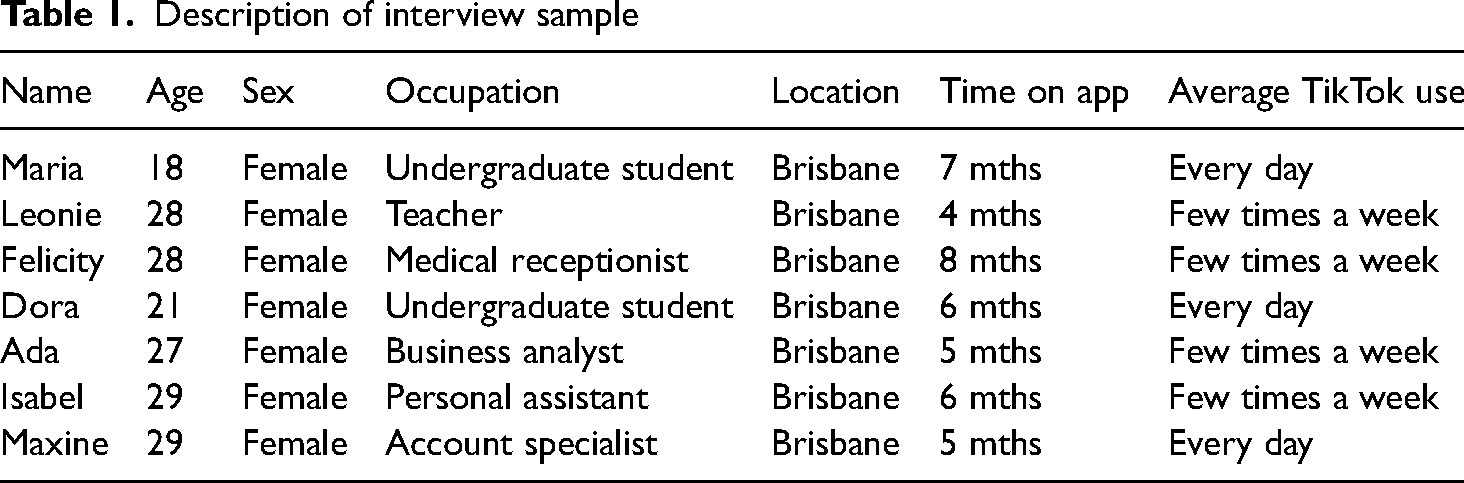
Participants were asked questions about their experiences with TikTok, including their motivations for using the platform, the type of content they engage with and why, how they use the platform and their views on the potential of TikTok as a political medium for young people. Prior to the interview, participants were sent links to the news articles about the young people's bushfire-related TikToks and asked to view the 24 TikToks that were referenced for discussion during the interview. During the interviews we re-watched the TikToks with participants and invited them to respond to them. This approach was informed by Robards and Lincoln’s (2019, p. 3) ‘scroll back method’ wherein a researcher and a participant ‘scroll back’ together through social media, navigating and co-analysing ‘complex digital traces of everyday lives’. Møller and Robards (2019, p. 98) note that the ‘scroll back method’ works particularly well in theorising affect as it provides opportunities to explore ‘the always already situated participant–researcher relationship, with media and other materials serving as the “field” backdrop’.
Interviews were audio-recorded and transcribed for thematic analysis. Guest et al. (2012, p. 8) note that exploratory studies require the researcher to read and re-read the data carefully, searching for key words, trends or ideas that will ‘help outline the analysis, before any analysis takes place’. We consequently spent many hours reflecting on the data and comparing and contrasting our ideas before adopting a systemic approach to thematic analysis, grouping relevant information and paying attention to patterns, convergences, differences and marginal themes (Alvesson and Kärreman, 2011).
Two key areas of analysis are presented in the next two sections. The first examines the affective design of TikToks with a focus on humour, whimsy and juxtaposition. These affective design elements enable the expression and sharing of an intensity of emotion through what Hartley (2010) calls ‘purposeful play’. In the second analysis section we extend this discussion, drawing on the interviews with young people as we viewed the TikToks together. This section emphasises the ambiguous ways our participants experienced and engaged with TikTok as both a place of escape from and connection to the bushfires.
Affective design of TikToks
The TikTok platform affords endless opportunities for creative expression. Users draw on various editing styles to cut, crop and frame their videos in a myriad of ways, often drawing on existing audio and visual effects. This ‘ongoing memetic process’, in which TikTok users build upon pre-existing material, allows for a ‘collective experience’ through the spreading and sharing of content (Zulli and Zulli, 2020, p. 12).
In her book, Memes in a digital culture, Limor Shifman (2014) explores memes and their potentialities to attract attention and virality. She outlines eight qualities prevalent in memetic videos and images (see 2014, pp. 73–94). However, she argues that memetic content will not normally contain all of these attributes, but rather incorporate three or four. The 24 TikToks analysed all demonstrated various memetic qualities, however three qualities were dominant across the sample: humour, whimsical content, and juxtaposition. We posit that these qualities form part of their ‘affective design’ (Ash, 2012) and are relied upon to modulate and amplify affect. In the following sub-sections, we have chosen specific TikToks to help us explain these design features adequately within the scope of this article.
Humour
Claiming humour was a key part of the TikToks may seem contradictory given the subject matter of a disaster, but humour is often used as a tool to challenge ‘hegemonic discourse’ (Calhoun, 2019, p. 28) and ‘acts as a vehicle for meaningful political participation’ (Davis et al., 2018, p. 3912). An illustration of the use of humour was a TikTok addressing the much-criticised decision by the Australian Prime Minister Scott Morrison to take a planned holiday to Hawaii at the peak of the bushfire crisis (see Judge, 2020). The creator plays the role of the Australian public questioning Morrison's decision – while standing in front of a raging fire and against a map of Australia covered with bushfire alert symbols. She also takes on the character of Morrison, dressed in a Hawaiian shirt and sunglasses standing on a beach holding a cocktail, responding to the public's criticisms with justifications such as his need for a holiday and his lack of capacity as a firefighter. Audio of the Keeping up with the Kardashians show is played over the top of the TikTok as viewers are asked to make links between the privilege, superficiality and entitlement of the famous reality television stars and Morrison. Having a sense of Kim Kardashian inhabiting the body of the prime minister as he ventriloquises the well-known phrase associated with the reality star, ‘My diamond earring came off in the ocean and it's gone!’ is comical, but as Ahmed (2004) explains, in exploring affect our focus should not be placed on what emotions are but rather what they do. In this TikTok, as with others produced by young people about the bushfires, humour is used to generate and circulate other affects rather than the types of emotions we might associate with humour such as enjoyment, pleasure and fun. What is communicated via the humour is young people's frustration, anger and resentment at the bushfire crisis, and, more broadly, the Australian government's lack of action on climate change.
Whimsy
None of the sampled TikToks were framed in a serious or sombre way. Instead, they were fanciful, playful, imaginative and unpredictable incorporating dances, gestures, popular culture references, and pre-existing audio. Shifman (2014, p. 84) notes that the whimsical nature of memetic content is precisely what makes them open to imitation, as other users ‘can imitate the playful spirit embedded in the texts … [while] inject[ing] new themes according to personal preferences’. It is not that serious TikToks do not exist (our personal explorations on TikTok have suggested they do), but rather that the whimsical appears to be the most common aesthetic of young people's bushfire TikToks.
An example of whimsicality can be found in a sampled TikTok which includes explicit criticism of Australian Prime Minister Scott Morrison (see Judge, 2020). The young man conveys his national identity via the Australian flag draped behind him. This representation of Australian identity alongside the text suggests that Scott Morrison is indifferent to the bushfire crisis. The text is also paired with the young man's unusual choice of gestures and dance movements. He thrusts two sets of hand gestures towards the screen before aggressively jumping into the air. These gestures are performed in time with the beat of catchy, upbeat music. For each gesture/movement, the screen shakes, and a new piece of text appears on screen. The final frame reveals the sentence ‘SCOTT MORRISON DOESN'T CARE’ alongside emojis of fire and Australian flags.
The gestures in this TikTok amplify the delivered message, accentuating the text. This comes to an affective crescendo in the last movement where the young man thrusts himself up into the air, as if he is throwing his body towards the on-screen text and emojis. The man's face does not show anger and nor is anger communicated in the music or motion. There is, however, an affective and embodied intensity evident as he propels his body forward. Anger and frustration seem to be forced out of his body and onto the screen.
It is worth mentioning that the gestures the young man performs are not original, or of his own design. In fact, they are part of a TikTok trend. What differs between the TikToks that repeat the gestures is the text that transitionally appears on screen. Other renditions of this trend have featured text that reads ‘I’m not hungry’, ‘You’re a cutie pie’ and ‘That kinda hurt’. Every iteration applies the same design; each word appears as the gesture is made, with the jump at the end completing the sentence. The text signifies the emotion that the gesture then amplifies, and then the jump indicates further emotional intensity. ‘I’m not hungry’ becomes annoyance; ‘You’re a cutie pie’ becomes a gesture of love and affection; ‘That kinda hurt’ becomes rejection, pain and sorrow. With such a brief time frame, the user's ‘embodied agency’ is reduced to a ‘set of specific gestural possibilities’ (Kendall, 2019, para. 10). Notably, the gestures that are present in the sampled TikTok are not typically associated with emotions such as anger or frustration; however, within this TikTok they embody the discourse that is present on the screen.
The TikTok platform widely encourages refashioning of the type described above. The TikTok search page displays the most popular hashtags which are often trends, re-creations or challenges. When watching a TikTok, the user can opt to see similar content by clicking on the music icon at the bottom right of the screen. This link takes the user to a page which displays not only the original TikTok to which the audio belongs, but also all TikToks that have been created using the same sound. Thus, the music icon acts like a hashtag, creating a space for connection between those who use the same music to reconstruct the gestures or dances. As we found with the participants interviewed for this study, it is common for users to spend time scrolling through TikToks via the music icon, exploring how different people have re-created a particular trend. Therefore, these trends allow young people to ‘build on the whimsical’, as well as enable their TikToks, and ultimately their political message, to be seen by a large audience.
Juxtaposition
Across the sample, there was a contrast between the subject matter of the TikToks, that is the devastating and fatal bushfires, and the humorous and whimsical elements of the social media form. More broadly, there was an implicit contradiction in that TikToks are playful and comedic in nature, and not typically associated with socio-political conversations. This paradox is central to their communicative power. As with the use of juxtapositions in video games ‘when players’ attention is distributed among a greater number of variables, those players have to work harder to keep up with what is going on and thus pay greater attention to the game itself’ (Ash, 2012, p. 20).
Ash’s (2012) observations about the affective impact of the deliberate deployment of antithetical features can be illustrated in a sampled TikTok featuring a young female recreating the popular TikTok dance trend ‘Say So’ on what appears to be fire-affected Mallacoota beach (see Judge, 2020). This area was an evacuation zone during the 2019/20 bushfires and was the subject of considerable media attention. Imagery of the orange-coloured sky at the beach became a key signifier of the national crisis, with photographs of people stranded on the beach circulated online and in the international media (Silva, 2020; Williams, 2019). The distressing imagery of the orange-hued beach is juxtaposed against the nonchalant, relaxed nature of the young woman, who participates in a commonly adopted TikTok dance trend to Doja Cat's hit record ‘Say So’. These types of dance trends are strongly embedded in youth culture and often performed in ‘mundane’ locations such as the bedroom or home (Kennedy, 2020). However, the location of the TikTok is far from ordinary. In fact, the creator's decision to film the dance at this location signals her inability to dance in her bedroom. Her way of living, her everyday teenage life is no longer available to her. Viewers bring this ‘emotional reading’ (Ahmed, 2004, p. 118) to TikTok, binding the dance trend with the severity of the fire. Thus, a dance trend associated with frivolity and enjoyment (captured on the young woman's face as she smiles in the frame) is set against a background of devastation which elicits a sense of anger, futility and fear. The creator's deliberate decision to prompt these seemingly contradictory affects is akin to what Ash (2012, p. 9) describes as ‘utiliz[ing] the space between aversive and attractive’ in order to generate incongruous affects and thereby demand attention.
Rettberg (2017, p. 7) notes that social media platforms like TikTok, ‘encourage a thinking where the original pattern or meme is not something to be revered, but something to be developed and made one's own’. The re-creations in the sampled TikToks which use humour, whimsy and juxtaposition amplify the affective states of bodies delivering the content. As designs are adapted and reimagined, bodies are placed at the forefront. Thin fragments of affect are layered on top of the new creation increasing the affective potential of the medium for viewers.
Thus, the type of TikToks we have discussed in this section should not be dismissed as apolitical. Creating them requires what Hartley (2010, p. 243) describes as ‘purposeful play’, which is defined as ‘a whole-of-body and body-to-body experience, entertaining and festive, in the very performance of political deliberation and participation’. This ‘whole-of-body’ experience represents a different approach to performing politics, providing new frameworks to deliver political and social messages to the audience by linking the visual to emotional through embodied performances and connections. We take up this issue further in the following section as we draw on the narratives of young people who are active on TikTok.
Affective capacities and ambiguities: TikTok as a place of escape and connection
Participants often commented about TikTok's algorithm and its ability to connect them to a wide range of social and political issues. Notably, when questioned about the content they engage with on the platform, participants rarely mentioned politically oriented TikToks. Rather, they were raised when discussing the political potential of TikTok. It became clear that social and political engagement on the TikTok platform was dependent on what Leonie noted was her ‘daily identity preferences’; which she described as what she felt like watching/who she wanted to connect with/who she wanted to be on each particular day depending on her mood. She explained that, in a desire to escape, some days her interactions would focus heavily on funny dog TikToks. The next she would be watching TikToks about the Black Lives Matter movement wanting to connect with broader society. Her practices demonstrate that political engagement on the platform does not form part of a ‘full-time or strategic citizen identity’ (Bang, 2005), but rather a spontaneous form of ‘everyday politics’ (Collin, 2008). This was the case for many participants in the sample. Often, it was the design features of individual TikToks that led participants to engage with social and political issues, allowing them to adopt personalised politics ‘emphasizing their own behaviour in terms of taste, lifestyle, consumption and leisure’ (Harris et al., 2010, p. 13).
Across the seven interviewees, participants explained their frustration with the Australian federal government's lack of action on climate change and linked this to the bushfire crisis. They also spoke about TikTok as a place of fun and frivolity. Thus, most were supportive of TikToks which criticised the prime minister and which did so through ridicule, satire and/or caricature. However, one participant deviated from the group. While Maxine engaged with the platform as a source of entertainment, she was not supportive of the ridicule directed towards the prime minister. Thus, when asked about watching the TikToks in preparation for the interview, she claimed it was disrespectful and unwarranted to lampoon the prime minister for a Hawaii holiday asking: ‘What was he gonna do? Stand there at the front?’ Interestingly, despite initially expressing affront, Maxine's reaction while scrolling through the TikToks during the interview was to laugh. When questioned about her reaction she responded: Yeah it was quite funny. It was like ‘Why do I find it funny?’ … I think it was actually quite well done…. You’re gonna get the same content in different things, but like if it's done well, then I think it can be quite funny.
Maxine's comment exemplifies how the affective design of TikToks shapes user interaction. Ringrose and Lawrence (2018) suggest that humour can, ‘enrich the possibilities of engagement, consciousness raising, and transformation both online and offline’ (2018, p. 16). Although Maxine in some ways sided with the prime minister in his choice to holiday in Hawaii while bushfires ravaged parts of the country, she still laughed at the TikTok. This may not change her political views, however it may open up a space for the possibilities of political engagement. As Ahmed (2004) argues, ‘bodies take the shape of the very contact they have with objects and others’ (2004, p. 1). This particular TikTok shifted Maxine's orientation towards the prime minster, if only slightly.
Interview responses and reactions to the political TikToks demonstrated the emotional ambivalence of participants when faced with the affective design features, particularly the combination of humour/whimsicality and seriousness. While watching a TikTok of a young girl playfully dancing on a fire-ravaged beach, Isabel instantly recognised the dance trend and stated that she had admiration for the young woman within the frame as it showed ‘that there is positivity out there’. However, she noted that the visceral imagery of the hazy beach which framed the young content creator was ‘very confronting’ to witness. Though the location in the TikTok elicited feelings of anxiety and fear, for Isabel the dance trend simultaneously evoked feelings of hope and relief, providing further evidence of the way in which humour in politically oriented social media can recalibrate negative emotions such as anxiety, fear and frustration into positive affective states (Dynel and Poppi, 2021). As the viewer's emotional responses circulated between the ‘aversive and the attractive’ (Ash, 2012, p. 11), the body of the young woman within the frame was always foregrounded, emphasising the proximity of the fire/climate change to young people.
Despite the sense of ‘affective ambiguity’ (Sundén and Paasonen, 2019) participants expressed in viewing the TikToks, they forged embodied connections with content creators and, through the intersection of the watching and creating TikTok bodies, established new political identities and attachments. This is reflective of Pedwell’s (2017) work, where she argues for an entangled understanding of how affects, images and text come together in ways that are not simply, ‘the potential effects of one image, one GIF or one video in isolation, but rather, the affective relations among multiple, changing digital files and configurations’ (2017, p. 19, emphasis added). This was evident in Felicity's reflections on the bushfire TikToks. She explained that while she was upset about the bushfires, and their connection to climate change, her viewing of the TikToks caused her to be ‘more outraged’ as she participated in what she referred to as the platform's ‘community’. Affective attachments to TikToks cannot produce ‘the community’ that Felicity noted, however they may produce what Dean (2010, p. 21) calls ‘feelings of community’, mediated relationships that are ever-changing, uncertain and interconnected. While Felicity admitted that she was initially ‘annoyed’ and ‘upset’ by the prime minister's actions, her engagement with TikToks about the matter intensified her affective stance, amplifying her anger and frustration. Reading Ahmed's (2004) work on the cultural politics of emotion, this amplification of anger and frustration can be understood as shaping Felicity's (and many others who are engaged in TikTok), subjectivities in particular ways.
This was only ever partial, shifting orientations, or opening up towards different possibilities of engagement in politics. Notably, the affective modalities of TikToks were also criticised by participants who accused content creators of manipulation, self-aggrandisement and/or thoughtless imitation. They referred to creators as ‘jumping on the bandwagon’ (Ada) in taking up dominant viewpoints on polarising issues. These allegations align with criticisms of online political activities as expressions of ‘slacktivism’, and promoting a ‘watered-down and lazy attitude’ to social and political issues (Lindgren, 2019, p. 423). However, critiques from the participants should not be equated with dismissing the political potential of TikTok. Instead, their critiques should be understood as indicative of their high-level analytical skills in reading social media. While Leonie agreed that it was easy to jump on the ‘bandwagon’, she believed political TikToks also created a ‘talking point’ for young people; a foundation for young people to ‘express themselves’.
TikTok was not necessarily seen as a primary source of information about the bushfires, but rather an opportunity to broaden one's perspective on them. What was important was that these different perspectives were delivered by the bodies of other young people. This is demonstrated in Ada's comments about the platform: Yeah, well TikToks, like, it's a human, a normal person like you know. Like they’re just showing it from their perspective, and you take it as is…. They’re doing it cause that's how they’re expressing it, rather than funnelled through the media.
Ada's response exemplifies how the bodies on the screen have the capacity to amplify and intensify affects as they present a body that is ‘human’, relatable and unfiltered. Ahmed (2004, p. 13) writes that, ‘the work of emotion involves the “sticking” of signs to bodies’. For the young people in our study what ‘stuck’ was the creative articulations of anger, grief, disappointment and frustration expressed by other young people.
Conclusion
Drawing on Ash’s (2012) notion of ‘affective design’, we have argued that politically oriented TikToks with the memetic qualities of humour, juxtaposition and whimsicality may be powerful ways for young people to navigate the powerful affects of grief, anger, frustration and disempowerment related to a lack of government action on climate change. We are not suggesting that TikToks are solely political nor a singular avenue for addressing environmental concerns. However, in a world where young people have very little political agency, the social media platform provides an avenue for the expression of political views as well as difficult affects. What is notable is the role of design in this process as interviewees explained that it is not only the social or political topic of a TikTok that garners the attention of youth, but the ways in which the TikTok is designed. While previous research has highlighted the importance of the platform affordances of TikToks (Hautea et al., 2021; Zulli and Zulli, 2020), we also emphasise the creative capacities of young people in identifying and leveraging these affordances for political purposes. This has implications for government, industry and community organisations wanting to communicate with youth via the platform. There are many organisations that already have TikTok accounts, presumably to engage youth about social issues; to be effective, however, content needs to be specifically designed to capitalise on the particularities of the platform and created for young people by young people.
Despite our intentions this study is limited by its small and overly homogeneous sample. As TikToks are embedded in embodied social relations it is critical that further research considers the experiences of diverse Australian youth in communicating politically on the platform. Given media reports on the continued growth of TikTok since this study commenced, and its increased use as a political force by young people (e.g. Abidin and Zeng Jing, 2021; Susarla, 2020), there is further need for rich case studies on the subject. What is unique about this current project is that, as well as analysing TikToks, we also spoke to young people about their engagement practices on the platform and their responses to bushfire TikToks.
This study's multi-method approach adds an important affective dimension to research on the affordances of social media, and particularly TikTok. It attends to political participation (focus on content creators) but also to young people who find affective resonances (and dissonances) on these platforms. The young people we interviewed for this project were not actively engaged in formal politics, and they did not necessarily seek out political TikToks. For them, TikTok was often a place of escape from boredom and from the realities of life. Yet at the same time, the platform provided a place of humour, whimsy and juxtaposition and way to connect with others around their fear, grief and uncertainty about the future of the planet and the damage of bushfires. TikTok created a space for openness and proximity to political discourse and social change in an environment in which young people felt comfortable.
Footnotes
Declaration of conflicting interests
The author(s) declared no potential conflicts of interest with respect to the research, authorship, and/or publication of this article.
Funding
The author(s) received no financial support for the research, authorship, and/or publication of this article.

Author biographies
Yanni Brown is a recent graduate from Griffith University. She completed a Bachelor of Arts with First-Class Honours in Sociology and Islam–West Relations and received a University Medal for her academic excellence. Her dissertation was awarded the 2020 TASA Honours Student Award for the best Honours student at Griffith University.
Barbara Pini is a professor at the School of Humanities, Languages, and Social Sciences at Griffith University. She has an extensive record of research focusing on inclusion and belonging in rural Australia. Her most recent work explores these concerns through contemporary rural life narratives.
Adele Pavlidis is a Senior Lecturer in Sociology with the School of Humanities, Languages and Social Sciences, and previously a DECRA (Discovery Early Career Researcher Award) Fellow (2018–21). She has published widely on a range of sociocultural issues in sport and leisure, with a focus on gender and power relations.