




Abstract
This article reveals the characteristics and demographics of non-Muslim Australians who express levels of anger towards Muslims and Islam. Using data from a 2018 national social survey of a random, stratified sample of Australians, we identify key demographic characteristics amongst those expressing above-average degrees of anger towards Muslims and the religion of Islam, separately. We identify the proportion of different typologies of people who hold anger towards Islam and Muslims. We aim to establish which combinations of demographic and personal characteristics are most strongly associated with the expression of anger so that policy and interventions targeted at reducing this emotion might be effectively directed. We draw on the literature about Muslimophobia and Islamophobia, along with key studies that have examined attitudes towards Islam and Muslims in Australia and elsewhere. Our findings are relevant to organisations and government bodies in Australia, with implications for policy and social cohesion programs.
Introduction
Muslims have a long history of association with and presence in Australia both pre and post colonisation, but not without some controversy. 1 Scholars (Deen, 2003; Ganter, 2008; Saeed, 2003) have written about the long and sometimes fractured history of Muslims in Australia. Despite this rich and varied history, Muslims continue to be portrayed in public and news media discourse as problematic (Ewart & O'Donnell, 2018) and as a threat to Australian society (Miller, 2017). Some Australian politicians promote fear of Muslims and position them as outsiders who are at odds with Australian values (Forrest et al., 2020; Reid, 2019). In this context Ganter (2008, p. 481) argues ‘Muslims have become the most widely debated and feared segment of the Australian community’. We explore the characteristics and demographics of non-Muslim Australians who self-identify as holding higher than neutral degrees of anger towards Muslims and, separately, towards Islam. We separated Muslims and Islam in our survey to see whether those with higher than neutral levels of anger towards Muslims had similar or different characteristics to survey participants with higher than neutral levels of anger towards Islam. We used data from a 2018 national social survey of Australians in which we asked questions about participants’ attitudes towards Islam and Muslims, finding that those with high anger levels towards Islam had different characteristics than those with high levels of anger towards Muslims.
Understanding the characteristics and demographics of those who express anger at Muslims and at Islam is relevant to organisations and groups whose mandate is to develop and implement social cohesion policies and programs. Our findings have significance for agencies tasked with countering groups promoting animosity towards Islam and Muslims.
Literature
Muslims account for around 2.6% of the Australian population (International Centre for Muslim and Non-Muslim Understanding, 2015). While they are a small percentage of the population they have attracted a significant amount of research, particularly in relation to news media coverage of stories about Muslims and Islam (Ewart & O'Donnell 2018) (Aly, 2007; Manning, 2006; Poynting & Mason, 2007; Poynting & Noble, 2003). However, there have been few studies of non-Muslim Australians’ attitudes towards Muslims. We will focus briefly on the European research because we know that Europeans are more concerned about the presence of Muslims than they are about the Islamic faith (Erdenir, 2010), but in Australia it is the opposite (Ewart et al., 2022). We also summarise some research from New Zealand because it is close to Australia and also has a very small proportion of Muslims in its population.
Muslimophobia and Islamophobia work differently, although scholars continue to be conflicted over the definitions of these two terms. Many scholars commingle Muslims and Islam, or use the terms interchangeably, when examining attitudes of non-Muslims towards Muslims. Erdenir (2010, p. 28) explains the difference between Islamophobia and Muslimophobia which are key drivers of negative attitudes towards Muslims and Islam. She (2010, p. 29) writes that Muslimophobia is ‘distinct from Islamophobia in the sense that the former targets Muslims as citizens or residents … rather than Islam as a religion’, whereas Islamophobia focuses on discrimination against the religion. Erdenir (2010, p. 29) also points out that, in the European context, mainstream politics focuses on Muslims not Islam, and that Muslimophobia is directed at the ‘cultures, lifestyles and physical appearances of Muslims’.
Recent studies of non-Muslims’ attitudes to Muslims reveal there is no one set of demographics that characterise those who are anti-Muslim. Rather, different surveys have identified a range of characteristics, sometimes at odds with what other surveys in the same country or region have found, that characterise those with animus towards Muslims and their faith. The results from international surveys vary when it comes to the role of gender, political viewpoint, and religiosity in animus towards Muslims.
Bakker-Simonsen and Bonikowski (2020, p. 114) tease apart the important differences between attitudes to Muslims and immigrants, finding that ‘varieties of national self-understanding are predictive of anti-Muslim attitudes, above and beyond dispositions toward immigrants’. Using data from 41 European countries they find that, with one exception, ‘anti-Muslim attitudes are positively associated with ascriptive – and negatively associated with elective (including civic) – conceptions of nationhood’ (2020, p. 114). The exception was north-western Europe, where ‘civic nationalism is linked to greater antipathy toward Muslims’ (2020, p. 114). In Germany, where there is a significant presence of Muslims, Wallrich et al. (2020, p. 2195) use data from a 2016 survey of 3,195 Germans about foreign groups living in Germany and reveal that, when asked about immigrants, respondents ‘disproportionately think of groups who are Muslim, and that such salience is associated with more negative attitudes towards “foreigners”’. Their analysis concludes that anti-Muslim sentiment is stronger and more prevalent amongst survey participants than anti-foreigner sentiment.
In the United Kingdom Helbling and Traunmuller (2020, p. 811) explore the underlying basis of Islamophobia. Their online survey administered in 2015 (2020, p. 811) reveals that ‘citizens’ uneasiness with Muslim immigration is first and foremost the result of a rejection of fundamentalist forms of religiosity’. They examine whether anti-Muslim attitudes are based on factors such as ethnic identity, behaviours associated with religion, or their religious identity. Religious behaviour is the defining factor that results in survey participants holding negative views of Muslims. Of significant interest is their finding that ‘liberals – who place less emphasis on national security – have more negative feelings about religious radicals than conservatives do’ (2020, p. 822). They conclude that survey participants who show antipathy towards Muslims do so because they perceive that Muslims’ religion, religious behaviours and immigrant status do not fit with the liberal and democratic values of the UK.
While immigration can lead to high levels of antipathy towards Muslim immigrants, two Norwegian surveys in 2011 and 2017 undertaken by Hellevik (2020, p. 120) find a ‘positive correlation between the share of immigrants in a local community and positive attitudes towards them’. They wrote that the ‘share of negative answers for Muslims varies between 29% and 47%’. About 27% of their participants have a high score on the survey's index of Islamophobia. Significantly they show that ‘the incidence of both antisemitism and Islamophobia is higher among men, among older people, and among people with lower levels of education’ (2020, p. 137). Meanwhile, a study of 20 European countries by Gusciute et al. (2020, p. 1) reveals that women are ‘more opposed to Muslim immigration than men’ and conservative women are more anti-Muslim than their male counterparts. Using data from the 2014 European Social Survey (26,000 participants), these researchers explore what underpins Europeans’ criticisms of Muslim immigration. They identify that opposition to Muslim immigration is higher across the countries surveyed than to immigration in general but that ‘countries with a higher “stock” of Muslim population and higher incidence of Islamic terrorist attacks are more welcoming towards further Muslim immigration’ (2020, p. 12).
New Zealanders’ attitudes towards Muslims have attracted a surprising amount of researchers’ attention – surprising because Muslims make up only 1% of New Zealand's population. 2 Using data from a New Zealand study undertaken between late 2018 and early 2019, Greaves et al. (2020) identify perceived levels of threat posed by Muslims and the extent of negativity towards followers of various religions, including Islam. Those with greater levels of perceived threat and negativity towards Muslims included ‘older people, New Zealand Europeans, men and those with more right-wing attitudes’ (2020, p. 260). Non-Muslim study participants have higher perceptions of Muslims as a threat than they have of any other religious group, with a third identifying they are somewhat or very threatened by Muslims, a proportion the authors viewed as disquieting. However, a third of their survey participants also perceive that Muslims pose no threat; although Greaves et al. (2020, p. 274) note that before the Christchurch mosque attacks there ‘was a relatively high level of perceived threat from Muslims, keeping in mind that these are attitudes that participants are: (a) conscious of, and (b) willing to write on a (de-identified) questionnaire’.
A study by Shaver et al. (2016) identifies that greater warmth towards Muslims is more common among non-Muslim churchgoing New Zealanders and those who attend other places of worship. These researchers theorise that, similar to the UK, discomfort with faith might explain the lack of warmth among non-religious people. However, Shaver and colleagues’ study identifies that the levels of anger and warmth towards Muslims are affected by Muslims’ ethnic backgrounds, with anti-Muslim prejudice being highly associated with anti-Arab prejudice. Shaver et al. (2016) find that a range of demographic characteristics are common to those with lower levels of warmth towards Muslims and Arabs in New Zealand. Lower levels of warmth towards Muslims are more common among those who are politically conservative, male, unemployed, not religious and not churchgoing, and older with lower levels of education.
Australia
In Australia researchers have only recently paid attention to non-Muslims’ attitudes towards Muslims. In recent decades a number of factors have contributed to a re-emergence of anti-Muslim sentiments in Australia. There has been a rise in right-wing extremism (Miller, 2017), the re-emergence of the One Nation political party with its anti-Islam platform, and the willingness of other politicians to capitalise on anti-Muslim sentiment (Forrest et al., 2020; Reid, 2019). Anti-Muslim sentiment in Australia is characterised by racism and hostility towards those who are perceived as being outsiders (Aly, 2007) and the increasing presence of anti-Islam groups on social media (Miller, 2017). In the context of the formation of far-right groups in Australia and associated beliefs that the increasing presence of Muslims and the religion of Islam presents a threat, Miller (2017) examines posts on social media sites of two of the most popular right-wing, anti-Islam groups in Australia, the One Nation political party and the online anti-Halal food campaign called Boycott Halal, to determine what their members’ concerns are in relation to Muslims. Their key fears relate to terrorism and the perception that Islam poses a political threat, as well as the perceived desire of Muslims to introduce Sharia law to Australia, perceptions that Muslims have negative attitudes towards women and children, and the incompatibility of some religious practices of Muslims with Western society (Adida et al., 2016; Bail, 2016; Sniderman & Hagendoorn, 2007; Zuquete, 2011). Views on racial and religious groups are often examined through the lens of political orientation in the extant literature (see, for example, Duckitt & Sibley, 2007), especially with the rise of right-wing populist protectionist parties in nations around the world in recent decades (Leviston et al., 2020). Therefore, it is important to consider political orientation when describing the characteristics of those most likely to display Islamophobia, particularly in a predominantly white and European culture such as Australia, where views on race, religion, and politics appear to be inextricably intertwined (Leviston et al., 2020).
Campion (2019) reveals that members of right-wing extremist groups primarily direct their anger towards ethnic Australians and Australia's Muslim communities. She highlights that, in the decade prior to 2019 and the Christchurch mosque attacks, committed by an Australian, right-wing extremism had re-emerged in Australia and Muslims have been amongst their targets. As Poynting and Brisman (2018) highlight, and Campion reiterates, intolerance has been normalised in Australia by politicians and commentators who have vilified Muslims. Belief in the self's membership of a strong in-group, as experienced through exposure to confirmatory newspaper headlines, is associated with the emotion of anger towards an out-group, and in turn the tendency to want to act offensively towards the out-group (Mackie et al., 2000).
Dunn et al. (2021) examine what Islamophobia looks like in Australia by developing a typology of Islamophobia among Australians using latent class analysis (LCA). Through two surveys of Australians in 2015 and 2016 these researchers identify four groups of Australians with varying perceptions of Islam based on their ‘fears, dispositions and likely actions’ (2021, p. 556). Islamophobes are distinguished through their responses to social distance measures and positive or negative views of Muslims. Of those they surveyed in both years, 13% are Islamophobes, 24% are unsure about diversity and have some concerns about Muslims, 50% have progressive attitudes about diversity coupled with some concerns about Muslims, and the remaining 13% are progressives with no concerns about Muslims. Membership of the Islamophobe group was more likely among older Australians, a dwindling group. However, most measures of characteristics, including educational attainment, were discarded from the analysis because of their lack of association with the individual measures used to predict the latent classes, while religious affiliation was not included in the multinomial regression but instead the effect of Christianity on class membership was interpreted separately. Dunn and colleagues recognise that Islamophobia is likely to be inconsistent across different demographic and social groups in Australia, and that a high level of covariance between variables is likely to be present (for example, they discuss the Christian-centrism that older Australians were raised with). However, their analysis continues to rely upon bivariate associations, most of which they found to be statistically insignificant; a result they argue may be caused by the ambient nature of Islamophobia within Australia. We suggest that interpretations of effects on average may result in a washing out of differences in Islamophobia across groups, as also alluded to by Sibley et al. (2020) and Greaves et al. (2020).
Attitudes towards Muslims in Australia are also the focus of a study by Mansouri and Vergani (2018), where they measure prejudice using operationalisations of the wish for social distance. Using data from a 2016 survey of non-Muslim Australians the authors explore the connections between ‘intercultural contact, factual and self-reported knowledge of Islam, and prejudice against Muslims in Australia’ (2018, p. 85). Not surprisingly, they find an association between those who had more contact with Muslims and more knowledge about Islam and lower levels of prejudice. However, they identify that this is over and above the effect of political leanings and education level (which they found had a significant influence on prejudice), and gender and religiosity (which did not). Another Australian survey (Colic-Peisker et al., 2020) of 1,020 non-Muslims in the Australian suburbs of Sydney and Melbourne in 2019, reveals that Christians are more Islamophobic than survey participants who have no religion or other non-Islamic religions when controlling for suburb proportions of Muslim residents. Age and education are also significantly linked with lower levels of Islamophobia, particularly in those aged 18–24 and participants who have completed years 11 or 12 or attended university. Islamophobia is higher among participants who have a lower socio-economic status. In Colic-Peisker and colleagues’ (2020) study, Islamophobia is measured using views on the Muslim practices of individuals that the respondent sees in their daily life, suggesting that the operationalisation is in line with what Erdenir (2010) and Triandafyllidou (2015) would term Muslimophobia.
In the aforementioned studies, researchers have not specifically separated Muslims from their faith when surveying non-Muslim Australians about their attitudes and prejudices towards Muslims. A study we undertook with a colleague (Ewart et al., 2022 ) reveals an important distinction between non-Muslim Australians’ attitudes towards Muslims and Islam. Using data from a random, stratified survey, the 2017 National Social Survey of Australians, we found that non-Muslim Australians hold more favourable views of Muslims than they do of Islam. Survey respondents ‘were significantly more likely to be unfavourable towards Islam (27.27%) than towards Muslims (11.85%)’, while ‘the percentage favourable towards Muslims (37.26%) was significantly greater than towards Islam (20.07%)’ (Ewart et al., 2022, p. 9). That study did not examine the demographic factors and other characteristics of survey participants who expressed animus towards Islam or Muslims. We now turn to the focus of this article, which is to identify the characteristics of those in our 2018 national social survey who self-reported high levels of anger towards Muslims and, separately, towards Islam.
This study: anger’s connection to action
Attitudes towards Muslims, Islam, or both have been measured in varying ways, depending on the purpose of the research. Research has explored differing facets of Islamophobia, including negative perceptions, perceived threat, and emotional response. Studies have found that Islam is viewed as either a terroristic threat (Doosje et al., 2009) or a symbolic threat (Uenal, 2016). Sibley et al. (2020) explain the construct validity of feeling thermometers, such as measures of generalised warmth or anger towards different out-groups in their discussion of the New Zealand Attitudes and Values Study's use of those measures to operationalise prejudice. The thermometer rating provides a ‘very simple and broad self-report instrument for measuring general positive (warm) versus negative (cold) feelings toward’ Muslims and Islam (Sibley et al., 2020, p. 49). We choose to follow those operationalisations and focus particularly on feelings of anger towards Islam and Muslims, because evidence suggests that aggressive behaviour towards out-groups is specifically predicted by high levels of this emotion (as opposed to fear of an out-group, which predicts avoidance behaviour; see Mackie et al., 2000). Lack of warmth towards an out-group would be an appropriate measure when the research is concerned with improving prejudice, but less so when it is concerned, as we are, with describing people who are more likely to act on their prejudice (Barlow et al., 2019).
So far, research in this area focuses on Islamophobia as one concept, rather than investigating the differences between Islamophobia and Muslimophobia, and does so with an emphasis on social cohesion. We instead examine extreme views, with the purpose of identifying those at greatest risk of acting through hate speech and hate crime. We recognise the difference between views – views participants see as sufficiently socially acceptable to air while responding to surveys – and actions. However, we theorise that only those willing to respond with extremely negative views in that context pose the kind of threat to both social cohesion and Muslim people that nay require government organisations and security agencies to build strategies of intervention, and we intend to inform the refinement of those strategies.
Method
Demographic and personal characteristics do not exist in isolation. It is clear that gender, age, level of education attained, political orientation and religiosity are inextricably linked. For example, the proportion of women aged over 66 in Australian society who attained a university qualification is necessarily different from the proportion of men in the same age group, because of differing social expectations and opportunities attached to gender 50 years ago. As identified by Dunn et al. (2021) and Pepper et al. (2019), older Australians are more likely to identify with Christianity.
It is logical to assume that influences on individual opinions by each characteristic cannot be analysed without reference to the other characteristics of each person. If gender, age, education level, political orientation and religiosity each have an influence on opinions, that influence must be explained in conjunction with the influence of all of those characteristics, because they explain each other in ways that are impossible to disentangle. While researchers traditionally attempt to mitigate these issues using control variables in multiple regression analyses, this assumes a consistency of the effect of one variable across many contexts (Hart et al., 2017). Rather than seeking to identify the isolated main effect of each demographic and personal characteristic on non-Muslim Australians’ feelings about Islam and Muslims, this study aims to identify the typologies of non-Muslim Australians who are more likely to express anger towards Islam and Muslims. This will be useful to those working on social cohesion and countering violence initiatives.
Greaves et al. (2020) note Sibley et al.'s (2020) finding that more people fell into the ‘angry’ or ‘cool’ group when assessing Muslims than when assessing other out-groups in New Zealand society, which was obscured when comparing averages of those sentiments. However, both attempt to mitigate these issues using multiple regression and therefore controlling for covariates. Hamley et al. (2020), meanwhile, recognise that an alternate approach such as latent profile analysis (LPA) may be required to account for the inconsistency of effect on prejudice across different combinations of characteristics (although their study was not focused on attitudes to Islam and Muslims, it utilised the same NZAVS dataset as other studies reviewed here). Dunn et al. (2021) come to a similar conclusion regarding the heterogeneity of Islamophobia in Australia, and therefore utilise LCA. However, they build their model attempting to explain class membership using methods concerned with the individual effects of variables. Our analysis goes one step further, assuming that not only are effects inconsistent across different conjunctions of demographics and characteristics, but in fact many of those different conjunctions do not exist or are extremely rare in the population and therefore are of little interest when predicting out-group prejudice.
The method of conjunctive analysis of case configurations (CACC), developed by Miethe et al. (2008), determines the proportion of a sample who possess a target characteristic (the dependent variable) given the combination of characteristics they share (independent variables). The goal is to ensure that only those combinations of factors that exist more commonly in the real world are analysed, without including combinations of factors that never occur, or occur rarely. This is in contrast to commonly used regression techniques, which aim to identify the average effect of each independent variable on the dependent variable across all possible combinations of the independent variables (Hart et al., 2017). Because CACC only evaluates those combinations of factors that actually occur, problems of multicollinearity (where variation in one or multiple independent variables is strongly explained by variation in other independent variables) can be mitigated.
Due to the close association between categories of demographic and personal characteristics present in the Australian population, we suggest that CACC is well suited to the analysis of Australian survey data. While most applications in the literature examine the contexts surrounding events, we intend to identify the proportion of different typologies of people who express anger towards Islam and Muslims. The aim is to establish which combinations of demographic and personal characteristics are most strongly associated with the expression of anger so that people who may potentially funnel their anger into action can be identified and resources can be allocated effectively. The following questions underpin this study:
Do the personal and demographic characteristics measured in studies of Islamophobia cluster disproportionately among Australian survey participants? What are the causal recipes for anger towards Islam and Muslims among Australians?
Data
Data for this study come from a survey conducted by the Social Research Centre (a subsidiary of Australian National University) in September 2018. The survey was administered to a pilot-tested, nationally representative sample of English-speaking people resident in Australia, aged over 18 years of age (n = 1,096). 3 The survey, consisting of a standardised introduction, questions supplied by researchers on a cost-shared basis, and demographic and core health questions, was administered online to 88% of the sample, with the remaining participants accessed via telephone through a 126-station computer-assisted telephone interviewing system.
The demographic questions in this survey included asking the participants to identify their religion, and as the focus of this study is on opinions of non-Muslim people, the participants who identified as Muslim were removed. In addition, all participants who were missing a response on any of the key variables were not included in the analysis, leaving a sample of 1,037 participants for analysis.
Relevant to this study, participants were asked about their anger towards Islam and Muslims, as well as a series of questions about their demographic and personal characteristics.
Measures
Dependent variable
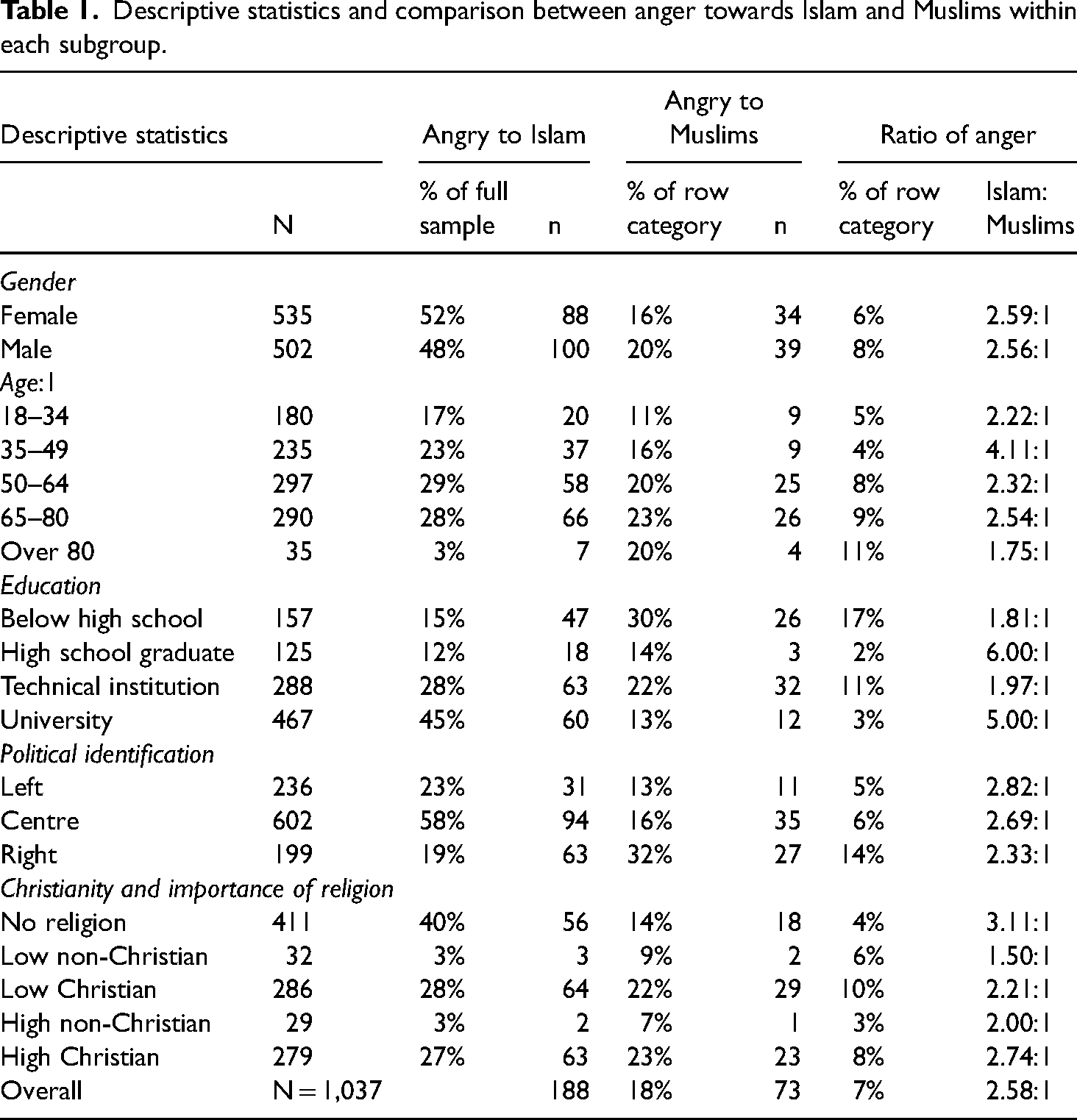
Participants rated their levels of anger towards the religion of Islam using feeling-thermometer measures where 1 indicated a low level, 4 neutrality, and 7 the highest level of that feeling. Participants also rated their levels of anger towards Muslims, as distinct from the religion itself. These measures were then each recoded into dichotomous measures where 1 indicated a level of anger that was higher than neutral (between 5 and 7). Of the sample, 18.13% indicated a level of anger towards Islam that was higher than neutral, while 7.04% were angry with Muslims (see Table 1), meaning 2.5 times more respondents were angry with the religion than its adherents. However, when each category of each explanatory variable is considered independently, that ratio ranges from 1.5:1 through to 6.0:1 for different groups within the sample, indicating variability in anger by group.
Descriptive statistics and comparison between anger towards Islam and Muslims within each subgroup.
Explanatory variables
Questions about the key demographics of gender, age, employment status, education, and religious and political affiliations were included in the survey. Responses were categorised according to previous theory and findings while using data exploration as a guide for where borders between categories should lie. Bivariate analysis of each with anger towards Islam and anger towards Muslims revealed very few statistical associations, all of which had effect sizes categorised as weak or very weak. 4 Participants were most likely to be female (52%), aged 50–64 (29%), university-educated (45%), Christian (55%, around half of whom placed high importance on their religion), and identified with the political centre (58%) (see Table 1).
Excluded participants
Most participants (45 out of 59) who were excluded from the analysis returned no response on the question of placement on the political spectrum. It is unclear whether this is because those participants were unwilling to respond or simply were not sure. Other exclusions were based on non-response to the key question of anger, or the importance of religion in their lives, and participants who reported a non-binary gender (of which there were only three). The excluded participants were twice as likely to be women as men, and twice as likely to report speaking a language other than English at home. However, where it was possible to compare, the excluded participants were not statistically different from the included participants on the key variable of anger towards Islam or Muslims, or any other variables of interest in this study.
Analytical approach
The CACC methodology will be applied in order to address both research questions regarding the clustering of demographic and personal characteristics within the Australian population, and the causal recipes associated with anger towards Islam and Muslims. Limitations of the methodology for our sample size mean that it is not possible to include every demographic and personal characteristic in one analysis. However, our purpose of describing the different combinations of characteristics that most commonly predict anger means that CACC is an appropriate methodology.
When the characteristics of the sample are considered together, there are 600 possible typologies of individuals within the sample. This number is reached by multiplying together the number of categories within each variable (i.e. 5 [age] × 2 [gender] × 4 [education] × 3 [political affiliation] × 5 [Christianity and importance of religion] = 600; see Miethe et al., 2008).
To identify the individual typologies present in the data, CACC first counts the number of survey participants in the sample who share each combination of factors. Then, the proportion of those within each typology who are angry towards first Islam as a religion and then Muslim people is calculated. The definition of a single case in the data changes from an individual who is either angry or not to a representative typology which has a proportion of angry individuals. In this way, not only are typologies that do not exist excluded from our analysis, but any oversampling of older and university-educated Australians, as is common in survey research due to response bias, is negated by the reduction of their influence on predictions.
Then, only dominant profiles will be used to describe the causal recipes for anger. With reference to minimum frequency rules suggested in Miethe and Regoeczi (2004), only those typologies which occur a minimum of five times in the sample will be included as dominant. 5 This decision rule is applied to limit the influence of participants in the survey who appear to occur rarely in Australian society on our predictions of groups more likely to be experiencing anger (and therefore more likely to act on that anger). Analyses utilise STATA v.15.1, with syntax updated and streamlined from the original CACC syntax provided in Miethe et al. (2008; updated syntax provided in Appendix).
Results
RQ1 Do the personal and demographic characteristics measured in studies of Islamophobia and Muslimophobia cluster disproportionately among Australian survey participants?
While there are 600 possible typologies of participants when considering the categories of our explanatory variables, only 284 of those typologies are seen within the sample. This means that only 47% of possible combinations of these characteristics actually appear within the representative sample of Australian adults, confirming our supposition that there is much less variability in combinations of characteristics than traditional statistical methods allow for. The number of survey respondents in each typology ranges from 1 to 18.
Of the 284 combinations of variables present in the sample, 75 of those (13% of all possible typologies) are counted a minimum of 5 times, accounting for almost two-thirds of the overall sample and confirming clustering of characteristics in particular typologies. No non-Christian typologies were large enough to be included as dominant configurations; however, very few respondents who identified as non-Christian but religious expressed anger, and so their exclusion does not affect our description of the most angry in Australian society.
RQ2 What are the causal recipes for anger towards Islam and Muslims among Australians?
In order to determine which of these commonly occurring typologies are most likely to be angry towards Islam and Muslims, we follow Hart and Miethe (2011) in defining uncommonly high probabilities of anger in a typology as more than 10% greater than the overall proportion in the sample. As such, typologies with a probability of anger towards Islam of 0.28 or higher (10% more than the overall proportion of respondents expressing anger of 18%) and of anger towards Muslims of 0.17 or higher (10% more than 7%) are defined as angry.
Table 2 displays the 20 dominant typologies within the data where the proportion of anger towards Islam is 0.28 or higher. Half of those typologies also record a proportion of anger towards Muslims of 0.17 or higher. Above-average anger towards Islam is mostly associated with education at technical institutions or below high school level, predominantly with Christianity, and almost exclusively the centre or right of politics. Only two of these angry typologies were of respondents aged under 50, and both reported having no religion and identifying with the centre of politics. While these typologies differed in gender and age, both also reported education levels of technical rather than academic focus. These two causal recipes resulted in almost identical levels of anger towards both Islam and Muslims. Fewer angry typologies involved men than women, and anger among the university-educated was seen exclusively among older Australians.
Anger towards Islam and Muslims (typologies with proportion of anger towards Islam greater than 0.27).
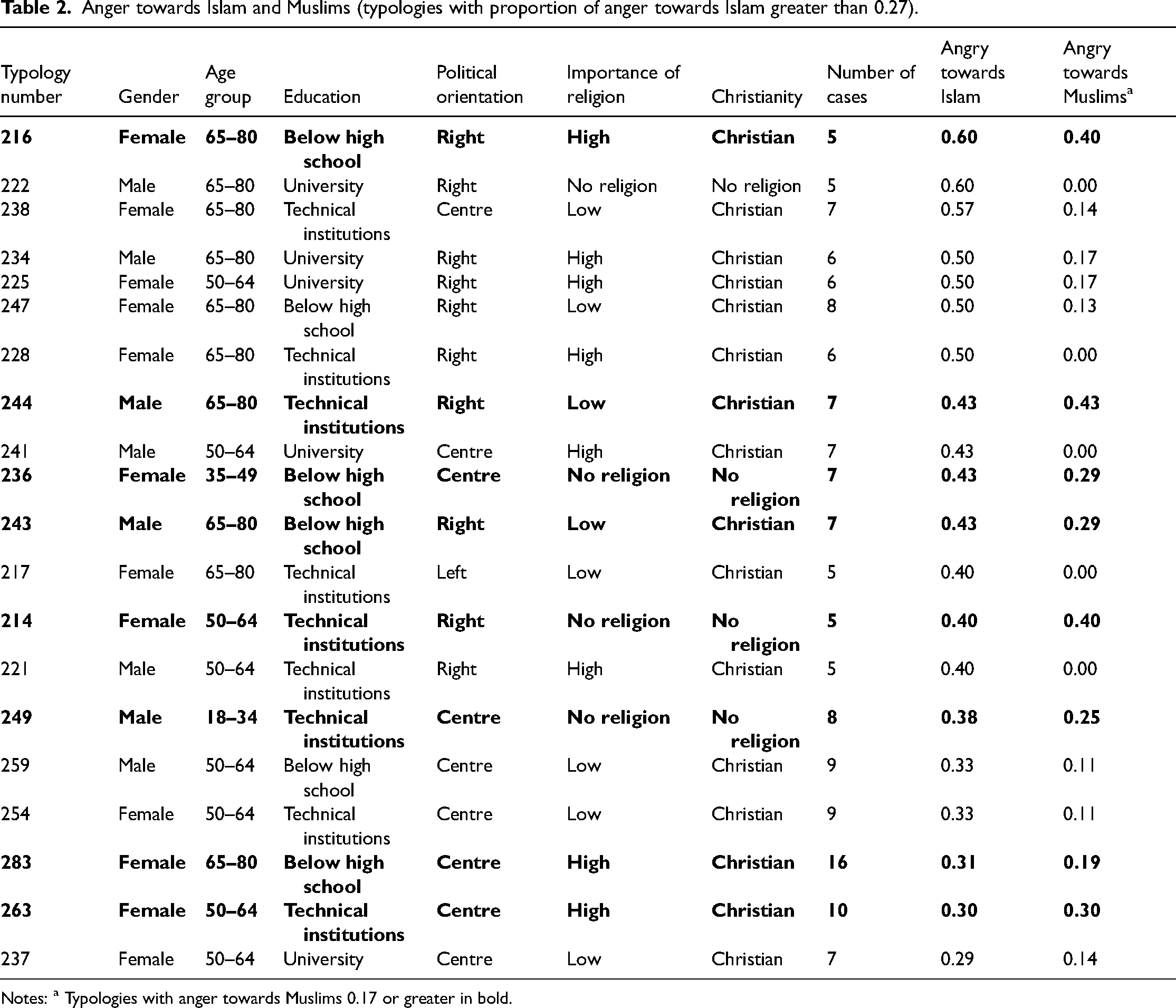
Notes: a Typologies with anger towards Muslims 0.17 or greater in bold.
The 11 typologies with levels of anger towards Muslims that were 10% higher than the norm (Table 3) all reached a level of education which was either below high school diploma or achieved at technical institutions. Those who were below high school were almost all aged between 65 and 80, and 5 of the 11 typologies were both aged between 65 and 80 and Christian. Overall, 8 of the typologies most angry with Muslims were Christian. Of particular interest is typology number 235, where females aged 18–34, educated at technical institutions, who self-identified as being from the centre of politics and as placing low importance on their Christian religion were twice as angry with Muslims as they were with Islam, and more than four times as angry with Muslims than the average. Males from the same age group, education, and political orientation (but with no religious adherence, typology number 38) were similarly angry with Muslims, and also well above average in their anger towards Islam. While 18–34-year-olds appeared generally to have the lowest levels of anger (see Table 1), these two typologies scored highly, and therefore their combination of education and politics should be of note to policy and security decision-makers.
Anger towards Islam and Muslims (typologies with proportion of anger towards Muslims greater than 0.17).
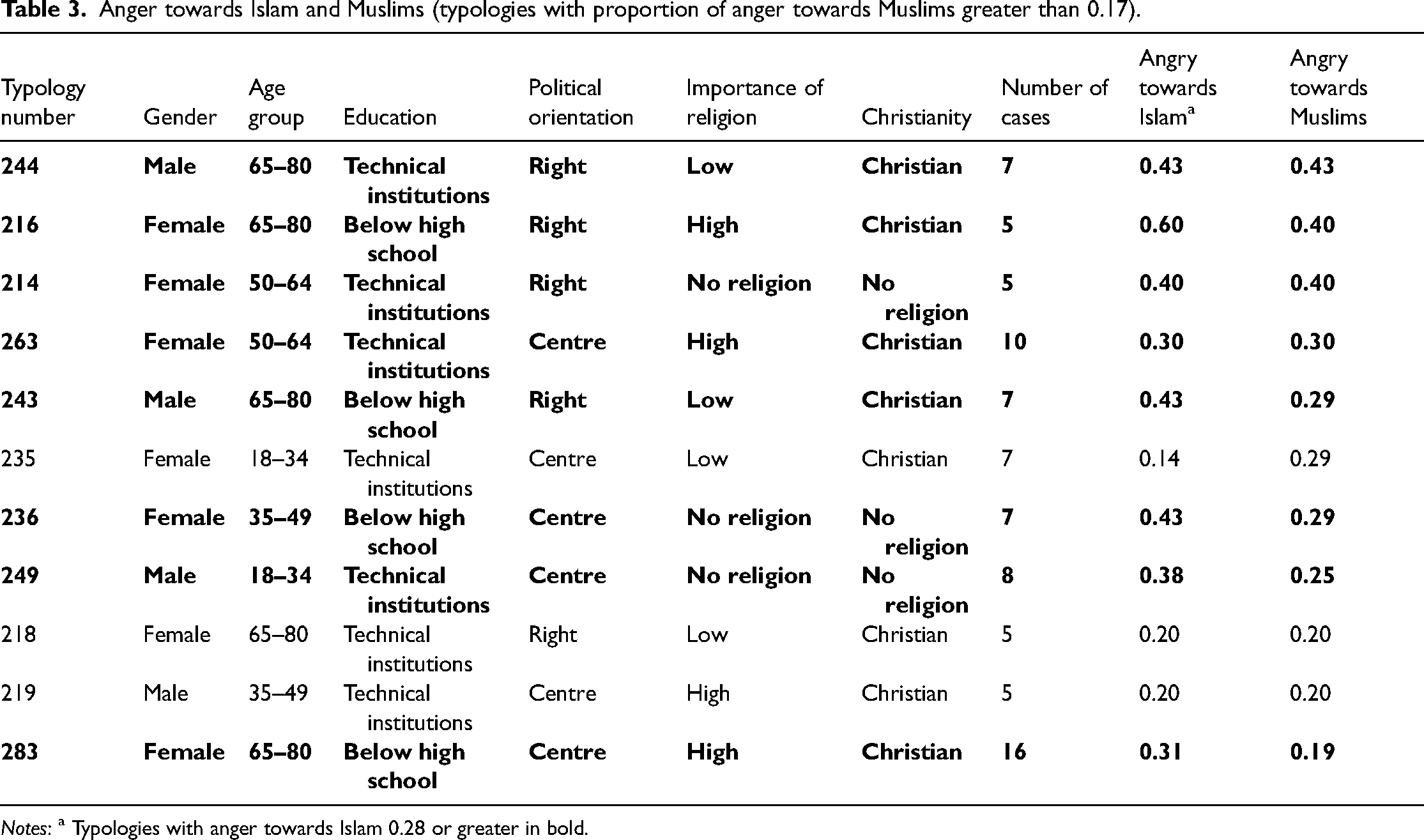
Notes: a Typologies with anger towards Islam 0.28 or greater in bold.
Discussion and conclusion
We examined a representative sample of non-Muslims Australians’ levels of anger towards Islam and Muslims. We explored two ideas separately: whether the causal recipes differ in relation to anger towards the religion; and whether those recipes were different in relation to anger towards Muslims. With a few exceptions, people are generally less angry towards Muslims than they are towards Islam.
Level of education continues to be a key determinant of attitudes towards Islam and Muslims in our sample. However, recent attempts to examine the causal relationship between education level and out-group prejudice have not been able to establish one; instead, Weber (2022) concludes that out-group views may be set before the age of 15, the beginning of his longitudinal study. Our sample of Australians illustrates the powerful link between age and education level in Australian society, where opportunity to both complete secondary school and enter higher education has expanded dramatically since the 1970s: only 2.5% of the sample under 35 reported their highest level of education as below high school level, and more than half of respondents under 50 had completed university. In addition, 38% of the high school completion group were aged under 35, suggesting that many may be in the process of obtaining a university qualification. In our dominant profiles, those with university education are only angry if they are older than 50, an indication of the clear interdependence of these variables when examining views on Islam and Muslims. The predominance of older and non-university-educated Australians in the causal recipes for anger towards both Islam and Muslims, along with the interdependence of those variables within Australian society and evidence of a non-causal relationship between education and prejudice, suggests that age is the factor of most interest: as noted by Dunn et al. (2021), a positive sign for the future of out-group acceptance. However, regardless of whether increasing the level of education reduces someone's likelihood of being angry or unfavourable towards out-groups, or whether that out-group attitude is somehow set among other factors that instead predict level of education, the evidence remains that the causal recipes for above-average anger with Muslims among Australians in our study all include education levels below high school or at technical institutions, which may be of use to policy-makers.
Contradicting some previous findings (Helbling & Traunmuller, 2020; Shaver et al., 2016), Christianity is a clear marker of above-average anger towards both Islam and Muslims in our study, and the importance the respondent placed on their religion does not seem to be influential. This does not support suppositions about general discomfort with religion in cultures such as Australia resulting in dislike, anger or prejudice against all religious people, rather than just Muslims. If this supposition were true, we would expect more empathy and therefore less anger from Christians who place high importance on their religion, and less anger from Christians than Australians who claim no religion. Instead, only 4 out of 20 typologies most angry towards Islam and 3 out of 11 most angry towards Muslims were not Christian, with the causal recipes for anger among Christians distributed evenly between those who place low and high importance on their religion. Further research is needed to unpack the reasons for Christian anger with Islam and Muslims in Australia; meanwhile, very few survey participants who followed a non-Christian religion expressed any anger towards Muslims or Islam, lending support to Dunn et al.’s (2021) discussion of the connection of Christian privilege with Islamophobia.
Only one causal recipe for above-average anger towards Islam or Muslims contained a left-leaning political identification, with identification with the right or centre of politics in Australia almost a necessary condition for anger. Given the political rhetoric and positioning discussed earlier (Forrest et al., 2020; Reid, 2019), and research findings that describe how people's attitudes towards out-groups are not only solidified and emboldened when they feel they are part of an in-group, but also predictive of anger and willingness to take offensive action (Mackie et al., 2000), political orientation may be the most useful identifying factor and policy target for Australians who wish to promote unity and avoid conflict. People's levels of anger towards Muslims are important because they both influence policy and affect public debates about the presence of specific groups and the extent to which those groups belong in particular societies. Anger levels and associated actions create or contribute to social division and may influence the behaviour of individuals towards out-group members. As suggested by Dunn et al. (2021, p. 556), efforts in relation to Islamophobes are best directed at containment, which they suggest will ‘be more easily progressed if their views are constructed as deviant and as a threat to public order, and this will be better progressed where any suggestion of non-formal political action (e.g. extremism, violence, prejudiced state acts, etc.) is roundly condemned by civil society’. Further research into how both media consumption and political discourse contribute to the perception of right- and centre-aligned Australians that they are part of an in-group where anger towards the out-group of Muslims is accepted is needed to improve policy-makers’ ability to target efforts to reduce anger.
Two groups stood out in relation to their anger levels towards Muslims and Islam. Women in the 18–34-year age group with a technical institution education, who were at the centre politically and, while Christian, placed low importance on that, were twice as angry with Muslims as with Islam. Overall, this group was four times as angry with Muslims than the average survey participant. The second noteworthy group were 18–34-year-old males with a technical institution education level, who were politically at the centre, but with no religion. This group was also angry at Muslims and well above average in their anger towards Islam. Aside from these two typologies, in the groups aged 18–34 years, anger was at its lowest. The aforementioned angry groups will be of interest to policy-makers and those charged with dealing with groups who express significant levels of anger towards Islam or Muslims.
Our findings will be of interest to a range of groups, including those working in the social inclusion space and those who monitor groups whose anger may spill into action. Anger is an indicator of an inclination to take action, and to engage in anti-social behaviour, against the group that is the focus of the anger (Mackie et al., 2000). The causal recipes for anger identified here will be useful for organisations involved in countering anti-Muslim and anti-Islam sentiments, in particular for identifying specific groups that may be motivated to act against Muslims. It is as yet unclear whether anger towards Islam or Muslims is more likely to result in that action, and future research is required to tease out the policy implications of differences in levels of Islamophobia and Muslimophobia in Australia.
We know from a previous study (Ewart et al., 2022) that non-Muslim Australians hold higher degrees of unfavourability towards Islam than they do towards Muslims. Our finding that Australians are more angry with the religion, that is Islam as a faith with its religious practices, than with its adherents supports that earlier finding, with half of the causal recipes for high levels of anger towards Islam simultaneously resulting in no or low anger with Muslims, and generally lower levels of anger with Muslims in our sample. Given our findings linking higher levels of anger with older, less educated people, who are politically centre and right, and Christians, the efforts of those trying to counter anti-Muslim or anti-Islam sentiment would be best targeted towards specific types of non-Muslim Australians. In addition, those researching non-Muslims’ attitudes towards Muslims should separate, rather than conflate, the categories of Muslims and Islam, because this informs us about whether it is the religion or its adherents that bear the brunt of negative attitudes. This is important both in addressing those attitudes and identifying the highest risk to Muslim Australians’ safety and wellbeing.
Footnotes
Acknowledgements
We would like to thank Dr Kate O’Donnell, adjunct member of the Griffith Criminology Institute, for her contributions to the design and development of the survey in her role as Principal Research Fellow on the Reporting Islam project. Thanks also to Dr Timothy Hart from the University of Tampa for his generosity in assisting with methodological concerns, and Griffith University's School of Humanities, Languages and Social Sciences for funding to assist with the completion of this article. The Reporting Islam project and the 2018 survey associated with this article were funded by the Commonwealth of Australia.
Declaration of conflicting interests
The author(s) declared no potential conflicts of interest with respect to the research, authorship, and/or publication of this article.
Funding
The author(s) disclosed receipt of the following financial support for the research, authorship, and/or publication of this article: This work was supported by the Commonwealth of Australia.

Notes
Author biographies
Shannon Walding is a research fellow in the Griffith Criminology Institute in Brisbane, Australia.
Jacqui Ewart is a member of the Griffith Criminology Institute. Her research focuses on news media representations and public perceptions of Muslims and Islam and communication about disasters. She was the co-chief Investigator on the Reporting Islam project 2014–2016 and chief investigator from mid 2016 to 2018.
Appendix 1
Updated STATA Syntax for Generating Conjunctive Data Matrix
Following Miethe et al. (2008), ABCD = categorical independent variables and Y1, Y2, Y … = categorical dependent variables.
bysort A B C D: gen N_Cases=_N
by A B C D: egen count_Y1=total(Y1)
gen Y1_MEAN=count_Y1/N_Cases
by A B C D: egen count_Y2=total(Y2)
gen Y2_MEAN=count_Y2/N_Cases
bysort A B C D: keep if _n==1