




Abstract
Masculinity studies has been slow to explore trans men's lives including how trans masculine embodiments are represented in the media. In this article, we examine how the masculinities of trans men are represented in the context of sport through two issues of two print magazines specifically targeting trans men audiences: The Jock Issue of Original Plumbing and The Sport Issue of FTM Magazine. Through combining body-reflexive practices and gender as a social structure in our trans gaze framework, our multimodal critical discourse analysis reveals that trans masculinity is presented as hegemonic, diverse, reflexive and subordinated within the micro, meso and macro levels of social life. As trans people continue to experience social marginalisation that adversely impacts on their health and wellbeing, how they are represented within the media – particularly by those media specifically targeted towards them – is important to examine and recognise.
Keywords
Introduction
Trans is a contemporary reference to gender variance, which may describe someone whose assigned gender at birth does not reflect their gender identity. 1 However, a broader understanding of trans avoids precise definitions or exclusions based on a gender binary (Halberstam, 2018) and acknowledges a range of gender identities that challenge normative social expectations that simplistically align sex, gender, and the body (Cromwell, 1999). Trans may include people who identify as transsexual, transgender, genderqueer, gender fluid, non-binary, and other identities that challenge the sex/gender binary.
For some trans people, transitioning their body is important to affirm their gender identity and may include gender reassignment surgery, hormone replacement therapy, or modifications to physical appearance including clothing (Nagoshi & Brzuzy, 2010). Transitioning – which may be an ongoing and indefinite process – involves consciously formulating and deploying gender choices that shape a person's identity and embodiment, and may not have ‘a destination, a final form, a specific shape, or an established configuration of desire and identity’ (Halberstam, 2018, p. 4). For trans men (the focus of our article), an intentionally embodied masculinity has the potential to reveal how gender is a material and lived social (and personal) experience, one that can be overlooked or taken for granted by cisgender men (those whose gender assigned at birth reflects their gender identity).
While the research on trans masculinities has been growing (see Abelson & Kade, 2020), historically this has relied heavily on contributions from Prosser (1998), Cromwell (1999), Devor (1997), Green (2005), and Rubin (1998, 2003). Furthermore, critical studies on men and masculinities (CSMM) have been slow to explore the perspectives of trans men due to ‘a cisgender and biologically essentialist bias’ (Abelson & Kade, 2020, p. 165) (Aboim, 2016; Aboim & Vasconcelos, 2021). Aboim comments that: trans-men have been seen as if located in a ‘no man's land’. They seem neither relevant for transgressing the boundaries of male privilege and changing the order of masculine domination, nor important enough to assess the trappings of that same privilege or dividend. On the other hand, trans-men have also received less attention from the part of Trans Studies when compared to their female counterparts, which have gained far more visibility. (Aboim, 2016, p. 226)
When considering cisgender men's magazines (including those with ‘soft’ heterosexual pornographic content), researchers have concentrated on those with high circulation and sales such as Men's Health. Lewington et al. (2018), Boni (2002) and Crawshaw (2007) respectively found that in Australian, Italian and United Kingdom editions of Men's Health, hegemonic masculinity continues to be promoted including or within a framework of self-care and self-responsibility. As noted by Crawshaw (2007, p. 1608), Men's Health presents ‘Men and man … as unproblematic, universal and ontologically stable categories’. In comparison, analyses of magazines targeted towards gay men outline how they objectify and sexualise the body with a focus on ideal masculine appearance and lifestyle (Jankowski et al., 2014; Saucier & Caron, 2008), which can have an adverse impact on men's body image (Jankowski et al., 2014).
Contrastingly, there has been almost no research into magazines specifically for trans men. To the best of our knowledge, the only previous research into how masculinity is represented in trans men's magazines has been by Arcurio (2013) and Yuen (2018). In their Master's thesis, Arcurio (2013) examines Frock (a magazine for and about trans women) and Original Plumbing (a magazine for and about trans men) to uncover how trans identity and culture are created through visual semiotics. Arcurio reveals unique and diverse identities, cultures, and experiences in these magazines that go beyond and challenge the gender binary. In contrast, Yuen (2018, p. 185) notes that the Japanese biannual magazine Laph (a magazine for and about trans men) reproduces hegemonic masculinity that replicates postwar Japanese society with ‘notions of heterosexuality, work [such as the salaryman], and a gender normative masculine embodiment’.
In this article, we contribute to deepening current knowledge of how trans men and trans masculinity are represented in trans men magazines. Importantly, such representations can influence and impact how trans men may understand and experience their masculinity, including what constitutes ‘acceptable’ trans masculinities within trans communities. Trans magazines are important for giving trans men visibility, which can potentially provide a counter narrative to the reductive negative stereotypes of trans people that continue in mass media (Hughto et al., 2021). Our focus is placed on two special issues focusing on sport and athleticism from two trans men magazines: Original Plumbing (2012) and FTM Magazine (2019). To undertake our examination, we draw on multimodal critical discourse analysis (MCDA), Connell’s (2005) concept of body-reflexive practices (BRPs), and Risman's (2004, 2018) concept of gender as a social structure (GSS). By combining BRPs and GSS, the recursive relationship between gender embodiment and the gender cultural and material processes that span the micro, meso and macro levels of the social structure can be considered, whereby masculine embodiment is identified as existing in the constraints and affordances of individual agency and wider social structures.
Before we proceed further, we declare that as researchers and individuals, we come to this topic in celebration of diversity, as active advocates for social inclusion, equality and equity, and as members of our university's Ally Network of which the second author, Peta Cook, was a founding member. In our personal lives, we have experienced identity-based discrimination. We believe that identity-based discrimination in all its forms is unacceptable.
Trans masculinity
CSMM has been slow to focus specifically on trans masculinity and trans men. This has occurred in part due to the historical marginalisation of trans persons (particularly trans men), and the conflation of maleness and masculinity (Jones et al., 2015). Scholarship specifically focusing on the sociocultural configurations impacting on trans men and their lived experiences did not appear until the late 20th century. Prosser (1998), Cromwell (1999), Devor (1997), Green (2005), and Rubin (1998, 2003) have produced some of the most cited research that has helped to challenge the pathologising and medicalisation of trans men. These works highlight the flexible and multiple embodiments of masculinity, and challenge the rigidity of the socially sanctioned two- gender binary model. For example, by interviewing trans men and their partners, Cromwell (1999) uncovered trans men to be strategic managers of the incongruities of their lives. They and their intimate partners queer the normative binaries of what it is to be masculine or to be a man: Prior to his [my partner] having surgery I had no problem with him having breasts. After surgery I realized that I had a veil in my mind, it acted as a filter. After surgery the filter was no longer necessary. His chest was now in reality what it had always been in my head. (Kristen in Cromwell, 1999, p. 130)
The above cited studies, however, present a theoretical disconnection between trans theory and masculinity studies, which reflects a ‘problematic approach to the unmarked category of cisgendered masculinity’ (Gottzén & Straube, 2016, p. 219). Without further expansion of masculinity studies, the plurality and flexibility of masculine embodiment as a social phenomenon is rendered invisible, including those of non-sexed, gender non-conforming men (Green, 2005).
Halberstam’s (1998) seminal work has been instrumental in CSMM by examining female masculinity through the divergent figures of lesbian ‘inverts’ such as tomboys, dykes and drag kings. Drawing from post-structuralist and queer perspectives, Halberstam (1998) treats the body as a site for identification and demonstrates that the deployment of masculinity can produce a range of masculine expressions. This destabilisation of the ‘natural’ relationship between maleness and masculinity expands the possibilities of how masculinities are produced and reproduced. In this light, Halberstam (1998, p. 276) postulates that: ‘The question, then, might be not what do female masculinities borrow from male masculinities, but rather what do men borrow from butches?’ We further ponder on what cis masculinities borrow from trans masculinities – cis men are not the only people (or bodies) that are masculine and experience masculinity.
For trans men, their masculinity involves strategic navigation of sociocultural obstacles, constraints, and affordances. Trans men demonstrate that masculinity is at its most complex and transformative when it is detached from the restrictive male/masculine conflation that exists in the sociocultural imaginary. There are multiple ways of embodying, enacting, becoming, and ‘doing’ maleness and masculinity.
Nevertheless, it must be understood that gender expression and embodiment operate as an interface of human interactions and play a significant role in organising social life. While sex is not a determinant of gender, it is always evaluated in reference to the body (Mason et al., 2018, p. 95). Marked by historical associations of the male body, masculinity is a symbolic social practice connected to the position of men (Connell, 2005, p. 41). As Aboim (2016) and Aboim and Vasconcelos (2021) have found in their research, the majority of trans men have desires to masculinise their body and be masculine or a man. To be seen as such, and to live as a man, is a part of the transition process and a significant part of a trans man's personal and social identity, and can involve experiencing and embodying plural and fluid masculinities. 2
Gender embodiment – framework
Queer theory was initially chosen as a theoretical framework as it emphasises the socially constructed aspects of social life, and posits that the self is created through individual and collective experiences (Browne & Nash, 2010). This lends to revealing (and unravelling) the taken-for-grantedness of heteronormativity, the hegemonic binary of sex and gender, and social norms that prescribe values, performances and regulations to gender (or gender normativity) (Browne & Nash, 2010). However, by focusing on the constructed aspects of people's lives, queer theory tends to overlook the social and personal significance of the body (Jones et al., 2015).
To mitigate this, trans theory proposes self-narratives, bodily knowledge, and intersecting identities for conceptualising gender embodiment (Nagoshi & Brzuzy, 2010). For our analysis, we respond by including Connell’s (2005) concept of body-reflexive practices (BRPs) into our theoretical framework as it focuses on the body as a subject (agent) and object (symbol), which is shaped by and shapes the social world. Connell states that BRPs: involve social relations and symbolism; they may well involve large-scale institutions. Particular versions of masculinity are constituted in their circuits as meaningful bodies and embodied meanings. Through body-reflexive practices, more than individual lives are formed: a social world is formed. (Connell, 2005, p. 64)
By placing an emphasis on the body working in intra- and inter-action with wider social processes, the concept of BRPs reveals that the body is interwoven with agency, mind, sensory experiences and the influence of social constructions and institutions, to produce individual and social realities. This also links with Connell’s (2005, p. 74) framing of gender as a structuring social practice that produces the ‘gender order’ of power relations (authority, control, and coercion), production relations (the division of labour), and cathexis (emotion and desire) (Connell, 2005, p. 74).
Connell's understanding of the gender order resembles Risman's (2004, 2018) concept of GSS. GSS recognises the reflexivity of gender relations involving interactions between individuals, social structure, and culture, and the distribution of cultural and material resources. Therefore, GSS seeks to examine gender stratification across the individual (micro), interactional (meso) and institutional (macro) levels of society. Change at any of these levels will impact on the other levels (Risman, 2018, 2004). For example, heteronormative gender expectations can be woven into the institutional rules and regulations of sport (macro), which has implications for individuals and their self-identity (micro) and how people interact and form relationships (meso). Therefore, GSS recognises gender as being more than an individual identity and as core to the organisation of the social system. GSS brings ‘gender to the same analytic plane as politics and economics’ (Risman, 2004, p. 431), while also acknowledging the recursive relationship between individuals and the social structure: individuals can exercise agency and reject the dominant gender constraints.
By combining BRPs (Connell, 2005) with GSS (Risman, 2004, 2018), we have created a trans gaze framework. This allows us to consider how understandings and experiences of the (gender) body are enmeshed and entwined with power, production, and cathexis, and structured by the micro, meso, and macro. It is on these foundations that we consider how trans men and trans masculinity are framed in selected media.
Method
To analyse how trans masculinity is represented in trans men's print magazines, MCDA was selected to tease out the micro, meso and macro tiers of linguistic and visual texts as influenced by our trans gaze framework. Drawing on systematic functional linguistics (SFL) (Halliday, 1978, 1985) and critical discourse analysis (Fairclough, 1995, 2003), MCDA reveals how texts (micro), discursive practices (meso) and social practices (macro) are intertwined with language, images, diagrams, and graphics to create meaning (Machin & Mayr, 2012). As such, MCDA enables the critical deconstruction, analysis, and interpretation of the meaning of visual images and text (Kress & Van Leeuwen, 1996).
The sample was drawn from the only two print magazines that, in 2019, had International Standard Serial Numbers (ISSNs) and whose primary audience is trans men: Original Plumbing and FTM Magazine. 3 Print magazines remain an important part of the media in contemporary society and can help to reinforce or challenge cultural values, including who is categorised as ‘other’ (Fairclough, 1995). These magazines, which were produced in the United States, each created an issue on a similar topic – sport and athleticism – as seen in The Sport Issue (FTM Magazine, 2019) and The Jock Issue (Original Plumbing, 2012). These two issues are the focus of our analysis. These issues were selected as sport is a deeply gendered institution that is synonymous with symbolic idealisations of masculinity and in opposition to femininity. Sport is a site to impress, celebrate, and replicate hegemonic heterosexual (hyper)masculinity as underscored by bodily strength, muscularity, and athletic prowess (Connell, 2005). In addition, arising from sporting identity, ‘jock’ is a term that refers to an individual who is strongly invested in and engaged with sports. Often synonymous with the ‘athlete identity’, ‘jock’ is associated with muscularity, egotism, and conformity to negative masculine norms such as sexism and aggression (Delaney & Madigan, 2015). Given how deeply masculinised ‘sport’ and ‘jock’ are historically, it is interesting to examine how these relate to the framing and narration of trans masculinity in trans men magazines.
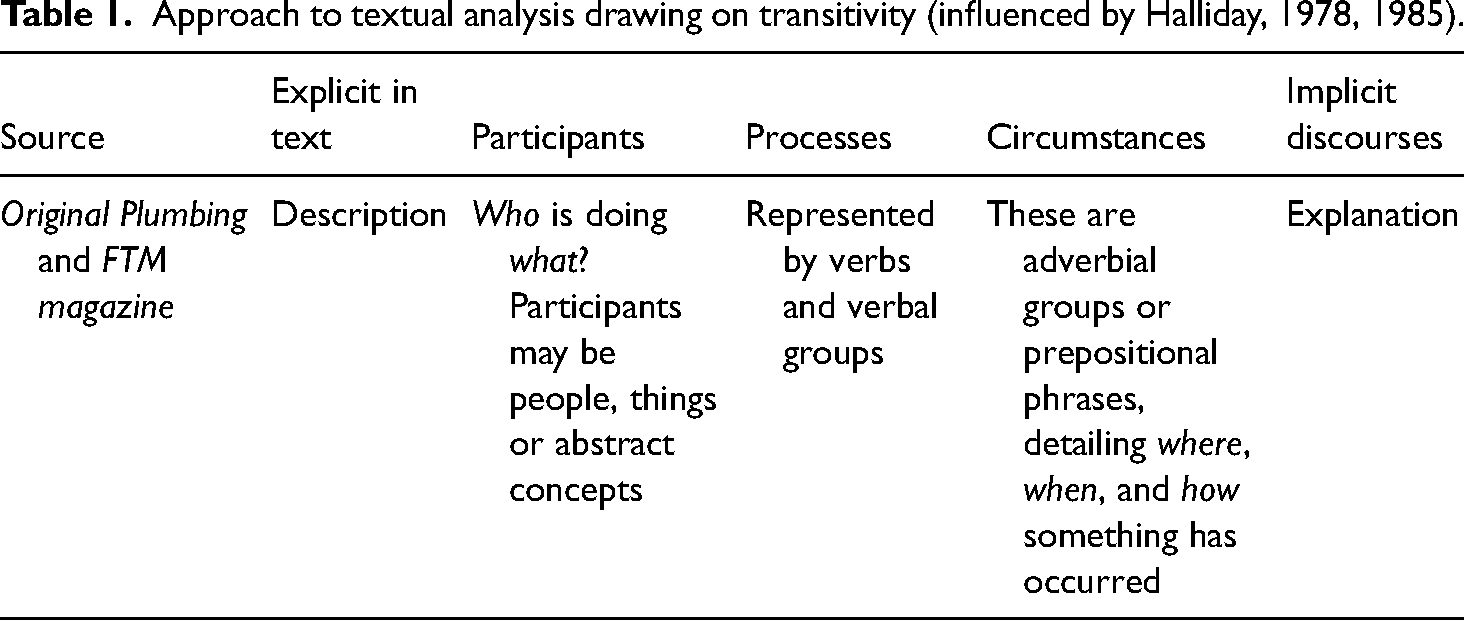
To analyse these two magazine issues, the MCDA analysis focused on the written and visual texts therein (which we refer to collectively as ‘texts’). As guided by Green et al. (2007), a four-step procedure of thematic analysis was followed. This involved data immersion (thoroughly reading and re-reading the texts); coding; creating categories; and finally identifying themes. During this process, texts were also subjected to the SFL system of transitivity (Halliday, 1978, 1985), which understands language as a system of interlocking options where meaning is represented in clauses. This includes examining who does what to whom, how and why (Nguyen, 2012, p. 87), as detailed in Table 1. Additionally, the pairing of written and visual texts was considered. Images in the magazine issues were categorised as cover; personality photography; or group photography, while written texts were sorted as personal stories; interviews; articles; and news reports. 4 In this article, we have provided one visual text where permission for reproduction from the copyright owner was granted. Where the copyright owner could not be identified, we have described or drawn a representation of the image instead.
Approach to textual analysis drawing on transitivity (influenced by Halliday, 1978, 1985).
From this process, three overarching themes were identified: Regulation of the trans masculine body, Trans masculine body in community, and Creating trans masculinity. Embedded within these themes were distinct and often uneven power arrangements between trans men, their immediate relationships, and wider social institutions. The relationship between our trans gaze framework and MCDA are visually represented in Figure 1. Under each theme in Figure 1, we have noted the features of GSS (Risman, 2004, 2018) that relate to macro, meso, and micro levels. This has allowed us to demonstrate the diversity in how trans masculinity is represented across the macro, meso and micro levels of social organisation, including how the trans body is a site for conflict and negotiation.
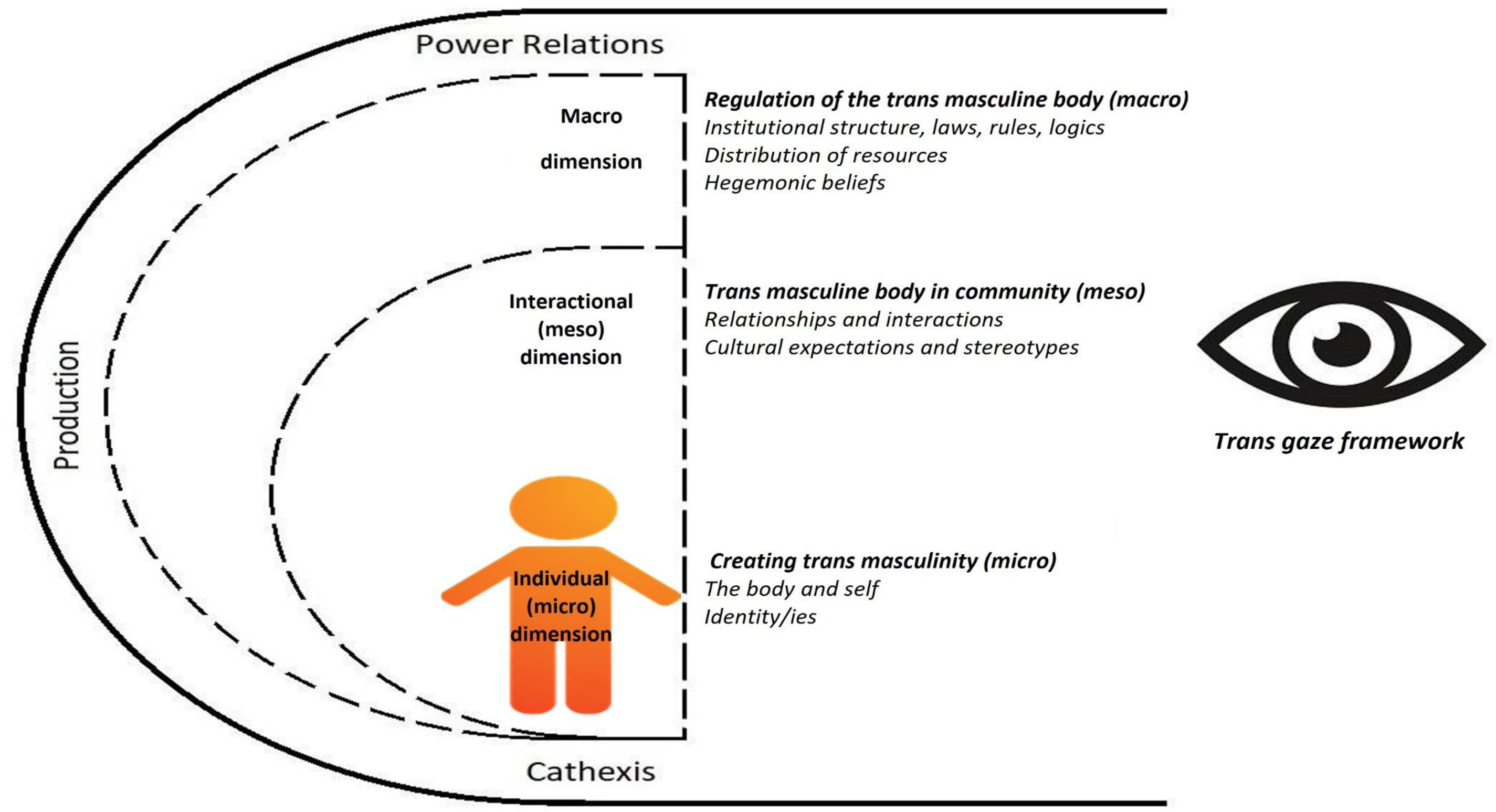
Our trans gaze framework incorporating Connell’s (2005) body reflexive practices, Risman's (2004, 2018) gender as a social structure, and MCDA.
Representing the masculine trans body
Regulation of the trans masculine body
Connecting to our trans gaze framework, Regulation of the trans masculine body occurs at the macro level. This theme is concerned with institutional rationalities and rules (such as the regulating forces of government and their ‘regimes of truth’, Foucault, 1980), how resources are distributed, and connections to hegemonic belief systems (Risman, 2018). Texts that fall into this theme include news reports, personal stories and interviews that focus on restrictions imposed on individuals by social institutions.
As the activity of sport is organised through the rigid, binary hegemonic systems of the sexed body (Krane, 2018), the MCDA revealed that trans people are controlled by sporting regulatory bodies, the state, and (typically hegemonic) gender expectations. In both magazine issues (FTM Magazine, 2019; Original Plumbing, 2012), the trans body is represented as being socially subordinate to institutions, with the ability of trans people to fully exercise and realise their embodiment being dependent upon the external and controlling forces of society. As such, their body is presented as being managed through normalisation, standardisation, and biopower – the institutional and regulatory systems that discipline and subjugate populations to make them useful and docile (Foucault, 1977). As an example, the following report explicitly presents the trans masculine body as controlled and excluded, revealing how social institutions regulate and normalise body type, and subordinate and marginalise trans people and their bodies: The Pentagon has used a rhetorical sleight of hand to insist the new policy doesn't actually ban transgender people, arguing service members can simply pretend they’re not and serve as their birth sex.
But it is certainly a ban.
After prevailing in four court battles, at least for now, the Pentagon released a directive in March to prohibit service members who appear transgender or act transgender by failing to meet grooming, uniform, and other military standards for their birth sex. It also bans people from enlisting in the armed forces if they have transitioned from their ‘biological sex’ to another gender. (FTM Magazine, 2019, p. 15, original formatting)
This report presents the hierarchical and rigid relationship between the administrative powers of the Pentagon (institutional rules and regulations) and transgender military members. The Pentagon symbolically conveys authority to direct and control, while transgender service members are generically identified as divergent and problematic, and subject-objects to be controlled, suppressed, and excluded. In our trans gaze framework, this relates to power relations at the macro level.
The United States military is a powerful institution. It is a social institution traditionally recognised as a male preserve (Dunning 1986), a closed social system with its own norms and regulations (Caforio & Nuciari, 2018) that replicates traditional hegemonic and hierarchical beliefs. This disciplinary power is witnessed through the coercive regulation and prohibition of the transgender body, which operates as an exercise of biopower that discriminates between valued and non-valued bodies. For example, the United States military as an institution – and as presented in this report – essentialises sex and gender expression through gender standards of grooming that reinforce masculinity and femininity as innately linked to the sexed body. Further, by suggesting that transgender individuals may serve only if they abstain from transition, self-determination is disregarded while also highlighting the military's preference for ‘normal’ cisgender bodies. This text therefore communicates that belonging in the United States military is conditional on body type. Similar themes are covered in other stories reporting on, for example, sports body policies on testosterone levels in intersex women (FTM Magazine, 2019, pp. 19–20).
The accompanying stock-library photograph illustrates military personnel in camouflage uniforms with their backs turned and walking away from the viewer into a cargo aircraft where, upon entry, they pass under the flag of the United States of America. The facelessness and anonymity of the military personnel presents a homogenised, collective group that is following, in mass, the institutional rules. Together, they visually symbolise authority, conformity, self-control, and communal power (Van Leeuwen, 2005, p. 55). In addition, the visual of the military personnel walking away from the viewer along with the accompanying written text are indicative to the trans reader that they marginalised from this social institution – it has ‘turned its back on them’.
The United States military is one social institution mentioned in these magazines along with others, including the legal system (FTM Magazine, 2019) and – of course – sport (FTM Magazine, 2019; Original Plumbing, 2012). These reports and personal stories reveal that when a trans person engages with their gender identity in and with social structures, this is marred by conflict and demonstrates how social institutions deploy regimes of practice and power to constitute individuals and social groups within a population (Dean, 2010). This often evokes a body deemed by social institutions to be more acceptable than the trans masculine body, thus reinforcing hegemony. Trans consumers of these media would, at the very least, see themselves as excluded from such social institutions due to the ways in which their trans identity and body are regulated and ‘othered’.
Trans masculine body in community
The theme of Trans masculine body in community connects to the meso level of analysis and focuses on how the close interpersonal relationships between trans men and their sporting communities, including team sport, are constructed. Drawing on our trans gaze framework, we are interested in the positionality of trans men in relationships and interactions within sporting practices, and how cultural expectations and stereotypes are embedded therein.
Although the magazines include professional athletes – such as triathlete Chris Mosier (FTM Magazine, 2019, pp. 38–41; Original Plumbing, 2012, pp. 13–16) – the predominant focus is on trans men who are non-professionals that participate in individual or team sports. They are represented as participating in sport to shape and self-create their transitioning bodies (micro), and for health, emotional, and social reasons. Sport is also framed as a ‘flash point’ for the personal discovery of their trans identity.
The Sport Issue (FTM Magazine, 2019) emphasises sporting practices and transition as an agent-driven project by offering a ‘How to’ guide, as in this extract from the article ‘Top five tactics for telling your team’:
UNDERSTAND THAT THE TEAM IS GOING THROUGH A TRANSITION AS WELL AND MEET THEM IN – THE MIDDLE – For however long, these women only knew you as another one of the girls. Being transgender is not a black and white concept and for many they cannot understand what it is like to feel like an alien in your own body. Understand that they may make mistakes and they may have questions, so be open to questions and be upfront with expectations you want from them. Just as you are learning about yourself, they are as well. (Dobles in FTM Magazine, 2019, p. 28)
In these tactics, trans men are represented as strategic managers of their social transition who should engage in emotional work (Hochschild, 1983) to minimise disruption to the team dynamic. Social transition is thus not a project of the self but embedded in relationships and interactions: it is about the collective (meso level) not agency (micro level). Trans readers are encouraged to develop and practice patience, empathy, and compromise to mitigate possible responses to their gender identity (such as mis-gendering), which is emphasised by the word ‘UNDERSTAND’ being presented in capital letters in bold red font. This suggests that trans men should oblige their teammates with details of their trans embodiment in exchange for team acceptance. Mis-gendering from teammates is positioned as ‘learning’, which comes at the expense of the trans person. To be accepted, trans persons need to be empowered self-advocates; they need to manage their team environment and be strategic, responsible, and considerate to the team; and their belonging to a community and team membership is dependent on revealing their transgender identity. Coming out and transitioning is thus presented as a manageable project that the trans man makes in the interests of others (the team). This involves a division of labour (production); the trans man must emotionally work for recognition and team acceptance. Significantly, this ‘How to’ guide omits the unequal distribution of power, the gender hierarchy, potential discrimination, and stigmatisation, and the possible biopolitical requirement for gender conformity by sports authorities (macro level).
In contrast, The Jock Issue (Original Plumbing, 2012) frames sporting practices and transition as a shared and collaborative experience that is negotiated by the team. Labour is thus not divided, but shared. This is seen in an article on an inclusive transgender and gender non-conforming baseball team, the Trailblazers: not everyone we played with was as enthusiastic about us being an explicitly transgender-inclusive sports team as we were. The first two leagues we joined had been plain awful. They each had an abundance of gender-based rules that confounded our team and were often times inherently impossible for us to follow. Even the ostensibly LGBTQ league we were currently in had posed its share of challenges. Not the least of which was having to work with league officials to change a longstanding policy on team eligibility based on the application question ‘Gay or Not Gay?’ (Ray Ray in Original Plumbing, 2012, p. 20)
The deliberate signposting of the team's collective identity as inclusive of gender diversity emphasises the importance of naming. This is represented through BRPs of sport that interweave bodies – as both object and subject – to collectively constitute and reconstitute the rules imposed by sporting authorities. At the same time, their masculinity or gender nonconformity within the sports community hinges on how others (teams, leagues, and regulatory bodies) position their belongingness. The difficulty of regulations is evident as the biopolitics (Foucault, 1978) of sports leagues can marginalise gender diversity. For example, the LGBTQ league policy exposes how a subjugated minority can replicate hegemonic and normative gender power arrangements. This links with the previous theme (Regulation of the trans masculine body), though here the relationship in and with a team at the meso level (in contrast to social institutions at the macro level) is crucial. Through their persistence, the Trailblazers as an embodied collective labour together to disrupt and reformulate the LGBTQ league’s dependency on sexuality and the body as organising principles. Their work does not rely on one team member's efforts – as represented in The Sports Issue (FTM Magazine, 2019) – but a collective commitment and mission to disrupt cultural expectations and stereotypes.
Elsewhere in The Jock Issue is a trading card image of the Barnstormers (a transgender-inclusive softball team) that features across a double page (see Figure 2) (Original Plumbing, 2012, pp. 32–3). The trading card iconography is significant. As collectable items that are culturally synonymous with notions of youth, sporting heroism and masculinity (Broom, 2019), trading cards often focus on an individual to aggrandise their solitary symbolic value. Here, however, the Barnstormers – composed of 13 individuals – are represented together in a two-page trading card highlighting the importance and value of being a team and being part of a team. Multiracial and of various body sizes and types, players pose casually and haphazardly – they interact and fool around (e.g. mouths agape, tongues out, the hand gesture of bunny ears behind another's head, and a ‘wet willy’ in another's ear) (Original Plumbing, 2012, pp. 32–3). This informality connotes a sense of camaraderie and belongingness, as noted in the article on the Trailblazers (Barnstormers are mentioned at the conclusion of this story). This is a marked contrast to the representation of teams within The Sport Issue (FTM Magazine, 2019), which focuses on individual responsibility that renders relationships as conditional on individuals disclosing and sharing details on their transgender identity. In contrast, the queering of the jock identity by the Trailblazers and Barnstormers is collective and plural. Although individuals within the Barnstormers are identifiable in the trading card, they are not reduced to being individuals (individualised athleticism or muscular physique). Rather, their individualism is relational, formed in connection with and in the team, and with that team being a key component to acceptance of gender and sex diversity.
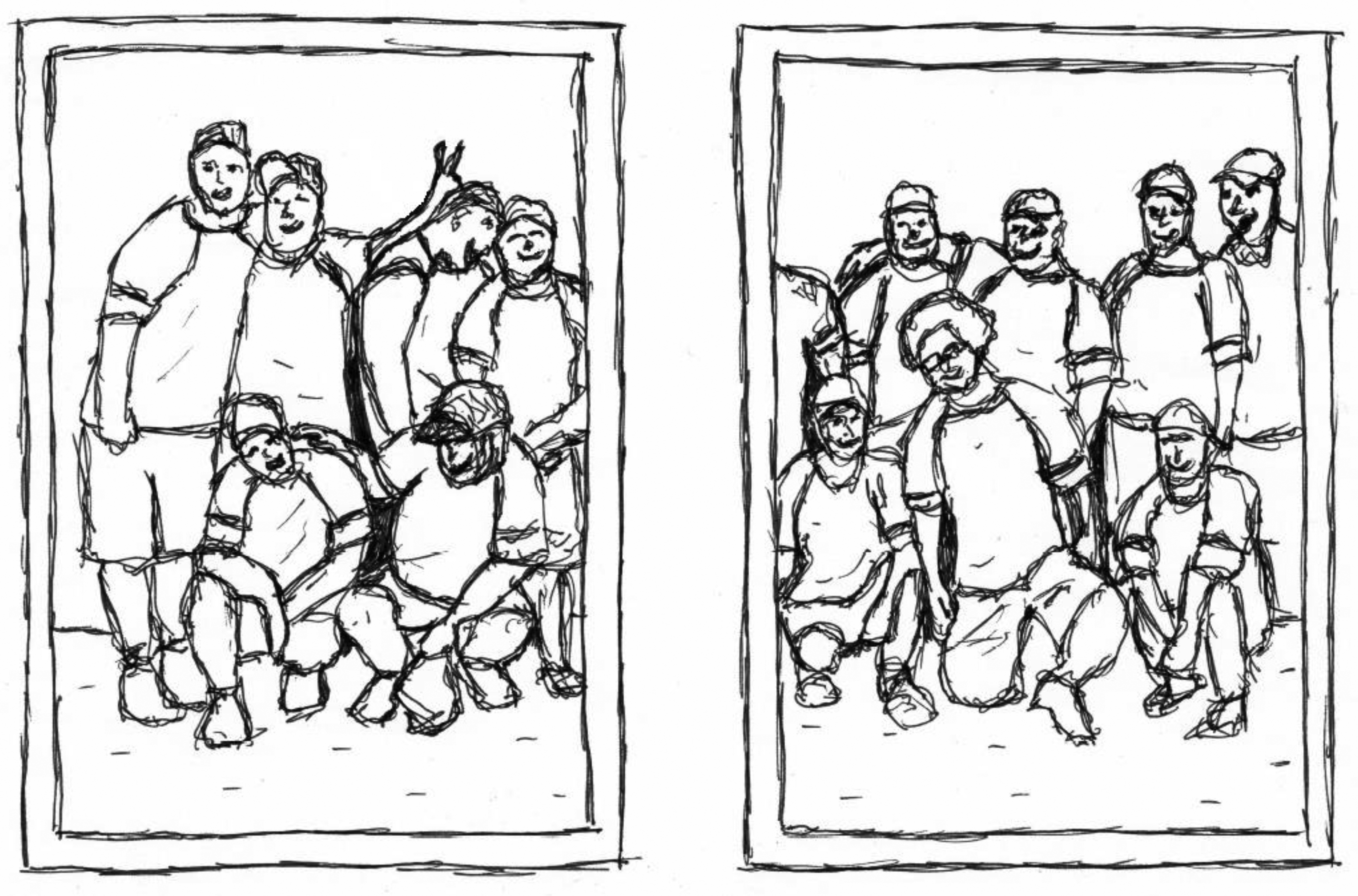
Drawing of the trading card of the Barnstormers from The Jock Issue (Original Plumbing, 2012, p. 17); drawing completed by the first author.
Creating trans masculinity
The theme of Creating trans masculinity focuses on trans men as individuals engaging in social practices as self-motivated, self-creating agents (micro level). In this theme, trans masculine embodiment is a deliberate project of the self and a social practice of what bodies do. Consequently, within our trans gaze framework, this theme is concerned with the desire (cathexis) associated with the individual body, self, and identity.
Personal motivations for initiating transition are framed as stemming from an incongruence between an individual's felt gender and society's gender expectations. At this level, it is the BRPs of agency that contribute to the self-development of trans masculinity. In both magazine issues, it is a ‘passable’ masculine appearance and embodiment that trans men are represented as desiring most. However, these desires are dependent on the degree of autonomy afforded by institutional biopower (Foucault, 1977), and the choices available to trans men. Although these magazine issues acknowledge the existence of structural hardships and private tragedies (macro level), trans men are represented as powerful in self-determination, emphasising sport as a way of coming into masculine being. In striving towards this goal, The Sport Issue (FTM Magazine, 2019) at times resembles a men's fitness magazine, with an emphasis on muscularised trans masculine bodies that bear a resemblance to societal norms of hegemonic masculinity. Given the amount of advertising in FTM Magazine (2019) (19 out of 48 pages, or 39.6% of total content), trans masculinity is also heavily commercialised, and thus achievable by using the ‘right’ consumer products4. In contrast, The Jock Issue (Original Plumbing, 2012) provides diverse trans masculinities.
The following excerpt is a personal story that explores how Kayiatos experienced the internal discomfort of gender dysphoria; a conflict of feelings between their physical self and the gender they intrinsically feel (Jones et al., 2015):
5
Uncomfortable with my physical self, I retreated from most physical activity. I didn't want to do anything that rooted me in my body nor did I want anyone looking at me, especially in a locker room. After I started medically transitioning, I regained my interest in physical activity. I returned to loving the feeling of moving my body and straining my muscles. (Kayiatos in Original Plumbing, 2012, p. 20)
Through gender dysphoria stories, trans men are represented as having a profound sensory awareness and knowledge generated through their body (micro level), including a sensitivity in environments that are subject to intense gender norms (meso level). As noted by Kayiatos, the locker room was one such flashpoint, a site of policing gender expectations and enforcing gender segregation and difference. For Kayiatos, this leads them to disengage from sports and withdraw from places loaded with gender expectations, which assists them to conceptualise their gender identity and initiate the process of identity reconstruction (the self) and physical transitioning (the body). Sports participation is then resumed, implying that dislocation from the body and self is compounded by the gender ordering of social spaces and physical activities. Absent here are the conditions that make such acts of choosing (agency) possible.
Stories that explore personal journeys of becoming masculine are the primary focus in The Jock Issue (Original Plumbing, 2012). This involves different types, forms, and experiences of being masculine that do not hinge on a two-gender masculine/feminine binary. This includes what it means to be a ‘jock’: I’m definitely more of a musician or a teacher or a radical queer than I am a jock. I have always loved being physically active, but it doesn't define me. Working out is something I do most comfortably on my own. If I were to define myself as a jock, I’d say I’m the type of jock who seeks to carve out a space in the ‘fitness’ world that is open to all. I’m the kind of ‘jock’ who thinks that all kinds of bodies are beautiful and who actively seeks to defy the notion that we, as human beings, must fit a certain mo[u]ld in order to be considered attractive or healthy. I’m the kind of jock who went to gym class during my lunch period in high school to play handball but cut math class to smoke pot in the woods with my friends. (Jesse in Original Plumbing, 2012, p. 48)
Jesse implicitly refuses the emphasis upon the cut, muscled and hard body as the sign of health, beauty, and masculinity. They are ‘more of a musician or a teacher or a radical queer than … a “jock”’ (2012, p. 48). This highlights Jesse's nonconformity to creating a hegemonic masculine ideal; being a ‘jock’ is linked with Jesse's self-identity to other activities, including some that are traditionally feminised such as teaching. Therefore, Jesse's masculinity is one that queers being a jock, and disrupts the cultural expectations of the fitness landscape (meso level) and hegemonic notions of masculinity (macro level). This is also seen in their trading card image presented elsewhere in the magazine (see Figure 3); an image that demonstrates how Jesse plays with their masculinity. In this trading card, Jesse parodies the jock identity and masculine norms through an embellished facial expression of effort and an exaggerated pose that accentuates their flexed arms and protruding buttocks (another image of Jesse's exaggerated performance is on the magazine cover). This is a performance, and the viewer is invited to observe the spectacle.
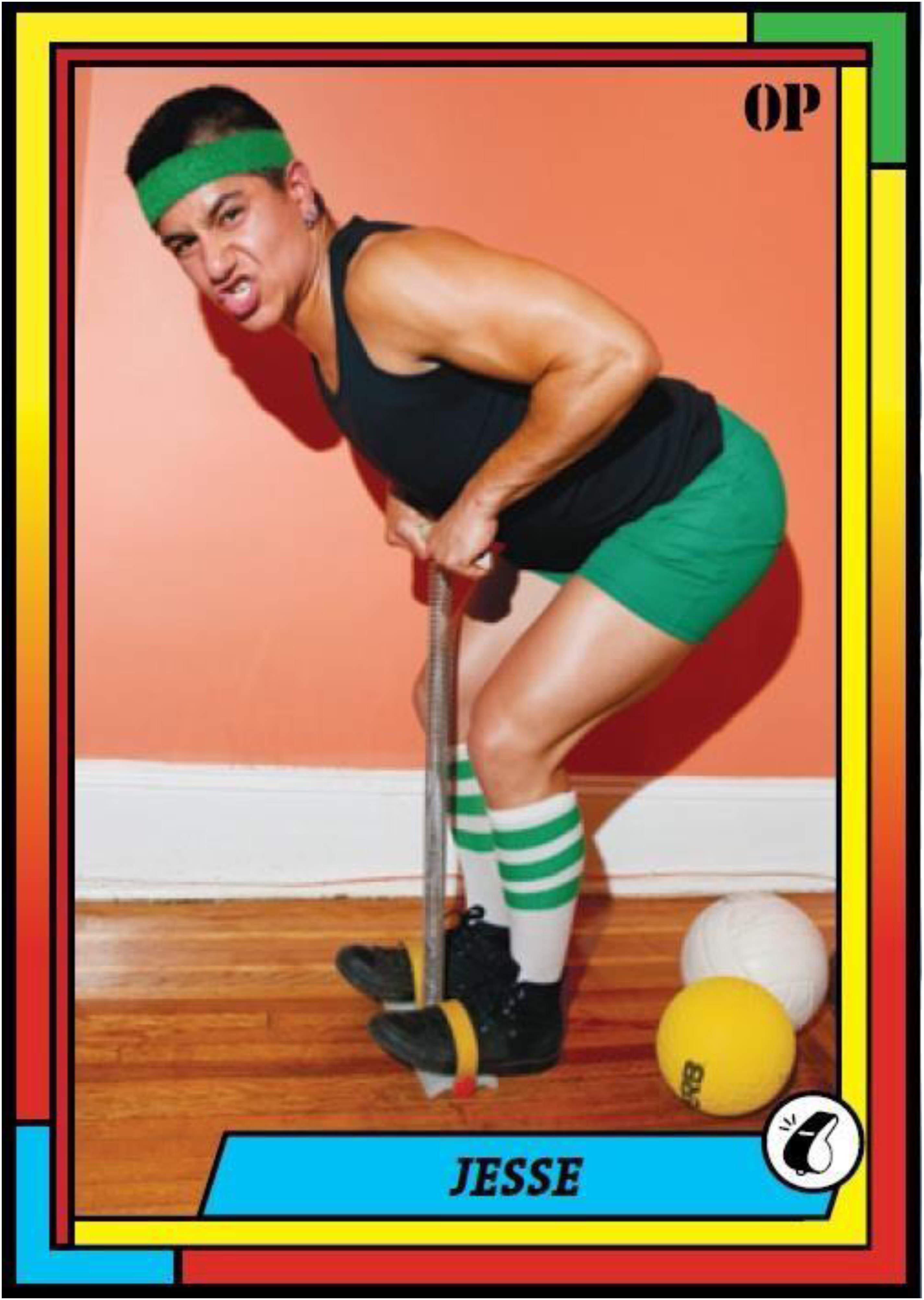
Trading card of Jesse from The Jock Issue (Original Plumbing, 2012, p. 14)
In contrast to the framing of sport as a way of becoming one's own version of masculinity as found in The Jock Issue (Original Plumbing, 2012), The Sport Issue (FTM Magazine, 2019) offers something different. The best example of this difference is an instructional fitness guide for ‘achieving your goals in fitness, and life’ (FTM Magazine, 2019, p. 30). This guide includes advice from a one-on-one personal trainer who advises fitness and life goals are achievable through consistency, preparation (including SMART goals to lose weight), mindset, and adaptability (2019, pp. 30–2). These instructions are presented as mechanisms for trans men to take control of their embodiment and personal self-development in becoming and being masculine. The article concludes with 15 exercises for a ‘full body HITT workout’ that includes knee lifts, squats, leg lifts, planks, and sprints (2019, p. 32). These narratives resemble the traditional hegemonic masculine ideals of the culturally acceptable, and best and most powerful version, of masculinity (Connell, 2005); that which embodies sporting prowess, athleticism, and muscularity. While trans men are in control of their body and may wish to explore queer, plural, fluid, inclusive or hybrid masculinities, The Sport Issue (FTM Magazine, 2019) generally guides them toward creating one (limited) form of a socially acceptable and desirable masculine body. 6 Nevertheless, the self-creation of this body could be a form of self-resilience and empowerment that is ironically pitted against cultural expectations, stereotypes (meso level), and hegemonic belief systems (macro level).
Conclusion
Through our trans gaze framework that incorporates BRPs (Connell, 2005) and GSS (Risman, 2004, 2018), we have highlighted how visual and written representations of identity, body and embodiment contribute to the construction of trans masculinity within two issues of magazines targeting trans men: Original Plumbing (2012) and FTM Magazine (2019). Our analysis reveals diverse trans masculine forms and performances, which span across the micro, meso and macro levels of social life. Self-creation is overwhelmingly represented in both magazines as a co-formative practice, albeit in different ways. For example, trans masculinity for trans men is presented as resembling conventional notions of hegemonic masculinity, as well as diverse, fluid, and queer masculine forms. At the same time, it is also noted in these magazines how masculine embodiment, affect and identity are regulated and subjected to the controlling norms of social institutions such as the military and sporting bodies. Through the entrenchment of the heteronormative biological body as a pillar of legitimacy and authenticity, the self-expression and self-creation of trans people can be limited. Subjective masculinity is thus an assembly of various perceptions and expectations of masculine symbolism; people who are trans are not just identities, they are subjects of knowledge and embodied meanings that highlight the flexibility, possibilities, and plurality of masculine constructions. Our trans gaze framework thus recognises and reveals how, through these magazines, trans people are presented as reflexive, inventive, and subordinated; they can transform the social structures around them while also being impacted and constrained by the same social structures.
While our research was narrowly focused on two issues of two magazines, the above findings shed important light on trans masculinity as a performative site of conflict and negotiation. In contrast to trans women, trans men continue to remain under-represented in popular culture (Aboim, 2016; Jones et al., 2015) and as such continue to experience a shortage of trans masculine role models as they negotiate, understand, and create their own version(s) of masculinity. Over the past decade, there has been an increase in representing trans people and their lives in film (e.g. Hyge, 2013) and television (e.g. The L Word: Generation Q, 2019). Along with magazines such as FTM Magazine and Original Plumbing, such media offer types and forms of masculinity within and beyond the binary system of heteronormative life, and create context for trans subjectivity. Trans persons may turn to such media as a platform for representation, self-development, and participation in society. This is particularly valuable given that trans men continue to experience invisibility, stigma, discrimination, and marginalisation, which impacts on their mental health and wellbeing (Hughto et al., 2021). This can be compounded by exposure to reductive negative stereotypes and representations of trans people within the media, which help to promote prejudice and discrimination while also fostering post-traumatic stress disorder, depression, anxiety, and psychological distress in trans people (Hughto et al., 2021). While the representation and visibility of trans characters appear to be improving in the media, the binary sex/gender system is often retained and unquestioned (McLaren et al., 2021). Sources of trans representation produced by the trans community such as FTM Magazine and Original Plumbing can be self-affirming for trans men, as they read the stories of others who are also trans men and consume plural and various forms of trans masculinities. Unfortunately, these magazines have both ceased publication, and thus trans men continue to experience a shortage of trans masculine role models in the media as they negotiate, understand, and create their own masculine sense of belonging, identity, and embodiment.
Our research reveals that trans masculinities are represented in trans media in divergent and contradictory ways. From hegemonic to queer forms, such media representations of masculinity could impact how trans people understand their masculine identity, and how they seek to claim it, including how they may modify and use their body. Furthermore, these magazines also report on the marginalisation and deep social complexities that are experienced by trans individuals when their gender identity and body diverges from sex and gender normativity. This allows such issues to be presented as social and community problems that must be resolved, rather than reduced to individual, private problems.
Masculinity is flexible, multiple, and defined by the available resources of the individual; interwoven with complex systems of symbolic and structural forces. Whatever form(s) masculinity takes – whether it resembles traditional hegemonic ideals or a queered masculinity (including non-binary masculinity) – it is imperative to recognise and support the plurality of masculine and gender diversity in how they are experienced and presented.
Footnotes
Acknowledgements
We would like to thank the founders and editors of Original Plumbing, Amos Mac and Rocco Kayiatos, and of FTM Magazine, Jason Robert Ballard. Their community focus and support of trans people and their lives through these magazines have been significant for and to the trans community. A further thank you to Amos Mac, who showed strong support for this research and has kindly allowed us to reproduce their photography in this article. Appreciation is also extended to Lucy Tatman, who co-supervised Korobacz's honours research on which this article is based.
Declaration of conflicting interests
The author(s) declared no potential conflicts of interest with respect to the research, authorship, and/or publication of this article.
Funding
The author(s) received no financial support for the research, authorship, and/or publication of this article.

Notes
Author biographies
Randos Korobacz holds a Bachelor of Arts (Hons) from the University of Tasmania. This article is based on his Honours thesis, for which he received First Class Honours. Randos also received a 2021 University Medal for his academic achievements, and the 2020 Australian Sociological Association (TASA) Honours/Masters Student Sociology Award, given annually to the best Honours/Masters student in sociology in each Australian university. Randos has recently commenced his PhD. His research interests are the sociology of gender and diversity.
Peta S. Cook is a Senior Lecturer of Sociology at the University of Tasmania. Her research is primarily focused on age-friendly communities, ageism, and the needs and wants of all older adults. Peta is strongly interested in social inclusion and diversity. For her community-based projects and research engagement in these areas, she received the University of Tasmania's Vice Chancellor's Award for Outstanding Community Engagement (2018), the Australian Sociological Association's (TASA) Sociology in Action Award (2020) and was a 2019 finalist in the Tasmanian Community Achievement Awards.