



Abstract
Using a societal analysis perspective that articulates structural, institutional and cognitive dimensions, this article outlines a model examining the contribution made by the schooling system to the social construction of elites. The model is put to the test by a comparative study of elitist educational pathways and their contrasting organisational modes in France, Belgium and Chile. The article shows that both the education of elites, and the role played by school in providing access to privileged social positions, continue to be marked by the distinctive historical construction of each society and education system, despite cross-cutting trends that are linked to globalisation.
Introduction
Every society has social elites – that is, social groups that hold or access positions of power and privilege in the social structure through the accumulation of high volumes of social, economic and symbolic capital (Khan, 2011; Mills, 1956; Rahman Khan, 2012). In modern democratic societies, the social trajectories leading to social privilege have increasingly been mediated through schooling (Meyer, 1977). Yet, while the growing importance of schooling in the social production of elites seems a major cross-cutting trend, indissociable from the dynamics of modernisation and of school democratisation and massification (Meyer, 1977; Turner, 1960), empirical observation reveals significant national variations in how schooling contributes to this process. In some cases (such as France), because elite training is both politically assumed and clearly institutionalised, elite school institutions are easily identifiable. Conversely, other educational systems make the training of elites more informal and thus less visible. For example, in the Belgian educational system, elite education seems both more discret and more diffuse, resulting as it does from an accumulation of parental micro-choices distilled throughout the schooling process. Even in highly egalitarian societies such as Sweden, the schooling system might appear very homogeneous but, on closer examination, it ‘in fact always has and still does contain elite institutions and programmes’ (Borjesson et al., 2016). We argue that elite educational pathways exist in almost all educational systems, though they can take different institutional forms that may or may not include the existence of separate elite institutions. Identifying such specific institutional pathways might demand taking a step back from the most visible institutions or segments officially labelled as elite training, and varying the scales of observation (Lahire, 1996).
Drawing on the comparison of three national cases (Chile, France and Belgium), this article envisages elite education as a specific institutional ‘school-linking process’ (Buisson-Fenet and Draelants, 2013) that organises specific elite pathways by linking educational institutions and/or curricula throughout the whole schooling process, at certain key stages. From this perspective, the article aims to draw up an analytical framework for understanding the multiple institutional configurations of elite education (or elite school-linking processes), reflecting how it is embedded into complex societal configurations.
The article is divided into four sections. The first offers a critical (though not exhaustive) review of the literature on elite education in order to circumscribe the added value of our own perspective. In the second section, we justify our affiliation with the French tradition of societal analysis/comparison (Maurice et al., 1982), and outline the analytical dimensions of the framework we have developed in order to apply this perspective to our object. We also present the corpus of secondary data on which we rely. The third section develops the comparison between our three case studies, and a concluding section revisits the links between elite education and the (re)production of inequalities.
The education of elites: current state of play
The literature on elite schools is consistent in its identification of a number of recurrent processes that are characteristic of elite educational establishments insofar as they contribute to maintaining and/or facilitating access to key positions of power for certain social groups. The most commonly identified characteristics are: (1) social closure, resulting from economic, academic and/or social selection processes (Clotfelter, 1996; Kenway and Koh, 2013; Stevens, 2009); (2) social capital development (Tholen et al., 2013); (3) socialisation into dominant cultural codes (Darmon, 2013; Kahane, 1988; Khan, 2011); (4) distinction processes or symbolic differentiation from other social groups (Bowen, 2015; Sriprakash et al., 2017); and (5) the transmission of a prestige label (symbolic capital) associated with elite establishments (Bourdieu, 1989; Draelants and Darchy-Koechlin, 2011).
Research has also emphasised the historical dynamics of transformation of the modes of social production and legitimation of elites. Because the Enlightenment and the democratisation movement in modern societies have gradually made schools an essential lever in the distribution of social positions (Meyer, 1977), there has been a gradual shift from ‘endogenous’ modes of social reproduction (characterised by inheritance or sponsorship and referring to a logic of inherited privilege) to elite meritocratic modes of production (characterised by acquired privilege and status attainment through competition) (Baker, 2018; Turner, 1960). These transformations have led the dominant social groups to consider (and experiment with) education as a key strategic field (Brown, 1990; Draelants, 2016).
Along with the identification of such general processes, research shows that elite schooling is strongly indexed to national particularities. Indeed, the ‘elite institution’ object is diversely constructed from one country to another: the level at which elite institutions are observed (in secondary or higher education) is influenced by modes of organisation at state level (van Zanten & Maxwell, 2016; van Zanten, 2016), and by ‘markers of eliteness’ that may vary according to national context (Maxwell and Aggleton, 2016). This contextual nature of elite schooling probably explains the predominance of a qualitative and ethnographic tradition in this field (Gaztambide-Fernández, 2009; Kenway and Koh, 2013; Khan, 2011). This has produced valuable ‘dense descriptions’ of contextualised modes of production of social privilege, though their conclusions are difficult to detach from their production contexts.
Similarly, there is little comparative work on elite education forms. Even where it does exist, this tends to concentrate either on local, visible forms of elite education, or on a certain type (or level) of elite institution, or on fixed geographical areas, such as elite schools in a given area of the UK (Maxwell and Aggleton, 2016); elite boarding schools across the Commonwealth (Kenway and Koh, 2013), or elite higher education in France and the UK (Brown et al., 2016). Though special comparative issues on elite education have been published, these usually comprise a set of single-case studies not necessarily sharing the similar analytical dimensions required for reasoned comparison (Maxwell et al., 2018; van Zanten et al., 2015). When comparative approaches attempt to build generalisations, they essentially seek to identify ‘invariants’ (shared structural characteristics making up a general typified portrait of what an elite school is) – in this instance, this risks failing to reflect the diversity of ways in which elite education is socially constructed and institutionalised in a particular context (Gaztambide-Fernández, 2009; Karen, 1990). Thus, though the very real efforts made in recent literature to compare different contexts – such as the multi-site global ethnography of Kenway and Koh (2013) – can highlight cultural and political variations, they do not systematically compare institutional arrangements in the way we are suggesting.
Our article aims to contribute to this growing comparative trend in elite education studies, complementing it in two ways. First, we think the comparison should avoid confining itself (as is often the case) to those visible segments or institutions officially identified as offering elite training, instead embracing the whole ‘school-linking process’ in which specific elite pathways are organised. Second, we argue that these various institutional forms of elite education must be related to the societal context of their production – that is, to the structural and cultural factors shaping these contexts, at both macro (societal) and meso (education field) levels.
Analytical and methodological framework: a revisited ‘societal analysis’
The idea of basing the comparison between different national case studies on a consideration of complex (political, institutional and social) ‘configurations’ within which the phenomenon under study takes place is not new. Initiated in the 1980s by a team of French economists and sociologists seeking to compare the very different wage structures observed in France and Germany (Maurice et al., 1982), ‘societal comparison’ aims to break with both ‘culturalism’ (looking to national history and culture to explain the differences observed) and functionalism (identifying ‘functional equivalents’ that can be compared over time and space because they fulfil a similar function). This approach invites scholars to pay attention to the diverse ways in which their object is expressed from one country to another, according to local social structures – and then, to analyse these variations. Societal analysis aims to explain each local configuration by situating it within a complex and singular combination of structural and organisational factors, articulated with one another according to a principle of ‘societal coherence’; it also aspires to elaborate an analytical framework for understanding these multiple institutional configurations.
The comparative approach used in this article builds on this tradition of societal comparison, while incorporating some of the criticisms directed at it (Lendaro, 2012). In response to Reynaud’s (2011) invitation to consider the recent findings of the sociology of regulation (in particular a sensitivity to the cognitive aspects of regulation), our comparison will focus on the structures and institutional arrangements observed in each country, and on the frames of meaning underlying them.
The comparative analysis of France, Belgium and Chile will therefore be carried out in two stages. We will begin by presenting an overall picture of the unique institutional configurations observed in each country around four key dimensions; these have been semi-inductively identified through analysis of the literature and collected empirical data (see Table 1). The first dimension is the degree of organisation and visibility: elite education is more or less institutionalised, with more or less easily identifiable elite establishments, from one country to another. The second dimension is the school level at which elite institutions and/or curricula can be observed in each country, as well as their institutional linkage. The third dimension concerns the degree and modes of selectivity of elite institutions (as criteria for their assessment can vary from one system to another). Lastly, we address the uneven weight of education (and qualifications in particular) in terms of access to both jobs and privileged social positions across societies. Together, these dimensions constitute national institutional configurations in which particular school-linking processes take place.
The four dimensions of elite institutional configurations

(Authors’ own classification).
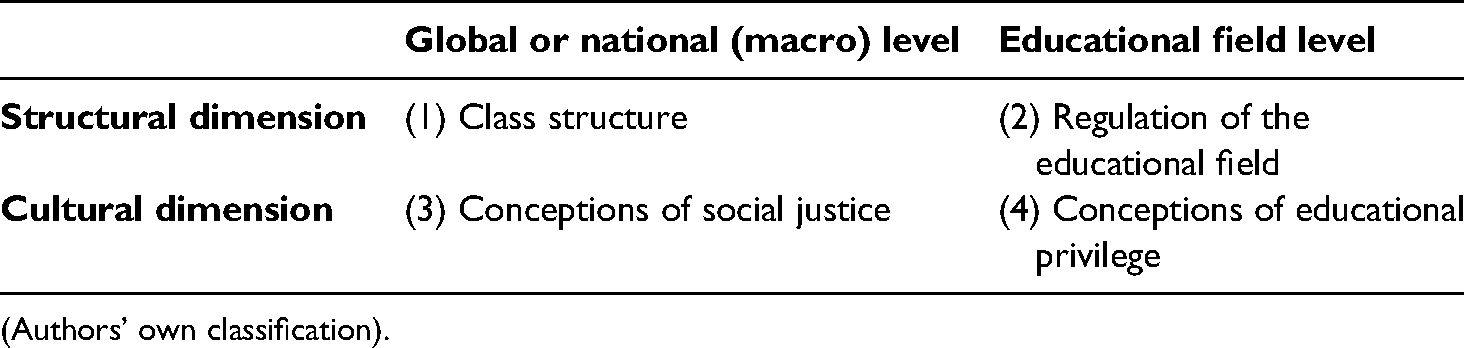
Second, in accordance with the perspective of societal analysis revisited, we will attempt to explain these configurations by referring them to (1) structural and organisational legacies and (2) specific cultural or cognitive inherited constructions. For each dimension, applying a classic sociological distinction between macro and meso levels of analysis, we distinguish a ‘global’ or national level and an ‘educational field’ level, both of which exert a certain influence on elite training institutional configurations. After cross-tabulating these two dimensions, we are left with four key elements to consider (see Table 2).
A societal comparison based on four elements
(Authors’ own classification).
The ‘structural’ dimension examined at national level is intended to ensure we do not lose sight of the fact that institutional arrangements concerning education are structured by a historical legacy and by national realities. First, we will address the pathways of dependence linked to the historical roots of class structure (and more specifically, the social reproduction of elites). Second, for the structural dimensions at the educational field level, we look at the embedding of elite pathways within the broader modes of regulation and organisation of the education system (Maroy, 2006).
Third, the cultural or cognitive dimension at national level draws attention to conceptions of social justice, and the foundations of the legitimisation of privilege that allows elites to distinguish themselves and to feel entitled. Fourth, at the educational field level, the same dimension refers more specifically to the conception of educational privilege. In other words, the question asked is: do the ordinary categories of elite education have stronger or weaker resonance and legitimacy in the country?
Though these four elements are distinguished here for analytical purposes, in practice they frequently intersect and overlap. In the following sections, it is thus inevitable that discussion of one element will involve mention of another in passing – even though we seek to address them serially.
The presentation of the French, Belgian and Chilean cases relies on empirical surveys conducted by one or other of the authors of this article, alongside our secondary reading of a wide range of empirical works on elite establishments and the construction of educational pathways produced within our research teams and, more broadly, a critical discussion of the existing research literature in all three countries – on educational elites as well as on the regulation of education systems and the (re)production of inequalities in these contexts.
A reasoned comparison of the three case studies
According to our analytical framework, we proceed in two stages: the next subsection examines the four key dimensions of elite institutional configurations listed above in Table 1, while the following one deepens the understanding of these institutional configurations through a societal analysis, in line with the elements shown in Table 2.
The formation of elites: national dimensions and particular configurations of school-linking processes
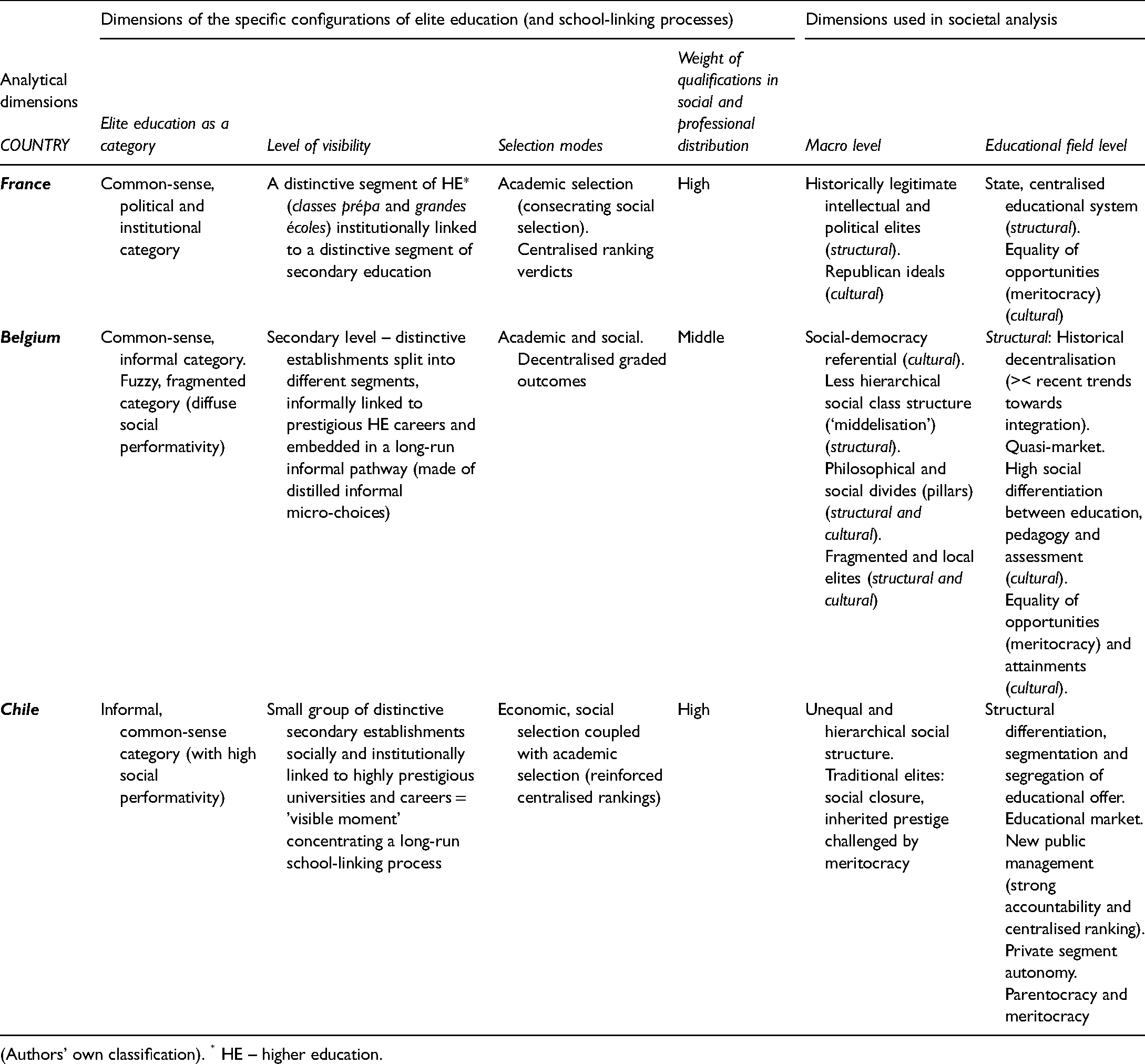
A first aspect of these configurations concerns the degree of institutionalisation and visibility. In France, ‘elite education’ is a common-sense category, clearly referring to well-identified prestigious and highly selective segments of higher education 1 as well as to certain specific types of establishment: the grandes écoles and the preparatory classes that gatekeep entry to them and are only available at a small number of prestigious lycées. These ordinary categorisations echo an institutional category of elite education, since France has a national ‘charter’ for the education of elites – that is, a ‘social mandate for the recognition of academic excellence which has enabled a small group of schools to develop specific characteristics’ (van Zanten, 2008: 242). Nothing similar has been observed in Belgium or Chile; though elite educational pathways do exist in these countries, they are less visible and are not reliant on a socially – and politically – endorsed institutional category. Nonetheless, informal common-sense categories must be considered socially performative, as they exist in people's representations and might actually impact educational practices.
Regarding the levels or school stages in which the training of elites is situated, differences have been observed between the three countries. In France, the ‘elite establishment’ category refers to grandes écoles (prestigious higher education establishments external to the university system), of which a select few (the Ecole Mationale d’Administration – ENA; Hautes Études Commerciales – HEC; École Polytechnique; and École Normale Supérieure – ENS) truly confer titles of ‘academic nobility’ (Bourdieu, 1989), as do the preparatory classes for admission to them. This segment is extremely hierarchical and operates through ‘school-linking processes’, with a limited group of large city-centre state lycées offering preparatory classes. The lion's share of the total number of pupils in preparatory classes is thus made up of pupils attending such elite lycées (Buisson-Fenet and Draelants, 2013).
In Belgium, the term ‘elite schools’ refers to secondary schools preparing students for higher education – more precisely for those university courses (civil engineering, medicine, law and economics) considered both most demanding and most promising in terms of career opportunities. This type of school distinguishes itself in terms of both social recruitment and educational offer, which focuses on curricular ‘excellence’, bi- or multi-lingual education and anticipative socialisation in preparation for the most attractive university careers (Draelants, 2013; Siroux, 2011). These educational strategies also form part of ‘long’ (though informal) school-linking processes: more and more schools (nursery, primary and secondary) seek to stand out from the competition and attract privileged groups by making such elitist curricular choices visible – by, for example, acquiring ‘immersion school’ status. Moreover, some families opt out of the state (or subsidised) education system, enrolling their children in international schools (French lycées, European schools, American schools, etc.), which offer a curriculum combining academic excellence, multilingualism and international openness (Wegria, 2018).
In Chile, the evidence shows that the formation of elites happens more at secondary school level than in the university system. Though some studies have identified the existence of two universities (the University of Chile and the Catholic University) and four careers (law, medicine, civil engineering and economics) in which elite preferences are concentrated (Villalobos et al., 2020), the school attended seems to be the determining factor in gaining access to the Chilean elite. The literature identifies a group of 14 schools located in the capital (Ilabaca, 2021). All are both private and highly selective (economically, socially and academically), and cover all stages of compulsory education (nursery, primary and secondary). Rivera and Guevara (2017) show that students graduating from these establishments are 60% more likely to go on to elite universities and careers than students graduating from the most prestigious state secondary schools (2017: 22). Here, then, the school-linking process operates at a specific stage, strongly linking certain schools with specific elite universities and careers.
These schools play a key role in the reproduction of elites because of the habitus they transmit and the social capital they generate (Howard et al., 2020; Moya and Hernández, 2014). The school-linking processes described above thus help maintain class homogeneity and social closure, despite the undeniable diversity of educational establishments (historical Catholic tradition; international; neo-Catholic, etc.), responding to the specific interests of different elite social segments (liberal, Catholic, progressive, etc.) (Ilabaca, 2021; Thumala, 2007).
The third configuration relates to the modalities and nature of selection processes regulating access to elite institutions. In France, the legitimacy of grandes écoles is based on academic criteria; it relies on a highly competitive and rigorous examination system, organised around (anonymous, highly regulated) written and oral examinations, leading to ‘ranked outcomes’ (Belhoste, 2008). The consecration function fulfilled by these rites of entry is well-known: they produce an academic elite (based on academic selection) that is ‘distinct, separate, but also recognised and acknowledging itself as worthy of such’ (Bourdieu, 1989: 140). Being a student at a grande école means being recognised as highly successful academically, following two or three years of intensive and ascetic study in preparatory classes, and this symbolises republican meritocracy.
In the Belgian quasi-market system, even though access to elitist secondary schools may involve some additional costs (in an officially ‘free’ educational system), informal reputations and social capital play an important role in identifying which establishments offer the most effective preparation for joining the most prestigious higher education careers (Dupriez et al., 2018). The informal aspect of these social and academic selection processes is enhanced by the absence of centralised ranked outcomes. Since only ‘graded outcomes’ (Belhoste, 2008) exist (i.e. decentralised examinations in which each institution takes full responsibility for assessment and certification), selectivity varies widely; depending on social and academic composition, establishments are more or less harsh/generous. The gradual introduction (at the end of primary and lower-secondary education) of centralised and standardised tests has made very little difference to this (Barbana, 2018).
At the same time, with some notable exceptions, 2 access to higher education is both reasonably affordable and granted without any entrance examination. There are no preparatory classes for higher education in Belgium. Some secondary schools organise a special 7th year of mathematics for students seeking to study engineering, but it is possible to pass the exam without it, as long as you have the required educational background. Despite this near-absence of the selection mechanisms often associated with social closure of elite training, in practice, clear links do operate between the type of pathway and options taken in secondary education, and orientation and success in higher education (Droesbeke et al., 2013; Van Campenhoudt et al., 2008).
Chile has two moments of access to elite education. Access to elite secondary schools is highly restricted, generating strong social closure. Because the private sector has been deregulated, these schools benefit from a high level of autonomy in their functioning, allowing them to grow and convert the social and cultural capital that converges there (Howard et al., 2020; Moya and Hernández, 2014). Beyond an undeniable economic barrier (tuition fees per child are around US $17,000 per year), 3 these institutions select their students both academically and socially (e.g. they require families to profess a particular religion or submit letters of recommendation, or they give priority to the children of alumni) (Ilabaca, 2021).
Second, admission to higher education in Chile is based on ranked outcomes, produced via centralised tests at the end of secondary school University Selection Exam (PSU). Each university is free to set minimum scores for admission. Students are very unequally prepared for this test, depending on the type of school they attend and on family resources. Those from families having high economic capital, who attend elite schools, are more likely to access highly selective universities (Rivera and Guevara, 2017).
The fourth and final aspect concerns the ‘grip of diplomas’ (Dubet et al., 2010). Possession of a minimum of qualifications is generally required to access elite positions. There are, however, differences between one context and another.
The influence of qualifications is particularly strong in France: not only is recruitment for many positions in the senior civil service based on the competitive examination principle, but these positions are also, by law, reserved for those holding higher education qualifications from certain establishments only
In Belgium, the educational background of the ruling elite is more difficult to describe. While the vast majority are graduates, and while it may be advisable to favour certain pathways in pursuit of a career in a given professional field (e.g. attending a prestigious institution such as the Solvay Business School to access leadership positions in commerce and finance), this is not a requirement. There is no such thing as a ready-made pathway (Paret and Wynants, 2016).
In the case of Chile, elites are characterised by their internal endogamy (social capital and kinship relations), rather than by possession of educational qualifications (Aguilar, 2011). It is only recently that some private schools and universities have come to complement what was formerly achieved via matrimonial unions.
Understanding institutional configurations by means of a societal comparison
In order to account for the specific institutional arrangements described in the previous subsection, we will now rely on a societal comparison combining structural and cultural elements (Table 2). These elements may correspond to characteristics of the social systems studied (macro level) and/or to specific features of the educational field. However, given the deep interdependence between these elements, it will not always be possible to approach them separately.
In each country, certain key elements of national history and the historical structuring of social classes (see dimension 1 in Table 2) clearly impact and explain the organisation and visibility of elite training, as well as the inherited cultural meaning associated with elite and educational privilege (see dimension 4 in Table 2). In France, several of the most prestigious and emblematic grandes écoles (including the École Polytechnique and the École Normale Supérieure) were created in the aftermath of 1789 to provide the state with the qualified senior civil servants necessary to its operation, based on a system predicated on academic merit. Not only does this historical background have a powerful impact on the meritocratic conception of educational privilege in France (and the social consecration of elites), it also opens the way to the legitimate existence of separate elite institutions.
In Belgium, elites are primarily local (Dassetto and Trivelin, 2003) because Belgian society is ‘pillarised’ (Mangez and Liénard, 2014); this expression refers to an established system of organising social and political life. Historically, major social issues in Belgium have been settled through compromise between groups and organisations linked to the main philosophical tendencies existing in the country.
4
These historic divides may have faded, yet the pillarised organisations still exist and continue to trace a path of dependency for public policy, particularly in education: this field has historically been characterised by freedom of choice and pedagogy, decentralisation and the coexistence of different offers, organised according to these philosophical pillars. Similarly, each ‘pillar’ produces its own elite (and its own elite schools), basing its legitimacy on contrasting principles of justice or educational philosophies (Dupriez et al., 2018). Unlike in France, this lack of a central definition of privilege might also explain the fact that these elites do not necessarily define themselves subjectively as such
Chilean elites have been described as a ‘social club’ (Rothkopf, 2008: 55), as these groups have historically been endogamous and socially hermetic, with a strong concentration of political, economic and social power (Correa, 2004) and an ability to mobilise in defence of their interests (Fischer, 2017). In recent decades, despite the growth of the middle classes, the upper classes and elites tend to self-segregate spatially and academically, generating closed social spaces – though with internal divisions (Méndez and Gayo, 2018). In this sense, Chilean education remains class-riven. The poorest attend public schools, the middle classes attend subsidised private schools, and the upper classes attend ‘fee-paying’ schools. The elites are located in this last sector, since it guarantees social homogeneity and reproduction of their own habitus (Howard et al., 2020).
The structuring of the educational systems that frame the education of the elites (see dimension 2 in Table 2), as well as the school-linking processes in which they sit, differ markedly from one context to another. In this respect, the Chilean case is remarkable. The 1980s transition from an educator state to a market-regulated system has made the Chilean education system one of the world's most segregated and least equal (Allende et al., 2018). This is due not only to the effects of a profoundly unequal social structure and urban segregation, but also to factors related to the schooling structure. This education system combines a high level of structural differentiation with a deregulated school market, initiated during the dictatorship, using various privatisation and decentralisation measures, and redefining education as a market enterprise (Bellei, 2015). Today, despite efforts to introduce elements of social justice into the regulation of the education system, these market logics continue to operate through competition between state and private educational provision, and parental choice, which reinforces social homogeneity or grouping (Corvalán et al., 2016). In addition, the state's role as evaluator has been strengthened, gradually subjecting the ‘unregulated’ school market to performative evaluation mechanisms based on a complex institutional accountability framework. The national test for measuring the quality of education (SIMCE) plays a central role as an instrument of state evaluation of establishment performance (Falabella and de la Vega, 2016).
Chilean elite schools, virtually unregulated by the state, also fuel competition – not least because they take part in national evaluation systems yet are not subject to the threats (of closure, sanctions, etc.) the rest of the system is subjected to. In this way, regulation of the system allows elite schools (often ‘over-performing’ because of their academic and social closure) to earn legitimacy through competition and evaluation.
In France, cultural and structural dimensions are largely embedded as the mobilising force of the republican frame of reference (a macro, cultural dimension), underpinning the organisation of education with a unifying vocation, embodied by the collège unique (compulsory state lower-secondary education up to the age of 15, coupled with educational centralisation) and the carte scolaire (which aims to assign pupils to schools on the basis of their sector of residence). The French educational system is however characterised by a significant degree of segregation and inequality (more so than in other contexts in which social inequalities are comparable) (Dubet et al., 2010). It has to be said that the carte scolaire mechanism has been considerably relaxed in recent years (van Zanten and Obin, 2008), and unification of the lower-secondary school was never completed. The existence of wide performance gaps between establishments, plus the fine distinctions specific to each level of schooling (via options or ability grouping) enable families’ educational strategies to play a role. This leads to the introduction of a process of progressive selection of the ‘best’, contributing to the establishment of ‘segregated democratisation’ (Merle, 2002). This school selection functions as a process of fractional distillation, drawing its legitimacy from a meritocratic principle of equality of opportunity (Dubet, 2004). The symbolic weight of academic excellence, embodied precisely by elite establishments and preparatory classes, thus reverberates throughout the education system.
In Belgium, because of the existence of the ‘pillars’ described above, school has historically been constituted less as an institution designed to integrate all young people into a common project than as a juxtaposition of socially segmented school forms. Reforms throughout the 20th century can be read as a progressive political questioning of this logic in the name of the equal opportunities principle (Dupriez and Verhoeven, 2006). This movement has intensified over the past ten years, with the steering of education being strengthened.
Despite this egalitarian frame of reference and the implementation of new accountability mechanisms, the Federation Wallonie-Bruxelles (FWB) education system continues to be marked by profound social inequalities in results – as is shown in the PISA (Programme for International Student Assessment) surveys. These inequalities are often explained as the combined effect of a strong institutional differentiation of the school offer (linked to philosophical divides, but also to a strong academic and social hierarchy between general, technical and vocational streams) and the ‘quasi-market’ competition mechanisms that accentuate the offers' differentiation (Delvaux and Joseph, 2006). In this context, elitist establishments emerge in fragmented ‘local markets’, leaving parents to decode a largely informal and complex system of differentiation and hierarchy. As a result, we assume that the school-linking processes constituting elite education pathways in Belgium are essentially both invisible and informal: they refer not to explicit institutionalised categories or rankings, but to emerging symbolic distinctions that are linked to quasi-market mechanisms and rely on a series of parental choices made at each stage of the schooling pathway (identifying the elitist offer on ‘local’ markets), or even on micro-choices made at ‘infra-establishment’ level (choice of distinctive options). In this sense, we assume the category of ‘elite education’ in the Belgian context to be fuzzier, and its social performativity seems weaker than that of Chile.
It would be difficult to overstate the importance of meritocratic discourse in regard to the cultural dimension of the conception of social justice (third dimension, Table 2) and the legitimisation of inequalities and elite formations. This discourse remains very much present, yet is increasingly being questioned – especially in response to sociological work on the reproduction of both social inequalities and elite education.
How does meritocratic discourse become embedded in the elite formation process? In the French case, research has shown that, in terms of access to grandes écoles, democratisation ground to a halt in the 1980s (Euriat and Thélot, 1995). This result stands in stark contrast to developments in the rest of higher education, where relative democratisation has been observed – especially at undergraduate level (Albouy and Tavan, 2007). Since the mid-2000s, some grandes écoles have responded to denunciation of their elitism with a series of experiments in ‘social openness’ (Buisson-Fenet and Draelants, 2010). However, recent data show that on average, there has been next to no rise in diversity within elite schools over the past decade (Bonneau et al., 2021). The highly elitist and socially homogeneous French grandes écoles therefore struggle to maintain the meritocratic and equal opportunity discourse on which their legitimacy was founded; it is becoming difficult for them to contest what they have been criticised for ever since the publication of Pierre Bourdieu's La Noblesse d’état (Bourdieu, 1989).
In Belgium, it is important to distinguish between the rationales at work in compulsory education and those underpinning higher education. As far as compulsory schooling is concerned, education policies have led to the pursuit of ever-more-ambitious forms of equality – in terms of access, of treatment, and ultimately of achievement – even of results. The meritocratic discourse, fairly prevalent during the ‘Trente Glorieuses’ years (1945–75), has faded. Recent reforms are part of an attempt to implement a ‘school for success’, putting the meritocratic principle on hold throughout most of compulsory schooling (Grootaers, 2006). Yet the Belgian university system remains both relatively selective (only 20% of any given age group enrols) and elitist (students from wealthy backgrounds remain over-represented). Massification, however, has had an effect on less prestigious non-university higher education (Hautes Écoles). At university level, democratisation varies across faculties, with some (e.g. medicine, law, engineering) remaining more socially selective and recruiting more students from elitist secondary schools (Van Campenhoudt, 2012). Thus, the meritocratic parameter continues to operate mainly at higher education level, legitimising social inequalities rooted in long-standing differentiated educational pathways, though less visibly so than in France.
In Chile both the legitimisation strategies of elites, and the resulting inequalities, rely on a mix of meritocracy and what Brown (1990) has called the ‘parentocracy’ – a system in which children's achievement is strongly influenced by parental activism at school. While there is indeed a discourse valuing performance (access to good universities as the product of pupil merit throughout their educational career), the prevalence of market policies means that the role and responsibility of parents, who are supposed to know ‘how to choose the right school for their children’ is more explicitly valued than elsewhere.
Discussion and conclusion
Against the backdrop of cross-cutting trends linked to globalisation, institutional configurations concerning the education of elites and the gatekeeping role played by schools in relation to privileged social positions remain highly variable from one society to another. Though the existence of elite educational institutions inevitably attracts scholarly attention, attendance at such an institution represents no more than a moment of crystallisation and consecration. We have thus argued that elite education must be understood as a specific ‘school-linking process’ organising the educational pathway as a whole. Depending on the case, visible elite institutions might emerge at distinct stages of schooling, while other systems reveal a more diffuse, informal pattern of elite selection.
Table 3 offers a synthetical view of the key outcomes of our societal comparison. It shows that these specific configurations of elite education are marked by the unique historical construction of each society, which both traces paths of dependency and explains the variants observed. These must be embedded in both the class structure, and the modes of regulation and governance, of the education systems in which they take shape, and also rest closely on the principles of meaning that legitimise them. Modern equal opportunities ideology operates in a significant way everywhere, but takes on different shades from one context to another.
Summarised key outcomes of the societal comparison
(Authors’ own classification). * HE – higher education.
A next step, aimed at deepening the research, could be to build a comparative societal analysis around a larger number of countries, in order to enrich the analytical model: Are there other important aspects of the institutional configurations of elites that should be considered? Do the structural and cognitive dimensions examined at national level and in the educational field adequately capture the diversity of institutional configurations beyond the cases studied? And one very important line of research to be pursued concerns the theoretical implications of the various institutional configurations of elite education for thinking about the question of inequalities in access to elite training. The more or less democratic nature of such training is dependent on the nature of the school-linking processes and the changing weight of different, relevant capitals, as well as on the evolution of the strategies used by upper-class parents and elite institutions to maintain social reproduction. We sketch out some hypotheses with regard to this in the remainder of this section.
All elite establishments participate in the reproduction of social inequalities. However, the various institutional arrangements observed do not have the same worth and do not contribute to the same extent to the construction of inequalities.
France, as we have seen, makes no secret of its intention to educate elites. Preparatory classes and grandes écoles are identified as the pinnacle of the French education system, designed to welcome its brightest students, holding a veil of meritocracy over a system designed for class reproduction. There is none of this in Belgium, where the routes faced by pupils are both more diffuse and disseminated throughout the academic career. In this case, it is certain inherited capitals and knowledge (on the pat of the family and school) that allow us to ‘identify’ the path.
A second criterion drawn from our model concerns the influence of the qualification on access to social positions. The French case is highly characteristic in this respect: more than a mere marker of social identity, having attended elite establishments becomes a durable ‘title of nobility’ with tangible professional consequences. Just as the visibility of elite education pathways might reduce inequalities by (initially) favouring more open academic competition, it also tends to freeze social positions when they are very strongly dependent on past schooling, as is the case in France. From this perspective, the more egalitarian systems are those in which qualifications are less influential, since decisions about social and professional destiny are not made only between the ages of 14 and 20.
From a comparative point of view, the increasing role played by the market in elite education – and more broadly on conceptions of social justice – is impossible to miss. The effects of market regulation are best observed in the Chilean case, where they have led to the exacerbation of educational inequalities. Most importantly, the market has also had the effect of maintaining and consolidating the educational advantages of the economic elites.
The mode of regulation characterising elite education in a given context also has consequences in terms of the different types of capital relevant in accessing elite schools. And this, in turn, has repercussions for those in segments of the higher social classes who benefit. This is observed in the Chilean case, where managerial segments of the elite are more likely to succeed, as the selection criteria are not purely academic but also involve economic capital. In the French case, where the state still largely controls school mechanisms for the selection of elites, and where social reproduction remains dominated by the transmission of cultural capital, the intellectual segments – especially teachers – are notoriously well represented at grandes écoles.
Analysing the education of elites in a contextualised way thus makes it possible to move towards an understanding of the systemic production of inequalities. Complementary research applying the model outlined in this article to other elite institutional configurations would be useful in refining it, and confirm whether it is indeed transferable to other contexts. An important question that demands further investigation is the impact of global structural and cultural trends on the distinctive historical construction of each society and each elite education system.
Footnotes
Declaration of Conflicting Interests
The author(s) declared no potential conflicts of interest with respect to the research, authorship, and/or publication of this article.
Funding
The author(s) received no financial support for the research, authorship and/or publication of this article.
Supplemental material
Supplemental material for this article is available online.
