




Abstract
This article explores Finnish LGBTIQ+ people’s break-ups. The long battle for equal rights has placed LGBTIQ+ people’s relationships under pressure to succeed. Previous studies argue that partners in LGBTIQ+ relationships try to appear as ordinary and happy as possible, and remain silent about the challenges they face in their relationships. Consequently, they may miss out on opportunities to receive institutional and familial support. This study aims to move beyond recurrent frameworks that take the similarity or difference between LGBTIQ+ relationships/break-ups and mixed-sex relationships as a predefined point of departure. The analysis draws on ethnographic observations of relationship seminars for the recently separated, an online counselling site for LGBTIQ+ people, survey data, and interviews with LGBTIQ+ people who have experienced recent break-ups. It employs the Deleuzo-Guattarian concept of assemblages in order to show how different components and manifold power relations come to matter in different ways in the course of the open-ended becomings of relationship break-ups.
[I thought] it cannot happen to too many people, because then it starts to look like this [LGBTIQ+-parented family] cannot work out. [. . .] It prevented me from thinking about separation for a long time as an option.
Introduction
This article explores a phenomenon about which little is known: the relationship break-ups of lesbian, gay, bisexual, trans, intersex and queer and/or questioning people (LGBTIQ+, where + is an acknowledgement of the non-cisgender and non-heterosexual identities that are not included in the initialism). LGBTIQ+ couples’ path to legal recognition has been long and complex. During the 2000s and 2010s, same-sex relationships gained increasing social acceptance and legal recognition in many Western countries. But although European countries have seen broadly similar transformations in institutional norms regarding same-sex sexualities, national specificities continue to exist (Roseneil et al., 2013). In Finland, which is the focus of this study, the Marriage Act (234/1929) became gender-neutral on 1 March 2017, and the Maternity Act (253/2018), which allows maternity clinics to formally recognise pregnant women’s female partners as social mothers, came into effect in April 2019. The public campaigns that led to both of these legal changes sought the social acceptance and legal recognition of LGBTIQ+ people’s couple and familial relationships by incorporating them into existing legally recognised models of intimacy such as marriage and the nuclear family. The recent legal changes challenge the still widespread idea that gender difference is at the heart of both couple relationships and parenting. However, previous research indicates that the long battle for equal rights has placed LGBTIQ+ people’s relationships under pressure to fit into the heteronormative model of long-term monogamous relationships, and to appear as happy as possible (Dahl, 2014; Gahan, 2018; Lahti, 2015; Moring, 2013). For instance, the extract above comes from an interview with a bisexual woman who explained that one of the reasons she had stayed so long in her registered partnership, despite recurring fights and other difficulties, was that she considered it to be more shameful for a rainbow family (LGBTIQ+ people’s families) to dissolve than for a traditional nuclear family with two straight parents.
Moreover, same-sex marriages and families continue to encounter antipathy in Finland. Opponents repeatedly argue that marriage and parenting should remain between two persons of ‘opposite’ sexes (Jalonen and Salin, 2020; Nikander et al., 2016). We assume that as long as this resistance continues, it may be difficult to publicly discuss the problems that occur in LGBTIQ+ people’s relationships, including the fact that they too experience difficult break-ups. Hitherto, only a few studies have explored the experiences and causes of LGBTIQ+ break-ups (e.g. Balsam et al., 2017; Gahan, 2017, 2018; Juvonen, 2018; Lahti, 2020). Previous research on LGBTIQ+ relationships and break-ups has often compared either same-sex and mixed-sex couples, or female couples and male couples (e.g. Balsam et al., 2008; Goldberg and Garcia, 2015; Gottman et al., 2003b). Further, these studies have often been invested in stressing how ‘similar’ same-sex couples are to mixed-sex couples.
This article aims to move beyond frameworks that mobilise the category of gender difference to scrutinise LGBTIQ+ relationships and separations. Instead, it seeks an understanding that does justice to messy affective processes that do not assume predefined individual gender and sexual identities. We are inspired by scholars such as Buchanan (2015), De Landa (2006) and Ringrose and Renold (2014), who employ the Deleuzo-Guattarian notion of ‘assemblage’ to highlight connectivities between objects and bodies. We suggest that LGBTIQ+ people’s break-ups can best be understood through assemblage theory, which is a way of mapping how things come together, and what the assembled relationships enable to become or block from becoming (De Landa, 2006; Ringrose and Renold, 2014). An assemblage is a productive intersection of bodies, actions, things, affects, words and ideas (Buchanan, 2015: 390). Assemblages are temporal groupings of relations that are both unfinished and open-ended (Coleman and Ringrose, 2013). In Deleuzo-Guattarian terms, assemblages are rhizomatic: they connect bodies with other bodies, matter, affects, ideas and societal processes in many different directions, without assuming deterministic top-down operations of power. Nevertheless, it is still possible to detect segmenting and violating forces within assemblages. In Deleuzo-Guattarian thought, ‘territorialisation’ refers to the process of stabilising an assemblage, and ‘deterritorialisation’ to destabilising it (Deleuze and Guattari, 2004). By paying attention to the multiple elements that come together in a relationship break-up assemblage, it is possible to grasp the most central entanglements that shape LGBTIQ+ intimacies.
Talking about LGBTIQ+ break-ups as assemblages sheds light on the relationality and multiplicity of break-up processes. Hence, we suggest that there is an analytical advantage in speaking of break-ups as assemblages (cf. Buchanan, 2015). There are different ways of understanding assemblage theory, which is also used in a myriad of ways across the social sciences and humanities (Buchanan, 2015). Following Buchanan (2015: 391), we consider that the term ‘assemblage’ loses its analytical power if it is only used to name and close down problems; instead, we use it to provide a new understanding of a problem. In our analysis of LGBTIQ+ people’s break-ups, the concept opens a new path of enquiry where LGBTIQ+ relationships and separations can escape worn-out comparisons to ‘straight couples’. Since assemblages emerge from the interactions between their parts (De Landa, 2006: 21), to mobilise this conceptual framework is also to refuse to reduce break-ups to reasons, or to straightforward notions of causality that flatten our understanding of separations. It also rejects short-cut explanations of LGBTIQ+ break-ups that foreground top-down operations of societal power (see Kolehmainen and Juvonen, 2018).
An assemblage links its parts together by creating relations, and it always exceeds the sum of its components. In relationship break-ups, as we will demonstrate, relationship norms, legal statuses, and sexuality- and gender-related cultural understandings entangle with matter, events, scenes and affective intensities. In assemblages, the components are constantly connecting in new ways and taking new forms: they assemble, disassemble and reassemble. For instance, the concept of assemblage grasps intersecting power relations by shifting the focus from stable identities, entities or bodies to processes and patterned relations. The relational becomings of human bodies, subjectivities and differences thus exceed predefined classifications of identity; rather, material and non-human elements are involved in the relational emergence of intersectional differences and related power relations (see also Tiainen et al., 2020). We therefore consider the mobilisation of the concept of assemblage to be one way to destabilise the categories of homosexuality and heterosexuality alike.
The questions of interest in this article are:
1) What does assemblage theory do to our understanding of relationship break-ups? In particular, how does assemblage theory enable us to better conceptualise and contextualise LGBTIQ+ break-ups?
2) How are the separation processes of LGBTIQ+ people lived and experienced? What kinds of support do separated partners seek, gain or need from relatives, friends, authorities and service providers in these processes?
3) How can we grasp the power relations within an assemblage without renewing a reductionist view of power? How do relations and relational networks constitute particular kinds of break-up?
This article draws on three research projects. The first author, Annukka Lahti, is conducting postdoctoral research on LGBTIQ+ break-ups (Project ‘When the Rainbow Ends’). The second author, Marjo Kolehmainen, has studied relationship counselling (Project ‘Just the Two of Us? Affective inequalities in intimate relationships’), part of which included participant observation at seminars for the recently separated. Kolehmainen then moved on to explore digital intimacies as part of a research consortium (Project ‘Intimacy in Data-Driven Culture’), conducting research on online advice and counselling for LGBTIQ+ people (see Table 1 for further details on all three projects).
Datasets employed in this article.
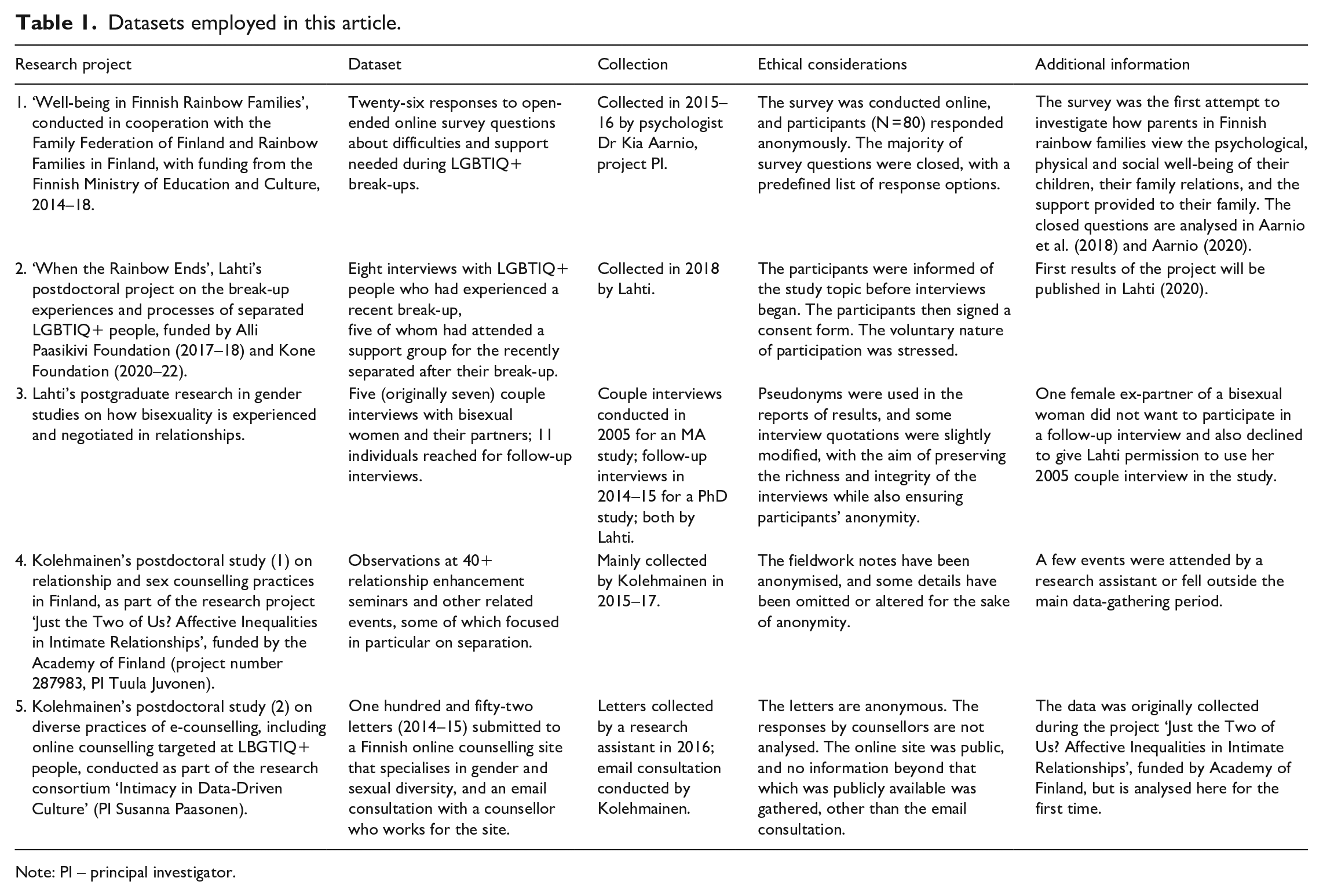
Note: PI – principal investigator.
Contextualising LGBTIQ+ relationships and separations
The question of whether and how same-sex couples differ from mixed-sex couples has been a theme in previous research (for a review, see Lahti, 2015). Nevertheless, no consensus prevails, and the results perhaps provide us with more questions than answers. For example, Gabb and Fink (2015) show that the everyday practices of same-sex couples are very similar to those of mixed-sex couples. However, several studies argue that same-sex couples share household duties, finances and childcare more equally than mixed-sex couples (e.g. Brewster, 2016; Gotta et al., 2011). According to a US study, same-sex couples show more affection and humour when they have a disagreement, and react more positively to such disagreements, than mixed-sex couples (Gottman et al., 2003a, 2003b). Female couples tend to score more highly than mixed-sex couples in relationship satisfaction measures, according to a recent study in Finland (Aarnio et al., 2018). However, numerous studies across Western countries also indicate that female couples are more likely to end up separating than male couples or mixed-sex couples (Aarnio et al., 2018; Andersson et al., 2006; Farr, 2017; Gartrell et al., 2011; Wiik et al., 2014).
Female couples’ high separation rates are often explained as resulting from their lack of support in heteronormative society (Balsam et al., 2017; Frost and Leblanc, 2019). Despite the progress in LGBTIQ+ people’s legal rights in many Western countries, LGBTIQ+ intimacies do not receive the same structural, legal and social support as mixed-sex couples. In Finland, the fear of discrimination from service providers also prevents LGBTIQ+ couples from seeking help such as counselling (Kuosmanen and Jämsä, 2007), and indeed it has been pointed out that counselling practices still foster gender stereotypes and advance heteronormative world views (Kolehmainen, 2018, 2019a). However, it might be easier for LGBTIQ+ people to exit unhappy relationships when institutional support is partial, random, sporadic or absent. Similarly, it might be easier to distance oneself from the cultural ideal that the longer a relationship lasts, the better it is. Indeed, we do not wish to promote the idea that relationship break-ups are always to be avoided. Many experience separation as a means to improve their lives. Even in such cases, however, separations often feel burdensome and troubling, at least temporarily. Furthermore, previous studies have often concentrated on same-sex couples or same-sex parented families without taking into account trans, intersex and queer people’s relationships and families (e.g. Balsam et al., 2017; Gahan, 2018). We suggest that LGBTIQ+ break-ups cannot be approached as unitary whole, but rather there might be important differences within LGBTIQ+ populations.
Previous research on the topic of LGBTIQ+ break-ups suggests that there are significant differences in terms of generation, culture and geographical location. In an Australian study (Gahan, 2018), same-sex parents aged 23–57 were interviewed about their separations, during which they had received support from neither their LGBTIQ+ community nor their friends. The separation often led to feelings of shame, isolation, anxiety and failure. Furthermore, the interviewees felt that they had broken an unspoken rule of same-sex families, which are considered acceptable on condition that they are middle class, ‘well behaved’ and not divorced. This is different from Juvonen’s (2020) study of the separations of middle-aged and older Finnish lesbians and bisexual women, who had often remained friends with their exes after the break-up. Juvonen’s study addresses the burgeoning lesbian community in Tampere, one of the largest cities in Finland, in 1970–90, and as part of that study she interviewed women about their relationships with women during that period. As Juvonen remarks, before the legal recognition of LGBTIQ+ people’s relationships, when the existence of female couples was often overlooked in public discussions, such couples were perhaps able to define the terms of their relationships more freely. Juvonen stresses that the ‘army of ex-lovers’ was one way to stay within and build a lesbian community. However, it must be noted that she does not focus on separated parents in particular, which might explain the different experiences post-separation. Also, in secular Nordic welfare countries such as Finland, separation and divorce are fairly commonplace, which may normalise separation experiences in general.
Finland’s divorce rate has remained at the same level for over 20 years: approximately half of marriages end in divorce (SVT, 2012). Separation and divorce are among the commonest reasons to seek couple counselling or therapy in Finland. There has been a historical shift, from divorce prevention to the nourishment of emotionally satisfying relationships and support for the separation process (Maksimainen, 2014). Indeed, the popular understanding of relationships in Finland entails the ideas of complex relationships and intelligible separations (Maksimainen, 2014). However, it is questionable whether these ideas apply to LGBTIQ+ people’s relationships and separations. It is one thing to be supported as a happily married same-sex couple, and another thing to receive recognition for your grief over your failed relationship. In other words, after legal recognition and increased rights have been granted, heteronormativity may still operate by marginalising emotions of LGBTIQ+ people (Dahl, 2014; Gahan, 2018; Lahti, 2015; Moring, 2013).
While previous studies provide important insights into the fabrics of different relationship forms, when such studies are rooted in dualist notions of sexual orientation or gender they produce limited understandings of the complex, nuanced lived realities of gender and sexual identities and practices, and indeed of relationship dynamics. This has led to the sidelining of other components of LGBTIQ+ relationships and the neglect of differences within same-sex relationships. Deleuzian thinking has been used as a pathway beyond dualisms (e.g. Coleman, 2009), and this article uses Deleuzian assemblage theory to avoid renewing dualisms such as same-sex/mixed-sex, as well as to avoid making a clear-cut division between relationship and break-up. We employ a Deleuzian take that sees gender and sexuality as products of bodies’ relations with other bodies: they are about ‘becoming’ rather than ‘being’ (e.g. Coleman, 2009; Kolehmainen, 2018), which enables us to discuss break-ups without reducing gender and sexuality to individualised identity categories. In order to grasp the affective, lively and often messy realities of relationships, we employ the Deleuzo-Guattarian concept of assemblages (e.g. Kolehmainen, 2018, 2019b; Lahti, 2018), and see multiple and complex elements as coming to matter in relationship break-ups.
Data and methodology
Initially, we became interested in this topic through our respective previous research projects. The first author of this article, Annukka Lahti, interviewed bisexual women and their partners of various genders for her MA study in 2005 and found out that the interviewees sought to fit their relationships into the romantic ideal: to form a durable, happy relationship with one person, possibly for the rest of their lives. When Lahti conducted individual follow-up interviews with the participants for her doctoral study in 2014–15, it turned out that most of the couples had separated in the meantime. Later she started a new line of enquiry by addressing LGBTIQ+ break-ups. The second author, Marjo Kolehmainen, has studied relationship counselling as a part of the research project ‘Just the Two of Us? Affective Inequalities in Intimate Relationships’. In this postdoctoral study, Kolehmainen started to pay attention to the different ways in which relationship break-ups were addressed during participant observation at relationship enhancement seminars (seminars for the recently separated included). Some experts seemed to view break-ups as something to prevent, whereas for others dissolving a relationship was a viable option. However, a couple break-up was often imagined as a dissolving nuclear family, with a father, mother and children. Later Kolehmainen moved on to explore digital intimacies as part of a research consortium ‘Intimacy in Data-driven Culture’. As a part of this study, she is interested in exploring online advice and counselling for LGBTIQ+ people.
When we later decided to write an article together, we wanted to know as much as possible about the topic. Hence, for the purposes of this study, we gathered together all the data on LGBTIQ+ break-ups in Finland that we could access or collect with relative ease. The data we could access comprises the following datasets: survey of divorced partners in LGBTIQ+-parented families who have answered open-ended questions concerning their separations; interviews with LGBTIQ+ people who have experienced a recent relationship break-up; longitudinal interviews with bisexual women and their (ex-)partners about their relationships, most of whom had experienced a relationship break-up; participant observation at seminars for the recently separated; an online counselling site for LGBTIQ+ people; and an email consultation with a counsellor who specialises in LGBTIQ+ issues.
Our different types of datasets span a period of almost 15 years, during which a lot has changed in Finnish society in terms of legislation. Since the registered partnership law for same-sex couples came into effect in 2002 (Act 950/2001), several legislative changes have been made in order to improve the legal position of LGBTIQ+ people and their families, including gender-neutral marriage law (Act 234/1929). Yet these changes might paint too progressive a picture of the societal change writ large. According to a recent study on social attitudes (Jalonen and Salin, 2020), a majority of people in Finland think that homosexuals should be free to live their lives as they wish, and the proportion sharing this view has increased over time. However, the respondents were less accepting towards the right to adoption: in 2016 just over 50% of people in Finland held a view that gays and lesbians should have the same adoption rights as heterosexuals. Hence, the general attitudes towards LGBTIQ+ couples and families have not perhaps improved as much as one might imagine. Thus, the views on and experiences of LGBTIQ+ break-ups might not have changed that much during the period spanned by our data. Notably, it was only after the adoption of gender-neutral marriage in law in 2017 that the first support groups for separated LGBTIQ+ people were established in Finland.
We acknowledge that the datasets are different. However, we do not see this as a problem, especially since we are not seeking to compare them. Hence, we decided not to make a ‘cut’ by excluding any of the available datasets. Cuts refer to processes of inclusion and exclusion in the research process: they are boundary-drawing processes that come to matter through what they reveal or conceal (Barad, 2007). Methodological cuts make some aspects of the explored phenomenon visible but other aspects less so, and the researcher is responsible for the cuts that are made in the practice of boundary-drawing (Coleman and Ringrose, 2013; see also Kolehmainen, 2018; Uprichard and Dawney, 2019). From this perspective, a decision to focus only on ‘similar’ datasets would have been an unnecessary cut – especially as the single datasets in question are relatively small – as we were hoping to map different ways in which break-up assemblages come to matter.
As Table 1 indicates, the survey data was collected in 2015–16 for the research project ‘Well-being in Finnish Rainbow Families’. The majority of the survey questions were closed rather than open-ended, with a predefined list of response options. The closed questions have already been extensively analysed elsewhere (Aarnio, 2020; Aarnio et al., 2017, 2018). The results showed that of the 89 parents surveyed, 68% had separated at least once. Aarnio’s (2020) analysis showed that 6 out of 10 separated parents were on good or very good terms with their ex-partners. Four parents out of 10 described their relationships with their ex-spouses as difficult or even broken. Fifteen parents wrote about difficulties in their break-ups, and 11 said that they had not received enough support during their break-ups. The 26 open-ended answers are analysed in our study.
Of the two sets of interview data, the first consists of eight interviews (conducted by Lahti) with LGBTIQ+ people who had experienced a recent break-up. All the interviewees reported their official gender as female; however, one identified as non-binary gendered and had gone through a trans process, one identified as ‘gender-neutral’, and one said that they did not see their gender as ‘100% female’. The participants were aged 29–53. In this article we refer to these interviews as ‘separation interviews’. The first results of the study indicate that participants’ relatives often did not recognise or take seriously the grief and other complex affects related to the break-up (Lahti, 2020). The participants received more support from their LGBTIQ+ and other friends during their separations.
The second set is longitudinal, consisting of five (originally seven) couple interviews with bisexual women and their variously gendered partners (four women and three men, one of whom identified as a transman), conducted in 2005, and 11 follow-ups conducted some 10 years later in 2014–15. Participants were aged 22–42 at the time of the first interview, and 32–52 at the follow-up. The results of the study revealed that the partners reiterated normative relationship discourses and stressed their equality with and similarity to heterosexual couples, as was fostered by Finnish public debates about registered partnerships (Lahti, 2015). However, by the time of the follow-up interviews, the majority of the couples interviewed in 2005 had separated, and most interviewees had new partners. The accounts of these separations in the follow-up interviews are the focus of this article. We refer to these interviews as ‘interviews with bisexual women and their ex-partners’.
The participant observation data consists of fieldwork notes (collected by Kolehmainen) from more than 40 relationship and sex counselling events (2015–17) that ranged from relationship enhancement seminars to a tantric workshop, and from events catering to the recently separated to variously themed lectures by experts. These events were collective, public or semi-public occasions whose venues ranged from public libraries to fairs, and from religious gatherings to hotel facilities. Some were organised by national non-governmental organisations, and employed counselling professionals from psychotherapists to certified couple counsellors as experts; others were part of spiritual, religious or commercial activities and often relied on lay experts. This data has been analysed extensively from several points of view, resulting in articles that stress, for instance, that it is common for relationship enhancement seminars to draw on gender stereotypes (Kolehmainen, 2018) and to advance heteronormativity in a number of ways (Kolehmainen, 2019a), even though the experts at least apparently support gender equality and sexual rights. However, for the purposes of this article, we focus especially on events that addressed separation. None of these specifically addressed LGBTIQ+ break-ups, however. The data has not previously been analysed from this perspective.
In order to get more information on support-seeking regarding LGBTIQ+ separations, we also analyse letters submitted to a Finnish online counselling site (2014–15) that specialises in gender and sexual diversity, which in practice refers largely to LGBTIQ+ issues. The site is unique in Finland for its foregrounding of diversity. Of 152 letters, 30 touch upon separation, although some only mention past relationship break-ups in passing. Eight letters focus more specifically on separation, but remarkably, not all of them do so exactly from the perspective of LGBTIQ+ relationships: some are from writers who indicate that they are straight, or at least in a mixed-gender relationship. Uncertainty over whether the writer or their partner is straight is a concern in several letters; these writers worry about the possibility that they might be lesbians, or that their partners might secretly be gay. We also consulted via email a counsellor who specialises in LGBTIQ+ issues and works for this site.
Our data provides multiple perspectives on break-ups, from manifold accounts: difficulties in LGBTIQ+ break-ups (survey answers), break-ups across the life course (interviews with bisexual women and their ex-partners), recently experienced separations (separation interviews), cultural understandings of break-ups and appropriate support (participant observation at seminars for the recently separated), and anonymous online letters regarding breaks-ups or the fear of break-ups (counselling website). The datasets are not commensurable, but since there is very little information available on the topic, we wanted to take into account all the data we had in order to form a background understanding of LGBTIQ+ break-ups in Finland. We do not treat the data as passively waiting to be gathered and analysed in order to enable us to find ‘truthful’ information about LGBTIQ+ break-ups (see Koro-Ljungberg, 2016). The data entails different entry points into the phenomenon, making it alive and vibrant. Our analysis is guided by new materialist ontology, which foregrounds the importance of production and relational processes. Our analysis of break-ups thus focuses on relational networks (Fox and Alldred, 2015, 2017; Kolehmainen, 2018). This approach enables detachment from the human-centred paradigm that would approach separations by identifying the reasons behind the break-ups. Of course, our data would allow us to identify reasons for LGBTIQ+ break-ups that would be very similar to those for mixed-sex break-ups – growing apart, mental health issues, alcohol and drug use, or the challenges of everyday life with small children – as well as reasons specific to LGBTIQ+ separations, such as identity transformations, closet-related issues, and the pressure to appear as happy and ordinary as possible. However, as the counsellor we consulted remarked, many of the ‘similar’ reasons are actually quite different when seen from an LGBTIQ+ perspective. For example, receiving support might require one to come out in the public healthcare system, or in other encounters with service providers – and the unpredictable consequences of coming out might cast a shadow over an already tense situation.
Nevertheless, this shift of focus – from the exploration of the reasons behind break-ups, to the exploration of break-up assemblages – is motivated by our desire for a more nuanced approach to break-ups that does not rely on causal models. We believe that assemblage theory provides tools to better understand the multidimensional dynamics of break-ups. From a Deleuzian viewpoint, the methodological tasks are to apply methods that enable the identification of relationships within an assemblage (see also Fox and Alldred, 2015), and to enter the middle, the ‘between’ – that is, to relate (Coleman and Ringrose, 2013). We seek to understand break-ups in ways that do not assume pre-given start or end points, or causal lines. As we follow the datasets from a Deleuzo-Guattarian rhizomatic point of view, it is possible to make multiple and non-hierarchical entry and exit points in the data and its interpretation. Hence, in what follows, we seek to identify the relations within the break-up assemblages. Importantly, we show how various elements come to matter in different ways in the course of the open-ended becomings of relationship break-ups.
Analysis
We have chosen to focus on three distinct themes in our analysis rather that represent all the themes present in the data. From our point of view each theme provides a relevant angle on break-up assemblages by destabilising one particular dualism that is often associated with LGBTIQ+ break-ups. All of the dualisms presume a notion of time at a standstill. Our analysis points to a different kind of temporality, where the different components and manifold power relations of a break-up assemblage are on the move and constitute one another relationally. The themes are: (1) hetero- and couple normativity in assemblages, which provides insights into how assemblages (de-)centralise norms; (2) sameness, difference and beyond, which maps how sameness and difference are situational and temporal processes; (3) breaking up beyond fixed categories: from identities to assemblages, which destabilises the very notion of LGBTIQ+ break-ups, as well as questioning the clear-cut dualism between couple relationship and break-up.
Hetero- and couple normativity in assemblages
One of the most obvious ways in which LGBTIQ+ relationships are interpreted is through the lens of heteronormativity. However, we take that with regard to break-ups, heteronormativity might take different forms that operate situationally. Heteronormativity refers to the various, often mundane ways in which heterosexuality is naturalised and privileged in everyday life (e.g. Jackson, 2006; Kolehmainen, 2019a; Roseneil et al., 2013). Heteronormativity in LGBTIQ+ break-up situations operates, for example, as a lack of recognition of the grief and other complex emotions attached to the relationship that has ended (Gahan, 2018; Lahti, 2020). However, our analysis shows that how heteronormativity functions in a break-up assemblage depends on the other elements and relations in the assemblage.
Heteronormative assumptions are still very present in counselling seminars for the recently divorced. For instance, experts at an event for the recently separated referred to partners in gender-neutral terms – ‘spouses’, ‘partners’, etc. – but when they shifted focus from dyadic couple relationships to the theme of separation from a child’s viewpoint, they assumed a family that had (only) two parents, a mother and father, as demonstrated in this image presented by one of these experts (Figure 1). This example demonstrates that when a child is brought into a relationship assemblage, the discourse slips from gender-neutral language into a discourse where gender difference is alive and well. It might also be telling of a situation where biological kinship evokes heteronormative interpretations.
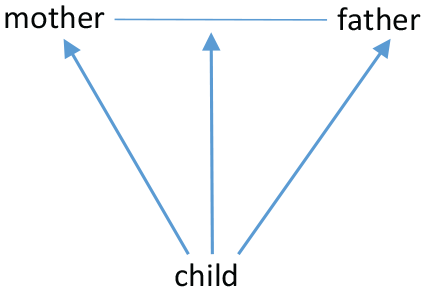
Diagram used in counselling seminars
The next example is from an interview with a bisexual woman in her 30s who had separated from her registered partner a couple of years previously. The relationship had lasted for 10 years, and she had had a child together with her ex-spouse; they shared custody following the divorce. The interviewee recalled the lack of support from her family members, who had failed to recognise the pain she had experienced after breaking up with her partner. Indeed, her mother had belittled the significance of this same-sex relationship: Well, I don’t believe that they have managed to say much about it to me, and even when I have tried to discuss this with my mother from time to time, she doesn’t really.… Perhaps she’s not able to provide any support, in the regard that she is horrified by the situation, like, aren’t you missing that child enormously all the time and so on, and of course I am. Yet she doesn’t . . . kind of consider the option that I might be missing my ex, too. She doesn’t see that as relevant in a similar way. (from Study 2, Separation interview)
In this case too, a child is seen as the most essential component in the assemblage of intimate and familial relationships, which in turn decentralises the same-sex relationship. In other words, here again heteronormativity creeps into the picture when children are discussed. Biological kinship between mother and child is seen as the primary social bond that defines the whole separation process: the break-up is understood first and foremost through the issue of parenting, not as an LGBTIQ+ separation.
This resonates with the queer critique of the current LGBTIQ+ struggle for recognition by claiming ‘family rights’. The lesbian and gay movement has tended to respond to the stigma of homosexuality by attempting to empty homosexuality of its associations with shameful sex, cherishing the norms of marriage and family, and thereby claiming respectability (Butler, 2004; Warner, 2000). Here, even though she has forged a respectable family union with a same-sex spouse, at the moment of break-up the interviewee’s queer affection is blocked off from her relational assemblage.
The next example provides insights into a different kind of assemblage, where the relationship between parent and child organises a teenage girl’s other relationships, including their quality and intensity. The girl has submitted a letter to the online counselling site, writing that her mother has forced her to break up with her girlfriend by threatening to abandon her. In this case, it is the mother who enacts the relationship break-up, first by mentally abusing her daughter upon discovering that she is a lesbian, and then by blackmailing her to stop dating a girl: I’m a 15-year-old girl and I’ve known that I’m a lesbian for a couple of years. Recently my mother found this out and got so angry at me that she didn’t talk to me for almost a month. I’ve met a girl, and we kind of started to date each other. My mother found this out and gave an ultimatum: either I leave this girl, or she moves away and leaves me on my own. I decided to break up with this girl, as I would rather not be at sixes and sevens with my mother because of one girl. I haven’t talked to this girl since then. About a week ago, I heard that this [girl] is planning to come see me, but I don’t know when, where or why. I’m afraid that my mother will see this girl and will threaten me again. Nevertheless, I still love this girl, but if I start dating her my mother will give up on me completely. Should I skip meeting this girl and please my mum? I soon have no way to meet girls, no matter if one is a lesbian or not. I hardly have any friends any more because my mother thinks all girls are lesbians! (From Study 5, letter submitted to an online counselling site)
Here the writer’s vulnerability – as a minor who is dependent on her mother – defines the networks of relationships she is (un)able to maintain. The mother is trying to block her from becoming lesbian, and has apparently also been able to limit her engagements by isolating her not only from her girlfriend, but also from her wider circle of friends. Here gender matters beyond the relationship assemblage, exceeding same-sex affection to become a territorialising force that blocks the writer’s relationships with friends, and thereby also multiplying the blockages in becomings of queer desire. Further, the mother limits the writer’s capacities to live as a lesbian girl, and her network of relations seems to be shrunken.
Sameness, difference and beyond
As previously noted, questions of sameness and difference are at the heart of much LGBTIQ+ politics. LGBTIQ+ relationships are almost routinely compared to heterosexual relationships, both in everyday encounters and in much academic enquiry (see Lahti, 2015 for a review). However, difference from or similarity to the heterosexual norm might come to matter in different ways in the course of a relationship, plugging in or unplugging components of a relationship assemblage. Sameness and difference are far from static and clear-cut divisions; rather, they are processes of open-ended becoming. The following example shows that the effects of the partner’s gender within a break-up assemblage were intensified because the separation in question happened before it became possible to adopt the child of a same-sex partner in Finland. The respondent explains that she and her ex postponed their divorce until the amendment to the law on registered partnership (Act 950/2001) that allowed adoption came into effect in 2009: We separated at a time when it was not possible to adopt the child of one’s same-sex spouse. I was so afraid that my ex-spouse would take the child from me, although I had given birth to another child in the same family, and we were in a so-called stalemate situation. I knew this had happened in many families of female couples. I was afraid that we would be in dispute. I spoke about this fear to my ex-spouse, and we agreed that she could trust me not to take the children away from her. So we made an agreement that I’d become a parental guardian, and we would postpone the official divorce until adoption was possible. It was a terrible time: we lived together part-time, and she abused me physically. I had to postpone the official separation for two years because my ex-partner didn’t send the adoption papers for my biological child to the district court, although I had already adopted her biological child. Later we had a custody dispute, where I think on top of everything else the cultural idea that there’s something wrong with being a non-resident mum affected us both negatively. (From Study 1, open-ended survey answer)
This an acute example of a situation where the respondent kept silent about problems in a female relationship, not only to perform happiness and normality in compliance with certain social norms but also to be able retain custody of her child. The law played a pivotal role in organising the relationships within this assemblage. The ex-partners continued living together part-time, and the interviewee became a victim of physical abuse. Even when the new law came into effect, the ex-partner refused to apply for a legal adoption order, which further complicated the situation. In this assemblage, the law had the power to intensify and create asymmetrical power relations not only between same-sex and mixed-sex couples, but also between spouses, as the interviewees’ ex used the lack of legal recognition (of a child that was not biologically hers) to block her ex-spouse’s ability to act, and to diminish the vitality of her body in the form of physical abuse.
Later, the two mothers had custody disputes. Here gender played a role: it is socially more acceptable for fathers to be non-resident parents than it is for mothers. In other words, cultural stereotypes and norms were also strong components in this assemblage, where the two ex-partners both found non-resident mothering uncomfortable.
Similarity and difference always come into being and intensify as uniquely assembled elements. Even within a single relationship, the fact that it is a same-sex relationship comes to matter differently throughout the process. For example, the bisexual woman discussed above – whose ex-partner’s gender mattered in how her mother treated her grief – also talked about the factors that had put a strain on her relationship in generic terms. The ex-partner’s gender thus came to matter in certain situations, such as when the break-up was considered through the category of mothering, but was unremarkable at the moment of the break-up itself, which took place in the midst of the so-called peak years. Peak years refer to the intense periods of life when there are care responsibilities – when the children are small (and some people also have to look after their elderly parents) – and there is also pressure to advance in one’s career : I think it was . . . quite typical peak years with a small child, and then this ex-spouse of mine had a quite busy or stressful job, which took a lot of time. So she concentrated quite a lot on that, and I guess I concentrated quite a lot on the child, and of course I had my own business as well, so it all required a lot of organising. We had a few tough years when our child was still small, and we somehow forgot to pay as much attention to each other, I guess. (From Study 2, separation interview)
In this assemblage, the partner’s stressful job came together with the responsibilities of caring for a small child and running a business, diminishing the vitality of the partners’ relationship as part of the ‘busy’ assemblage. This is very recognisable, and the gender of the spouses did not seem to matter much during this period of their relationship, although later their genders acted as territorialising forces with the power to steer their relatives’ reactions to the break-up.
Breaking up beyond fixed categories: from identities to assemblages
Our data includes several instances where separations cannot easily be defined as ‘straight’ or ‘LGBTIQ+’ break-ups, and where wide conceptual frameworks such as heteronormativity can only very partially account for the nuances involved. Particularly in the letters to the online counselling site, the inability to define and fix stable, clearly bounded identities causes anxiety and confusion, leading several writers to reflect upon the possibility of ending their current relationships. For instance, in the following letter, the young writer stresses that she sees herself as a straight woman and does not want to break up with her fiancé, and yet she is afraid of becoming a lesbian: I’m a 25-year-old woman and have lived in a happy relationship for more than two years. From time to time I experience intensifying anxiety about my own sexual orientation. My workmate revealed to me that she’s a lesbian, and she made a comment that it takes one to know one . . . I have always taken for granted that I’m straight, and I have never ever imagined that I fancied women, and I haven’t yet had any crushes on women. But I feel that finding women attractive or becoming a lesbian would be the worst scenario now, when I’m in a good relationship. I’m afraid that if I see someone who is clearly a lesbian, she will infect me with the same thing. I have nothing against lesbians. I just would rather not be one now, when I’m in a happy relationship with a man whom I love and whose children I wish to have. . . What if I just wake up as a lesbian some day? I find butch lesbians in particular disturbing, with those you cannot tell whether they are men or women. I’m afraid that if I just look at them, something will happen, or if I sit on a bench where they sat before, I might turn into a lesbian. (From Study 5, abridged extract from a letter submitted to an online counselling site)
It would be limiting to understand this writer’s concern through the category of identity, which might lead to the forced interpretation that she is ‘in denial’ about her true self. Rather than interpreting her story as an account by a closeted bisexual or lesbian or a ‘late bloomer’ – or in other identitarian terms – we see it as a story of ‘becoming’ rather than ‘being’. In other words, we take it that (her) sexuality can be seen as a process of becoming (with) part of an assemblage, which exceeds human or individual identity, rather than as a fixed identity. From this perspective, becoming a lesbian can be seen as a trans-subjective and intercorporeal process, rather than in terms of an individual trait or inner truth. When bodies are not seen as bounded, singular and autonomous entities, it becomes possible to recognise the relevance of trans-subjective and intercorporeal processes (Blackman, 2012). In Deleuzian terms, the process of becoming a lesbian can be seen as ‘starting from the middle’, without assuming a long-suppressed desire or ‘true’ self.
Indeed, a temporal perspective is essential for our interpretation. The writer seems to be resisting the possibility of being a lesbian in the present moment, rather than rejecting the idea of becoming a lesbian in the future. She writes that she has not ‘yet’ had any crushes on women. Interestingly, rather than an individual, innate identity or desire, lesbianism is considered as an assemblage that has the capacity to act upon the writer through trans-subjective and intercorporeal contagion. For instance, lesbianism is imagined as an assemblage that might take hold of her and turn her into part of it if she sits on a bench where lesbians have previously sat. Hence, lesbianism extends itself beyond human, individual bodies, working across and on human and non-human bodies, objects and things, assembling through matter such as the bench.
The following example also demonstrates that the understanding of LGBTIQ+ break-ups should not be reduced to the issue of sexual orientation, and that the comparison between ‘same-sex’ and ‘mixed-sex’ relationships might fail to do justice to either ‘type’ of relationship or identity. In this excerpt, the interviewee recalls various overlapping reasons for her recent break-up with her partner, who was undergoing a female-to-male trans process at the time of their separation. Multiple issues played a role and strained the relationship: her partner’s transition process; welfare reports regarding her child, initiated by her male ex-partner; her parents’ struggle to accept first her ‘same-sex relationship’ and then her trans partner; her partner’s criticisms of her child-rearing practices; etc.
We had every possible process going on, I had these child welfare report processes, and he had the trans process going on, and our jobs on top of it. This process, to support one’s partner’s trans process, it was kind of tough, although I wasn’t in charge of it or didn’t meddle in his business, but nevertheless to be there to support him and be a little bit afraid about everything going well. Of course there’s also joy, when you see that the other person is evolving, and there are joyous moments.… When he enjoyed his masculinity, it was nice. But also a strain to think what it all means in practice, and how it affects the relationship, and how can one adjust to it, and what might happen to one’s own affection. There is a certain kind of uncertainty there. But on the other hand, it strengthens the relationship and the bond. But in the end, in our case it somehow.… Well, I cannot say that it tore us apart. It’s not like that. It’s a very multifaceted issue. But then again, what kind of man he became, how he was as a man, he wasn’t quite like a man I could live with. (From Study 2, separation interview)
What happened in the relationship can best be understood through the idea of rhizome: there were multiple rhizome-like power relations that came together in the relationship, leading to various challenges. The interviewee recalls that the transition process, during which her partner became more masculine, gave her moments of both joy and concern. She experienced joy on behalf of her partner, who could now enjoy his masculinity, but she was also worried about his new ‘hypermasculine’ characteristics, such as being grumpy, lying on the sofa, and drinking alcohol on weekdays.
Moreover, the interviewee’s male ex-partner initiated welfare reports regarding her child, first because her new partner ‘was a woman’, and then because the partner was undergoing transition. Social services repeatedly refused to accept this as a reason to suspect that the interviewee was unable to care for her child, but it nevertheless placed a strain on her, her partner and their relationship. Thus the problems of an unequal heterosexual relationship assemblage and its power imbalances ‘jumped’ from the previous relationship and territorialised the interviewee’s new relationship assemblage (see also Lahti, 2018).
However, our analysis of this relationship assemblage also stresses that it might not be fruitful to assume a clear division between ‘unequal heterosexual’ relationships and ‘equal LGBTIQ+’ relationships. The transitioning partner was also very critical and controlling towards the interviewee’s child-rearing practices, which caused constant struggles in the relationship. According to the interviewee, this was related to the partner’s gender: he had not won his father’s acceptance as a boy. Here his gender mattered, but not in a straightforward way. His experience of not getting recognition for his masculinity as a child, as well as his childhood experiences of vulnerability and powerlessness, were connected in a rhizomatic way to his new family assemblage, where they gave energy to his envy of his partner’s child. His experience of vulnerability was reproduced in this new family situation, where he felt that his partner spoiled her child by listening to him and giving him too much attention. Although the interviewee was able to identify this dynamic, and also to see her partner’s vulnerability as a transperson, his abuse of power by trying to make her choose between him and her child diminished her vitality as part of the relationship assemblage. All these issues developed as processes during the relationship, intensifying at some points and eventually leading to the break-up.
Conclusions
In this article, we have extended current perspectives by conceptualising and analysing LGBTIQ+ break-ups without taking their ‘similarity to’ or ‘difference from’ mixed-sex relationships as a predefined point of departure. Rather, we have sought to recognise the different components that come to matter in break-up processes without limiting the analysis to predefined dualisms. We understand relationship break-ups as assemblages where multiple elements come together in situational, temporally shifting ways. Often these elements and dynamic processes are organised in certain ways, such as in gendered, sexualised, classed and racialised power dynamics, as well as in the painful relationship dynamics that come together in break-up assemblages. Importantly, the power dynamics come to matter differently in the course of the relationship, depending on relational processes that shift through time. By approaching break-up processes as assemblages, we have revealed the multiplying effects of break-ups, and highlighted their ongoing and unpredictable processes.
Our analysis has destabilised the central dualisms that are often associated with LGBTIQ+ break-ups. We have shown how heteronormativity, being itself an assemblage, (dis)assembles the relational networks in several LGBTIQ+ break-up assemblages. But it takes different, temporally and situationally shifting forms, depending on the other components and relations in the assemblage. Specific social orders – for example, how the respectability of different relationship forms and sexualities is perceived, and how recognisable various sexualities and genders are – come to matter depending on the assembling of different elements. Furthermore, sameness to and difference from the heterosexual norm can plug in or unplug new elements in a relationship assemblage, and are thus anything but static and clear-cut divisions. At some points during the becoming of a relationship, the partners’ genders might not matter much, but the effects might intensify during a break-up, depending on the other assembling elements. For instance, inadequate legal protection for LGBTIQ+ couples might assemble with and intensify other problems in the relationship. Finally, our analysis reveals that break-ups cannot be easily divided into ‘straight’ or ‘LGBTIQ+’ break-ups. The effects of an LGBTIQ+ break-up assemblage are not determined by the participants’ identities, but by the specific relations it forms with other bodies, relations, ideas and affects.
Conceptualising break-ups as assemblages enables us to see both ‘difference from’ and ‘sameness as’ mixed-sex couples, but because all assemblages are unique (see De Landa, 2006), this conceptualisation prevents straightforward generalisations. Assemblage theory makes it possible to analyse break-ups in ways that do not reduce gender and sexuality to individual human subjects, or stabilise categories such as ‘homosexuality’ and ‘heterosexuality’ in predictable, predefined ways. An assemblage is always a multiplicity whose components are integral to its existence (Buchanan, 2015: 385). Yet although they are complex and multiple, it would be a mistake to see break-up assemblages as random. An assemblage is not a chance collocation of people, materials and actions (Buchanan, 2015: 385). Since all assemblages are unique, singular in their individuality, we should also be able to specify the individuation process that gave birth to them (De Landa, 2006). As our analysis has shown, for example, heteronormativity, homophobia and transphobia (being assemblages themselves) (dis)assemble the relational networks in several LGBTIQ+ break-up assemblages.
When we are talking about relationship break-ups, this concept stresses the multiplicity of elements that might play a role in the process of (dis)assembling relationship arrangements, from the relationship between the partners to the other people involved (ex-partners, relatives, children, social workers, etc.), and from societal power relationships (norms, heteronormativity, homo- and transphobia, gendered asymmetries, etc.) to non-human elements (such as legislation, or material objects such as a bench). However, an assemblage cannot be reduced to its components, as it is always more than just the sum of its elements. Even if similar elements can be identified in different break-ups, assemblage theory still recognises the uniqueness of individual LGBTIQ+ break-ups – unlike research designs that foreground the search for reasons – and ultimately it is relations, rather than components, that are essential for analysing assemblages.
Footnotes
Acknowledgements
Our heartfelt thanks to everyone who commented an earlier version of this paper. In particular, we would like to thank the two anonymous reviewers for their insightful comments as well as the editors of the special issue for their support in this project. We would also like to thank the participants of the IAS residential seminar for commenting an earlier draft of this paper while Kolehmainen was an IAS Visiting Research Fellow at UCL’s Institute of Advanced Studies in the Humanities and Social Sciences in 2020.
Funding
Annukka Lahti’s research on LGBTIQ+ break-ups (Project ‘When the Rainbow Ends’) is funded by Alli Paasikivi Foundation 2017–18 and the Kone Foundation 2020–22. Marjo Kolehmainen’s study of relationship counselling (Project ‘Just the Two of Us? Affective Inequalities in Intimate Relationships’ (grant number 287983), was funded by Academy of Finland 2015–19). She went on to explore digital intimacies as a part of a research consortium Intimacy in Data-Driven Culture (IDA), funded by the The Strategic Research Council (SRC) at the Academy of Finland.
