




Abstract
Temporary work is common across Europe, especially among young people. Whether temporary employment is a transitory stage on the road to standard employment, and whether this varies depending on institutional contexts, is controversial. This article investigates variability in transition rates from temporary to permanent employment across Europe, and how this is related to employment protection legislation (EPL) and the vocational specificity of education systems. We utilize harmonized panel data from the European Union Statistics on Income and Living Conditions, covering 18 European countries and including 34,088 temporary workers aged 18–30. The results show that stricter EPL is associated with lower rates of transitions to permanent employment, while partial deregulation, with strict EPL for permanent contracts but weaker EPL for temporary contracts, is associated with higher transition rates. Vocationally specific education systems have higher transition rates, on average. Moreover, the role of EPL is conditional on the degree of vocational specificity.
Keywords
The use of temporary employment contracts in Europe has increased dramatically since the 1980s. Temporary employment generates new social divisions, and has been called the ‘new European inequality’ (Gash and McGinnity, 2007). In terms of temporary employment risks, age is perhaps the most decisive feature, and youth and young adults are heavily over-represented among temporary workers across Europe (Dieckhoff and Steiber, 2012).
Whether temporary contracts (i.e. employment contracts of limited duration) facilitate integration into the labour market for young workers, or whether young workers, rather, tend to become stuck in recurrent spells of temporary employment and unemployment, is subject to controversy (Eurofound, 2013; Gebel and Giesecke, 2016). Empirical findings, from various countries, have been mixed (Baranowska et al., 2011; Booth et al., 2002; Gash, 2008; Gash and McGinnity, 2007; McVicar et al., 2018; Svalund and Berglund, 2018), which raises the question of whether differing institutional contexts shape this process. From the perspective of the integration of young workers into the labour market, two of the most prominent institutional factors are the employment protection legislation (EPL) and the education system (Breen, 2005). EPL regulates the use of temporary contracts, as well as the incentives that employers have for using temporary as opposed to permanent contracts, while education systems are crucial for the human capital of young workers, and thus for their ability to participate in the labour market (Dieckhoff and Steiber, 2012; Shavit and Müller, 2000).
The aim of this study is to investigate how each nation’s EPL and the vocational orientation (specificity) of their education systems shape the chances of transiting from temporary to permanent employment among young workers in Europe. We use individual-level panel data from the European Union Statistics on Income and Living Conditions (EU-SILC), covering 18 countries from 2004 to 2013. In line with much of the previous research on the role of institutions in creating labour market inequalities (Barbieri and Cutuli, 2016; Breen, 2005; Gebel and Giesecke, 2011, 2016), we use a cross-country comparative approach to analyse the importance of different institutional contexts for transitions between employment contractual states. With the growth of harmonized micro-data, comparative approaches have become a backbone of institutional analysis, enabling researchers to observe similar micro-level processes, such as labour market transitions, in different institutional contexts.
This study adds to previous research on the relationship between the institutional setting and temporary employment in several ways. First, most comparative research on contractual transitions have been ‘small-N’ comparisons limited to few countries (Gash, 2008; Gash and McGinnity, 2007; Scherer, 2004; Svalund and Berglund, 2018). Notable exceptions are Barbieri and Cutuli (2016), who use repeated cross-sectional data on prime-aged workers, transforming it into ‘pseudo-panels’, and Passaretta and Wolbers (2016), who use retrospective data on first job after leaving education. However, there is a need for more studies on employment transitions, using individual-level panel data from a large number of countries. With our large sample of country units, we can explicitly test the role of institutional context, and tease out the relative importance of different institutional factors.
Second, the study contributes to the debate regarding the function of temporary contracts. It is still controversial as to what extent temporary contracts are predominantly dead-ends, or function as stepping-stones to standard employment, and how and why these processes vary across institutional contexts (Barbieri and Cutuli, 2016; Passaretta and Wolbers, 2016). The comparative focus, coupled with panel data, allows us to investigate which of these two scenarios is dominant and where, and thus whether having a temporary contract means the same thing in terms of future employment prospects across European countries. Third, very few studies have looked at how the education system is related to transitions from temporary to permanent employment, despite the importance of the education system for youth labour market outcomes (Gash and McGinnity, 2007; Shavit and Müller, 2000).
Previous research and theoretical framework
Employment contracts are the outcome of a micro-level interaction between employers and workers (Polavieja, 2003). To simplify the following argument, we will assume that most workers prefer a permanent contract to a temporary one, and focus on the rationale of the employer. From the employer’s perspective, temporary contracts can serve at least two purposes (Gebel and Giesecke, 2011; Polavieja, 2003). 1 First, temporary contracts can serve as a buffer that provides employers with numerical flexibility and ensures that the size of the workforce can be adjusted in relation to fluctuations in market demand. Keeping a stock of temporary workers, whose contracts do not have to be renewed when they expire, can ensure this numerical flexibility at a low cost. This function is related to labour market segmentation theories (Polavieja, 2003; see also Piore and Doeringer, 1971), according to which labour markets consist of a primary sector, with stable employment (i.e. permanent contracts) and good wages, and a secondary sector, with unstable and temporary employment, with a low degree of mobility between these two.
Second, temporary contracts can serve as a screening device for employers. Signalling theory (Spence, 1973) suggests that, as workers’ productivity cannot be known to employers beforehand, employers use information based on the workers’ observable characteristics when deciding on prospective employees. In the absence of strong signals, employing workers on a permanent contract entails a risk for employers. Temporary contracts can then function as a probationary period, during which the employer can observe the worker and decide whether or not to offer a permanent contract later on (Baranowska and Gebel, 2010; Gash, 2008). This is especially relevant for young workers with little experience, as their productivity is relatively unknown to potential employers (Dieckhoff and Steiber, 2012; Kahn, 2007).
The first function of temporary contracts (the buffer function), in line with labour market segmentation theory, predicts that movement between contractual states is rare (Gash, 2008). If the buffer function is dominant, temporary workers are at risk of becoming trapped in successive spells of temporary employment, with few moving on to permanent employment. The second function (the screening function) predicts that transitions from temporary to permanent employment will be more common (Gebel and Giesecke, 2011). Young workers, whom employers would consider too risky to hire on a permanent basis, are given a ‘foot in the door’, and an opportunity to eventually gain a permanent position (Booth et al., 2002; Gash, 2008). The following section outlines how the institutional context – labour market legislation and education systems – can be expected to shape the relative importance of these two functions.
Employment protection legislation
Cross-country differences in EPL have been in focus for much of the comparative work on temporary employment. Theoretically, this builds on the assumption that the micro-level behaviour of firms and employees is shaped by institutions (Polavieja, 2003). EPL regulates both the freedom of employers or firms to dismiss workers, and their freedom to use the type of employment contract that they see fit when hiring workers (Gebel and Giesecke, 2016). The freedom to dismiss workers reflects the costs and inconveniences associated with terminating a permanent contract, for instance severance payments (hereafter called EPL-regular). The freedom to decide the type of employment contract when hiring workers reflects the legal limitations of using temporary contracts and temporary work agencies, for example, the maximum number of successive temporary contracts (hereafter called EPL-temporary) (OECD, 2017).
Strict EPL for regular (permanent) contracts leads to higher potential costs of hiring and firing for employers, and is associated with higher temporary employment rates among young workers (de Lange et al., 2014; Kahn, 2007). Higher firing costs should lead to lower transition rates to permanent employment through both the buffer and screening mechanisms outlined previously. First, when terminating a permanent contract becomes more costly, employers have a greater incentive to ensure numerical flexibility through a buffer stock of temporary employees (Polavieja, 2003). Second, the higher costs of firing should increase the need for, and prolong the use of, temporary contracts as screening devices, since firms need stronger signals of productivity when terminating contracts due to low productivity is more difficult (Baranowska and Gebel, 2010).
By making the use of temporary contracts more restrictive for employers, strict EPL for temporary contracts should, lead to lower temporary employment rates (Dieckhoff and Steiber, 2012; Gebel and Giesecke, 2016; Nunziata and Staffolani, 2007). However, the effects of the strictness of EPL-temporary on transitions from temporary employment are less clear-cut. From the perspective of the need for flexibility (the buffer function), the deregulation of temporary contracts makes it easier for employers to both keep and renew a stock of temporary workers, and also to substitute permanent workers for temporary ones (Gebel and Giesecke, 2016). When employers are free to use several successive temporary contracts for the same worker, they are not forced to convert these contracts to permanent ones if they desire to keep that worker (Blanchard and Landier, 2002). The buffer function thus leads to a prediction that deregulated EPL-temporary reduces transitions to permanent employment.
Strict EPL-temporary also makes it more difficult and costlier to use temporary contracts for screening purposes, but the screening function does not in itself imply predictions regarding the effects on transition probabilities. One possibility is that, if EPL for temporary employment is strict, fewer workers will have these types of contracts, making temporary workers a more select group. If temporary employment is then more stigmatized among the general population, employers might be more unwilling to hire temporary workers on a permanent basis. In other words, if the use of temporary contracts is less common, employers might be inclined to interpret these contracts as signals of low productivity. In support of this proposition, Nunziata and Staffolani (2007) found that stricter EPL for temporary contracts was negatively associated with permanent employment rates across European countries. It should also be noted that strict EPL-temporary might increase flows into unemployment if employers are not allowed to renew temporary contracts when they expire (Blanchard and Landier, 2002).
Moreover, the strictness of the two types of EPL should not be considered separately, and central factor is the gap between the two (Barbieri and Cutuli, 2016; Dieckhoff and Steiber, 2012; Svalund and Berglund, 2018). In a situation of partial deregulation or flexibilization at the margin, where EPL-temporary has been liberalized while EPL-regular remains strict (a large ‘EPL-gap’), both the buffer and the screening functions imply that employers have an added incentive to offer renewals of temporary contracts instead of converting them into permanent ones (Blanchard and Landier, 2002; Noelke, 2016). Accordingly, Passaretta and Wolbers (2016) found that stricter protection of permanent contracts, when compared to temporary ones, reduced transitions out of temporary employment; and Barbieri and Cutuli (2016), in a European comparison, found that the probability of temporary workers ending up in permanent jobs was lowest in southern Europe, which can be related to the large EPL-gaps there.
Education systems
While there has been a great amount of interest regarding the relationship between the strictness of EPL and temporary contracts, less interest has been shown regarding the role of education systems (Gash, 2008). This is surprising, given that the education system has been found to be a central factor in youth labour market outcomes (e.g. Breen, 2005; Shavit and Müller, 2000). Previous research highlights that, in particular, the vocational orientation and specificity of upper secondary education is of importance in this regard (Breen, 2005; de Lange et al., 2014). Vocational specificity denotes the extent to which education provides students with vocational skills, and the specificity of these skills, which entails that education is closely tied to specific occupations. The specificity of vocational degrees is of particular importance from the perspective of signalling theory, mentioned earlier. For an employer with incomplete information regarding the productivity of prospective employees, the educational credentials of a worker are essential observable characteristics that convey information about his or her likely productivity. The signalling value of educational credentials is of particular importance for young people, since they lack other forms of observable human capital, such as work experience. A vocationally oriented education system sends clear signals to employers with regard to the skills of young workers, and can thereby make the labour market integration of youth run more smoothly (Shavit and Müller, 2000).
Based on the screening function, there is reason to expect that the assumptions regarding the importance of signalling effects from the education system should also be of importance for transitions out of temporary employment (Gash and McGinnity, 2007). Since vocationally specific education provides employers with clearer information about the skills and productivity of young workers, it reduces the potential risks associated with hiring young workers on a permanent basis. Thus, after a short trial period, young workers should be more likely to receive permanent jobs. A lack of educational signalling may, on the other hand, prolong the period of employment under temporary contracts, which becomes necessary in order to provide more complete information on the productivity of the worker.
Additionally, previous research indicates that labour market institutions and the education system interact in shaping youth labour market outcomes (Breen, 2005). For instance, Gash (2008) suggests that the German vocational education system might explain the relatively high transition rates to permanent employment observed there, despite the rather rigid German employment legislation. Likewise, Breen (2005) found that the signalling value provided by vocationally specific education systems could fully offset the negative effects of strict EPL on youth unemployment rates.
Data and methods
We use individual-level data from the European Union Statistics on Income and Living Conditions (EU-SILC), which provides cross-country comparable micro-data on individuals in all EU countries, as well as in many non-EU European countries. EU-SILC is the largest survey providing harmonized panel data on individual labour market status across the majority of European countries, thus simultaneously enabling the analysis of individual labour market transitions over time and across countries. EU-SILC is based on output harmonization, meaning that Eurostat (the coordination body) sets the goal of the survey in terms of target variables and their content, sample sizes and data quality, while the actual surveys are carried out by the member states. EU-SILC is a rotational panel, covering four years in most countries, which means that in each year a quarter of the panel is dropped and replaced by a fresh subpanel.
Our sample is defined as individuals aged 18–30 who were observed to have a temporary contract in one wave, and were followed up in the next wave within the panel. Following the guidelines developed by Borst (2018), we merge all the survey waves between 2004, the year of the first (non-pilot) survey, and 2013, since EPL-data are not available after 2013. From each survey, we take all individuals aged 18–30 who are temporarily employed in year t, and look at the observed labour market transition for this individual in the year t+1. Thus, the sample only includes individuals who were employees at year t, specifically respondents with a temporary contract and who also report ‘working’ (part or full-time) to be their main activity at the time of the interview. We exclude Germany and Denmark due to missing data, and Norway and Luxembourg, where the panel dimension of the data is missing, or too complex to be used in an accumulated panel (Borst, 2018). The final sample consists of 18 countries, 139 country-years, and 34,088 individuals, out of which 18,793 (55.13%) remain in temporary employment, 9951 (29.19%) transit to permanent employment, and 5344 (15.68%) end up in non-employment. The countries are Austria (AT), Belgium (BE), Czech Republic (CZ), Estonia (EE), Spain (ES), Finland (FI), France (FR), Greece (EL), Hungary (HU), Ireland (IE), Iceland (IS), Italy (IT), the Netherlands (NL), Poland (PL), Sweden (SE), Slovenia (SI), Slovakia (SK), and the United Kingdom (UK). Temporary employment rates among young workers vary greatly across these countries, with Anglo-Saxon and Central/Eastern (save Poland and Slovenia) countries having lower average rates, while Continental and southern Europe, especially, have higher rates.
Dependent variable
The dependent variable is the type of employment contract the year after the respondent was first observed in temporary employment (year t), thus indicating whether the respondent’s employment contract in t+1 is of limited (temporary) or unlimited (permanent) duration. However, transition to another contractual state is not the only possible route for the temporarily employed, since many instead end up losing their job when their temporary contract expires (Gash, 2008). We have therefore generated a new variable, based on the EU-SILC indicator for contractual status, that includes a third category for those who transit into some form of non-employment (McVicar et al., 2018). Non-employment is self-reported and includes unemployment, early retirement, permanent disability, domestic work or other inactive states, but not education or military service (these are excluded from the analysis). The dependent variable is constructed so that individuals who are observed in temporary employment in both time periods (year t and t+1) are coded 0, individuals in temporary employment in year t and in permanent employment in t+1 are coded 1, and individuals in temporary employment in year t and in non-employment in t+1 are coded 2. Contractual status is self-reported, and the aim of the EU-SILC operationalization is to describe situations that can be regarded as substantially similar for the employee, although in different institutional contexts. The unifying core is that both the employer and employee regard the contract as being of limited duration, with objective conditions deciding the date of termination. This includes, as examples, seasonal contracts, agency work without permanent contracts, and apprenticeship contracts with limited duration.
Independent variables
The set of individual-level control variables includes gender (0 = male; 1 = female), age in years (range of 18 to 30), and highest attained level of education. All covariates are self-reported, and education is standardized across countries in accordance with the International Standard Classification of Education (ISCED; we enter one dummy variable for each one-digit ISCED category). The covariates are not in focus for the analyses, and are therefore not presented in the tables, but are included in the models in order to control for possible compositional differences between countries in the temporary employed group. Regrettably, EU-SILC data do not distinguish vocational from general educational degrees, which would be relevant in relation to the vocational specificity of education systems. Also, EU-SILC data do not distinguish apprenticeships from other types of temporary employment contracts. We return to this issue later.
In line with previous research (e.g. Noelke, 2016), we use OECD data on the strictness of the EPL, distinguishing between EPL for regular and temporary contracts, as indicator of employment protection. The first of these measures procedures and costs involved in dismissals of workers, while the latter measures regulations concerning the use of temporary contracts, and thus of hiring workers. The indicators are constructed based on statutory laws, collective bargaining agreements and case law, as well as contributions from country experts (OECD, 2017; the sub-indicators are listed in Table S1 in the online appendix). The study uses two OECD version 1 2 indicators of the strictness of EPL; EPL for regular contracts, and EPL for temporary contracts. Both variables are coded on a scale of 0–6, where higher scores represent stricter EPL. In addition, we also use an indicator of the difference between EPL for regular and for temporary contracts (the EPL-gap; higher scores representing greater strictness of regular EPL compared to temporary EPL), this being a measure of the degree of partial deregulation of the labour market (Passaretta and Wolbers, 2016).
Vocational specificity is used as an indicator of the degree of the vocational orientation of education systems (Breen, 2005; de Lange et al., 2014; Shavit and Müller, 2000). Vocational specificity represents the extent to which education provides students with vocational skills, and the specificity of these skills. Education systems can provide vocational education in the form of broad vocational programmes, or provide students with specific skills in situations where education and working in firms or organizations are combined in apprenticeship or so-called dual systems (Shavit and Müller, 2000). The indicator used in this study is based on the percentage of students in upper secondary education who are in an apprenticeship type of education in their respective country, taken from OECD and averaged over the years 2002 to 2008 (OECD, 2004–10). We have divided the original indicator by 10 since the coefficients associated with a one percentage point change are very small and difficult to interpret. The transformed indicator thus has a possible range of 0 to 10, with observed values ranging from 0 to 4.94.
We want to avoid possible confounding from other structural or institutional factors that might be related to both EPL and vocational education, and to transition rates. In order to be in line with previous comparative research on the topic, we therefore control for the total unemployment rate (%) of the labour force, and the yearly GDP growth rate (%) (Gebel and Giesecke, 2016; Passaretta and Wolbers, 2016). Moreover, in sensitivity analyses, we also control for collective bargaining coverage, measured as the share of all wage earners who have the right to bargain. Since permanent workers are typically over-represented among union members, unions can set minimum wages above market clearing rates, at a cost to young workers with uncertain productivity (Dieckhoff and Steiber, 2012; Gebel and Giesecke, 2016; Polavieja, 2003) (not included in the main analysis due to more missing data).
Descriptive statistics for individual and country-level variables are included in Tables S1 and S2 in the online appendix.
Analytical strategy
Since our dependent variable can take on three different nominal values – temporary employment, permanent employment and non-employment – we use multinomial logistic regression models. Multinomial models estimate one odds ratio for each category of the dependent variable, compared to the reference category (remaining in temporary employment), meaning that separate odds ratios are estimated for each transition route (to permanent employment and to non-employment, respectively). Thus, multinomial models allow us to estimate the ‘effect’ of a policy on the odds of making a certain transition (as compared to remaining in temporary employment), while simultaneously estimating its effect on the risk of alternative exit routes. Since the aim of this study is to investigate transitions to permanent employment, it is primarily this transition route that is in focus when the results are discussed.
Given the hierarchical structure of the data, with individuals (level 1) nested in country-years (level 2), nested in countries (level 3), we estimate multilevel multinomial regression models using the gllamm-program (Rabe-Hesketh et al., 2004). By taking the nested structure of the data into account, and introducing random intercepts for each level, multilevel techniques provide more reliable estimates of standard errors.
While we have panel data at the level of countries, we have chosen to run random effects models without fixed effects for countries (cf. Breen, 2005). This is because the variation over time in the focal policy indicators was so small that it makes a fixed effects approach inefficient and dubious, since differencing can greatly exacerbate the importance of measurement error in these situations (for a critique of error in measurement of EPL, see Myant and Brandhuber, 2016). About half of the countries studied had no variation whatsoever over the studied time-period for the respective EPL-indicators, and the lion’s share of the observed variation was changes of about a tenth or so scale points of the EPL-index (which can range from 0 to 6). Vocational specificity could not be analysed as time varying either (cf. Breen, 2005; de Lange et al., 2014). First, the time lag between upper secondary education and labour market experiences of up to 15 years later makes this difficult, since it is not clear exactly when a change in the share of vocational pupils will have an effect on employment prospects. Second, by shaping the operation of the overall labour market, vocationally specific education systems have contextual-level effects that are not directly related to the share of vocational students at any specific time-point (Shavit and Müller, 2000; see more on this in the discussion). Thus, the share of the vocationally educated among 25-year-old workers might have consequences for the prospects of 18-year-old workers when they compete for the same permanent employment positions.
Results
Figure 1 displays the average share of the temporary employed sample in each of the 18 countries that had moved to permanent employment or non-employment, or remained in temporary employment, in the subsequent year, over the period 2004 to 2013.
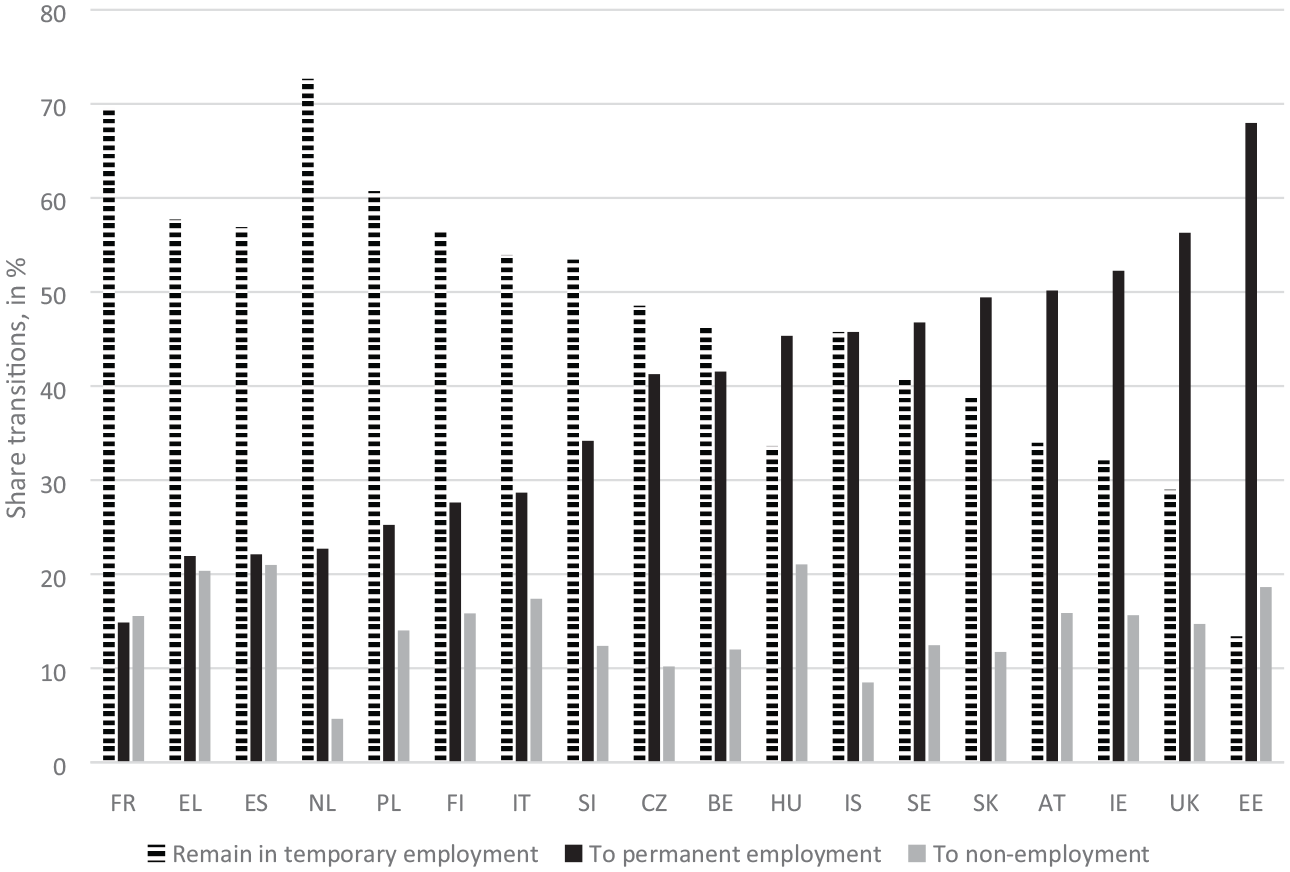
Year-to-year transition rates from temporary to all three possible states among youth in observed countries (average 2004–13).
In line with previous research on temporary employment rates among young people, Figure 1 also demonstrates a great variation in the transition rates to permanent employment, as well as in the share remaining in temporary employment, across Europe. The one-year transition rates to permanent employment vary from almost 70% in Estonia to less than 20% in France. Temporary employment is a more enduring state in southern Europe (Spain, Greece), as well as in some Continental European countries (the Netherlands, France). Thus, in these countries, temporary contracts seem to be mainly used for reasons of flexibility, and these contracts therefore function as stepping-stones for young workers to only a limited extent. Some Eastern (Estonia and Slovakia) and Nordic countries (Sweden and Iceland), and the liberal Anglo-Saxon economies (Ireland and the UK), have higher transition rates of around 50% or more, suggesting that temporary contracts are primarily used as a screening device and function as stepping-stones for many workers. While the share remaining in temporary employment and the share moving to permanent employment largely mirror each other, the pattern for those transitioning to non-employment is less clear.
Having established a rather substantial cross-country variation in transition rates, we next seek to investigate how this variation is related to EPL and vocational specificity. Table 1 includes four models, with coefficients for the two possible transition routes in separate columns. In multinomial logistic regression analysis, differences in odds for the same variable across different models can reflect differences in unobserved heterogeneity across the models, just as well as changes of substantial interest (Breen et al., 2018). Direct comparisons of the sizes of the odds across models should therefore be avoided, and the focus here is on qualitative interpretations of the signs and significance of the coefficients.
Multilevel multinomial logistic regression analysis of the probability of moving from temporary employment to permanent employment or non-employment, 2004–2013.
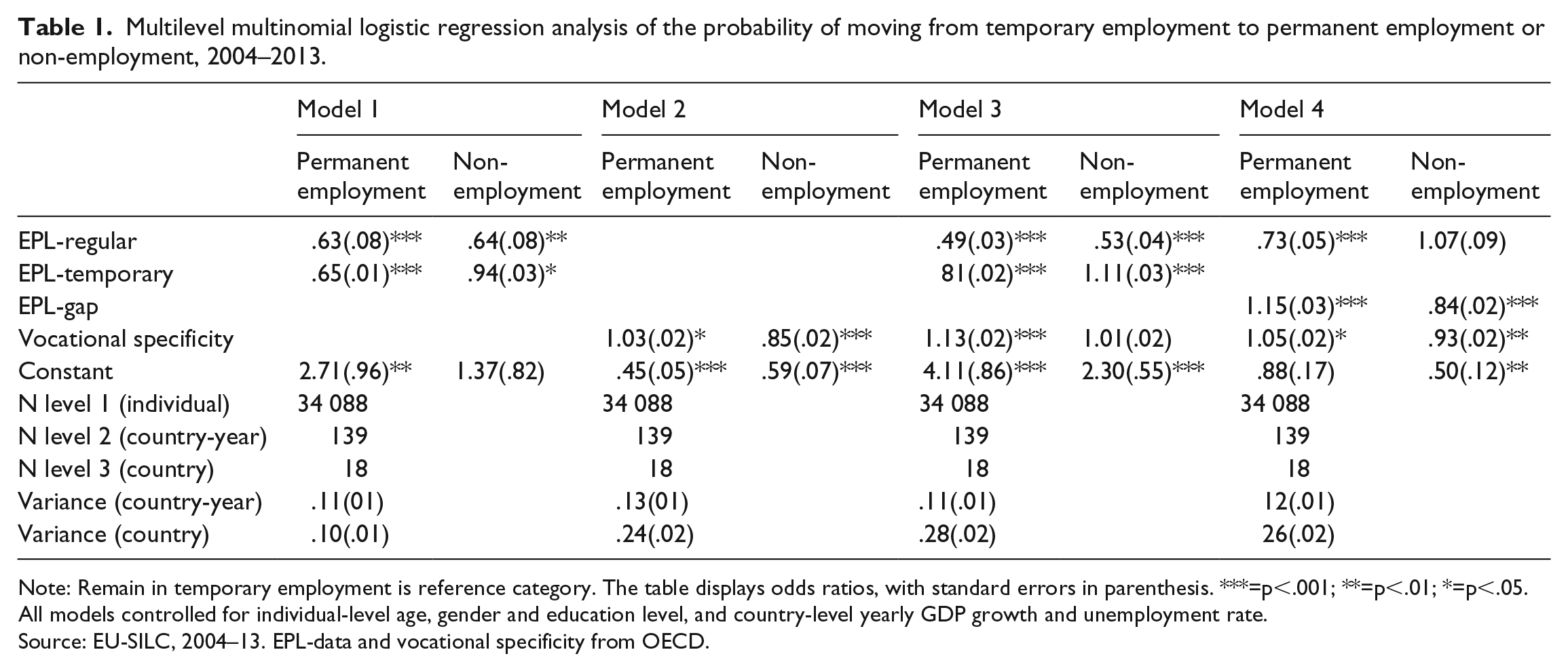
Note: Remain in temporary employment is reference category. The table displays odds ratios, with standard errors in parenthesis. ***=p<.001; **=p<.01; *=p<.05. All models controlled for individual-level age, gender and education level, and country-level yearly GDP growth and unemployment rate.
Source: EU-SILC, 2004–13. EPL-data and vocational specificity from OECD.
The left column of each model shows odds ratios for transitions to permanent employment, and the right column shows odds ratios for non-employment. Model 1 includes EPL for both permanent (EPL-regular) and temporary (EPL-temporary) contracts. The coefficients show that stricter EPL for both is significantly (at the 5% level) associated with lower probabilities of transiting to permanent employment, as compared to staying in temporary employment, but it is also associated with lower probabilities of transiting to non-employment, although the effect for non-employment is much weaker for EPL-temporary. The odds ratio for EPL-regular means that a one-step increase in the EPL-index, which can range from 0 to 6, is associated with 37% lower odds of transition to permanent employment.
When vocational specificity is entered without the EPL-indicators in model 2, it is positively associated with transitions to permanent employment, although the coefficient is only borderline significant (p = .046), and is negatively associated with transitions to non-employment. Since the indicator of vocational specificity has been multiplied by 10, the change associated with a one percentage point increase in the share is given by exponentiation of the odds ratio in model 2 by a factor of 0.1. Thus, a one percentage point increase is associated with 0.3% higher odds of transition into permanent employment, and approximately 2% lower odds of transition to non-employment. When we enter vocational specificity together with EPL for regular and temporary contracts in model 3, the odds ratio for vocational specificity is clearly strengthened with regard to permanent employment, but becomes insignificant for non-employment. Also, stricter EPL-temporary is associated with increased flows to non-employment in model 3.
Model 4 investigates partial deregulation (the EPL-gap), but includes EPL-regular as a covariate to ensure that the results reflect the gap itself and not the overall strictness of EPL (cf. Passaretta and Wolbers, 2016). From model 4, we can see that when the EPL-gap is positive, and EPL-regular is strict compared to EPL-temporary, transition rates to permanent employment are higher, and transitions to non-employment are lower. However, it should be noted that the EPL-gap is strongly negatively correlated with EPL-temporary (the correlation coefficient is around -0.8), making it difficult to conclude whether the observed associations are driven by the gap itself, or by more liberal regulations for using temporary contracts. 3
In a second step, we investigate how EPL and vocational specificity interact in shaping transition probabilities (Table 2). To facilitate interpretation of the interaction terms, vocational specificity has been dichotomized (Breen, 2005), with 20% of pupils in vocationally specific programmes as a cut-off point. The main effect of the EPL-indicators thus shows the ‘effect’ (in a statistical sense) of EPL in countries with predominantly general education systems, while the interaction terms show how this ‘effect’ differs in more vocationally specific systems. The main effect of vocational specificity shows the effect of this variable when the respective EPL-indicators take the value zero.
Multilevel multinomial logistic regression analysis of the probability of moving from temporary employment to permanent employment or non-employment, 2004–13 showing interactions between policy indicators.
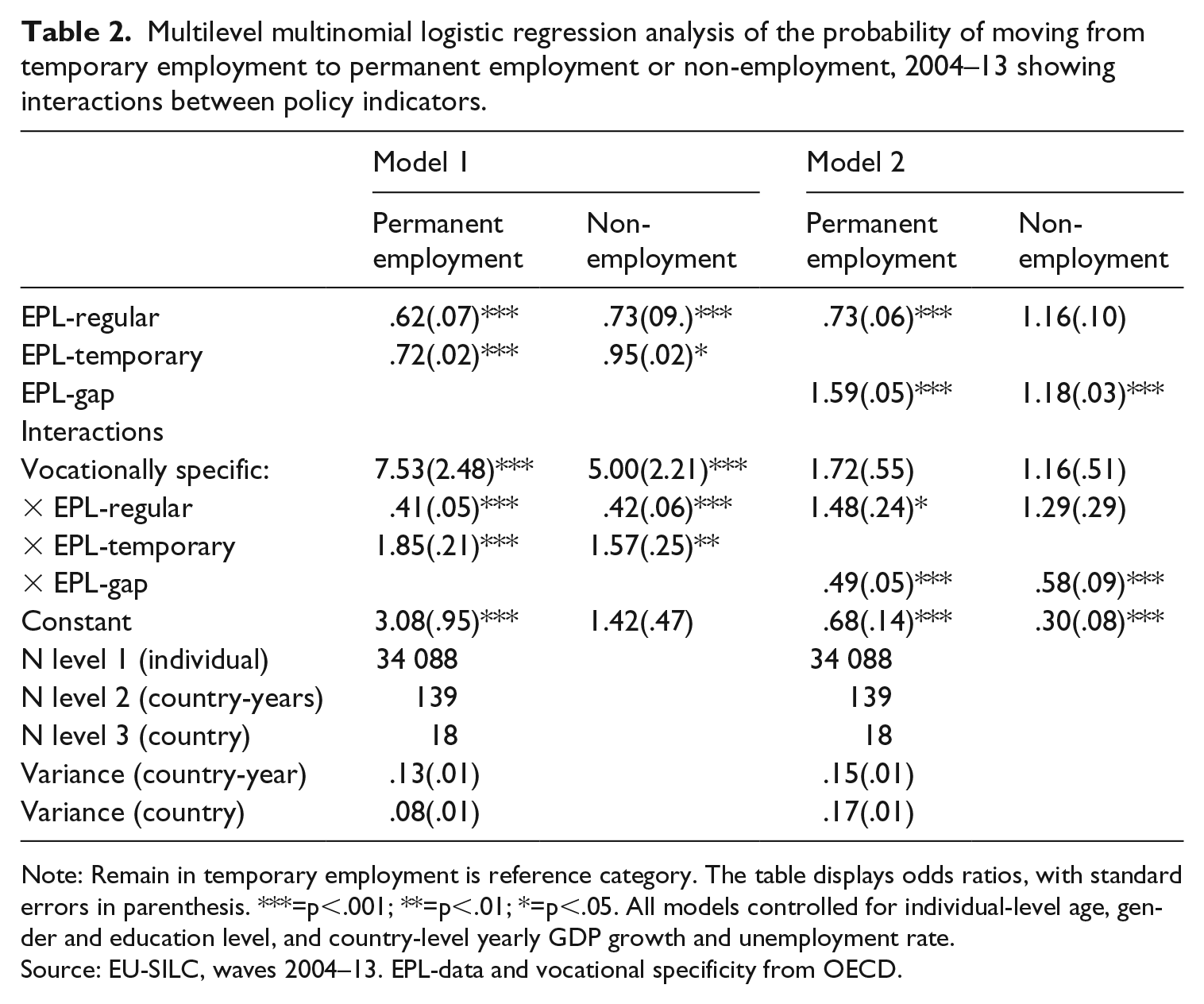
Note: Remain in temporary employment is reference category. The table displays odds ratios, with standard errors in parenthesis. ***=p<.001; **=p<.01; *=p<.05. All models controlled for individual-level age, gender and education level, and country-level yearly GDP growth and unemployment rate.
Source: EU-SILC, waves 2004–13. EPL-data and vocational specificity from OECD.
The interaction terms between vocational specificity and both EPL-regular and EPL-temporary (model 1 in Table 2) are significant, although in opposite directions. The negative effect of EPL-regular on transitions out of temporary employment (to permanent employment and non-employment) is stronger in vocationally specific countries, although it remains negative in general education systems as well. For EPL-temporary, the interaction terms with vocational specificity are significant and positive for both permanent employment and non-employment, while the main effect of EPL-temporary is in both cases negative. This means that stricter regulations for temporary contracts strongly increase transitions out of temporary employment in countries with vocationally specific education systems, compared to those with general education systems. Since odds ratios are combined on the multiplicative scale, the effect of EPL-temporary in vocationally specific countries is in both cases positive (0.72*1.85 = 1.33; 0.95*1.57 = 1.49).
Model 2 shows that the interaction terms between the EPL-gap and vocational specificity are negative for both permanent employment and non-employment, while the main effect of the EPL-gap is in both cases positive, meaning that partial deregulation reduces transitions out of temporary employment more in countries with vocationally specific education systems, compared to the same EPL-gap in general education systems. The net effect of the EPL-gap in vocationally specific countries is negative for both transition routes (1.59*0.49 = 0.78; 1.18*0.58 = 0.68).
Sensitivity analyses
We have performed robustness checks to investigate how sensitive the results are to specific decisions made regarding the data and models. First, we have controlled for collective bargaining coverage, since there are theoretical reasons to expect that wage rates affect the employment opportunities of temporary workers (see p. 00). This was not done in the main analyses due to missing data for many years, but the results were substantially stable with this covariate included (see Tables S3–S4 in the online appendix). Second, Norway and Luxembourg were excluded from the main analyses due to a missing or too complex panel structure. We have examined how sensitive the results were to this choice by re-estimating the models with both countries included (Table S5–S6 in the online appendix). The results were weaker, but substantially the same with regard to EPL-regular and EPL-temporary, and transitions to permanent employment. However, EPL-regular was not associated with transitions to non-employment, and the results for vocational specificity varied across models to a greater extent. Also, the interactions between vocational specificity and EPL-temporary and the EPL-gap, respectively, were strongly reduced and became non-significant. Third, we have included year fixed effects to control for possible time trends (Tables S7–S8 in the online appendix), which is especially relevant since the studied time span includes the Great Recession. The results for transitions to permanent employment were, with the exception of the interaction between EPL-temporary and vocational specificity, substantially stable for all focal variables, but neither EPL-regular nor EPL-temporary was significantly associated with transitions to non-employment, while the EPL-gap and vocational specificity were associated with higher transition rates to non-employment.
Fourth, we have explored to what extent the results might be influenced by transitions of employees on temporary apprenticeship contracts. Specifically, we split the sample in half, and re-estimated the models including only workers aged 25–30 years, since apprenticeship contracts are much rarer in this age group (Tables S9–S10 in the online appendix). Results for transitions to permanent employment were substantially stable, with the exception of the interaction between EPL-temporary and vocational specificity, which was no longer significant. Vocational specificity, and in some models EPL-temporary, was no longer associated with reduced transitions to non-employment. The overall conclusions of the sensitivity analyses are that results for the average effects of the EPL-indicators are stable with transitions to permanent employment as outcome, but results with regard to the interactions with vocational specificity, and with transitions to non-employment, are less robust.
Discussion
This study aimed to investigate how national EPL and the vocational orientation (specificity) of education systems shapes the chances of transiting from temporary to permanent employment among young workers in Europe. The variation in transition rates across European countries is substantial, with the share transiting to permanent employment in a given year ranging from less than 20% to almost 70%. The variation in transition rates was, moreover, related to the strictness of EPL for regular and, less strongly, for temporary contracts, such that stricter EPL was, on average, associated with lower transition rates to permanent employment. Partial deregulation, in other words, strict EPL for regular contracts but not for temporary contracts, was associated with higher transition rates to permanent employment, on average. However, since EPL for temporary contracts and the EPL-gap are strongly correlated, it is difficult to judge whether the results for these variables should be interpreted as reflecting the strictness of EPL-temporary, or the differences in strictness between EPL-regular and EPL-temporary. Higher transition rates in countries with a large EPL-gap are clearly unexpected from a theoretical point of view, which can be taken as suggesting that the results are at least partly driven by EPL-temporary, rather than by the gap itself. Stricter EPL-regular is associated with lower, and stricter EPL-temporary with higher, rates of transitions to non-employment, though this result was not fully robust. Hence, overall, stricter EPL for regular contracts reduces the risk of losing a job for young temporary workers, but it also causes them to become stuck in these jobs.
The vocational specificity of education systems was consistently associated with more transitions to permanent employment, though the association with transitions to non-employment was sensitive to controlling for EPL. Furthermore, the effects of EPL were contingent on vocational specificity, thus making the negative effect of EPL-regular stronger in vocationally specific systems.
It should be stressed that results for vocational specificity were based on only 18 country observations, and estimates of country-level effects in multilevel models can be unstable when there are few higher-level observations (Stegmueller, 2013). The results regarding vocational specificity, as well as the more complex models with interactions between vocational specificity and EPL, should therefore be interpreted with more caution. Moreover, we do not know to what extent the results are influenced by transitions of employees on temporary apprenticeship contracts, which would affect how the results for, especially, vocational specificity should be interpreted. However, while we could not investigate this directly due to data limitations, we do not believe that this is a major problem. In all included countries except Austria, apprenticeships constitute a minority of temporary contracts in the 15–24 age group (data not available for older workers), and the share declines sharply with age (Eurofound, 2013). Moreover, the share of apprenticeships among young workers with temporary contracts is only weakly correlated (r = 0.16) with our indicator for vocational specificity. The fact that the core results were robust to the choice of age group also supports this conclusion.
Overall, the most robust results concern the consistent negative effects of stricter EPL on transitions to permanent employment, while the nature of the data precludes strong conclusions regarding vocational specificity (due to few country observations) and the EPL-gap (due to collinearity with EPL-temporary).
The study provides some new evidence on the difference between looking at (static) temporary employment rates at a single time-point, and (dynamic) transitions from temporary to permanent employment. When compared to previous findings on temporary employment rates across Europe (Eurofound, 2013), we find similarities but also differences. For instance, Sweden has relatively high temporary employment rates among young people, but this study shows that the transition rates to permanent employment are also relatively high, indicating that temporary contracts function as stepping-stones for young workers there. In France, with similar temporary employment rates, transitions rates are much lower, and temporary contracts can instead be considered as dead-ends for young workers (in line with Gash, 2008).
Our results also shed light on the degree to which EPL may affect youth unemployment rates through flows from temporary to non-employment. We found that strict protection for regular contracts, as well as partial deregulation, is associated with fewer transitions into non-employment (though these results were not fully robust). While this runs counter to standard theoretical expectations (Kahn, 2007), it is consistent with some previous empirical results. Although the evidence on the unemployment effects of EPL is inconclusive, recent comparative studies have found that strict EPL does not increase (youth) unemployment rates (see especially the review by Noelke, 2016). One explanation for this perhaps unexpected result could be that stricter EPL (and partial deregulation) reduces labour turnover in general, which could spill over to the temporary employed (cf. Blanchard and Landier, 2002; Noelke, 2016). This would be in line with the results of Passaretta and Wolbers (2016), who found that large EPL-gaps reduced transitions to unemployment. However, unlike Passaretta and Wolbers, we did not find evidence that they also reduced transitions to permanent employment.
The results concerning the vocational specificity of education systems, and how it interacts with EPL, also require some further comments. Contrary to Breen (2005), who found that vocationally specific education could offset the potential negative effects of strict EPL (for regular contracts) on youth unemployment rates, our results suggest that strict EPL-regular (and a large EPL-gap) is more harmful for transition probabilities in vocationally specific countries. Data limitations restrict our capacity to investigate the process underlying this interaction, but one explanation could be that vocationally specific systems contribute to shaping the overall labour market structure by creating so-called occupational labour markets, in which occupationally specific credentials and skills are required for most jobs (de Grip and Wolbers, 2006; Shavit and Müller, 2000). When vocational degrees are the norm (Biegert, 2014), and temporary contracts are mainly used for workers without degrees, young workers without vocational degrees might become even more disadvantaged when competing with workers holding such degrees (de Grip and Wolbers, 2006; de Lange et al., 2014). For this particular segment of youth, transition rates might, therefore, be lower.
This corresponds with the results of some small-N comparative studies on labour market transitions, especially among young people. The type and degree of education tend to be more important for transitions from temporary or non-employment in countries with vocationally oriented education systems and strict EPL, such as Germany and Slovenia, when compared to countries with a more general education system and liberal EPL, such as Estonia and the UK (Biegert, 2014; Gash, 2008; Kogan and Unt, 2008). According to this interpretation, it appears that vocationally specific systems, while making labour market entry smooth for young workers with vocational degrees, can also contribute to a dualization in which labour market outsiders are even more disadvantaged due to a lack of specific qualifications (cf. de Grip and Wolbers, 2006; de Lange et al., 2014). Unfortunately, this study could not investigate the role of individual-level vocational education due to a lack of sufficiently detailed data, and the interpretation must remain a theoretical one.
This study has some important limitations. First, the over-time variation was very small for EPL, and non-existent for vocational specificity, meaning that the effects of institutional reforms were difficult to investigate. Thus, with observational data and little over-time variation, causal interpretations of country-level coefficients should be made with care. Second, the OECD’s EPL-index has been criticized for, among other things, not paying sufficient attention to actual implementation of laws, and for not taking within-country and between-firm variation into account (Myant and Brandhuber, 2016). To the extent that the indicators suffer from measurement problems, the results might be biased (cf. Noelke, 2016). Third, panel attrition can bias the findings if differences in attrition rates across countries are correlated with the policy indicators. Fourth, we only utilized two survey waves per individual, and only looked at one year-to-year transition, but the process of establishing oneself in the labour market can be a more prolonged one (McVicar et al., 2018).
Future studies should investigate how cross-country transition patterns vary, depending on individual characteristics. Previous research shows that the labour market inequalities related to temporary employment interact with, for instance, gender (Biegert, 2014). Furthermore, it is important to investigate how vocational degrees at the individual level interact with the vocational specificity of education systems. This was regrettably not possible with the current data (reaching up to the year 2013), but the most recent waves of EU-SILC contain more finely tuned educational measures.
Supplemental Material
Online_supplementary_material_-_Appendix – Supplemental material for Transitions from temporary employment to permanent employment among young adults: The role of labour law and education systems
Supplemental material, Online_supplementary_material_-_Appendix for Transitions from temporary employment to permanent employment among young adults: The role of labour law and education systems by Björn Högberg, Mattias Strandh and Anna Baranowska-Rataj in Journal of Sociology
Footnotes
Acknowledgements
This project has received support from the European Union Horizon 2020 research and innovation programme under Grant Agreement No. 649496 and Swedish Research Council grant no 2017-02385. We also thank the participants at the 2018 ESPAnet conference for valuable comments and suggestions.
Authors’s note
Mattias Strandh is also affiliated with Center for Research on Child and Adolescent Mental Health, Karlstad University, Sweden.
Funding
The author(s) received no financial support for the research, authorship, and/or publication of this article.

Supplemental material
Supplemental material for this article is available online.
Notes
Author biography
References
Supplementary Material
Please find the following supplemental material available below.
For Open Access articles published under a Creative Commons License, all supplemental material carries the same license as the article it is associated with.
For non-Open Access articles published, all supplemental material carries a non-exclusive license, and permission requests for re-use of supplemental material or any part of supplemental material shall be sent directly to the copyright owner as specified in the copyright notice associated with the article.
