



Abstract
This paper aims to evaluate British architecture students’ peer learning experiences in informal situations, that is, outside formal timetables. Due to the COVID-19 pandemic, the study made a comparison between those students’ learning experiences within physical and virtual environments, to find out if there are changes, difficulties and novelties when those students were introduced to unfamiliar learning contexts. Using the theoretical lens of the community of practice, the author conducted interviews and questionnaires to collect students’ learning experiences and stories when they were engaged in those two environments, respectively. It was found that the physical design studio environment and mutual engagements within it are essential to those students’ individual learning. Therefore, even if those students learned within the virtual environment, they still tried their best to simulate a design studio atmosphere to learn as the form of a community. Another obvious issue is that students normally lack peer-to-peer support, such as architectural knowledge, IT skills and mental health, when they are engaged in virtual environments. Comparatively, those supports are easily obtained via peer learning within physical environments, especially design studios. Based on the finding, future work should determine what architectural knowledge, skills, values and attitudes students developed from the community of practice.
Introduction
Background and contexts
Since various learning environments have been introduced in tertiary education, especially virtual and distance learning contexts, students have more alternative approaches to help their learning with higher effectiveness and better collaboration. 1 For instance, architecture as a practice-based discipline 2 requires students to grasp more practical knowledge and skills highly relying on specifically physical learning atmosphere, that is, the design studio. 3 In addition, to absorb more solid knowledge, skills and techniques, students are required to have very engagements between peers without formal instructions, such as desk crits normally within the design studio. 4 In summary, compared with other disciplines, architecture students’ learning experiences rely more on specific learning venues, which include the design studio and model making laboratory, and specific learning modes, which include desk crits, jury and studio culture. However, the virtual learning environment weakened the specific engagements between architecture students and disabled the specific learning venues where those students are used to generating their ‘studio culture’ (such as late nights, exciting projects, extreme dedication, lasting friendships, long hours, punishing critiques, a sense of community and personal sacrifice, etc.). 5 Hence, students’ peer learning experiences within unfamiliarly virtual environments are valuable to be investigated. For example, the learning settings and studio culture, within which students are all learning within the design studio sometimes doing their own stuff sometimes communicating with other fellows to talk about their group architectural models and sometimes walking around to check others’ working process, were lost during remote learning period. Thus, students could not get used to the isolated working mode.
Besides, the COVID-19 pandemic provides this paper a valuable chance to focus on the setting and implementation of virtual environments for higher education. Specifically, according to UNESCO, 6 over 72% of the world’s student population (around 220 million tertiary education students during 2021 7 ) were required to work from home due to the pandemic and university closures, affecting nearly 1.6 billion learners in more than 200 countries. 8 Therefore, most disciplines have discontinued face-to-face teachings, which made virtual and distance learning the most common education method for tertiary education, the same as for the discipline of architecture. 9
The engagement of virtual environment into architectural design studio education
Fortunately, there were numerous attempts to engage virtual learning environments into design studio education, 10 and some studies have contributed to exploring the theory and conducting virtual design studios since 1990s.11,12 For example, Chen et al. 13 designed some networked facilities that provide participants with access to the virtual organisation’s databases and computational resources, messaging and data exchange and video conferencing. Rodriguez et al. 14 proposed the format of teaching and learning where participants’ communication and collaboration is mediated mainly through asynchronous digital tools. White 15 did the exploration of some new digital tools, so students can gain the knowledge of technological skills, software modelling methods and problem-solving that may be useful in future practice. Achten and Beetz 16 utilised Web 2.0 technologies establishing a more definitive sense of openness, and it mainly focused on the collaborative character of the design practices developed through these applications.
Nevertheless, architecture students still cannot virtually interact with peers or the instructor in valid ways as they do in physical design studios, especially in asynchronous alternatives. 17 Likewise, Carter and Doyle 18 claimed that virtual design studios must (at the very least) effectively simulate the tropes of the conventional studio model. Even further, Pektaş 12 concluded that students’ views on traditional studio teaching are still very positive even though they were introduced to a virtual design studio project for a long time, and some of them even indicated that traditional face-to-face education is an indispensable part of design education.
The phenomena mentioned above are because there are several disadvantages of conducting learning activities within a virtual design studio. For example, Kvan, 11 Achten et al., 19 Saghafi et al., 20 Güler 17 and Marshalsey and Sclater 3 all claimed that less face-to-face interaction between students and tutors leads to less effective fiduciary relationships and motivation for interactive and collaborative learning. Saghafi et al. 20 argued that the senses of belonging as a student and being a part of a learning community are influenced when students are learning only by virtual means, leading to alienation, confusion and loss of identity. Carter and Doyle 18 indicated that the virtual design studio fails to meet the inexplicit and open-ended ambitions of the design studio, and it provides a much less feedback loop.
To avoid those disadvantages, some previous studies introduced a practical concept ‘community of practice’, which can theoretically train architectural students’ abilities to maintain their basic knowledge and skills acquisition when they are learning within the virtual environment, to architectural pedagogy.
Communities of practice in architectural education
As the uniqueness of design education, students are required to be engaged in multiple participative processes involving interaction with other individuals in the design studio. 21 For example, Schön 22 proposed the learning theory known as ‘reflective practice’, which identified that active learning, social interactions and engagement 23 could play a premium role in this process.11,20 The learning theory supports students to benchmark themselves against peers as the form of ‘community of practice’. 24
The community of practice refers to the group of people who share a concern, a set of problems or a passion about a topic and who deepen their knowledge and expertise in this area by interacting on an ongoing basis. 25 This is to say, to foster the community, students are encouraged to learn from peers 26 collectively and actively to a stated goal. 4 Thus, a community of practice enters into the experience of participants through their very engagement, resulting in four basic characteristics: mutual engagement, a joint enterprise, a shared repertoire and a sense of belonging. 27 Accordingly, to constitute a successful community of practice, learning appears to be student-centred. Meanwhile, different core roles within the community of practice should be performed well by students, including community leaders, facilitators, subject-matter experts, core members and lurkers. 28
A student-centred learning model could combine multiple art and design disciplines, enabling students to grasp solid skills of mutual engagements with other individuals in complex project, 29 which architecture students always encounter. Thus, engaged in architecture, communities of practice have brought some practical contributions. For example, Williams articulated that the design studio environment has the capacity to bring students with shared meanings, goals and responsibilities, and the self-organised community of practice that encourages individual student’s learning. 30 Besides, Morton 31 indicated that students, based on country of origin and friendships, usually involve in informal groupings outside of class, to develop their learning process.
However, since ‘studio-centred’ pedagogy has been regarded as the heart of architectural education, 32 architectural students’ learning progresses and outcomes are all reviewed by tutors and reviewers by means of tutorials, desk crits and juries, which belong to formal timetabled activities. By contrast, communities of practice are self-organised by community members, and they are maintained by shared knowledge and common vocabulary specifically designed for the community, 33 which belong to informal timetabled activities. Hence, most architectural schools may not be fully preparing students with the skills needed for communities of practice, such as lacking systematic development or assessment of communication and interpersonal skills for sharing and developing their ideas with each other, 34 and existing hierarchical patterns of interactions between the instructor and students. 33 Thus, it is doubtful that if a community of practice model works for cultivating design studio culture, as it is outside formal timescale and hard to be observed and evaluated by tutors. 32 Especially, when architecture education was moved into virtual environments due to the pandemic, architecture students were forced to face many virtual learning methods, platforms, and environments, which were unfamiliar to them to some extent. 9
Research contribution
In the light of previous literature, we have a superficial understanding of the relationships between architectural learning and the community of practice. Nevertheless, there have been no obvious findings that, as a form of community of practice, it is unclear to show architecture students’ interactive peer learning patterns outside formal timetable activities, especially those engaged in virtual environments. This study intended to focus on peer learning experienced by architecture students in informal situations, that is, outside the formal timetabled activities, devoted to find out the different ways that the community of practice constituted by student’s peer learning engaged in physical and virtual learning environments. As underlying factors which have significant impact on architecture students’ learning experiences were compared within the physical and virtual environments, this paper would contribute to find out what architecture students’ really need when they are doing peer learning within the indoor environment in informal situations. The outcome could ultimately add bricks to architectural pedagogy, architectural learning modules, and physically and virtually contribute to architectural learning environments, to enable architectural learning environments to be more acceptable to architecture students’ peer learning in informal situations.
Accordingly, the research question ‘How do students learn from peers about architectural design in informal situations outside formal timetabled activities?’ shall be answered. The following objectives represent specific aspects of the research question: 1. To evaluate the ways that peer learning happens in informal situations using the theoretical lens of community of practice. 2. To compare peer learning in virtual and physical environments.
Methods
The principle of designing questions
To answer the research questions and objectives, the data collection questions were all designed for collecting architecture students’ experiences and activities of peer learning in informal situations before and since the pandemic. Specifically, to reach the 1st objective, data collection methods were aiming to elicit students’ specific peer learning stories both within physical and virtual environments, and participants were interviewed to narrate those experiences. The data collected from those questions would reveal the ways of peer learning to evaluate those ways.
To reach the 2nd objective, students were asked to narrate their learning experiences through interviews and questionnaires when the learning environment was converted into virtual contexts since March 2020. By comparing learning experiences in different contexts, the difficulties, changes and novelties became clearer regarding students’ experiences of such peer learning activities when the pandemic happened.
Data collection
Procedures
This study is the pilot study of a doctoral thesis investigating the specific architectural knowledge, skills, values and attitudes that undergraduate architecture students developed from the community of practice. For the thesis, the pilot study data were collected by interviews and questionnaires. Specifically, the interview was semi-structured with open-ended questions, not only anchoring individual interviews to provide coherence 35 but also giving a certain degree of flexibility so that follow-up questions can be asked for interviewees to freely narrate and elaborate. 36 That process was based in Welsh School of Architecture, Cardiff University.
On the contrast, questions in the questionnaire were mainly close-ended, measuring students’ self-assessments of their peer learning experiences, followed by some open-ended questions to record students’ insights of the conversion from physical into virtual environments. To ensure reliability, the pilot questionnaire was initially sent randomly online via some survey platforms, such as SurveyCircle and SurveySwap. Subsequently, the redesigned formal questionnaires were sent to undergraduate students in four architectural institutions in Cardiff University, University of Sheffield, the University of Edinburgh and University of the West of England (UWE), Bristol. By comparing learning experiences in different contexts, it is helpful to obtain a clear idea about the differences, changes and novelties regarding students’ experience of such peer learning activities when the pandemic happened.
The data collection was conducted between October 2020 and August 2021, separated in three phases, which were the interview (n = 9) from October to December 2020, the pilot questionnaire (n = 32) taken during April 2021 and the formal questionnaire (n = 156) that was carried out from April to June 2021. Different phases are helpful to find out whether students’ learning experiences and perspectives have changed during different periods of pandemic. Due to the pandemic and social distancing rules, data collection was conducted online by means of Microsoft Teams and Microsoft Forms. The recorded transcripts and responses were uploaded into NVivo for the analysis.
Interview structure
The main question of interview is ‘How do you undertake your design studio learning since the pandemic? How do you think about it? Please narrate the experiences, changes, difficulties and the novelties you did’. The investigator needed to ask more detailed follow-up questions if interviewees’ narratives were not related with the prospective responses. Specific questions are illustrated in the Appendix.
In addition, to find out specific ways in which the environment changes had influenced their learning experiences and how students cope with them, students were also asked ‘Could you please think about a specific project and talk about how the studio helped you to develop that project? How about group work and how the studio helped with this?’
Questionnaire structure
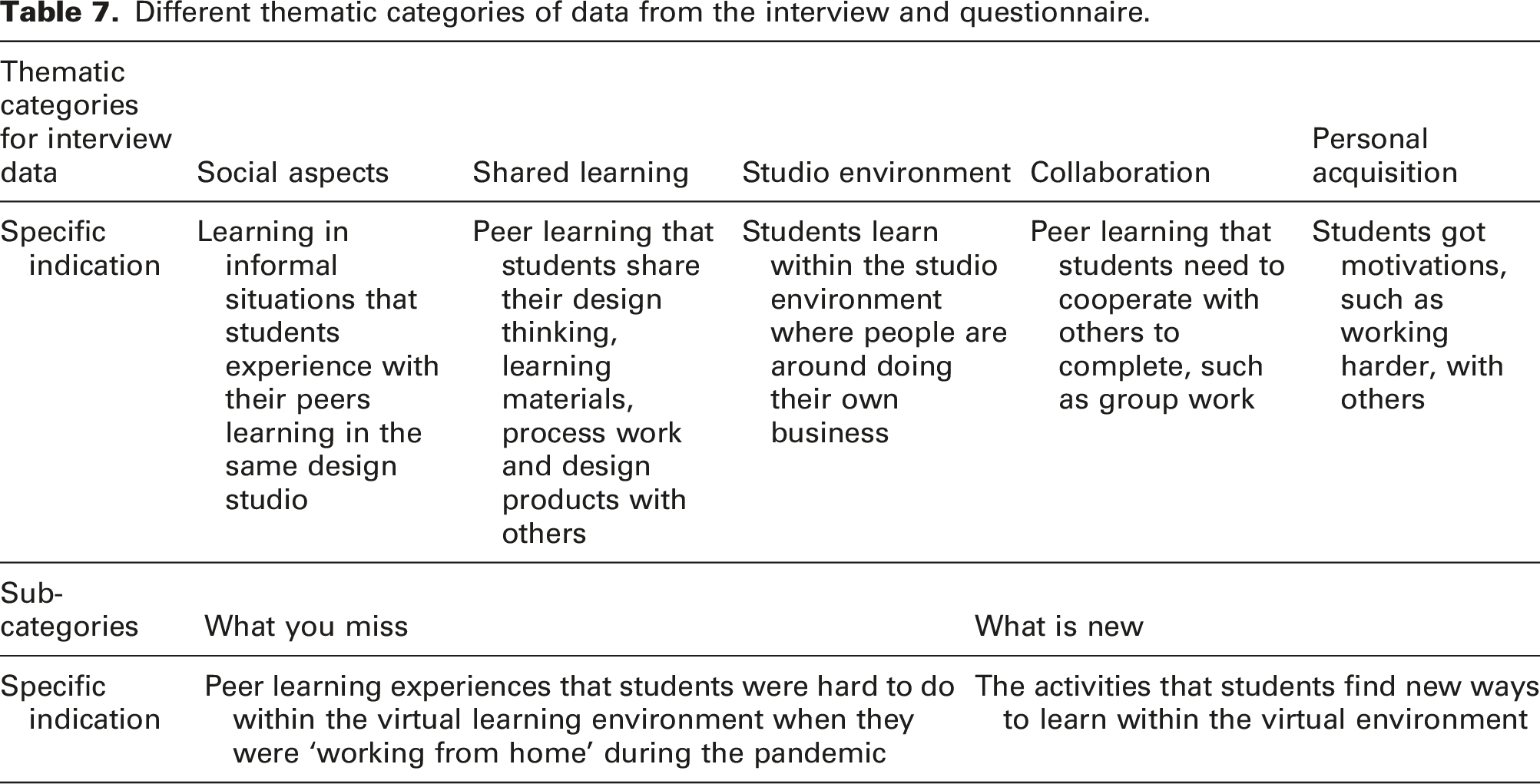
According to the students’ accounts collected from the interview, there were five main themes interpreted and summarised in the Qualitative Data Analysis section. Since the five main themes were identified, the questionnaire participants were required to firstly respond to 23 close-ended questions on a five-point Likert scale, which was composed of ‘Strongly Agree-5’, ‘Somewhat Agree-4’, ‘Neutral-3’, ‘Somewhat Disagree-2’ and ‘Strongly Disagree-1’. Those five main themes are as follows: 1. Students helping each other or being helped. 2. Students comparing their work to others. 3. Students being motivated by being in the studio (e.g. to work harder). 4. Students working together (such as group work). 5. Socialising (talking about things not directly related to the project and studio atmosphere, etc.).
After that, participants needed to respond to five more open-ended questions, to elaborate their learning experiences within physical and virtual environments, respectively, in detail: 1. In what ways do you think that physical design studios help your design learning (e.g. improving your creativity and improving your sense of collaboration)? 2. What has been lost as a result of working remotely? 3. Does anything work better as a result of working remotely? 4. Please give examples of how you cope with the differences when working remotely. 5. In what ways do you think that remote learning can be improved?
The sample of the questionnaire is attached in the Appendices.
Validity and reliability
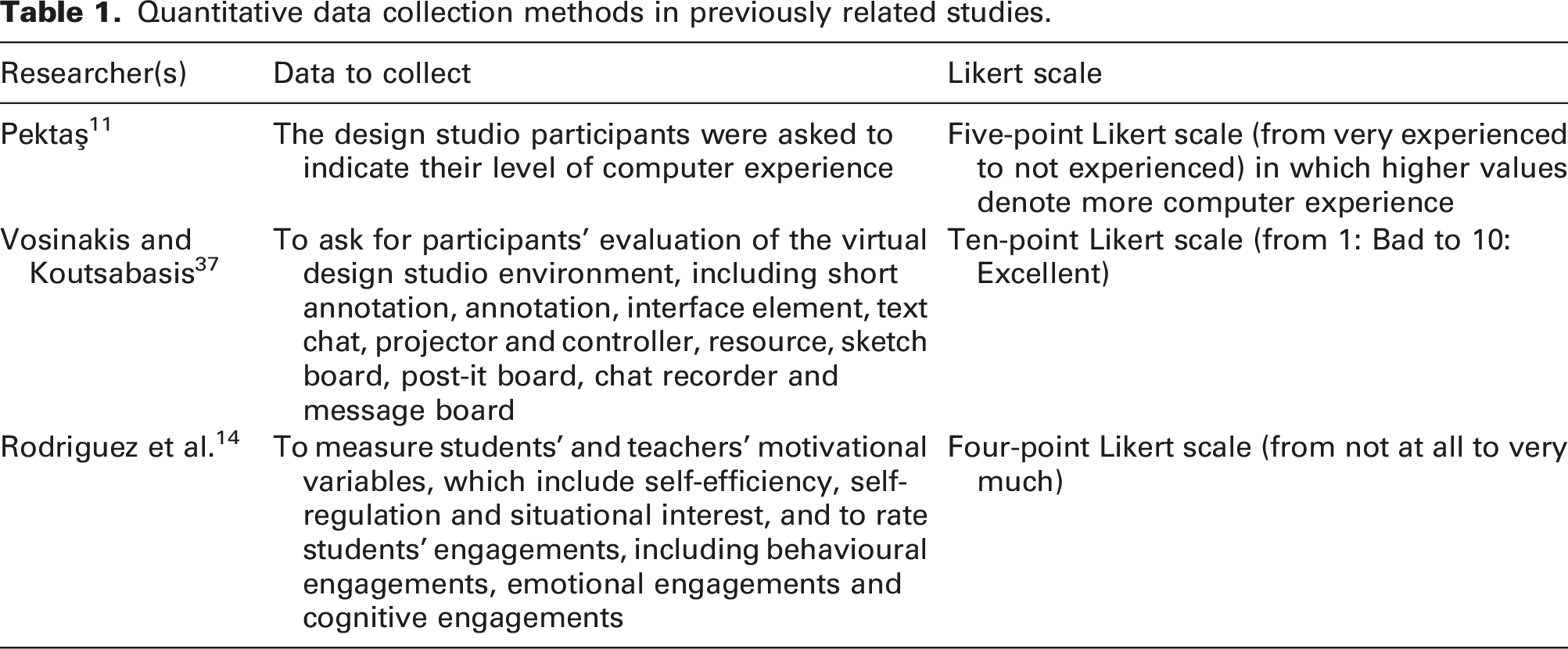
Quantitative data collection methods in previously related studies.
Eigenvalues from the results of the pilot questionnaire.
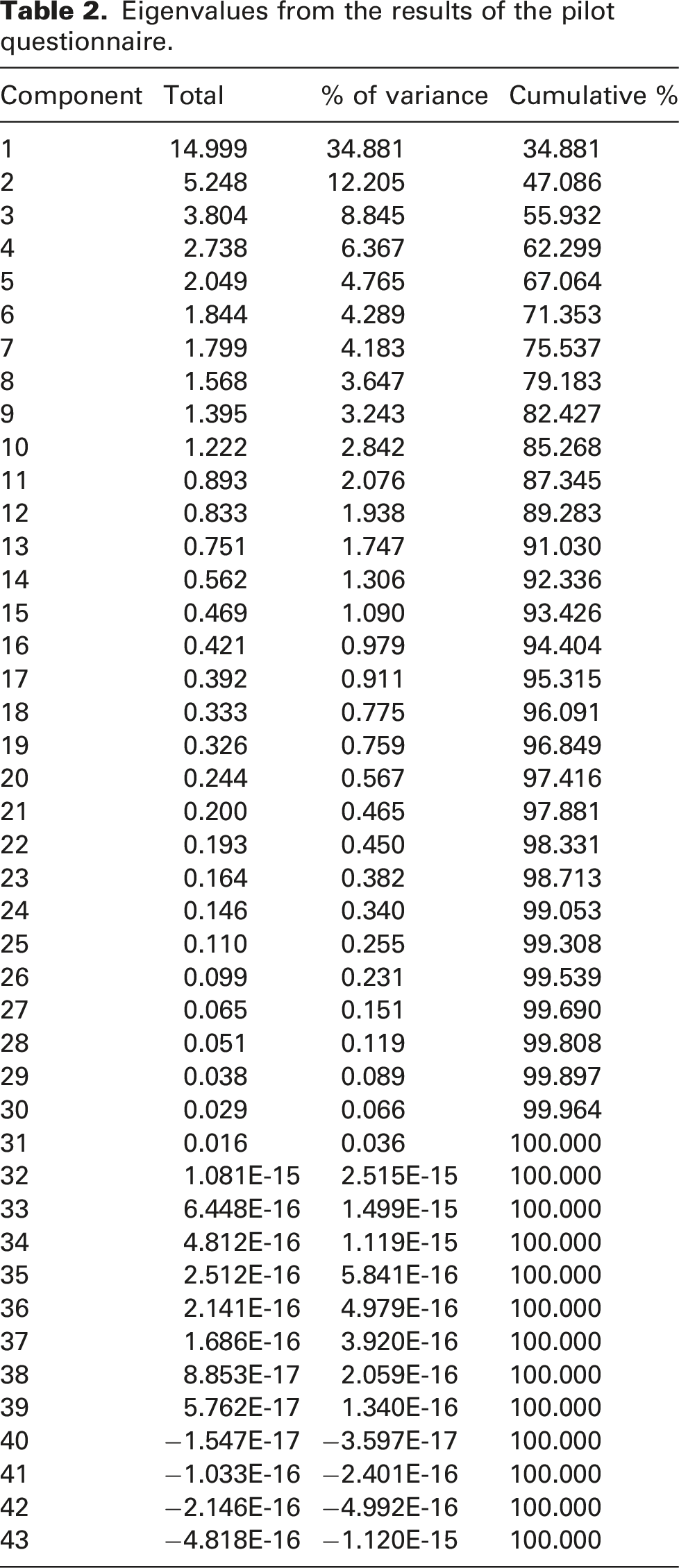
After knowing that there are 10 underlying factors, to look for which items measure which factors, factor loading was applied to show the Pearson correlations between the items and the components (factors). However, some variables measure multiple components in the component matrix, so the factor loadings were furthermore redistributed by varimax rotation. Table 3 illustrates the rotated component matrix. Accordingly, there were 10 components (factors) that really mattered, which are: Factor 1: Personal acquisition from others in the studio. Factor 2: Debates with others in the studio and remotely. Factor 3: Task allocations in the studio and remotely. Factor 4: Studio atmosphere in the studio and remotely. Factor 5: Collaboration between each other in the studio. Factor 6: Shared learning in the studio and remotely. Factor 7: Virtual help to others. Factor 8: Comparing work between each other in the studio and remotely. Factor 9: Personal acquisition from others remotely. Factor 10: Individual learning in the studio and remotely. Rotated component matrix of the statistics from the pilot questionnaire.
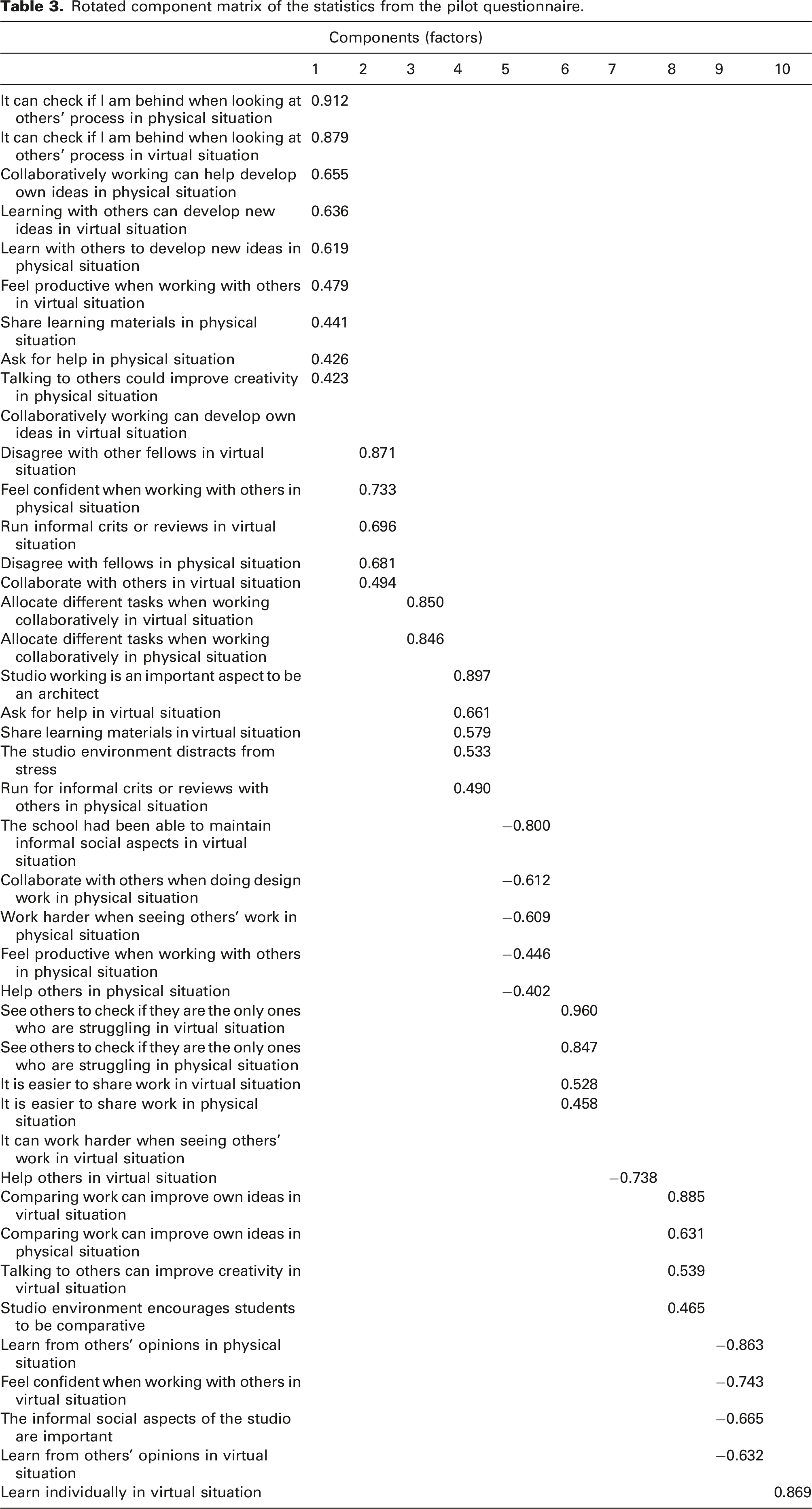
From the 10 underlying factors, they cover all questions, which were designed for the initial questionnaire, to collect students’ peer learning aspects both in the design studio and remotely. Thus, there were no invalid questions in the initial questionnaire, and the questions designed for the formal questionnaire did not change. Nevertheless, the structure of the formal questionnaire was redesigned according to the 10 underlying factors summarised above. For example, the first underlying factor ‘Personal acquisition from others in the studio’ covers the questions ‘I find that talking to others improves my creativity in the design studio’, ‘I feel more productive when I learn with other students or friends in the design studio’, ‘Learning with other students or friends helps me develop new ideas in the design studio’, ‘It makes me feel more confident when I work with other students or friends in the design studio’, ‘I am able to learn from the opinions of other students on my work in the design studio’ and ‘I find that working collaboratively with other students helps me develop my ideas in the design studio’. As for the ways that other questions were structured in the formal questionnaire, a sample of the formal questionnaire is attached in the Appendices.
Eigenvalues from the results of the formal questionnaire.
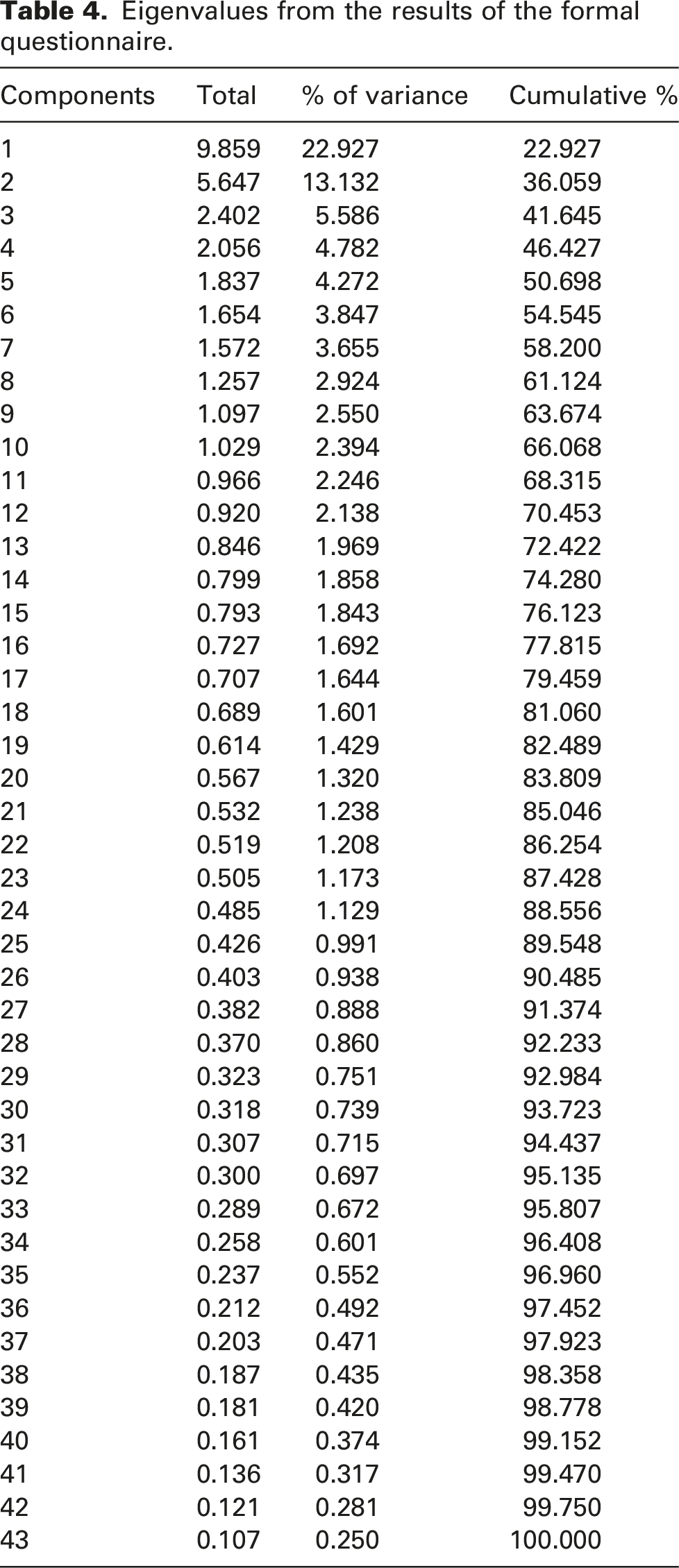
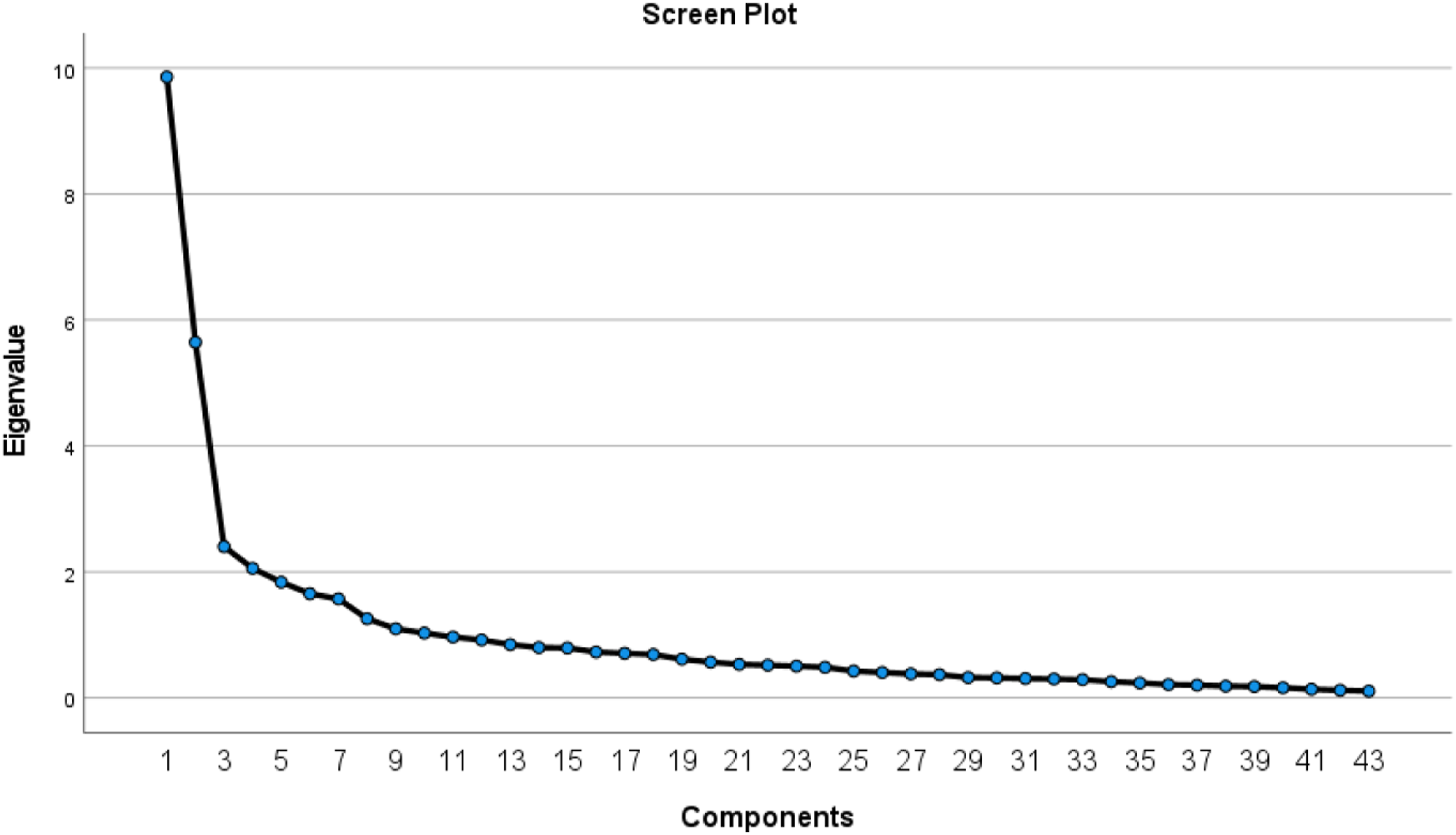
Screen plot of the specific component and eigenvalues from the formal questionnaire.
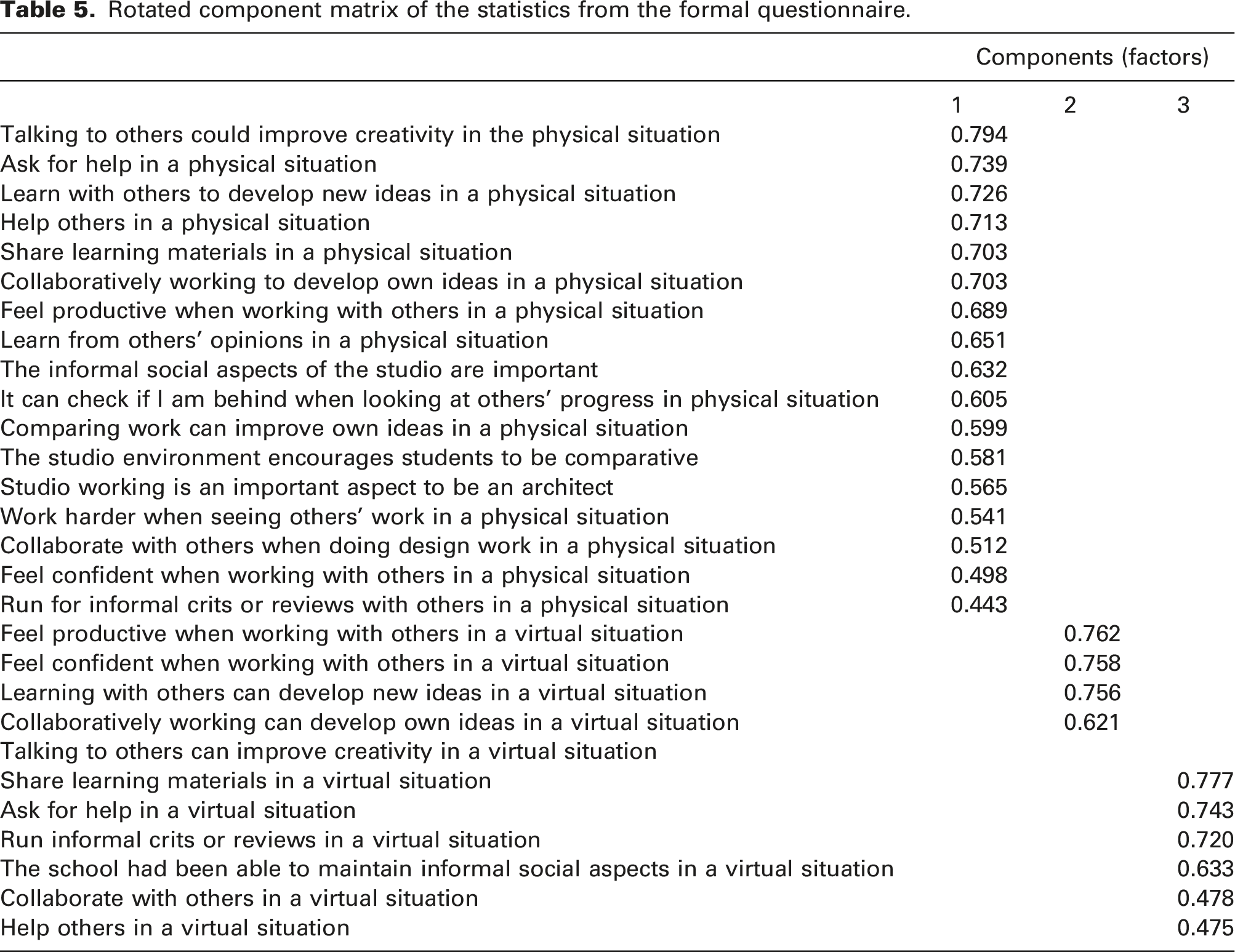
Consequently, the factor loading of the statistics from the formal questionnaire shows three underlying components (as shown in Table 5), interpreted into: Component 1: Informal social aspects of the studio environment and physical contacts between students. Component 2: Students’ acquisition within virtual learning environment. Component 3: The efforts to maintain informal social aspects in virtual environment. Rotated component matrix of the statistics from the formal questionnaire.
Different thematic categories of data from the formal questionnaire.
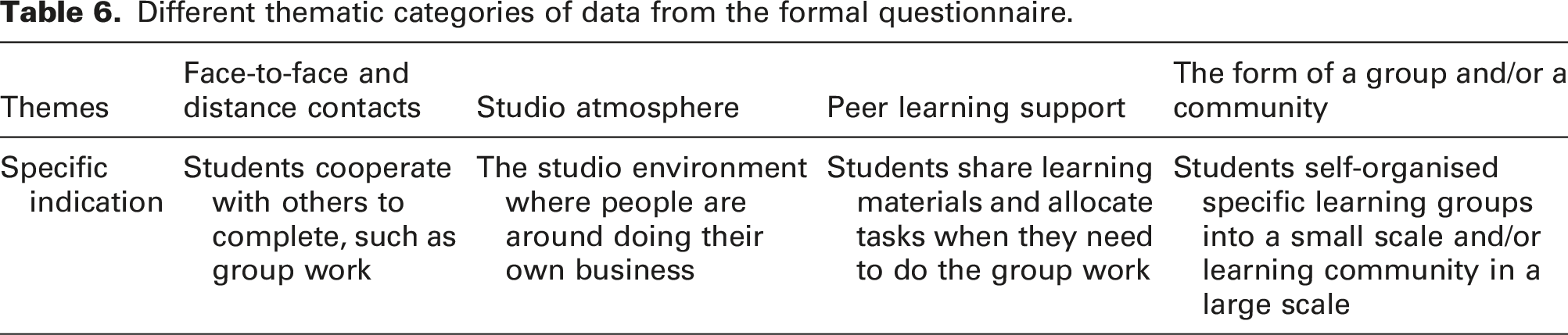
In summary, the exploratory factor analyses of the initial version of the questionnaire and the formal one would ensure the validity of the questions in both versions of the questionnaire, which are valid to collect architecture students’ literal concerns to their peer learning when they are outside the formal timetable activities.
As for reliability, due to changes in epidemic prevention requirements and design projects, the design studios for educational modes have also changed throughout different times. Thus, to find out whether students’ informal peer learning activities within design studios have changed with difficulties and novelties in different times since the pandemic started till the physical design studios returned to normal, the survey was divided into two phases. Specifically, the first phase of the pilot questionnaire was initially conducted with a small scale of students, and then the second phase of the revised and redesigned formal questionnaire according to the findings of pilot survey was further conducted. In addition, to ensure that the questions designed for the questionnaire are reliable to measure architecture students’ peer learning experiences in informal situations, the internal consistency was conducted. Specifically, this paper applied Cronach’s alpha to measure the internal consistency of both versions of questionnaires. The result shows that the value of Cronbach’s alpha of the initial questionnaire was 0.94 and that of the value obtained by the formal questionnaire was more than 0.89, which means that the internal consistency of the two versions of the questionnaire is, respectively, excellent and good. In other words, the questions were all reliable to measure what this study aimed to measure.
Data analysis
Qualitative data analysis
Different thematic categories of data from the interview and questionnaire.
Quantitative data analysis
As illustrated in the Validity and Reliability section, to find out the underlying factor which has significant impacts on questionnaire participants’ peer learning experiences in informal situations, the exploratory factor analyses were conducted. Besides doing exploratory factor analysis, the descriptive and inferential statistics were further analysed. For example, students’ responses for quantitative questions in the questionnaire were automatically illustrated into bar charts by Microsoft Forms, so they were directly analysed in the form of description statistics. 41 Apart from that, the measurement scale of those quantitative data was ordinal category, and distributions of all statistics were not normal, so frequency distribution of responses would likely be helpful to describe data. 42
Furthermore, as the Likert-scale questions belong to ordinal variables, they are normally not appropriate to do parametric tests. Thus, the nonparametric analysis method Mann–Whitney U test (U) was used to analyse inferential statistics. 27 The null hypothesis (H0) was set as ‘There is no significant difference between the mean rank of architecture students’ peer learning experiences between within the design studio and remote learning environments’, to compare mean ranks of architecture students' attitudes to various peer learning experiences within physical and virtual environments, identifying if there are significant difficulties via the p-value.
Results
Face-to-face and distance contacts support mutual engagement
Architecture learning was based on mutual interactions between different individuals, especially the face-to-face contacts,
34
and the data collected from the interview proved that viewpoint. With this sense of physical community, students would experience productive interactions, generating creative ideas more easily, and comparing others’ artefacts with their own to see whether they were going wrong way. Although some students have tried to get used to learning within the virtual environment during the pandemic, most of them still miss face-to-face interactions. For example, Student 7-Interview narrates: … It is more convenient for me to see others’ work and then discuss and compared with others within virtual design studio. Every time I come in to communicate with others, I can more easily get new thoughts and ideas in my design process … it is quite important for my design process to get new ideas or the new way to do my work.
Besides, they found that the most difficult practical activity is collaboration virtually, such as group model making. For example, Student 6-Interview narrates: If we want to show our own model (via the virtual platform), it is not known if it is the same as it was in person.
Likewise, Student 9-Interview indicates: It would be very difficult if we would like to do some group models online.
Participants’ opinions about mutual engagements in virtual environments.
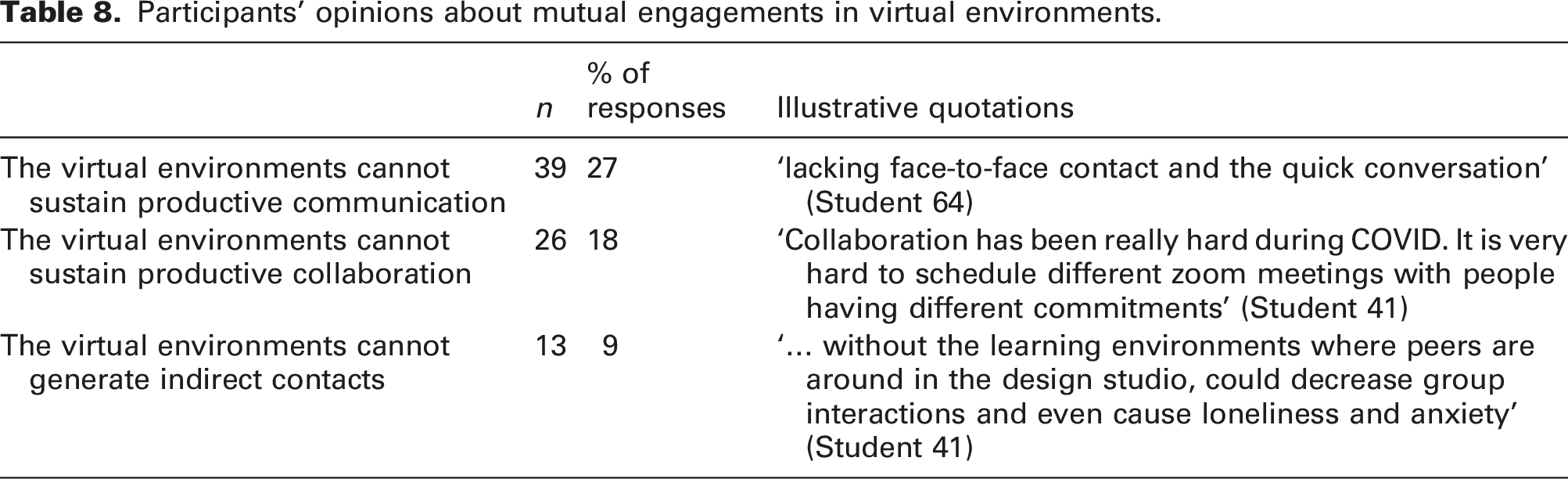
To enrich casual face-to-face interactions when students work in isolation, around one thirds of them recommended that there should be more opportunities to arrange informal meetings and other sorts of engagements between students outside the formal timescale. However, most of them argued that virtual environments still cannot totally afford the whole range of physical interactions. The questionnaire results reflect that view, illustrating that the cumulative presence of ‘Strongly Agree’ and ‘Agree’ of students’ willingness to do mutual engagements (including ‘asking for help’, ‘helping others’, ‘sharing learning materials, design thinking, design process work with each other’, ‘improving one’s own creativity when talk about design projects with others’, ‘comparing work with others to develop own ideas’ and ‘feeling confident when work with others’) within physical environments are between 66% and 82%, whereas those within virtual environments are between 41% and 62%.
Besides descriptive statistics, the inferential statistic illustrates more obvious results. The results from the Mann–Whitney U test show significant differences between every aspect of students’ preferences on learning with fellows (including ‘asking for help’, ‘helping others’, ‘sharing learning materials, design thinking, design process work with each other’, ‘improving one’s own creativity when talking about design projects with others’, ‘comparing work with others to develop one’s own ideas’ and ‘feeling confident when working with others’) within the physical and virtual environments (p < .001 < .05). Thus, the null hypothesis was rejected. Summarily, there are obvious differences of students’ willingness for doing peer learning between physical and virtual contexts, which also indicates distance contact cannot generate the same effects as face-to-face contacts do on architecture students’ peer learning in informal situations.
Nevertheless, there were still a few students finding out the positive aspects of distance contact. For example, Student 9-Interview thinks that the remote learning experience is quite good for discussion, indicating: … It does not have some difficulties in talking about and discussing our project … we have a team of Chinese people … so sometimes it is easier to speak Chinese (to my classmates).
Studio atmosphere and its alternative as a joint enterprise
It is known that architecture students’ willingness to do their peer learning experiences is related to the studio atmosphere, within which people and learning materials are around, to some extent.
21
Students’ narratives from the interview proved that even each individual works on his/her own stuff. Specifically, most students rely on the studio atmosphere where different people are around, to ask their peers and friends whenever and wherever, to get inspiration and motivation if they are going wrong by face-to-face communicating. Thus, design studio atmosphere can be deemed a joint enterprise where architecture students organise peer learning as a form of the community of practice. For example, Student 4-Interview narrates: The key parts of learning architecture are sitting and working with people in the studio, because I think that it is the same in the practice where I sit around other colleagues when I will work in the future ……
Similar to the narratives from the interview, many students’ responses from the questionnaire articulated that the design studio environment and learning settings within it are the heart for their architecture learning, but the virtual contexts weaken the elements. For example, Student 75-Questionnaire indicated: … Doing a ‘crit’ to a group of anonymous icons with a strangely disorientating silence is not the same as staring at the people you are supposed to be convincing of your ideas … you lose the free flow of learning wherein you can see emotively ideas being generated and tangents to draw from … the groups be reduced to smaller sizes, at most 6–7 …
Accordingly, it is difficult to have the same feeling of studio atmosphere when students are engaged in the virtual environment. To solve the issue, some students found alternative ways to constitute a similar atmosphere within the virtual environment, and these methods also helped their physical studio learning. For instance, the first interviewee thinks that it still has the alike studio atmosphere via online meeting applications, such as Microsoft Teams and Zoom. Even further, the second student narrated that the virtual learning environment is creative and productive, and it is much easier to get caught up on something but then get stuck on it now. The fourth student and sixth student both narrated that they think that Miro is nice to share everyone’s work, but it is not the same as physically being there. It is noticeable that Miro is a platform for modern work, enabling collocation, distribution and remote teams to communicate and collaborate across formats, tools, channels and time zones – without the constraints of physical location, meeting space and whiteboard. Student 7-Interview also praises the Miro, narrating: … (by) the use of Miro, we have really been able to fancy upgrade ourselves with the teacher. (They) can correct us more efficiently, and it has more of a studio feeling …
Likewise, most of questionnaire participants self-organised their alike studio atmosphere to maintain their peer learning. Some representative responses are illustrated below to show exhaustive examples about creating studio atmosphere. Student 60-Questionnaire: … to create an alike studio atmosphere, I set up a studio-like desk space for work and stick the drawings on the walls like in the studio. Student 39-Questionnaire: … having a proper work setup in my room: for example by having two desks – one for drawing/model-making and the other for the computer … when I would work with other flatmates for group work in earlier smaller modules in 3rd year … I think providing further opportunity for lots more studio spaces to be made available with ease … would also be helpful. Student 46-Questionnaire: I went to each other’s house to do work or did video calls all the time while they sat at their desks doing work. Student 62-Questionnaire: … we did weekly/biweekly presentations of work … to get a sense of others’ work (like studio) and could ask questions after … we often met up in cafes or booked studio slots, had briefing calls and went through what we had done and what still needed to be done. We had a shared google drive which we uploaded the latest versions of drawings etc … Student 75-Questionnaire: a ‘shared trauma’ … allows a more trusting environment for presentations and the revelation of ideas, and, if work was to be taken or copied or mimicked in anyway (as it is scarily easy to do so now with Miro), it is a lot easier to see where the ideas come from, and where the derived ideas come from. Ultimately this (environment) … would most inspire students to work even harder and remember that they’re contribution matters as much as the rest of them … we could … generate real, smaller scaled bustling creative hubs of young architects, with a centrical professional for guidance, and more so of a steering of that group rather than commandment. Student 116-Questionnaire: … We were ‘architecture household’ where all the flatmates were doing the same course, so setting up tables into an impromptu three-person studio at the back of our kitchen was very valuable … A better access to physical model making facilities would be great. Regular presentations with required ‘finished’ pinups could be quite helpful for keeping on track … of how far along you are …
Nevertheless, still few of the participants (5%) rather felt that the studio atmosphere had negative effects on their own learning. For instance, Student 59-Questionnaire expressed his/her concerns about learning within the studio atmosphere: …… However, occasionally working in the studio is more stressful as there are opportunities for constant comparison. Working remotely, I had to just accept what I was doing was my best and get on with it.
Figures 2 and 3 (summarised from the questionnaire) show the results of students’ assessments of the effects of the studio atmosphere. They reflect that learning within the design studio atmosphere can obviously improve their comparison and release their pressure in some extents. Even though, 20.5% students still feel that they might get tensive learning within the studio milieu, because of the competitive atmosphere around. Hence, design studio atmosphere is comparatively the most suitable element to create a joint enterprise, as the common goal and ambition are generated from it. The percentage of the studio atmosphere encourages students to be comparative (156 responses). The percentage of the studio atmosphere releases students’ tension (156 responses).

The two figures above directly reflect questionnaire participants’ positive perceptions and responses on feelings and preferences on studying within the studio atmosphere. Besides, to find out if the virtual environment brings significant impacts on studio atmosphere, some statistics interpreted from the nonparametric test results illustrate the difference between the studio atmosphere within the physical and virtual contexts. Specifically, there are three aspects (including ‘feeling not struggling alone’, ‘individual learning’ and ‘debating with fellows’) indirectly reflecting students’ attitudes to the impacts of studio atmosphere when they study within the physical design studio and virtual environments, respectively. For example, there is a significant difference (p = .002 < .05) between students’ feeling not struggling alone within the physical and virtual environments. Thus, the null hypothesis was rejected.
By contrast, the Mann–Whitney U test result shows that the difference in preference between individual learning in design studio and remotely is not significant (p = .317 > .05). The result implies that the working environment does not have significant impacts on students’ individual learning. Thus, the null hypothesis was not rejected. It is also noticeable that the results between debating with their fellows in physical and virtual environments from Mann-Whitney U test show no significant difference (p = .138 > .05). Thus, the null hypothesis was not rejected.
Peer learning support as a shared repertoire
The study found that, without peer-to-peer supports, most students lost their focus to cultivate their interests and ambitions of architecture learning. For instance, the third student of the interview indicated that the face-to-face interaction can make students more involved in lectures, while the online lectures are too long to focus. The fourth student narrated that he was not living with other architecture students, so he struggled to know if he was doing correctly outside of designer views. Student 7-Interview even complains: … I guess that there is a lack of separation of working and resting spaces (in my own room) s … If I am stuck, I would just scroll through social media, but it is not productive socialising.
Student 8-Interview complains more, indicating that: We use … Miro to put our work on it, and then the teacher reviews it … not as sufficient and efficient as like in the actual studio … so I do not really like online studio … if I am doing my work alone, I do not really get much motivation as much as before.
Similarly, from the responses to the questionnaire, the most obvious issue caused by the virtual environment is that it makes students rely on their own to face difficulties and problems which can be usually easily determined by face-to-face discussion. That issue may cause demotivation, burnout and confusion gradually (student 31). Those issues are all due to lacking support from physical peer interactions in virtual environments. The questionnaire results reflect that the cumulative percent of ‘Strongly Agree’ and ‘Agree’ of students doing various of peer-to-peer supports (including ‘running informal crits or reviewing with others’, ‘checking if behind comparing with others’, ‘seeing others’ work enabling working harder’ and ‘feeling more productive when working with others’) within the physical environment are between 56.4% and 82.7%, whereas those within the virtual environment are just between 27.6% and 53.9%. This comparison indirectly means that they lack support and instruction from other students with great expertise. Thus, compared to the physical environment, those students would not successfully cultivate a shared repertoire to constitute a community of practice when they are learning virtually.
Besides, the Mann–Whitney U test results illustrate significant differences between every aspect of architecture students’ peer-to-peer supports (including ‘running informal crits or reviewing with others’, ‘checking if behind comparing with others’, ‘seeing others’ work enabling working harder’ and ‘feeling more productive when working with others’) within the physical and virtual environments (p < .001 < .05), which reject the null hypothesis.
The form of a group and/or a community builds the sense of belonging
According to students’ narratives from the interview, productive socialising is in the physical design studio. Specifically, the traditional studio provides students with a space to learn and develop their work in the form of a community, which cultivates their sense of belonging. For instance, Student 1-Interview stated: We could see everyone’s different opinions … so different people could get different data at one time.
Student 2-Interview illustrated: Each person in the group makes a model, showing studio mates with a model / physically holding a model and talking about it.
Student 3-Interview indicated: (I) could witness others’ methodology, seeing how people do it with the process, and I could more easily get new thoughts and ideas in others’ design process.
Moreover, students pin up things on the board, to see what goes where and whose work goes first. After all, students could gradually become used to the environments they are engaged in, feeling that they belong to the learning community that a design studio could provide.
Besides individual work that students can obtain help from their peers, the design studio atmosphere also facilitates collaborative learning. For example, students could do some big group models together and everyone could use them. More than that, the studio provides students with an atmosphere of indirect teamwork, in which students may not be working on the same thing, but they are still working together. For example, students are personally working on their own computer, a working environment with people doing similar things where the student could be encouraged that they are not alone in their struggles. Also, students could obtain technical help from others within the studio environment, such as asking someone else randomly and immediately, getting feedback images immediately as well. Even further, the physical interactions between year mates can generate nostalgic experiences which could be relevant for future projects or endeavours. Summarily, finding a way to create a ‘work zone’ is very important because it speeds up the process of getting into a working mood, just like response from Student 39-Questionnaire: … I think having a smaller community of five other architecture students can be a replacement for the lack of a design studio. I think trying to retain a sense of community in the year group and in design studios would be a great way of keeping a community spirit alive …
Compared with learning within the physical studio atmosphere, learning in virtual contexts keeps a soft interaction between students. For instance, via Miro, students can put all their work onto the online board, so that everyone else can see and discuss it over video calls. More than that, as there is no one pushing on a virtual learning environment, it can release the pressure brought by the studio atmosphere, which could cultivate students a sense of independence in terms of doing work (as shown in Figures 4 and 5). In addition, some students found that remote learning somehow helped them to try various alternative measures to help do their work, such as social media. The percentage of allocating tasks when working in groups (156 responses). The percentage of preferring individual work (156 responses).
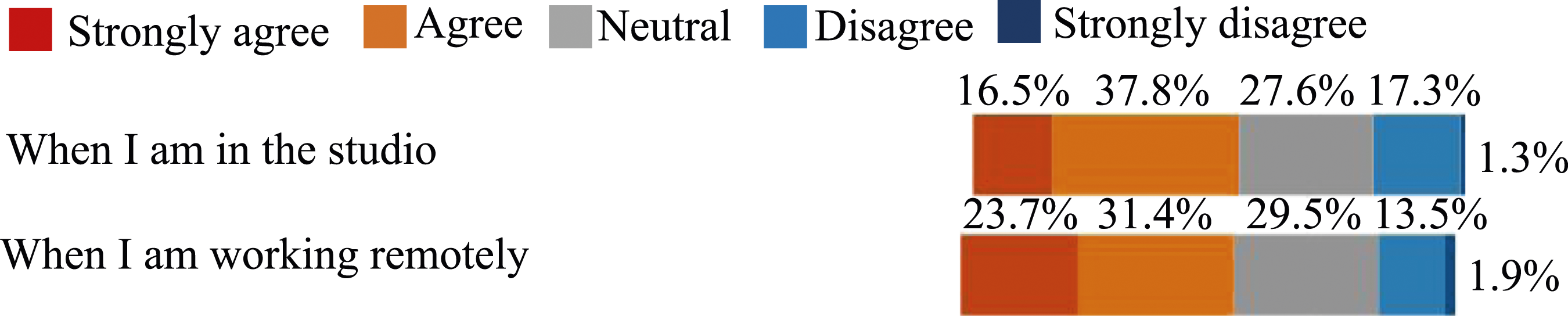
Nevertheless, remote learning still causes a loss of belonging to some extent. As shown in Figure 6, although students regarded informal social aspects (i.e. casual conversations with other students) as important elements of their own learning when they are engaged in the conventional design studio, the school has not tried its best to maintain those aspects when they were learning from a distance during the pandemic. Besides, there is a significant difference between students’ assessments to maintain the informal social aspects within the physical and virtual environment (p < .001 < .05). Thus, the null hypothesis was rejected. The informal social aspects in physical and virtual environments (156 responses).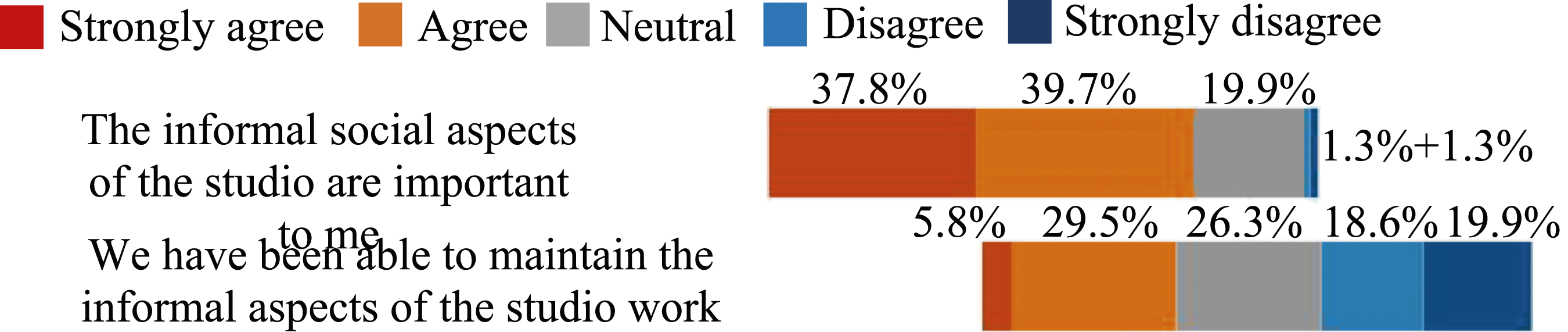
As for the specific differences, some questionnaire participants elaborated their perceptions. For example, Student 39-Questionnaire complained about what had been lost when working remotely: A sense of studio collaboration (has been lost when working remote–y) – I have felt extremely detached from others in my design unit … It has felt almost anti-climate when submitting online the design portfolio as there was no coming together event like there was in previous pre-pandemic times. I felt rather isolated, designing almost entirely on my own … Overall, a collective sense of community has very much been lost this year.
Student 116-Questionnaire also expressed similar perceptions: Working alone makes me prone to not share my design and makes me more insecure. Studio environment forces you to expose your work and come to terms with it. Crits and regular pinups act as checkpoints to keep the presentation part of the work on track when in the studio, but remote work offloaded (for us) the majority of presentation and finalisation till the final crunch which was quite taxing.
Anyway, architecture students used to see all the individual work of everyone else and share resources, such as a lot of drawings, advice and ideas, with each other, but they could only talk about it before their screens over distance. Also, if they were stuck, they would just scroll through social media, so they could not get as much motivation as from productive socialising.
Discussion
As the statement in previous literature, design learning is tightly guided by the cycle of interactive and ongoing feedback, 2 and ‘studio culture’, 5 identifying that social interactions, active learning and social engagement2,23 could have a premium role in the learning process.12,13 The study findings summarised from this paper not only demonstrated such theories but also unfolded more details of students’ daily routines and peer learning experiences. For example, this paper conducted a survey between three British architectural institutions, making the comparison between architecture students’ preferences on interactions, studio atmosphere, peer-to-peer learning supports, and the form of learning community within physical design studios and virtual contexts before and during the pandemic. Most architecture students from all the samples schools in this study are always thirsty for creative ideas and want to obtain inspirations when they are doing their own work. Specifically, those students need an environment where different people are around, so that they can have physical supports, inspirations and motivations from their peers if they are stuck whenever and wherever, which can be mostly easily achieved in the physical design studio. However, the pandemic made those students study within virtual and isolated contexts, which disabled the studio atmosphere and opportunities for face-to-face interactions. Therefore, students would try their best to maintain the design studio atmosphere when they are learning in their own homes or other places, which indicates that the sense of community where students could come together and do work is very important for their design learning.
More than that, it was unclear in previous literature that students are capable to cultivate basic architecture knowledge and skills based on peer learning in informal situations. 33 In other words, the typical researchers specifically designed a project or a course that was aimed at exploring the potential implications brought by virtual environments to architectural pedagogy.13–16 By contrast, this paper focused on architecture students’ daily routines outside formal timescale activities before and during the COVID-19 pandemic, which avoided the effects of purposeful modules or pedagogies. The study findings summarised that the main challenges and difficulties of peer learning that students encountered are the lack of effective ways of communication and collaboration, physical learning settings and learning skills support when outside formal timetable activities (especially by distance measures). It identified the insights that most architecture students lack communication and interpersonal skills, 34 and existing hierarchical relationships between the instructor and students. 33 Besides, architecture students’ sense of belonging in a great community of practice can improve their motivation and avoid loneliness. 43 Thus, to constitute a successful community of practice outside formal timescale activities, the connections between students are required to be reinforced, and the studio atmosphere where people and learning materials are around ought to be maintained when students study in their own homes. In addition, to be more creative and competitive, most architecture students prefer to learn in the community of practice where they can feel that they are not struggling alone.
Furthermore, different to almost all the disadvantages of the virtual design studio found in many previous studies,3,11,17–20 this paper demonstrated that still, a few students (around 8%) found innovative aspects of peer learning in virtual environments. For instance, some architecture students who participated in the survey indicated that they were more creative and productive for peer interaction, and much easier and casual to be caught up on something, via Microsoft Teams, Zoom, Messenger, WeChat or calling people. Those aspects also helped inspire their physical learning within the design studio.
However, this study only focused on students’ peer-to-peer learning experiences, so prospective research should find out specific details of the potential effects of students’ individual learning experiences compared with others, such as someone’s good reputation of one special expertise to inspire other students’ passion to learn. Furthermore, the specific ways of peer learning could affect the community of practice and will need to be investigated in a further study to provide references to constitute and renovate architectural design studio and even virtual learning environments. In addition, this paper only focused on the differences, changes and novelties between architecture students’ peer learning experiences within physical and virtual environments. Due to the limited research subjects, those students more rely on specific venues and contexts, so the findings may not be suitable for all other subjects. Thus, future work can expand the scale of subjects in other disciplines, to determine if there are differences between architecture students’ and other students’ encounter when the physical learning environment is converted into the virtual one.
Conclusion
To ensure successful architecture education both in physical and virtual environments, this study fills the gaps that there have been no obvious findings regarding students’ peer learning when they are outside formal timetable activities. The study results illustrate that although architecture students’ individual learning rates in physical and virtual contexts are similar, they basically collaborate or interact with peers more likely within the atmosphere of the physical design studio, so the virtual contexts lack the environment to promote students to work together and help each other. Most students strongly agree or agree that informal social aspects are important in the physical design studio, but nearly half of students strongly disagree or disagree that virtual contexts could maintain informal social aspects, such as peer learning in the studio atmosphere. Thus, the virtual learning environment still cannot replace the physical design studio for informal social aspects. In conclusion, the virtual environment should exploit some alternative functions and measures to maintain, promote and even innovate peer learning in the informal situations between students.
Besides the implications to the virtual environment, this paper also potentially provides suggestions on the design and management of indoor environment within the conventional design studio. Specifically, the face-to-face contacts, studio atmosphere, peer-to-peer learning supports, and the form of a learning group and a learning community could have principal impacts on architecture students’ peer learning experiences in informal situations. Thus, the design of the indoor environment should be aligned with students’ perceptions of those four aspects. For example, there should be multifunctional spaces engaged within the indoor environment, to enable students’ different contact modes, such as group working within the messy studio atmosphere and individual learning outside the studio atmosphere. In addition, the lighting, acoustic and ventilated conditions within the indoor environment should also ensure multiple options for students to choose, so that they can study followed by their initiatives.
Supplemental Material
Supplemental Material - The comparison between architecture students’ peer learning in informal situations within physical and virtual environments during the COVID-19 pandemic
Supplemental Material for The comparison between architecture students’ peer learning in informal situations within physical and virtual environments during the COVID-19 pandemic by Jierui Wang in Indoor and Built Environment
Footnotes
Acknowledgements
I wish to thank my supervisors Dr Andrew Roberts and Dr Hiral Patel for supervising, mentoring, supporting, guiding, reading, re-reading and offering copious annotations in almost no time. In addition, Professor Wouter Poortinga and Dr Mhairi McVicar hosted annual reviews, which provided me with advice and suggestions to revise my thesis, to push the completion of this paper.
Author contribution
JW decided the research field; contributed to literature review, methodology, data collection, data analysis and paper writing; and drew conclusions.
Declaration of conflicting interests
The author(s) declared no potential conflicts of interest with respect to the research, authorship, and/or publication of this article.
Funding
The author(s) received no financial support for the research, authorship, and/or publication of this article.

Supplemental Material
Supplemental material for this article is available online.
References
Supplementary Material
Please find the following supplemental material available below.
For Open Access articles published under a Creative Commons License, all supplemental material carries the same license as the article it is associated with.
For non-Open Access articles published, all supplemental material carries a non-exclusive license, and permission requests for re-use of supplemental material or any part of supplemental material shall be sent directly to the copyright owner as specified in the copyright notice associated with the article.
