



Abstract
Daylight can enhance the quality and inhabitability of architecture through a better relationship with the exterior environment, especially by its intensity, chromaticity and ability to synchronize the human circadian clock. Daylight integration in architecture remains a challenge in Nunavik (Quebec, Canada) due to its subarctic climate, photoperiod and solar geometry. The objective of this research is to implement photobiological metrics of light in architectural representations by isolating the photopic (daytime vision) and melanopic (circadian clock) portions of the electromagnetic spectrum, and to spatialize daylight and artificial light in relation to landscapes and indoor architectural spaces. An automated and low-cost capture tool based on Raspberry Pi microcomputers and Camera Modules (RPiCM) captures high dynamic range images, which accurately measure luminance to render human perception. Absolute photopic luminance maps (cd/m2) are supplemented with false colour displays of photopic/melanopic contents of light regarding building surface materials. The research develops photometric captures of absolute photopic and melanopic illuminance (lux, EML). Photobiological metrics of light are integrated into a set of physical properties of lighting patterns to perform light assessments and are ultimately represented as a graphical display to help designers and researchers to evaluate architectural interior–exterior relationships through daylight qualities.
Introduction
Architectural design strategies can reinforce the relation and perceptual continuity between interior spaces and the exterior environment. 1 In northern climates, daylit interiors can be characterized by their ‘strong focus on landscape and place creation’, 2 as rightness of fit and integration to the territory. Daylighting design strategies can transpose aspects of the territory into interior spaces, such as light intensity and chromaticity. They also express the changing exterior environment and atmospheric conditions, with their daily and seasonal variation, even without direct views to the exterior.3,4 This research considers the Nunavik region (Quebec, Canada, latitudes 55°N and higher) to illustrate daylight issues in architectural design in northern climates. Although buildings in Inuit territories are culturally portrayed through multiple combinations of forms and colours, 5 constructions in northern regions such as Nunavik often consist of conservative envelopes with small or no apertures for energy efficiency or security. The resulting indoor light ambiences seem independent of exterior conditions, and usually remain constant through artificial lighting. Despite the ‘harsh’ extreme northern climate, creating sealed and secure interiors does not constitute a viable architectural solution, both in social and psychological terms, 6 as spaces presenting an increased connection to the exterior can contribute to their inhabitants’ physiological and psychological wellbeing.7–13 Interiors should, moreover, take advantage of daily and seasonal variations.14,15 Light with a strong short wavelength component (blue light) is necessary to maintain proper synchronization of a myriad of biological rhythms through the circadian clock daily entrainment. Daylight, by its spectral distribution, naturally contains melanopic light, whereas most common artificial light sources possess a more fragmented spectral distribution. 16 The melanopic contents of daylight can therefore inform the continuity and similarity between exterior and interior light ambiences, as daylit interiors are not isolated from the exterior territory, in terms of light ambiences, but are rather viewed as part of the same continuum.17,18 Architects perform light assessments with a series of variables related to the physical morphology of lighting patterns.19,20 This analysis authenticates the properties of a pattern, including the melanopic contents of light that could further inform architects regarding interior–exterior relations.
The objectives of this research are to implement novel modes of representation to spatialize quantitative data regarding daylight and artificial light in relation to architectural forms and light ambiences in inhabitable environments. While architectural daylighting specialists commonly evaluate light distribution patterns using luminance maps to assess design strategies, patterns related to photobiological analyses based on melanopic light have not yet been integrated in such assessments. Photobiological patterns inform architects by spatializing melanopic light in relation to existing spaces, or conceptually, their design intentions, to improve the contribution of architecture to inhabitants’ circadian health. This paper introduces representations that integrate melanopic metrics of light to assess photobiological patterns in northern indoor and outdoor environments. It investigates the role of interior–exterior architectural configurations and materiality regarding light spectrum and distribution, in terms of visual patterns, to inform daylighting design strategies. It also explores the relationship between windows and the lighting patterns they generate. It is hypothesized that a combination of exterior and interior 360° panoramic captures can result in a graphical display of lighting pattern properties that ultimately serves as a support tool for architectural design initiatives regarding spaces that express a stronger interior–exterior relation, in terms of light ambiences. To this end, a series of panoramic captures of exterior and interior environments were performed in Inukjuak (Quebec, 58.5°N) in March 2019. The first section of this paper identifies daylighting considerations specific to northern regions, the second section describes the capture and representation strategy in the methodology and the third section presents the results of a diversity of light scenes, which are ultimately expressed in a graphical display of their lighting pattern properties.
Background: Daylighting assessments in northern regions
This research addresses the interior–exterior relation of architecture of northern regions, as manifested by indoor light ambiences and lighting patterns. This section presents how daylight and artificial light can be assessed in architecture using established intensity metrics and more recent photobiological metrics. It then describes how expressing lighting patterns in visual representations allows their characterization in relation to a set of properties variables. This research hypothesizes that the integration of an additional photobiological variable in the analysis of lighting pattern properties in northern architecture could help overcome the current shortage of indoor–outdoor connection in the buildings present in this climatic context. Thus, the paper proposes implementing visual representations to evaluate how architecture contributes to inhabitants’ wellbeing.
Photobiology in lighting patterns
Daylighting specialists conduct quantitative analyses or light assessments by using lighting patterns to identify light ambiences presenting similar pattern properties. Lighting patterns correspond to the morphology of light ambiences, which can be physically characterized in light assessments by a set of analysis variables, conventionally including brightness distribution and dominance. Photobiology, which is the study of the biological effect of light on living organisms, is recently gaining more importance in architectural and environmental research mostly because of its impact on wellbeing, addressing human biological rhythms and circadian health.16,21–27 Research shows that the human visual response to light is twofold, consisting of image-forming (IF) and non-image-forming (NIF) responses.28,29 The IF response refers to vision in its traditional sense. The NIF response refers to another visual response, which rather results in the synchronization of the circadian clock, which proves critical at northern latitudes.10,30–32 This NIF response also includes direct effects on biological rhythms under the control of the circadian clock such as cognition, alertness, performance, mood, hormones, core body temperature and the sleep–wake cycle that are important for wellbeing.33–37 The NIF response also depends on the time of day,38–40 relative spectral distribution of light and colour opponency.41,42 The IF and NIF responses correspond to different wavelength ranges in terms of photoreceptor sensitivity; whereas the IF response is related to the eye’s photopsin photopigment, with sensitivity peaking around 555 nm, the NIF response is related to the melanopsin photopigment, with sensitivity peaking around 480 nm. 43 This paper refers to ‘photopic light’ as the isolated wavelengths corresponding to photopsin’s photosensitivity, measured in lux, and to ‘melanopic light’, that some refer to as ‘circadian light’, as those corresponding to melanopsin’s photosensitivity, measured in Equivalent Melanopic Lux (EML). The WELL Building Standard 44 uses EML to offer occupants an appropriate exposure to light to maintain circadian health. It requires 150 EML (accepted) and 275 EML (recommended) for at least 4 hours every day in regularly occupied spaces. In this sense, growing medical and photobiological research28,29,43 has enabled researchers in architectural daylighting to integrate newly developed lighting metrics into architecture.21,45 However, few studies use spatiotemporal photographic mappings of melanopic luminance.46–48
Light assessments that integrate photobiological metrics are often performed using synthetic quantitative values, such as retinal melanopic illuminance or partial spatial mappings of melanopic light, as in fisheye luminance maps (cd/m2), which possess a fixed view angle and direction.47,49 These punctual assessments do not necessarily acknowledge the variety of ambiences that can be experienced in a space in relation to view orientation or time of day or year. This research proposes a morphological analysis of lighting patterns, as spatially represented in entire 360° panoramas, by a variable of photopic/melanopic dominance, along with established variables of brightness, contrast and distribution. Based on existing methods,46,48 photopic/melanopic dominance refers to the relative difference between the photopic and melanopic contents of light. From a photobiological perspective, northern architecture should favour daylight in indoor spaces because of its capacity to reflect exterior lighting conditions, 10 and its ability to keep human biological rhythms synchronized with the circadian clock due to its even spectral distribution containing both photopic and melanopic light. 50 Conventional artificial light sources do not always offer an optimal spectral distribution to produce both photopic and melanopic light,16,51,52 and mostly produce photopic light. Blue-enriched white LEDs (Light Emitting Diodes) might produce melanopic-dominant light, but they do not constitute common artificial lighting in northern living and working areas. Moreover, due to the spectral distribution of artificial and natural light, photopic/melanopic dominance can constitute a relevant indicator of indoor spaces’ daylight integration.
Lighting patterns and architectural form
Lighting patterns can be spatially expressed in visual representations, as in 360° panoramic images and luminance maps. Such spatial representations of light connect architecture and indoor light ambiences, suggesting the possible relationships between lighting patterns, as intensity and chromaticity, and time of day, view orientation, sky view obstructions and atmospheric conditions. They also clarify the variations of light ambiences from the user’s perspective, in relation to spatiality and temporality. 53 Because of the dynamic nature of daylight, lighting specialists perform daylighting assessments on a temporal scale to assess different lighting conditions in various times of day or year, as many types of light can be experienced in a single space under different sky conditions. 19 Under clear sky conditions, light ambiences are also more dependent on solar geometry, in terms of daily and seasonal sun positions and altitudes, compared to the diffuse daylight of an overcast sky. 54 Yet, architectural form and surfaces have a stronger incidence on resulting lighting patterns, as some daylighting parameters are inherent to architecture, namely, opacity, transparency, materials and their reflectance. 55 Lighting patterns in interior spaces also depend on visual complexity associated with architectural form variables,56–59 which include interior space dimensions, aperture design, furniture and contents of the space and position of the observer in the space. Visual complexity can be evaluated with metrics of contrast, average luminance and luminance variation. 60 Digital images thus serve as visual representations of lighting patterns, which also relate to space perception. 19 The morphology of lighting patterns refers to the spatial distribution of metrics of brightness, contrast and, as introduced in this research, photopic/melanopic dominance. They allow the qualitative authentication of lighting pattern properties in different settings, and ultimately the development of a light typology. While most analyses usually focus on brightness distribution through luminance and contrast measures, integrating photobiological metrics to light assessments expresses photopic/melanopic dominance, which constitutes an additional morphological variable that can serve as a basis for photobiological analyses of built environments. When expressed in digital images, photopic/melanopic dominance visually reveals spatial properties of light that may not appear on luminance maps because it differs from brightness and contrast properties.
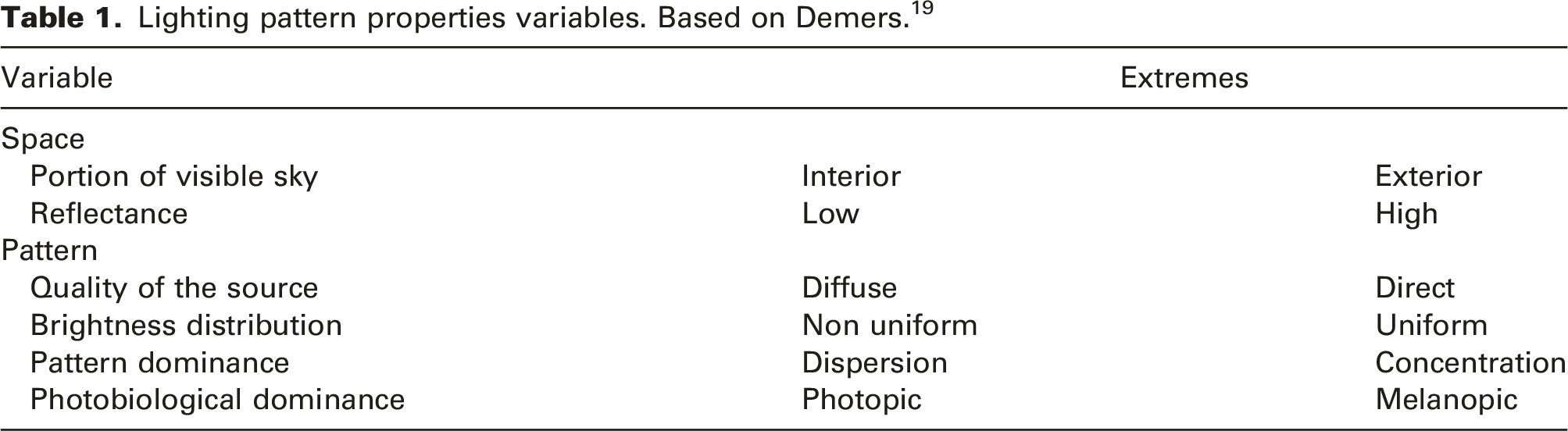
Lighting pattern properties variables. Based on Demers. 19
Stereographic sun path diagrams can assist daylighting designers to characterize melanopic lighting patterns because building orientations containing apertures (one-sided, two-sided corner, two-sided facing) also affect indoor light distribution, as uniformity and non-uniformity. Figure 1 illustrates yearly sun path diagrams for Quebec City (46.8°N) and Inukjuak (58.5°N). These recognized tools in architecture use polar coordinates to express all the possible positions of the sun at any time of the year (orange area) for a specific location in space, as azimuth and altitude, in addition to contextualizing shading masks.
54
When used indoors, they link a space’s aperture configuration to sunlighting potential, solar geometry, sky view angle and geographic orientation. Hypothetical apertures (yellow outlines) illustrate the incidence of latitude on sunlight potential, which is increased in winter at higher latitudes. Different aperture typologies result in spaces where daylight is either concentrated or diffuse. However, this depends on outdoor conditions, more particularly types of sky, ground reflectances, glazing type and indoor lighting types.51,61 This research proposes transposing 360° panoramic representations of photopic and melanopic light into polar coordinate representations that integrate sun path diagrams to highlight the architectural relation between exterior landscape and indoor lighting patterns. Stereographic sun path diagrams. Quebec City, 46.8° N (left) and Inukjuak, 58.5° N (right).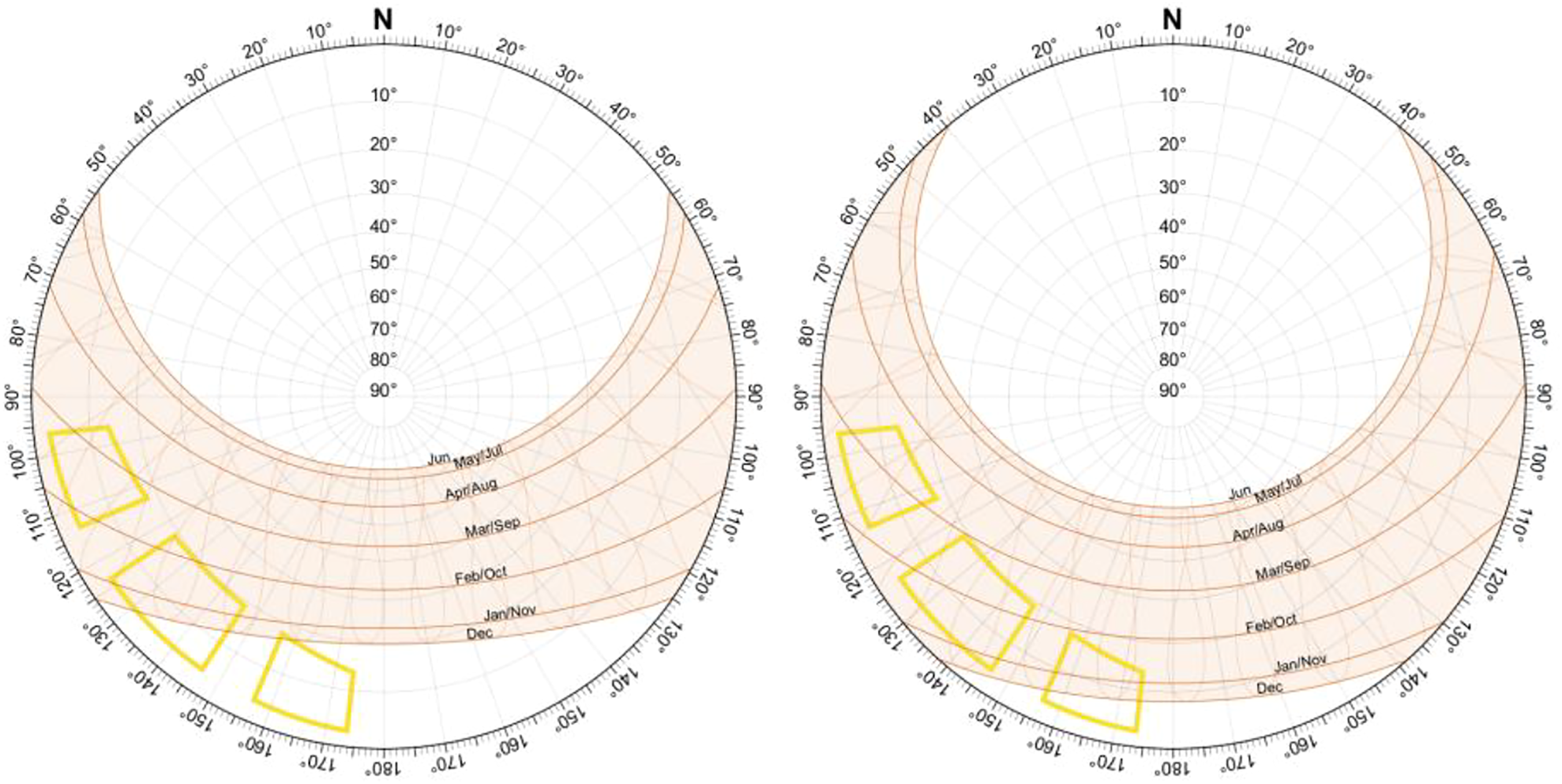
Methodology
The methodology is based on previous research, 48 which uses digital images as analysis tools to assess lighting pattern properties in outdoor landscapes and indoor spaces. It combines photographic and photometric capture methods for the visualization of photopic and melanopic light. This visualization of lighting ambiences is twofold: it relies on qualitative and quantitative aspects of architectural daylighting. 62 In this research, qualitative aspects refer to human perception, 63 while quantitative physical aspects refer to absolute photopic and melanopic illuminance (lux, EML), surface luminance (cd/m2) and photopic/melanopic dominance of architectural components (unitless). This research is distinctive in its use of complete 360° panoramas to represent light ambiences in a scene, and of photopic/melanopic dominance maps. The first section presents the photographic tool that acquires pixel RGB (Red, Green, Blue) channels and surface luminance, and a photometric tool to acquire absolute illuminance. The second section presents the developed modes of representation that visually and spatially express the collected data, and from which lighting pattern properties are evaluated. The third section presents the environmental context and the captured scenes.
Photographic and photometric captures
Physical light information is acquired in two steps, respectively, with photographic and photometric tools. Both steps consist of 360° panoramic captures to record lighting patterns for all possible view directions in a scene.
The photographic tool is based on Raspberry Pi microcomputers, 64 selected for their small size and adaptability that supports their use in remote locations, such as northern regions. The associated Camera Module (RPiCM) can be interfaced easily with the Raspberry Pi to capture and produce high dynamic range (HDR) images. This photographic technique allows an accurate measurement of luminance using RGB channels to render human perception, in terms of light intensity and chromaticity, and to generate false colour luminance maps.65–67 Scripts developed on the microcomputers provide the necessary flexibility to automatically capture and process images for exterior and interior scenes, as described in previous research.48,68,69 Panoramic captures are performed with a series of images corresponding to a complete 360° panorama. Because of the RPiCM’s horizontal view angle of 62.2°, at least 12 images are necessary to provide sufficient overlap to limit geometrical deformation during stitching. This generates tone-mapped HDR panoramas and false colour luminance maps. Additionally, false colour photopic/melanopic dominance maps are generated using a post-processing script based on Jung’s method46,48 that calculates relative photopic and melanopic luminances from RGB channels, in relation to wavelength intervals. These three panoramas encompassing a 360° field of view spatialize light distribution and spectrum in relation to architecture.
The photographic data is complemented with photometric information collected using an ILT5000 research radiometer (International Light Technologies Inc, Peabody, MA, USA). 70 The sensor possesses a field of view that is comparable to humans, and can be equipped with two optical filters that correspond to photopic and melanopic light. 43 The sensor head is mounted on a tripod at the height of 1.5 m to correspond to a standing observer, and vertical illuminance (lux, EML) is acquired through a horizontal panoramic sweep for all orientations of a 360° rotation, performed over a duration of approximately 60 s, at the rate of one value per second. The capture is repeated with both optical filters to capture vertical illuminance at a specific time following the method developed in previous research. 48
Representation
This research develops a method of representation that integrates photobiological metrics to perform light assessments in outdoor and indoor spaces, aiming to qualify the interior–exterior relation in different architectural settings. Although these representations can be used in any environment, this research specifically studies northern environments. For ease of visual assessment, this research expresses photopic light in red and melanopic light in blue colours throughout the various representations. Light assessments are performed using previously developed modes of representation. 48 To evaluate daylighting strategies holistically, these representations convey information for both objective and subjective assessments. 71 The first visualization consists of a series of 360° panoramic representations, which comprises tone-mapped HDR images, luminance maps and photopic/melanopic dominance maps. Panoramas express human perception, brightness zones in relation to luminance distribution in space and photopic- or melanopic-dominant zones in relation to light chromaticity. The second visualization consists of polar coordinate diagrams, which synthesize all possible directions of an observer’s field of view in a 360° panorama. They supplement photopic/melanopic dominance maps with photopic and melanopic vertical illuminance (lux, EML). They moreover provide insights regarding the performance of architectural form in relation to stereographic sun path diagrams, geographic orientation and yearly photoperiod, and constitute design tools that allow conceptualizing the incidence of architectural interventions on existing and projected light ambiences regarding photopic and melanopic light.
Environmental context
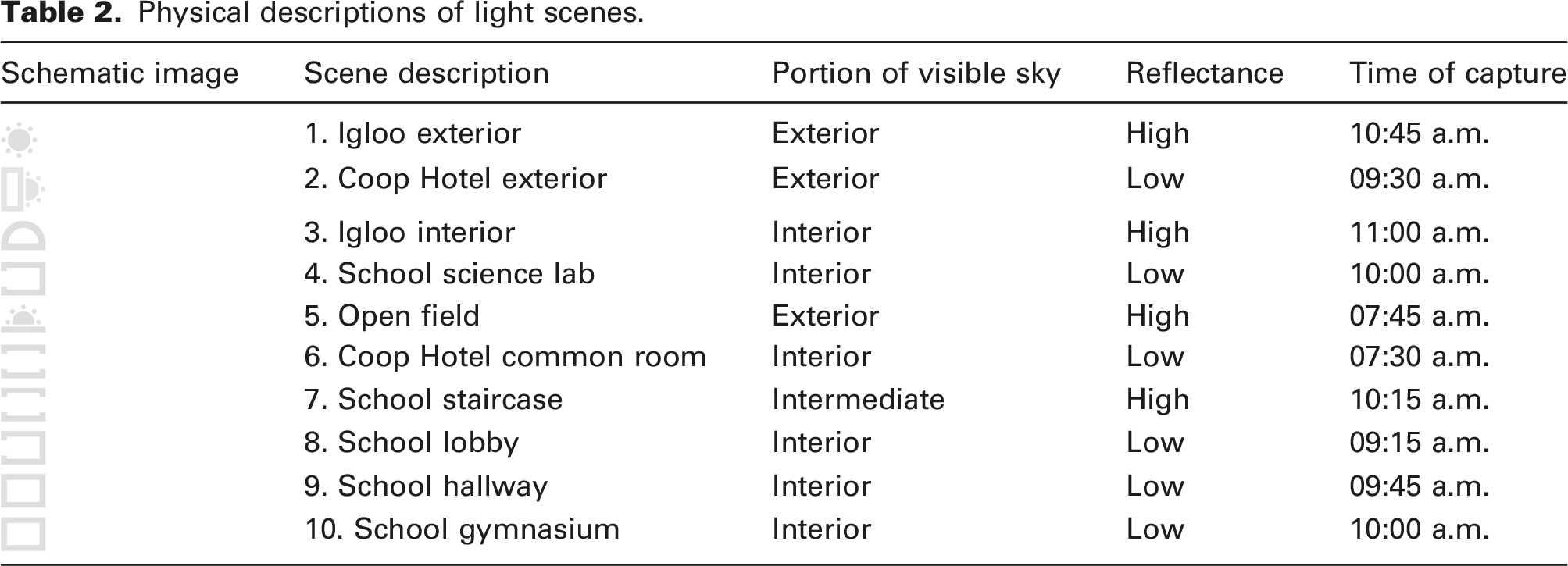
Physical descriptions of light scenes.
Light scenes consist of an assemblage of various daylight conditions, observer positions and architectural types, resulting in specific melanopic light patterns. From the set of 10 captures, panoramic representations of four significant capture sites are shown in Figure 2. The four spaces, each captured at similar times of day, were selected for their contrasting expression of architectural typology. The first space consists of an exterior field with unobstructed sky view, captured at 10:45 am (Figure 2(a)). It is characterized by a direct view of the sun, which is close to its apex, low-density built landscape and high-reflectance snow cover. The second space consists of an exterior setting with half-obstructed sky view, captured at 9:30 am (Figure 2(b)). The capture was performed close to a building, corresponding to an observer located in its shaded portion, to experience a smaller portion of the visible sky. This position of the observer, characteristic of more urban settings affects light directionality and intensity, as architectural zones of opacity occupy a larger area of the sky dome. It, moreover, shows the brightness difference with interior spaces, in terms of range of experienced illuminance values. The third capture was performed at 11:00 am inside a traditional igloo built by village elders as part of the school’s Culture Week (Figure 2(c)). The space is characterized by its organic dome form and semi-translucent snow envelope. The envelope also integrates a small south-oriented aperture consisting of a solid ice block, which is located at an altitude corresponding to winter sun paths and displays increased transmittance and diffusion. The fourth space consists of a contemporary science classroom at Innalik School, captured at 10:15 am (Figure 2(d)). It measures approximately 8 m by 10 m and presents a single window oriented southeast on the shorter wall, and the wall opposite contains the teacher’s blackboard. The lateral partitions are filled with clear storage cabinets for science equipment. To focus on aperture typology and daylighting, the fluorescent lighting system was turned off at the time of capture. In these four scenes, the two exteriors present considerations regarding melanopic light in relation to portions of visible sky and snow cover. The igloo, as a vernacular construction, acts as a reference for what is hypothesized to present a suitable integration of exterior light ambiences. The igloo’s lighting patterns express similar morphological characteristics in interior and landscape, while the modern classroom exemplifies a more typical contemporary space. Panoramic representations of significant sites. (a) Exterior, unobstructed sky view, 10:45 a.m. (b) Exterior, half-obstructed sky view, 09:30 a.m. (c) Interior, igloo, one small aperture, 11:00 a.m. (d) Interior, school science lab, one aperture, 10:15 a.m.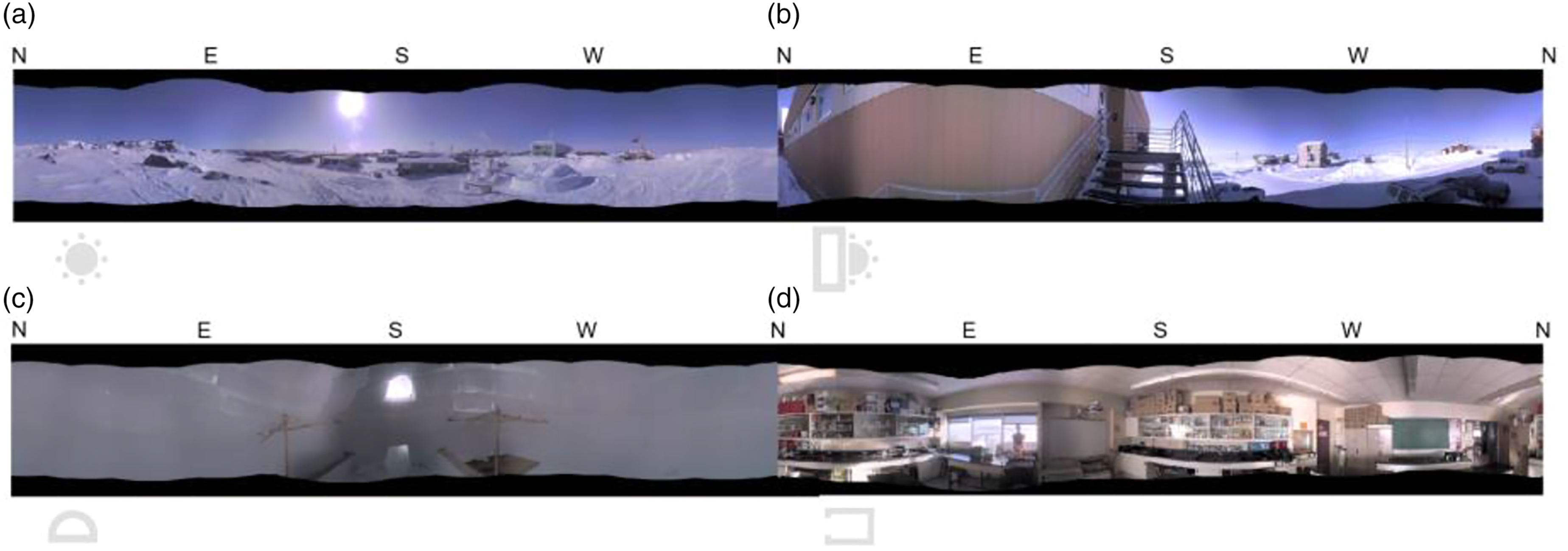
Results: Light scenes
Light ambiences in transition spaces are qualitatively assessed using lighting pattern properties, as expressed in 360° panoramic representations. The first section presents a series of captures regarding those variables. The second section then presents a graphical display of this set of parameters, focusing on photopic and melanopic contents of light in the captured scenes.
Underlying patterns in architectural spaces
Panoramic representations allow to simultaneously visualize different lighting pattern properties, therefore emphasizing light types that correspond to each scene. The comparison of the two exterior sites (Figure 3(a) (unobstructed sky view) and (b) (half-obstructed sky view)) demonstrates the incidence of the position of the observer on patterns and illuminance in relation to architecture and context. The unobstructed sky view causes the most important changes in vertical illuminance, in terms of direct light sources location and view orientation. The exterior (a) presents uniform illuminance values, with an important peak towards the sun, whereas the exterior (b) presents lower values with a slight peak towards the greatest portion of sky view. Both exterior sites present melanopic-dominant light in photometry (illuminance) and photography (distribution), which suggests the potential of characterizing lighting patterns with a photobiological variable to better evaluate interior–exterior relations in architecture, as interiors that reflect landscape ambiences should display melanopic dominance. The comparison of exterior site (a) and igloo interior (c) presents daylight integration, meaning lighting pattern properties that typologically correspond to exterior lighting patterns. In both images and illuminance graphs, visual patterns are morphologically analogous despite a difference in intensity. Despite light concentration towards the sun and aperture as expressed by peak vertical illuminance values, light is dispersed and uniform due to the high reflectance of snow (approx. 0.80),
73
as shown in bright yellow on the luminance maps. In both cases, the photopic/melanopic dominance map also illustrates light uniformity and melanopic dominance, a result of the even chromaticity of snow in the landscape and igloo envelope. The luminance map of a classroom interior (d) shows that light is mostly concentrated towards the aperture (east-northeast), whereas the landscape presents more dispersed brightness zones. Illuminance values attest to this concentration, while the opposite direction (west-southwest) presents lower yet equivalent photopic and melanopic illuminance, indicating that view direction constitutes a more sensitive variable regarding exposure to melanopic light. A greater fragmentation of photopic- and melanopic-dominant zones can be observed on the dominance map, which is indicative of the space’s visual complexity: the direction corresponding to the storage cabinets and cream-coloured wall indicates a slight photopic dominance, whereas the window direction indicates strong melanopic dominance. Conversely, the igloo corresponds to the exterior as it presents subtle yet uniform melanopic dominance. Therefore, analysis through morphological variables suggests that the vernacular igloo, in terms of light distribution and spectrum, constitutes an architecture which presents an accurate integration of daylight, as both the landscape and interior scenes display light types with similar morphological features. Visual representations of scenes captured at similar times of day, therefore, highlight lighting pattern properties, allowing the characterization and comparison of light types in outdoor and indoor spaces. Panoramic representations of significant sites. For each set: tone-mapped image (top), luminance map, cd/m2 (middle), photopic/melanopic dominance map (bottom) and vertical illuminance graph (lux, EML). (a) Exterior, unobstructed sky view, 10:45 a.m. (b) Exterior, half-obstructed sky view, 09:30 a.m. (c) Interior, igloo, one small aperture, 11:00 a.m. (d) Interior, school science lab, one aperture, 10:15 a.m.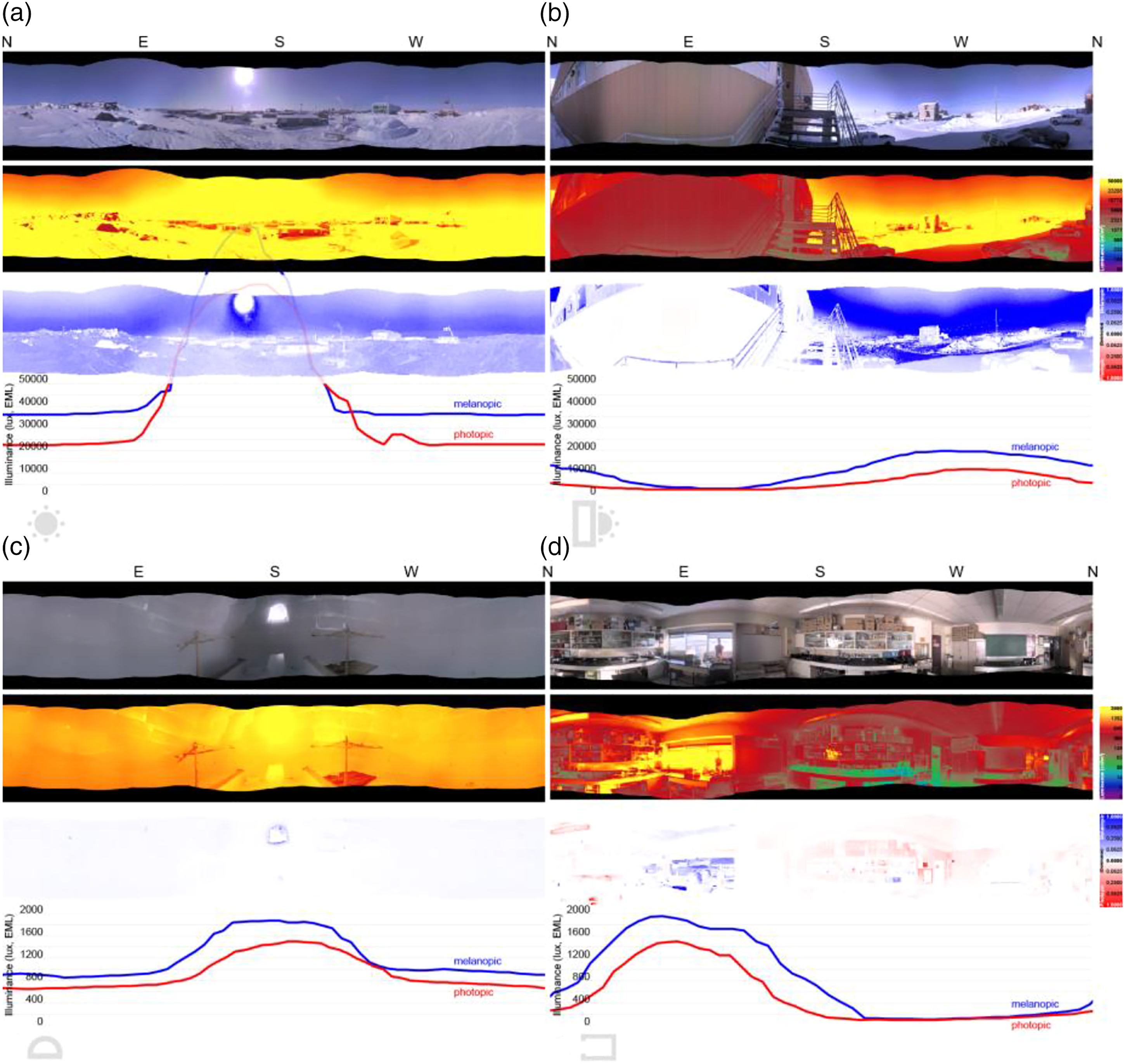
Polar representations incorporating the sun path diagram developed in previous research
48
highlight photopic/melanopic dominance as synthesized in values of vertical illuminance. Plotting vertical illuminance on a polar coordinate diagram expresses a morphology that emphasizes light directionality and photopic/melanopic dominance, while also connecting a scene to its geographic orientation, sun path diagram and portion of visible sky. Different scenes can therefore be compared in relation to these sunlighting criteria. Figure 4 shows the polar representations of the scenes depicted in Figure 3. The similarities and differences between the exterior (a) and the igloo interior (c) regarding photopic and melanopic contents of light become more apparent in these representations. Illuminance values present a similar directionality in relation to geographic orientation: the respective locations of the sun and aperture constitute the orientations (south) with maximum illuminance values, corresponding to 121,000 EML and 1900 EML, respectively, with slight melanopic dominance. The opposed orientations (north) maintain high values corresponding to 36,000 EML and 860 EML, respectively, again with melanopic dominance, which is consistent with photopic/melanopic dominance maps. Moreover, both diagrams (a) and (c) show that minimum illuminance values correspond to one third of maximum values, suggesting that view orientation has a smaller photobiological incidence on retinal illuminance in these two spaces. Conversely, the classroom interior (d), while also depicting maximum illuminance value of 1950 EML towards the aperture (east), presents much lower value of 110 EML towards the opposite orientation (west), which corresponds to almost one twentieth of maximum values. In this case, the interior vertical illuminance diagram differs from that of the exterior, in terms of directionality and difference between extremes, whereas the igloo’s diagram is similar despite a notable difference in intensity. This can be more clearly noticed in the north and south portions of the diagram, where illuminance values drastically decrease as the sensor is rotated away from the aperture. Moreover, the west orientation of the classroom corresponds to the location of the teacher’s desk and blackboard, meaning that students’ field of view would most of the time have low vertical illuminance values, with the window wall located behind them. In terms of photobiology, this suggests insufficient exposure to melanopic light for students at this specific time. The WELL Standard
44
recommends that at least 125 EML be present for at least 75% of desks in learning areas and that this light level be present for at least 4 hours per day every day of the year. However, the northern lifestyle should be taken into consideration as students might spend more time outdoors, suggesting more exposure to melanopic light during other daily activities. In the classroom, other times of day might also present lower differences in illuminance between the aperture and the blackboard due to the location of the sun, resulting in more uniform and diffuse light. Yet, the architectural configuration and associated usage would still present similar photobiological and daylighting considerations at other times of day or season. In this set of morning captures taken close together, the similarity between the exterior and igloo interior suggests how architectural form itself, which includes aperture configuration and surface materiality, has a greater incidence on the resulting type of lighting pattern, as opposed to time of day or season and solar geometry. Polar representations of significant exterior sites. Central image: dominance map (unitless), with yellow outline for visible sky. Outlines: vertical photopic and melanopic illuminance (lux, EML). (a) Exterior, unobstructed sky view, 10:45 a.m. (b) Exterior, half-obstructed sky view, 09:30 a.m. (c) Interior, igloo, one small aperture, 11:00 a.m. (d) Interior, school science lab, one aperture, 10:15 a.m.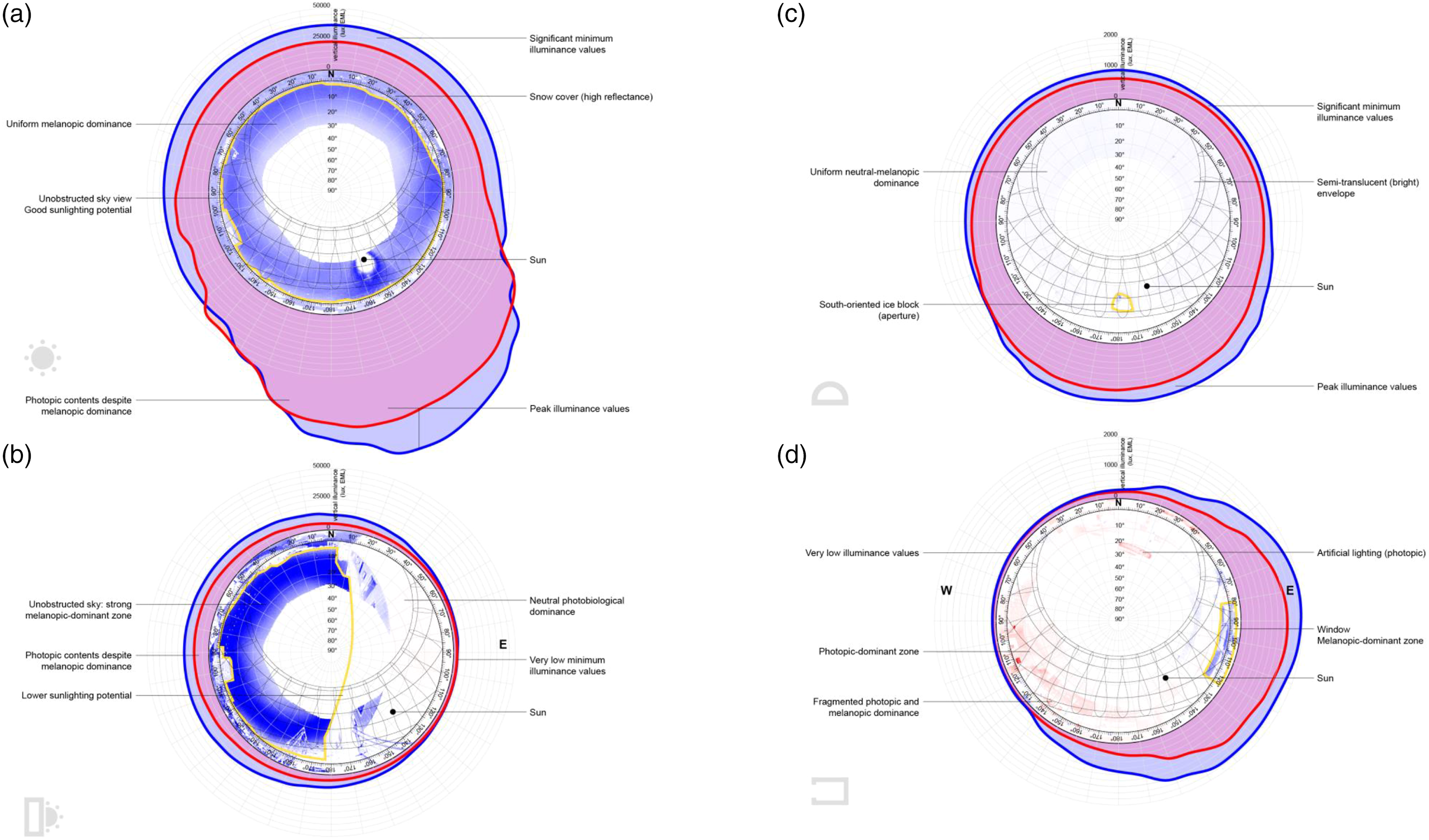
The previous analysis of the igloo and classroom does not necessarily advocate for a nostalgic return to vernacular constructions, but rather illustrates the possibility for an improved architectural integration of the territory’s daylight in northern architecture. A different, contemporary setting provides an improved relationship with the exterior, in terms of light type and lighting pattern properties. It consists of a recent construction presenting a contemporary building type and aperture configuration. Panoramas that clarify the relationship between the landscape and indoor space are shown in Figure 5. The exterior site (Figure 5(a)) consists of a sunrise viewed from outside the Inukjuak Coop Hotel, with a partly obstructed sky view and high-reflectance snow cover. This low solar altitude generates more contrasting light colours to assess light continuity from outdoor to indoor spaces. The interior site (Figure 5(b)) consists of the artificial and daylit hotel common room. It is characterized by the plurality of smaller apertures oriented towards two adjacent directions, or up to 180° in the presented position of the observer. Panoramic representation of improved daylight integration. For each set: tone-mapped image (top), luminance map, cd/m2 (middle), photopic/melanopic dominance map (bottom) and vertical illuminance graph (lux, EML). (a) Exterior, partly obstructed sky view, 07:45 a.m. (b) Interior, hotel common room, many small and medium-sized apertures, 07:30 a.m.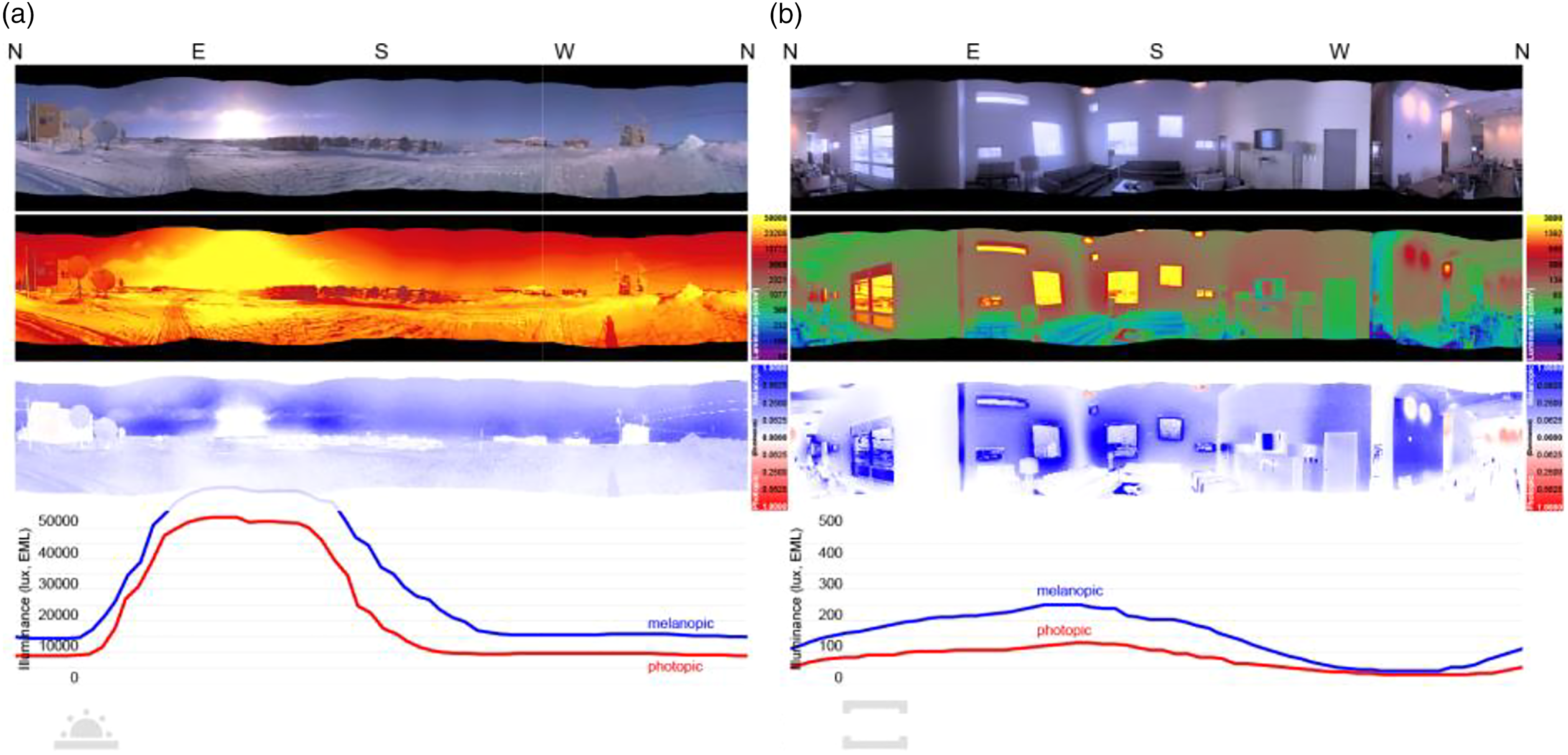
This illustrated example shows similarities, in terms of distribution and dominance, between the general orientation and direction of light, which in both exterior and interior cases consist of concentrated yet uniform light. The exterior luminance map presents similar orange hues in all orientations, which correspond to very bright zones of 10,000–20,000 cd/m2, typical to exterior settings. The luminance map of the hotel space similarly presents wall surfaces with pale red hues, corresponding to values of 50–100 cd/m2, while apertures indicate yellow brightness zones that offer values of 3000 cd/m2 and above. The exterior and interior spaces both present melanopic dominance on the illuminance graph and dominance map, with the exception of the artificial lighting – unnecessary at this time of day due to large fenestrated areas. This suggests that this aperture design contributes to daylight dispersion, resulting in a more uniform ambience that is consistent with the exterior ambience, despite the aperture being concentrated towards the sun. Despite different orders of magnitude regarding illuminance and luminance values, these scenes present similar pattern properties, namely, uniform distribution and melanopic dominance, which attest to the continuity between exterior and interior ambiences and therefore daylight integration.
The corresponding polar coordinate representations integrating sun path diagrams of the two hotel spaces are shown in Figure 6. Captured at similar times under clear sky conditions, they provide supplementary insights regarding daylight integration and the interior space’s capacity to reflect the exterior light ambiences, suggesting an improved interior–exterior relation for its inhabitants. The spatial distribution of apertures (yellow outlines) highlights melanopic-dominant zones corresponding to the larger and more dispersed sky view of the hotel space, which is exposed to a longer portion of the daily course of the sun. Peak illuminance values are directionally similar in both captures, that is, oriented towards the sun and southeast apertures, despite a large difference in intensity. Uniform distribution of light can be observed in the interior’s vertical illuminance curves that show no steep changes in relation to orientation, as dispersed apertures simultaneously let in direct sunlight and diffuse daylight from the sky and snow. Conversely, the exterior vertical illuminance curves show a steeper reduction as the captor’s hemispherical field of view is rotated away from the sun, although maintaining substantial levels in the direction opposite the sun. Photobiologically, this indicates that the interior orientations presenting lower illuminance values, while insufficient this early in the morning, might at other times of day maintain an acceptable intensity for an observer, such as 200 EML for living spaces.
44
This analysis of lighting pattern properties architecturally suggests that the plurality of smaller apertures and their distribution in the building envelope contribute to light uniformity under these specific conditions. The examples presented in this section suggest that photopic/melanopic dominance can structure a graphical display of pattern properties, which is presented in the following section. Polar representation of improved daylight integration in interior–exterior continuity. Central images: photopic/melanopic dominance map (unitless), with yellow outline for visible sky and apertures. Outlines: vertical photopic and melanopic illuminance (lux, EML). (a) Exterior, partly obstructed sky view, 07:45 a.m. (b) Interior, hotel common room, many small and medium-sized apertures, 07:30 a.m.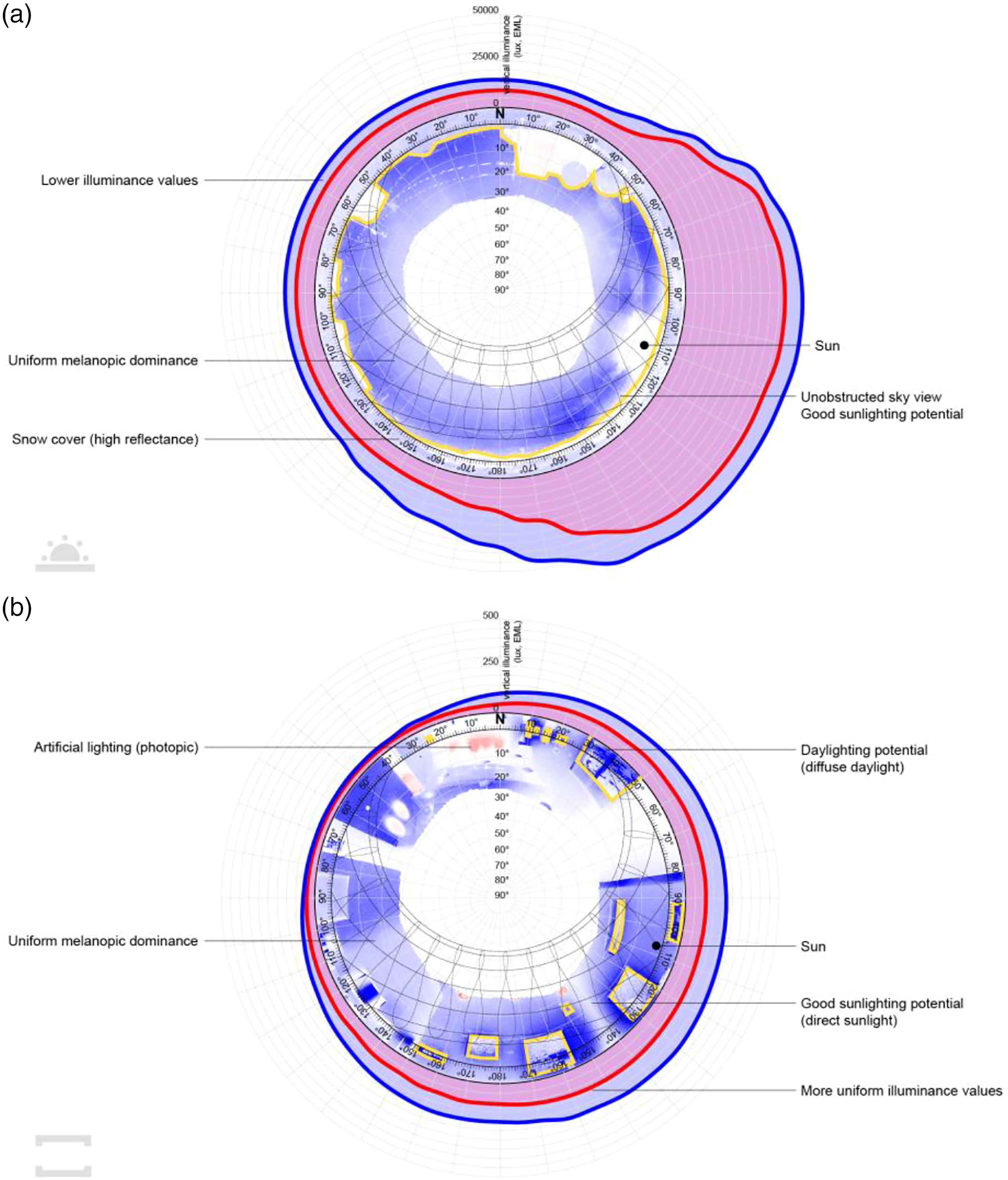
Synthesis of lighting pattern properties
The diversity of light ambiences, ranging from bright outdoor to darker indoor spaces and corresponding to various light distribution and dominance patterns, is assembled in a graphical display of photopic and melanopic light, as shown in Figure 7. This allows for simple assessments of lighting pattern properties, focusing primarily on photopic/melanopic dominance and brightness distribution to identify similar exterior and interior ambiences. Graphical display of photobiological lighting pattern properties in experimented scenes.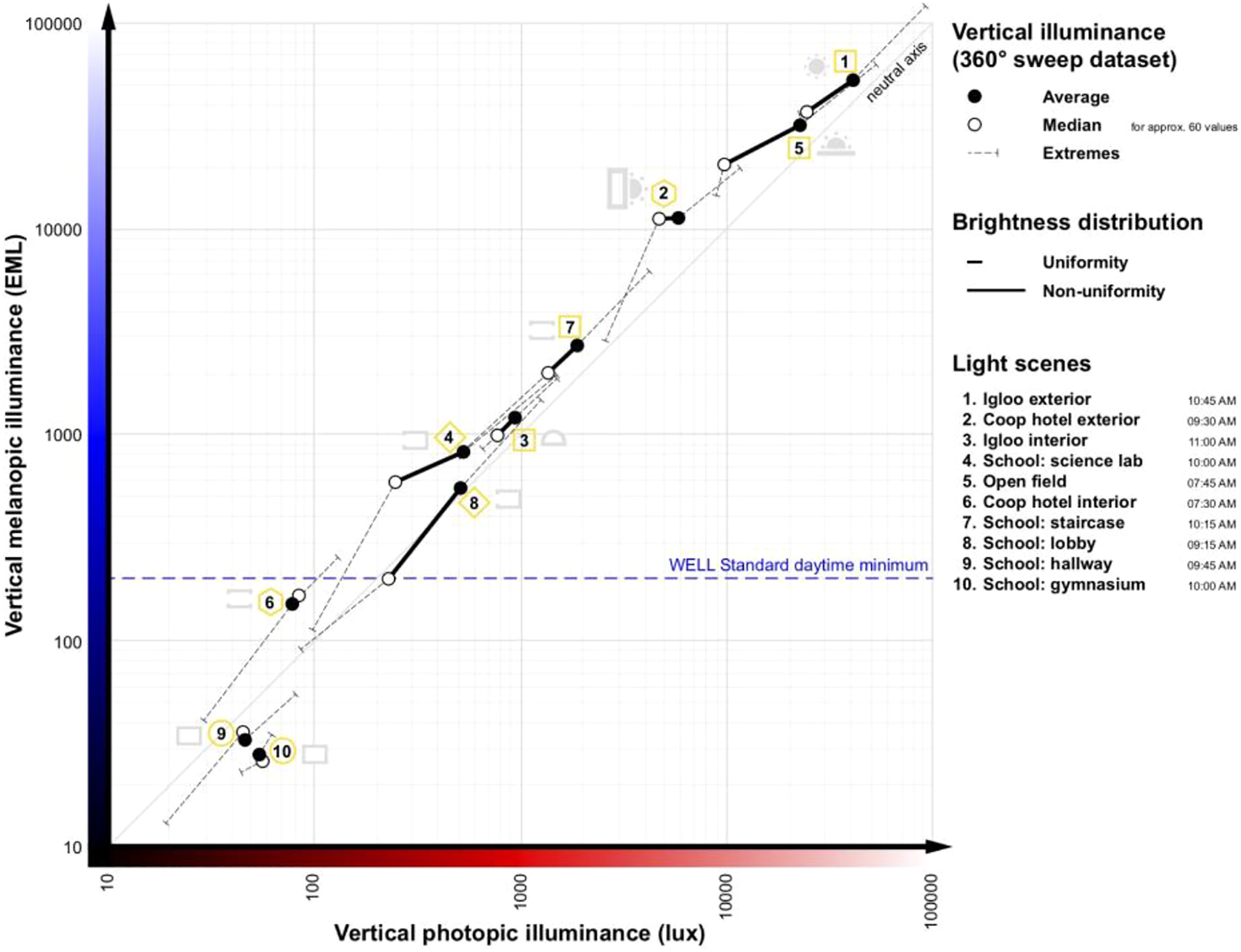
The two axes represent the light scenes’ respective photopic and melanopic illuminance (lux, EML). These correspond to the average and median values of a scene’s dataset, which contains approximately 60 values, for photopic and melanopic light, respectively. The neutral axis is a theoretical equivalence in photopic and melanopic illuminance (y = x), useful to clarify graphically a scene’s dominance. Due to the overlapping wavelengths of photopic and melanopic light, most captures remain close to this neutral axis. Moreover, the more uniform spectral distribution of daylight forbids too much distancing from it in daylighting conditions. However, it remains theoretically possible to obtain more diversified results, as in spaces using specific artificial light sources with strong photopic or melanopic dominance, or workers using special melanopic-blocking optical filters. 41 Brightness distribution, as uniformity and non-uniformity, is visually assessed using the difference between average and median illuminance and is represented in bold black lines. Extreme values are represented in thin dashed lines, expressing notions of light concentration or dispersion, acknowledging localized brightness zones such as the sun or apertures. The graph allows to readily authenticate a scene’s general vertical illuminance in relation to the x-axis and y-axis, its photopic/melanopic dominance in relation to the neutral axis and brightness distribution and pattern dominance in relation to its spreading in the graph. As exterior spaces generally present melanopic dominance, interiors that integrate daylight should also present melanopic dominance. A recommendation from the WELL Standard is identified in this visual representation, namely, daytime living spaces, corresponding to 200 EML and above (blue dashed line). The graphical representation can therefore inform architects regarding the functionality of spaces in varying environmental conditions and programmatic needs.
This graphical display suggests that in addition to standard metrics of contrast and brightness, photopic and melanopic metrics of light provide insights into the relation and continuity of light ambiences between interior and exterior spaces. The visual display of lighting pattern properties facilitates the identification of aperture or window typologies that generate interior light types, or combination of pattern properties, that correspond to exterior lighting ambiences. For instance, the graph indicates that all exterior sites present melanopic dominance and uniform brightness distribution. This can be explained by the highly reflective snow cover at that time of the year. Clear sky captures also generate lighting patterns with concentrated brightness zones. Correspondingly, the interior captures that present homologous light uniformity and melanopic dominance correspond to the igloo (Scene 3) and Coop Hotel interior (Scene 6) and the very bright intermediate space corresponding to a daylit staircase (Scene 7). Conversely, photopic-dominant scenes usually consist of artificially lit interior spaces, as higher illuminance values provided by daylight possess a spectral distribution with slight melanopic dominance. The school gymnasium (Scene 10), while presenting very uniform light, indicates clear photopic dominance. This means that its light ambience is chromatically different from the exterior and shows illuminance values of 28 EML, well below the WELL Standard daytime recommendation of 200 EML. Photobiologically, lighting in this space, therefore, appears insufficient. Thus, comparing these spaces as proposed in Figure 7 can help designers to better identify the spaces in need of improved indoor lighting ambiances to meet occupants’ photobiological needs and thereafter develop appropriate design solutions. For instance, designers could further investigate the times of the day during which the school gymnasium (Scene 10) is occupied and propose renovation interventions targeting the type of artificial light used at certain times of the day or the building envelope to increase or to adapt window configurations.
Discussion
The results presented in this paper characterize interior–exterior relations through lighting pattern properties. Although some spaces present insufficient melanopic illuminance in relation to the WELL Standard, existing spaces presenting lower illuminance values or photopic dominance should not necessarily be interpreted as problematic, as inhabitants move to other spaces throughout the day. Different spaces and view directions might therefore fulfil people’s photobiological needs such as exterior spaces or brighter interiors. Within each space, average illuminance values could also vary depending on view directions and the position of occupants (seating or standing), for instance. As suggested in recent research,74,75 a broader interpretation of daily activities, as a temporal sequence of events, and daylight perception,76–78 should therefore be considered when assessing daylight quality in various spaces. Yet, the novel modes of representation that spatialize melanopic light in relation to architecture, as polar coordinate diagrams and graphical displays of lighting pattern properties, inform designers on the incidence of architectural form and aperture typology on resulting light types, so as to guide future architectural design initiatives. Further research would be required to fully evaluate the performance of aperture typologies.
Our methodology is limited by the many steps of the capture process, which take approximately 8–10 min per scene, allowing enough time for lighting conditions to change. An instantaneous 360° measuring array would insure more representative values of actual scenes. This research presents a limited number of site samplings, in terms of temporal scale and ambience variation, to perform a complete longitudinal assessment of possible ambiences. As the captured scenes correspond to a single time of the day and year, a longitudinal study over the yearly photoperiod would be required to fully assess the photobiological considerations related to an architectural type, by their variations or constancy, as daylight in northern regions is characterized by its seasonal extremes. However, the energy autonomy of capture tools is limited in very cold exterior environments. The automation of capture and post-processing steps should therefore be improved if longitudinal surveys are to be performed. Climate-based simulations, such as those developed by Mardaljevic, Andersen, Roy and Christoffersen, 79 including the spectral composition of light could moreover be useful to evaluate daylighting conditions on an annual basis or at specific times. A greater diversity of spaces and surface colour could also be experimented as environmental conditions of diffuse daylight and vegetation ground cover. This photobiological lighting pattern measuring and representation method constitutes a basis for transferring this exploratory research to architects’ more practical design projects, such as typological studies of aperture design. Further research could test architectural configurations and aperture design for spaces in early conceptual phases, such as in scale models under northern daylight. It could also develop subjective assessments using immersive visualizations of built environments and conceptual scale models, in relation to possible Inuit cultural preferences, while also evaluating the thermal and photobiological challenges related to daylighting at the photoperiod’s seasonal extremes that are characteristic to northern regions.
Conclusion
This research presents the applicability of a photobiological methodology to characterize lighting patterns, namely, the photopic and melanopic contents of light. Key findings include the application of spatial representations of photopic and melanopic light, as in dominance maps and representations using polar coordinates, to compare and assess daylighting design strategies used in northern indoor spaces in relation to the landscape. In the context of Nunavik, this research proposes a novel graphical display of lighting pattern properties to clarify photopic/melanopic dominance and brightness distribution. The structure of this graphical display constitutes a tool for the comparison of lighting ambiences in different scenes, namely, exteriors and daylit interiors. The igloo, the epitome of northern vernacular architecture, illustrates a fit integration of the territory’s daylight, in terms of light distribution and spectrum. The photobiological methodology and associated graphical display can architecturally inform the optimization of design initiatives and hypotheses regarding aperture configuration and surface materiality. As continuity between outdoor and indoor light ambiences can improve the wellbeing of local Inuit communities, the methodology constitutes a support tool for improving interior–exterior daylighting transactions.
Footnotes
Authors’ contribution
The research article reflects Sentinel North’s convergence of expertise, transformative research, the development of new technologies and the training of a new generation of interdisciplinary researchers aimed at improving our understanding of the northern environment and its impact on humans and their health. The transdisciplinary project, carried out by Phillippe Lalande, graduate student in architecture, required the contribution of researchers from three faculties: Claude M.H. Demers (supervisor, daylighting, architecture), Marc Hébert (co-supervisor, photobiology), Jean-François Lalonde (computer engineering, hardware and software system development), André Potvin (microclimates and building typology) and Mélanie Watchman (environmental survey analysis, writing).
Declaration of conflicting interests
The authors declared no potential conflicts of interest with respect to the research, authorship, and/or publication of the article.
Funding
The author(s) disclosed receipt of the following financial support for the research, authorship, and/or publication of this article: This research was supported by the Sentinel North strategy of Université Laval, made possible, in part, thanks to funding from the Canada First Research Excellence Fund. More specifically, the research was funded by the project ‘Optimizing biophilia in extreme climates through architecture’.
