



Abstract
The investigation of fire incidents in buildings is essential in understanding the consequences on occupants and property. Moreover, a fundamental role in life safety and property protection is represented by the minutes after the fire ignition. Therefore, it is possible to evaluate the effects that the discovery time of occupants and response time of the fire brigades have on a successful evacuation, reduction of fatalities and fire confinement in buildings. The Dwellings and Other buildings fire statistical databases published by the Home Office in England with data from 2010/11 to 2016/17 are investigated to determine how the fatality/casualty rates vary with different discovery times in Dwellings according to the methodology provided by Ramachandran, and adopted in the PD 7974-7:2003. Furthermore, the average response time of the fire brigades for Dwellings and Other buildings appears to be between 7-8 and 8-9 minutes, respectively. When the response times are analyzed in terms of the fatality/casualty rate, there is an upward trend in Other buildings. Finally, response time is also examined considering fire spread, fire and total damage showing that in Other buildings the classes of more severe fire damage increase for a response time between 6 and 8 minutes.
Keywords
Introduction
When a fire ignites in a building, the first minutes after the ignition are fundamental for life safety and property protection. In particular, an effective human response of occupants to the fire, and the response time of the fire brigades to the call represent the possibility of quickly escaping, promptly evacuating the occupants, suppressing the fire and limiting the structural damage. Indeed, one of the most crucial aspects during a fire incident is the possibility of a safe escape from a building and an effective fire brigade response in attending the fire scene, rescuing occupants and extinguishing the fire.
It is, therefore, fundamental to understand the behaviour of the occupants in buildings during the incident, 1 from how and when people raise alarms, how quickly they respond to alarms, and how they move once the alarm has been raised. 2 These times from fire initiation to evacuation are also required in time-dependent risk assessment models.
The beneficial aspects of an effective occupant response were investigated in a study developed in the State of Victoria (Australia) considering 109 fatal residential fire incidents and investigating victims’ and survivors’ risk characteristics to understand if there were populations that were more likely to sustain injuries. 3 Some factors were linked to the fire cause as well as to the effective response. It was also seen that age, house quality and behaviour could potentially instigate a fire, inhibit fire response and contribute to fatalities. The study also stated that some of the fatalities could have been reduced by early warnings.
The importance of fire detection was also highlighted by Ramachandran 4 who affirmed that a successful evacuation depends on the discovery time of the fire and effective communication to occupants of the fire location, size and spread. Ramachandran also stated that there are three main time periods composed of four events which are ignition, perception, beginning of evacuation and arrival at a safe place. 4 The ‘time needed’ for occupants is also linked to psychological aspects and can vary according to the objectively and subjectively perceived availability of escape. 5 Moreover, assumptions and simplifications of human behaviour could inappropriately characterize the actual evacuation time. Therefore, the factors influencing actions taken by occupants need to be identified such as perception of cues, interpretation of situation and risk, the decision about actions and actual action. 6
The estimation of a reasonable fire detection time is linked not only to the evaluation of effective escape but it is also considered at the base of the design of evacuation models able to simulate crowd behaviours in the presence of fire, and numerical simulations to determine the operation of fire safety devices such as the start-up time of aerosol extractors. 7 Moreover, the discovery time and response time are considered one of the most relevant factors able to improve occupant rescue operations and limit the spread of fire affecting a building. They could also be adopted in fire risk assessment and used as inputs for the evaluations related to the identification, assessment and treatment of fire risk. 8
When fatalities occurred and fire spreads beyond the room of origin, usually through openings or due to convection, the main reasons are attributable to the exposure to toxic gases and the collapse of a compartment or structural member, respectively. The latter usually happens when a flashover occurs. Furthermore, the factors influencing fatalities and fire spread are the presence of automatic extinguishing systems, the material involved in the fire and the response time of the fire brigade 9 which appears to be influenced by the traffic conditions and distance from the fire stations to the fire incident. Even though it is impossible to simulate all fire scenarios, it is essential to apply a probabilistic assessment of the most relevant scenarios based on risk-informed evaluation. 10
While the discovery time is relevant in the light of fire detection, another factor that could limit the fire consequences in terms of life safety and property protection is the response time of the fire brigades in attending the scene. Seven-time steps are usually defined between ignition and firefighter intervention that are classified as the notification of the incident, firefighter dispatch, preparation, travel time, set up after the arrival at the fire scene, occupant rescue and fire extinguishment. The response time is also defined as the sum of dispatch, preparation and travel times.
The relationship between discovery and response time, and fatalities and property loss is affected by the speed of fire spread and fire growth rate due to material involved, ventilation or number of openings as well as the delay in discovering and notifying the fire incident. 11
It is, therefore, clear how a quick response determines a more effective intervention 12 and this is supported by the fact that the increase in response time could increase the risk of trapped people being exposed to untenable conditions and the risk of property loss affected by wide fire spread before the intervention of the fire department. 12 In this light, the relationship between the fire service response and fire outcomes was studied in New Zealand showing that, based on a regression analysis, 4% of building fires were classified as ‘large fire’ when the emergency call was received. However, it was proved that for every one-minute increment in response time, the proportion of fires described as ‘large’ on arrival increased by 2.3%. 13
The response time is properly planned based on demand and resource allocation. More specifically, in the UK, a specified minimum level of response time and brigade attendance is determined for the fire risk areas in which the city is usually subdivided considering commercial and industrial city complexes, centres of large towns, built-up areas of towns and rural areas. In a community, fire protection assumes the form of potential demand which can be reduced with active or passive measures, and realized demand for which the fire brigade is responsible. Moreover, the type of hazards, geography and peak period times determine the resources allocated by the fire brigades to guarantee the best occupants rescue and fire suppression. 9
Optimization of the number and location of fire stations could substantially reduce the time between the notification to the arrival at the fire scene. 14 The reduction in response time determines an improvement in fire protection and reduces the direct financial losses that could be invested in prevention, regular maintenance and detection and suppression systems. 15 This is also supported by Hogg’s statement that: ‘Every additional station, if properly sited will reduce the overall time between call and arrival but each additional station should pay for its upkeep in terms of the resultant saving in life and monetary loss from fire’. 14
Furthermore, the goal to better cover the area assigned to each fire station is to reduce the response time of fire brigades and have several fire sites within a fixed distance range. In the majority of studies, response time is evaluated to measure performance. However, only a few studies demonstrate the relationships between response time and fire losses. 15
Consistent with the necessity to examine real fire incidents in buildings, the British Standard PD 7974-7:2003 16 related to the probabilistic risk assessment presented fire statistical data from 1966 to 1987. Due to the need for more recent data able to evaluate current fire scenarios, the British Standard previously mentioned was recently updated in 2019 17 considering an extended study18,19 in which the guidelines provided by the PD 7974-7:2003 were compared to current fire statistics of the USA and England. However, in those comparisons, Table A.13 focused on ‘Discovery time and fatal casualties’ of the PD 7974-7:2003 (named PD 7974-7 in this paper) was not examined.
Structure of the developed analysis.

The developed analyses are based on the data of Dwellings 20 and Other buildings 21 fires databases publicly available and published by the Home Office in England with data from 2010/11 to 2016/17 to provide reliable data representative of current fire incidents. The discovery time and notification to the fire brigades could be reduced by the operation of alarms while fire duration, spread and damage by automatic extinguishing systems. However, active and passive fire protection measures in buildings have not been considered in this study as they are not specified in Table A.13 of PD 7974-7:2003 and an overview of all possible times of occupants and fire brigades during fire incidents was the intent of this study.
The generated outputs will provide an overview of the current fire response of occupants and fire brigades as well as useful considerations on the relationships between fire detection and fire brigade response and fire consequences on lives and property. The results could also be adopted by Fire and Rescue Service organizations, and national and local authorities as valuable tools to evaluate current fire response, determine resource allocations and create fire prevention campaigns.
Fire statistics of the Home Office
The analyses of this research were developed considering the fire statistical data provided by the fire statistics of the Home Office in England. The information on the fire incidents is collected in the aftermath of an event by the fire brigades attending the scene filling in the Incident Recording System form 22 and subdivided into several fire statistical variables related to pre, during and post-fire conditions.
The Home Office Incident Recording System (IRS) was developed by the Home Office, which gathers data on incidents attended by the fire and rescue services (FRSs) in England, Wales and Scotland. It is composed of a pre-populated web-based form with information from the Command and Control systems, and it is filled in and submitted by those present during the incident. 23 A quarterly release on Fire and Rescue Service statistics collecting national statistics on fires, casualties, false alarms and non-fire incidents attended by the fire and rescue service in England and annual releases with more detailed analyses and non-fire incidents, is published by the Home Office. 24 The quality of data is ensured by the collaboration between the Home Office and FRSs but unidentified inconsistencies may be present in the datasets. 23
The IRS
22
is composed of questions covering the complete description of the fire incidents from fire causes to the evaluation of structural damage. Primary fires are defined as fires that cause damage by fire/heat/smoke and have at least one of the following conditions: - any fire that occurred in a (non-derelict) building, vehicle or (some) outdoor structure - any fire involving fatalities, casualties or rescues - any fire attended by five or more pumping appliances.
25
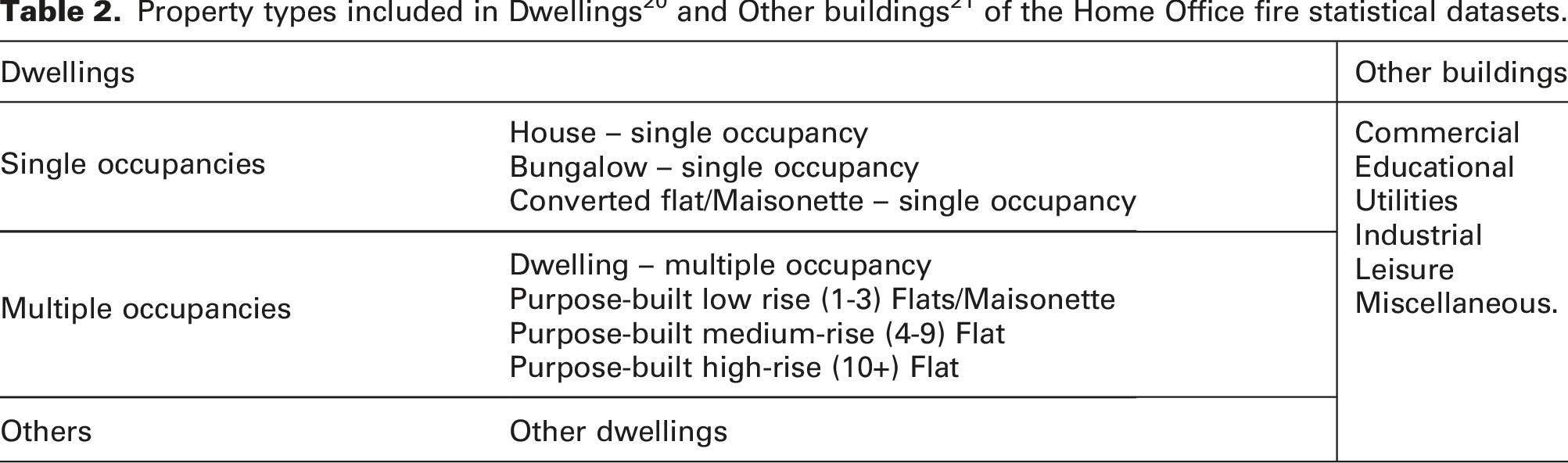
Primary fires are also divided into four categories: Dwellings, Other buildings, Road vehicles and Other outdoor fires. The focus of this study is mainly on Dwellings and Other buildings fires datasets published by the Home Office in which data are collected from 2010/11 to 2016/17. 21 The year 2016/17 was chosen as one of the latest years without social restrictions before the beginning of the COVID-19 pandemic. There is the possibility of an influence of the pandemic on changes in trends of fire incidents. This is also supported by the statement provided by the Home Office related to the fire statistics in England for the year ending in March 2022 that affirms that the increase in incidents attended in 2022 compared with the previous year was driven by increases in fires, non-fire incidents and fire false alarms where restrictions to life due to the COVID-19 pandemic in the previous year may have reduced the number of certain incident types. 26
The fire statistical fields adopted in the analyses are specifically referred to the time between ignition and discovery, and the time between discovery to call of occupants and the response time of the fire brigades. Response time is defined as the time interval between the call being made (notification of the incident) and the first fire vehicle attending the scene. 21 The fatalities and casualties are recorded as a unique value. Therefore, the fatality/casualty rate is evaluated by considering the total number of fatalities and casualties divided by the total number of fires. In the fire statistics of the Home Office, fire spread is available as well as the fire damage classified according to fire and total damage where fire damage is defined as the total horizontal area damaged by the flame and heat in m2 at the stop of the fire; and total damage as the area damaged by the flame, heat, smoke and water in m2 at the stop of the fire. 21
In the following section, the research recreates Table A.13 of the PD 7974-7:2003 focused on the investigation of the discovery time in relation to the number of fires and fatality/casualty rate with data available in the Dwellings fires dataset published by the Home Office.
Discovery time, fatality and casualty rate
As stated in the ‘Introduction’ section, Table A.13 of PD 7974-7 describes the discovery time and fatal casualties based on the data of the Fire Statistics of the United Kingdom of 1978-1991 classified according to Single and Multiple occupancy dwellings. The number of deaths, fires and the fatality rate per fire defined as the number of deaths divided by the number of fires, are evaluated according to the discovery time. 27
Table A.13 of PD 7974-7 considers only the fatality rate and the values are derived from the research developed by Ramachandran. 27 However, in the study of Ramachandran, not only the fatalities are present but also the non-fatal casualties for the same fires recorded by the Fire Statistics United Kingdom in the period 1978-1991.
It is important to highlight that the fire statistical variable related to fatality/casualty of Dwellings in the English fire statistics describes whether the incident involved at least one fire-related fatality or one casualty from the fire. Therefore, the analysis needs to be considered with a degree of caution and in light of the differences that inevitably arise when comparing the data referred to different metrics.
The classes of discovery times in PD 7974-7 Table A.13 are listed such as discovery at ignition, under 5 minutes, between 5 and 30 minutes and more than 30 minutes after ignition. The fatality rate is assumed to increase with time based on a linear relationship according to a constant λ (called increase rate per minute) defined as relating the fatality rate to the discovery time. The assumption that the fatality rate increases with time appears reasonable in light of the possible increase of the fire size in time and the consequent difficulties of the fire brigade in confining the fire and evacuating occupants. Since usually a high number of fatalities are found in the fire room of origin at ignition and the class of discovery time over 30 minutes (usually approximated to 45 minutes) presents a very wide range, λ is calculated considering only the discovery time under 5 minutes and between 5 and 30 minutes. Detection systems are not considered in the analysis even if they could reduce the fatality rate.
28
Based on a linear relation, the coefficient k is defined as the intercept of the vertical axis as shown in equation (1), where Pd is the overall fatality rate and ∆tdet is the average discovery time.
The Home Office dataset for Dwellings published in 2017 with data from 2010/11 to 2016/17, is described in the ‘Fire statistics of the Home Office’ section and has been adopted for the developed analysis considering Single and Multiple occupancy dwellings. The general class of Single occupancy dwellings includes those of House – single occupancy, Bungalow – single occupancy and Converted flat/Maisonette – single occupancy. In Multiple occupancies, Dwelling – multiple occupancy, Purpose-built low-rise (1-3) Flats/Maisonette, Purpose-built medium-rise (4-9) Flat and Purpose-built high-rise (10+) Flat classes are considered. The class of Other occupancies available in the Dwellings fires datasets and referred to as other dwellings has been also considered in the analysis. A direct comparison between the PD 7974-7 and the Home Office fire statistics is only possible for Single and Multiple occupancies.
The classification adopted in the English fire statistics for the discovery time is similar to the one presented in Table A.13 of the PD 7974-7 with the only exception of two classes summed together that are discovery time over 30 minutes and up to 2 hours and the one of discovery time over 2 hours. However, in the Home Office datasets, fatalities and casualties are recorded as a unique value and the fatality/casualty rate is obtained for the Dwellings fires dataset. As stated above, fatality/casualty of Dwellings in the English fire statistics describes whether the incident involved at least one fire-related fatality or one casualty from the fire. Therefore, the analysis developed in this section has summed the number of fatalities and non-fatal casualties available in the study of Ramachandran 27 to evaluate the fatality/casualty rates for a more accurate evaluation.

For the PD 7974-7 and Ramachandran’s data, the number of fires is the same as the data of the PD 7974-7 are derived by the analysis of Ramachandran. In general, the number of fires recorded in the English fire statistics is approximately 3.2 and 4.6 times less in Single and Multiple occupancy than in Ramachandran’s data, respectively. This could be due to different time frames for the analysis of Ramachandran considers 13 years while 7 years for the Dwellings fire statistical dataset. Moreover, an increase in population from 1978 as well as possible changes in domestic and energy habits, and fire safety regulations could be the factors able to reduce fire incidents.
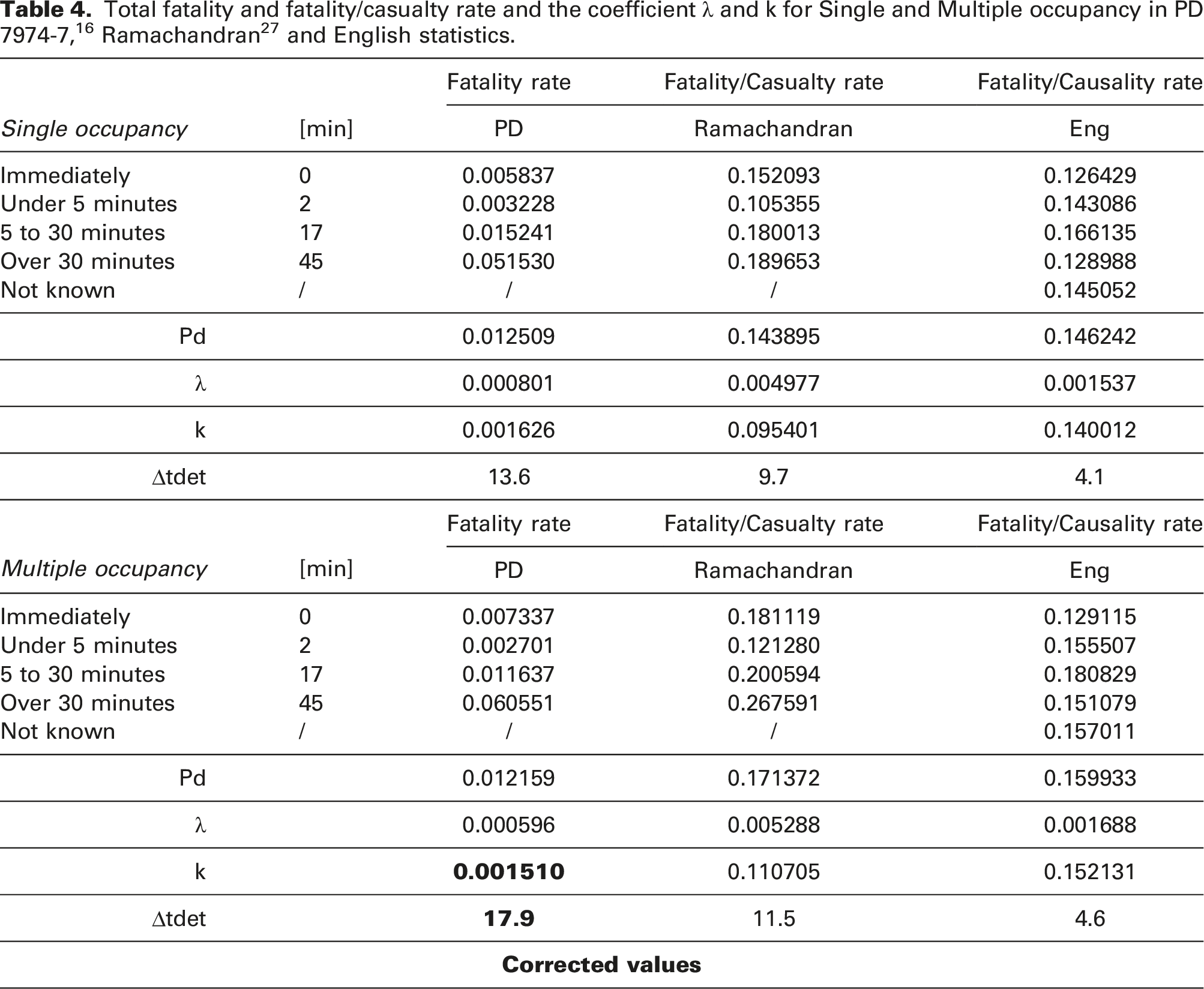
The coefficient λ is determined by evaluating the difference between the rate for 17 and 2 minutes and dividing the value by the time range of 15 minutes. Once λ is known, the coefficient k is evaluated by inverting the formula of equation (1) applying the overall rate and discovery time for 2 minutes. The average discovery time ∆tdet is calculated considering the total rate and the coefficients λ and k.
When the fatality rate is determined, as stated in section 6.2.5 (life risk) of PD 7974-7 document, 16 ∆tdet is equal to 13 minutes for Single and Multiple occupancies. However, the analysis developed in this research obtained for the data provided by the PD 7974-7, a ∆tdet of 17.9 minutes for Multiple occupancy and a coefficient k of 0.001510 instead of 0.001509. Furthermore, the average discovery time for Single and Multiple occupancy are 4.1 and 4.6 minutes in English fire statistics, respectively (Table 4). Based on the obtained results, the average discovery time in English fire statistics is more than 2 times less than the one obtained in Ramachandran’s study. This could be determined by an increase in the number of households having installed alarms or due to fire prevention campaigns supporting awareness of fire risks. The discovery time is also a fundamental variable to be considered in evacuation models and risk-informed evaluation.
Figure 1 plots the fatality rates for PD 7974-7 and the fatality/casualty rates for the English fire statistics obtained for Single and Multiple occupancy according to the classes of discovery times present in PD 7974-7 and English fire statistics. The trend for Single and Multiple occupancy in PD 7974-7 and English fire statistics have similar values and a great difference between the two occupancies types is not present. However, the fatality/casualty rate in English fire statistics is usually at least 10 times greater than those available in PD 7974-7. The values derived from the number of fatalities divided by the number of fires in the PD 7974-7 are relatively small leading to fatality rates always below 0.07. When fatalities and non-fatal casualties are summed together, fatality/casualty rates deduced in Ramachandran’s study appear to better represent those provided by the English fire statistics. Fatality and fatality/casualty rate for Single and Multiple occupancies in PD 7974-7
16
(PD) and English statistics (Eng).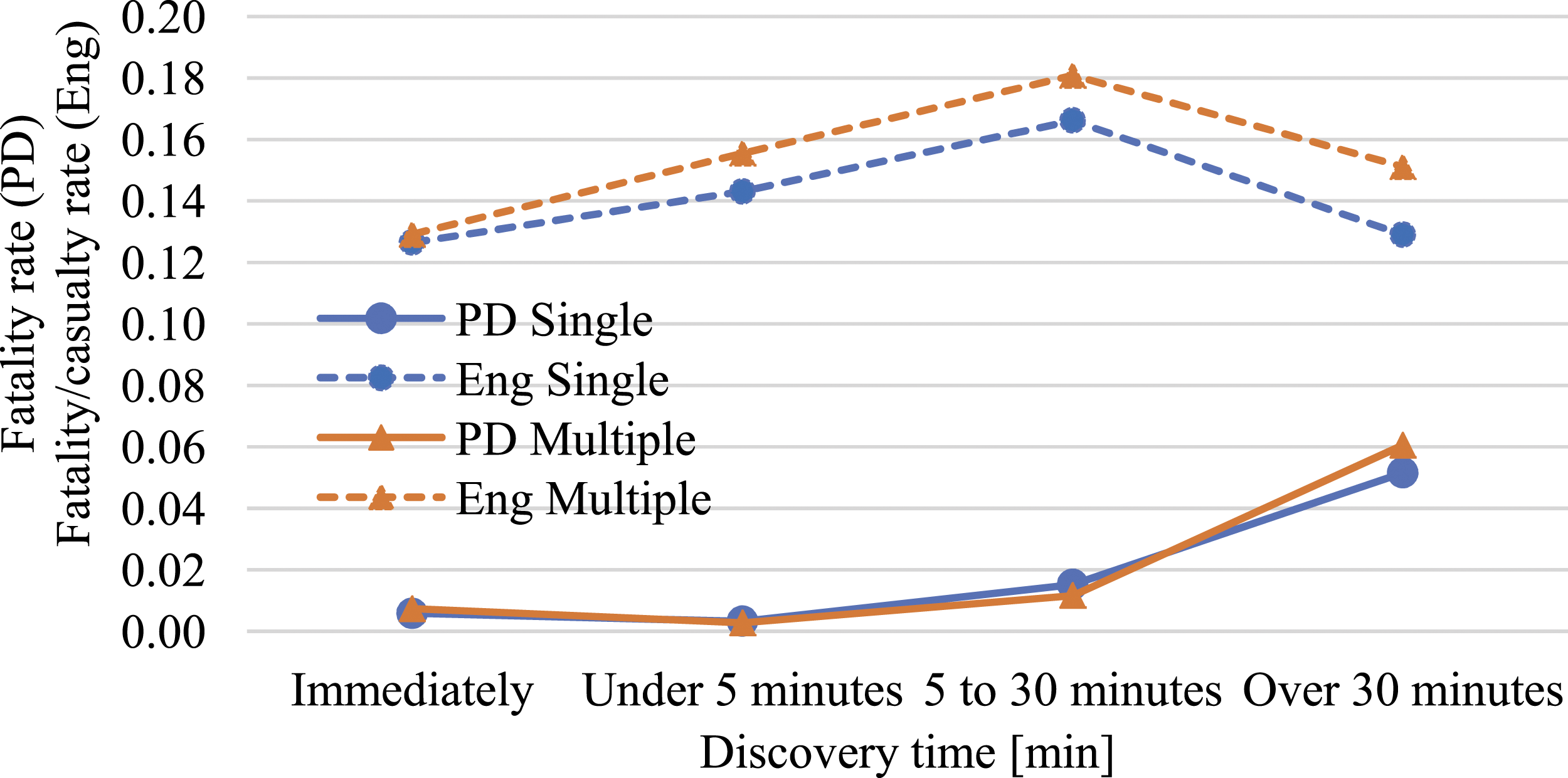
As mentioned above and presented in Table 4, the fatality/casualty rates according to Ramachandran’s study and English fire statistics appear similar. Indeed, the values of the fatality/casualty rate in Table 4 vary from 0.10 to 0.20 in Single occupancy and from 0.12 to 0.27 in Multiple occupancies. The average fatality/casualty rate for both statistics could be approximated at 0.14 in Single occupancy and 0.17 in Multiple occupancies. Moreover, applying the same methodology of equation (1) to determine the overall fatality/casualty rate Pd and the coefficients λ and k, the average discovery time ∆tdet is equal to 9.7 and 11.5 minutes in Ramachandran’s study which appear to be 4 and 6 minutes less than those obtained for the analysis of fatalities of PD 7974-7 in Single and Multiple occupancies, respectively (Table 4). The reduction seen between the average discovery time in fatalities and non-fatal casualties in the analysis developed by Ramachandran could be attributable to the possibility that in fatal fires, an explosion, rapid-fire growth or non-vigilant occupants could imply higher risk and delays in the discovery times. When the average discovery time in the Dwellings fire statistical dataset is examined, this is reduced from the evaluation of Ramachandran showing a more rapid fire detection possibly attributable to a better operation of fire detection devices and effective fire prevention campaigns for communities.
Based on Figure 2, when the fatality/casualty rate is investigated, there are generally two peaks: one for the immediate fire discovery and the other for a discovery time between 5 and 30 minutes. The high values attributable to the immediate fire discovery could be related to the impact that an undetected fire causes on the safety of occupants. Moreover, trends of recent fire statistics are similar to those provided by data from 1978 to 1991 showing minor differences in the obtained values. Therefore, the fatality/casualty rate assumes a similar tendency over time. Fatality/casualty rate for Single and Multiple occupancy in Ramachandran (Ram)
27
and English statistics (Eng).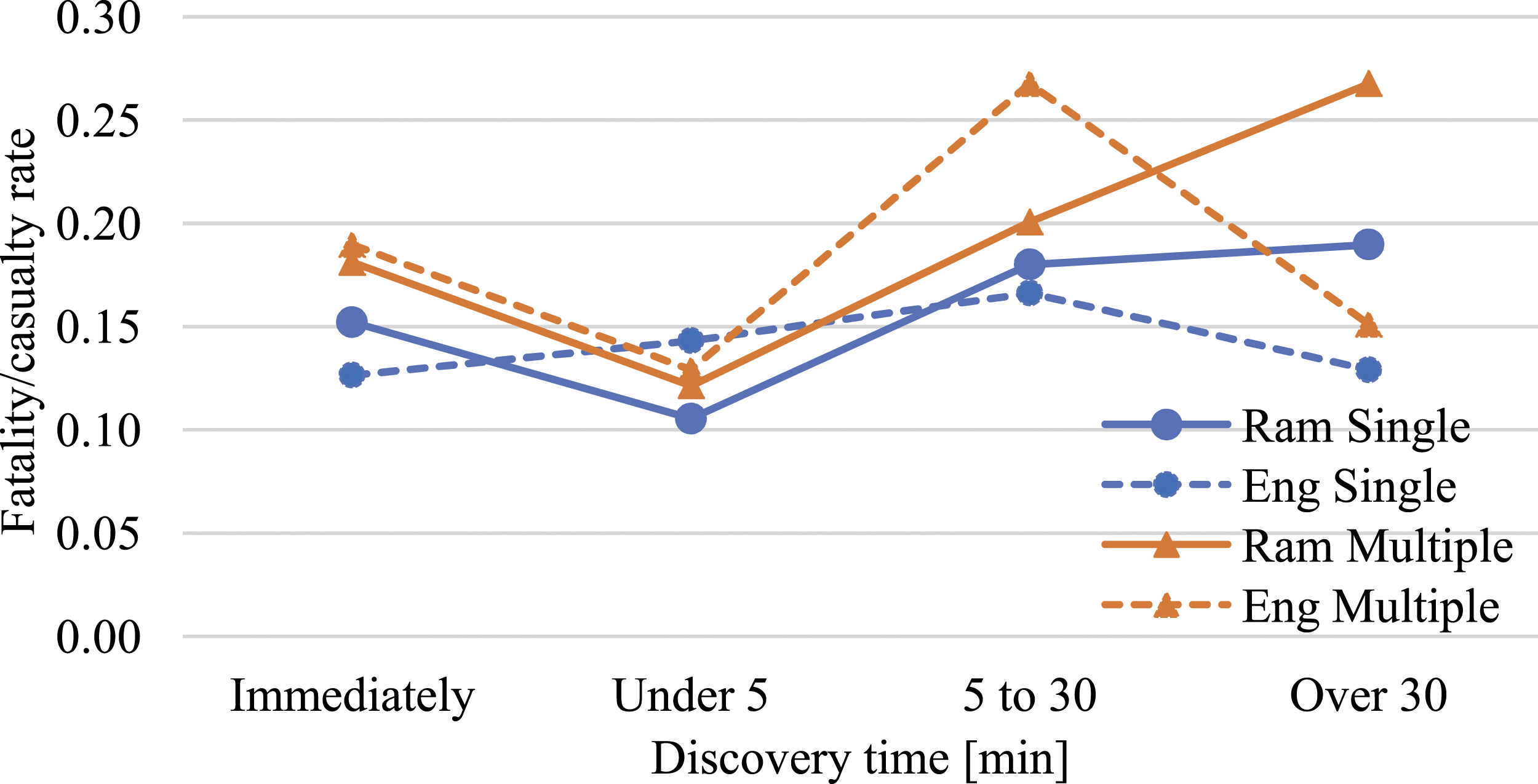
The fatality rates of PD 7974-7 are less than the fatality/casualty rates of the English fire statistics. However, the PD 7974-7 data are based on the study of Ramachandran, which also includes the number of casualties. Therefore, fatality/casualty rates derived from Ramachandran’s study are similar to those of English statistics. It is important to highlight that the fatality/casualty of Dwellings in the English fire statistics describes whether the incident involved at least one fire-related fatality or one casualty from the fire, and if the actual number of fatalities and casualties are considered in English fire statistics, this could generate higher fatality/casualty rates than those obtained by the current evaluation. Therefore, the estimates need to be considered with a degree of caution and highlighting that the data are referred to different metrics.
The following section is now based on the evaluation of the response time in terms of life and property losses considering English fire statistics. In particular, the fatality/casualty rate, the fire spread and the fire and total damage will be investigated based on the response time of the fire brigade in Dwellings and property types in Other buildings.
Response time and impacts on losses
Once the discovery time has been investigated, another factor influencing life safety and property protection is the response time defined as the time interval between the notification of the incident and the first fire vehicle attending the scene. 21 It is evaluated as the sum of dispatch preparation and travel time.
The Fire incidents response time published by the Home Office 29 affirmed that the overall response times over the past 20 years have increased from less than 6 to 8-9 minutes for Dwellings and Other buildings being potentially attributable to several factors such as the increased traffic level and changes in the health and safety policy of fire brigades asking more questions to better address the fire risk. From 2015/16 to 2016/17, a decrease of 6% and 5% have been recorded for fire-related fatalities and non-fatal casualties in Dwellings while for the average area damage an increase of 1% and a decrease of 1% is evaluated for Dwellings and Other buildings, 29 respectively. In the year ending March 2021, the average total response time to primary fires in England was 8 minutes and 35 seconds showing a decrease of 8 seconds since the previous year, with a decrease by 10 seconds in Dwellings and 1 second in Other buildings. 30 According to the London Fire Brigade, the average first appliance attendance time appeared to be less than 6 minutes with peaks in 2015 of 5 minutes and 33 seconds and the fastest average attendance in 2020 with 5 minutes and 1 second. 31 It is, therefore, clear that fire risk appears to change over time according to different locations and property types.
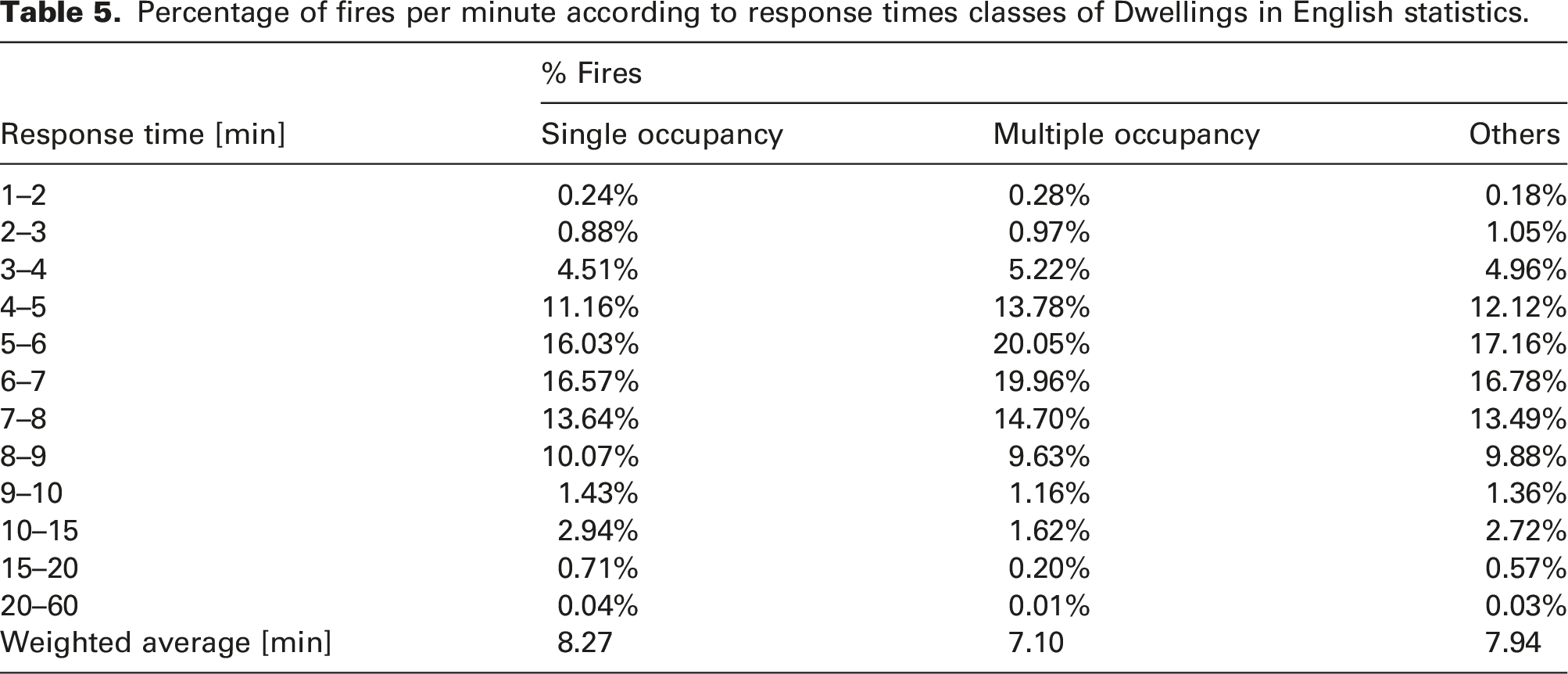
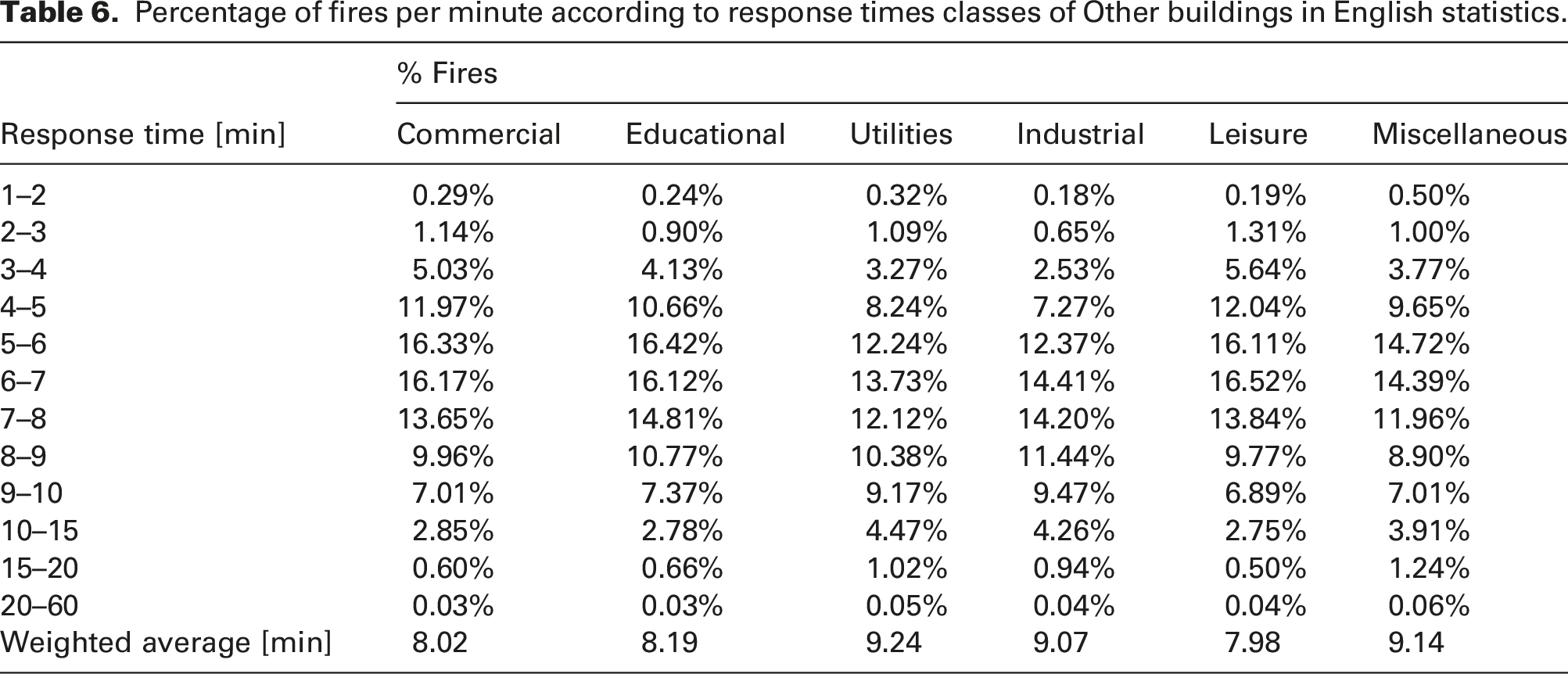
The analyses developed in this section and the following ones, consider the Dwellings and Other buildings datasets of the Home Office with data from 2010/11 to 2016/17, as described in the ‘Fire statistics of the Home Office’ section, to evaluate the average response time and the influence that it can have on property and lives. The classes of response time are usually recorded with a time range of 1 minute up to 10 minutes, 5 minutes from 10 to 20 minutes and 40 minutes from 20 to 60 minutes. The time ranges have been reclassified according to one-minute band and the fire frequency evaluated based on the number of fires for a specific response time class divided by the time range in minutes and the total fires.
Percentage of fires per minute according to response times classes of Dwellings in English statistics.
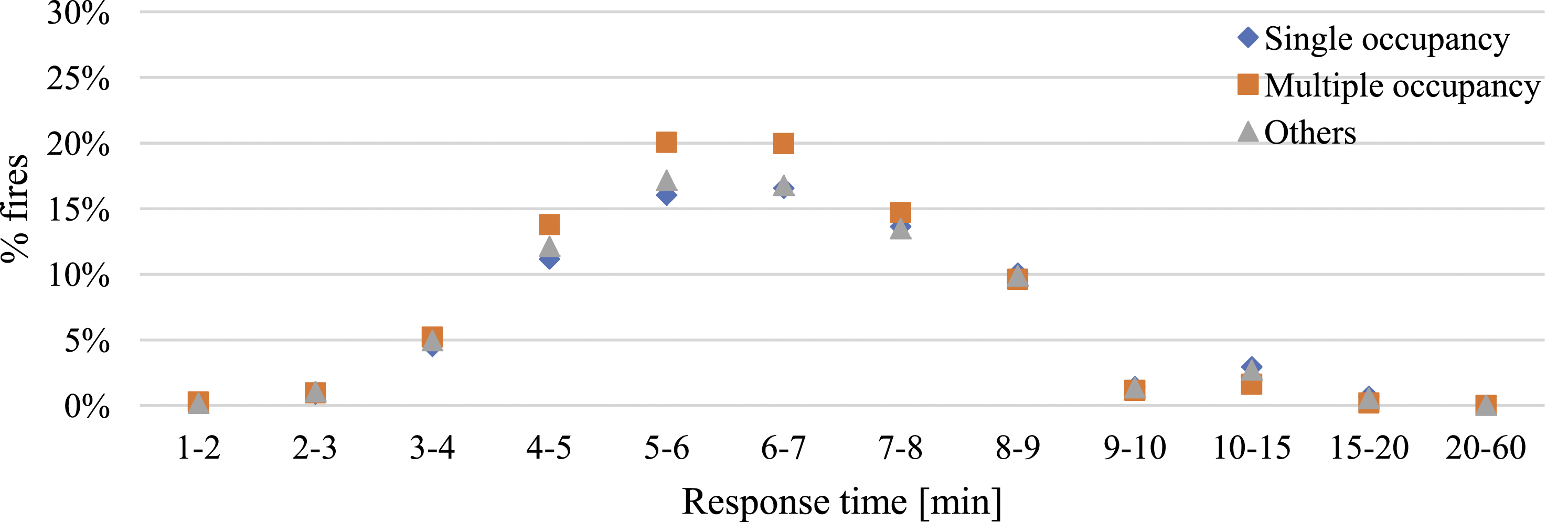
Evolution of the percentages of fires per minute according to response times classes of Dwellings in English statistics.
Percentage of fires per minute according to response times classes of Other buildings in English statistics.
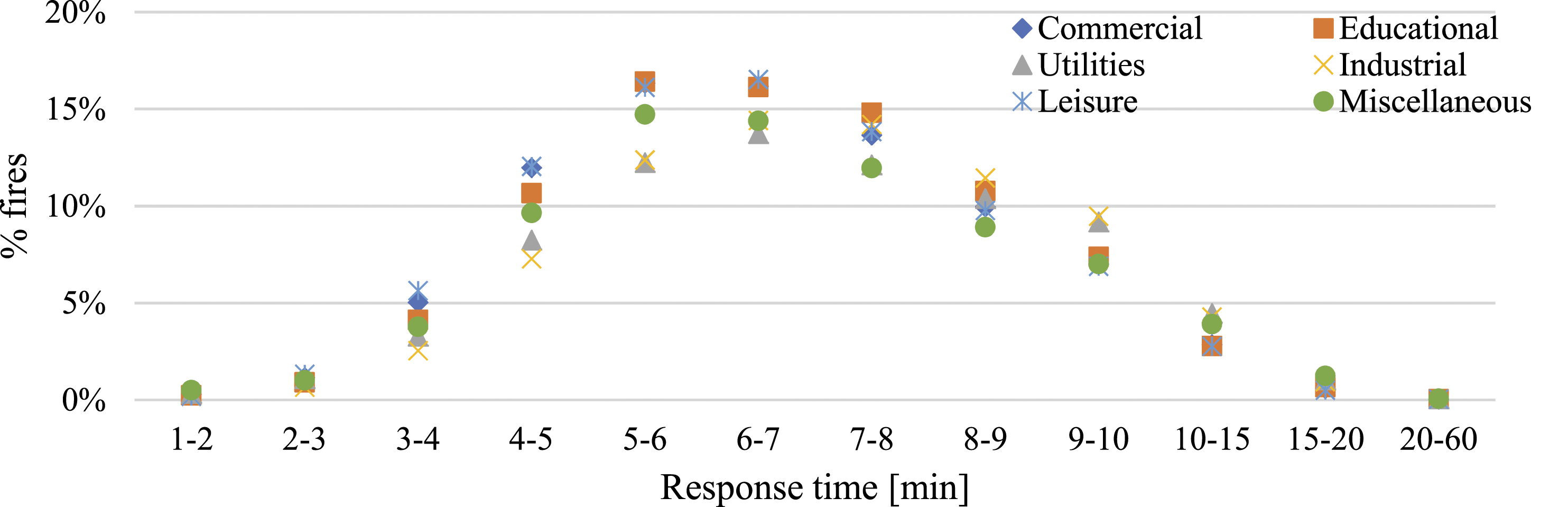
Evolution of the percentages of fires per minute according to response times classes of Other buildings in English statistics.
Therefore, similar trends are found in Dwellings and Other buildings where the peaks are confined from 4-5 to 7-8 minutes response time. The main difference is given by the class of response time of 9-10 minutes where fire frequency is usually below 2% in Dwellings while it is greater than 7% in Other buildings. This could be mainly attributable to the smaller populations in terms of number of fires and building stock for Other buildings, or the differences in fire risk when specific property types are investigated. For example, the various building types of Other buildings usually have different fire safety measures than Dwellings, with the presence of fire brigades on-site or specialized personnel able to promptly respond to a fire. Moreover, proprieties such as Industrials, Utilities or Single occupancies could be located far from urban areas or cities determining a higher travelling time for the fire brigades.
It is now important to evaluate the response time further to understand if its reduction could have an influence on life safety as described in the ‘Response time and fatality/casualty rate’ section or property damage as discussed in the ‘Response time, fire spread and damage’ section.
Response time and fatality/casualty rate
As already evaluated in the ‘Discovery time, fatality and casualty rate’ section, the fatality/casualty rate is calculated considering the total number of fatalities and casualties divided by the total number of fire incidents where fatalities and casualties are recorded as a unique value in the dataset and are referred to whether the incident involved at least one fire-related fatality or one casualty from the fire. While in the ‘Discovery time, fatality and casualty rate’ section, the discovery time has been considered, in this section the response time is analyzed for Dwellings considering Single, Multiple and Other occupancy and Other buildings, where the property types have been grouped into six general classes such as Commercial, Educational, Utilities, Industrial, Leisure and Miscellaneous.
In Dwellings, the fatality/casualty rate for 1-2 minutes response time assumes an approximated value of 0.10 in Single and Multiple occupancies and 0.23 in Other occupancies (Figure 5). Despite the different values for a few minutes' response time, from 3-4 to 7-8 minutes a plateau of 0.16 fatality/casualty rate is reached for the three occupancy types. The response time has a great impact, especially in the first minutes after the notification of the incident. This is supported by the analysis in Figure 5 which shows that a one-minute increment in the response time from 2-3 to 3-4 minutes determines an increase in the fatality/casualty rate of approximately 0.02 in Single and Multiple occupancies. This is reasonable when a rapid-fire growth occurs, occupants are trapped or unable to escape. It is also important to notice that it is very unlikely to have a response time of the fire brigades below 2 minutes unless the building is located in proximity to a fire station. Moreover, the initial low values in the fatality/casualty rate could be attributable to a low number of data and need to be considered with a degree of caution. The fatality/casualty rate usually decreases after 9-10 minutes. This needs to be seen in the light of the weighted average response time of approximately 8 minutes for Dwellings determined in the ‘Response time and impacts on losses’ section which implies the arrival of the fire brigade and the beginning of the occupant rescue operations. Therefore, the decrease could also be attributable to the small number of fires recorded for a response time of 9 minutes or greater as shown in Figure 3. Fatality/casualty rate and response time of Dwellings for Single, Multiple and Other occupancies in English statistics.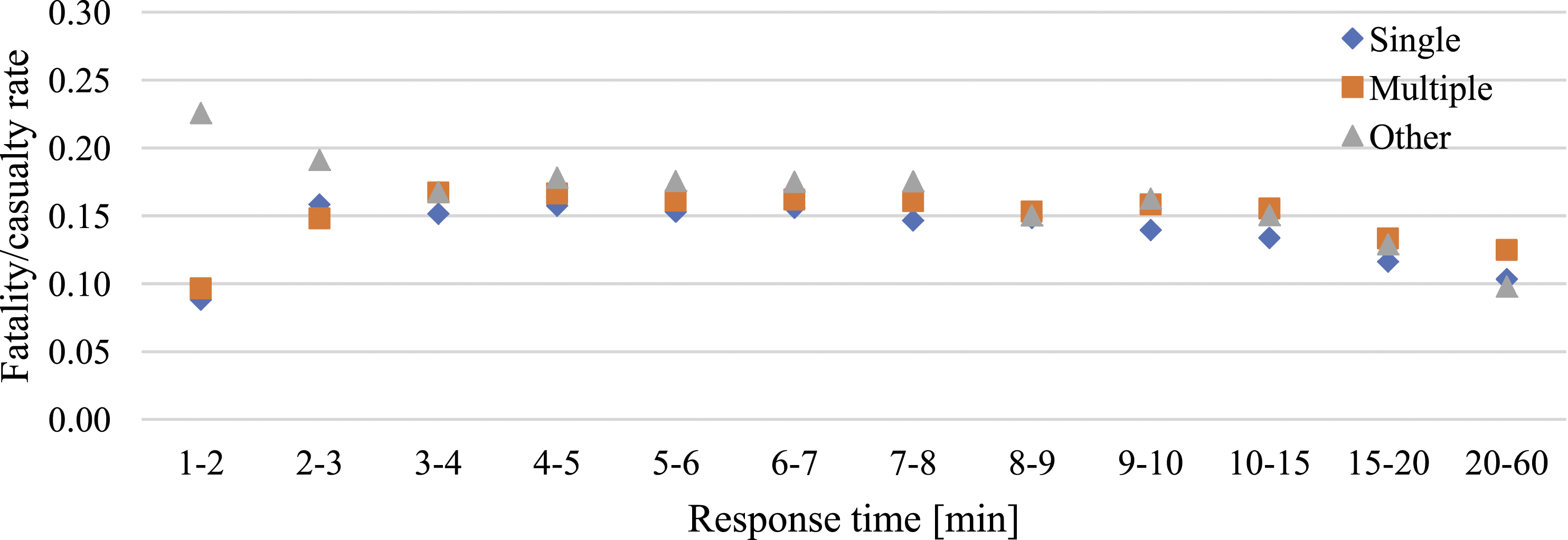
Generally, the fatality/casualty rate in Other buildings assumes values between 1/4 and 1/3 of those found in Dwellings potentially attributable to the lower number of fire incidents recorded. The occupancy types of Other buildings can be described according to their tendency in three main groups represented by Commercial and Industrial, Educational and Leisure, and Utilities and Miscellaneous. The six property types of Other buildings are presented based on their similar trends.
Commercial and Industrial show similar fatality/casualty rates between 0.03 and 0.04 from 4-5 to 8-9 minutes response time. Commercial rates fluctuate around 0.04 showing that the response time affects only minimally the fatality/casualty rate in this property. This could be due to the presence of standardized evacuation strategies, trained staff in the event of a fire or the presence of alarms. In Industrial, there is a minimum of 0.01 for 2-3 minutes response time (Figure 6) that could be attributable to its average response time of 9.07 minutes found in the ‘Response time and impacts on losses’ section which inevitably shifts the trends towards longer response time. Fatality/casualty rate and response time of Other buildings for Commercial, Educational, Utilities, Industrial, Leisure and Miscellaneous in the English fire statistics.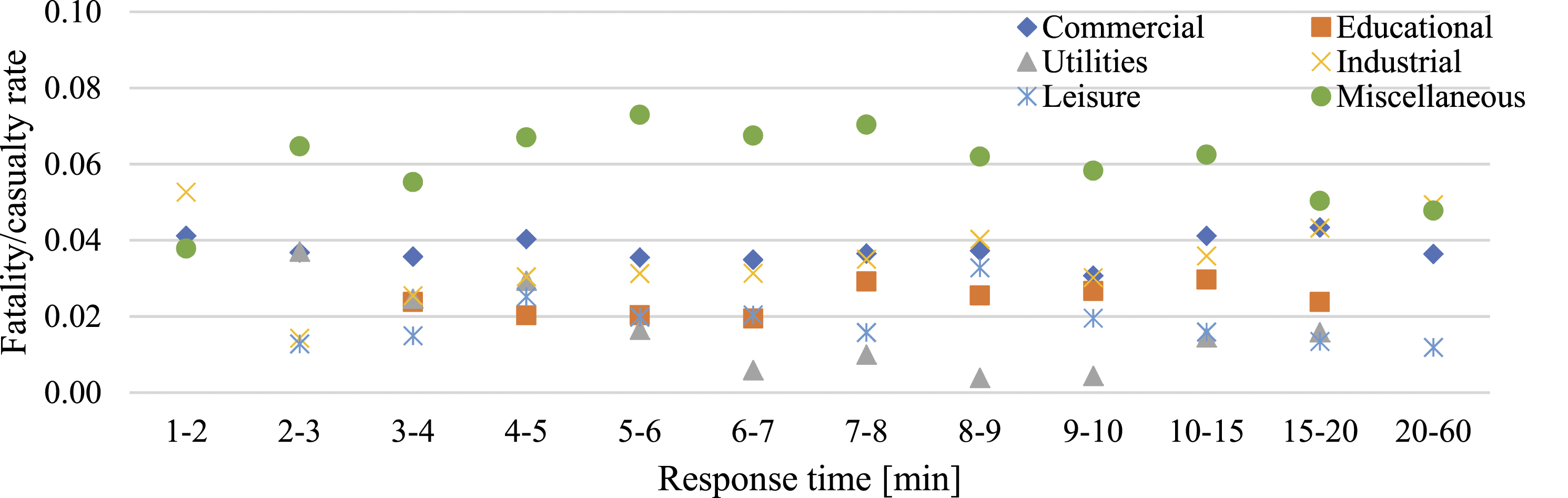
Fatalities and casualties are not available for some response times and this is the reason why the trend for Leisure starts from 2-3 minutes and the one for Educational from 3-4 minutes and ends in 15-20 minutes. The lack of fire incident data related to a response time from 1 to 3 minutes in Educational needs to be considered carefully in the fire safety strategies as it is very unlikely to have the arrival of the fire brigades immediately after the fire ignition and it is important to effectively plan evacuation measures to address such fire scenario. Educational and Leisure present similar fatality/casualty rates of 0.02 from 5 to 7 minutes of attendance time with low fatality/casualty rates when compared to the other property types. For Industrial and Educational, there is an increase in the fatality/casualty rate from 3 to 8 minutes. In particular, from 3 to 7 minutes the fatality/casualty rate increases by 0.01 in Educational and Industrial showing that a prompt response time could reduce the rate of people affected by the fires.
The remaining property types in Other buildings present a wide scatter distribution varying from approximately 0.01 and 0.03 in Utilities. Moreover, Miscellaneous assumes the highest values reaching 0.07 for 5-6 minutes due to the different nature of building stocks included in this property, while Utilities is the lowest one with a minimum of 0.004 from 8 to 10 minutes. Finally, Leisure and Utilities present similar fatality/casualty rates of 0.02 from 4 to 6 and 10 to 20 minutes as shown in Figure 6. Miscellaneous, Leisure and Utilities assume data, not in line with the trends of the other property types and this could be due to the small number of fires recorded and the wide and diverse property types included in their definitions.
Therefore, the response time appears to influence the fatality/casualty rates of various property types in the first minutes and is less influential after 4 minutes. Furthermore, it is important to consider that the small fatality/casualty rate for 1-2 minutes response time could be related to the fact that is it very unlikely for the fire brigade to reach the fire location in that time. The occupancy types in Dwellings present a similar tendency while in Other buildings is difficult to deduce common comments due to the diversity of the building stock and purposes, and the presence of specific fire safety measures that are not applied in residential buildings. In the following section, the analysis of the response time is investigated in relation to the fire spread and damage caused by fire incidents.
Response time, fire spread and damage
This section investigates the fire scenarios faced by fire brigades in terms of fire spread and damage according to one-minute band response time evaluating the percentages of fires. As described in the ‘Fire statistics of the Home Office’ section, in the English fire statistics, the damage is recorded according to fire and total damage where fire damage is the total horizontal area damaged by the flame and/or heat while the total damage is the area damaged by the flame, heat, smoke and water at the stop of the fire in m2. 21 It is important to specify the fire spread, fire and total damage evaluate the horizontal damage. Therefore, for the class of no fire damage, no horizontal fire damage is recorded; however, there could be the possibility to have vertical fire damage. For Dwellings and Other buildings, a general trend could be found where fire frequency increases for the various classes of spread and damage with a maximum reached around approximately 7 minutes followed by a gradual decrease towards a zero value for a response time greater than 20 minutes.
In Dwellings, the evaluation of fire spread and response time shows peaks in fire frequency for 6-7 minutes response time in the class of no fire damage and limited to the item first ignited (5.36%-5.34%) and for 5-6 minutes when the fire is confined to the room of origin (4.94%). Therefore, fires are usually confined to the room of origin with the higher classes of fire spread assuming fire frequencies of less than 2% (Figure 7). Usually, a room can be compared to a compartment and, based on this consideration, the fire appears to be confined in the fire compartment and does not spread to other rooms. When Other buildings are examined, those classes related to severe damage are not negligible showing potential major fires and an increase in response time that needs to be considered in line with the previous analyses discussed in the ‘Response time and impacts on losses’ section. Response time and fire spread of Dwellings in English statistics. 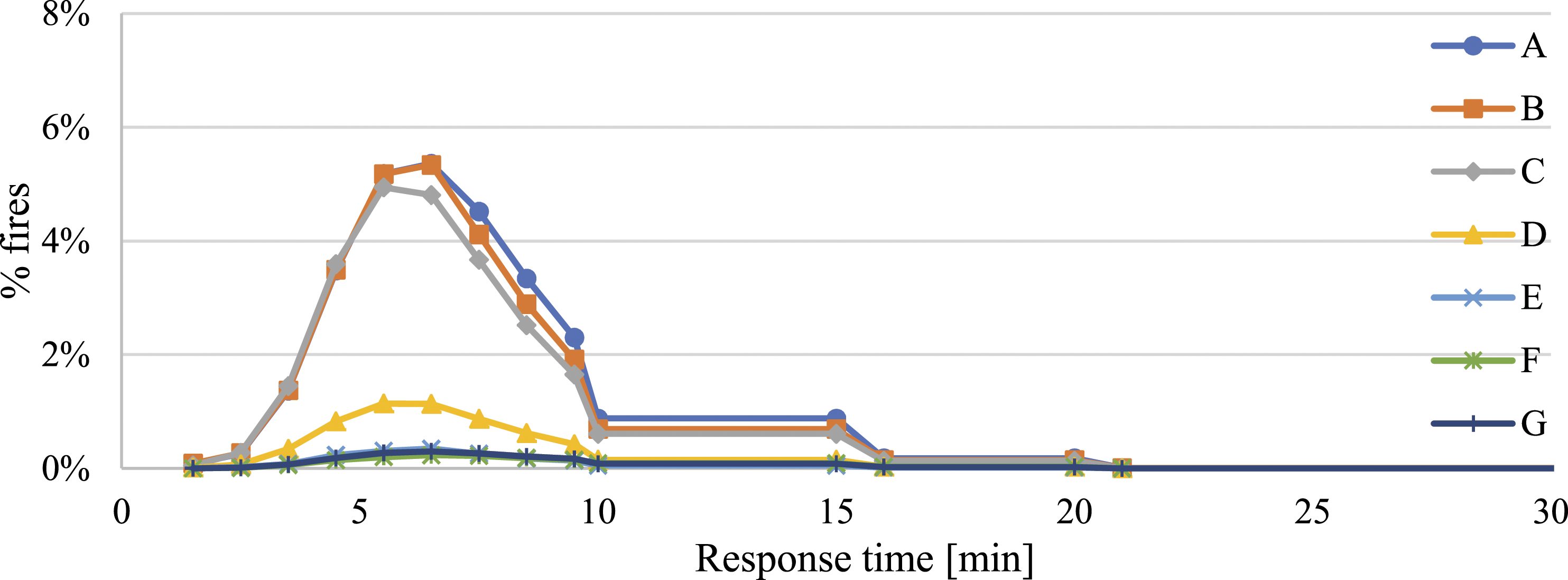
The results obtained for the investigation focused on the fire spread are supported by the analysis of damage with the related response time in Dwellings that presents a maximum for 5-6 and 6-7 minutes response time with damage confined to 0 and 5 m2 and fire percentages, respectively, greater than 10% and 4% when fire damage is considered (Figure 8(a)). Even if peaks are reached between 5 and 7 minutes, when total damage is investigated, the highest curve is represented by 0 m2 of total damage while all the other classes assume values less than 2% with the consequence that greater m2 of damage appears relevant instead of not negligible as in the case of fire damage (Figure 8(b)). The increase in the classes of more severe damage when total damage is examined shows the impact of the firefighter intervention assumes a maximum value around 6 minutes. In general, when Dwellings are investigated, the fire spread appears confined to the room of origin while the analysis for total damage shows higher classes of damage recorded if compared to fire damage. For an increase of one-minute response time, the percentage of recorded fires increases by more than 2% up to 7 minutes, followed by a gradual decrease. The fire spread, fire and total damage appear to follow the same tendency showing the importance of a prompt response time in reducing the consequences of fires. Response time and (a) fire and (b) total damage of Dwellings in English statistics. 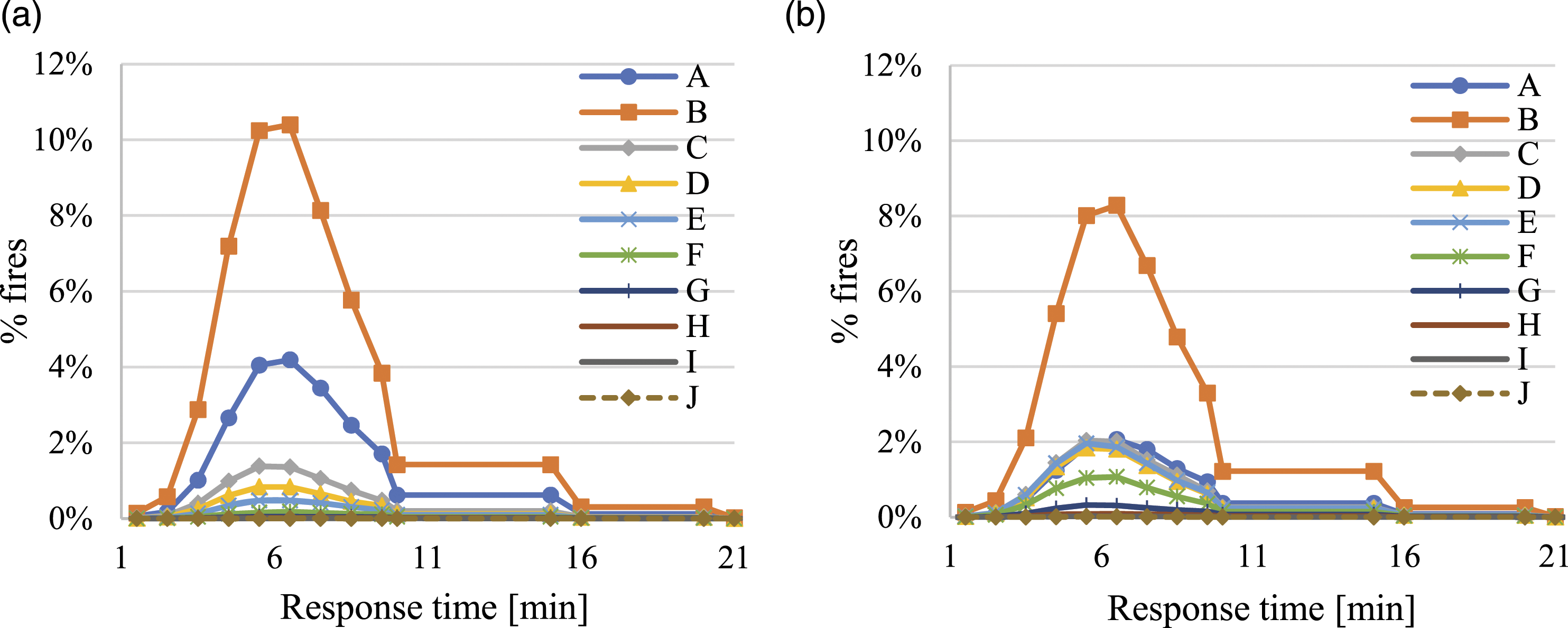
In Other buildings, generally, peaks for the various property types are obtained for a maximum of 6% corresponding to a response time from 5 to 7 minutes. The trends found for the fire spread in relation to the response time are similar to those obtained for Dwellings where the highest fire percentages are presented in the classes of the item first ignited, no fire damage and spread limited to the room of origin while greater classes of fire spread are usually negligible. The only exception is given in Commercial and Miscellaneous where the fourth-highest curve is described by fire affecting the whole building or more than two floors as represented by Figure 9. This shows that if the fire brigades have a response time between 7 and 8 minutes, in Commercials, the fire could have almost 3% of cases affecting the whole building while this is reduced to almost 2% if the attendance is within 5 minutes. Therefore, in Commercial and Miscellaneous, the classes of fire spread related to high consequences fires are more likely to occur especially when the response time reaches up to 7 minutes. This could be attributable to specific construction techniques, materials, fire risks and hazards available in those properties. The ‘Response time and fatality/casualty rate’ section showed that for Commercial, there was a small fluctuation in the fatality/casualty rate when related to the response time. Therefore, the response time in this property type appears to influence more the fire spread than the fatality/casualty rate. When fire spread is examined a one-minute increase in response time could determine an increase of more than 2% in fire incidents in this property. Response time and fire spread of (a) Commercial and (b) Miscellaneous in English statistics. 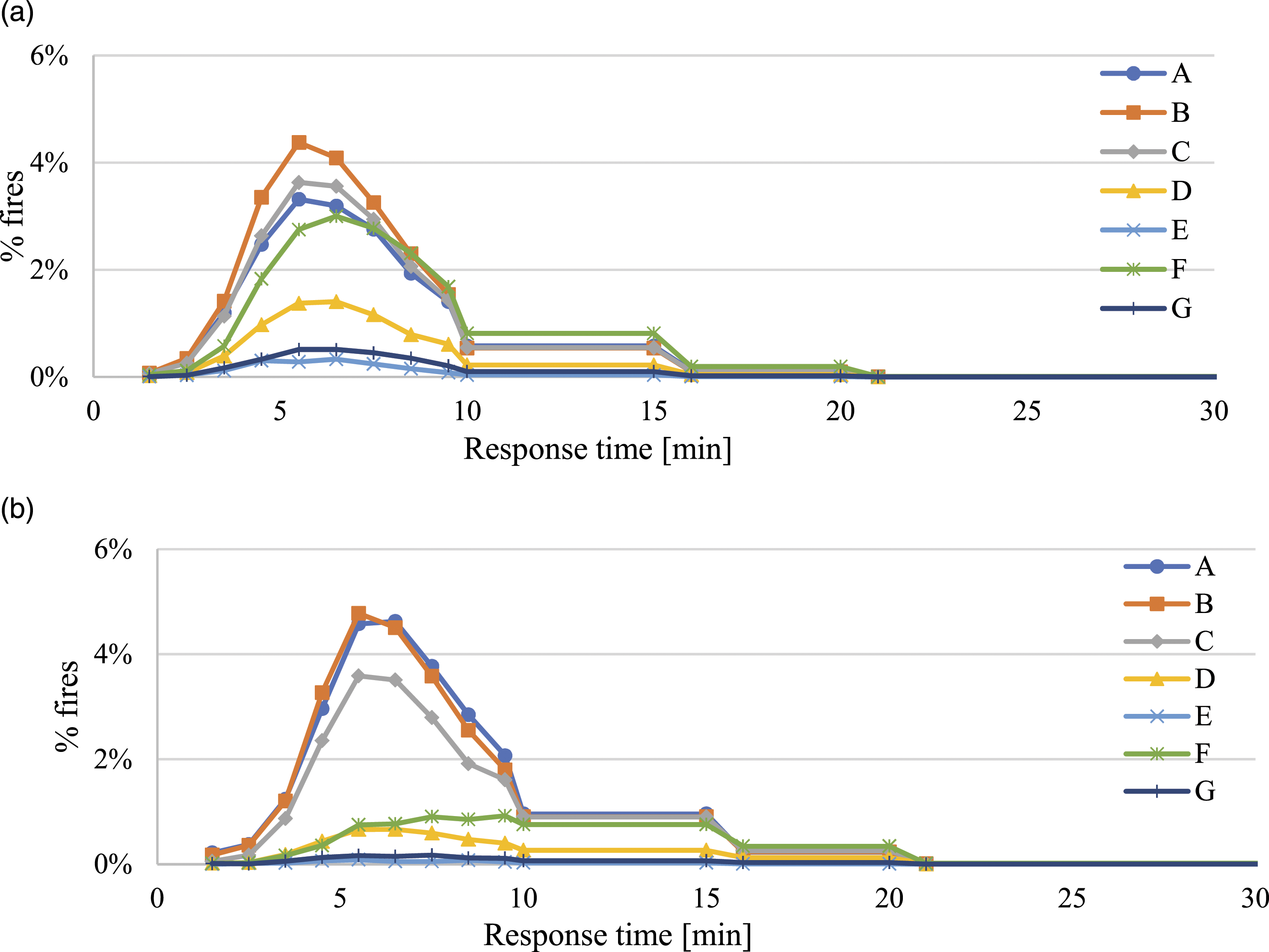
In Other buildings, when fire and total damage are evaluated according to the response time of fire brigades, the maximum values are always less than 10% in fire damage and less than 9% in total damage. Moreover, the distribution is usually right-skewed where the highest curves are provided by damage up to 5 m2 and 0 m2. As for Dwellings, while the other classes of damage appear almost negligible for fire damage, they increase in value in total damage tending towards the second-highest curve represented by 0 m2 and showing the impact of the effect of extinguishment operation. Therefore, in Other buildings, fire incidents appear to require the actions of the fire brigades to be extinguished more often than for Dwellings and potentially due to higher consequences of fires. The property types in Other buildings are described according to three groups based on similar trends: Commercial and Leisure; Educational, Utilities and Industrial; and Miscellaneous.
In Commercial and Leisure, the highest peaks in fire percentage are reached when damage is up to 5 m2 for 5-6 minutes with 8.62% and 9.52% in fire damage and 7.32% and 7.89% in total damage, respectively. In Commercial, the second-highest curve is given by 6 to 10 m2 of damage and in total damage the highest m2 of damage increases if compared to those of fire damage, with a value of approximately 1% for the class of 51 to 100 m2 in 5-6 minutes (Figure 10(a) and (b)). In Leisure, the percentages of fires are greater in 5 m2 than in the curve of 0 m2 where again more severe damage areas are usually less than 2% for 6-7 minutes for total damage (Figure 10(c) and (d)). It is, therefore, possible to affirm that in these two property types, the growth of higher classes of total damage increases with the increase of response time up to 7 minutes and assumes the highest values when compared to the other property types of Other buildings. Response and damage of (a) Commercial fire damage, (b) Commercial total damage, (c) Leisure fire damage and (d) Leisure total damage in English statistics. 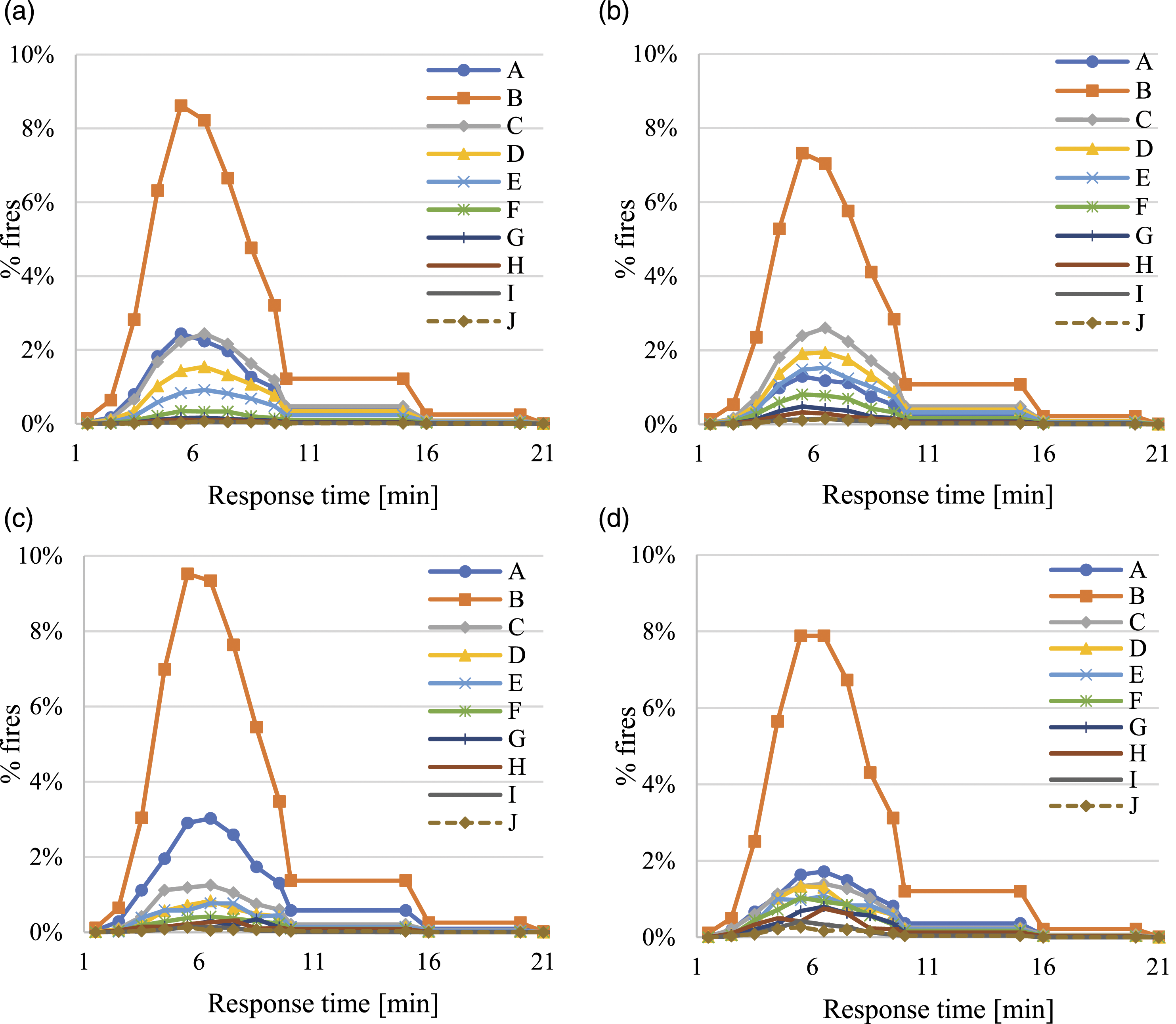
In Educational, the three highest fire percentages are reached when damage is up to 5 m2 from 5 to 8 minutes response time with an average value of 9.29% in fire damage and 8.20% in total damage. For fire and total damage, the second-highest curve is represented by the one describing null damage and all the other classes of area damage slightly increase if total damage is investigated (Figure 11). As for Commercial, the analysis focused on total damage presents an increase in fires with more extended area damage implying that other types of damage such as water damage produced by the extinguishment operations are included. As shown in the ‘Response time and fatality/casualty rate’ section for Educational, while there is an increase of 0.01 in the fatality/casualty rate from 3 to 8 minutes, the trends for fire and total damage reach a peak between 5 and 6 minutes. Therefore, for a response time of 5-6 minutes, the highest number of fires attended present damage of 5 m2 and a fatality/casualty rate of 0.02 (Figure 6). Response and (a) fire damage and (b) total damage of Educational in English statistics. 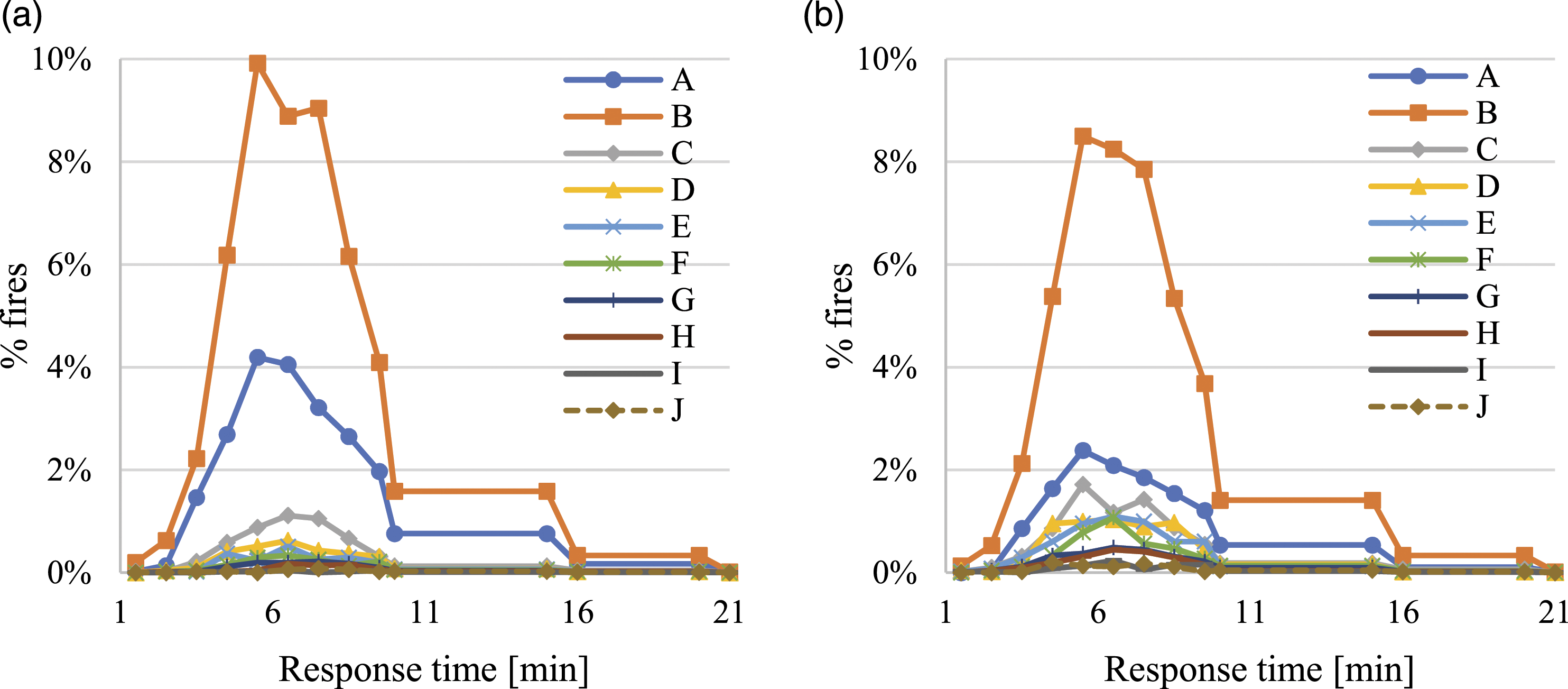
In Utilities for damage up to 5 m2, despite the peak being reached for damage in 6-7 minutes response time, values approximately greater than 6% are present for a response time between 5 and 10 minutes for fire and total damage. The second-highest percentages of fires are found for 0 m2 and in total damage, the damage classes greater than 6 m2 assume values less than approximately 2% (Figure 12(a) and (b)). The interval between 10 and 15 minutes of response time usually presents values less than 2% for damage up to 5 m2 in the Other building types examined while it assumes 2.63% and 2.74% in Utilities and 2.08% and 1.87% in Industrial for fire and total damage, respectively. In Industrial, a significant increase in greater damage areas in total damage compared to the fire damage is not found and in both cases, damage greater than 10 m2 presents percentages of fires greater than 1% for 6-7 minutes (Figure 12(c) and (d)) showing the presence of fires of a potentially bigger size. Therefore, for Utilities and Industrial, it is more likely to have fires leading to major consequences in terms of property damage with a response time that assumes a peak between 6 and 8 minutes with non-negligible attendance for over 10 minutes and damage classes attributable to major fires. Response and damage of (a) Utilities fire damage, (b) Utilities total damage, (c) Industrial fire damage and (d) Industrial total damage in English statistics. 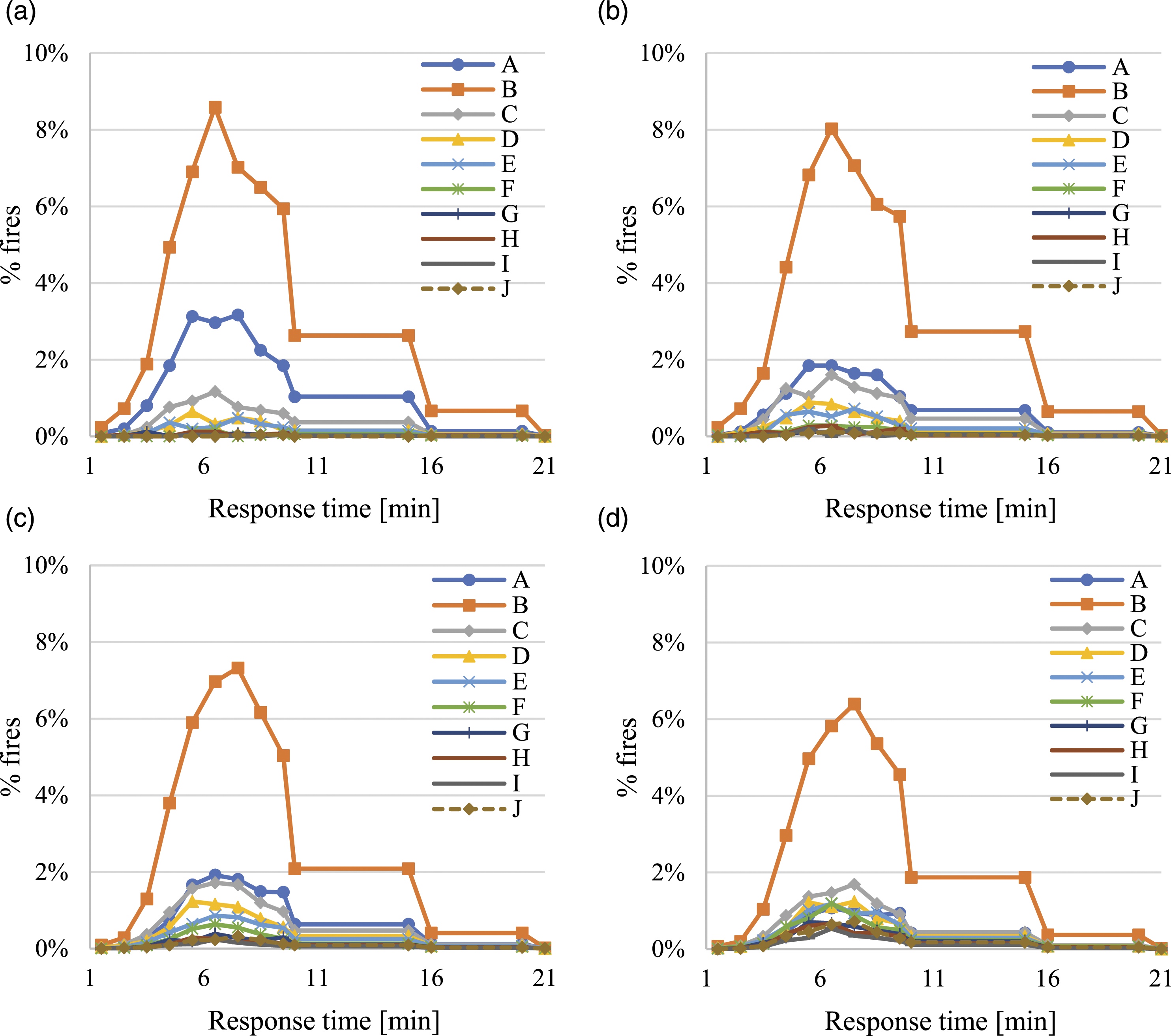
Finally, in Miscellaneous, from 5 to 7 minutes response time in damage up to 5 m2, two consequent peaks are found with a value of approximately 8.73% in fire damage and 7.70% in total damage. While in fire damage only the classes of 0 and up to 5 m2 and in total damage only the one of damage up to 5 m2 provide percentages greater than 2%, all the other damage classes have values less than 0.97% in fire damage and 1.93% in total damage (Figure 13). As stated in the ‘Response time and fatality/casualty rate’ section when the fatality/casualty rate is examined, the diversity of the properties in Miscellaneous could present different characteristics leading to trends that are not comparable with the property types analyzed for Other buildings. Response and (a) fire damage and (b) total damage of Miscellaneous in English statistics. 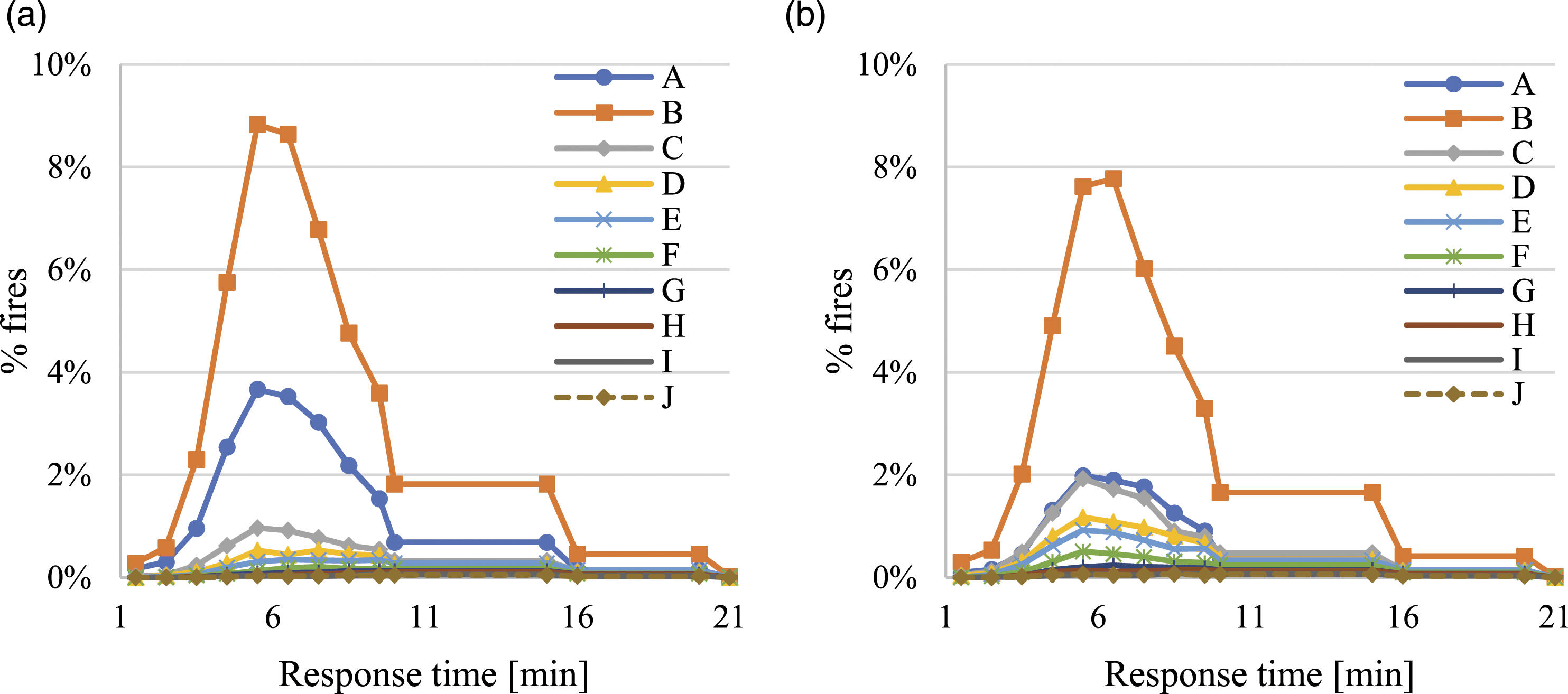
Based on the elaborations developed in this section, when the response time is examined in terms of fire spread, fire and total damage, the outcomes present potential fire scenarios faced by the fire service during the fire incidents. Considering the outcomes generated by the analyses, a large number of small fires and a small number of large fires are recorded. However, differences are found between Dwellings and Other buildings. More specifically, in Other buildings, the classes related to more severe damage related to fire spread and quantification of damage, appear to assume a non-negligible contribution. This could be due to a different fire risk, presence of hazards and fire safety measures in place. Finally, it is reasonable to believe that the analysis of the total damage inevitably shows the contribution of the fire service in extinguishing the fires.
Conclusions
The research developed in this paper had the aim to recreate and improve Table A.13 of PD 7974-7:2003 considering recent English fire statistics, investigate the influence of the discovery time of occupants and response time of the fire brigades on life safety, and determine the correlation between the fire brigade response time and fire consequences on lives and properties. The English fire statistics are represented by the data of Dwellings 20 and Other buildings 21 fires databases publicly available provided by the Home Office in England with data from 2010/11 to 2016/17 to determine reliable data representative of current fire incidents.
The analysis has recreated Table A.13 of the PD 7974-7:2003 focused on the fire discovery time and fatality rate based on fire statistics published by the Home Office. The values available in Table A.13 were based on a study of Ramachandran which includes also the number of casualties not reported in the British Standard document. Since in English statistics fatalities and casualties are reported as a unique field, fatality/casualty rates based on the study of Ramachandran (considering data from 1978-1991) were calculated and compared to those deduced by the English fire statistics. The number of fatalities mentioned in the PD 7974-7 is almost ten times less than the estimate for non-fatal casualties in Single and Multiple occupancy present in Ramachandran’s study. Moreover, for fatalities, the trend appears to increase with the discovery time, while for non-fatal casualties, the tendency has a peak between under 5 and 5 to 30 minutes followed by a decrease. Potential reasons for these trends are seen in the impossibility of people to escape for fatalities, and in a rapid-fire growth for non-fatal casualties where the initial minutes after ignition are crucial.
When fatality/casualty rate is investigated in the Dwellings fire statistical dataset, the tendency of fire incidents according to various discovery times is similar to the one of non-fatal casualties in Ramachandran’s study. When the average discovery time is evaluated for the English fire statistics, this appears to be more than 2 times less than the one obtained by the data of 1978-1991. The decrease in the average discovery time could be attributable to an improvement in fire safety measures, an increase in the number of households with installed alarms or thanks to fire prevention campaigns. The fatality rates of the PD 7974-7 are less than the fatality/casualty rates of the English fire statistics while the study of Ramachandran includes the number of casualties with fatality/casualty rates similar in value to those of the English fire statistics. It is important to highlight that the fatality/casualty of Dwellings in the English fire statistics describes whether the incident involved at least one fire-related fatality or one casualty from the fire, and if the actual number of fatalities and casualties are considered in English fire statistics, this could generate higher fatality/casualty rates than those obtained by the current evaluation. Therefore, the estimates need to be considered with a degree of caution and highlighting that the data are referred to different metrics.
When the response time of fire brigades in attending the fire scene of English fire statistics is studied, it appears similar and confined from 4-5 to 7-8 minutes when Dwellings and Other buildings are examined. However, in Other buildings, the response time between 9 and 10 minutes is not negligible and is greater than 7% potentially due to the distance of those property types from the fire stations. The distance to the fire stations appears to be a factor influencing the average response time. For example, the quickest response time is found for properties usually placed in urban areas such as Commercial and Educational buildings (8.02 and 8.19 minutes) while the longest response times are obtained for Industrial and Utilities (9.07 and 9.24 minutes) generally located outside cities due to their building sizes and purpose. For Dwellings and Other buildings, the highest number of fires is recorded between 5 and 7 minutes.
The response time is then investigated in relation to the fatality/casualty rates in Dwellings and Other buildings. In Dwellings, after a rapid increase, the fatality/casualty rate from 3-4 to 7-8 minutes presents a plateau of 0.16. The response time has a great impact in the first minutes where a one-minute increment in the response time from 2-3 to 3-4 minutes determines an increase in the fatality/casualty rate of approximately 0.02 potentially attributable to a rapid-fire growth, trapped occupants or occupants unable to escape. Moreover, it is very unlikely to have a response time of the fire brigades below 2 minutes unless the building is located in proximity to a fire station. When Other buildings are examined, the fatality/casualty rate assumes values between 1/4 and 1/3 of those found in Dwellings potentially attributable to a lower number of fire incidents recorded. In particular, the six property types of Other buildings are presented based on their similar trends. Commercial rates fluctuate around 0.04 with the response time that affects only minimally the fatality/casualty rate possibly due to the presence of standardized evacuation strategies, trained staff able to quickly respond during a fire or to the presence of alarms. In Industrial, the average response time of 9.07 minutes shifts the trends toward longer response time. For Industrial and Educational, there is an increase in the fatality/casualty rate from 3 to 8 minutes showing that a prompt response time could reduce the rate of people affected by the fires. Miscellaneous, Leisure and Utilities have fatality/casualty rates not in line with the trends of the other property types due to the small number of fires recorded and the wide and diverse property types included in their classes.
The analysis of the response time in terms of fire spread, fire and total damage provides information on possible fire scenarios faced by the fire service at the fire scene. It appears that a large number of small fires and a small number of large fires are characterized by a response time of 7-8 minutes. The fire spread in Dwellings appears confined to the room of origin while total damage presents higher classes of damage if compared to fire damage. It is also important to highlight that for every minute increase in response time, the percentage of recorded fires increases by more than 2% up to 7 minutes, followed by a gradual decrease. In Dwellings, the fire spread, fire and total damage appear to follow the same tendency showing the importance of a prompt response time in reducing the consequences of fires. In Other buildings, the classes related to more severe damage classes in fire spread and damage appear relevant if compared to those provided in Dwellings. In particular, in Commercial and Miscellaneous, the classes of fire spread related to high consequences fires are more likely to occur for a response time up to 7 minutes and this could be potentially attributable to the presence of specific construction techniques, materials, fire risks and hazards. While the analysis of fatality/casualty rate compared to the response time in Commercial presents a small fluctuation, the response time appears to have a greater impact on the property damage. It is in this light that a one-minute increase in response time could determine an increase of more than 2% in fire incidents in this property when fire spread is investigated. In Other buildings, when fire and total damage are evaluated according to the response time of fire brigades, the distribution is usually right-skewed where the highest curves are provided by damage up to 5 m2 and 0 m2 with the other classes of damage non-negligible in the analysis of total damage showing the impact of the effect of extinguishment operations. Therefore, in Other buildings, fire incidents appear to present higher consequences for fires. Again different fire risks, the presence of hazards and fire safety measures in place lead to different fire characteristics and consequences on buildings.
The research developed in this paper provides a comprehensive and detailed assessment of the impact of the discovery time on the fatality/casualty rate. Such analysis has been extended to the influence of the response time on the fatality/casualty rate, fire spread, fire and total damage. The outcomes of this research have clearly shown that various property types of Dwellings and Other buildings could have different response times and fire scenarios faced by the fire brigades attending the scene. Moreover, a one-minute increase in response time influences the fatality/casualty rates in the first minutes. When the one-minute increment is investigated in relation to the fire spread, fire and total damage, more severe damage classes are identified with peaks for approximately 7 minutes. Furthermore, based on the analysis focused on the average response time, the location of the property types in urban areas appears to be characterized by the quickest response time. The outcomes of the research will be beneficial for the Fire and Rescue Service to optimize fire response, location of fire stations and resource allocation. Finally, the results could be adopted as inputs in fire safety design and evacuation models considering specific property types.
Footnotes
Acknowledgement
The authors would like to thank the Home Office for providing their fire statistical datasets and enabling the development of this research.
Authorship
Martina Manes: conceptualization, writing – original draft. David Rush: conceptualization, writing – review and editing.
Declaration of conflicting interests
The author(s) declared no potential conflicts of interest with respect to the research, authorship, and/or publication of this article.
Funding
The author(s) received no financial support for the research, authorship, and/or publication of this article.
