



Abstract
There is little information on indoor risk factors for dermatitis in Japan. We studied associations between dermatitis in Japanese junior high school students in Hyogo prefecture and the home environment. A standardised questionnaire was sent to students in four schools (12–15 years old), 1048 (99%) participated. Data on the home environment was collected by the questionnaire. Associations were analysed by multilevel logistic regression in mutually adjusted models, calculating odds ratio (OR) with 95% confidence intervals. A total of 15.2% reported current dermatitis, 8.8% cat allergy, 6.1% dog allergy, 6.0% mould allergy, 25.7% pollen allergy and 32.3% any allergy (a history of atopy). Female gender (OR 1.65), a history of atopy (OR 2.14), new building materials (indoor paint or floor materials) (OR 1.59), dampness or indoor mould (OR 1.51) and windowpane condensation in winter (OR 1.45) were associated with current dermatitis. The association between window pane condensation and dermatitis was stronger in students without a history of atopy (interaction p=0.02). In conclusion, dampness, indoor mould and window pane condensation in wintertime can be household risk factors for dermatitis in adolescents. Chemical emissions from new building materials, especially paint and floor materials, can be another risk factor.
Introduction
Atopic dermatitis is an inflammatory skin disease, often associated with other atopic diseases and highly concordant in homozygotic twins and linked to family history of atopy. 1 It is one of the most common chronic inflammatory skin diseases. 2 The disease can affect 15–30% of children worldwide2–4 and 2–10% of adults.1,2,5 There has been a global increase of childhood atopic dermatitis,2,6,7 especially in developing countries. 7 Atopic dermatitis in early childhood can increase the risk of asthma and allergic rhinitis later in life,8–10 and can be the first step in the atopic march. 9 Atopic dermatitis can be affected by indoor and outdoor environmental factors 11 and climate zone.12,13 Moreover, in utero exposure to tobacco smoke from maternal smoking and own tobacco smoking are important risk factors for atopic dermatitis. 14
Population studies have demonstrated a higher prevalence of atopic dermatitis in homes with dampness or indoor mould in pre-school children,15–18 school children19–23 and adults. 13 Recent review articles have concluded that dampness and mould are important household risk factors for atopic dermatitis.14,24
Chemical exposure at home, including volatile organic compounds (VOC), is another risk factor for atopic dermatitis. Two review articles concluded that household airborne chemical exposure can be associated with atopic dermatitis.14,24 Redecoration and buying new furniture can be associated with a higher prevalence of atopic dermatitis in pre-school children15,17,25–27 and schoolchildren.23,27 A birth cohort study found an association between total volatile organic compounds (TVOC) in the air at home at birth and development of atopic dermatitis at the age of 3 years. 28 Moreover, an intervention study reported that getting poly-vinyl chloride (PVC) based wall paper worsened atopic dermatitis as compared to getting environmental friendly wall paper without PVC. 29 Other domestic risk factors for childhood atopic dermatitis include allergenic animals such as cats or dogs, 30 cockroaches 20 and house dust mite allergens. 31
Japan is a major country in Asia, but few studies exist on household risk factors for dermatitis in Japanese adolescents. In 2008–2009, we performed a school study on environmental risk factors for asthma and respiratory infections in Hyogo, Japan. 32 The main aim of this article is to study associations between selected indoor factors in the home environment and dermatitis among students. The hypothesis tested was that current dermatitis is associated, positively or negatively, with the type of buildings, recent indoor painting, new floor materials, having furry pets (cat or dog), environmental tobacco smoke (ETS) and indicators of dampness and indoor mould.
Materials and methods
Study population
Four junior high schools in Hyogo in Kansai region were included in the study. One was a public school and three were private and two of the private schools were for girls only. None of the schools had reported environmental problems or health complaints to the school authorities. We invited schools randomly and included schools willing to participate. The study was performed in two waves, one in the early summer of 2008 and one in the early summer of 2009. The public school was financed by the local government. The private schools were financed by annual tuition fees. All three grades (12–15 years) were included in the study. Totally 32 classrooms were randomly selected; six classrooms in two of the private schools, four classrooms in the third private school and 16 classrooms in the public school. The students (n=1056) received a questionnaire distributed by the class teachers. The study was approved by the ethical committee of Kobe College, and all participants and parents/guardians gave informed consent.
Assessment of demographic data and health data
The questionnaire included standardised questions on dermatitis obtained from the ISAAC study 33 and some additional questions used in previous school studies from Sweden, South Korea, China and Malaysia.34–36 There were questions on age, gender and current smoking (yes/no) but no questions on family income or parental education. Moreover, there were yes/no questions on allergy to pollen, cat, dog or mould. A history of atopy was defined as reporting cat, dog and mould or pollen allergy.
Assessment of dermatitis
The questionnaire included the International Study of Asthma and Allergies in Childhood (ISAAC) questions on atopic dermatitis.
33
First, there was a yes/no question asking if you
Home environment data
There were questions on the construction material of the current home (wooden or concrete house), pet keeping (including the type of pets) and environmental tobacco smoke (ETS) at home (yes/no). Moreover, there was one question asking if there had been any indoor painting and another question asking if there had been any new floor materials in the past 12 months. 32 There were four questions on building dampness or mould growth in the past 12 months. 38 The question on floor dampness asked about bubbles or discolouration on the plastic floor covering or black discolouration on wooden floors. Finally, one question asked about window pane condensation in winter. This question is an indicator of high air humidity in combination with poor ventilation.
Statistical methods
Initially, we compared the prevalence of current rhinitis and reported allergies between males and females by Chi-2 analysis. Then, we studied associations between reported allergies and current dermatitis by 3-level multilevel logistic regression models (student, class and school level) adjusting for age and sex. Moreover, we studied associations between current dermatitis and the home environment factors by 3-level multilevel logistic regression models (student, class and school level) adjusting for age, sex and a history of atopy (one home factor in each model). In addition, for home environment factors significantly associated with current dermatitis, we investigated the interaction between a history of atopy and the home environment on current dermatitis. Finally, we studied associations between home environment factors and current dermatitis by the same 3-level multilevel logistic regression models, including age, sex, a history of atopy and all home environment factors with p <0.1 in the previous one home factors models (mutual adjustment). The associations were expressed as odds ratios (OR) with a 95% confidence interval (CI). Statistical analysis was performed by STATA version 13. A 5% level of significance was applied in all analyses.
Results
Prevalence of current dermatitis and self-reported allergies, stratified by gender (n=1048).
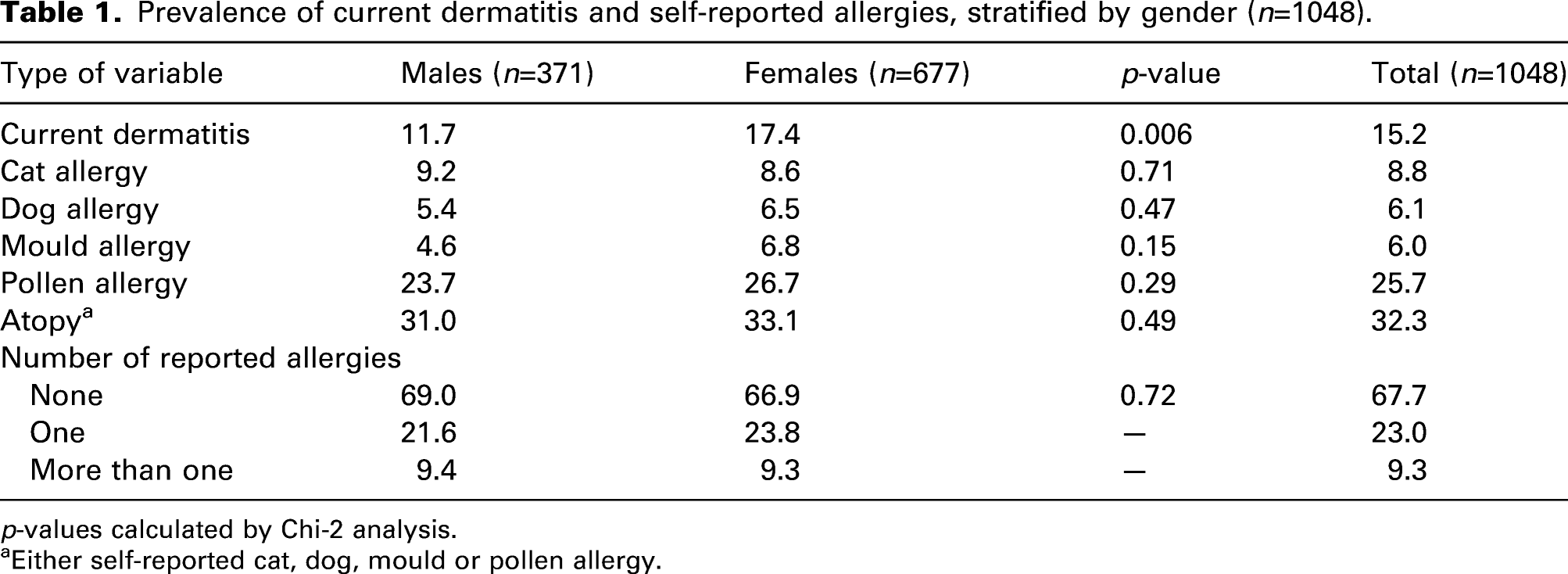
p-values calculated by Chi-2 analysis.
aEither self-reported cat, dog, mould or pollen allergy.
Associations between self-reported allergies and current dermatitis in students (n=1048).
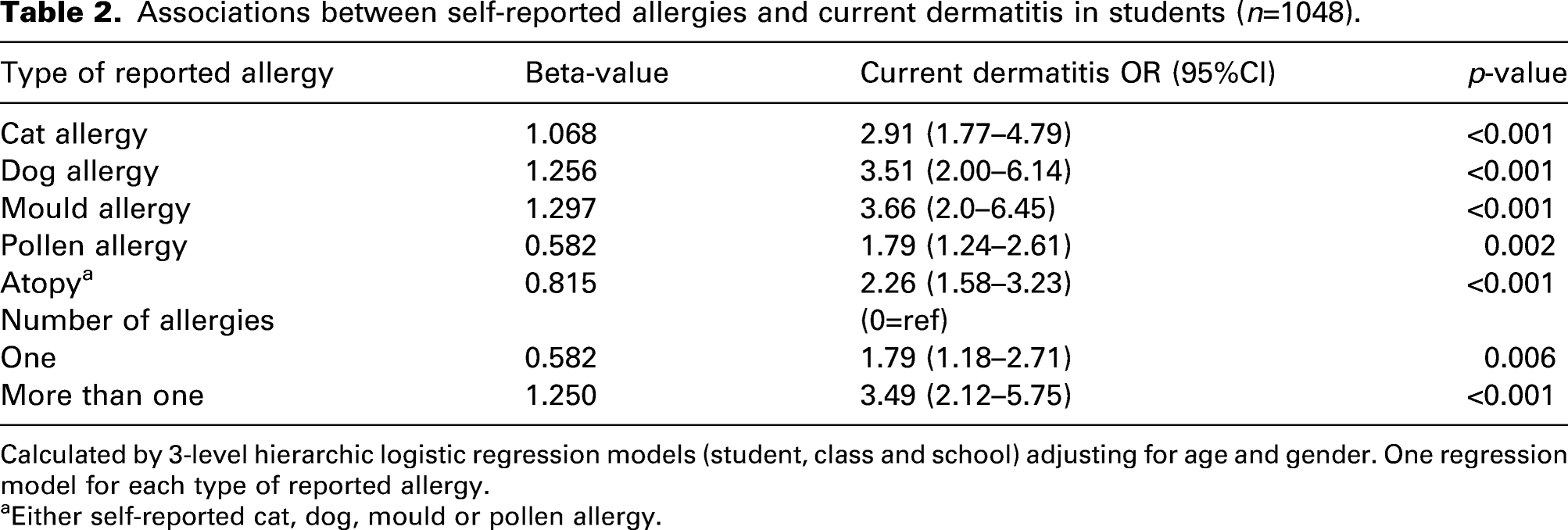
Calculated by 3-level hierarchic logistic regression models (student, class and school) adjusting for age and gender. One regression model for each type of reported allergy.
aEither self-reported cat, dog, mould or pollen allergy.
Associations between home environment and current dermatitis (n=1048).
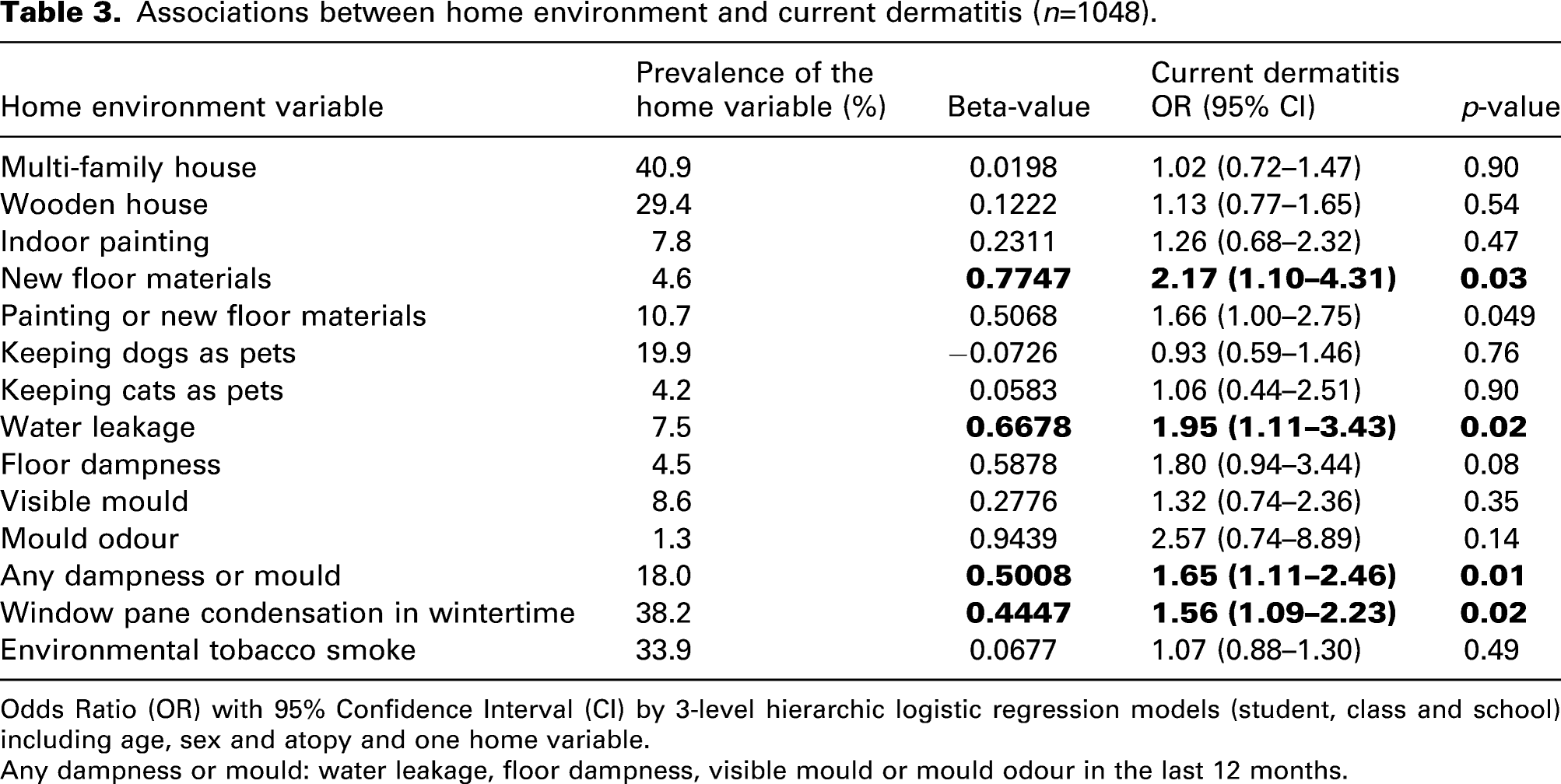
Odds Ratio (OR) with 95% Confidence Interval (CI) by 3-level hierarchic logistic regression models (student, class and school) including age, sex and atopy and one home variable.
Any dampness or mould: water leakage, floor dampness, visible mould or mould odour in the last 12 months.
Associations between home environment and current dermatitis in a mutually adjusted model (n=1048).
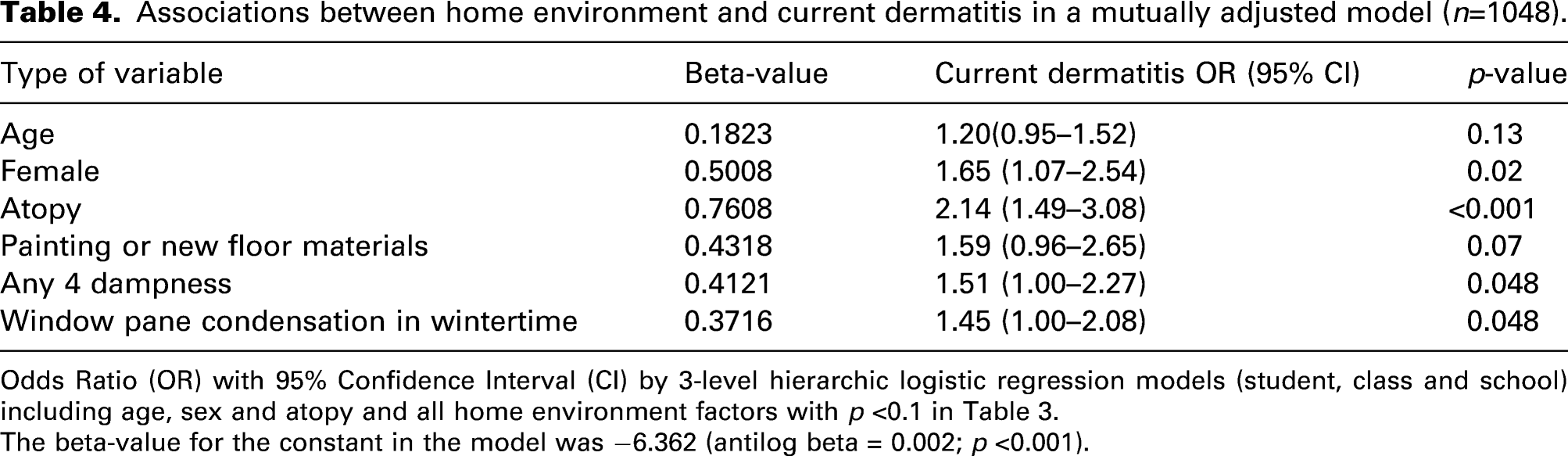
Odds Ratio (OR) with 95% Confidence Interval (CI) by 3-level hierarchic logistic regression models (student, class and school) including age, sex and atopy and all home environment factors with p <0.1 in Table 3.
The beta-value for the constant in the model was −6.362 (antilog beta = 0.002; p <0.001).
Discussion
Dermatitis was associated with factors in the home environment. At home, signs of dampness or mould, especially floor dampness, were associated with dermatitis. Other risk factors in the home included new floor materials, indoor odour (other than mouldy odour) and window pane condensation in winter.
We had a high participation rate (99%), the schools were selected in a random way, and there had been no previous complaints to school authorities on the indoor environment in schools. Thus, selection bias is less likely but the external validity is limited because of the small number of schools. The study has some advantages and some limitations. One advantage is the good response rate and analysis of associations by mutual adjustment. However, one limitation is that we did not visit homes for inspection or indoor measurements. Another weakness is the lack of clinical diagnosis of dermatitis. It is important to take into consideration also the possible presence of arthropods in indoor environment, which is conditioned by microclimatic factors and by arthropod reservoirs, such as moulds on walls, plants, pets and worm-eaten wooden structures (furniture, parquet, beams and firewood). Arthropods usually provoke an itchy dermatitis called strophulus. Even if the clinical picture and medical history are often suggestive for ectoparasitoses, in absence of a dermatologic approach, it may be misdiagnosed. 39 Finally, the cross-sectional study design limits the possibility of drawing conclusions on causality.
A total of 15.2% reported current dermatitis. We found a strong association between reports in IgE mediated allergy (cat, dog and mould and pollen allergy) and reports on dermatitis, indicating that dermatitis detected in our study was mainly atopic dermatitis. However, an elevated total and/or allergen-specific serum IgE level is not present in about 20% of affected individuals. Some authors denote ‘extrinsic’ and ‘intrinsic’ groups of disease based on the presence or absence of IgE elevation, but whether these are true variants remains controversial. This prevalence is in agreement with previous studies on atopic dermatitis among adolescents. One European review article concluded that 10–20% of adolescent children have atopic dermatitis. 40 One study from Fukui prefecture in Japan found that 19.2% of adolescent school children had atopic dermatitis. 41 Another large study from Tokyo found that the prevalence of allergic dermatitis was 13.6% at age 12 years, 11.9% at age 13 years and 10.9% among 14 years old school children. 42 In adolescence, there is a considerable remission of atopic dermatitis. 41 We found that females had more current dermatitis than males. Thus, it is in agreement with some data 35 but the large prevalence study from Tokyo found no difference in the prevalence of atopic dermatitis between males and females. 42
We found an association between signs of dampness or mould in the past 12 months and dermatitis. The association was strongest for water leakage, which was the most common sign of dampness. Our finding is in agreement with a recent review article concluding that dampness and mould at home are risk factors for atopic dermatitis. 14 However, we only found one previous study on associations between dampness and dermatitis from Japan. 19
We found associations between window pane condensation in wintertime and dermatitis. This is in agreement with previous prevalence studies from China13,17,18 and Japan. 19 Window pane condensation in winter is an indicator of high air humidity and poor ventilation, especially if the home has double window glazing, and is associated with measured exposure (high relative air humidity, low ventilation flow and house dust mite allergens in dust).43,44 The association was stronger in children without reported allergies, suggesting that the effect of window pane condensation on dermatitis could be partly non-allergic.
We found that new building materials used for redecoration, especially new floor materials, was a risk factor for dermatitis. This is in agreement with a previous review concluding that new indoor materials can be risk factors for allergic dermatitis in Asia. 14 Specific redecoration products reported to be related to atopic dermatitis include indoor painting, new wall paper and new floor materials. Two studies from China reported that childhood dermatitis was related to types of floor materials,45,46 with solid wood flooring 45 and laminated floors 46 being risk materials. Moreover, one study from Korea reported that the severity of allergic childhood dermatitis increased when new floor materials were installed. 26 We cannot conclude on types of chemicals emitted from floor materials, but interestingly one study from Japan found an association between levels of certain phthalates in household floor dust and childhood dermatitis. 47 Phthalates are used as plasticisers in PVC materials in floor and wall paper. Another population study from Sweden found associations between the sum of propylene glycol and glycol ethers in household air and eczema in pre-school children. 48 These compounds are common in water-based paints, floor polish and other water-based consumer products.
Conclusion
In conclusion, signs of dampness at home, such as water leakage, and window pane condensation in wintertime can be risk factors for dermatitis among school children in Kansai area. Moreover, chemical emissions from new building materials used for redecoration, especially new floor materials, can be associated with dermatitis.
Footnotes
Acknowledgments
We gratefully thank Ayako Kokawa, Mami Kajiwara, Kumiko Ueda and Marina Yamaguchi for their work in the project. We are grateful to the students and to the school administration for their cooperation.
Authors’ contributions
All authors contributed equally to the study.
Declaration of conflicting interests
The author(s) declared no potential conflicts of interest with respect to the research, authorship, and/or publication of this article.
Funding
The author(s) disclosed receipt of the following financial support for the research, authorship, and/or publication of this article: This study was funded by Kobe College, the Swedish Research Council (2017–05,845), and the Swedish Research Council for a sustainable development FORMAS (348-2011-7402).
