




Abstract
Novel severe acute respiratory syndrome coronavirus 2 (SARS-CoV-2) is spreading rapidly all over the world with over 23 million infected near the end of August 2020. There are also asymptomatic patients (APs) who are difficult to identify, but they are infectious and believed to be one of the transmission sources. No specific medicine, no vaccine and even no reliable quick identification tests on SARS-CoV-2 are available yet. Workable safety management must be implemented to stop such global pandemic resulting from disease transmission, including those infected through APs. A two-stage containment scheme is proposed with quarantining people into units within blocks. The units inside a block is to be open after being closed for quarantine for an agreed period such as 14 days. The blocks would then be sealed for another period before opening. Argument of the proposal was supported by a simple mathematical approach with parameters deduced from observations on a cruise ship to estimate the infection constant. The proposed containment scheme is believed to be effective in controlling the spreading of SARS-CoV-2 and identifying APs by a more targeted screening test for the suspected group with a more acceptable environment at the second stage of containment.
Keywords
Introduction
Spreading of the novel severe acute respiratory syndrome coronavirus 2 (SARS-CoV-2) and the related disease COVID-19 1 among people is fast, particularly in North and South America, Europe, Asia and Africa. Over 23 million confirmed cases have been reported1,2 near the end of August 2020, compared with 6 million in early June. Consequences are disastrous to human health, lives and economies and should be controlled.3,4
The disease transmission rate is very high in places having difficulties 5 to lockdown cities or communities and asking citizens to wear masks in public areas. For example, the confirmed cases in USA were only about 0.2 million in late March but over 4 million in late July. 6 The virus is carried by respiratory droplets and might even be contained in aerosol when driven by mechanical means under some circumstances, such as ventilation provisions, toilet flushing, vent pipe of drainage system, coughing,5–11 or even when having hot pot dinners. 12 These virus-laden droplets could be inhaled directly by someone nearby or might fall on nearby surfaces and cause infection. There are possible transmissions through symptomatic or asymptomatic carriers (ACs) 13 carrying the virus without any symptoms. The latter group of people are specially called 14 asymptomatic patients (APs) for COVID-19 recently. APs and ACs must be identified to terminate the transmission chain by applying safety science.
The control to stop the fast transmission of COVID-19 becomes very difficult15,16 because there are no medicine available for the virus, no vaccine and even no quick reliable identification tests yet. There are difficulties in keeping people at homes and even asking them to wear masks while staying outside. In Hong Kong, mandatory requirements 17 to wear masks in public areas has been implemented only since late July. Huge number of people were infected. The number of infections might be underestimated everywhere because the coverage of screening test is usually inadequate. As there are no quick, cheap and accurate identification tests 18 yet, it is a great challenge in identifying APs without containment. In places like Hong Kong with seven million people, one million people have to be tested every day to ensure an almost 100% certainty, because testing results are valid for seven days the longest. At the moment, health facilities can only operate 5000 tests a day. That is because 16 it takes an average of 8 h for a reliable identification test. The Hong Kong Special Administrative Region government is attempting to increase the number to 7000 tests 16 a day, the maximum capacity affordable to serve 1 person per 1000 citizens. This is still far below the demand of one million tests a day, even though with support from Mainland 19 to have over 100,000 tests a day. Therefore, a safety engineering approach has to be applied to work out appropriate safety management schemes in stopping the fast spreading of COVID-19.
Containment has been demonstrated 20 to be an effective way to stop disease transmission in several countries which have appropriate control, including China, Korea, Japan, Spain and Germany. However, citizens do not feel good while being confined in small rooms. Countries without tight enough control to achieve effective containment suffer from very high disease transmission rate. It is important to implement an acceptable but effective quarantine containment management scheme through appropriate engineering practice.
As such, a safety management scheme with two-stage containment 21 has been proposed to control the spreading of virus with such high infection and death rate. 22 The place to control is divided into n blocks, with m smaller units inside each block. People are contained in the smaller units of each block for a common quarantine period15–17 of 14 days at the first stage. As in other safety codes, the period of 14 days was decided by the government based on scientific data, economic impact, medical research, engineering viability and other factors with support from majority of different parties. Infected patients with symptoms will be identified for curing. The units inside each block are then open, but people at different blocks are quarantined inside each block for another period of 14 days. There are at least three advantages. First, the transmission rate will be reduced significantly by quick action on infected patients. Second, APs or ACs5,6 can be identified easily because people are contained in units of each block for a certain period of 14 days first, then in a block for another 14 days with close monitoring. Third, a more acceptable physical containment space in a block is provided. A simple mathematical approach is applied to support the arguments. There are updated information that the incubation period, live virus shedding period and polymerase chain reaction (PCR) detectability period might be different.23–27 The containment scheme proposed still works upon adjusting the quarantine containment period.
Quarantine containment scheme for potential APs
A safety management scheme with two-stage containment was proposed earlier 21 based on a commonly observed incubation period of 14 days. The scheme is further justified based on updated data. The containment period can be adjusted based on the updated23–27 incubation period, live virus shedding period and PCR detectability period.
The containment area to be controlled is divided into n blocks (
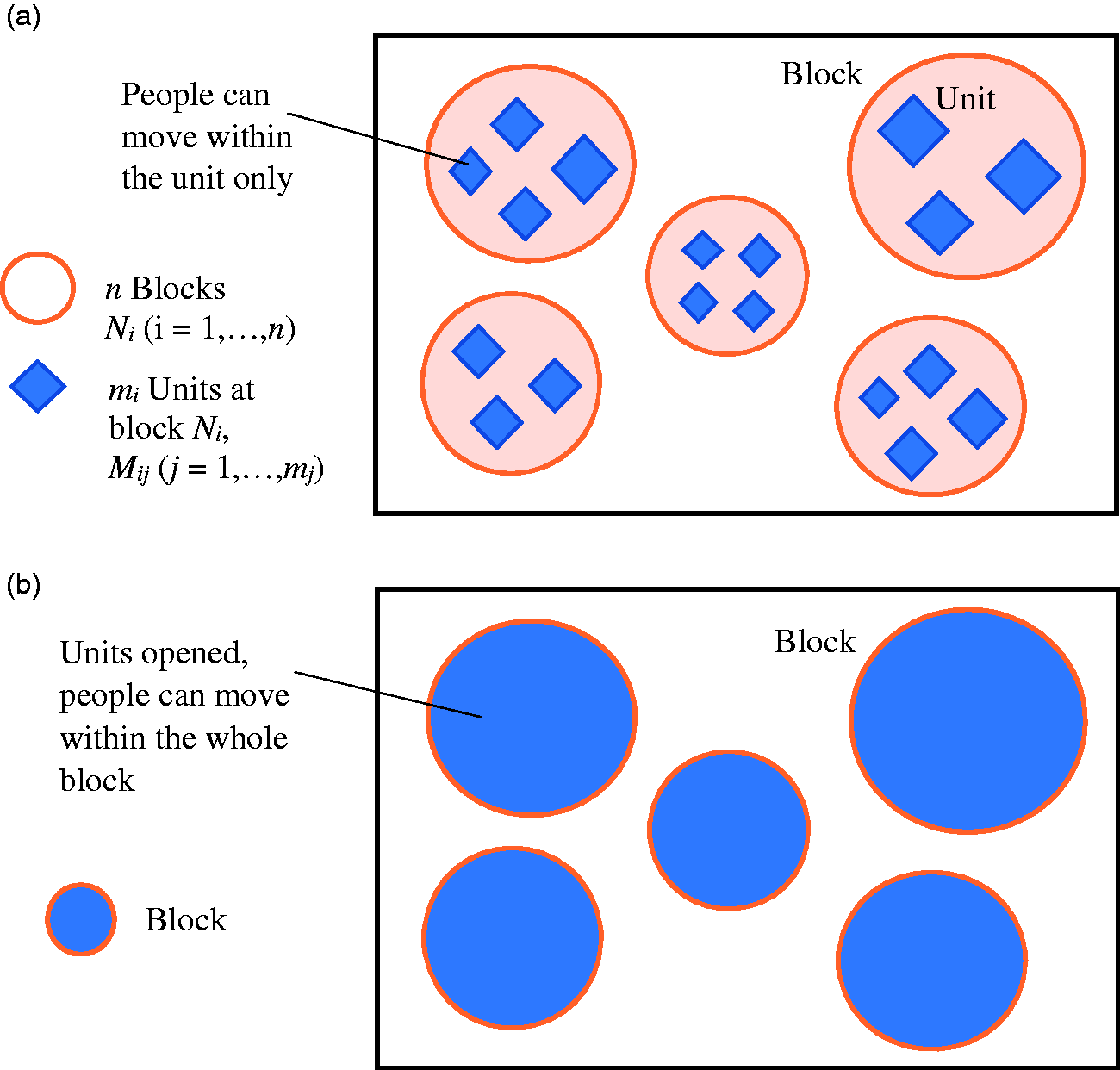
Two-stage containment scheme. (a) Stage 1: Containing people in units of each block and (b) Stage 2: Containing people in each block.
The blocks and units can be assigned under different conditions of different countries. For example, a block28,29 can be a tall residential building in dense urban areas. A unit can be an apartment inside. In smaller towns, a block can be a village and a unit can be a house inside. For the first stage of containment of 14 days, people in a unit can physically contact one another in the unit but not people in other units. In the following 14 days (second stage), people in a block can physically contact one another but not people in other blocks.
People in a unit are encouraged to follow quarantine guidance 30 such as wearing masks all the time, maintaining good personal hygiene (washing hands frequently, not touching nose, mouth and eyes, etc.) and keeping a social distancing of at least 1 m. However, it is very difficult to ensure such guidelines are kept in each unit. Transmission is possible within the unit, but not among units in the block at the first stage.
In the second stage of quarantine for another period of 14 days, people are allowed to move and have contact with others within the same block. People are encouraged to follow quarantine guidance 30 again, but human contact among different containment blocks is not allowed. All units are open, and transmission is still possible within each block. This would provide an opportunity to observe disease transmission through AP.
Infected patients identified in each containment stage would be quarantined for medical treatment and observation. The rest can be released after two stages of quarantine.
Advantages of the proposed two-stage containment scheme are as follows: Individuals being quarantined in their small residence for a longer period of over 14 days would feel suffocated by the confinement. The first stage of quarantining people within units first and then a bigger block would provide a better containment atmosphere and a change of environment for the people being quarantined. The authority can identify the infected patients easily inside units and blocks and to provide appropriate treatment immediately. Some people might have an incubation period longer than 14 days.
31
Introducing a second stage of containment would allow the authority to identify such APs before they go back to the community. Confining people in a bigger block would cause less restriction and provides a better atmosphere. APs can be identified easier at the second stage of containment. That is because AP is a dangerous source of infection. Some APs are very infectious but without any symptoms.
Methodology
Mathematical modelling concepts was used in this study to illustrate the effects on containment based on models reported in the literature.4,13,29,32–38 There are many stochastic models which can capture the inherent randomness in disease transmission observed in outbreaks. The probability of an infection in the next period of time (in a discrete time model) was postulated by Hamer 38 in 1906 to be proportional to the number of infectious individuals multiplied by the number of susceptible individuals. This is very similar to Law of Mass Action in chemical kinetics. The basic transmission susceptibility, infection and removal (SIR) model for a directly transmitted infectious disease was introduced 32 with three coupled non-linear ordinary differential equations on susceptibility (S), infection (I) and removal (R) without explicit solutions. Information can be predicted by simple numerical tools. A detailed summary of transition dynamics was provided, 32 with an additional group called ‘exposed (E)’. A mathematical model of transmission based on four datasets from within and outside Wuhan was developed. 33
However, these are stochastic models requiring a large number of occupants for validation. At the initial stage of containment of a small initial number of people in each unit with a small number of infected people, a simple model would be better. A generalizable epidemiological model that allows one to evaluate too many properties of containment schemes is not practical.
A proposed empirical approach
An empirical mathematical approach was applied to illustrate the effect of containment using the observed data. Consider the jth unit Mij of the ith block Ni with initial number of people

An infection constant λ can be introduced by Equation (2)

Integrating gives Equation (3)

The number of people infected

After the first containment period of 14 days, the infection constant would be highly reduced to a smaller value λ2. That is because AP would have a lower infection rate starting from 14 days onwards. The situation is a little bit complicated because

The infection rate is proportional to (
A simplification is to assume each unit

Infection growth constant
Two points to note based on the observation on transmission
20
before: The infection growth constant λ can be fitted by the slope of the transient growth curves observed in an enclosed space. λ2 can be estimated by some assumptions observed from APs.
As observed from literature data39–41 in the past few months, the infection chance in a unit can be estimated roughly from the observation in the aircraft carriers and cruisers. Data available in a cruiser or an aircraft carrier is an appropriate example case to deduce the growth constant for an enclosed unit. The containment environment, number of people in each unit and human interaction mechanisms are very similar to a contained unit
If there are adequate data recorded on observed
A selection of appropriate enclosure unit size is needed. The aircraft carrier or cruiser40–42 appears to be a good choice because of similar environment. Observation data available on transient infected number
An example case study
Observed data of a cruise ship40,41 on the number of people infected Q is shown in Table 1. As reported, 41 the cruise ship had 3711 total crews and passengers.
Number of people affected at the early stage in Diamond Princess. 41
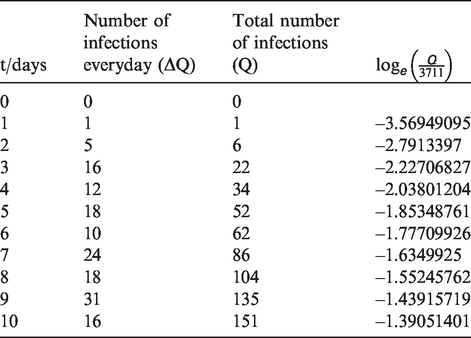
Based on equation (7), a curve of
With such deduced values of λ, the transient infected values
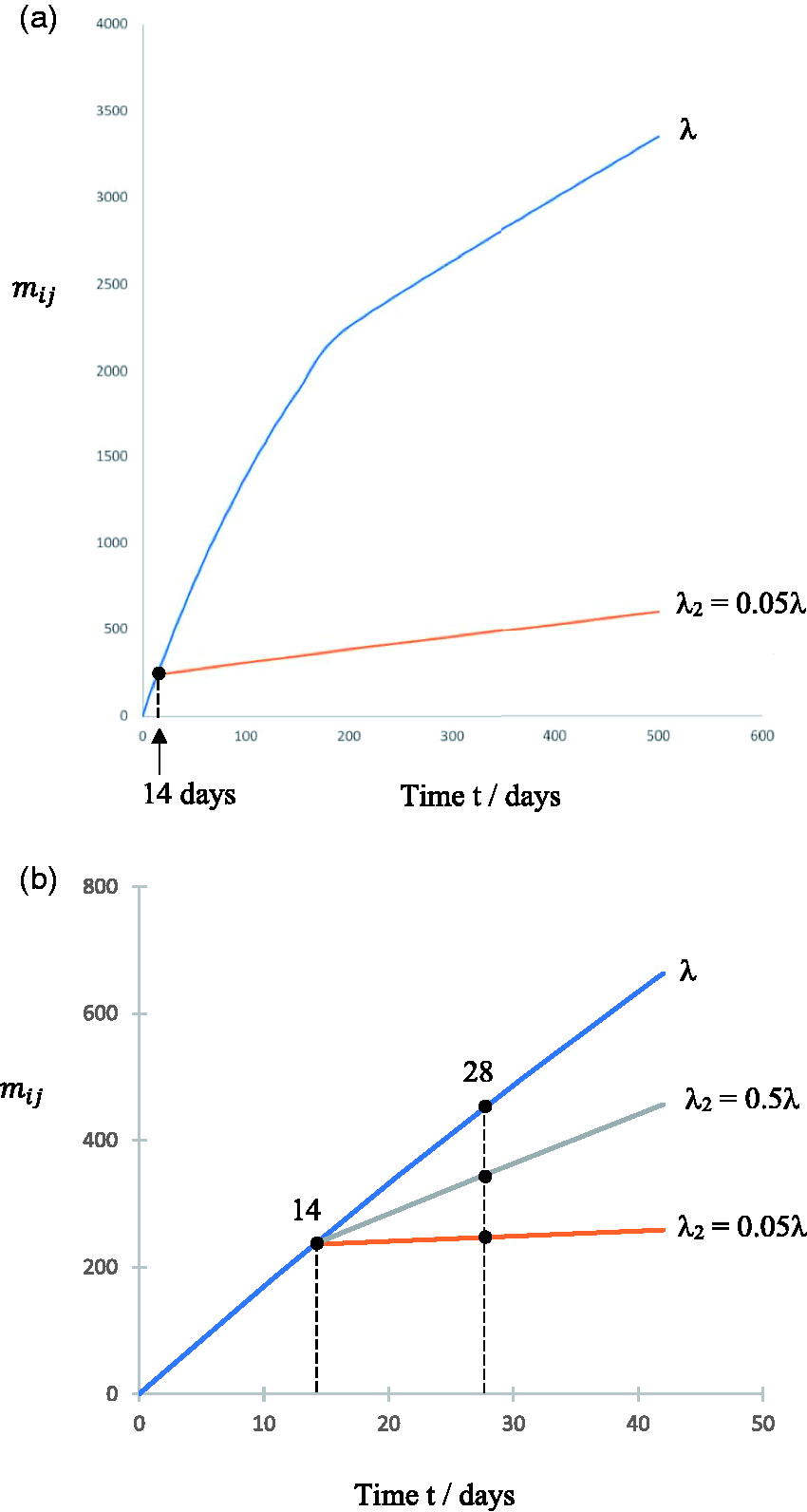
Number of infections at different rates. (a) Over a long time and (b) Over a shorter period.
Without containment, the number of infections in each unit is given by the curve predicted through λ1. However, if the people are confined within the unit for 14 days, the number of infections is increased by a smaller constant λ2 inside each block.
After 28 days, the number of infections is much lower than that without this second stage of containment.
Suppose the unit
There are many statistical data on the chance of catching
22
the SARS-CoV-2 virus; some was estimated to be about 0.09. There are 20,000 patients out of a population of 7,000,000 in Wuhan city around April 2020, giving a much lower infection chance of 1/350. A lower value of 8 people carrying virus in a sample 10,000 people or 1/1250 was reported
20
in China. A value of 10 infections in 10,000 people appears reasonable. There can be as low as 107 in 4.4 million people in Dalian,
43
or 1 in 40,000. Taking a higher value of 1 AP in 20,000 people is reasonable, value of λ2 is assumed to be
Effect of using different values of λ on the number of infections can be observed in Figure 2(b). Reducing λ by containment would give lower rates of infection. For example, even a higher value of λ2 of 0.5 would not give a high infection rate as in Figure 2(b).
Discussions
In view of the high transmission rate of COVID-19 and the insidious transmission through APs, an acceptable but effective containment safety management scheme has been proposed30,44 to be implemented urgently. There are two conflicting points: Containment is necessary to identify the infected patients and APs. Some APs are observed to be very infectious but without any symptoms. Normal activities are stopped in containment, damaging the local economy. People are likely to feel uncomfortable if quarantined in small units for a long time. Local government might not be able to implement quarantine containment scheme smoothly and effectively.
The proposed two-stage quarantine containment scheme provides a compromise for the two conflicting views and is feasible based on analysis from a well-understood area of epidemiology. People are kept in a unit first for a period such as in Figure 2(b) for 14 days. Infected patients can be picked up and then treated properly. People are then kept in a bigger block for another 14 days. To identify infected patients and hence trace back the AP would be more convenient and easier. The second stage of containment would give a better opportunity to identify APs. This stage is a good preparation before resuming normal activities in breaking all the containing barriers.
After 28 days of well-managed containment, the number of APs should be very small, having a value tending to zero. The infection source would be easier to trace if some people are infected after 28 days upon releasing all blocks.
The containment period of 14 days can be changed from the observed incubation period, live virus shedding period and PCR detectability period.23–27 The argument on having lower infection rate is still the same as shown in Figure 3 for containing a shorter period of 7 days for each stage under different values of λ2 as in above for Figure 2(b) with a containment period of 14 days.
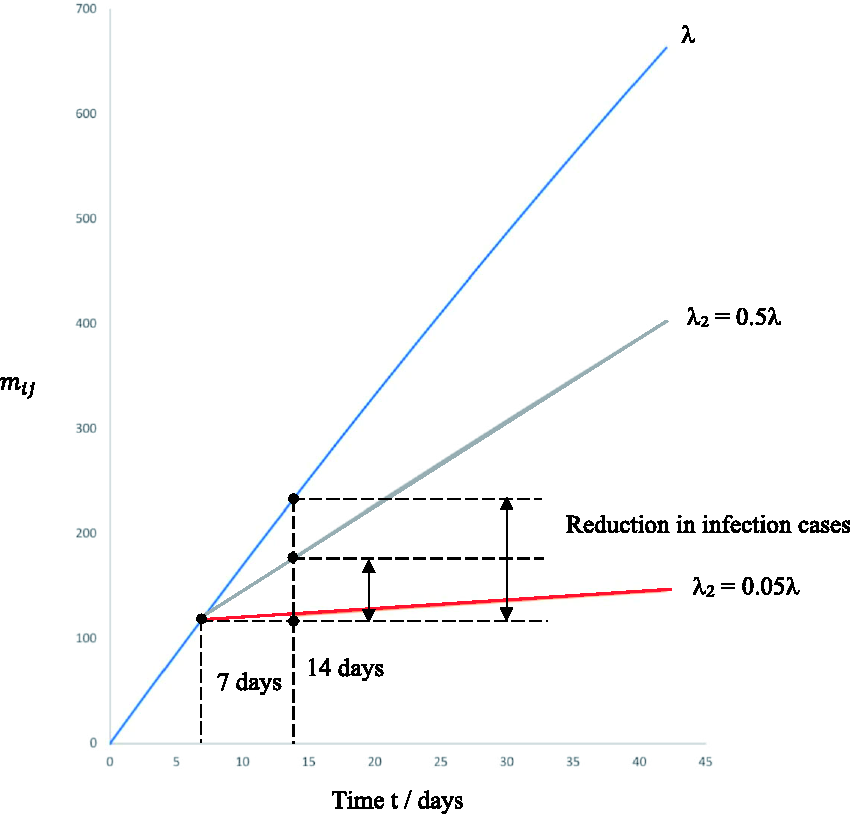
Shorter containment period of 7 days of each stage.
Conclusions
As a conclusion, this scheme can give an opportunity to control disease transmission better under the current situation without any noteworthy properties of the system and is very appropriate for identifying APs. This is a safety management approach and should be implemented properly to ensure quarantine within the units and blocks in two stages of containment, each with a common agreed period such as 14 days. A detailed operation scheme should be developed to cater for the limitations of individual units and blocks. An effective management team is needed to execute the scheme and observe whether people inside the units in the first stage and the blocks at the next stage are infected. The proposed scheme is also more humanitarian until there are vaccines or quick identification tests developed for epidemic control. The scheme is more effective if the virus identification tests are more effectively managed.
Footnotes
Authors' contributions
All authors contributed equally in the preparation of this manuscript.
Declaration of conflicting interests
The author(s) declared no potential conflicts of interest with respect to the research, authorship, and/or publication of this article.
Funding
The author(s) received no financial support for the research, authorship, and/or publication of this article.
