




Abstract
Aims:
This study describes the Norwegian Sports Membership Database (NSMD), assesses its coverage, and develops definitions of active sports memberships.
Methods:
We validated the coverage of the NSMD, a database capturing individual-level sports memberships among people aged 10–70 years between 2015 and 2024. We compared yearly membership counts in the NSMD with figures from official reports from the Norwegian Olympic and Paralympic Committee and Confederation of Sports (NIF). We defined all memberships as lasting one day or longer, and active memberships as lasting at least one season or with a paid licence.
Results:
Between 2015 and 2024, the NSMD contained 3,148,213 memberships, of which 2,180,621 (60%) were considered active. In total, there were 1,606,048 unique individuals across 55 sports federations and 279 disciplines. Football accounted for 24% of all memberships, handball for 11% and gymnastics for 9%. Database coverage was low in 2015, accounting for 11%–16% of expected memberships, but it improved substantially over time, exceeding 85% of all memberships and 92% of active memberships in 2023 for those aged 13–19.
Conclusions:
Introduction
Population-based registries, such as health-care registries, have been an invaluable resource for researchers, policymakers and other stakeholders [1]. They have provided unique opportunities to study large populations over time [2–4], identify risk factors [5] and evaluate interventions in real-world settings [6]. Such registries are particularly powerful when they can be linked with other administrative data sources, such as education or tax records, enabling analyses that cut across different domains of society [7]. However, despite the well-documented value of registries in other fields, no comparable population-level data sources currently exist for organised sports participation. This represents a significant gap, given the potential of such data to inform research on physical activity, social inequality, public health and policy development. Establishing registries for organised sports could therefore open new avenues for interdisciplinary research and provide an important complement to existing health and administrative data sources.
In this paper, we present the Norwegian Sports Membership Database (NSMD) administered by the Norwegian Olympic and Paralympic Committee and Confederation of Sports (NIF). This database covers all recorded memberships in organised sports in Norway between 2015 and 2024. The database provides a unique opportunity to track sports participation over time, providing detailed insights into new, ongoing and discontinued memberships in more than 50 sports and 200 disciplines. By linking this database to other national registries, researchers can conduct longitudinal studies on sports memberships together with socio-economy and health.
The main objectives of this paper are to describe the content of the NSMD, assess its coverage and develop definitions of active memberships.
Methods
Data source and collection
The NSMD covers all identifiable membership records in organised sports in Norway. Each membership record is linked to an individual’s national identity number. This identity number is unique to all Norwegian residents and is key in allowing integration with other data sources and registries [8]. The NSMD was gradually established from 2015, following the NIF’s mandate requiring all sport federations in Norway to adopt membership systems compatible with this centralised database [9].
The sample from NSMD used in this description included all sports memberships for members aged 10–70 years between 1 January 2015 and 31 October 2024. Each record contained detailed information on start date, end date, sport and discipline. The database contained no missing values, but end dates were absent if the membership was still active at the time of data extraction (i.e. 31 October 2024).
For 34 of the 55 sports, information on paid licences were available (Supplemental Table S1). Licences cover insurance and are usually required from the year a child turns 13 in order to play games and compete in tournaments [10]. The licence data contained each member’s national identity number and sport as well as the licence’s expiration date. The start date was defined as one year prior to the expiration date.
To provide a thorough description of the available data, we linked each person to their registered sex, age, county of residence and country of birth from the Norwegian Population Register [8]. For children and adolescents, we also included information on their parents’ income from Statistics Norway [11].
Statistical analysis
We first described all memberships in the NSMD by sex, age, country of birth, participation length and type of sport for individuals aged 10–70 years between 2015 and 2024. A membership was defined as anyone registered in at least one organised sport for at least one day during a calendar year in which they were aged 10–70. Memberships were classified as all memberships (lasting at least one day) or active memberships. Active memberships followed the NIF’s definition of competitive or full-season participation [12] and were operationalised as memberships with a paid licence or lasting an entire season. We defined seasons in each sport based on their main competitive season: February–November for sports with summer seasons (e.g. football, athletics, cycling, and martial arts) and September–June for sports with winter seasons (e.g. handball, skiing, gymnastics, and motor sports). Supplemental Material 1 and Supplemental Table S1 contain a more detailed description of all sports, their seasons and the availability of licences.
We then assessed the coverage of the NSMD by comparing the number of all memberships and the number of active memberships each year with the NIF’s annual reports [12]. The NIF reported both a number for all memberships and a number for active memberships. We calculated all memberships on 31 December each year between 2015 and 2023. For active members, we stratified the coverage by each sports federation. The discrepancy between the numbers found in the NSMD and in the NIF’s reports is a result of how the data are collected. The NSMD is based on individual membership records linked to national identity numbers, whereas the NIF’s reports rely on aggregated membership counts reported by federations and clubs.
Because the NIF reported totals by age groups and our data covered ages 10–70, we restricted the coverage analysis to individuals aged 13–70. For sport-specific coverage, we focused on ages 13–19, since older age groups often include coaches and administrative members rather than active athletes. We removed company sports, university sports, and multisports (see Supplemental Material 1).
After estimating coverage, we examined whether registered members in low-coverage years differed from those in high-coverage years. Based on already-calculated coverage rates, we classified sports and years into four groups: low (0%–39%), fair (40%–59%), moderate (60%–79%) and high (80%–100%) coverage, using terminology from Norwegian medical quality registers [13]. We then investigated variations in age, geography and socio-economic factors over time within sports, particularly focusing on the youngest age group, 13–19 years, to determine if using data from years with low coverage would induce biases.
All data management was conducted in R version 4.4.1 using Rstudio (R Foundation for Statistical Computing, Vienna, Austria). R-scripts are available on GitHub: https://github.com/MethiF/2025_The_Norwegian_Sports_Membership_Database.
Ethical considerations
Ethical approval for the NorSport-project [14] was granted by the Regional Committees for Medical Research Ethics South East Norway on 23 August 2023 (reference #584239).
Results
Descriptive results
Between 2015 and 2024, there were 3,148,213 registered sports memberships in the NSMD (Table 1). Of these, 2,180,621 (60%) were considered active memberships, lasting more than one season or with a paid licence. Males were overrepresented in terms of both all memberships (56%) and active memberships (57%), and most members were born in Norway (92%).
Descriptive statistics of memberships in the Norwegian Sports Membership Database.
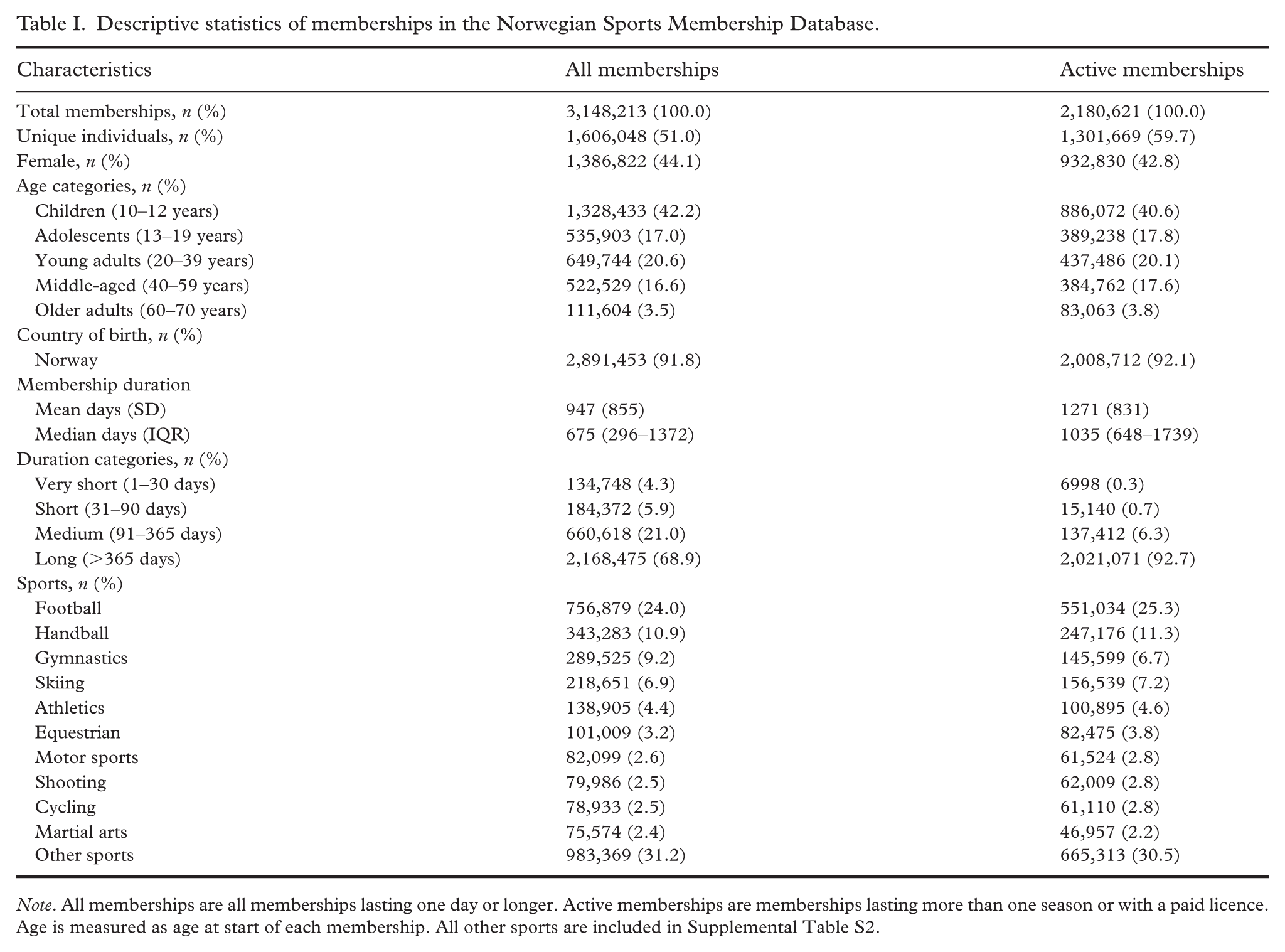
Note. All memberships are all memberships lasting one day or longer. Active memberships are memberships lasting more than one season or with a paid licence. Age is measured as age at start of each membership. All other sports are included in Supplemental Table S2.
Of all 3,148,213 memberships, 1,606,048 (51%) belonged to unique individuals, suggesting that, on average, a member had 2.0 memberships and 1.7 active memberships. Most memberships (69%) lasted more than 365 days. Among active memberships, 93% lasted more than 365 days.
Football was the most common sport, comprising 24% of all memberships. This was followed by handball (11%), gymnastics (9%) and skiing (7%). For active memberships, football remained the most common sport (25%), followed by handball (11%), with skiing (7%) being slightly more common than gymnastics (7%).
Table I shows descriptive characteristics of all and active memberships. In Table I, age is measured as the age at the start of each membership. More than 40% of both all memberships and active memberships in the NSMD started when the individual was 10–12 years of age. In Figure 1, in contrast, the unit of analysis is membership-year. This figure shows the age distribution for all individuals being members at least one day each year. The left panel shows the age distribution for all memberships, and the right panel shows the age distribution for active memberships. The blue and red lines show smoothed distributions for males and females. Both all and active memberships had a similar distribution, with a peak at the age of 11. Membership rates then rapidly declined until the age of approximately 30, with a slight increase for 40- and 50-year-olds.
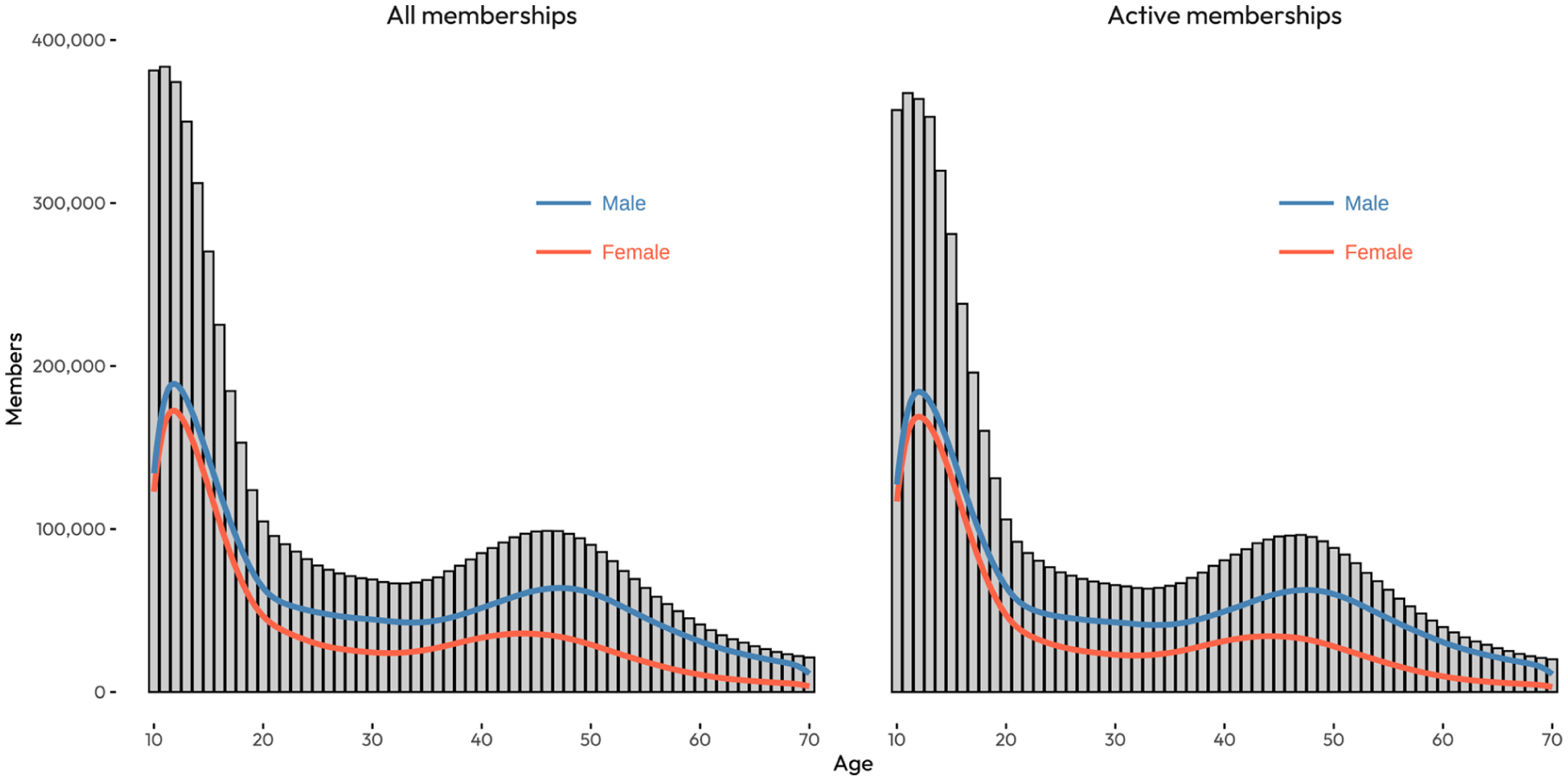
Age distribution of all and active memberships in the Norwegian Sports Membership Database.
Coverage
Since its establishment in 2015, the purpose of the NSMD has been to cover all registered memberships in organised sports in Norway. Figure 2 shows the share of memberships found in the NSMD compared with the total number of memberships reported by the NIF. Figure 2(a) shows the coverage for all memberships, stratified by age groups. Figure 2(b) shows the coverage for active memberships. All six panels show that coverage has gradually increased from 2015 to 2023. It is also evident that coverage is highest for the youngest age group (i.e. those aged 13–19 years). This is also the age group where sports participation is most common. The coverage is also higher for active memberships than for all memberships. For all memberships, the coverage reaches 85% in 2023 for those aged 13–19 years, and 58%–64% for the older age groups. For active memberships, the coverage approaches 93% for 13- to 19-year-olds in 2023, and 76% for the older age groups. In Figure 2, we included all sports, although golf was not thoroughly captured in the NSMD. After removing golf from both the numerator and the denominator, which was only possible for active memberships, since the NIF does not report all memberships stratified by sports federation, the coverage reached 96% in 2023 for 13- to 19-year-olds, 85% for 20-to 25-year-olds and 89% for 26- to 70-year-olds (Supplemental Figure S1). The total number of memberships in the NIF’s reports and the NSMD is shown in Supplemental Figure S2.
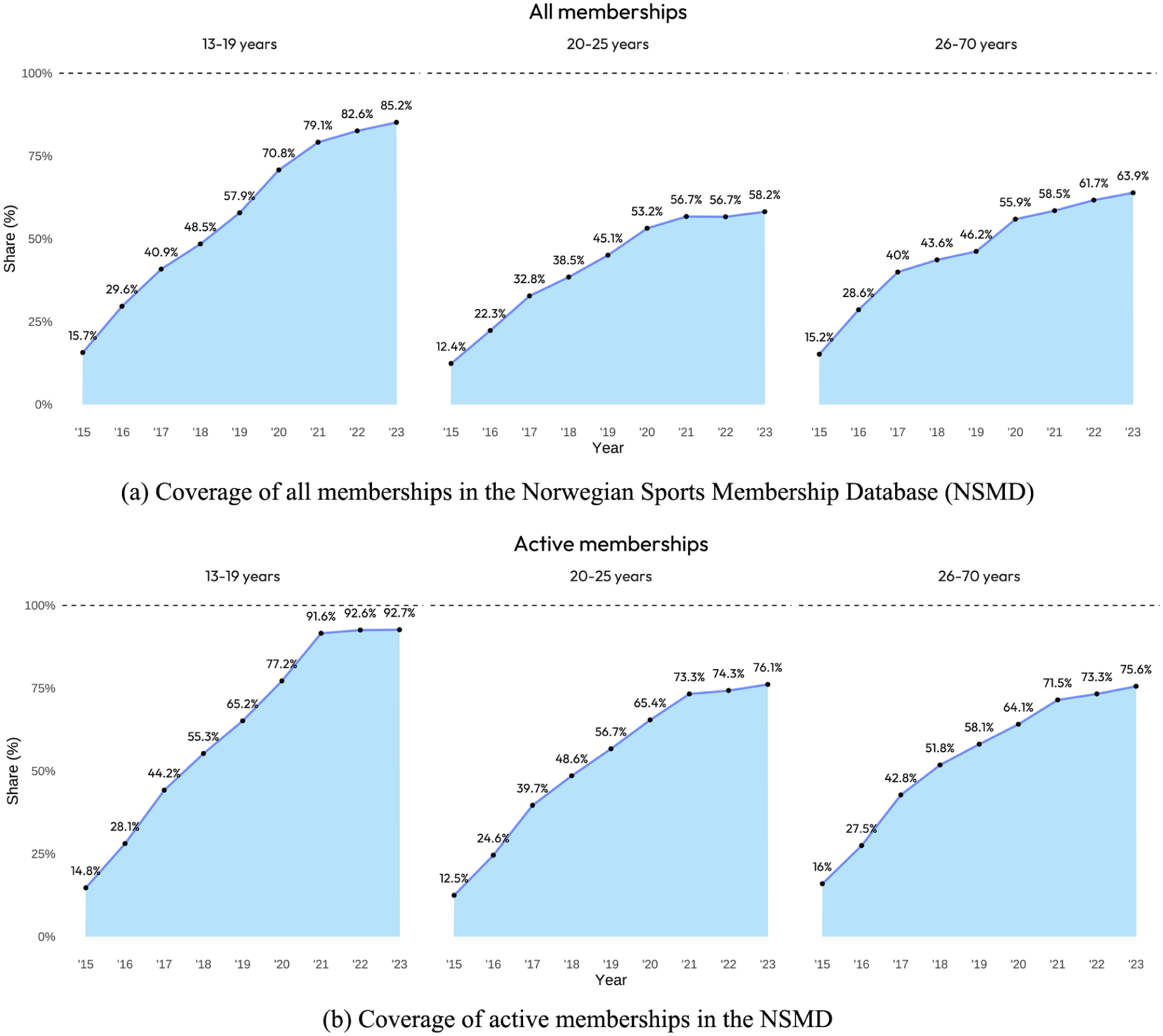
(a) Coverage of all memberships in the Norwegian Sports Membership Database (NSMD). (b) Coverage of active memberships in the NSMD.
Figure 3 shows the yearly coverage of the ten most common sports among 13- to 19-year-olds. Although all 10 sports had a coverage <40% in 2015, all sports exceeded 80% coverage in 2023. For some sports, such as equestrian, gymnastics and motorsport, the coverage exceeded 100% in 2023, illustrating that there were more registered members in the NSMD than in the NIF’s reports. Similar plots for all sports and all three age groups are provided in Supplemental Figure S3).
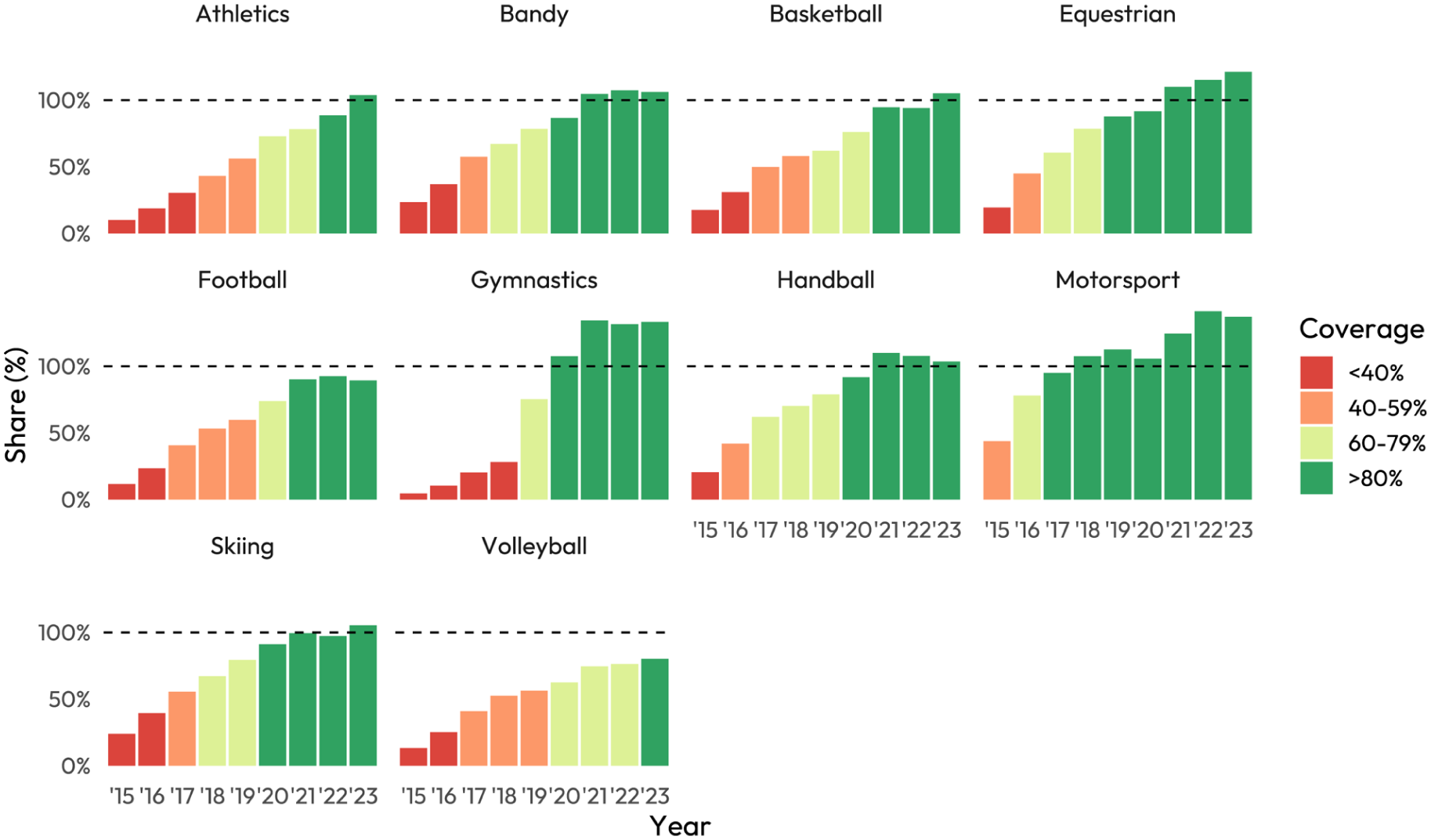
Coverage of the top 10 sports.
We observed only minor differences in member characteristics (age, geography and parental income) in years with low coverage compared with years with high coverage (Supplemental Material 2).
Discussion
Since its establishment in 2015, the NSMD has grown to include more than three million memberships and 1.6 million unique individuals across 55 sports federations and 279 sports disciplines. In this paper, we have introduced two operational definitions of memberships for use in future research: (i) all memberships lasting at least one day and (ii) active memberships, defined as participation over a full season or with a paid licence. Using the active definition, the dataset comprised more than two million active memberships.
The coverage of the database has improved substantially over time, increasing from approximately 10%–15% of all memberships in 2015 to 60%–90% of memberships in the years following 2021. Coverage was highest for 13- to 19-year-olds and lower for 20- to 25-year-olds and 26- to 70-year-olds. This discrepancy was partly attributed to golf not being captured by the NSMD. In reports by the NIF, the top five sports in terms of active memberships were football, handball, golf, company sports and skiing [12]. However, golf and company sports were not fully captured in the NSMD. Only 7% of golfers were included due to incomplete integration of the golf federation’s membership system [15]. Excluding golf greatly improved coverage for these groups from approximately 75% to 85%–90% (Supplemental Figure S1).
For certain sports and age groups, coverage exceeded 100%, indicating that more memberships were recorded in the NSMD than were reported in the NIF’s annual statistics. When calculating coverage, we implicitly assumed that the numbers in the NIF’s annual reports were correct. However, these figures were based on club submissions without a formal verification process. Clubs could find it challenging to count the precise number of members, and approximately 5% did not report membership figures to the NIF at all [12]. As a result, in later years, the available numbers in the NSMD may offer a more precise depiction of the actual number of sports memberships in Norway than in the NIF’s reports. However, determining which of these sources is the most reliable remains challenging.
The coverage of the NSMD varies substantially over time. By 2021, coverage of most sports among 13- to 19-year-olds exceeded 90% (Supplemental Figure S3), indicating that the NSMD captured almost all memberships. Our analysis of demographic and socio-economic distributions between years of low (<40%) and high (⩾80%) coverage revealed only minimal discrepancies (Supplemental Figures S4–S6). These were primarily influenced by sport type rather than demographic or socio-economic factors. This suggests that researchers may use, albeit with caution, the longitudinal data from 2015, for example, to follow members over time without excluding particular socio-demographic groups.
A key strength of the NSMD is the inclusion of all organised sport memberships for the entire Norwegian population, which allows for population-wide analyses across a broad range of sports. The longitudinal nature of the data enables researchers to track exposures and outcomes over time, studying events before, during or after joining organised sports. With the ability to link these data to other Norwegian registries and data sources through the unique national identity number of each individual, researchers can explore sports participation in relation to socio-economic, health-related and other types of outcomes [14].
Our descriptive analysis of the NSMD showed that participation in organised sports was dominated by younger cohorts. Memberships peaked at age 11 for both boys and girls. This finding corresponded well with both the NIF’s reports [12] and studies from other countries [16]. As more than 90% of Norwegian children take part in organised sports at some point during their childhood [17], and organised sports constitute the largest source of physical activity for them [18], the NSMD is particularly valuable for studying children's participation in sports. In contrast, participation patterns differ for older adolescents (⩾16 years) and adults. The largest dropout of organised sports occurs during lower secondary school and in the transition to upper secondary school [19], and surveys show that these age groups are more likely to engage in physical activity outside of organised sports, such as gyms [20]. The NSMD data showed an increase in members for 40- to 50-year-olds, which may be a result of either a resurge in senior athletes or the inclusion of administrative members such as coaches, volunteers or board members. The increase in members aged 40–50 years is also consistent with age distributions from the NIF’s reports [12].
Although the strengths of the NSMD relate to its population-wide coverage, longitudinal aspects and the ability to link it with other individual-level data, it does have some limitations. The structure of the database leads to challenges such as overlapping information and duplicate entries, without the ability to determine whether these memberships are, in fact, overlapping or the result of erroneous registrations. For example, an individual may be registered with one football membership lasting from 1 January 2020 to 1 January 2023 and another football membership from 2 October 2022 to 1 January 2024. For most practical research, this could likely be considered one sustained membership. In addition, there may be uncertainty surrounding participation levels. The NSMD contains no information on physical activity – that is, we do not know whether a member attends practices once every two weeks or seven days a week, and we do not know whether this differs between ages and sports. In the future, we plan to link the NSMD with large population-based surveys, such as the Trøndelag Health Study (HUNT) [21] or the Norwegian Mother, Father and Child Cohort Study (MoBa) [22], to validate whether sports memberships may be used as proxies for physical activity levels.
Being a member does not necessarily reflect active participation, as individuals can stop attending practices or games before deregistering their memberships. We addressed this by incorporating licence data, which requires active payment to participate in games and tournaments, and we defined active memberships as those lasting at least one season or with a paid licence. Using all memberships and active memberships may serve to answer different questions. Studies of socio-economic barriers may include all memberships, whereas analyses of physical or psychosocial benefits of sustained participation may focus on active memberships.
A final limitation is that the period the NSMD reached high quality (i.e. in 2021) coincided with the COVID-19 pandemic. During the pandemic, Norway imposed extensive restrictions on organised sports [23,24]. Restrictions varied throughout the country, with stricter measures in urban areas with higher infection rates. Restrictions also differed between different sports, age groups and levels of professional activity. Although the NIF’s reports indicate a minor decrease in membership in 2020 and 2021 [12], the NSMD saw an increase in memberships during the same period, likely due to increasing coverage (Supplemental Figure S2). A survey in 2022 revealed that although participation in organised sports decreased during the pandemic, participation in the same sports increased after the pandemic [17].
Compared with previous research, the vast majority of studies on organised sports participation are from surveys with self-reported data on participation. There are a few exceptions. For example, researchers from Australia have used deidentified registration data for a limited number of sports to investigate ages and genders, and whether sport members tend to live in urban or rural areas [16]. Similarly, an ongoing initiative in Norway uses membership data with birth dates to investigate the relative age effect in sports [25]. However, none of these projects involve the ability to link membership data to other registries on the individual level [14]. Hence, the NSMD offers the first possibility to conduct these types of studies.
Conclusions
The NSMD contains all recorded and linkable memberships in organised sports in Norway from 2015 to 2024. From 2019, the NSMD contains two-thirds of all active memberships, and around 90% between 2021 and 2023, for 13- to 19-year-olds. By linking the NSMD to administrative health and socio-demographic registries, researchers can conduct longitudinal studies to investigate what happens before, during and after individuals participate in different sports.
Supplemental Material
sj-pdf-1-sjp-10.1177_14034948261432559 – Supplemental material for The Norwegian Sports Membership Database: Coverage, biases and potential
Supplemental material, sj-pdf-1-sjp-10.1177_14034948261432559 for The Norwegian Sports Membership Database: Coverage, biases and potential by Fredrik Methi, Ingeborg Hess Elgersma, Jonas Minet Kinge, Arnstein Mykletun, Rannveig Kaldager Hart, Atle Fretheim and Karin Magnusson in Scandinavian Journal of Public Health
Footnotes
Acknowledgements
We would like to thank Terje Kleiven, Ingvild Reitan and Guro Aurtande at the Norwegian Olympic and Paralympic Committee and Confederation of Sports (NIF) for thorough help and assistance in using and understanding the NSMD data. We would also like to thank Kjetil Telle, Kristian Bandlien Kraft and Runar Barstad Solberg at the Norwegian Institute of Public Health (NIPH) for valuable feedback and comments during the drafting of the manuscript.
Declaration of conflicting interests
The authors declared no potential conflicts of interest with respect to the research, authorship and/or publication of this article.
Funding
The authors disclosed receipt of the following financial support for the research, authorship and/or publication of this article: This work was funded by Foundation Dam, through Youth Mental Health Norway (grant number 2025/FOR555616). The funding bodies had no role in the design of the study, data collection, analysis, interpretation of data or in writing the manuscript.

Supplemental material
Supplemental material for this article is available online.
References
Supplementary Material
Please find the following supplemental material available below.
For Open Access articles published under a Creative Commons License, all supplemental material carries the same license as the article it is associated with.
For non-Open Access articles published, all supplemental material carries a non-exclusive license, and permission requests for re-use of supplemental material or any part of supplemental material shall be sent directly to the copyright owner as specified in the copyright notice associated with the article.
