




Abstract
Aims:
We use cognitive tests among military conscripts in Norway to further investigate an association between the Chernobyl fallout and mathematical skills previously reported for school grades both in Norway and in Sweden.
Methods:
The Medical Birth Registry of Norway was linked with data from the Norwegian Armed Forces Health Registry on conscript cognitive scores. Average radiation doses were estimated for each municipality and calendar month from May 1986 to April 1989. Dose in the mother’s residential municipality in the fifth calendar month of the pregnancy was used as exposure. Total cognitive score among boys was analysed using a natural-experiment design with pregnancy cohorts from years prior to the fallout as reference. Our analysis estimated whether a difference in scores before and during exposure was specific to regions with higher doses. Sub-scores for numerical reasoning were available only for cohorts after 1986. An alternative sibship analysis using younger brothers as reference was therefore performed.
Results:
We found no evidence of reduced total cognitive score in areas with relatively higher average radiation doses. Similarly, there was no evidence that numerical reasoning was reduced.
Conclusions:
Background
Exposure to radiation during foetal life was linked to reduced cognitive function in 10- to 11-year-old children from Hiroshima and Nagasaki [1]. The data suggested a threshold dose and a critical exposure window between weeks 8 and 15 of pregnancy. This association was consistent with studies of offspring of women exposed to pelvic diagnostic radiation during pregnancy [2]. A recent study did not find associations with prenatal radiation doses among elderly survivors from Hiroshima and Nagasaki without previously recognized cognitive problems [3].
Contamination from the disaster in the Chernobyl nuclear power plant on 26 April 1986 affected large areas of northern Europe. Radiation doses were much lower than those experienced in Hiroshima and Nagasaki, but health effects of the fallout from Chernobyl continue to be a matter of public and scientific concern [4 –7]. Population-based studies from Sweden and Norway have suggested possible effects of prenatal exposure to the Chernobyl fallout on mathematics school grades [8,9]. A more recent study with data from Norway reported association between exposure to radioactive contamination from Soviet nuclear bomb tests in the 1950s and ’60s in months 3 and 4 of pregnancy and cognitive scores from testing of conscripts at 18 years of age [10]. Evidence is, however, still considered ‘limited to inadequate’ for an effect of low-to-moderate doses of ionizing radiation on neurodevelopment [11].
In Norway, the Armed Forces routinely examine entire cohorts of young people to assess their ability for military service. The conscripts’ data from cognitive testing are stored in the Norwegian Armed Forces Health Registry (NAFHR), providing another opportunity to investigate subtle neurodevelopmental effects of prenatal exposure to the radioactive fallout from Chernobyl. These data were linked with data from the Medical Birth Registry of Norway (MBRN) for relevant birth cohorts. Exposure data were provided by the Norwegian Radiation Protection Authority, which performed extensive monitoring of radiation exposure in all 454 municipalities of Norway for each month in three years following the accident [12,13].
We identified radiation dose in residential municipalities for calendar month 5 of each pregnancy, the a priori vulnerable window of exposure, and then identified appropriate unexposed or lower-exposed comparison groups. This included a natural-experiment approach used in our previous report on neurodevelopment and school grades [8], and also a sibling analysis. The purpose of this paper is to assess the total cognitive score and a sub-score for mathematical reasoning, specifically to see whether our previous finding of reduced mathematics school grades in Norway could be replicated among exposed conscripts using a similar approach [8]. Together with our previous reports on neurodevelopment and school grades [9] and birth defects [14] this is the third paper using the same exposure data and the natural experiment approach.
Methods
Data sources
Our study included all births in Norway from 1983 to 1999 as recorded in the MBRN. Information in the registry that was included in our analyses included date of delivery, length of pregnancy in days, date of last menstrual period (LMP), mother’s residential municipality, parity, mother’s national ID number, offspring ID number, sex, survival of offspring, date of death, date of emigration. A list of variables requested from the MBRN is shown in the Supplementary material file online. Length of pregnancy was based on LMP. For 6% with missing information on LMP, we used birth weight to estimate length of pregnancy [15]. This allowed us to estimate the fifth calendar month of pregnancy (counting the calendar month of LMP as month 1) for virtually all births.
Norwegian registries were linked using a unique ID number assigned at birth. This ID number makes it possible to link parents to children, to identify siblings and to link each birth with follow-up information across registries.
Outcome data
Data on cognitive ability were collected at military conscription testing, which is usually conducted at age 18–19 years. Cognitive ability is assessed by three different, time-limited subtests: Arithmetic (25 min), Word Similarities (8 min) and Figures (20 min). The Arithmetic test is a measurement of arithmetic, algebraic and logical reasoning ability, while the Word Similarities test is a synonym test. The Figures test is a non-verbal test of analytic intelligence. We denote the three scores numerical reasoning, verbal reasoning and general reasoning test score respectively. The three test scores are standardized into normally distributed F-scores (mean=50, standard deviation, SD=20) and summed to yield a combined measure of cognitive ability, which is reported as a stanine score (total cognitive score). A stanine score of 5 represents an IQ score of 100 (Wechsler Adult Intelligence Scale), with an increment/decrement of 7.5 IQ units for each stanine unit deviating from 5. The NAFHR holds total cognitive scores for >90% of the male birth cohorts born 1950–1991 [16]. Storage of the sub-scores was unsystematic and incomplete but improved from 2004 when an electronic journal system was implemented, and the data were used to improve documentation of the selection procedures for military service.
Exposure data
Immediately after the Chernobyl accident in April 1986, the Norwegian Radiation Protection Authority initiated a programme of monthly exposure measurements that lasted for 36 months (May 1986 to April 1989). Average external doses in milliSieverts (mSv) per month to individuals in a municipality were estimated from surface measurements of cesium-134 and cesium-137 as shown in Strand et al. [17], and average internal doses were similarly estimated from the consumption of food and milk as shown in Strand et al. [18]. Average doses were estimated for each of the 454 municipalities in Norway for each of 36 calendar months from May 1986 to April 1989. Our previous papers provide descriptions of the geographical and temporal distribution of the estimated doses. Maps described the geographical distribution of external and internal doses at different time points (Figure 1 and 2 in Lie et al. [9]), and Figure S1 in Lie et al. [14] shows the temporal change month by month from May 1986 to April 1989 in total dose (external plus internal). We assumed that the total dose represents the average dose to pregnant women in a municipality and used this in our main analysis. Since internal doses could be of particular relevance for the foetus, we also performed separate analyses of internal doses.
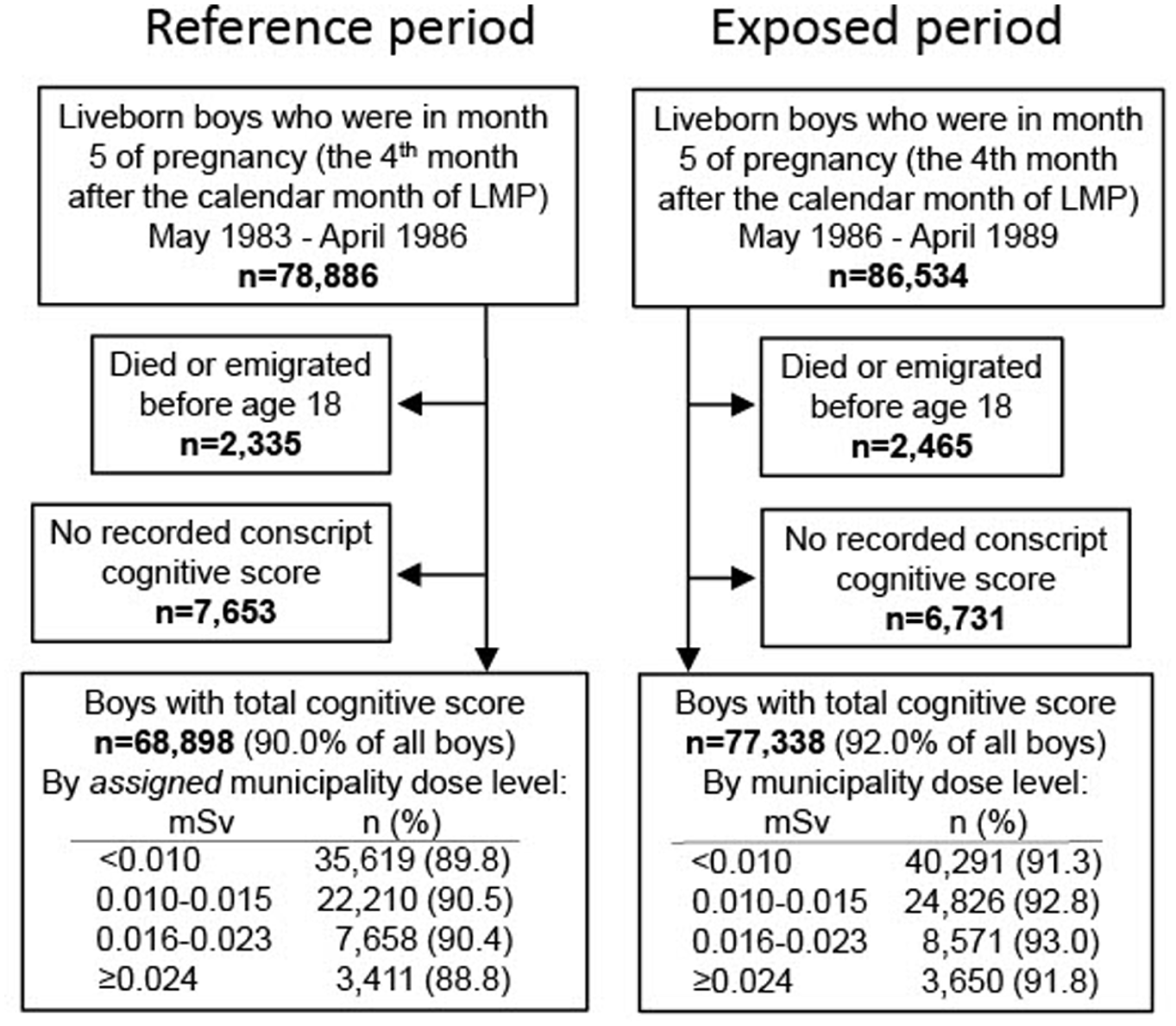
Identification and follow-up of boys in the exposed group and the reference group from the Medical Birth Registry of Norway.
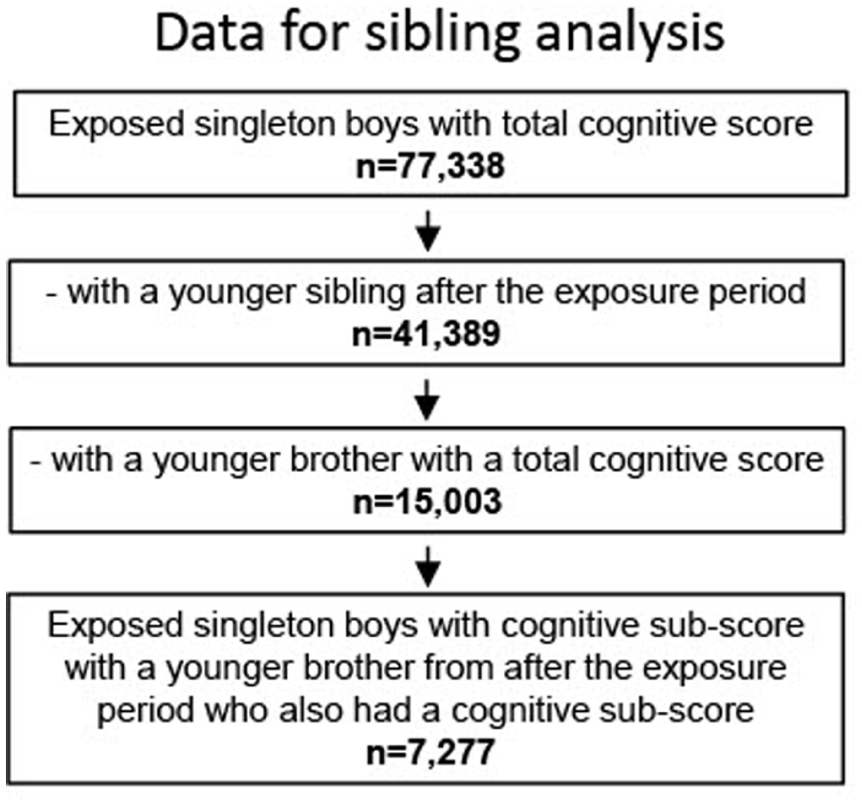
Follow-up of boys from the exposure period and their younger brothers identified from the Medical Birth Registry of Norway.
A file with the external and internal doses by Norway municipality numbers and calendar months is available as a Supplementary file to this paper (Norway_Chernobyl_Doses_Municipalities_ May1986_to_April1989.csv). A brief description of the files is provided at the end of the Supplementary material file.
An estimated 6% of the radioactivity released from Chernobyl (cesium-134 and cesium-137) fell as rain over Norway. This added an average of about 30% to Norway’s background radiation during the first year after the accident [12]. Still, the most highly populated areas received relatively low doses.
The highest mean external radiation dose estimated in any municipality in a single month was 0.23 mSv (in Øystre Slidre in May 1986) [14]. The median dose for the country including the food-based (internal) dose gradually increased over the first year and then declined [8]. Since internal dose is as relevant as external dose, we used the combined monthly external and internal dose divided into four categories (<0.01, 0.01–0.0159, 0.016–0.0239 and ⩾0.024 mSv per month) in the main analyses.
Timing of exposure
Studies of cohorts from the bombing of Hiroshima and Nagasaki identified exposure in pregnancy weeks 8 to 25 as important for neurodevelopmental effects, with weeks 8 to 15 as the most critical [1]. Our previous analysis of middle-school grades found an association between reduced mathematics grades and exposure in calendar month 5 of pregnancy. Month 5 corresponds to exposure between conception week 11 and 19, depending on whether LMP was late or early in the calendar month. We therefore used doses in month 5 of pregnancy as our a priori exposure of intertest.
Study designs
Since almost all conscripts in this time-period were male, we restricted our analyses to males. The total cognitive score was available for conscripts in birth cohorts both before and after the accident in 1986 while sub-scores for numerical reasoning (with values from 0 to 100) were available only for birth cohorts after 1985. To make maximal use of both types of cognitive data, we employed two study designs – one to assess total cognitive score in a natural experiment, and the other to assess numerical reasoning in a sibling analysis.
Natural experiment
Our analysis of total cognitive score adapted a natural-experiment design using cohorts before the accident as a reference for the exposed cohorts after the accident [9,14]. Specifically, we compared conscripts who were in the fifth month of pregnancy during May 1983 to April 1986 with conscripts in the fifth month of pregnancy during the exposed period of May 1986 to April 1989. Exposed conscripts were assigned to the dose level of their fifth pregnancy month in the municipality where their mother lived. The reference group comprised conscripts who were in their fifth month in pregnancy from the same municipality in the same calendar month three years earlier (Figure S1, Supplementary material).
Figure 1 shows follow-up of the cohorts of newborn boys from the reference and exposure periods. Among 78,886 singleton boys from the reference period, 2335 (3%) died or emigrated before age 18 years. Among the male conscripts from these reference cohorts, 68,898 (90%) had a recorded total cognitive score. Similarly, among 86,534 singleton and liveborn boys from the exposure period, 2465 (3%) died or emigrated before age 18, and 77,338 (92%) had a recorded total cognitive score. Participation in the conscript testing did not vary among categories of assigned dose in the reference period, or by experienced dose in the exposure period (Figure 1).
Sibling analysis
Sub-scores from cognitive tests were not available for cohorts before the exposure period, so it was not possible to assess sub-scores based on unexposed previous cohorts. Instead, we used later cohorts of younger brothers of the exposed boys as a comparison in a sibling design. This sibling approach assumes that exposure continued to decline after the exposure period. Furthermore, sub-scores were available for 54% of boys exposed in their fifth month owing to a poorer recording system for this period (see section Outcome data above). Sub-scores were more complete for the younger siblings (90%). In the final analysis, sub-scores were available for 7277 brother pairs (Figure 2).
Statistical methods
Linear regression models were used to assess cognitive scores in both the natural-experiment design and the sibling analyses. For the natural-experiment design, the models included indicator variables for calendar year adjustment through the six-year study period and indicator terms for the three highest dose categories. This should adjust for a general time trend from the reference through the exposure period, and for baseline geographical variation in score in the reference period. The analyses were further adjusted for maternal age and parity as linear trends and an indicator variable for being first-born. See the Supplementary material Methods for more details on the statistical model.
The association with radiation doses was estimated as interaction terms between the dose categories and an indicator variable for the exposure versus the reference period. These interaction terms estimated any change in cognitive score after the accident that was specific for the higher dose categories, with change in the lowest dose category as reference. The estimates are presented as excess difference in mean score beyond the difference in the lowest dose category. An estimate greater than 1 indicates an increase in cognitive score in a dose category relative to the score change in the lowest dose category. Reduced scores in the highest dose categories would correspond to effects of the exposure. A test for trend for the excess mean cognitive score across dose categories was computed as a test of an overall association with the exposure. All analyses were adjusted for mother’s age and parity as a linear trend, plus an indicator for being first-born. Our mode of analysis bears resemblance to the difference-in-difference method which has become increasingly popular in econometrics over the last decades [19]. Details of the statistical models are provided in the Supplementary material.
We adjust for a general time trend of cognitive scores in our analysis. If trends were different for high- and low-dose areas, our analysis could still be biased. We explored this possibility by fixing the geographical distribution of dose categories to that of May 1986 throughout the study period (years 1–3 in the reference period and years 4–6 in the exposure period) and estimating unadjusted mean scores per geographical area and year. Note that municipality doses in reality changed month by month in the exposure period (and assigned doses correspondingly in the reference period) (Figures 1 and 2 in Lie et al. [9]). These trends do therefore not represent the exact trends for the real dose categories but only provide an impression of the most likely trends.
The analyses of cognitive sub-scores (numerical reasoning, verbal reasoning and general reasoning) in sibships used similar random intercept regression models, which provides adjustment for shared factors within sibships [20]. The models included one term for the exposed versus the younger reference siblings and indicator terms for the highest categories of dose. Possible effects of exposure were again modelled as interaction terms between dose category and an indicator variable for the exposed versus younger siblings, as described in details of the statistical methods in the Supplementary material. Adjustments were made for mother’s age, parity and for birth year using indicator variables.
We also conducted a series of supplementary analyses. We assessed total cognitive score in the natural experiment design based solely on internal (food-based) dose as the exposure. Association of the odds of a low total score (<3) with total dose was also estimated using logistic regression. Total cognitive score was analysed in the sibling design to check for consistency with the natural experiment analyses. For completeness’ sake, we also assessed the other sub-score categories in the sibship analysis. Since fertility could be related to neurodevelopment in offspring, we performed sibship analyses with adjustment for interval between consecutive pregnancies. Finally, a certain level of post-Chernobyl radiation exposure is likely to have persisted throughout the follow-up period of younger brothers, even as it continued to decline [21]. We did not have information about dose levels after April 1989. We therefore used a simplistic log-linear regression model to predict the falling doses in each municipality and used these predicted doses as doses for younger brothers after April 1989 in a supplementary analysis. All statistical analyses were performed with Stata v. 18 (StataCorp LLC, 4905 Lakeway Drive, College Station, TX 77845-4512, USA).
Results
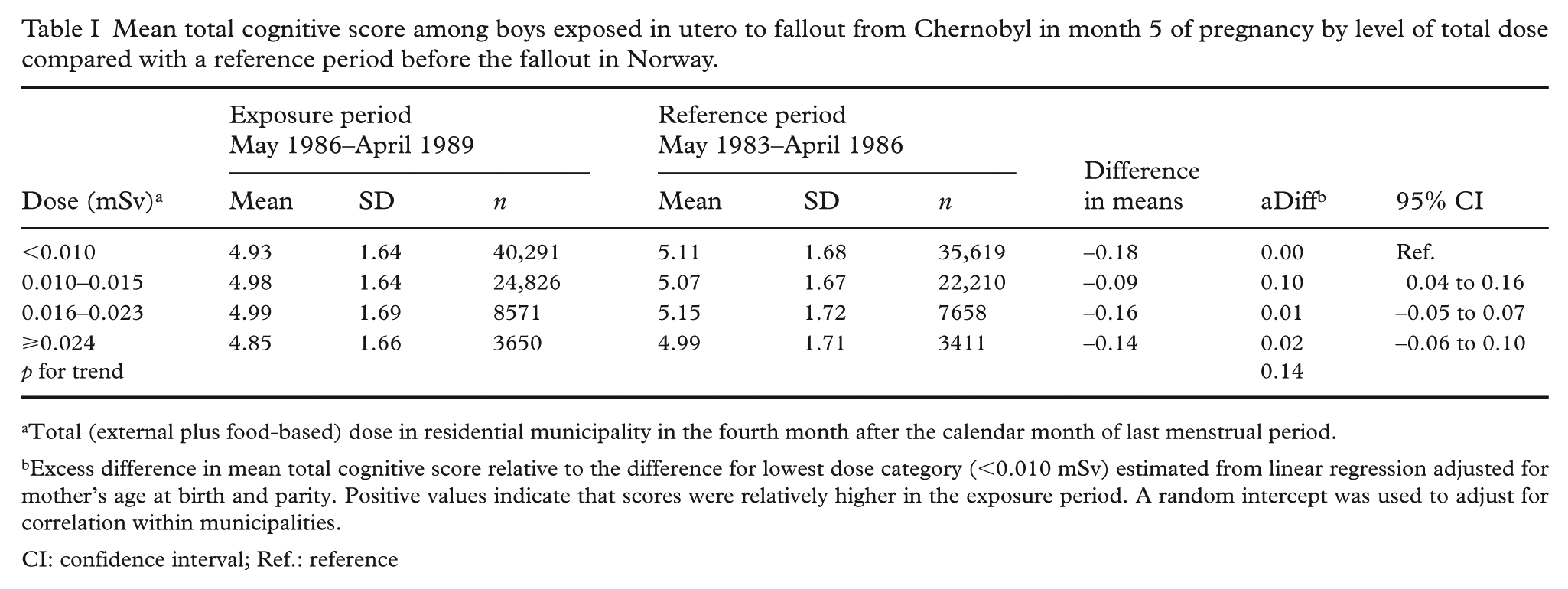
We first assessed the association between total dose in month 5 of pregnancy and total cognitive score in the natural experiment design. Table I shows the mean total cognitive score in the unexposed reference period and the exposure period for the different dose categories. In the pre-accident reference period, the highest dose category (⩾0.024 mSv) started out with a slightly lower mean cognitive score (4.99) than the lower dose categories. The three lowest dose categories had pre-accident mean cognitive scores above 5. Mean cognitive scores were lower in all categories in the exposure period. The mean cognitive score fell most strongly in the lowest dose category (<0.010 mSv), from 5.11 before the accident to 4.93 after the accident. This overall time trend is consistent with the reversed Flynn effect over the last decades [22].
Mean total cognitive score among boys exposed in utero to fallout from Chernobyl in month 5 of pregnancy by level of total dose compared with a reference period before the fallout in Norway.
Total (external plus food-based) dose in residential municipality in the fourth month after the calendar month of last menstrual period.
Excess difference in mean total cognitive score relative to the difference for lowest dose category (<0.010 mSv) estimated from linear regression adjusted for mother’s age at birth and parity. Positive values indicate that scores were relatively higher in the exposure period. A random intercept was used to adjust for correlation within municipalities.
CI: confidence interval; Ref.: reference
We found no evidence that scores were more reduced in the exposure period in the higher dose categories, and in fact point estimates went in the other direction. Mean cognitive score in the lowest dose category was higher in the exposure period relative to the change at the higher levels, although this trend was not statistically significant (p=0.09). Similarly, we found no evidence of association of cognitive score with food-based radiation doses (Supplementary Table I), nor in an analysis of the odds of a low total cognitive score (<3) (Supplementary Table II).
When we inspected time trends in categories of municipalities defined by dose in May 1986, there was a tendency of a stronger downward trend in the highest dose categories in the pre-Chernobyl years 1–3 (Supplementary material, Figure S2). This downward trend did, however, not continue into the post Chernobyl exposure period of years 4–6.
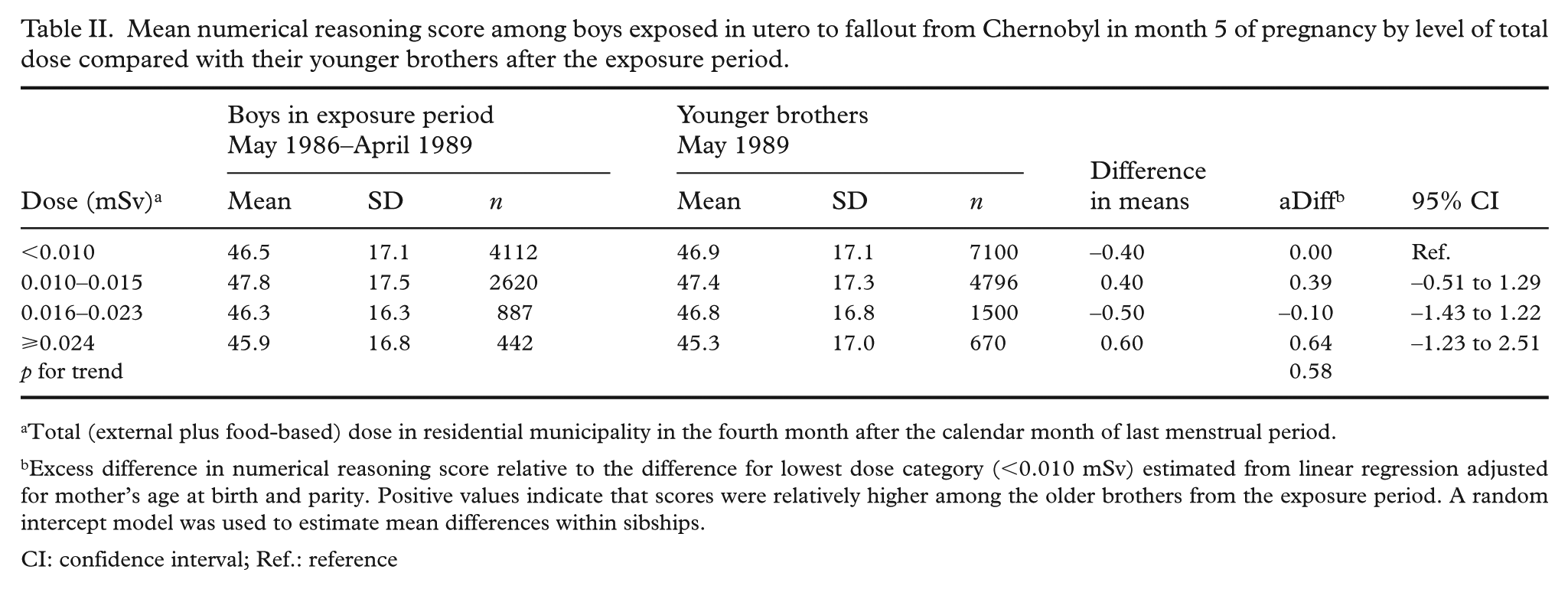
Our sibling analysis allowed us to pursue our previously reported association of prenatal radiation exposure with reduced mathematics grades. Table II shows the mean numerical reasoning scores for exposed conscripts and their younger brothers when they were tested at conscription. Conscripts from the exposure period with the lowest levels of radiation dose (<0.010 mSv) had a slightly lower mean cognitive score (46.5) than their younger brothers after the exposure period (46.9). However, exposed boys with the highest doses (⩾0.024 mSv) had a higher mean numerical reasoning score (45.9) than their younger brothers (45.3). This trend opposite to the hypothesized direction was not statistically significant (test for trend=0.17).
Mean numerical reasoning score among boys exposed in utero to fallout from Chernobyl in month 5 of pregnancy by level of total dose compared with their younger brothers after the exposure period.
Total (external plus food-based) dose in residential municipality in the fourth month after the calendar month of last menstrual period.
Excess difference in numerical reasoning score relative to the difference for lowest dose category (<0.010 mSv) estimated from linear regression adjusted for mother’s age at birth and parity. Positive values indicate that scores were relatively higher among the older brothers from the exposure period. A random intercept model was used to estimate mean differences within sibships.
CI: confidence interval; Ref.: reference
We also used the sibling design to assess the other available cognitive test results (total cognitive score, Supplementary Table III; sub-score for general reasoning, Supplementary Table IV; and sub-score for verbal reasoning, Supplementary Table V). No associations were identified. Adjustment for spacing between pregnancies gave virtually identical results and analyses involving predicted radiation doses after the exposure period did not support any associations.
Discussion
We have previously reported an association between higher levels of exposure to the Chernobyl fallout in Norway in the fifth month of pregnancy and mathematics school grades from middle school [8]. A similar association had also been reported in Sweden [7]. The present report makes use of two study designs to further investigate possible links between radiation exposure in foetal life and later cognitive function in male military conscripts. The natural experiment design assessed total cognitive function by comparing cohorts born before and after the Chernobyl accident. The sibling analysis allowed assessment of numerical reasoning as well as total cognitive scores. We found no evidence of associations between radiation exposure and any cognitive outcome.
Studies of Hiroshima and Nagasaki survivors had found effects of prenatal exposure to high levels of ionizing radiation in a window around week 15 of pregnancy on later cognitive development [1]. The possibility of cognitive effects of lower doses of radiation (as occurred with the Chernobyl fallout across Europe) is more controversial [4]. There are few data to support such effects, and a systematic review described the current evidence as limited to inadequate [11]. Effects have, however, recently been reported for contamination in Norway from nuclear bomb tests in the 1950s and ’60s [10]. We found no evidence of effects of the Chernobyl fallout in Norway in this study of cognitive test results among conscripts and, in particular, no evidence of effects on mathematical skills as previously reported for these Norwegian cohorts [9] and in a study from Sweden [8].
Among the strengths of our study was the quality and detail of the ecological exposure information, including the highly relevant internal exposure from food and milk. An extensive programme was conducted by The Norwegian Radiation Protection Authority to estimate average exposure doses in each of the 454 municipalities of Norway in 36 consecutive calendar months after the Chernobyl accident in late April 1986. There was considerable variation across Norway and doses typically fell toward the end of the 36-month period [14].
Another strength was the use of national registries with complete coverage of all births in Norway, with the possibility to identify calendar month in each pregnancy. Screening for military service is mandatory in Norway, and conscripts were tested for cognitive abilities. Total cognitive scores were available for more than 90% of conscripts, with no difference in data completeness by dose category (Figure 1). Cognitive sub-scores were available for cohorts only after the accident. These data were available for 54% of exposed conscripts and 90% of their younger siblings. There was little evidence of systematic differences in cognitive scores (including numerical reasoning) related to level of dose.
Our analysis also had several limitations. First, the average dose calculations were performed in the years just after the Chernobyl accident [17,18], and we have not been able to recalculate or refine these calculations. Second, our design relies on the assumption that there are no underlying time trends in cognitive scores through the study period that differentially affect our high- and low-dose categories. The reversal of the Flynn effect during our study period with generally falling scores opens for this possibility. We found that areas that were in the highest dose categories in May 1986 had scores that fell from higher scores in the reference period. These falling trends were, however, stalled after the accident happened. Although this is not consistent with a harmful effect of the Chernobyl fallout, these trends call for caution in the interpretation.
A third limitation is that doses were measured as averages within municipalities, and that the ecological nature of the exposure creates the possibility of individual exposure misclassification. This presumptively reduced our ability to identify an association; the estimated associations may not be interpreted as effect sizes on an individual level. If doses were harmful only above a certain level, our approach would work only if a high average municipality dose corresponded with a higher number of highly exposed foetuses. Important heterogeneity exists for groups such as the Sami population and farmers–hunters who consume more reindeer and venison meat and freshwater fish. These high-exposed groups reduced their exposure considerably because of dietary advice [23]. We were unable to identify these important sub-groups in our analysis.
Our sibling analysis had the additional limitation that we assume that younger brothers after the exposure period experienced low or negligible doses from Chernobyl. This is an assumption that we were unable to test. The sibling analysis may also be biased by a gradually lower participation over time in the conscription testing of poor-scoring boys in the 1990s [22]. A lower participation of lower scoring younger brothers in low-dose categories might have contributed to masking an association.
In summary, our study found no evidence that prenatal exposure to radiation from the Chernobyl fallout affected cognitive skills among conscripts in Norway. Specifically, we did not find any evidence that numerical reasoning skills were affected. This analysis does not support an association previously reported for mathematics school grades in Norwegian middle school.
Supplemental Material
sj-pdf-1-sjp-10.1177_14034948251410496 – Supplemental material for Prenatal exposure to the Chernobyl fallout in Norway and cognitive abilities among conscripts
Supplemental material, sj-pdf-1-sjp-10.1177_14034948251410496 for Prenatal exposure to the Chernobyl fallout in Norway and cognitive abilities among conscripts by Rolv T. Lie, Elin A. Fadum, Dag Moster, Allen J. Wilcox, Leif A. Strand, Per Strand and Siri E. Håbergberg in Scandinavian Journal of Public Health
Footnotes
Data access
The study borrowed data from national health registries. Data from the MBRN are available on request through https://helsedata.no provided ethical clearance is obtained. Conscript data may be obtained from The Armed Forces Health Registry by contacting the mail address  file.
file.
Declaration of conflicting interests
The authors have no conflicts of interest to declare.
Ethics statement
The project was approved by the Norwegian regional ethics committee for ‘sør-øst D’, REK reference 25372.
Funding
The authors disclosed receipt of the following financial support for the research, authorship, and/or publication of this article: This work was supported by the Norwegian Research Council (grant number 262700).
Supplementary material
Supplementary material for this article is available online.
References
Supplementary Material
Please find the following supplemental material available below.
For Open Access articles published under a Creative Commons License, all supplemental material carries the same license as the article it is associated with.
For non-Open Access articles published, all supplemental material carries a non-exclusive license, and permission requests for re-use of supplemental material or any part of supplemental material shall be sent directly to the copyright owner as specified in the copyright notice associated with the article.
