




Abstract
Aim:
To investigate the associations between social sustainability factors and people’s satisfaction with their local community as a place to live now and in the future.
Methods:
This study used data from the Norwegian County Public Health Survey conducted in Viken County, Norway, in 2021 (N = 97,323). The survey included questions concerning physical aspects (e.g. accessibility of services and facilities) and non-physical aspects (civic participation, social support, trust, safety, place attachment and well-being) of social sustainability in local communities. A new outcome variable was constructed to capture people’s satisfaction with their local community as a place to live now and in the future. Hierarchical linear regression was applied to examine the relationships between physical and non-physical factors of social sustainability and this outcome.
Results:
All included factors were significantly associated with people’s satisfaction with their local community as a place to live now and in the future, but the magnitude and direction of these associations varied. Place attachment (β = 0.53), safety (β = 0.15) and well-being (β = 0.11) were the strongest indicators of people’s satisfaction with their local community. Non-physical factors accounted for 41% of the variance in people’s satisfaction, while physical factors accounted for 14%.
Conclusions:
Keywords
Background
Social sustainability is an important dimension of sustainable development [1], and this dimension has received increased attention from academics, practitioners and policy-makers in recent years [2]. Although definitions of this concept vary, social sustainability is often described either as a process of developing good places for current and future generations to live in or as the ideal state for a place to be in. A definition based on the first understanding states that social sustainability is ‘a process for creating sustainable, successful places that promote well-being, by understanding what people need from the places in which they live and work’ [3]. An example of the latter proposes that a socially sustainable neighbourhood is one that ‘provides residents with equitable access to facilities, services, and affordable housing; creates a viable and safe environment for interaction and participation in community activities; and promotes sense of satisfaction and pride in the neighbourhood in a way that people would like to live there now and in the future’ [4]. Both definitions closely link social sustainability to a local context [2,5]. Alongside these definitions, recent systematic reviews of the literature have identified components often included in the conceptualization of social sustainability, such as social justice or equity, social capital, safety and security, place attachment, and well-being and quality of life [2,6,7]. These components cover both physical and non-physical factors of local communities, such as the accessibility of services and facilities in the local area, civic participation, social relationships, perceived safety in the local community and attachment to the place [8].
From this, it is evident that social sustainability and health promotion significantly overlap in scope and goals, as neighbourhoods and local communities are recognized as settings for promoting health and well-being [9,10]. According to the Ottawa Charter, ‘Health is created and lived by people within the settings of their everyday life; where they learn, work, play and love’ [9], and addressing the determinants, such as the physical and non-physical factors of places, that impact individuals and communities has been stated as pivotal for creating healthy places for people to reside in [11]. Hence, both the research fields of social sustainability and health promotion intend to understand how physical and non-physical factors influence people’s well-being and how to create health-promoting environments for present and future generations [12]. Such knowledge is paramount for developing socially sustainable places that promote health and well-being, as highlighted in national and international policy documents [11,13,14].
Although several studies examining the social sustainability of places have been conducted, most have investigated the effect of urban forms (e.g. density, building typology, land use) on factors such as social equity, place attachment and social capital [15–18]. However, to develop places where people want to live, we also need research that considers how various physical and non-physical factors influence people’s perceptions of the local community as a good place to live now and in the future, that is, a socially sustainable place. Interestingly, several studies have developed analytical tools for assessing social sustainability and applied these to research [3,4,19–22]. Yet, until now, these tools have mainly been applied to measure components of social sustainability individually or the correlations between the components [19,22,23]. An exception is a case study conducted in four neighbourhoods in London and Berlin where the participants were asked to evaluate seven indicators of social sustainability [23]. This study showed that residents reported access to services and facilities as the highest achieved factor, whereas the quality of home was the most important factor of social sustainability. While this study provides some insight, it only investigates the relative importance of different means for social sustainability and not the actual associations between the means and the desired outcome. Therefore, more studies are needed to better understand the complex relationships between factors that may influence people’s satisfaction with their local community.
To sum up, most empirical studies on social sustainability have a pronounced focus on the means of social sustainability without investigating how these means relate to the desired endpoint of creating a socially sustainable community, for example, to create a place where ‘people would like to live there now and in the future’ [4], which is a major shortcoming. Additionally, as most studies have investigated how the built environment, such as urban forms, may affect social sustainability factors, it is clear that the physical aspects of the local community have been given research priority [6]. To address these shortcomings, the main objective of this study was to investigate whether commonly described physical and non-physical factors of social sustainability are associated with people’s satisfaction with their local community as a place to live now and in the future.
Methods
Region of interest in this study
Viken County was formed by merging three Norwegian counties, Akershus, Buskerud and Østfold, in 2020 and became the most populated county in Norway, with 1.2 million inhabitants (2019). Viken was located in southeast Norway, encompassing urban and rural settlements and coastal areas. The population in Viken scored average or above on most public health indicators such as living conditions, environmental conditions, and health and health-related behaviour. However, the county had a somewhat lower proportion of inhabitants with higher education compared with the Norwegian average [24].
Data
This cross-sectional study used data from the Norwegian County Public Health Survey conducted in Viken County, Norway, in 2021. The survey included, among others, questions covering physical neighbourhood characteristics such as access to services and facilities and non-physical factors such as civic participation, social support, trust, safety, place attachment and well-being. Additionally, respondents rated their overall satisfaction with the local community as a place to live now and in the future [25]. The digital questionnaire was distributed by email to a representative sample of 268,684 adults (⩾18 years old) based on the National Population Register. In total, 108,738 (41%) inhabitants completed the questionnaire. For this study, we included only respondents with complete data for all variables of interest, resulting in an analytical sample of N = 97,323.
Dependent variable
Based on the definition of a socially sustainable neighbourhood as places where ‘people would like to live now and in the future’ [4], we constructed an outcome variable. This variable was derived from two questions in the survey, asking participants: ‘To what extent are you satisfied with your local community as a place to live?’ [26] and ‘To what extent would you like to live in your local community in the future?’ The two questions were graded on an 11-point scale (0 = ‘not at all’ to 10 = ‘to a very high degree’). The outcome variable was calculated as the mean value of these two items. Cronbach’s alpha of this scale was 0.83.
Independent variables
We included six survey items to measure physical factors of social sustainability. Participants were asked to rate the perceived accessibility of cultural facilities; sports facilities; shops, restaurants, et cetera; public transport; pedestrian and cycling facilities; and green areas, including parks, nature, and recreation areas in their local community on a six-point Likert scale: 1 = ‘very good’ to 5 = ‘very poor’, with six indicating ‘I don’t know’ [27]. Responses of ‘I don’t know’ were treated as missing values. The variables were reversed and dichotomized into 1–3 = ‘poor accessibility’ and 4–5 = ‘good accessibility’.
The non-physical factors of social sustainability included civic participation, social support, trust, safety, place attachment and well-being. We used one question from the survey to measure civic participation: ‘How frequently do you participate in organized activities/volunteering?’ The response options were 1 = ‘daily’, 2 = ‘weekly’, 3 = ‘1–3 times per month’, 4 = ‘rarely’ and 5 = ‘never’. This variable was reversed and dichotomized into 1 = ‘no’ and 2–5 = ‘yes’. This categorization was chosen because we evaluated the distinction between participating and not participating as more substantial than any other category.
The Oslo Social Support Scale was utilized to assess social support [28]. This scale includes three items: the number of persons to rely on when needed (0 = ‘none’, 1 = ‘1–2’, 2 = ‘3–5’, 3 = ‘⩾6’), the amount of interest and concern provided by others (0 = ‘a lot’, 1 = ‘some’, 2 = ‘uncertain’, 3 = ‘little’, 4 = ‘none’) and access to practical help from neighbours when needed (0 = ‘very easy’, 1 = ‘easy’, 2 = ‘possible’, 3 = ‘difficult’, 4 = ‘very difficult’). After reversing the second and third items, a sum score for all three items was calculated (Cronbach’s alpha = 0.60).
We measured a general level of trust by including one item: ‘In general, do you consider people trustworthy, or can you never be too careful when associating with others?’ [29]. This question was rated on an 11-point scale (0 = ‘can’t be too careful’ to 10 = ‘in general, people are trustworthy’). Safety was measured as perceived safety when walking in the neighbourhood [27]. The responses were provided on an 11-point scale (0 = ‘not safe at all’ to 10 = ‘very safe’). Place attachment was measured by the question: ‘To what extent do you feel an attachment to the place where you live?’ The responses were given on an 11-point scale (0 = ‘no attachment’ to 10 = ‘strong attachment’) [27]. Two questions from the survey were included to construct a measurement of global well-being. Participants were asked about their global cognitive well-being through the question: ‘Overall, how satisfied are you with life these days?’ (0 = ‘not at all satisfied’ to 10 = ‘completely satisfied’) [29, 30], and their global eudaimonic well-being by asking ‘Overall, to what extent do you feel the things you do in your life are worthwhile?’ (0 = ‘not at all worthwhile’ to 10 = ‘completely worthwhile’) [29, 30]. A mean value of global well-being was then calculated (Cronbach’s alpha = 0.84) [27].
Socio-demographic variables
The socio-demographic variables included in this study were gender (male/female), age (18–30 years/31–50 years/51–66 years/⩾67 years), education level (primary school/high school/university 2–4 years/university >4 years) [25] and marital status (single/partner).
Statistical analysis
The statistical analyses were performed using R Statistical Software [31]. Prior to the analysis, data were screened for accuracy and missing data. Additionally, continuous variables were assessed for normality and linearity. All physical factors of social sustainability and civic participation were included as categorical variables in the analysis, whereas social support, trust, safety, place attachment and well-being were treated as continuous variables. Descriptive statistics were computed for all key variables. The bivariate associations between independent variables and people’s satisfaction with their local community as a place to live were assessed by independent-sample t-test, analysis of variance, or Person’s product-moment correlation depending on the independent variables. Adjusted associations were examined using a hierarchical linear regression analysis in three steps. All the variables capturing physical factors of social sustainability were entered in the first step, while the non-physical factors were entered in the second step. Socio-demographic factors were included in the third step of the analysis. Standardized regression coefficients R2 and ΔR2 are reported for each step. Due to the large sample size, p-values < 0.01 were considered statistically significant. Variance inflation factors (VIFs) were calculated to test for multicollinearity between independent variables. The VIFs were less than 2 for all factors, indicating that the independent variables were not strongly correlated.
Ethics approval and consent to participate
The study was approved by the Norwegian Agency for Shared Services in Education and Research ((Sikt), reference number 186526). Consent to participate in the survey was signed electronically when responding to the survey. The participants were informed about the use and storage of the data collected and ensured that all data would be treated anonymously.
Results
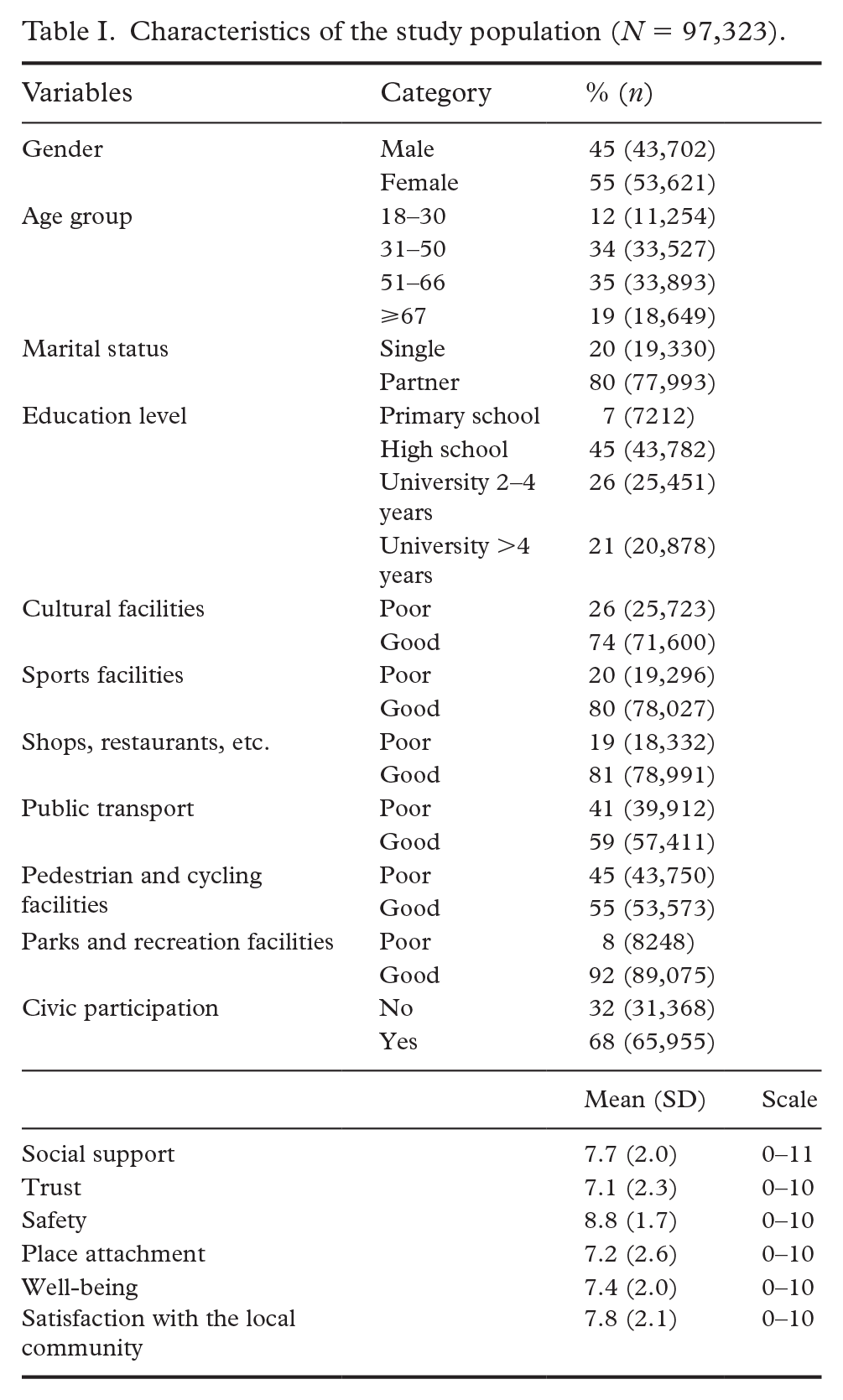
Of the total study population, 55% were women. Most participants were aged 31–50 years (34%) or 51–66 years (35%), 80% had a partner, and the majority reported high school as their level of education (45%) (Table I). Perceived access to services and facilities in the local community was generally high. More than three-quarters of participants reported good access to cultural facilities, sports facilities, shops, restaurants, et cetera, and parks and recreation facilities. Additionally, more than half of the participants reported good access to public transport and pedestrian and cycling facilities. Civic participation was reported by more than two-thirds of the participants. The participants reported relatively high levels of social support (mean = 7.7), trust (mean = 7.1), place attachment (mean = 7.2), well-being (mean = 7.4) and safety (mean = 8.8) and, overall, they were satisfied with the local community as a place to live now and in the future (mean = 7.8) (Table I).
Characteristics of the study population (N = 97,323).
The bivariate analyses showed significant positive associations between all included variables and people’s satisfaction with their local community as a place to live now and in the future (Table II).
Bivariate associations between independent variables and people’s satisfaction with their local community as a place to live now and in the future.

p-values were calculated using an independent-sample t-test, analysis of variance and Pearson’s product-moment correlation.
Table III displays the results from the hierarchical linear regression model. In the first step, which included physical factors only, 14.1% of the variance in people’s satisfaction with their local community was accounted for. Reporting good access to cultural facilities, sports facilities, shops and restaurants, public transport, parks and recreation facilities, and pedestrian and cycling facilities was significantly associated with higher satisfaction with the local community than was reporting poor access (Table III). The strongest indicator of the outcome was the accessibility of parks and recreation facilities (β = 0.18). At the same time, only weak positive associations were found for the indicators accessibility of pedestrian and cycling facilities (β = 0.05) and public transport (β = 0.01).
Hierarchical linear regression analysis of the relationships between physical and non-physical factors of social sustainability and people’s satisfaction with the local community as a place to live now and in the future.

Standardized regression coefficient.
Reference category ‘poor access’.
Reference category ‘no’.
Reference category ‘male’.
Reference category ‘18–30 years old’.
Reference category ‘single’.
Reference category ‘primary school’.
p-value <0.01.
The non-physical factors were included in the second step of the regression analysis, collectively accounting for 41.1% of the variance in the constructed outcome. Stronger attachment to the local community was significantly and positively associated with satisfaction with the local community (β = 0.53). Furthermore, we found a moderate positive and significant association between safety and the outcome (β=0.15) and between well-being and the outcome (β=0.12). Interestingly, civic participation and satisfaction with the local community were not significantly associated, whereas trust showed a significant but weak negative association with the outcome (β = −0.01) in the second step of the analysis.
Adjusting for socio-demographic variables in the third step minimally influenced the explained variance of people’s satisfaction with their local community (0.4%). After including physical, non-physical and socio-demographic variables in the regression analysis, the model explained 55.6% of the variance in people’s satisfaction with the local community as a place to live now and in the future. All factors were significantly associated with the outcome; however, these associations’ magnitudes and directions varied. When comparing physical and non-physical factors of social sustainability while controlling for socio-demographic variables, place attachment (β = 0.53), safety (β = 0.15) and well-being (β = 0.11) emerged as the strongest indicators of people’s satisfaction with the local community. The accessibility of cultural facilities (β = 0.06), sports facilities (β = 0.03), shops (β = 0.06), public transport (β = 0.02), pedestrian/cycling facilities (β = 0.03) and social support (β = 0.02) showed weak positive associations with the outcome, while weak negative associations with people’s satisfaction with their local community were found for civic participation (β = –0.01) and increasing trust (β = −0.02).
Discussion
The results showed that the accessibility of services and facilities (the physical factors) accounted for 14.1% of the variance in people’s satisfaction with the local community. Civic participation, social support, trust, safety, place attachment and well-being (the non-physical factors) explained an additional 41.1% of the variance in this outcome. Furthermore, place attachment, safety and well-being were the strongest indicators of satisfaction with their local community.
Several empirical studies have investigated social sustainability in cities, communities and neighbourhoods [15,23,32]. Most of these studies have assessed the effect of urban forms (e.g. density, building typology, mixed land use) on components of social sustainability such as social equity, social capital and place attachment [15,17,18,33]. In other words, these studies have primarily focused on the means for creating socially sustainable places, and less effort has been made to determine whether these means are related to an endpoint or goal of social sustainability. Therefore, we tried to investigate such associations in a large population sample by constructing a variable for the desired outcome of social sustainability, which, according to some, is to create places where ‘people would like to live now and in the future’ [4]. To our knowledge, this is the first study to take this approach within the social sustainability literature [6]; hence, there is limited existing research for comparison. Therefore, it would be interesting to compare our results with some of the research conducted on neighbourhood satisfaction or liveability.
Our results showed that good accessibility of services and facilities in the local community (cultural facilities, sports facilities, shops and restaurants, public transport, pedestrian and cycling facilities, and parks and recreation facilities) was associated with increased satisfaction with the local community as a place to live now and in the future. Equal access to services and facilities is described as a key factor of social sustainability [2,6,7]. Our results align with previous studies that have demonstrated significant positive associations between perceived access to services and facilities, such as shops and parks, and neighbourhood satisfaction [34,35]. In addition, a study of four different neighbourhoods in London and Berlin reported that access to services and facilities was an important indicator of social sustainability [23]. However, it is worth noticing that others have reported no significant associations between the number of amenities, area of parks, and neighbourhood satisfaction [36], suggesting that the importance of access to services and facilities in the local community may vary depending on the context.
We found that physical social sustainability factors accounted for only 14.1% of the variance in residents’ satisfaction with the community. This result indicates that the accessibility of services and facilities may be less important for people’s satisfaction than non-physical factors, which accounted for 41.1% of the variance. The relative importance of non-physical factors was further supported by the finding that the magnitude of the associations between physical factors and the outcome diminished when the non-physical factors were introduced into the model. However, these findings may also imply that the relationships between the accessibility of services and facilities and satisfaction with the local community as a good place to live are multifaceted. For instance, Kytta et al. [32] found that access to everyday services was not directly associated with residents’ well-being; instead, the association was mediated by perceived environmental qualities. Similarly, Yoo and Lee [37] showed that access to parks/public sports facilities was not directly associated with social sustainability, but the relationship was mediated by social capital. Altogether, these results suggest that both physical and non-physical factors play essential roles in shaping people’s satisfaction with their local community. However, empirical studies applying more complex analyses involving mediators and moderators are needed to provide a deeper understanding of these relationships.
In our study, civic participation, social support, trust, safety, place attachment and well-being were included as non-physical factors of social sustainability, as these factors have often been described in the literature [2,7,8]. We found that these factors were significantly associated with people’s satisfaction with their local community as a place to live both now and in the future. Yet, the strength and directions of these associations varied. People’s attachment to their local community emerged as the strongest indicator of satisfaction with the place (β = 0.53). This might be expected as place attachment refers to an emotional bond between people and specific places [38,39], and other studies have also identified neighbourhood attachment as a predictor of neighbourhood satisfaction [36,40]. Theories on place attachment propose that people may develop an attachment to a place based on memories connected to the place (e.g. childhood, important milestones) or because of the physical or social environment [39]. The most surprising finding was the weak association between social support and people’s satisfaction with their local community. Additionally, the results revealed a negative association between civic participation, increased trust, and satisfaction. Although associations were weak, the results were unexpected and could not be explained by multicollinearities between independent variables. However, one possible explanation is that these measurements were not explicitly tied to the local community but represented more general measurements. Therefore, future studies should consider including more specific measurements, such as local community participation or trust in people living in the area, to investigate whether these factors are associated with people’s satisfaction with their local community.
We included well-being as an independent variable in the statistical model based on reviews of the literature identifying this as a component of social sustainability [2,6]. However, from a health promotion point of view, it could be argued that residents’ well-being represents a desired outcome of creating socially sustainable places. This view would be more consistent with a socio-ecological perceptive often applied within health promotion research [41]. Moreover, several definitions of social sustainability explicitly state that well-being is part of the desired goal or outcome of socially sustainable development [3,42,43]. However, we have only identified one study of social sustainability using well-being as an outcome [32]. Therefore, future research should consider the role of well-being as an outcome in studies on social sustainability.
Certain limitations should be considered while assessing the results. Given the cross-sectional nature of this study, causal relationships between social sustainability factors and people’s satisfaction with the local community cannot be established. Future studies should use longitudinal data to address this limitation. The response rate in the Norwegian County Public Health Survey in Viken County was 41%, which is higher than surveys conducted in other Norwegian counties in the same period [44]. In the study population, the response rate was higher among women (46%) than among men (36%). Furthermore, there were variations in response rates according to age group. The highest response rate among women was found in the age group 60–69 years (58.6%), whereas the lowest was found in the age group 18–29 years (30.6%). For men, the highest response rates were found in the age groups 60–69 years (53.3%) and 70+ years (54.9), whereas men aged 18–29 had the lowest response rate (17.7%). A comparison of the analytical sample and the ‘missing sample’ (participants missing one or more variables included in the statistical analysis) in this study revealed that there were more elderly, singles and participants with primary school as their highest level of education in the ‘missing sample’. Therefore, there might be reasons to believe that participants were systematically missing (volunteer bias), as seen in other health surveys. Despite these limitations, we believe our findings can be generalized to contexts similar to the one being studied, such as the Scandinavian context.
This study included factors of social sustainability most frequently described in the literature; however, there were some factors that we were unable to consider. For example, several authors have suggested housing affordability, quality of home, and job availability as important factors for social sustainability [4,17,20,45], which would have been interesting to include. Another limitation pertains to the dichotomization of all physical factors of social sustainability and civic participation. The dichotomization of civic participation could especially be questioned as we chose to separate between ‘yes’ and ‘no’. This was done as others have reported a more considerable difference between participating and not participating in civil activities than between any frequency of participating [46]. Additional analyses showed no differences in the results when including ‘rarely participating’ in the ‘no’ group. Some argue against dichotomization in general due to the potential loss of information in statistical analyses [47]. However, others have claimed that dichotomizations of variables may yield more meaningful results for a broader audience to interpret [48]. We used the Oslo Social Support Scale to measure social support because this scale has been recommended in health surveys [28]. However, Cronbach’s alpha was only 0.6, indicating low internal consistency between the three items. The low number of items included in this scale might explain the result. Finally, some of the variables included in this study were not tied to the local context, which may explain the weak associations in the regression analysis.
Conclusion
The literature on social sustainability suggests that social sustainability is a multifaceted concept, and this study confirms that both physical and non-physical factors are associated with people’s satisfaction with their local community as a place to live now and in the future. The main body of knowledge on social sustainability comes from academic fields such as urban planning and architecture [6]. Most of these studies have investigated the relationships between urban forms and different means of social sustainability [15,18,33,49], while few have assessed the relationships between means and outcomes of social sustainability [32]. Therefore, we constructed an outcome measure closely related to definitions proposing that a socially sustainable place is where people would like to live now and in the future [4]. Although there are weaknesses in such a constructed outcome measure of social sustainability, it represents an important initial step toward comprehending how physical and non-physical factors shape residents’ perceptions of socially sustainable places. However, future research is necessary to understand how physical and non-physical factors of social sustainability interact and how these factors are associated with well-being to create communities that people consider good places for current and future living.
Footnotes
Declaration of conflicting interests
The authors have no conflicts of interest to declare.
Funding
The author(s) disclosed receipt of the following financial support for the research, authorship, and/or publication of this article: FORTE (grant number: 2022-01357) and the Swedish Research Council for Sport Science (grant number: 2020/3, P2021-0065).
