



Abstract
This article situates the field of health promotion in its current cutting-edge agendas around health and wellbeing; social and other determinants of health; complexity and its associated sciences; planetary health; and inclusion and diversity. However, it is also proposed that there are emergent dimensions that should be placed more deliberately on the agendas of health promotion research and practice. The piece offers three dimensions for noting health promotion futures: a cognitive, spatial and temporal one. The first is a non-anthropocentric appreciation of the complex interactions between geosphere, biosphere and anthroposphere that can be framed through a lens of governance and cosmology; the second one is established by humankind’s journeys beyond the atmosphere into outer space; and the third one argues we – that is, the global health (promotion) community – need to account for temporal determinants of health, more consciously and conscientiously. The gazes seem beyond current agendas of health – but the article demonstrates how they are to become mission-critical aspects of contemporary and future worlds.
Keywords
Introduction
Since the adoption of the Ottawa Charter for Health Promotion in 1986, ‘the move toward a new public health’ (indeed, the subtitle of the conference where the charter was developed) has remained dynamic and novel. The champions of health promotion (and most notably the World Health Organization (WHO) and International Union for Health Promotion and Education and their various publication outlets) remain at the cutting edge of global developments. This remains the case despite significant – whether intentional or more obtuse – efforts to regress from its focus on systems, determinants and complexity to a more traditional behaviour-only conceptualisation (the orthodox ‘health education’ approach) which still has its place in the broader health promotion field.
The most recent iteration of the Ottawa Charter is the Geneva Charter for Wellbeing. This statement calls for a broader recognition of ecological, economic and planetary considerations to promote health and wellbeing. This is highly appropriate: European policy-makers discovered that, in order to develop health in all policies (a tenet of another WHO global conference on health promotion), its proponents should ‘avoid the H word’ [1] with Health pointing to disease care and medicine, rather than its potential as a resource for human life at its best. With a focus on wellbeing, greater attention is also given to political and commercial determinants of health. Intriguingly, recent research has demonstrated that such efforts may well miss their mark. This is because calls for awareness and change only seem to land within the health and medicine echo chambers [2], rather than being aimed at the culprits. This means that if, for instance, the global obesity epidemic is analysed as being caused by obesogenic environments rather than individual choices, the components of those environments should be switched on to crafting solutions, and not merely health lifestyle operators. Similar mechanisms have been observed in the field of urban health. It was found that particular cliques of disciplinary or belief-confined specialists research each other and communicate within their own confines, rather than truly engaging in transdisciplinary real-world change agendas [3]. Elsewhere, with colleagues I have argued that transdisciplinarity has epistemological, ethical and effectiveness (the three Es) advantages for both practice and science [4].
In this seemingly ever-expanding health promotion universe, it still is important to identify the next frontiers of discovery and challenge. This is what the Tenth Nordic Health Promotion Research Conference (Halmstad, June 2023) was asked to frame. Such an intent has challenges in itself: on the one hand, speculating about the future and its consequences is intrinsically fraught. Apocryphally [5], Niels Bohr famously said that prediction is very hard, especially when it comes to the future. Much of what this piece will postulate has been insufficiently explored and/or evidenced. However, there are technologies available that allow us to scope (or ‘forecast’) a range of futures, and determine within them possible, plausible, probable and preferable paths humanity might want to choose or avoid [6]. Playing on the name of a famous non-governmental organisation in our field (Doctors without Borders; Médecins sans Frontières) I intend to transcend boundaries in various ways. Taking a cue from a classic typology in global health [7], I will explore moving beyond cognitive, spatial and temporal frontiers.
More than human
Health promotion and its parents, brothers and sisters, and cousins (health education; health behaviour change; health literacy; community development; social movements) have traditionally put people at the centre. This is still the case, as it should be, in healthcare delivery. ‘Patient-centred care’ (even though this might be an oxymoron, because ‘doctor-centred care’ clearly is a side of the coin that should not exist. . .!) remains the mantra of the sick care system [8]. This anthropocentric perspective has been challenged, and for good reason. Humans may have the hubris of believing that they rule the world, but ultimately it is in their interaction with the (vastly larger) biosphere and geosphere that life exists and sustains itself. The promotion of human health not only depends on the promotion of the health of ecosystems and planetary balance – it is entirely dependent on it. Health promotion of the 21st century should therefore transcend the human confines it created, and fortunately, there are strong voices that already support such a shift [9].
The perspective of a balance between environment, the biosphere and humans has been codified in the health sciences as the ‘One Health’ notion. It is, until recently, specifically advanced by veterinary clinicians and epidemiologists and human biology infectious disease specialists. Traditionally and by gross simplification, ‘One Health’ issues occur in three types of places. The first is where the jungle meets civilisation: where ‘scary exotic diseases’ such as Ebola, Zika or Chikungunya escape their tropical forest reservoir because of undue or irresponsible human behaviours. The second includes laboratories, for instance, for the weaponisation of organics, but also, looking at gain of function in food science and safety. The third place is where humans create zoonotic reservoirs to quell our insatiable appetites – in the intensive bio-industries where millions of chickens or thousands of pigs are kept alive at almost artificial levels with the use of industrial advanced feeds, antibiotics and a mad range of environmental and pharmaceutical interventions. This is where avian and swine flu, foot and mouth disease, Q fever and mad cows thrive.
This One Health image of a clinical and exploitative practice is incorrect, or at least, very incomplete. If we shift our level of analysis a bit (which is the ‘cognitive’ shift advocated in the introduction) the most recent pandemic did not come from either jungle, lab nor sty. It came out of a city (Wuhan, China) and then travelled quickly to other cities along direct air travel itineraries. More or less ‘local’ transmission (Thailand, Taiwan, Korea) occurred virtually instantly in December 2019 and January 2020, after which cases popped up in US cities, and Milan, Italy. The latter city became a hotspot in virulent outbreaks in the surrounding region of Lombardy – its characterisation as an ‘alpha global city’ showing that a world city not only achieves benefits, but also is susceptible to major global threats. The region was one of the first beyond mainland China to invoke complete and highly restrictive COVID-19 lockdowns. Analyses show, however, that local authorities and urbanists often have very limited scope, understanding and governance potential to control public health emergencies of international concern. A scoping review [10] identified that cities – in spite of hygienic advances started a century and a half ago – are challenged in defining and controlling morphological and planning parameters for containing the spread of a virulent respiratory disease. Thus, one needs to identify urban environments as key reservoirs of future disease outbreaks – whether they are contagious between life forms (such as severe acute respiratory syndrome class viruses or classic ‘plague’ – the black death!) or ‘non-communicable’ but generated and sustained by our wilful destruction and pollution of the biosphere and geosphere (through, for instance, nano-plastics and ‘forever toxins’ such as per and polyfluorinated substances). Beyond the urban environments, the 21st century ‘vectors’ of transmission need to be identified. In the olden days, these could be biological (mosquitos, for example, malaria and dengue, rats for the plague) or behavioural (trade; shared facilities, etc.). In this century, they are the material and immaterial manifestations of technology, such as social media and airports [11]. These, of course, mesh intractably with urbanism.
Traditionally, the concept of ‘One Health’ focused on the pathogenic interface between humans, animals and their ecosystems, particularly regarding infectious diseases. Classic ‘One Health’ primarily concerns zoonoses – pathogens that jump from animals to humans. This is a very anthropocentric view, comparable to nonsensical historical ideas that Planet Earth stood at the centre of the universe. And even now, centuries after Copernicus and Galilei demonstrated that the centre of our stellar neighbourhood is a star called ‘Sol’ (the Sun), there are continued challenges to that fact. Whether in flat-earth ideology [12] or by sheer ignorance, humanity continues to believe that homo sapiens are the centre and pinnacle of everything in the known universe. This view has led to organised research and development to keep people safe from food hazards, and contain the spread of animal disease to humans and other animals (see predominantly economic arguments related to the global intensive bio-industry – e.g. the cases of mad cow disease, Q fever or hoof and mouth disease) [13].
New insights and innovations over recent years have, however, changed this anthropocentric perspective. Moving beyond a unique focus on human health promotion requires an innovative scoping of the One Health approach [14].
One Health is an integrated, unifying approach that aims to sustainably balance and optimize the health of humans, animals, plants and ecosystems. It recognizes the health of humans, domestic and wild animals, plants and the wider environment (including ecosystems) are closely linked and interdependent. The approach mobilizes multiple sectors, disciplines and communities at varying levels of society to work together to foster well-being and tackle threats to health and ecosystems, while addressing the collective need for clean water, energy and air, safe and nutritious food, taking action on climate change, and contributing to sustainable development.
This is the definition [15] advanced by an alliance of global United Nations affiliated organisations called the Quadripartite.
The 2020s have been pivotal for this shift. This period has been called a ‘polycrisis’ (a coalescing of war, pandemic, climate crisis and inequity), others a ‘permacrisis’ (a constant state of variations of severity of such crises) [16]. In response, the European office of WHO commissioned the Italian political nestor Mario Monti to explore ways out of such crises [17]. Their views aligned with those of the Planetary Health Alliance [18] and innovative voices in the One Health field [19]. An alliance of four organisations (the United Nations Environment Programme (UNEP), WHO, Food and Agricultural Organization of the UN (FAO) and World Organisation for Animal Health (WOAH)) formed the Quadripartite, formulating a One Health joint plan of action. This enhances the prominence and empowering nature of the One Health perspective, in particular in its practical and implementation dimensions. The One Health high-level expert panel [20] continues to refine and formulate insights that span beyond the traditional bio-industry, zoonotic and antimicrobial resistance concerns with settings-based health promotion and more community-engaged perspectives. Such views have also been endorsed by a multitude of European actors [21]. Considering that the recent pandemic emerged from a city and rapidly spread to other cities, a focus on urban health and healthy cities for One Health is logical. However, this focus should clearly recognise a fourth element in the nature–animal–human interface: worldview cosmologies, and in particular the potent ways in which Indigenous communities around the world see the wholeness of land, nature and spirit [22].
Moving health promotion beyond the anthropocentric gaze therefore requires a number of leaps. Health and wellbeing must be identified beyond a humans-only enterprise. This is, in fact, part of the mission of establishing and strengthening wellbeing economies and implementing the Geneva Charter [23]. However, shifting our focus from humans alone to the biosphere and ecosystem also requires a new understanding of the complexities and connections between systems and institutions [24]. Beyond the mere understanding comes a need to train and support workforces to do this as well. The initial call for a broader One Health curriculum and workforce development was put out in 2023 [19] and has been wholeheartedly supported by WHO Europe in its One Health recommendations [25]. A third leap forward needs to include realistic popular, community and political support for broad, ecologically inspired, planetary focused, and both tangible and feasible actions and approaches that include these views. This is a hard call for individual humans – no-one individually can be held responsible for habitat destruction, species extinction, climate change, antimicrobial resistance and food system disruptions, just because occasionally we would like to eat a beef meatball [26], and yet, when billions do, the effects will be devastating.
Humanity needs to come to a new planetary awareness and renewed comprehensive socio-ecological contract that our actions, individual, collectively and across species, do matter. Combining the local with the global (‘glocal’) allows for shifts that empower individuals, local institutional and political interests and opportunities, and global (One Health) threats [27]. A health promotion for the 21st century should take this challenge at its core.
Beyond the planet
In the early 17th century, Galileo Galilei challenged the idea that planet Terra is the centre of the heavens. Rather, he posited, Sol (a star more commonly known by humans as the Sun) is at the centre. It took another few centuries before the ‘experts’ discovered that even our own solar system was not the centre of all. Not even our Milky Way (better known as Galaxy) is! Rather, we live in the equivalent of outer suburbia of the universe. Even though most people now recognise these facts (although flat-earthers remain, and the Catholic Church took several centuries to come clean [28]), it remains highly challenging to frame problems outside human and planetary boundaries; ultimately, people are small thinkers. Charles Lindblom (the political scientist responsible for the formalisation of notions of ‘muddling through’ or incrementalism in policy development) apparently has said about our capacity to process big problems: ‘academics have big brains to focus on small problems, whereas politicians have small brains trying to deal with big problems’.
Still, big problems at any level need to be considered. Above, we saw what would be required to re-centre the discourse to a more-than-human or beyond-human perspective (see also, for instance, Lupton [29]) and the role of health promotion in that. However, humanity is still very much confined to terran, or planetary, boundaries. Even the formal notion of ‘planetary health’ – as broad, holistic and inclusive as it is – sees the habitat that includes humans and its issues as spatially and cognitively confined to ‘the pale blue dot’ [30] – and remains largely anthropocentric. Planetary health is ‘a solutions-oriented, transdisciplinary field and social movement focused on analysing and addressing the impacts of human disruptions to Earth’s natural systems on human health and all life on Earth’ [31]. In all its hubris, then, professoriates, journals, research entities and global networks were established to research, map and safeguard this interdisciplinary field. Much can be said about the degree to which the acolytes of planetary health appropriately conceive the complex comprehensiveness of the endeavour – for instance, in recent contributions to a leading journal in the field, the empirical analyses seem to be geospatially confined to Scotland, The Netherlands and southern Mozambique [32]. In fact humanity is busy leaving this planet, and busy wreaking havoc on the space and existence outside our own geosphere and atmosphere. Space indeed is the last frontier, and one that also needs to be confronted by health promotion. Already, space has been conceived as a concern for global (not planetary) health and diplomacy [33]. Identifying a problem clearly is the start of potentially seeking solutions – and health promotion as a solution-oriented endeavour (the definition explicitly speaks of people ‘taking control of the determinants of health and thereby improving their health’) must be part of that solution, as the following illustrates.
It could well be that travelling to the stars (or, rather, moons and planets in our own solar system) is a futile endeavour. Perhaps we should first and foremost focus on our own planet. This is of course a profoundly valid concern: people need to clean up our own house first, before projecting worries elsewhere, but interplanetary mining and colonisation is very much happening. The space exploration and exploitation stakeholders traditionally were nation states. The ‘veterans’ of space travel (the USA, the European Union and Russia as a successor to the USSR) have been joined by China, India, Japan and ‘smaller’ states such as Israel, the United Arab Emirates and Saudi Arabia. In recent years the focus of space exploration and exploitation, however, has moved to embrace private industry. Until recently, industry necessarily operated within public sector control and accountability. This changed in recent years. With the issuing of the ‘Artemis Accords’ the aerospace sector has fallen victim to neoliberal outsourcing and taking advantage of ever-hollower states (the ‘hollow state’ notion tells us that neoliberalism has created empty government shells of lacking accountability, filled with consultancy firms, unaccountable spending mechanisms and profit-driven rampage [34]). As the saying goes, ‘in space no-one can hear you scream’ [35] and apparently the internal void of the hollow state has that very effect.
The hollow state in outer space is shaped by Artemis Accords. These aspirations were unilaterally proposed by the USA Trump administration and its National Aeronautics and Space Administration (NASA) in 2020, and invited countries and corporate partners to sign up to an agenda of unfettered public–private (mostly the latter, it seems) business of space exploitation. There is a disruptive [36] – and possibly destructive – nature of these ‘accords’ that seem to be in violation of the Outer Space Treaty [37 ; Table 1] and the role and responsibilities of the United Nations Office for Outer Space Affairs (UNOOSA). The text of the original Outer Space Treaty very much seems to be in the same vein as the Ottawa and Geneva Charters for Health Promotion: outer space, like health, is integral to planetary aspirations and wholeness and cannot be owned by anyone – state or private – actor. They are shared between all.
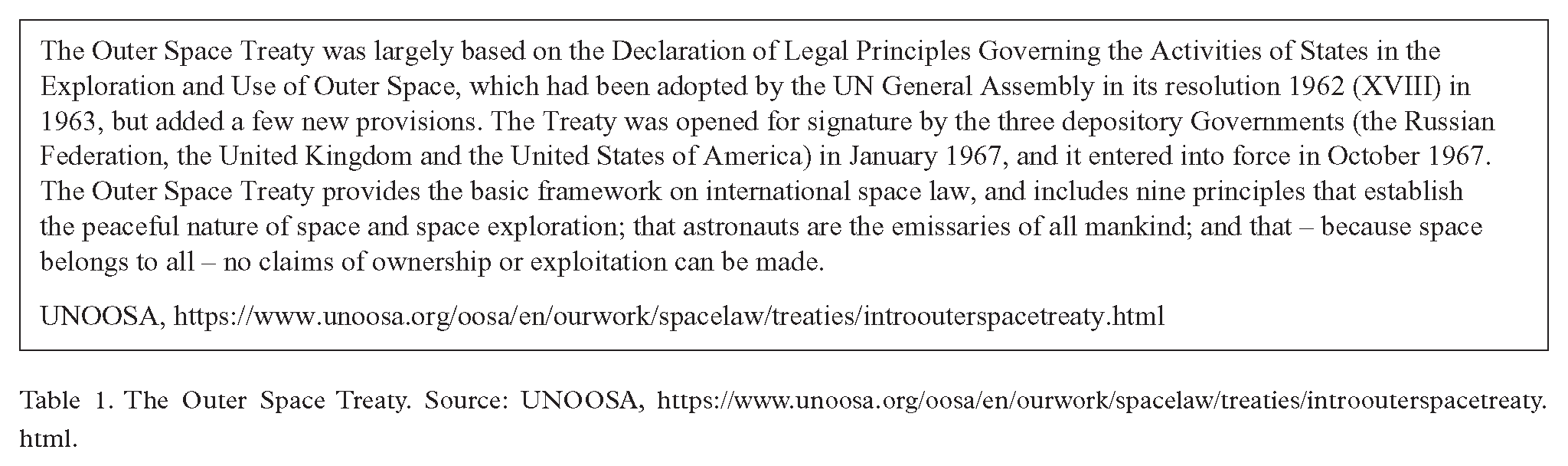
The Outer Space Treaty. Source: UNOOSA, https://www.unoosa.org/oosa/en/ourwork/spacelaw/treaties/introouterspacetreaty.html.
The privatisation of space may be an exciting idea for aspiring billionaire space travellers and mining industries that see a lurking end to Earth’s resources, but from a human, social and wellbeing perspective the health promotion community should be concerned about the impact of these efforts. Spending billions, if not trillions (whether or not garnered from state sources through taxpayer schemes or from private capital through profit and philanthropy), on space exploration is to the detriment of investments in sustainable food systems, water management, health care and health protection, etc. A warning should be sounded. The lofty ambitions set out by the Outer Space Treaty are already breached.
A few examples would suffice [38]. First, let us have a look at the Moon, our closest neighbour and often touted as the springboard for Martian and further extraplanetary travel and colonisation. Von Ehrenfried, not limited by any critical concern, enthusiastically explores all the wonders of returning to the Moon [39]. Going there is unequivocally lofty and good. Among the many apparatuses, vehicles and devices that went to Luna was a ‘Peregrine Lander’, operated by private firm Astrobotics. Shortly after take-off, the mission was compromised [40] and the craft disintegrated in space. Normally, this would not have created global headlines. However, ‘Ground Control’ suggested crashing the mission’s payload into the lunar surface, an attempt at salvaging some of the mission’s parameters. On Earth, people would call this ‘littering’ and it would constitute a minor infringement, but in this case, Peregrine Lander was carrying human remains that were to be deposited in the Moon’s Sinus Viscositatis, or the ‘Bay of Stickiness’. This ‘space burial’ caused considerable upset to the Navajo Nation, stating unequivocally that depositing human remains would be ‘desecration of a celestial object that is sacred to the Navajo people’ [38]. The Navajo are not the only group of people to attribute profound religious value to our Moon – there are many others who would share this concern, and who would similarly argue that this funeral of sorts creates significant challenges to spiritual wellbeing. A few weeks later, Intuitive Machines’ Odysseus moon lander landed sideways on the lunar Antarctic, and Japan’s Slim (smart lander for investigating Moon) landed on its nose in Shioli Crater.
It is quite likely that, somehow, concerns of desecration are glossed over as mere metaphysical pains, but crashing the Peregrine Lander into the Moon would have added to an already worrying quantity of human garbage on the Moon [41]. The image of the Moon, Luna, or Selene, as a virgin environment that should not be contaminated (yes, see the treaty’s principles. . .) has already long been destroyed. Lunar space junk is already provoking thoughts of a future space archaeology [42]. Similarly, the health sciences should start to take an interest in what is done to outer space now, including as a matter of foreign (beyond global) policy [36].
Of potentially more direct health and wellbeing impact is the space equivalent of the North Pacific plastic gyre (the accumulation of a large area of plastic debris in the northern Pacific Ocean [43] with significant global health impact) [44]. The European Space Agency is mapping an increasingly dense cloud of orbital debris [45]. Unlike the more esoteric (and long-term) risks associated with lunar landings and crashes (and the already growing busyness on the Martian surface), the more than 20,000 pieces of garbage speeding around the Earth may have very immediate and serious impacts on health. They may take out satellites involved in communications; measurements of ozone and carbon dioxide (CO2) critical for understanding climate change; insights required for agronomy (farming on Earth in many places is profoundly informed by satellite sensing technologies), and of course create a cascade of collisions that may lead to space junk crashing into Earth. In fact, it may not be a meteorite that has been around for a couple of billion years that crashes and creates the next extinction event, it may well be an ‘uncontrolled descent’ of a space vehicle the size of a London double decker bus that lands Dr Who-style in Westminster – and takes out a couple of thousand people and essential infrastructure.
As much as such anecdotes describe unanticipated incidents, some of the interplanetary health dangers are more perversely deliberate [46]. The nuclear weaponisation of low orbit creates very real and much more frightening large-population health risks than the old-fashioned mutual deterrents of the thermo-nuclear arsenal.
Whereas the Outer Space Treaty may have been a stepping stone for international collaboration towards the prevention of catastrophic space pollution, the current Artemis Accords are certainly not. While those that currently sound the alarm may be regarded as ‘space nerds’, it is time for global wellbeing enthusiasts, planetary folk, health practitioners and scientists, communities and institutions to join the calls for a more responsive and pro-active stance in ‘interplanetary health promotion’. The next health promotion charter ought to include a paragraph that addresses extra-planetary health promotion challenges – and opportunities.
Beyond time
In the (relativist) spacetime continuum, space and time are inseparable. Time has received even less consideration than space. In none of the declarations on health promotion since the Ottawa Charter have there been significant recognition of what Barbara Adam has called the one unique thing that makes humanity human: time, or rather our awareness of it [47].
That is not to say that several authors have called for the more systematic study and incorporation of time issues into public health and health promotion. Strazdins has given a first, more or less comprehensive, overview [48]. She identifies a number of time-related health promotion issues that would require more deliberate attention in scholarship and practice. For one, she demonstrates that time is a determinant of health. Reframing this, beyond the current novel attention to commercial and political determinants of health (that have gone beyond the Marmot Commission’s ‘social’ determinants [49]), all of the categories of determinants are influenced by, and have impact on, temporal determinants of health. There still appears to be a dire need to develop and test a more integrated and coherent conceptual framework that accounts for time in health.
Let us consider a few of the issues and dimensions that would need to be part of such a conceptual frame.
At an individual level, people seem to need time to respond to, and behaviourally integrate, opportunities to enact particular lifestyle choices – for example, around individual food choices, use of addictive substances and exercise – and it is clear that synergies with environmental factors facilitate an easier dedication of time. For instance, a number of studies have highlighted that people reluctant to adopt health behaviour changes claim they do not have time to cook healthily (and also, spend time shopping for healthy products); that tobacco smoking gives them an excuse to spend some ‘down time’, or that ‘utilitarian exercise’ (e.g. cycling to work rather than cycling to burn calories) requires less time. Such pronouncements also suggest that the conceptualisations that people have of ‘time’ are diverse and flexible. To some, time equals effort. To others, time is a precious resource, and to many, time (to spend on health, but also other valued dimensions of – anthropocentric – life and wellbeing) is outside one’s own immediate control.
Examples of such an ‘upstream’ temporal notions are plentiful. Women in sub-Saharan Africa collectively spend more than 200,000,000 hours on walking to, collecting, and bringing home, potable water [50]. Although there are tangible community offsets to these investments (social networking and building social capital along the way), the development of piped sanitation systems would clearly be not just an immediate investment in the health of families, but also in other pursuits, including education and economic activity. This example, most notably, shows the profound social inequities associated with time pressure, and these do not just apply to gendered temporal challenges in the Global South. In the field of housing and health, for instance, individual residential duration in a neighbourhood influences the degree and effectiveness of resident community action [51]. Greater lengths of time are required to ‘mature’ political astuteness in particular environments. Similar mechanisms for organisational change processes have been identified [52] – with the added qualification that appropriate leadership can ‘speed up’ time!
There are temporal determinants of health and wellbeing that are further – distally – removed. Butler and Friel look at the relationships between human and ecosystemic health, and show that their balance may be destroyed quickly, but will take a much longer time to regenerate [53]. Pedersen separates chronology from temporality [54]. The one being the temporal law of a natural sequence of things (which dictates, for instance, that you cannot unboil an egg. . .), whereas the other shows that there may be specific well-chosen times for anything (how hard the egg is boiled, or when the train departs).
Then there are temporal determinants of health that influence all of these individual, population and systems time perspectives. Howlett combines chronology and temporality in arguing for a more conscientious account of time in the development and sequencing of policy and its various (implementation) instruments [55]. For instance, do systems rules (laws) come before interpersonal behaviour conventions, or is it the other way around? Or is there a particular iterative and temporally determined pattern between these? If so – it would be good to have a more grounded insight. The same, still, is true for time scales for most health promotion efforts.
In the above we looked at individual, population and systems dimensions, and then policy and political ones. Still, we have not touched on one of the unspoken mantras in community development for health. . .. It is often said that for a community programme, you need 7 years to lay the groundwork, 7 years to run and implement it, and another 7 years to evaluate it properly. This seems to be about the temporal scale for famous programmes such as the North Karelia endeavour [56], but if this is true for such strongly validated and effective programmes, why is less than sufficient time (and other resources) allocated to to finding and developing human resources; training; research grants; PhD programmes; community support; and many more? One reason, I feel, is that we do not have a sufficiently grounded temporal evidence base for such endeavours. The other, of course, is that time dimensions of political cycles may not align with real-world problem solving. . ., but that does not mean temporal dimensions of health should remain the mystery they are.
A future for health promotion
The current ‘cutting edge’ agendas for health promotion development seem familiar. They exist in pronouncements about wellbeing and the doughnut economy [57]; in a further and reconceptualisation of the determinants of health discourse (moving beyond the social into commercial and political dimensions) [58]; the embrace of complexity theory and advanced tools to map health promotion dynamics [59]; and wide scopings of a world of health, including eco and planetary health [60]. These are as natural and necessary as the health promotion engagement in debates around racism, decolonisation and settler oppression [61].
In the above, however, I have sketched some perspectives that are yet beyond the current debates about the future (health promotion) needs of humanity. In exceedingly simple terms:
Humankind needs to move out of the centre of self-interest. Just like Galileo Galilei showed the Sun to be the centre of our solar system (and eventually, astrophysicists mapping that even our gravitationally bound complex of planets exists in a galaxy that is far from Universe Central – the location of the original Big Bang. . .). For our own health, given that we are dependent on complex natural and (bio)physical interactions that range from microscopic (e.g. the ecosystem of our own gut microbiome) to the planetary, emphasising the health and sustainability of these interactions would enhance those of Homo Sapiens.
Health and sustainability transcend planetary boundaries. Outer space is already a factor in planetary – and therefore individual and community – health. However, with public and private space exploration and exploitation we also generate new risks – and opportunities. Humanity should learn from the emergence of the Anthropocene on planet Terra and try to avoid making the same mistakes that led to climate change; cultural and natural annihilation; and injustice and inequity in all its forms. On earth as in heaven. . ..
The temporal dimensions of human, planetary and interplanetary health are yet to be fully grasped, mapped and codified. The science and art of health promotion would do themselves a favour to incorporate ‘time’ in their mantras. Looking at the recent pandemic, we might not have forgotten as easily what happened just a century ago, during the Spanish flu. As Lev Tolstoi said in War and Peace, ‘The two most powerful warriors are patience and time.’ Let’s make them our allies.
Footnotes
Declaration of conflicting interests
The author(s) declared no potential conflicts of interest with respect to the research, authorship, and/or publication of this article.
Funding
The author(s) disclosed receipt of the following financial support for the research, authorship, and/or publication of this article: FORTE (grant number: 2022-01357) and the Swedish Research Council for Sport Science (grant number: 2020/3, P2021-0065).
