




Abstract
We aim to consolidate recent trends in public health into a reconceptualization of the field as public good. We build on several strands of theory, research and action to formulate a more impactful future for the field. Our argument comprises three main parts. In the first part, we describe the central components of the proposed public good: conditions of justice, experiences of mattering, and outcomes of subjective and objective wellbeing. In the second section, we identify continua of practices that paint a trajectory from traditional public health to ecological and participatory public health, to universal wellbeing framed as a public good. The continua are defined in terms of assumptions, practices and roles. Among others, these continua pertain to capabilities, scope of the field, ecological focus, timing of intervention, role of citizen, role of professional, role of settings and role of government. Finally, the third section introduces a series of strategies and recommendations to make the narrative of universal wellbeing as public good a reality.
Keywords
Introduction
Several developments in theory, research, policy and practice point to the need to advance the public good; however, a coherent framework is yet to emerge. It is our goal in this paper to suggest a framework that can help the field of public health move closer to universal wellbeing as a public good.
The Social Determinants of Health (SDoH) approach has brought considerable attention to structural causes and socioecological understandings of illness and suffering. As such, it has had positive impacts on strengthening the equity lens on public health research and policy. SDoH has done so mainly through comprehensive research, influential reviews and policy briefs. And yet, the systematic, unfair and preventable inequities in opportunities to live well are not only increasing but have recently accelerated with COVID-19, wars and societal turmoil [1 –4]. In addition, even though progress toward achieving the UN’s 17 Sustainable Development Goals has been achieved, the transformative promise of ‘leaving no one behind’ still seems out of reach, even within the Nordic welfare states. Despite universal welfare and economic redistribution, inequities in health and wellbeing are surprisingly high [5 –7].
In his 2020 Scandinavian Journal of Public Health (SJPH) commentary, Lundberg [7] argues that there is a need for a new narrative in the development of the SDoH framework, arguing that it ‘has not been easy to communicate to stakeholders in other sectors, and we cannot as yet see much of substantial societal change as a result of it’ (p.473).
We believe that universal wellbeing, framed as a public good, can provide such a narrative. First, this is because public goods are conceptualized as universal, non-excludable (i.e. impossible for one person to exclude others from enjoying a good) and non-rivalrous (i.e. not possible for a person who enjoys a good to prevent others from doing the same) [8,9]. Second, it is because the public good needs to involve all citizens and comply with the ‘all-affected’ principle of democratic participation, including those most affected in the decision-making process [10,11].
The propositions we outline in this commentary move beyond an emphasis on gross domestic product as an indicator of public value and societal success [12]. What is at stake is how the research community, governments and societies work to support the development of wellness and fairness across generations. That, of course, includes care for the planet that is supposed to sustain future generations.
Influential economic scholars such as Amartya Sen, Kate Raworth, Joseph Stiglitz and Mariana Mazzucato have paved the way for such restructuring by placing equitable and sustainable human development and wellbeing at the centre of priorities (see e.g. Sen [13], Raworth [14], Stiglitz [15] and Mazzucato [16]). Consequently, public value must be created or provided to all members of society without having private profit as the basic motivation [15,17]. In this paper, this is what we call the public good as universal wellbeing. In the economic sphere, a transition toward a sustainable wellbeing economy has received endorsements from an increasing number of governments and international organizations, forming solid alliances to accelerate progress toward enabling people to enjoy health and wellbeing as a fundamental human right [2,12].
We approach wellbeing as a multifaceted concept encompassing emotional, functional and structural dimensions that are compatible with living well, with dignity, and with full participation in society [2,18]. In this sense, wellbeing connects to worthiness, freedom, mastery and functioning; to having a sense of purpose and meaning in life; to experience positive emotions and social connections, adequate living conditions and active citizenship; and to enjoy long, healthy lives [19 –21]. This entails a multilayered, ecological approach to wellbeing that recognizes the interdependence of personal, relational and collective levels. The interdependence among these dimensions requires attention to ‘wellbeing ecosystems’, where issues of power, oppression, agency, participation and emancipation become central [21,22].
Inspired by McCartney et al. [23], we approach wellbeing inequities as ‘systematic, avoidable and un-fair differences . . . that can be observed between populations, between social groups within the same population or as a gradient across a population ranked by social position’ (p.28). Universal wellbeing aims to combat these differences. Accordingly, we support conceptions of wellbeing that also entail health, with a direct alignment to its social determinants [23].
The vision of universal wellbeing, framed as a public good, relates to levelling the gradient so that all people have equal opportunities to reach the highest possible levels of wellbeing. This implies equipping them with the capabilities to do so. Such a vision requires a move from an individualist conception of wellbeing toward a collective approach, one that acknowledges that there is no wellness without fairness [18]. That is, a redistributive and universal approach that works to proportionately support people according to their needs. We argue that the mission of the public good as universal wellbeing can bridge gaps in public health, where mental health tends to be overshadowed by physical health [2]. Based on the arguments presented above, public good as universal wellbeing might unify divides by formulating a holistic and ecological approach [24,25].
Components of the public good
We believe that the foregoing theories and initiatives come together around three components of public good as universal wellbeing: conditions, experiences and outcomes. Given that public goods are shared and collective, they require balancing wellness with fairness. We claim that a central condition for the common good is justice, a central experience is mattering, and the central outcomes are objective and subjective health and wellbeing (Table 1).
Components and domains of the public good.
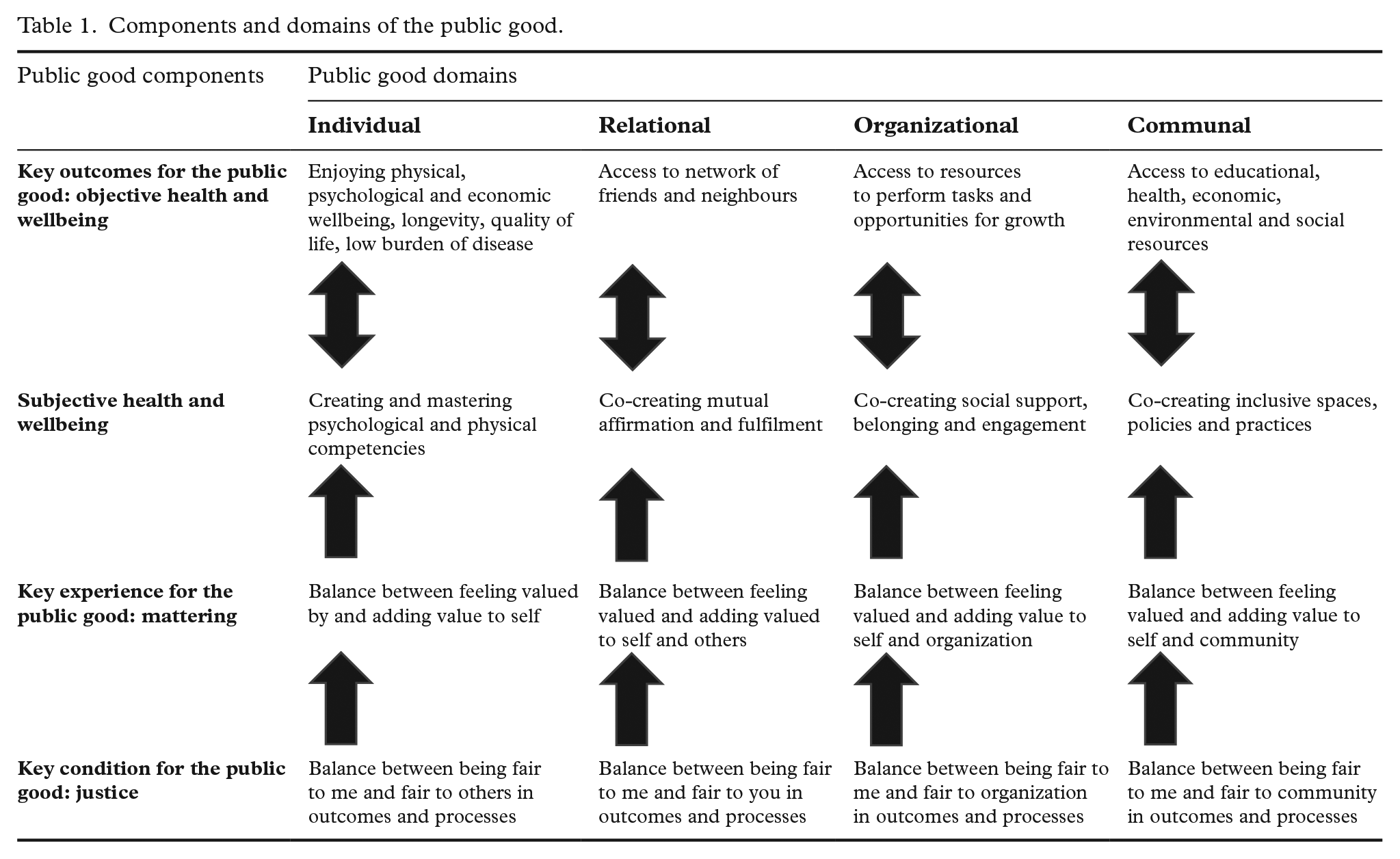
In our framework, we emphasize the ecological domains in which health and wellbeing should be manifested. Since the personal, relational and collective levels are continuously interacting, we submit that the public good must attend to multiple ecological levels at the same time.
We also draw attention to the balancing acts required to advance universal wellbeing. Justice must be enjoyed by everyone. The same goes for mattering. Focusing on what is due to me, or my need to feel valued, without attending to what is due to others, or other people’s need to feel valued, results in a narcissistic society. This is why we call for balancing acts at the levels of conditions and experiences.
As can be seen in Table 1, experiences of mattering emerge when conditions of justice prevail across domains of the public good. The more we benefit from conditions of justice in our individual lives and in relationships, organizations and communities, the higher the likelihood that we will experience mattering and worthiness across these domains of life. The more we experience mattering, the higher the chances that we will enjoy subjective and objective health. We can now elaborate on the three key components of our framework.
Justice
Extensive evidence points to the fact that justice is a sine qua non condition for health and wellbeing [21,26 –28]. The text in the bottom row of Table 1 refers to the foundational definition of justice, which is to each according to his or her due. That is, there must be a balance between what is fair to me, or what is due to me, and what is fair or due to others. This is the key challenge of justice and the public good. We call for a balance between what is due to me and others in two domains of justice: outcomes, or distributive justice, and processes, or procedural justice [21]. For the public good to flourish, societies must educate and legislate to achieve a balance between what is legitimately due to an individual and the community at large. When that balance is approximated, people in diverse roles feel that they matter because they feel valued and respected, and because they have opportunities to add value, regardless of their particular background [29].
Mattering
According to Prilleltensky [18], mattering is based on the need ‘to feel valued by, and to add value to, self, others, work and community’ (p.16). As empirical studies have demonstrated [27,28], mattering mediates between experiences of justice and health. We hypothesize that this is the case because when people are treated fairly, they are treated with dignity and respect, made to feel valued and given chances to add value. Apparently, these two experiences, feeling valued and adding valued, encompass many positive features essential to human thriving. Feeling valued invokes key psychosocial goods such as healthy attachment, being loved and supported, compassion and self-compassion, enjoying friendship and intimate connections, being seen, and having one’s unique identity upheld. Adding value, on the other hand, encompasses essential features of wellbeing, such as autonomy, self-efficacy, sense of control, mastery, self-determination, empowerment, creativity, flow, using signature and character strengths, joy of learning, and competencies [29]. Indeed, there is extensive evidence linking mattering to these and other positive psychological and physical outcomes [30,31].
Health and wellbeing
The third and final component of the public good is outcomes. We distinguish between objective and subjective wellbeing at the individual, relational, organizational and communal levels. While the subjective component of wellbeing emphasizes perceptions and feelings, the objective outcomes focus on access to resources and signs of health and wellbeing. We think it is important to define wellbeing in terms of both objective outcomes, such as longevity and suffering-free days, and subjective aspects, such as perceptions of happiness and quality of life. Objective and subjective wellbeing can be observed in different domains of life.
Summary
While other components might have been included in our framework of the public good, we chose justice, mattering, and health because they represent, respectively, essential conditions, experiences, and outcomes that are typically associated with public health and wellbeing. These overarching components subsume many important elements thought to be part of the common good. Without policies and practices upholding justice, citizens feel despondent. This is the reason why millions of people flee their countries each year, seeking places where they can expect to be treated fairly.
Mattering is another metarequisite for the public good. When people feel ignored, neglected and devalued, they often turn to nationalism and xenophobia to gain a sense of personal respect [32]. At the personal level, they often become depressed [30]. In the absence of a sense of worthiness, people develop either internalizing or externalizing disorders [30,31]. In either case, the consequences are deleterious for the individual, who feels devalued, and often for the surroundings as well [33]. On the other hand, when mattering is present in relationships, families, workplaces and communities, people flourish [29].
Practices for the public good
Arguments for pursuing the public good are not new to readers of SJPH. For example, Prilleltensky published an article in this journal in 2005 entitled ‘Promoting well-being: Time for a paradigm shift in health and human services’ [34]. In that article, he argued that only a new approach that focuses on strengths, prevention, empowerment and community conditions can make considerable progress toward the achievement of wellbeing for all. In another SJPH article, Heimburg and Ness [35] proposed a new narrative for public health by advancing a relational approach to welfare that is morally grounded in social justice and human rights. We build on these and other papers to introduce 12 continua that support the reconceptualization of universal wellbeing framed as a public good. We organize the reasons for the shift from traditional public health to public good along three main parameters: assumptions, practices and roles. As seen in Table 2, we describe three main approaches to public health: traditional, ecological/participatory, and public good.
Continua of assumptions, practices and roles in public good as universal wellbeing.
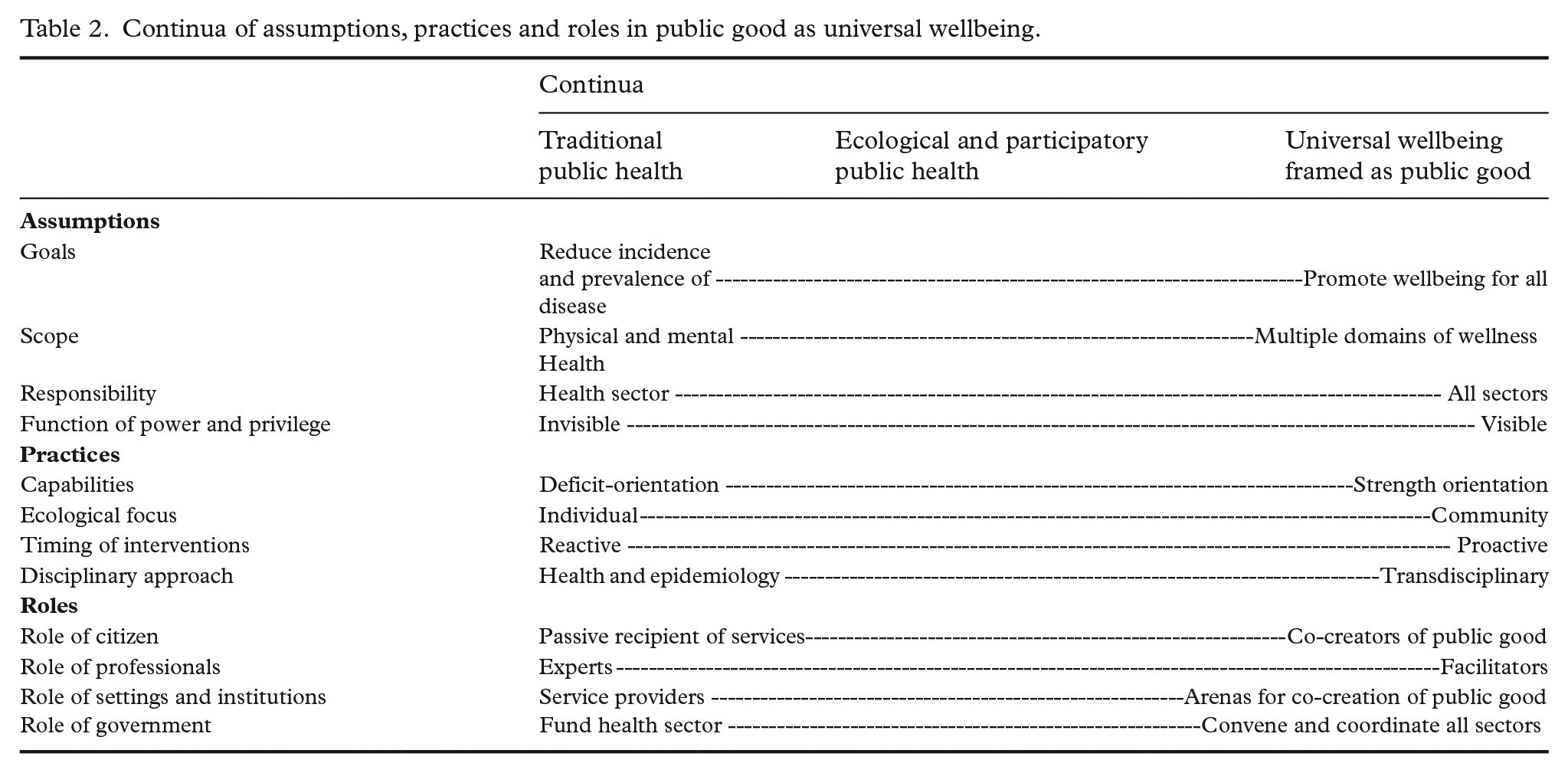
In our view, the field has been shifting from traditional views, in which the focus is mainly on the reduction of the prevalence and incidence of disease, toward health promotion and inclusive practices such as participatory action research. The move from traditional to ecological/participatory practices is also seen in the SDoH approach, which accentuates the environmental components of health and wellness. What we propose here is to go further and explicitly advocate for public health as a public good on the right-hand side of the continuum (Table 2).
Assumptions
In our view, there are four key assumptions that need to be reformulated as public good: goals, scope, responsibility, and function of power and privilege (Table 2). We advocate a shift from reducing the incidence and prevalence of disease to promoting wellness; from focusing on physical and mental health to advancing health in multiple domains of wellness; from assuming that only health professionals are responsible for wellbeing to sharing the responsibility with all professionals; and from assuming that power and privilege play no role in health to taking them into account.
Practices
There are also four practices that support the shift toward a public good conception of public health: capabilities, ecological focus, timing of interventions, and disciplinary approaches (Table 2). We claim that the field is moving from a deficit toward a strength orientation, from an individual to a collective focus, from reactive to proactive interventions, and from single disciplinary to transdisciplinary approaches.
Roles
Finally, we see that the field is embracing new roles for citizens, professionals, settings and government. We label these shifts a turn toward the public good. Specifically, we see that citizens are shifting from being recipients of services to co-creators of health and wellbeing. We also observe that professionals are assuming the role of facilitator instead of expert. Service providers and institutions in different settings, such as schools and health care centres, are also acting as arenas of co-creation. Finally, governments are redefining their roles. Wellbeing governments take collective responsibility for the welfare of their citizens. Instead of just funding and managing the health sector, they act as conveners of all stakeholders to unify government priorities in the pursuit of the public good. They make accountability systems transparent to enhance trust and to measure and evaluate development. In this way, governments act as the driving force for social sustainability while acknowledging and supporting people and community empowerment through a systemic, systematic and context-sensitive approach.
In our view, all of these changes are already taking place in different countries, regions and settings. We are consolidating these changes in a public good as universal wellbeing framework to facilitate conversation, research, theory and action.
Strategies for advancing the public good and universal wellbeing
Contextualizing and measuring the mission of universal wellbeing
Joseph Stiglitz [15] points to the fact that if we do not measure the right things, we do not do the right things. Measurement and mechanisms of accountability affect people’s actions and priorities. In taking the complex drivers for universal wellbeing into account, one might become overwhelmed. However, the pioneering work done by the Wellbeing Economy Governments partnership (WEGo) countries makes an empirical case for how this might be done in practice, supported by research and the Sustainable Development Goals (SDGs) [36,37]. The WEGo network stems from the Wellbeing Economy Alliance initiative [36]. WEGo is a collaboration between governments (Finland, Iceland, New Zealand, Scotland and Wales) that aims to advance the building of comprehensive wellbeing economies. The WEGo countries commit to sharing expertise and policy practices with each other and the wider international community, acting as role models and change agents who work shoulder to shoulder with advocates for wellness and fairness and inclusive citizenship. In our view, WEGo is calling for economic policies for the public good.
A common point of reference for these governments is the application of the capabilities approach to operationalize the public good at the intersection of wellbeing and social justice.
The capability approach frames wellbeing as people having real and equal opportunities (freedoms) to live lives they have a reason to value and the capacity to sustain [38,39]. In the context of our arguments, capabilities represent key conditions for wellbeing in ways that intersect personal, relational, social, material, cultural and structural issues (e.g. work, play, love, democratic participation, learning, legal rights, welfare, living standards and social protection) [39,40]. We see this framework as a promising approach to interweaving objective measures with subjective elements of wellbeing. The capability approach could also generate qualitative data to complement quantitative measures by focusing on experiences of, and conditions for, wellbeing. Accordingly, we agree with scholars who have argued that the capabilities approach aligned with the universal wellbeing mission could support the development of a strong narrative to guide the future of public health [41 –43].
Despite the intuitive appeal of universal wellbeing as a mission, it is important to consider potential dark sides. A possible pitfall of centralizing universal wellbeing as the key mission is that the value of health (objective and subjective) is overshadowed by other dimensions. Another potential pitfall is to embrace a wellbeing framework without being conceptually and theoretically clear on the phenomena at stake. For example, if (objective) living conditions were left out of the wellbeing equation, it would largely fail to address important capabilities that are well addressed by the SDoH approach. While being aware of such pitfalls, we suggest that the mission of universal wellbeing, as we have conceptualized it here, might act as a moral, relational, communal and structural approach to pursuing a ‘wellfair society’ [29; p.6], a social arrangement amalgamating wellness and fairness in human and societal development. This approach frames public health as a matter of relational responsibility, where solidarity, trust and social justice act as key drivers for social change.
Universal wellbeing as an organizing principle for the public good
Approaching the mission of universal wellbeing as an organizing principle has several advantages. First, the public good should be the organizing principle for the public sector and democratic institutions. As such, it has the potential to bring sectors and stakeholders together around common goals [17,44,45]. Universal wellbeing is increasingly framed as an ultimate public good that is dependent on co-creation across the whole of society [12,44] and is not intuitively sectorized through divisions of responsibility. Although some progress has been made by the adoption of the SDoH framework – aligned with a ‘health equity in all policies’ approach – progress remains illusory [46,47]. One possible explanation for this relative lack of success is the foregrounding of ‘public health’ and ‘health equity’ as the values at stake, where the general perception of health connects to the role of the health sector. This is also why pioneer countries, such as Finland, recently reframed public health policies from ‘health in all policies’ to promoting universal wellbeing [48]. In addition, it should be noted that in 2022, Finland ranked number 1 in the World Happiness Report [49].
Against this backdrop, we argue that placing universal wellbeing as the ultimate mission for public value provides meaning, purpose and direction to the public sector. After all, wellbeing is ultimately defined as the purpose of providing public welfare [50]. By recognizing the need for a whole-of-society approach, universal wellbeing fosters dialogue on how governments work to achieve this mission. Second, the value of universal wellbeing, and how it can be created and sustained, affects the roles being played out by citizens, businesses, volunteers, the media, researchers, frontline staff, public officials and political leaders, to mention some key stakeholders in the creation of universal wellbeing as a public good. Unfortunately, governance logics in the public sector (classic bureaucracy and New Public Management) tend to facilitate a passive role for citizens and stakeholders outside of the public sector [51] and are often more focused on the production of services and compliance with (sectorized) budgets rather than the common public value at stake.
Recognizing universal wellbeing as a mission that is dependent on a whole-of-society approach could support the co-creation of such public goods, motivate active citizenship and ultimately increase people’s sense of mattering [35,52,53]. This is not only because the wellbeing values at stake are generally of importance for people and their loved ones but also because the ‘public palaces’ at stake (e.g. universal institutions such as kindergartens, schools and libraries) need legitimacy and public support to work in favour of social inclusion and to synergize public, civic and private contributions to the common good [54,55].
Third, universal wellbeing implies the need for a transdisciplinary approach. We need to be pragmatic as to what fields can contribute to the mission. Using universal wellbeing as an organizing principle could therefore bridge apparent (scholarly) divides between health promotion, disease prevention and recovery; between biomedicine and sociology; or between psychology and political science. Such calls for pragmatism and transdisciplinary approaches to public health research are rooted in a recognition of the interconnectedness of biological, relational, social, cultural, commercial, spatial, multisectoral and political drivers of universal wellbeing [56,57]. Accordingly, we echo the increasing calls for transdisciplinary approaches to public health research and theory [24,58]. Coining public health as a mission science requires a need for diverse and pragmatic approaches to research, building from universal wellbeing as an organizing concept across a wide range of disciplines, theories and methodologies.
Universal wellbeing as an organizing principle for the economy
Universal wellbeing can also serve as an organizing concept for the economy as a whole. A ‘wellbeing economy’ situates economic systems as mechanisms to serve the common good and safeguard public interests rather than pursuing economic growth as a mission on its own terms. It is a way of organizing the economy to meet the needs of all within the needs of the planet [14,45]. A wellbeing economy values and monitors what really matters for people to matter and flourish. This recognizes that investing in social sustainability and ‘leaving no one behind’ is vital for achieving the wider aspects of sustainable development. Wellbeing economy is therefore about making investments in public goods such as health, education, nature and vibrant communities, where local neighbourhoods represent the basic unit of sharing, caring and democratic empowerment [59]. Accordingly, placing wellbeing for all as the organizing principle for missions involves a radical redirection of the economy. Overconsumption, sectorial divides and increasing economic inequities cause serious threats to realizing universal wellbeing.
What is needed is to shape markets, not fix them from market failures and quick-fix budget cuts. Mazzucato’s [16] work on ‘multiplier effects’ in mission-oriented economies recognizes that economic resources and fiscal priorities represent only a proportion of the total resources and capabilities needed to make transformative change and accelerate joint action. However, what is needed, both to convey systems and make a public good ecosystem work in practice, is a deepening of democratic participation and a recognition of society as something we create together and reinvent across generations. Just as the vision of achieving universal wellbeing recognizes that there is no wellness without fairness [29], the organizing principle for achieving main missions through co-creation highlights that there is no social change without participation, collaboration, strong institutions and people-powered processes [11,42,52,60].
Merging a data-driven and a people-powered approach
Progress in understanding the social determinants of health is unquestionably important for tackling contemporary public health problems. A data-driven approach is imperative to becoming aware of pressing concerns and the root causes of social injustice and inequities in health and wellbeing. However, there are increasing calls for intersecting a research-informed and data-driven approach with a people-powered and participatory approach in public health [61,62]. Active public participation, collaboration across sectors and relevant stakeholders, and sensitivity to local contexts and cultures are vital for informing and shaping actions and coherent policies [62,63].
So, let us make our argument clear: we do not suggest downplaying the role of biomedical and epidemiological research and knowledge on what is frequently described as the ‘social determinants of health’. These strands of research are fundamentally important for understanding and explaining the factors affecting human health and wellbeing. However, becoming aware is not enough. To achieve transformative change, there is also a need to become empowered to take action on universal wellbeing. Making the move from becoming aware of the need to leave no one behind to being empowered to act requires various forms of public health research that also enable people-powered processes. Here, the interlinkage between public health research and informed, comprehensive action becomes even more relevant, as a comprehensive public health research agenda might contribute to accelerating the urgent need for action.
A ‘global’ approach to action and innovation
In 2019, the UN Secretary General called for a whole-of-society approach to mobilize and accelerate action on the SDGs and human rights on three interdependent levels: (1) global action to secure and improve leadership, resources and innovative solutions; (2) local action embedding transformative shifts in policies, budgets and institutions, facilitated by legal and fiscal frameworks of cities and local- and state-level governments; and (3) people action, including all relevant stakeholders and members of society (e.g. civil society across all age-groups, the media, the private sector, unions, academia and other relevant actors) [64]. These three interdependent areas of action are vital to co-create a persistent drive pushing forward required and transformative social change: a comprehensive societal movement for the common good, where key public values are safeguarded and promoted through a system-wide approach to human rights and the SDGs.
The need for joint action and innovation invites a discussion on the role of public health research in progressing universal wellbeing. The need to mobilize action is leading us to ask whether the new steps taken toward a universal wellbeing narrative have created a window of opportunity for a transformative public health research agenda. We suggest that moving the field of public health toward the public good can accelerate the next steps of progress in achieving universal wellbeing.
Concluding remarks
In this paper, we have presented a framework to move the field of public health toward universal wellbeing framed as a public good. We suggest that building a strong, research-informed and theoretically sound narrative on universal wellbeing could support innovation, co-creation and social transformation. Although the SDoH approach has been a successful narrative in providing empirical evidence of the key conditions affecting universal wellbeing, this framing has not yet succeeded as a framework for action and transformation.
Our framework promotes a narrative proposing a mission-driven approach to intersecting wellbeing and social justice to realize the universal value of ‘leaving no one behind’. The implication of this narrative transforms the roles of all actors involved in co-creating universal wellbeing as a public good: citizens are empowered and initiate social change through their actions and agency; and professionals work in transdisciplinary teams and promote real sharing of power by viewing citizens as active, resourceful and contributing to the public good. Policymakers focus on universal wellbeing as a common vision for the public good and strategize missions to achieve the vision across sectorial and organizational domains. They make sure that policies are universal yet proportionate to needs, and place those furthest behind first. Ultimately, for all actors involved, our proposed narrative involves participatory, collaborative, relationally responsible and place-based responses to create a ‘wellfair’ society where everyone matters to processes and outcomes. To conclude, this requires moving the field of public health toward universal wellbeing framed as a public good.
Footnotes
Declaration of conflicting interests
The author(s) declared no potential conflicts of interest with respect to the research, authorship, and/or publication of this article.
Funding
The authors received no financial support for the research, authorship, and/or publication of this article.
