




Abstract
Aims: This study examined the association between the workplace-effort in psychosocial risk management and later employee-rating of the psychosocial work environment. Method: The study is based on data from two questionnaire surveys – one including 1013 workplaces and one including 7565 employees from these workplaces. The association was analyzed using multi-level linear regression. The association for five different trade-groups and for five different psychosocial work environment domains was examined. Results: Limited but statistically significant better employee-ratings of the psychosocial work environment in the respective domains were observed among Danish workplaces that prioritized “development possibilities for employees,” “recognition of employees,” “employees influence on own work tasks,” good “communication at the workplace,” and “help to prevent work overload.”
Keywords
Introduction
The need to improve the psychosocial work environment was voiced by the European Agency for Safety and Health at Work already in 2006 [1]. The background for the appeal was the high prevalence of mental disorders and psychological distress in Europe [2].
Several studies have shown the association between the psychosocial work environment and the employees’ health [3–5]. For example, job control [4,5], effort–reward imbalance [3,4], job strain [6], social support, poor management quality, work overload, and injustice have been linked with mental disorder and sickness absence [3–5]. Based on such results, the World Health Organization has provided recommendations and guidelines to companies for improving the psychosocial work environment through psychosocial risk management [7].
However, studies show that it is difficult to improve the psychosocial work environment. Several workplace interventions have failed to show an effect [8,9]. In some cases, they even seemed to do more harm than good [10].
The present study examined to what degree the employee-rated psychosocial work environment was better in Danish workplaces that had a high effort in psychosocial risk management compared to those workplaces that had not.
Methods and material
Study sample and design
Our study linked two questionnaire-surveys: a special subsample of a workplace-survey – “Work Environment Activities in Danish Workplaces (WEADW)” [11], and a special subsample of an employee-survey – “Work Environment and Health in Denmark (WEHD).” The WEADW-survey (conducted early 2012) measured the workplace-efforts in the preceding year, and the WEHD-survey (conducted late spring/summer 2012) measured employee-rated work environment at the present. The study was approved by the Danish Data Protection Agency, journal number 2012-54-0017.
Work Environment Activities in Danish Workplaces (WEADW) – special sample
Our workplaces were stratified on five trade-groups (“knowledge work,” “private service,” “care work,” “industry,” and “building and construction”) and five size groups (10–34, 35–99, 100–249, 250–499, and 500 or more employees). We used web-based and paper questionnaires. Both a management representative and an employee involved in occupational health management were invited to participate. In case of two answers we used the average score. In March 2012 we had at least one response from 1060 workplaces (response rate 52%).
Work Environment and Health in Denmark (WEHD) – special sample
Depending on the size of the workplace, 10–30 employees were randomly extracted from each of the responding workplaces (15,767 employees). The employees were sent an invitation to the survey (response rate 53%). We excluded employees with less than 3 months seniority, workplaces with less than 10 employees, and employees and workplaces with missing answers to all questions, leaving 7565 employees from 1013 workplaces. For 2% of the workplaces we had only one valid employee-answer and for 22% of the workplaces we had more than 10 valid answers.
Predictors
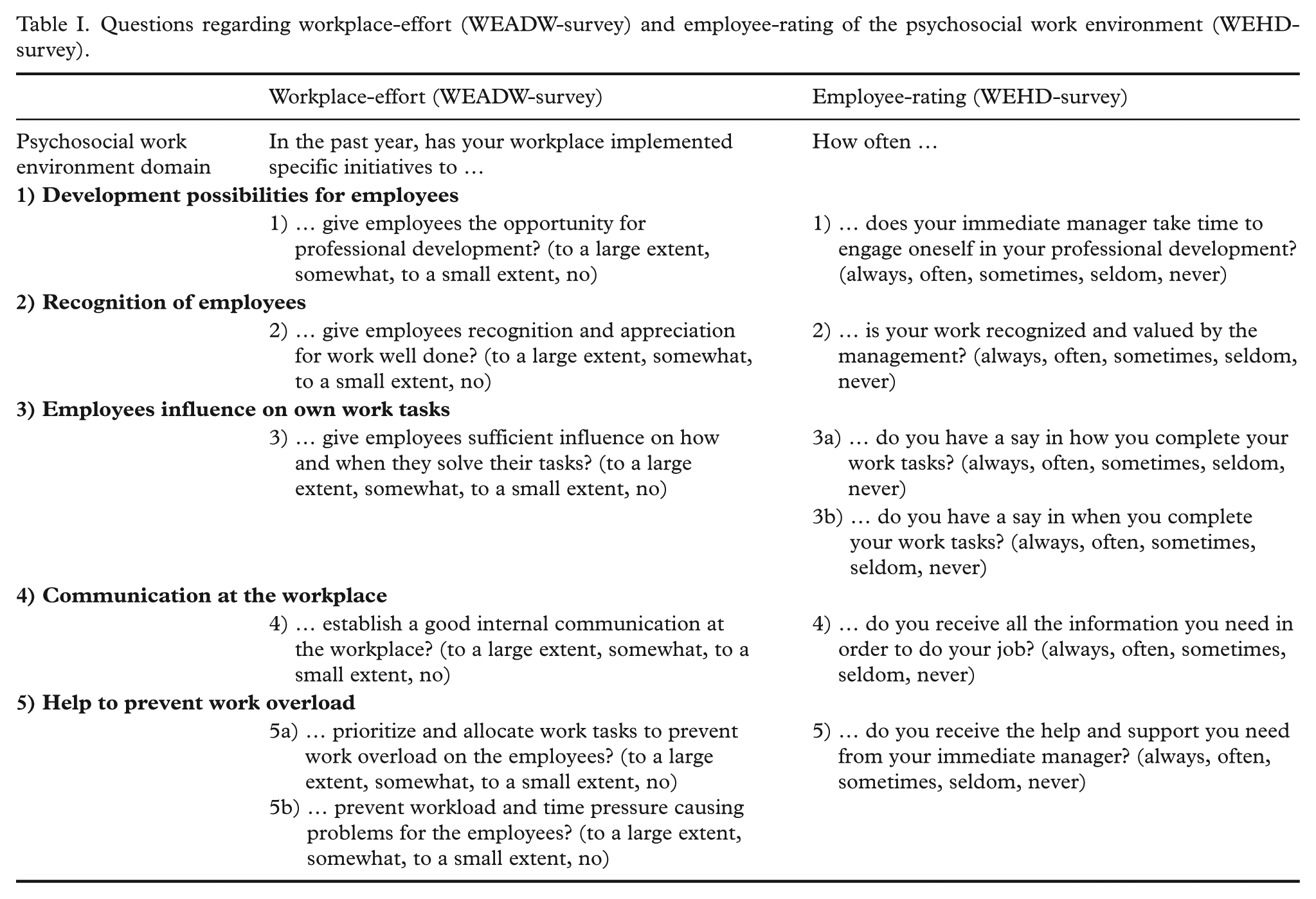
The workplace-effort was divided on: “possibilities for development,” “recognition of employees,” “employees influence on own work tasks,” “communication at the workplace,” and “help to prevent work overload” (see questions in Table I). Questions were scored from 0 to 100 on a Likert scale (no (0), to a small extent (33.3), somewhat (66.6), to a large extent (100)). We used the average score when we had two questions on the subject.
Questions regarding workplace-effort (WEADW-survey) and employee-rating of the psychosocial work environment (WEHD-survey).
Outcomes
The employee-ratings of the psychosocial work environment were chosen to match the workplace-survey (see Table I). Questions were scored from 0 to 100 on a Likert scale (never (0), seldom (25), sometimes (50), often (75), always (100)). We used the average score when we had two questions on the subject.
Covariates
We adjusted for trade-group, size of the workplace, previous identification of psychosocial improvement possibilities at the workplace (“yes/no/missing,” in case of two answers, “yes” overruled “no”), age, and gender of the employee. We chose to adjust for these covariates since they may influence both predictor and outcome in our analyses (e.g. both workplace-efforts and the psychosocial work environment may be dependent on trade-group).
We adjusted for respondent-type from the workplace-survey (management representative = 1; employee working with risk-management = 2; answers from both = 1.5), since managers tend to rate the effort higher than employees. (We had both respondent-types in 449 workplaces; the average overall effort was rated by managers to be = 77 points and by employees to be = 64 points. The Pearson correlation of manager-rating and employee-rating was 0.22 with p-value ⩽0.0001.)
Trade-group, age, and gender data came from registers; all other variables were measured in the questionnaires.
Statistical methods
We used multilevel linear regression analyses with adjustment for clustering effects (employees from same workplace), covariance matrix was compound symmetry [12,13]. As robustness analyses, we performed analyses with 36 trade-groups (instead of 5), we performed analyses stratified on the five workplace sizes (instead of adjusting for workplace size), we performed analyses only including the workplace respondent-type “management representative” and analyses only including respondent-type “employee working with risk-management” (instead of adjusting for respondent-type). The robustness analyses results were similar to the main analyses (results not shown).
Results
Almost 80% of the workplaces stated they had made an assessment of the psychosocial work environment within the last 3 years (the Danish APV = “health and safety risk assessment,” all workplaces should evaluate and document the work environment at the workplace at least every three years according to EU rules. It is not supervised by the authorities, but a risk assessment in writing must be available at the workplace). Of those 74% had identified improvement possibilities. Workplace-efforts were not limited to workplaces that had identified improvement possibilities. In workplaces with identified improvement possibilities 49% had made a high effort, in workplaces without identified improvement possibilities 51% had made a high effort, and in workplaces without assessment (or missing answer) 45% had made a high effort (high effort defined as an effort “to a high degree” in at least one of the five psychosocial work environment domains).
The unadjusted workplace-effort scores across all five psychosocial domains were for each trade-group, respectively: 72 points in “knowledge work,” 70 in “private service,” 77 in “care work,” 63 in “industry,” and 65 in “building and construction.” The corresponding average employee-rating scores were: 66 points in “knowledge work,” 63 in “private service,” 66 in “care work,” 62 in “industry,” and 62 in “building and construction.” That is, the unadjusted results indicate a positive association.
Table II shows the associations between the workplace-effort and the employee-rating adjusted for workplace size, workplace respondent, previous identified improvement possibilities, age, gender, and trade-group. Only some associations were significant when divided on trade-group; however, all associations were significant if trade-groups were pooled. All associations were small, e.g. an increase in workplace-effort of 1 in the domain “development possibilities for employees” is only associated with an increase in employee-rating of 0.11 points (see Table II).
The association of the workplace-effort and the employees-rating of the work environment. Linear regressions adjusted for trade-group, size of the workplace, age and gender of the employee, previous identified psychosocial work environment improvement possibilities, and who answered the workplace survey.

The slope is β from the linear regression formula y = a + βx, x = workplace-effort, y = employee-rating.
Discussion
The questionnaire responses available do not cover all psychosocial work environment areas. However, taken together we believe that the questions measure important aspects of the workplaces’ everyday management of the psychosocial work environment.
We found that workplaces with a high effort in the preceding year had a more positive employee-rating. However, although the result was consistent and statistically significant, the estimated associations were small.
Several previous studies of psychosocial work environment interventions have failed to show an effect [8–10]. Researchers have explained this lack of success by difficulties in the implementation process of psychosocial work environment interventions, and the result of an intervention may be widely different in different workplace settings [10,14]. Hence, if many psychosocial work environment interventions fail, it may explain the limited association between the workplace-effort and the employee-rating in our study.
A strength of our study is the inclusion of 1013 Danish workplaces. The main limitation of our study is the lack of employee-ratings of previous work environment. If most workplace-efforts were initiated due to a previous poor work environment, we would underestimate the effect of the risk-management. If most workplace-efforts were initiated in well-functioning workplaces, which have good work environment due to other reasons, we would over-estimate the effect of the risk-management. If only the past years workplace-effort matters for the work environment, we should not adjust for previous levels. We adjusted for previous psychosocial work environment using the workplaces self-report of identified improvement possibilities; nevertheless, individual measurements of previous work environment from all employees would have been preferable and would have given us the possibility to examine some of these mechanisms.
Another limitation of our study is a low response-rate. Our study may not reflect an average workplace – in particular we suspect we miss answers from workplaces with low effort. Furthermore, responding workplaces with a low effort may over-report in order to give more desirable answers. This may also lead to an underestimation of the association between workplace-effort and employee-rating.
Our study shows that Danish workplaces with a high effort in psychosocial risk management had a small but statistically significant higher employee-rating of the psychosocial work environment. The results indicate a limited but overall positive effect of the efforts, but causality cannot be firmly established using our observational design.
Footnotes
Acknowledgements
The authors are grateful to The Occupational Surveillance group at The National Research Centre for the Working Environment for valuable assistance with access to and quality assurance of data.
Conflict of interest
The authors declare that there are no conflicts of interest.
Funding
This work was supported by a governmental grant.