



Abstract
Using the national-level employment and unemployment surveys (NSS and PLFS) and the macro-level data for the period 2005–2019, this article explores the trends and recent growth patterns of rural non-farm sector employment in India. It also examines the micro-level factors determining individuals’ preference towards non-farm sector jobs and the macro-level factors responsible for the growth of non-farm sector employment in rural India. The main findings of the study suggest that although rural non-farm sector employment is rising in absolute terms, its growth rate has slackened in recent years. While the level of education and skill training, market wage rates and socio-cultural setups are among the key micro-level factors determining farm–non-farm employment choices of rural folks, at the macro-level, the growth of investment in capital goods, the number of factories, investment in infrastructure development and the growth of the manufacturing sector are crucial for the growth of non-farm sector jobs in India. Based on these findings, it is argued that the improvement of human capabilities through increased investment in education and skill, and the growth of non-farm sector employment through the development of rural infrastructure and industrialization measures, are necessary to sustain the structural transformation and to harness the demographic dividend in India.
Introduction
In India, the rural economy is currently passing through a critical juncture, as overall rural employment has started declining, despite the fact that the number (and share) of youth and working-age population are rising (Mehrotra & Parida, 2019, 2021). The job market crisis is also partly reflected in an upsurge in educated youth unemployment (Bairagya, 2018; Mehrotra & Parida, 2021; Mitra & Verick, 2013). This is an alarming situation because non-farm sector jobs are not growing adequately to compensate for the decline in agricultural employment. During 2004–2005 and 2018–2019, while the number of workers in agriculture declined by 68 million (about 4.8 million per annum), in the non-farm sector (rural industry and services together), employment grew only by 42 million (only about 3 million per annum). Since a large proportion (about 69 per cent, as per the 2011 Census) of India’s population is still living in rural areas, the generation of adequate non-farm sector employment opportunities is going to play a crucial role in reducing rural poverty. Moreover, the growth of non-farm sector employment is likely to sustain the structural transformation process, and it will help boost economic growth in rural India. Hence, in this context, it is necessary to explore the factors that constrain the growth of rural non-farm sector employment in India.
A review of earlier studies in India reveals that a set of both supply- and demand-side factors is responsible for the slow growth of jobs in rural India. On the supply side, the rural labour force started shrinking because of the increasing participation of youth in education (Hirway, 2012; Kannan & Raveendran, 2012; Mehrotra et al., 2014; Rangarajan et al., 2011; Thomas, 2012) and due to the withdrawal of women workers from agriculture owing to an improvement in the standard of living (Desai, 2019; Mehrotra & Parida, 2017). On the demand side, growing mechanization in agriculture and rising costs of cultivation are behind the decline of the agricultural workforce 1 (Himanshu, 2011; Kannan & Raveendran, 2019; Mehrotra & Parida, 2021; Mehrotra et al., 2014; Pattayat & Parida, 2017).
Studies like Neetha (2014), Pattanaik and Nayak (2014), Dhara and Chatterjee (2017) and Sapkal and Sundar (2017), on the other hand, have highlighted the gender dimension of non-farm sector employment participation. According to these studies, rural women are relatively more constrained to enter non-farm sector jobs than their male counterparts. In fact, an interplay of complex socio-economic and cultural factors restricts their non-farm sector work participation in rural India (Mehrotra & Parida, 2017). Lanjouw and Shariff (2004), Lanjouw and Murgai (2009), Kapoor et al. (2021), Shah and Pattanaik (2021), Ghosh and Ghosal (2021), Kapoor and Kapoor (2021) and Pattayat et al. (2022) have examined the role of rural non-farm sector employment on household-level income and on the incidence of poverty. These studies have found that non-farm sector employment has a positive implication on household income growth and, hence, is likely to reduce the extent of household poverty.
Furthermore, discussion on the quality of non-farm sector jobs (Agarwal & Goldar, 1995; Bhattacharya & Mitra, 1993; Chand, 2001, 2003 Deshpande, 1992; Jha, 2006; Raj & Sen, 2012; Visaria, 1995), issues on stagnant real wages (Mehrotra & Parida, 2019, 2021; Venkatesh, 2013), gender composition and skill constraints (Davis & Bezemer, 2003; Dhara & Chatterjee, 2017; Jatav & Sen, 2013; Kapoor et al., 2021; Mehrotra & Parida, 2017; Neetha, 2014; Pattanaik & Nayak, 2014; Sapkal & Sundar, 2017), its role in poverty reduction (Ghosh & Ghosal, 2021; Lanjouw & Murgai, 2009; Lanjouw & Shariff, 2004; Kapoor & Kapoor, 2021; Kapoor et al., 2021; Pattayat et al., 2022; Shah & Pattanaik, 2021), etc. are well explored by the existing body of literature.
Although a few studies conducted at the all-India level (and at the state level) explored the structural factors constraining the growth of rural non-farm sector employment, these studies did not examine the behavioural factors that restrict individual employment choices. This study attempts to fill this research gap. Hence, the main objective of this study is to explore both the individual and family-level factors determining an individual’s preference towards non-farm sector jobs in rural India, apart from exploring the recent trends and patterns of non-farm sector employment. Moreover, this study attempts to identify the possible macro-level factors that are restricting the growth of rural non-farm sector employment in India.
This article is organized into five sections. The second section explores the recent trends and composition of rural non-farm sector employment in India. The third section outlines the sources of data and methodology for regression estimations. The main findings of the article are discussed in section, which provides a detailed discussion based on our econometrics results. Finally, the fifth section concludes the article along with a discussion on the policy suggestions, limitations of the study and scope for further research.
Rural Non-farm Employment in India: Recent Trends and Patterns
Trends of Rural Non-farm Sector Employment
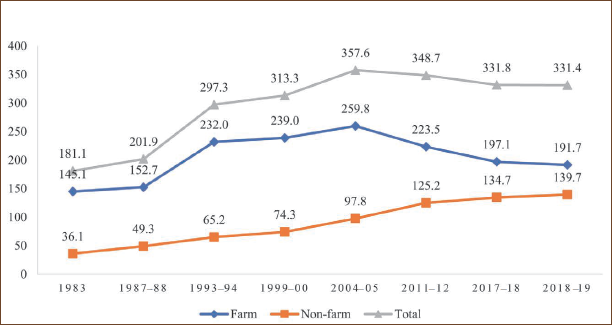
In rural India, the number of jobs had consistently increased from 181 million to about 358 million between 1983 and 2004–2005, at a rate of about 8 million per annum. But in the later years, it had declined massively to reach 331 million, as in 2018–2019 (Figure 1). This decline was mainly driven by the decline of farm sector jobs. The total employment in agriculture and allied sectors in rural India had declined from 260 million to 192 million (about 4.9 million per annum) during 2004–2005 and 2018–2019, whereas rural non-farm sector jobs increased only by 3 million per annum during the same period (Figure 1). That means the growth of non-farm sector jobs could not fully compensate for the decline of farm employment in rural India. As a result, the overall employment in rural India has declined by about 2 million per annum in the last one and a half decades.
Within the rural non-farm sector, the manufacturing sector’s performance was terribly bad. It had registered a negative growth in jobs during the post-2012 period (Table 1). As a result, the share of employment in the rural manufacturing sector also declined.
Sectoral Employment Trends in Rural India.
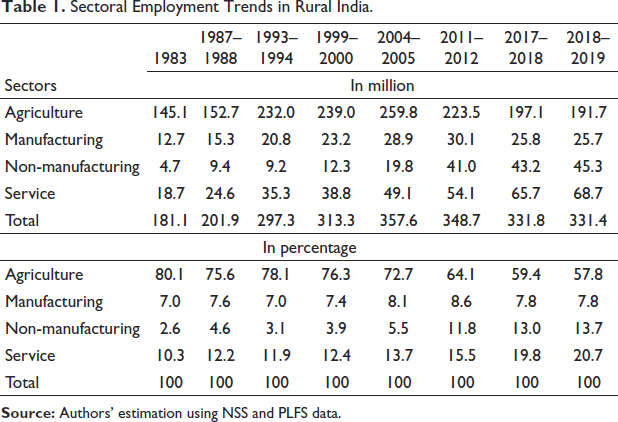
Second, the non-manufacturing 2 (mostly the construction sector) job growth had fallen to 0.7 million per annum after the 2011–2012 period. In this sector, total employment was rising at an average rate of about 3 million per annum during 2004–2005 and 2011–2012 periods.
Nonetheless, the absolute number of jobs in the rural service sector has continued to rise over the years. Hence, it was contributing about 50 per cent of the total non-farm sector jobs in rural areas (Table 1). Though the service sector has been contributing substantially to the growth of rural non-farm sector jobs, the quality of employment in this sector is very poor because of large-scale informality (Mehrotra & Parida, 2021).
Patterns of Rural Non-farm Employment in India: Youth, Gender and Social Group
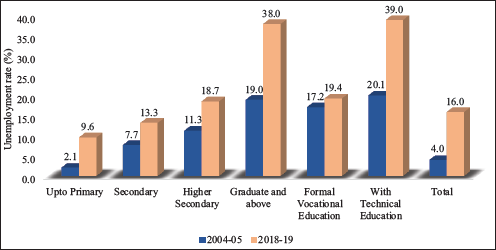
The distribution of the rural non-farm workforce by age group has revealed that the share of youth workers has been declining since 2004–2005 across the manufacturing, construction and services subsectors (see Table 2). This suggests the fact that youth are either moving towards urban areas in the quest for jobs or preferring to remain unemployed due to a lack of suitable employment opportunities in rural areas. The latter argument seems to be more relevant. As for the educated youth, the unemployment rate increased massively (four times during 2004–2005 and 2018–2019) in rural India (Figure 2).
Rural Non-farm Employment Patterns in India.
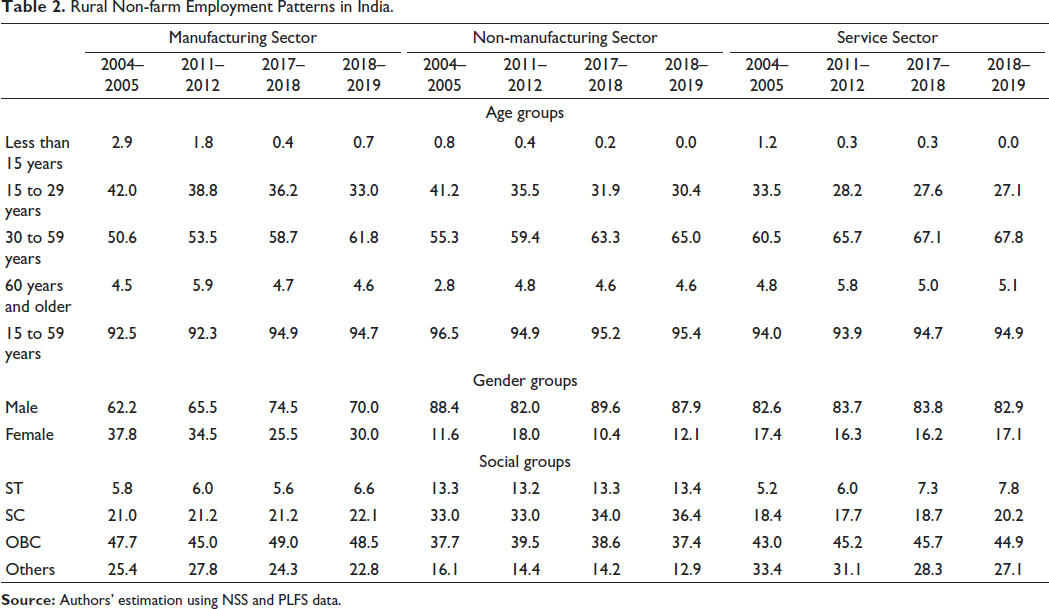
The gender-wise comparison reveals that the share of females in the rural non-farm sector workforce is quite low as compared to their male counterparts across the manufacturing, construction and service subsectors (Table 2). A negligible share of women workers in the rural service sector implies the fact that despite a rise in the mean years of schooling in rural India, young women are still either unable to grab non-farm sector employment opportunities or not getting suitable jobs within their vicinity due to the unavailability of such opportunities (Mehrotra & Parida, 2017).
The social group-wise comparison indicates that the share of employment of Scheduled Tribes (STs) and Scheduled Castes (SCs) is relatively higher in the low-paid construction sector, while the share of SCs and STs is quite low in both manufacturing and service sectors. The social group ‘Other Backward Classes (OBCs)’ holds the highest share of jobs across the non-farm sectors in rural areas, whereas persons belonging to other social groups (classified as ‘Others’) hold the second largest share of non-farm sector employment in rural India.
The Quality of Non-farm Sector Employment in Rural India
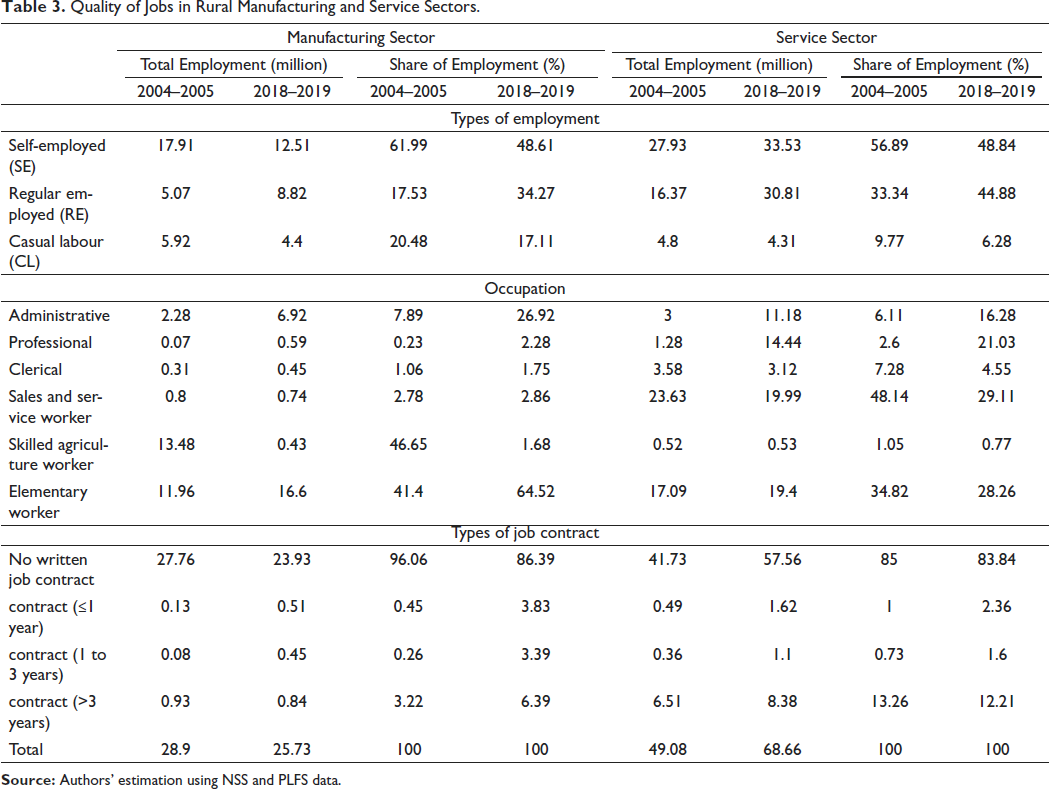
It is also noted that the quality of non-farm sector employment is very poor in rural India. Self-employment constitutes about half of the workforce in both rural manufacturing and service sectors. Though the share of regular salaried employees in both rural manufacturing and service sectors has increased in recent years, a large proportion of them are still found engaged in low-paid elementary occupations and/or without any written job contracts. More precisely, they are employed without any kind of social security benefits (Table 3), mostly with a very low level of real wages. This could be one of the main reasons behind the recent increase in educated youth unemployment in rural India. The educated and trained youth may not consider these jobs suitable according to their human capabilities, and instead, they prefer to remain unemployed for a longer period.
Quality of Jobs in Rural Manufacturing and Service Sectors.
The Indian economy has been passing through a phase of demographic dividend, with a relatively higher share of youth population (mostly educated and trained), for whom an increasing number of quality jobs need to be created. This is necessary to boost the process of economic growth in India. In contrast, the falling overall rural employment due to limited non-farm sector job opportunities is a sign of regressive development. This creates doubt that the process of structural transformation, 3 which began during 2004–2005, might not be sustained over the long run. Hence, it is important to explore the factors which restrict the growth of rural non-farm sector employment in India.
Data and Methodology
Sources of Data and Variables
This article is based on secondary data. The unit-level data from the Employment and Unemployment Surveys (EUS 4 ) and Periodic Labour Force Surveys (PLFS 5 ) of the National Sample Survey Organization (NSSO) are used. These data are used for exploring broad sectoral employment trends and the changing pattern of rural non-farm sector employment. To obtain the absolute number of workers, the Census-projected 6 population (for the respective survey years) is used as an adjustment factor.
To find out the micro-level factors determining an individual’s choice (or preference) for non-farm sector employment, multinomial logit regression models are used. The regression models use the unit-level data collected during the 2004–2005, 2011–2012 and 2018–2019 surveys. Individual and household characteristics, including age, sex, level of education, social group, standard of living, etc. are used as explanatory variables.
Moreover, to explore the macro-level factors determining the growth of non-farm sector employment in rural India, we have estimated System Generalized Methods of Moment (GMM) regression models (using a small panel data set with 29 states and 15 years). Both Difference GMM and panel fixed effect regression models are estimated for comparison. The state-wise macro-level indicators collected from the Reserve Bank of India (RBI) and Central Statistical Organization (CSO) including growth of net state domestic product (NSDP) for each of the non-farm sectors (manufacturing, non-manufacturing and services), growth of non-farm sector wage rate (W), growth of gross capital formation (GCF), growth of length (in kilometres) of state roads (LSR), growth of length (in kilometres) of national highways (LNH), growth of the number of industries, percentage of youth having graduated and above the level of general education (GE), percentage of youth having technical education (TE), etc. are used.
Econometric Tools Used
Since the dependent variable (choice of farm and non-farm employment) is an unordered polychotomous variable (which assumes the value 0 for not employed, 1 for employed in the farm sector and 2 for employed in the non-farm sectors), to find out the factors determining it, we have estimated a multi-nominal logit (m-logit) regression model. Since the interpretation of the estimated coefficients of the multi-nominal logit regression model is a bit complicated, we have estimated the marginal effects of each and every regressor for a relatively easier interpretation. The estimated marginal effects are normally interpreted as changes in the dependent variable (of a particular category) with reference to its base category. The two categories of dependent variables of our interest are non-farm employees and farm employees, as compared to the third category (employed neither in the farm nor in the non-farm sectors). Hence, each of these estimated coefficients is interpreted for the specific category of employment (non-farm or farm) relative to the base category (neither employed). While a positive estimated coefficient means that the corresponding category is preferred, the converse is true in the case of negative estimated coefficients. The estimated results for both male and female samples are given separately in Tables 4 and 5, respectively.
To explore the factors responsible for the growth of rural non-farm sector employment (RNFE), at the macro level, dynamic panel data regression models are estimated. The growth of non-farm sector employment is used as the dependent variable. Since we have a short panel [the number of cross sections (29 states) is greater than the number of years (15 years)], the GMM method of estimation developed by Arellano and Bover (1995), Blundell and Bond (1998) and Roodman (2009) is used. The System GMM model is preferred to pooled OLS, OLS fixed effect (FE) and Difference GMM (developed by Arellano & Bond, 1991) regression models. Because the System GMM method of estimation not only produces unbiased and consistent estimators in the presence of potentially endogenous regressors but also overcomes the possible heteroscedasticity and serial correlation problems in the data. The formal derivation of the System GMM equations is given below:

The dependent variable is the growth of rural non-farm sector employment (RNFE). On the right-hand side, a set of both exogenous (X) and endogenous (M) variables is included. The subscripts j and t indicate the cross section and time period, respectively. The stochastic disturbance term (

Rewriting Equation (1) in the first difference form will produce this:

Equation (2) is used for estimating the Difference GMM regression models. But to obtain the System GMM result, a further modification based on Equation (2) is necessary.


The System GMM is an augmented version of the Difference GMM with an additional assumption that the first differences of instrument variables are uncorrelated with the fixed effects (Equations (3a) and (3b)). This allows the introduction of additional instruments that can substantially improve the level of efficiency (Roodman, 2009).
Furthermore, the System GMM result is checked for robustness using the Arellano-Bond second-order serial correlation (AR) test and Sargan and Hansen identification test. For a model to become robust, the AR test needs to be satisfied (for no serial correlation), along with the Sargan–Hansen over-identification of instruments tests. Based on these tests, it is concluded that the estimated System GMM models are statistically robust. The estimated results are obtained by using both one-step and two-step GMM methods. Moreover, the OLS pooled, OLS fixed effect (FE) and Difference GMM results are also given in Table 6 for comparison.
Econometrics Results and Discussion
Micro-level Factors Determining Farm and Non-farm Employment Choices
For exploring the factors determining an individual’s relative probability of being employed in the non-farm sector or in the farm sector, we have estimated two multinomial logit regression models, separately for men and women. The estimated results are shown in Tables 4 and 5, respectively.
Let’s begin the discussion with the result of the men’s equation (see Table 4). It is noted that the pseudo-R-square is about 0.78. This implies a very good model fit. The coefficients of age and age square, the proxies for job market experience, have reflected statistically significant coefficients. While the coefficient of age is positive, its square reflects a negative sign. This result is as expected, because with increasing age or experience, the labour market participation of people is likely to rise, all else being unchanged. But after a threshold age/experience, the chance of participating in the labour market tends to decline, because of the negative returns to experience. This phenomenon is clearly reflected by the negative age square coefficients. We have obtained the same result for both men and women. This result is consistent with the theoretical arguments of Clark et al. (1979) and Clark and Summers (1982) that the job market experience has a positive effect on the labour market participation of individuals.
Result of Multinomial Logit Regression for Male Equation in Rural India.
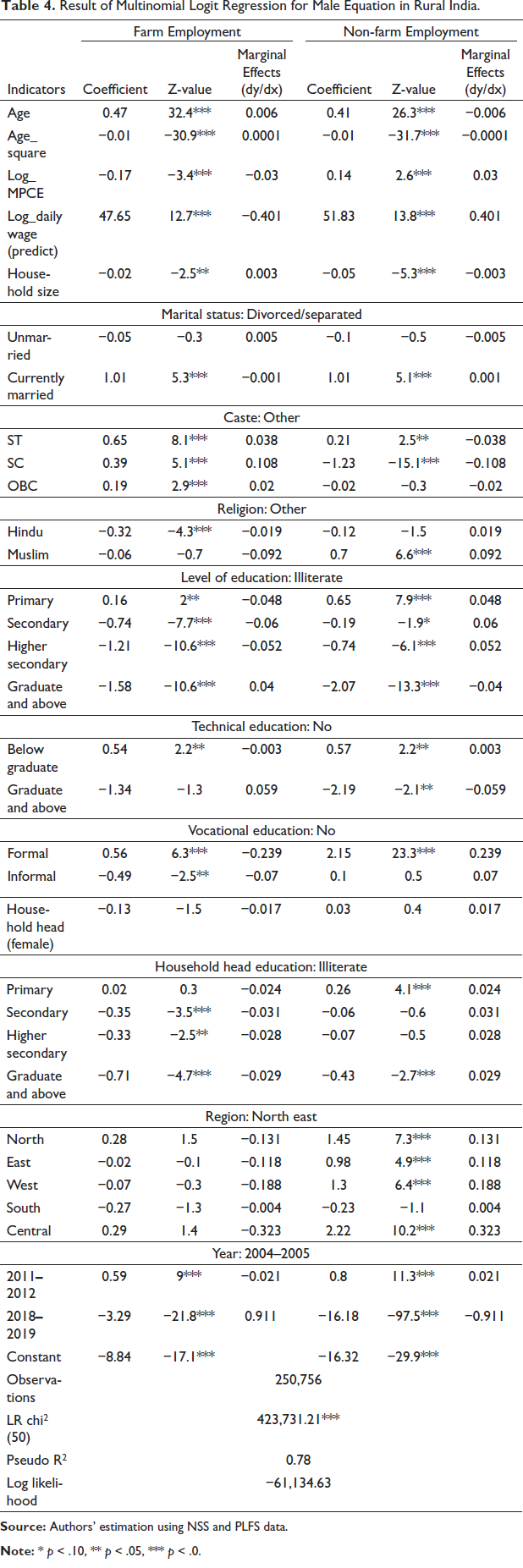
The coefficient of log monthly per capita expenditure (log MPCE) has reflected a positive coefficient in the case of non-farm employment and a negative coefficient in the case of farm employment. This implies the fact that improvements in the standard of living of people have a negative effect on their relative probability of choosing/preferring to farm sector employment (the case of negative income effect). But in the case of non-farm sector employment choice, the reverse is true. That means individuals belonging to economically better-off families are, on an average, more likely to join non-farm sector jobs. This result is consistent with the findings of earlier Indian studies like Lanjouw and Sharif (2004), Lanjouw and Murgai (2009) and Kumar et al. (2020), as well as the findings of studies conducted in Africa and East Asian countries like Hoang et al. (2014), Imai et al. (2015), Zereyesus et al. (2017) and Bui and Hoang (2021). According to these studies, participation in non-farm sector activities helps households to come out of poverty. An improved standard of living for the family enables them to spend a relatively higher share of family income on educating their children (see Kapoor et al., 2021), which later on helps them to go for non-farm sector jobs instead of farm employment.
The coefficients of technical and vocational education dummies also substantiate the above argument. That means individuals with technical (below graduate level) education or formal vocational training are relatively more likely to enter non-farm sector employment as compared to their technically and vocationally unqualified counterparts. However, in the case of general education, the reverse is true. This result is consistent with the findings of Jatav and Sen (2013) and Kumar et al. (2020), which have found that entry to non-farm sector jobs is restricted for illiterates and for individuals without any technical education qualification. We found that even individuals with higher levels of general education are less likely to accept both farm and non-farm sector jobs in India. Instead, they prefer to remain unemployed for a longer period of time (Mehrotra & Parida, 2021). This could be due to the fact that the existing market wage rate in rural India lies below the reservation wage. Otherwise, the existing employment conditions (lack of written job contracts or without social security provisions, etc.) are not acceptable to the young and qualified youth. Hence, the unemployment rate among them is rising instead of their non-farm labour market participation.
The coefficient of the logarithm of wage (predicted) is positive and statistically highly significant in the case of both farm and non-farm employment choices. This finding is supported by earlier studies like Lanjouw and Lanjouw (2001), Sahu (2004), Lanjouw and Sharif (2004), Lanjouw and Murgai (2009), Jatav and Sen (2013) and Kumar et al. (2020). According to these studies, the non-farm sector normally offers relatively higher wages or earnings to an individual as compared to their farm income. As a result, increasing non-farm work participation due to increased non-farm real wages will have a negative effect on the incidence of rural poverty. Hence, it could be argued that policies for increasing market wage rates (whether through an appropriate minimum wage legislation or by any other means) would help not only to attract a large number of educated unemployed youth towards rural non-farm sector jobs but also to reduce rural poverty substantially.
Parental education and their occupation (reflected through their education levels) also play a significant role in determining the individual’s preference for farm and non-farm sector jobs. Individuals whose family head has graduated and is above a certain level of education are relatively less likely to participate in farm jobs. On the other hand, individuals whose family head is either illiterate or has a low level of education (up to the primary level) are relatively more likely to take up farm (though statistically not significant) jobs. This result is consistent with the above poverty argument. Individuals with low levels of education are more likely to enter farm jobs, as non-farm sectors demand relatively better-skilled workers with more formal education or technical or vocational training skills. Hence, the incidence of poverty is also expected to be higher among the workers engaged in agriculture jobs. On the other hand, low-skilled causal employment or self-employment activities in the non-farm sectors also do not require much education. But these low-skilled jobs may fetch a relatively better income. Moreover, regular salaried employment provides much more income than agriculture, but these jobs demand only highly educated and skilled workers.
Since the children belonging to relatively better-off families can afford higher levels of general education and technical and vocational training, their probability of non-farm work participation is higher.
The coefficients of the regional dummy indicate that the growth of mechanization in agriculture (in the northern, western and eastern region states, relative to the north-eastern region states) has caused an increase in the relative probability of non-farm sector employment preference among individuals. This phenomenon has been noted by earlier studies like Himanshu (2011), Mehrotra et al. (2014), Kannan and Raveendran (2019) and Mehrotra and Parida (2019). Particularly, the study of Mehrotra and Parida (2019) has revealed that in the states in which agricultural employment is declining due to rising mechanization, non-farm sector employment is growing, though not adequately to compensate fully for the decline of farm jobs. Hence, in this context, the role of rural industrialization and urbanization measures is crucial for generating an adequate number of non-farm sector jobs.
In the case of the females’ equation, it is also noted that the pseudo-R-square is very high (0.72). This represents a very good model fit again. It should be noted that we have used a few more family-level factors (that partly cover the existing socio-economic and cultural complexities), in addition to the factors already controlled in the case of the men’s equation. Variables including the number of children under the age of two years, the number of adult females within the family, the spouse’s education level, the occupation of the spouse, the earnings of the spouse, etc. are used as extra regressors in the case of the female equation (see Table 5).
Result of Multinomial Logit Regression for Female Equation in Rural India.
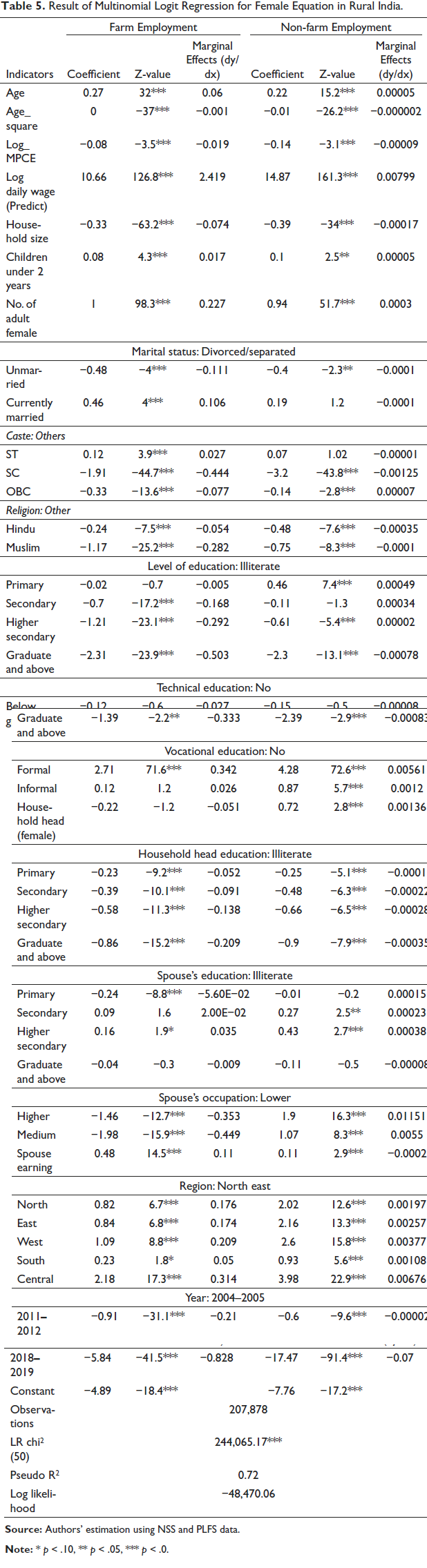
Unlike the case of males, the log monthly per capita expenditure (log MPCE) of females is reflected in negative and statistically significant coefficients in the case of both farm and non-farm employment equations. This implies a negative income effect on female workforce participation in rural India. This result is consistent with the findings of Mehrotra and Parida (2017). This implies that during the period of structural transformation in India, when the standard of living improved with a substantial decline in the incidence of poverty (see Chauhan et al., 2016), the overall female work participation declined considerably. In contrast, the findings of Visaria (1995) and Ranjan (2009) suggest that women’s participation in non-farm activities is distress driven. That means women normally take up both farm and non-agricultural activities to sustain their family income. This might have been the case during the 1990s and early noughties, when the incidence of poverty was very high in India. But our result suggests that with the improvement in the standard of living, in recent years, women’s labour force participation behaviour has changed in rural India.
To counter the negative income effect of female work participation, an improvement in the female work participation rate is necessary. This can be done by strengthening the coefficient of wages, because a relatively stronger positive substitution effect of the real wage rise can upset the negative income effect. As the coefficient of logarithm of wage (predicted) is positive and statistically highly significant in the case of both farm and non-farm employment choices of rural females, an increase in non-farm sector wages will have a knock-on effect on women’s non-farm work participation.
While the coefficients of vocational training dummies reflect positive and statistically significant coefficients, both general and technical education dummies show negative and significant coefficients. This could be due to both supply- and demand-side issues. On the supply side, it could be argued that the skill endowment of generally and technically educated women is not up to the mark. Hence, it could not help them take up non-farm sector jobs during the phase of agricultural transformation and mechanization. Second, on the demand side, the existing market wage rate is below their threshold wage, or the existing employment conditions are not acceptable to them. These factors could restrict them from entering the labour market. Hence, they continue to perform household or family chores. This finding is consistent with the theoretical argument of Hausman (1979), Psacharopoulos and Tzannatos (1989) and Fogli and Veldkamp (2011) that women have relatively higher threshold wages.
Furthermore, the estimated coefficients of education dummies of the head of the family reflect negative and statistically significant coefficients in the case of both farm and non-farm employment choices. This result is consistent with the negative income effect argument. It shows that women belonging to higher economic classes are less likely to take up paid jobs in rural areas. It may be partly because of the unavailability of quality non-farm sector jobs.
The existing social complexity of women’s work participation in rural India is also partly captured by the marital status dummies (negative coefficients), social group and religion group dummies and the coefficient of the total number of adult females in the family (positive coefficients). This result shows that unmarried females are less likely to take up both farm and non-farm sector jobs. Women belong to the Muslim religion and Hindu women also have relatively lower probabilities of work participation as compared to women who belong to all other religions. Moreover, women belonging to socially marginalized caste groups (including STs and SCs) have a relatively higher probability of work participation as compared to OBCs and other caste women. This result is consistent with the findings of Reddy (1979), Andres et al. (2017), Mehrotra and Parida (2017) and Desai and Joshi (2019).
It is also found that women belonging to relatively larger family sizes are less likely to participate in both farm and non-farm sector jobs. Female work participation is also positively influenced by the presence of other adult females in the family. These results are consistent with the findings of Mehrotra and Parida (2017).
However, the positive estimated coefficient of children under two years of age not only contrasts with the finding of Mehrotra and Parida (2017) but is also contrary to the theoretical expectation. Women with children under two years are normally expected to take care of the progeny (due to the existing socio-cultural settings in rural India), and hence, they are not expected to participate in paid work. A positive coefficient in this case indicates that some social transformation might have begun in the rural areas during the phase of structural transformation. This argument is consistent with the findings of Sivakami (1997), which claim that traditionally, a woman’s position has been at home and that, in the past, society denigrated women who worked outside the house. Now, things have changed, and women are beginning to look for work outside the home out of sheer economic need, followed by a desire to improve their financial circumstances, have a reliable source of income, utilize their education, pursue a profession, etc. However, in rural places, impoverished women may go to work mostly out of sheer necessity. This argument is further substantiated by Sonawat (2001), who has noticed a change in family ties and relationships with family in contemporary Indian society due to urbanization and rapid industrialization.
The above arguments are also in line with our empirical evidence. We have found that the coefficient of spouse characteristics, including education, occupation, earning, etc., reflects that women who are married to highly qualified persons or whose spouses are engaged in higher occupations are, on average, more likely to take up non-farm sector jobs instead of preferring to perform only household or domestic chores.
To sum up, it can be stated that an interplay of individual characteristics, household characteristics and the social-cultural setup together influence the employment choices of men and women in rural India. Though social constraints, a household’s economic status and its demographic composition significantly influence the farm and non-farm employment status of women, the level of education and training (skill) and market wage rates are among the key factors that play an important role in determining the employment choices of both men and women in rural India.
Macro-level Determinants of Rural Non-farm Sector Employment Growth in India
At the macro-level, we have examined the factors determining the growth of rural non-farm employment (RNFE) in rural India (Table 6). The comparison of ordinary least square (OLS), panel fixed effect model, one-step Difference GMM (DGMM) and two-step Difference GMM regression results suggests that the result obtained through the System GMM regression method is the most appropriate one, because the estimated coefficients of the lagged (first lag) dependent variable in both the Difference GMM regression equations are smaller (0.38 in the case of the one-step method and −0.09 in the case of the two-step method, respectively) than the coefficients of the lagged (first lag) dependent variable in the panel fixed effect (FE) model (0.60). According to Blundell and Bond (1998) and Roodman (2009), in this case, System GMM regression should be used to avoid downward bias due to weak instrumentation of regression coefficients.
Results of the Dynamic Panel Regression Model.
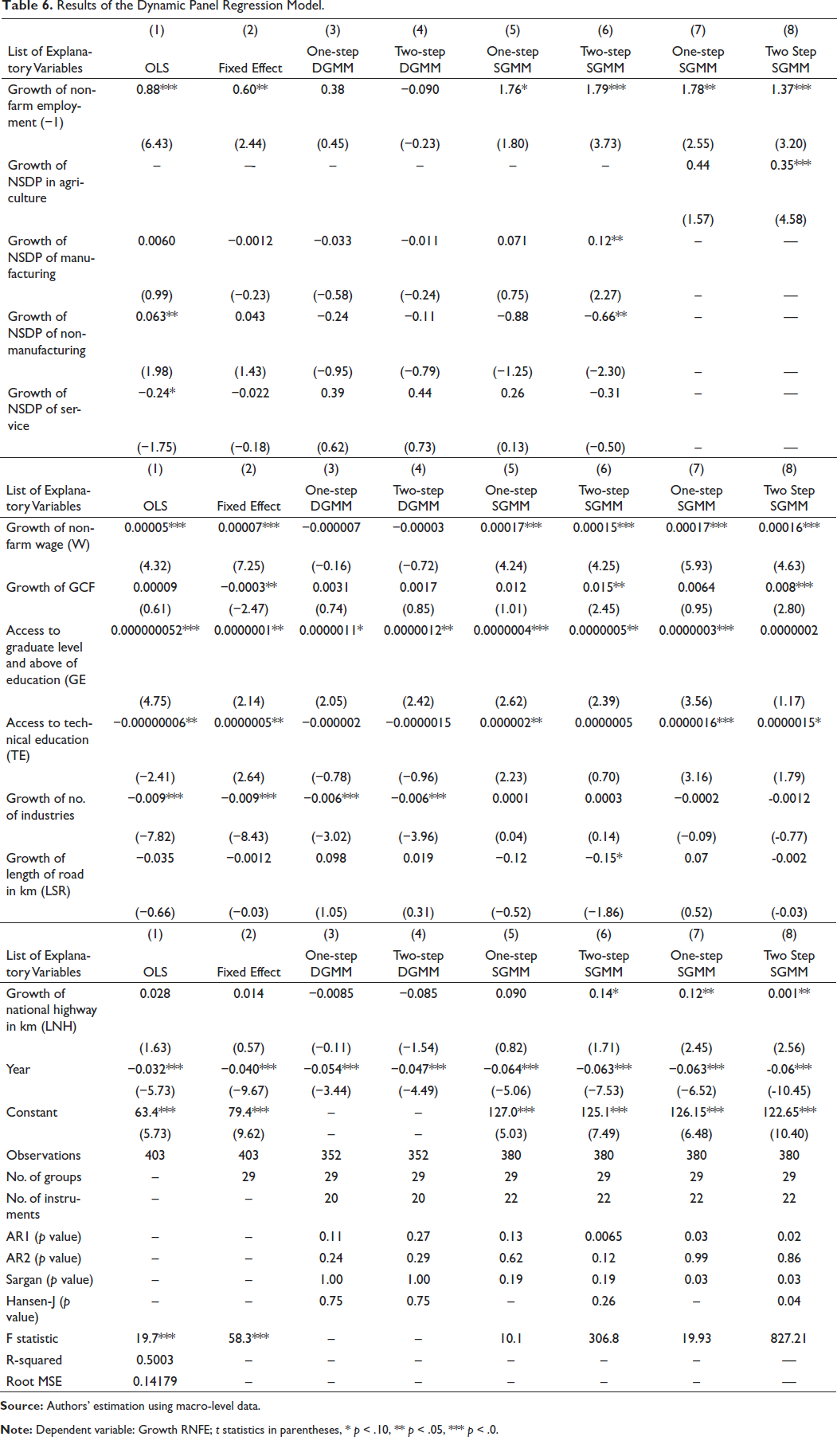
We begin the discussion with the coefficient of the lagged dependent variable (i.e., growth of RNFE (−1)). This coefficient reflects a positive sign, and it is statistically significant. It implies the growth of RNFE in the period ‘t’ is positively influenced by its previous year’s value. Moreover, the growth of the agriculture sector also positively affects the growth of employment in non-farm sectors (Table 7: columns 6 and 7). It might happen due to the existing interlinkages between these two sectors. People who are leaving agriculture due to mechanization look for alternative jobs in non-farm sectors. Moreover, the expansion of output in the farm sector may also help boost the growth of non-farm activities in rural areas. Hence, this dynamic relationship is to be maintained to create more and more RNFE opportunities in the coming years. To do so, investment in education and skill development needs to be increased (at least up to 5 per cent of GDP), along with an increased level of gross capital formation (GCF) to boost the growth of the number of industrial units and non-farm sector wage rates.
The coefficients of access to general (graduation and above level) education (GE) and technical (both below and above graduation levels) education (TE) are positive, but only the coefficient of general education is statistically significant. This implies that increasing access to higher education for rural people will have a positive impact on the growth of rural non-farm sector employment in India. Although the absolute value of our estimated coefficients is very small (0.0000005), this implies a negligible partial impact on the growth of RNFE. It is argued that when it is combined with favourable demand-side factors, it is going to boost the growth of RNFE substantially. Earlier empirical studies in India, including Davis and Bezemer (2003) and Kapoor et al. (2021), have also highlighted that education and technical training play a positive role in the development of the rural non-farm sector. This argument is consistent with the hypothesis of the human capital theory developed by Becker (1962) and Mincer (1984).
For the increasing growth of RNFE, technological advancement is crucial. It is also reflected in our regression estimates. We have found a positive and statistically significant coefficient for the growth of GCF. It implies that a one percentage point increase in the growth of GCF leads to a rise of RNFE by 0.015 percentage points, keeping all other things constant. Studies like Lanjouw and Lanjouw (2001), Haggblade et al. (2010), Binswanger-Mkhize (2013) and Parida (2015) have argued in favour of technological advancements in the process of rural development and the growth of rural non-farm sectors.
In this context, it is also to be noted that an increase in investment in infrastructural development and the growth of industrial units are the need of the hour. This may be done through a pro-industrial growth policy regime that will foster the growth of investment in rural India. We have found a positive (although not significant) estimate (0.0003) of the growth of the number of industrial units on the growth of the RNFE equation (model 6). Moreover, a relatively stronger coefficient growth of the length of the national highway (0.14) suggests its significance (its forward and backward linkages) on the growth of RNFE in rural India. This argument is also supported by earlier studies like, Binswanger-Mkhize (2013), Venkatesh et al. (2015) and Mitra and Tripathi (2021). Moreover, Haggblade et al. (2010) argued that rural non-farm sector growth in India is highly constrained by the limited transport and communications infrastructure in rural areas.
An increase in the rural non-farm sector wage rate is also crucial for boosting the growth of RNFE. This result is consistent with our micro-level results (previous section). An increase in the rural non-farm sector wage rate is going to attract many educated rural youth job seekers to the non-farm labour market, particularly those whose threshold wage rates are higher than the current market wage. Based on our estimated coefficient (0.00015), it can be argued that a one percentage point rise in the overall rural non-farm sector wage rate, on average, can help to increase the growth of RNFE by 0.00015 percentage points ceteris paribus.
Now let’s examine the role of the growth of the non-farm sector output in non-farm sector employment growth. Theoretically, it is expected that the growth of output will have positive impacts on employment growth. Begin with the coefficient of manufacturing output, which reflects an expected positive and statistically significant coefficient. It implies that a one percentage point increase in the growth of NSDP in the manufacturing sector leads to a boost of 0.12 percentage point in RNFE, with all other things remaining unchanged. In contrast, the growth of RNFE is negatively influenced by the growth of output in the non-manufacturing (construction and utilities) sector. This contrasting result may be a reflection of the fact that capital intensity is growing stronger in this sector. However, the growth of service sector output has an insignificant impact on the growth of rural non-farm sector employment. Even though the rural service sector has continuously been registering job growth, an insignificant impact of output on employment shows that the labour productivity in rural service may be very low. It is quite possible due to the prevalence of large-scale informality. Hence, to overcome the problem of joblessness, the growth of industries should be promoted along with the development of infrastructure and the human capital base of the rural economy.
Concluding Remarks
For the last one and a half decades, the number of jobs has consistently been declining in rural India. This decline is mainly due to a massive fall in employment in agriculture and allied sectors (about 4.9 million per annum) and the slow growth of non-farm sector jobs (about 2 million per annum). The falling agricultural employment was due to the growth of automation/mechanization and the rising cost of cultivation (two major pushing factors). At the micro-level, the level of education and skill training, job market experience, wages/earnings, the standard of living of the family, occupation and educational level of the family head, etc. determine the non-farm sector employment preference of males significantly. But in the case of females, the demographic composition of the family, marital status and the complex socio-cultural setups in which they live together play an important role in their work participation decision. Like many other past studies, it is explored that a set of macro-level factors (both demand- and supply-side factors) determine the growth of rural non-farm sectors in India. Among these macro-level factors, the growth of investment in capital goods, the number of factories, investment in infrastructure and road connectivity and the growth of non-farm sector output (the manufacturing sector in particular) are crucial for the growth of non-farm sector jobs in India.
Based on these results, it is argued that improvement of human capabilities through increased investment in education and skill, development of rural infrastructure and road connectivity, along with rural industrialization measures will help to not only increase the non-farm sector output but also boost the growth of quality non-farm sector jobs in rural India. An increase in the number of formal jobs will help boost real wages and reduce the open-educated unemployment problem to a greater extent.
Footnotes
Declaration of Conflicting Interests
The authors declared no potential conflicts of interest with respect to the research, authorship and/or publication of this article.
Funding
The authors received no financial support for the research, authorship and/or publication of this article.
