



Abstract
Even though quantifying the impacts of COVID-19 on jobs and employment has been studied in recent literature worldwide, not much research has attempted to investigate the impacts in terms of employment adjustment, especially during the initial outbreak of the pandemic. Using secondary survey data of 1,320 employees working in the tourism sector in Bhutan as a case study, our multinomial logit model estimations show that female workers were among the most vulnerable group to be asked to reduce some benefits from work, to receive only a partial salary or to leave without pay during the initial outbreak. However, when the situation became more severe (resulting in the laying off of employees), the tourism sector in Bhutan laid off male workers also. Negative impacts on their employment were likely to be found among workers with higher education, the relatively young and married workers. In addition, employment adjustments were also found to vary by tourism sub-sector during initial outbreaks. Workers in the entertainment sector seemed to experience the smallest hit from the initial outbreak since they still received some partial payments or were asked to only temporarily leave their jobs without receiving payment. Some sectors, especially tour guides, tour operations, river rafting and land transport, however, had to lay off their workers during the initial outbreak as those businesses rely mostly on international tourists. This study also discusses the policy recommendations to ensure employment stability during such a crisis in the future.
Introduction
The World Health Organization (WHO) first declared COVID-19 a global health emergency in January 2020, and on March 11 it declared the viral outbreak to be a pandemic, the highest level of health emergency. As infections began rising sharply in late February 2020, governments in many countries took unprecedented steps in March 2020 to lock down social activities in order to contain the spread of the pandemic, inadvertently creating a global economic recession. As a result, the focus of governmental policies expanded from considering the pandemic merely as a health crisis to one of macroeconomic and financial market concern, to be addressed through a combination of monetary, fiscal and other policies, including border closures, quarantines and restrictions on social interactions (Khamis et al., 2021).
The impacts of COVID-19 have been studied since the macroeconomic impact has materialized (Rungcharoenkitkul, 2021), followed by the effects on financial markets and financial assets (Beirne et al., 2021) and impacts on the economic status of individual households (income, expenditure and household poverty) (Martin et al., 2020).
COVID-19 also affected the labour market at large. Globally, workers and their families, especially women and youth, were disproportionately affected, worsening the existing inequalities in the world of work (Carranza et al., 2020). And COVID-19 caused an increase in unemployment in European countries such as Germany, Spain and the United Kingdom (Su et al., 2022). It was also discovered that those who were still employed were working fewer hours, which resulted in reduced purchasing power and an increase in poverty similar to that of those low-skilled workers who suffered the most in this situation. For the most part, the impacts of COVID-19 on the labour force affected workers who were over-represented in the tourism and hospitality industry sector (Fana et al., 2020).
The impacts of COVID-19 on jobs and employment were even more critical for the developing countries, especially in the tourism sector, which often plays a major role in generating their national income. For example, in South Africa, as explained by Rogerson and Rogerson (2020), the country’s tourism sector was devastated by the pandemic, and small and medium-size firms faced bankruptcy and their workers’ layoffs and pay-cuts during the initial outbreak of the virus. During the period from February to April 2020, the rate of unemployment in South Africa was 18 per cent due to the loss of 3 million jobs. On the other hand, India, well known for its unique culture and traditions and a major destination for international tourists, which had seen its tourism sector flourish pre–COVID-19 with 87.5 million jobs comprising 12.75 per cent of the total employment, too experienced negative impacts—about 40 million jobs lost and an annual loss of revenue of around US $17 billion (Jaipuria et al., 2021).
Many studies that evaluate the impacts of COVID-19 on jobs and employment were also conducted focusing on the demand side of the labour market by using firm-level data to understand how businesses adjusted during the initial outbreak. In retrospect, in terms of short-term adjustments, many businesses that were affected by COVID-19 should have adapted their business operations more effectively. And businesses that were unable to adapt should have made plans to sell out or to dissolve themselves entirely. For example, Bartik et al. (2020a) conducted a study on how small businesses adjusted to COVID-19 and found that in the United States they were affected greatly by COVID-19 due to mass layoffs and the closing of businesses (43 per cent of businesses were temporarily closed and the number of employees reduced by 40 per cent). Carnevale and Hatak (2020), on the other hand, focused on employee adjustments and well-being during COVID-19, stressing the challenges faced by workers in terms of changing work environments.
Nevertheless, today’s organizations have to remain alert and adaptive to unforeseen events, such as external crises, which create increased uncertainty among their workforce and pose immediate threats to the organizations’ performance and viability. However, with the recent COVID-19 pandemic, organizations suddenly have to navigate the unprecedented and thereby find new solutions to challenges arising across many areas of their operations. Literature related to the impacts of COVID-19 on jobs and employment were usually conducted on a macroscopic scale, for example, measuring impacts in terms of the number of job losses, the higher rate of unemployment, or the percentage of wage/income reduction. However, managing human resources in an organization during times of crisis must be planned properly in order to retain workers after the crisis subsides. The question here is, should managers have laid off workers permanently or temporarily? Should have they been placed on leave without pay or only with their salaries cut? Or should the firm owner have paid their salary partially until the situation got better? It is crucial for the organization/firm to manage and integrate proper human resource management (HRM) techniques in times of crisis so as to take into account employment adjustments and related issues, such as whether to lay off workers entirely or merely cut their wages or reduce their working hours. Rukumnuaykit et al. (2002), for example, conducted a firm survey in the tourism sector in Thailand during the Omicron outbreak at the beginning of 2021 and found that about 58.8 per cent of business sector crisis survival efforts consisted of reducing wages and other compensation, while 36.4 per cent consisted of reducing the labour force by laying off some workers. This study shows that immediately laying off workers need not necessarily be the first option employed to cut costs during COVID-19. Therefore, during times of crisis, the role of HRM becomes challenging but vital for organizational efficiency (Thumiki et al., 2019).
While the impact of COVID-19 on the tourism sector has been investigated thoroughly in many countries, the analysis of labour markets and employment adjustments during the onset of COVID-19 has been limited, especially with regard to developing countries due to unavailability of data. So far there have not been many studies to explain how labour markets adjusted to an unforeseen crisis once the pandemic began.
The tourism sector in Bhutan generates revenue and foreign exchange earnings and contributes significantly towards socioeconomic development of the country. It creates job opportunities, leads to conservation of the nation’s natural and cultural heritage and contributes to the realization of national development goals. Bhutan’s tourism policy is also unique and different from that of the rest of the world as Bhutan adheres strongly to the policy of ‘High Value, Low Volume Tourism’, which serves the purpose of creating an image of exclusivity and high yield for Bhutan. Under this strategy, the government of Bhutan charges a daily fee of US $250 per tourist during the peak season and US $200 during the low season. This tourism policy represents the government’s priority of balancing the socioeconomic, cultural and environmental pillars of gross national happiness (GNH) by deriving high economic value, while maintaining a relatively low volume of tourists (Nyaupane & Timothy, 2010; Schroeder, 2015).
This research article uses Bhutan as a case study to understand how the initial outbreak of a crisis such as COVID-19 should be handled, ideally, in terms of employment adjustment in the tourism sector. Using secondary data on labourers working in the tourism sector who were surveyed in April 2020 in major tourist provinces, we aim to examine how employment was adjusted during the onset of the outbreak in Bhutan.
There are five sections in this article. In the next section, the literature reviews on impacts of COVID-19 on the labour market will be examined, especially during the onset of COVID-19. The third section explains the data using simple tabulation on COVID-19 effects on employment adjustment in the tourism sector of Bhutan. The fourth section adopts the econometrics analysis and analyses the estimated results, and the fifth section concludes and provides some recommendations.
Literature Review on COVID-19 and the Labor Market
During the global financial crisis of 2008, many countries, including the United States, took into consideration the factors that are important in shaping labour use strategies in the aftermath of the crisis (McDonnell & Burgess, 2013). McDonnell and Burgess (2013) found that while many countries affected by the global financial crisis encouraged employers to lay off workers, most European Union member states provided support to labourers who had lost their jobs by providing them with training for alternative employment. Similarly, in these European countries, as Fabiani et al. (2015) explained, firms were not willing to cut the base wages of employees during the initial phase of the financial crisis. But in order to protect jobs in the long term and avoid laying off permanent workers, wage cutting was implemented, but only as a last resort. Moreover, firms paying out larger proportions of worker compensation as flexible pay components were less likely to cut base wages and more likely to cut employee bonuses and flexible pay. But during the 2008 global financial crisis, millions of workers were in fact laid off, and many experienced either pay cuts or cuts in other benefits as enterprises sought to reduce labour costs to remain afloat (Verick, 2011).
Most studies on labour markets conducted during the onset of COVID-19 have focused on job losses and types of businesses (Bartik et al., 2020a, 2020b; Chetty et al., 2020). For example, it was found that younger workers experienced disproportionate job losses and that female workers seemed to be more likely to exit the labour force altogether (Lemieux et al., 2020). Moreover, there was an increase in unemployment insurance claims (Dang et al., 2020). As stated by Bartik et al. (2020a, 2020b) and Coibion et al. (2020), in the United States, over 20 million people lost jobs and the unemployment rate increased from 3.5 to 14.7 per cent in April 2020, resulting in an increased number in unemployment insurance claims. Similarly, low-wage workers were more likely to have experienced the largest drop in employment, and firms that were previously unstable were not only likely to shut down during the initial phase of COVID-19 but were also less likely to restart their business after recovery. In terms of types of employment affected, by the end of April 2020, 50 per cent of the drop in employment had come from restaurants and hotels, while more than 20 per cent had come from services such as repair and maintenance, personnel services and laundry (Bartik et al., 2020a, 2020b).
Another study by Lemieux et al. (2020) was conducted to review the initial impacts of COVID-19 on the Canadian labour market. The authors focused on variables such as changes in employment and aggregate working hours between February and April 2020 and found out that due to COVID-19 and shutdowns/lockdowns, working hours among workers aged 20–64 years declined by 32 per cent of aggregate weekly work hours, which caused a 15 per cent decline in employment. The most severely affected were those who worked in jobs that required interacting with the public, especially younger workers paid on an hourly basis and not belonging to a union (Lemieux et al., 2020).
The COVID-19 pandemic imposed a challenge on HRM with regard to the adjustment of the work place. For example, Carnevale and Hatak (2020) conducted a study on employee adjustment and well-being in the era of COVID-19 and pointed out the adjustments that employees had to make as a result of changing working conditions—such as shifting to a remote work environment or abiding by new workplace policies to reduce the interpersonal contact. On the other hand, van Zoonen et al. (2021) discovered that during the onset of COVID-19 in Finland, certain structural factors (higher work interdependence and clarity of job criteria) made it easier for employees to adjust to a remote work setting that lacked the familiar relational factors (interpersonal trust) that are negatively related to the adjustment to remote work. The employee may feel less satisfied and effective as trust serves as an important interpersonal function in the form of support and socialization, which may ultimately lead to lower level of adjustment to remote work.
As for the case of COVID-19, Carnevale and Hatak (2020) explain the challenges employees faced during the pandemic and the implications on HRM when an organization requires employees to change their work environment. Similarly, van Zoonen et al. (2021) have also investigated the factors influencing adjustment to remote work by examining structural factors such as work independence and the clarity of job criteria as mechanisms underlying adjustment to remote work.
For the most part, the recent literature has focused on the impacts of COVID-19 and their implications on firms and employees in general. But the employment adjustments necessary in the tourism sector during the onset of COVID-19 have not yet been thoroughly investigated. Therefore, this study will analyse the employment adjustments within the tourism industry in Bhutan and will recommend policies to mitigate problems during such crises. The next section will explain the data and methodology used in conducting this study.
Data and Methodology
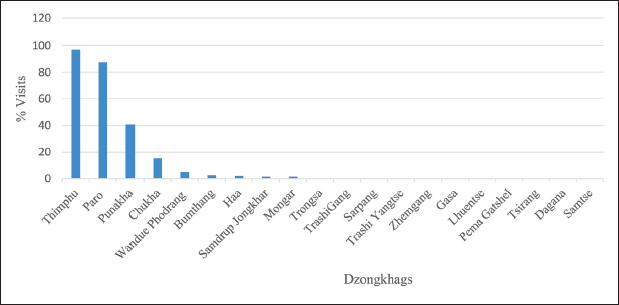
We used secondary data from the Rapid Socio-economic Impact Assessment, conducted by the National Statistical Bureau (NSB), in collaboration with the Ministry of Labour and Human Resources (MoLHR), Tourism Council of Bhutan (TCB), Gross National Happiness Commission (GNHC) and United Nations agencies, in April 2020. A total of 1,320 respondents were selected from labourers working in the tourism sector in five major tourism-destination districts (or so-called Dzongkhags in Bhutan), namely Thimphu, Paro, Punnakha, Bumtrang and Chukha. According to the Tourism Council of Bhutan (2018) and indicated in Figure 1, the actual number of tourist visits were found to be concentrated in only four districts—Thimphu (96.84 per cent), Paro (87.26 percent), Punakha (40.75 percent) and Chukha (15.3 percent). Out of the total number of 274,097 visitor arrivals to Bhutan in 2018, the majority were from India (69.99 percent) followed by the United States (3.85 percent), Bangladesh (3.81 percent) and China (2.51 percent) (Tourism Council of Bhutan, 2018).
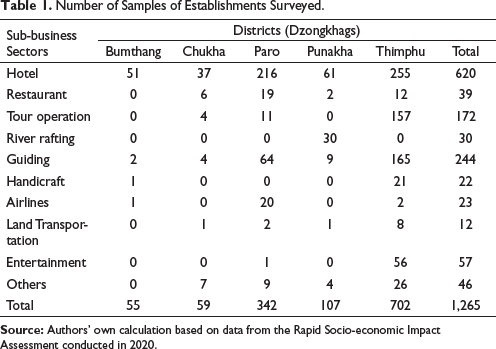
In the survey, target populations were stratified in those five districts and classified into nine tourism sub-sectors, which included hotels, restaurants, tour operations, guiding, river rafting, handicrafts, airlines, street vendors and entertainment. At the time of the survey, interviews were conducted by telephone due to social distancing requirements. Sampling tabulation of sub-sectors and districts are shown in Table 1.
Number of Samples of Establishments Surveyed.
From the survey data shown in Table 2, impacts on employment status due to the initial outbreak of COVID-19 were tabulated by socioeconomic factors, namely gender, age, marital status and education level. The dataset shows that around 43.60 per cent were female and 56.40 per cent male. A majority of labourers in the tourism sector in Bhutan (77.21 per cent) were relatively young (18–35 years old), followed by 36–60 years old (21.69 per cent). The majority of the respondents were married (62.78 per cent), followed by those who were single and widowed/separated/divorced (32.31 and 4.91 per cent, respectively). In terms of education, just as in other countries, the majority of labourers working in the tourism sector in Bhutan had a secondary degree (51.91 per cent), followed by 23.73 per cent with a bachelor’s degree and above (23.73 per cent) and 10.82 per cent who had completed only primary school or less.
Status of Employment During COVID-19 by Socioeconomic Factors (Percentage).
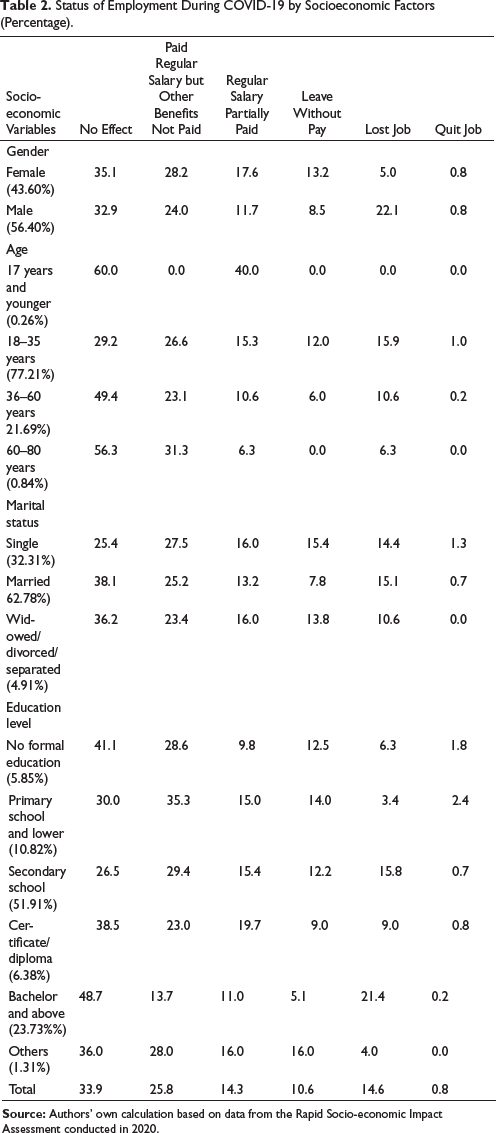
By reflecting on the effects COVID-19 had on their own employment during the initial outbreaks in April 2020, respondents could select from among the following relevant survey categories: (a) no effect, (b) still receive regular salary but other benefits not paid, (c) regular salary partially paid, (d) leave without pay, (e) lost job and (f) quit job. A majority of respondents reported ‘no effect’ (33.9 per cent) since the survey was conducted during the initial outbreak of COVID-19; quitting one’s job (0.8 per cent) seems to be the least popular choice because at the beginning of the crisis, workers did not have much time to look for new jobs. The tabulation shows that during the onset of the outbreak, firms did not sack their workers immediately but, on the other hand, tried to mitigate the impacts of the pandemic on their businesses by reducing benefits, then reducing regular wage payments and then asking workers to leave temporarily (without pay).
Tourism workers in Bhutan were paid differently at the beginning of the pandemic. For instance, some of the workers were paid a regular salary but none of the other benefits that they were entitled to receive, some were paid a regular salary but partially, some were placed on leave without pay and some either lost their job or had to quit their job. Female participants (28.2 per cent) received regular pay without benefits more so than did the 24 per cent male workers. However, male workers were more likely to lose their job entirely (22.1 per cent) compared to their female counterparts (5 per cent). Male employees seem to have been harder hit by the pandemic compared to females in terms of losing benefits and receiving partial regular pay, while the main impact on females was being placed on leave without pay.
The younger population seems harder hit as compared to the older age groups, especially in terms of receiving pay without benefits and receiving only partial payment. For instance, while only 26.6 per cent workers in the younger age group (18–35 years) received payment without benefits, 31.3 per cent of those in the 60–80 age group did so. Teenage workers (17 years and younger) received only partial payment compared to older age groups.
With regard to marital status, workers with single status seemed harder hit than those who were married or widowed/divorced/separated. Comparing married workers to single and widowed/separated/divorced cases shows that proportionately fewer married workers were placed on leave without pay (7.8 per cent) and that a majority of them received either regular pay without benefits or partial payment.
In terms of education, respondents with lower education reported negative impacts on their jobs compared to those with higher education. For example, only 5.1 per cent of the respondents who had completed their bachelor’s degree or above were asked to leave without pay, while 12.5 per cent of those with no formal education, 14 per cent with only primary education and 12.2 per cent with only secondary education were asked to leave without pay.
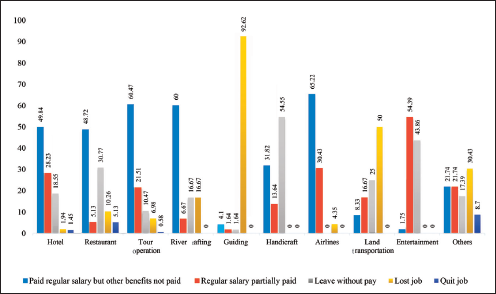
Figure 2 shows the status of employment during the onset of COVID-19 by tourism sub-sector, namely: (a) hotels, (b) restaurants, (c) tour operation, (d) river rafting, (e) guiding, (f) handicraft, (g) airlines, (h) land transportation, (i) entertainment and (j) others. Results indicate that effects on individuals’ employment also varied according to which tourism sub-sector employed them. Most workers in the airline industry (65.22 per cent), for example, received their regular salary without other benefits, as did 60.47 per cent of those in tour operation and 60 per cent of workers in river rafting (60 per cent). Losing jobs, on the other hand, was found to be the highest for tour guides (92.62 per cent) and those working in land transport (50 per cent). Workers who were asked to leave without pay were found prominently in the handicraft sector (54.55 per cent), followed by the entertainment sector (43.86 per cent) and restaurants (30.77 per cent), respectively.
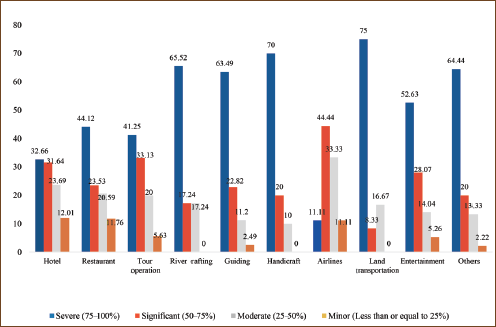
COVID-19 affected tourism employment because businesses experienced severe losses of income due to travel restrictions. Figure 3 presents the severity of income loss among tourism workers according to which sector they worked in. By classifying employment in terms of sub-sector, the initial impact of the pandemic could be seen to affect the severity of income loss differently. The categories are: (a) Severe (75–100 per cent), (b) significant (50–75 per cent), (c) moderate (25–50 per cent) and (d) minor (less than 25 per cent). Severe loss (75–100 per cent) was experienced by workers in almost all sub-sectors especially land transportation (75 per cent), handicraft (70 per cent), river rafting (65.52 per cent) and others (64.44 per cent).
From the statistical analysis discussed above, we cannot make definitive conclusions about employment adjustments from the onset of COVID19 because the tabulation does not control for other important variables, such as the socioeconomic variables of gender, education, age and tourism sub-sectors. Otherwise, the tabulation shows biased results. Moreover, this analysis needs more statistical testing to ensure its confidence level. Therefore, in the next section, the econometrics technique is employed to solve the bias problems due to the absence of a control variable and build credibility by explaining statistical relationships and econometrics. It will be explained further in the next section.
Econometrics Estimation
This study adopts an econometrics model to statistically test the status of employment adjustment of tourism workers during the initial outbreak of COVID-19 in Bhutan. The independent variables include socioeconomic factors such as gender, age (and age2), marital status, education and tourism sub-sector controlled variables. Since the dependent variables have multiple outcomes of employment impacts (no effect, paid regular salary but other benefits not paid, regular salary partially paid, leave without pay, lost job and quit job), we employ the multinomial logistic regression model to see the outcome chosen from the list of independent variables. The marginal effects were estimated to interpret the probability on those outcome variables (Perraillon, 2019).
There are nine estimated models shown in Table 3. ‘No effect’ from COVID-19 was used as a reference variable in Models 1–5 while estimating multinomial logit regression with reference to socioeconomic factors (age, age2, gender, marital status and education level) without controlling for the sub-sector. This ‘no effect’ variable, however, cannot be used further as a reference outcome when we control the sub-sector variables since the survey has no further questions, including asking for the sub-sector from those who answered ‘no effect’. In this case, for Models 6–9, ‘Paid regular salary but other benefits not paid’ was then used as a reference variable while estimating multinomial logit regression.
Estimated Results from the Multinomial Logit Model (Marginal Effect).
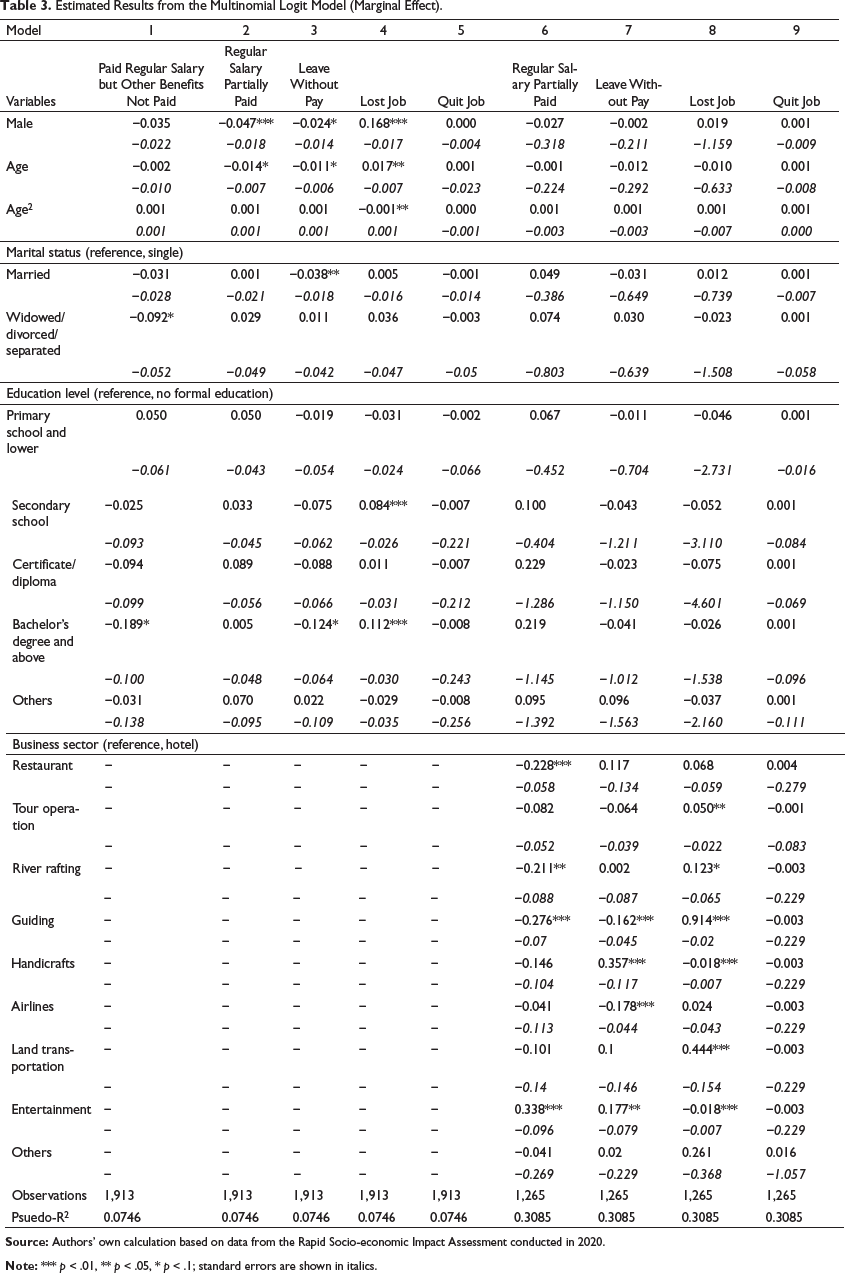
Overall, compared to ‘no effect’, female workers are more likely to receive regular salary without other benefits, to receive partial payment and more likely to leave their job without receiving payment more than their male counterparts. This can be explained by the fact that those female workers were the first group for which the tourism businesses were more likely to reduce some benefits, pay only a partial salary or ask them to leave without pay, compared to males during the initial outbreak. However, when the situation became more severe (resulting in having to fire employees), businesses had more tendency to lay off male workers. Our estimated coefficients show that male workers had a 16.8 higher probability than did females for losing their jobs, compared to ‘no impact’—with a statistically significant 99 per cent confidence level.
In terms of age, when their age increases by one year, tourism sector employees in Bhutan are less likely to receive regular pay without benefits and partially paid salary. Moreover, as their age increases, workers are also less likely to opt for leave without pay. In addition, compared to single workers, married workers are found to have 3.8 per cent lower probability to leave without pay and 9.2 per cent widowed/divorced/or separated workers are found to have being paid regular salary but no other benefits with statistical significance at a 95% confidence level.
It is quite interesting when it comes to the educational level. We discovered that highly educated workers (compared to those with no education) were more likely to lose their jobs during the initial COVID-19 outbreak. Our estimated coefficients show that those workers with bachelor’s degrees were about to have 11.2 per cent higher probability of losing their jobs than those with no formal education. This finding is consistent with a study from Fabiani et al. (2015), in which firms usually adjust their labour cost by reducing wages or hiring. Those with greater qualifications and educational background cost firms more than do those with less education. Firms were more likely to save costs by laying off their most highly educated employees. According to Figure 2, which shows that job losses were found mostly in the guiding sub-sector, we can also imply that the majority of highly educated workers (having at least a bachelor’s degree) work as tour guides, thus making their jobs totally dependent on the number of tourists. Given the absence of tourists during the pandemic, the tour guides were left with no work and firms wanted to cut costs by laying them off.
For the business sector shown in Models 6–9, due to the outbreak of COVID-19, workers in the entertainment sector were least affected from still receiving some partial payment compared to those working in the hotel sector. Our estimated coefficients show that those working in the entertainment sector had about 33.9 per cent higher probability for receiving partial payment compared to those working in the hotel sector, with a statistical significance at a 99% confidence level.
As for more severe outcomes, employees who were more likely to be asked to leave their jobs without receiving payment tended to be in the handicraft and entertainment sub-sectors, with higher probability of 35.7 and 17.7 per cent, respectively, compared to those working in the hotel sector. Due to the lack of tourists in the country, handicrafts businesses had to shut down, and businesses had no other option than to release workers without pay.
With regard to the most severe outcome, losing one’s job, we found that those working in the guiding, land transportation, river rafting and tour operation sectors were impacted the most from the COVID-19 pandemic, compared to those working in the hotel sector. This is because revenue from those four businesses were completely dependent on international tourists rather than domestic travellers and tourists. Guiding and land transportation are complementary businesses that are generally packaged together in tours for international tourists. So, without foreign tourists, it is no surprise that workers in both sectors had to be laid off (this finding is statistically significant at a 99 per cent confidence level). Similarly, in the case of river rafting, due to the physical distancing containment measures, such businesses had to be closed for both foreign and local tourists. Bottom line: the tour operation business is completely dependent on foreign tourists, and without them, they have no income to run their business, and thus, workers employed under them were more likely to lose their jobs.
Airline workers were less likely to have to leave their jobs without pay and enjoyed a 17.8 per cent lower probability of having to leave without pay compared to hotel workers. This was mainly due to the redeployment of staff, especially in the case of staff working for the private airlines. [In Bhutan, there are only two airlines, Drukair (Bhutan Airlines) and Tashi Air (a private airline).] Approximately 50,737 hoteliers, tour operators, guides and homestays were affected due to the pandemic as they depended on tourism for livelihood. There was zero revenue brought in by private airlines as flights were grounded for months, so the private airline had to redeploy staff to other companies in order to continue to be able to pay them. Out of 203 staff, 38 employees were redeployed in the first phase and about 40 workers working in India, Thailand and Nepal were laid off without pay.
For those working in restaurants, even though the restaurant business does not rely only on international tourists, all restaurants in big districts were asked to temporarily close (or serve only online orders and pickups) during the country’s lockdown, which is why restaurant owners had no choice other than not paying worker salaries. The estimated coefficient indicates that workers in the restaurant sector had a 22.8 per cent lower probability than those working in the hotel sector of receiving partial payment.
Estimated results from Table 3 show that employment adjustments were found to vary by sector during the initial COVID-19 outbreak. Some sectors (entertainment) still needed to employ some workers, so those workers received some partial payments or were only asked to temporarily leave their job without receiving payment. Some sectors, however, had to unfortunately lay off their workers during the initial outbreak as their businesses mostly relied on international tourists, businesses such as those working in guiding, land transportation, river rafting and tour operation. The hardest hit from the outbreak of COVID-19 were those working as tour guides, as they were less likely to receive partial payment as well as more likely to lose their job entirely.
Due to different impacts, our results also show that workers therefore need different kinds of support from the Bhutanese government. This can be discussed in our last section.
Conclusion and Policy Recommendations
The WHO first declared COVID-19 a global health emergency in January 2020, and on March 11 it declared the viral outbreak to be a pandemic, the highest level of health emergency. As infections began rising sharply in late February 2020, governments in many countries took unprecedented steps in March 2020 to lock down social activities in order to contain the spread of the pandemic.
COVID-19 also affected the labour market at large, especially in the tourism sector, which plays a major role in contributing to many countries’ national income. Nevertheless, the literature related to the impacts of COVID-19 on jobs and employment has usually been conducted on a macro-scale, measured, for example, in terms of the overall number of job losses, a higher rate of unemployment or a percentage of wage/income reduction. However, managing human resources in an organization during times of crisis must be planned properly in order to retain workers after the crisis. The question here is, should the managers have laid off workers permanently or temporarily? Should they have been placed on leave without pay or only with an allowance cut? Or should the firm owner have paid partial salaries until the situation improved. This study, therefore, investigated the employment adjustment during the initial outbreak of COVID-19 by using workers in Bhutan’s tourism industry as a case study.
Using secondary data from the Rapid Socio-economic Impact Assessment (2020), a total of 1,320 respondents were selected from labourers working in 10 tourism sub-sectors in five major tourism-destination districts—Thimphu, Paro, Punnakha, Bumtrang and Chukha. We found that, compared to ‘no effect’, female workers were more likely to receive their regular salary minus other benefits, to receive partial payment and to be laid off with no payment more than did their male counterparts. Female workers were also the first group for whom tourism businesses were more likely to reduce some benefits, to pay only partial salary or to ask to leave without pay during the initial outbreak. However, when the situation became more severe (requiring some employees to be laid off), businesses were more likely to lay off male workers. Other negative impacts on employment were likely to be found among those workers with higher education, the relatively young and married workers.
Employment adjustments were found to vary by sector during the initial outbreaks. Some sectors (such as land transport) still needed to employ some workers, so those workers received partial payments or were asked to temporarily leave their jobs. Some sectors (namely river rafting, airlines, tour operation and restaurants), however, unfortunately had to terminate their workers’ employment altogether during the initial outbreak as their businesses relied almost exclusively on international tourists, who were no longer coming to Bhutan.
Results from Table 3 indicate that working women were more affected by the initial outbreak of COVID-19 in terms of receiving their regular salary minus the usual benefits and of receiving only a partial salary compared to their male counterparts. Therefore, it is crucial for the government of Bhutan to provide assistance to such women as they become more vulnerable in the context of such a crisis, especially in the short run. In addition, support to sectors that have been most affected due to the lack of international tourists (namely tour guiding, tour operation and land transport) is also necessary.
Based on data from the questionnaire that asked about the kinds of support workers (classified by sector) need from Bhutan’s government, Table 4 shows the largest proportion of workers preferred training to acquire new skills, getting unemployment benefits and rent support from the government. Since women were the first affected group in terms of having their benefits reduced and receiving only partial compensation for their work, the government of Bhutan should therefore give them special consideration by providing rent support or unemployment benefits in the short run. On the other hand, when the situation becomes severe and also affects males, in terms of losing their jobs, it is crucial to provide them with training to upgrade their skills and knowledge.
Government Support Need Classified by Sector (Percentage).
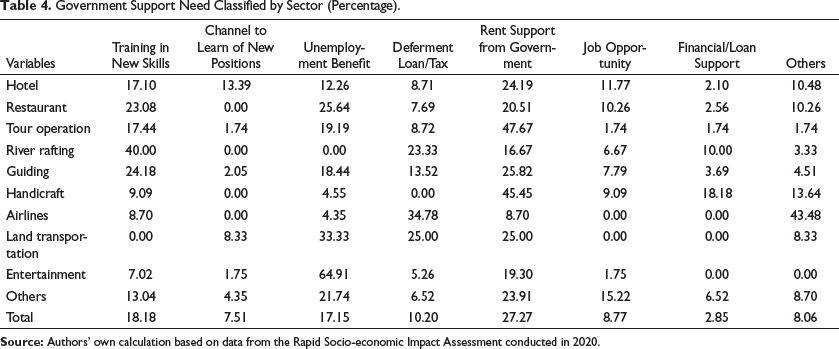
Table 4 indicates that 64.91 per cent of employees working in entertainment preferred unemployment benefits, followed by 33.33 per cent of those working in land transportation and 28.57 per cent of restaurant workers. Similarly, offering laid-off workers training to acquire new skills was the most popular option chosen by the employees in the river rafting and guiding sectors. Workers in tour operations (46.2 per cent) and handicrafts (41.67 per cent), on the other hand, chose getting rent support from the government as their first choice. This is because, tourism sector employees have been badly affected by the pandemic and thus may have to go on leave without pay and thus not be able to pay their rent and meet daily living expenses. Therefore, such workers have indicated the highest preference for unemployment benefits. Other workers, however, think that job opportunity and financial/loan support from the government are not really important or necessary support because they hope to resume their work after the pandemic.
As Bhutan strongly ascribes to a GNH goal rather than merely pursuing gross domestic product, it is crucial to implement policies regarding unemployment benefits and rent support during crises such as the COVID-19 pandemic, especially for those who earn low wages, thus taking into account their survival and well-being.
His Majesty the King Jigme Singye Wangchuck announced the Druk Gyelpo’s Relief Kidu grant (income support by the king to individuals whose livelihood has been affected by COVID-19). And our findings here provide policy recommendations with regard to the types of necessary government support during times of such crisis.
Finally, we must note that there are a number of limitations in this research project. First, data used in this study were collected from a survey taken during the initial outbreak (April 2020). Thus, we cannot quantify the total impact on employment over the multi-year course of the pandemic and are therefore limited to focusing on the impacts from the initial outbreak only. Second, there are a number of omitted variables, which is problematic in terms of our econometrics model. This is because the questionnaire was administered in a rapid survey fashion, which did not allow for a number of socioeconomic characteristics to be included. In addition, we would also like to recommend that future researchers undertake a study of some of the other important indicators besides the employment adjustments to a crisis such as COVID-19. These include effects on health and other aspects on the lives of vulnerable groups during COVID-19 as well as impacts on economic growth. Moreover, conducting an analysis of the effectiveness of government measures and policies aimed at protecting employees and businesses from such a crisis is also crucial for future planning.
Footnotes
Declaration of Conflict of Interests
The authors declared no potential conflicts of interest with respect to the research, authorship and/or publication of this article.
Funding
The authors received no financial support for the research, authorship and/or publication of this article.
This research paper is part of Rinzin Choden’s master thesis for her graduation from National Institute of Development Administration. Her thesis was completed under the supervision of Piriya Pholphirul.
