



Abstract
The harsh treatment of carers by the UK Department for Work and Pensions (DWP) is the focus of this article. By prioritising fraud detection rather than beneficiary well-being, the administration of the Carer's Allowance (CA) payment, or more specifically the overpayments saga, has to date caused considerable social harm. Our analysis of it shows striking similarities with the Australian Centrelink's automated debt raising and recovery system, the Online Compliance Intervention (Robodebt). In this article, we take a first step in delineating core attributes of structural violence, to explore if they are present in the CA overpayments saga. The findings show that what has been unfolding manifests as a form of structural violence, belying any reductive framing of it as a digital welfare scandal, an isolated case of maladministration, a bureaucratic over-reach or a faulty algorithm in need of correction. The findings make us reckon with how welfare states can become imbued with a violence, rooted in their culture and systems, that serves the prevailing political, social and economic order. It is anticipated that by elucidating key attributes of structural violence, what is overwhelmingly an explanatory theoretical concept may have greater relevance and usefulness for future empirical study in the welfare and social security fields.
Introduction
Notwithstanding welfare states’ capacity to buffer individuals and families against the worst extremes of poverty, a golden age of welfare provision never truly existed (Wincott, 2013). Welfare provision was never solely about looking after the poor; rather it was the required product of the unequal economic relations of capitalism (Gough, 1979). For socialism to be restrained and class conflict mitigated in the interests of capitalism, the welfare state was instrumental for social order rather than equality, for appeasement of the working classes and the reconciliation of labour with business interests (Flora and Heideheimer, 1981; Gough, 1979). While the societal beneficiaries of the welfare state nowadays are numerous, it is the ‘poor on welfare’ who are consistently targeted for vilification and scrutiny and who must submit to human, as well as technically and legally fraught systems of scrutiny, monitoring and surveillance, to prove their worthiness (Kiely and Swirak, 2022; Van Toorn and Soldatic et al., 2024).
The global economic crisis of 2008 provided a critical opportunity for European governments to deflect attention from the causes of the crisis by actively framing the problem as one of over-subsidised welfare requiring urgent corrective action (Vidra, 2018). Social classist and, in some countries, racist tensions were fuelled in the interests of undermining solidarity between hard-working taxpayers and welfare claimants (Meade and Kiely, 2020). The rhetoric of the binary of the productive and the parasitic, with its constitutive and disciplinary functions, played a critical part in many countries in creating conditions ripe for the pursuit of a determined punitive welfarism underpinned by conditionality and workfare (Meade and Kiely, 2020; Vidra, 2018). Welfare fraud discourse intensified and government campaigns bent on detecting and preventing welfare fraud seemed little concerned with the rights and welfare of those they subjected to investigation (Adler, 2016; Ranchordás and Schuurmans, 2020). The political value of welfare stigma was reflected in the increasing reference to welfare fraud language in political and media discourses, to such an extent that welfare fraud became increasingly depicted as ‘welfare as fraud’ (Chunn and Gavigan, 2004: 220). The establishment over the last few decades of in-house welfare fraud policing units, has allowed criminal justice logics and their associated data analytics to become deeply embedded in state welfare systems, enhancing capacity for fraud detection work, a trend that is evident across many countries (Stenström, 2021; Van Veenstra et al., 2021; Zajko, 2023).
As technologies are harnessed to bring welfare provision into the 21st century, new systems, we are told, will enable better decision-making, streamline welfare delivery and render it more efficient and more impregnable to discretion, circumvention or deception. For some, it provides the vital ingredient for a progressive reinvention of the welfare state (Huws, 2020). However, in 2019, the United Nations Special Rapporteur on extreme poverty and human rights, Phillip Alston, called on states to avoid stumbling zombie-like into a digital welfare dystopia (United Nations, 2019). As he saw it, the impetus behind the emergence of the digital welfare state was a desire on the part of governments to reduce spending, to limit beneficiaries and services, to generate profit for corporate interests and to surveil and monitor welfare recipients toward modifying their behaviours. He forecasted that the age of the digital welfare state would be marked by a reversal of state accountability towards the individual and greater antagonism to individual human rights. In hindsight, Alston's concerns were very well-founded, in the face of several national scandals which have followed. For instance, the Dutch Government's SYRI (Systeem Risico Indicatie
Aside from scandals, as states embrace digital solutionism, material inequalities are exacerbated and the most marginal find themselves further excluded or subjected to demeaning coercive income management strategies (Bielefeld, 2018). The proliferation of predictive analytics and algorithmic decision-making, in diverse social welfare fields, have been found to encroach upon individuals’ and families’ human dignity and rights, to further divert attention from structural inequalities (Edwards et al., 2022; Redden, 2020; Van Bekkum and Borgesius, 2021) and to embody disciplinary technologies of monitoring, regulation, management and control (Hodgetts et al., 2014). Research studies highlight democratic deficits at the heart of so many state-driven digitalisation initiatives in social policy and, at the very minimum, there have been calls for a much stronger reassertion of democratic, accountable, ethical, critical and human-centric approaches to underpin future iterations of digital welfarism (Jørgensen, 2023; Redden, 2020; Van Zoonen, 2020). With these considerations in mind, the question this paper seeks to answer is if the CA overpayments saga is a disastrous technical systems failure of digitised welfare, or if it constitutes a significant form of structural violence, which has anti-welfarism at its core?
Structural violence
The concept of structural violence that emerged in the late 1960s (Galtung, 1969) recognises the violence built into societal structures, and how this violence reveals itself in unequal power relations and unequal life chances (Galtung, 1969: 171). It has been further defined by Chrobak, (2021: 175) as ‘…the intentional or unintentional violation or limitation of the rights of individuals or groups resulting from systemic conditions. These conditions might occur within institutional, cultural or social systems.’ As noted by Chrobak (2021), while structural violence can potentially cause as much pain or suffering as direct or personal violence, it can be hidden by a veil of bureaucracy, repetition or routine and have no identifiable perpetrator. Springer and LeBillon (2016: 2) observed that structural violence tends to have a processual and unfolding quality as distinct from one single act/outcome orientation. It means that persons impacted may not necessarily experience a direct act of violence, rather the violence is meted out in a way which leaves them suffering over time, when that suffering is preventable. Similarly, Canning (2017: 48) states: ‘where there is capacity for people to live free from suffering, but no political will exists to implement change to alleviate such suffering, structural violence is present.’
Because structural violence is underpinned by the social order (Galtung, 1969), the fight against it can be difficult as there may be little general awareness of it; it may not be necessarily visible, or it may not be recognised as violence at all, thus eliding analysis of it as a structural phenomenon. As observed by Bourgois and Scheper-Hughes (2004), structural violence is often not perceived as deviant and can even be considered moral when it serves sectional material interests and conventional norms. Galtung (1969) recognised as structural violence the inequalities that are inherent to the capitalist economic system, when its resources are so unevenly distributed, as is the power that decides their distribution. It follows that to study the mode of capitalist production is to study the operation of violence, because capitalism is bound up with relations of domination and exploitation. Capitalism can be seen to be based on violence but it also perpetrates violence. This is evident in the technological advances underlying capitalist intent for increased profit-making and the search for efficiencies. Tyler (2022: 263) describes instances during the height of the Industrial Revolution and the rise/subjugation of the working classes, where ‘…people broke machines in protest at their pauperisation and dehumanisation by the capitalist machine’. For those caught in the maul of these machines, they were experienced not as technologies of improvement or progress, but as ‘hell itself’ (Tyler, 2022: 263). This example from a previous time of rapid and intensive technological progress reminds us that progressive technologies aimed at increasing efficiencies – be it those of capital or welfare – can be experienced as harmful by those at the receiving end of these ‘efficiencies’, leading us to the question that if there are efficiencies, who do they serve and at what cost are they achieved?
In society, the state is a key arbiter in deciding whose lives flourish. It is through the mechanism of the welfare state, that a state exercises power by providing security and care but also by withdrawing, withholding or limiting such provision and by making critical decisions pertaining to its administration. Those in receipt of social assistance are persons whose positions are ones of structural vulnerability. In exchange for payment, they have little choice but to acquiesce to demands for information and to endure intrusions into their privacy and all kinds of indignities in the name of administrative accountability (Siliunas et al., 2019). Structural violence is perpetrated by the state against poor people when they are negatively impacted and harmed by state laws, policies, use of resources and practices, even when these are ostensibly designed to assist them (Monahan, 2017). Structural violence can be embedded in the logic and administration of the welfare state and, by extension, the neoliberal 1 and digitalised welfare state. As we see it, the underlying rationale that makes social service provision as private economic enterprise, and social security as algorithmic automation, even acceptable as contemporary manifestations of welfare reform can be ultimately one of structural violence, particularly if the welfare and dignity of users and recipients are significantly impacted. As such, when they cause service users to suffer, the tools and mechanisms, whether analogue or digital in the context of the welfare administration, can be understood as part of the invisible and ‘…mundane, everyday business’ of ‘…the detached administration of violence’ (Cooper and Whyte, 2017: 4).
Methodology
The concept of structural violence is not without its critics, and chief among the criticisms levelled at it as a concept for use in empirical research, is that it operates as something of a ‘black box’ or a catch-all category offering ‘more moral heat than analytic light’ (Wacquant, 2004: 322). The intention to develop an empirically validated theorisation of the concept was never realised, and so the argument that the term can become over-extended in its application to cover all kinds of social injustice that vary in magnitude is not without merit (Herrick and Bell, 2022). Drawing on the literature on structural violence, as a starting point, we have delineated five core attributes that, we propose, if present concurrently, indicate that structural violence is occurring. We hope that by elucidating these attributes, we are helping to operationalise an explanatory concept to make its application more meaningful. The first of these is that the victims of structural violence are living in conditions of significant social and economic inequality and that they are denied the opportunity to ameliorate their financial straits; the second is that they encounter impossibly inflexible and oppressive bureaucratic culture or regulations which have the effect of denying them their dignity and personhood; the third is that they are threatened with, or made to experience criminalisation and punishment; and the fourth is that they suffer adverse outcomes. Finally, the fifth is that opportunities that could be taken to alleviate or stop their suffering and to prevent the adverse outcomes are known, but deliberately not taken, permitting their suffering to continue over a prolonged period.
We explore whether the attributes identified above are present in the CA overpayments saga. We also undertake a comparative analysis to show the parallels between the CA overpayments saga and OCI / ‘Robodebt’. This bolsters our argument that digitalisation can be put to work in the service of the welfare state to do what is expected of it in capitalist society: to police and to punish as much as to provide. The CA overpayments case study relies on data such as that provided by the Carers UK reports, House of Commons Work and Pensions Committee reports and oral evidence, House of Commons questions and answers, National Audit Office reports, media articles 2 and research reports, supplemented by academic sources where they were available.
Before drilling down into the specifics of the CA overpayments case, the lack of recognition and value given to care work in capitalist welfare state societies merits discussion. It makes it easier to understand why the financial support the British state provides to those whose time is predominantly spent in the care of others is so inadequate over time as to leave many of them structurally disadvantaged and living impoverished lives. This heightens the risk that the CA recipient is from the outset at risk of structural violence, because of the high opportunity costs of caring and the lack of value assigned to the work of care in capitalist societies.
Care work and the welfare state
Economists and feminists have long argued and shown that in all spheres of social reproduction – our homes, communities, health, education and social services – care work is devalued and exploited (Fraser, 2016; Lynch, 2009). The economy of care is highly mixed, as it includes the state, private entities and the highly paid, but also significant numbers of low paid and unpaid persons (Skeggs, 2014). The extraction of profit from care is evident in many countries, as for example in Ireland where most of the long-term elder care is now delivered by for-profit entities, a development actively assisted by Irish government policy from 2006 onwards (Mercille, 2024). In the context of a growing care crisis, particularly in countries of the global North, global care chains connect poor societies to wealthier ones in highly unequal ways, through the movement of people and capital via households, hospitals and businesses, underlining the centrality of care relations in the global political economy (Muehlebach, 2012).
It serves states to ignore the interdependency of human life across generations, to disregard that care giving and receiving are categories that are not mutually exclusive, and that are subject to complexity and changeability (Herd and Meyer, 2002). Over time, we have seen policy proposals to retain working carers in paid employment, such as replacement care (Pickard, 2019), or we see the practical application of a wide range of diverse surveillance and assistive technologies (e.g. automating care via caregiving robots and pets) taking hold in the care and welfare domains. If welcomed for the opportunities they offer to reduce the cost of carers leaving employment to care, or to improve care efficiency and to extract more surplus value from an underpaid and stretched workforce, they are also a striking manifestation of a contemporary crisis in care. As Hoppania and Vaittinen (2015: 83) argue, care in the neoliberal economy, no matter how much it is commodified or the human conduct in this domain rationalised or mechanised, continues to disrupt the ‘neoliberal household’ which ‘… is full of bodies entangled in corporeal relations of care: bodies that sit uneasily with the economic role assigned to them’.
The UK Carer's Allowance: setting the context
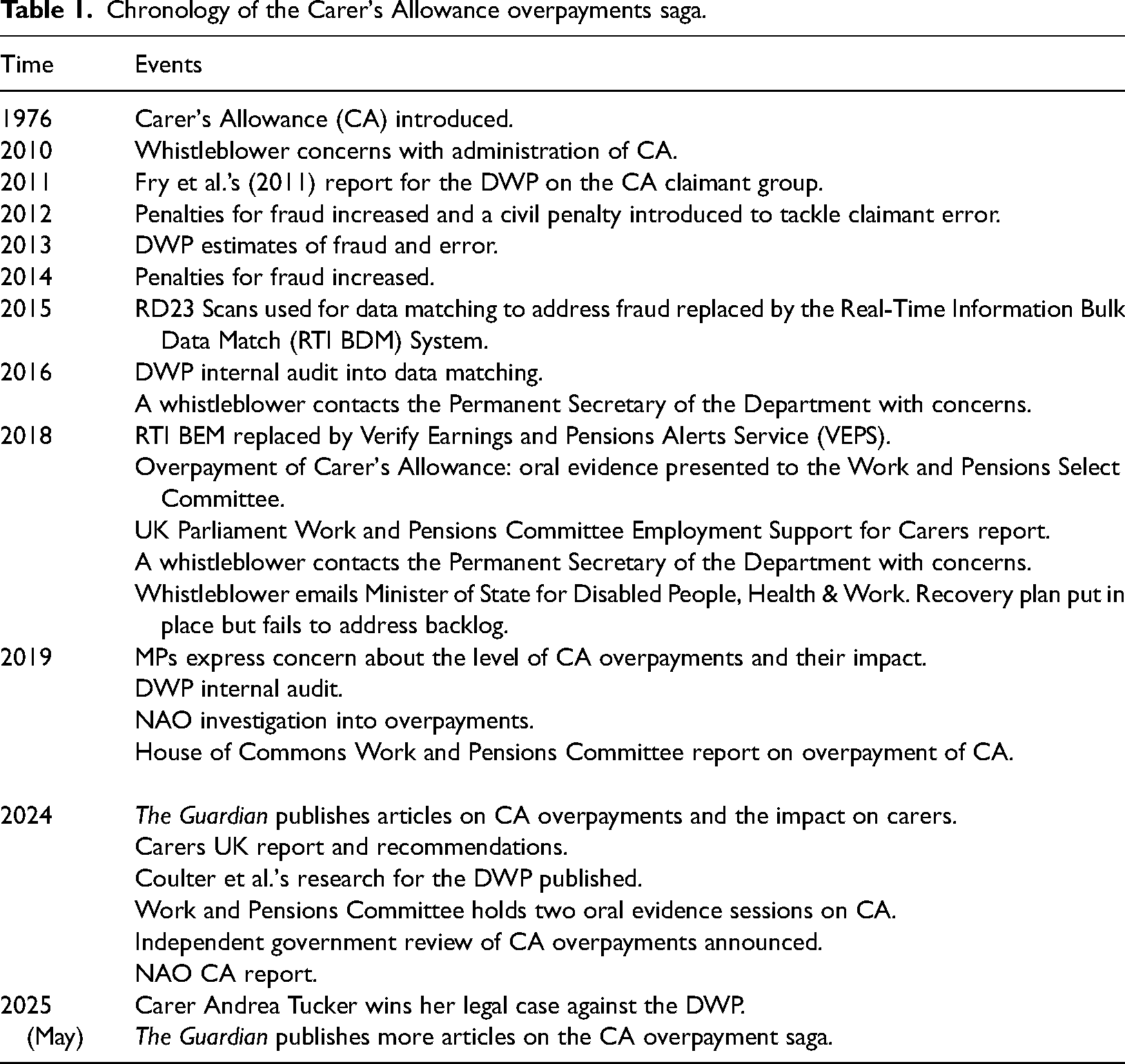
There are 5.8 million carers in the UK, based on data from the 2021 Census (Carers UK, 2024). 60% of carers report a long-term health condition or disability compared to 50% of non-carers (Carers UK, 2021). Over one million carers claim the CA, a payment of £83.30 weekly (Government UK, 2025) at the time of writing. One of the eligibility criteria is that the claimant must provide 35 h of care work a week and cannot earn above a limit of £196 per week (excluding tax, social insurance and other expenses) (Government UK, 2025). If a claimant earns more than the weekly limit, they stand to lose the entire payment, and earning as little as £1 extra a week makes one ineligible for the entire benefit. Persons are advised that they must report changes in their circumstances to the Department for Work and Pensions (DWP) if they are applying for or claiming the allowance, and one of these circumstances is if they start to earn more than £196 a week. The National Audit Office (2019) reported a 50% increase in claimants between 2011 and 2019, and as a result the expenditure on CA increased in real terms from £1.6b in 2007–08 to £2.9b in 2017–18 (NAO, 2019). Carers’ organisations have long argued that the CA payment to carers was insufficient to meet its stated purpose of providing a replacement income for those who gave up work or work less due to caring. Despite many reports over time being critical of many aspects of the CA, little changed in relation to the key features of the payment (Kennedy and Gheera, 2020). On 7 October 2018 and again in 2024, The Guardian reported on the plight of carers who found themselves facing fines and criminal prosecution, owing to moves by the DWP to recoup CA overpayments. On 16 October 2024, 14 years after initial concerns were raised and when confronted with the ongoing fallout from the saga, Liz Kendall – Labour Government Member of Parliament and Work and Pensions Secretary – announced plans for an independent government review to be completed in summer 2025. This review is inquiring into how the problem of overpayment transpired and it is expected to identify the changes required to mitigate future overpayment risk and to support persons with overpayment debt (Department for Work and Pensions, 2024). In April 2025, the weekly payment was increased slightly from £81.90 to £83.90 and the weekly earnings threshold from £151 to £196. In Table 1, we provide a chronology of key events critical to understanding the CA overpayments saga. This is followed by a closer examination, to explore whether the five key attributes of structural violence are present in what has been unfolding.
Chronology of the Carer's Allowance overpayments saga.
Attribute no. 1: carers live in conditions of social and economic inequality
In 2011, a study of the CA claimant group drew attention to the low sum of money paid to them at the time, while also finding that for many families it provided a much-needed source of household income, helping to cover the bare necessities (Fry et al., 2011). In this study and in Coulter et al.’s (2024) research conducted for the DWP, some claimants reported that they thought the low level of payment reflected the undervaluing of their care work, and that it made them feel less worthy than others. Research commissioned by Carers UK yearly found that the pressures of juggling and struggling bring many claimants close to breaking point (Carers UK, 2024). The Joseph Rowntree Foundation reported that the rate of poverty of those in receipt of the payment had doubled in the decade between 2013 and 2023 (Joseph Rowntree Foundation, 2023). Coulter et al.’s (2024) research conducted for the DWP in 2021, but not published until 2024, profiled CA claimants, showing that they occupy positions of structural vulnerability. Claimants were mainly women (72%) and over half (54%) lived in low-income households (earning £20,799 per annum or less before deductions) (Coulter et al., 2024). They were predominantly lowly educated and in poor health, with two in five (40%) having a long-term health condition. Most cared for close relatives (Coulter et al., 2024). When confronted with an overpayment and in a context of a lack of flexible working opportunities, some carers left work entirely or stopped claiming, and others reduced their paid working hours to avoid the stress of going over the earnings limit and the risk of overpayment (Carers UK, 2024). It was noted by the House of Commons Work and Pensions Committee (2018) that the loss of potential earnings caused financial difficulties for carers, putting them at a much higher risk of poverty than non-carers. The long-recognised poor social and economic circumstances of carers, together with the state's inaction over many years to sufficiently raise the earnings threshold and the CA payment itself to keep pace with the National Living Wage, provides evidence of the first attribute of structural violence.
Attribute no. 2: a bureaucratic culture and regulations denying dignity and personhood
The operation of the payment and the regulations and requirements imposed by the DWP on claimants, as well as its bureaucratic culture, are emblematic of the second attribute of structural violence. Unlike other benefit payments that gradually taper off, going above the earnings limit in the case of the CA means that persons lose the whole payment, the so-called ‘cliff-edge’ problem. Fluctuating earnings (typically associated with zero-hour contracts and shift work), extra hours worked to replace an absent co-worker, receipt of bonus pay or a backdated pay rise, are just a few of the reasons as to why claimants fall foul of the earnings limit, often without their knowledge (Carers UK, 2024). For those whose pay is irregular, the averaging method used by the DWP to calculate earnings lacks transparency and can be poorly understood by claimants (Carers UK, 2024).
The DWP consistently reiterates its position that it is the responsibility of claimants ‘…to consistently inform the DWP of any changes in their circumstances that could impact their award, and it is right that we recover taxpayers’ money when this has not occurred’ (Halliday and Butler, 2024). Yet the DWP knew from the research conducted with claimants in 2021 that compliance activity would be challenging for claimants, as one in ten (9%) did not have access to the internet and a sizeable minority reported a lack of confidence in completing online forms (36%). At this time, several suggestions were put forward as to how the Department could make it easier for claimants to engage with it (Coulter et al., 2024). Again in 2024, claimants faced with overpayments reported a litany of problems engaging with the DWP. They stated that providing information about their changed circumstances did not prompt the required action by the Department. Others contacted one section of the DWP about their changed circumstances, to find that this was never conveyed to the required section (Carers UK, 2024). There were claimants who telephoned but failed to make direct contact with the required section and instead were left on hold for long periods; some of those who were successful in making contact reported that they did not get to speak to someone who was sufficiently knowledgeable to assist them (Carers UK, 2024). In the same report, several claimants with debt acknowledged that they struggled from the outset to understand how the rules of the earnings limit worked. If seen in isolation, these incidents could be interpreted as administrative inertia, but in the round, they amount to a bureaucratic culture that prioritises systemic accountability over genuine public service.
The DWP has persisted in calculating the earnings averaging weekly rather than monthly; if their earnings were calculated monthly or over a year, carers could exceed the average net income over one or more weeks yet still be within the rules. The DWP has not acted on recommendations to resolve the cliff-edge problem or to change the mode of assessing earnings in a way that would be more favourable to claimants (House of Commons Work and Pensions Committee, 2019a). The whole payment is clawed back for each week that a carer is in breach. As the DWP has never had sufficient staff to investigate all the overpayment alerts and to notify claimants concerned when breaches have occurred, debts are accrued unknowingly, sometimes over years. In 2019, the National Audit Office calculated that a carer on benefits or a state pension with a CA overpayment debt of £20,000 – of whom there were 133 in March 2019 – could be paying the Department back for a period of 34 years (NAO, 2019). The DWP chose not to act on recommendations made by the House of Commons Work and Pensions Committee (2019) to assess the impact on claimants’ lives of having to make such repayments.
Throughout, there is evidence of a clear lack of regard for public service and a culture in the DWP that shows little care for carers or the views of their advocates. The overall purpose of the automation used is to detect overpayment as the critical first step to withdrawing payment and recouping debt, which is often left to build up over time. It is not focused on administering a much-needed payment, which the DWP knew (from research it commissioned and which was completed in 2011) made a real difference in the lives of its recipients (Fry et al., 2011). While claimants expressed a wish to engage with knowledgeable human agents capable of empathising and understanding the specifics of their situation and guiding them appropriately, there was evidence that this was not necessarily what they encountered. In Coulter et al.’s, (2024: 56) research for the DWP, accounts were reported similar to this one from a woman interviewed: ‘It's like you're dealing with a computer, not a person. I ended up with a big overpayment, but it totally wasn't my fault. It's like they don't believe you.’
Attribute 3: criminalisation and punishment of claimants
The impacted claimants constituted from the outset a suspect population, as is shown in communications they had with the DWP about overpayment. In Coulter et al’s (2024) study, they reported being spoken to by the DWP staff ‘as though they had intentionally committed fraud’. Similarly, carers who participated in the Carers UK (2024) study also reported being made to feel like criminals who should be punished (Carers UK, 2024). Small compliance penalties, larger administrative penalties and pursuit for prosecution under the Proceeds of Crime legislation are all tools in the DWP's fraud and error toolkit. In 2018–19, the Department applied 1253 administrative penalties, a 46% increase on the average of 860 over the previous four years (NAO, 2019: 24). The National Audit Office (NAO) found that, as of March 2019, the DWP was seeking to recover a total of £150m from just under 80,000 carers, yet it had only actually recovered £22m between 2018 and 2019 (NAO, 2019: 16). During this time, it was widely accepted that overpayments could be easily and unwittingly racked up by carers if they did not notice their earnings fluctuating or increasing and if they were not informed by the Department (Bland, 2024; House of Commons Work and Pensions Committee, 2019a; NAO, 2019). The NAO (2019) took note that only 10% of identified cases were either referred to the Crown Prosecution Service or had received an administrative penalty – an alternative to prosecution. This showed awareness that cases were often more attributable to error than to fraud, yet the threat of legal action meant claimants were still treated in a criminalising and punitive way. The Guardian newspaper reported that 134,000 carers were making repayments to the DWP in 2024, in some cases of as much as £20,000, and in a small number of cases, criminal prosecutions were being pursued (Butler and Halliday, 2024). The NAO (2024) reported that CA debt recovery had increased from £19.6m in 2018–19 to £47.3m in 2023–24. It reported a significant drop from the previous years in referrals for prosecution and administrative penalties (from 246 between 2018–19 to 54 in 2023–24, and from 774 in 2018–19 to 75 in 2023–24 respectively). Yet, the number of 75 administrative penalties in 2023/24 was still an increase compared to each of the years starting with the 2020/21 financial year. The value of administrative penalties rose from £114.4k to £140.8k from 2020/21 to 2023/24, and civil penalties from £0.747m to £1.506m during the same period (UK Parliament, 2024b). Taken together, the issuance of civil and administrative penalties and the pursuit of criminal prosecution constitute the third attribute of structural violence.
Attribute 4: adverse outcomes that can be prevented yet are not
As of 13 May 2024, 134,800 people had an outstanding CA debt, twice as many women as men (UK Parliament, 2024a). Confronted with the shock of an overpayment debt, some carers cut back on their paid work or left their employment altogether to avoid the stress associated with the risk of overpayment (Carers UK, 2024). Through deductions to their other state benefits to pay the debt, some carers were left to struggle more and fall deeper into poverty (Carers UK, 2024). The considerable personal distress caused to individual carers was well documented. For instance, one carer quoted in the The Guardian newspaper commented that she was ‘… forced to repay £2100 in carer's allowance and “made to feel like a fraudster”. She added: “I couldn’t eat or sleep. I lost weight. I was on antidepressants. I was terrified I’d go to prison. I’m still traumatised, years later. It's a terrible system. It feels like a trap”’ (Halliday and Butler, 2024). Carers UK provided a testimony from Hilary, who having resigned from work to care for her son – who required frequent hospitalisation – ran into debt due to monthly royalties she received for content she had written while working. She drew attention to the ‘cruelty’ built into the system that ‘kind of rubs you out as a person…you are so vulnerable on that kind of land…their systems are so labyrinthine you don’t know how to navigate them’ (Carers UK, 2024: 11). Sleeplessness, stress, inability to eat due to anxiety and suicidal ideation were identified as only some of the harms endured by those faced with overpayment debt, who provided testimonies (Carers UK, 2024). The fact that claimants suffered adverse effects was also accepted by the NAO (2019) and the House of Commons Work and Pensions Committee (2019a) in their reports. The adverse outcomes resulting from claimants’ experiences reveal the ripple effects of structural violence.
Attribute 5: continuing the violence
The fifth attribute of structural violence is seen in the DWP's repeated failure to address meaningfully the problem of overpayment: firstly, it has allowed the maladministration that causes the known suffering of so many to persist over time, and secondly, it has failed to act on whistleblower concerns and on external recommendations designed to alleviate the suffering. The cliff-edge feature of the payment was raised as a problem as early as 1991 (McLaughlin, 1991), and a Parliamentary Committee called for its removal in favour of a taper system in 2018 (UK Parliament, 2018), a call that was ignored by the DWP. The issues arising with the administration of the payment were first identified as a significant concern by an internal whistleblower in 2010 (House of Commons Work and Pensions Committee, 2019a), who proceeded to make two formal complaints in 2016. This was followed by two internal Department audit reports in 2017 and 2019, but the DWP refused to have further contact with the whistleblower in 2017 (NAO, 2019). The picture that emerged from the House of Commons Work and Pensions Committee Report (2019a) was one of the DWP allowing the problem to persist and overpayments to escalate despite knowing the hardship and stress it was causing to those impacted (House of Commons Work and Pensions Committee, 2019a). While in 2019, the Department was requested by the same Committee to put in place diverse measures to reduce the burden of responsibility placed on CA claimants (House of Commons Work and Pensions Committee, 2019a), the DWP, in response, only undertook to introduce an enhanced notification system so that claimants could better fulfil their responsibilities to it.
The DWP claimed that the introduction of an improved flagging system in 2019 was designed to solve the problem, and this system was heralded by the Department as likely to produce additional savings of £136m by 2025-26, due to reductions in frauand error (NAO, 2019). Fast-forward to April 2024 and May 2025, and reports in The Guardian show that many carers had yet again unwittingly racked up considerable overpayment debt by the time they were made aware of it (Butler and Halliday, 2025; Halliday, 2024; Halliday and Butler, 2024). When the DWP was asked by The Guardian to comment on reports of the stress impacting carers, a spokesperson referred to the increase in the amount of the payment over time since 2010 and reiterated the Department's commitment to ‘… fairness in the welfare system, with safeguards in place for managing repayments, while protecting the public purse’ (Halliday and Butler, 2024). The procedural unfairness in the debt detection and recovery has not prompted any movement. Rather, the Department on occasions has used the evidence of the harm caused, not to disband the system or to change direction, but to give it a green light to continue and to strengthen its resources and operations. Such was the DWP's persistence, that the House of Commons Work and Pensions Committee Report (2019a: 6) called on the Government to set out an action plan to improve the DWP's capacity to listen to its own staff, its customers and the advocacy organisations. In the same report, the Government as well as the DWP was called to task for not making any of the changes that the House of Commons had sought in its 2018 report. When the Permanent Secretary for the DWP was asked repeatedly, when giving oral evidence to the House of Commons Work and Pensions Committee (2019b), if he was willing to apologise to the claimants impacted, he declined, preferring instead to reiterate that the DWP's priority was to optimise the opportunity for claimants to report their changed circumstances and to correct past problems using a better technological system. He stated: ‘There is more opportunity now with the new technology under VEPs that the report describes. There are daily alerts. … We can prevent overpayments in some cases before they happen. … When you have better technology, it means it is worthwhile putting resource on to that because it is going to be a more effective use of resource.’
In April 2025, a government inquiry is underway, all overpayment alerts have to be checked and when required, claimants must be duly notified. In addition, the weekly earnings limit has been raised from £151 to £196. While such developments are welcome, the cliff-edge issue has not been addressed. There are also legitimate fears that as more resources are devoted to checking alerts, the upshot will be increased detection of overpayments allowed to build up over time, with more negative implications for carers. The continuation of the known harm, combined with the other four attributes, provides further support for an understanding of the Carer's Allowance overpayments saga as an instance of structural violence.
Parallels with ‘Robodebt’
Drawing on accounts of the Australian Online Compliance Intervention (OCI), pejoratively known as ‘Robodebt’ (Carney, 2019; Whelan, 2020; Whiteford, 2021), we can discern key similarities, which point to the systemic and intentionally harmful effects of data driven-digital welfare compliance management. Firstly, as with the DWP initiative, the OCI was a Big Data initiative, matching reported income to tax records to recoup welfare overpayments (Whelan, 2020). Like the OCI, the DWP consistently dresses up its highly politicised system in the discursive cloak of greater efficiency and potential cost savings. It too uses income averaging in a way that has a significant negative impact on claimants, occupying their time and making them responsible for doing the work of monitoring their earnings, preventing and detecting any overpayment themselves and informing the Department lest they run up a debt that has to be paid back. Interventions from the NAO and the House of Commons Work and Pensions Committee in 2019, calling for a part of the process to be automated so as to benefit claimants, were ignored. With radical indifference to carers’ capacities and circumstances, labour is outsourced to them, a constituency who undoubtedly juggle and struggle to integrate paid labour with caring responsibilities. At the same time as claimants with limited resources are expected by the DWP to enact their responsibility to be efficient administrators of their own finances and to develop the mastery to execute this responsibility, the DWP shows itself, as highlighted by the NAO (2019) and the House of Commons Work and Pensions Committee (2019a), to be recalcitrant and careless over time in undertaking its own human service and administrative work.
Common to both cases are a significant lack of transparency and a lack of genuine public service, as well as the presence of ‘whistleblowers’ who from the outset, and repeatedly, made their concerns known up the chain of command but without the desired effect. Accessing a human decision-maker, and the correct one to act on the information they were giving the DWP, proved challenging for claimants. In both instances, what was very likely to happen was foreseeable, and there were also points where useful intervention could have made a difference. This suggests, as Whiteford (2021) and Henman (2025) argue in relation to Robodebt, that the malfeasance was intentional. Accounts from the carers impacted and the vigour with which the DWP pursues repayment under threat of prosecution, reveals that accidental overpayment is taken as evidence of fraud, in the mode of ‘guilty until proven innocent’, also a feature of ‘Robodebt’ (Whelan, 2020). Rather than the DWP doing the work to prove the debt, the claimant is presumed guilty, told that they owe the debt, and the onus is placed on them to be able to prove otherwise. The passing of a long period of time, sometimes as long as 10 years, reduces the prospect that persons have the required proof to contest the debt. It reveals the disrespect afforded to the claimant in producing a premature truth about them. A clear illustration of this is the DWP's legal pursuit of carer and part-time charity-shop worker, Andrea Tucker. She showed a tribunal which ruled in her favour in February 2025: that as she calculated it, her average yearly income over five years was permissible within the rules; that she had informed the DWP of her return to work in 2019; and that she worked six hours for free so as to fulfil her employment contract and not to breach the earnings limit (Butler, 2025). Yet, the DWP contacted her in April 2024 to demand that she pay £4600 in accrued overpayments (Butler, 2025). At the tribunal, a DWP representative had to accept that the overpayments did not arise due to fraud or dishonesty on Andrea Tucker's part, but because the Department's income averaging calculation was done weekly, as distinct from monthly or yearly (Butler, 2025).
Aside from the initial outlay for the OCI / Robodebt initiative ($240.4m), there has been an array of other costs associated with refunds, compensation and cancelled debt, all dwarfed by the most expensive ever class action settlement in Australia, at $1.2b (Nikidehaghani et al., 2023: 696). This prompts questions as to what the actual cost of the recovery of CA overpayments by the DWP will be in total, when legal fees, systems costs, staff recruitment and earnings, as well as resource implications for non-governmental carer organisations, are all configured. The costs of the psychological, physical and economic harms inflicted upon claimants, their families and the persons they care for have been given scant regard by the DWP, as the structural violence of this Kafkaesque welfare dystopia continues to unfold. Finally, most instructive from the comparative analysis is the recognition that it would be a gross misrepresentation of both cases to view them as effects of automation processes gone wrong. As noted by Henman (2025) in relation to Robodebt, and applicable also to the CA overpayments case, the algorithms are only doing what is asked of them.
Conclusion
The CA overpayments saga shows technology being put to work to enable financial resources to be extracted from poor people under threat of responsibilisation, even criminalisation through the pursuit of prosecution. It exemplifies the core attributes used to denote structural violence at work. Similarly to Australian Centrelink's OCI, system design principles are put to work to detect fraud and to claw back overpayment debt, and not to optimise the care and welfare of beneficiaries, who occupy positions of structural vulnerability.
The ‘clap for carers’ tribute during the Covid-19 pandemic might well make us think that carers’ status as deserving is undisputed. Yet the overpayments saga is just another illustration of how welfare surveillance systems underpinned by automation have structural violence built into their foundational design and logics, and presuppose from the outset the untrustworthiness of subjects, in this case carers. If we accept that structural violence happens when persons who are structurally vulnerable are left to continue suffering when such suffering is consistently evidenced and known of, these carers are victims of such violence. As the House of Commons Work and Pensions Committee wrote in its (2018: 3) report to Government: ‘Carers lead complex lives in which time is precious. But obvious opportunities to help them are being missed.’ The moral judgement at the root of the DWP's data-matching imperative, which prima facie treats all carers as potential fraudsters unless they can prove otherwise, allows structural violence to take place in the first instance and then to persist. Furthermore, the very presence of a system of monitoring and surveillance legitimises the forms of moralising judgment it tacitly asserts. The value of using a structural violence framework to understand what is still unfolding is that we do not lose sight of the historic and contemporary, structural and cultural embeddedness of the ideological presumption of widespread welfare fraud by claimants – in government, in wider societal culture and in the DWP. ‘Robodebt’ and the administration of the CA payment are ideological digitalisations, driven by governments’ political priorities, and they exert structural violence.
Using surveillance to detect rule violations and to impose punitive sanctions results in a range of significant social harms caused to people who may simply not have the capacity to abide by the rules, may find the rules difficult to understand because they are overly complex, lack transparency, or are impossible to comply with (Gustafson, 2011). In this context we can appreciate that welfare surveillance causes harm even when there are no public scandals, sagas or fiascos (Zajko, 2023), and that the harm disproportionately affects specific groups, further compounding existing structural inequalities and reproducing structural violence. Others have argued, based on the Dutch childcare benefits scandal, that there are limits to the digital welfare state (Fenger and Simonse, 2024). Yet, as we see from the CA overpayment saga, systems which become the objects of our attention because of the gravity of the structural violence they inflict and the serious harm they cause are not necessarily jettisoned. Even when they are jettisoned, their ideologies and their logic persist, re-emerging in new forms or in new sites. Despite public attention, inquiries and reviews, the CA machinery is subjected to system ‘improvement’ and better resourcing with renewed promise of generating even higher cost savings. Yet again, and at least until the next report is published, any more serious questioning, or any rupture to the neoliberal capitalist order of things, is averted.
It is critical to identify the weaknesses in rule-of-law control mechanisms made visible by digital welfare sandals, or to seek to establish what can be done through legislation to assert individuals’ social rights and to prevent or ameliorate the worst violences perpetrated by diverse digital welfare projects. In the case of the CA saga, investigative media reporting and public pressure have been critical, and they too are necessary in view of Carney's (2019: 4) assertion that the prevention of more ‘Robodebts’ requires ‘a multifaceted set of initiatives’. In the case of the CA overpayments saga, what should have started and ended with a whistleblower in 2010 has continued, commanding both the attention and action of committees, non-governmental organisations, advocates and activists, journalists, politicians and auditors, to name but a few. It seems that if we are to definitively rescue our care and welfare systems from the repressive logics of neoliberal state crafting, as enacted in their current iteration through digitalised welfare management and surveillance, we have a mammoth task.
Footnotes
Acknowledgements
We are grateful to the editors and to the anonymous reviewers for their comments and suggestions.
Declaration of conflicting interests
The authors declared no potential conflicts of interest with respect to the research, authorship and/or publication of this article.
Funding
The authors received no financial support for the research, authorship and/or publication of this article.
