



Abstract
The article aims to examine the existing possibilities for social security coordination with Eastern partnership countries by taking as case studies two new Member States with relatively recent migration policies: Bulgaria and Poland. It first presents social security coordination dynamics at the national level, looking into the bilateral agreements concluded by Bulgaria and Poland and at their personal and material scope. Then it moves to an analysis of their implementation based on empirical data gathered through focus groups with migrant workers coming from Ukraine and Russia, interviews with officials and data obtained from the respective Ministries. The article employs a rights-based framework for analysis consisting of international standards in the field of coordination of social security, against which it assesses the bilateral agreements concluded by Bulgaria and Poland with Eastern Partnership countries.
Keywords
Introduction
The circular migration 1 of third-country nationals and social security coordination have been intertwined since the first attempt of the EU to legislate on the possibility for circular migration through the 2001 Proposal for a Directive on Admission for Paid Employment and Self-employed activities. 2 One of the initial proposals to make use of the competences to legislate on the immigration of third-country nationals granted by the Amsterdam Treaty, 3 the Proposal contained the right to ‘request and obtain the payment of contributions’ made by economic migrants and by their employers into public pension schemes during the period of validity of their permits in certain circumstances. 4 This was in line with one of the aims of this Proposal, which was to ensure ‘that migrants are not cut off from their country of origin and that they have the possibility of going back as the situation develops in the country of origin.’ 5 Therefore, this Proposal provided for a ‘supplementary protection addressing those cases in which the third-country national has neither acquired a right to an EU pension to be paid now or in the future in a third country, nor the possibility of transferring her/his EU pension rights into a scheme in the third country where s/he resides.” 6
Due to the limitations of the institutional settings of Title IV of the Amsterdam treaty and the strong resistance of the Member States, the negotiations on this Proposal were suspended, and it was subsequently withdrawn. 7 Nevertheless, attempts to link these two policy instruments continued 8 and provisions in this regard were included in the EU legal migration directives that aimed to facilitate circular migration, such as Directive 2009/50/EC 9 (EU Blue Card Directive) and Directive 2014/36/EU 10 (EU Seasonal Workers Directive). 11
In 2012 the European Commission adopted the Communication on the EU external dimension of social security coordination, emphasising that its main aim was to facilitate labour mobility. 12 It stated that coordination between the EU and third countries was based on both bilateral agreements between Member States and third countries, and that a common EU approach to social security coordination was underway. 13 Yet, as Verschueren has pointed out, in spite of all the instruments that have been adopted as part of this EU approach, social security coordination between the Member States and third countries is still, to a large extent, a subject of the conclusion of bilateral agreements between individual states. 14 This article therefore focuses on the bilateral agreements on social security coordination as one of the policy instruments that can facilitate rights-based circular migration. It aims to assess the importance of these instruments for migrants’ rights in the context of circular migration. To do this it is crucial to understand the dynamics behind them: why Member States decide to conclude such agreements with third countries, what are the steps for starting negotiations, what they cover and how they are implemented.
This article uses Bulgaria and Poland as case studies. These countries present relevant cases for such research because they are new Member States with relatively recent migration policies, which are developing from having been countries of emigration and transit migration, to becoming new countries of immigration. They both attract migrants from the Eastern partnership countries and, therefore, provide a good basis for comparison with each other. Considering them in the context of the Eastern partnership neighbourhood makes it easier to see whether geo-political interests, cultural and historical ties, as well as in some cases geographical proximity, play a role in the conclusion of bilateral agreements on social security, as Nickless and Siedl suggest. 15
Methodology
This article reflects the results of PhD research on ‘Circular migration from the Eastern partnership countries to the EU: The rights of migrant workers in Bulgaria and Poland’. 16 This was an empirical legal project, which applied qualitative methods to collect more than 40 interviews with a range of stakeholders in Bulgaria and Poland. The present article uses empirical data gathered through selected interviews relevant to the topic of social security coordination. In addition, it draws on nine focus groups conducted with workers from Russia and Ukraine, which are among the top five groups of non-EU country nationals in both Bulgaria 17 and Poland, 18 as well as among the top five foreign born communities living in the EU. 19 In addition, four general focus groups were conducted with migrant workers with varying skills levels and five specialised focus groups with highly-skilled Blue Card holders from Russia and Ukraine working in the IT sector in Poland and Bulgaria. On average, the focus groups consisted of five migrants.
Process of negotiations and structure of the agreements
Poland has concluded a total of eight bilateral social security agreements 20 and Bulgaria a total of 14. 21 Both countries have agreements with two of the Eastern partnership countries, Ukraine and Moldova. In addition, Bulgaria has also signed an agreement with Russia. Although Russia is not part of the Eastern partnership, it is an important partner in the external dimension of EU migration policy and, most specifically, the Global Approach to Migration and Mobility (GAMM), which is the overarching framework of the EU external migration and asylum policy 22 (at least until the annexation of Crimea, when all migration-related EU-Russian dialogues were suspended). Furthermore, as already mentioned, Russia is the country of origin of the largest immigrant group in Bulgaria. Therefore, the agreement between Bulgaria and Russia is included in the analysis. Both Bulgaria and Poland have signed most of these agreements during the last ten years. Currently, Bulgaria is negotiating an agreement with Azerbaijan. 23
Choice of third countries
In both countries, the decisions to commence negotiations were taken at the respective Ministries of Labour and Social Affairs. According to the interviewed official from the Polish Ministry of Family, Labour and Social Policy, there are always several factors that need to be considered before a positive decision is taken. 24 The first one is whether there is a sufficient number of Polish nationals residing in a given third country. This factor led to the conclusion of agreements with countries to which many of Poles have immigrated, such as Canada, the USA and Australia. Secondly, the Ministry considers the number of third country nationals from the respective country living in Poland who are interested in the conclusion of such an agreement for social security reasons on the basis of inquiries and requests for meetings with the Ministry officials by insured third country nationals. 25 The third factor is based on business considerations, e.g. the elimination of overlapping payments of social security contributions through the conclusion of an agreement between Poland and South Korea, which is considered to have removed one of the obstacles for the development of their bilateral economic relations. Lastly, the geographic proximity of a third country to Poland also plays a role. This consideration applies to the social security agreement with Ukraine, for which a decisive factor for the Ministry was the fact that labour migration is more common between these neighbouring countries due to their geographic and cultural proximity.
Concerning the Eastern partnership countries, the interviewed Polish ministry official stressed that the experience of social security coordination acquired before Poland’s EU accession showed that the conclusion of bilateral agreements was beneficial for both contracting parties. 26 The reason was that these agreements allowed the countries to choose an optimal solution for bilateral cooperation in the field of social security and to establish technical and organisational conditions for ‘smooth’ application of EU provisions in future. The interviewed official noted that, according to the Polish government, considering the Eastern partnership countries future EU accession, the conclusion of bilateral agreements with them would allow the institutions in Poland and these countries to prepare for mutual cooperation in the field of social security coordination in line with EU rules. 27
The approach in Bulgaria was very similar. According to the interview with an official from the Bulgarian Ministry of Labour and Social Policy, the main factor for choosing a third country with which to start negotiations was the presence of a Bulgarian diaspora in the respective country. 28 In many cases, these countries are former Soviet Union republics, where a large number of Bulgarians used to work during the communist era and they were therefore considered priority countries. In addition, Bulgaria has had a yearly plan outlining the countries to next approach for negotiations. For the period 2015/2016, when the field research took place, Kazakhstan, Azerbaijan, Armenia and Georgia were on the priority list of Bulgaria. These countries were chosen because Bulgarians who worked in these countries started to retire and there was a need for an instrument to coordinate the payment of pensions. 29 Also, due to the former regulations for free movement within the Soviet Union and the cultural links between the two countries, Bulgaria accommodated a large Russian diaspora. Those who kept their Russian citizenship and needed to retire in Bulgaria were also considered as potential beneficiaries of the agreement. During the Soviet period there was a bilateral agreement between Bulgaria and the Soviet Union that was repealed and the two countries did not have any social security coordination instruments for several years. 30 The Bulgarian state initiated negotiations for a new agreement, which was adopted in 2010. As a secondary factor in initiating the negotiation of an agreement, the Bulgarian ministry also considered inquiries from third country nationals living in Bulgaria and Bulgarians living abroad.
The Ministry officials interviewed in both countries revealed that, very often, despite efforts of the institutions to initiate social security agreement negotiations, the respective third countries were not interested. 31 The Bulgarian official cited the example of Kazakhstan, whose government recently announced that it was not interested in signing a social security agreement with Bulgaria; and the USA, which had a long list of countries waiting to start negotiations.
Bulgaria uses the GAMM, and the Mobility Partnerships in particular to start negotiations for the conclusion of social security agreements. In earlier versions of most of the scoreboards 32 with the Eastern partnership countries, one can see that the conclusion of social security bilateral agreements was among the initiatives that the Bulgarian government had proposed. Probably because of the lack of interest of the third countries participating in the Mobility Partnerships, some of the scoreboards have left out these initiatives. In the case of Poland, the Ministry official interviewed said that they were only using GAMM ‘to a very limited extent’, and that they based their decisions on whether to start negotiations on the above-mentioned factors. 33
International standards applied in the drafting of bilateral agreements in the field of social security
The Polish ministry official revealed that the agreements concluded by Poland were always based on the fundamental principles of the coordination of social security systems contained in Regulation No 883/2004, 34 inter alia the principle of equal treatment; the principle of the export of benefits, and the principle of aggregation of insurance periods. 35 By way of comparison, the Bulgarian institutions used the Model provisions for a Bilateral Social Security Agreement contained in the European Convention on Social Security at the start of agreement negotiations. 36 According to the interviewee, even in cases when the other contracting party proposed a model of an agreement, the Bulgarian institutions always followed the principles of the Convention.
Personal scope of the agreements
In most cases the personal scope of the agreements between Poland and Bulgaria and the Eastern Partnership countries covers all persons who are, or have been, subject to the legislation of one or both contracting parties, as well as other persons who derive rights from such persons. 37 The agreements between Bulgaria and Russia, 38 and Bulgaria and Ukraine 39 however, have a limited personal scope and concern respectively only Russian, Ukrainian and Bulgarian citizens.
Material scope and other social security coordination principles
The material scope of the two agreements with Poland cover old-age pensions, invalidity pensions, pensions in respect of accidents at work and occupational diseases, and survivors’ pensions, which are also exportable benefits. 40 In addition, the agreement between Ukraine and Poland has a broader material scope, which also includes unemployment benefits, maternity and paternity benefits, sickness cash benefits and death grants. 41 This agreement allows for export of maternity and paternity benefits and sickness cash benefits. 42
The most ‘generous’ agreement between Poland and a third country is not with an Eastern partnership country. It is with Macedonia and it has a broad material scope, which includes old-age pensions, invalidity pensions, disability pensions in respect of accidents at work and occupational diseases, death grants, unemployment allowances, sickness and maternity allowances, family benefits, and sickness/healthcare benefits in kind. 43
Most of the agreements that Bulgaria has concluded with Eastern partnership countries exclude family benefits and healthcare benefits. The agreements concluded with Ukraine, Moldova and Russia cover sickness cash benefits, including maternity benefits, old-age pensions, invalidity pensions, pensions in respect of accidents at work and occupational diseases, survivors’ pensions and death grants. In addition, the agreements with Moldova and Ukraine include in their material scope unemployment benefits, and the one with Russia includes family benefits. The most generous agreement is with Albania, covering all types of already existing benefits, as well as all benefits that will be provided for in future. 44 The agreements with Eastern partnership countries that Bulgaria has concluded mainly cover the export of pensions. 45
The bilateral agreements concluded by both Bulgaria and Poland with the Eastern Partnership countries contain provisions covering all basic principles in social security coordination in regards to equality of treatment; maintenance of acquired rights and rights in the course of acquisition under their legislation; aggregation of the insurance periods; applicable legislation, as well as export of benefits. 46
According to Article 132 of the Polish Act on retirement pensions and disability pensions from the Social Security Fund of 17th December 1998, even when there is no bilateral agreement with a particular third country, the payment of old-age and disability pensions is still possible in Poland: ‘At the request of a retiree or pensioner living abroad, the pension shall be received by a person authorised to receive the pension, who is domiciled in Poland or into the account of the retiree or pensioner in his/her country, unless international treaties provide otherwise.’ 47 In practice, this means that Polish pensions are transferred to the state of residence of the pensioner only if there is a bilateral agreement on social security between Poland and the respective state. Nevertheless, when there is no agreement and the pensions are not transferable, they can be paid in Poland to a person authorised by the pensioner who resides on the territory of Poland, or to the Polish bank account of the respective pensioner. There is no such provision in the Bulgarian ordinance on the pensions and retirement. Yet, pensions are transferred via post offices and the bank accounts of the pensioners. Thus, a person can live abroad and receive their pension through a Bulgarian bank account, which enables a de facto export of the pension. 48
There are no legal provisions in either country legislating the possibility for reimbursement of social security contributions, where contributions have been made to a scheme but the benefits were not accessible for third country nationals due to waiting periods in the host country or the lack of bilateral agreement providing for the export of benefits.
Implementation of the bilateral agreements on social security coordination
Data
The statistical data provided by the institutions involved in social security coordination in Bulgaria and Poland shows that they do not differentiate between third country nationals and citizens when gathering such data. The numbers concern only data on pensions transferred to the territories of both contracting parties. Furthermore, the available data differs and cannot be directly compared (see the figures below). However, it still gives a good indication of the implementation dynamics of the agreements with Eastern Partnership countries.
According to the data provided by the Polish Ministry of Labour and Social Policy, the number of persons who have transferred Polish pensions according to the social security agreement with Ukraine (on the basis of a monthly average) were 11 in 2014, 32 in 2015 and 56 in 2016 and 70 at the end of June 2017 (see Figure 1). 49 Based on the agreement with Moldova, only one person had transferred her/his pension in the period between the beginning of 2014 to 2016, and two by June 2017 (Figure 2). 50
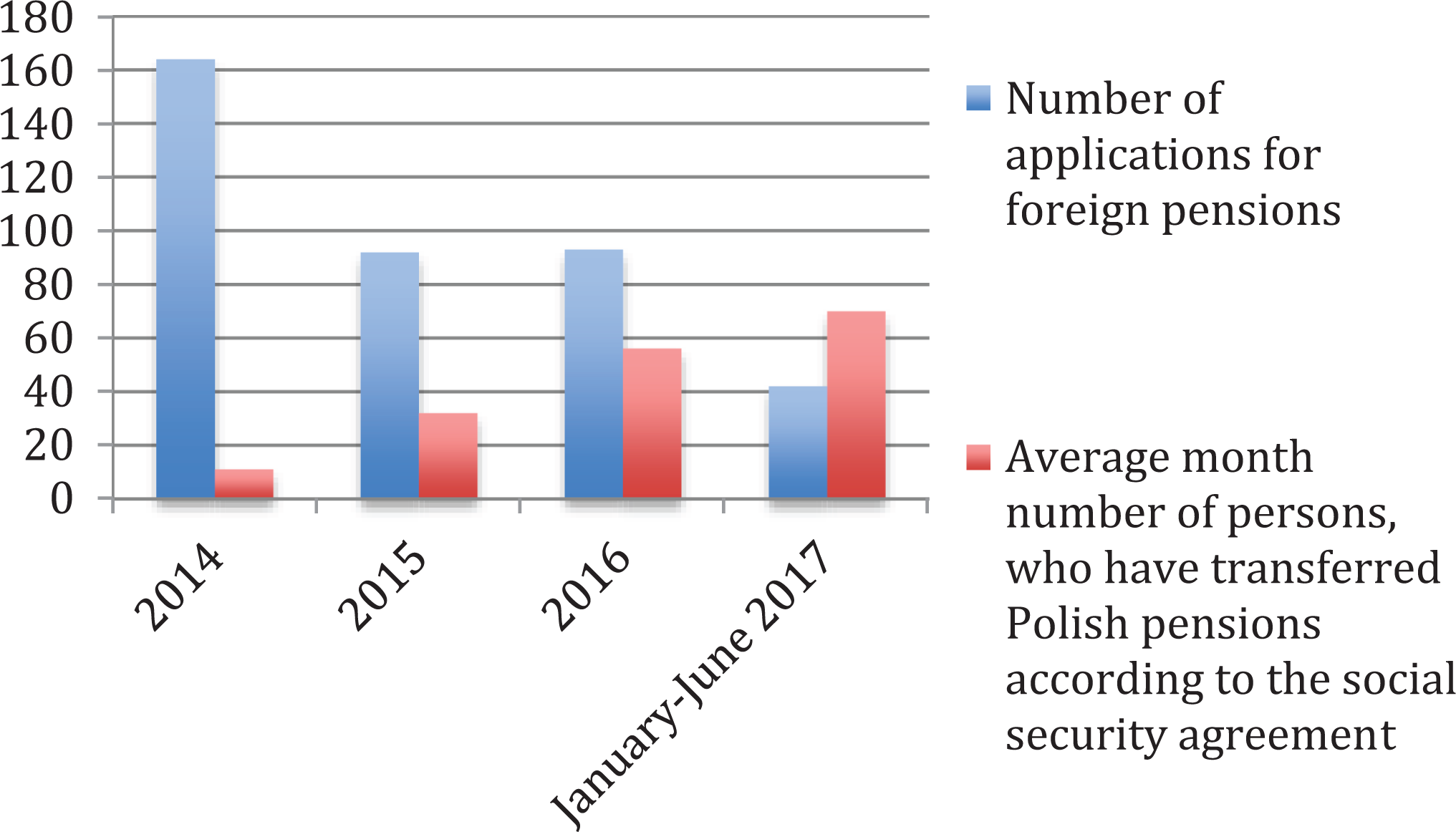
Data on the implementation of the social security agreement with Ukraine.
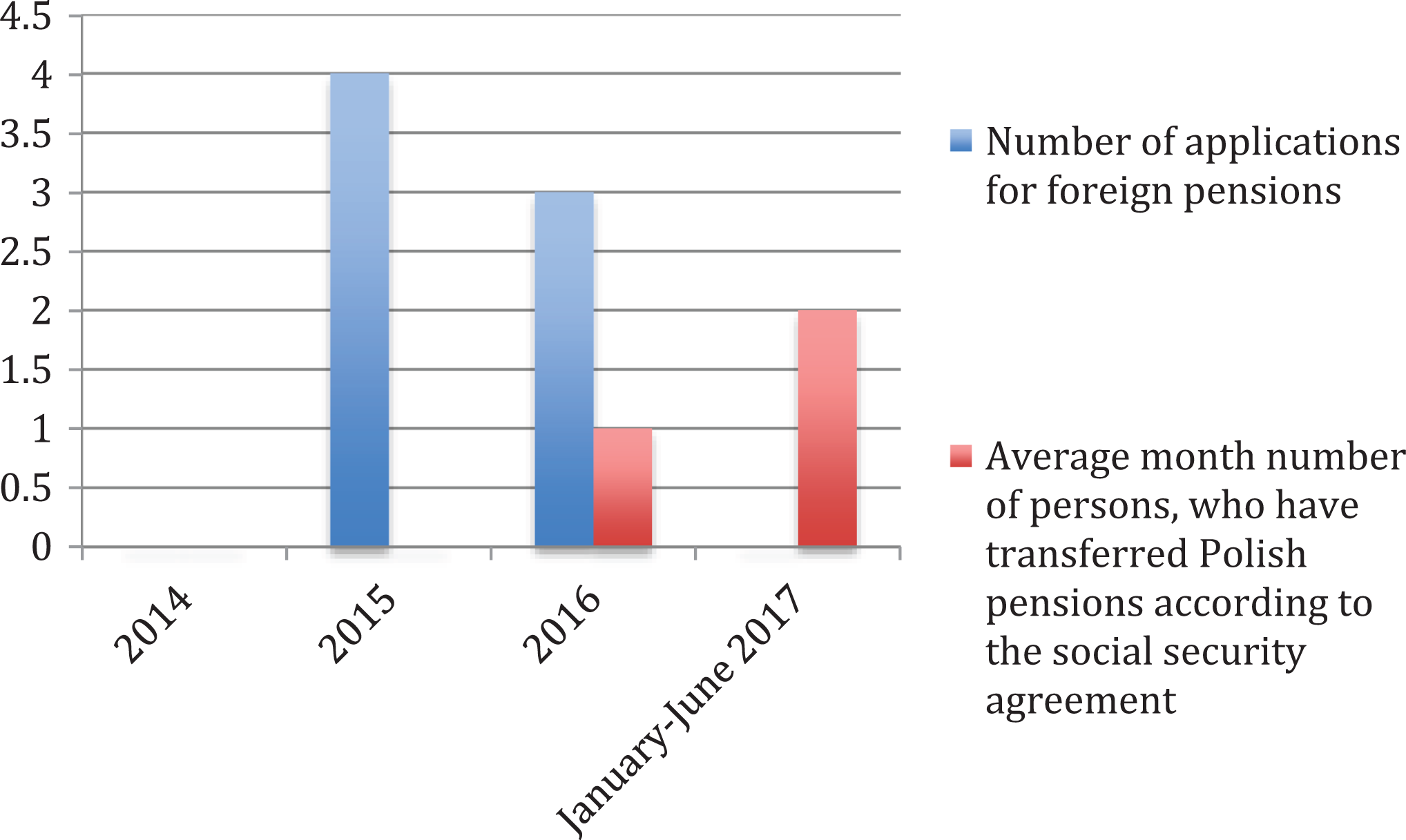
Data on the implementation of the social security agreement with Moldova.
As of September 2017, 51 Bulgarian pensions were being transferred to Ukraine on the basis of the bilateral agreement, to Bulgarians who had worked both in Bulgaria and Ukraine (see Figure 3). 52 Respectively, during the same reporting period, 874 Ukrainian pensions were being paid in Bulgaria. The implementation of the agreement between Moldova and Bulgaria is insignificant in terms of number of current beneficiaries (see Figure 4). Against this background, the implementation dynamics of the agreement between Russia and Bulgaria differs drastically. The number of Russian pensions paid in Bulgaria is currently 5260 and 137 Bulgarian pensions are paid in Russia (see Figure 5). The interviewed official said that the beneficiaries are mainly Russian citizens living in both Bulgaria and Russia. 53 In addition, she shared that it was very challenging to keep the data current because pensioners were added or removed from the lists every month.
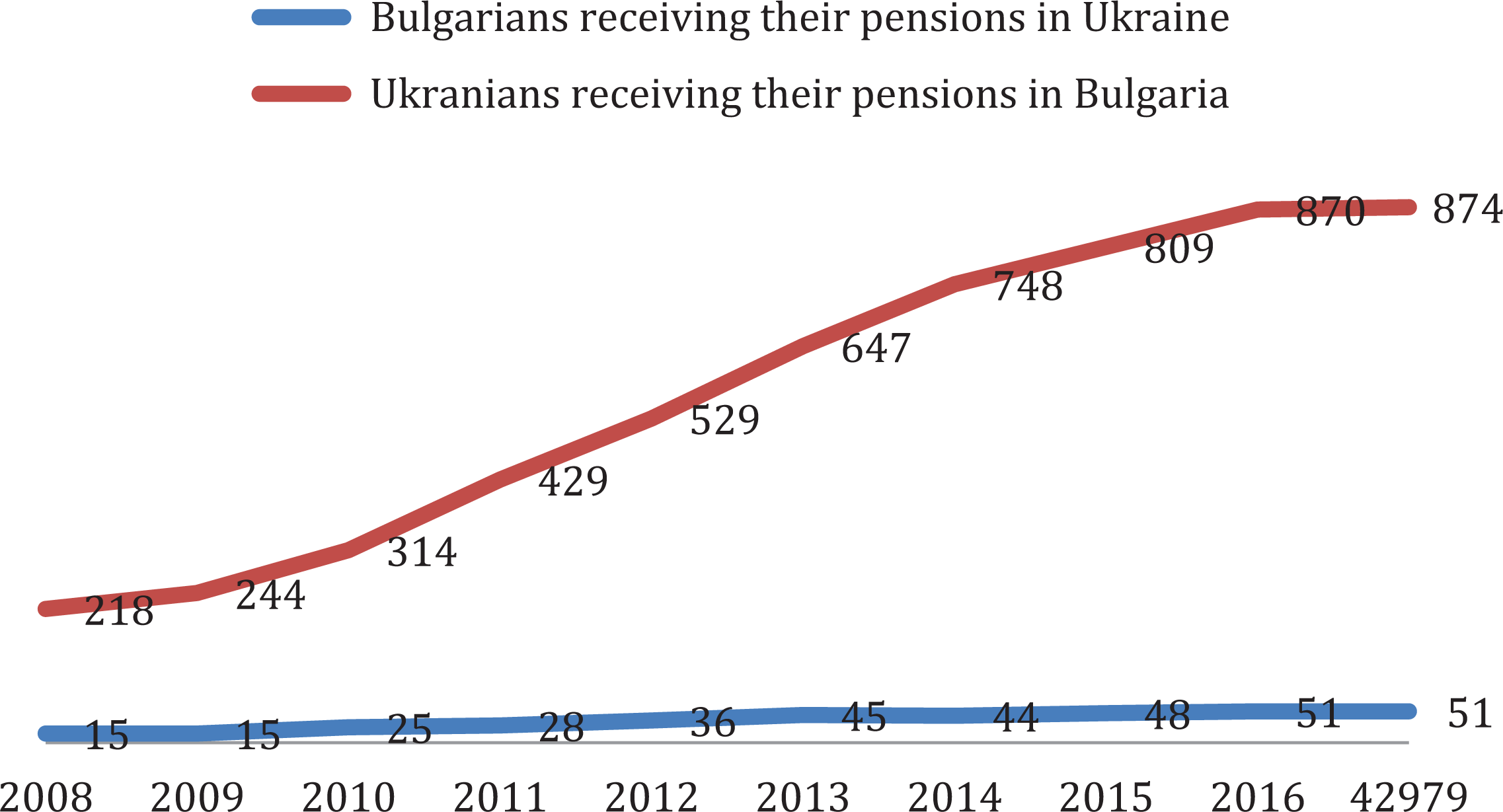
Implementation of the bilateral agreement between Bulgaria and Ukraine.
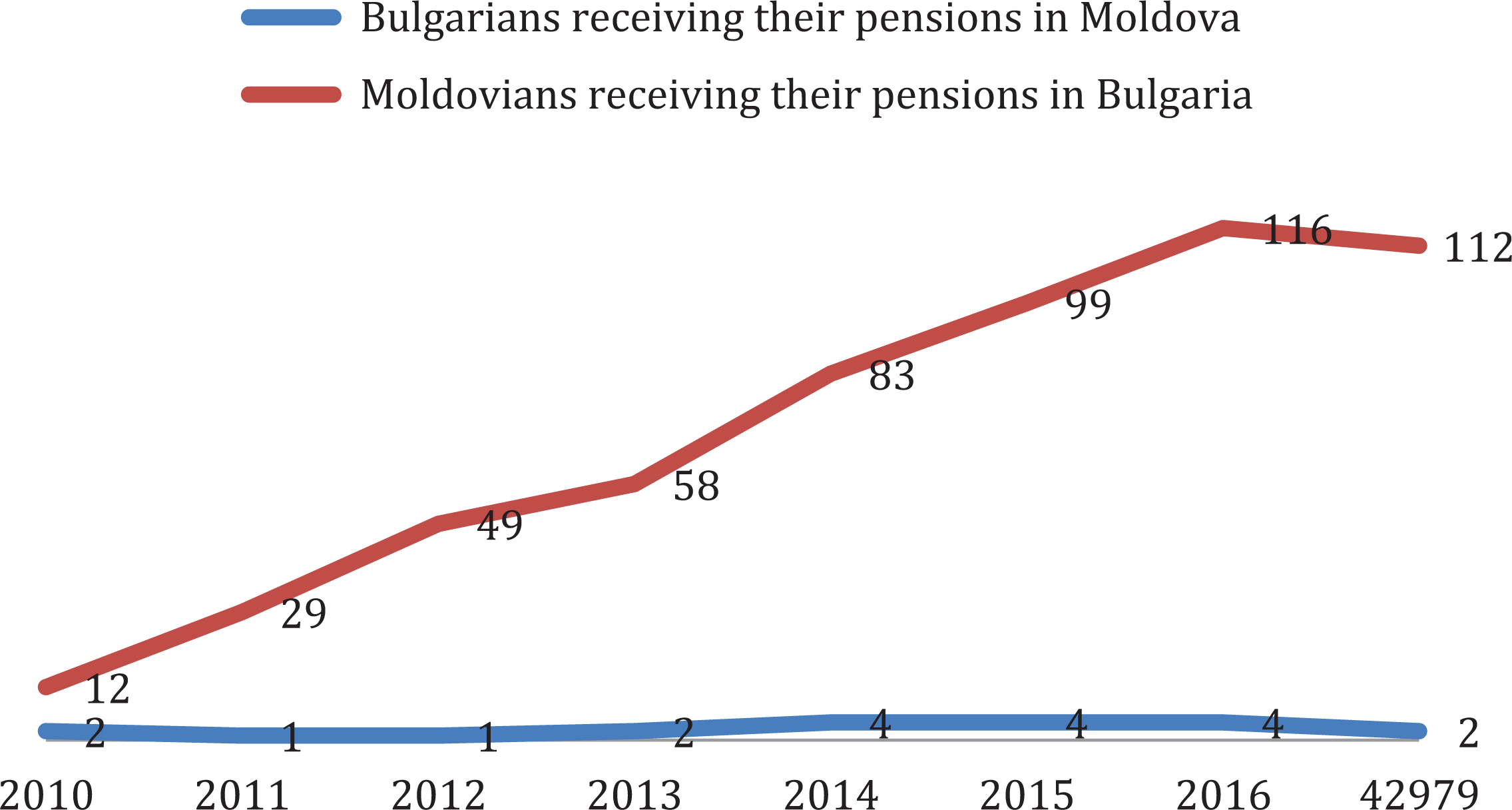
Implementation of the bilateral agreement between Bulgaria and Moldova.
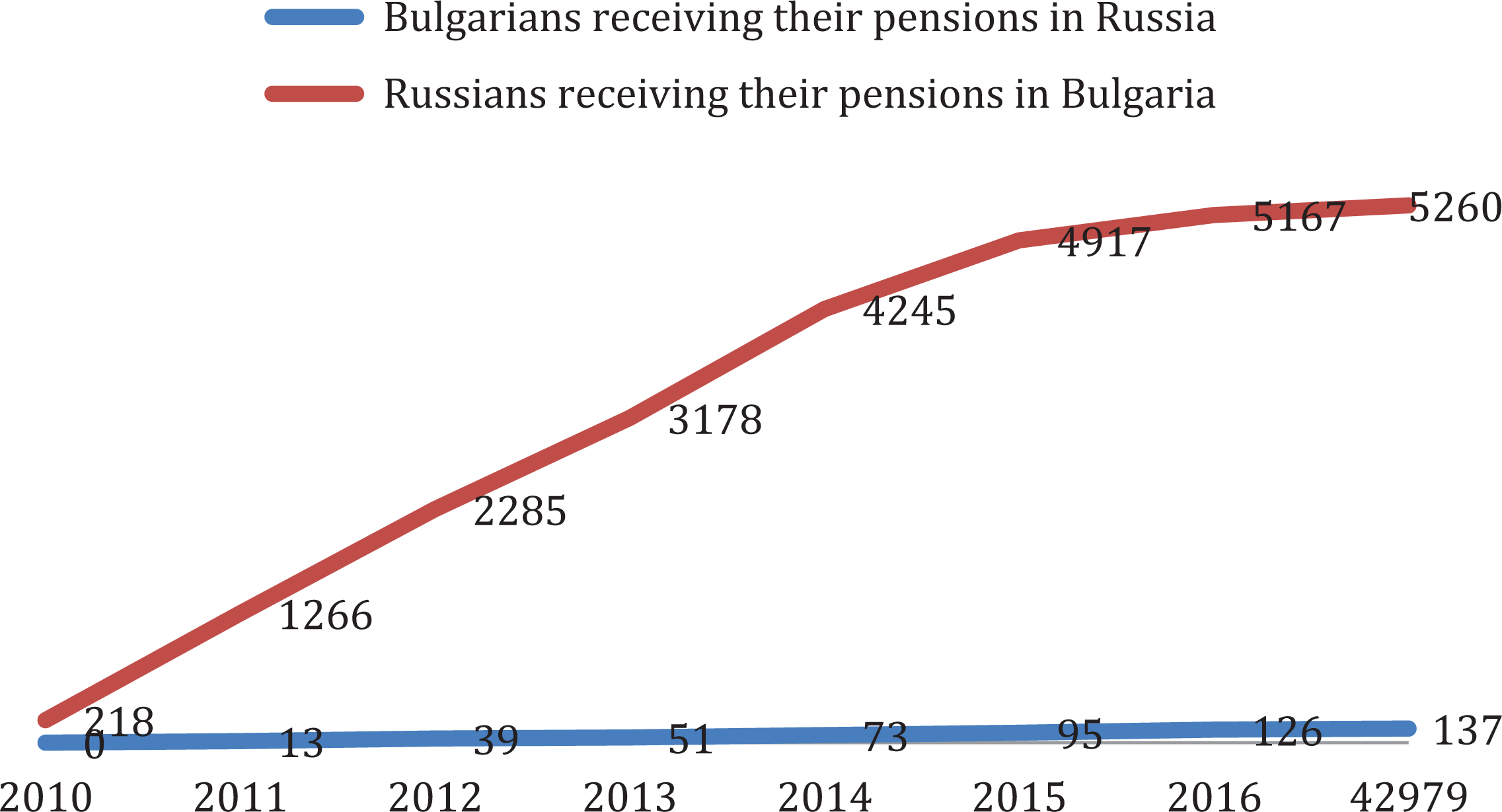
Implementation of the bilateral agreement between Bulgaria and Russia.
Findings of the general focus groups with Ukrainian and Russian migrants in Poland and Bulgaria
The findings of the focus groups conducted with migrants in Bulgaria and Poland suggest that the level of awareness of the existence and aims of the social security bilateral agreements is very low. There were two participants in the focus group with Ukrainian migrants in Bulgaria who were retired and were aware of the agreement between Bulgaria and Ukraine. 55 The first one used to be a circular migrant during the communist period and started receiving an invalidity pension when she was still in Ukraine. Four months after she moved to Bulgaria in 1988, she started receiving her invalidity pension in Bulgaria on the basis of the former social security agreement between the Soviet Union and Bulgaria. The second participant was actively engaged with the Ukrainian community in Bulgaria and recounted that Ukrainian women who married Bulgarians and moved to Bulgaria after they had worked in Ukraine, did not generally face problems with the export or the calculation of their pensions on the basis of the current social security agreement. She knew how to proceed when she decided to retire in Bulgaria. There was one pensioner in the focus group with Russian migrants who was aware of the bilateral agreement between Russia and Bulgaria. 56 She reported that she received pensions from both countries and that she preferred to have her Russian pension paid into a Russian bank account because she often travelled to Russia to visit friends and family.
Only two Ukrainian participants in the two general focus groups conducted in Poland had any knowledge of the subject. 57 One of the Ukrainians informed himself through a TV programme, ‘where lawyers explained that there is an agreement between Poland and the Ukraine, and another one signed with the European Union, which states that if you work officially in Poland, then you should send your documents to the Ukraine and then you pay your contributions and you are entitled to your future pension, when you retire’. As the interview with representatives of NGOs demonstrates, see below, this is not so easy in practice. The other focus group participant revealed the experience of her mother who retired in Ukraine after working in Poland for ten years. The years that her mother had worked in Poland were taken into account in the calculation of her pension in Ukraine. The participant was surprised by this positive development: ‘That’s really strange because the ZUS (Zakład Ubezpieczeń Społecznych, Social Security Institution) in Poland is a mess and, as far as I know, they are even unable to calculate pensions transparently for Poles, let alone for Ukrainians. In the Ukraine, for its part, I can tell you from my experience that the institutions are also stubborn in accepting documentation proving that you worked ten years in Poland and count this experience as a basis for obtaining a pension in the Ukraine.” 58
Several representatives of NGOs who counselled third country nationals in Poland were also interviewed as part of this research. Most of them did not have any social security coordination cases. One of the lawyers revealed that, since the conclusion of the agreement with Ukraine, they have had very few social security cases and those concerned migrant workers who wanted to retire and were having problems collecting all the documents they required to be able to apply for benefits under the social security bilateral agreement. 59
Findings of the focus groups with Ukrainian and Russian Blue Card holders in Poland and Bulgaria
Only two Blue Card holders who participated in the focus group with Russians in Bulgaria knew that there was an agreement between Bulgaria and Russia. 60 They associated this agreement solely with the payment of pensions, which was something that did not currently concern them. They did not know any other details about this instrument. Their main issue of concern was their access to healthcare. As migrants, they were only entitled to medical aid in emergency cases, funded by the state budget. 61 Apart from that, unless they hold long-term residence permits, they cannot use health care provided by the state or benefit from the EU Blue Card Directive or the bilateral agreement between Bulgaria and Russia, because this is not part of the material scope of these instruments. Therefore, they all paid into a private health insurance policy.
In Poland, one focus group participant from Ukraine stated that he knew about the agreement between Poland and Ukraine, and that he was interested ‘only in calculating the years of experience’. 62 In addition, only one participant in the Russian focus group had heard about such a possibility concerning individuals moving from Kazakhstan to Russia, and supposed that such an instrument should also exist in his case. 63 Most of the participants revealed that they were not interested in this issue because the pensions they would get from both Poland and Russia were extremely low (250 EUR in Poland and 200$ (170 EUR) in Russia). One of the participants said: ‘So anyway you should have at least two flats, one for renting and one for living’. 64
Some of the factors contributing to the low awareness among the interviewed Blue Card holders is the fact that they moved to Bulgaria and Poland relatively recently, on average 1 -1.5 years ago. In addition, most of them were young people at the beginning of their careers. Finally, most of the Russian Blue Card holders did not want to return to Russia and some of them stressed that they did not want to have any dealings with the Russian authorities.
Information policy measures provided by the social security institutions
In order to raise awareness of social security rights, the Polish Social Insurance Institute (ZUS) provided ‘insurance counselling’ for people who lived or worked in other Member States or in third countries. 65 By way of contrast, the Bulgarian Social Security Institute provided information in Bulgarian and partially in English on its website, and also had experts who could reply to e-mail requests in English and German. 66 The Bulgarian official revealed that persons who were interested in their services were usually fluent in Bulgarian because they had worked in Bulgaria. The Bulgarian Social Security Institute had also disseminated information brochures in several languages through their regional network of offices and through the social attachés at the Bulgarian embassies abroad.
Conclusion
The data presented shows that the bilateral agreements concluded by both Bulgaria and Poland with the Eastern Partnership countries cover all basic social security coordination principles, which are also contained in EU social security law. None of the countries had provided for reimbursement of social security contributions in their legislative frameworks in cases where migrants and their families cannot access benefits due to waiting periods in the host country or the lack of a bilateral agreement providing for the export of benefits. This is a provision contained in Article 27 (2) of the UN Convention on the Protection of the Rights of all Migrant Workers and the Members of Their Family. 67 Despite the fact that the interviews demonstrate that both countries provide for a de facto transfer, this standard should be considered in cases of short-term circular migration of seasonal workers. 68
With regards to the material scope, all agreements between Bulgaria and Poland, and the Eastern partnership countries have a narrower scope than Regulation No 883/2004. All of them cover pensions – old age, invalidity pensions, and disability pensions in respect of accidents at work and occupational diseases and survivors’ pensions. Apart from this, the agreements with different countries vary. It seems that, for the Ukrainian state, unemployment benefit is an important issue because it is provided for in agreements between Ukraine and Poland, and between Ukraine and Bulgaria. Family benefits are covered only in the agreement between Russia and Bulgaria.
It is interesting to note that the agreements between a particular third country and Bulgaria and, on the other hand, Poland can differ considerably with regards to their material scope. Such an example is Moldova. The agreement between Poland and Moldova has a very limited material scope (in force from 2014), compared to the one with Bulgaria, which apart from pensions also covers sickness cash benefits and maternity benefits, death grants and unemployment benefits (in force from 2009). Finally, none of the agreements under consideration cover health care benefits, which in the case of Bulgaria could have remedied the situation of some migrants who cannot benefit from the state healthcare system before obtaining a long-term residence permit.
This inconsistent level of provisions could put circular migrants in a vulnerable situation. If access to health care benefits is not possible, migrants risk financial loss when leaving either of the two countries between which they are circulating, and moreover they may experience periods without health coverage. Furthermore, circular migration entails the change of employment in two countries at different short or long-term intervals. Ideally, migrants move between jobs offered in the countries between which they circulate. Nevertheless, there might be cases where their contract or permit in the host country expires, and they need to go back to their country of origin without having secured new employment. Being unemployed between two contracts in two different countries is a possible outcome of circular migration. Therefore, this group of migrants would benefit from unemployment benefits to cover any short-term unemployment.
Circular migrants may also be accompanied by their families. Therefore, access to family related benefits needs to be considered for certain periods after families or family members return to their country of origin. This group encompasses family benefits as well as maternity and paternity benefits. Family benefits generally aim to ‘increase opportunities for families and children as well as improving their quality of life’. 69 They may consist of allowances, vouchers or tax reductions, early childhood service or providing an extended period of maternity or paternity leave. 70 In order to access maternity and paternity benefits, migrants are usually required to have a minimum number of insurance contributions. 71 The approach to family benefits differs very much from country to country: it could be contributory, based on general taxation system or a mix of both. This can render transferability more difficult. Nevertheless, when families or family members return to their countries of destination, they might not be entitled to this kind of support, which can put them in a vulnerable position.
The agreements between Bulgaria and Russia, and Bulgaria and Ukraine, demonstrate another potential source of vulnerability for circular migrants. The have very narrow personal scope covering only nationals of the contracting parties and may exclude third country nationals from benefiting from the provisions of the bilateral agreements and create additional gaps in a field that is already characterised by inconsistencies. This problem is particularly pertinent in a region characterised by the redrawing of borders after the dissolution of the Soviet Union, regional conflicts and intensive regional and internal migration.
Finally, as already noted above, in the absence of any multilateral agreements regulating issues in this regard, the main instruments used are the specific bilateral agreements concluded by the Member States and third countries. This article shows that the number of bilateral agreements is low, despite the cultural, historical and geographic proximity of the countries in the Eastern partnership. It seems that the policy platform provided by GAMM does not facilitate the process of starting negotiations with these countries. One of the obstacles that needs to be taken into consideration is that the political relations between the countries also has an impact on the conclusion of these instruments. It is therefore not very likely that one will witness an agreement between Poland and Russia in the foreseeable future, especially after the events in Crimea and the suspension of the Local Border Traffic Agreement between Poland and Russia in 2014. There is a clear role for the EU and the international actors involved, such as ICMPD, to utilise the Mobility Partnerships and other dialogues within the GAMM more effectively in order to increase the number of agreements in this regard.
Another problem identified in this article is related to the implementation of these bilateral social security agreements. The lack of awareness among interviewed migrants, as well as the low numbers of beneficiaries of these agreements (especially in the case of Poland), means that there is a need for an active awareness campaign to raise these issues, which are technical and not easily understandable by migrants who do not necessarily have a good level of the local language. Migrants need to be informed about their rights actively during their circulation. Waiting until the age of retirement could mean a loss of entitlement or problems created by the lack of documents that need to be presented to the respective social security institution.
Footnotes
Declaration of conflicting interests
The author(s) declared no potential conflicts of interest with respect to the research, authorship, and/or publication of this article.
Funding
The author(s) received no financial support for the research, authorship, and/or publication of this article.