




Abstract
With the introduction of strict obligations and sanctions in social security, the traditional boundary between criminal law and administrative law seems to fade away. Administrative fines in particular facilitate strict, efficient and effective law enforcement. In spite of the fact that administrative fines are part of administrative law, criminal law safeguards are still applicable. This could cause problems, since administrative authorities and administrative judges are not necessarily familiar with these criminal law principles. This article addresses the question of how administrative authorities and administrative judges assess culpability when deciding on administrative fines in the Netherlands. The main finding is that administrative authorities, and especially municipalities, overestimate the degree of culpability. The case shows that, in the search for more repressive instruments, it is imperative to allow courts to keep an eye on the proportionality of the sanctions.
Introduction
Administrative law is increasingly used to punish and to discipline the citizen. The result is a rather new branch of administrative law that has some of the characteristics of criminal law. This new branch of administrative law has two characteristics. First of all, the norms and obligations are rather vague. The claimant has to provide all information that might be relevant for the assessment of the right to the benefit. This leaves wide discretion for administrative authorities that have to interpret whether or not such an obligation is fulfilled. In the end, it is up to the administrative authority to decide whether the citizen has disclosed all relevant information.
The second characteristic is the instruments, like administrative fines, that aim to punish the individual. This is not new. 1 What is new is that administrative fines are used in many fields of law, such as competition law and social security law and that the sanctions that are imposed are higher. 2 An example of developments in the Dutch welfare state might illustrate this development. A person who violates the obligation to provide all necessary information will have to repay the benefit and will receive an administrative fine, up to a maximum of the same amount of money. 3
Consequently, legislators often create two options for punishing the citizen involving the use of criminal law or administrative law. 4 It is then interesting to note that the maximum administrative fine is often higher compared to the fine the offender could get under criminal law.
With punitive instruments in administrative law, the question arises as to how the typical criminal safeguards are maintained. In this article, we focus on the principle of nulla poena sine culpa, meaning that the mental state of the offender plays a role in the decision of whether or not a penalty is justified. The absence of culpability is a reason not to charge the offender. Even if the offender is culpable, the sanction should correspond to the degree of culpability, ranging from ‘negligent’ and ‘reckless’ to ‘deliberate’ and ‘purposeful’. 5 The nature of the crime is different if it is committed due to negligent behaviour, or if the offender committed it on purpose. The research question is therefore: how do administrative authorities and administrative judges assess culpability when deciding on administrative fines?
The case of social security fines
High administrative fines
As stated before, the Dutch Parliament introduced new legislation in 2013 to strengthen the enforcement of a social security regulation. One major change was the increase of the maximum fine from EUR 2,269 to a fine corresponding to the maximum amount of money that the fraudulent recipient was receiving as a benefit, which could amount to EUR 50,000. If the fraudulent behaviour resulted in a higher amount of unduly received benefit, the offender might face charges by the public prosecutor. This could result in a maximum fine of EUR 82,000 or four years’ imprisonment. 6
Another change was that the administrative authority no longer had discretion in determining whether it would impose a fine. The finding that an offence has been committed would automatically result in the decision to impose a fine. The administrative authorities that use these new instruments are the municipalities with regard to social benefits, and two national agencies which oversee unemployment benefits and disability pensions (Employee Insurance Agency, UWV) and child benefits and public pensions (Social Insurance Bank, Svb).
Immediately after the introduction of the new legislation, the administrative authorities imposed the maximum possible fines, assuming that they did not have any discretion to take individual circumstances into consideration. This practice lasted until 24 November 2014, when the highest administrative court in social security matters (the Central Appeal Tribunal) published a judgment. 7 This reads like an instruction to administrative authorities on how they should use their powers to impose fines.
The main message from this decision is that administrative authorities should not automatically impose the maximum fine. Instead, they should always pay attention to the degree of culpability. The maximum fine is only fair in the case of intentional action. In all other cases, where there is less culpability, the fine should be less.
Degrees of culpability
The administrative authority has to prove intent. This is usually proven if the offender explicitly states that he knew that he was violating the rules. Examples of offenders who act intentionally are those who are involved in growing cannabis. This activity is not only a crime but can also have consequences for entitlement to benefits. After all, the offender earns money through the illegal growing of cannabis and with that income he is not entitled to a benefit. In these circumstances, the court will rule that the offender has acted intentionally. This is particularly the case if the offender admits in a police report that he was aware of the obligation to report all relevant income but was unable to do so because he earned the income through illegal activities.
If the administrative authority cannot produce such a statement from the offender, it can be rather difficult to prove intent. In such a case, gross negligence might be more appropriate. The Central Appeal Tribunal has ruled that in cases of gross negligence, 75% of the maximum fine is the appropriate sanction. However, gross negligence also has to be proven by the administrative authority. For gross negligence it is also important to determine whether or not the offender was aware that he had committed a crime, for example because he had committed a similar crime a few years earlier, or alternatively, because he notified he provided the administration with similar information in the past. In both situations, it is reasonable to assume that the offender knew about the rule. The main difference with intentional behaviour is that the offender does not admit that he knew about the violation of the rule.
If there is no intent and no gross negligence, the offending will be seen as ‘normal’ culpable conduct. In that case, 50% of the benefit is considered to be the appropriate fine. This is the ground rule if neither the administrative authority nor the offender presents any proof that there is either intent or an absence of intent in the commission of the offence.
There are grounds for lowering the fine to 25% in the case of reduced culpability, if the crime is not entirely the result the of offender’s choice. Quite often, the offender will argue that he did not know about the obligation to reveal all relevant information or that he was otherwise unable to fulfil the obligations. These arguments only succeed if personal circumstances prevent the offender from notifying the administration. This is the case if the offender is illiterate and could not check whether or not the payment in his bank account was correct. Reduced culpability might also be the case if the offender tried to rectify his mistake by providing the relevant information immediately after he discovered the offence and on his own initiative. Finally, the court also held that the offence was committed with reduced culpability if the administrative authority was partly to blame for the offence. This could be the case if the administrative authority was not explicit enough about the obligations attached to the benefit or if it did not respond adequately to information or if it misinterpreted the information from the offender.
It is important to note that the above differentiation is based on case law. The legislation itself does not contain a breakdown of degrees of culpability. The Act only contains the formulation of the offence (violating the obligation to provide information) and the sanction that might follow (the maximum fine being the amount of benefit unduly received).
Application in practice
It is interesting to see how administrative authorities responded to these jurisprudential rules. With this aim in mind, all published cases from the Central Appeal Tribunal dealing with administrative fines and including a decision on the degree of culpability, were collected. 8 In analysing the case, three questions were asked: first, whether or not the offender made a case about the degree of culpability; second, what the decision made by the administrative authority on the degree of culpability was; 9 and third, what the Central Appeal Tribunal decided on the degree of culpability. We also gathered information about the date of the case and the type of administrative authority that issued the fine.
Description of the variation
The first observation is that many offenders put forward a defence with reference to reduced culpability or to the absence of culpability. In at least 80% of cases, we could read a defence that hinted at such a plea. These were the pleas in which the offender stated that ‘he did not know about the obligation’ or ‘was unable to reveal the information’, etc. In the remaining 20% of cases it was unclear whether the offender had pleaded that he was or was not to blame for the offence. In only one case was it stated explicitly that the offender did not question the degree of culpability. In this case the court considered that the appellant (the offender) withdrew the ground for appeal in which he questioned the degree of culpability. 10 This case was exceptional: in general, it is likely that the degree of culpability is part of the proceedings since it does not take too much interpretation to qualify a ground of appeal as a defence to the degree of culpability.
The second observation is that administrative authorities often issue fines on the assumption that there is intentional action by the offender. Table 1 shows that in the majority of cases, the fine was based on the assumption that there was normal culpable conduct (51% of cases). In 39% of cases, the administrative authority was of the opinion that the offender committed the offence intentionally or that there was gross negligence. In only 9% of cases did the administrative authority find a reason to reduce the fine due to reduced culpability or the absence of culpability.
Position of the administrative authority and the judgment of the court.
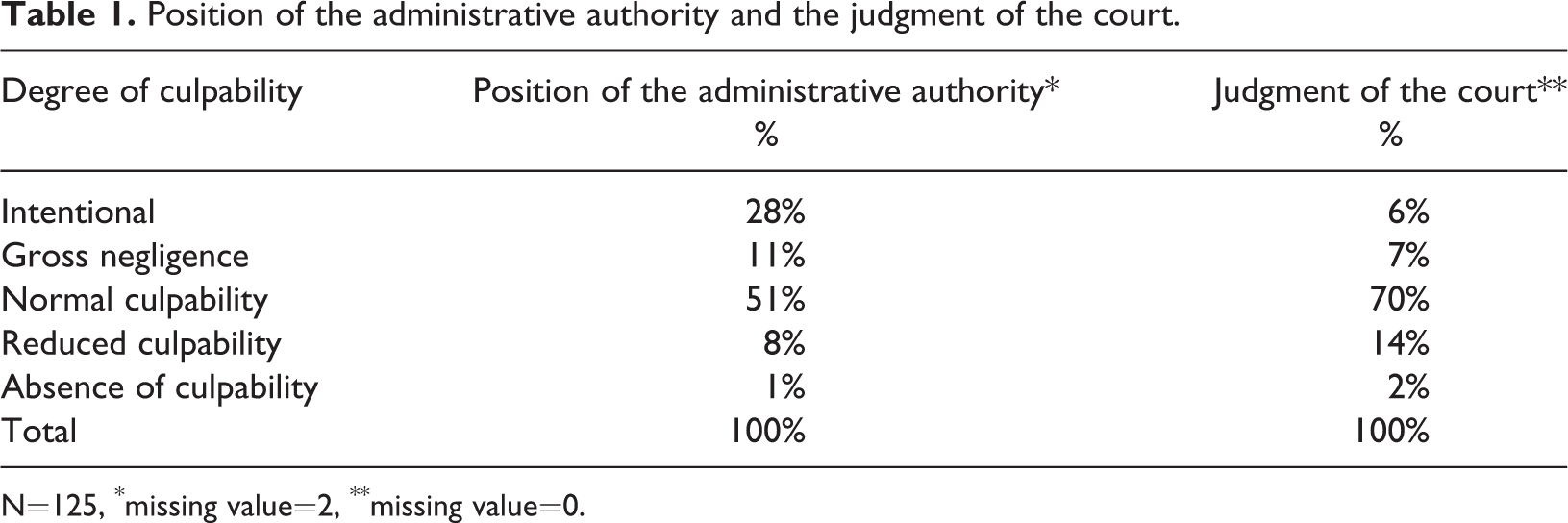
N=125, *missing value=2, **missing value=0.
The third observation as shown in Table 1 is that the court is more often of the opinion that there was normal culpable conduct (70% of cases) or that there were reasons to assume that there was reduced culpability or the absence of culpability (16% of cases). In only 13% of cases were there grounds for deciding that there was intentional behaviour or gross negligence.
Differences of opinion between administrative authorities and the courts
Apparently, the court and the administrative authority classify similar facts differently. It is therefore interesting to compare cases in which the court follows the administrative authority and in which it has a different opinion. This comparison is presented in Table 2. The columns show the position of the administrative authority. The rows indicate the judgment of the court. The grey cells indicate the percentage of judgments that confirm the initial position of the administrative authority.
Comparison position administrative authority and the judgment of the court.
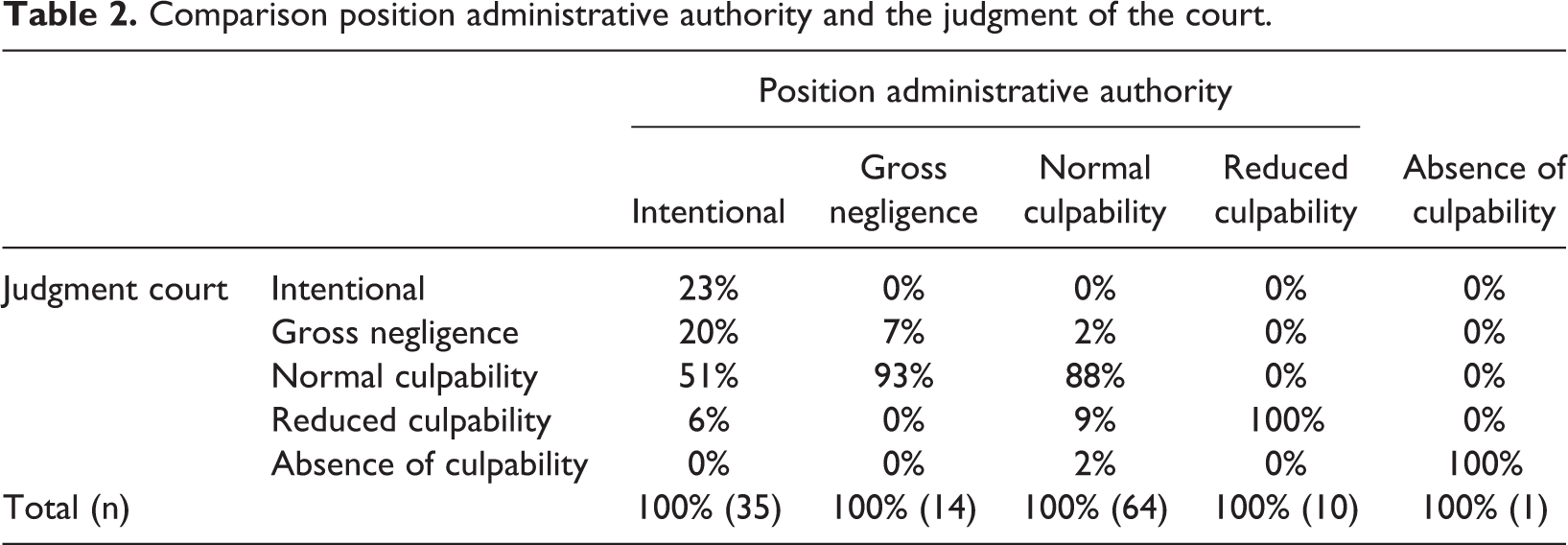
Table 2 shows that in only 23% of the cases where the administrative authority believed that the offender acted intentionally, the court followed that position. In 51% of cases the court rejected that opinion and decided that there was only normal culpable conduct. With gross negligence, the figures are even worse for the administrative authority. In only 7% of the cases did the court follow the position of the administrative authority. In the remaining 93% of cases, the court altered the decision based on its judgment that there was only normal culpable conduct. The court confirmed the decision on the degree of culpability in 88% of the cases where the administrative authority founded its decision on the assumption that there was normal culpable conduct. In these cases, the court also found a reason for deciding that there was reduced culpability (9%) or the absence of culpability (2%). The judgment of the court tallied with the position of the administrative authorities only in the cases in which the administrative authority held the position that there was reason to reduce or annul the fine due to reduced culpability or the absence of culpability.
Based on these figures one can calculate the percentage of cases in which the court had a different opinion on the degree of culpability and the percentage of cases in which the court confirmed the position of the administrative authority. In 62% of cases the judgment of the court and the position of the administrative authority on the degree of culpability were the same. In the remaining 38% the court held a different opinion to the administrative authority. As seen from Table 2, this different opinion always meant that the court judged that there was a lower degree of culpability than the administrative authority in its initial decision.
Analysis
How can the fact that the administrative authorities apparently made the wrong decision on the degree of culpability be explained? Two potential explanations can be tested. The first potential factor is time. The decision of the Court of Appeal dates from November 2014 and it may have taken some time before it found its way into the internal policy documents or codes of conduct of the administrative authorities that had to determine administrative fines. After all: the judgment represented quite a change from the practice of determining administrative fines automatically. Instead of simply imposing the maximum fine, the administrative authority now had to take into account all the circumstances, to assess the degree of culpability and only then to impose the appropriate fine. Bureaucratic behaviour results in routine. 11 Organisational routines create a certain amount of inertia that can make it difficult to adapt to changing circumstances. 12
To test this hypothesis, the proportion of cases in each three-month period in which the court confirmed and altered the opinion of the administrative authorities were calculated over a period of time. The results are presented in Figure 1 below.
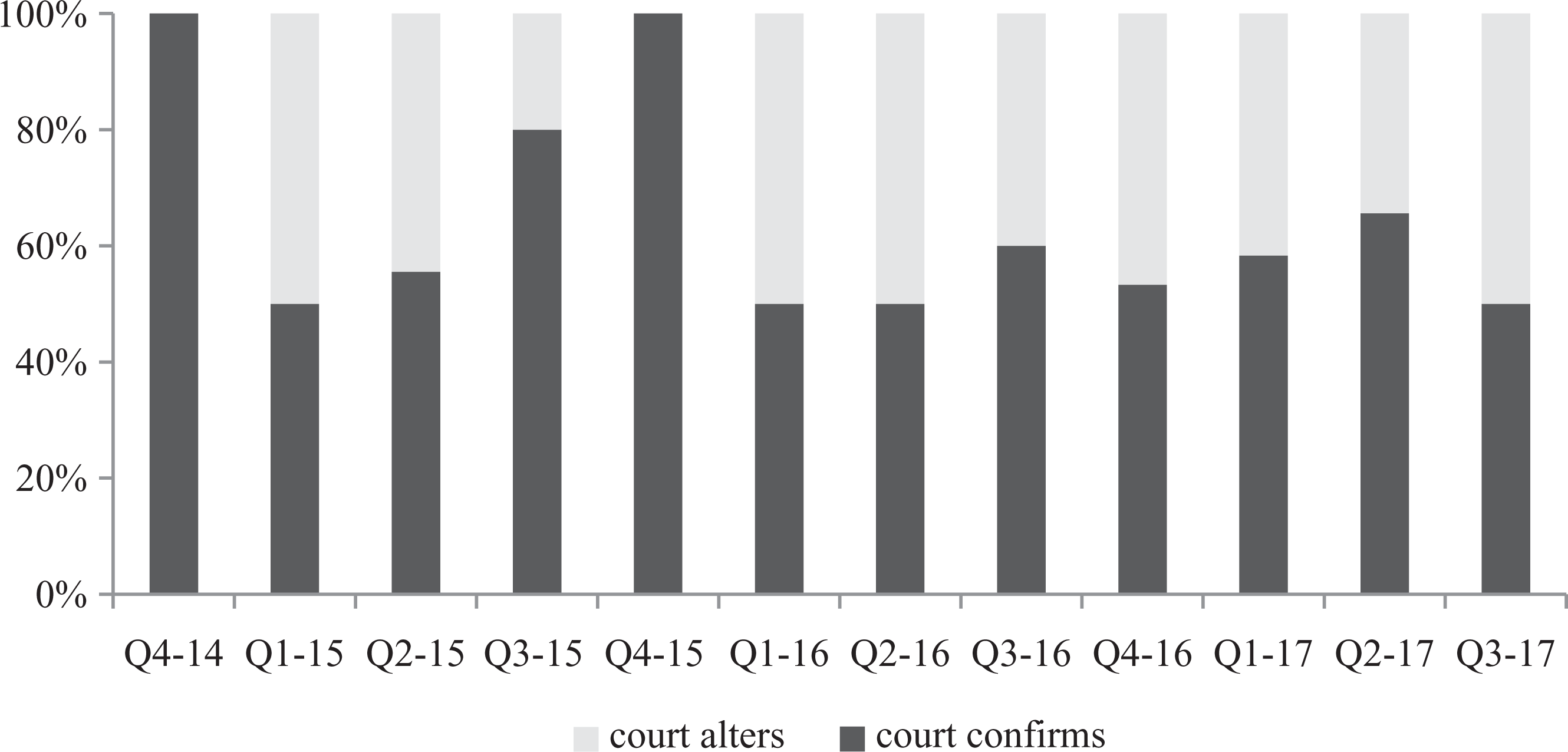
Proportion of cases in which the court confirmed or altered the position of the administrative authority.
Figure 1 shows that, although the initial judgment in November 2014 introduced new criteria to assess the degree of culpability, the court altered the decisions of the administrative authority in the next year in only 50% or less of cases. In the fourth quarter of 2015 for example, the court confirmed all the decisions of the administrative authorities. It is interesting that most of the cases in which the court deviated from the opinion of the administrative authorities, and lowered the degree of proportionality, occurred in the last two years. In 2016 and 2017, the court appeared to determine the degree of culpability differently from the way it had done so in previous years. Time is therefore not a very strong explanation for the observed difference between the decisions of the administrative authorities and the judgements of the court. Administrative authorities appear to be even more inert then assumed.
That inertia might have to do with the lack of administrative capacity of the administrative authorities that have to determine administrative fines. 13 As stated above, the competence to issue fines in social security is a competence of municipalities (for social benefits) and two (large) national agencies (for unemployment benefit, disability pensions and child benefit). The category of municipalities includes a wide variety of administrative authorities. The group of municipalities includes large municipalities that, just like national agencies, do have the experience and expertise to implement the judgments of the Central Appeal Tribunal. However, it also includes smaller municipalities that rarely impose administrative fines and might therefore have neither the knowledge nor the expertise to apply the judgments of the Central Appeal Tribunal. It has not helped that the Association of Netherlands Municipalities, which normally supports municipalities with the implementation of new regulations, only recently (in April 2017) published a position paper, explaining the judgments of the Central Appeals Tribunal. 14
To test the factor of administrative capacity the proportion of cases in which the court confirms and alters the position of the administrative authority, Table 3 contains a comparison for these two groups of administrative authorities.
Type of administrative authority and judgment of the court.
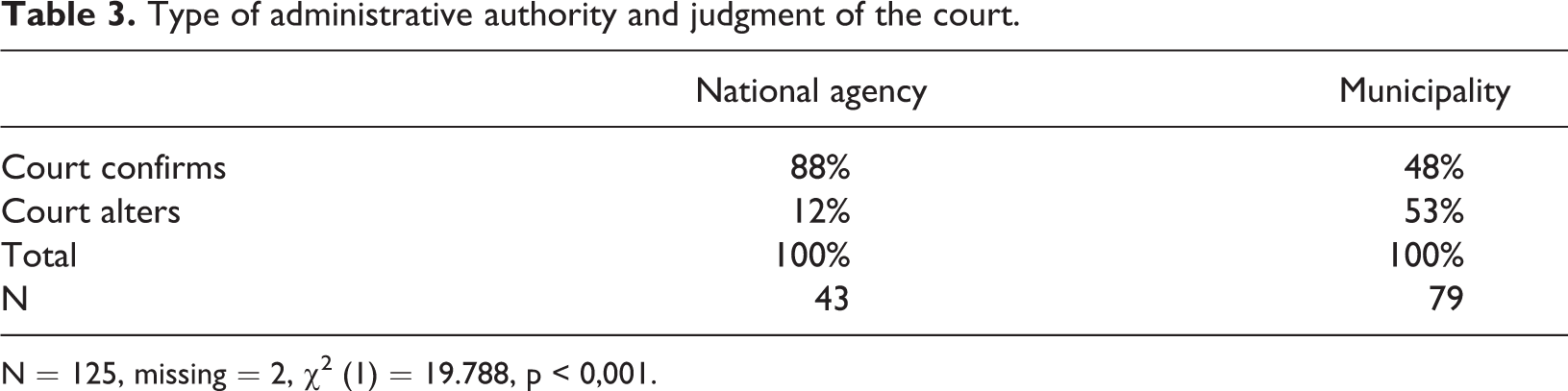
N = 125, missing = 2, χ2 (1) = 19.788, p < 0,001.
As seen from Table 3, the type of administrative authority is indeed a relevant factor in explaining the proportion of correct decisions in the opinion of the court. In 88% of the decisions made by the national agencies, the court confirmed the decision, whereas that was only the case in 48% of the decisions made by municipalities. The difference is significant.
The difference between the court judgments and the initial decisions of the agencies and the municipalities has to do with the fact that municipalities are more often of the opinion that the offender intentionally committed the offence. As shown in Table 4 municipalities are more often of the opinion that the offender committed the offence intentionally compared to the national agencies. This difference is significant.
Position on the degree of culpability of national agencies and municipalities.
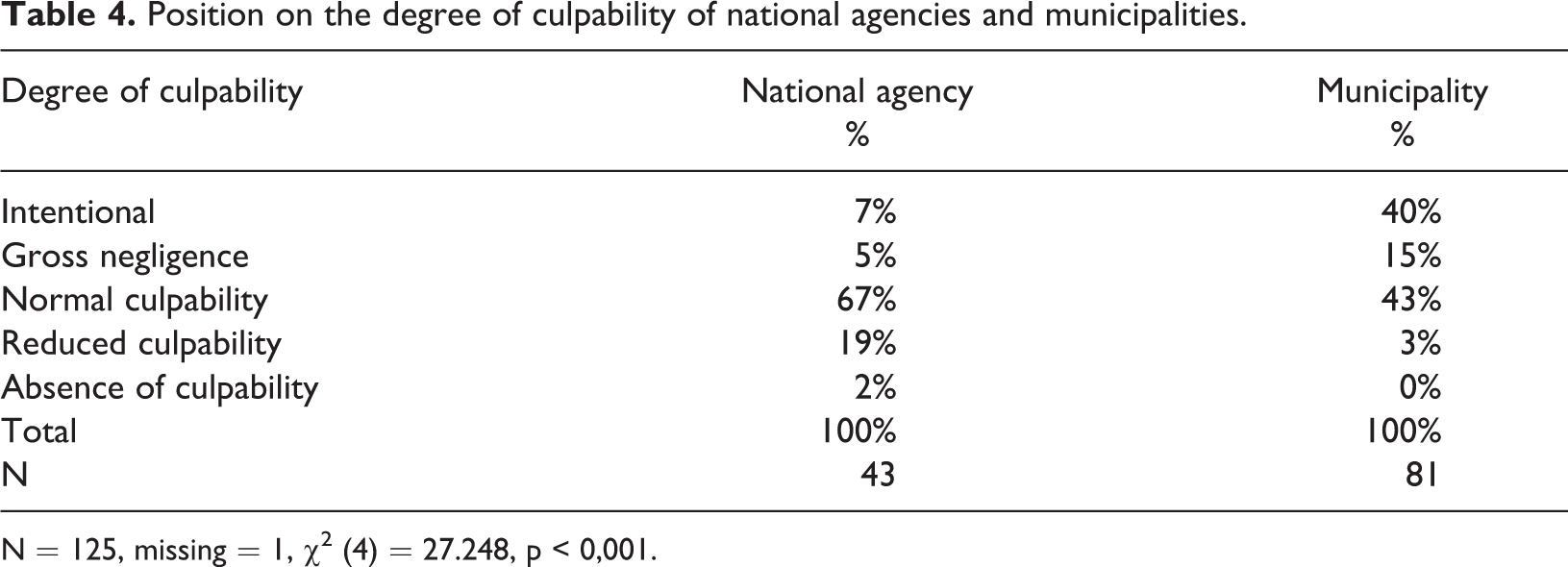
N = 125, missing = 1, χ2 (4) = 27.248, p < 0,001.
Discussion
Why are municipalities so often of the opinion that the offender committed the offence intentionally? A potential explanation is that the target groups of municipalities differ from those of the national agencies. Municipalities decide on social benefits whereas national agencies decide on employee insurance schemes (mainly unemployment benefit and invalidity pension). Social benefits constitute the safety net meaning that, even if an offender did not reveal all relevant information about his or her situation in the past, he or she might be entitled to a benefit from now on. That means that the municipality might have reason to punish the offender more severely, with the aim that the individual would then change his or her behaviour and be more careful in the future.
Another explanation is that municipalities face more political pressure. Fraudulent behaviour directly affects the municipal budget. Consequently, the municipality might want to lower expenditure by aiming to avoid the abuse of funds by fraudulent recipients. National agencies do not have the same incentive since their budget is fixed and is not influenced by the amount of money saved due to effectively combating fraudulent behaviour. Political pressure might result in a preference for imposing high fines, ignoring existing case law and producing new case law. Both potential explanations deserve further research on the style of law enforcement by municipalities vis-à-vis national agencies.
Concluding remarks
The legislators seem to be keen on searching for more effective instruments with which to discipline citizens. Criminal law is seen as inefficient, focusing too much on the individual circumstances of the offender. That is one of the main reasons why administrative fines have gained in popularity. Despite this development, administrative law must still observe the safeguards that are inherently protected in criminal law proceedings, like nulle poena sine culpa and proportionality.
The research question that informed this article is how do administrative authorities and administrative judges assess culpability when deciding on administrative fines? The case of administrative fines in the Dutch social security law shows that legislators may try to create a situation in which the administrative authorities have to ignore personal circumstances and cannot take the degree of culpability of the offender into consideration. The case in question shows that despite this attempt of the legislators, the court can intervene and correct excessively harsh regulations. As a result, the hard and fast rule has been changed into a more detailed rule, forcing the administrative authority to focus on the individual circumstances of the offender, which now have to be considered when issuing a fine.
The case also shows that administrative authorities, especially the municipalities, find it difficult to consider these personal circumstances when assessing the degree of culpability. Administrative authorities consider that offences are more often the result of intentional action than the Central Appeal Tribunal. It is also clear that the administrative authorities do not seem to learn from new case law as the proportion of cases in which the court corrects the position of the administrative authority remains at about 50%.
The municipalities appear to misjudge the circumstances and wrongfully qualify the circumstances as intentional action. This might be caused by the lack of administrative capacity to implement the judgments of the Central Appeal Tribunal. An alternative explanation is that the proportion of errors is the result of a strategy. Municipalities might intentionally opt for the maximum fine due to political pressure or because the municipality is in a long-term legal relationship with the offender and may regard the fine as an opportunity to educate the offender about the need to observe the relevant provisions.
Regardless of the explanation, the fact remains that it apparently pays to appeal against an administrative fine under social security law, since in 38% of the cases the fine issued by the administrative authorities is lowered by the court. Given the fact that the offenders have often few bureaucratic skills and therefore less access to justice, this is quite worrying. After all, it is likely that many offenders receive fines that are not founded on a correct assessment of the degree of culpability and that are not challenged in court. That is another reason for being very careful about introducing administrative fines into social security regulations.
Footnotes
Declaration of Conflicting Interests
The author(s) declared no potential conflicts of interest with respect to the research, authorship, and/or publication of this article.
Funding
The author(s) received no financial support for the research, authorship, and/or publication of this article.