




Abstract
Background
Traditional epidemiologic studies suggest that Alzheimer's disease (AD) may be associated with intracerebral hemorrhage (ICH).
Objective
To explore whether there is a causal relationship between AD and ICH and the underlying mechanisms involved.
Methods
Mendelian randomization (MR) approach was used to explore causal relationships. The genetic instrumental variables of the candidate genetic instrumental variable AD were obtained from genome-wide association studies. The inverse variance weighted method was the primary method for MR analysis and meta-analysis. The obtained single nucleotide polymorphisms were analyzed for corresponding genes for subsequent pathway enrichment and protein-protein interaction analysis.
Results
For the single AD dataset, our MR analysis of the AD datasets versus the ICH datasets revealed a genetically predicted causal relationship between AD and ICH (OR 5.947, 95%CI 1.165–30.356, pIVW = 0.032). In addition, the MR-Egger method and MR-PRESSO method revealed no horizontal pleiotropic effect of AD on the risk of ICH. Meta-analysis of each dataset using IVW revealed a final calculated OR of 1.08 (95%CI 1.02–1.15, p = 0.01). Subsequent pathway enrichment analysis revealed that the corresponding genes were involved mainly in the metabolic process of amyloid-β (Aβ) and negatively regulated Aβ formation. In the PPI network analysis, proteins such as ApoE, SROL1, CLU, ABCA7, and AβPP were found to be closely related and located in the key position of the center.
Conclusions
We verified the causal relationship between AD and ICH via MR, and identified the possible pathological mechanisms involved. We also discovered that Aβ plays an important role in this process.
This is a visual representation of the abstract.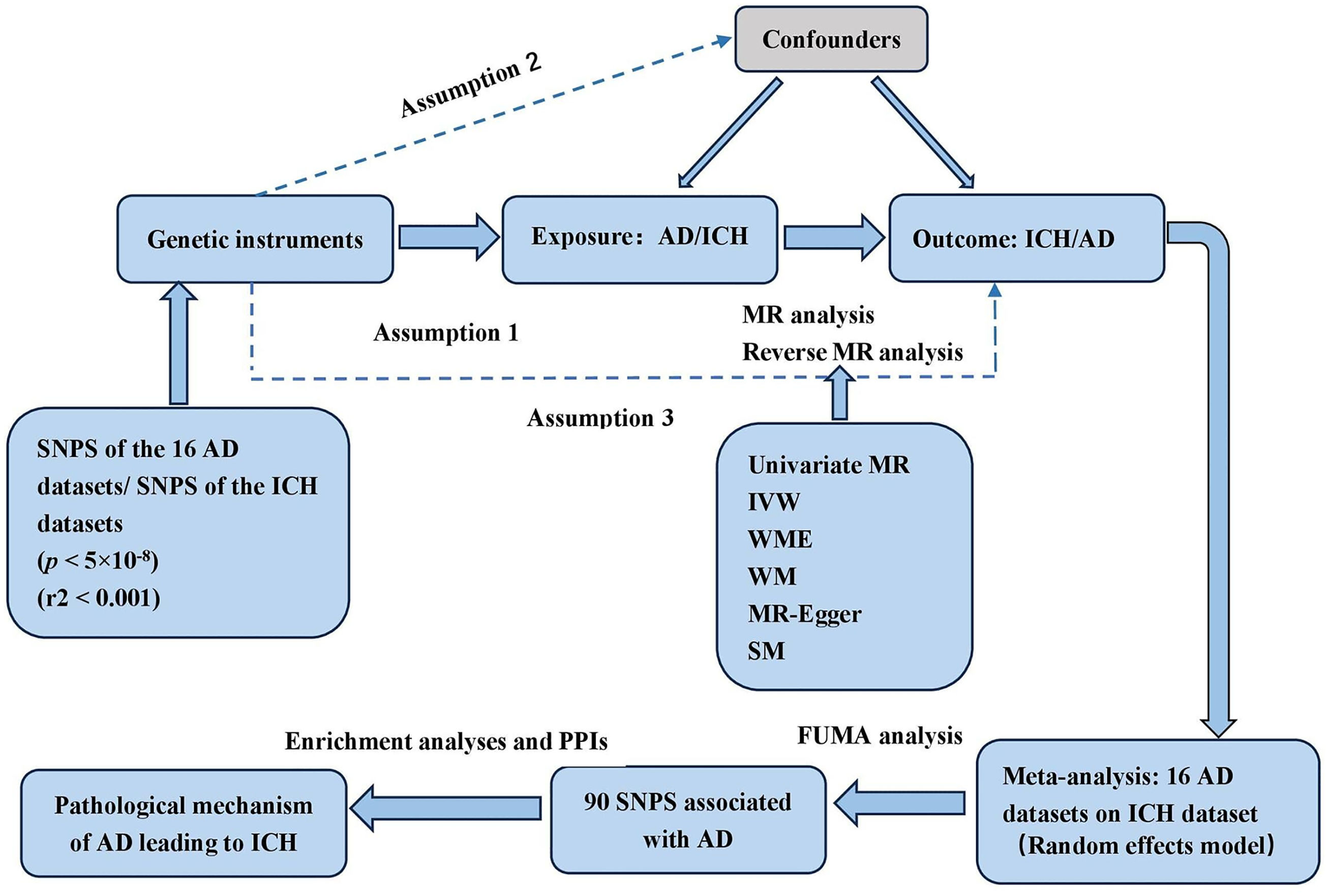
Keywords
Get full access to this article
View all access options for this article.
References
Supplementary Material
Please find the following supplemental material available below.
For Open Access articles published under a Creative Commons License, all supplemental material carries the same license as the article it is associated with.
For non-Open Access articles published, all supplemental material carries a non-exclusive license, and permission requests for re-use of supplemental material or any part of supplemental material shall be sent directly to the copyright owner as specified in the copyright notice associated with the article.
