




Abstract
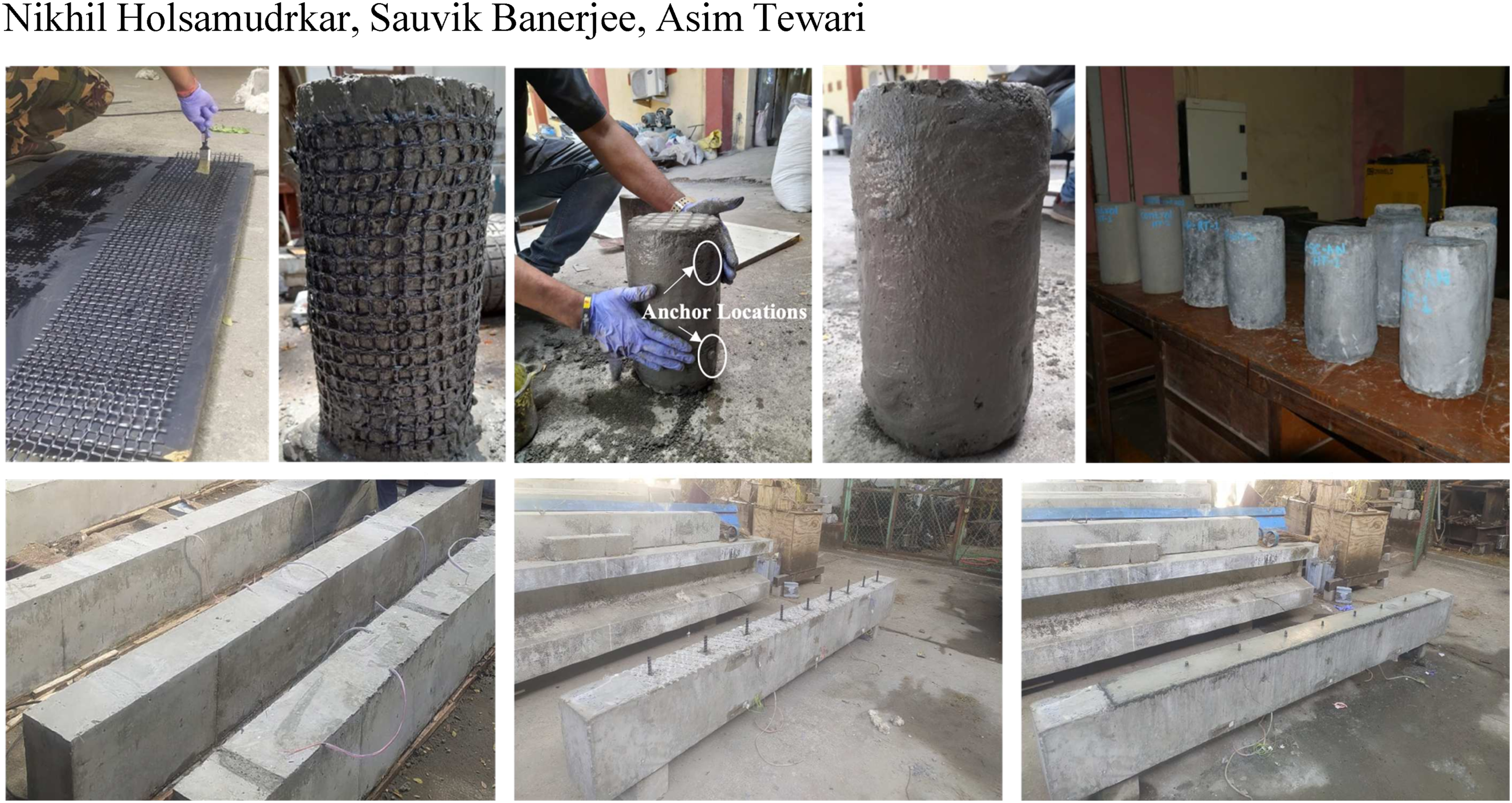
Conventional Fiber-reinforced cementitious matrix (FRCM) systems are prone to fiber-matrix debonding and fiber-fiber debonding, resulting in underutilization of fabric capacity and increased costs. The fabric is impregnated with epoxy to address fiber-fiber slip. However, the epoxy coating stiffens the fabric, rendering it unsuitable for curved surfaces and exacerbating fiber-matrix debonding. To tackle these challenges, this study combines an pre-impregnation strategy for fabric bendability and a mechanical anchorage system to mitigate fiber-matrix debonding. This method locks anchorages within the hardened FRCM mesh structure, activating anchorage upon deformation. Bond-slip characterization of pre-impregnated FRCM systems with and without anchorage is conducted as a preliminary investigation. Four full-scale beams are prepared: one control beam and three partially damaged beams, followed by FRCM strengthening using three different methodologies. Additionally, four cylinders are strengthened with a developed FRCM system. It is observed that the semi-cured with anchorage strategy improves the fabric exploitation ratio to 0.98. The failure mode in both semi-cured and uncured with anchorage was observed to be fiber rupture. The study revealed that the design strain limit for FRCM can be safely increased from 0.012 to 0.016 for anchored specimens with fabric impregnation. This cost-effective strengthening method can potentially be used to strengthen various concrete and masonry elements.
Get full access to this article
View all access options for this article.