



Abstract
Why are some states elected to the United Nations Security Council while others are not? I reorient our thinking towards what states find as unattractive features in a candidate regarding the mission of the Security Council – namely, those characteristics of a candidate that undermine promoting international peace and security. I argue that revolutionary leaders are less likely to be elected to the United Nations Security Council for both direct – fraying relationships with other countries – and indirect – increased propensity for causing intra- and inter-state conflict – reasons. Probit analysis of United Nations Security Council elections reveals that, compared to the average United Nations member, the likelihood that countries led by revolutionary leaders are elected to the United Nations Security Council declines in the duration of their tenure, eventually falling below that of other states. Mediation analysis reveals that the direct effect is stronger than the indirect effect.
Introduction
The United Nations Security Council (UNSC) is the global community’s foremost body for managing threats to international peace and security. It comprises five permanent states (the P5), who have been members since the UN’s founding, and 10 elected states (the E10), who are members that serve 2-year elected terms. Election to the UNSC is highly coveted, and scholars have identified reasons why UN members desire these seats and what they expect to gain from holding these positions. Ultimately, UN members want a seat on the Security Council to contribute to maintaining international peace and security (e.g. Farrall et al., 2020; Nick Pay and Postolski, 2022). They expect that in holding this seat, they will also gain prestige from their performance (e.g. Aral, 2009), increased diplomatic attention (e.g. Wang, 2022), and economic kickback for cooperation on these pressing global matters (e.g. Berlin et al., 2023; Dreher et al., 2009; Kuziemko and Werker, 2006; Reynolds and Winters, 2016). However, we know much less about why members of the UN General Assembly (UNGA) would select some of their peers for these important positions and not others. Yet, in focusing on those features of states that may make them an attractive candidate for election to the UNSC, such as democracy, size, or strength, scholars have found few systematic patterns that help explain which states are elected to these positions on this important global body (e.g. Bueno de Mesquita and Smith, 2010; Dreher et al., 2014; Uzonyi, 2025b). This may be because there are few features that states agree are important for elected members to possess in these 2-year terms. Why are some states elected to the UNSC while others are not?
Rather than focus on what makes states attractive candidates for election, I propose to reorient our thinking towards what states may find as unattractive features in a candidate regarding the mission of the Security Council – namely, those characteristics of a candidate that undermine promoting international peace and security. I posit that revolutionary leaders of states are less likely than other leaders to be elected to the Security Council during their tenures in office because they are more likely than other states to undermine international peace and security, rather than bringing a mediating influence to an organisation tasked with promoting peace and security. Drawing from Colgan (2012: 446), I define a revolutionary leader as one who comes to power and ‘transforms the existing social, political, and economic relationships of the state by overthrowing or rejecting the principal existing institutions of society’. Revolutionary leaders have a direct and two indirect pathways towards decreasing their probability of being elected to the Security Council. The first indirect pathway is that by transforming the existing institutions and social structures of society, such leaders are prone to face more intrastate challengers and often engage in brutal means of attempting to suppress these rebellions (e.g. Kim, 2018; Melson, 1992; Valentino, 2004), thus destabilising their region and threatening international stability. The second indirect pathway is that revolutionary leaders are also more prone to initiating interstate conflict (Colgan, 2013; Colgan and Weeks, 2015), thus destabilising the international community. The direct pathway is that the ambition of revolution often requires such leaders to continually challenge not only their domestic status quo but their state’s standing internationally. Butting up against the existing international order over time wears on the P5, suggesting that these major powers will be less likely to back such leaders’ bids for UNSC membership as their tenure in office increases and relationships continue to fray. Furthermore, since the vote for UNSC membership rests with the UNGA, this broader membership will have little interest in electing a leader who, over time, has repeatedly been prone to violence and shown a disdain for institutions.
I test this argument quantitatively on the likelihood of UNSC election. I find that compared to the average UN member, the likelihood that countries led by revolutionary leaders are elected to the UNSC declines in the duration of their tenure, eventually falling below that of other states. This delayed effect of being a revolutionary leader supports the logic of the direct pathway – it takes time for a revolutionary leader’s actions to fray international relationships and reduce the connections necessary to gain support for electoral success. Mediation analysis further supports this finding by revealing that the effect of revolutionary leaders is mostly through the direct pathway, rather than through either of the indirect pathways.
This project thus contributes to our understanding of the role of leader characteristics, the United Nations and international organisations more broadly. First, a broad literature highlights that leader characteristics influence an array of domestic and international processes such as the duration of war (e.g. Thyne, 2012), economic investment (e.g. Simmons, 2016), genocide (e.g. Uzonyi, 2022), interstate conflict (e.g. Smith and Spaniel, 2019), nuclear proliferation (e.g. Fuhrmann and Horowitz, 2015), and the outcome of war (e.g. Prorok, 2016), among others. Here, I show that such characteristics can also influence whether the leader is elected to important global bodies. Second, the literature on the UNSC has struggled to find patterns that correlate systematically with Security Council elections. I contribute to this literature by highlighting that states are hesitant to elect peers whom they view as detrimental to the cause of the UNSC’s mission of promoting international peace and security. This suggests we should further consider the role of the non-permanent members of the UNSC in the Council’s work when theorising on this process rather than viewing membership as a 2-year term to maximise rents from the P5. Finally, this project contributes to the literature on international organisation more broadly by building off a burgeoning agenda on individual leaders in IOs (e.g. Baturo and Gray, 2024; Choi, 2022; von Borzyskowski and Vabulas, 2022). Previous scholars have highlighted that leaders are able to deviate from standard practices within organisations and may choose to enter or leave IOs as best suits their needs. My work demonstrates, though, that leaders may develop bad reputations over the course of their tenures that keep them out of coveted leadership positions within these organisations.
Revolutionary leaders and Security Council elections
The UNSC comprises two types of states. The first type of state is the permanent five (P5) members – China, France, Russia, the United Kingdom, and the United States. These five states are not elected to the Security Council, can vote on all issues before the Council, and can veto any proposal. The second type of state is the non-permanent elected 10 (E10) members. 1 These 10 states are elected for rotating 2-year terms, can vote on all issues before the Council, but cannot veto proposals. The E10 are elected from regional groups set up in the UN Charter in an effort to provide global representation to the Security Council, despite the P5 members being the major victorious powers at the end of World War II. The UNGA elects three states from Africa, two from Asia, one from Eastern Europe, two from Latin America and the Caribbean, and two from the Western European and Other States Group. Each of these regional groups nominates member states from their region for the UNGA election. Sometimes, a regional group nominates the same number of regional candidates as the open number of regional seats – a ‘clean slate’ – whereas other times, a group nominates more candidates than their region has open seats – a ‘contested slate’. While the UN member states, through the UNGA, have the formal power to elect the E10 members, Dreher et al. (2014) note that the UNGA has tended to leave this decision to the groups when they produce ‘clean slates’.
Together, the P5 and E10 are to monitor and promote international peace and security. They work towards these goals by helping UN members settle their disputes and authorise peacekeepers where such conflict management would help the disputants overcome issues of distrust (e.g. Clayton and Dorussen, 2022; Walter, 1997). The Security Council may also diplomatically isolate UN members whose actions the Council views as threatening to global security, and it can also escalate this pressure through targeting such non-compliers with economic blockades or military force. Given these crucial roles in helping to provide international peace and security, it is important that the Security Council members can work together towards promoting peace (e.g. Akande, 2012; Voeten, 2001; Wuthnow, 2010). While the P5 members may have institutional and physical capacity advantages over the E10 in swaying UNSC decision-making towards their preferences, the elected members do play an important role in crafting Security Council decisions. Since UNSC decisions require nine affirmative votes for all matters, the E10 can work together to sway the direction of the Council’s decisions (e.g. Farrall et al., 2020; Nick Pay and Postolski, 2022). Furthermore, the P5 understand that having strong E10 backing on resolutions provides legitimacy to the Security Council’s decisions and thus moderate their positions to seek compromise within the UNSC (e.g. Gifkins, 2021). Thus, like their stronger counterparts on the Council, the elected members are seen as key figures in this process.
I posit that candidates who are viewed as counterproductive to this mission of the UNSC will be less likely to be elected to it by their peers. Consequently, revolutionary leaders – through indirect pathways related to their propensity for intrastate and interstate conflicts and a direct pathway of fraying international relations – are less likely to be elected to the Security Council because they are viewed as counterproductive to international peace and security, especially as these infractions accumulate over their tenure in office. P5 members will not want to back leaders who constantly challenge the international order, and UNGA voters will not want to elect peers who reject institutionalism and undermine peace.
Indirect pathway 1: Increased intrastate conflicts
The first indirect pathway connecting revolutionary leaders to a decreased likelihood of UNSC election is through an increased rate of intrastate conflicts. Revolutionary leaders come to power intending to transform the existing social, political, and economic relationships of the state. Tearing down these existing structures increases intrastate conflict for two reasons. First, while the leader may intend to make these dramatic changes rapidly, it is likely that he will face resistance from those portions of the state that traditionally benefitted from these formal and informal institutions (see Valentino, 2004). As this resistance increases, the leader will need to either co-opt or crush the dissent. Since the leader’s intent is to rid society of these traditional forces, co-optation is often neither possible nor palatable for the new regime. Instead, the revolutionary turns to violence to suppress the dissent (e.g. Kim, 2018; Melson, 1992). In response, the regime’s violence spirals into civil war (e.g. Davenport, 2007). Second, dramatically changing the existing social, political, and economic institutions of a state not only creates grievance among those that had previously benefitted from the status quo, but these potentially rapid shifts also can destabilise day-to-day life and communal relations. As peaceful relations unravel within the state, the value of turning to violence to secure a new status quo against the revolutionary regime increases (e.g. Cederman et al., 2013; Collier and Hoeffler, 2004). Furthermore, these changes create uncertainty among domestic groups, hindering their ability to bargain with the new regime elites. As these uncertainties increase, the likelihood of civil war also increases for each of these groups (e.g. Thyne, 2012; Walter, 2009).
Intrastate war creates forced migration (e.g. Lichtenheld, 2020; Moore and Shellman, 2004). As the forced migrants cross borders, rebels and government agents often follow, and fighting spreads to nearby states (e.g. Salehyan and Gleditsch, 2006), destabilising regions. Furthermore, these conflicts harm economic activity within the home state and its neighbours (e.g. Minhas and Radford, 2017). This decreased economic performance can act as a further catalyst for the diffusion of war, as it shifts the value of peace and interjects uncertainty into the domestic situations of these states. For these reasons of creating and spreading war – and thus undermining regional and international peace and security – revolutionary leaders will be likely seen as unfit to be elected to the Security Council by their peers in the UNGA.
Indirect pathway 2: Increased interstate conflicts
The second indirect pathway connecting revolutionary leaders to a decreased likelihood of UNSC election is through an increased rate of interstate conflicts. Revolutionary leaders often seek to transform their state’s position in the international system. Achieving greater status or reclaiming territory viewed as the traditional homeland of the state requires the leader to initiate revisionist disputes with other countries on both matters of policy and territory. While such ambitions risk war, making many leaders hesitant to provoke their neighbours and peers in this manner, there are two primary reasons that revolutionary leaders often drive interstate conflicts despite the heightened risk. The first reason is that these leaders are more risk-tolerant than leaders in other political systems (see Colgan, 2013). The process of coming to power through revolution is inherently dangerous. It requires violence and intense personal risk, both to the individual and their families and friends. Those individuals who survive this process and rise to the top of a revolutionary movement have come through a process that selects for highly ambitious people who are willing to accept more dangerous propositions than others. The second reason is that the process of revolution, in tearing down the existing social and political structures of the state, leaves few domestic restraints in place to limit the leader from threatening his neighbours or being punished for risking the lives and resources of the state in this process (see Colgan and Weeks, 2015). Often, personalist leaders emerge from this process who can command the political and military structure of the state without fear of repercussion for increasing interstate conflict with their neighbours.
Such conflicts are directly threatening to international peace and security, as they are cross-international border violence. Furthermore, like intrastate wars, interstate conflicts also diffuse across time and place (e.g. Shirkey, 2020; Siverson and Starr, 1991). This diffusion can further undermine international peace and security, as the wars develop into regional conflicts. Since the Security Council’s mission is to prevent threats to international peace and security, a leader who rises to power with ambitions to challenge the policies and territorial claims of his neighbours is in direct challenge to these objectives. Thus, through the mechanism of causing interstate conflicts, revolutionary leaders will be likely seen as unfit to be elected to the Security Council by their peers in the UNGA.
Direct pathway: Fraying relations
Each of the indirect pathways helps explain why, in a given year, a revolutionary leader may be less likely than his peers to be elected to the UNSC – his domestic and international policies help undermine international peace and security rather than improve it, thus making him a bad candidate for the job. Over time, these processes, along with the inherent confrontational requirement of being a revolutionary, also exacerbate the situation for such leaders. Revolutionary leaders are publicly committed to a sustained shift in their state’s international policies and position during their tenure (Colgan and Lucas, 2017). In the short term, such jockeying for upending the status quo may help revolutionary leaders attract support from one major power against another (e.g. Coggins, 2011). However, long term, the domestic politics of being a revolutionary require such leaders to buck against being a puppet of any foreign regime (e.g. Downes and O’Rourke, 2016). This pressure means that a revolutionary leader finds himself in the position of continually attempting to throw off the yoke of the current status quo powers (e.g. Timmerman, 2022).
Over time, the revolutionary’s reputation as a bully to his neighbours (and thus voters) in the UNGA and a thorn in the side of the major powers of the P5 begins to harden. This locks the revolutionary leader into a cycle of dissatisfaction with the international system. The revolutionary is set on antagonising the current status quo powers (Colgan, 2013). The current status quo powers – and smaller states that cannot bear the costs of conflict spilling into their borders or economies – are set on containing the influence of the revolutionary. Seeing the revolutionary as a disrupter of the international system, rather than as a leader dedicated to maintaining international peace and security, other leaders from within the leader’s regional group and more broadly in the UNGA come to understand the revolutionary as a bad candidate for a job dedicated to promoting stability. The worse the revolutionary leader’s reputation becomes over the course of this tenure, the more likely he will be seen as unfit to be elected to the Security Council by his peers.
Revolutionary leaders come to fray relations with both P5 and non-P5 states in the UNGA. Both are important in this process because both cast votes in the E10 elections. The P5, though, play a particularly important role in this process because they can use their resources to help sway the outcome of these elections. The P5 states have a strong motivation to ensure their resolutions will pass in the UNSC. For this reason, the P5 members have an incentive to ensure that ‘problematic’ revolutionary leaders are not elected to the Security Council for fear that they will disrupt the resolution process. Therefore, a P5 member often attempts to screen out candidates it believes will attempt to resist its activities in the Council by aiding the campaigns of states running against the revolutionary leader or lobbying other UN members not to vote against the state it opposes (Lai and Lefler, 2017). For instance, the United States backed Yugoslavia’s Tito for the Eastern European seat in 1949 over Czechoslovakia’s Gottwald because the United States believed it could work with the communist in Belgrade more so than with the revolutionary leader in Prague (Balci, 2022).
Furthermore, many UNSC elections pit states of similar economic and military stature against one another for a region’s seat. In these situations, it is the campaign strategies and activities of the candidates that make the difference. Where a candidate’s leader explicitly takes part in the campaigning, rather than leaving the process to the country’s diplomats, the country often fares much better (e.g. Ekengren and Möller, 2020; Thorhallsson and Eggertsdóttir, 2020). For a revolutionary leader whose actions have eventually turned his neighbours and the major powers against him throughout the course of his tenure, such crucial campaign activities are not available to the country since his reputation is tied negatively to the success of its campaign and candidature.
Figure 1 illustrates how the direct and indirect pathways of a revolutionary leader’s effects on international peace and security culminate in undermining his prospects for UNSC election over his tenure in office.

Direct and indirect pathways between revolutionary leaders and election.
Together, these pathways produce the observable implication captured in the following hypothesis,
Previous scholars have highlighted the strength of the rotational norm in the African Group (e.g. Carnegie and Mikulaschek, 2020; Caro-Burnett and Weese, 2023; Dreher et al., 2014), suggesting that cases from this group should be hard cases for my theory. Yet, the case of Sudanese President Omar al-Bashir’s failed bid for a Security Council seat in the year 2000 illustrates the mechanisms of my theory well. In 2000, the Organisation of African Unity (OAU) endorsed Sudan to replace Namibia, which was vacating an African Group seat on the Security Council at the end of the year. However, Uganda was strongly opposed to Sudan’s candidacy, as President al-Bashir was actively supporting rebel groups in Uganda. Indeed, al-Bashir had long sponsored rebel groups in his neighbours’ territories (see Meier et al., 2023). Now, his neighbours could not abide his election to the body that was responsible for managing such conflicts and guaranteeing peace and security regionally and internationally. With al-Bashir unable to build consensus for his candidacy in the African Group, Mauritius stepped forward to challenge Sudan for the open African seat on the Security Council in that election cycle. In doing so, Mauritius wrote a letter to the General Assembly voters detailing the opposition to al-Bashir, and in contrast, highlighting its own ‘necessary credentials and the ability to contribute effectively in the deliberations and the decision-making process in the Security Council on all issues of peace and security’. 2
In 1989, al-Bashir took power in Sudan through a coup and consolidated power fully by 1993 when he named himself President. Throughout his tenure in office, the indirect pathways of my theory are well supported, as al-Bashir was seen as a menace to regional and international security. First, he fought and spread intrastate conflicts (indirect pathway 1). For decades under al-Bashir, Sudan had suffered its own civil wars. In the year 2000, alone, these intrastate conflicts produced over 500,000 refugees and asylum-seekers that spilled into the neighbouring countries, destabilising the region (UNHCR, 2025). Second, he challenged his neighbours and promoted cross-border violence (indirect pathway 2). Rather than fight his rivals directly, though, (e.g. Findley and Young, 2011; Salehyan et al., 2011), al-Bashir regularly preferred to sponsor insurgents and terrorists in his enemies across the region. These intra- and inter-state conflicts thus helped lead, in part, to the direct pathway of fraying relations with these regional peers, undermining cohesion in a regional group that tended to back a single candidate for the UNSC election.
Furthermore, President al-Bashir’s aggressive international stance had also long been a thorn in the side of the United States, specifically, as he sought to push against the Western liberal order (direct pathway). With a willing challenger to Sudan’s Security Council bid in Mauritius, the United States began to wage a campaign against al-Bashir’s UNSC election. Washington highlighted al-Bashir’s sponsorship of transnational terrorism, his threat to international peace and security, and his attacks on areas of ongoing UN relief operations. Secretary of State Madeleine Albright lobbied individual African states that were torn between Sudan’s regional record and the initial OAU endorsement, attempting to sway those members who saw this campaign as Western meddling in African decision-making (New Humanitarian, 2000). Since the final vote is at the UNGA level, Albright also made frequent speeches to the Assembly at large, highlighting Sudan’s poor human rights record in comparison with that of Mauritius. State Department Spokesman Richard Boucher even argued that Sudan should be banned from the seat because it was currently under UN sanctions (BBC, 2000).
Ultimately, international dissatisfaction with al-Bashir prevailed over the OAU’s endorsement of Sudan to fill the African Group’s seat. After four rounds of voting, Mauritius beat Sudan in UNGA voting 113-55. This case thus helps illustrate each of the mechanisms outlined in my theory. It also highlights possible nuance in various contexts. For instance, this case highlights that the indirect and direct pathways may be intertwined, and that despite the fraying international relations of a revolutionary leader, he may still enjoy support from some group members who are like-minded in their opposition to the current international status quo. Such nuance suggests that my primary hypothesis may be conservative as it does not address such possible scope conditions and finding statistically significant support for the average effect it posits thus may prove difficult.
Research design
The unit of analysis for this study is the state-year. The study starts in 1965, following the expansion of the Security Council. However, as the Supplemental Materials show, the results hold for all years back to the establishment of the UN in 1948 (Supplemental Materials A1, p2). The study is temporally limited to 2004 due to data availability on revolutionary leaders (Colgan, 2012).
The dependent variable is coded 1 in the year in which a state is Elected to the UNSC; 0 otherwise (UN, 2025). A state is dropped from the sample for the period in which it is serving on the UNSC. It is also dropped for the 3 years after rotating off the Security Council because it is not eligible for immediate re-election. The P5 states are also dropped from this analysis because they are not elected to their positions on the UNSC. Given the binary nature of this dependent variable, I estimate a series of probit models to test my hypothesis. Each probit model includes a time polynomial of Years since Elected to control for temporal dependence in the data. 3 This variable is measured at the state-level since the election data are collected at the state-level, and it is the state that is elected to the UNSC. It also helps capture the process of turn taking – the ‘rotation norm’ – in some regional groups, as previous scholars have found that Years since Elected should increase before the next time a state is elected to the Security Council (e.g. Caro-Burnett and Weese, 2023; Dreher et al., 2014).
The key independent variable to capture the direct pathway of a revolutionary leader’s effect on the probability of his state being elected to the Security Council is an interaction. The first constitutive term in this interaction is Revolutionary Leader, provided by Colgan (2012). It equals 1 for each year in which the leader of a state meets the above-given definition of a Revolutionary Leader; 0 otherwise. The second constitutive term is each leader’s Tenure in office, measured in total days in office to that point for the year (Goemans et al., 2009). This variable has a high rightward skew, so I use its log in each model, Log(Tenure). Note, this variable is collected at the leader-level and captures leader-specific time unrelated to the Years Since Elected state-level variable, since leaders turn over throughout a state’s electoral history. 4 I include each of these constitutive terms, with the resulting interaction term, Revolutionary Leader*Log(Tenure), in the following models.
I include two variables to capture the indirect pathways through which the revolutionary leader influences UNSC elections – one for each effect. The first is the total number of Intrastate Conflicts the leader is fighting within his state each year (Davies et al., 2024). This variable has a high rightward skew, so I include its log, Log(Intrastate Conflicts), in the following models. The second is the total number of Interstate Conflicts the leader initiates each year (e.g. Palmer et al., 2022). This variable also has a high rightward skew, so I use its log, Log(Interstate Conflicts), in the following models, as well.
I begin with a parsimonious model that only includes the leader variables and the time polynomial of Years since Elected to control for temporal dependence in the data. Next, I expand the models to include the conflict variables. I then estimate models that include additional independent variables to control for alternative explanations and possible confounding effects. First, I include Log(GDPpc) from Bolt and Van Zanden (2024) because wealthier countries are more likely to be elected to the Security Council (e.g. Dreher et al., 2014) and less likely to fight civil war (e.g. Fearon and Laitin, 2003). Second, I include Log(Population) from Bolt and Van Zanden (2024) because larger countries are more likely to be elected to the Security Council (e.g. Bueno de Mesquita and Smith, 2010) and more likely to fight civil war (e.g. Raleigh and Hegre, 2009). Larger countries are also more likely to produce revolutionary leaders (Colgan, 2010). Third, I include Democracy from Coppedge et al. (2024) because, in some regions, more democratic states are more likely to be elected to the Security Council (e.g. Uzonyi, 2025a) and less likely to fight civil war (e.g. Hegre et al., 2001). Democracies are also less likely to produce revolutionary leaders (Colgan, 2010).
All time-varying independent variables are lagged 1 year to capture the sequence of events in the data. Table 1 provides the descriptive statistics and variance inflation factors (VIFs) for all variables in the models. All VIFs are under 1.80, suggesting that multicollinearity is not a significant concern for this analysis. In sum, my primary model is specified as follows, where the election of leader i in year t is a function of the interaction between whether they are a revolutionary leader and their (logged) time in office (Leader Tenure), in addition to the control variables included

Descriptive statistics and variance inflation factors.

Dependent variable.
The Supplemental Materials (A7, pp. 8–9) provide a table of all revolutionary leaders fitting Colgan’s definition for this period along with which years they won election to the UNSC and years in which they gained significant votes but did not win a seat.
Main analysis
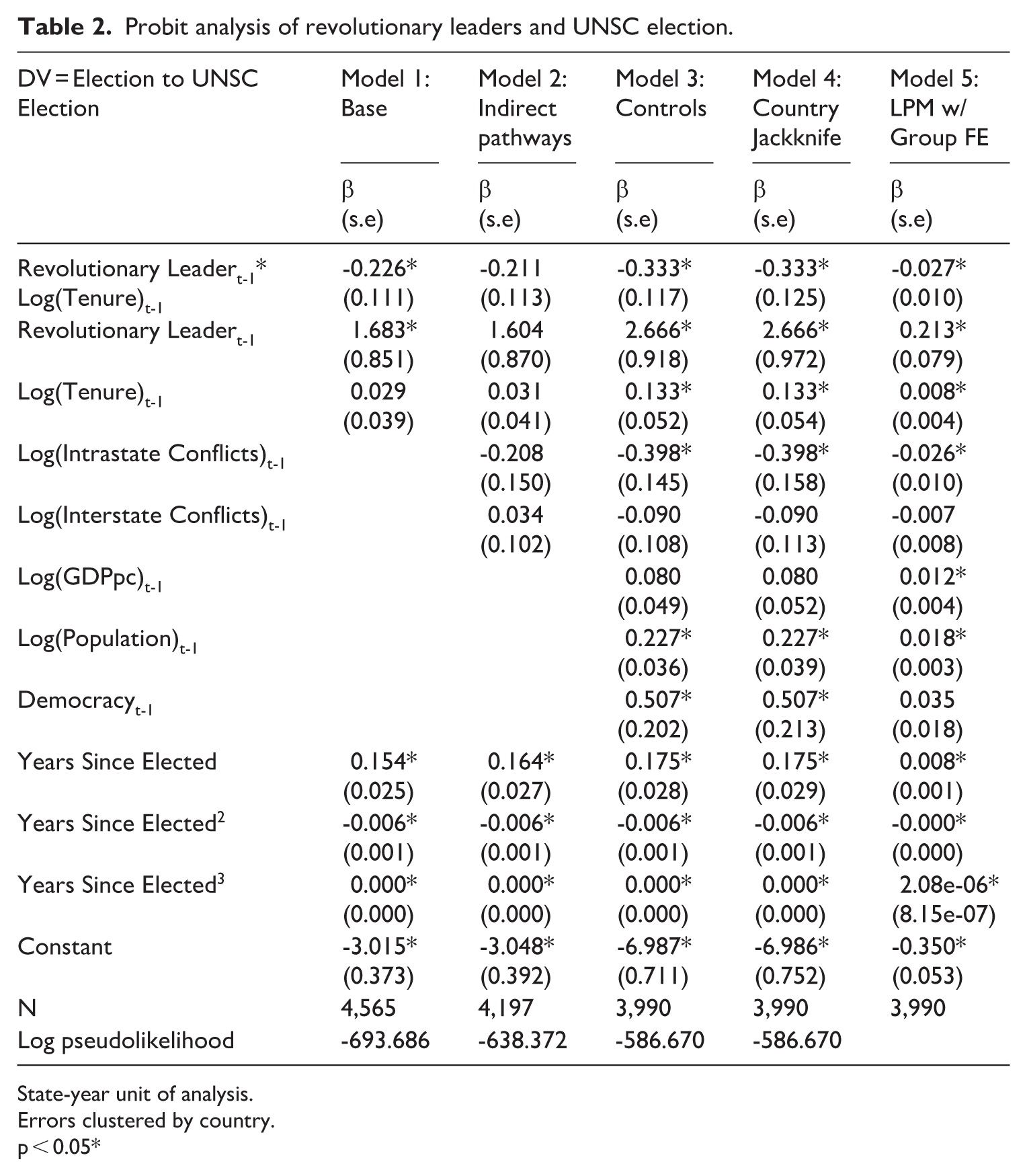
Table 2 presents the results of the probit analysis. Model 1 is the base model that includes only the interaction term to capture the direct effect of revolutionary leaders over time. Model 2 adds the intrastate and interstate conflict variables to also capture the indirect effects of the revolutionary leader on the probability of his country being elected to the Security Council. Model 3 includes the full host of additional independent variables controlling for alternative explanations and potential confounding effects. Model 4 performs a jackknife procedure in which each country is systematically dropped from the sample to check whether any one country is driving the results. Model 5 is a linear probability model that includes the country’s regional group fixed effects to hold constant the time-invariant effects, and regional differences, of the groups and their varying routines towards elections.
Probit analysis of revolutionary leaders and UNSC election.
State-year unit of analysis.
Errors clustered by country.
p < 0.05*
Two interesting patterns emerge from across these models. The first pattern to note is that the coefficient on the constitutive term Revolutionary Leader, by itself, is positive and statistically significant in all models, except Model 2. At first glance, this may suggest that revolutionary leaders are more likely to be elected than other leaders. However, this interpretation should be taken with care. Since this is a constitutive term in an interaction model with Log(Tenure), this would be the interpretation of the averaged effect across all revolutionary leaders if Log(Tenure) equalled 0. However, Log(Tenure) never equals 0 in this sample because it is calculated as the maximum days served in the year for the incumbent leader (see Table 1). Furthermore, as the marginal effects of the interaction term Revolutionary Leader*Log(Tenure) presented in Figure 2(a) to (d), and corresponding to Models 1–4, respectively, show, the positive effects of being a Revolutionary Leader are never statistically significant across the range of a leader’s tenure. Thus, while we have this pooled main effect for revolutionary leaders in the data, it is not statistically significant for any sample of the leaders.
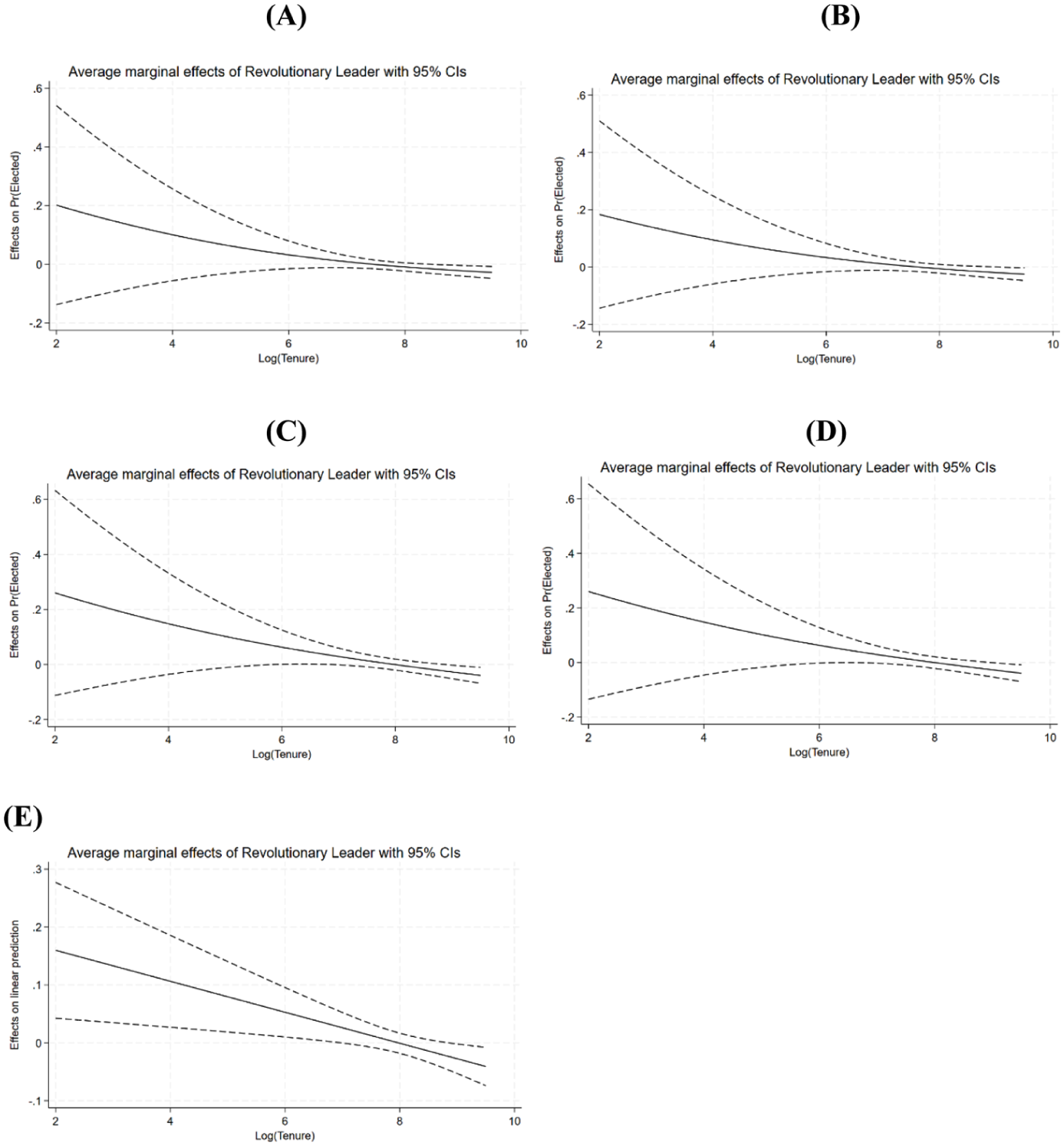
Marginal effect of a revolutionary leader on elections across tenure in office.
The second pattern to note is that the coefficient on the interaction term Revolutionary Leader*Log(Tenure) is negative, as expected, and statistically significant in all models (except Model 2). This coefficient, too, though, is the average effect calculated across the pooled sample. It is important to consider where in a revolutionary leader’s tenure his electability may eventually decline and fall below that of other states. Returning to the marginal effects presenting in Figure 2(a) to (e), each frame of Figure 2(a) to (e) demonstrates the same pattern: compared to the average UN member, the likelihood that countries led by revolutionary leaders are elected to the UNSC declines in the duration of their tenure, eventually falling below that of other states. However, it is important to note that a revolutionary leader’s likelihood of election is not lower than that of any other type of leader until late in his tenure. As can be seen in Figure 2(a) to (d), for much of a revolutionary leader’s tenure, the effect of being a ‘revolutionary’ is statistically insignificant – the confidence intervals in the figures include 0. However, in each figure, the confidence intervals narrow, and this effect becomes significant as the leader remains in office. In each figure, the effect becomes statistically significant at the 95% level when Log(Tenure) reaches between 8 and 9. This effect is statistically significant for all models, including Model 2. Model 5, which includes region fixed effects, displays this negative relationship, as well. However, it is the one model that displays a statistically significant positive relationship between UNSC election and revolutionary leaders early in their tenures (Figure 2(e)) – fitting with the averaged effect displayed by the coefficient on the constitutive term Revolutionary Leader shown in Table 2, as well. This suggests that, in some regions, such leaders may enter office with promises to reform society and overhaul post-colonial societies – change their peers may appreciate at first.
Together, these two patterns suggest that while, across all these models, my hypothesis is supported to some degree, there is nuance. Being a revolutionary leader is not an immediate obstacle for an individual’s election to the UNSC. Rather, these patterns highlight that this effect tends to kick in over time.
It is important to note that the variables capturing the indirect pathways between a Revolutionary Leader and election are less robust. In all models, except Model 2, Log(Intrastate Conflicts) decreases the probability of election. This finding fits with previous work suggesting that UN member states prefer Security Council members to be more peaceful states (e.g. Caro-Burnett and Weese, 2023). Surprisingly, however, I find that in no model is Log(Interstate Conflict) statistically significant.
The additional independent variables vary across models. A larger Log(Population) is associated with an increased likelihood of a state being elected to the Security Council in each model in which it is included (Models 3–5). Larger states more commonly being elected to the Security Council fits with previous expectations (see Bueno de Mesquita and Smith, 2010). States with a higher Democracy score are associated with a higher likelihood of being elected to the UNSC in Models 3 and 4, but not Model 5. Previous scholars tend to find inconclusive patterns between democracy and whether a state is elected to the Security Council. The above models include several variables capturing political violence and instability for a state, both domestically and internationally. This suggests that once the violence-reducing effects of democracy are parsed out, regime type may have a more consistent effect on UNSC elections. Future scholars may wish to more fully explore what other features of democracy a state’s regional peers find attractive in electing such regimes to the Security Council. However, it is important to note that the one model in which Democracy was statistically insignificant was Model 5, which included regional fixed effects to account for heterogeneous effects across regions, as highlighted by those scholars who show more mixed results related to the relationship between regime type and UNSC electoral success. 5
Log(GDPpc) is only statistically significant once I parcel out group effects (see Dreher et al., 2014) in Model 5. Here, it also becomes associated with a higher likelihood of a state being elected to the UNSC. This is expected because wealthier states can better campaign and lobby their peers for a seat on the Council. Finally, in all models, the time polynomial shows that there are temporal effects to this process. While I use the time polynomial to handle temporal dependence in the binary outcome models, these effects support previous findings related to turn taking, or rotational, norms in the UNSC electoral process (e.g. Caro-Burnett and Weese, 2023; Dreher et al., 2014). 6
As a robustness check, I also address the possibility of correlated errors across countries in the same region. First, I re-estimate Model 3 but with the errors clustered on region-years. Second, I estimate a multilevel logit model with random intercepts by region. In each model, my results hold. Third, I estimate modified choice models in which each region makes a choice of ‘winner’ per electable seat. Here, I find the same pattern as Model 3, but now the interaction is no longer statistically significant. The tables and figures for each of these models are presented in the Supplemental Materials (A6, p. 7).
Mediation analysis
My theory suggests that Revolutionary Leaders may influence their state’s ability to be Elected to the UNSC through both direct and indirect pathways. The probit analysis in the previous section allows me to analyse whether there is a robust cumulative average effect between such leaders and UNSC elections. However, it does not allow me to tease apart whether Revolutionary Leaders are having a direct effect on their states being elected or an effect that is mediated through one of the indirect pathways on which I theorised. That is, while the probit analysis indicates whether intrastate or interstate conflicts share a statistically significant correlation with UNSC elections, such an analysis does not allow for the direct testing of these various possible pathways.
Therefore, I turn to mediation analysis to directly test this part of my theory. This model uses Elected as the dependent variable and Revolutionary Leader*Log(Tenure) as the key independent variable of interest, with the constitutive terms Revolutionary Leader and Log(Tenure) each included as covariates to ensure correct estimation of the interaction effect. Log(Intrastate Conflicts) and Log(Interstate Conflicts) are the two mediating variables, and the remaining variables – Log(GDPpc), Log(Population), Democracy, and the time polynomial of Years since Elected – are the control variables. It then estimates the indirect effect of Log(Intrastate Conflicts), the indirect effect of Log(Interstate Conflicts), their combined total indirect effect on Elected, the direct effect of Revolutionary Leader*Log(Tenure) on Elected, and then the total effect of each of these variables on Elected using logit models. The standard errors and 95% confidence intervals for each of these effects are produced through a bootstrap procedure of 500 replications.
Table 3 presents the results of the mediation analysis. As is evident from Model 6 in Table 3, the mediation analysis supports the conclusion of the probit model, despite taking a different approach to exploring the relationship between each of these variables and the likelihood that a country is elected to the Security Council. Here, the mediation analysis reveals that it is the direct effect of Revolutionary*Log(Tenure) on the probability of Elected that is statistically significant, as in the probit analysis. Neither the indirect effect of a revolutionary leader through Log(Intrastate Conflicts) nor through Log(Interstate Conflicts) is statistically significant. These indirect pathways tend to be more short term. As the above analysis showed, compared to the average UN member, the likelihood that countries led by revolutionary leaders are elected to the UNSC declines in the duration of their tenure, eventually falling below that of other states. This may help explain why such short-term, immediate variables like civil or interstate conflict are not the pathways through which being revolutionary influences election to the UNSC. However, per Model 6, the total effect of being a long-tenured revolutionary leader still supports my hypothesis that such leaders are less likely to be elected to the UNSC as their tenure in office increases.
Mediation analysis of revolutionary leaders and UNSC election.

State-year unit of analysis.
Errors obtained through 500 bootstrap interactions.
p < 0.05*
Probing the mechanism
The models thus far suggest that the direct mechanism of fraying relations is most likely at work over the course of a revolutionary leader’s tenure. However, these models do not provide a test of patterns that may capture the revolutionary’s experience with frayed relations. To probe that mechanism more directly, I offer two tests that use sanctions imposed against leaders as a proxy for frayed relations (see Table 4). Model 7 explores whether revolutionary leaders are likely to experience more sanctions than other leaders later in their tenure – aligning with my expectation that revolutionary leaders experience more frayed relations later in their tenures. Here, I conduct an ordinary least square (OLS) country-year analysis in which the dependent variable is the logged count of sanctions placed against the leader, Log(Sanctions), as provided by Yalcin et al. (2025). The key independent variables remain the interaction between Revolutionary Leader and Log(Tenure), Revolutionary Leader*Log(Tenure), and I include the full set of controls from Models 3–5 with a lagged dependent variable of the logged sanction count in place of the time polynomial of years since UNSC election, given the change in dependent variable. As is evident from Figure 3(a), revolutionary leaders face fewer sanctions than other leaders early in their tenures. However, as their tenures increase, so does the number of sanctions they face. This is supportive of my claim that revolutionary leaders tend to have fraying relations with other countries later in their tenures.
Analysis of revolutionary leaders, sanctions, and UNSC election.

State-year unit of analysis.
Errors clustered by country.
p < 0.05*

Revolutionary leaders, sanctions, and UNSC election.
Having established this pattern, Model 8 then substitutes Log(Sanctions) for Log(Tenure) in my primary model (Model 3) as a measure of frayed relations, more directly. I then re-estimate this fully specified model. As is evident from Figure 3(b), we see a very similar pattern to the earlier models (Models 1–5). When revolutionary leaders have better relations with other countries, they are no more or less likely to be elected to the UNSC. However, compared to the average UN member, the likelihood that revolutionary leaders are elected to the UNSC declines as Log(Sanctions) increases, eventually falling below that of other states.
Selection effects?
To be elected to the Security Council, a state must first choose to run for a seat. This suggests that there may be a selection process of which leaders run that influences which leaders win. To examine this possibility, I estimate a bivariate probit model. The first equation of this bivariate probit model will estimate the probability of a state Running for election, while the second equation estimates the probability of the state being Elected. Beyond their different dependent variables, the equations are the same aside from two exceptions. The first exception is that the Running equation includes a time polynomial of Years Since Running instead of Years Since Elected. The second exception is that it includes V-dem’s 0–1 Civil Society index (Coppedge et al., 2024) as an excluded variable that correlates with the likelihood of a state running for a UNSC seat but not winning it. 7 Theoretically, domestic civil society should be able to influence the costs of their own leader running when a campaign does not behove the state; however, civil society should have no effect on winning votes from other states once the leader has already made the decision to run, since the decision to elect the running state is made in those other countries. The bivariate probit will estimate a rho (ρ) term that captures the latent dependency between the decision to run and the outcome of whether the state is elected. It then corrects for any bias related to the correlation between these two equations.
The results of the bivariate probit are presented in Model 9 of Table 5. There are three key patterns to note from these results. First, ρ is statistically insignificant. This pattern indicates that the process that leads states to run for a UNSC seat is not correlated with the likelihood of winning that election in these data. Second, Revolutionary Leader*Log(Tenure) has a similar influence on a state’s probability of running for election as it does on that state’s probability of winning an election: the likelihood that a revolutionary leader runs for a UNSC seat is higher than other leaders when they are mid-tenure and is then lower later in the leader’s tenure (see Figure 4(a)). The effect of being a revolutionary leader is statistically insignificant early in a leader’s tenure. Third, despite this similarity in effect, my primary results remain robust: the likelihood that countries led by revolutionary leaders are elected to the UNSC declines in the duration of their tenure, eventually falling below that of other states. Here, this effect becomes statistically significant at the 95% level once Log(Tenure) reaches 9.2 (see Figure 4(b)).
Bivariate probit of running for and election to UNSC.

State-year unit of analysis.
Errors clustered by state.
p < 0.05*

Interactions from bivariate probit model.
Regional differences
Previous scholars highlight that varying regional norms, preferences, and electoral schedules may lead some factors to influence UNSC outcomes differently between groups (see Dreher et al., 2014). To explore this possibility for the influence of revolutionary leaders, I re-estimate my main model (Model 3) in each of the five regional groups. All results are presented in the Supplemental Materials (A5, p. 6). I find that the patterns presented above are the strongest for the Asia-Pacific Group. Since a few regional giants – India, Japan and Pakistan – are routinely elected within this group, such patterns may suggest two key theoretical points for our understanding of the connection between revolutionary leaders and election to the Security Council. First, when regional giants dominate the election in a group, revolutionary leaders, like leaders of other states in the region, may simply not have a chance to hold the UNSC seat. Thus, part of this story may be about regional access. Second, though, is that the pathway most supported in the data is the direct pathway in which friction between the revolutionary leader and other states leads to fraying relations. In groups that are dominated by a few giants, revolutionary leaders may see these states as targets, running afoul of the regional powers, and become boxed out by them and their supporters.
The patterns presented above also hold for the African Group at the 10% level and are in the correct direction for the Group of Latin America and Caribbean Countries, but the interaction is statistically insignificant. In Eastern Europe, it is mid-tenure revolutionary leaders who are least likely to be elected. The region that deviates the most from the pooled results is the Western European and Others Group (WEOG), which only had two revolutionary leaders in this period. The WEOG results help highlight two important lessons from this exercise. First, the various regions do sometimes differ in what influences their electoral outcomes. Second, though, their histories may make making meaningful comparisons by region difficult for some factors when not many cases (and thus data) exist for some variables in some regions. In these situations, as in the case of revolutionary leaders who tend to be less common than non-revolutionary leaders, globally, the pooled analyses speak better to the broader phenomena.
Discussion and conclusion
The UNSC is an important global body that makes decisions influencing prospects for international peace and security. Positions on this body are coveted by states that both want a say on these policy decisions and to benefit from the monetary rewards that sitting on this body can provide. Previous scholarship on UNSC election has emphasised what characteristics of a state its regional peers may find attractive in voting new members onto this rotating board. I reorient our thinking about this process by highlighting what characteristics of an individual leader his regional peers may find unattractive in terms of accomplishing the job of providing international peace and security, with which the UNSC is responsible.
As I expected, revolutionary leaders are less likely than other leaders to be elected to the Security Council once they have frayed relationships with other leaders, highlighting the importance of these leader-specific negative characteristics. Such a process speaks to the importance of leaders’ reputations in international relations. As scholars have noted, a leader can develop a reputation separate from that of the state (e.g. Gibler, 2008; Yarhi-Milo, 2018). This reputation takes time to develop (Uzonyi, 2022). However, once formed, it becomes sticky and hard to leave behind. In terms of the UNSC, this raises the question of what a revolutionary leader can do to break the cycle of mistrust and antagonism between himself, his regional peers, and the major P5 powers. Importantly, some revolutionary leaders do get elected to the Security Council. Some, like Algeria’s Boumédiène, are elected early in their career before their reputation is cemented. Others, though, like Zimbabwe’s Mugabe, are elected later in their careers. What explains why some revolutionary leaders can overcome their reputations later in their tenures?
Furthermore, it is important to note that these individual-level characteristics that shape a leader’s – and thus a state’s – ability to earn a position on important global bodies are also separate from the here and now effects and influences of political violence. Throughout this study, civil war is shown to decrease a state’s chances of being elected to the Security Council. In part, this is likely due to civil war’s destabilising effects on a region – thus highlighting a war-prone leader’s unattractiveness to his peers. Furthermore, such violence may suggest that the leader will be distracted by these events at home from being able to focus on the job of the Security Council. Either way, the results also highlighted that the influence of a revolutionary leader worked independently – and through a different pathway – from that of the political violence. This suggests that leaders may not judge each other for how they conduct domestic business and may be willing to look the other way if domestic or international pressure is not too high (see Krcmaric, 2018). Instead of peer-to-peer, the concerns appear to be how leaders treat each other and whether one continues to antagonise the club across time. Importantly, many leaders are willing to vote for revolutionary leaders. An extension of this project would be a directed-dyad analysis to explore which leaders are willing to vote for revolutionary leaders and under what conditions. More broadly, additional research is needed to more fully understand the extent to which peer-to-peer antagonisms and protections help explain interactions inside and outside international organisations and other aspects of global politics.
Supplemental Material
sj-pdf-1-bpi-10.1177_13691481261441987 – Supplemental material for Revolutionary leaders and election to the United Nations Security Council
Supplemental material, sj-pdf-1-bpi-10.1177_13691481261441987 for Revolutionary leaders and election to the United Nations Security Council by Gary Uzonyi in The British Journal of Politics and International Relations
Footnotes
Funding
The author received no financial support for the research, authorship, and/or publication of this article.
Ethical approval and informed consent statements
Not applicable.

Data availability statement
All underlying research materials related to this project are available on the author’s website.
Supplemental material
Additional Supplementary Information may be found in the online version of this article.
Notes
References
Supplementary Material
Please find the following supplemental material available below.
For Open Access articles published under a Creative Commons License, all supplemental material carries the same license as the article it is associated with.
For non-Open Access articles published, all supplemental material carries a non-exclusive license, and permission requests for re-use of supplemental material or any part of supplemental material shall be sent directly to the copyright owner as specified in the copyright notice associated with the article.
