




Abstract
This article introduces the concept of the national gimmick – a performative, stylised persona derived from professional wrestling – as an effective lens for analysing government nation branding and soft power strategies. Using WWE’s Clash at the Castle and its 2022 partnership with the Welsh Government as a case study, the article demonstrates how governments employ entertainment spectacles to project curated national identities to global audiences. It argues that professional wrestling’s emphasis on stereotype, performance, and narrative makes it an especially potent medium for understanding how states simplify and disseminate nation brands. By examining the portrayal of the Cymru Wales Brand through WWE media, and the tensions surrounding Welsh representation at the event, the article highlights both the potential and the limitations of such partnerships. This interdisciplinary contribution bridges political communication and pro-wrestling studies to advance the study of government’s soft power strategies and the politics of branding.
Introduction
In September 2022, on a Cardiff side street, Conservative MP Dehenna Davison faced off against Labour MP Christian Wakeford in front of a crowd of cheering onlookers. Grinning widely, Davison swung a steel chair at Wakeford. As the chair connected with his head a metallic thunk rang out and Wakeford crumpled awkwardly to the ground. Davison then planted her foot on the downed MP’s chest as the crowd chanted, ‘One! Two! Three!’ (Daily Star, 2022). Later, retweeting video footage of the incident, Wakeford – who had defected from the Conservative Party to join Labour earlier that year – commented, ‘She’s been dying to do that since I crossed the floor [of the House of Commons]’ (Christian Wakeford MP, 2022). At the time, both Davison and Wakeford were members of the All-Party Parliamentary Group (APPG) on Wrestling, a cross-party group of parliamentarians with a shared interest in UK pro-wrestling. They, along with fellow APPG members, were in Cardiff to attend WWE’s Clash at the Castle, a Premium Live Event (PLE) held at the Principality Stadium – WWE’s first UK stadium show in 30 years.
To many, the idea of British parliamentarians attending a pro-wrestling event or treating it as a political matter will seem bizarre. After all, politics is typically portrayed as deeply serious by its practitioners and associated media, while pro-wrestling is usually derided as low-brow entertainment unworthy of attention. However, dismissing pro-wrestling as unworthy of political attention overlooks the APPG’s work on industry standards and workers’ rights (All-Party Parliamentary Group on Wrestling, 2021). It also ignores the growing linkages between politics and pro-wrestling within academic and media discourse (Mazer et al., 2020; Moon, 2020, 2022; O’Brien, 2020).
Clash at the Castle (hereafter Clash) offers a perfect case in point since, in a very tangible sense, it was a political co-production between WWE and the Welsh Government (2023a), which provided financial support for the event in the form of approximately £2.2 million in grant payments. Tied into the Welsh Government’s Major Events Strategy, these payments were contingent upon meeting pre-agreed targets, such as achieving specific levels of ticket sales, generating a positive economic impact for Wales, and ‘promoting Wales in the USA’ through ‘bespoke content creation’ (Welsh Government, 2023a). Clash was a political co-production because these targets, especially the latter, directly influenced the content of WWE’s entertainment output. Moreover, the Welsh Government was not ‘hands off’ when it came to developing this target-required content, representatives describing how they ‘worked very closely with WWE’, taking the partnership ‘to a new level . . .’ (House of Commons, 2023: Q197).
This partnership was not motivated by any love of sports entertainment. The Record for Ministerial Engagements and Meetings shows Minister for the Economy Vaughan Gething attended Clash, but this was in an official capacity, not as a fan (Welsh Government, 2022a). As Gething himself explained: the reason we got involved with the WWE and Clash at the Castle . . . was not because I remember watching Hulk Hogan when I was a much younger person, but because of the giant social media appeal that that event and that company has. (House of Commons, 2023: Q197)
For the Welsh Government, Clash’s success in promoting Wales in the United States ultimately hinged on the use of WWE’s international reach to promote their nation brand, the Cymru Wales Brand (CWB), which sits at the core of the Major Events Strategy and associated soft power strategies (Welsh Government, 2020a). Almost all contemporary governments engage in such nation-branding strategies, which involve the use of ‘the tools of branding to alter, confirm or change the behaviour, attitudes, identity or image of a nation’ (Bolin and Stahlberg, 2010: 82; Gudjonsson, 2005: 285).
Even discounting social media and televised reach, governmental partnerships with the WWE initially appear an astute choice – pro-wrestling’s nature as a performance form making it an ideal vehicle for nation-branding projects. As Widler (2007) describes, what nation-branding ultimately does is to take a complex entity (the nation) and strip it down to a basic image, reproducing and enhancing stereotypes in doing so. In pro-wrestling terms this process of stripped-down images with heightened stereotyping already exists in the form of the ‘gimmick’, the industry term for wrestlers’ personas. In her own research, Nevitt (2010: 322) has illustrated how pro-wrestling characters – aka their gimmicks – ‘frequently represent or embody particular ideas, groups or nations’. Had Gething’s recollections of Hulk Hogan’s 1980s run been stronger, he might have remembered his flag-waving feuds with the Iranian Iron Sheik, ‘Russian’ Nikolai Volkoff, ‘Japanese’ Yokozuna, and American turncoat Sergeant Slaughter and his ‘Iraqi’ allies – all essentially battles between personifications of nations, as stereotypically simplified by WWE.
Article focus
Building upon recent scholarship that applies pro-wrestling concepts – such as ‘kayfabe’ and the ‘heel’ – to political study (Day and Wedderburn, 2022; Gooding and McCarty, 2025; Hofstra, 2024; Moon, 2020, 2022; O’Brien, 2020), this article introduces the concept of the ‘national gimmick’ as an analytical lens for understanding nation-branding. It does so through a case study of WWE’s Clash at the Castle and its partnership with the Welsh Government. More than a simple analogy, this constitutes an act of what Alexander Bogdanov (2016: 221) termed ‘substitution’ – the metaphorical transfer of conceptual frameworks developed in one domain of labour into another, to be tested through practical application (Wark, 2015: 60). The aim here is to operationalise concepts from professional wrestling within the field of political analysis. The contention is that pro-wrestling provides a unique performative model to comprehend nation-branding mechanisms, the national gimmick specifically highlighting how governments reduce complex cultural realities into curated, marketable images.
Examining WWE’s portrayal of Wales in promotional material for Clash, this article employs qualitative content analysis, manually examining a corpus of texts that includes government statements and policy documents, media reports, and WWE’s related transmedia promotional content and broadcast segments. Sources were selected through purposive sampling (Yin, 2011: 88), based on their relevance to the Major Events Strategy, CWB, or WWE’s production and promotion of Clash, focusing upon the period from the event’s announcement in December 2022 to the release of the Welsh Government’s independent economic impact assessment in April 2023.
The article demonstrates how the Welsh Government sought to leverage WWE’s extensive media reach to enhance the CWB, promoting themes of landscape, adventure, history, and cultural distinctiveness. At the same time, it exposes the limitations of such partnerships – particularly WWE’s failure to incorporate Welsh wrestlers into the event’s narrative, thereby undermining the full realisation of its branding potential. In doing so, this study contributes to both political communication and sports studies by bridging nation-branding scholarship with pro-wrestling studies (Castleberry et al., 2018), foregrounding the role of scripted spectacle in shaping national identities. By attending to pro-wrestling’s established methods of identity construction, this article invites scholars to reconsider how governments craft and project national images, particularly in an era increasingly defined by entertainment-driven soft power strategies.
Nation-branding and national gimmicks
What is nation-branding and in what way could the pro-wrestling concept of national gimmicks offer a useful supplementary lens for its study? While ‘branding has been applied to consumer products for well over a century’, formalised branding strategies emerged in the 1990 (Roig et al., 2010: 116). Nation-branding, which has increasingly gained academic popularity (Knott et al., 2017: 901), encompasses a wide range of activities, from national logos to long-term branding strategies, ensuring their institutionalisation across policy areas (Kaneva, 2011: 118). As a policy itself, nation-branding functions as a form of soft power (Jordan, 2014: 284) that leverages ‘the symbolic resources and resonance of nationalist discourse’ (Aronczyk, 2008: 43). Its goal is to positively influence how a nation is viewed globally, influencing everything from tourism and foreign investment to political alliances and cultural exchange. Ultimately, such nation brands are inherently simplistic, designed to overlook the internal contradictions and complexities within nations (Jordan, 2014: 300); as Widler (2007: 144) puts it, ‘instead of fighting stereotypes, [nation-branding] reproduces and enhances them’. In this way, they operate similarly to national gimmicks in pro-wrestling.
While it may appear simple, defining pro-wrestling is not easy. Scholars attempting to do so have variously described it as ‘a simulacrum of grappling and combat sport practices’ (Chow and Laine, 2014: 44), ‘an exciting, stimulating, beguiling form of performance’ (Nevitt, 2010: 322), and ‘a hybrid form of sport, street fight, ballet, spectacle, and soap opera’ that ‘defies easy categorisation’ (Garis, 2005: 195). These varied descriptions underscore the performative nature of pro-wrestling, the genre-defying quality of its spectacle, and the liminal space it occupies beyond popular culture genres and traditional academic disciplines (Litherland, 2018: 5).
The foundational concept within pro-wrestling is kayfabe – part of a distinct, highly specialised vocabulary developed within the industry, which shapes how performers, promoters, and fans engage with it. Kayfabe refers to the maintenance of the perception of the spectacular performance as legitimate, preserving the integrity of storylines and character portrayals for the audience. To describe something as being ‘in kayfabe’ means that it exists within the scripted reality of pro-wrestling’s ‘story world’, rather than being ‘a shoot’ (an unscripted or real occurrence). Originally, kayfabe functioned as a noble lie that excluded outsiders from the industry secret: that pro-wrestling was not a legitimate sporting competition but rather a ‘work’ (a performance with predetermined outcomes). Over time, however, the term has evolved to describe the paradoxical manner in which audiences have become ‘smart’ to the business, recognising wrestling as a staged performance while nonetheless engaging with and investing in it emotionally through a conscious suspension of disbelief. In so doing, audiences actively co-produce the performance itself by ‘keeping kayfabe’ – acting as fans who believe in the legitimacy of storylines, rivalries, and match outcomes, embracing the spectacle and reacting as conventions dictate in partnership with the in-ring performers.
In pro-wrestling, a ‘gimmick’ refers to a wrestler’s kayfabe persona, an exaggerated or stylised character developed to distinguish them from other performers and elicit specific reactions from the audience, whether positive (as a ‘face’) or negative (as a ‘heel’). These gimmicks, which may include costumes, catchphrases, behaviours, and even a wrestler’s fighting style, are designed to create a memorable and marketable identity. National gimmicks involve pro-wrestlers embodying exaggerated national identities or stereotypes, personifying a nation’s perceived characteristics, values, and/or political stances.
As Nevitt (2010) argues, pro-wrestling’s unique attributes, such as the kayfabe gimmick, makes it a particularly effective vehicle for disseminating messages, such as a nation brand. In pro-wrestling, ‘bodies are simultaneously corporeal and metaphorical’, with characters frequently representing or embodying ‘particular ideas, groups or nations’ (Nevitt, 2010: 322). This allows its staged combat encounters in the ring to function as mechanisms for ‘overt propaganda’. Pro-wrestling thus serves as a performative space where national identities are dramatised, commodified, and occasionally subverted. The wrestlers’ performances become metaphors for broader political or cultural struggles, the ring acting as a stage for nationalistic theatre, tapping into the audience’s emotions and cultural biases, thereby enhancing the spectacle’s appeal.
Differences exist. Nation brands are typically consistent, aiming for coherence, and require careful management to maintain a stable image over time. National gimmicks can be more fluid and adaptable, often changing in response to audience reactions, storyline developments, or shifts in cultural context. The same national gimmick can be adapted to portray either a heel or a face simply be emphasising or de-emphasising different traits to alter how that national identity is portrayed. Most significant, of course, is the fact that national gimmicks are constructed to enter conflict with other gimmicks (nation or otherwise). While nations’ brands compete on the international stage, this jockeying for status is (normally) not directly hostile to others. Indeed, part of the appeal of nation-branding for its promoters is ‘its professed ability to render the stakes and claims of nationalism less antagonistically or chauvinistically than its previous incarnations’ (Aronczyk, 2013: 16).
The concept of the national gimmick in professional wrestling nevertheless proves analytically useful in two ways, when applied to the study of nation-branding. First, it foregrounds the inherently performative nature of nation-branding strategies. The term performative is used here in a dual sense. On one hand, it underscores how governments stage events and media presentations to showcase their national brand to the world. On the other hand, it recognises the implicit personification at work in such campaigns. While nation brands are not typically embodied by individual performers in the manner of pro-wrestling gimmicks, they function analogously to a mask, developed by branding professionals, which, once affixed to a given nation, bestows set definition upon its complicated contours, which that nation is then expected to embody and enact.
Just as ‘Hulk Hogan’ was a persona performed by Terry Bollea once assigned the gimmick by WWE owner Vincent J. McMahon, so too Wales performs ‘Cymru Wales’ when adorned with the symbolic accoutrements of the Welsh Government’s nation-branding strategy, particularly as projected through ‘major events’. As this article’s analysis of Clash demonstrates, pro-wrestling offers a compelling vehicle for such nation-defining activities – a fact shrewd politicians have realised.
Second, the concept invites reflection on the role of audience complicity in brand effectiveness. That is, nation-branding depends, to some extent, on the audience’s willingness to suspend disbelief and accept the brand’s constructed image as at some level authentic. Most people are aware that national images are curated for appeal – think, for example, of images of flamenco dresses, maracas, and ‘World Tapas day’, in Spanish branding campaigns. Nevertheless, brands aim to convey a certain verisimilitude, sufficient to encourage audiences to ‘go along with it’ – to embrace the brand’s simplified depiction and, in effect, keep kayfabe. The concept of the national gimmick thus facilitates additional analytical attention to both the performative construction of national identity through branding and the audience’s imaginative engagement with it.
To be clear, in using concepts such as kayfabe and gimmicks, the intention is not to import the normative connotations associated with pro-wrestling alongside them – for example, reputations of hyper-masculinity (Oppliger, 2004) and racist stereotypes (Maguire and Wozniak, 1987). Rather, their functionality relates to their role within the theatrical form of pro-wrestling – its performative practices – separated from the often-reactionary content of specific performances (Laine, 2020: 11, 54). It is this distinction – between the form and the content – that enables their analytical substitution from pro-wrestling into the field of political studies, where they may be operationalised as an alternative tool set for examining governmental nation-branding strategies in action.
Nation-branding and national gimmicks
Before proceeding with the analysis, it is necessary to consider why governments would choose to partner with WWE. At first glance, the decision may appear peculiar, given pro-wrestling’s association with jingoism, misogyny, and homophobia. Regardless of their accuracy – increasingly disputable – these associations sit uncomfortably with the inclusive image most governments seek to project. Such reputational risks are further compounded by WWE’s well-documented relationship with Donald Trump, whose appearances in kayfabe storylines and induction into the promotion’s Hall of Fame serve to link the company’s image to reactionary political forces (Moon, 2024).
Nonetheless, governments – particularly those presiding over post-industrial economies like Wales – have increasingly adopted policy strategies targeting entertainment, tourism, and other non-industrial sectors as engines of economic regeneration (Krier and Swart, 2017: vii; Smith, 2007: 85). Within this paradigm, partnering with WWE can appear strategically rational, offering access to the company’s global media platforms and its ability to attract large-scale audiences to high-profile events.
Such uses of mass and popular culture form part of a broader global trend in which governments compete to attract corporate entertainment ventures by offering generous public subsidies and logistical support. These events are framed as catalysts for economic revival, promoted as delivering ‘lasting social and economic benefits to host communities’ (Dashper et al., 2014: 3) – despite bidding processes often resting on a ‘very shaky platform of under-estimated costs and over-estimated benefits’ (Harris, 2021: 59–60). As the case of Clash demonstrates, collaborating with WWE fits such strategies perfectly.
Indeed, the Welsh Government’s partnership is not unique. More powerful states have similarly partnered with WWE, most notably Saudi Arabia. In March 2018, WWE announced a decade-long strategic partnership with the Saudi General Sports Authority, ‘in support of Vision 2030, Saudi Arabia’s social and economic reform program’ (WWE, 2018). Launched in 2016, Vision 2030 aims to diversify the Saudi’s oil-dominated economy, in part by increasing international tourism. WWE receives $100 million annually to stage biannual events in the Kingdom, providing a soft power platform for rebranding a state associated with authoritarianism and human rights abuses (Abuhjeeleh, 2019: 3). WWE has eagerly embraced this role, integrating promotional symbols such as the Riyadh Season logo – a tourist initiative linked to Vision 2030 – directly into its programming, including prominent branding on the ring mat itself.
While operating on a far smaller scale and budget, the Welsh case nevertheless illustrates the political potential pro-wrestling offers for states seeking to promote their national brand – qua gimmick – on the global stage. Yet this also raises significant normative questions: What are the cultural and political costs of aligning state identity with commercial spectacle? To what extent do such partnerships compromise governmental commitments to inclusivity and progressive political messaging? While it is beyond the scope of this article to address these questions fully, Clash at the Castle offers not only a window into the strategic logic of contemporary soft power, but an opportunity to reflect on its limitations and contradictions.
The major events strategy: Aims and objectives
In Wales, the outreach to WWE was part of the Welsh Government’s Major Events Strategy which, as the WWE’s (2022g) initial press-release announcement stated, funded Clash: WWE Clash at the Castle at The Castle is to be hosted in Cardiff, Wales, with support from Welsh Government, delivered in line with its Major Events Strategy. Event Wales work closely with local partners including the Cardiff Council Events Team to attract a range of sporting, cultural and business events to Wales, including spectacular global events such as this, which raise Wales’ profile world-wide and further cement Wales’s reputation as a world-class events destination. (see also: WWE, 2022h)
The Welsh Government’s objectives for the WWE partnership are found within the strategy itself. Initially introduced in 2010 (Welsh Government, 2010), the strategy was updated in July 2022 as The National Events Strategy for Wales 2022-2030 (Welsh Government, 2022b), with core responsibility for the strategy’s implementing and distribution of funds sitting within the government body, Event Wales (Welsh Government, 2022b: 19). 1 A WWE stadium event clearly fit the criteria of a Major Event as per the strategy, these being events able to ‘attract and influence large scale international audiences’, generate ‘extensive media coverage’ and ‘deliver economic impact and significant visitor numbers’ for Wales, potentially ‘command[ing] global TV audiences’ and ‘influencing specific market segments’ (Welsh Government, 2010: 5). The latter aspects made WWE particularly attractive.
The need to attract a greater share of international visitors to the United Kingdom, especially from the United States, was highlighted as ‘crucial’ to Wales’s economic future in Priorities for the Visitor Economy 2020-2025 (Welsh Government, 2020c: 13), the government’s latest tourism strategy. With 15 million weekly viewers and 800 million social media followers, the WWE clearly fit this goal. Gething explicitly described hosting WWE as about ‘access to America and a profile in the American market’, elaborating that it was ‘an enormous economic event and opportunity for Wales because of the significant reach it has within the US market’, one of Wales’s ‘priority international markets’ (House of Commons, 2023).
Events funded under the strategy must align with certain criteria based on their different natures and expected outcomes (Welsh Government, 2010: 13), all subject to ‘stringent post-event monitoring’ (Senedd Cymru, 2022a). One constant, however, is that Major Events are ‘expected to deliver significant benefits to the Welsh economy and or raise Wales’ profile in the world’ (Welsh Government, 2010: 13, 2015) and Gething emphasised ‘levels of ticket sales, positive economic impact for Wales and promoting Wales in the USA’ as key targets linked to the WWE’s grant payments (Senedd Cymru, 2022a). These three areas, centred on economic impact, tourism, and international promotion, aligned with three of the strategy’s key objectives: that events (1) reflect and celebrate those things which are authentically Welsh; (2) strengthen the Welsh economy; and (3) enhance the profile, reputation, and influence of Wales (Welsh Government, 2022b: 7, 2023b).
The National Events Strategy defines ‘authenticity’ as meaning events with ‘a distinct “Welshness”’, which ‘include the Welsh language and reflect the CWB’ (Welsh Government, 2022b: 7). Several practical actions for ‘encouraging authenticity’ are provided by the strategy, including [e]nsuring Welsh culture and language will be represented at events in Wales, helping to tell the stories of Wales to residents and visitors alike [. . .] Delivering a greater sense of ‘Welshness’ for events through, for example, landscape, coastline, history, culture, food, and music
and ‘[f]ocusing on celebrated Welsh icons’ (Welsh Government, 2022b: 10). The promotion of such ‘authentically Welsh’ themes are in turn tied to Priorities for the Visitor Economy 2020-2025, which is directly integrated into the Major Events Strategy, reinforcing their goals interconnectedness (Welsh Government, 2020a, 2020b, 2020c, 2022b: 20). Overlaying these core objectives with an amalgamation of criteria given in related strategy documents provides the following list of key aims (Figure 1).
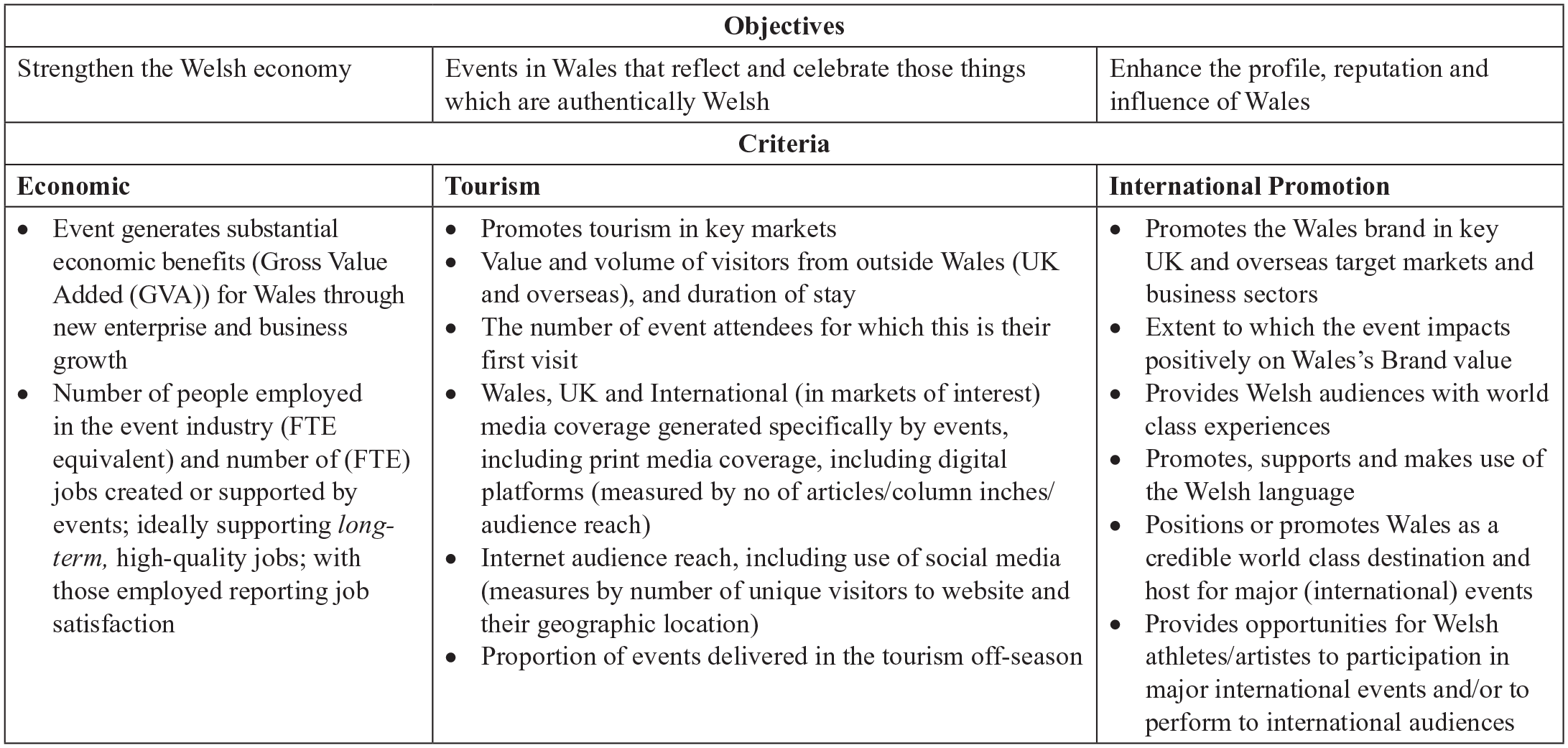
Major events strategy objectives.
Did the WWE deliver on these goals? From the start, Ministers emphasise the first objective, framing the show as ‘an enormous economic event’ (Senedd Cymru, 2022b) that would provide ‘a massive boost’ to the Welsh economy (Senedd Cymru, 2022b). Welsh Labour MP Alex Davies-Jones (chair of the APPG on Wrestling) echoed this message in The Times, emphasising economic benefits to local businesses in particular (Davies-Jones, 2022). The Welsh Government later celebrated the event’s success meeting this objective by citing an unreleased, independent Economic Impact Study reporting a 10:1 return on investment, with £21.8 million ‘injected’ back into the Welsh economy (Welsh Government, 2023a).
Regarding tourism, several criteria were checked off: First, regarding value and volume of visitors, the event attracted 62,296 attendees, with 75.3% from outside Wales and 57% of these expressing interest in subsequently exploring more of Wales (Welsh Government, 2023a). Second, regarding international media coverage and Internet reach, WWE’s Chief Content Officer Paul Levesque (aka Triple H) announced Clash had the highest viewership of any international PLE in company history and trended #1 on Twitter (Triple H, 2022). Considering WWE’s vast communication reach with an international audience, this certainly sounds positive, and Director of Marketing for the Welsh Government Heledd Owen highlighted the twitter trending in select committee evidence (House of Commons, 2023: Q197). Clearly, the Welsh Government considered these successes.
Gething specifically highlighted the objective of ‘promoting Wales in the USA’ (Senedd Cymru, 2022a), however, something extending beyond tourism to encompass the final objective of international reputational and profile enhancement. Here, the quantitative metrics such as viewership and social media mentions are clearly significant, and the Welsh Government celebrated the event for providing ‘a huge boost to our profile internationally’ accordingly. This success was linked to WWE’s creation of ‘bespoke content’ that ‘showcase[d] Wales’ vibrant language and culture’, including ‘nine minutes of premium footage that showcased the whole of Wales’ and frequent references to ‘Cardiff, Wales’ during the commentary (Welsh Government, 2023a).
When it comes to image and reputation, however, the international reach of such footage is just one metric of successful promotion – the specific image of Wales communicated also matters. The Welsh Government has declined to answer questions about the metrics underpinning this objective (Leigh Jones, 2022); however, as the criteria listed above clarify, successful promotion of Wales in the United States ultimately involved promoting their national brand – the CWB. Understanding this brand’s core elements is thus essential to grasp the national symbols and themes the Welsh Government expected the WWE’s footage to promote.
The Cymru Wales Brand
Wales has long struggled to establish a strong brand identity in the US market (Pritchard and Morgan, 1996: 348). This weakness persisted into 2022, when Clash took place, with media reports of Americans Googling ‘is Wales a country?’ (Nation Cymru, 2022a) Historically, Wales has faced challenges differentiating itself from other destinations, especially within the United Kingdom. In 1999, Elwyn Owens of the then Wales Tourism Board noted that Wales’s strengths – such as its beauty and activities – were not unique, making it difficult to find a distinct selling point; the one card that did differentiate Wales, its language and culture, was one there was hesitancy to embrace (quoted in Pritchard and Morgan, 2001: 176). By 2006, however, the Welsh Government established Visit Wales as the internal arm of its tourism policy, and its confidence in promoting Welsh culture grew, eventually culminating in the Cymru Wales Brand’s (CWB) development.
Beyond tourism, this confidence – and the brand – is part of an inarguably broader nation-building project, driven by a desire to distinguish Wales from its larger English neighbour and in so doing strengthen the devolved government’s legitimacy. Nation-branding here acted as a form of both international soft power – a point explicitly recognised in the Welsh Government’s (2020a) Public Diplomacy and Soft Power 2020-2025 Action plan – and domestic nation-building (Jordan, 2014: 285). This approach was in line with Welsh Labour’s political strategy of ‘clear red water’ with England, linking its red socialist symbolism with y Ddraig Goch (the Red Dragon of Wales) as part of a set of rhetorical manoeuvrings to solidify its dominance of Welsh politics (Moon, 2013). Promoting a ‘Welsher Wales’ through a new nation brand thus served not only Wales, but Welsh Labour, politically.
‘How do we want the world to see us? The Cymru Wales Brand provides an answer’: So states the brand’s official website (Cymru Wales Brand, n.d.), developed by creative studio Smörgåsbord since 2015. The brand includes a core marque (the logo) featuring ‘a contemporary rendering of the familiar Dragon icon’(Pritchard, 2017), a bespoke typeface ‘influenced by medieval Welsh manuscripts’, colour palettes ‘inspired by the Welsh landscape’, photographic and tone of voice guidelines (Cymru Wales Brand, n.d.), and a toolkit for implementation. 2 These are all designed as part of ‘a new visual identity for Wales’ (Smörgåsbord, n.d.), which acts as ‘a glue that unites the great people of Wales’ under the ‘core idea’ of Wales as ‘inherently Welsh with a global outlook’ (Pritchard, 2017). Celebrated by the Welsh Government as a ‘striking’ ‘foundation’ for a ‘clear and consistent vision of Wales’ essential qualities’ (Cymru Wales Brand, n.d.), the brand is used to promote Wales in the United Kingdom and beyond, ensuring a ‘disciplined, unifying and coherent approach to building Wales’s image as a contemporary and inspiring place to visit, work, invest and study’ (Welsh Government, 2020a).
For Clash, the brand’s dragon logo appeared prominently on WWE social media (WWE, 2022a), posters (Principality Stadium, 2022), and set decorations for the post-show press conference (WWE, 2022i). But the CWB is more than simply visuals; with it come a series of objectives, which include to ‘surprise and inspire’, ‘do good things’, and ‘be unmistakably Wales’. These goals are translated into concrete priorities (Figure 2) in Priorities for the Visitor Economy 2020-2025 (Welsh Government, 2020c), which connects them to four key elements of ‘Wales’ core offer’: (1) Outstanding landscapes, protected and cared for; (2) vibrant communities and a creative culture; (3) epic adventures and activities for everyone; and (4) ‘a unique Welsh welcome’.
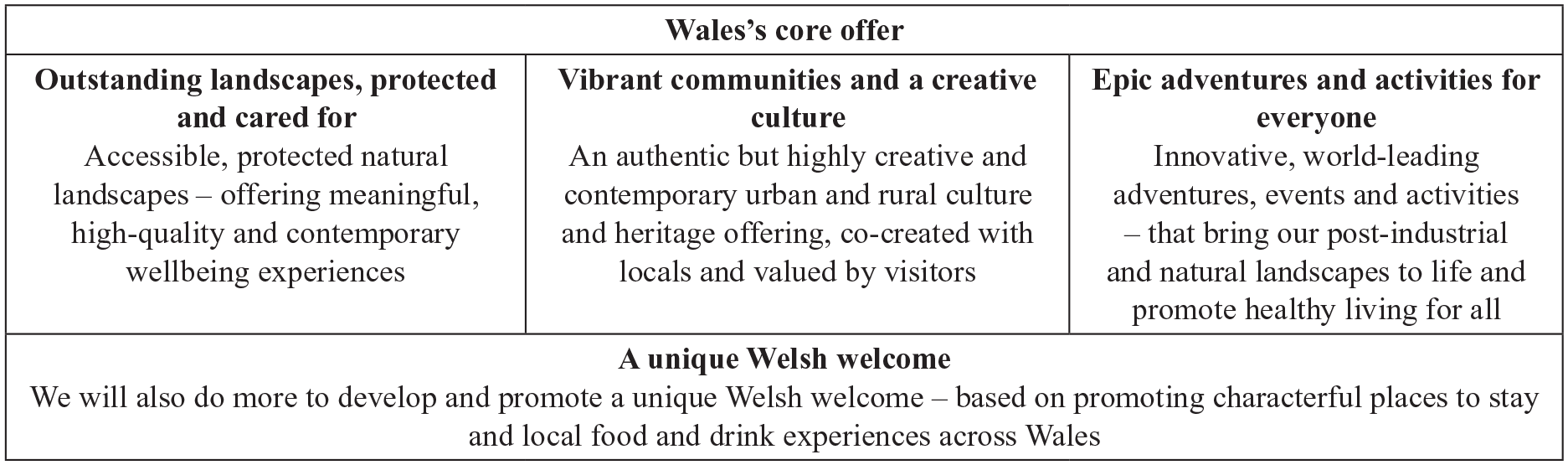
Wales’s core offer.
The brand’s website (n.d.) attaches these principles to five areas: Tourism; Business; Food and Drink; Study; and Cadw (the Welsh Government’s historic environment service). With Tourism – central to Major Events Strategy funding for Clash – the CWB emphasises the nation as a destination for ‘high-quality, authentic experiences in breathtaking places’, including ‘world-leading adventure’, ‘contemporary culture’, ‘outstanding natural landscapes’, and ‘a distinctive sense of place’ (Cymru Wales Brand, n.d.). Such messages each incorporate elements of Wales’s ‘core offer’. Although the brand itself is a relatively recent creation, this approach aligns with long-standing strategies in tourism that highlighted Wales’s environment, ‘Celtic’ culture, language, and heritage, particularly its castles, which have become a ‘secondary brand signature for Wales’ (Pritchard and Morgan, 2001: 173).
Illustrative of the latter is a previous 2005 poster campaign advertising ‘castles: 641 Starbucks: 6’ (WalesOnline, 2011). Clearly, when people think Wales, the Welsh Government wants them to think castles. Among ‘the best-preserved and most concentrated in Europe’ (Pitchford, 1995: 44), these towering structures, many built by the conquering Edward I in the late 13th century, serve as powerful symbols of Wales’s history and identity, born of conquest and resistance. Cardiff Castle, in particular – Clash’s titular castle, which featured on promotional posters leading up to the event – is a symbol of foreign oppression: Owned by the Marquess of Bute, a Scotsman who profited from Welsh coal extraction, resentful Cardiff residents have described the castle as ‘a huge symbol of capitalism’ (Pitchford, 1995: 46). Within the CWB, however, these castles are reimagined not as colonial scars, but as sites of adventure and legend, with their darker historical associations downplayed. The very name WWE chose for the event, Clash at the Castle, thus tied directly into the CWB.
To effectively promote the CWB, WWE’s bespoke content therefore needed to showcase the nation’s landscapes, cuisine, culture, history, and castles – many of them – as well as its iconic symbols, and reputation for warm hospitality. By adopting this brand and embodying the persona of ‘Cymru Wales’, the nation was imparted a distinct personality and attitude: one that is active and adventurous, thriving outdoors, whether scaling Welsh mountains or walking along her coastlines. It is also welcoming and friendly, with a worldview rooted in myth and legend, speaking its own unique language, most likely while gazing from castle ramparts. The audience – especially those in the United States – would hopefully love it. Did WWE deliver?
Clash at the Castle: Bespoke content
Clash was a Premium Live Event (PLE), distinct from weekly programming like Raw or SmackDown, in serving as a climactic showcase where major storylines and feuds pay-off, and broadcast via subscription platforms (Peacock in the United States, the WWE Network elsewhere). Positioned below tentpole events like WrestleMania but above routine shows, monthly PLEs target both dedicated fans and more casual or lapsed viewers, offering accessible entry points into WWE’s broader storytelling arcs. To maximise engagement, WWE thus combined pre-event promotion with in-show contextual recaps, generating opportunities for bespoke content. But where was this content broadcast?
Answering this requires recognising WWE as a convergent media form, where audiences engage across multiple media platforms populated by intertextual texts that reference past content to generate new meanings. This reflects a transmedia storytelling approach, in which a single narrative is extended across diverse media (Reinhard and Olson, 2019: 8). To be fully versed in WWE’s ‘serialized storyworld’ (Jeffries, 2019) going into a PLE, one does not simply watch Raw; the show’s storylines are supplemented with ‘post-show’ interviews on YouTube, historical (often ‘shoot’) documentaries providing background context hosted on the WWE’s streaming service, superstars’ kayfabe social media interactions, and even commentary discussions taking place on secondary shows, like Main Event, or The Bump.
This is important to note since an analysis of WWE’s output across its main roster television shows (Raw and SmackDown), social media platforms (YouTube and Twitter), and weekly streaming service programmes (Main Event, The Bump, This Week) leading up to Clash, finds that the primary bespoke content WWE produced to promote the CWB and thereby meet the Welsh Government’s objectives was not featured on their major weekly television shows. Instead, it consisted of a series of videos uploaded to YouTube (where WWE has 96.4 million subscribers) and made available on WWE’s streaming service. Four such videos were released, titled: ‘Dolph Ziggler journeys across Wales, the home of the WWE Clash at the Castle’ [4m22] (WWE, 2022c); ‘Dolph Ziggler samples signature Welsh dishes ahead of WWE Clash at the Castle’ [2m56] (WWE, 2022d); ‘Drew McIntyre brushes up on Welsh language in Cardiff, Wales ahead of WWE Clash at the Castle’ [6m54] (WWE, 2022e); and ‘Drew McIntyre’s medieval workout in the Welsh mountains’ [3m55] (WWE, 2022f). For casual fans, who only watch the ‘main roster’ shows Raw and SmackDown, therefore, the only Cymru-coloured content that would have encountered was the references to ‘Cardiff, Wales’ when referencing the host city (terminology specifically requested by the Welsh Government’s targets; Welsh Government, 2023a) and the dragon-based theme (strangely, not always red). Nevertheless, the nature of WWE’s convergent media and transmedia storytelling approach means many fans would encounter these videos and consume them in preparation for Clash.
In the first uploads, veteran WWE Superstar Dolph Ziggler (a former WWE Champion, then positioned in the lower-mid-card and not featured at Clash itself) fronted two tourism videos, participating in ‘adventures across Wales’ (WWE, 2022c) arranged by Visit Wales. In the first, most of the adventures take place in North Wales, starting with a trip to Conwy Castle, where Welsh actress and musician Tara Bethan, appointed as WWE’s ‘Welsh ambassador’ (Newyddion S4C, 2022), provides a history lesson. Ziggler then visited adventure sites across North Wales – surfing, zip-lining and jumping on huge trampolines. The video also includes footage from Cardiff, showing a visit to a children’s training session run by the Welsh Rugby Union at Cardiff International Sports Campus, and a ‘culinary tour’ of Cardiff Market with Loving Welsh Food guide Ieuan Rhys. The second video is an extended version of this culinary tour, where Ziggler samples laverbread and cockles, Welsh faggots,
3
and Welshcakes (WWE, 2022d). Ziggler signs off the first video by declaring: What an amazing time checking out all of Wales, from Cardiff all the way up to Conwy Castle behind me. I’ve had such a spectacular time – the people, the views, the landmarks, the history, it’s amazing and it’s got me very excited for Clash at the Castle, September 3rd, and if you’re coming, and I know you are, and you’re on your way, make sure you check out every other site there is to see, go check out VisitWales dot com.
These videos are openly co-productions between Visit Wales and WWE, with visitwales.com banners sporting the Cymru Wales marque at the bottom of the food tour video. Unsurprisingly, these videos emphasised major themes of the CWB: landscape, food and welcome, adventure and activities linked to healthy living, Welsh history, but also culture and language – with Ziggler’s guides both speaking Welsh at certain moments.
The theme of culture and language was central to the third video, in which Drew McIntyre received a brief Welsh language lesson from Tara Bethan inside Cardiff Castle (WWE, 2022e), with Clatsio yn y Castell (Clash at the Castle) among the phrases he was taught. This was not the only instance where WWE promoted the event using the Welsh language (Cymraeg); WWE collaborated with Duolingo to release a ‘WWE Cymraeg Guide’, featuring terms like Siwperseren WWE (WWE Superstar), Tim Tag (Tag Team), and Symudiad Olaf (Finishing Move) (Nation Cymru, 2022b). McIntyre’s visit to Cardiff Castle was also used to film a series of Visit Wales promotional clips, highlighting CWB themes. He described Wales as ‘a land of myths, legends, culture, landscape, adventure’, emphasising that ‘it’s not just the city, it’s the amazing coastline, the rolling hills of the Valleys and the highest peak of Snowdon’ (Visit Wales, 2022). These clips were subsequently used in media reports, such as a BBC Wales news segment previewing the event (BBC News, 2022). The only thing missing from the previously detailed list of brand elements was mention of a ‘celebrated’ Welsh icon.
Myths and legends also featured in the fourth video, which showcased McIntyre exercising ‘in the Welsh Mountains’ – though the location was actually The Green Mile Training Camp outside Cardiff, far from any mountains. While emphasising key themes of the Welsh landscape and activities promoting healthy living, the video also included McIntyre delivering a promo that seamlessly aligned with the themes of history, culture, and language. As he intoned: In Welsh legend, there is a tale of the red dragon, y ddraig goch. Long ago a white dragon tormented this land. Y ddraig goch would rise up and defend the land and the two beasts would be locked in an epic battle. Y ddraig goch would be victorious, vanquishing the white dragon and becoming a symbol for all the land. I have waited a lifetime for this moment. To hear the roar from the voices of my people in the land of legends. (WWE, 2022f)
4
These videos, shared across WWE’s digital platforms (WWE, 2022b, 2022j, 2022k; WWE Community, 2022), showcased the company’s Superstars promoting the CWB. Through scripted dialogue, they painted a picture of Wales perfectly aligned with the Welsh Government’s brand. However, none of this footage was featured on WWE’s television programming; it was only accessible via the company’s social media platforms. Given that WWE’s YouTube page boasts 96.4 m subscribers and its Twitter account has 13.4 m followers, these are nevertheless substantial platforms for disseminating content (see Welsh Government, 2023a). In descending order, the videos’ viewership, as of September 2024, was:
‘Drew McIntyre’s medieval workout in the Welsh mountains’ [3m55] – 529,832 views (WWE, 2022f);
‘Dolph Ziggler journeys across Wales, the home of the WWE Clash at the Castle of the Castle’ [4m22] – 128,410 views (WWE, 2022c);
‘Drew McIntyre brushes up on Welsh language in Cardiff, Wales ahead of WWE Clash at the Castle at the Castle’ [6m54] – 88,815 views (WWE, 2022e);
‘Dolph Ziggler samples signature Welsh dishes ahead of WWE Clash at the Castle’ [2m56] – 60,559 views (WWE, 2022d).
In total, this amounted to just under 20 minutes of bespoke video content, with each video receiving significantly higher views than Visit Wales’s usual content.
The Clash at the Castle broadcast
For the Clash event itself, WWE integrated the Welsh setting into the arena design. Screens above the ring resembled Cardiff Castle with a fire-breathing dragon graphically perched atop it. However, WWE most directly met its Major Event Strategy targets through video packages aired during the broadcast, featuring footage provided by the Welsh Government via Visit Wales. The Welsh Government made much of this footage. In a written parliamentary statement, Gething celebrated that ‘[s]everal minutes of dedicated Wales footage formed part of the broadcast’ (Senedd Cymru, 2023). Addressing a House of Commons Select Committee, Heledd Owen reported that Welsh Government representatives: worked with the organisers to make sure that, at the beginning of the pay per view, if you were to watch it in the US, there was a large segment of around six minutes, which showed some of Wales and its fantastic scenery. The value of that would have been in the millions.
Addressing the same committee, Vaughan Gething described this footage as a ‘giant love-in infomercial’ (House of Commons, 2023: Q197).
These statements are at odds with what was broadcast: During Clash, three short video packages were shown, which included a 20-second sequence during the kick-off show 5 and 20-second and 50-second sequences during the main event. Despite this being just 90 seconds of footage, far less than ‘around six minutes’ suggested, Owen has confirmed this was the footage she and Gething were referring to, with no further missing minutes (personal communication, September 2024). The videos themselves featured drone footage showing landscape shots of Cardiff, coastline, green valleys, majestic mountains, and many, many castles, all labelled ‘© Crown copyright (2019) Visit Wales’. While the pre-show footage aired without narration (the show hosts were discussing WWE drama while the clip played), the footage during Clash at the Castle was accompanied by promotional commentary from lead commentator Michael Cole, who highlighted CWB themes.
During the first video package, which aired 1 hour into the show, Cole remarked: Clash at the Castle, tonight hosted by the wonderful city of Cardiff in the glorious country of Wales. Lush greenery everywhere on the Cardiff Bay, into the town centre, the famous Cardiff Castle, a former Roman fort where during World War 2 its tunnels were used as air raid shelters, but now today a majestic centrepiece for this vibrant capital of Wales.
For the second video package, Cole further enthused: Ladies and gentlemen what an extraordinary event tonight and what a wonderful week here. Clash at the Castle in the vibrant capital of Wales, Cardiff, located on beautiful Cardiff Bay. The city is a multicultural melting pot. World class sports, restaurants and of course pubs – The Glassworks, The City Arms, Pen and Wig, all have had a lot of my money over the past couple of days. What an amazing city in Cardiff!
Not everyone would have seen this footage and heard this commentary during the broadcast – viewers in the United Kingdom watching on BT Sport were shown advertisements during the Visit Wales segments. Nevertheless, the key global audience streaming via the WWE Network/Peacock saw the full content – and while, combined, this footage and commentary only amounted to one and a half minutes, it effectively highlighted central signifiers of the CWB: Welsh landscapes, coastlines, food, the ‘Welsh welcome’, and Welsh history, especially castles.
The one notable omission was mention of celebrated Welsh icons, identified by the National Events Strategy as a key element of strong event propositions (Welsh Government, 2022b: 10). Assuming this was part of the Welsh Government’s funding targets, one might expect WWE to address it. Before Clash, the closest WWE came was commentator Kevin Patrick’s description of Wales on the 1 September 2022 episode of Main Event as ‘a place that’s famous for rugged coastlines, national parks, Anthony Hopkins, Gareth Bale, and now WWE’.
At Clash itself, WWE did feature a Welsh celebrity guest appearance however, with a 20-second shot of legendary pro-wrestler Adrian Street and Miss Linda – his manager, wife and a pro-wrestler in her own right – waving in the audience (1:22:22). Known as pro-wrestling’s ‘glammiest gender bender’ of the 1970s and 1980s (Murphy and Young, 2021: 197), the androgenous Street was a hugely influential figure in the development of modern pro-wrestling (Greer, 2017) and the most famous wrestler to come out of Wales (Waterson, 2023). Despite Street’s iconic status and being the subject of a 2019 documentary WWE produced for its streaming service (WWE, 2019), he was, arguably, unlikely to be widely recognised among attending fans. Nevertheless, Michael Cole made sure to emphasise Street’s Welsh heritage, introducing him as ‘from Brynmawr, Wales, [a] UK wrestling legend’. When fellow commentor Corey Graves described Street as ‘flamboyant but tough as nails’, Cole quickly added ‘and from Wales!’.
In summary, WWE presented Wales to the world as a land of myths and legends, dragons, castles, green mountains and valleys, blue skies and reservoirs, and beautiful coastlines. It is a place for adventurous activities and sports, from rugby and surfing to nature workouts, zip-lining, and trampolining – all before enjoying good food and warm welcomes in ‘wonderful’ pubs, located in vibrant bi-lingual communities, suffused in distinct Welsh culture, which birthed charismatic icons like Adrian Street. Taken together, the portrayal of Wales presented by WWE sported all the CWB’s key signifiers. Broadcast to televisions, phones, and tablets across the United States and beyond, it is easy to see why Visit Wales considered the event a success.
Yet, as far as pushing a gimmick goes, these video packages and ‘shout-outs’ also represented a significant missed opportunity. According to the National Events Strategy, events should ‘tell the stories of Wales to residents and visitors alike at a level that is appropriate for the nature of the event being delivered’ (Welsh Government, 2022b: 10). Given that this was a pro-wrestling event aimed at pro-wrestling fans, WWE had a clear opportunity to meet this criterion by using the wrestling format itself to introduce Wales to a US audience. They could have effectively conveyed Wales’s history as a wrestling nation by incorporating it into the in-ring product, truly getting the Welsh gimmick ‘over’ via its direct personification in the ring.
Fantasy booking the Cymru Wales gimmick
Discussing the home-field advantage for Drew McIntyre (Scottish) and Sheamus (Irish) during the pre-show, WWE superstar Wade Barrett (English) told the predominantly US audience: I know we’re all different countries over there in the UK and Ireland, really our culture is exactly the same. We all watch the same TV shows, we all listen to the same bands, we all drink the same beers. We’re all bonded in that way, and of course there’s some sporting rivalry . . . We’re all exactly the same just with slightly different accents.
Barrett’s remarks clearly went against the message of the Welsh Government’s CWB. Yet the broadcast’s in-ring messaging was little different. While Adrian Street was a Welsh icon, his singular presentation risked implying that Wales had little contemporary pro-wrestling to celebrate. Refences to Welsh wrestling were oblique: Seamus was said to have wrestled in Cardiff; English wrestler Pete Dunne was noted to have co-founded a promotion in Wales. But it was the Scotsman, Drew McIntyre, who was referred to as the ‘local’ hero.
This framing stood in stark contrast to the reality beyond the stadium. As Welsh pro-wrestler Mark Andrews noted, ‘People might not realise it but Wales is a hot-bed for wrestling and there is a very strong fanbase’ (Mark Andrews quoted in Smith, 2023). WWE could have drawn on this history and talent to build a powerful storyline rooted in Welsh identity. Wales has a deep pro-wrestling heritage; according to Orig Williams, celebrated Welsh pro-wrestler and promoter, wrestling is a ‘natural part, if not obvious, of the Welsh’ (‘Y mae’n rhan naturiol, os nad amlwg, o hunaniaeth y Cymru, felly’; Chivers, 2012: 54). Wrestling matches were advertised in Welsh newspapers as early as 1851 (Johnes, 2005: 9); Williams (1985: 115) linked the tradition back further to the Roman period. His promotion, The British Wrestling Federation, featured stars like Adrian Street in venues across the United Kingdom and Ireland during the 1970s and 1980s (Street, 2013: 2). He was also responsible for producing and presenting the television show Reslo (Wrestling), which aired weekly from 1982 to 1995 on the Welsh-language broadcaster Sianel Pedwar Cymru (S4C). Notably, Reslo was the only British wrestling show to feature women wrestlers, whose inclusion was otherwise banned on TV outside of Wales – a point actually highlighted by Michael Cole during the Clash at the Castle broadcast. After ITV cancelled World of Sport in 1985, Reslo became the sole British pro-wrestling show on terrestrial television, underscoring its unique popularity in Wales.
WWE was not unaware of this legacy. Tara Bethan, their ‘Welsh ambassador’, is Williams’s daughter, who could have shared rich stories of Welsh wrestling history (in their video together, McIntyre, learning of her father, mentioned he had wrestled for Orig). WWE even had four Welsh Superstars under contract at the time of the event’s announcement – Eddie Dennis, Wild Boar, Flash Morgan Webster, and the aforementioned Andrews. All four wrestled on WWE’s NXT UK brand as well as 205Live, a secondary show for cruiserweight talent. Andrews and Webster had also competed in the United States as part of the main NXT show. Dennis and Andrews were featured in pre-event press, heightening expectations of their inclusion. In interviews with the BBC and The Times, for example, Dennis noted that wrestling at the event would be a dream come true (BBC News, 2022; Low, 2022). Andrews revealed he had commissioned bespoke ring gear for the event (McGeorge, 2023).
Just days before the show, however, WWE released all four from their contracts, alongside the closure of the NXT UK brand. Thus, an event funded to ‘promote Welshness’ featured no Welsh performers. Although hopeful speculation swirled about the possible return of another Welsh wrestler, Tegan Nox at Clash (BBC Wales, 2022), it did not materialise. Her return instead came 3 months later, re-debuting on an episode of Raw. WWE did not even manage a cameo for Mason Ryan (aka Barri Griffiths), the only other Welsh WWE Superstar to appear on main roster programming (between 2009 and 2014), and a former trainee of Orig Williams (2010: 150).
It is tempting, as said, to read this as a missed opportunity. Certainly, WWE had the narrative and promotional tools at its disposal to tap into the unique power of pro-wrestling kayfabe and truly get the Welsh gimmick ‘over’ in a manner surpassing even the Welsh Government’s aspirations. WWE could have orchestrated a storyline leading up to Clash showcasing their Welsh superstars. Despite the limited viewership of NXT UK in the United States, WWE could have aired short 30-second vignettes introducing Andrews, et al. on Raw and SmackDown In these clips, the wrestlers could have expressed their pride and excitement about a WWE stadium show coming to Wales, potentially while standing on castles, above green valleys, overlooking blue coastlines, speaking about their nation’s mythic past, with red dragons in abundance. If airtime on the shows itself was too valuable, the nature of WWE’s convergent, transmedia storytelling approach means the clips could have simply been hosted on YouTube or the streaming service alongside Ziggler’s tourist trips and McIntyres Welsh lessons.
This would have helped bring Cymru Wales to life as a living, breathing, fighting entity. It would certainly have been enough to get UK fans to ‘pop’ as they came out for a multi-man tag match on the pre-show, picking up a quick win against a team of low-card US wrestlers, followed by a 10-second highlight package on the main show. As Andrews lamented: This was a huge opportunity for Wales, you know for Welsh wrestling and all the years we’ve put the graft in, the bingo halls . . . the community centres, backyard wrestling, you know what I mean? All of the years of putting the work in in Wales, it just would’ve been lush, if one of us could have had the moment to be celebrated. (BBC Wales, 2022)
Instead, WWE fulfilled its contractual commitments through YouTube video packages and clips of footage sourced from Visit Wales. Welsh pro-wrestlers were only featured in local media before the event, missing an opportunity to deliver a powerful in-ring message to the US audience about this small, hitherto poorly known nation – adventurous, full of excitement and a passionate people, just as the CWB envisages. This done, WWE could have still released these wrestlers after the show.
Yet the decision not to feature Welsh talent cannot be attributed solely to oversight or failure of vision. Ultimately, it appears pro-wrestling is not part of the Welsh Government’s imagined national gimmick. Pro-wrestling could easily have fitted into the CWB’s vision of an active, adventurous Wales; the fact, however, that Visit Wales sent Dolph Ziggler to watch rugby practice, but not a pro-wrestling event, speaks to how the guardians of the CWB view its boundaries. Pro-wrestling was merely a vehicle for promoting the CWB; the native, Welsh form evidently did not fit among the signifiers of mountains, castles, and coastlines. The lack of any linkage therefore seems inevitable – nobody was going to push it from the Welsh side of the relationship.
At the same time, it likely reflects WWE priorities as a global entertainment company working to commercial imperatives – including corporate restructuring, roster consolidation, and the pursuit of narrative coherence across its transmedia platforms. In such a context, showcasing Wales beyond a minimum requirement becomes a secondary concern, particularly when weighted against WWE’s preference for advertising recognisable stars, and storytelling targeted at a predominantly US audience.
Tensions between the Welsh Government’s nation-branding aspirations and WWE’s own nationalistic corporate branding as a US company are a compounding factor here. As Billig (1995: 151) wrote in Banal Nationalism: Strictly speaking, it is a mistake to call this American wrestling. It proclaims itself to be world wrestling, whether conducted under the aegis of the World Wrestling Federation or its rival business World Championship Wrestling. Its title and its operations are global, but its heart, both commercially and thematically, remains in the United States. ‘World wrestling’, as befits its commercial ownership and administration, depicts the world as an American morality tale of masculine display.
WWF may now be WWE, and WCW may be no more, but Billig’s point stands. The conflations of the world with America may serve narrative clarity, but it inarguably limits how alternative national visions are promoted.
A further example illustrating related tensions came in a promotional advert co-produced by WWE and BT Sport (now TNT Sports), without Visit Wales input. The advert featured 6’6’ WWE Superstar Damien Priest visiting a Welsh sheep farm, making Welsh cakes, and brewing beer in Cardiff – a campaign the advertiser described as ‘juxtaposing all the melodrama of WWE with a decidedly Welsh sense of humour’(Creative Salon, 2022). Titled, ‘What happens when you stick a WWE Superstar in a Welsh family from The Valleys?’ [1m50] (TNT Sports, 2022c), the advert ran for six days across BT Sport’s Instagram, Facebook, Twitter, Snapchat, and digital audio channels (Creative Salon, 2022). It also aired on BT Sport and became the most-viewed video among all the YouTube content produced for Clash, with 1,496,593 views as of September 2024 (almost a million more views than McIntyre’s Welsh mountain workout). Three shorter 30-second clips were also produced, each garnering higher viewership on YouTube than most of the WWE/Visit Wales co-productions (TNT Sports, 2022a, 2022b, 2022d).
Yet the advert’s humour leaned heavily on English stereotypes of the Welsh as dim and backward (Parker, 2014) – hardly an image the Visit Wales wanted promoted in the United States, and markedly different from the videos co-produced with WWE. The best that could be said was that the advert included a Welsh farmer mentioning ‘a warm Welsh welcome’ and Priest offering a toast of lechyd da (cheers). Notably, however, this advert was not featured on the WWE’s YouTube page – and the target was not a US audience, but UK viewers. Essentially, this was a domestic advert aimed at a predominantly English audience, for whom jokes about stereotypical Welsh sheep farmers would resonate. The advert’s aim was to boost event viewership rather than ‘enhance the profile, reputation and influence of Wales’ internationally. What it nevertheless demonstrates is the danger, for WWE’s partners, of losing control of their brand.
These examples expose the limits of WWE as a partner in state-led branding campaigns. The company’s storytelling is built around familiar and easily digested narrative tropes – patriotic heroes, broad cultural generalisations, and superstar-led spectacles. It can incorporate national branding where it serves these ends, but such integration is often superficial and secondary to the needs of the corporation’s storytelling priorities. As a performance form, professional wrestling offers a unique convergence of theatre, sport, and spectacle – making it an ideal vehicle for nation-branding in principle. But to make the most of this pro-wrestling specific potential, the gimmick must enter the ring, not remain confined to marketing collateral.
Conclusion
This article introduces the concept of the national gimmick as a lens for examining state-led nation-branding and soft power strategies. Using WWE’s Clash at the Castle and its co-production with the Welsh Government, the analysis illustrates how governments can perform national identity through branded spectacles produced by entertainment platforms – and how these efforts may be constrained by the commercial logics and ideological contours of said media partners. These constraints are particularly pronounced in the case of Wales, where limited economic power and restricted foreign policy competence compel the devolved government to pursue symbolic forms of international visibility.
Pro-wrestling, with its exaggerated characters and simplified narratives, offers a compelling analogue for how national identities are reduced to stylised, marketable forms. The national gimmick captures this dynamic: like a pro-wrestler’s persona, a nation brand is designed not to reflect cultural complexity but to provoke desired audience reactions. Conceptually, the gimmick models how branding compels nations to perform identity, hoping audiences will suspend disbelief, accepting their selected simplifications. Governments do not merely represent the nation; they stage it – through events and media – while compelling the nation to inhabit the curated image crafted by branding professionals. Just as Terry Bollea embodied a flag-waving Americanness under the gimmick of Hulk Hogan, Wales, through the CWB, performs a version of itself tailored for external consumption: mythic, adventurous, and welcoming. In this way, brands, as gimmicks, compel nations to wear a kind of symbolic mask – one that conceals internal contradictions and shapes the poses a nation is permitted to strike.
The Welsh case illustrates the benefits and limitations of such strategies. WWE incorporated key elements of the CWB into its promotional content – landscape, language, legend – but declined to integrate Welsh wrestlers or wrestling history into the in-ring narrative. This reflects not a simple oversight but a structural asymmetry: for WWE, Wales was not a national identity to personify, but a backdrop leveraged to unlock public funding. This disjuncture underscores a broader lesson: nation-branding through entertainment spectacle is never frictionless. It is shaped by the commercial imperatives and ideological baggage of their commercial partners, which may clash with governmental goals.
The contention here is that the concept of the national gimmick has scope beyond pro-wrestling related branding efforts. Nevertheless, initially extending the concept to other cases of this type – such as Puerto Rico’s hosting of WWE Backlash 2023, or Saudi Arabia’s partnership with WWE – would offer an opportunity to further test its viability as a lens for examining the politics of performance at the core of governmental nation-branding strategies. Because in soft power’s realm, the world may not be a stage, but a ring – and national brands the gimmicks governments ask us to believe in.
Footnotes
Acknowledgements
My thanks to Peter Allen, Andre Barrinha, Sophia Hatzisavvidou, and Leslie Wehner for comments on earlier versions of this paper. An early version of the paper was presented at the 2023 Political Studies Association annual conference. The ideas contained here were further developed in discussions with Will Cooling on the PWTorch podcast and Matthew Hexter and Richard Martin on Hiraeth podcast. My thanks to all for inviting me onto their platforms.
Funding
The author(s) received no financial support for the research, authorship, and/or publication of this article.
