




Abstract
Devolution processes, while aiming to transfer power to sub-state entities, contribute to creating new political, administrative, and economic centres. Consequently, in multi-level systems, we observe the coexistence of state-wide and sub-state capital cities, which may be perceived differently by citizens. This article focuses on the United Kingdom and analyses the results of an original survey conducted in Scotland and Wales. In these two devolved nations, sub-state capital cities, Edinburgh and Cardiff, ‘compete’ with the UK capital, London. Respondents were asked to assess these three cities across three dimensions: the individual/value dimension, the symbolic dimension, and the integrative dimension. While, overall, both Edinburgh and Cardiff outperform London on all three dimensions, important differences exist among respondents. This study shows that far from being neutral, the role of capital cities in devolved jurisdictions can be highly politicised and is also closely associated with individual preferences for more or less decentralisation.
Keywords
The structuring of a political system is intricately linked to the emergence of centres of political power. This is best exemplified by a process known as the ‘nationalisation of politics’ (Caramani, 2004), which unfolded between the 19th and 20th centuries and was accompanied by the centralisation of authority and the rise of capital cities as places of power and resource concentration (Ringrose, 1998; Therborn, 2017). However, the prevalence of central governments and the resulting ‘geography of power’ within a national political system have varied from country to country. In those countries defined by Stein Rokkan as ‘monocephalic’, the capital city assumed a clearly dominant role in economic, cultural, and political terms (Flora et al., 1999). In ‘policephalic’ or ‘polycentric’ countries, on the other hand, the capital city has coexisted with an urban network and power has been more dispersed, thereby reducing the imbalance between the centre and its periphery.
For a large part of the 20th century, the United Kingdom was very close to the ‘monocephalic’ ideal type (Flora et al., 1999: 220), with London as the dominant centre of political power. The centralisation of authority accelerated after World War II with the growing role of the state in the economy (Béland and Lecours, 2005: 689). The crisis of Keynesianism and state control in the 1970s did not halt this process. In fact, the pro-market shift promoted by Prime Minister Margaret Thatcher in the 1980s resulted in an even greater assertion of central control (Loughlin, 2007). This ‘hyper-centralisation’ further shifted power and resources to London, as the hub of international finance, while the rest of the country faced the challenges of deindustrialisation and transition to a service-based economy. This growing imbalance triggered increasing demands for decentralisation, particularly in Scotland and Wales, where economic grievances were mixed with the mobilisation of ‘stateless’ national identities (Keating, 2001). In sum, as stated by Keating (2021: 143), ‘neo-liberal unionism, ironically, may have helped to undermine the union’.
Devolution was a response to the excessive dominance of London in British politics, economy, and culture. In the late 1990s, power was shifted from the centre of the British state to Scotland and Wales, resulting in a more ‘polycentric’ system (Morgan, 2007). However, the establishment of a devolved parliament in Scotland and assembly in Wales required the capital cities of these two nations to (re)assert their role as spaces where new institutions could operate and provide policy direction. Polycentrism did not imply the end of central government but, as the term itself suggests, led to a multiplication and redefinition of competing centres.
The structuring of a Scottish or Welsh political space has resulted in the strengthening of ‘meso-level’ authorities located in Edinburgh and Cardiff (Keating, 2013). Consequently, citizens in each devolved nation find themselves in a multi-level system characterised by the coexistence of two capital cities, a state-wide one (London) and a sub-state one (Edinburgh or Cardiff). London is no longer the only destination point for ‘national’ political careers or the place where key decisions are taken. Edinburgh and Cardiff have claimed an increasingly significant share of authority vis-à-vis London but also relative to the rest of their respective nations.
This article seeks to uncover the relationship between citizens and multiple capitals in decentralised/devolved systems. The United Kingdom is used as an emblematic case of a country that was once highly centralised and, more recently, has become less territorially integrated. The complex relationship between citizens in sub-state political systems and capital cities is analysed through a multi-dimensional framework. This includes
(a) the individual/value dimension, considering individuals’ self-identification with the capital city and its inhabitants;
(b) the symbolic dimension, focusing on popular perceptions of the capital city as representative of the rest of the polity;
(c) the integrative dimension, examining people’s assessment of how inclusive and accessible the capital city is.
The aim is to contribute to the literature on territorial politics by considering the role of capital cities at lower levels of governance following a process of decentralisation. The establishment of devolved representative and policy-making institutions at the ‘meso-level’ between central and local authorities has the potential to result in a concentration of power and resources in sub-state capital cities – what has been defined as ‘regional centralism’ (Laffin, 2004, 2007) – and trigger new ‘centre-periphery’ dynamics. While much has been said about the London-centric character of British politics and the growing perceived gap between the UK capital and the rest of the country (Brown, 2021), particularly after Brexit (Jennings and Stoker, 2017a), much less is known about similar tensions that may exist within Scotland and Wales. Generally, there has been a tendency to view the devolved nations as unitary political entities that interact with the central government in Westminster. This article uses original public opinion data to show that, similar to what observed at the UK-wide level, the relationship between citizens and sub-state capitals in meso-level jurisdictions may also be complex and varied, providing a much more fragmented and nuanced picture. This has broader implications for other multi-level systems, beyond the United Kingdom.
The next section discusses the three key dimensions that may be used to define citizens’ relationship with capital cities. This is then followed by some general hypotheses linking these dimensions to socio-demographic and socio-economic characteristics of individuals, their place of residence and their political and meta-political inclinations (including trust and identity). These hypothesised links are systematically tested by considering how two representatives samples of Welsh and Scottish residents perceive both state-wide capital (London) and sub-state capitals (Edinburgh and Cardiff). While, overall, both Edinburgh and Cardiff outperform London on all three dimensions, important differences exist among respondents. Crucially, spatial, political, and meta-political factors seem to be more strongly correlated with individuals’ perceptions of Edinburgh and Cardiff than of London. Finally, the analysis shows that, even when controlling for a wide range of factors – including political affiliations – overall perceptions of state-wide and sub-state capitals are significantly associated with citizens’ preferences for more or less devolution and, in the case of Scotland, with attitudes towards EU membership. Therefore, this study demonstrates that far from being neutral, views on the role of capital cities in multi-level settings can be highly politicised and may, in turn, inform important constitutional debates.
The complex relationship between citizens and capital cities in multi-level settings: A three-dimensional framework
The structuring of a political community is almost inevitably linked to the emergence of territorial inequalities between ‘core’ and ‘peripheral’ areas, with capital cities often enjoying a privileged status as the places where key holders of political, economic, and cultural power reside.
The literature has long focused on instances where the centralisation of power and its territorially redistributive impact have elicited opposition from peripheral regions. The ‘centre-periphery’ cleavage and its political mobilisation have been associated with the rise and electoral persistence of regionalist or sub-state nationalist parties (de Winter and Türsan, 1998; Lipset and Rokkan, 1967). In this context, the state-wide capital city acts as a focal point for the tension between homogenising and assimilative pressures exerted by the core of a polity, and the resistance and growing resentment of more culturally, economically, and politically distant populations. Academic attention has been mainly paid to how peripheral grievances have targeted central political elites and dominant political and cultural paradigms, rather than the actual place where power is concentrated.
Only in recent years has literature started to frame these territorial tensions by referring more explicitly to the material and symbolic status of the capital city. Thus, for instance, in the debate surrounding the EU referendum in the United Kingdom, ‘place’ became an important political variable (Finlay et al., 2019), and London became synonymous with cosmopolitanism, elitism, privilege, Europeanism, and cultural vibrancy – a place full of so-called ‘anywheres’ (Goodhart, 2017) – attracting resentment from other ‘left-behind’ places (Fiorentino et al., 2024). The divisive potential of capital cities has been further magnified by another aspect that has increasingly attracted scholarly interest: the growing political divide between urban and suburban/rural areas, which is noticeable in the United Kingdom, the United States, and many other Western democracies (Kenny and Luca, 2021; McKay et al., 2023). As urban centres of power, capital cities are therefore likely to become particularly contentious in political debates.
There are some additional questions, however, that have received very little attention: what happens in devolved or regionalised settings, where sub-state capitals emerge alongside the state-wide capital city? Do we observe similar dynamics? Do intra-regional fractures arise around these new centres of power, which intersect with state-wide territorial fractures?
The analysis presented below focuses on the capitals of Scotland and Wales, which, since 1999, have (re)gained their role as key political hubs of the two UK devolved nations, although they started from rather different local conditions. Even before devolution, Edinburgh was the capital of a once independent nation and retained its status as the core of a jurisdiction with significant policy and administrative autonomy (Mitchell, 2014; Paterson, 1994). Cardiff, on the other hand, had a much less established role. It was recognised as a city in 1905 and was officially declared the Welsh capital only in 1955, although other local authorities competed for that position. Generally, despite its ‘economic importance to south Wales, the city lacked the economic, cultural or political characteristics that might have lent credence to the idea of it as the Welsh capital’ (Johnes, 2012: 510). Therefore, devolution was a key factor in ‘cementing’ Cardiff’s primacy in Wales.
Despite their different origins and legacies, in today’s devolved Britain, both Edinburgh and Cardiff should be studied alongside London, the state-wide capital, to fully understand the complex unfolding of centre–periphery dynamics in a multi-level setting. While these aspects can be assessed by considering the territorial concentration of power and resources through ‘objective’ indicators, popular perceptions may provide fascinating insights into the multifaceted role of state-wide and sub-state capital cities along three key dimensions: the individual/value dimension, the symbolic/representational dimension, and the integrative dimension.
The individual/value dimension refers to how each member of a national or regional community relates to the political centre of that community. For instance, literature has explored how people’s decisions to migrate to a capital city may be influenced by factors tied to their individual life histories and perceptions of personal connections with that place (Wilson and Habecker, 2008). Focusing on England, Gallego et al. (2014) showed evidence that people tend to move to areas which are more politically aligned with their own views, highlighting the importance of connections between individual values and places.
This article does not discuss physical migration; instead, it examines the extent to which people’s values and societal ideas align with their personal perceptions of the capital city, including its inhabitants and social environment, situated at the core of the entire political system. In her work on urban–rural fractures in Wisconsin, Katherine Cramer (2016) demonstrates how the politics of resentment is rooted in individuals living in less urbanised, more peripheral areas, who feel distinctly different from those living in the major centres of the state, including the capital city. Therefore, the individual/value dimension concerns individuals’ deeper self-identification with the capital city.
As highlighted by John Parkinson (2009: 10) ‘capital cities are, by design, by usage or both, symbols of national institutions, values, myths and norms – they contain such symbols and they are, in their own right, such symbols’. When the age of nationalism started at the end of the 18th century, the capital city became ‘the symbol of national identity, a place where the “national genes were worshipped along with . . . symbols of national power”’ (Dijkink, 2000: 65). The symbolic role of capital cities is also discussed by Therborn (2017: 82), who also highlights that the ‘rise of national politics of variable kinds transformed the urban space more consistently with its demands for representational spaces’ (emphasis added). Thus, the capital city’s symbolic role also has a representational meaning, linked to its ability to reflect the wider national community. This is summarised by Campbell’s (2003: 14) assertion that capital cities . . .
. . . are simultaneously a municipality representing local interests, a capital representing national power, and a host of international embassies. They are home to both the symbolic ‘imagined community’ . . . of national monuments and the bureaucratic apparatus of the national governmental offices. Capital cities also lie at the intersection of political and economic interests in the nation.
Generally, the symbolic/representational dimension transcends the individual and refers to the broader connections between the capital city and the polity structured around it. Some citizens may not identify with the capital city simply because they do not align with the socio-political paradigms dominating the wider national/regional community in which they live. In this case, even in the absence of self-identification, the capital city could still be regarded as symbolically linked to its surrounding nation or region. Conversely, we may observe a fracture between the nation’s ‘imagined community’ (Anderson, 1983) and the capital city when the former ceases to collectively identify with the latter. Thus, for instance, multicultural and cosmopolitan cities like Paris and London, where significant political and economic resources are concentrated, may be increasingly perceived as different political entities, no longer representative respectively of the ‘France profonde’ (Hall, 2008: 20) or ‘Middle England’. The latter concept was developed in direct opposition to the UK capital, alongside another term, ‘the chattering classes’, referring to ‘a cadre of metropolitan, left-liberal intellectuals, spouting off about the country’s problems at North London soirées’ (Moran, 2005: 234).
The third dimension extends beyond identity and symbolic links, focusing on more material aspects of accessibility and socio-economic inclusion. Here, a capital city is assessed based on the integrative role it plays within the polity, that is, whether members of the polity can easily reach it, live there, and benefit from its facilities. Thriving and gentrifying capital cities may increasingly be perceived as ‘exclusionary’ creating feelings of displacement and inaccessibility (Atkinson et al., 2016). While providing new opportunities, they may become places of ‘socioeconomic segregation’ (Musterd et al., 2017). Generally, the interplay between economic, social, and political processes may strengthen the centrality of capital cities, while leading to a ‘peripheralisation’ of other areas (Kühn, 2015). This may be exacerbated by remoteness and the lack of physical infrastructure and public transport (Krugman, 1991). However, perceptions of peripherality may also arise in locations that are geographically close to the capital city but do not benefit from this proximity (Kühn, 2015).
The three dimensions described above are analytically distinct, although they are interconnected. Their simultaneous weakening may indicate deep fractures within a national or regional community, with the capital failing to act as a hinge between the centre and periphery or as a bridge across different sectors of society.
Perceptions of capital cities: Explanations and implications
Perceptions along each of the three dimensions described in the previous section may vary depending on some contextual variables or individual characteristics of people belonging to a national or regional community. If that is the case, the capital city ceases to be a predominantly neutral space at the centre of a polity but may become subject to increased social and political contestation coming from specific segments of the population.
Starting from general demographic and socio-economic characteristics of individuals, an explanatory analysis should not overlook the influence of place on how people perceive a capital city. In addition, perceptions may be closely tied to partisan orientations, as well as factors such as national/regional identities and trust, which are foundational or meta-political in nature because they refer to individuals’ sense of belonging to the community and system of governance in which they live.
Demographic and socio-economic factors
The literature has suggested a growing identification of capital cities as places where educated, cosmopolitan, powerful, and affluent elites reside (Goodhart, 2017; Jennings and Stoker, 2017b). The expectation, therefore, is that each of the three dimensions highlighted above will be positively associated with household income and individual levels of education, both standard questions included in public opinion surveys. 1
Recent research has also shown ‘marked and significant urban–rural differences in progressive values, defined as tolerant attitudes to immigration, gender rights, and family life’ (Luca et al., 2023: 2329). Consequently, capital cities may be viewed more positively by younger people, who tend to be more socially liberal than older generations (Jennings and Stoker, 2017b). These cities may also be perceived as more ‘emancipatory’ by women than by men. While increasingly subject to criticism, the notion of the city as a space of women’s economic independence and cultural, commercial, and sexual freedom – in contrast to the oppressive conditions associated with peripheral, suburban, and rural areas – has often been endorsed by feminist literature (Lees, 2004).
Finally, capital cities – including sub-state capitals – tend to attract a larger share of immigrants due to their political and economic roles (Dascher, 2000), making them more ethnically and culturally diverse. Consequently, it is expected that ethnic minorities will develop more positive perceptions of capital cities, particularly in terms of self-identification and integration.
Place and context
Place and context may also play a crucial role in shaping perceptions of the capital city as a hub of political and, often, economic power (de Lange et al., 2023). First, a clear gap can emerge between people residing in the capital and those living outside it, with the former generally holding more positive views than the latter. In a study on Finnish peripheral regions, Mattila et al. (2023) show that ‘centre-periphery’ divides may be ‘rescaled’ at lower levels of government, resulting in antagonistic attitudes towards regional capital cities. These tensions may suggest the absence or weakness of strong identity and symbolic connectors between the core of a polity and its surroundings. They may also point to the lack of integrative dynamics, with low levels of accessibility for those coming from outside. In addition, living in rural and more remote areas might contribute to the development of feelings of alienation and even resentment towards the place where a significant portion of authority and resources is concentrated (de Lange et al., 2023; Stein et al., 2021). Finally, even if personal economic conditions are not bad, residing in disadvantaged areas, in so-called ‘places that don’t matter’ (Rodríguez-Pose, 2018), may lead people to revolt against the status quo and develop negative views of the capital city as the centre of political power and economic privilege.
Partisanship
The three dimensions used to measure how citizens perceive capital cities are not directly and explicitly political and do not necessarily depend on who controls central power. However, extended periods of party dominance (Vampa, 2020) can lead people to associate the capital city with the party in government. Therefore, one might expect that supporters of the ruling party are inclined to have more positive views of the capital city than supporters of opposition parties. Evidence from England suggests that this is not the case, as the Conservative party and its supporters became increasingly ‘anti-London’ (Oliver, 2016; Travers, 2021) despite the Tories being in central power for almost 15 years. Yet in multi-level contexts like Scotland and Wales, dynamics may be different, as they may be driven by congruence/incongruence in the compositions of governments at the state-wide and sub-state levels (Schakel and Massetti, 2018). Supporters of the parties leading sub-state government – Scottish National Party (SNP) in Scotland and Labour in Wales – may hold more favourable views of sub-state capitals, while those closer to the party in state-wide government may have more positive attitudes towards the state-wide capital. These differences may also be linked to different positions of parties on the centre–periphery political dimension, with supporters of unionist parties holding relatively more positive views of the state-wide capital and supporters of sub-state nationalist or regionalist parties being more favourable to Edinburgh and Cardiff.
Identity and political trust
There are wider, ‘meta-political’ factors that may shape how citizens assess capital cities at different territorial levels. Identity – that is, identification with a national/state-wide or sub-national/sub-state community – may influence people’s connection to capital cities in terms of self-identification, symbolism, and perceptions of inclusiveness. In Scotland and Wales, a tension exists between British and Scottish/Welsh identities (Henderson and Wyn Jones, 2021). A strong British identity may be accompanied by positive views of London as the geographical heart of Britishness, while strong Scottish and Welsh identities may lead individuals to view Edinburgh and Cardiff more favourably.
Employing a truly multi-level approach, one might also consider European and local identities. These two variables are included here as controls, as developing more precise hypotheses regarding their relationship with perceptions of capital cities would require further theorising. Intuitively, a positive association between European identity and perceptions of capital cities could be expected, given that capital cities are often seen as open, diverse, and multicultural spaces.
Trust in the political system may also matter (McKay et al., 2024). Holding favourable views of how politics and government function at the state-wide and sub-state levels could foster generally positive perceptions of the places – whether the state-wide or sub-state capital – where key political decisions are made.
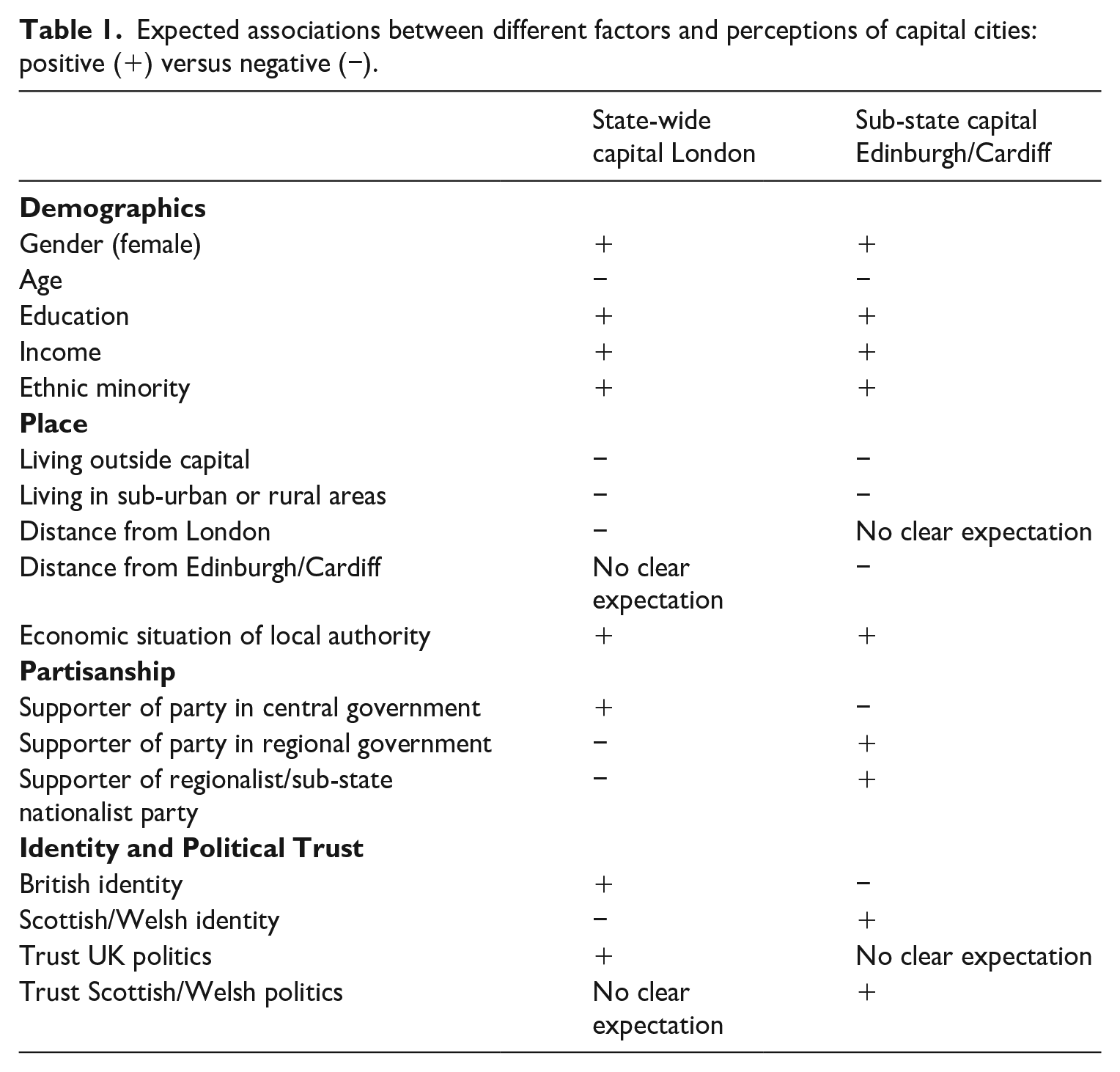
Table 1 summarises the expected relationships between the different sets of variables discussed above and perceptions of both state-wide and sub-state capitals, applying the hypothesised associations to the UK context – and specifically, Scotland and Wales.
Expected associations between different factors and perceptions of capital cities: positive (+) versus negative (−).
So what? Linking citizens’ views of capital cities to their constitutional preferences
Having established the factors that may influence people’s assessment of capital cities in multi-level settings, a question arises: do these varying perceptions have broader implications for citizens’ constitutional preferences (Henderson, 2019; Henderson and Medeiros, 2021)? After all, capital cities are at the heart of political-institutional systems and may shape popular views on how centralised or decentralised a country should be, as well as on other significant territorial matters. For example, one expectation is that more positive views of the state-wide capital would correlate with greater support for more centralisation, as people would not mind seeing a growing concentration of power in a place they view favourably. On the other hand, a stronger connection with the sub-state capital may underpin a stronger preference for further devolution or even independence of the sub-state unit.
An additional constitutional implication, extending beyond the classic territorial arrangements between state-wide and sub-state levels of government, concerns support for EU membership. Analysing this aspect in depth would require further theoretical development and a clearer articulation of the mechanisms linking perceptions of capital cities in multi-level settings to supra-national processes of European integration. This study examines this link in exploratory terms, providing preliminary evidence of whether such an association exists. The premise of this exploration is that in Europe, state-wide and sub-state capitals may also be important hubs for the promotion of cosmopolitan ideals and transnational collaborations, as they may benefit more than other places from the wider opportunities presented by European integration and globalisation (OECD, 2006).
We have already established the expectation that a stronger European identity may be associated with more positive views of capital cities. It is hypothesised that, in turn, high approval of a capital city would translate into increased support for the European Union (EU) – even controlling for European identity. Conversely, negative perceptions of capital cities would correlate with higher levels of hostility towards European integration (Schoene, 2019). More specifically, in the British context, holding positive views of Edinburgh, Cardiff, and London should be accompanied by support for re-joining the EU. Yet, within Scotland and Wales, the potential identification of London with the pro-Brexit Westminster government (until July 2024), and Edinburgh and Cardiff with more pro-EU political elites, might show diverging effects.
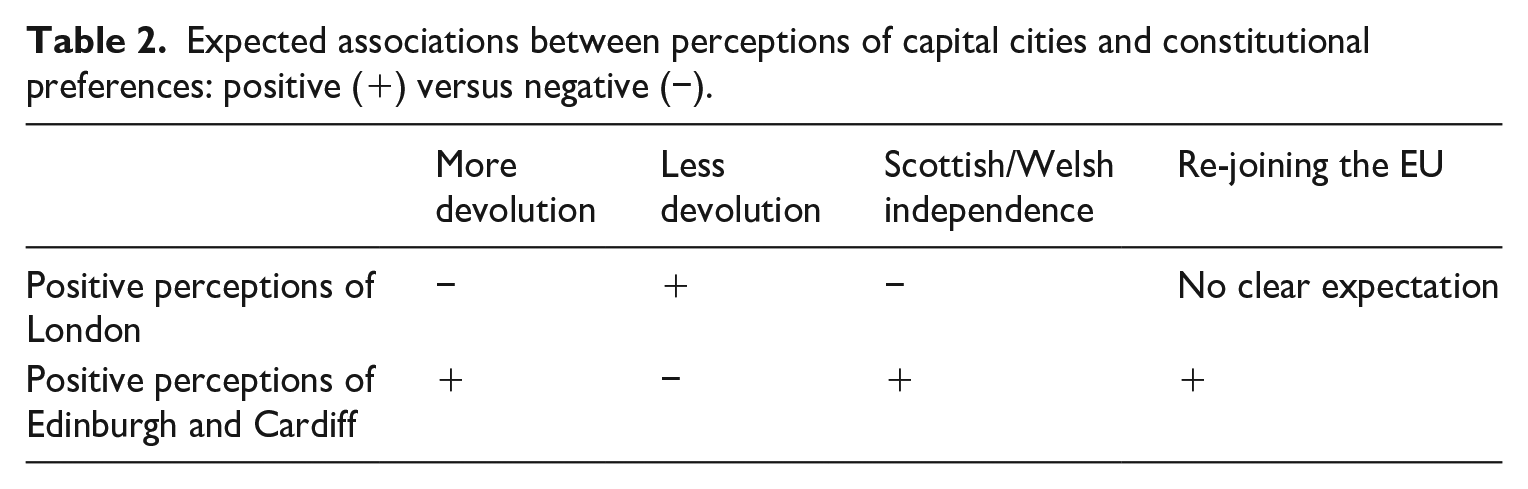
Table 2 summarises the additional set of hypotheses discussed above, in which perceptions of capital cities become the independent variables and constitutional preferences are the dependent variable. It should also be noted that while the direction of the associations in Tables 1 and 2 is expected to be the same for Edinburgh and Cardiff, the strength of these associations may be greater for Edinburgh than for Cardiff. Indeed, as highlighted earlier in the article, Edinburgh has a more established legacy as a sub-state capital city compared to Cardiff. This difference may lead to stronger and more entrenched perceptions within certain societal groups, resulting in a more pronounced link between these perceptions and constitutional preferences in Scotland.
Expected associations between perceptions of capital cities and constitutional preferences: positive (+) versus negative (−).
Data and methodology
In order to test the sets of expectations presented above, this study relies on data taken from an original survey conducted between 8 and 20 December 2023 in Scotland and Wales, with a representative sample of 1756 respondents (1028 in Scotland and 728 in Wales). The capital cities of the two devolved nations, Edinburgh and Cardiff, coexist with the state-wide capital, London. This provides the best configuration to study public perceptions of capital cities in multi-level settings.
The first part of the empirical analysis focuses on identifying the key factors related to perceptions of sub-state and state-wide capital cities across the three dimensions outlined in the framework above. To measure the ‘individual/value’ dimension, respondents were asked: ‘How much do your values and views match those of most people living in London/Edinburgh/Cardiff on a scale from 0 (not at all) to 10 (completely)?’. To measure the ‘symbolic/representational dimension’, the question asked was: ‘In your opinion, how closely does London/Edinburgh/Cardiff reflect the wider British/Scottish/Welsh society on a scale from 0 (not at all) to 10 (completely)?’. Finally to assess the ‘integrative dimension’, respondents were asked to state their level of agreement, on a scale from 1 to 5 (1 = strongly disagree, 5 = strongly agree), with the following statement: ‘London/Edinburgh/Cardiff is an open city accessible to all people living in the UK/Scotland/Wales. Consider factors such as housing, transport to the city, access to its services, and cultural events’. 2 An overall perception index has also been constructed by summing the standardised scores of the answers to the three questions.
The scales measuring the three individual answers and the overall perception index are treated as interval-level dependent variables in ordinary least squares (OLS) regressions including a range of independent variables capturing different individual and contextual factors.
In terms of demographic variables, the model includes sex of the respondent (1 = male, 2 = female), age (in years), education (no degree/not in higher education = 0, degree/in higher education = 1), household income (scale from low-income category, 1, to high-income category, 12), and ethnic minority (no = 0, yes = 1).
To account for place and context, variables have been added to specify whether respondents live in the sub-state capital city (0) or not (1) and whether they live in an urban (1), suburban (2), or rural (3) area (urban area is used as reference category). Measures of distance are also included following a similar approach to the one used by Stein et al. (2021). The first measure is about the distance by road between the centre of the respondents’ local authority and the centre of London (calculated in miles and based on Google Maps). The second measure calculates the distance by road between local authority and centre of Edinburgh or Cardiff (also in miles and based on Google Maps). Local authority’s per capita gross domestic product (GDP; based on 2021 data from the Office for National Statistics) is used as a proxy to assess whether the respondent lives in a disadvantaged or prosperous area, with higher values indicating greater prosperity.
The models also specify the party supported by the respondent (Conservative is used as the reference category, since the party was in government in Westminster at the time of the survey, but in opposition in both Cardiff and Edinburgh). Finally, measures of identity and trust are accounted for. For identity, instead of relying on the classic Moreno question, scales from 0 (very weak) to 10 (very strong) are used to measure the intensity of state-wide (British), sub-state (Scottish/Welsh), European, and local identities. The ‘Britishness’ and ‘Scottishness’ or ‘Welshness’ variables partly capture the fact that some Scottish and Welsh residents were born in different parts of the United Kingdom and may, therefore, feel more British than Scottish/Welsh. Unfortunately, the survey did not include a specific question on the exact place of birth of the respondent – being born in England, for instance, may play a particularly relevant role in Wales – but future studies could consider incorporating this variable. Finally, for trust, respondents were asked to rate their level of trust in the British/Scottish/Welsh political systems on a scale from 0 (no trust) to 10 (full trust).
The second part of the analysis treats the overall perceived role of capital cities (measured by an index summing the three dimensions) as an independent variable. The aim is to determine the extent to which views of London, Edinburgh, or Cardiff are significantly associated with respondents’ different constitutional/territorial preferences, while controlling for all the other demographic, geographical, political, and meta-political independent variables already included in the OLS models. To test these associations, logistic regressions will be performed with the dependent variable being support (1) or not (0) for a range of options, including more devolution, less devolution, Scottish/Welsh independence, and re-joining the EU. Detecting significant effects, even after accounting for a wide range of alternative explanations, would imply that perceptions of capital cities may hold important implications for broader discussions concerning the distribution of power and resources in multi-level systems.
Analysis
Individual/value dimension
We first consider the extent to which Scottish and Welsh residents identify with capital cities and the people who live there. Figure 1 shows that in both devolved nations, on a scale from 0 to 10, the average level of self-identification with the sub-state capital city, Edinburgh or Cardiff, is much higher than with the state-wide capital, London.
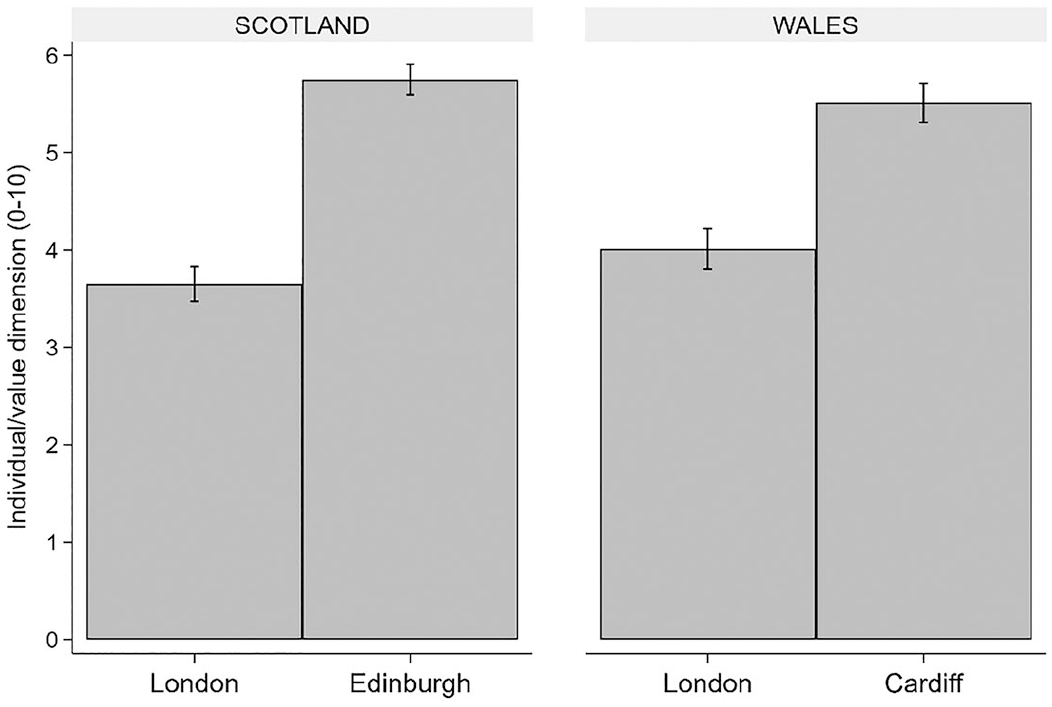
Scottish and Welsh residents’ self-identification with state-wide and sub-state capital cities (average on 0–10 scale).
Table 3 includes the results of OLS regressions, using the 0–10 self-identification scale as the dependent variable. Results are provided by devolved nation and separately for London and sub-state capitals. Different sets of stars are used to mark variables with statistically significant effects, with the least stringent threshold set at 0.1 – indicating less than a 10% chance that the observed result occurred randomly (lower p-values correspond to greater confidence in the observed effects).
Factors associated with Scottish and Welsh residents’ self-identification with state-wide and sub-state capital cities.
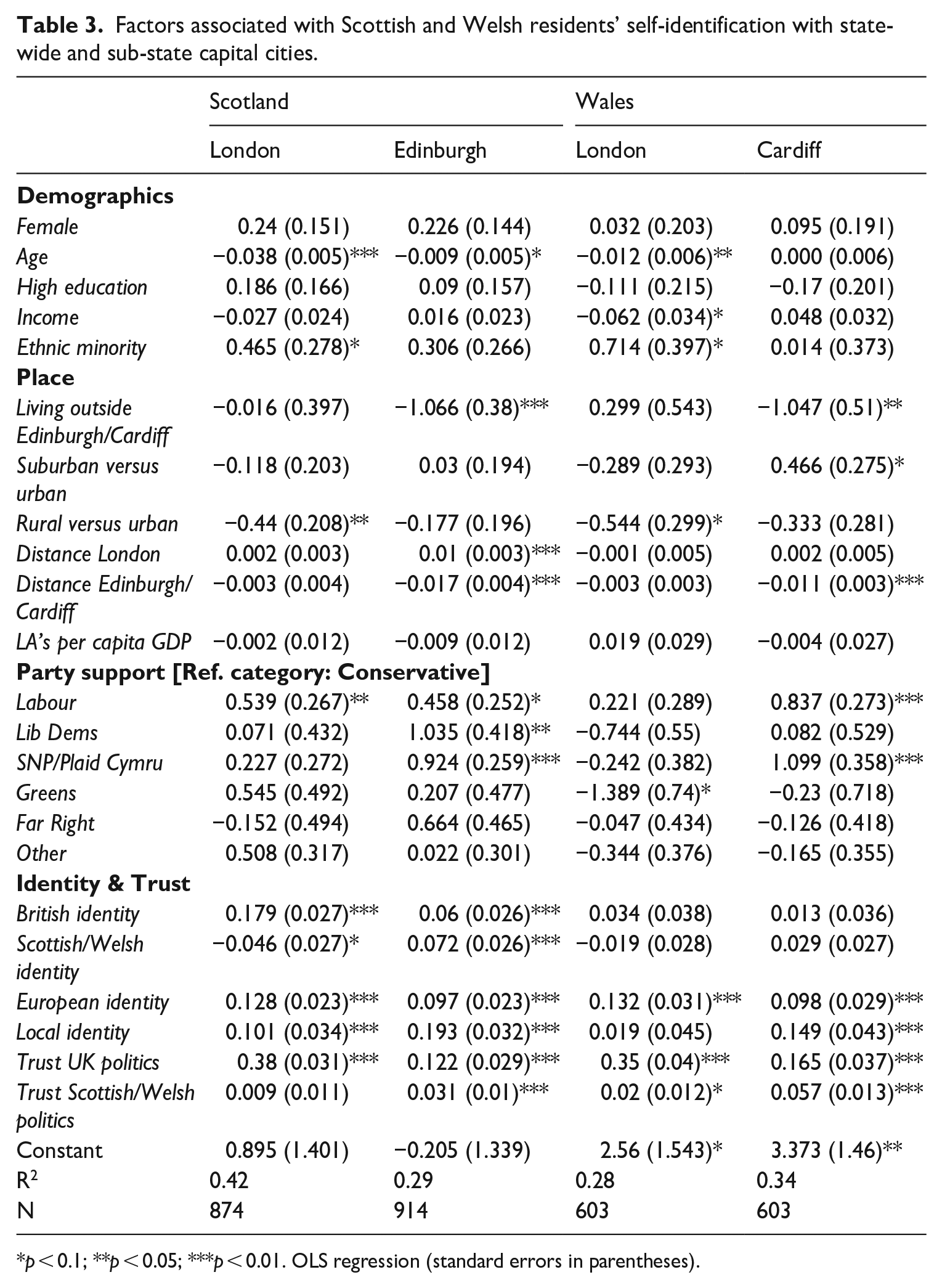
p < 0.1; **p < 0.05; ***p < 0.01. OLS regression (standard errors in parentheses).
The number of cases in the models included in Table 3 and subsequent tables differs from the total number of respondents reported in the methodology section due to missing values. In addition, while some independent variables may exhibit correlation with one another, no significant multicollinearity issues have been detected. (See Appendix 1 for the proportion of missing values for each variable and a note on the variance inflation factor measuring multicollinearity.)
It can be seen that among the demographic variables, age appears to be negatively associated with self-identification with both state-wide and sub-state capitals, although the effect is not statistically significant in the case of Cardiff. Interestingly, being part of an ethnic minority is positively and significantly associated with self-identification with London, while the effect is not significant for Edinburgh and Cardiff, which are probably perceived as less culturally and ethnically diverse than London.
Living outside Edinburgh and Cardiff has a strong negative effect on self-identification with the sub-state capital city, as expected, but no significant effect is detected in the case of London, which instead seems to be more affected by the urban–rural divide (people living in rural areas are less inclined to self-identify with London). Interestingly, while not as important for perceptions of London, distance has a significant effect on perceptions of the sub-state capitals. Living further from London has a positive effect on how people perceive the capitals of their respective devolved nations, while living further from the sub-state capitals has a negative effect on self-identification. Thus, remoteness shapes more how people see their personal connections with the centre of sub-state jurisdictions than with the state-wide capital.
Partisanship generally has more visible effects when considering attitudes towards the sub-state capitals. In Scotland, supporters of Labour, the Liberal Democrats, and the SNP display significantly higher levels of self-identification with Edinburgh and its inhabitants compared to Conservatives (the reference category). Conversely, only Scottish Labour supporters show a stronger personal connection to London, and what it represents, than Conservatives. In Wales, while no significant differences are seen among party supporters in their attitudes towards London (with the Greens being the only exception and less pro-London than the Tories), the partisan divide between Tories and Labour/Plaid Cymru is more marked in relation to Cardiff, with the latter feeling significantly closer to the Welsh capital than the former.
The tension between state-wide and sub-state identities clearly emerges in Scottish residents’ attitudes towards London. While feeling British is positively and significantly correlated with perceptions of the UK capital, the opposite is true in the case of Scottish identity. However, it is interesting to note that in the case of Edinburgh, both British and Scottish identities are associated with more positive views of the Scottish capital. This ‘asymmetry’ between London and Edinburgh suggests that Edinburgh may be perceived as a more unifying centre than London, attracting support from people embracing different forms of patriotism and sense of belonging. In Wales, however, the weaker role played by state-wide and sub-state identities is reflected in the absence of their significant effects. On the other hand, strong local and European identities contribute to generally positive individual perceptions of both state-wide and sub-state capital cities in Scotland and Wales. This suggests that different allegiances may have similar effects and strengthen, rather than weaken, the role of capitals, particularly sub-state ones, as important nodal and connecting points in multi-layered communities.
Similarly, political trust contributes to cementing individual ties with sub-state capitals, regardless of whether it concerns British or devolved politics.
Symbolic dimension
The second dimension assessed in this analysis refers to the symbolic role of capital cities, specifically the extent to which they are thought to reflect the wider society of their national communities: the British one in the case of London, and the Scottish and Welsh ones in the cases of Edinburgh and Cardiff. Again, the overall perception of Scottish and Welsh residents is that the capitals of the two devolved nations do a better job in symbolising Scottish and Welsh societies than London does in representing the United Kingdom (Figure 2). The gap is slightly wider in Scotland than in Wales.
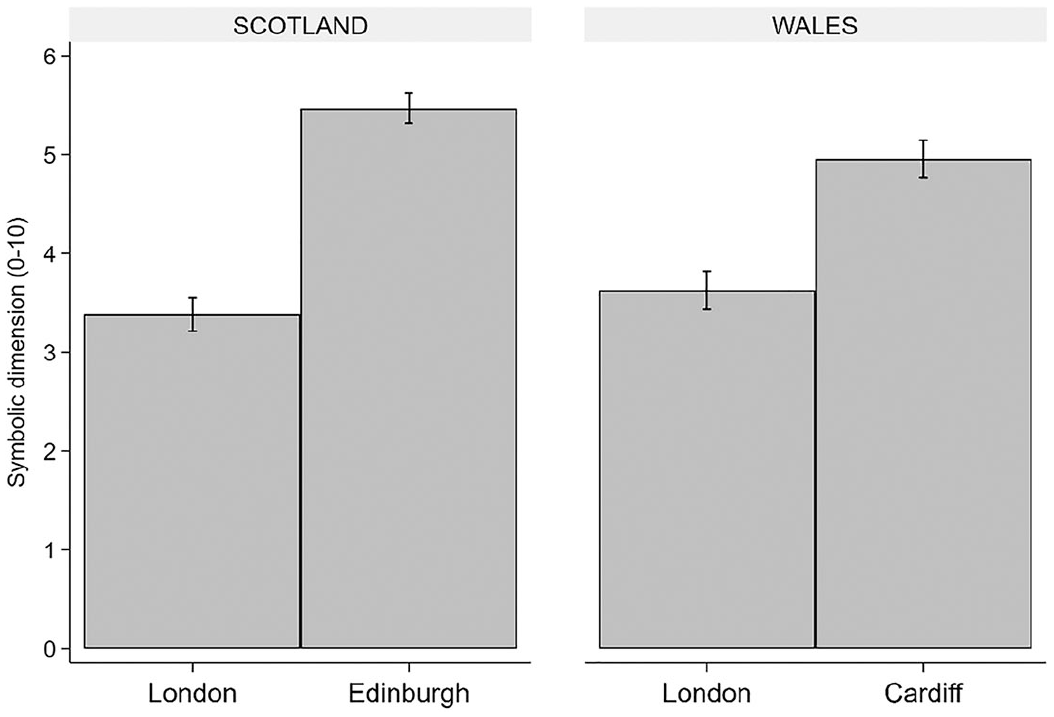
Scottish and Welsh residents’ views on how well state-wide and sub-state capital cities perform their symbolic/representational role (average on 0–10 scale).
However, looking at specific factors underlying the different perceptions, it emerges once again the negative impact of age. In addition, in Scotland, women and more highly educated people have a more positive view of the representativeness of London (Table 4).
Factors associated with Scottish and Welsh residents’ views on the symbolic role of state-wide and sub-state capital cities.
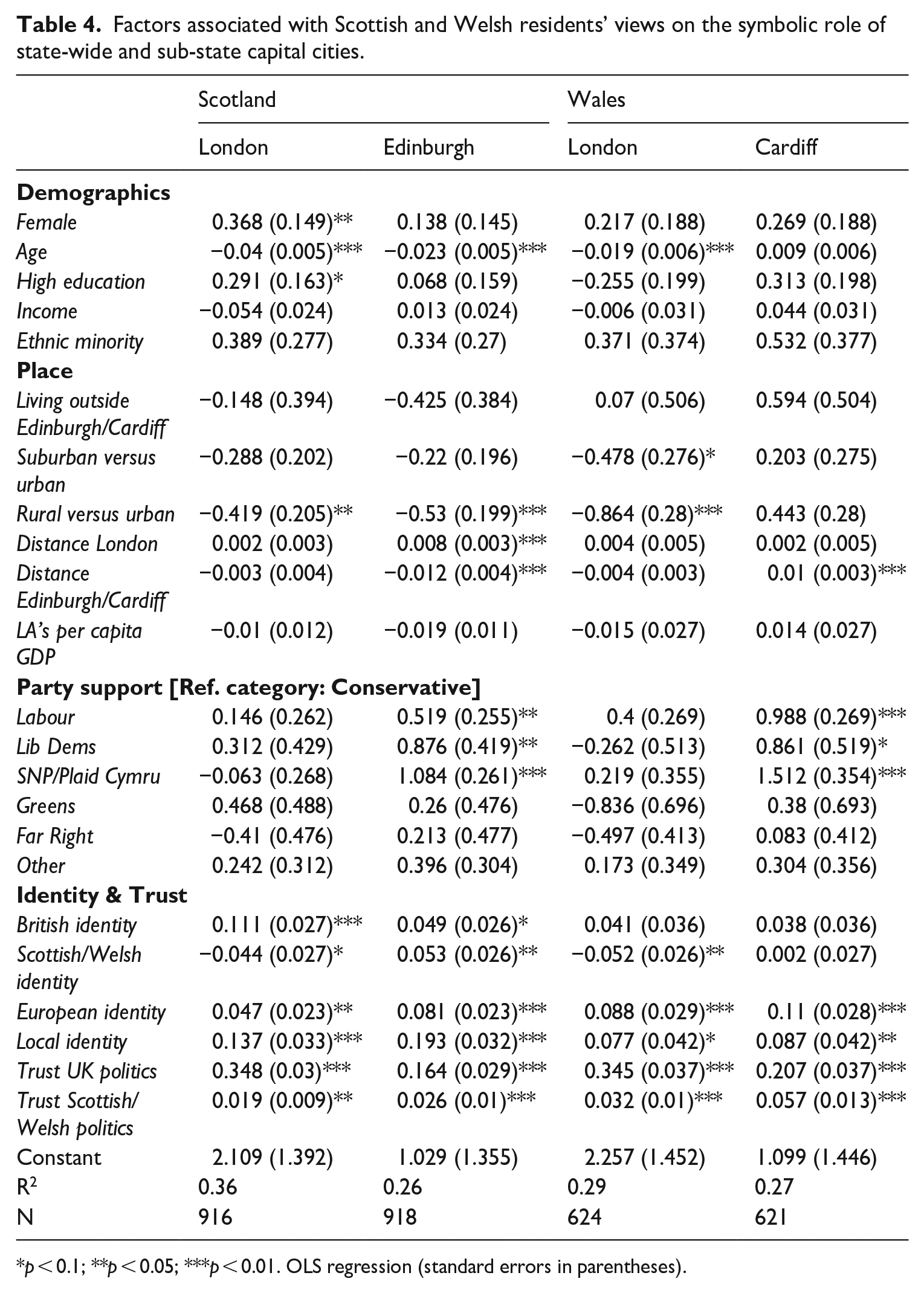
p < 0.1; **p < 0.05; ***p < 0.01. OLS regression (standard errors in parentheses).
We again observe geographical remoteness as an important determinant of how Scottish and Welsh respondents perceive Edinburgh and Cardiff. In particular, increasing distance from the two sub-state capitals decreases perceptions of their representativeness. In addition, in Scotland, we observe that distance from London improves attitudes towards Edinburgh. Interestingly, an urban–rural divide emerges in both devolved nations when people assess London, with rural residents holding significantly more negative views. However, in Scotland, this divide also affects perceptions of Edinburgh, which is seen as less representative of Scottish society by rural respondents.
As in the case of the first dimension, partisan effects are more pronounced for attitudes towards the sub-state capitals than London, suggesting that the role of the former may be more ‘politicised’ than the latter. In particular, we observe that, while there is general partisan uniformity in attitudes towards London, supporters of the two main nationalist parties of Scotland and Wales hold significantly more positive views of Edinburgh and Cardiff than the Tories do. Significant differences also emerge between Conservatives and supporters of Labour and the Lib Dems. The effects of different types of identity and trust are largely similar to those found in the individual/value dimension.
Integrative dimension
The third dimension considers the extent to which state-wide and sub-state capital cities play an integrative role by being open and accessible to all members of a national or regional community. As already explained in the methodology section, this variable is measured on a 5-point scale, with higher values suggesting more positive views. Once again, and unsurprisingly, we observe a gap between London and the two sub-state capitals in favour of the latter (Figure 3).
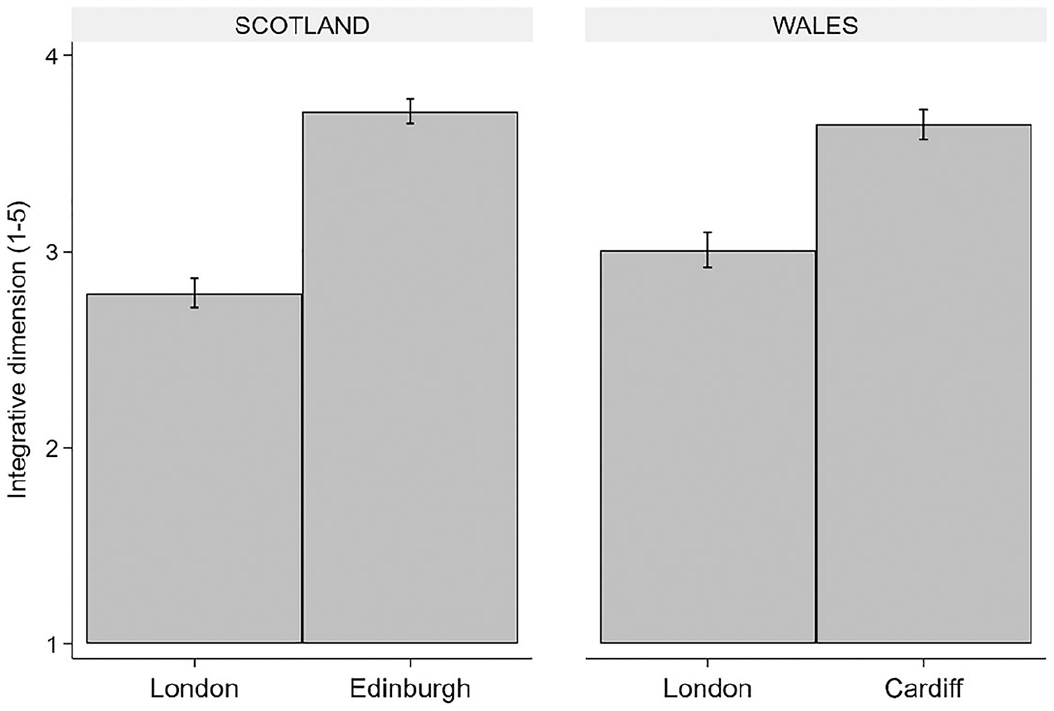
Scottish and Welsh residents’ perceptions of how inclusive and accessible state-wide and sub-state capital cities are (average on 1–5 scale).
However, when examining the factors that may explain individual perceptions, we find some interesting results (Table 5). Among demographic variables, only being part of an ethnic minority consistently shows a positive effect across different models, although this effect is not statistically significant in the case of Cardiff. Surprisingly, education has a negative and statistically significant – though small – effect for Cardiff, suggesting that more educated individuals find the Welsh capital city less accessible. A possible explanation – albeit speculative and theoretically ungrounded – could be that individuals with university degrees perceive Cardiff as less accessible because they do not view the Welsh capital as offering the job opportunities, career paths, or income prospects they seek, with London remaining the primary destination for such opportunities. In Scotland, the unexpected result concerns income, as wealthier individuals find the Scottish capital less accessible and inclusive. Yet this effect is also relatively small and is barely statistically significant at the 0.1 level, so it should be interpreted with caution.
Factors associated with Scottish and Welsh residents’ views on accessibility/inclusivity of state-wide and sub-state capital cities.
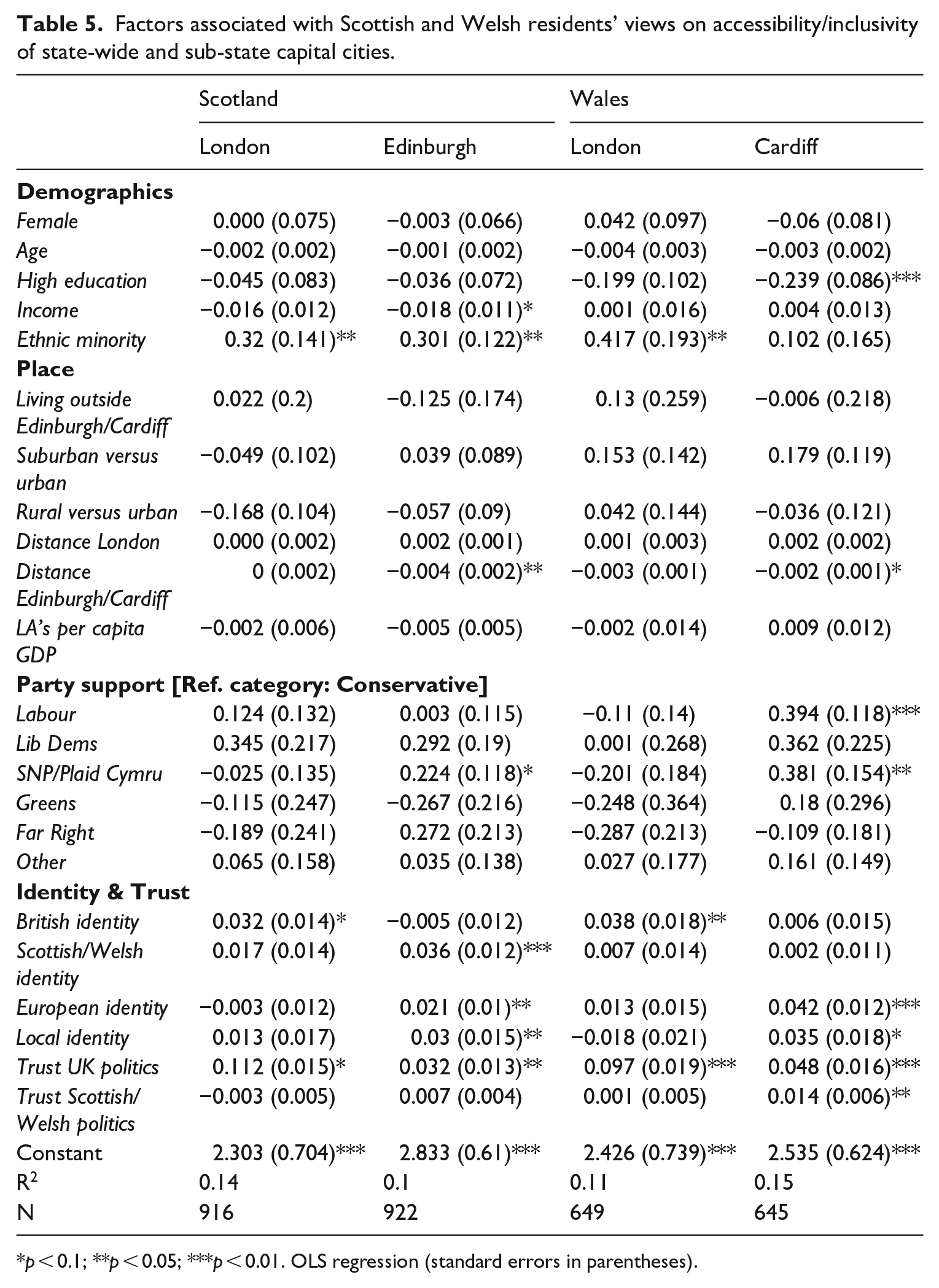
p < 0.1; **p < 0.05; ***p < 0.01. OLS regression (standard errors in parentheses).
Once again, distance from Edinburgh and Cardiff, measured in miles, reduces perceptions of accessibility as one might expect. In the case of London, distance does not make a big difference – this is also unsurprising, given that all local authorities in Scotland and Wales are hundreds of miles away from London. Thus, being marginally closer to the UK capital does not significantly ease accessibility.
Partisanship plays a role only in the cases of Edinburgh and Cardiff, confirming the higher levels of politicisation around the sub-state capitals compared to the state-wide one. In Scotland, SNP supporters have significantly more favourable perceptions than Conservatives, whereas in Wales, Labour and Plaid Cymru display significantly positive effects. So it seems that being a supporter of a nationalist party (Plaid Cymru), a party in devolved government (Labour in Wales), or both (SNP) is positively associated with a feeling that the sub-state capital is fulfilling its integrative role within the wider community. Identity variables show that Britishness positively impacts perceptions of London in both Scotland and Wales, while the integrative dimension of Edinburgh benefits from high levels of Scottish identity. Welsh identity does not seem to play a big role for attitudes towards Cardiff in this case. What Scottish and Welsh capitals have in common is the positive links with European and local identities, which London lacks. So, despite being physically less connected to Europe than London, Edinburgh and Cardiff are perceived as more accessible by Scottish and Welsh individuals who feel strongly European – an interesting finding which places London-centric interpretations of ‘Europeanness’ in the United Kingdom into a different perspective.
Finally, trust in the state-wide political system seems to play a much stronger role than trust in the sub-state political system in underpinning the integrative role of both sub-state and state-wide capitals.
Overall attitudes towards capital cities
The analyses presented above show that, despite different legacies and political-institutional contexts, overall perceptions of Edinburgh and Cardiff are very similar and, in both cases, significantly more positive than perceptions of London.
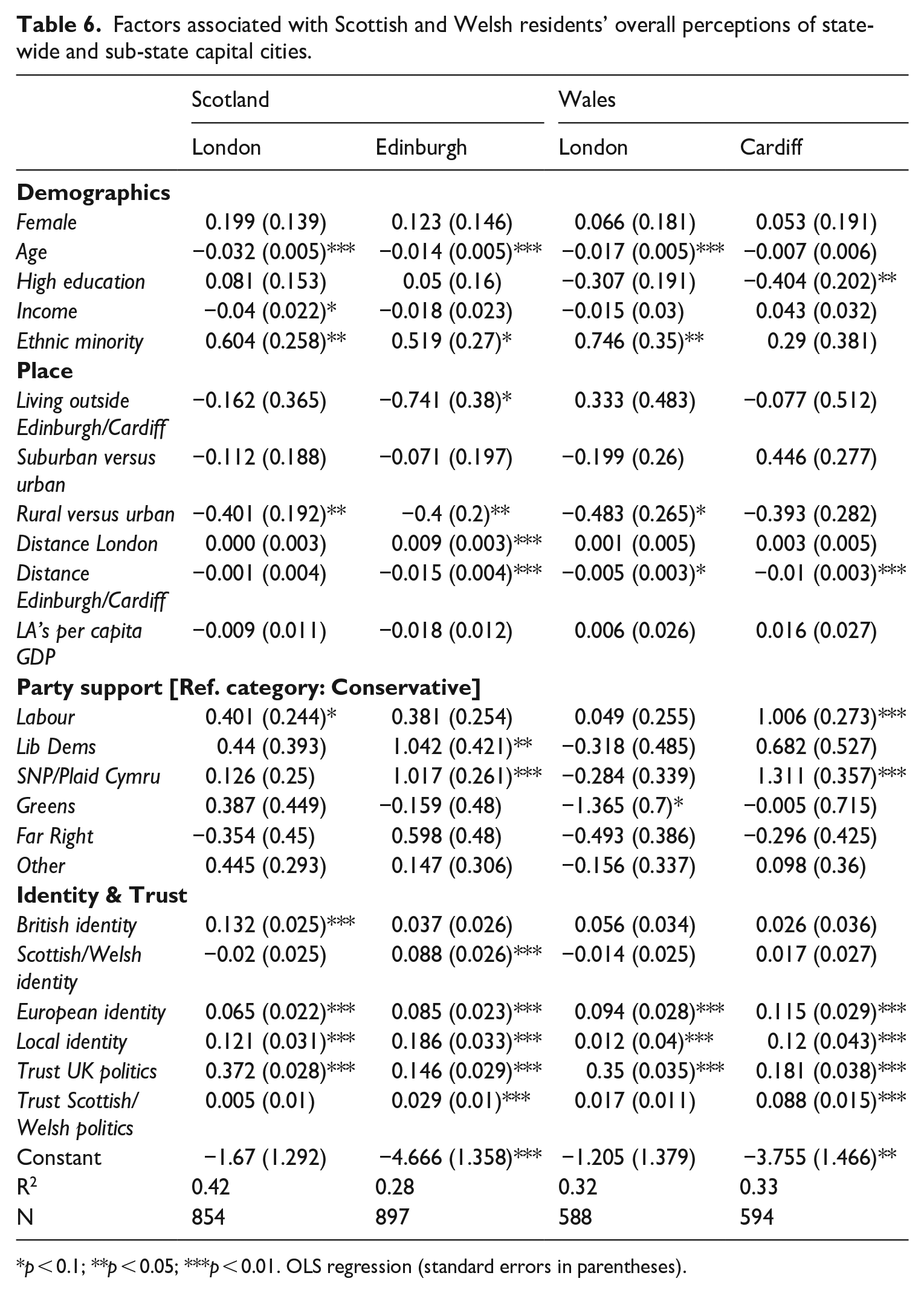
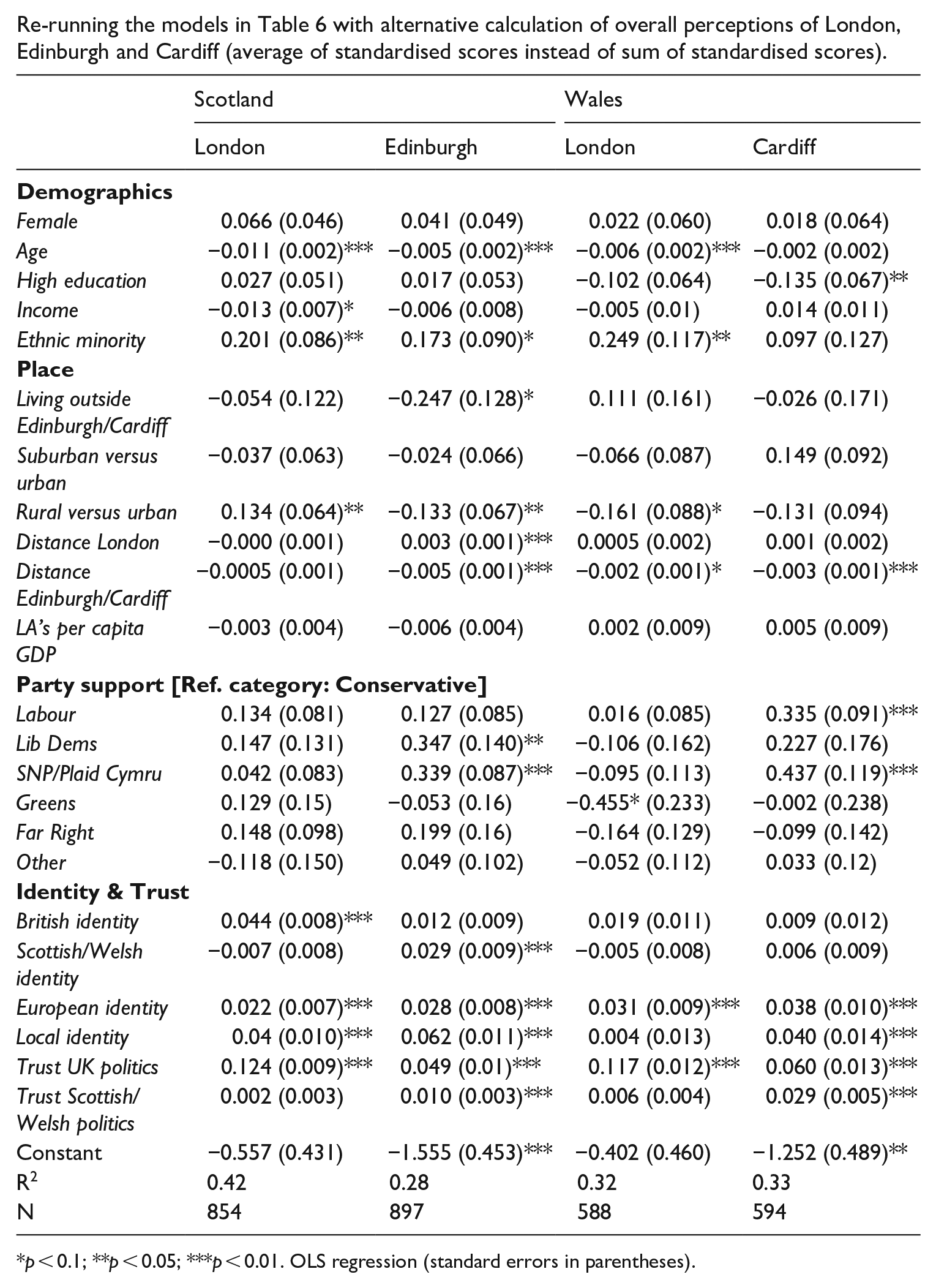
This section provides a summary by examining overall attitudes towards London, Edinburgh, and Cardiff. It does so by adding the standardised scores of the three dimensions discussed above into a single measure (ranging from −4 to +6 in the case of London and from −7 to +5 in the cases of the sub-state capitals). Higher values indicate more positive views of a capital city. An alternative approach, using the averages of the three standardised scores rather than their sums, can also be adopted. All results presented in Table 6 are confirmed even with this alternative approach (see Appendix 2).
Factors associated with Scottish and Welsh residents’ overall perceptions of state-wide and sub-state capital cities.
p < 0.1; **p < 0.05; ***p < 0.01. OLS regression (standard errors in parentheses).
Results shown in Table 6 confirm the role of age in shaping attitudes towards capital cities: older people tend to be less positive, although the effect is not significant in the case of Cardiff. The only statistically significant demographic effect for the Welsh capital is education and it is negative, indicating, quite surprisingly, that more educated people regard it more negatively. Interestingly, the positive effect of being part of an ethnic minority is stronger in the case of London and weaker/barely significant (at 0.1) for Edinburgh. The general picture is one of stronger connections between multicultural London and ethnic minorities residing in Scotland and Wales.
When it comes to geographical factors, people living outside Edinburgh and in rural areas have significantly worse attitudes towards the Scottish capital. The rural–urban divide is also visible in attitudes towards London in both Scotland and Wales. In addition, distance from the sub-state capital cities negatively affects perceptions, while distance from London has the opposite effect. Generally, spatial factors and remoteness seem to shape what people think of sub-state centres of power more than the economic context in which they live; the effects of local authorities’ per capita GDP are not strong nor statistically significant.
Partisanship has a stronger effect on overall attitudes towards the sub-state capital cities than towards the state-wide capital, suggesting that the former may be more politicised than the latter in devolved contexts. In Scotland, only Labour supporters exhibit a barely statistically significant positive difference compared to Conservatives. Interestingly, in Wales, Green supporters have significantly less positive perceptions of London than Conservatives. Overall, however, no clear partisan patterns emerge in how Scottish and Welsh citizens evaluate London.
On the other hand, being a supporter of a party leading the devolved government (SNP in Scotland, Labour in Wales) or a sub-state nationalist party (SNP in Scotland, Plaid Cymru in Wales) contributes to positive perceptions of Edinburgh and Cardiff. Lib Dems are the only other group of party supporters that regard Edinburgh significantly more positively than the Tories in Scotland.
As expected, in Scotland, a stronger British identity is positively correlated with more positive views of London, while it has no significant effect on views of the sub-state capital. On the other hand, a stronger Scottish identity results in more favourable views of Edinburgh but not of London. In Wales, we do not see significant effects of British and Welsh identities. Generally, we observe weaker (and less significant) associations for Cardiff than for Edinburgh. This pattern may be partly due to the smaller size of the Welsh sample. However, this may also be linked to Edinburgh’s stronger legacy as a sub-state capital compared to Cardiff.
European and local identities have significantly positive effects on perceptions of both sub-state and state-wide capitals in both Scotland and Wales. The results suggest that while there may be tension between Britishness and Scottish identity (and to a lesser extent, Welsh identity) in shaping attitudes towards capital cities in a devolved system, feelings of belonging to local and transnational communities are not incompatible with, but actually reinforce, support for multiple political centres (controlling for all the other factors included in the model).
Unsurprisingly, trust in British politics has a positive effect on how people perceive the UK capital. Interestingly, the two sub-state capitals benefit from trust in both British and Scottish/Welsh politics, highlighting their role as connectors between devolved and British governments and institutions.
The implications: Are views of capital cities associated with different constitutional preferences?
Having identified the factors associated with perceptions of state-wide and sub-state capital cities, we now turn to the broader issue of the constitutional position of Scotland and Wales within the post-Brexit UK. We expect that, even when controlling for a range of demographic, geographical, political, and meta-political factors, citizens’ views of state-wide and sub-state capitals will contribute to shaping their preferences for more or less devolution, for independence, and even for EU membership.
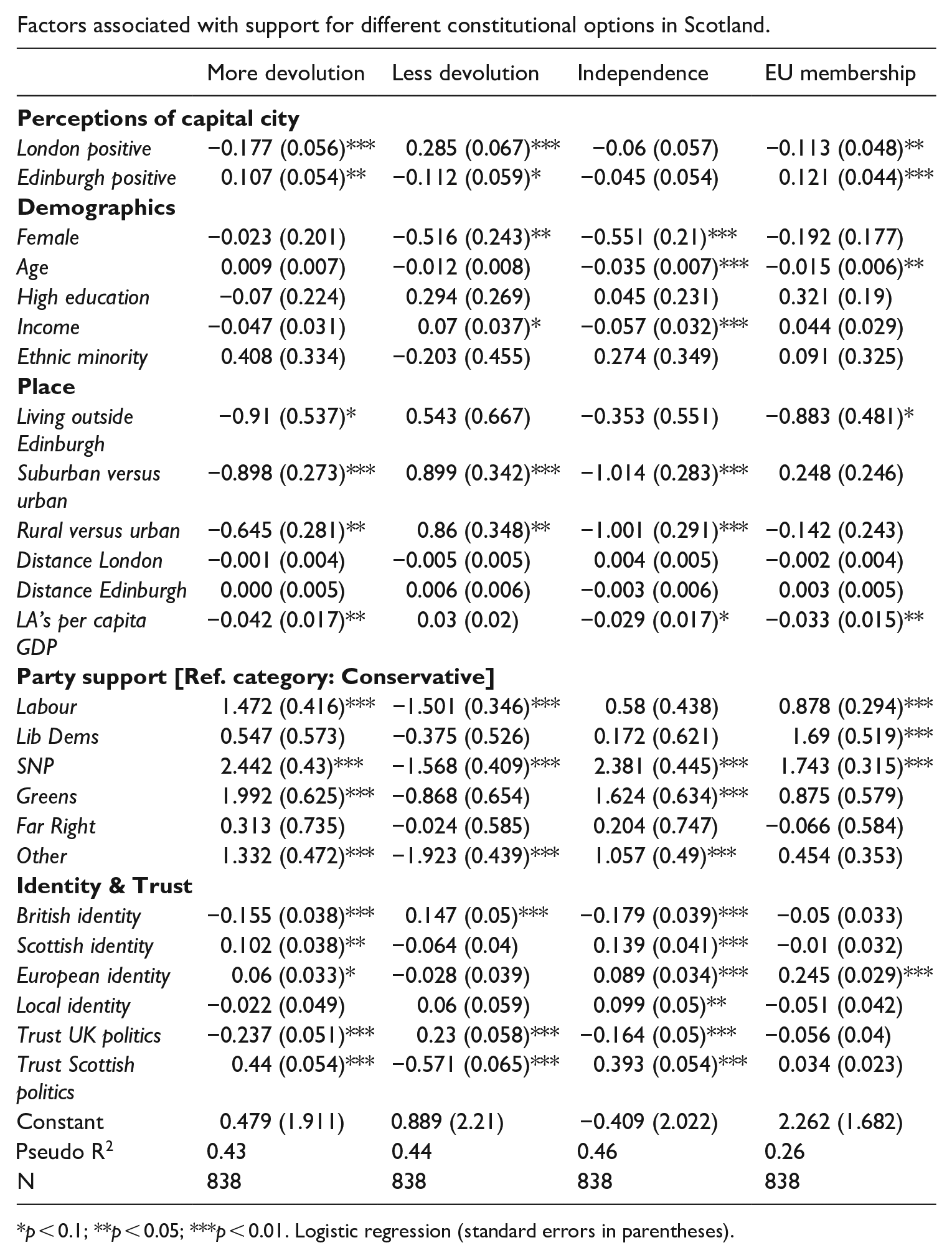
Results for Scotland confirm most of these expectations. Figure 4 presents results based on logistic regressions with four different constitutional options as dependent variables. It shows the average marginal probability effects of perceptions of London and Edinburgh on support for each constitutional option (with 90% confidence intervals). The marginal probability effects are transformations of logistic regression coefficients, which, being log odds, are difficult to interpret directly. Full results, including coefficients for all the other demographic, geographical, political, and meta-political controls, are provided in Appendix 3.
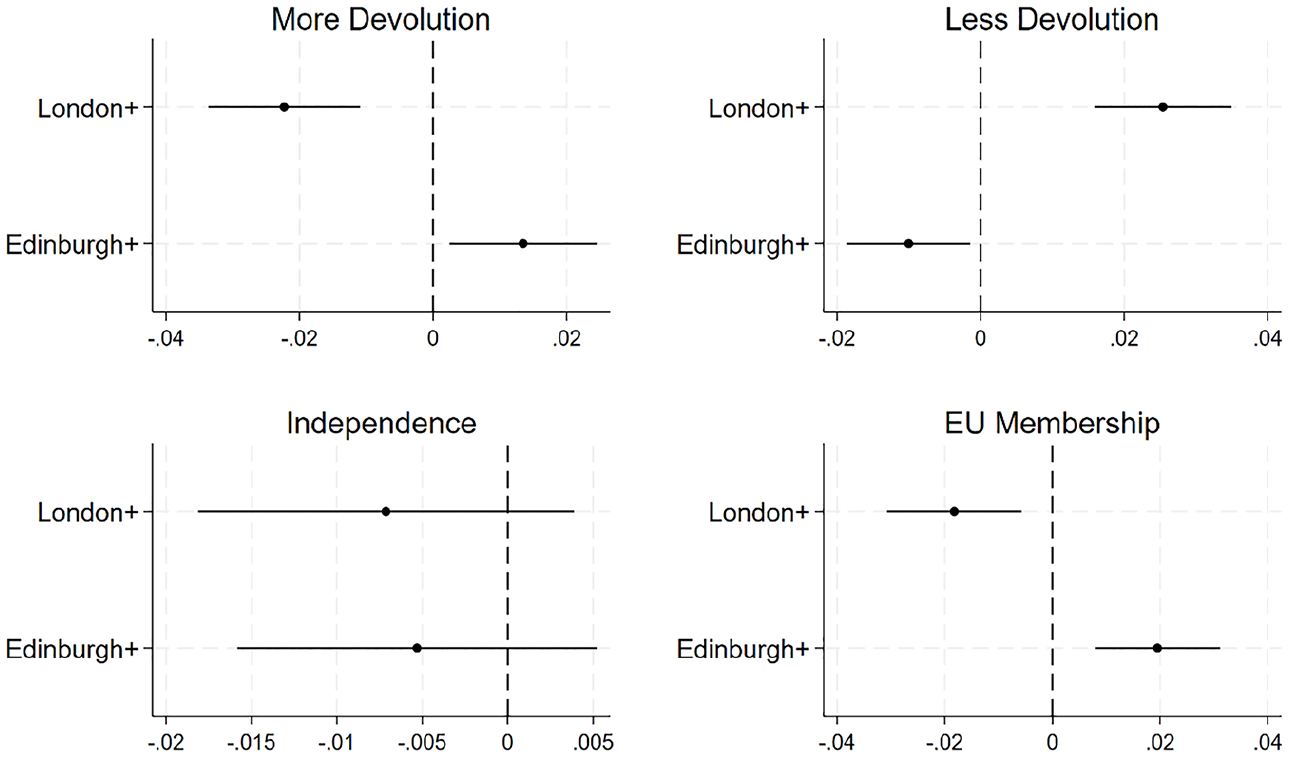
Average marginal effect of public perceptions of London and Edinburgh on probability of supporting constitutional options.
Figure 4 suggests that, even controlling for all the other variables included in the model, a one-point increase in the overall measure of attitudes towards London results in an average decrease of more than two percentage points in the probability of supporting more devolution. The opposite happens if we consider attitudes towards Edinburgh, although the effect is slightly smaller. On the other hand, those who see London more positively are more inclined to want less devolution. In this case, the average marginal effect is an increase of two percentage points in the probability of supporting less devolution. Once again, the effect of holding favourable views of Edinburgh goes in the opposite direction.
When it comes to independence, there does not seem to be a significant effect in either direction. This result is consistent with what was suggested in the first part of the empirical analysis. While being differently shaped by political and territorial factors, perceptions of all three capital cities are ultimately positively correlated with high trust in British politics, highlighting the fact that they act as nodal points in the UK-wide political-institutional systems. Therefore, despite their association with alternative configurations of territorial power (i.e. more or less devolution) within the British state, attitudes towards capital cities do not appear to underpin debates around the actual existence of a British state and are not significantly correlated with pro- or anti-secessionist preferences.
However, when respondents were asked about the possibility of re-joining the European Union, results are almost perfectly symmetrical: feeling closer to London leads to a statistically significant decrease in the probability of supporting this option (average negative effect of two percentage points for each unit increase in the London perception scale), while feeling closer to Edinburgh results in a significant increase (average positive effect of around two percentage points). This is an interesting finding considering the general political discourse in the United Kingdom, where London is assumed to hold the symbolic role of inspiring pro-EU attitudes. However, in the Scottish context, it is Edinburgh that plays that role, while those who regard London positively are more aligned with the pro-Brexit camp, holding all other factors constant.
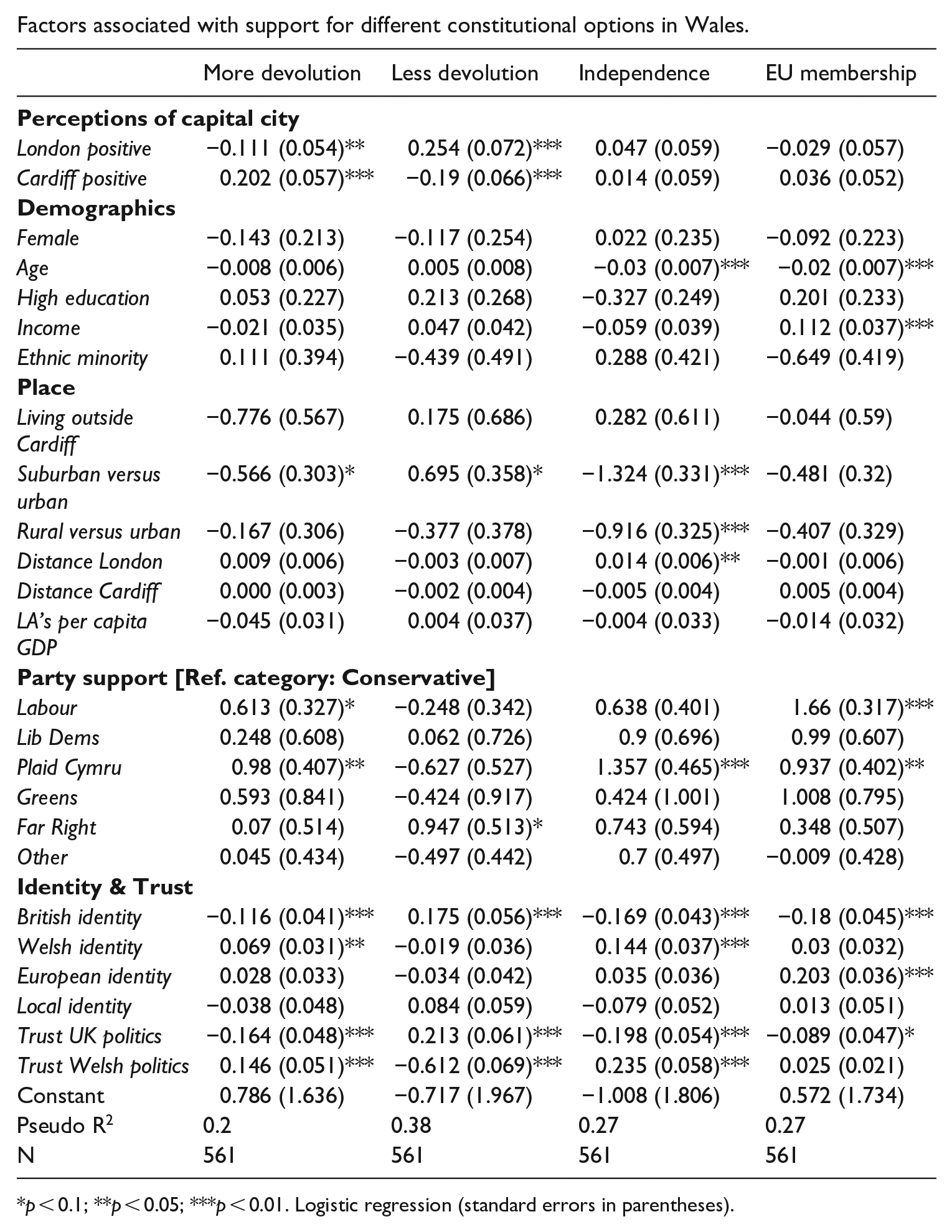
As shown in Figure 5, Wales displays similar results to those observed in Scotland when considering the links between citizens’ perceptions of capital cities and their devolution preferences, even after controlling for a wide range of other variables (full results in Appendix 4). In fact, the average marginal effects (in opposite directions) for London and Cardiff are even greater than those observed in Scotland. In Wales, a one-unit improvement on the overall scale of attitudes towards Cardiff results in an average increase of almost four percentage points in the probability of supporting more devolution. A similar effect is observed when considering the impact of pro-London attitudes on support for less devolution. Also in Wales, capital cities are not significantly associated with pro-/anti-independence divides. Yet, unlike Scotland, no significant effects are detected on the EU dimension either.
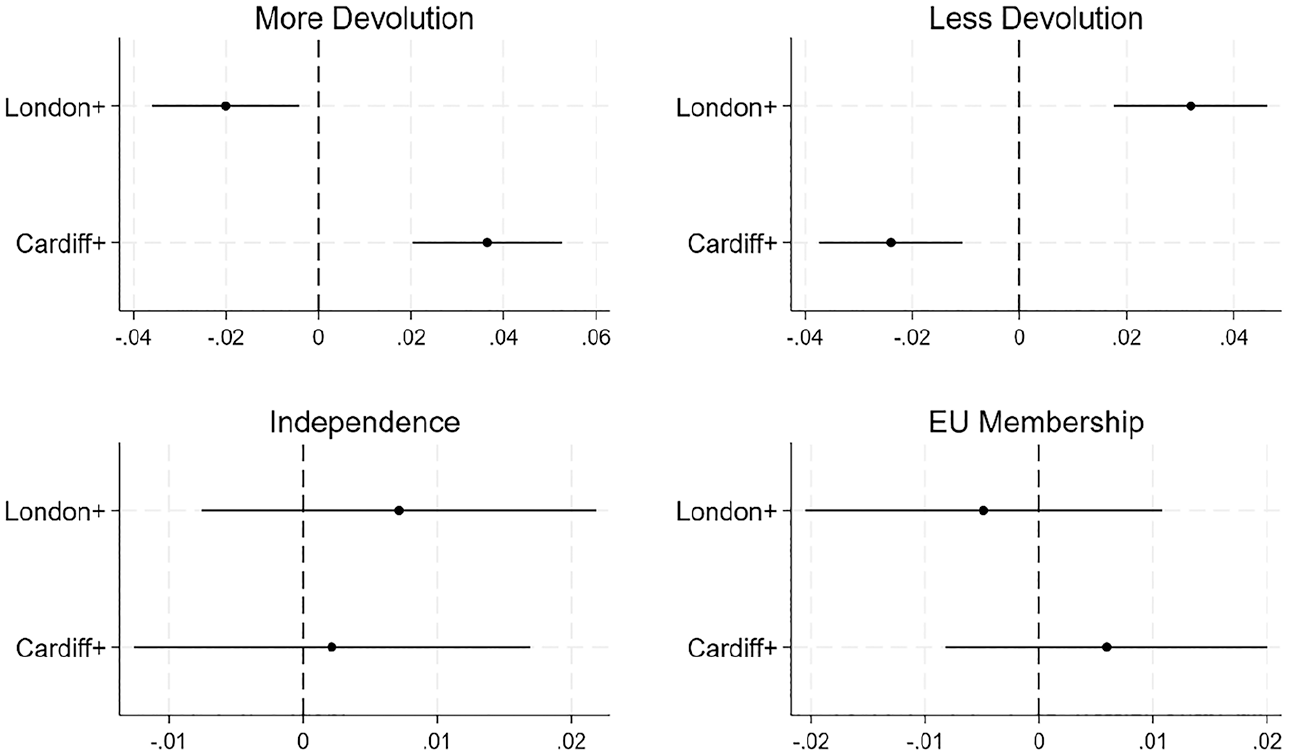
Average marginal effect of public perceptions of London and Cardiff on probability of supporting constitutional options.
Discussion and conclusion
This study has sought to explore the role of state-wide and sub-state capital cities in multi-level settings. It has focused on the United Kingdom as a case of a formerly highly centralised country that has undergone a process of devolution, contributing to the (re-)emergence of multiple centres of power. More specifically, Scotland and Wales were selected as contexts in which citizens engage with the state-wide UK capital, London, and sub-state capital cities, Edinburgh and Cardiff. A set of expectations was tested in a two-step analysis based on data collected in a new survey conducted in Scotland and Wales.
First, perceptions of London, Edinburgh, and Cardiff were assessed against a wide range of demographic, geographical, political, and meta-political factors. It was shown that across three dimensions of assessment – individual, symbolic, and integrative – while scoring consistently better than London, sub-state capital cities emerge as more politically divisive than the UK capital in the Scottish and Welsh electorates. Supporters of parties leading devolved governments and/or adopting Scottish/Welsh nationalist positions hold significantly more favourable perceptions of Edinburgh and Cardiff compared to supporters of the Conservatives, who governed in Westminster at the time of the survey. In addition, distance from the sub-state capital plays an important role in shaping citizens’ attitudes, with geographical remoteness negatively impacting their views of Edinburgh and Cardiff, while no effect is observed in the case of London.
Among the demographic variables, age is consistently significant, indicating that older people are less supportive of both state-wide and sub-state capital cities compared to younger people. Interestingly, ethnic minorities in Scotland and Wales tend to identify more with London than Edinburgh and Cardiff, likely due to the markedly higher levels of cultural/ethnic diversity in the UK capital compared to the latter two.
As expected, a tension exists between British and Scottish/Welsh identities in their relationship with attitudes towards London, Edinburgh, and Cardiff. Yet, local and European identities seem to be generally compatible with better perceptions of both sub-state and state-wide capitals. Political trust also partly transcends territorial boundaries: greater trust in the UK political system results in more positive perceptions of all capital cities. However, trust in Scottish/Welsh politics is more consistently associated with views of Edinburgh and Cardiff. This indicates that while both state-wide and sub-state capital cities are associated with the functioning of the UK political system, only the latter are more closely linked to how people assess devolved politics.
The analysis then turned to the constitutional implications of holding more or less positive perceptions of capital cities. The expectation was that, being at the core of multiple political-institutional systems, London, Edinburgh, and Cardiff may contribute to shaping citizens’ general preferences about the territorial/constitutional distribution of power in the United Kingdom. It has been shown that indeed, developing positive views of London is associated with support for less devolution and opposition to more transfers of power from the centre. On the other hand, holding more favourable attitudes towards Edinburgh and Cardiff leads to opposite results, regardless of other key socio-economic, geographical, political, and meta-political variables shaping individual’s views.
The key lesson from this finding is that – beyond appeals to different national identities, partisanship, and other background factors – mobilising hostility towards the devolved capitals while fostering stronger emotional attachments to London may effectively persuade people that devolution should not advance further and might even be reversed. Conversely, the pro-devolution cause could be strengthened by celebrating Edinburgh and Cardiff as cities with which all Scottish and Welsh residents can identify and to which they have easy access. The primary challenge for supporters of devolution will be to change the perceptions of those groups identified in the analysis as holding significantly more negative views of Edinburgh and Cardiff – while critics of devolution will face a similar challenge in sectors of society that are particularly hostile to London.
Another significant finding, though presented in exploratory terms and without extensive theorising, is that attitudes towards capital cities in multi-level systems may also have supra-national implications and be linked to support for EU membership. Contrary to the London-centric discourse, which suggests that stronger ties to London are associated with more pro-EU positions in the United Kingdom, Scotland presents a different scenario. Here, positive views of the sub-state capital, Edinburgh, are closely associated with support for re-joining the EU, while attachment to London is linked to pro-Brexit sentiments. Although Scotland as a whole emerged as a strongly pro-EU devolved nation during the 2016 referendum – unlike Wales, where attachment to either London or Cardiff does not appear to correlate with EU support – Euroscepticism remains significant in some sectors of Scottish society. The findings of this article suggest that attitudes towards capital cities may reflect deeper divisions within Scotland’s electorate, often obscured by its overall pro-Remain majority.
Generally, this study has provided original insights into a still relatively under-researched area: the politics surrounding multiple capital cities in devolved systems. It has been demonstrated that citizens’ engagement with and perceptions of state-wide and sub-state capital cities may vary significantly, and this, in turn, may have important political-constitutional implications. To be sure, this is mostly an observational-correlational study. Although the effect of attitudes towards capital cities held even when controlling for a wide range of other variables, proving causation – that is, that changing attitudes result in varying support for different constitutional arrangements – would require an even more rigorous research design, possibly incorporating longitudinal data collection and causal modelling techniques. Experimental designs could also help uncover interesting mechanisms. In addition, qualitative analysis – particularly ethnographic studies of communities situated differently in relation to a capital city – could provide valuable evidence on how people develop their perceptions of centres of political, cultural, and economic power.
Finally, while the framework developed here has been applied to the United Kingdom, future studies could refine and expand its scope by including other cases and assessing the role of state-wide and sub-state capitals in bridging or magnifying real or perceived territorial inequalities, as well as shaping citizens’ different preferences on how authority should be distributed in multi-level systems.
Footnotes
Appendix 1
Multicollinearity diagnostic for the multivariate regressions included in this article:
The variance inflation factor (VIF) is used as a diagnostic tool to measure the severity of multicollinearity in regression analysis. Conventionally, a VIF above 10 indicates high multicollinearity that requires correction. Some researchers adopt a more conservative approach and use a lower threshold of 5, particularly when the sample size is large and precise coefficient estimates are critical. Across all the models included in this article, the mean VIF is well below both the 10 and 5 thresholds, ranging from 1.7 to 2, which indicates relatively low levels of multicollinearity.
Appendix 2
Re-running the models in Table 6 with alternative calculation of overall perceptions of London, Edinburgh and Cardiff (average of standardised scores instead of sum of standardised scores).
| Scotland | Wales | |||
|---|---|---|---|---|
| London | Edinburgh | London | Cardiff | |
|
|
||||
| Female | 0.066 (0.046) | 0.041 (0.049) | 0.022 (0.060) | 0.018 (0.064) |
| Age | −0.011 (0.002)*** | −0.005 (0.002)*** | −0.006 (0.002)*** | −0.002 (0.002) |
| High education | 0.027 (0.051) | 0.017 (0.053) | −0.102 (0.064) | −0.135 (0.067)** |
| Income | −0.013 (0.007)* | −0.006 (0.008) | −0.005 (0.01) | 0.014 (0.011) |
| Ethnic minority | 0.201 (0.086)** | 0.173 (0.090)* | 0.249 (0.117)** | 0.097 (0.127) |
|
|
||||
| Living outside Edinburgh/Cardiff | −0.054 (0.122) | −0.247 (0.128)* | 0.111 (0.161) | −0.026 (0.171) |
| Suburban versus urban | −0.037 (0.063) | −0.024 (0.066) | −0.066 (0.087) | 0.149 (0.092) |
| Rural versus urban | 0.134 (0.064)** | −0.133 (0.067)** | −0.161 (0.088)* | −0.131 (0.094) |
| Distance London | −0.000 (0.001) | 0.003 (0.001)*** | 0.0005 (0.002) | 0.001 (0.002) |
| Distance Edinburgh/Cardiff | −0.0005 (0.001) | −0.005 (0.001)*** | −0.002 (0.001)* | −0.003 (0.001)*** |
| LA’s per capita GDP | −0.003 (0.004) | −0.006 (0.004) | 0.002 (0.009) | 0.005 (0.009) |
|
|
||||
| Labour | 0.134 (0.081) | 0.127 (0.085) | 0.016 (0.085) | 0.335 (0.091)*** |
| Lib Dems | 0.147 (0.131) | 0.347 (0.140)** | −0.106 (0.162) | 0.227 (0.176) |
| SNP/Plaid Cymru | 0.042 (0.083) | 0.339 (0.087)*** | −0.095 (0.113) | 0.437 (0.119)*** |
| Greens | 0.129 (0.15) | −0.053 (0.16) | −0.455* (0.233) | −0.002 (0.238) |
| Far Right | 0.148 (0.098) | 0.199 (0.16) | −0.164 (0.129) | −0.099 (0.142) |
| Other | −0.118 (0.150) | 0.049 (0.102) | −0.052 (0.112) | 0.033 (0.12) |
|
|
||||
| British identity | 0.044 (0.008)*** | 0.012 (0.009) | 0.019 (0.011) | 0.009 (0.012) |
| Scottish/Welsh identity | −0.007 (0.008) | 0.029 (0.009)*** | −0.005 (0.008) | 0.006 (0.009) |
| European identity | 0.022 (0.007)*** | 0.028 (0.008)*** | 0.031 (0.009)*** | 0.038 (0.010)*** |
| Local identity | 0.04 (0.010)*** | 0.062 (0.011)*** | 0.004 (0.013) | 0.040 (0.014)*** |
| Trust UK politics | 0.124 (0.009)*** | 0.049 (0.01)*** | 0.117 (0.012)*** | 0.060 (0.013)*** |
| Trust Scottish/Welsh politics | 0.002 (0.003) | 0.010 (0.003)*** | 0.006 (0.004) | 0.029 (0.005)*** |
| Constant | −0.557 (0.431) | −1.555 (0.453)*** | −0.402 (0.460) | −1.252 (0.489)** |
| R2 | 0.42 | 0.28 | 0.32 | 0.33 |
| N | 854 | 897 | 588 | 594 |
p < 0.1; **p < 0.05; ***p < 0.01. OLS regression (standard errors in parentheses).
Appendix 3
Factors associated with support for different constitutional options in Scotland.
| More devolution | Less devolution | Independence | EU membership | |
|---|---|---|---|---|
|
|
||||
| London positive | −0.177 (0.056)*** | 0.285 (0.067)*** | −0.06 (0.057) | −0.113 (0.048)** |
| Edinburgh positive | 0.107 (0.054)** | −0.112 (0.059)* | −0.045 (0.054) | 0.121 (0.044)*** |
|
|
||||
| Female | −0.023 (0.201) | −0.516 (0.243)** | −0.551 (0.21)*** | −0.192 (0.177) |
| Age | 0.009 (0.007) | −0.012 (0.008) | −0.035 (0.007)*** | −0.015 (0.006)** |
| High education | −0.07 (0.224) | 0.294 (0.269) | 0.045 (0.231) | 0.321 (0.19) |
| Income | −0.047 (0.031) | 0.07 (0.037)* | −0.057 (0.032)*** | 0.044 (0.029) |
| Ethnic minority | 0.408 (0.334) | −0.203 (0.455) | 0.274 (0.349) | 0.091 (0.325) |
|
|
||||
| Living outside Edinburgh | −0.91 (0.537)* | 0.543 (0.667) | −0.353 (0.551) | −0.883 (0.481)* |
| Suburban versus urban | −0.898 (0.273)*** | 0.899 (0.342)*** | −1.014 (0.283)*** | 0.248 (0.246) |
| Rural versus urban | −0.645 (0.281)** | 0.86 (0.348)** | −1.001 (0.291)*** | −0.142 (0.243) |
| Distance London | −0.001 (0.004) | −0.005 (0.005) | 0.004 (0.005) | −0.002 (0.004) |
| Distance Edinburgh | 0.000 (0.005) | 0.006 (0.006) | −0.003 (0.006) | 0.003 (0.005) |
| LA’s per capita GDP | −0.042 (0.017)** | 0.03 (0.02) | −0.029 (0.017)* | −0.033 (0.015)** |
|
|
||||
| Labour | 1.472 (0.416)*** | −1.501 (0.346)*** | 0.58 (0.438) | 0.878 (0.294)*** |
| Lib Dems | 0.547 (0.573) | −0.375 (0.526) | 0.172 (0.621) | 1.69 (0.519)*** |
| SNP | 2.442 (0.43)*** | −1.568 (0.409)*** | 2.381 (0.445)*** | 1.743 (0.315)*** |
| Greens | 1.992 (0.625)*** | −0.868 (0.654) | 1.624 (0.634)*** | 0.875 (0.579) |
| Far Right | 0.313 (0.735) | −0.024 (0.585) | 0.204 (0.747) | −0.066 (0.584) |
| Other | 1.332 (0.472)*** | −1.923 (0.439)*** | 1.057 (0.49)*** | 0.454 (0.353) |
|
|
||||
| British identity | −0.155 (0.038)*** | 0.147 (0.05)*** | −0.179 (0.039)*** | −0.05 (0.033) |
| Scottish identity | 0.102 (0.038)** | −0.064 (0.04) | 0.139 (0.041)*** | −0.01 (0.032) |
| European identity | 0.06 (0.033)* | −0.028 (0.039) | 0.089 (0.034)*** | 0.245 (0.029)*** |
| Local identity | −0.022 (0.049) | 0.06 (0.059) | 0.099 (0.05)** | −0.051 (0.042) |
| Trust UK politics | −0.237 (0.051)*** | 0.23 (0.058)*** | −0.164 (0.05)*** | −0.056 (0.04) |
| Trust Scottish politics | 0.44 (0.054)*** | −0.571 (0.065)*** | 0.393 (0.054)*** | 0.034 (0.023) |
| Constant | 0.479 (1.911) | 0.889 (2.21) | −0.409 (2.022) | 2.262 (1.682) |
| Pseudo R2 | 0.43 | 0.44 | 0.46 | 0.26 |
| N | 838 | 838 | 838 | 838 |
p < 0.1; **p < 0.05; ***p < 0.01. Logistic regression (standard errors in parentheses).
Appendix 4
Factors associated with support for different constitutional options in Wales.
| More devolution | Less devolution | Independence | EU membership | |
|---|---|---|---|---|
|
|
||||
| London positive | −0.111 (0.054)** | 0.254 (0.072)*** | 0.047 (0.059) | −0.029 (0.057) |
| Cardiff positive | 0.202 (0.057)*** | −0.19 (0.066)*** | 0.014 (0.059) | 0.036 (0.052) |
|
|
||||
| Female | −0.143 (0.213) | −0.117 (0.254) | 0.022 (0.235) | −0.092 (0.223) |
| Age | −0.008 (0.006) | 0.005 (0.008) | −0.03 (0.007)*** | −0.02 (0.007)*** |
| High education | 0.053 (0.227) | 0.213 (0.268) | −0.327 (0.249) | 0.201 (0.233) |
| Income | −0.021 (0.035) | 0.047 (0.042) | −0.059 (0.039) | 0.112 (0.037)*** |
| Ethnic minority | 0.111 (0.394) | −0.439 (0.491) | 0.288 (0.421) | −0.649 (0.419) |
|
|
||||
| Living outside Cardiff | −0.776 (0.567) | 0.175 (0.686) | 0.282 (0.611) | −0.044 (0.59) |
| Suburban versus urban | −0.566 (0.303)* | 0.695 (0.358)* | −1.324 (0.331)*** | −0.481 (0.32) |
| Rural versus urban | −0.167 (0.306) | −0.377 (0.378) | −0.916 (0.325)*** | −0.407 (0.329) |
| Distance London | 0.009 (0.006) | −0.003 (0.007) | 0.014 (0.006)** | −0.001 (0.006) |
| Distance Cardiff | 0.000 (0.003) | −0.002 (0.004) | −0.005 (0.004) | 0.005 (0.004) |
| LA’s per capita GDP | −0.045 (0.031) | 0.004 (0.037) | −0.004 (0.033) | −0.014 (0.032) |
|
|
||||
| Labour | 0.613 (0.327)* | −0.248 (0.342) | 0.638 (0.401) | 1.66 (0.317)*** |
| Lib Dems | 0.248 (0.608) | 0.062 (0.726) | 0.9 (0.696) | 0.99 (0.607) |
| Plaid Cymru | 0.98 (0.407)** | −0.627 (0.527) | 1.357 (0.465)*** | 0.937 (0.402)** |
| Greens | 0.593 (0.841) | −0.424 (0.917) | 0.424 (1.001) | 1.008 (0.795) |
| Far Right | 0.07 (0.514) | 0.947 (0.513)* | 0.743 (0.594) | 0.348 (0.507) |
| Other | 0.045 (0.434) | −0.497 (0.442) | 0.7 (0.497) | −0.009 (0.428) |
|
|
||||
| British identity | −0.116 (0.041)*** | 0.175 (0.056)*** | −0.169 (0.043)*** | −0.18 (0.045)*** |
| Welsh identity | 0.069 (0.031)** | −0.019 (0.036) | 0.144 (0.037)*** | 0.03 (0.032) |
| European identity | 0.028 (0.033) | −0.034 (0.042) | 0.035 (0.036) | 0.203 (0.036)*** |
| Local identity | −0.038 (0.048) | 0.084 (0.059) | −0.079 (0.052) | 0.013 (0.051) |
| Trust UK politics | −0.164 (0.048)*** | 0.213 (0.061)*** | −0.198 (0.054)*** | −0.089 (0.047)* |
| Trust Welsh politics | 0.146 (0.051)*** | −0.612 (0.069)*** | 0.235 (0.058)*** | 0.025 (0.021) |
| Constant | 0.786 (1.636) | −0.717 (1.967) | −1.008 (1.806) | 0.572 (1.734) |
| Pseudo R2 | 0.2 | 0.38 | 0.27 | 0.27 |
| N | 561 | 561 | 561 | 561 |
p < 0.1; **p < 0.05; ***p < 0.01. Logistic regression (standard errors in parentheses).
Funding
The author(s) disclosed receipt of the following financial support for the research, authorship, and/or publication of this article: This work was supported by the British Academy/Leverhulme Trust [grant number SRG23\230264].

Data availability statement
The data that support the findings of this study are available from the corresponding author upon reasonable request.