




Abstract
The existing scholarship implies different mechanisms for the enforcement of international human rights law through the domestic public opinion channel. In this research, we investigate the comparative influence of these alternative mechanisms in a cross-country setting. Using data from original survey experiments from the United States, Germany, and Turkey, we show that public concerns over human rights violations in foreign countries are highly politicised by strategic political relationships. Our results provide a fuller account of the specific micro-mechanisms through which the domestic public opinion channel most effectively constrains government action in enforcing international human rights law. Our findings suggest that naming and shaming by informing the public about the international human rights law violations in foreign states may not provide a consistent and reliable check, as the public defines punishment strategically based on political alliances and interests over legal context.
Introduction
One of the most important questions in international relations is the effect of international law on state behaviour, and when states comply with their legal obligations (Chayes and Chayes, 1993; Guzman, 2008; Henkin, 1979; Kelley, 2007; Koh, 1997; Simmons, 2000; Tokdemir and Mark, 2018; Victor et al., 1998; von Stein, 2016). To answer this question, scholars have turned to domestic politics in the case of international human rights law. In the absence of strong mechanisms for the enforcement within human rights agreements, scholars have argued that domestic actors, such as national courts, civil society organisations, and public opinion may play a role in enforcing international human rights law in foreign countries (Conrad and Ritter, 2013, 2020; Cox, 2020; Hafner-Burton and Tsutsui, 2007; Hill, 2010; Lupu, 2013; Powell and Staton, 2009; Simmons, 2000, 2009; Tomz and Weeks, 2020; Bayram and Miller, 2023).
These works imply different mechanisms for the enforcement of international human rights law through the domestic public opinion channel. Accordingly, respect for legal obligations, political alliances, and individual values and norms are three of the key mechanisms of enforcement. Little is known, however, about the relative influence of these alternative mechanisms. Drawing on novel cross-national data, this research examines how these mechanisms shape public demand for their governments to hold foreign actors accountable for violations of international human rights law.
Publics recognise the significance of legal obligations, and when they become aware of human rights abuses perpetrated by foreign nations, they demand that their governments hold these wrongdoers accountable (Bell et al., 2012; DeMeritt, 2012; Hafner-Burton, 2008; Hafner-Burton and Tsutsui, 2007; Krain, 2012; Lebovic and Voeten, 2009; Meernik et al., 2012; Murdie and Peksen, 2013; Peterson et al., 2018). Scholars have also demonstrated that international law plays a role in shaping public attitudes towards various policy issues including human rights (Chilton and Versteeg, 2016; Lupu and Wallace, 2019; Wallace, 2013). Indeed, as more reports indicate that Russia has been committing human rights abuses since the onset of the 2022 war with Ukraine, public opinion in the United States and Europe has been consistently supportive of sanctioning Russia (De Pinto, Salvanto and Backus, 2022) 1 and holding Russia accountable (European Parliament, 2022). 2
At the same time, publics seem to apply double standards in their willingness to enforce international human rights law. There is growing evidence that shows publics respond differently to violations of human rights agreements by different foreign governments, often cutting slack to allies and democracies while being tough on rivals and autocracies (Rathbun et al., 2024; Terman and Byun, 2021; Tokdemir, 2022; Tomz et al., 2023; Tomz and Weeks, 2020; Zarpli, 2024). Moreover, individual attitudes towards international law and international organisations are partly grounded in individuals’ dispositional characteristics and values, rather than merely shaped by structural and situational factors. This insight suggests that public preferences for upholding international human rights law might lie deep within individual-level foundations. Foreign policy-related dispositions of individuals, therefore, constitute a third mechanism that could play a role in what kind of action publics demand in response to foreign governments’ violations of international human rights law.
This study analyses the relative influence of the different pathways suggested by the existing literature for the enforcement of international law in a multi-country setting. In democracies, leaders care about public opinion on international human rights law and take it into account when deciding whether to sanction violators. Findings from a growing number of studies increasingly show the importance of public preferences for foreign policy and international conflict and cooperation more broadly (Chilton et al., 2017; Chu and Recchia, 2022; Kertzer and Zeitzoff, 2017; Kitagawa and Chu, 2021; Sagan and Valentino, 2017; Tomz and Weeks, 2013). It is therefore important to sharpen our understanding of why citizens are more likely to not only demand that their governments condemn violations of international human rights law but also act to hold perpetrators accountable.
To ascertain the importance of the different mechanisms underpinning the public opinion channel of enforcement of international law, we derive three hypotheses from existing works centred on the identity of the perpetrator, the degree of legal obligation, and individual dispositions. Using data from original survey experiments fielded in Germany, Turkey, and the United States, we show that the identity of the perpetrator is the strongest predictor of public demand for accountability. People ask for punishment of enemies, but are relatively comfortable with excusing allies. Individuals’ cosmopolitan and multilateralist foreign policy disposition also plays a role in leading to stronger demands for accountability, albeit a small one. The degree of legal obligation and contestation, surprisingly, makes little difference.
A prevailing assumption in the literature on naming and shaming is that by educating the public about abuses perpetrated by foreign governments, pressure will build on governing elites to hold perpetrators accountable. Our findings challenge this assumption. The results reveal that there is a far more complicated and concerning story. Public demands for accountability are strongly politicised as a function of strategic political relations – the pull of international law and individuals’ values have very limited effect. Put differently, politics trumps legality and values.
Our findings contribute to a fuller understanding of the mechanisms through which human rights treaties constrain government behaviour through the public opinion channel. The existing scholarship has examined the different mechanisms in isolation. We advance this body of work by examining the importance of different mechanisms of enforcement in relation to each other. In addition to clarifying the relative importance of the purported mechanisms of enforcement through public opinion, our results contribute to greater precision and external validity in understanding how the public opinion channel works across different countries. Specifically, our research intervenes into existing debates by testing competing hypotheses about different domestic enforcement channels in in three diverse countries with different capabilities for enforcement and track records of compliance with human rights law themselves. By comparing the alternative mechanisms of legal drivers, enemy–ally relations, and individual dispositions across the United States, Germany, and Turkey, countries that are particularly relevant given their diverse power status in international politics in maintaining norms surrounding international human rights law, we offer a more generalisable picture of how enforcement works through the public opinion channel.
In the following sections, we first offer an overview regarding the enforcement of international law and human rights through public opinion channel. We then present our hypotheses in three sets, each referring to diverse channels driven by identity politics, legal context, and foreign policy predispositions. Next, we introduce the experimental design and data followed by a discussion of the results. We conclude with a summary of our key findings and the broader implications of this work.
Nexus between public opinion and international law
In the decades following the end of World War II, the international community has placed greater rhetorical and legal emphasis on the promotion of human rights. International regimes and institutions include the establishment of the International Covenant on Civil and Political Rights (ICCPR), the International Convention Against Torture and Other Cruel, Inhuman, or Degrading Treatment or Punishment (CAT), and the Rome Statute (forming the International Criminal Court) to name a few of the mechanisms by which the international community ensures the promotion of human rights. Despite the almost universal adoption of these standards, governments routinely engage in acts of repression or state terror that violate international laws. Simply signing onto a human rights treaty does not ensure that governments will not engage in widespread repression in the future (Hill, 2010; Neumayer, 2005). On balance, compliance with human rights laws remains a persistent challenge for the international community (Fariss, 2018; Hafner-Burton and Tsutsui, 2007; Hathaway, 2002; Hill, 2010; Hill and Jones, 2014).
The international community often has few options available for enforcing international laws regarding human right treaties. Global agreements that deal with monetary policy, trade, or the use of biological or chemical weapons are strengthened with either explicit mechanisms that hold violators accountable or implicit mechanisms of mutual reciprocity. Human rights treaties often fail to include strong mechanisms that sanction violators (Hill, 2010; Wallace, 2013). Similarly, these international agreements tend to also lack the appropriate incentives for reciprocity. As abuses are perpetrated against a domestic audience, foreign governments may not be directly affected by violations (Simmons, 2009). This reduces the incentive for the international community to take costly action against perpetrators of human rights violations. A recent study by Terman and Byun (2021) also emphasises that actor identity plays a crucial role in whether governments seek to reprimand the behaviour of foreign states. Governments are sensitive to not only who is being targeted but also how salient the issue type is to the target state. Governments criticise their adversaries for contentious issues such as human rights while largely critiquing their allies on safer issues such as trade.
Absent strong mechanisms within the agreements themselves, past scholarship has noted that the onus for holding abusers of human rights accountable falls to third-party states and civil society organisations. A wealth of research has emerged on the role human rights INGOs play in spurring international action in addressing human rights abuses (Allendoerfer et al., 2020; Bell et al., 2012; Meernik et al., 2012; Murdie and Davis, 2012; Peterson et al., 2018). By highlighting the abuses perpetrated by governments, these organisations push third-party states and international organisations to address abuses through popular mobilisation. In other words, by raising public awareness of abuses perpetrated by foreign governments, human rights INGOs increase the likelihood that publics will demand that their governments hold foreign perpetrators accountable.
These findings on naming and shaming squarely map onto the scholarship exploring the domestic public opinion channel by which human rights treaties constrain government behaviour (Simmons, 2009), namely by shaping national publics’ understanding of which policies are legitimate (appropriate), offering new information and expectations, and encouraging civil society mobilisation (Dai, 2007; Hathaway, 2007; Lupu and Wallace, 2019; Sikkink, 2001; Simmons, 2009). These new expectations in some cases might create a ‘boomerang’-type effect pushing policy makers to condemn human rights violations in foreign countries (Keck and Sikkink, 1998). Growing evidence indeed suggests that international law figures prominently in public attitudes towards drone strikes (Kreps and Wallace, 2016), the legitimacy of government repression (Lupu and Wallace, 2019), dissent (Conrad and Ritter, 2020), torture (Chilton and Versteeg, 2016; Wallace, 2013), and compliance with laws of war (Chilton, 2014; Dill and Schubiger, 2021; Wallace, 2019).
Yet other studies reveal a more nuanced picture, indicating that the identity of the wrongdoer might diminish the importance publics place on international law qua law. A number of works have shown that publics are less likely to name and shame allies and strategic partners but more likely to punish adversaries (Abebe, 2009; Carraro et al., 2019; Nance, 2015; Terman and Byun, 2021; Terman and Voeten, 2018). 3
Research has also shown that public demands for military interventions are conditioned by strategic relations, such as shared alliance membership (Tomz et al., 2023), democratic regime type (Tomz and Weeks, 2013), and shared racial and ethnic identity (Rathbun et al., 2024). These findings parallel earlier works that have shown that domestic audience prefer being tough on enemies and lenient on allies (Herrmann et al., 2001; Lieberman and Skitka, 2017; Peksen et al., 2014).
There is also evidence individual attitudes towards international law and international organisations are partly grounded in individuals’ dispositional characteristics and values such as cosmopolitan identity (Bayram, 2017), ideology (Bayram and Miller, 2023) and foreign policy orientations more broadly (Kertzer et al., 2014; Rathbun et al., 2016). The implication is that in addition to the importance people might place on international legal obligations and strategic relations, there are individual-level factors that predispose members of the public to be more or less deferential towards international law. In this respect, the domestic enforcement mechanism might operate through regard for international law at the individual citizen level shaped by specific foreign policy dispositions.
This study analyses the relative influence of the different pathways suggested by the existing literature for the enforcement of international law through the public opinion channel in a multi-country setting. Existing scholarship has mostly examined different mechanisms in isolation. We build on and advance this research by analysing the significance of various enforcement mechanisms in relation to one another. This approach is essential for developing a more comprehensive understanding of the specific micro-mechanisms through which public opinion most effectively constrains government action in enforcing international human rights law abroad. In the next section, we present the three hypotheses mapping onto the mechanisms suggested by the existing literature.
Micro-mechanisms of public demands for the punishment of human rights violators
‘More serious crimes deserve more serious punishment’ as the adage goes (Carlsmith and Darley, 2008: 199). Which factors then render violations of human rights law more serious than others in the eyes of publics?
First, we focus on the identity of the wrongdoer. ‘Punishment is not always chosen to fit the crime, but rather to fit the criminal’ (Geldenhuys, 2004: 327). As outlined above, the literature indicates that whether the country violating international human rights law is an adversary or friend is a crucial input shaping public perceptions of severity of the crime. Social identity-based explanations for justice explain the psychological dynamics underpinning this double standard (Clayton and Opotow, 2003; Tyler and Blader, 2003; Wenzel et al., 2010). Crimes committed by out-group members are perceived to cause greater harm to the community thus requiring a harsher form of punishment to balance the scales of justice (Van Prooijen and Lam, 2007; Sommers and Ellsworth, 2000). Enemies are out-groups. Their crimes are perceived as a greater injustice and symbolic status threat than those committed by allies. In fact, when stereographical enemy images are used to characterise the adversary, it becomes necessary to use harsher forms of punishment to ensure to moral superiority of the in-group and eliminate the threat (Herrmann and Fischerkeller, 1995; Oppenheimer, 2006).
Based on these insights, we posit that publics will be more accommodative of torture perpetrated by allied regimes as compared to adversary governments. Publics will perceive known allies as part of their figurative in-group, and thus will be more likely to accept the use of torture by foreign governments that they believe will have their own national security interests in mind. This is not to say that they approve of this torture, just that they are unwilling to seek meaningful punishment for those foreign governments believed to be part of their in-group. Therefore:
H1. When torture is perpetrated by a known friendly state, the demand for punishment will be lower than when torture is perpetrated by a known adversary.
Second, we focus on the degree of legal constraints. In the psychology of punitive justice, just desert explanations posit that punishment is best manifested as giving wrongdoers what they deserve for the crime they committed. Punishment is backward looking in this sense and seeks to restore a sense of justice. The nature and severity of the transgression play a key role in seeking just deserts. People apply more severe punishments for more severe crimes. In the context of international relations, violations of legally binding agreements should be a key consideration for publics.
A common assumption found both in the naming and shaming literature and in studies emphasising public opinion-based enforcement of international law is that people care about the metaphorical ‘pull’ of international law. Indeed, there is growing, albeit mixed, evidence for this claim (Chilton and Versteeg, 2016; Dill and Schubiger, 2021; Lupu and Wallace, 2019). Accordingly, we argue that stronger legal constraints imposed by highly legally binding and precise laws with low levels of contestation about their interpretations will lead publics to see violations as more serious and thus increasing their willingness to punish. Legal obligation is often considered the most important dimension of legalisation. It refers to the extent to which rules are ‘legally’ binding. ‘[L]egal obligations bring into play the established norms, procedures, and forms of discourse of the international legal system such as pacta sunt servanda’ (Abbott et al., 2000: 408). Even though there is some debate as to what makes legal obligations more ‘serious’ in the first place (Brunnée and Toope, 2010; Finnemore and Toope, 2001; Franck, 1990), it is generally accepted that legal obligations have more teeth or as Franck (1990) famously put ‘compliance pull’. This is because legal obligations involve legal responsibility that does not exist for obligations arising from ‘coercion, comity, or morality alone’ (Abbott et al., 2000: 408). Legal obligations also bring into play specific norms and discourses of the international community (Finnemore and Toope, 2001).
Since the ‘compliance pull’ is stronger and more serious when there is a legal obligation, the public should feel greater moral outrage when a highly legalised hard law instrument is violated as opposed to a soft law one, leading to a greater willingness to punish. Knowing that the country violating human rights was legally prohibited from is likely to engender greater disapproval given both the normative standing of international legal agreements and the public commitment they represent to international and domestic audiences. Therefore:
H2a: The stronger the legal obligation the greater the demand for punishment.
Legal instruments with low contestation about what they state leave little room for ambiguity, provide clear and consistent standards for appropriate behaviour, and narrow the scope of interpretation by elaborating on the conditions of applicability (Abbott and Snidal, 2000). Level of contestation refers to the extent to which a law ‘specifies clearly and unambiguously what is expected of a state . . . in a particular set of circumstances’ (Abbott et al., 2000: 412). Because they define appropriate conduct unambiguously, violations of precise legal instruments should invoke a higher degree of public disapproval leading to a greater willingness to punish. The logic here is that because precise legal instruments leave little room for ambiguity, violators cannot argue their way out by diplomatic manoeuvres or evasion to justify rule breaking. As such, publics will be more likely to receive clear signals about violations, leading to greater demand for punishment. Indeed, Wallace (2013) found that people were less likely to ‘condone torture’ if they were told a low-contestation rule prohibited it. Similarly, Linos and Pegram (2016) found that when responsibilities and tasks are specified firmly and precisely the rate of compliance increases even if the agreement is nonbinding. Accordingly, we hypothesise that:
H2b: The lower contestation about the legal obligation the greater the demand for punishment.
Finally, beyond the macro level dynamics pertaining to ally–enemy relations and the strength of legalisation, there are supply side explanations predicting that individual dispositions and values will influence their willingness to punish violators of international law as it often drives the moral outrage one feels towards a transgression. Indeed, some works have suggested retributiveness as a relevant individual trait (von Stein, 2016). Here we focus on foreign policy orientations. We believe foreign policy orientations provide a more suitable framework to explain when citizens are more or less willing to accommodate or criticise foreign governments for the use of torture because these orientations underpin the international relations paradigm in people’s minds (Rathbun, 2009), which then affects broader attitudes towards international conflict and peace (Herrmann et al., 1999; Holsti and Rosenau, 1990; Rathbun et al., 2016). 4
Cooperative internationalism (CI) is a foreign policy orientation marked by a preference for multilateralism and cosmopolitanism in international affairs (Holsti and Rosenau, 1990; Rathbun et al., 2016). 5 CI reflects support for international institutions and law and cooperation with other states for mutual gains and collective action. It also involves a concern for the wellbeing of other countries and human beings and a sense of global solidarity. Following existing findings that showed cosmopolitanism and multilateralism leading to greater respect for international law and stronger compliance attitudes (Bayram, 2017), we expect individuals who score high on CI to be more willing to punish violators of international law because CI embodies a commitment to international law and institutions.
H3a. As respondents place greater value on cooperative internationalism, their demand for punishment will be greater.
We further posit that a preference for not getting involved in other countries’ affairs will likely affect demands for accountability. Scholars have specified isolationism as a core foreign policy dimension that is grounded in a belief that one’s country should have a ‘home focus’ and disengage from international affairs (Kertzer, 2013; Rathbun et al., 2016). Isolationism opposes both military involvements and political entanglements in international law and organisations.
Whether it is anchored in libertarianism or Jeffersonianism, since isolationism rejects international entanglements, we expect individuals with a strong isolationist foreign policy orientation to be less likely to punish violations of international law. Because they generally disapprove of international law and organisations and are concerned with the sovereignty costs imposed by such institutional entanglements, we expect isolationists not to experience a strong sense of moral outrage in face of violations of international law and thus not bother to seek retribution.
H3b. As respondents place greater value on isolationism, their demand for punishment will be lower.
Research design and method
To test our hypotheses, we conducted original survey experiments in the United States, Germany, and Turkey through 2018 and 2020. 6 These countries are particularly relevant for our analysis to account for variation in public demands for punishment. As global powers, both the United States and Germany play a role in maintaining norms surrounding international human rights law. On the other hand, while Turkey is a major regional player within the Middle East that often pays lip service to human rights law, it has by far the worst human rights record of the three. For INGOs seeking to ensure that fragile countries abide by agreements protecting human rights, the domestic populace within these three countries represent a critical audience for their appeals. Importantly, as compared to other regional powers (such as China), the governments of these three countries are vulnerable to widespread domestic pressure, particularly through elections, in varying degrees. 7 We believe the case selection of these three countries with different capabilities, practices of human rights, attitudes towards international law and multilateral global governance institutions, as well as distinct public preferences and pressure on their governments offers a useful testing laboratory for understanding how publics respond to human rights abuses by foreign governments.
The Turkish survey included face-to-face interviews with a nationally representative sample conducted during November and December 2020 by Infakto. 9 Based on the probability proportional to size method, 1.816 Turkish adults have participated in the survey. In addition to the representative sample of 1350 respondents from 169 sampling units determined by the Turkish Statistical Institute, we also have a booster sample of 466 respondents from 57 sampling units located in Kurdish majority cities to ensure the participation of enough number of Kurdish respondents, who constitute a major socially and politically relevant minority. Following the administration of the survey, every single respondent was called to cross-validate the administration to ensure the quality of the data.
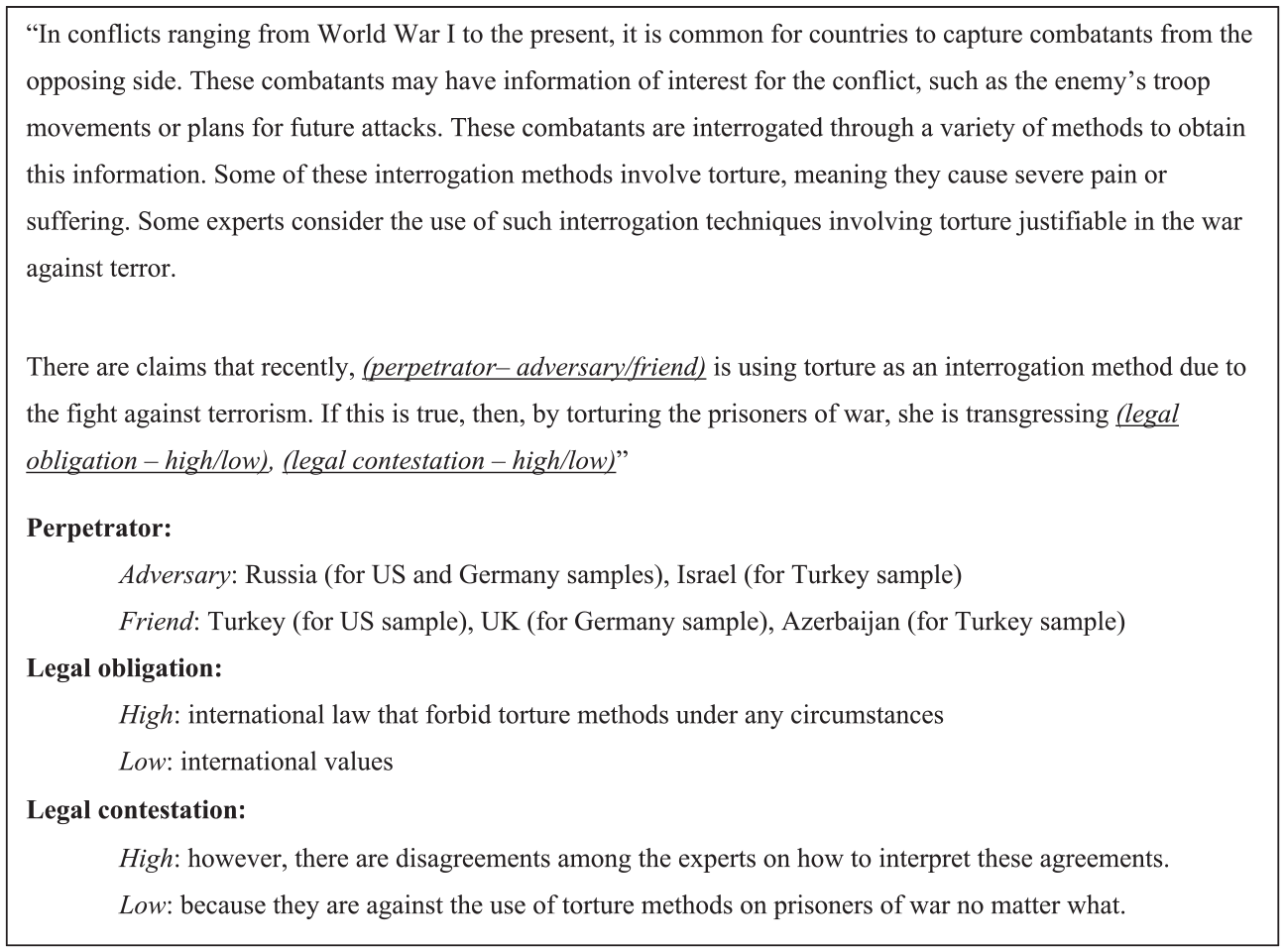
The vignette.
We then manipulated the strength of the legal obligation and contestation (high vs low). This treatment provides a useful way to disaggregate which aspects of international legal commitments affect preferences the most. It also affords the possibility of identifying whether publics respond to legality or normative importance of rules against human rights violations. And because it has been used in previous studies (Wallace, 2013), it enables us to compare our results to previous findings. To signal high legal obligation, we told participants that the perpetrator had ‘signed international treaties that do not allow the use of torture’ and by using torture the perpetrator ‘violated international law’. To signal low legal obligation, we indicated that the perpetrator violated ‘general international values that clearly do not allow for the use of torture’. The low contestation treatment indicated that international law or values clearly do not allow for the use of torture under ‘any circumstances against any prisoners’. To signal high contestation we told respondents that there is a lot of debate among experts about what the treaties and values proscribing torture really mean and what they prohibit.
To assess the effect of perpetrator identity, the vignette featured either a known ally to the respondent’s government or a known adversary using identity substitution. The identity of the perpetrator was randomly assigned for each respondent. Allies and adversaries were selected from the countries with which publics are likely to have some familiarity with the goal of triggering their true feelings and emotions.
In Turkey, respondents were either asked about Azerbaijan (friend) or Israel (adversary). Azerbaijan is a Turkic neighbour and ally of Turkey with both countries defining their relationship as ‘one nation, two states’. In fact, Turkey has been a staunch military and diplomatic ally of Azerbaijan since Azeri independence in 1992. Most recently, Turkey and Azerbaijan signed the Shusha Declaration (June 2021) cementing their alliance and Turkey’s commitment to Azerbaijan’s territorial integrity. 12 Whereas Israel is one of the most disliked countries among some segments of the Turkish citizenry due to the Palestine conflict. Turkish-Israeli relations have been severely deteriorating since the early 2000s, leading to each country removing its ambassador and Turkey accusing Israel of committing genocide in 2018 (Jewish Virtual Library, 2021).
In the United States, respondents were randomly assigned either Turkey (friend) or Russia (adversary). Turkey is a NATO member and an enduring ally of the United States despite the different agendas in the fight against terrorism and diverging interests in various regions including the Middle East, East Mediterranean, and Black Sea. On the other hand, Russia is a historical ‘enemy’ and current rival in international politics. Russia’s granting asylum to Edward Snowden, the war in Donbas, Russia’s support for the Assad regime in the Syrian civil war, and Russia’s alleged cyber interference in the 2016 Presidential elections attest to the strain in US–Russia relations.
In Germany, respondents were asked about torture perpetrated by the United Kingdom (friend) or Russia (adversary). Despite its withdrawal from the European Union, the German Federal Foreign Office recently reiterated that the United Kingdom is an important economic partner (German Federal Foreign Office, 2021). Yet, the last few years have led to more strained relations between Germany and Russia (Esch, 2021).
We recognise that the strength of our friend-adversary combinations varies across the countries in our study. One can argue that the Azerbaijan-Israel selection for Turkey potentially offers the most clear and strong friend-adversary combination, while the UK–Russia combination for Germany the weakest. We see this variation as a leverage to explore. In fact, this opportunity is precisely the reason why we opted for using real country names as opposed to fake ones or country A or B. By using real country names, we hope to trigger feelings of enmity and sympathy so as to predict the impact of perpetrator identity. If our argument is correct in that members of the public want to see enemies punished and allies excused, then the impact of perpetrator identity on punishment attitudes should be strongest in Turkey than in Germany.
Moreover, even though collecting data in three different countries enhances the external validity of our findings, we acknowledge possible concerns regarding informational equivalency resulting from different friend and adversary selection for manipulation purposes based on each context (Dafoe et al., 2018). To alleviate these concerns, we follow Kitagawa and Chu’s (2021) strategy of empirically examining the impact of across country individual variations via individual foreign policy predispositions, which also help us test Hypotheses 3a and 3b. Accordingly, the respondents answered three questions, each measuring the level of multilateralist, cosmopolitan, and isolationist attitudes. We use the very same battery of questions in each three countries, and the questions are reported in Appendix.
We also include several demographic covariates as part of our analysis to increase the robustness of our results. While we expect randomisation to reduce the likelihood that the experimental treatments are provided to only certain demographic groups, there is still the possibility that key variables may be acting as a proxy for characteristics within the population. 13 Accordingly, we include education, income, religiosity, race, ethnicity, ideology, and self-expressed gender of the participants in additional analyses. We report the descriptive statistics and balance tests for the treatment groups in the Appendix.
One critique of this approach may be not to identify the characteristics of the punishment such as content of punishment, by whom it will be imposed, or its ramifications once imposed on foreign governments for the use of torture. While this is a clear limitation in our analysis, including specific types of international interventions (diplomatic, economic, and military), actors (non-governmental organisations, international organisations, governments), and costs (i.e. possible retaliations) may present other challenges, and further complicate the design. It would be unlikely, for example, for the public to support armed interventions into allied countries especially in countries where members of the public are particularly casualty sensitive (thereby potentially biasing our results). Crucially, we contend that the specific scope of foreign policy tools (such as recalling ambassadors, freezing assets, or placing trade tariffs) is less important than the magnitude of punishment demanded by the public. While the public may not be aware of the diversity of ways that regimes may hold foreign officials accountable for torture, they are capable of articulating their own demand for accountability for human rights abuses. Hence, we use the concept of ‘demand for punishment’ as a way to measure publics’ call for action in response to violation of an international norm.
Another limitation in our approach is that we do not ask about baseline attitudes around torture prior to asking about the severity of punishment for either allies or adversarial regimes. While we accept this as a limitation, it should be noted that similar studies (e.g. Chilton and Versteeg, 2016; Lupu and Wallace, 2019; Wallace, 2013) also refrain from using this type of metric in analyses. In addition, the use of randomisation helps ensure that respondents in each experimental group were similar across crucial covariates that help to opposition to torture (e.g. Lupu and Wallace, 2019: 419). We report the distribution of our dependent variables across treatment groups in the Appendix.
Results
We report the results in three steps. We start with average treatment effects (ATEs) for perpetrator identity, legal obligation, and legal contestation in order to discern the impact of our experimental manipulations on participants’ willingness to hold perpetrators of torture accountable (see Table 1). We then present the results of a series of ordered logistic regression estimations. In addition to substantiating our findings for ATEs, these estimations enable us to investigate the role played by individual foreign policy dispositions and explore possible interaction effects. We conclude by presenting the marginal effects that allow us to further clarify the separate and joint impact of our treatments. The upshot of our findings is that public demands for holding violators of human rights norms accountable are shaped by enemy–ally relationships. Legal constraints do not sway people towards greater demands for accountability; cosmopolitanism and multilateralism do so only to a limited extent.
Average treatment effects.

Regression adjusted Average Treatment Effects, 100 reps bootstrapped 95% Cis.
p < 0.1, *p < 0.05, **p < 0.01 ***p < 0.001.
Supporting H1, across all countries, the identity of the perpetrator plays a clear role in shaping public demands for punishing foreign governments for committing torture. Respondents are more accommodative when torture is perpetrated by allied governments but willing to punish enemies. These effects are statistically significant in all countries, but substantial change in the likelihood of demanding punishment is large in the Turkish (25%) and American samples (21% increase) and relatively small in the German sample (4% increase). Given the variation in the salience of adversary vs friend treatment as discussed above, we see this the degradation of the effect indicative of the substantive impact of perpetrator identity in shaping people’s demand for punishment.
Regarding the impact of legal constraints, we only find a statistically significant average treatment effect for legal contestation in the US sample; however, the substantive significance of the finding is small (5% increase). We do not find average treatment effects for legal obligation in any of the samples and for legal contestation in the German and Turkish samples. Overall, our results fail to support H2a and only marginally support H2b.
Next, we move on to the results of multivariate regression estimations shown in Table 2. We have run the models for each country separately instead of aggregating all data from three countries and running multi-level or country interactive models, which could complicate our inferences regarding the country variations. Not surprisingly, regression results reveal a very similar pattern. We observe robust findings for perpetrator identity across three countries despite the substantively weak results for Germany. We do not have supportive evidence for the effect of legal obligation and contestation as influences on public demands for punishing perpetrators of torture.
Ordered logistic regression results.

Standard errors in parentheses, survey weights are applied, Ethnicity: White in US sample, Turkish in Turkey sample, German in Germany sample.
p < 0.05, **p < 0.01, ***p < 0.001.
Turning to Hypothesis 3a and 3b, we separately report the effects of multilateralism and cosmopolitanism testing the former hypothesis, and isolationism testing the latter one. The results are statistically significant and in the expected direction in both US and German cases. Accordingly, those who score higher in the dimensions of cosmopolitanism and multilateralism are more likely to demand punishment for human rights violations of foreign perpetrators, and those who score higher in the isolationist dimension are less likely to demand punishment from their governments to foreign perpetrators. However, Turkish case demonstrates a puzzling picture. While we observe similar results when it comes to multilateralism, we find no effect in cosmopolitanism, and reverse direction effect on isolationism.
We believe that lack of similar findings in Turkish case demonstrates the generalisability of demand-side explanations focusing on predispositions of individuals. Accordingly, further investigation of the literature on Turkish politics reveals that Turkish conservatives are less isolationist as compared to the conservative AKP government (Tokdemir et al., 2024), and its constituents are more demanding for Turkey to play a role in international affairs. Some scholars even define these aspirations as neo-Ottomanism – a reference to imperial background of Turkey, and aspirations to reach Ottoman Empires’ borders (Sozen, 2010; Wastnidge, 2019), whereas isolationism and conservatism are highly correlated in the United States and Germany. Hence, while we confirm the findings in the literature applied to our argument, we also demonstrate across-country differences based on the domestic context.
Taking a step further, we report the marginal effect of treatments in Figure 2 to further clarify our results. Looking at the marginal effects, participants across all three countries are significantly more likely to pursue no or low punishment for allies. On the contrary, adversaries are significantly more likely to receive severe or very severe for the use of torture. Again, these effects are more pronounced in the US and Turkish populations as compared to the German one. Our results indicate clear double standards in concern for torture depending on whether the torturer is an adversary or friend, reinforcing existing evidence on the politicisation of the international human rights regime.
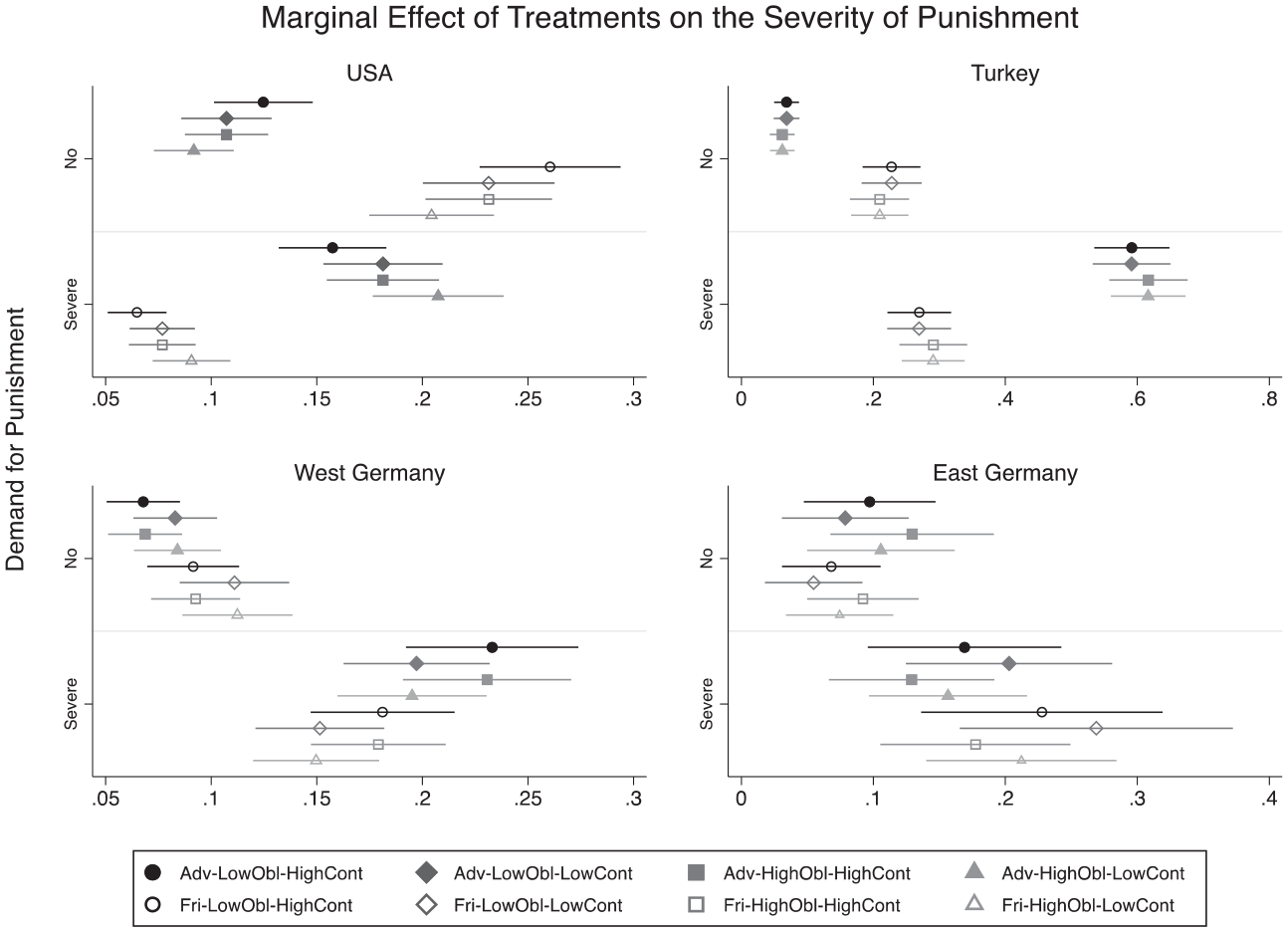
Marginal effects – United States and Germany (West vs East).
In the United States and Turkey, when there is both greater obligation and low contestation, citizens are more likely to prefer severe and very severe (in the US case) punishment of foreign adversaries. These effects are less consistent as we vary obligation and contestation levels. In short, the gap in punishment for adversarial regimes as compared to allied regimes is driven largely by the identity of the perpetrator rather than the strength of international laws. On balance, the findings suggest that the identity of foreign actors plays a role in whether domestic audiences will push for international accountability for the use of torture.
Perhaps the most puzzling finding that has emerged from this analysis is that Germans seem relatively unmoved by the identity of perpetrators as well as the scope of international laws. This may be driven by vast efforts of the state persistently reviewing Germany’s troubled history of mass atrocities, hence heightened awareness among German citizens regarding international human rights laws. Moreover, prior to unification, the Federal Republic of Germany insistently followed a foreign policy (i.e. Ostpolitik) that sought appeasement of Soviet states, abstaining from broader NATO condemnation of harsh USSR and East German policies of state repression (Kirchick, 2017). That, in return, might have a dampening effect on a clear adversary vs friend distinction among Germans compared to Americans and Turks. Surveys over the last decade have noted that Germans have, at best, mixed attitudes on their relationship with Russia (Fix, 2020).
The majority of Germans, prior to the invasion of Ukraine, have insisted on a more favourable relationship with the Russian government. While this attitude has shifted significantly since Russia’s attempt to topple Kyiv, segments of the German population still hold positive views of the Russian regime. This positive attitude, perhaps unsurprisingly, is concentrated in Eastern Germany (Stanley-Becker and Guinan-Bank, 2022).
Despite these differences, our findings continue to underscore that the identity of perpetrators alters the public demand for accountability. In particular, the differences in West and East Germans provide greater support for our proposition that the identity of the perpetrator plays a crucial role in shaping public demands for punishment. Only Germans with a historic adversarial relationship with the Russian regime are more likely to push for greater accountability while Germans who lived under Soviet occupation appear more likely to accommodate the use of torture by Russian forces. In short, public demands for accountability depend heavily on whether the public perceives foreign actors as either a friend or foe. Equally, these accommodative attitudes can be mitigated with stronger international laws.
Finally, we also report the conditional impact of foreign policy attitudes on perpetrator identity in predicting demand for punishment. As explained earlier, societal-level explanations (i.e. in- vs out-group dynamic via friend–adversary dichotomy), and micro-level foundations (i.e. respondents’ foreign policy orientations) are the main predictors of their reactions to human right violations executed by foreign perpetrators. Now, we aim to discover if we observe a moderation among these key predictors. To this end, we have run an explanatory factor analysis to combine the main three foreign policy orientations, namely, cosmopolitanism, multilateralism, and isolationism. Factor analysis provides us with one dimension, which we labelled as global engagement, and predicted the global engagement scores of respondents accordingly. Then, we re-estimated a series of ordered logistic regressions to predict the demand for punishment, this time interacting perpetrator identity and global engagement.
The conditional impact is not significant in German case (see the Appendix for the full report of the empirical models), but statistically significant in US and Turkey cases as reported in Figure 3. On the left column, we report the probability of ‘no demand’ for punishment for United States (top row) and Turkey (bottom row), and the probability of ‘punishment’ on the right column, respectively. As expected, high global engagement is associated with higher probability of demand for punishment, and vice versa, given these respondents support higher global interaction and respect for international institutions. Yet, we observe that when the perpetrator is an ‘adversary’ then the marginal impact of global engagement largely disappears, and both supporters and opponents of global engagement become more likely to demand for punishment, even in Turkish case, the differential effect is not significant anymore across levels of global engagement.
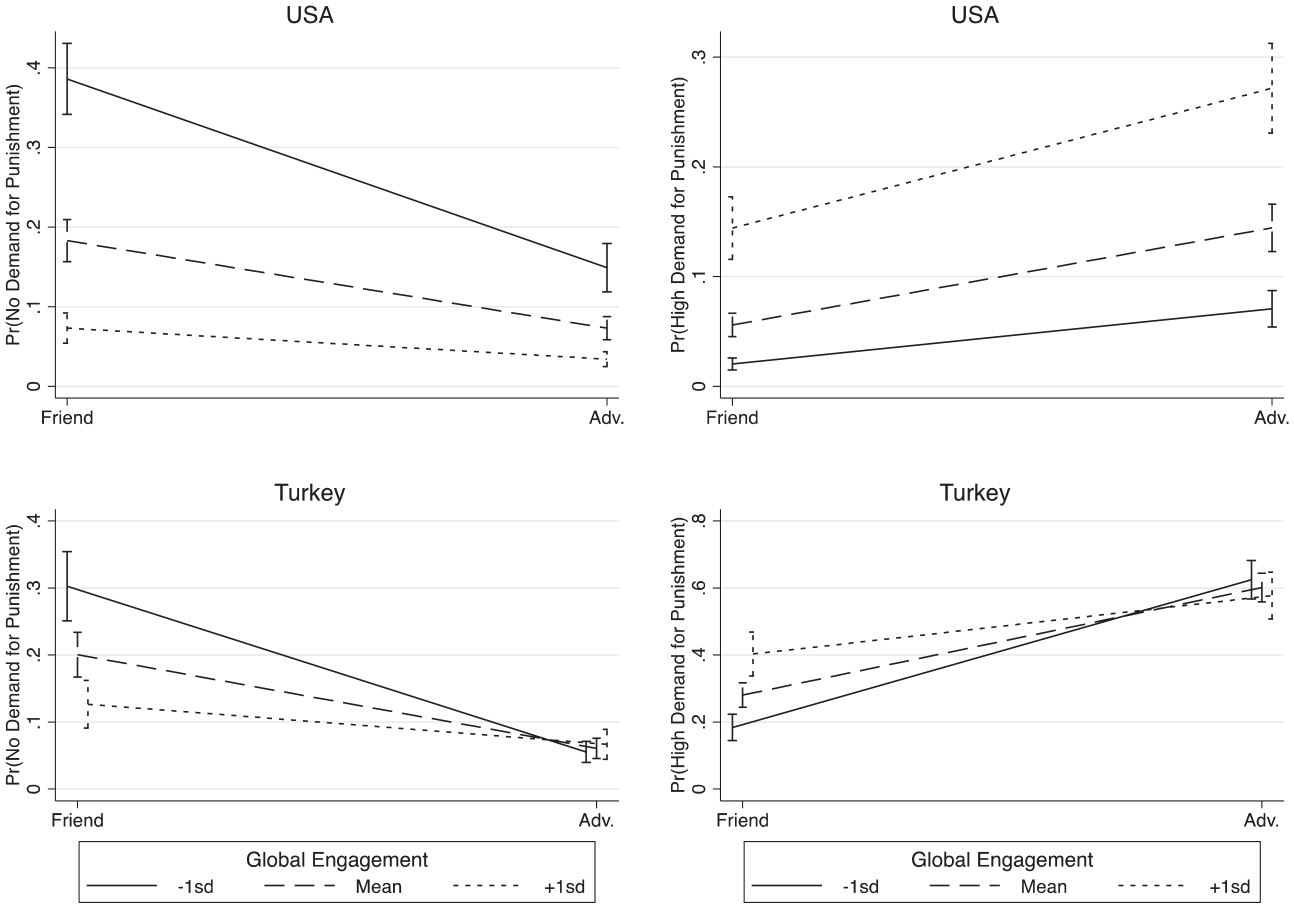
Impact of violator identity on punishment demand conditional on FP attitudes.
Conclusion
Following World War II, with the spread of liberal values and democracy, the world has witnessed a spike in the number of international organisations and institutions which seek to regulate human rights. Yet compliance has never been straightforward. IOs and INGOs depend heavily on major powers to uphold these regimes by sanctioning violators, and do so, in part, by educating and convincing the well-trusted publics within major powers of these violations and the need for their national governments to sanction foreign perpetrators. However, these organisations often have mixed success in convincing global publics of the need for greater accountability. In this article, we examined the variation in international public opinion towards the violations of international human rights law.
Based on data collected in three countries (the United States, Germany, and Turkey) through original survey experiments, we showed that, despite all contextual differences, public opinion of these three global and regional powers demand punishment of foreign governments committing torture depending on whether these governments are friends or adversaries. Expanding some of the existing findings, we show that the politicisation of human rights extends past diplomatic corridors and bleeds into the opinions and perceptions of the wider public. Moreover, in all three countries, friend/enemy perceptions drive public opinion more strongly compared to legal obligations for which international human rights law stands. Hence, participants within the study were more likely to prefer weaker punishment if the torture was perpetrated by a friendly government as compared to abuses perpetrated by adversarial regimes.
In the light of these findings, one might interpret our results pointing to a concerning future urging us about the effectiveness of international human rights law and the domestic enforcement of international law through public opinion. Our findings suggest that the public acts selectively in pressuring their governments to enforce international human rights law based on the pre-existing interstate relations. As such, our results indicate that relying on naming and shaming mechanisms through informing the public about the international human rights law violations may not provide a consistent and reliable check on governments, as the public may strategically define the very violations. At the same time, our findings offer new insight into how international actors may attempt to overcome the challenges associated with politicisation in maintaining international human rights regimes. Not only do national governments have an incentive to avoid condemning the actions of allies on sensitive issues such as torture, extrajudicial killings, or political imprisonment, but our findings suggest that publics may have little appetite to pressure leaders to confront human rights abuses.
Our study aims to push the boundaries of existing research in two main ways. First, we examine the relative impact of various domestic enforcement mechanisms to determine which is most effective. Second, we test this comparison across different countries, as a first cut on how cross-national differences might condition the effectiveness of domestic enforcement mechanisms.
Our research suggests several further inquiries. Future research should include the degree of delegation within the legalisation continuum along with obligation and contestation levels to provide additional tests of our findings. Scholars could also use different friend and adversary substitutions as robustness cheques. An extension of the concept of ‘punishment’ would also be valuable to see the variation in how people react to the violation of international human rights law. Further precision on what ‘punishment’ may include and what it means in various contexts through interviews and focus groups might also offer leverage to infer the alternating findings in different contexts.
Another productive area of research will be analysing how public opinion responds to elite cues regarding punishment of violators of international human rights law. We believe this is also crucial to further investigate whether the respect of human rights is merely a rhetorical tool to protect friends and shame enemies. It will also be valuable to examine how the strength of naming and shaming by NGOs combined with agreement design and the strategic context of violations jointly affect public demands for accountability. Our research is a first step in exploring cross-national differences in the operation of domestic mechanisms of enforcement. While we have offered evidence from three different countries about the operation of these mechanisms, we have not theorised country-level variation. Future works should dig deeper into how different country characteristics and histories might moderate the role of legality, alliances, and individual values.
