




Abstract
Moral foundations theory is one of the most popularised and tested lenses of recent years, with its ability to account for differences in political ideology. For the first time using a nationally representative random probability sample, we assess how the newly refined moral foundation questionnaire may explain differences in political ideology and views on political issues in the UK. We confirm a six-factor model with robust estimates for the moral intuitions of care, equality, proportionality, authority, loyalty, and purity. We then use moral intuitions to predict (a) economic left-right and socially liberal-conservative ideology and (b) the relationship between political ideology and views on salient political issues. We find moral intuitions mostly play a unifying role across a series of issues, with the exception of feelings toward patriotism and Brexit.
Introduction
The role of morality in political science has gained traction in recent years, building on a bedrock of analyses identifying how differences between and within societies can be accounted for via an examination of entrenched value systems (Feldman, 2003; Schwartz, 1992). One of the most popularised theories in recent years has been moral foundations theory (MFT). This approach is predicated on the notion that ethical frameworks are a product of innate psychological systems which have evolved to help individuals navigate social life (Haidt and Joseph, 2004). While initially employed to account for cultural differences, subsequent studies have demonstrated that MFT seems to also account for differences in political ideology (Graham and Haidt, 2012). Several studies have emerged predicting various political outcomes and political ideologies, including policy preferences (Lindsey and Lake, 2014) and voting behaviour (Harper and Hogue, 2019). Through these investigations, the primary finding is that behind differences between liberals and conservatives in the USA, there exist different moral profiles (Graham et al., 2011; Haidt, 2012). Individuals who express politically liberal views emphasise the foundations of harm and fairness (which focus on the protection of individuals from unjust conditions), while those who express conservative viewpoints emphasise foundations of in-group loyalty, authority, and purity which ‘bind people into roles, duties, and mutual obligations’ (Graham et al., 2011: 368). Moral foundations can therefore be grouped into two clustering sets of intuitions – individualising (harm and fairness) and binding (in-group loyalty, authority, and purity).
Theorising political differences as being ‘morally charged’ has important implications for the study of contemporary social and political debate. As ideologies reflect (in part) differences in moral belief systems, political divisions can become magnified to the point of polarisation (Stein, 2017). While uniquely political problems can be worked through and resolved via institutional mechanisms, moral problems are more contentious and intransigent, and often reflect irreducible cultural divisions (Goren and Chapp, 2017). With political debates in both the USA and the UK gripped by growing ‘culture war’ debates around morally charged issues including immigration, multiculturalism, and LGBTQ rights, importing the MFT framework to examine the political sphere promises to explore the moral dimensions of these contemporary political issues and divisions.
This article aims to test how the refined moral foundation questionnaire (MFQ2) developed by Atari et al. (2022) can help explain variance in political ideological positioning and different responses towards salient political issues in the UK. We do so for the first time using data from a nationally representative random probability sample, with most previous analyses of the MFQ2 survey using online or student-panel data (De Buck and Pauwels, 2023; Zakharin and Bates, 2023). We first review the current political and ideological landscape in the UK in relation to long-standing ideological frameworks and more current issues and events. From this, we establish a set of hypotheses outlining how we expect moral foundations to be associated with different measures of political ideology and views on salient political issues. We then look to validate the MFT factor structure using confirmatory factor analysis model. After achieving satisfactory results, we test the utility of MFT within a multiple regression framework. We estimate how MFT factors relate to ‘classic’ ideological divisions on economic left/right positions and socially liberal-conservative positions. Our analyses then explore how MFT moderates the relationship between political ideologies and views on salient political issues in the UK. An important implication of MFT is that specific foundations are expressed or ‘triggered’ to a greater/lesser extent dependent on an individual’s political ideological position. By exploring MFT-Ideology interactions, we estimate the degree to which moral intuitions exacerbate differences in views on specific political issues. The results indicate that ‘morally charged’ politics have a significant role in assessing differences on key issues of the environment, immigration, support for same-sex minorities, patriotism, and support for authoritarian government.
MFT and ideology in the UK
In understanding how MFT applies to the UK context, we first consider the framework in which it has been developed, and the nature of ideological differences within the UK. Graham et al. (2018) posit four ‘lenses’ which underpin the background of the theory: nativism, cultural learning, intuitionism, and pluralism. Nativism asserts the idea that there is a ‘first draft’ of the moral mind; that human morality is shaped before peoples’ experiences. This ‘first draft’ is then amended through a process of cultural learning within their particular context. The crux of MFT, however, is that there is an intuitionism that is foundational to social and political life, the result of an enduring evolutionary process that conditions the subconscious to respond to particular threats or dilemmas in a certain way (Haidt, 2001). The fact there is a pluralism of different intuitions testifies the fact that humans have faced numerous challenges to ensuring a cooperative existence (Graham et al., 2013).
Initial research into moral foundations proposed a set of five moral systems prevalent across cultures (Haidt and Graham, 2007, Graham et al., 2013). The care/harm foundation is based on the adaptive challenge of caring for vulnerable offspring, and the dependence of human children for several years on adult humans. Emotions and virtues associated with this foundation include compassion for victims, caring, and kindness. Fairness/reciprocity is based on the rewards of mutual relationships or the perceived need to reduce cheating or deception for society to function. Related emotions and values include anger, gratitude, fairness, justice, and trustworthiness. In-group/loyalty is based on forming cohesive alliances or perceived threats to a group. Emotions and values related to this foundation include group pride, traitors, loyalty, and self-sacrifice. Authority/respect focuses on the formation of beneficial hierarchical relationships and signs of lower or higher social ranks. Emotions and values include those of respect, fear, obedience, and deference. Finally, purity/sanctity relates to psychologies of disgust and contamination. They propose an initial relation to the threat of exposure to risks, informing a more ‘behavioural immune system’. Related emotions and values include disgust, restraint, piety, and cleanliness.
More recently, further development of MFT items has been undertaken by Atari et al. (2022). Atari et al highlighted the drive for this development given criticism of the lack of inclusion around concerns of equality, ignoring systematic inequalities (as well as individuals’ willingness to address them at the expense of one’s own social group; Janoff-Bulman and Carnes, 2013), and the need to include measures of proportionality and fairness as distinct from the foundations within MFQ-1 (Atari et al., 2022; Skurka et al., 2020). MFT has therefore been adapted based on feedback to focus on six moral intuitions:
Care – avoiding emotional and physical damage to another individual;
Equality – equal treatment and equal outcomes for individuals;
Proportionality – individuals getting rewarded in proportion to their merit or contribution;
Loyalty – cooperating with ingroups and competing with outgroups;
Authority – deference towards legitimate authorities and the defence of traditions, all of which are seen as providing stability and fending off chaos;
Purity – avoiding bodily and spiritual contamination and degradation.
Moral foundations can be separated into individualising and binding foundations, dependent on whether the moral value is focussed on the individual or towards broader groups and society. Foundations focussed on care and equality relate to individualising foundations, while those around proportionality, loyalty, authority, and purity to issues binding society. While moral intuitions are thought to quietly regulate daily thoughts and actions, they come to the fore when different ‘receptors’ are triggered by stimuli that embolden or challenge them. These can be activated by relatively inconsequential episodes, such as a friend being late, where we experience ‘small flashes’ of approval or disapproval, or by big ethical issues, such as abortion or the death penalty, where our responses are likely more visceral and antagonistic (Haidt and Joseph, 2004). In ideological terms, analyses from the US have highlighted how the relative strength of individualising against binding foundations informs differences between liberal and conservative values. Intuitively, liberal responses concerned with issues of social justice should be governed by the individualising foundations of equality and care, while conservative responses concerned with tradition and should be governed more by binding foundations which intuitively protect national values (loyalty), respect for authority, as well as purity of mind and body (Zakharin and Bates, 2023). However, the empirical landscape in the US established to date does not neatly separate liberals from conservatives along individualising/binding lines, but rather that liberals exhibit more separation between individualising and binding foundations, whereas conservatives show greater integration. Specifically, for those who are liberal, triggers which activate the care and/or equality moral intuitions do not necessarily activate the intuitions of loyalty, authority, or purity, whereas for conservatives, triggers which activate care and/or equality are also more likely to activate the binding foundation of loyalty (Turner-Zwinkels et al., 2021).
To what degree MFT informs political differences in the UK, however, is underexplored both in terms of confirming the measurement model as previously theorised as well as the role moral intuitions play in shaping ideological positioning and differences in support for salient policy issues. In relation to the latter, the time is ripe to test the possible explanatory utility of MFT. The political landscape in the UK in recent times has served numerous issues and events that potentially have triggered both ‘binding’ and ‘individualising’ moral foundations. Brexit, immigration, same-sex rights, increasing economic inequalities, climate change, and the desire for stronger leaders and less democracy (often referred to as ‘democratic backsliding’) are seen as ongoing, contentious issues that invoke strong and often polarising responses from members of the public.
Binding triggers
Historically those of a conservative mind-set in the UK are not too dissimilar to conservatives in the USA. On both sides of the Atlantic, conservatives emphasise core values of tradition, individualism, limited government, fiscal responsibility, and economic liberalism. In policy terms, they generally support lower taxes, lower government spending, deregulation, and policies that promote private enterprise, respect for authority, and national pride (Fawcett, 2022). Issues around economic privatisation and state intervention in redistributing wealth are common triggers of intuitions around proportionality, while challenges to the traditional forms of legitimate authority or disrespect towards one’s society or nation might evoke responses around loyalty or authority.
However, much like any ideological group, conservatism in the UK is made up of a plurality of ideological variants (Heywood, 2021). Neoliberals, for example, embrace small government, free market competition, and low taxation. This contrasts with One Nation conservatives who embrace a larger role for government in correcting the inequalities caused by free market capitalism. Social Conservatism meanwhile emphasises the limited role of government in economic affairs but believes the state ought to regulate social life and promote traditional values, such as encouraging marriage through the tax system. Finally, there is a more recent variant of Populism. This variant is prima facie at odds with long-standing variants of conservatism, in that it is anti-establishment in nature (Alexandre-Collier, 2023). However, the UK variant of populism (as previously steered by UKIP and the right of the Conservative Party) emphasises core conservative values of patriotism and political sovereignty and pushed the agenda for Britain leaving the EU with a view to the country ‘taking back control’.
The issue of ‘Brexit’ represented one of the most significant causes of social and political conflict in the UK, with public opinion nearly evenly divided at the time of the referendum between 52% of voters in favour of leaving and 48% of voters preferring to remain in the EU. Several follow-up studies testify that this leaver/remainer split still represents a core source of political identity, with evidence that each side views the other as possessing negative character traits (Curtice et al., 2020; Hobolt et al., 2021; Schumacher, 2019; Sobolewska and Ford, 2019). While triggering moral intuitions primarily to populists on the right of the ideological spectrum (i.e., loyalty and authority) Brexit also appealed to a range of ideological mindsets, even to some on the left (Seymour, 2019). The issue of Brexit dovetailed with two issues which struck at the core of conservatism – immigration and national sovereignty. Concerns over immigration peaked in 2015 after two rounds of EU enlargement and increasing numbers of refugees and asylum seekers entering the UK. Despite waning salience, immigration represented a source of political division long after the referendum (Blinder and Richards, 2020). The authority intuition may well overlap with support for Brexit, based on concerns for the need to protect national sovereignty. However, the authority intuition might also indicate greater support for centralising power and support for stronger leadership. In this sense, the moral intuition of authority may also be equated with an increased support for authoritarianism.
Tensions for conservatism have also been activated in recent years due to rising economic inequalities and hostilities over government responses to the COVID-19 pandemic. Most conservatives indicate concern over increasing levels of government debt, with the corollary of desiring greater fiscal responsibility. Social conservatives who place importance on traditional values (such as the preservation of traditional marriage, family, and religious values) have also had their variant of conservatism challenged in the wake of rising secularism, a fall in the number of marriages, the liberalisation of views on sex, and recently over issues around same-sex rights, particularly around issues of parenthood and adoption. Question marks have therefore been raised by socially conservative groups as to the extent to which homosexual relationships should be seen as equivalent to heterosexual relationships, and remains a sensitive moral issue despite broadly accepting views of homosexuality in general (Dotti Sani and Quaranta, 2020).
Individualising triggers
While there are strong overlaps between conservatives in the USA and the UK (with similar variants within), the characteristics on the left/liberal end of the ideological spectrum in the UK are slightly more complex. Historically, this is captured by the presence of two national parties that are nominally left-leaning: the socialist-influenced Labour Party, and the more social democratic Liberal Democrat Party. Socialists and social democrats share a mutual emphasis on protecting minority rights and using public policy to redistribute wealth and income; however, they differ on two grounds. Socialists are more sceptical of the free market and demonstrate stronger support for government intervention such as the nationalisation of industry. Second, social democrats are more trusting of international organisations and favour more interventionist foreign policies (Heywood, 2021).
Much like their conservative opponents, socialists and social democrats have had their moral intuitions triggered by recent issues and events. A common trigger has been the increasing level of economic inequality within the UK, which should directly engage intuitions of equality. Pro-immigrant views associated with pro-remain voters also contrasts with anti-refugee and anti-asylum-seeker views prevalent within part of UK politics. In the face of political messaging and government attempts to curb the number of refugees/asylum seekers entering the country, this should trigger the intuition of care. Another issue that could activate individualising intuitions is climate change. A feature of climate change is that it disproportionately affects those in economically poorer nations as well as future generations. In theory, support for the government taking a pro-environment stance should be partly driven by both care and equality foundations (Feinberg and Willer, 2013; Graham et al., 2011). However, it is interesting to note that issues of sanctity and degradation may be important in understanding environmentalism by reinforcing the values of protection and self-purity (Feinberg and Willer, 2013; Milfont et al., 2019).
Hypotheses
Different moral foundations should help explain two sets of political outcomes: first, where individuals locate themselves on broader ideological spectrums, and second, support or opposition to specific political issues. Our first set of hypotheses relates to the relationship between moral foundations and left-right/liberal-authoritarian ideologies. The aim is to assess whether more conservatively ‘binding’ intuitions correlate with conventional right-wing positions on economic and social matters, and whether the more liberal ‘individualising’ intuitions correlate with conventional left-wing positions:
H1: The proportionality, purity, loyalty, and authority foundations negatively correlate with support for greater income equality.
H2: The proportionality, purity, loyalty, and authority foundations negatively correlate with support for socially liberal attitudes.
H3: The care and equality foundations positively correlate with support for greater income equality.
H4: The care and equality foundations positively correlate with support for socially liberal attitudes.
We also expect moral foundations to moderate the relationship between political ideology and levels of support for specific political issues. Given the recent context of the UK, this relationship between morals and political ideology should manifest through issues around the environment, immigration, support for same-sex minorities, patriotism, support for populism, and Brexit. If it is true that political ideologies are expressive of moral intuitions, we would expect binding or individualising foundations to exacerbate differences between left/right- and liberal/conservative-leaning people around salient political issues. In simple terms, moral intuitions should contribute to polarisation tendencies.
H5: Higher levels of binding intuitions should decrease support for same-sex parenting among right-wing and less socially liberal people.
H6: Higher levels of binding intuitions should decrease support for immigration among right-wing and less socially liberal people.
H7: Higher levels of binding intuitions should increase support for authoritarianism among right-wing and less socially liberal people.
H8: Higher levels of binding intuitions should increase support for patriotism among right-wing and less socially liberal people.
H9: Higher levels of binding intuitions should increase support for Brexit among right-wing and less socially liberal people.
H10: Higher levels of individualising intuitions should increase levels of pro-environment responses among left-wing and socially liberal people.
H11: Higher levels of individualising intuitions should increase support for same-sex couples among left-wing and socially liberal people.
H12: Higher levels of individualising intuitions should increase support for immigration among left-wing and socially liberal people.
H13: Higher levels of individualising intuitions should decrease support for authoritarianism among left-wing and socially liberal people.
H14: Higher levels of individualising intuitions should decrease support for patriotism among left-wing and socially liberal people.
H15: Higher levels of individualising intuitions should decrease support for Brexit among left-wing and socially liberal people.
Data and variables
Our study uses World Values Survey (WVS) wave seven data from the UK. 1 Fieldwork was completed between March and September 2022 by a random probability sample of 3056 adults within the UK, including 1645 respondents from England, 523 from Scotland, 437 from Wales and 446 from Northern Ireland. Further information on the sampling methodology can be found via the WVSA (WVSA, 2023). The initial MFQ was developed to create valid and reliable estimates based on five original foundations (Graham et al., 2009; Haidt and Graham, 2007) yet emphasised a ‘moral pluralism’ across contexts and not insisting on a pre-defined number of factors (Atari et al., 2022). MFQ-1 has been extensively reviewed across cultural contexts. Research using exploratory and confirmatory factor analysis (EFA, CFA) has found the best-fitting solutions to be based on five or seven-factor solutions, constructed around the dimensions earlier discussed (Zakharin and Bates, 2023). However, few studies have found fit statistics that fall within acceptable critical values. Graham et al. (2011) found a five-factor fit using a 26,014 sample, with an RSMEA of 0.048 and CFI of 0.824. However, a 1042 UK online sample conducted by Curry et al. (2019) found a seven-factor fit, with acceptable RMSEA (0.05) and CFI (0.910) values. The Many Labs 2 project (Doğruyol et al., 2019) found a strong five-factor solution based on 4,971 respondents from Western countries. These results demonstrate that the initial MFQ-1 can be considered robust in generating a five-factor solution, albeit with sub-optimal fit statistics in some circumstances.
More recently, Atari et al. (2022) conducted exploratory structural equation modelling (ESEM) on a new version of the MFQ (MFQ-2), to assess how reliable estimates can be generated using the expanded MFT framework. Using nationally stratified samples from 19 countries (n = 3902) they conducted analysis in two stages: first analysing the full data to remove items with cross-loadings, and then a second stage on the final 36 items selected. Further multi-group confirmatory factor analysis (MGCFA) was conducted to assess the statistical fit between cross-national contexts. Atari et al’s results demonstrated a good model fit based on their final selection of 36 MFQ-2 items (RMSEA =.052, SRMR =.07), confirming a satisfactory solution for a six-factor structure. In this study, we use a 24-item version of MFQ-2 to assess MFT in the UK, using CFA to assess how the structure of the 24-item questionnaire works in relation to their theoretical framework. All questions are a five-point Likert-type scale asking how well each personality trait describes people or their opinions, from (1) ‘does not describe me at all well’ through to (5) ‘describes me extremely well’. Variable labels, descriptions, n, mean values and standard deviations for all 24 items are available in Supplemental Appendix 1.
Political ideology
To measure political ideology, we construct two scales to capture economic left-right and socially liberal-conservative ideologies. In relation to left-right ideology, we follow the approach originally devised by Evans et al. (1996) which utilises a battery of questions gauging peoples’ views on the role of the state in economic affairs (left-right). EFA demonstrates that five items are reduced into two factors relating to pro-economic competition and income equality (63.5% cumulative variance explained). Given the saliency and more politically charged issue of inequality, we use the income equality scale as the focus of subsequent analyses.
To measure socially liberal-conservative attitudes, we utilise a battery of questions asking respondents on how justifiable a range of acts are (Duffy et al., 2023). We conducted EFA on these questions with three dimensions uncovered explaining 56% of the total cumulative variance: sex and death (i.e., homosexuality, prostitution, abortion, divorce, sex before marriage, suicide, euthanasia, and having casual sex), cheating and stealing, and the use of violence. Given that very few people support cheating and stealing as well as the use of violence, we focus subsequent analyses on the sex and death dimension as a proxy measure to capture the ‘freedom to pursue one’s own course of life’ (Evans et al., 1996: 191). A full list of questions used and scales constructed within the analysis in addition to the results of the EFA are available in Supplemental Appendix 2.
Political issues
We also construct items capturing views towards salient political issues within the UK. To assess concern towards environmental issues, we use a single-item binary distinction between those who prioritise ‘protecting the environment’ over ‘economic growth’ or ‘other issues’. To assess views on same-sex couples, we use a single-item binary, with 1 being those who agree/strongly agree that ‘homosexual couples are as good parents as other couples’, and 0 being those who neither agree/disagree nor disagree/disagree strongly. To measure views on immigration, we use EFA to reduce a series of agree/disagree questions focussed on different aspects of immigration (e.g., immigration ‘increasing the crime rate’ or ‘leading to social conflict’) into a scale measuring negative-positive views on immigration (α = 0.759). Support for authoritarianism is captured by combining three variables into a single-item measure: support for a ‘strong leader who does not have to bother with parliament or elections’, whether ‘democracies should protect people’s liberty’, and the ‘importance of democracy’ (α = 0.604). National patriotism is measured by combining two variables: a ‘sense of national pride’ and a ‘feeling of closeness to their country’ (α = 0.600). Views on Brexit are captured through a single-item, 10-point scale, where 1 is ‘unhappy with Brexit’ and 10 is ‘happy with Brexit’.
Socio-economic variables
For the regression models, we include key socio-demographic and independent variables as important controls. Gender is included as a binary variable between female and male respondents. We use age categories to capture generational cohorts as discussed by Duffy (2021). Educational attainment is calculated via a five-point categorical variable based on International Standard Classification of Education levels (ISCED, 2011). Employment status is captured by contrasting respondents who are ‘in employment’ against those who are ‘not in employment’, ‘retired’, or are ‘students’. Income levels are assessed through a ten-point scale of income decile groups. Ethnicity is captured by contrasting ‘white’ respondents with those from a ‘black, Asian or minority ethnic’ (BAME) background. Religious denomination is assessed between non-religious respondents, Religious Christians, and Religious non-Christians (due to low cell counts, it is not possible to unpack this non-Christian religious group). Whether respondents live in a rural or urban environment is included as a single binary item, while self-reported hardship is measured as a single-item factor score, reduced from a series of questions on different forms of deprivation and hardship experienced by respondents. Full information on variable coding and scale construction can be found in Supplemental Appendix 3.
Results
Measurement model
Based on previous work using MFQ-2 items, we conduct CFA to determine the measurement of the updated MFT framework within a UK context. CFA was conducted using MPLUS version 8.9 software. Maximum likelihood estimation with robust standard errors (MLR) is used to estimate the model and associated goodness-of-fit statistics. The model is assessed where RMSEA ⩽ 0.06 (90% CI ⩽ 0.06), SRMR ⩽ 0.08 and CFI and TLI ⩾ 0.9 (Brown, 2015; Kyriazos and Kyriazos, 2018). A review of previous research indicates we should expect a six-factor solution with a second-order structure defining individualising and binding foundations to be the optimal solution. Figure 1 shows the path diagram of the CFA model (with STDY standardised scores and standard errors).
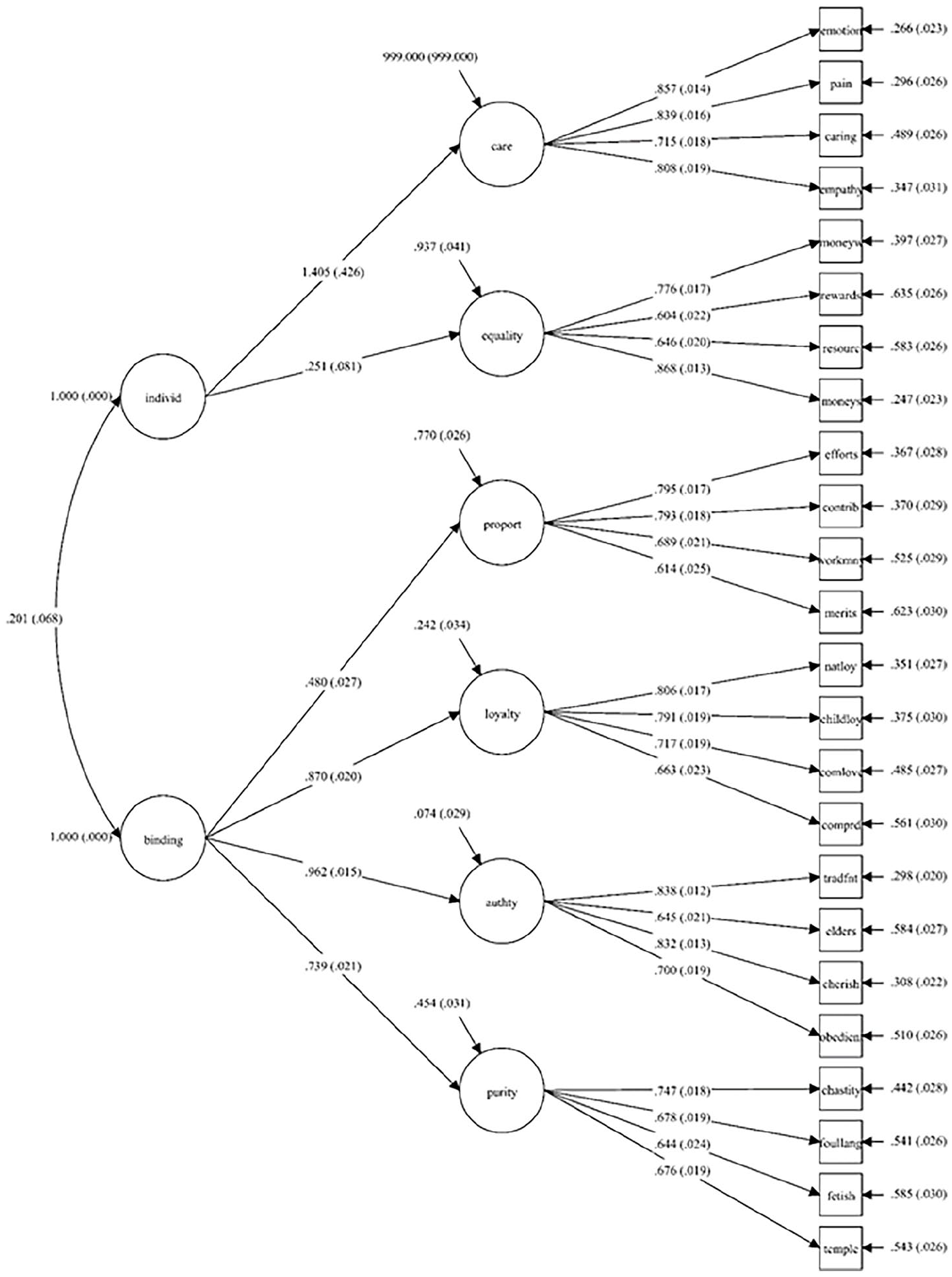
Measurement model.
CFA confirms a six-factor solution with second-order effects in the UK context, with strong fit statistics. We find a strong estimation for the six first-order foundations; care, equality, proportionality, authority, loyalty, and purity. However, we find a weaker estimation of second-order relationships regarding the individualising foundations, and a weak loading of proportionality to binding. Our results indicate an acceptable fit based on RMSEA (0.046–0.050) and SRMR (0.065), with CFI and TLI scores marginally below critical values of 0.9 (CFI = 0.887, TLI = 0.873). 2
At the first-order level, all 24 items load into the six-factor structure as expected. We are also able to capture a strong second-order relationship between the binding foundations of loyalty, authority, and purity. Loadings on the binding values are driven by the loyalty (.87), authority (.96), and purity (.74) foundations; however, we find a weak loading for proportionality (.48) into this dimension. We are also unable to fit a suitable second-order structure based on the individualising items of care and equality. The high loading score of the care (1.43) foundation, alongside high standard errors (.43), could be driven by several factors. First, there might be insufficient data to fit a second-order structure between these variables. A larger sample size might yield different results. Second, our use of a reduced MFQ-2 questionnaire (with 24 items compared to Atari et al’s original 36 items) may result in insufficient distinction between the effects of the care and equality foundations. Finally, it may not be possible to capture robust second-order effects due to the specific nature of the UK’s social and political context. Nonetheless, CFA confirms the first-order six-factor model in the UK, in line with the expected MFT framework, despite differences arising at the second-order groupings for individualising and binding.
MFT and political ideology
In exploring the relationship between MFT and political ideology, we see an association as expected between the individualising and binding foundations and left-right political views. As demonstrated in Figure 2, we see a correlation between care and equality and support for greater income equality. Broken down into decile groups, respondents with a greater intuition towards care and equality are more likely to support greater income redistribution. We also see relationships between binding foundations (proportionality, loyalty, authority, and purity) and left-right ideology, with respondents in higher decile groups negatively correlated with supporting greater income equality.
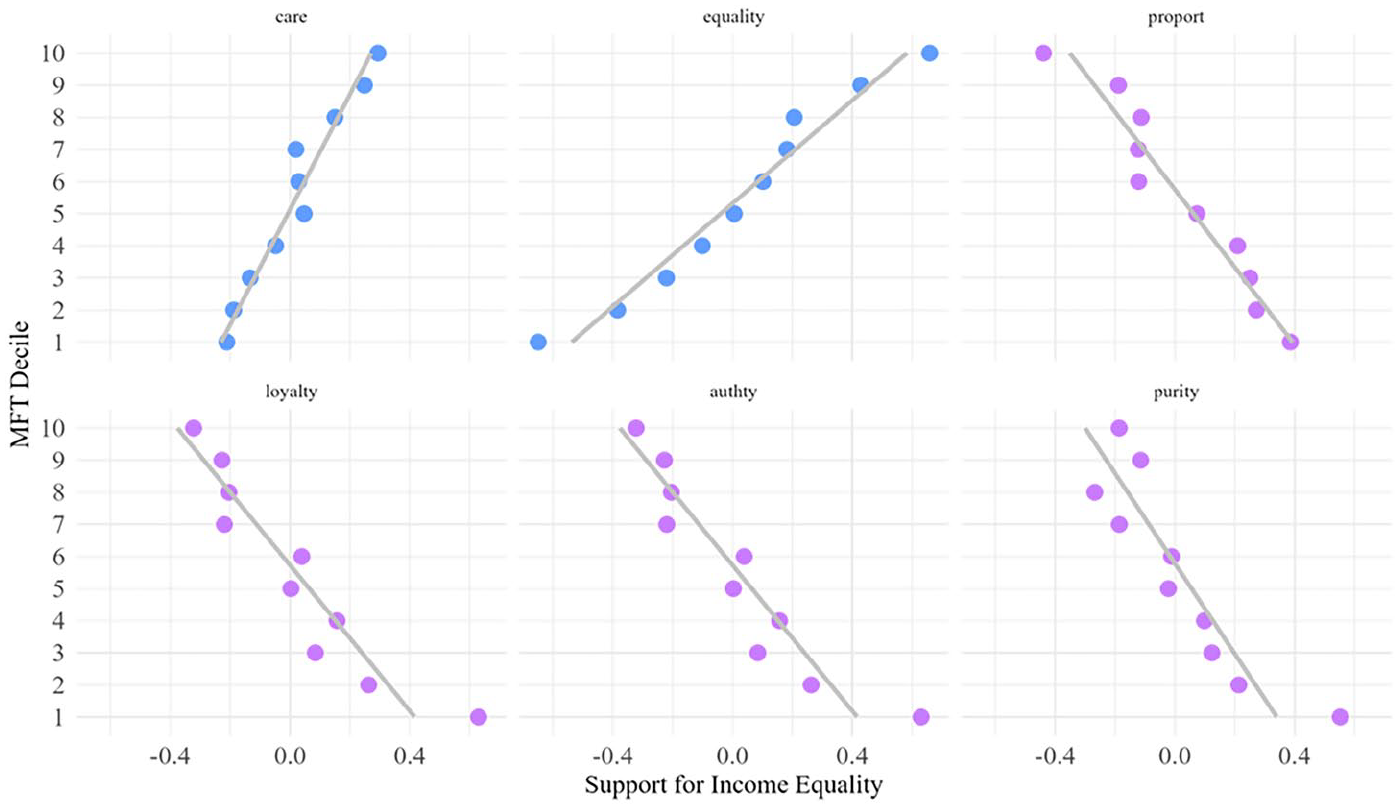
Moral intuitions by left-right ideology (support for income equality).
We also observe relationships between the binding moral foundations and liberal-conservative ideology. As shown in Figure 3, respondents with greater intuitions around loyalty, authority, and purity are more likely to hold conservative attitudes (lower justification of various socially liberal norms). Interestingly, we see no observable trend between the binding items of care and equality with liberal social attitudes, against our expected hypothesis. This perhaps is understandable in recognition of the UK as one of the more tolerant and liberal societies from the WVS sample – as such, statements supportive of socially liberal actions may not act as a ‘trigger’ or ‘challenge’ to these foundations given the prevalence of liberal attitudes widely held within the UK.
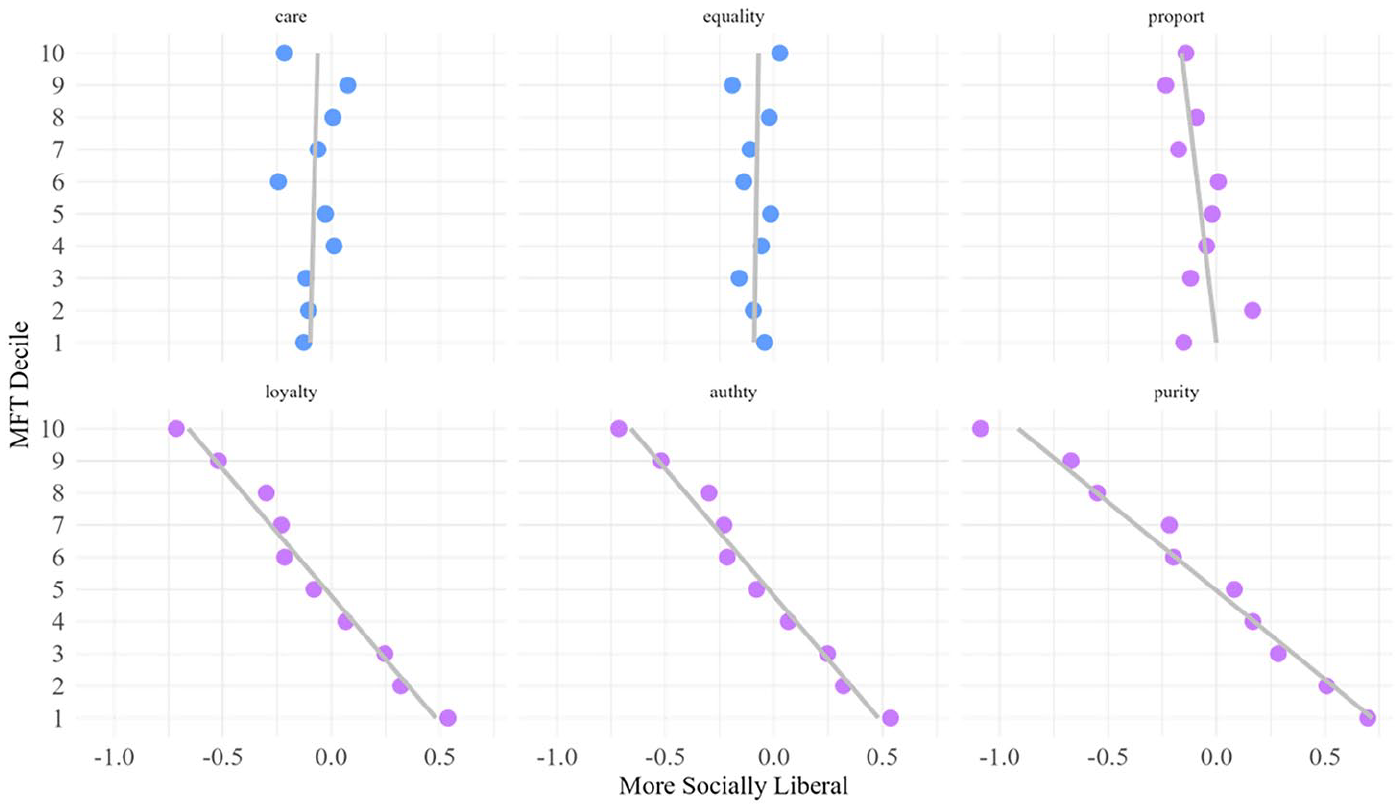
Moral intuitions by liberal-conservative ideology.
Given the suitability of measuring MFT items in the UK, and measures working as anticipated concerning left-right and liberal-conservative ideologies, we find strong evidence to continue assessing how moral foundations may help us to understand political issues within the UK.
To further explore the relationship between MFT and political ideology, we develop two models using a multiple regression framework. The aim is to estimate whether MFT items still hold significant relationships with political ideology once individual-level controls are accounted for. Due to the high correlation between the intuitions of loyalty, authority, and purity, it is not possible to include all MFT items individually within the model. Initial testing demonstrated that in doing so, the model suffers from multicollinearity with the Variance Inflation Factor (VIF) exceeding critical values for loyalty (VIF 5.95) and authority (VIF 8.06). As such, the following regression models include the binding intuitions of loyalty, authority, and purity as a combined second-order factor. Due to its weak loading from the CFA, proportionality is included as a separate independent variable, alongside the separate individualising intuitions of care and empathy.
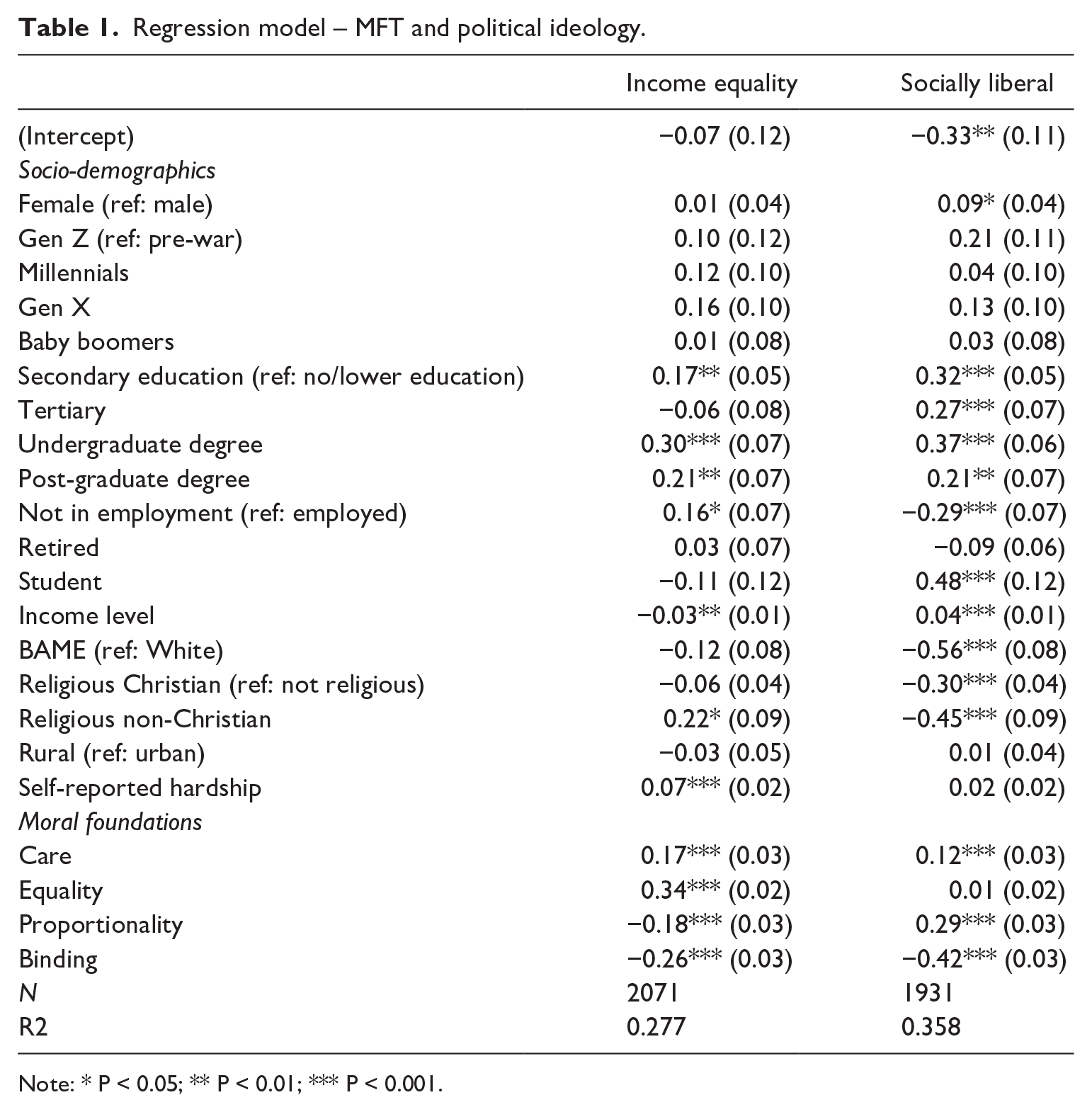
The results of our first models are shown in Table 1, which again demonstrates the utility of MFT in predicting both the measures of left-right and liberal-conservative ideology. Adjusting for socio-demographic controls, moral foundation items have an additional predictive utility in assessing left-right and liberal-conservative ideological positioning. Reporting significant results (p ⩽ 0.05) the moral foundations of care (0.17***), equality (0.34***), proportionality (−0.18***), and binding intuitions (−0.26***) are all significant in predicting support for greater income equality, net the effects of education, employment status, income level, religious denomination, and self-reported hardship. The individualising foundations of care and equality are positively correlated with greater support for left-leaning ideology, while proportionality and binding intuitions are negatively correlated.
Regression model – MFT and political ideology.
Note: * P < 0.05; ** P < 0.01; *** P < 0.001.
For measures of liberal-conservative ideology, we also see significant results from MFT items. We find the individualising measure of care to be associated with more liberal attitudes (0.12***), while binding intuitions are strongly associated with less liberal attitudes (−0.42***). Proportionality is correlated with greater levels of liberalism (0.29***), further suggesting that in a UK context, this item is more closely associated with individualising intuitions around equality, fairness, and care of others in society, rather than binding intuitions around deference to social norms and concerns over the structure of society.
Our initial results demonstrate the explanatory power of MFT in assessing relationships between moral intuitions and forms of political ideology in the UK. However, to extend the remit of our work we assess the relationships between MFT, political ideology, and responses to a series of salient political issues within current UK politics. To assess how these different issues might ‘trigger’ moral intuitions and political ideologies to operate in tandem, we conduct further regression modelling with interaction effects between MFT items and left-right/liberal-conservative ideologies.
Moral foundations, political ideology, and political issues
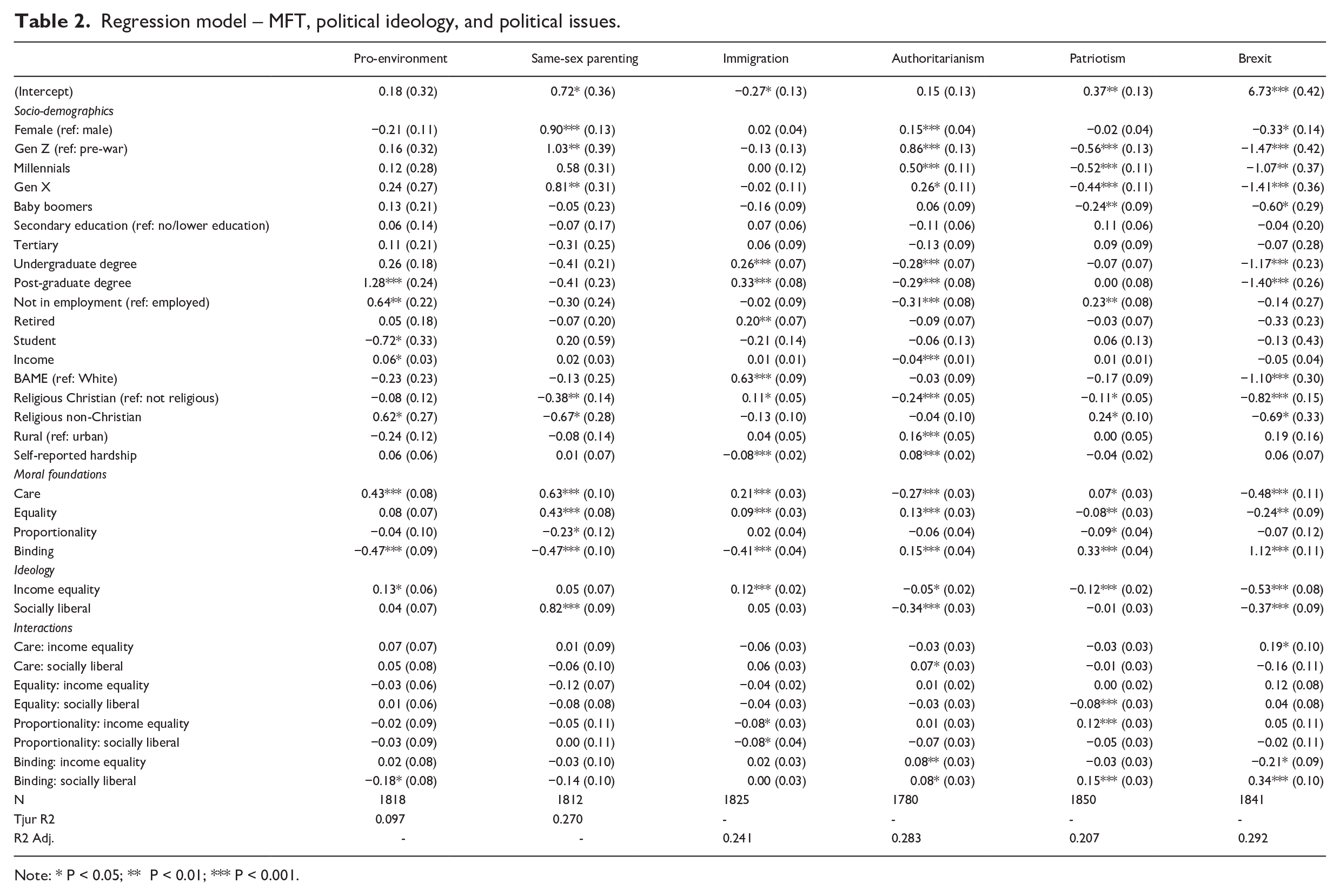
In evaluating MFT, political ideology and responses to political issues we fit a further six models. All results are shown in Table 2, while plots of predicted probabilities from each significant interaction effect are available in Supplemental Appendix 4. We introduce interaction effects alongside our original control variables and main-effect moral intuitions variable to model the relationship between moral intuition and political ideology. Interaction terms are created for each of the four MFT measures (care, equality, proportionality, and binding) alongside measures of left-right and liberal-conservative political ideology (‘income equality’ and ‘socially liberal attitudes’). To recall, we expect to find that in the presence of various ‘triggering’ issues – environmental concerns, same-sex parenting, immigration, authoritarianism, patriotism, and Brexit – that moral intuitions should exacerbate the effects that ideology has on how people respond to such issues.
Regression model – MFT, political ideology, and political issues.
Note: * P < 0.05; ** P < 0.01; *** P < 0.001.
Main effects
In terms of the main effects, we find significant positive correlations between the care foundation and support for greater environmental protection over economic growth (0.43***), and binding intuitions and weaker support (−0.47***). We also find those with economically left attitudes have a stronger support for environmental protection (0.13*). Those with higher moral intuitions on care (0.63***) and equality (0.43***) are more likely to believe same-sex parents are as good as other parents, while those valuing proportionality (−0.23*) and binding intuitions (−0.47***) are less likely to agree that same-sex parents are as good as other parents. More socially liberal attitudes (0.82***) are also strongly positively correlated with stronger support for same-sex parents. In relation to views on immigration, the intuitions of care (0.21***), equality (0.09***), and binding intuitions (−0.41***) have significant effects, as does left-leaning economic ideology (0.12***).
In relation to support for authoritarianism, patriotism, and Brexit, moral intuitions again appear to play a significant role. Care (−0.27***) is negatively correlated with support for authoritarianism, while intuitions around binding intuitions (0.15***) are positively correlated. However, against expectations, we see a positive correlation between equality and support for authoritarian governance (0.13***). Greater support for income equality (−0.05*) and social liberalism (−0.34***) are also associated with weaker support for authoritarian governments. In relation to patriotism, equality (−0.08**) and proportionality (−0.09*) are associated with lower support, while binding intuitions (0.33***) are associated with stronger support. However, against expectations, care (0.07*) is also positively correlated with a higher sense of patriotism. Left-leaning political ideologies around income equality (−0.12***) are also negatively correlated with patriotism. Finally, we see that the individualising items of care (−0.48***) and equality (−0.24**) are negatively associated with happiness towards Brexit, while binding items (1.12***) are strongly positively correlated with happiness with Brexit. Left-leaning (−0.54***) and socially liberal (−0.37***) respondents express lower levels of happiness regarding Brexit.
Interaction effects
The interaction terms included in the models demonstrate the degree to which moral intuitions can exacerbate or attenuate ideological differences in relation to predicting how people respond to political issues. In relation to concerns over the environment, we find a significant interaction between binding intuitions and liberal-conservative ideology (−0.18*). We see that for those who are more conservative, an increase in binding intuitions has a marginal effect in decreasing their support for environmental protection over economic growth. However, for those who are more socially liberal but prioritise binding intuitions, the interaction has a significant cross-over effect. Those who have low intuitions around binding are significantly more likely to support environmental protection over economic growth, regardless of their political ideology. However, for those who hold strong binding intuitions and a degree of social liberalism, they show stronger opposition to prioritising the environment. It is important to reiterate that this interaction shows the marginal interaction effect between binding intuitions and social liberalism, on top of the negative correlation with binding intuitions overall. In this sense, we see how moral intuitions might act as potential ‘overriding’ effect when combined with political ideology; it may not matter whether you are socially liberal or not, the issue of environmental protection could trigger binding intuitions which decreases concern for environmental protection across the liberal-conservative divide.
In predicting support for immigration, we see a significant interaction between proportionality and both income equality (−0.08*) and socially liberal attitudes (−0.08*). Proportionality has an attenuating effect across both economic left/right and liberal/conservative ideological positions. While those who are economically right or socially conservative expresses greater negativity towards immigration compared, this ideological gap reduces as the proportionality intuition increases, to the point where there are no observable differences in ideological terms at the higher end of the proportionality scale. In this sense, proportionality appears to override perceptions of immigration across both the left-right and liberal-conservative dimensions.
In predicting support for authoritarianism, we find a significant interaction effect between care and social liberalism (−0.07*), where an increase in intuitions around care is associated with lower support for authoritarianism across all respondents but has a stronger effect on those who are more socially conservative. As such, the care intuition attenuates ideological differences between liberals and conservatives. We also find significant interactions between the binding intuitions and income equality (0.08**) and social liberalism (0.08*). In both cases, stronger intuitions around the binding foundation decrease ideologically driven differences in relation to support for authoritarianism.
We also capture significant interaction effects for the patriotism model. Equality demonstrates a cross-over effect with the liberal-conservative ideological dimension (−0.08***) where small ideological differences are observed at the lower end of the equality scale but crossover and increase in differences as the equality intuition becomes stronger. The intuition of proportionality, on the other hand, seems to attenuate ideological differences when interacted with the economic left-right ideological dimension (0.12***). Despite notable left-right ideological differences in support for patriotism when proportionality is weak, these differences disappear when proportionality is strong. The binding intuition demonstrates a marginal cross-over effect when interacted with the liberal-conservative dimension (0.15***), with an increase in binding intuitions leading to more socially liberal respondents to feel a greater sense of patriotism, while have the same but less pronounced effect on more conservative respondents.
Finally, we estimate significant interactions between moral intuitions and ideology when predicting levels of happiness with Brexit. We find an exacerbating interaction effect between care and income equality (0.19*), where no ideological differences are found when the care intuition is weak, but significantly lower levels of happiness with Brexit for left-leaning individuals when the intuition of care is high. We also find an exacerbating interaction between the binding intuition and left-right ideology (−0.21*). When the binding intuition is low, there are no differences between left-right leaning individuals; as the binding intuition is more strongly felt, ideological differences between left and right leaning individuals on happiness with Brexit become more pronounced. However, the binding intuition interacts with the liberal-conservative dimension to attenuate differences on happiness with Brexit (0.34***). When the binding intuition is not strongly felt, those who are more socially conservative express greater levels of happiness with Brexit. As the binding intuition is more strongly felt, happiness with Brexit increases across the ideological divide to the point where there are no ideological differences observed when the binding intuition is strong.
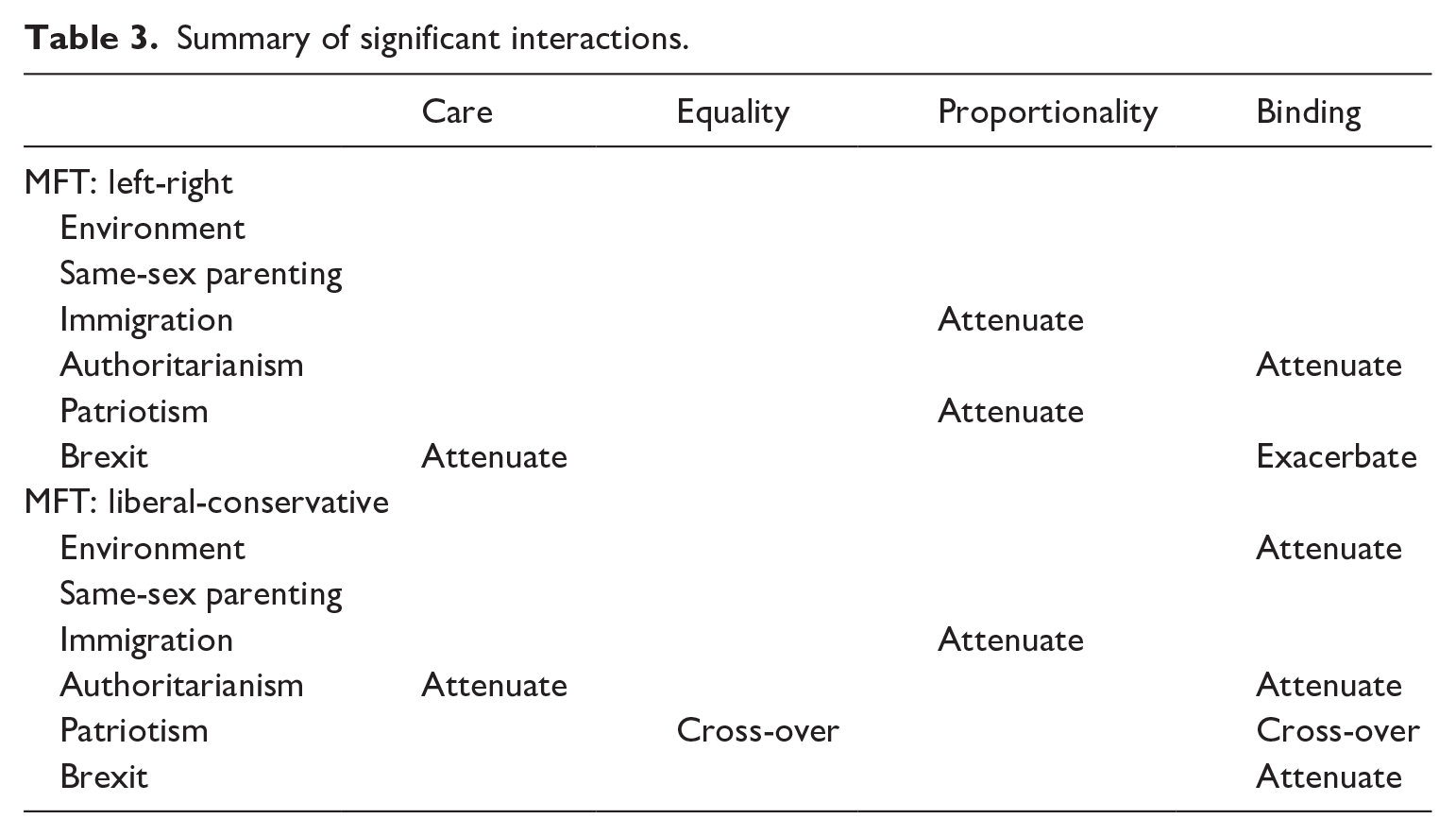
We summarise the findings of the interaction results in Table 3. We originally hypothesised that moral intuitions should contribute to polarising tendencies on political issues, with individualising intuitions strengthening economically left and socially liberal positions and binding intuitions strengthening economically right and socially conservative positions. The results, however, only partially confirm this. Indeed, we find that where there are significant interactions, moral intuitions are more likely to attenuate ideologically driven differences on political issues rather than exacerbate. The exception is in relation to happiness with Brexit, where a stronger presence of the binding intuition increases the divide on the issue between those who are economically left or right. Interestingly, in relation to patriotism, a stronger presence of the equality or binding intuition reverses differences on the issue between those who are socially conservative and socially liberal.
Summary of significant interactions.
Discussion
We set out with two principle aims in this article: (1) to confirm the measurement model of MFT within the UK and (2) to explore and estimate the role of moral intuitions in relation to political ideologies and support/opposition for salient political issues. In line with Atari et al. (2022), we confirm at the first factorial level that a six-factor solution is possible in the UK using a reduced version of the MFQ2 survey. However, we were unable to confirm the second-order relationships between individualising and binding moral foundations as laid out in the original theory. While first-order measures for loyalty, authority, and purity load well into a second-order factor for binding intuitions, proportionality has a much weaker loading. Equally, care, and equality do not load into a second-order factor for individualising intuitions.
As such, subsequent multivariate analyses exploring the role of moral intuitions alongside political ideology/issues used four factors: the first-order factors of care, equality, and proportionality as well as the second-order factor of binding which represents a combined expression of loyalty, authority, and purity. Our results show that these four moral intuitions play a significant role in predicting differences across political ideologies and in assessing responses towards salient issues. Not only do we find significant main effects on how people orientate themselves ideologically but also how moral intuitions interact with ideological positioning when understanding how people respond to political issues. We offer final thoughts on why the UK MFT measurement model deviates from the proposed theory and how the results inform polarising tendencies within UK politics.
UK MFT measurement model
We believe several factors may serve as a helpful explanation as to why the data from the UK was unable to confirm the second-order relationships. First, our use of a reduced 24-item survey (compared to the full 36-item version of MFQ2) may result in a lack of information to adequately capture the theorised distinctions between each foundation, which may be needed to fit second-order solutions in a UK context. Equally, we note cultural contexts of different societies have distinct effects on understanding differences between individualising and binding items. We suggest that moral intuitions around proportionality in the UK may therefore operate differently in comparison to the remaining binding measures, while instincts around equality may have limited explanatory power given the UK’s historic backing for a welfare state. In this sense, second-order relationships between the six items within the MFT framework may not be present within a UK context, and further study is required to assess the possibilities of this conclusion.
MFT and political polarisation
Using the moral intuitions of equality, care, proportionality, and binding, we find MFT items have strong predictive power in assessing differences between left-right and liberal-authoritarian political ideologies. Using multivariate regression analysis, our results highlight a significant correlation between measures of care and equality with left economic political ideology, and proportionality and binding measures with right economic positions. Care also has a strong correlation with greater levels of social liberalism, as does proportionality, while binding intuitions are strongly associated with lower levels of social liberalism.
Analysis of responses to key political issues also highlights how moral intuitions may both polarise and unify. We, however, mostly reject the overarching hypothesis that differences in moral intuitions help in accounting for polarisation tendencies between different ideological groups on key political issues. While we find that the equality and binding intuitions reverse differences between socially liberal/conservative respondents in response to national patriotism, and the binding intuition polarises responses to Brexit between those who are economically left and right, we mostly observe instances where shared moral intuitions bring different ideological groups together. The intuition of proportionality attenuates both economic left/right and socially liberal/conservative differences on the issue of immigration, while a stronger presence of the care intuition attenuates differences in socially liberal/conservative ideological positions to decrease support for authoritarianism. The presence of the binding intuition likewise also seems to override ideological differences in relation to authoritarianism and views on the environment. Within the UK context, then, a stronger presence of moral intuitions more often than not converges thinking on political issues across ideological divides rather than contributing towards polarisation tendencies.
Supplemental Material
sj-docx-1-bpi-10.1177_13691481241291426 – Supplemental material for Moral foundations and political ideology in the UK
Supplemental material, sj-docx-1-bpi-10.1177_13691481241291426 for Moral foundations and political ideology in the UK by Paul Stoneman and James Wright in The British Journal of Politics and International Relations
Footnotes
Acknowledgements
The authors thank Prof. Bobby Duffy for his support as the principal investigator of the UK in the WVS Project and for arranging the inclusion of MFT in the most recent survey.
Author contributions
Funding
This research was carried out as part of the World Values Survey, Great Britain-Northern Ireland (Wave 7) Project, reference: ES/T004703/1. The project was funded by: Economic and Social Research Council, Cabinet Office, Barrow Cadbury Trust, British Academy, Northern Ireland Office, Social Change Initiative, Unbound Philanthropy, Joseph Rowntree Charitable Trust, Community Foundation for Northern Ireland.

Supplemental material
Additional supplementary information may be found with the online version of this article.
Appendix 1 – Moral foundations questionnaire 2 (MFQ2)
Table 1 – MFQ2 items with number of responses, mean score and standard deviations
Appendix 2 – construction of dependent variables for regression models
A – Economic left-right ideology (income equality)
Table 2 – Variables used for EFA around economic left-right ideology, used to construct measure for income equality
Table 3 – EFA on questions around economic left-right ideology, with eigenvalues and cumulative variance explained
Table 4 – component matrix for two factor solution on economic left-right ideology
B – Socially liberal-conservative ideology (socially liberal)
Table 5 – variables used for EFA on socially liberal-conservative ideology, used for the construction of measure of social liberalism
Table 6 – EFA on items listed in table 5, with eigenvalues and cumulative variance explained
Table 7 – Component matrix for three factor solution on socially liberal/conservative ideology
C – Protecting the environment vs Economic Growth
D – Attitudes toward immigration
Table 8 – variables used for EFA around attitudes to immigration, used to construct dependent variable
Table 9 – EFA on attitudes to immigration, with eigenvalues and cumulative variance explained
Table 10 – Component matrix for two factor solution on attitudes toward immigration
E – Support for authoritarianism
Table 11 – variables used for EFA on attitudes to authoritarianism, used to construct dependent variable
Table 12 – EFA on attitudes to authoritarianism, with eigenvalues and cumulative variance explained
Table 13 – Component matrix for one factor solution on attitudes to authoritarianism
F – National patriotism
Table 14 – variables used for EFA on attitudes to national patriotism, used to construct dependent variable.
Table 15 – EFA on attitudes to national patriotism, with eigenvalues and cumulative variance explained
Table 16 – Component matrix for one factor solution on attitudes toward national patriotism.
G – Happiness with Brexit
Appendix 3 – coding information for independent variables
Appendix 4 – Interaction effect plots
Interaction Effects
Interaction plots for pro-environment, immigration and authoritarianism models
Interaction plots for patriotism and happiness with Brexit models.
Notes
References
Supplementary Material
Please find the following supplemental material available below.
For Open Access articles published under a Creative Commons License, all supplemental material carries the same license as the article it is associated with.
For non-Open Access articles published, all supplemental material carries a non-exclusive license, and permission requests for re-use of supplemental material or any part of supplemental material shall be sent directly to the copyright owner as specified in the copyright notice associated with the article.


