




Abstract
This article examines attitudes towards international trade in the United Kingdom. Using evidence from two cross-sectional surveys (July 2019 and June 2022), our research allows us to disentangle between citizens’ support for international trade in the abstract and support for specific trade policy in the form of new free trade agreements, and with specific partners. Our findings indicate that overall non-economic and contextual explanations are more relevant to understanding attitudes towards new free trade agreements compared to economic explanations. We point to the context-specific relevance of non-economic explanations, such as identity and partisanship, and show that while the Brexit context has had a major impact on attitude formation, this was also nuanced. Our findings have implications for the study of attitudes towards trade and – more broadly – towards different aspects of globalisation.
‘As we develop our own independent trade policy and look to forge new and ambitious trade relationships with our partners around the world, we will build a truly Global Britain upon a strong economy with open and fair trade at its heart’. Liam Fox, Secretary of State for International Trade
Introduction
Brexit not only called into question the United Kingdom’s (UK) trade relationship with its European trading partners but also with the rest of the world. The idea of ‘Global Britain’ – with trade at its core – became a foundation of the country’s post-Brexit foreign policy (Vasilopoulou et al., 2023). Underlying this change lay the contradiction of UK governments espousing free trade ideals while simultaneously leaving the largest trading bloc and integrated market (García, 2023). Trade and new free trade agreements (FTAs) became more salient in the media and political debates where these matters were highly polarised (García, 2020). It is puzzling that little empirical research exists on UK citizens’ preferences for international trade in this changing context and when FTAs have significant and politically sensitive distributional consequences. This gap in research is also problematic when public opinion can have the potential to shape the ability of governments to successfully negotiate international agreements (Buisseret and Bernhardt, 2018).
The literature on public opinion towards free trade has identified both economic and non-economic explanations of citizens’ trade preferences (Nguyen and Spilker, 2019). On the one hand, economic explanations based on international trade theory expect less educated, low-skilled individuals working in industries harmed by trade to express more protectionist attitudes (Scheve and Slaughter, 2001). On the other hand, scholars have linked factors not reducible to underlying economic interests, such as ethnocentric attitudes and in-group favouritism, to protectionism (Margalit, 2012; Mayda and Rodrik, 2005; Mutz and Kim, 2017). Research demonstrates the usefulness of these theories in explaining individuals’ support for the general principle of international trade. However, these theories have not been sufficiently tested beyond the United States (US). Research has also questioned whether such explanations are useful in relation to individual attitudes towards specific free trade agreements (for example, Hicks et al., 2014; Jungherr et al., 2018; Steiner, 2018).
Aiming to fill these gaps, we examine support for the principle of international trade in the abstract and specific FTAs in the post-Brexit UK context. Using evidence from two large-scale cross-sectional representative online surveys conducted in the UK in July 2019 (n = 2,119) and June 2022 (n = 2,230), our contribution is threefold. First, our research allows us to disentangle between citizens’ support for international trade in the abstract and support for specific trade policy in the form of new FTAs, and with specific partners (see also Jungherr et al., 2018; Steiner, 2018). We find that economic factors are partially associated with support for trade in general. Yet, such explanations appear less useful in terms of understanding citizens’ attitudes to FTAs with specific partners.
Second, we point to the context-specific relevance of non-economic explanations, such as identity and partisanship. Non-economic factors, in particular national identity, matter for trade attitudes in the British context, but not in the way hypothesised in previous literature (e.g., Honeker, 2023; Mansfield et al., 2016; Powers et al., 2021). The Brexit context paradoxically meant that citizens with a stronger sense of national identity tend to be more supportive of FTAs. Interestingly, however, this also depends on the trade partner. Whereas strong national identifiers see advantages for the UK from FTAs with other countries, including the US, Australia, India, Japan and Canada, when it comes to a deal with the European Union (EU), the relationship is in the opposite direction. Overall, compared to Conservative voters, supporters of other parties are less in favour of trade and new FTAs, with the exception of a UK-EU FTA for Labour supporters.
Third, we show that while the Brexit context has had a major impact on attitude formation, this was also nuanced. Whereas the Remain vote is negatively related to support for the principle of international trade and FTAs, when broken down into individual partners, Remainers find advantages from a trade deal with the EU. Yet EU referendum vote does not correlate with support for a deal with any other potential partner. Finally, individuals who think that the trade partner, as opposed to the UK, would have the upper hand in trade negotiations are more likely to see disadvantages with FTAs with all partners except for the EU and Japan.
Taken together, we bring new evidence to the rich literature on trade attitudes by examining a less well-studied yet important country (notwithstanding Powers et al., 2021). Our findings have implications for the study of attitudes towards trade and more broadly towards different dimensions of globalisation. We hope to set a research agenda that pays more attention to UK citizens’ attitudes towards international issues and globalisation, beyond Brexit.
Public opinion on trade: Economic and non-economic explanations
Initial attempts to explain individual-level trade preferences drew on international trade theory to understand the role of economic interests. While the benefits of trade tend to be unequal across the population, costs are often concentrated within specific groups (Alt et al., 1996; Milner, 1999). Foremost in this literature has been the expectation that an individual’s trade preferences depend on their skill level and their country’s relative economic comparative advantage (the factor-endowments model). Following the Stopler-Samuelson theorem, this model assumes costless intersectoral mobility of productive factors and implies that trade benefits those owning the factors of production but hurts others (Mayda and Rodrik, 2001). The Ricardo-Viner model, on the other hand, focuses on the extent to which specific industries benefit from trade and suggests that employees in winning industries will support it (Scheve and Slaughter, 2001). Trade liberalisation tends to benefit exporting at the expense of import-competing sectors and may result in factory closures exposing affected workers to more vulnerability and exacerbating inequalities (Scott, 2006). Concerns about unemployment have also been at the core of protectionist arguments against trade (Irwin, 2002).
Extensive literature has explored such economic determinants of trade attitudes. Those owning the factors of production, for example, landowners, workers in high-productivity sectors, and citizens with high levels of human capital (skills and education), are more likely to support free trade than others (Slaughter and Scheve, 1998). 1 Skilled labourers are seen to find it easier to change jobs or sectors in response to changes in trade relations than unskilled labourers (Hiscox, 2002; Mayda and Rodrik, 2005; Mayer, 1984). Accounting for the shifts in the international political economy, Walter (2017) considered both sector-specific exposure to globalisation and skill level. She found that highly skilled workers tend to face lower labour market risks compared to low-skilled individuals when working in industries exposed to globalisation. Owen and Johnston (2017) showed that individuals employed in routine-task-intensive occupations tend to be more protectionist compared to individuals in less routine occupations, and this effect increases if their job is vulnerable to offshoring. 2 In short, while highly educated, skilled, mobile and young citizens are likely to support international trade, the so-called ‘losers of globalisation’, including less-educated, low-skilled individuals in routine occupations in industries exposed to trade, can be expected to oppose it.
H1: Higher socioeconomic status individuals are more likely to support the principle of international trade.
Scholars have shown, however, that most citizens have a limited understanding of trade (Flynn et al., 2022; Medrano and Braun, 2012; Rho and Tomz, 2017). Factual knowledge and trade issue salience is typically low compared to other issues (Guisinger, 2009; Hiscox, 2006). Economic explanatory models may therefore make unrealistic assumptions about the ability of individuals to understand the consequences of trade on their economic welfare. To compensate for shortfalls in information, individuals may draw on heuristics or cues including those based on psychological, ideological or cultural factors to form their trade preferences (Hicks et al., 2014; Steiner, 2018).
Non-economic explanations of individual trade preferences include nationalist and isolationist values (Kaltenthaler and Miller, 2013; Mansfield and Mutz, 2009; Mayda and Rodrik, 2005; Sabet, 2014). Beyond its economic consequences, trade involves a degree of cultural exchange, migration of labour, the growing presence of multinational corporations and exposure to foreign influences, which may be perceived as posing a cultural threat to the nation (Margalit, 2012). Opposition to international trade has therefore been attributed to ‘out-group’ anxiety and prejudice towards people of different cultures and ethnicities (Mansfield et al., 2016; Mansfield and Mutz, 2009). In addition, political ideology and partisanship have been linked to trade attitudes, with right-wing individuals more likely to support free trade (Mayda and Rodrik, 2005; Scheve and Slaughter, 2001).
H2: Individuals with weak feelings of national identity are more likely to support the principle of international trade.
H3: Right-wing individuals are more likely to support the principle of international trade.
Attitudes towards specific free trade agreements
In line with the above framework, several economic and non-economic factors can be expected to be associated with individuals’ support for the principle of free trade or international trade in the abstract. However, preferential trade agreements have become the most important driving force in how trade is liberalised (Dür et al., 2014). Research has begun to question the assumption that the same explanations which apply to attitudes to the principle of free trade will relate to attitudes to specific FTAs. For example, context-specific factors played a more important role in shaping attitudes to the Transatlantic Trade and Investment Partnership (TTIP) than ‘standard’ explanations (Jungherr et al., 2018; Steiner, 2018). 3
Political framing, elite cues, and the qualities of the trade partner stand out as key contextual explanations. First, individuals assess policy based on information. Political actors try to influence public discourse through the prominence of specific frames that support their views. Public opinion responds to such communication to form judgements. Therefore, the information presented by both governments in promoting trade agreements and concerns raised by opponents can shape public attitudes toward FTAs (Hicks et al., 2014; Jungherr et al., 2018). For example, citizens provided with cues on the negative implications of TTIP were more likely to change their opinions and join online petitions against the deal (Spilker et al., 2020).
Second, the type or qualities of the trade partner can form a useful heuristic (Jungherr et al., 2018; Spilker et al., 2018; Steiner, 2018). Brutger and Li (2022: 1887) use the term ‘like-minded’ countries to define partners that share common interests and argue that ‘the public should infer that the home country will get a better deal since its interests are more likely to be well represented in the trade deal’. Individuals living in democratic countries tend to be supportive of trade deals with culturally similar democracies (Spilker et al., 2016). Unstable countries, on the other hand, tend to increase perceptions of risk (Gray and Hicks, 2014) and can raise questions of fairness in the negotiations (Brutger and Rathbun, 2021). For example, assumed credibility and trustworthiness played an important role in attitudes towards bilateral US-China trade cooperation (Schweinberger, 2022). Citizens may also view trade through a foreign policy lens (Schweinberger and Sattler, 2023) with individuals preferring trading with military or political allies over adversaries (Carnegie and Gaikwad, 2022; Spilker et al., 2018).
Relatedly, attitudes towards FTAs with specific trade partners may be linked to power evaluations. Individuals show support for balanced trade flows and are generally unlikely to support deals that leave their countries relatively behind, with some individuals even more likely to support deals if the partner country loses (Mutz, 2021; Mutz and Kim, 2017; Mutz and Lee, 2020). Some individuals may consider their country strong enough to independently negotiate international trade agreements, thus anticipating more relative gains from the cooperation, for example, material, political, geopolitical or otherwise. In fact, such negotiations may symbolise their country’s broader foreign policy power, and thus potentially strengthen the country’s international influence. For these individuals, new FTAs can become a vehicle for increasing and projecting their country’s power in the world (Carnegie and Gaikwad, 2022; Meunier and Nicolaïdis, 2006).
Taken together, contextual explanations related to political framing and type of partner can be influential in shaping public attitudes to FTAs. In the next section, we explore how these might apply in the UK post-Brexit context.
Attitudes towards international trade and FTAs in the United Kingdom
Comparative survey research found relatively low levels of protectionism in the UK before Brexit, although this increased after the mid-1990s with almost a fifth of respondents supporting limits on foreign products to protect the economy by 2013 (Nguyen and Spilker, 2019: 19). We see little reason to expect that the economic and non-economic explanations outlined earlier might struggle to explain attitudes towards the principle of free trade in the UK, but they should be tested empirically. When it comes to UK citizens’ preferences for specific FTAs, we explore how political framing and type of partner might apply in the post-Brexit context. We argue that Brexit and Conservative party voters are more likely to support new FTAs. The Brexit context also meant that – paradoxically – strong national identifiers are more likely to support new FTAs. In addition, those individuals who evaluate the UK’s power positively vis-à-vis trading partners are also more likely to support new FTAs.
First, FTAs featured as a campaign issue during the Brexit referendum (García, 2020). Although it was not clear which specific FTAs would follow Brexit or with whom (Brakman et al., 2018), it was in the context of Brexit that the potential economic benefits of FTAs were debated. Proponents of the leave option emphasised that Brexit would offer the opportunity to negotiate new FTAs where they would have more influence to broker a better deal for their country. In the words of the official ‘Vote Leave’ campaign (2016): ‘The EU stops us signing our own trade deals with key allies like Australia or New Zealand, and growing economies like India, China or Brazil. We’ll be free to seize new opportunities which means more jobs’. The Remain campaign argued the UK could only ensure its prosperity ‘through’ rather than outside of the EU (Britain Stronger in Europe, 2016).
Brexit symbolised a sharp divide within the British public, which resulted in two opinion-based groups: ‘Leave’ and ‘Remain’. These shared ‘Brexit identities’ cut across traditional party lines, tend to be stronger than partisanship, and generate affective polarisation in terms of stereotyping, out-group prejudice and evaluative biases (Hobolt et al., 2021). Such identities remained stable following the referendum and most voters were unwilling to reconsider their vote (Grynberg et al., 2020). In this context, we expect voters’ positions on Brexit to have played a continued role in their opinion formation towards FTAs. Such a dynamic seemed plausible when trade negotiations were placed at the heart of the Brexit process (García, 2023). Promptly after the EU referendum in July 2016, the Conservative government established a new Department for International Trade (2019) to negotiate trade agreements, to use trade ‘to promote the government’s agenda for a Global Britain and its ambitions for prosperity’ and to champion free trade.
In addition, political parties disagreed on the benefits of brokering a deal with specific partners. Divisions emerged surrounding a post-Brexit trade deal with the US as the then leader of Labour Party Jeremy Corbyn claimed that the National Health Service (NHS) would be ‘up for sale’ (Financial Times (FT), 2019). Prime Minister Boris Johnson promoted the advantages of a deal and argued that ‘Trading Scottish salmon for Stetson hats, we will deliver lower prices and more choice for our shoppers. Most importantly, this transatlantic trade deal will reflect the unique closeness of our two great nations’ (FT, 2020a).
H4: Brexit voters are more likely to support new FTAs.
H5: Conservative party voters are more likely to support new FTAs.
Second, in the context of Brexit, there are reasons to expect that voters’ national identity might affect their attitudes to specific FTAs differently than attitudes to trade in general. The Leave campaign’s slogan ‘take back control’ portrayed a vision of Britain as once again an independent country in full control of its laws, its borders, and its money (Gamble, 2018). FTAs were presented as a way in which the UK could pursue free trade while taking back control of its borders (May 2016). Couched with a sovereignty narrative, the Leave campaign argued that through Brexit the UK would regain its seat in the World Trade Organisation (WTO). It would influence world trade negotiations and ultimately it would ‘be free to trade with the whole world’ (Vote Leave, 2016). For this context-specific reason, we expect national identity to have affected trade preferences in an unusual way.
H6: Individuals with weak feelings of national identity are less likely to support new FTAs.
Third, discussions on FTAs and specific trade partners were related to ideas of UK power. For remainers, FTAs were benchmarked against their positive EU evaluations. It was argued that such agreements would ‘lead to an inferior trading arrangement [. . .] and would lessen our clout in global trade negotiations’ (Britain Stronger in Europe, 2016). Supporters of Brexit argued the UK had built the global free trade system in the nineteenth century, but the EU had for years inhibited Britain from its ‘historic mission’ in playing a leading role in promoting global free trade (for example, Johnson, 2020). Brexiters claimed the UK had lost influence within the EU and that it would ‘gain in clout’ through leaving the EU (Johnson, 2016). Moreover, Conservative politicians argued that the ‘cards were stacked in our favour’ in EU trade talks (FT, 2016; The Metro, 2020).
Yet, as Conservative governments aspired for the UK to act as a global power able to maximise leverage to negotiate trade deals, they found their autonomy constrained by a global economy and legal commitments associated with EU withdrawal (Egan and Webber, 2023). Critics contended trading partners including the US (The Atlantic, 2019) or the EU (FT, 2020b) held the ‘upper hand’ in negotiations and highlighted the UK’s weak position in negotiating with Japan (The Times, 2019). Trade deals were sometimes justified in relation to the power of trading partners. For example, in 2022 Prime Minister Boris Johnson’s (2022) push for a trade deal with India was linked to India’s status as a rising power and its position in the Indo-pacific which was ‘increasingly the geopolitical centre of the world’.
H7: Individuals with positive power evaluations of the United Kingdom vis-à-vis trading partners are more likely to support new FTAs.
Data and method
We collected data on individuals’ preferences drawing evidence from two representative cross-sectional public opinion surveys of UK respondents, conducted by YouGov on 29 to 30 July 2019 (n = 2,119) and on 31 May to 5 June 2022 (n = 2,230). The first survey was conducted three years after the Brexit referendum during a discussion around a potential US–UK FTA and the negotiation of the EU-UK Trade and Cooperation Agreement (TCA). The second survey captures trade preferences after the UK’s exit from the EU on 31 January 2020, during a period that the country signed a series of new FTAs and after the COVID-19 pandemic.
The UK signed the TCA with the EU, which entered into force in May 2021. Following Brexit, the UK signed new FTAs with Japan (2020), Australia (2021) and New Zealand (2022), a digital FTA with Singapore (2022) and Ukraine (2023), and an agreement to join the Comprehensive and Progressive Agreement for Trans-Pacific Partnership (2023). The UK has begun negotiations with other individual countries including the US, India, Canada, Mexico and Israel and the Gulf Co-operation council (House of Commons, 2024).
The surveys are weighted by, and the samples are representative of, the UK population in terms of age, gender, education, region, and vote choice both at previous General Elections and at the 2016 EU referendum. We asked questions that allowed us to compare citizens’ support of the principle of international trade in the abstract to their attitudes to new FTAs. Through this strategy, we can compare the predictors of these separate – but arguably related – issues.
Trade attitudes were measured by asking: ‘Generally speaking, do you have a positive or negative impression of the following. . .?’. Respondents were asked, in a randomised order, to indicate their impression of globalisation, immigration, Brexit, international trade, and potential new trade agreements after Brexit. In our analysis, we only focus on the two latter survey items. The answers were given on a four-point scale, where 1 = ‘Very negative’ and 4 = ‘Very positive’. The variables were recoded into binary to distinguish between support for (1) and opposition to (0) the principle of international trade in the abstract and new FTAs. Models were therefore estimated using binary logistic regression, but robustness tests include ordinal regression models that account for the ordinal nature of the original dependent variables (see Figure A in the Appendix).
To tap into economic explanations of trade attitudes (H1) (Mayda and Rodrik, 2001; Owen and Johnston, 2017; Scheve and Slaughter, 2001), we employ measures of respondents’ education (1 = ‘Low’, 2 = ‘Medium’, 3 = ‘High’), employment status (1 = ‘Works full time’, 2 = ‘Works part time’, 3 = ‘Not working’) and income (gross household income per year). To operationalise non-economic explanations (Kaltenthaler and Miller, 2013; Mansfield and Mutz, 2009; Mayda and Rodrik, 2005; Sabet, 2014), we rely on several measures. For identity factors (H2, H6), we had to rely on two separate measures across years. In 2019, the question asked respondents to indicate their attachment to their country (1 = ‘Very strongly attached’, 4 = ‘Not at all attached’). In the 2022 survey, national identity was measured using an index, compiled from six survey items also used in the British Election Study. For comparison purposes, both variables were recoded to run from 0 to 1, where 0 indicates strong and 1 = weak national identity. To account for the possibility that trade attitudes correlate with political preferences (H3; H5), we also measure vote choice during the 2017 and 2019 General Election, respectively, for each survey (1 = ‘Conservatives’, 2 = ‘Labour’, 3 = ‘Liberal Democrats’, 4 = ‘Other’). Conservatives – the party in office at the time of fieldwork – are defined as the reference category.
To test contextual explanations, we rely on vote choice at the 2016 EU referendum (1 = ‘Leave’, 2 = ‘Remain’) (H4). Considering that Brexit debates emphasised specific trade partners and were linked to ideas of UK power and discussions on who might be in a position of power during trade negotiations (H7), we also include the question: ‘Who do you think would have the upper hand in trade negotiations between the following?’. The UK was paired with a list of trading partners, including the EU, the US, China, India, Australia, Japan, and Canada. These partners vary in terms of size of their economy and cultural affinity with the UK. The list of country pairs was randomly rotated. For each of the pairs, respondents assessed whether the UK (0) or the trading partner (10) would have the upper hand in trade negotiations. For analytical purposes, a new variable was generated using the average of the scores for each of the trade partners (Cronbach’s alpha = 0.92 in 2019 and 0.87 in 2022). As a robustness test, we explored separately the evaluations of the distribution of power between the UK and the EU (see Figure C in the Appendix). Our statistical tests indicate that multicollinearity is not a concern (VIF: 1.13-1.89 (Model 1); VIF: 1.13-1.92 (Model 2); VIF: 1.1-2.16 (Model 3); VIF: 1.09-2.16 (Model 4).
Scholars have highlighted the role of social demographic characteristics, including age, with older individuals being more supportive of protectionism (Ehrlich et al., 2010), and gender, with females more likely to oppose trade liberalisation (Kaltenthaler et al., 2004). We therefore include demographic controls, such as age and gender, in our models (see Table A for Descriptive statistics, and Table B for question wording in Appendix).
Results
Descriptive analysis of support for international trade and new FTAs
We start by providing a descriptive overview of our two central questions of interest, which are public attitudes towards trade in general, and, more specifically, towards new FTAs. Figure 1 indicates vast differences in public opinion. On average, the majority of respondents has a very or fairly positive impression of international trade (65.2% in 2019 and 57.1% in 2022), but fewer respondents feel the same way about new FTAs (42.5% in 2019 and 30.7% in 2022). Thus, we first find that attitudes towards new FTAs are much more pessimistic than those towards trade more broadly, and these patterns are consistent over time. Correlation between the two trade indicators remains moderate (r = 0.44 in 2019 and r = 0.45 in 2022), suggesting that the public tend to view these as separate issues. The proportion of ‘don’t knows’ is similar across both variables (17%-19%). 4
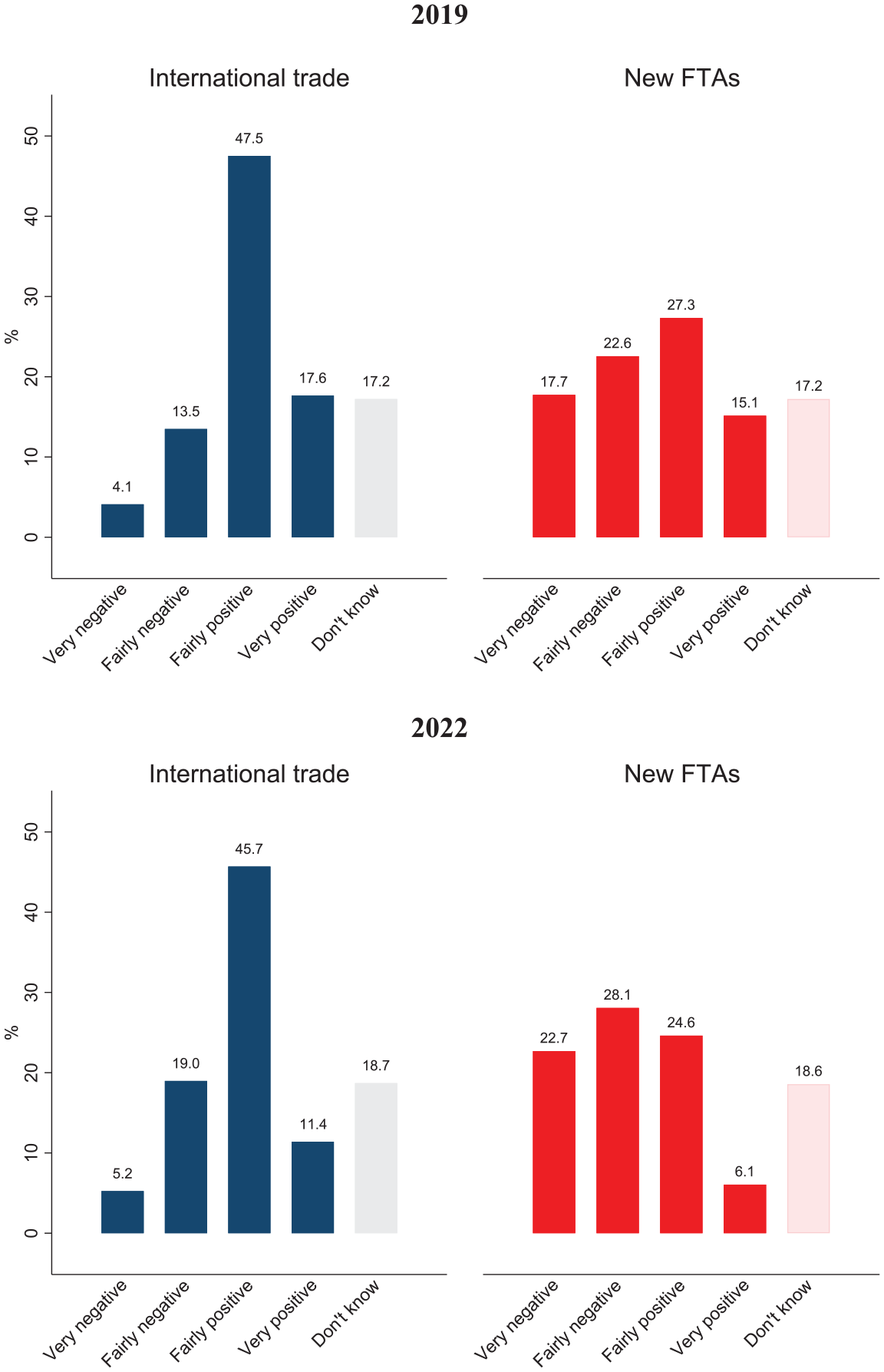
Impressions of international trade and new FTAs.
Second, descriptive analysis suggests that support for both international trade in the abstract and new FTAs declined over time. The proportion of respondents with a positive impression of international trade decreased by 8 percentage points from 2019 to 2022, and positive attitudes towards FTAs dropped by almost 12 percentage points. Given that the share of ‘don’t knows’ remained stable, this seems to indicate a decline in trade support over time. However, since the two surveys did not follow a panel structure, we cannot exclude the possibility that this is due to sampling differences.
Explaining support for the principle of international trade and new FTAs
Next, we estimate regression models to assess the association between trade attitudes and a carefully selected list of predictors. Following the discussion in our theoretical section, we estimate the explanatory capacity of economic (H1), non-economic (H2, H3), and contextual (H4, H5, H6, H7) explanations, as well as demographics. It is worth pointing out that the models do a much better job at predicting attitudes towards new FTAs (R2 = 0.4 in 2019 and 0.38 in 2022) than towards international trade more broadly (R2 = 0.05 in 2019 and 0.04 in 2022; Table D in Appendix).
Substantively, the results demonstrate that similar indicators affect support for trade in the abstract and specific support for new FTAs in rather different ways (Figure 2; see also Figure B in Appendix). 5 As suggested by economic explanations (H1), higher socioeconomic status should increase the likelihood of supporting international trade. This is mostly the case for general trade attitudes, where higher education (in 2019) and income (in 2022) yield more optimistic positions. The third economic variable, work status, shows no significant effects in most models. Overall, while socioeconomic status is partially associated with support for trade in general, the utilitarian logic does not apply to opinions on new FTAs.
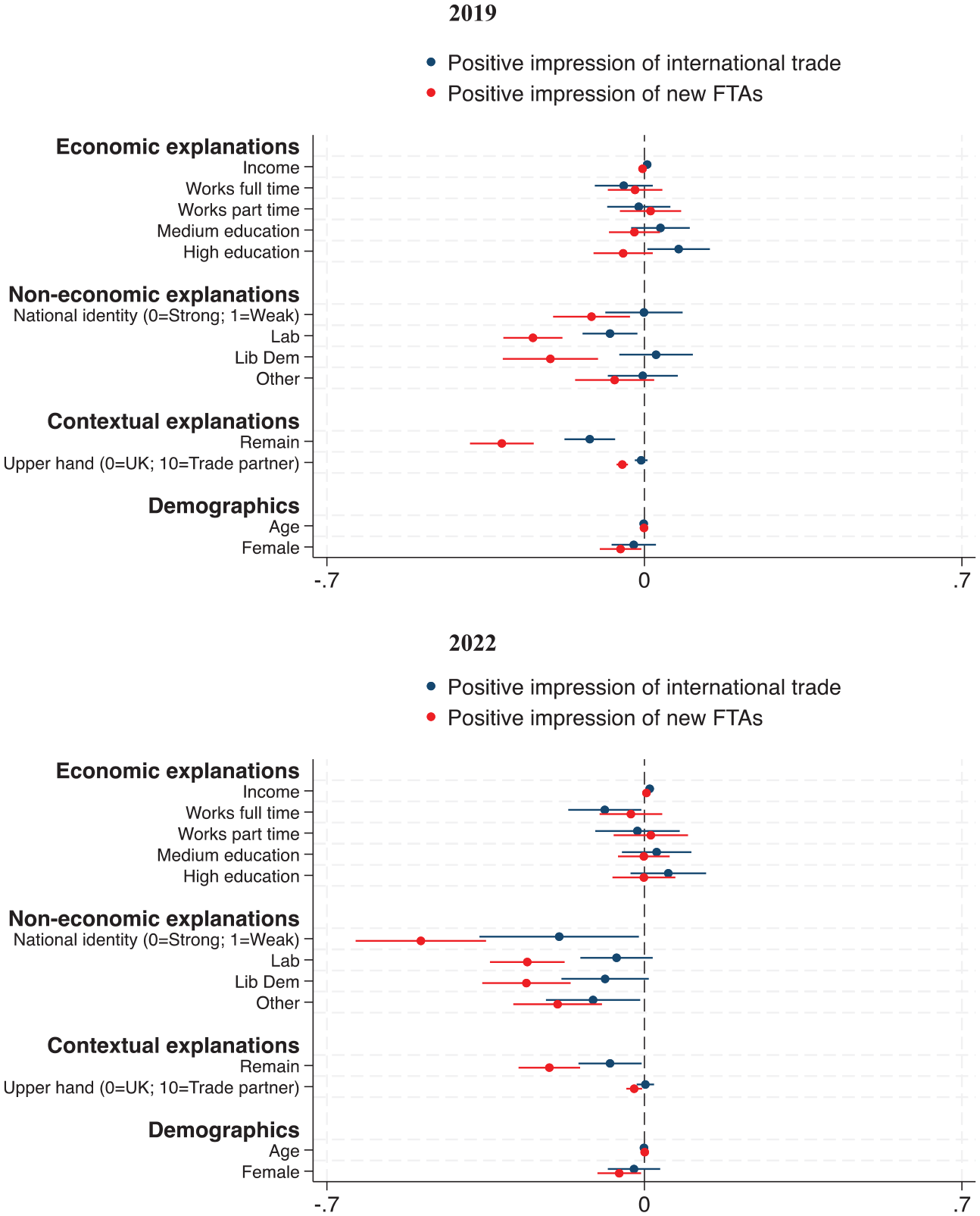
Predictors of impression of international trade and post-Brexit new FTAs.
Diverse patterns for trade and FTAs are also observed when it comes to non-economic explanations (H2, H3). Contrary to H2, which expects that individuals with weak feelings of national identity are more likely to support the principle of international trade, identity does not correlate with support for trade in general (in 2019) or has a very small effect in the opposite direction (in 2022). Citizens with weak feelings of national identity, on the other hand, are significantly less supportive of new FTAs compared to their counterparts with more universalist values, which supports H6. This finding suggests that ethnocentrism matters for trade attitudes in the British context, but not the way hypothesised in previous literature (e.g., Honeker, 2023; Mansfield et al., 2016; Powers et al., 2021). In the context of Brexit, voters with a stronger sense of national identity may have been more supportive of FTAs because they saw them a route to promoting sovereignty and control (e.g., over laws and borders).
In line with H3 and H5, compared to Conservative voters, supporters of other parties are less in favour of trade and especially of new FTAs. The predicted probability of Conservative voters’ endorsing new FTAs was 70% in 2019 but 31% for Labour voters and 38% for Liberal Democrats. In 2022, the same probability for Conservative voters dropped to 50% and to 16% for both Labour and Liberal Democrat supporters. Interestingly, despite the fact that the ‘Global Britain’ narrative featured in the Labour Party (2017) manifesto, which also was rather positive towards new FTAs; by 2019, Labour grew critical of new FTAs referring to them as ‘reckless’ and arguing that they would ‘never let our health service be up for grabs in any trade negotiation’ (Labour Party, 2019). This may go some way to explaining why Labour supporters in our samples tend to be more sceptical of new FTAs. This relationship remains in our 2022 survey which suggests that it is more than a ‘Corbyn-effect’.
In terms of the EU referendum vote (H4), Remainers are less supportive of trade and especially of FTAs, but the Brexit effect has decreased from 2019 to 2022. In 2019, the predicted probability of endorsing new FTAs was 75% for Brexiteers and 32% for Remainers. In 2022, the probabilities were 48% and 18%, respectively. Overall, this suggests that although, historically, Britain’s main political parties converged on the economic benefits of globalisation, and support for FTAs was not a prime predictor of the Brexit referendum outcome (Vasilopoulou, 2016), in the minds of citizens FTAs tend to be partially linked to Brexit vote.
We have, finally, hypothesised that individuals who think that the UK, as opposed to the trade partner, would have the upper hand in trade negotiations are more likely to support new FTAs (H7). This offers an additional dimension to the contextual Brexit story. Especially in 2019, power evaluations emerged as a much more prominent explanation compared to more conventional accounts: its effect size is much larger compared to all explanations except for Brexit (see Figure B with standardised variables in the Appendix for the comparison of effect sizes). This means that in 2019, holding all other predictors at their mean values, the predicted probability of endorsing new trade agreements was 71% to 92% for people who thought that the UK is in a position of power in trade negotiations (values ≤ 4 on the original scale of 0-10), but remained much lower at 21% to 53% for those who thought that the trade partner is (values ≥ 6 on the original scale of 0-10). The differences were smaller in 2022, with 38% to 52% and 17% to 29%, respectively, but still firmly significant, indicating a large gap in support for new FTAs depending on respondents’ evaluations of who would have the upper hand in the negotiations. As opposed to new FTAs, this variable is not associated with general trade attitudes.
Sociodemographic variables seem to play a relatively minor role in helping us understand trade attitudes in the UK. Age is not related to support for either trade in general or FTAs. Female respondents are less likely to support FTAs (Figure 2).
Support for FTAs with specific partners
Next, we turn our focus on UK citizens’ attitudes towards FTAs with specific partners. We employ our 2022 survey, which asked respondents: ‘Generally speaking, do you think there are more advantages or disadvantages associated with the UK having a free trade agreement with each of the following trade partners, or is it about equal?’ We included a list of trading partners, including the EU, the US, China, India, Australia, Japan, and Canada. These partners vary in terms of the size of their economy and cultural affinity with the UK. The list of country pairs was randomly rotated. For each of the countries, respondents assessed whether there would be more disadvantages for the UK (1 = ‘Negative’), as many advantages as there are disadvantages (2 = ‘Neutral’), or more advantages for the UK (3 = ‘Positive’).
Figure 3 provides a descriptive overview of public attitudes towards FTAs with specific partners. Here again, important divisions are apparent. Except for a trade deal with China, more respondents see advantages for the UK compared to disadvantages. It is noteworthy, however, that with reference to all seven potential partners, there is a sizable group of respondents that views as many advantages as disadvantages, which we consider a neutral opinion (31.8 per cent with the EU; 33.7% with the US, 27.7% with China, 33.6% with India, 34.8% with Australia, 34.1% with Japan and 35.1% with Canada). The proportion of ‘don’t knows’ varies from 18.4% regarding a trade deal with the EU to 29.4% with Japan. 6
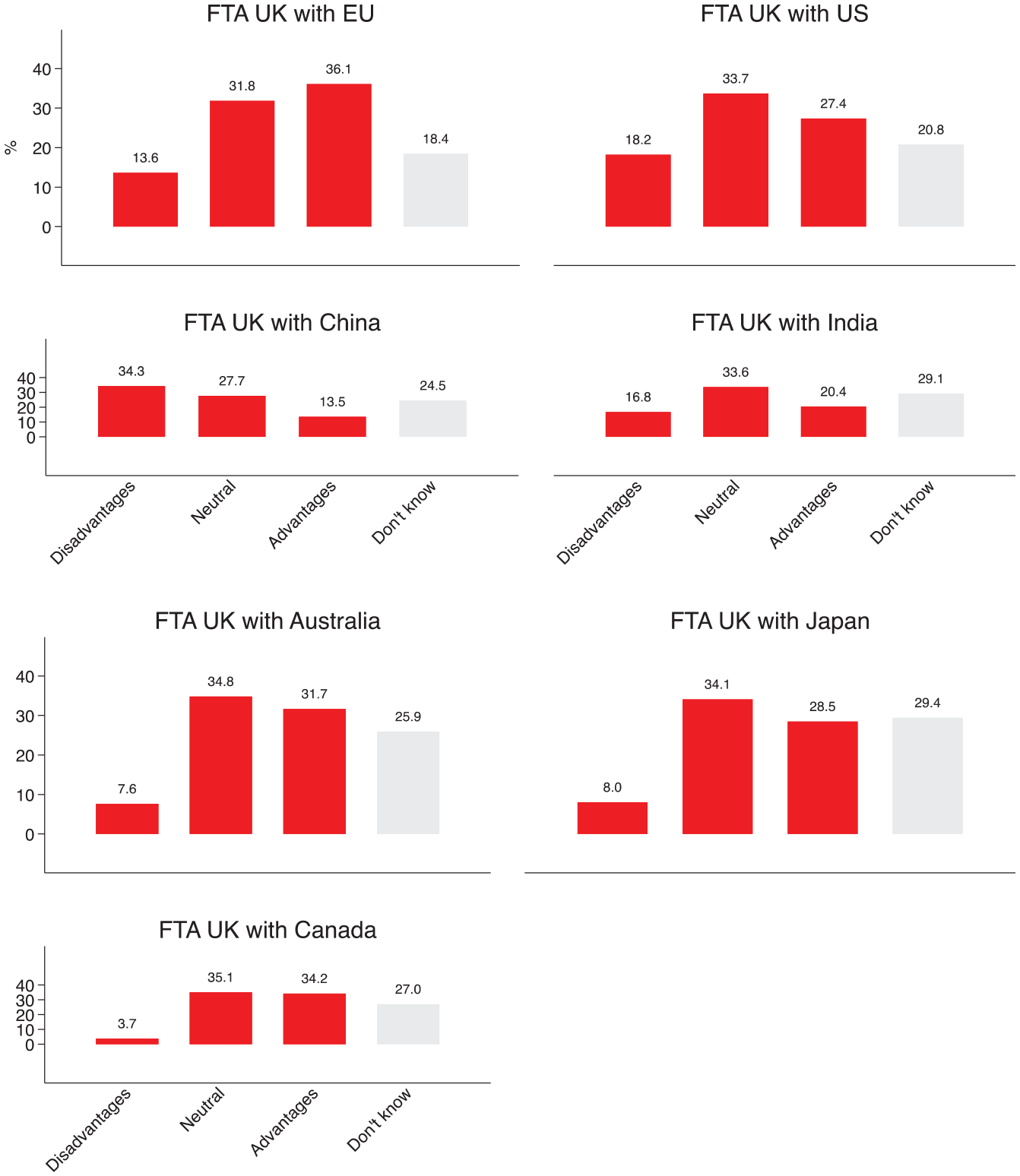
Advantages or disadvantages associated with the United Kingdom having a FTA with different trade partners.
We proceed by estimating ordinal logistic regression models to assess the association between attitudes towards FTAs with specific partners and a series of economic, non-economic, contextual and demographic variables. Although our main intention is to test contextual explanations (H4, H7) in line with our theoretical framework, we also discuss our findings related to economic and non-economic explanations to understand in what ways attitudes to FTAs with specific partners differ from the principle of international trade in the abstract.
Substantively, the results demonstrate some interesting patterns (see Table 1). We observe that economic explanations have very little relevance in helping us understand respondents’ attitudes towards FTAs with specific partners. Non-economic and contextual explanations, however, paint a very interesting picture.
Support for FTAs with specific partners.

Source: YouGov 2022.
Regression coefficients from logistic regression models. Standard errors in parentheses.
p < 0.01; **p < 0.05; *p < 0.1.
We test the relationship between Brexit vote and support for FTAs with specific partners (H4). Interestingly, we only observe a positive relationship when it comes to Remainers’ seeing advantages from a trade deal with the EU. Whether the respondent voted to stay or leave the EU does not correlate with views on trade deals with any other partner.
Partisanship, however, is important (H5). On the one hand, compared to Conservatives, Labour voters are more likely to see advantages from a deal with the EU. On the other hand, both Labour and Liberal Democrat voters are less likely to see advantages with a trade deal with the US and Australia compared to Conservative party voters. Labour voters are also less likely to see advantages with a deal with Canada compared to Conservatives. Partisanship does not correlate with support for deals with China, India and Japan.
Whereas those with weak national identity see advantages for the UK from a FTA with the EU, those with feelings of strong identity see advantages for the UK for FTAs with other countries, including the US, Australia, India, Japan and Canada (H6). This, once again, suggests that ethnocentrism and national identity are important for helping understand trade attitudes in the British context, but not the way hypothesised in previous literature (e.g., Honeker, 2023; Mansfield et al., 2016; Powers et al., 2021). As UK governments promoted ideas of a ‘Global Britain’, national identity became compatible with support for FTAs. However, we find no association between national identity and support for a FTA with China. One potential explanation of this relates to the ambiguity of UK governments on relations with China and the latter’s relatively low salience on the British public agenda (Stanley, 2024). In this context, citizens may have struggled to develop opinions on China’s appeal as a trading partner. China’s status as one of the UK’s main trading partners but also a non-democratic country seems likely to be another contributing factor (following Spilker et al., 2016).
Finally, respondents who think that the trade partner, as opposed to the UK, would have the upper hand in trade negotiations are more likely to see disadvantages with FTAs with all partners except for the EU and Japan (H7).
Socio-demographic explanations are also related to support for trade deals with specific partners. Older people are less likely to see advantages from trade deals with the US, China, Australia, India and Japan. Women are less likely to express this view for a trade deal with the EU and Japan. No association between gender and FTA support may be observed with reference to other partners.
Taken together, our findings indicate that attitudes towards FTAs are partner-specific. When the questions are broken down into specific partner countries, interestingly, EU referendum vote is only related to an agreement with the EU and not with other countries. For other trade partners, partisanship, identity and perceptions of who might have the upper hand in negotiations tend to matter.
Discussion
In this article, we have examined citizens’ attitudes towards international trade and specific FTAs in the UK. Through the use of two large-scale representative surveys of UK adults carried out in 2019 and 2022, our findings indicate that overall non-economic and contextual explanations are more relevant compared to economic explanations. We find that individuals with strong feelings of identity tend to be supportive of international trade and FTAs, and specifically see advantages for the UK for FTAs with other countries, including the US, Australia, India, Japan and Canada. Although Remainers tend to oppose international trade, when broken down into individual partners, Remainers find advantages from a trade deal with the EU. However, EU referendum vote does not correlate with support with any other partner. Individuals who think that the partner, as opposed to the UK, would have the upper hand in trade negotiations are more likely to see disadvantages with FTAs and with FTAs with specific partners.
We should stress that our findings do not necessarily mean that economic calculations do not matter in preference formation towards trade. There is indeed a debate in the literature on whether individual self-interest (factor endowment model, sectoral model) (e.g., Scheve and Slaughter, 2001) or sociotropic considerations (country-level economic factors) (for example, Mansfield and Mutz 2009; Mutz, 2021) are most relevant. Fordham and Kleinberg (2012) argue that group economic interests are crucial in shaping citizens’ trade preferences. In line with Schaffer and Spilker (2019), we entertain the idea that our null results might relate to information. We therefore suggest that future experimental research should probe this directly, by for example, exposing respondents to information about how trade (in the abstract or with specific partners) might economically affect them or their country. Research is also needed to explore whether economic variables at the regional level may be more relevant in shaping trade attitudes in the UK (following Frieden, 2022) In addition, due to our interest in substantive response categories, ‘don’t knows’ are excluded from our analyses. In our study of attitudes towards specific partners we do, however, have a middle category which captures neutral attitudes. Future research, nevertheless, should consider such responses (see Kleinberg and Fordham, 2018).
In our study, non-economic and contextual explanations seem to be more relevant. It is worth, however, pointing to the fact that non-economic factors, for example, identity and partisanship, may not necessarily be fully independent from the Brexit context. As we have argued above, parties took clear positions on trade during and after the Brexit referendum, which sometimes also changed over time. For example, although Labour has historically been pro-trade, its then leader Jeremy Corbyn made negative references to trade. National identity, in our case, was also contingent on the Brexit context. We found that respondents with strong identity were supportive of trade deals with partners, except for the EU. In this sense, and considering that identity correlates with Brexit vote, these individuals appeared to be convinced that national identity can be enhanced and strengthened through non-EU trade deals, an idea central to the ‘Global Britain’ narrative. Therefore, our interpretation of the identity effect is necessarily context-specific.
We have also sought to draw attention to the role of the trade partners and individuals’ perceptions of who might have the upper hand in the negotiations. Considering that our questions tap into attitudes (Fordham and Kleinberg, 2012), it would be useful if future research further explored our finding in experimental settings. For example, an experimental research design could test how information on who might have the upper hand in negotiations might affect support for FTAs or what type of relative power would individuals attribute importance to, for example, economic, negotiation expertise, or values-related. Future research should examine whether this factor is applicable to other similar countries in the developed world, for example, the US and Canada, or dissimilar contexts of developing countries.
More broadly, our research suggests that it is useful to go beyond the standard debate between economic versus non-economic causes of the globalisation backlash (Walter, 2021). Therefore, we hope to set a new research agenda that pays more attention to context and the role of the specific trade partner.
Supplemental Material
sj-docx-1-bpi-10.1177_13691481241284363 – Supplemental material for Public attitudes towards international trade and free trade agreements in the United Kingdom
Supplemental material, sj-docx-1-bpi-10.1177_13691481241284363 for Public attitudes towards international trade and free trade agreements in the United Kingdom by Sofia Vasilopoulou, Liisa Talving and Daniel Keith in The British Journal of Politics and International Relations
Footnotes
Acknowledgements
We are grateful to Tony Heron, Peg Murray-Evans and the two anonymous reviewers for providing very helpful feedback on earlier versions of this work.
Funding
The author(s) disclosed receipt of the following financial support for the research, authorship, and/or publication of this article: The authors would like to thank the Morrell Trust and Department of Politics and International Relations, University of York for funding this research.

Supplemental material
Additional supplementary information may be found with the online version of this article.
Figure A. Robustness test with ordinal regression models. Figure B. Robustness test with standardised variables. Figure C. Robustness test with power evaluations vis-à-vis the EU. Table A. Descriptive statistics. Table B. Question wording and coding scheme. Table C. Impressions of international trade and post-Brexit free trade agreements (%), by group. Table D. Predictors of impression of international trade and post-Brexit new trade agreements.
Notes
References
Supplementary Material
Please find the following supplemental material available below.
For Open Access articles published under a Creative Commons License, all supplemental material carries the same license as the article it is associated with.
For non-Open Access articles published, all supplemental material carries a non-exclusive license, and permission requests for re-use of supplemental material or any part of supplemental material shall be sent directly to the copyright owner as specified in the copyright notice associated with the article.
