




Abstract
This article explores children in the majority world’s experiences of the stringent health security practices implemented in response to the COVID-19 pandemic. Drawing on original empirical research in five majority world countries, it examines children’s own accounts of their experiences of lockdowns and stay-at-home orders. Our analysis of the children’s narratives draws out the spatial, temporal, and affective dimensions of home-making under stay-at-home orders. In turn, we highlight complex and ambivalent connections between the notable and the mundane, between security and the everyday, and between home-making and world-building, and offer conclusions informed by majority world children on the ‘(important) banality of security and security politics’.
Introduction
In January 2020, the World Health Organization (2023) declared a Public Health Emergency of International Concern. The status of the COVID-19 pandemic as ‘a global emergency’ led in the following weeks and months to wide-ranging public health protection measures including school and workplace closures, restrictions on public gatherings, and stay-at-home requirements. The global articulation of the pandemic in the language of security saw ‘conceptions of health and security overlap almost entirely, suspending virtually all other concerns’ (Elbe and Hilberg, 2022: 397).
The relationship between safety and home was thus remade in millions of homes worldwide in the context of a declared global emergency. The stringent health security measures implemented during the pandemic therefore provide an important case study for understanding what we parenthetically call (everyday) security politics. This phrasing is intended to highlight the inseparability of security politics and the everyday.
Drawing on original empirical research in five majority world countries, we examine here children’s own accounts of their experiences of lockdowns and stay-at-home orders. Our analysis of the children’s narratives draws out the spatial, temporal, and affective dimensions of home-making under stay-at-home orders. In turn, we highlight complex and ambivalent connections between the notable and the mundane, between security and the everyday, and between home-making and world-building, and offer conclusions informed by majority world children on the ‘(important) banality of security and security politics’ (Anderson et al., 2022: 6).
Literature review and conceptual framework
In assuming editorial responsibility for this journal, the editors together centred the ‘(important) banality of security and security politics’ (Anderson et al., 2022: 6). In the field of International Relations (IR), broadly defined, there has been a growing body of scholarship that seeks to ‘make visible, to make political, the practices, places, and experiences’ that have for a long time been ignored (Nyman, 2021: 316). Such practices, places, and experiences are variously and sometimes interchangeably 1 described as mundane (Acuto, 2014; Brickell and Cuomo, 2019; Kallio and Häkli, 2011; Nyman, 2021; Shim, 2016), banal (Anderson et al., 2022), vernacular (Bubandt, 2005; Croft and Vaughan-Williams, 2017; Jarvis, 2019; Searle et al., 2021; Vaughan-Williams and Stevens, 2016), and prosaic (Sylvester, 2009).
The implied alternative to the mundane, banal, vernacular, and prosaic is the ‘high politics’ of security, emphasising the security of states against external military (including nuclear) threats. Post-Cold War studies of security included attempts to both broaden and deepen the concept and theory of security. Broader conceptions encompassed a range of non-military threats to national security, including the threat of pandemics; however, many broadening conceptions retained the state as referent object. Articulations of ‘human security’ (United Nations Development Programme (UNDP), 1994) both broadened and deepened the conception of security, encompassing a broader range of issues (including public health), and scaling down from the state to consider the wellbeing of individuals and communities. Even so, for the most part, they remained firmly situated within a state-centred framework in which states as sovereign actors and as members of the international community were responsible for (and potentially threatened by) phenomena including diseases and pandemics. ‘Security’ is thereby implied to have objective meaning articulated in response to causal threats.
Emancipatory approaches to security depart from this premise, arguing that ‘the meaning of security is not based on a universal, a priori notion of what being secure is, but rather stems from the experiences of real people in real places’ (Nunes, 2012: 351). Given the prevalence of stay-at-home orders, the ‘real places’ in which many experienced the pandemic were the places they called home. Feminist IR theory has a long history of attention to the ‘banal’, ‘mundane’, ‘vernacular’, and ‘prosaic’ including the home, and to their complex and ambivalent interactions with ‘the global’ (Enloe, 2011, 2014; Sylvester, 2012; Wibben, 2011). However, the mainstream of the discipline has arguably still not ‘taken seriously enough’ home or the ‘hyper-local’ (Mac Ginty, 2019: 235). Outside of IR, by contrast, home has for much longer been understood as ‘a fundamental material and imaginative site of the everyday’ (Shim, 2016: 598).
Home is often idealised as a space providing ‘physical and emotional security, privacy and comfort’ (McDonnell, 2021: 119). However, while there is a clear and important connection between safety and home, the relationship is far from straightforward, as feminist scholarship has long highlighted (Blunt and Dowling, 2006; Brickell, 2012a, 2012b; Martin and Mohanty, 1986; Watson, 2019). There is instead a complex and even ambivalent relationship between ‘safety, belonging and the family’ (Botterill et al., 2019: 468). Homes can be places of ‘fear, violence and alienation’ as much as of ‘belonging, desire and intimacy’ (Blunt and Dowling, 2006: 6). This is especially the case for children (again, more considered beyond IR), who are ‘embedded in complex power relations and possibly have less autonomy than any other social group’ (Skelton, 2013: 130).
As with the home, it had equally been the case that ‘IR paid almost no attention to children and childhoods, per se’ (Beier, 2020b: 3), though this too has begun to change (Beier, 2020a; Berents, 2018, 2019; Berents and McEvoy-Levy, 2015; Brocklehurst, 2017; Jacob, 2015; Macmillan, 2015; Watson, 2015). Children’s perceptions in all their complexity can best be understood ‘through knowing more about their experiences and interactions in the place where they spend most time, with the people with whom they are closest’ (Plowman and Stevenson, 2013: 355). Research to date on childhood and children in IR has emphasised children’s roles in forming ‘webs of power relations’ (Kallio and Häkli, 2011: 100) and cautioned against reproducing ‘pervasive’ and ‘inveterate ideas about innocent, vulnerable, and precious childhood’ (Beier, 2020b: 2). Such approaches often depict childhood as incipient adulthood, in which subjecthood lies in ‘an imagined future’ (Beier, 2021: 164). However, studies have shown that ‘even very young’ children engage in home-making in their everyday spaces, practices, and experiences ‘within the context of their societies’ (Skelton, 2013: 130), highlighting the active role children play in navigating everyday insecurities. Studies of children in post-conflict settings point also to the power of children’s resilience as well as ‘what such resilience may inspire: love, compassion, community, and a recognized place for children as actors in their own right’ (Watson, 2015: 47).
Our research focuses on children in the ‘majority world’ (Alam, 2008). We adopt Alam’s phrase, ‘majority world’ in acknowledgement of both the number and historical marginalisation of people in the Global South. Doing so also disrupts the scales and binaries implicit in alternative adjectives like ‘developing’. This isn’t to obscure the ‘immediate and tangible’ forms of (in)security experienced by people in the majority world (Lemanski, 2012: 61) but rather to consider the idiosyncrasies and importance of their lived experiences of (in)security. 2 In majority world contexts where centralised state services are weak, the importance of the family (included extended family), peer group, and local community is intensified. Research with majority world children points to the importance of informal interpersonal sources of support in navigating adversity (Vostanis et al., 2020). Home-making in conditions of material precarity adds pressure, however, to the informal networks that are often most important to children’s wellbeing. As such, the local conditions of wellbeing can simultaneously be ‘disabling’ and ‘enabling’ environments (Patel et al., 2017: 12). Pre-pandemic research has also already demonstrated the extent to which even primary school aged children understand ‘household financial pressures, and the deep and deleterious impacts inadequate incomes and precarious housing have on them’ (Bessell, 2022: 453) as well as the significance of children’s perceptions of their neighbourhoods to their mental health (Meltzer et al., 2007). Given the local sources of (in)security salient to the lives of majority world children, we turn now to the prism of ‘the everyday’ through which we discuss and situate our findings.
Consolidating earlier frameworks (in particular, Crawford and Hutchinson, 2016) for thinking about everyday security, Nyman outlines three dimensions: ‘mundane spaces (the spatial everyday), routine practices (the temporal everyday), and lived experiences (the affective everyday)’ (Nyman, 2021: 317). ‘The spatial everyday’ comprises mundane, ‘ordinary and accessible’ locations that have often been ignored or downplayed (Nyman, 2021: 318). In day-to-day life, children’s homes, schools, and other local, ordinary, and accessible spaces are important locations, in – and without which – children lived the extraordinary of the global pandemic.
Homes have been said to ‘hold within them the past, present and potential future’ (Bennett, 2015: 956), bringing us to the salience of ‘the temporal everyday’ or ‘routine practices’. Everyday practices often seem ‘unexceptional [. . .] unremarkable, unimportant, or unthinking’ (Nyman, 2021: 318). Crawford and Hutchinson (2016: 1193) have related, too, the multiplicity of temporalities in the everyday, ‘some incidental, some routine, some rare, some shared, some personal, some notable and some distinctly mundane’. During the COVID-19 pandemic, lockdowns and stay-at-home orders collapsed the notable and the mundane, impacting in varied and complex ways on people’s day-to-day routines.
What Nyman (2021: 317) terms ‘the affective everyday’ refers to ‘embodied experiences’ as well as people’s feelings about those experiences. Affect looks then to the shaping of emotions ‘through direct experience’ (Crawford and Hutchinson, 2016: 1196). Fear and hope are particularly often articulated in connection to uncertainty and indeterminacy. Bubandt (2005) argues, for example, that ‘human uncertainty [. . .] provides the ontological grounding upon which fears and insecurities are projected’. Affect, then, shows the everyday to be highly political. In Crawford and Hutchinson’s (2016: 1192) account, ‘it is in the politics of everyday life that power dynamics [. . .] are forged and reproduced, often imperceptibly and pervasively over time’. The reproduction and continuation of power dynamics in the everyday constitutes vulnerability, especially for majority world children, and it is important to keep ‘sight of the ways in which power circulates and children remain vulnerable’ (Beier, 2020b: 13). Even so, this article does not see vulnerability or continuity as predetermined. In uncertain human scenarios, people ‘negotiate political and social subjectivities and identities and [. . .] imagine certain kinds of futures’ (El-Shaarawi, 2015: 40). Hence: Despite the association of everydayness with continuity, this need not be conservatively rooted in tradition, but rather can be fluid, ambivalent and open to new possibilities. (Crawford and Hutchinson, 2016: 1192)
We therefore recognise the imperative not to ‘romanticize and essentialize the coping strategies of marginal [. . .] communities’ (Chandler, 2020: 210) and at the same time acknowledge their active navigations of security. This approach considers the scale of ambivalence and scope for possibility, even as they apply to homes vulnerable to financial insecurity and buffered by largely informal sources of support. This less-determinate and more circumspect approach to security applies even to the politics of global emergencies, as we now demonstrate.
In the wake of 9/11, studies in security – notably securitisation – emphasised emergencies and the exceptional, seeing in them logics of ‘exclusion, totalization and even violence’ (Nunes, 2012: 345). This approach was not confined to states of emergency declared in response to terrorism. Scholarship has also tracked the framing of diseases including Ebola as security threats which ‘risked facilitating the disproportionate use of force and privileging short-termism’ (Elbe and Hilberg, 2022: 396). There are clear parallels here to COVID-19 responses, and while there is therefore an unequivocal overlap between health and security in states’ pandemic responses, we agree that there has been a: tendency to give prominence to actors with formal powers to ‘securitize’ at the expense of other actors who are too often conceived as passive recipients or bystanders to such moves. (Crawford and Hutchinson, 2016: 1188)
We seek therefore to capture the ‘the voices of structurally disempowered agents’ (Kurylo, 2022: 15) and to ask questions, rather than make assumptions, about the politics of the ‘banal’, ‘mundane’, ‘vernacular’, and ‘prosaic’, or what we approach here via Nyman’s schematic of the everyday. Our considerations of home in the spatial everyday account for the complex, rather than binary, relationships between homes and ‘the global’. We seek also to avoid ‘the ‘spectacular versus everyday’ temporal dichotomy’ (Lemanski, 2012: 72). While attuned to the ways in which the everyday is traversed by restrictive health security practices, and to the everyday challenges (pre, pro, and post-pandemic) faced by majority world children, we seek to make visible the complex politics of their everyday lives.
As others before us have noted, it is important in ‘talking about the world [. . . to] start listening to its inhabitants’ (Rowley and Weldes, 2012: 526). Amplifying Ranasinghe (2013) and subsequently Crawford and Hutchinson (2016: 1198), we argue again ‘that much more needs to be known about what security and insecurity feel like to different people in diverse settings at various times’. We also share the ‘desire to widen and deepen conversations in International Relations around issues concerning children and childhoods’ (Beier, 2020b: 9). More than this, we agree with Botterill et al. (209: 469) that the study of security more broadly is ‘enhanced through [. . .] bringing youth voices to the fore’. By looking at children’s pandemic-everyday as expressed by them, we seek here to contribute to understanding of the (everyday) politics of security in the context of a declared global emergency.
Aims
Based on original empirical research with majority world children during the COVID-19 pandemic, we develop here an interdisciplinary account of (everyday) security politics. Drawing on focus group, diary, and visual data from children in Brazil, Kenya, Pakistan, South Africa, and Turkey, our study aimed to explore children from five majority world countries’ everyday lives and experiences under the lockdowns and stay-at-home orders of the COVID-19 pandemic. The research examines the children’s navigation of – and feelings about – these security practices as traversed at home and in their remade, prolonged everyday pandemic routines. Drawing on and extending the findings of existing research, we aimed to understand the children’s fears, insecurities, and vulnerabilities, but also their hopes, supports for wellbeing, and potentials for agency. To address our aims, we therefore asked the research question, ‘how did children in the majority world experience and understand the security imperative to stay-at-home during the COVID-19 pandemic?’
Materials and methods
Our exploratory work was underpinned by a qualitative thematic design to allow the identification of salient issues at stake for the research question. This design promotes a child-centred approach focusing on children’s voices. Congruent with this child-centred framework was our macro-social-constructionist epistemology. This emphasis on language and meaning making reflects the sociological position that children and childhood are constructed and change over time (James and Prout, 2015), while recognising that children’s voices need to be heard to inform policy and practice (Livingstone, 2013). Taking this position provides a mechanism at a macro level for the examination of social context, social relations, institutionalised practices, and future ideals (Burr, 2015).
Ethics
The study was governed by the code of conduct and ethical process and received approval by the University of Leicester Ethics Committee in the United Kingdom (Approval No. 28518). Each host non-governmental organisation (NGO) acted as a gatekeeper. Parents provided written informed consent for their children to participate. In addition, the research team implemented an iterative approach to ensure children’s empowerment and autonomy through verbal assent procedures. Participants were not paid for their participation, but all travel expenses were reimbursed. All data were anonymised for dissemination. Research findings and conclusions were fed back to participants via the local gatekeeper NGOs.
Data collection
We collected data during the pandemic and thus took a flexible and responsive child-centred approach by using a multi-method intra-paradigmatic mixing approach. This is congruent at an epistemological level and provides a mechanism for engagement of participants and detail in collection (O’Reilly et al., 2021). This approach involved focus groups, which are a collaborative and dialogic form of data collection. Moderators give space for participants to share ideas and comment on the contributions of others (Willig, 2008). In total we conducted 10 focus groups, one with younger children (aged 8–10 years), and one with older children (aged 14–16 years) in each country. Focus groups were conducted in person, except for Brazil where, because of pandemic safety guidelines at the time, these were arranged online on a Zoom platform. Each focus group was co-moderated by a locally based research associate and by a peer researcher who could relate to and engage with child participants. The focus group guide was developed from the literature and in relation to the research question. Children were encouraged to discuss aspects of their everyday life since the onset of the pandemic, needs they had encountered, challenges and enablers, as well as informal and formal supports received. Each focus group lasted for approximately 1 hour. Focus groups were conducted in the children’s native language, audio-recorded, transcribed, and translated to English by the focus group moderators. As authors, we considered the ethical and methodological aspects of translation and made the decision not to alter the initial translations out of consideration for the initial decisions of the moderators who were present at the time, recognising at the same time the implications of this decision (Abfalter et al., 2021).
Focus group data were complemented with diary text, where participants kept a diary over the course of 1 month (2 weeks before and 2 weeks after the focus group), and entries were used to stimulate discussion during the focus groups. Children were asked to write about their daily lives, experiences, and feelings, without any further prompts or guidance. Translations were again undertaken by the in-country moderators. In addition, the children were encouraged to draw pictures if they found it easier or more appropriate than written text as a way to ‘create representations of the world around them’ (Nahia et al., 2022: 548–549).
Analytical method
To explore the focus group and diary data, we used thematic analysis based on a codebook approach (Braun and Clarke, 2019). This form of thematic approach conflates inductive and deductive coding to create a codebook with coder memos and has processes for ensuring coder agreement. Two coders independently coded the data, and the conceptual codes and final themes were mapped and agreed by the wider research team. Codes and themes were subsequently verified via additional team and partner dialogue. Analytic mapping and verification resulted in 114 conceptual categories which collapsed into 13 main themes, of which 3 (see Table 2) are pertinent for the research question guiding this article.
Context and participants
The wider interdisciplinary project, titled ‘Co-constructing Inequalities and Improving Wellbeing Post-Pandemic: Children’s Vision in five Major World Countries’ recruited children from five majority world countries: Kenya, Pakistan, Brazil, South Africa, and Turkey, all of which are on the Development Assistance Committee (DAC) List of Official Development Assistance (ODA) recipients at the time of writing (Development Assistance Committee, 2024). 3 These countries therefore have some similarities in terms of economic challenges, though each is unique in terms of its context and culture. Here, we briefly contextualise each country for information, in order of the stringency of their government’s COVID-19 response (Mathieu et al., 2023). Out of the countries included, Turkey had the most stringent response (54.63) according to the COVID-19 Stringency Index, and Pakistan had the least stringent response (Mathieu et al., 2023).
In Turkey, we worked with participants from Karatay and Selcuklu in Konya, which is an agricultural and industrial city where over half of the population are under the age of 35 years. This is a low-resource area with high levels of poverty and crime and a large refugee population. The next most stringent government response was in South Africa (45.37), where we worked with participants in Ekurhuleni Metropolitan Municipality in the Gauteng Province. In this area, a large percentage of the population is unemployed and lives below the poverty line. There is some established infrastructure such as water, electricity, and sewerage. In Brazil (stringency rating of 40.28) we worked with participants in Rocinha, Rio de Janeiro’s largest favela, with a population of approximately 15,000–200,000, a lack of space, and limited quality housing. Rocinha has schools, day cares, primary healthcare, and police stations, but has poor sanitation, drug-related violence, and trafficking. In Kenya (stringency rating of 37.96), we worked with participants in Nakuru city, which has a refugee population, poverty, and widespread deprivation of basic needs such as food, shelter, and clothing. This city tends to lack basic social amenities such as adequate housing and has limited access to digital media. In Pakistan (stringency rating 28.7), we worked with participants in the Manzoor Colony Mehmoodabad, a neighbourhood of Karachi East. This is an underprivileged area with high rates of crime, domestic violence, and cultural conflict.
In each country, we invited children aged 8–10 years and aged 14–16 years to participate. For the sake of brevity, and in line with the definition of childhood under international law, we refer to both our younger and older child participants as children throughout the text, though the age-group is referenced in their quotations and drawings. Children and their parents in each location were contacted and approached through the local networks of a host NGO that acted as host and gatekeeper. In total, 73 children (of which 36 were in the younger, and 37 in the older age-bracket) took part in the study (Table 1). Sampling adequacy was assured within and across groups (Amankwaa et al., 2016) as required for a thematic design (O’Reilly and Parker, 2013).
Participants and data collection modality across countries.

Results
Our research into, and analysis of, the lived experiences (or ‘affective everyday’) of children in five majority world countries under the stay-at-home orders of the COVID-19 pandemic highlights the salience of mundane spaces (or ‘spatial everyday’) and routine practices (or ‘temporal everyday’). The children navigated pandemic security practices through home-making, rearticulating these traversals in their own words and drawings. The children’s articulated fears, insecurities, vulnerabilities, and hopes for the future intersected with the spatial and the temporal of home and the global in ways highlighting the complexity and ambivalence of (everyday) security politics. In answer to our research question (of how children in the majority world experienced and understood the security imperative to stay-at-home during the COVID-19 pandemic), we found that the children both experienced – and articulated – the salience, complexity, and ambivalence of the mundane and the notable, routine and emergency, and continuity and change.
The emerging themes (i.e. spaces, practice, lived experience, and emotions), and sub-themes are summarised in Table 2, and presented in more detail below, supported by related excerpts or drawings.
Themes and sub-themes.

Theme one: Spaces
The spaces inhabited by majority world children under pandemic health security measures emerged as vitally important. Generally speaking, poor housing conditions such as overcrowding and high density are associated with greater spread of diseases, even within higher income countries (UK Local Government Association, 2021). Under stay-at-home orders, the impact on children in majority world countries of adverse weather conditions was intensified: A friend of mine lives in a shack, and the shack has a lot of holes, so if it rains there are leaks and it’s also not very clean. (Older child in focus group, South Africa) The place was so crowded. (Older child in focus group, Kenya)
Participants shared views on challenges created by poor sanitation and adverse living conditions in relation to their personal environment, which had implications for the hygiene conditions needed to tackle the virus: Sewerage water of main line is on roads, from which really bad smell comes and the mosquitoes are all around. (Older child diary, Pakistan) Due to construction work, stagnant sewerage water is everywhere near our house, we face difficult walk and going to school. (Figure 1)
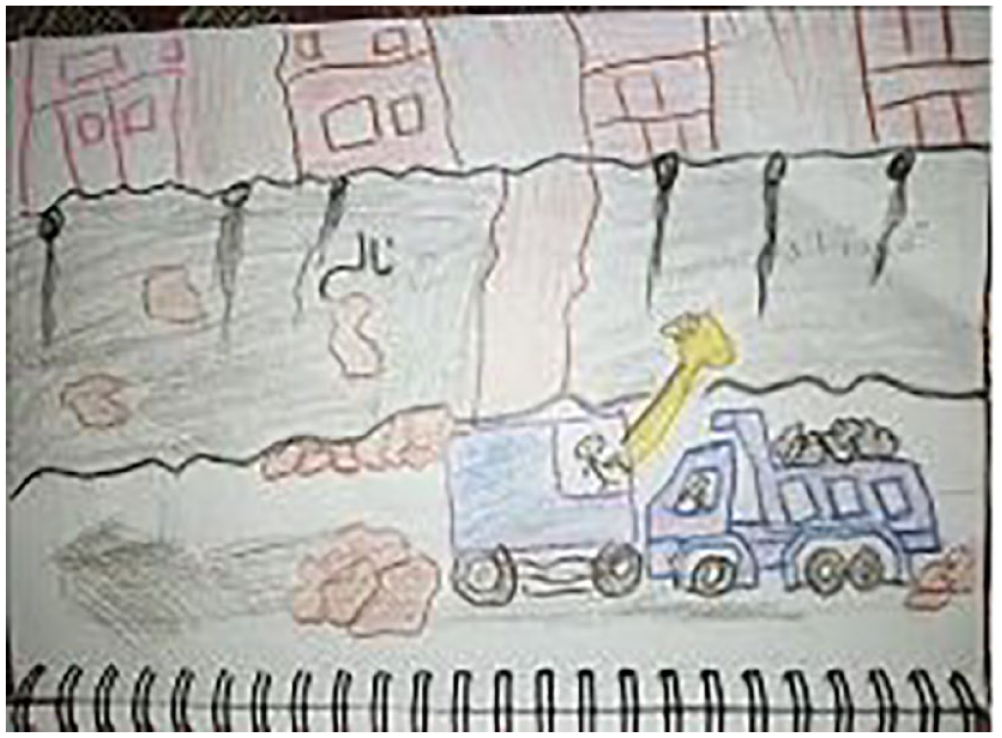
‘Due to construction work, stagnant sewerage water is everywhere near our house, we face difficult walk and going to school’ (Older child diary, Pakistan).
The children recognised that the virus was not operating in a vacuum, and that existing community and environmental challenges remained alongside those created by the disease, and by associated public health measures. They articulated the ways in which their immediate environment during the pandemic influenced their sense of wellbeing. Outside of the physical home, the local spaces that remained accessible were often not conducive to children’s needs or wellbeing. Everyday life in dense residential areas with precarious living conditions can emphasise ‘the ambivalence of [. . .] proximity (Bjarnesen and Utas, 2018: 9). For example, one older child argued that the sensory aspect of the environment contributed to the difficulties experienced: In front of my house everyone throws trash, and it smells so bad I find it very difficult in my neighbourhood. (Older child in focus group, Kenya)
The multiplicity of difficulties encountered by children was discussed, as participants highlighted the exacerbation of resource challenges created by pre-pandemic inequalities and adversities. They regularly endured power cuts and a lack of basic facilities. As one participant pointed out: Woke up at 6 o clock due to electricity load shedding. (Younger child diary, Pakistan) There was no gas at our place, and we had to bring food from outside, and whole day we suffered without any gas supply at home. (Older child diary, Pakistan)
Managing these adversities was exacerbated by the pandemic, as this had a direct impact on the job market, with many parents losing their employment. Financial crises were one of the main consequences reflected across all countries. Participants reported concerns on how loss of parental jobs impacted their day-to-day lives, with some reporting the everyday struggle to meet basic needs. The families’ financial conditions led to food shortages with many struggling to make basic ends meet. Some families had to borrow money to purchase food supplies, with this debt compounding their financial insecurities: Money was scarce and sometimes we did not have enough food. Our parents lost their jobs, they had to go to a loan shark to borrow money, but they did not have the money to pay those loan sharks, because they were unemployed. (Older child in focus group, South Africa)
The children were acutely aware of the impact of health security measures on the material resources and wellbeing of their families, even when they found their emotions difficult to articulate: It’s hard to tell how I feel. I understand my parents always struggle with money. They don’t have the money to buy even for themselves. (Older child diary, Kenya) I was very sad because we did have anything to eat for breakfast. When I asked dad to give us some money, he said he was broke. My other siblings were crying because they were hungry. (Older child diary, Kenya)
The consequences of these structural environmental and resource challenges related to both the wider systemic context of the country, and the specific additional adversities brought about by the pandemic. These were significant in many life domains, and children were especially cognisant of the emotional fallout on their communities.
I got to know few cases people were doing suicide because of financial issues. (Older child in focus group, Brazil) I saw many people struggling. (Younger child in focus group, Pakistan) A lot of people lost their jobs and went to sleep starving. (Older child in focus group, South Africa)
Pre-pandemic hardships such as sub-standard housing, overcrowding, poor sanitation, and limited access to food and basic utilities were thrown into sharper relief by stringent health security measures in the wake of the pandemic. In navigating these challenges, children in our study also reported ways in which they actively contributed during the pandemic to improve the social circumstances of their communities, increase wellbeing, and create a purposeful sense of home, exercising ‘practical and imaginative agency’ in the negotiation ‘of home and belonging-in-place’ (McDonnell, 2021: 121): We have been cooking and giving food to people who do not have food. (Younger child in focus group, South Africa) My cousin and brother distributed grocery items to people in need and I helped him. (Younger child in focus group, Pakistan) We have been giving the less fortunate kids our old clothes. (Older child in focus group, South Africa)
Majority world children in challenging environments and lacking basic resources still found ways to take positive actions to build relationships in their immediate communities, highlighting the ‘kinship-like ties [. . .] produced and reproduced in everyday life (Bjarnesen and Utas, 2018: 6). Our participants clearly related their understandings of the ways in which the pandemic-induced contraction of the spatial everyday was also a bringing together. As one participant articulated clearly: We care for each other, we help each other. (Older child in focus group, Brazil)
Theme two: Practices
Given the difficult environments and resource challenges the children, their families, and their wider communities faced, the ability to travel outside of these to other locales, and to undertake outside activities was vital to their pre-pandemic everyday lives. Under pandemic restrictions, activities such as school, leisure activities, religious rites, and wider family gatherings were curtailed, often overnight. Although schools are often ‘deeply ambivalent’ aspects of children’s everyday lives [. . .], ‘Closing schools as a response to pandemic had deep implications for children’s routines and their sense of safety, security, and connectedness’ (Bessell, 2022: 451).
Finding themselves ‘stuck’ at home impacted directly and immediately on children’s everyday security. Boredom prevailed, and the children felt and understood themselves to be trapped: I had a busy routine . . . but then the classes were suspended, everything closed down and I stayed at home, that was what affected me the most. (Older child in focus group, Brazil) The number of COVID cases doubled and I couldn’t leave the house. (Older child in focus group, Brazil) I think I’m dying of boredom. (Older child diary, Turkey)
The participants experienced pandemic restrictions on mundane practices including school as creating fear and loneliness too. Public health surveillance measures had a particular impact here (see Vaughan-Williams and Stevens, 2016): I felt lonely, I did not have time to play with my friend in the neighbourhood. (Older child diary, Turkey) It made me sad to see police officers patrolling, and we could not even play soccer in the street. (Older child in focus group, South Africa)
Typical mechanisms for mitigating fear, boredom, and loneliness were curtailed by pandemic restrictions. A key example was the role religion played in coping, as participants reported that the religious community activities that help to safeguard wellbeing were limited: I could not go to church. You know, when you go to church you have an assurance that God is right next to you and even when you pray. When you are at home you think about what you are going to eat, so when you are at church you do not think much about those things. It affected me because I did not go to church. (Older child in focus group, South Africa) Churches were closed and we lost hope, because it was the only place where we get our faith. (Older child in focus group, South Africa) Feeling so low that I was not able to go to church today. People are not allowed to attend due to government restrictions. (Older child diary, Brazil) My cousin was about to get married, then halls were closed, so we had a small event at my house, which wasn’t fun. (Older child in focus group, Pakistan)
In these circumstances, mundane practices such as family meal-times or games became central factors in the children’s everyday experiences and understandings of how they were navigating the extraordinary of the pandemic, as illustrated through the following drawing and diary entry: Today I ate pizza with my family. (Figure 2)

‘Today I ate pizza with my family’ (Younger child diary, Brazil).
My mom helped me the most. I used to get bored a lot in coronavirus, so she was the one who used to tell me different activities, she kept me busy, so that is why it was easy for me. I wasn’t getting any ideas while being bored at home and I used to get hyper, she gave me all the ideas. You can do this or that, do painting. She even participated with us in activities. (Older child in focus group, Brazil)
Disruption to the mundane practices sometimes also mitigated against boredom and loneliness as older siblings returned home from university or work outside of the home: My siblings from Nairobi just came back home. (Older child diary, Kenya) My brother has a mobile, we have a TV at home, my elder sister has a computer she uses while in the university. Once in a while I want to use them, so I talk to them. (Older child in focus group, Brazil)
Theme three – lived experience and emotions
The fundamental uncertainty of everyday life for majority world children was sharpened and exacerbated by the pandemic. The contraction of spaces and relationships, and the breaking and remaking of routines saw the children experience and articulate complicated imaginaries of the (pre-pandemic) past, present, and future. Children have often been found to actively work ‘at keeping distant or wider fears in perspective’, even when aware of risks in their environments (Skelton, 2013: 132). For some participants, this manifested as non-knowledge of the future: In life you expect the unexpected. In life you should always be prepared because you do not know what the future holds. (Older child in focus group, South Africa)
Participants also directly expressed their desires for a post-pandemic future, demonstrating again uncertainty over whether and when there will be an everyday without COVID-19: My wish is to end the virus. (Younger child in focus group, Turkey) I wish the virus was over, too. (Younger child in focus group, Turkey)
A sense of normality was important to participants. Some of the children spoke of a return to normal in the future: Everything will be like before, as it used to be. (Younger child in focus group, Pakistan)
Others imagined a post-pandemic ‘new normal’ (Figure 3).
When the pandemic will be over, I don’t think so things will be like before. (Younger child in focus group, Pakistan) And after pandemic, mask and social distancing will be compulsory like a new normal. (Older child in focus group, Pakistan)
Optimism characterised many participants’ images of a future free from fear, as these entries show. The top quotation is describing a drawing of the future from her diary.
The bad times of 2020 COVID is ending, and a girl is standing and watching the ending and a new chapter of my life is going to begin after COVID-19. (Figure 3)
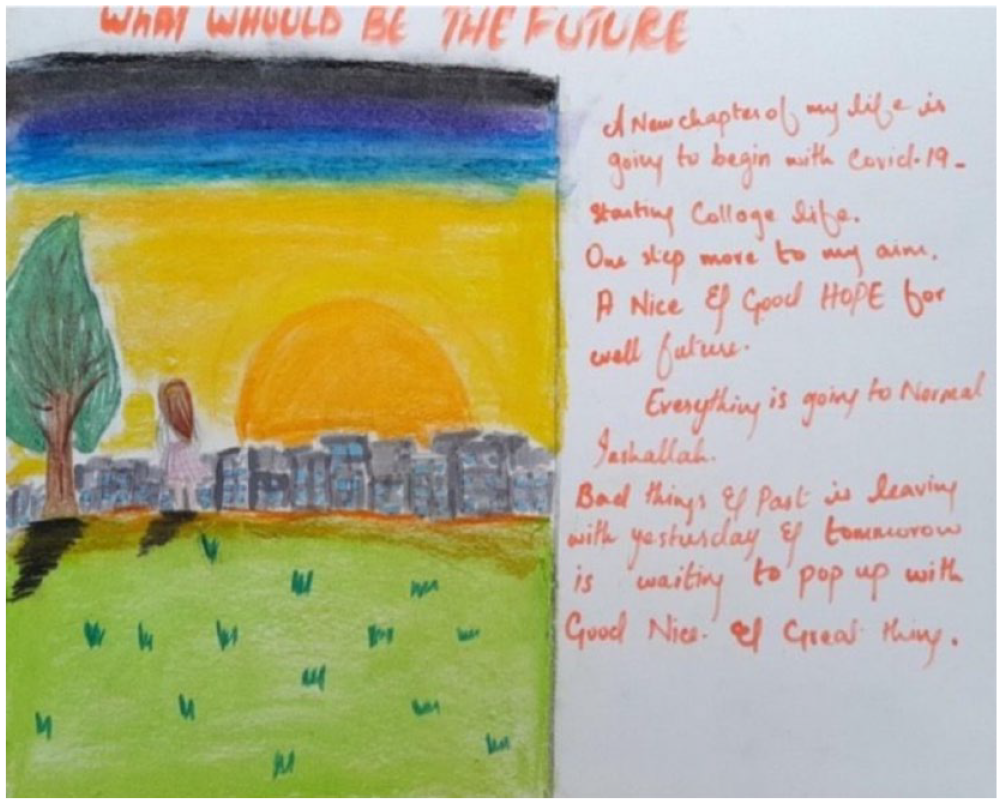
‘Because after Corona [. . .] is over, all will be normal, and we will see a new sunrise of HOPE’ (Older child in focus group, Pakistan).
For families with fewer resources, an approach to home as ‘futurity’, rather than homes of origins or memory is not uncommon (McDonnell, 2021: 124). In some cases, the post-pandemic ‘new normal’ was imagined by our participants as a future in which things were better than before, reflecting their understanding of their own resilience post-pandemic: People will learn from their mistakes. (Younger child in focus group, Turkey) It will encourage me in the future, and it will remind me of what happened in the past. (Older child in focus group, South Africa)
In some cases, specific lessons had been learned, often from family members, for example, on developing more adaptive mindsets and behaviours: I learned that we should make some savings for the future, so that when we encounter such events like the recent pandemic, we would be able to bear the expenses such as if we get ill, we can bear the expenses for the treatment. (Older child interview, Pakistan) [regarding Grandma] I learned to study as much as you can. (Younger child diary, Pakistan)
For others, the future contained risks and insecurities. One participant described the following picture on the future in their diary: There’s a robot, and there’s a guy who controls everything I drew here. I drew an apple tree and the candy apples come from that tree. What else, let me think. There is rain and lightning, and the lightning strikes the helicopter, and the helicopter is carrying a bomb. There are the planes that are hovering around, like armed forces planes. They are deploying missiles and shooting with machine guns [. . .] There’s a tornado hitting a car, and there’s a volcano spewing meteors, and lava too. (Figure 4)
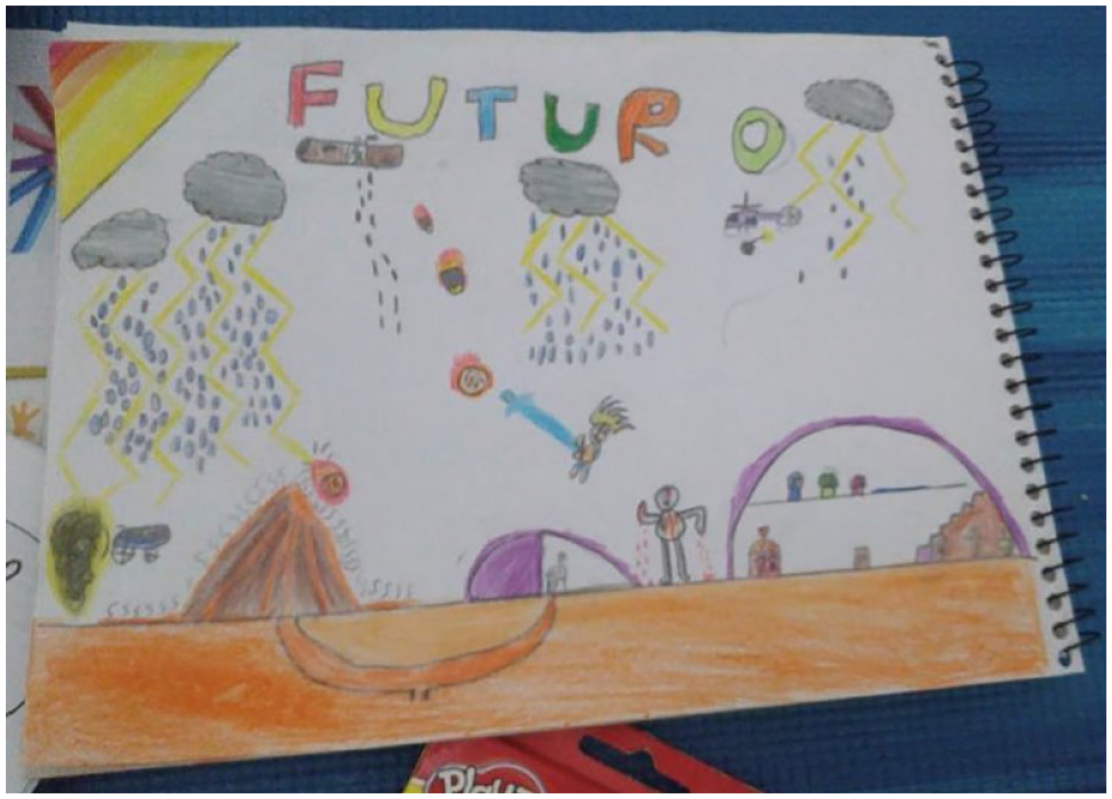
‘There’s a robot, and there’s a guy who controls everything I drew here. I drew an apple tree and the candy apples come from that tree. What else, let me think. There is rain and lightning, and the lightning strikes the helicopter, and the helicopter is carrying a bomb. There are the planes that are hovering around, like armed forces planes. They are deploying missiles and shooting with machine guns [. . .] There’s a tornado hitting a car, and there’s a volcano spewing meteors, and lava too’ (Younger child diary, Brazil).
Despite the many challenges faced, and uncertainty about the future, the children also expressed senses of agency, belonging, and kinship in being at home and home-making: Even though white people treated our parents unfairly, we do not have to do the same thing. Just because people have treated you badly, it does not mean that you should do the same. (Older child in focus group, South Africa) Many overseas were sent back to their counties during pandemic, so they all would be jobless, so we need to find employment for them, for which government should provide job opportunities for them. (Older child in focus group, Pakistan)
Other participants also looked to appropriate adults to create more opportunities for children in considering the future in recognition of their opportunities, wellbeing, and rights: I want to learn the guitar too, but I’m on the waiting list, because there are too many people interested. If there were more places offering music classes, everyone would be able to take them. (Younger child in focus group, Brazil)
Discussion
Our participants reflected on their lived experiences of – and feelings about – staying at home in a pandemic context characterised by contractions of the spatial and relational everyday, disruptions of routines, and curtailment of activities. The transnational space of a global pandemic impacted on children’s home lives and local environments, leading to the ‘re/making’ of home (McDonnell, 2021: 119). Children’s home lives during the pandemic saw them ‘forging and maintaining spatial and relational connections’ (McDonnell, 2021: 130) in ways that were ambivalent, and often very far from ideal (Brickell, 2012b: 228). Our findings indicate the impacts of the pandemic on children’s everyday lives, building on prior work (Beier, 2021; Cortés-Morales et al., 2022; Haffejee et al., 2023; Nahia et al., 2022; Tebet et al., 2022) interrogating the effects of this global emergency on pre (and post-) pandemic ‘corporeal practices, spatialities, im/mobilities, relationships and affects’ (Cortés-Morales et al., 2022: 2). Several implications of our findings discussed below may apply to children from different sociocultural contexts. However, we particularly focus on the additional or compounding concept of home and security for children living in disadvantaged majority world communities.
The pandemic, like other emergencies and crises, exposed global frailties and inequalities in basic needs and infrastructure associated with people’s local environments. Other research has observed the way that ‘expressions of resilience are disturbed by core vulnerabilities, and the extent to which there is an ‘unequal individualisation of global (in)securities’ (Botterill et al., 2019: 480–482). For children in the majority world, pre-pandemic sources of everyday insecurity in the local environment, such as poor housing, poor sanitation, and low household income, were intensified by the need to stay at home. As such, the pandemic intensified and highlighted ‘the crisis of a way of life that was already a problem for the majority of people before the pandemic’ (Cortés-Morales et al., 2022: 387). In this way, pre-pandemic conditions that can be understood as ‘slow emergencies’ (Grove and Adey, 2015) were intensified and made perceptible by the more ‘intense, dramatic’ (Anderson et al., 2020: 631) global emergency of the pandemic. Thus, while our case study is framed by an ‘unusual or spectacular event’ (Lemanski, 2012: 66), (in)security was navigated in the everyday, highlighting the co-constitution of the ‘unusual’ and the ‘mundane’.
The children we spoke with talked about feeling unsafe in relation to their local environments, pointing to inequalities and insecurities in their neighbourhoods. They spoke too of the impact of losing protective factors such as schools and external religious or social activities on their sense of wellbeing. In majority world countries, limited or absent structural supports render homes a site of increased importance to everyday security, and by extension, a potential site of insecurity. The manifest fragility and informality (Cortés-Morales et al., 2022: 3) of the children’s spatial everyday was clear to us, and to the children themselves.
In the children’s concerns about their neighbourhoods, we see how ‘the density of residential areas and public spaces and the precarity of the lives of most of their inhabitants bring out the ambivalence of the micro-politics of proximity with particular clarity and force’ (Bjarnesen and Utas, 2018: 9). Children’s anxieties about their material living spaces manifested in each of the five majority world countries in which we spoke to children. We found in our data the many ways in which the curtailment of already fractured support networks contributed to feelings of fear and isolation. Our findings corroborated those of Beier (2021: 161) in that the pandemic manifested in ‘its mapping over and exacerbation of other intersecting crises’. We agree that it represented not ‘a rupture in an otherwise more or less stable social world, but [. . .] a source of new demands made on children for whom emergency is quotidian’ (Beier, 2021: 161).
In some cases, extended family returning to the home signified a positive change representing new sources of comfort. The children we spoke to also often recognised when the need of others was greater and acted in ways to forge supporting connections with them. This supports previous scholarship on ‘the continuing potential of home as a site of solidarity, renewal and resistance, specifically for people who are [. . .] marginalised in wider society’ (McDonnell, 2021: 119). The children we spoke to also demonstrated versatility in their response to pandemic disruptions and restrictions (see also Favretto et al., 2023), as well as their ability to act to support and protect family members and others.
The temporal breaks posed by the COVID-19 pandemic and government health security regimes of varied stringency also had (unsurprisingly) significant impacts on children. With the severe disruption to children’s everyday routines and home life caused by the pandemic, children articulated feeling, stuck, bored, and lonely. However, even absent the context of a global emergency, home-making as part of everyday life generally involves contrasts, departures, and returns. As we all struggle to learn from the security politics of the pandemic, it is instructive to consider ‘quotidian experiences of disruption, and the processes by which routines become undone, reassembled, and reconfigured’ (Greene et al., 2022: 217).
The conception of a pandemic ‘anthropause’ suggests ‘a specific spatio-temporality in which time apparently slows down and/or stands still’: To inhabit a pause involves a sense of being in the middle of things, at a turning point, in a moment (or series of moments) of uncertainty. As such, pauses offer the chance for reflection. Equally, a pause is a disruptive, piercing event, engendering distinctions of ‘before’ and ‘after’. A pause is thus a moment of potentiality, suspended between past and future. (Searle et al., 2021: 70)
Searle, Turnbull, and Lorimer draw from this an analysis which revisits Arundhati Roy’s (2020) claim that ‘the pandemic is a portal’. They see in this the potential to embrace ‘the political potential of disruption, transition, and affirmative world-building’ (Searle et al., 2021: 74). The breaking and re-making of routines through activities and relationships can itself be creative and constructive.
We know that in times of emergency, ‘ordinary and unnoticed routines [. . .] are thrust into the spotlight as people struggle to maintain or recreate a sense of normalcy’ (Goode et al., 2022: 61): During the long pandemic season of 2020, the most common question has been, ‘When will things get back to normal?’ Arguably, the next most common question has been, ‘How do things get back to normal?’ followed closely by, ‘Will things ever get back to normal?’ and, finally, ‘Do we really want to go back to normal?’ (Goode et al., 2022: 61).
In this approach, emergency ‘bestows hope that a different future is possible’ (Kurylo, 2022: 14). Mandich has demonstrated the power of fear in reimagining the future. In her analysis, fear ‘questions the ‘feeling at ease’ in everyday experience’ (Mandich, 2020: 693). Her research, and ours, point to the importance of fear and hope as affective aspects of everyday life in conditions of uncertainty, and hence as concerns for understanding the (everyday) politics of security in all of its entanglements.
Unsurprisingly, many of the children we spoke to expressed the desire for ‘the virus to be over’. Beyond that, some children expressed the desire to get back to normal, whereas others imagined a ‘new normal’, which – at the extremes – was either apocalyptic, or hopeful. The children’s narratives of how they were affected by the pandemic demonstrate ‘contestations of the boundaries that they experienced as unjust and thus restricted their sense of belonging’ (Karlsson, 2019: 438). This applies not only to the ‘boundaries’ of pandemic restrictions, but to trans-pandemic boundaries experienced by children through ‘manifold inequalities in all aspects of life’ (Cortés-Morales et al., 2022: 387) that pre-dated and have out-lasted the security politics of the emergency pandemic responses. Our findings support the claims of Cortés-Morales et al. (2022: 387) and others that many people disadvantaged by the normal security practices of global politics ‘do not want to ‘go back to normal’, because ‘normality was the problem’.
This contrasts directly with the security politics of emergency governance, which retain a status-quo expectation that ‘the non-emergency everyday can be returned to’. Anderson et al. (2020) have noted the underpinnings of such governance on a ‘geo-historically specific distinction between the everyday and the emergency’. By contrast, in their imaginings of ‘new-normals’, the children spoke of lessons learned, reimagined relationships, and articulated their demands for stronger infrastructures and greater opportunities. Research in childhood studies addresses the relationship between children’s agency, relationships, and interdependencies (McDonnell, 2021: 119). Although dependent on so much beyond their control, and on their families, there is evidence here of ‘young people’s resistance and resilience to challenging circumstances through embodied and emotional strategies’ (Botterill et al., 2019: 469).
We too saw in the children’s hopelessness and hopes for the future the ‘political potential of disruption, transition, and affirmative world-building’ (Searle et al., 2021: 74). Our participants’ constructions of home ‘inspire[d] imaginings of the future’ (Kallio and Häkli, 2013: 9). In the uncertainty of the pandemic, children imagined the future, connecting to the notion of ‘home as futurity’ (McDonnell, 2021: 124). Children’s representations of homes ‘transcend[ed] its physicality, moving to include [. . .] projections into a future home’ encompassing ‘qualitatively different belongings’ (McDonnell, 2021: 130).
Homes are made and remade across spatial, temporal, and affective dimensions of the everyday, all of which contribute to the everyday life of security. This is particularly the case for children because of their dependent status, and even more so in majority world countries with lower levels of formalised support for children’s rights and development. The voices of children in majority world countries during the pandemic highlight both the importance and ambivalence of home, which served in turn as a catalyst for their imaginings of post-pandemic futures. Our interdisciplinary, participatory, and multi-method approach to engage children in majority world countries yielded important insights into children’s own understanding of (everyday) security politics, and of home-making, which we connect in turn to world-building. While experiencing degrees of dependence and vulnerability, children were empowered by their hopes for the future, informed by their understandings of the past and present.
We argue in conclusion that majority world children’s active navigations of pandemic security practices demonstrate the centrality and vitality of informal and mundane protections against insecurities. They also help us think critically about everyday security in uncertain presents and futures. Although our participants, as majority world children, were dependent and vulnerable in multiple ways, their remakings of home and imaginaries of the future demonstrate the intersection of ‘the spatiotemporalities of childhood [. . .] with other spatiotemporal schemes’ (Allerton, 2023: 767). What we have chosen to call (everyday) security politics attempts to capture the blurred and messy entanglements of spatial, temporal, and affective schemes still often analytically separated.
Conclusion
For children, staying at home during the COVID-19 pandemic impacted on their everyday securities. Our study had three key, interlinked findings. First, our participants experienced and understood the importance of the spatial everyday (mundane spaces) in terms of their housing, immediate environments, and resources (and lack thereof). Second, they experienced and understood the significance of the temporal everyday (routine practices) through pandemic-induced disruptions, curtailments, and the remaking of the quotidian. Finally, they experienced and understood the (everyday) security politics of the pandemic in relation to their feelings about the pre-pandemic past and pandemic present, and in their anticipation of the future.
The unsettling effects of the pandemic further destabilised many of the ‘systems of provision’ for majority world children (Greene et al., 2022: 216) compounding the ‘slow emergencies’ that already characterised their everyday lives. However, our findings support the positioning of children as independent social actors in defining home, safety, and future aspirations in the face of adversity, through their lived experiences. In majority world contexts where children may feel excluded from decision-making and constrained by socioeconomic barriers, participants as young as 8 years old demonstrated that, given the opportunity, they can articulate their sense of home and belonging, and thus both extend and redefine their roles and participation as citizens.
In this article, we have set out an account of the (everyday) security politics of the pandemic, looking to its spatial, temporal, and affective dimensions. This article explores children in the majority world’s experiences of the stringent health security practices implemented in response to the COVID-19 pandemic. Drawing on original empirical research in five majority world countries, it examined children’s own accounts of their experiences of lockdowns and stay-at-home orders. Our analysis of the children’s narratives has drawn out the spatial, temporal, and affective dimensions of home-making under stay-at-home orders. We have highlighted complex and ambivalent connections between the notable and the mundane, between security and the everyday, and between home-making and world-building.
The children we spoke to already recognised the extent to which pandemic emergency measures will ‘reverberate [. . .] into the future’ (Crawford and Hutchinson, 2016: 1193). We have tried to argue in acknowledgement of the children’s own words and drawings, and drawing on existing literature, that these futures are not yet written. From this, we sketch an image supporting an image of (everyday) security politics in which homes and home-making interact with, blur with, and are entangled with the world and with security politcs such that ‘the everyday’ and ‘security’ are impossible to separate. To circle back to Nyman (2021: 325), we find that security politics is experienced, felt, and articulated through ‘living in, traversing, managing, making, and feeling’ the spaces of state-led security efforts by human beings.
We argue in conclusion that it is vital to ‘hold security and resilience mutually in tension while keeping children’s subjecthood [. . .] and vulnerability both conspicuously foregrounded’ (Beier, 2020c: 221). While experiencing degrees of dependence and vulnerability, the children we spoke to were empowered by their hopes for the future, informed in turn by their understandings of the past and present. Children’s active navigations and narratives of security and insecurity during the pandemic highlight the centrality and vitality of informal and mundane protections against insecurities, contributing to our understanding of the ‘(important) banality of security and security politics’ (Anderson et al., 2022: 6).
Footnotes
Acknowledgements
The authors offer their sincere thanks to the two reviewers for this journal for their clear and constructive feedback.We would also like to thank the other members of their project team at the University of Leicester: Clare Anderson, Effie Lai-Chong Law, Grace Sykes, Harry Dixon, and Caroline Upton, and acknowledge the role of our partners, Şeyda Eruyar, Elijah Mironga Getanda, and Juliana Fleury. Thanks are owed also to Rachel Keighley, and Louise Freeland, and to the teams that supported data collection in each country. Our biggest thanks go to the children and young people who spent time with us teaching us about their lives and hopes.
Funding
The author(s) disclosed receipt of the following financial support for the research, authorship, and/or publication of this article: The authors are grateful to the Leicester Institute for Advanced Studies and the Global Challenges Research Fund for funding this project.
