




Abstract
Political science and international relations have undergone substantive internationalisation over the last 25 years. This short article uses a dataset covering all papers published in the British Journal of Politics and International Relations to investigate how authorship in the journal has changed over time in light of this. It finds that while, overall, BJPIR has been dominated by authors based at institutions in the United Kingdom, the journal has clearly internationalised over the past 10 to 15 years. This internationalisation has mostly been driven by increasing numbers of authors based at European institutions whereas work by authors from outside Europe, North America, and Oceania remains relatively rare. These results provide insights into the journal’s development over the past 25 years, but also the extent and the limitations of the internationalisation of political science and international relations more generally.
Introduction
English has emerged as the predominant academic language (Altbach, 2007), leading to a growing trend among non-native English-speaking scientists to publish their work in English, under the assumption that doing so will enhance the visibility and citation rates of their articles (Di Bitetti and Ferreras, 2017). Although this trend presents several negative implications, such as favouring particular scholarly traditions and methodologies, fostering the pursuit of specific research agendas, and providing an advantage to native English speakers, it also yields positive outcomes. For example, in the fields of political science and international relations, the use of English as the lingua franca has arguably facilitated the integration of the discipline, fostering the exchange of ideas and the advancement of scientific knowledge. But for English-language political science and international relations journals initially committed to the study of a ‘national’ field, it has also resulted in a push to diversify both the topics and contributions they cover as they have sought to find their place in this internationalising field.
Background
The British Journal of Politics and International Relations (BJPIR) exemplifies this trajectory. Initially, its primary focus was on matters concerning British politics; the inaugural Editorial in 1999 underscored the journal’s mission to ‘deepen and broaden our understanding of British politics’ (BJPIR, 1999: 1). However, by 2010, the narrative surrounding the journal’s strengths and aims had changed. Editors from Belfast noted that ‘the journal has been evolving into a major outlet for political studies and international relations scholarship in the UK and beyond, but that itself is an ongoing process that needs to be fostered and encouraged by editors’ (BJPIR, 2010: 155). In addition to various other strategic areas of growth, the Belfast editors expressed a commitment to publishing works spanning theoretical frameworks different from the English School of IR or the Welsh School of Critical Security Studies, broadening accepted methodologies, and extending subjects beyond British domestic and international politics to include post-colonial politics, and global then ‘hot’ themes such as the war on terror.
The latest editorial, published initially in 2021, marks yet another significant shift towards diversifying topics and contributions, refocusing the journal on the politics of global challenges (BJPIR, 2022). Now, the stated editorial aim is ‘to position “BJPIR” at the forefront of scholarly efforts to understand and address the politics of global challenges, such as climate, health, violence, and geopolitics’ (BJPIR, 2022: 3). The editors also explicitly express their commitment to leveraging their position ‘to support the discipline-wide effort towards gender parity, and improve the journal’s representation of underrepresented minority groups, scholars from the Global South, and early career researchers’ (BJPIR, 2022: 3).
Motivated by these developments in editorial vision which mirrored the increasing internationalisation of the fields of Political Science and International Relations, this article aims to explore whether the intended-for diversification of contributors in BJPIR has indeed materialised. In doing so, we view this as a case study of a prominent English-language journal which, in line with internationalisation pressures, has sought to move from a clear focus on the ‘national’ field of British Politics to a more diversified range of topics and contributors. This short article investigating the geographical diversity of work published in BJPIR thus speaks to recent work investigating the internationalisation of political science and international relations (see e.g. Carammia, 2022), but also their diversification in terms of gender (see e.g. Pflaeger Young et al., 2021; Verney and Bosco, 2022) and race (e.g. Akram, 2024; Henderson, 2014; Zvobgo and Loken, 2020).
To this end, we investigate three research questions concerning the geographical diversification of work published in BJPIR. First, what has been the overall author composition of published articles in BJPIR across its 25-year lifespan from 1999 to 2023? Second, how has the proportion of articles published by British-affiliated scholars changed over time? And third, has there been an increase in published authors affiliated with institutions in the ‘global’ South, or has a potential overall trend towards internationalisation been driven by authors with Western affiliations outside the United Kingdom?
Empirical analysis
To investigate these questions, we use data on the geographical location of the corresponding/submitting author(s) of papers accepted for publication in BJPIR over its first 25 years of existence. We were graciously granted access to a part of the data by the BJPIR editorial team, including published manuscript IDs, types, acceptance dates, and the country of the submitting author’s institution between November 2008 and the end of 2023 1 . To extend this dataset in order to cover the entirety of the journal’s existence, we hand-coded the country of the institution of all listed corresponding authors for the journal volumes 1–11 from the journal’s online presence 2 . Since the first article covered by the dataset the editors provided us with appeared in issue 11(3), we removed issues 11(3) and 11(4) from the hand-coded data and then combined the two partial datasets. Our final dataset covers all accepted manuscripts during the first 25 years of BJPIR.
This dataset allows us to trace changes in the countries’ institutions of publishing authors over time, thus offering insights on how the journal has done in its quest to diversify contributors. But before doing so, we need to acknowledge the limitations of our data. In particular, we do not capture authors’ nationality or country of socialisation, but instead only where they are employed. And especially for articles with a group of authors, the country of the corresponding author’s institution may well be unrepresentative 3 .
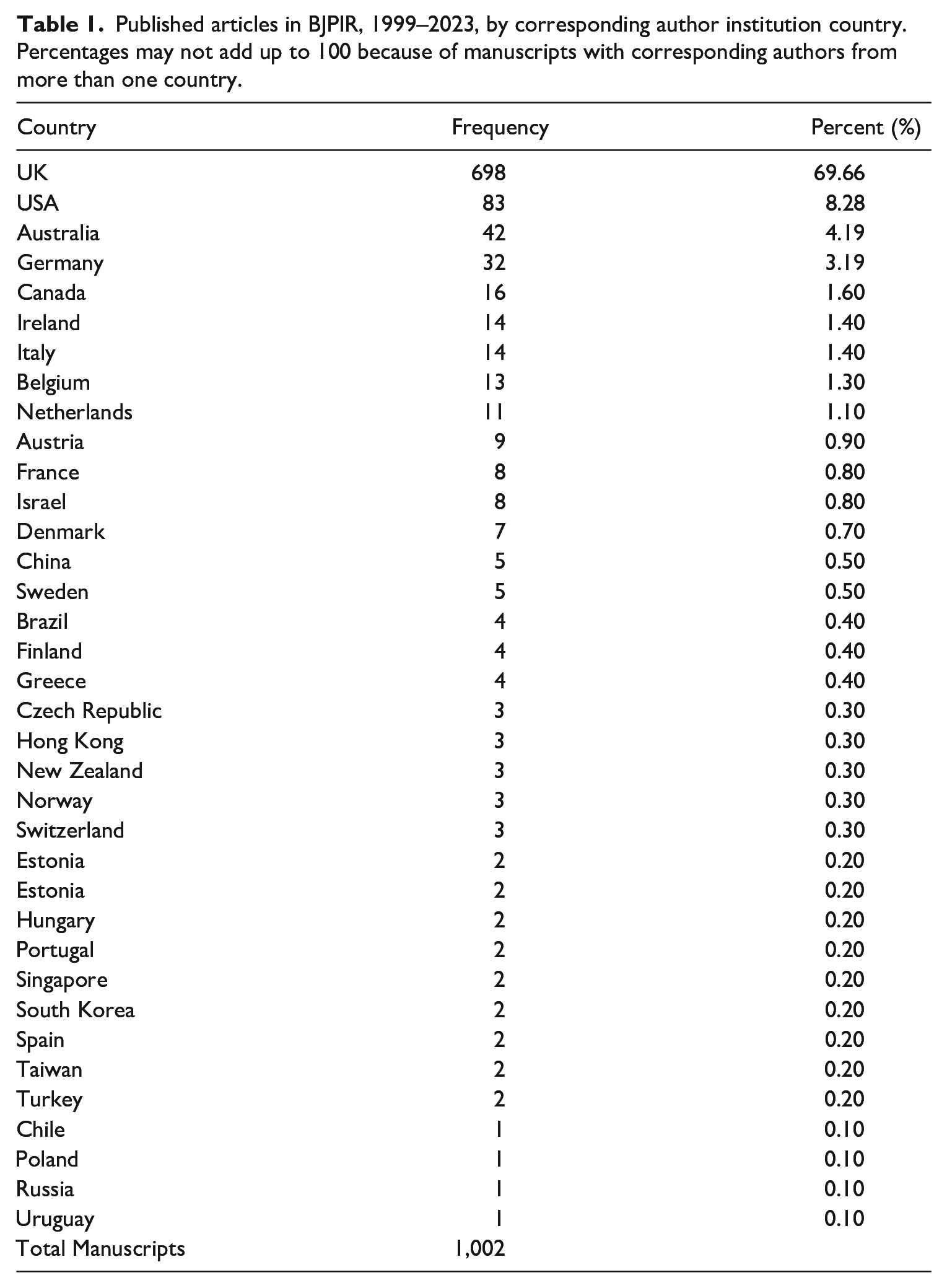
To address the first research question, Table 1 simply shows the countries represented among the institutions of authors publishing in BJPIR, ordered by their frequency. It is striking how dominated BJPIR has been by UK-based academics as almost 70% of published articles feature a British corresponding author. The next most prominent country, with a measly 8.3% of published articles, is the United States while authors based at Australian institutions come in third, with 4.2% of published articles. This first stab at the data thus indicates that BJPIR is, indeed, very British. It also suggests that even where authors are not based at British universities, they tend to work in closely related academic systems (Australia, Ireland, and Canada) or have a special interest in British Politics 4 . For its first 25 years, BJPIR has thus clearly mainly been an outlet for British political studies with only few international contributors.
Published articles in BJPIR, 1999–2023, by corresponding author institution country. Percentages may not add up to 100 because of manuscripts with corresponding authors from more than one country.
However, a closer look at the data offers some reasons for optimism in this regard. Figure 1 shows how the share of UK-based authors in a quarter-year has changed over time. Given that some quarter-years include only very few observations, with many journal issues only including six articles and some quarters experiencing little activity in terms of acceptances, the trendline is jumpy. Overall, however, British authors’ dominance of BJPIR has reduced over time, a picture that is supported by the smoothed trend line. In its early years of existence, BJPIR regularly featured all-British issues. But beginning in 2008, authors started to become more diverse and since ca. 2013, UK-based authors account for less than two-thirds of all work published in BJPIR. In the years 2019–23, there were even several quarter-years where UK-based authors did not form the majority among accepted articles. However, even in this most recent period, the overall trend still indicates that British-affiliated authors account for more than half of all accepted articles. While BJPIR has thus clearly made strides towards becoming more international, it does remain a very ‘British’ journal with, potentially, a lot of work left if further diversification is intended.
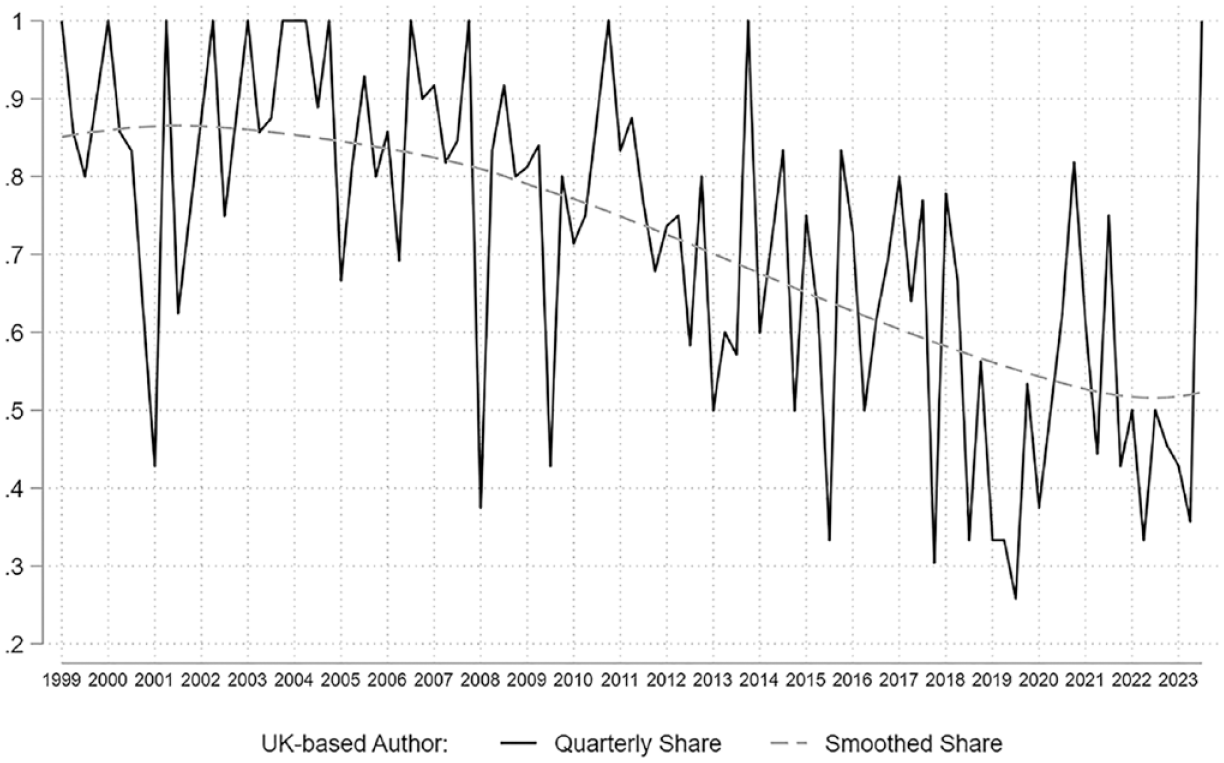
Share of UK-authored articles in BJPIR over time (quarter 23.4 removed due to only one observed acceptance), quarter-yearly observations. Smoothed share uses locally weighted scatterplot smoothing (bandwidth: 0.8).
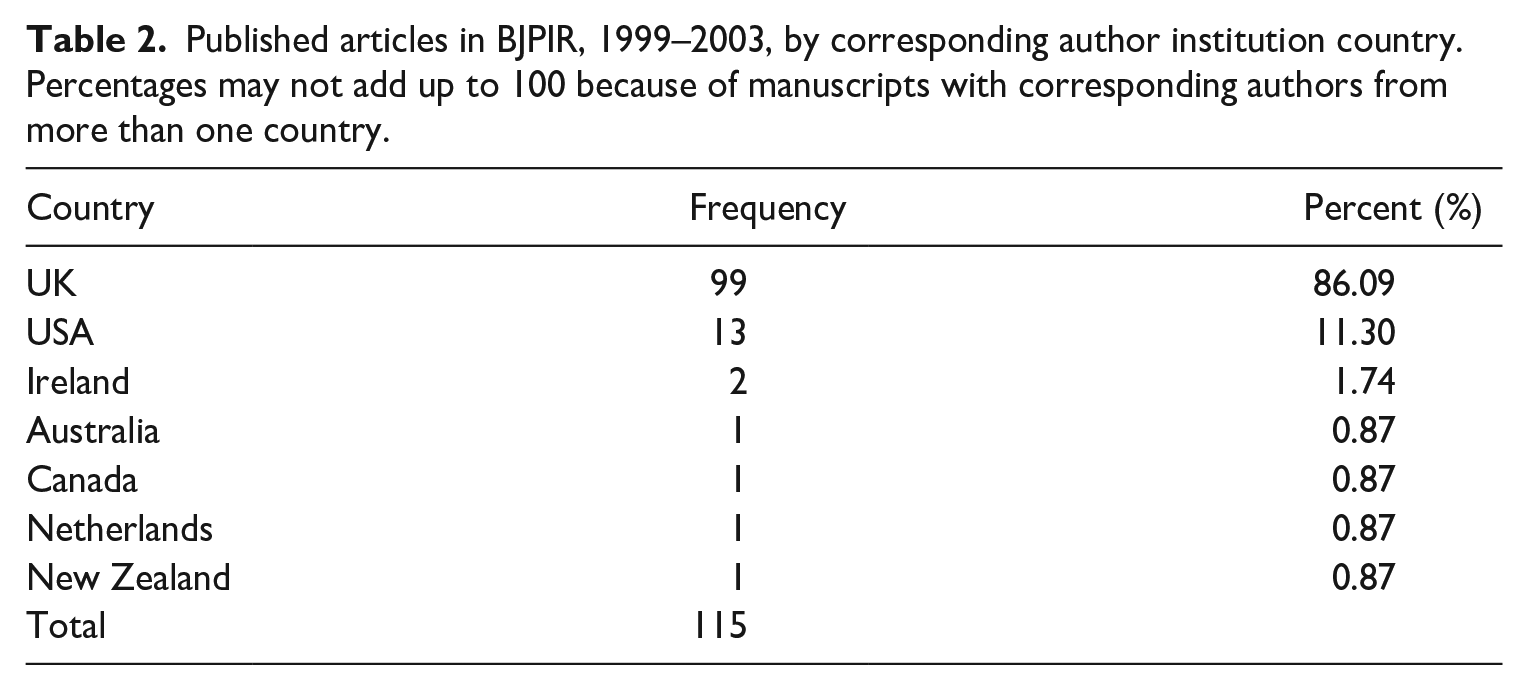
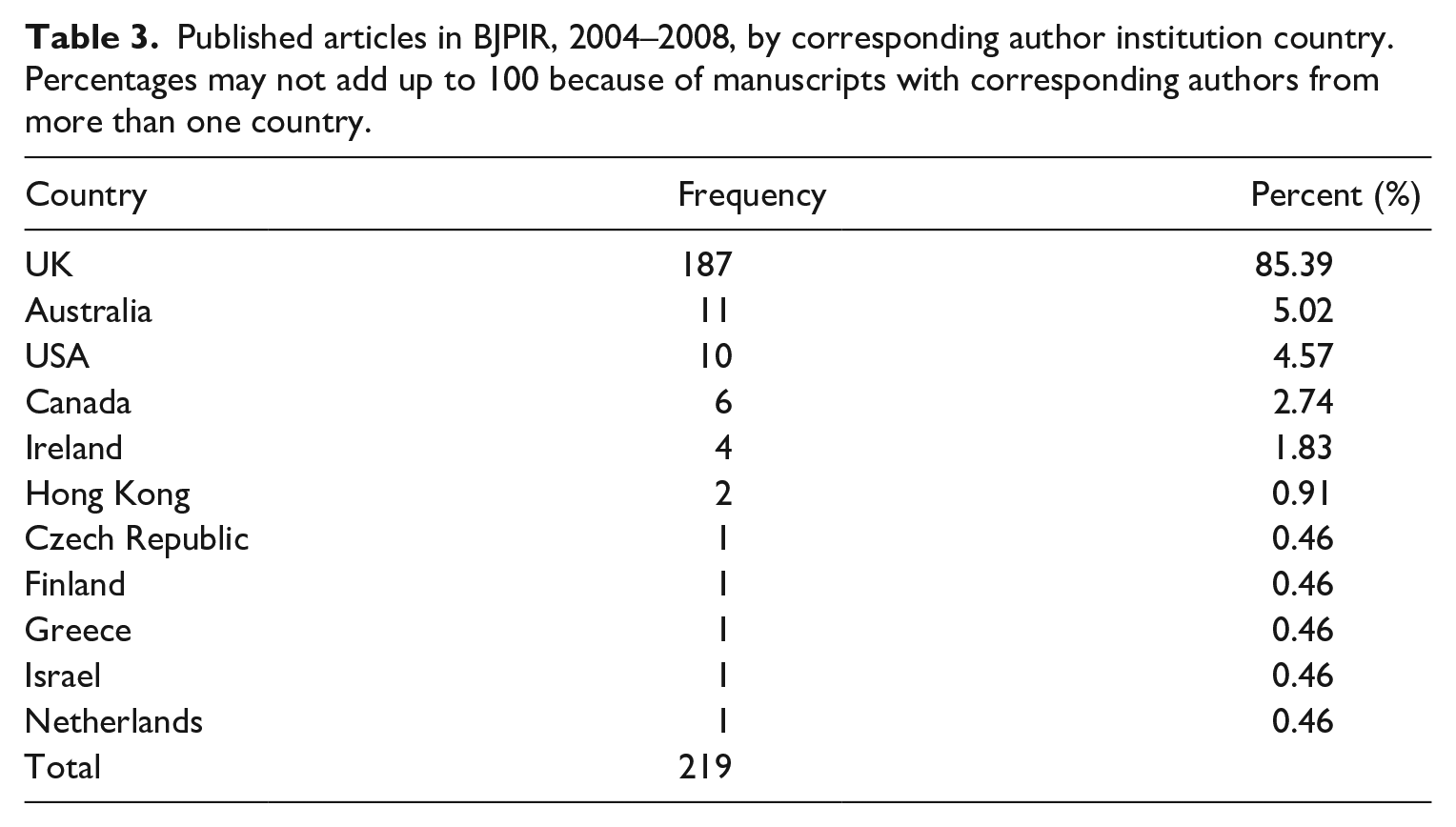
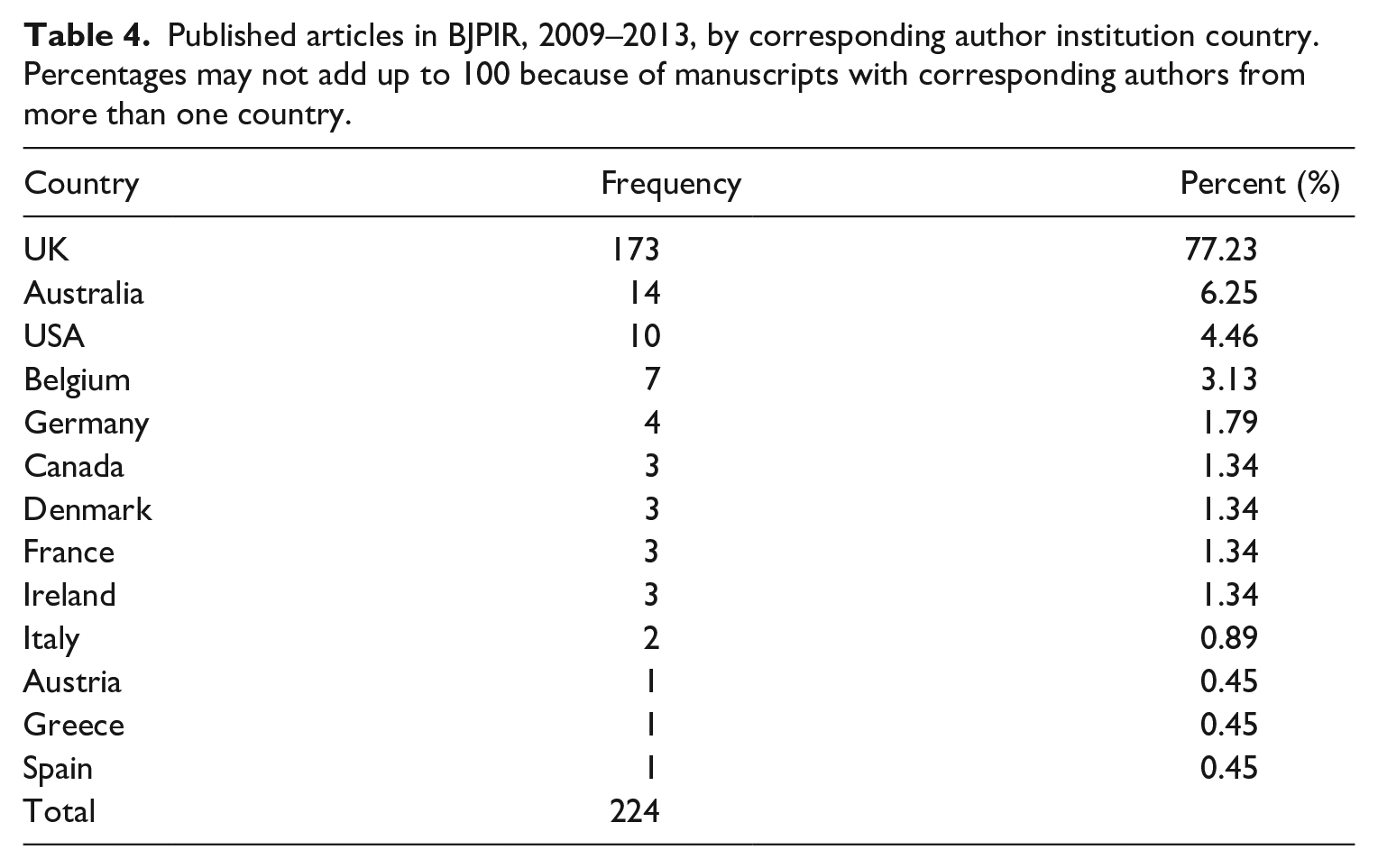
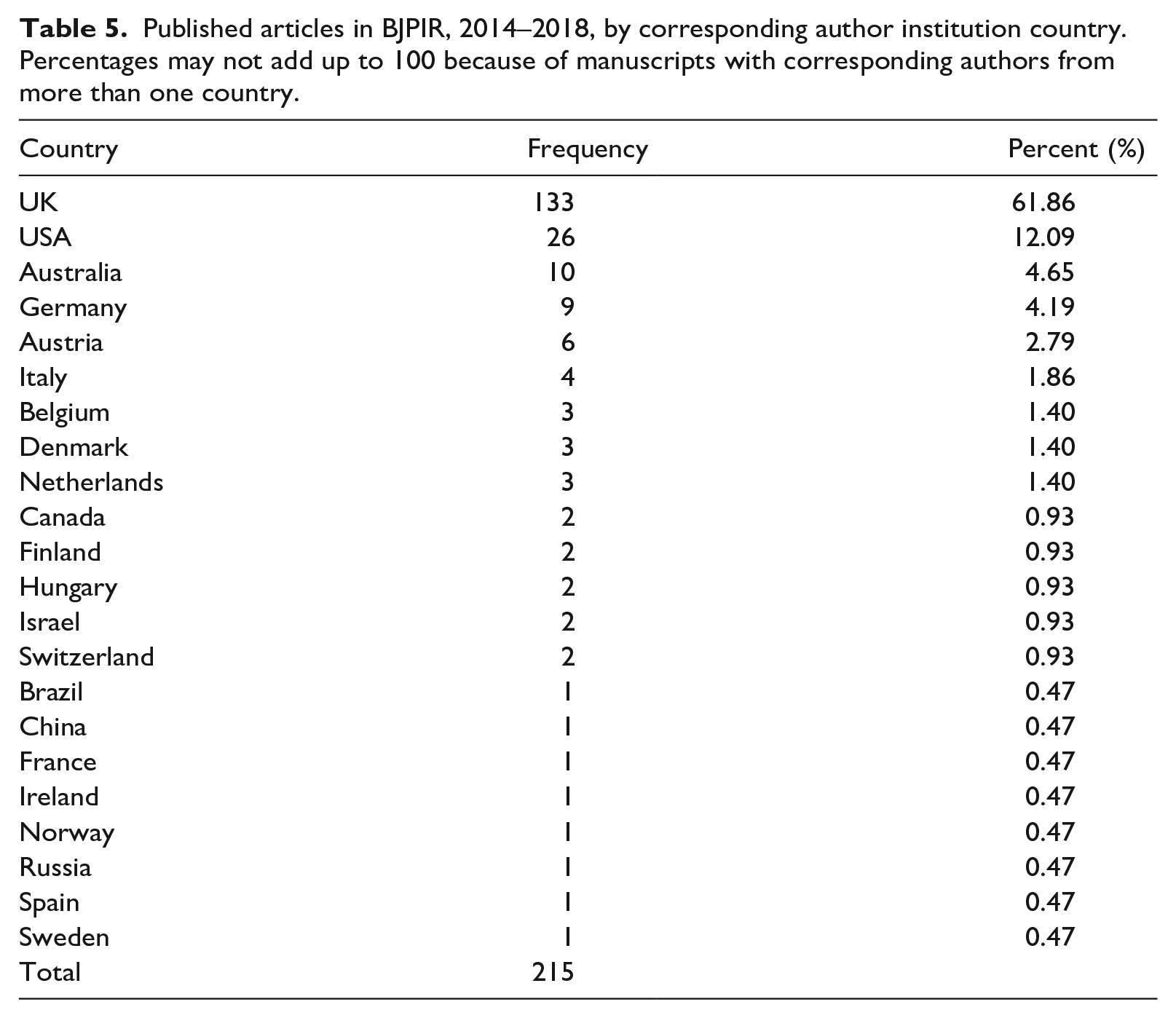
Finally, we look beyond the UK to understand where, since the share of UK-based authors has reduced over time, publishing authors are now based. For this purpose, we split the dataset into five 5-year intervals and then present tables showing the countries where authors were based for each of them. This way, we can understand trends in diversity in terms of the pure number of countries, but also whether UK-based authors’ articles were simply replaced by work from other countries of the global academic north, such as the United States, Germany, or the Netherlands, or whether the journal actually diversified its reach further, especially in terms of featuring work by scholars from outside Europe, North America, and Oceania. Tables 2 to 6 accordingly report the countries represented among published work in BJPIR for the periods 1999–2003, 2004–2008, 2009–2013, 2014–2018, and 2019–2023, respectively.
Published articles in BJPIR, 1999–2003, by corresponding author institution country. Percentages may not add up to 100 because of manuscripts with corresponding authors from more than one country.
Published articles in BJPIR, 2004–2008, by corresponding author institution country. Percentages may not add up to 100 because of manuscripts with corresponding authors from more than one country.
Published articles in BJPIR, 2009–2013, by corresponding author institution country. Percentages may not add up to 100 because of manuscripts with corresponding authors from more than one country.
Published articles in BJPIR, 2014–2018, by corresponding author institution country. Percentages may not add up to 100 because of manuscripts with corresponding authors from more than one country.
Published articles in BJPIR, 2019–2023, by corresponding author institution country. Percentages may not add up to 100 because of manuscripts with corresponding authors from more than one country.
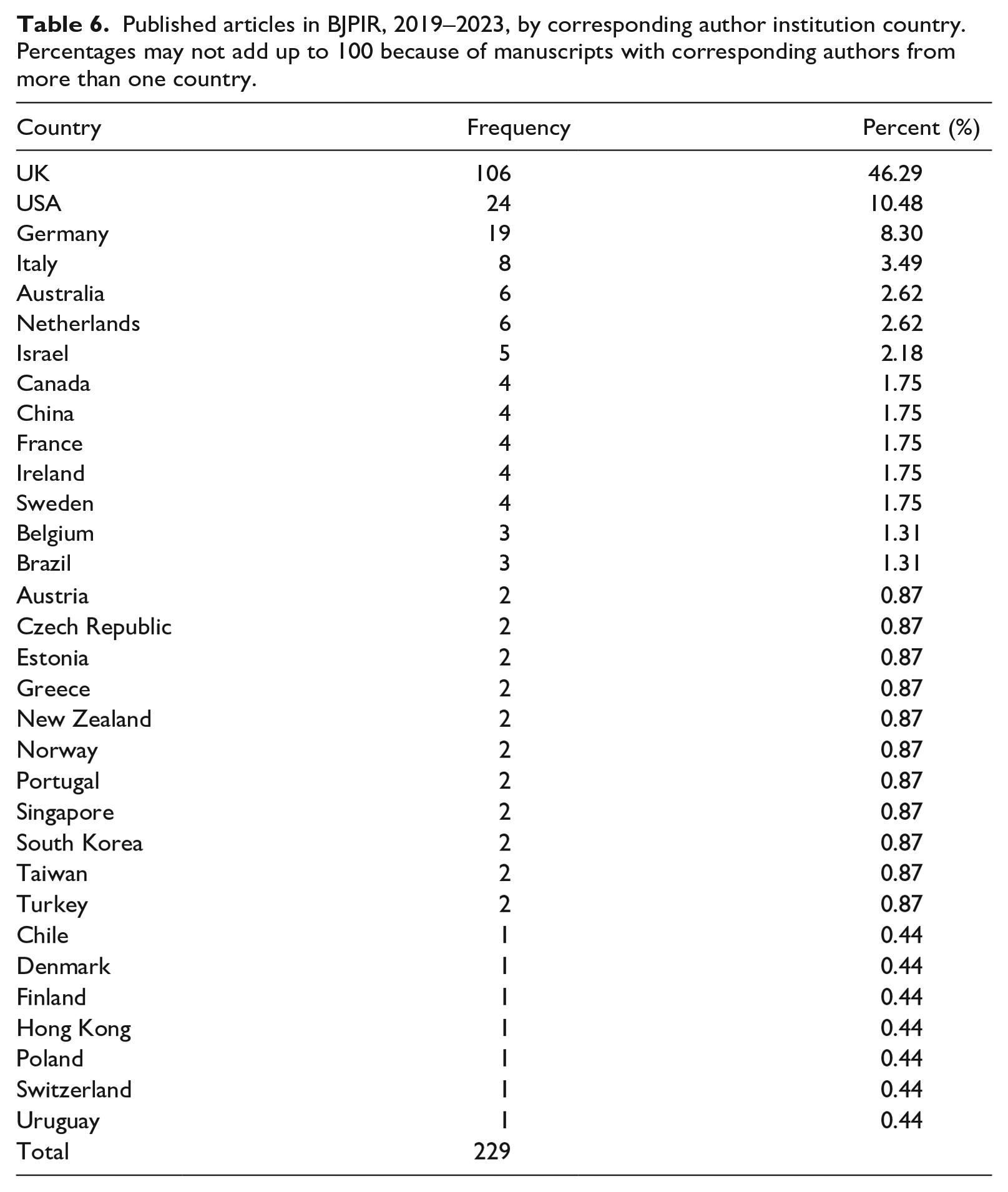
A first takeaway from Tables 2 to 6 is that over time, BJPIR authors have clearly become more diverse in the sense that they represent institutions in more countries. While in each of the first two 5-year intervals authors were based in less than a dozen countries, 22 countries were represented among authors’ institutions in 2014–2018 and in 2019–2023, this number grew even further to 32. In this sense, BJPIR has clearly been able to diversify its contributors as authors based in many more different countries have been able to publish work in its pages. In line with this and mirroring Figure 1, the percentage of UK-based authors has also gone down over the years, with Table 6 even showing that, when looking only at the 5-year period from 2019 to 2023, these contributors accounted for less than 50% of the manuscripts accepted for publication.
At the same time, Tables 2 to 6 also highlight that while BJPIR has thus been able to diversify the profile of its contributors over the past 25 years, it very much remains a journal dominated by authors from Europe, North America, and Oceania. While Tables 5 and 6 show that work by authors based outside these geographical regions has started to be accepted more in the last 10 years, these manuscripts still form a clear minority. Instead, where BJPIR has arguable been most successful is diversifying the sources of its accepted manuscripts within Europe.
Conclusion
This short article looks for the international in International Relations and Political Science by investigating where the authors publishing in the British Journal of Politics and International Relations over its first 25 years have been based. Using a dataset covering the more than 1000 manuscripts accepted for publication over this time, it finds that while, overall, the clear majority of work published in BJPIR has come from UK-based authors, there also has been substantial movement towards increasing internationalisation over the last 10 years. While almost 9 out of 10 papers published in the journal during its first decade were authored by UK-based academics, such papers accounted for less than half of all work accepted in the last 5 years. Instead, BJPIR now increasingly publishes work by authors based elsewhere in Europe. In contrast, manuscripts from outside Europe, North America, and Oceania remain a small minority in the pages of BJPIR.
As BJPIR (2022: 3) aims to ‘improve the journal’s representation of under-represented minority groups, [and] scholars from the Global South’, it thus appears that editorial policies for a more ‘targeted’ approach to internationalisation are needed. Along these lines, it may be useful to consider publishing special issues that focus, for instance, on Global South perspectives on a given topic, or to take up the journal Migration Politics’ (2023) practice of an authors’ fellowship in residence programme, though aimed specifically at Global South scholars. But amid this discussion of how to further internationalise BJPIR, we also believe it useful to return to the journal’s initial and most recent editorials (BJPIR, 1999, 2022), which both highlight British Politics as the topic at the journal’s core. In order to further open the journal to under-represented and Global South scholars, it may perhaps be necessary to interrogate and modify what counts as, and should be published by journals focusing on, British Politics and, for that matter, International Relations (see Akram, 2024; Zvobgo and Loken, 2020).
Footnotes
Acknowledgements
The authors would like to thank Jack Holland, and the entire BJPIR editorial team, for giving us access to data on BJPIR author locations, Francesca Petrizzo for providing and helping us with these data, and two anonymous reviewers for their feedback on an earlier version of the manuscript.
Funding
The author(s) received no financial support for the research, authorship, and/or publication of this article.
