




Abstract
This article seeks to explain why spatial policy in England has been so ineffective in recent decades. It offers a novel framework – ‘Hyper-Active Incrementalism’ – to conceptualise the way that public policy in this area is prone to being short-term, under-evaluated, reactive, fragmented, incremental and top-down. It applies this framework to a historical survey of spatial policy, offering a nuanced understanding of the causes of these pathologies. We argue that Hyper-Active Incrementalism helps explain the persistence of a range of Westminster pathologies, as it drives the ongoing dialectic relationship between over-centralisation and policy failure. The data drawn from our historical survey suggest that Hyper-Active Incrementalism has accelerated overtime, a dynamic of increasing governance fragmentation that contributes to the incoherence of the UK state. In conclusion, we argue that governments must learn from past failure not just in this policy area but also elsewhere, by adopting a system-wide approach to reform.
Keywords
Introduction
The United Kingdom is ranked as one of the most regionally unequal high-income countries in the world (Wong et al., 2019: 3). Past and present governments have overseen multiple initiatives to address what is referred to as the ‘geography of discontent’ stemming from regionally concentrated economic disadvantage (McCann, 2016). Success in this area has at best been patchy, revealing a range of policy shortcomings. Yet, the salience of this policy agenda has continued to grow as regional inequality has markedly increased. The nature of the UK political economy has seen the concentration of service and finance-related industries in London and the South-East of England, while the structural position of the North and Midlands has been eroded by the relative decline of heavy and manufacturing industry. The recent period has been marked by the financial crisis of 2008–2009 and the Coalition Government’s post-2010 programme of fiscal retrenchment, alongside greater localised inequalities between towns and cities, in conjunction with longer-standing north-south and east-west disparities. This article poses a deceptively simple question: why have UK governments over time been so ineffectual at resolving the issue of spatial inequality within England?
If we consider this question in terms of policy failure, there is an extensive literature identifying the role played by the United Kingdom’s highly centralised state in leading to ‘bad’ policies, which ultimately fail to live up to either their rhetorical framing or core objectives (Butler et al., 1994; Dunleavy, 1995; King and Crewe, 2014; McConnell, 2010; Marsh et al., 2024). The United Kingdom and England, in particular, has long been recognised as one of the most centralised of all liberal-democratic political systems (Carrascal-Incera et al., 2020; Diamond et al., 2016; Newman and Kenny, 2023). Recently, both the Conservatives and Labour have framed centralisation as a key determinant of policy failure in this area. The Johnson Government’s flagship policy on levelling up 1 argued, ‘. . . It is not just that this country is the most economically imbalanced – it is the most centralised’ (HM Government, 2022: x). Similarly, Starmer’s Labour Party observes, ‘. . . Economic imbalance is exacerbated by the gross over-centralisation of the UK state . . .’ (Labour Party, 2022: 37). Both have argued for a more decentralised approach to remedy the issue.
It is, then, the issue of centralisation that we investigate in this article as the major driver behind the persistent failure to address spatial inequality. What is particularly striking in this policy area is the sheer range and scale of policies that have been developed by governments since the 1970s to tackle spatial inequality in England. Each initiative has struggled to unpick the stubborn, place-based inequalities, and London-centric concentration of wealth and power.
What distinguishes the attempt to ‘level- up’ initiated by the Johnson Government from its predecessors was its acknowledgement of the scale of historical shortcomings in UK spatial policy, which it linked to wider issues regarding the system of governance. The 2022 Levelling Up the United Kingdom White Paper accepted that tackling such disparities required a ‘. . . new model of government and governance of the UK’ (HM Government, 2022). Yet, as we show below, the subsequent policies to address levelling up merely replicate past failings, being top-down and short term in character. The net effect has been a series of policy initiatives which have paradoxically been both disruptive in terms of the dismantling of stable institutions and incremental. The latter is evidenced by a fundamental caution, epitomised by the unambitious level of allocated public expenditure.
To understand the relationship between centralisation and the ineffectiveness of spatial policy over a 40-year period, we develop a novel theoretical framing that we term ‘hyperactive incrementalism’ (HAI). The HAI framework allows us to understand the ongoing pattern of policy failure and its link to wider issues in the UK system of governance. Efforts to tackle regional inequality reveal a persistent pattern of small-scale reforms layered onto the existing Westminster model (WM), each perpetuating a widely recognised set of pathologies – centralisation, siloisation, short-termism and top–down policymaking. To that end, the relationship between policy failure and centralisation is understood as a dialectical one, in which over-centralisation and the specific features of the UK political system lead to HAI, contributing to policy failure; in turn, the central state then reacts to policy failure by seeking to further intervene, repeating a familiar pattern of hyperactive incrementalism and an ongoing cycle of policy failure. In our analysis, we focus on England as the largest of the United Kingdom’s four nations – and historically, the most centralised and spatially unequal.
We argue that the extant literature, while identifying centralisation as an issue, has not sufficiently explained long-term failure in spatial policy (see, for example, King and Crewe, 2014). To address this lacuna and unpack the relationship between spatial inequality and a highly centralised government system, we turn to two key literatures. The first drawn from public policy focuses on ‘disjointed incrementalism’; the second is a more UK-specific critique of the Westminster Model, identifying a tendency towards ministerial hyper-activism. This approach allows us to develop the conceptual framework of ‘hyperactive incrementalism’ – intended to characterise many of the shortcomings in current and past policymaking efforts by the UK central state. We then apply the framework to an empirical overview of spatial policy to provide a nuanced and analytically sophisticated explanation of the on-going failure to tackle the persistent issue of geographic inequality.
The article is structured in the following way. First, we review the relevant literature to establish our HAI framing. We then present a historical account of spatial policy in England over time, applying a HAI analysis. This approach reveals that rather than learning the lessons of past failure, spatial policy reflects a long-established pattern of ineffectual HAI. In addition to this historical analysis, we draw out quantitative results from our policy review to understand the broad patterns of HAI over time. As well as providing further evidence for the prevalence of certain core features of HAI, we also show that this process seems to be accelerating. The article concludes by arguing for more systemic reform to break the cyclical pattern of policy failure, arguing that such an approach can be extended to other areas facing similar challenges.
Conceptualising the UK approach to spatial policy: Hyperactive incrementalism
If we are to take seriously the relationship between ongoing failings in spatial policy and the nature of UK governance, our starting point is to develop a framework that enables us to examine this contingency. Our period of investigation coincides with an era of ‘governance’, marked by the imposition of New Public Management (NPM) and the fragmentation of the public sector delivery landscape. Crucially, unlike other states embracing similar NPM approaches, the United Kingdom chose to retain a highly centralised style of policymaking. Despite recent criticism of over-centralisation from both main parties (HM Government, 2022; Labour Party, 2022), spatial policy has remained predominantly top-down, short-term, incoherent and siloised (Richards et al., 2023).
Disjointed incrementalism
Lindblom’s (1959, 1979) ground-breaking work, The Science of Muddling Through, often foreshortened to ‘disjointed incrementalism’, challenged the premise of rationality in policymaking (Simon, 1976). His central concern was that real-world decision-making is both tentative and improvised, since actors necessarily recognise the limits to their own understanding, constrained by the opportunity costs of undertaking comprehensive ‘knowledge-based’ evaluation of policy options. Lindblom’s work acknowledges that ‘bounded’ rationality leads to incrementalism. Policymaking occurs through the process of ‘trial and error’, whereby policymakers use ‘rules of thumb’ and intuition to take decisions. There are seen to be limited advantages and potentially high costs to diverging from past policy approaches (Cairney, 2018). As such, policymaking in liberal democracies is characterised by the following:
A preference for non-radical over radical policy options and reforms.
Change being affected through a series of small steps – a layering of reforms onto existing policies – to avoid large-scale policy failure.
An emphasis on consensus centred on negotiation and bargaining between actors (Lindblom, 1979).
Policymaking invariably draws on past experience (including addressing the unintended consequences of previous decisions), taking decisions in the absence of comprehensive analysis of the alternatives, and a willingness only to depart incrementally from the status quo.
There is a direct link between incrementalism and historical institutionalism’s concept of path dependency, whereby national governments seldom diverge significantly from established policy approaches and frameworks (Richards and Smith, 1997). The literature on ‘varieties of capitalism’ and the ‘three worlds of welfare states’ stipulates that states tend to follow established policymaking patterns where there are limits to lesson-drawing across national boundaries, alongside firmly entrenched traditions in policymaking (Esping-Andersen, 2013; Hall and Soskice, 2001). Scholars of the Western welfare state have noted the ‘stickiness’ of welfare institutions and their imperviousness to radical policy change (Pierson, 1996; Schmidt, 2002).
Policymakers are thus inclined to make ‘exploratory’ forays into the policy arena using a ‘sequence of approximations’. They invariably incline towards problem avoidance, ‘. . . moving away from known social ills rather than towards a known and relatively stable goal’ (Braybrooke and Lindblom, 1970: 73). Decision-making is usually reactive, fragmented, and disjointed. Policymaking is a process of evolution that is ‘remedial, serial and exploratory’, characterised by ‘. . . limited capacities to understand and solve complex problems and an unsettled, shifting compromise of conflicting values’ (Braybrooke and Lindblom, 1970: 212). Lindblom framed this approach as disjointed incrementalism or, more colloquially, the ‘science of muddling through . . . [where] public policy consists to a large extent of patching and repairing, building on and learning from experience’ (Klein and Marmor, 2011: 909).
Lindblom’s framework drew predominantly from analysis of the US political system and the normative Cold War era assumption that pluralistic liberal democracy was superior to Soviet central planning. He contended that there is no concentrated or single site of power and authority that has absolute control over the policy process. Instead, there are a multiplicity of actors, countervailing forces and political interests engaged in the process of ‘partisan mutual adjustment’.
Lindblom’s approach is not closely aligned to the United Kingdom’s highly centralised approach to governance, as reflected in the Westminster Model (WM). The WM is an executive-dominated system with limited pluralist checks and balances. In recent decades, it has been challenged by devolution, localism and the emergence of a multi-level polity. The literature characterises such trends through concepts such as meta-governance and power asymmetry: central government has relinquished major policy levers, particularly over implementation, but maintains control through an asymmetric command of resources and power (Marsh et al., 2003, 2024; Newman et al., 2023), which remain concentrated at the centre and reinforced by the fiscal power of the Treasury (Coyle and Sensier, 2020; Warner et al., 2021).
Lindblom’s assumption that radical policy change occurs intermittently is further developed in the literature on ‘punctuated equilibrium’ which argues that critical junctures in policymaking occur, but only rarely (Cairney, 2018). The UK policy landscape has been marked by striking changes over the last 40 years under the auspices of NPM, notably the marketisation of public services, reform of local government and the restructuring of the National Health Service. It is posited that the United Kingdom has been particularly exposed to repeated policy failures and fiascos because national governments are able to impose policy reforms with few constraints on executive discretion (King and Crewe, 2014). To explain this dynamic, we turn to a more UK-orientated literature highlighting the tendency of ministers towards hyper-activism.
Ministerial hyper-activism
Our starting point is Moran’s (2003) account charting the rise of the regulatory state. Moran introduces the notion of ministerial hyper-innovation to the literature on the role of ministers (see, for example, Headey, 1974; Kaufman, 1997; Marsh et al., 2000). Moran focuses on the breakdown of UK governance in the 1970s and the institutional changes associated with the emergence of the regulatory state which he pinpoints as integral to an evolving, post-Keynesian world of marketisation and privatisation. He contends that traditional elites and their policy methods of informality, self-regulation and hierarchy have been replaced by more disciplined approaches to controlling state and society (Jennings and Lodge, 2019). The roll-out of NPM reforms in the 1980s, of which the United Kingdom was at the forefront, saw competition, managerialism, quasi-markets and centralised performance management as essential to a near continuous cycle of public sector reform (Pollitt and Bouckaert, 2017).
In this era of fragmentation, British governing elites sought to re-establish power and authority by forging ‘the regulatory state’. Direct forms of control such as the public ownership of industry were largely abandoned, replaced by distinctive regimes for governing economic and social institutions focusing on audit and inspection. The most prominent innovations include the creation of arms-length Next Steps agencies after 1988, heralding a recalibration of the state; the imposition of performance monitoring, surveillance and target-setting; alongside greater efforts by Whitehall to micro-manage delivery of public services (Innes, 2023). The Treasury developed new forms of top-down control focused on financial and performance targets. Such mechanisms included Public Service Agreements, 3-year departmental spending reviews, Single Departmental Plans, and most recently, Outcome Delivery Plans.
For Moran (2003: 123), these reforms marked the ‘transformation of Britain from a regime of stagnation to a regime of hyper-innovation’. Yet residues of the old ‘club government’ model persisted, not least in Whitehall and Westminster, alongside the regulatory state with its ‘symbolic policies’ and high-profile, but often ineffectual initiatives. The dominant characteristic of policymaking was not only the speed and rapidity of policy change, but its fragmentation and complexity, which increased the risk of policy catastrophes and failures (Richards et al., 2023).
Moran (2003: 27) suggests that while the post 1970s epoch in policymaking was, ‘marked by . . . crisis and chaos, the subsequent epoch is one of hyper-innovation: the frenetic selection of new institutional modes, and their equally frenetic replacement by alternatives’. Frustratingly, this is the closest he comes to formally defining ‘hyper-innovation’ – leaving unanswered questions regarding scale and temporality. Instead, he identifies a pattern of ‘hyper-innovation’ by mapping empirical changes initiated by the rise of the regulatory state. He argues that rather than creating order and control as the new governing elites intended, stability was sacrificed by constant policy churn alongside the breakdown of the ‘old enclosed policy communities’.
Moran (2003: 27) labels this new era an ‘age of fiasco’, insisting that ‘. . . [t]he British regulatory state, far from being smart, is . . . often remarkably stupid’. He posits that only limited areas of state activity are ‘immune to change’. Nonetheless, few subsequent reforms and innovations have ‘stuck’. They have tended to be ‘provisional in character’, epitomised by the roll-out of privatisation policies from the 1980s onwards, which produced ever more complex systems of regulation that, in turn, increased the risk of policy fiascos (Moran, 2003). Moran concludes that Britain should be regarded (alongside New Zealand) as an international leader, constituting a ‘laboratory of hyper-innovation’. The regulatory regime within this newly emerging experimental field of public policy is both ‘fragile’ and ‘unstable’. Hyper-innovation has ‘. . . produced micro-management from the centre, often driven by the short-term horizons of politicians enmeshed in the partisan political struggle’ (Moran, 2003: 154).
From hyper-innovation to hyper-activism
Moran’s oversight in more specifically defining the concept of hyper-innovation draws us towards a complementary literature focusing on ministerial ‘hyper-activity’ in the United Kingdom. The driver behind this approach is a policymaking landscape in which ministers are seen to pursue reforms in a segmented and uncoordinated manner. It questions whether these policies and approaches should be regarded as ‘innovative’. More often, there is a strong element of ‘back to the future’ in the roll-out of such programmes, rather than the development of policies that are judged to be novel or original.
In turning to the literature on ministerial hyper-activism, Rhodes (1995) considers the notion of ‘hyper-active’ premiers, a concept Smith (1999) employs to describe Margaret Thatcher’s approach as Prime Minister. Yet the emphasis is on personalism – that of individual ministerial styles – rather than more system-wide characteristics. More usefully, Barber (2017: 3) offers a nuanced account of the effect of the British political system and ‘. . . the impact of the adversarial Westminster model, which can be seen as the source of policy “hyperactivity”’. He employs the neologism ‘initiativitus’ – the tendency of ministers to act and be seen to act across a range of policy areas: ‘What might be termed political “initiativitus” not only sees governments extending their reach in areas which perhaps should not concern them, but more seriously the action can sometimes be counter-productive. It implies that doing nothing might produce “better” outcomes’ (Barber, 2017: 5).
Wood’s (2019) study of ‘hyper-active governance’ is similarly useful. Like Moran, Wood argues that the rise of networked/polycentric governance over the last four decades is in response to a set of ‘ingrained pathologies’ that are ‘. . . symptomatic of long-term deficiencies in the state’s capacity to resolve contradictions inherent in contemporary economic growth models’ (Wood, 2019: 2). His approach is anchored in debates regarding processes of politicisation, de-politicisation and re-politicisation. For Wood, the more fluid and complex governance landscape led policymakers to overcome a strategic capacity deficit by increasingly ‘mobilising’ technocratic expertise to address a wide range of pathologies. Control over public policy is downloaded through delegation (a de-politicisation strategy), but experts become embroiled in controversy, creating imperatives for ministerial intervention (leading to re-politicisation). Wood (2019: 3) employs the term hyper-active governance to capture how policymakers intervene when such eventualities arise. He posits that the term: ‘. . . describes how governments act in this compulsive manner, seeking to sustain the authoritative image they derive from delegating decisions to experts, while intervening with experts’ decisions to protect them from public criticism’.
Wood’s account is implicitly anchored in the WM’s shaping effect on ministers’ approach to policymaking. It is a system with a tradition of governing characterised by power-hoarding and top-downism – the ‘man (sic) in Whitehall knows best’ (see Richards, 2008) – which cultivates a tendency towards ministerial intervention as politicians seek to project an image of governing competence (Bulpitt, 1986). The WM’s lack of veto points adds to the mix, rendering governments prone to policy failures and fiascos.
From this perspective, hyper-active governance is understood as compulsive and systemic, with ministers regularly over-riding technical expertise. It provides a bridge linking hyper-activism to incrementalism. Ministers are portrayed as reactive, with a predisposition to adopt incremental solutions to complex problems. Responses are shaped by short-term political priorities, rather than long-term strategic considerations. This pattern is evidenced in Coyle and Muhtar’s (2023) analysis of spatial policy. They identify the tendency towards short-termist policymaking, driven by the refusal to learn lessons from implementation and leading to a repetitive cycle of policy failure. Hyper-active governance then moves policymakers away from approaches that are ‘fundamentally transformational’. Instead, the inclination is towards ‘frenetic standstill’ whereby, ‘. . . the forms of “intervention” identified do not lead to substantial policy change . . . institutional mechanisms are adjusted and the content of policies is tweaked’ (Wood, 2019: 196).
The final contribution in this area is from Richards et al. (2023) who develop the notion of the United Kingdom has become an ‘incoherent state’ in the light of governments constantly initiating reforms to address perceived pathologies in the WM. They argue that over time governments have sought to address shortcomings in the Westminster system by grafting-on reform in an ad hoc, layered and disjointed manner. A hallmark of this approach is ministerial hyper-activism. Multiple waves of reform have been undertaken in the last few decades, but each sought to retain, rather than systematically overhaul, existing constitutional arrangements. Often decisions are made for political, rather than strategic management reasons, culminating in an incoherent governance landscape. An overlapping, at times contradictory, policy delivery system has emerged involving a mix of local governance bodies, both public and private, with different territorial boundaries, powers and confusing lines of responsibility and accountability.
Richards et al. (2023) conclude by arguing that to address these complex, multi-dimensional policy challenges, wholesale reform is needed. Systemic transformation is contingent on a new governance framework, where decision-making and policy implementation can properly accommodate increasingly de-centred forms of network governance and the meaningful transfer of power from the centre. This approach reframes the role and functions of central government departments and ministerial responsibility, with actors beyond the centre being responsible and accountable for policy failure or success over clearly defined and delineated joined-up jurisdictions.
Bridging the approaches: ‘Hyper-active incrementalism’
If we unpack the assumptions underpinning these literatures, a set of complementary themes emerge. In the case of disjointed incrementalism, approaches to the policymaking arena are characterised as slow, uncertain, tentative/incremental, fragmented/disjointed, untested, evolutionary, layered and marked by problem avoidance. Similar features are identified in the literature on ministerial hyper-activism: frenetic standstill, unpredictable, fragmented/segmented, reactive, limited rather than systemic change, unstable, provisional/impermanent, prioritising political expediency over (rational) expert knowledge, with rolling reforms, policy churn, short-termism and micro-management (top-downism).
Integrating these two approaches allows us to develop our concept of ‘HAI’ which, we argue, offers an effective framework for analysing the approach to UK regional and spatial policy, and to UK public policy more broadly, over the last four decades by taking account of the wider UK governance setting.
HAI posits that most policies are SURFIT in character:
Short-term. Lacking medium- to long-term focus in design and thus impermanent in character.
Under-evaluated. Insufficiently tested and evidence-based, often repeating previous mistakes.
Reactive. Formulated in response to everyday political exigencies, rather than prioritising a ‘preventive policymaking’ approach (see Cairney and St Denny, 2020)
Fragmented. Siloed and segmented in fashion, rather than holistic, system-wide and joined-up.
Incremental. Creating a layering process where reforms are grafted onto existing approaches in an adaptive manner.
Top-down. Developed at the political centre and cascaded down.
There are two micro-level consequences of HAI:
The predominance of uncertainty and short-termism among policymakers.
Ministerial activism drawn from the WM’s emphasis on both centralism and an accompanying accountability model that draws power back to the centre.
These, in turn, lead to two macro-level consequences of HAI:
An incoherent state
A tendency towards policy fiascos (see Diamond, 2018; Richards et al., 2023).
What HAI attempts to capture is the way in which policymaking has become increasingly complex and fragmented, despite the highly centralised approach associated with the WM. There is a marked tendency towards ever increasing – but incremental – policy interventions as the shortcomings in the existing system become increasingly exposed. Innes (2023: 170) portrays this as ‘chaotic fragmentation’, whereby governments have created an ‘. . . explosion of control requirements across an increasingly disintegrated institutional framework’. Yet there are unintended consequences, as central control undermines administrative capacity, while greater complexity produces outcomes not intended by the centre. New governance processes are invariably layered onto existing institutional arrangements, leading to administrative confusion and policy drift (Richards and Smith, 2004). Consequently, long-standing governance pathologies in the United Kingdom are perpetuated, rather than resolved. The logic of this HAI framing is one in which the relationship between policy failure and centralisation is understood as dialectical: HAI both leads to policy failure and in turn causes policy failure. This, of course, is not to discount other drivers, but it is an approach which emphasises the contradictions revealed by centralised control over a fragmented governance landscape as a main dynamic shaping outcomes.
In what follows, we apply HAI to past and present approaches to spatial policy in England, explaining the persistent failure to adequately address regional inequality. We argue that the characteristics of HAI provide an analytically fertile conceptual framing to explain the shortcomings in this policy area, which are then applied to specific policy initiatives – notably the 2022 levelling-up agenda – highlighting why past patterns of failure are repeated.
Applying hyper-active incrementalism to three periodisations in UK spatial policy
The recent ‘levelling-up’ agenda is but another iteration in a long line of initiatives to tackle geographical inequality within the field of ‘spatial policy’. Martin et al. (2022: 5) define spatial policy as ‘. . . the varied ensemble of measures and interventions that states use in an attempt to reduce or ameliorate geographical inequalities in economic prosperity and opportunities, and to promote growth, employment and welfare in lagging regions and cities’.
Approaches to framing spatial policy vary significantly, reflecting uncertainty about how geographical inequalities are best measured (McCann, 2020), how ‘lagging places’ should be defined (Martin et al., 2021) and how territory is divided up across multiple scales (Jessop, 2016). The openness of such foundational questions, coupled with ideological variations in market-led and state-led policies (Etherington and Jones, 2016; Jessop, 2011) and a range of possible implementation strategies (Bailey and Wood, 2017; Sørensen and Torfing, 2007), ensures that spatial policies cannot be easily categorised. Here we draw on Martin et al.’s (2022) definition to argue that spatial policies entail at least one, and usually both, of the following features: (1) an attempt to tackle unequal geographic distributions and (2) an attempt to improve outcomes in ‘lagging places’.
Our methodology to delineate this policy domain and then analyse it by applying the HAI framework involves systematically identifying spatial policies since 1979, a year that marked a critical juncture in central government’s approach to policymaking. We sought to uncover all the spatial initiatives in the period between 1979 and the present that were significant (i.e. attached to a major political slogan, outlined in a government White Paper, having a directly allocated budget, or involving the creation of new public bodies). Having identified 46 separate initiatives, we charted them in terms of implementation and abolition, as well as the funding received (see Appendix 1 one for a full list of these policies). We identified the department responsible for their creation and delivery and tracked the reorganisation of departments over time (see Figures 2 and 3). Additional data were gathered on references to each policy initiative from Hansard using the ‘Hansard at Huddersfield’ data tools. As a starting point, we drew together existing academic and policy literature on spatial policy.
There were ‘grey areas’ as to whether a given policy counted as a spatial policy; but for the most part, they were clearly identifiable given the concern with geographical inequalities and lagging places. Similarly, there were some that could have been treated either as a single policy or a group of separate initiatives. To deal with these ambiguities, we followed the money, distinguishing between policies that were funded separately, and grouping those that were part of the same funding stream.
To present the findings from the analysis, we first considered the historical development of the policies, periodised according to the three eras of party rule since 1979: Thatcher-Major (Conservative administrations 1979–1997), New Labour (Labour administrations 1997–2010), and post-2010 (Conservative and Coalition administrations 2010–2023). The core features of HAI are present throughout this chronology, but we also identify changes between the three eras, notably the acceleration of HAI over time. In the final section of the analysis, we present quantitative data, identifying patterns of change while setting out top-level findings on policy churn, machinery of government reforms, political discourse, and distribution of funding.
Contextualising spatial policy: The post-war era
Initiated by the first majority Labour government in 1945 and lasting until the 1970s, post-war spatial policy was characterised by a cross-party commitment to Keynesian economics (Kavanagh, 1992). The ‘spatial Keynesianism’ of the post-war era sought to alleviate ‘entrenched patterns of uneven spatial development’ (Brenner, 2004: 115). Regional policy was based on a belief that the ‘equitable spatial distribution of work and economic activity’ was the government’s ‘moral requirement’ (Raco, 2007: 47).
During the post-war period, spatial policy sought to redistribute industries and labour across the country by controlling growth in the South-East and subsidising economic activity in targeted ‘Development Areas’ (Martin et al., 2016). By the late 1970s, Keeble (1977: 3) argued that the intensity of regional policy in Britain is ‘. . . greater than in any other Western Industrial Country’. Throughout the post-war era, Whitehall dictated policy and controlled the financing of local government (Shapely, 2011). More broadly, redistributive spatial policy was driven largely from the centre.
The Thatcher and Major conservative governments (1979–1997)
The economic shocks of the 1970s led to a major shift in spatial policy, centred on the Conservative Party’s pursuit of more neo-liberal informed economic policy. The Conservative governments of the 1980s and 1990s affected a sharp increase in regional inequality (Dunford, 1995). This increase is traced to the withdrawal of the state’s role in territorial redistribution, as regional economies were opened up to global market forces, exacerbating the process of deindustrialisation (Hudson, 2013).
The Thatcher–Major era saw an incremental shift from the regional redistribution of the post-war era towards experimental attempts to regenerate the inner cities, often, though not exclusively, through free-market policies (Nurse and Sykes, 2020). The process of policy development was characterised by disparate initiatives layered on top of one another. Spatial economics became a testing-ground for market-led policies. Early on, the Thatcher government introduced enterprise zones (EZs) and urban development corporations (UDCs), which were ‘. . . among the government’s first forays into the clear blue waters of tax cuts and deregulation’ (Weaver, 2016: 72). The incremental layering of trial-and-error approaches is characteristic of the United Kingdom’s hyperactive incrementalism. Localised regeneration projects exemplified the ideological direction of central government, rolled-out through a top-down approach to spatial policy.
EZs, enclaves of business tax-relief and deregulation in deprived inner cities, enabled Whitehall to trial free-market policies in defined geographical places, as a precursor towards wider policy roll-out (Squires and Hall, 2013). UDCs were established as arms length bodies responsible for regenerating the local economy of the inner cities. They have proved to be among the more enduring ‘experimental’ initiatives (Deas et al., 2000: 2). Raco (2005: 144) argues that ‘. . . their record was extremely patchy and partial, despite the expenditure of over £4 billion of government money’. Edwards (1997) draws comparisons with earlier, short-term policy initiatives, suggesting that UDCs did not leave a sustainable legacy. There is much debate about the effectiveness of EZs and UDCs (Imrie and Thomas, 1999; Raco, 2005). Both followed a similar policy-cycle from experimental inception, through incremental and disjointed evolution, to a low-profile demise and latter reincarnation in a different form (Raco, 2005).
As urban economies were being targeted with EZ and UDC policies, another more fundamental set of reforms to local government was being enacted. It is an almost unique feature of the United Kingdom that reforms to the institutional structures of the polity are not treated much differently from day-to-day policy work (Dicey, 1979). Local government is one such example. The recent history of its constant reform is intertwined with centrally driven spatial policy. The churn in local institutions and national spatial policy are a product of fragmented, ministerial activism (Norris and Adam, 2017). Their evolution has in turn been disjointed. During the Thatcher and Major years, political tiers were removed through structural reorganisations. By 1997, Scotland, Wales, and many parts of England were administered by a single layer of sub-national government. The reorganisation of local government finances made local authorities dependent on central government funding. In Wales, for example, by 1997, only 14% of local authority funding was raised locally (Stoker, 1997). A top-down and reactive approach defined these reforms, both in the political motivations for curtailing the power of ‘radical’ Labour-led local authorities, and in the legal battles the government fought to deliver the reforms (Stoker, 2004).
In summary, the Thatcher-Major era of spatial policy witnessed the incremental introduction of market mechanisms for urban regeneration, alongside a contraction of the state. At the same time, there was increasing top–down control by central government. Short-termism characterised spatial policy throughout this period, alongside under-evaluation. The approach to urban regeneration and local government reorganisation was fragmented, the latter being driven by political imperatives. No clear lasting institutional legacy or agenda emerged, merely ad hoc changes to the organisation and practices of the wider governance system alongside a preference for market-led approaches to regional policy continued by subsequent administrations.
The Blair and Brown Labour governments (1997–2010)
New Labour’s spatial policy was shaped by wider reforms of UK governance. Labour’s 1997 landslide victory was the catalyst for an intense period of constitutional reform. As a period of hyperactivity, the first term saw the creation of elected governments in Scotland, Wales, Northern Ireland, and Greater London, alongside nine ‘regional development agencies’ (RDAs) across England. Labour’s devolution project represented a significant rescaling of the country’s spatial policy, given the previous absence of regional-level government (Bradbury, 2021). The urban regeneration approach of the Thatcher-Major era was maintained with its focus on market-delivery, but it was adapted and resituated within regional-level planning (Allmendinger and Tewdwr-Jones, 2000). New Labour adopted an incremental ‘grafting-on’ approach, since its reforms preserved the Westminster model and key features of the United Kingdom’s centralised top-down system (Diamond et al., 2016). In so doing, it perpetuated a tradition of ad hoc spatial policymaking, layering new reforms on top of existing arrangements (Dorey, 2015).
In England, RDAs built on the market-led approach of Thatcher and Major but also on the legacy of the post-war ‘Regional Economic Planning Councils’, providing a mechanism for regional regeneration supplemented by major state spending (Nurse and Sykes, 2020). Despite the institutional framework of the RDAs, a highly fragmented approach persisted. Although the RDAs had a wider remit, they were ultimately accountable to the centre and struggled to halt rising regional inequality (Mawson, 2007).
RDAs were a tentative step in an unfinished policy agenda. New Labour had originally planned to develop them alongside regional assemblies. Instead, they became a clear example of reactive policymaking, with assemblies shelved in 2004 after the failed referendum in the North-East (Tickell et al., 2005). The referendum outcome was partly about campaign tactics – the successes of the ‘No’ campaign and the failures of the ‘Yes’ campaign – but is more directly attributable to the timing of the poll and the weakness of the devolution arrangements on offer (Tickell et al., 2005). Although the RDAs remained in place until 2010, regions began to figure less in New Labour’s thinking, with a scalar refocusing on the smaller units of ‘city-regions’ and the larger units of macro-regions, with initiatives like the Northern Way. This shift provided the foundation for subsequent governments, with initiatives such as the Northern Powerhouse. New Labour’s intention had been to build incrementally, region-by-region on the mayor-and-assembly model established in Greater London. Instead, a short-termist and reactive approach post-2004 created a destabilising rescaling of regional governance in England, which was solidified in 2010 when the RDAs were dismantled by the Coalition Government (Tomaney, 2002).
New Labour’s spatial policies were framed in terms of regional development and tackling geographical inequalities. They also contained targeted policy initiatives. Major cities were the focus of a new era of urban policy, an ‘urban renaissance’ that sought to target transport, skills, land-use and investment (DETR, 2000). This approach represented an evolution from the urban policy of the Thatcher-Major era, replicating a market-focused and spatially targeted concern with inner cities, but without any continuation of the same institutions and initiatives. The under-evaluation and short-termism of previous policies provided the conditions for the same mistakes to be repeated during New Labour’s urban regeneration efforts (Imrie and Raco, 2003).
The New Labour era provides one example of a policy that broke from the pattern of short-term and under-evaluated initiatives. Lawless et al. (2010: 272–273) describe New Labour’s New Deal for Communities as one of the longest-running of England’s spatial policies. However, it is worth noting that this initiative managed to survive because the political pendulum swung back towards it in its latter years, with new government initiatives on decentralisation and community control (Lawless et al., 2010).
The 1997–2010 period of spatial policy is marked by the resurrection of active regionalism and a major devolution of powers. Yet, it is one characterised by the retention of top-down control, alongside market-led approaches delivering fragmented policies in a reactive mode. There were attempts to deliver longer term policies, but these sat alongside a continuing failure to move beyond an incrementalist system of governance in which short-termism was deeply entrenched.
The coalition and conservative governments (2010–2023)
Since 2010, there have been multiple spatial policy initiatives reflecting several reform agendas, including the institutional structure of sub-national governance, the reorganisation of territory, the direction and redirection of funding streams, the reassignment and rescaling of policy remits, and the reform of place-specific corporate tax and regulation regimes. Across these initiatives, it is possible to identify an acceleration in the key features of HAI. The period can broadly be divided into the following four overlapping policy phases: Localism, City Deals, an industrial strategy, and Levelling Up.
In spatial policy, localism led first to the dismantling of New Labour’s policy framework, including regional-level RDAs, a move that further embedded a destabilising short-termism. Their abolition created an institutional disjuncture, leading to a loss of expertise, local partnerships, and stability (Pike et al., 2018). In place of RDAs, central government asked local leaders to form ‘Local Enterprise Partnerships’ (LEPs). While LEPs did represent a move away from top-downism, they were a fragmented patchwork of institutions, overlapping both geographically and in remit with local authorities and other public agencies (Newman and Gilbert, 2022). There was a refusal to acknowledge that accompanying cuts to local authority budgets: ‘. . . compromised any potential autonomy for local government’ (Clarke and Cochrane, 2013: 13).
The City Deal approach emerged incrementally, but was fundamentally different, targeting the economic development of city-regions. This shift in focus demonstrated the acceleration of short-termism, alongside the resurgence of top-down policymaking in a new guise – Whitehall and Treasury-led deal-making (Sandford, 2017). The creation of ‘city deals’ in the early to mid 2010s saw local councils negotiating with the centre to receive funding and some decision-making powers as a means to increase local growth (Ward, 2023). The deal-making approach reflected an under-evaluated and incremental policy. It also represented an incoherent and variegated fragmentation of devolution in which each part of England set off at different speeds down different tracks (Newman et al., 2023).
Between the 2014 GM deal and the demise of the Cameron Government in 2016 (in the wake of the Brexit referendum), deals were negotiated for the regions surrounding the major cities. This hyper-active period of deal-making was made possible by a window of opportunity between the 2015 General Election and the 2016 Brexit vote in which the Chancellor George Osborne sought to drive the devolution agenda forward (Berry and Giovannini, 2017).
In the 3 years that followed, Theresa May’s government made few changes to the institutional architecture of LEPs and MCAs. This settlement partly represented continuity, but it also halted the roll-out of devolution across the country with no further expansion of devolution deals. The short-termism of this stop-start approach was reinforced by a short-lived, new ‘industrial strategy’ at the local and national level (Berry, 2020). While the institutional framework remained the same, it was being used to deliver a new top-down policy agenda. Yet LEPs struggled to deliver local industrial strategies, because they lacked the policymaking capacity and budgetary stability (Fai and Tomlinson, 2018; Newman et al., 2021). With the disruptive backdrop of the Brexit process, the May government’s industrial policy became another incremental step in an increasingly frenetic spatial policy landscape. It was subsequently abandoned by the Johnson government.
Between 2019 and 2023, the approach to UK spatial policy has been dominated by the ‘levelling-up agenda’. Initially developed as a social mobility policy within the Department for Education, ‘levelling up’ was repurposed as a spatial policy as part of the Conservatives’ 2019 election programme. As an archetypal reactive policy, it was a political mantra first, from which a policy programme subsequently emerged. Levelling-up lacked clear definition from the outset, being little more than a campaigning slogan, which subsequently created a range of challenges in its gestation into a major policy programme in the early 2020s (Newman, 2021).
In February 2022, the government published its Levelling Up the United Kingdom White Paper (LUUKWP; HM Government, 2022). LUUKWP provided a wide-ranging critique of previous policymaking failures and Westminster pathologies, employing many of the characteristics identified in the HAI framework:
Short-termism – spatial policy is suffused by ‘endemic policy churn’ leading to constant shifts in ‘organisational, legislative and programmatic levels’;
Fragmentation – highlighting that Whitehall departments have a track-record of operating as self-contained, ‘baronial’ fiefdoms, and that ‘. . . historically, joining up policies in line with the needs of places has been unusual’ (HM Government: 111).
Under-evaluation – which had led to an absence of a ‘clear and common understanding’ of previous initiatives: ‘. . . despite, successive waves of policy to reduce spatial disparities, there has been little effective oversight of these policies, nationally or locally’ (HM Government: 114).
Despite the acknowledgement of these problems in the LUUKWP and it advocating the principle of subsidiarity in which decision-making should be undertaken at the ‘. . . most delegated or localised level at which it can be effectively provided’ (HM Government: 116), a HAI approach still effectively characterises the post-2019 reforms. Institutional reform has continued incrementally, with devolution deals being struck intermittently as and when the political context allows.
The abolition of LEPs in 2024 is a key example of increasing short-termism. An entire institutional infrastructure has been created and abolished since the Conservatives came to power in 2010, while the incremental and top-down reorganisation of local government has continued with another wave of unitarisations (Leach and Copus, 2021). Aside from institutional changes, the core of the levelling-up agenda has been delivered through a series of competitive, yet highly inefficient, funding rounds overseen by Whitehall (Newman et al., 2023). This Westminster-centric approach to the funding of Levelling Up, when set alongside other numerous smaller pots like the Towns Fund and the ironically titled ‘Long Term Plan for Towns’, has drawn widespread criticism (see Diamond et al., 2023). In the landscape of spatial policy funding, local institutions have had their core budgets significantly reduced since 2010 and are instead reliant on competing for a fragmented array of centrally designed funding schemes. This trend embeds short-termism and fragmentation throughout the system, while increasing top-down control, which in turn requires a more reactive approach to policymaking at the local level (Bailey and Wood, 2017).
Levelling-up perpetuates a familiar pattern in which reform is layered onto the existing WM despite its self-evident weaknesses and pathologies. 2 Devolution across the UK nations and regions created new governance structures that were imposed on previously existing arrangements, entrenching past pathologies (Richards et al., 2022). There has been a repeated failure to identify the system-wide alterations that are necessary if UK governments are to make a sustained impact on persistent regional economic disparities.
A HAI analysis of spatial policy churn and fragmentation since 1979
As outlined in the conceptional section of this article, there are the following six features of HAI. Policy is characterised as (1) short-term, (2) under-evaluated, (3) reactive, (4) fragmented, (5) incremental, and (6) top-down. This framework has been developed by bridging two seemingly contradictory policymaking concepts: disjointed incrementalism and hyper-innovation. We have then applied this framework to nearly half a century of spatial policymaking in the United Kingdom, delineating each spatial policy initiative in the period. The literature gathered on each initiative fed into the historical analysis summarised earlier, in which we identify each of the six features of the HAI framework.
In this final section, to illustrate the patterns of HAI over time, we analyse the creation and abolition of policy initiatives, reforms to the machinery of government, the changing political discourse, and the shifting funding landscape. Data on these four metrics are not sufficient to separately evidence each of the six features of HAI (a future research agenda), but what we are able to identify is that short-termism and incrementalism are at the heart of the HAI framework, and the consequential incoherence of the UK state. Crucially, the findings indicate that HAI is increasing over time, notably since 2010 and with the post-2019 uptick associated with levelling up.
The creation and abolition of policy initiatives
The principal features of our analysis are, first, the acceleration of policy churn over time and the increasing short-termism of UK regional policy. Figure 1 shows the number of spatial policy initiatives created and abolished since 1979, alongside the 5-year rolling average. The overall trend is the increasing speed and abruptness of policy change, often associated with growing ministerial churn. When transposed onto the three main periods of reform in Figure 1, we can see that the Thatcher-Major era (1979–1997) was characterised by an early phase of reform, followed by consolidation and evolution throughout the 1980s, before more pronounced changes in the mid 1990s. The New Labour era (1997–2010) began with 7 years of almost constant reform, before several years of continuity; and then finally a phase of reform as a response to the financial crisis of 2007–2008. As Figure 1 demonstrates, since 2010, change has significantly accelerated, with a huge spike in reform initiatives following the creation of the Conservative-Liberal Democrat Coalition in 2010. Reform then continued at a steady pace until the most recent spike associated with Levelling Up.
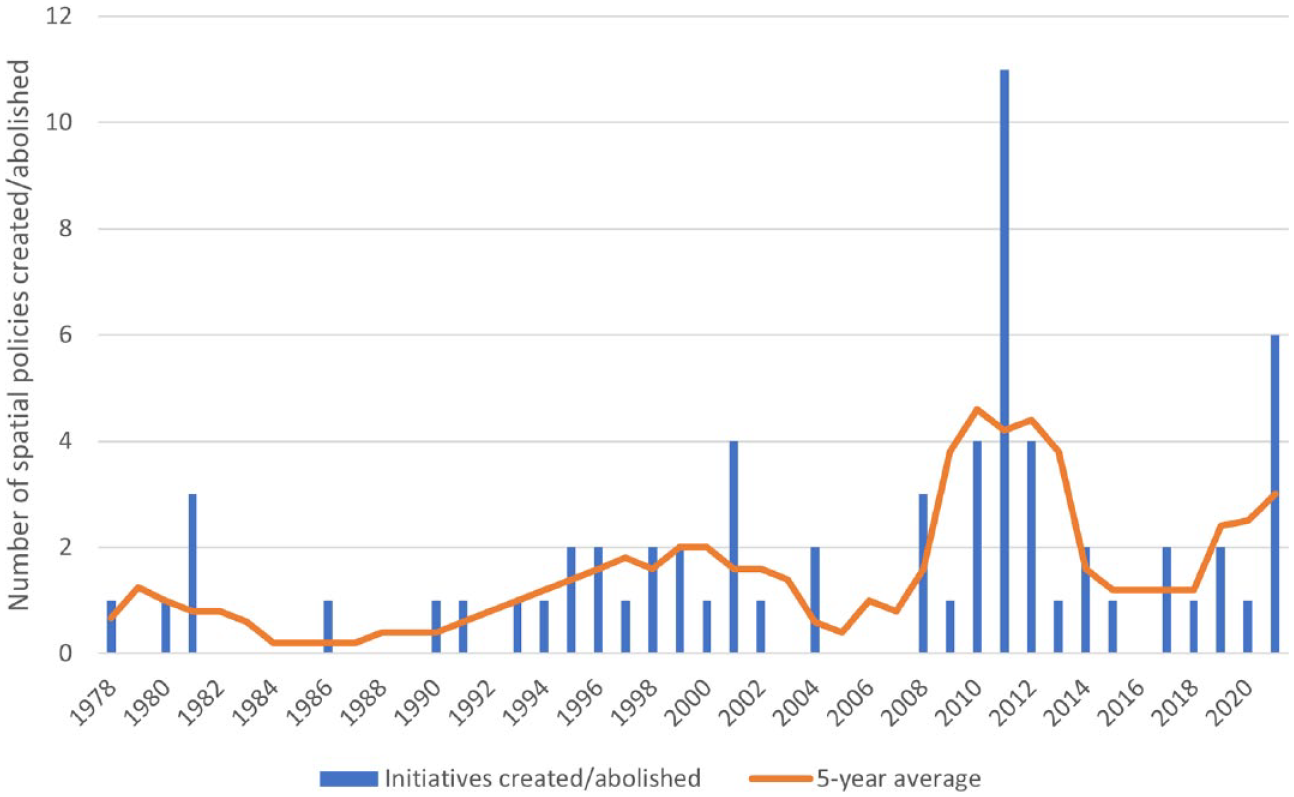
Churn in spatial policy initiatives over time.
The historic trend, evidenced by the 5-year rolling average in Figure 1, is an acceleration of policy churn, with more initiatives created and abolished each year, alongside an increase in its abruptness with more concentrated periods of change observable. There is invariably more complexity and confusion throughout the policy process as a consequence, undermining policy effectiveness. There is a striking tension in the levelling-up agenda between the LUUKWP’s critique of historic policy churn and the rise in hyperactivity matched only by the localism reforms of 2011.
Machinery of government turbulence
The second theme relates to reforms of the United Kingdom’s machinery of government. The reorganisation of departments responsible for spatial policy has been a constant feature of the Whitehall landscape over the last 45 years. Reallocating departmental responsibilities allows ministers to demonstrate they are making an impact. Yet, there are invariably unintended consequences. Figure 2 illustrates the number of departments engaged in the spatial policy initiatives identified in our study. It is important to note that spatial policy is conducted by departments which predominantly operate in a siloised manner. Figure 2 demonstrate that while DLUHC, DfT, and their predecessors have dominated the policy domain throughout the period, spatial policy initiatives have been developed and delivered by other departments. As well as providing evidence of fragmentation, the data reveals that policy churn and ministerial activism is also present in machinery of government reforms. Alterations to the governing machinery have also been prominent in the levelling-up agenda which not only included the creation of DLUHC (shown in Figure 3), but also the reorganisation of the business, energy, and trade departments. Such changes are invariably layered on top of previous reforms, increasing instability and fragility in the Whitehall system. Moreover, it is striking that the most recent reorganisation removed the phrases ‘local government’ and ‘industrial strategy’ from the Whitehall nomenclature.
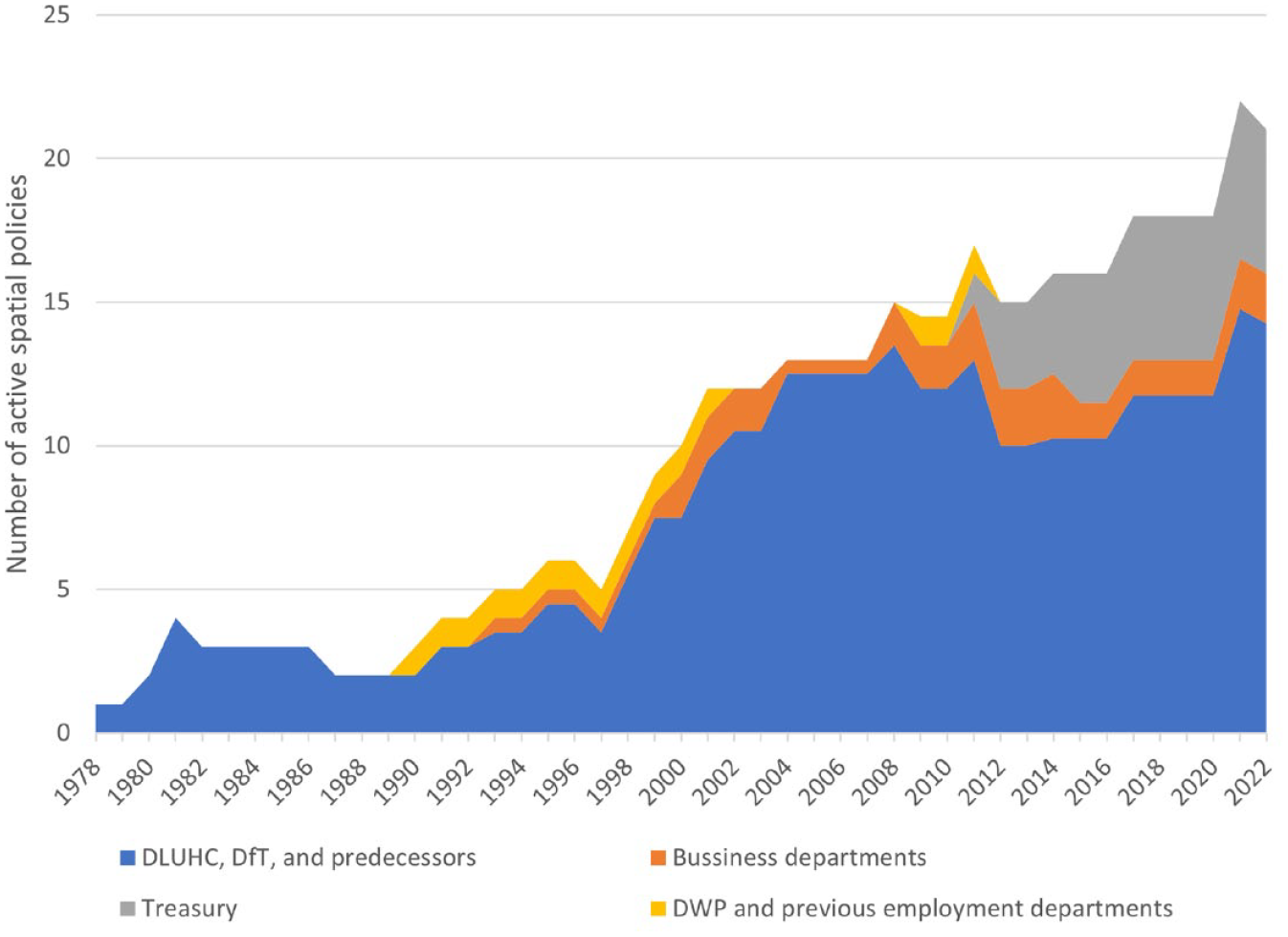
Active spatial policy initiatives by department.
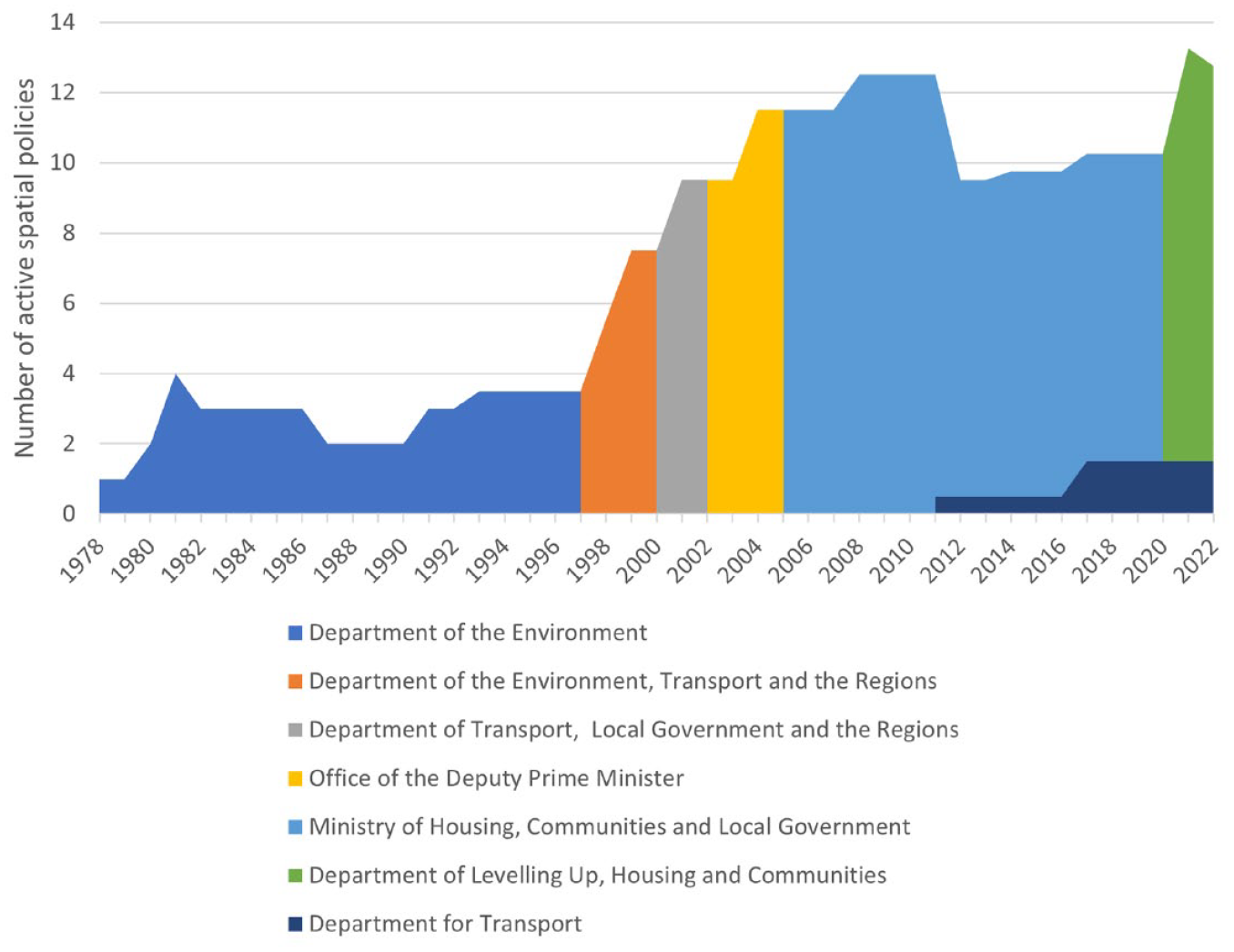
Spatial policies from DLUHC, DfT, and predecessors.
Alterations to the machinery of government occurred in a climate where the annual Civil Service Survey reveals that only 32% of officials believe change is ‘well managed in their organisation’ (Cabinet Office, 2022). The Institute for Government suggests that the creation of a new department or a merger of two existing departments costs around £15 million, alongside £34 million in lost productivity (Durrant and Tetlow, 2019). Other estimates are much higher; White and Dunleavy (2010) estimate that the creation of DEFRA initially cost £30 million while DWP cost £175 million.
Finally, Figure 2 charts the rise of the Treasury as a key actor in the Whitehall policy arena on spatial policy. This strength reflects a more general centralisation of power in Whitehall associated with greater fiscal and public spending control, but also a growing interest in spatial policies among economists (see Warner et al., 2021). The expanded role of the Treasury coincided with the withdrawal of other departments from spatial policy and the changing nature of top-downism detailed above. Where New Labour relied on more direct monitoring and oversight of local government activities, governments since 2010 – and especially since levelling up – have imposed top-down spatial policy through budgetary control mechanisms, making the Treasury an increasingly important player in this policy space.
Short-term political discourse
The third finding, highlighted in Figure 4, concerns the growth of short-termism in spatial policy. Here, we examined how often the 46 policy initiatives were mentioned in the House of Commons between 1978 and 2021 (measured by ‘mentions per million words’). ‘Mentions’ can illustrate the salience of policies; if we focus on the shape of the lines in Figure 4, rather than their relative size, the data underline the extent of policy churn and the impermanence of policies.
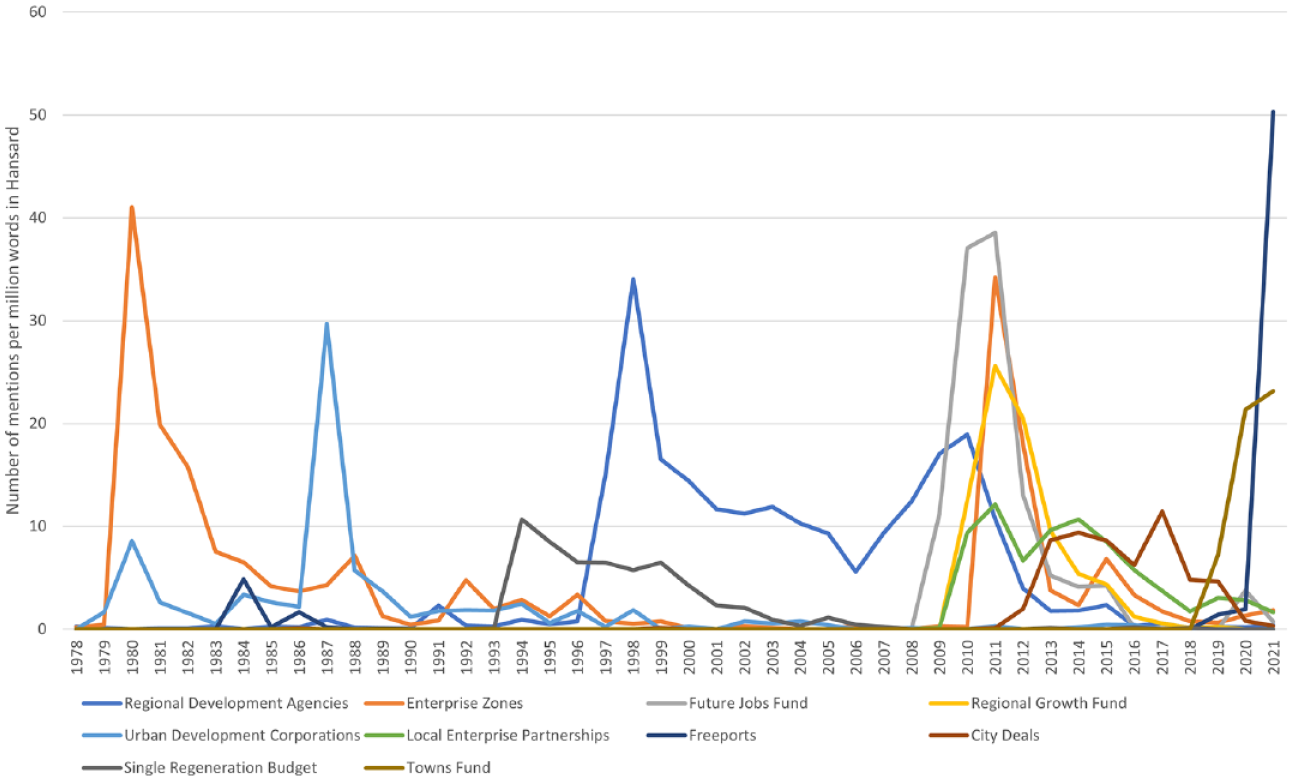
Spatial policies – the 10 most mentioned spatial policies (by mentions per million words) in Hansard.
Perhaps the most striking pattern is Enterprise Zones (on the left in orange) which had two major spikes, first in the 1980s and again in the 2010s, when they were reintroduced by the Coalition government. Each of these two spikes rises quickly and then falls steadily with a long tail as the policy is still discussed. Figure 4 illustrates that policy initiatives based on new institutions, notably the RDAs (in blue in the centre) and LEPs (in green on the right) have much greater longevity, with RDAs dominating the debate for over a decade.
Despite these notable exceptions, the most common pattern is of policies that appear and disappear with little impact. Some, like Urban Development Corporations are discussed before they spike, while others like the Regional Growth Fund or Future Jobs Fund have a slightly longer period of prominence. These are examples of short-term policies that received limited attention for only a few years. Policy churn creates an impression of uncertainty and fragility surrounding any new initiative, generating a self-reinforcing cycle, as the transience of each initiative is anticipated by increasingly cynical actors and thus becomes ever more unstable.
Multiple budgets and variable funding streams
The final issue relates to the funding of spatial initiatives marked by ruptures between periods of ‘feast and famine’ that adds to turbulence and short-termism. We measured government investment in the 46 identified spatial policies and spread these over the period they were in place. While this data does not capture all the nuance of shifting public investment, it allows us to observe macro-level patterns over time. Figure 5 illustrates the changing level of investment across the period. It is important to note that the largest increase in the middle of the timeline marks the creation of the Single Regeneration Budget, which was attached to ‘limited new monies’ but drew together existing spending plans that previously lacked ‘spatial’ aims (Gibbons et al., 2021; Tilson et al., 1997).
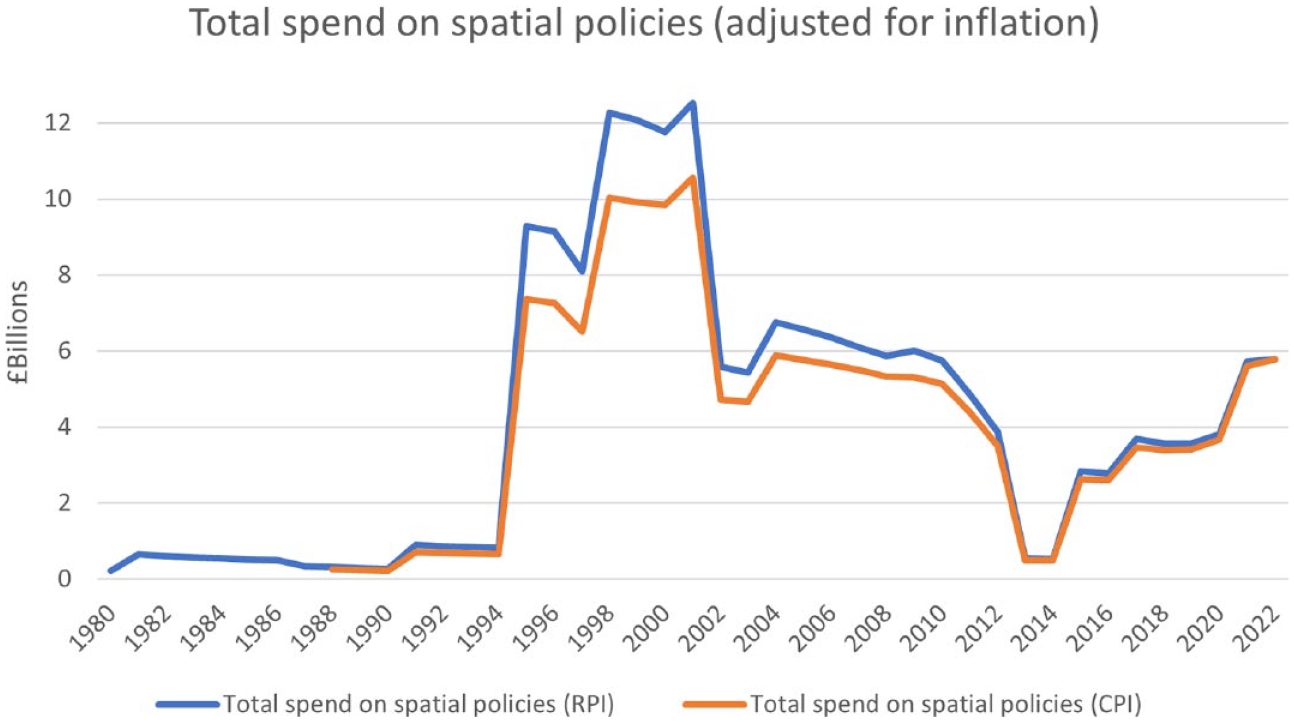
Total spend on spatial policies over time (adjusted for inflation). 3
When New Labour came to power, resources were delivered through RDAs, with significant funding attached (see the second spike in Figure 5). The figure then shows how spending dropped significantly during the austerity years, before bouncing back through the spatial policies of the City Deals, Devolution Deals, and the Levelling-Up agenda. This fluctuation is an indication of the constantly changing policy environment and the funding uncertainty characteristic of spatial policy in England. The point is illustrated further in Figure 6, which demonstrates how spatial funding is divided between initiatives. In Figure 6, it is apparent that until New Labour, funding tended to be focused on one or two major initiatives. The dissipation of funding is visible from the early 2000s onwards, with further fragmentation in the 2 years following the emergence of the levelling-up agenda.
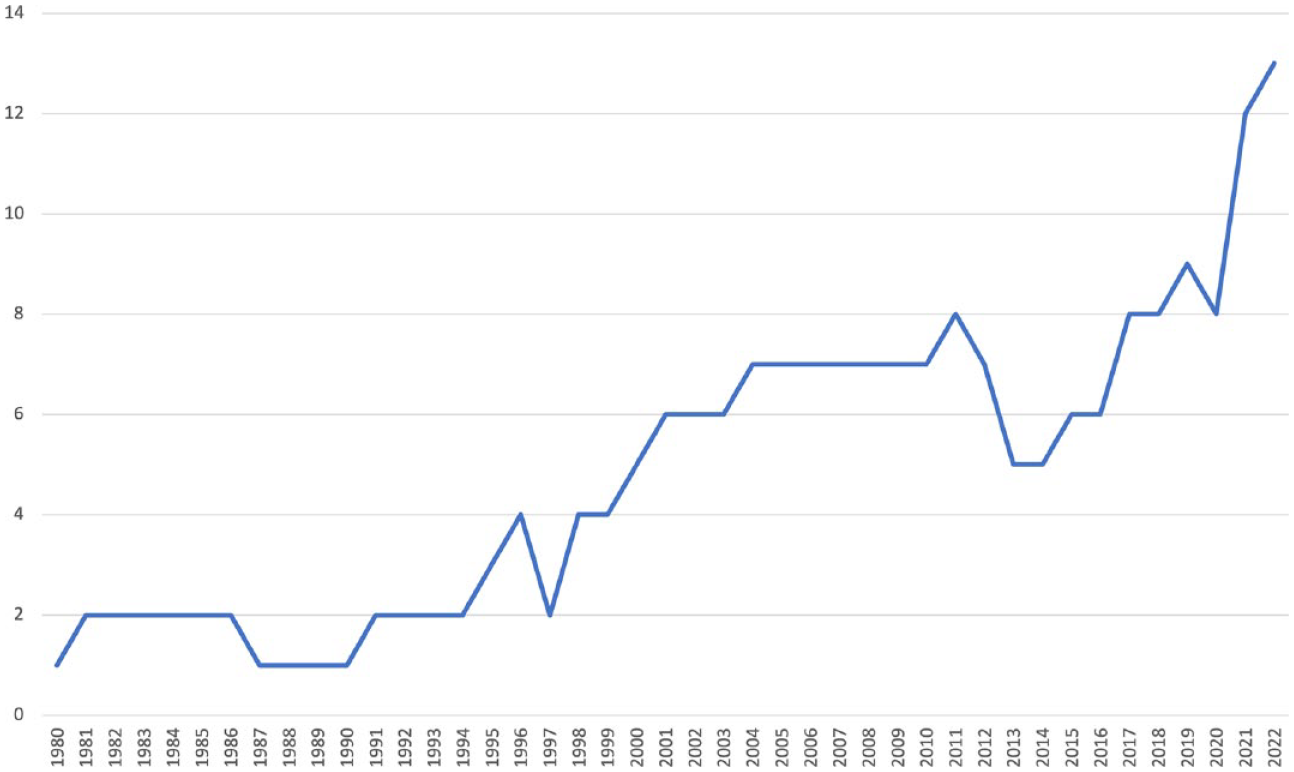
Fragmentation of spending on spatial policies over time.
Conclusion
This article poses a salient question: why have UK governments struggled to resolve the issue of spatial inequality in England? The highly centralised nature of the UK state has coincided with on-going sub-optimal outcomes for numerous spatial inequality policies over time. Our prompt for adopting this approach was the Johnson Government’s LUUKWP (HM Government, 2022), which identified the centralised UK system of government as a key problem. This is an issue that has regularly been highlighted, but not sufficiently framed in any clear conceptual manner by the existing literature. To that end, we developed the HAI framework to understand this contingent relationship. The evidence we have presented through an examination of spatial policy in England between 1979 and 2023 supports the view that the current system of politics, underpinned by the Westminster model, acted as a bulwark against the formation of effective spatial policy. Centralisation is thus regarded as both a major cause and effect of the failure of spatial policy in England.
Over time, ministers have been unable to match promise with performance, as successive governments failed to narrow the long-standing gap in regional economic growth and productivity between London, the South-East, and the rest of the United Kingdom. Regardless of the ideological complexion of the governing party, progress on spatial policy has been unsatisfactory, highlighting an on-going path dependency. Barriers to effectively address spatial inequality appear deeply interwoven in the fabric of the British state. They include siloisation, short-termism, centralisation, policy fiascos, and ad hoc decision-making. Our key empirical findings are as follows:
Over time, policy churn in relation to spatial economic policies has grown markedly. Our data demonstrate that the number of spatial policy initiatives have exponentially increased since the late 1970s, often in a disjointed and siloised manner. Moreover, policy churn has accelerated over the last decade. In particular, we have witnessed a more intensive and concentrated period of upheaval in policies and institutions.
Second, the focused period of policy churn has been accompanied by major alterations in the United Kingdom’s machinery of government. The departments primarily responsible for spatial policy have been reorganised at regular intervals, but with limited impact on policy outcomes. A complex policy agenda such as tackling geographical inequalities inevitably involves multiple departments. Yet, Whitehall remains fragmented and notoriously weak at ‘joining up’ programmes across departmental boundaries.
Third, spatial economic policies appear, disappear, and reappear at an alarming rate of regularity with limited lasting impact on the regional landscape they seek to affect. Too many policies are short-lived having been dismantled before being properly tested or evaluated. This situation in part reflects ministerial activism exacerbated by the increased rate of ministerial and civil service churn in Whitehall and the vagaries of the political cycle.
Finally, our data demonstrate that spending on spatial policies has fluctuated significantly over the period under investigation. There was a major increase in public investment in spatial policy after New Labour came to power. Spending then fell dramatically after 2010 as the Coalition government enacted its austerity agenda. Yet investment in levelling-up policies began to rise again in the period since the Brexit referendum. Spatial policies have been subject to a ‘feast and famine’ approach to budgetary strategy often favoured by the UK Treasury, which further reinforces the instability of initiatives and institutions.
We conclude that governments should learn the lessons of past failings and, adopt a more comprehensive and system-wide approach to reform. The HAI approach we develop to explain shortcomings in spatial policy can be employed to understand wider pathologies in UK policymaking, serving as a critique of the WM. HAI draws attention to the paradoxical relationship between continuity and change in UK politics and policymaking: the frenetic pace of policy initiatives and public sector restructuring is matched by ongoing inertia in core government institutions. Reform occurs within the existing parameters and constraints imposed by the WM. Hence, churn and constant organisational tinkering that characterises the UK policy process is matched by incrementalism and muddling through, alongside the recurrent pattern of short-termism and ad hoc decision-making. The pattern of reform over the last 40 years is one in which the centre in Whitehall and Westminster is largely untouched, alongside the powers it commands, despite devolution and reform to local governance at the periphery.
We have demonstrated that HAI can explain the persistence of WM pathologies and their role in hindering an effective approach to addressing geographical inequalities. A future research agenda must entail further analysis of the path dependent nature of UK regional and spatial policy, drawing on additional data to explain the persistence of such pathologies. If spatial economic policy is to have a lasting impact on regional productivity performance, it is vital to understand the institutional impediments to comprehensive and system-wide reform.
We end by seeking to widen the analytical lens drawing on the approach set out in this article. We would argue that HAI offers a potentially rich analytical framework that can be applied to studies beyond spatial policy. Here, we return to criticisms made of the existing literature on policy failure in UK politics (see, for example, King and Crewe, 2014). Jennings (2015: 444) neatly identifies this issue as one of a refusal to ask: ‘. . . searching questions about the tools that governments opt to use and broader trends in modes of delivery of public services for the modern state, or why these do not avert policy blunders’. We would claim that the HAI framing is one means towards redressing this problem. It is an approach that can be employed to shed light on sub-optimal outcomes in other policy-sub-systems, particularly concerning the long-term impact of change in public management and public services.
Footnotes
Appendix 1
Chronological list of spatial policies identified in our policy review:
Funding
The author(s) disclosed receipt of the following financial support for the research, authorship, and/or publication of this article: The author(s) received financial support from the ESRC’s Productivity Institute for their project ‘The UK Productivity-Governance Puzzle: Are UK’s Governing Institutions Fit for Purpose in the 21st Century?’ – details of which can be found here:  .
.