




Abstract
How are the rise, fall, and evolution of minilateralism in the Indo-Pacific region explained? To address this question, I examine the cases of the Quad and AUKUS, and argue that they were caused by the success and failure of coalition-building efforts made through ‘tactical hedging’. As the world transitions from a unipolar to a non-unipolar world, states attempt to formulate coalitions to safeguard their national interests. However, the challenge is to figure out which states are truly ‘like-minded’ and can strategically coordinate their policies for mutual interests. Under this circumstance, states send signals through ‘tactical hedging’ – ‘an ambiguous, temporal declaratory policy doctrine’ – that assists the hedger in assessing whether its allies and partners are willing to cooperate; in this case, building a coalition towards the same or similar strategic objectives. The key is the initial ambiguity in signalling, which becomes critical to the future success of building a coalition among parties whose interests are not always congruent.
Keywords
Introduction
Minilateralism has become a significant strategic feature in the Indo-Pacific region. There are now cooperative frameworks that consist of three to five states, including the US–Japan–Australia Trilateral Strategic Dialogue, the Supply Chain Resilience Initiative among Australia, Japan, and India, and the US–Japan–Philippines frameworks. Most notably, the Quad, the Australia–India–Japan–US consulting group, has been steadily institutionalised since the United States announced the importance of the ‘Free and Open Indo-Pacific’ (FOIP) in 2017. The Australia–UK–US (AUKUS) Security Partnership was also established in 2021 to strengthen Australia’s military capabilities by acquiring nuclear-powered submarines and trilateral cooperation in defence technology.
Most scholars and policymakers attribute this rise of minilateralism in the Indo-Pacific to China’s increasing material capabilities, which are expected to shift the regional balance of power. This shift also indicates power diffusion worldwide as the United States is no longer able to maintain its concrete unipolar status alone. Moving towards a non-unipolar world has gradually made it difficult for the existing multilateral and bilateral mechanisms endorsed by the United States to uphold and impose their rules and norms. However, rising powers, particularly China, have more room to propose new principles, rules, and norms that serve their interests, opening up options for other international and domestic actors to accept alternative rules and norms (Barnett, 2021; Koga, 2023b; Zurn, 2018). In this context, the United States has attempted to build strong strategic coalitions with ‘like-minded’ states, such as US allies and partners, by facilitating minilateralism to defend the existing international order, which embodies the power struggle between great powers during a power shift (e.g. Schweller and Pu, 2011).
This structural explanation provides us with a general configuration and trend of great power competition; however, it is not satisfactory for understanding the development of minilateral coalitions. For instance, why did the Quad collapse in 2008 given China’s consistent rise? Why did it take almost a decade for the Quad to be resurrected? Why was the AUKUS not established until 2021? In addition, not only the United States but also US allies and partners initiated minilateral coalitions. In other words, structural factors alone cannot explain the dynamic process of the rise, fall, and evolution of minilateralism.
Clarifying this puzzle requires an analysis of not only structural factors but also the political dynamics among member states within a minilateral framework. While the initiator of minilateral coalition-building largely steers the fate of the coalition by determining its strategic vision, objectives, and approaches, there is always the possibility that potential members disagree with them. The initiator thus needs to be careful about sustaining their interests in joining the coalition. To this end, in the initial phase, the initiator sends an ambiguous foreign-policy signal to draw potential members’ reactions, clarify their respective strategic positions, and adjust the objectives or approaches of the coalition framework to consolidate their strategic ties.
In this context, I argue that the rise, fall, and evolution of minilateralism in the Indo-Pacific region are caused by the success and failure of coalition-building efforts made through ‘tactical hedging’. As the world transitions from a unipolar to a non-unipolar world, including a multipolar world, states attempt to formulate coalitions to ensure their national interests. However, they are unsure which states are truly ‘like-minded’ and can strategically coordinate their policies for mutual interests. To find this out, states send signals through ‘tactical hedging’ – ‘an ambiguous, temporal declaratory policy doctrine’ – that assists the hedger in assessing whether its allies and partners are willing to cooperate; in this case, building a coalition towards the same or similar strategic objectives. In so doing, the initial ambiguity in strategic objectives becomes the key to the future success of building a coalition among parties whose interests are not always congruent.
The cases of the Quad and AUKUS demonstrate two different developmental paths of minilateralism. On the Quad, Japan conducted ‘tactical hedging’ by emphasising the importance of the existing international rules and norms under a ‘Free and Open Indo-Pacific Strategy’ in 2016, and successfully induced diplomatic cooperation from Australia, India, and the United States, resurrecting the Quad in 2017. On AUKUS, Australia drew advanced defence cooperation from the United Kingdom and the United States by establishing an Australia–UK–US security partnership in 2021. It conducted dual tactical hedging to understand whether the United States and/or the United Kingdom would share their nuclear technology to develop Australia’s nuclear-powered submarines and whether AUKUS has the potential to extend its partnership in a particular defence technology area with external states.
Understanding the coalition-building process through tactical hedging is imperative for comprehending the dynamic configuration of alignment and realignment that would affect the regional and/or global balance of power. While coalitions in the formative phase may not substantially impact international strategic balance, such coalitions could evolve into offensive or defensive alliances, or abruptly fall apart; this could significantly shape the strategic environment. In this sense, the coalition-building process should be seriously and carefully analysed.
The remainder of this article is organised as follows: The first section discusses trends in the literature on minilateralism and signalling in international relations (IR) and highlights the gap in the extant literature on signalling for coalition-building. The second section introduces the concept of tactical hedging, which contributes to filling this gap in the literature by explaining the costs and benefits of the tactic and its three-phase development. The third and fourth sections provide case studies on Quad and AUKUS, in which tactical hedging is employed; however, their developmental paths and use of tactical hedging differ. The fifth section analyses on the utility of tactical hedging for minilateral coalition-building and its pervasiveness in the Indo-Pacific region.
Literature review: Minilateralism and signalling in IR
Coalition-building is important and necessary for a state seeking to shape an international strategic environment and order in its favour. Unless the state has significant material capabilities to dominate the world, which is extremely unlikely, coalition-building remains one of the most attractive alternative strategies the state can realistically pursue (e.g. Mearsheimer, 2010: 387). Nevertheless, the higher the involvement of the states in the coalition-building process, the more difficult it becomes to form a coalition because of the wide range of diverging national interests. This collective action problem suggests that the state should start building a coalition with a few members that are more likely to share strategic objectives, interests, and visions – that is, minilateralism (Mohan, 2023; Naim, 2009).
Admittedly, definitions of minilateralism abound, and there is no single common definition. However, here, minilateralism refers to ‘an informal or formal grouping of three to five states that aim to coordinate their strategic agendas and facilitate functional cooperation in particular issue area’ (Koga, 2022a). The number of states in a group required for ‘minilateralism’ is relative because such a definition is relational and changes over time. For example, the Association of Southeast Asian Nations (ASEAN) in 1967, when there were only five members, were not considered as ‘minilateral’ while the Five Power Defence Arrangement (FPDA) is currently considered minilateral. In the contemporary Indo-Pacific region, trilateral and quadrilateral frameworks are considered minilaterals (Singh and Teo, 2020). Therefore, the number of states in the minilateral frameworks in this region can range from three to five. It is important to distinguish this from a general ‘coalition’, which is functionally the same yet does not distinguish the number of the members.
Likewise, the term, coalition, is often used casually in an ambiguous manner and is not distinguished from an alliance or alignment. Technically speaking, it refers to ‘a grouping of like-minded states that agree on the need for joint action on a specific problem at a particular time, with no commitment to a durable relationship’ (Pierre, 2002: 2), which is different from ‘alliance’, that is, ‘formal associations of states from the use (or nonuse) of military force, in specified circumstances, against states outside their own membership’ (Snyder, 1997: 4). Coalition’s strategic commitment is thus ambiguous.
How are minilateral coalitions established? States cannot automatically build a coalition, even if they share similar strategic concerns. Also, unlike with existing allies, there is no legally binding treaty obligating security cooperation. To formulate a coalition, an initiator first needs to signal its strategic intentions explicitly or implicitly and avoids misunderstanding and miscommunication that may quickly cause disagreement and possibly kill the idea of coalition-building. Therefore, communication – signalling – becomes the key.
Signalling is a major subject in IR (Plagemann, 2025). Based on an analysis of the causes of war and peace during the Cold War period, the study of signalling maintains its relevance in the post-Cold War era to understand crisis bargaining, explore the formulation process of costly signals, and identify the means to convey credible signals to target states (Fearon, 1994, 1997; Garzke and Li, 2003; Jervis, 1970; Kertzer et al., 2020; Quek, 2016; Sartori, 2005; Schelling, 1966; Schultz, 1998; Slantchev, 2005; Trager, 2010; Yarhi-Milo et al., 2018). However, this traditional research scope is insufficient to comprehensively understand its functions because ‘target states’ are predominantly defined as adversaries. While sending a clear signal to rival states or adversaries is imperative for preventing wars and conflicts, signals must also be sent to allies and partners to understand their strategic positions. Indeed, recent literature has focused on the signalling of commitment to pre-existing allies and protégés (e.g. Gannon and Kent, 2021; Horowitz et al., 2017; McManus and Yahi-Milo, 2017). The theoretical framework of alliance politics is also employed to understand the signalling to allies which illustrates that allies constantly fear ‘entrapment’ and ‘abandonment’ and need reassurance signals from their counterparts (Christensen and Snyder, 1990; Green, 2001; Henry, 2022; Mochizuki, 2022; Snyder, 1984, 1997; Yarhi-Milo et al., 2016). As such, the study of signalling has extended to strategic interactions between a broad range of actors by including issues such as alliance commitment (Cebul et al., 2021; Fuhrmann and Sechser, 2014).
Still, signalling for coalition-building has yet to be explored in-depth in the existing literature. The current literature treats allies, partners, and adversaries as given, assuming that actors have already established clear strategic objectives such as ensuring security commitments to allies and making military threats credible. This analytical focus cannot adequately apply to the coalition-building process for three reasons. First, new coalitions may not have clear strategic objectives during their formative phases. Admittedly, military coalitions during a war period, such as the coalition in the 1990–1991 Gulf War and the ‘coalition of the willing’ during the 2003 Iraq war, have a fundamental goal, namely achieving a military objective – winning a war. However, a coalition in peacetime can be multipurpose, and member states do not always agree on prioritising their strategic objectives. In other words, its purpose remains ambiguous as it takes time for member states to come to an agreement that prioritises tangible joint cooperative actions.
Second, the so-called ‘cheap talk’ can still be instrumental in the coalition-building process. Generally, cheap talk refers to ‘costless, nonverifiable claims’, so it is not credible signalling as it does not ensure states’ commitment (Farrell and Gibbons, 1989: 1214). However, such discussion can draw reactions from other states, providing clues for understanding their postures, preferences, and interests. For example, the Biden administration announced the creation of the IPEF in May 2021 for economic rule-making in the Indo-Pacific region, while originally aiming to formulate a relatively exclusive economic framework to counter China (Hoang, 2023; Hoyama, 2022; Nikkei Asia, 2022; The White House, 2022f). Initially, the United States did not have concrete ideas about the IPEF’s agendas and functions except for emphasising its commitment to economic cooperation in the region. Despite these ambiguities, the interactive process between the United States and regional states, such as Japan, Malaysia, Singapore, New Zealand, and Australia, directed the IPEF to focus on ‘trade facilitation, standards for the digital economy and technology, supply chain resiliency, decarbonisation and clean energy, infrastructure, worker standards, and other areas of shared interest’ among the advanced economies (Iwamoto, 2021; Kine, 2022; Nishimura, 2021; Takeuchi, 2022; The White House, 2021e; Williams et al., 2022). Moreover, it became apparent that the framework would become non-binding and more inclusive as Japan pointed out that exclusive membership in the IPEF would create diplomatic tensions with Southeast Asian states (Yomiuri Shimbun Online, 2022). In this way, ‘cheap talk’ became useful for obtaining more information about each potential member state’s preferences, and the United States accepted this suggestion and was open to suggestions from outside (Sevastopulo and Inagaki, 2022).
Third, while the coalition-building process is highly dynamic from its formulation to consolidation, the existing conceptual frameworks of signalling excessively focus on how states reassure or ensure their commitments, and not on how states build coalitions. Even Plagemann’s new conceptual framework, which provides four useful categorisations of signalling – threats and red lines, alliance signalling, status signalling, and pseudo-signals – does not cover the coalition-building signal (Plagemann, 2025). The most likely category that the signalling for coalition-building falls in is ‘alliance signalling’ that ‘advertise[s] a state’s value and attractiveness as an ally or communicate expectations a state has towards actual or potential allies’. However, again, this concept assumes that allies are given and that the signal sender has already defined its strategic position to counterparts – how to reassure them – and there is no indication of modifying such a position. The other potential category is ‘pseudo-signals’ that are ‘cheap-talk elaborately veiled and publicly sold as meaningful signals’. Yet, this signalling assumes that a signal sender does not consider building a coalition, as it eventually ‘fails to convincingly communicate what it pretends to contain’. This is different from the signal for coalition-building.
The difficulty in understanding this type of signal is derived from the fact that it is relatively cost-free and can easily be categorised as cheap talk. Audience cost is not too high either, because the signal is too ambiguous to clarify its commitment and specify the target states. However, if reactions from other states are successfully drawn, they have the potential to create new coalitions that impact the strategic environment.
The establishment of a coalition itself is, of course, not sufficient to have a strategic impact. This requires the member states to coordinate their strategic objectives and priorities. In addition, signals are less likely to be effective if they contradict others’ pre-existing beliefs (e.g. Kertzer et al., 2020). However, if their pre-existing beliefs were similar to the sent signal, these ‘like-minded’ states would be willing to coordinate their policies and potentially nurture their common strategic preference. In this context, ‘tactical hedging’ has become a useful analytical framework for understanding the dynamics of coalition-building signalling.
The concept of tactical hedging
Tactical hedging refers to ‘an ambiguous declaratory policy doctrine that aims to understand and determine whether any long-term strategy shift is necessary or possible’ (Koga, 2019: 289; 2020: 62). This type of hedging is tactical because it does not immediately determine or alter a state strategy, such as balancing, bandwagoning, or hedging. Rather, in the emergence of an uncertain strategic environment, including a power shift from a unipolar to a multipolar world, states are likely to adjust their state strategies. However, before doing so, they seek to determine whether such an adjustment can gain international support, or at least non-denial, from other states. This caution stems from states’ general tendency to avoid unnecessary inter-state tensions or conflicts with others, particularly when seeking the formulation of a coalition or alignment. Under this condition, tactical hedging is employed.
On tactical hedging in coalition-building, if the hedger considers such an attempt possible and necessary, it will likely expedite the coalition-building process by intensifying negotiations with ‘like-minded’ states and others. Conversely, if the hedger considers it necessary, but not possible for the current situation, given diverging national interests or strategic perspectives, it will likely seek and nurture common ground with potential allies/partners through consultation to enhance the future prospects of coalition-building. This tactic is likely to be taken regardless of the size of state power or diplomatic culture because states consider mutual agreements or consensus to be key to the sustainability of a coalition. Consequently, the speed of coalition-building changes depending on the degree of similarity in threat perceptions, common national interests, and shared worldviews. The more congruent these factors are, the more likely they are to formulate and consolidate a coalition quickly. Obviously, if the state has a strong resolution to shift its strategy unilaterally, such as a decision to engage in war, it would not conduct tactical hedging because negotiations would likely be tedious. In this sense, tactical hedging depends on circumstances rather than on the attributes of the state.
With these characteristics, tactical hedging can be considered tacit signalling situated in between ‘costly signal’ and ‘cheap talk’, where the ambiguous narration of the hedger’s strategic intent is highlighted. This is fundamentally different from ‘hedging’, which came into the lexicon of the IR field in the 2000s. Hedging refers to ‘state behaviour that attempts to maintain strategic ambiguity to reduce or avoid the risks and uncertainties of negative consequences produced by balancing or bandwagoning alone’ (Koga, 2018: 639). It is true that the concept of hedging is contested as many scholars invent their own definitions; however, they are generally concerned with state strategy that is likely to endure in a relatively stable strategic environment (e.g. Ciorciari and Haacke, 2019; Goh, 2005; Koga, 2022d; Kuik, 2008; Lim and Cooper, 2015). In contrast, tactical hedging is foreign-policy signalling to understand the states’ strategic postures and positions, so that the hedger can adjust its strategic objectives and approaches where necessary.
It is also true that various state strategies such as external balancing, bandwagoning, and hedging send certain diplomatic signals to external actors. Yet, the nature of the signals differs because they are outcome-based signalling – signals derived from the effects of each state strategy. For external balancing, states already clearly understand each other’s strategic objectives and believe that they have sufficiently ensured their partners’ political commitments. This results in a legally binding treaty to lock in mutual commitments. Although it is another matter that each ally will truly fulfil such an obligation in times of crisis, the formulation of the alliance itself will send a clear signal to the international community and the target states that their strategic cooperation is genuine.
Likewise, bandwagoning occurs when states are militarily and economically aligned with threats to their survival (Walt, 1987). Bandwagoning causes a loss of certain political, economic, and security autonomy, but such a loss is strategically compensated for by a threatening state’s protection, at least temporarily, which is better than domination. Given that bandwagoning also requires a clear commitment to indicate that bandwagoners will not be hostile towards the source of the threat, its diplomatic signal tends to be clear.
Hedging attempts to send great powers a signal that a hedger will not take a side (Ciorciari and Haacke, 2019; Kuik, 2008; Marston, 2023; Teo and Koga, 2022). A hedger’s engagement with different great powers may be asymmetric, either military or economic; however, this type of action signals that the hedger intends to remain neutral and avoid being deeply entrapped by great power competition. This strategy tends to be adopted by small and middle powers under a multipolar system, where states have the option of strengthening their strategic ties with multiple great powers. In a bipolar system, on the contrary, each great power attempts to force states to take sides, and non-great powers have difficulty maintaining a hedging strategy (Ciorciari, 2010; Korolev, 2019; Kuik, 2016). As such, the signals produced by those state strategies are fundamentally post hoc.
Differing from these state strategies, tactical hedging is process-based signalling, focusing on the interactive process between states. This is because it generally takes time for a state to understand whether its partners are truly reliable before making material commitments. To understand partners’ commitment and discern their strategic thinking, states diplomatically engage with them by employing specific ‘narratives’, which refer to ‘the ways that issues are framed and responses suggested’ – nurturing a certain story that links historical events with some evidence or experience (Freedman, 2006: 610). Although those narratives are vaguely crafted, states can still deliver messages explaining the general development of the international strategic environment and the necessity of coalition-building to manage emerging issues. In this sense, the narrative becomes important for tactical hedging as it draws partners’ reactions to the idea of coalition-building and is useful in understanding their intentions for future commitment.
For a hedger, the narrative is also used to justifiy its understanding of the international environment, political beliefs, and strategic behaviour, with the aim of gaining diplomatic support, or at least non-denial, for its actions from a target state. This is similar to ‘strategic narrative’ that is defined by ‘representations of a sequence of events and identities, a communicative tool through which political actors – usually elites – attempt to give determined meaning to past, present, and future in order to achieve political objectives’ (Fenton and Langley, 2011: 1172–1173; Miskimmon et al., 2013: 5). Both use communication, rhetoric, and narration to signal actors’ strategic intentions, and aim to create a shared understanding of strategic purposes. However, their strategic objectives differ. Tactical hedging aims to forge common ground to collectively pursue strategic objectives and interests, regardless of whether their ultimate national interests differ. By contrast, a strategic narrative aims to shape other actors’ perceptions rather than finding common ground (Miskimmon et al., 2013). In other words, tactical hedging is focused on ‘co-option’ whereas strategic narrative is based on ‘influence’.
Furthermore, unlike the one-way communication of strategic narratives that aims to persuade and change the target state’s discursive environment and strategic mindset, tactical hedging often does not specify targets. Clearly, receiving support or non-denial from ‘like-minded’ states, which are likely members of minilateral coalitions, is important for a hedger; however, their support may not be sufficient to build a coalition. This is because there are other possibilities in which important regional partners and rivals can hinder such a manoeuvre by challenging the coalition’s legitimacy. Therefore, in tactical hedging, target states are not only those who are likely to become partners but also those who are not necessarily potential members of the coalition.
In sum, signalling becomes clearer when it involves military and economic cooperation. Discourses and narratives might be ‘cheap’ because they will not always entail sufficient cost to be credible. Nonetheless, even in the absence of substantial costs, these discourses and narratives can still send a signal because they contain political messages that may eventually lead to material cooperation. It is therefore necessary to differentiate process-based signalling, namely strategic narrative and tactical hedging, from outcome-based signalling, balancing/bandwagoning, and hedging, which involve sunk costs. This categorisation of the four strategic and tactical behaviours – balancing/hedging, hedging, strategic narrative, and tactical hedging – is shown in Table 1.
Categorisation of strategic behaviour for coalition-building.
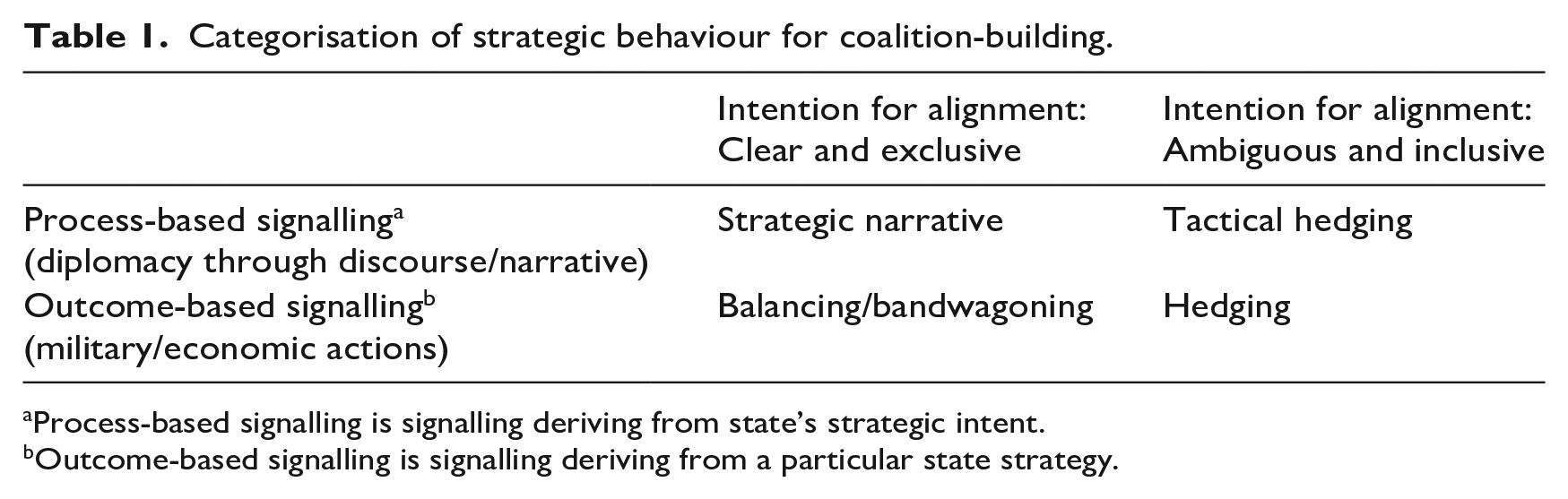
Process-based signalling is signalling deriving from state’s strategic intent.
Outcome-based signalling is signalling deriving from a particular state strategy.
Tactical hedging is illustrated by abstract Indo-Pacific visions issued by regional states, such as Japanese Prime Minister Shinzo Abe’s Indo-Pacific speech in August 2016; the ASEAN Outlook on the Indo-Pacific in 2019; the EU Strategy for Cooperation in the Indo-Pacific in 2021; and South Korea’s Indo-Pacific Strategy in 2022 (ASEAN Secretariat, 2019; European Union, 2021; Ministry of Foreign Affairs of Japan (MOFA), 2016; The Government of the Republic of Korea, 2022). However, these strategic postures have evolved. For example, the United States gradually employed strategic narratives rather than tactical hedging when the Trump administration shifted the relative ambiguity in its Indo-Pacific strategy in mid-2017 to a clear strategic stance in December 2017, emphasising that China was a revisionist power that challenged the existing international order in its National Security Strategy (The White House, 2017a, 2017b). This became more explicit when the Biden administration issued the US Indo-Pacific Strategy, which further clarified the challenges faced by China and the need to build partnerships and coalitions (The White House, 2022c).
Strategic benefits and cost of tactical hedging
Why do states engage in tactical hedging for a coalition-building? There are three basic strategic motivations at the international level (Koga, 2019). First, tactical hedging can provide a diplomatic indication of potential strategy shifts, including the possibility of building a coalition. Launching a declaratory policy doctrine functions as an attention-grabber for the international community, regardless of whether the main targets are partners or adversaries (Gioia and Chittipeddi, 1991; Hambrick and Lovelance, 2018). Second, tactical hedging’s ambiguity can elicit reactions from ‘like-minded’ states that reflect their strategic preferences. As the international community anticipates a potential strategy shift from being a tactical hedger, reactions from other states become useful indicators to clarify whether those states are potential supporters, bystanders, or opposition to a new coalition-building effort. Third, ambiguity allows a hedger to modify potential coalition’s objectives and/or approaches after receiving reactions from other states. If the hedger cannot gain international support for its policy doctrine, particularly from the ‘like-minded’ states, it would either abandon the doctrine entirely or modify it such that the allies and partners would likely accept it. This is important because the existing or potential adversary’s reaction sometimes plays a significant role in shaping strategic calculations of the hedger and its ‘like-minded’ states.
To be sure, powerful states are generally less concerned about international reactions and are unlikely to hedge because they have the material capability to decide and act unilaterally. However, certain issues require international collaboration and support, such as countering transnational issues, managing relationships with allies and partners, and building international orders. In this sense, tactical hedging functions as a useful signalling tool, even for great powers, to measure the level of international support they are likely to receive.
That said, the sustainability of tactical hedging depends on three conditions. First, it requires international attention. Even if a state launches a new foreign-policy doctrine, it cannot measure the degree of potential support for the concept unless the international community, including the target states, pays attention to it. Therefore, a hedger needs to consider (1) the buzzword (e.g. whether the buzzword is sufficiently eye-catching), (2) timing (e.g. whether the content of a foreign-policy doctrine has sufficient interest in the international community), and (3) power status (e.g. whether a hedger has significant material and ideational capabilities to influence international politics). Although having all three elements is unnecessary, without them, they can easily be dismissed as an insignificant doctrine.
Second, messaging consistency is important over the long term. This seems paradoxical because the characteristics of tactical hedging include ambiguity. However, time is an important factor. While the initial ambiguity of signalling provides greater flexibility to reinterpret and adjust strategic objectives and/or approaches, this flexibility carries the risk of generating inconsistent messages in the long-run. For example, if a hedger indicates the importance of the non-interference principle in its foreign-policy doctrine but applies arbitrarily over time, the international community will consider the doctrine to be used only for the hedger’s national interest. In addition, if the hedger emphasises the importance of human rights, but strengthens partnerships with oppressive foreign governments, other states will view the hedger’s behaviour from the perspective of power politics, making the doctrine less credible.
Third, the initial ambiguity of the foreign-policy doctrine needs to be clarified in the long term. If ambiguity persists, it will likely create misperceptions and misunderstandings among other states, counterproductive to the interests of a hedger. Furthermore, the international community exerts diplomatic pressure to clarify hedger’s strategic intentions, particularly when the doctrine is controversial. The hedger can resist these requests, but prolonged ambiguity will likely lead the hedger to create unnecessary tension with an international audience.
These three conditions relate to the credibility of signalling, but should be differentiated from the traditional understanding of costly signals. A costly signal illustrates a structural condition in which the receiver can assess whether the sender’s message or action is credible or deceptive. On the other hand, the signal of tactical hedging depends on other states’ perceptions of the credibility of messaging – whether the foreign-policy doctrine has any relevance in the current international environment, strategic impact, relatively clear intentions, or contradictions in messaging.
Also, tactical hedging is different from everyday diplomacy, which seeks ‘ways to ensure both the diversification of risks and the mitigation of uncertainty’ (Ciorciari, 2009: 168; Goh, 2006; Tessman and Wolfe, 2011: 218; Koga, 2018: 641). Simply put, the key difference lies in whether a foreign-policy doctrine is explicitly declared. Diplomacy is generally practised through the confirmation and reorientation of existing diplomatic reference points, such as state policies, joint statements, and agreements, and does not play a direct role in producing new and large policy ideas. In contrast, tactical hedging requires a particular policy statement and doctrine, which will be a new reference point. For example, it is easy to identify the origin of China’s Belt and Road Initiative that are Xi Jinping’s speeches in Kazakhstan and Indonesia in 2013, while the origins of US ‘Pivot’ or ‘Rebalancing’ refers to President Barak Obama’s speech at the Australian Parliament and State Secretary Hillary Clinton’s Foreign Policy article, ‘America’s Pacific Century’ in 2011 (ASEAN-China Centre, 2013; Clinton, 2011; Ministry of Foreign Affairs of the People’s Republic of China, 2013; The White House, 2011).
Three phases of tactical hedging for coalition-building
How is tactical hedging for coalition-building operationalised? This tactic comprised three main phases (Hambrick and Lovelance, 2018; Koga, 2019). In the first phase, a hedger, typically the leader of a state, launches a symbolic and ambiguous foreign-policy doctrine – a ‘diplomatic sign’ – whose objective is to draw attention and reaction from other states, particularly like-minded states. Diplomatic signs, such as mottos, slogans, and catchwords, are important to foreign-policy doctrines because they can evoke particular strategic meanings. Rather than simply making similar statements sporadically, these signs are more stable in language despite the continued ambiguity in their meanings, and they can make it easy for a hedger to deliver a core message that can be ‘hammered out’ by repeating them through formal and informal statements in the future (Alvesson, 1998: 87). In so doing, a hedger conveys a vague narrative that implies its worldview, the legitimacy of its behaviour, new priorities, and the necessity for coalition-building.
External states attempt to discern the strategic meanings of these diplomatic signs and narratives; however, given their ambiguity, a broad range of interpretations is possible. For example, such signs might be interpreted as the intention to establish a military alliance or political alignment to counter a certain target state. Alternatively, they could be a signal to create an inclusive alignment to enhance global and regional governance, or they may be just a bluff. As ambiguity is difficult to grasp, external states would make a preemptive move to implicitly and explicitly support or reject the concept by showing their own interpretations that reflect their preferences.
Accordingly, the most important task for a hedger during this phase is to receive and analyse reactions from external states, particularly like-minded states. Whether these reactions are positive or negative helps shape the hedger’s strategic concepts. If there is no reaction from the international community, the hedger cannot develop a conceptual framework of diplomatic signs for coalition-building and must reframe it. As non-recognition can be interpreted in many ways, such as denial of legitimacy, tacit recognition, and disinterest, the hedger needs to pay attention to the international context of the day to infer external states’ long-standing preferences so that they can estimate who is likely to be a partner, neutral, or denier (Hambrick and Lovelance, 2018: 111; Hardy et al., 2000: 1232–1233; Kinne, 2014: 249).
In the second phase, the hedger attempts to understand the extent to which the original concept needs to be modified. The diplomatic sign itself does not explain anything and requires narratives that outline its meaning, values, and principles. Considering the reactions received, the hedger incorporates the most critical responses from external states. Responses from like-minded states are particularly important because they are most likely to become members of a coalition.
The ultimate objective of this phase is to nurture a soft coalition with as many states as possible, while prioritising like-minded states – minilateralism. This is not a tall order because the coalition, including the minilateral one, does not have to conclude any formal agreement. However, a certain agreement must be reached with the shared strategic vision of the world. In this sense, the task of a hedger is to install a more concrete meaning and image in a diplomatic sign, which reduces initial ambiguity. Thus, this requires (1) sufficiently narrowing the meaning of the diplomatic sign after incorporating other states’ reactions, and (2) ensuring that the symbol has a particular strategic connotation that will not be rejected by, at least, ‘like-minded’ states.
If tactical hedging in this phase is successful, the diplomatic sign can become an important strategic reference point at the international level and can be used to consolidate the coalition. Rallying around this reference point, hedgers and their partners occasionally conduct face-to-face meetings to discuss areas of cooperation and the means of achieving their strategic objectives. Face-to-face interactions nurture ritual-like interactions that facilitate feelings of interdependence and increase the likelihood of cooperation (Holmes, 2013; Pacher, 2018: 881). This process is the creation of ‘narrative infrastructure’ for coalition-building, which refers to ‘the evolving aggregation of actors/narratives in their material and social settings that enables and constrains the possible stories, actions, and interactions by actors’ (Bartel and Garud, 2009; Deuten and Rip, 2000; Fenton and Langley, 2011; Llewellyn, 2001). Narrative infrastructure helps hedgers and potential partners understand ‘tangible and bounded endpoints’, and its role in generating ‘thrust and direction’ of cooperative behaviour among actors contributes to the formulation of a more concrete coalition by coordinating areas of focus and means of cooperation (Fenton and Langley, 2011).
In the third phase, the hedger and its partners act together to achieve shared strategic goals. This is because, without tangible cooperation or practice, diplomatic signs will be perceived only as rhetoric, not actions, resulting in a loss of credibility. The most notable first step in transforming their strategic ideas, principles, and objectives into actual actions is the institutionalisation of the soft coalition (Alvesson, 1998: 90). Institutionalisation weaves a variety of activities together under the diplomatic sign, including the regularisation of meetings among member states, creation of preset agendas for cooperation, establishment of working groups and task forces, and execution of regular joint training and exercises among member states’ military forces and coast guards.
At this point, the constructed narratives are sufficiently clear to identify the storyline of the development of an international strategic environment, common political values and principles, and an approach to realising their strategic vision and objectives (Hardy et al., 2000: 1230–1231; Kertzer et al., 2020). Nurturing shared strategic objectives and identifying approaches to achieving them in practical terms are important tasks for a hedger to consolidate the coalition. If successful, this coalition will be much stronger than the soft coalition in the second phase, and member states will be willing to work together on agreed themes, seek further strategic collaboration, and possibly evolve into a legally binding multilateral or minilateral treaty alliance system.
Although this is a coalition-building process, minilateralism remains a convenient means to lay the rigid foundation of a broader coalition because a hedger can initially engage with only ‘like-minded’ states, avoid an intensive collective action problem, and have a choice over the extent to which the coalition should be expanded.
Employing these conceptual and theoretical frameworks, the following sections examine the development of the Quad and AUKUS to understand how Japan and Australia have conducted tactical hedging for minilateral coalition-building.
The Quad: Tool for tactical hedging
The ‘Quad’ originated in 2004, when the four states, the ‘core group’, cooperated in their humanitarian assistance/disaster relief (HA/DR) activities for the Indian Ocean Earthquake and Tsunami (Grossman, 2005). The Quad has evolved institutionally since 2004; however, its development path has not been straightforward as the framework failed in 2008. From the perspective of tactical hedging, there are currently two phases of significant institutional development: failure in 2007–2008 and progress in 2017–2021.
The first coalition-building effort was made from 2007 to 2008, when the Quad was rapidly moving into a political and military coalition, yet it eventually collapsed because the four states were unable to coordinate their policies due to their diverging strategic interests. Japan took the initiative to formulate a democracy-based strategic framework under the name of the ‘value-oriented diplomacy’ and ‘Arc of Freedom and Prosperity’ as its new diplomatic signs (Lower House, Japan, 2006; MOFA, 2007). In the first phase of tactical hedging, Japan nurtured bilateral and trilateral ties with the United States, Australia, and India, emphasising the importance of democratisation in ‘broader’ Asia and the maintenance of an international order based on liberal values. This is well-illustrated by Japan’s diplomatic support for Australia’s initiative that created the US–Japan–Australia Trilateral Strategic Dialogue in March 2006 and Abe’s historic speech at the Indian Parliament in August 2007, ‘Confluence of Two Seas’ (Koga, 2022e: 23; Tow, 2015: 23–37). Japan’s strategic intent was to facilitate democratisation and ensure maritime security as a public good in the Indian and Pacific Oceans, with regional democracies (Abe et al., 2023).
Assuming that the four states shared similar strategic interests, the Abe administration took the initiative to organise a quadrilateral meeting, and the four agreed, in principle, to hold the meeting at the assistant-secretary level back-to-back at the ASEAN Regional Forum in April 2007 (Smith, 2020). While this first meeting did not have any preset agendas and was ‘exploratory’, Abe envisioned the Quad to revolve around strategic dialogue and joint military exercises (Abe et al., 2023; Smith, 2020). Indeed, the four states engaged in military training through the US–India bilateral military exercise, Malabar, by inviting Japan, Australia, and Singapore to participate in Malabar-2007-2 in September 2007 (Bharat Rakshak, 2007). Face-to-face meetings and tangible military cooperation illustrate the possibility of institutionalising quadrilateral strategic cooperation. In this sense, Japan attempted to move quickly from the second to the third phase of tactical hedging for coalition-building, presuming that it had created a sufficient narrative infrastructure.
However, Japan’s attempts were thwarted quickly. The fundamental cause of this was the gap in the threat perceptions of four members towards China. After the first meeting in 2007, China sent a démarche to the member states to inquire about the strategic intention of the grouping as it was concerned about the potential containment of China (Chellaney, 2007). In response, Australia and India showed hesitancy in institutionalising such cooperation because they had yet to express a strong commitment to the Quad (Abe et al., 2023: 287; Mohan and Govella, 2022). From Australian and Indian perspectives, Japan’s strategic posture was too provocative for China (Rudd, 2019). As China’s military and economic capabilities in 2008 were limited, it was too early to counterbalance China. Furthermore, the four members did not sufficiently consult each other in determining the Quad’s strategic objectives, and thus, Japan was not able to modify its strategic objectives and approaches promptly to assure Australia and India. Consequently, the rapid development of groupings has created more concern about their relations with China. Additionally, leadership changes in the three countries, namely Australia, Japan, and the United States between 2007 and 2009 thwarted its diplomatic momentum, and the Quad collapsed in 2008 (Abe, 2021).
A second coalition-building effort was made in 2016 during the second Abe administration. Abe maintained its strategic desire to formulate the Quad as indicated in his 2012 op-ed, ‘Asia’s Democratic Security Diamond’, by which Japan, the United States, Australia, and India, along with other democratic states such as the United Kingdom and France, should cooperate to counter China’s maritime ambitions in the South China Sea and beyond (Abe, 2012). However, considering its previous failure to institutionalise the Quad, Japan remained cautious about this idea immediately after Abe assumed its second premiership in 2012. In fact, under the second Obama administration, the United States was unwilling to support Abe’s basic strategic ideas (Abe et al., 2023: 286). In this context, Japan conducted tactical hedging by launching a new diplomatic sign: ‘Free and Open Indo-Pacific’ (FOIP) (MOFA, 2022b).
The FOIP was an ambiguous concept that emphasised the importance of economic prosperity with liberal values, such as ‘democracy, rule of law, and market economy’, as well as sea lines of communication in Asia and Africa but did not specify the means to pursue them (MOFA, 2016). This ambiguity is derived from Japan’s strategic dilemmas. On the one hand, it was clear to Japan that China’s economic influence through the Belt and Road Initiative (BRI) and its maritime assertiveness in the East and South China Seas had been not only causing a shift in the regional balance of power in broader Asia but also challenging the existing ‘rules-based’ international order that Japan had economically and diplomatically benefitted from (Koga, 2020). However, if Japan explicitly expresses China as a threat to the Indo-Pacific region, other advanced democracies, particularly Quad members, may not support the concept because of their differing threat perceptions. Therefore, in the beginning, Abe kept it low-key, choosing Kenya for the first speech regarding FOIP in 2016, so that the entire international community did not quickly react, while aiming to gradually assimilate the concept worldwide (Abe et al., 2023: 283).
In this setting, Japan used the FOIP as a diplomatic sign to gradually attract reactions from the international community, particularly from its ally and partners. While a few regional states responded to this concept, a significant impact was made by the US strong support for FOIP in 2017. Under the Trump administration, the United States started to employ the same term, ‘FOIP’, as its strategic narrative to counter China (CSIS, 2017; The White House, 2017a). As the United States had material and ideational capabilities to shape international politics, its allies, partners, and regional states reacted immediately. Since then, FOIP has become an international diplomatic reference point, and the US–Japan Summit set the broad principles of FOIP in November 2017 (MOFA, 2017).
The Quad was reactivated in the same month. Senior officials from the four members met at the East Asia Summit but neither prepared agendas nor produced joint statements. Their general strategic concerns were similar, but their approaches differed. Again, Australia and India were not ready to openly confront China, seeking potential economic cooperation, despite their increasing cautiousness. Japan also sought Japan–China cooperation in infrastructure development in a third country by conducting a series of bilateral summits with China. In addition, some regional states and institutions, particularly ASEAN, expressed concerns about the possibility of the intensification of great power strategic rivalry. Thus, four members attempted to mitigate their concerns by accommodating their requests, for instance, by respecting ‘ASEAN Centrality’ in the Indo-Pacific region (Caballero-Anthony, 2014; Tan, 2017). Incorporating these concerns, the Quad gradually nurtured narrative infrastructure for a ‘FOIP’.
In addition, the strategic perceptions towards China among the four countries began to converge in the late 2010s, accelerating the Quad’s institutionalisation. Being aware of the strategic implications of China’s rise as early as 2009, Australia gradually voiced concerns about China’s influence operations and economic coercion in 2015 (Australian Department of Defence, 2009). It established laws to limit foreign investment in critical infrastructure and acquisition, which China blamed as actions based on a ‘Cold War mentality’. In 2020, Australia’s diplomatic push to investigate the source of COVID-19 led China to impose economic sanctions against Australia, which changed its policy stance towards China (International Institute for Strategic Studies, 2020).
Similarly, India was concerned about intensifying border disputes in Ladakh. In the past, India attempted to manage its relations with China despite the 2017 Doklam stand-off as illustrated by their attempts to mitigate bilateral tensions – the ‘Wuhan Spirit’ – in the 2018 summit meeting (Rajagopalan, 2019). Nevertheless, a significant perception shift occurred when India faced China’s excessively aggressive behaviour in encroaching territories in Ladakh, causing the death of 20 Indian soldiers (Tarapore, 2023: 247). As the new US and Japanese leaders shared similar strategic perspectives towards China, Japan gained diplomatic momentum to move from the second to the third phase of tactical hedging (The White House, 2021b). Its main objective remained the same – maintaining and enhancing the rules-based international order without targeting a particular state, namely China. The Quad members aimed to shape a regional environment that could constrain powers that challenged the existing order.
In the third phase, rapid institutionalisation occurred due to the strong US push induced by Japan’s tactical hedging. In addition to the online summit meeting in March 2021, the Biden administration convened the first in-person summit meeting in September 2021 and provided tangible actions for the FOIP, which agreed to officially regularise foreign ministers’ and senior officials’ meetings and establish focused activities, including global health, infrastructure, climate, education, critical and emerging technologies, cybersecurity, and space (The White House, 2021a, 2021d). As high-level face-to-face meetings continued, the Quad decided to regularise the summit meeting and expand its agenda to include programmes such as the Indo-Pacific Partnership for Maritime Domain Awareness (IPMDA), Quad Cybersecurity Partnership, Quad Infrastructure Coordination Group, and Quad Humanitarian and Disaster Relief Mechanism (The White House, 2022b, 2022e).
To be clear, the Quad was still careful about integrating their military cooperation, namely Malabar, although it has become increasingly Australia–India–Japan–US-oriented (Rajagopalan, 2021). Instead, the Quad became one of the core frameworks for realising a FOIP that would provide regional public goods in the Indo-Pacific region, such as the COVID-19 vaccines, consolidating the coalition more concretely.
AUKUS: Dual tactical hedging
The AUKUS, which enhanced trilateral security partnership, was established on 15 September 2021, by the Australian initiative. AUKUS’s strategic objective is clear – to maintain and enhance the traditional balance of power in the Indo-Pacific region in its favour by strengthening Australia’s military capabilities under the name of ‘the international rules-based order’ (The White House, 2021c). Accepting that the existing international order is no longer ensured solely by US unipolarity, AUKUS decided to take a two-pronged approach: strengthening Australia’s military capabilities through the acquisition of nuclear-powered submarines with technical help from the United States and/or the United Kingdom (Pillar 1) and facilitating cooperation on defence technologies, including cyber capabilities, artificial intelligence, quantum technologies, and additional undersea capabilities (Pillar 2).
There seems to be no ambiguity in AUKUS as its strategic objective is clear. In the late 2010s, the three members began to share a similar strategic perspective on the Indo-Pacific region, where China’s challenge to the international order became paramount economically, diplomatically, and militarily. Originally, this strategic convergence began to appear around 2010. Australia perceived this strategic shift in East Asia as early as 2009, and decided to increase its naval capabilities to ensure freedom of navigation by acquiring submarines as a ‘strategic deterrent’ (Parliament of Australia, 2009; Taylor, 2020: 106–107). The United Kingdom attempted to increase its diplomatic and defensive presence in the Indo-Pacific region and sought an opportunity to do so as it would ‘tilt towards the Indo-Pacific’ after Brexit (Roy-Chaudhury, 2021). Prime Minister Boris Johnson also considered strengthening the UK’s local nuclear power industry (Hartcher, 2022). For its part, the United States emphasised the importance of Indo-Pacific security stability in its 2017 National Security Strategy and eventually demonstrated its tangible commitment to the Indo-Pacific region by showing its intention to share nuclear technology with Australia (Edel, 2021; The White House, 2017a). Over time, these strategic postures converged with China’s increasing diplomatic and maritime assertiveness in the Indo-Pacific region (e.g. Medcalf, 2022).
With similar threat perceptions, the establishment of AUKUS, primarily focusing on Pillar 1, required less diplomatic effort for Australia to use ambiguities in Phases 1 and 2 of tactical hedging (The White House, 2023). Nevertheless, Pillar 1 requires more intensive negotiations among the members in Phase 3. Moreover, there are ongoing ambiguities about the expansion of AUKUS members in Pillar 2, and a consensus has yet to reach among the member states (Koga, 2023a). Given this, Australia has conducted dual tactical hedging on Pillars 1 and 2.
In Pillar 1 of AUKUS, the first phase of Australia’s coalition-building effort began after Australia internally raised its concern about the delay of the 2016 ‘Attack Class’ submarine deal with France’s Naval Group (Needham, 2021). While Australian Prime Minister Scott Morrison assured France to continue the deal, the Morrison administration engaged with the United States and the United Kingdom as an alternative plan – acquiring nuclear-powered submarines – in June 2021, when a G7 summit was held, and Australia was invited as a guest (Hartcher, 2022). At this point, the United Kingdom also incorporated the Indo-Pacific narrative through its ‘Indo-Pacific tilt’ in March 2021, and Prime Minister Boris Johnson agreed with this idea (Government of the United Kingdom, 2021a, 2021b). However, President Biden expressed concerns about the potential violations of the Non-Proliferation Treaty (NPT). To mitigate this concern, the US–Australia defence meeting was held in August and concluded that such cooperation would neither violate the NPT nor excessively provoke China, and that it would be able to ensure Australia’s financial and political commitment (Government of the United Kingdom, 2021a, 2021b). Under the banner of member states’ respective Indo-Pacific strategies, Australia swiftly created a narrative infrastructure, making it possible for the three to move quickly from the first, second, and third phases of tactical hedging. Accordingly, Australia took only 3 months to choose AUKUS over France in September 2021, while this decision would cast a long shadow on Australia’s diplomatic credibility vis-a-vis France.
Moving into the third phase of tactical hedging, Australia has sent two nuanced diplomatic signals to the international community. First, AUKUS was an exclusive security coalition for building nuclear-powered submarines. The cancellation of Australia’s agreement with France’s Naval Group indicated its refusal to establish an inclusive coalition as Australia had rejected its offer of French nuclear submarines. Second, the AUKUS still faced the risk of nuclear technological transfer. Indeed, there are always technologies and information that even allies cannot comfortably share, and thus, Australia needed to further discuss the steps it would need to take to acquire nuclear-powered submarines from the United States and the United Kingdom. Australia thus understood that the establishment of AUKUS neither immediately guaranteed it would acquire nuclear-powered submarines nor confined it to the submarine deal only (McCormick et al., 2018; Satake, 2023).
In Pillar 2, the three members publicly discussed the possibility of including other states in the future by emphasising their defence technology cooperation. Kurt Campbell, the US Indo-Pacific coordinator, inferred the potential expansion of membership as early as November 2021 by stating that AUKUS is ‘not a closed architecture’ (Fullilove, 2021). Furthermore, in December 2021, Defence Minister Peter Dutton indicated a possibility for collaboration with other states, stating ‘. . . we need to make sure that we’re bringing like-minded countries together, friends, and those that share our values and outlook’ (Caisley, 2021). At the anniversary of AUKUS in September 2022, the AUKUS leaders stated that ‘[a]s our work progresses on these and other critical defence and security capabilities, we will seek opportunities to engage allies and close partners’ (The White House, 2022d). In January 2023, Tobias Ellwood, UK chair of the Commons defence select committee, advocated the inclusion of Japan and India in AUKUS to develop a ‘NATO’ in Asia (Sharp, 2023). In August 2023, the UK Foreign Affairs Committee suggested the inclusion of Japan and South Korea in Pillar 2 of AUKUS (House of Commons Foreign Affairs Committee, 2023). These statements about the potential membership expansion are still ambiguous but have made the term ‘AUKUS’ the diplomatic sign that invokes further coalition-building in the Indo-Pacific region.
This contrasts with Pillar 1, in which AUKUS did not allow any external power to intervene in its agendas or change the areas of cooperation. Given the nature of defence-focused trilateral cooperation, AUKUS, in relation to Pillar 1, was not entirely concerned with the criticism received from the outside. For example, Malaysia and Indonesia explicitly pointed out the risks of the armed race and nuclear proliferation (Choong and Storey, 2021; Li, 2022). China also accused AUKUS of representing ‘outdated Cold War mentality’, but since Australia was more concerned about China’s military expansion and influence, Australian Defence Secretary Ben Wallace emphasised that AUKUS was a rational response to China (Yan and Oliphant, 2021). Australia attempted to reassure those considered as significant strategic partners and concerned about AUKUS, including New Zealand, Indonesia, and India (Mcphee and Vincent, 2021; Patton, 2023; The Hindu, 2021). Additionally, Australia, together with other members, engaged diplomatically to alleviate their concerns, while regional states assessed their institutional compatibility with existing ones, such as ASEAN (Galloway and Barrett, 2021; Koga, 2022b; Tan, 2022). However, its exclusiveness was intact, and AUKUS Pillar 1 was significantly selective. The potential expansion of the AUKUS minilateral coalition thus rests on Pillar 2.
In addition, given its institutional objective of maintaining and enhancing the existing international order, if AUKUS decides to expand its membership, the candidates should be advanced democracies in Europe and Asia that have similar strategic perspectives; the most likely candidate is Japan. Japan’s political constraints on nuclear power and its strong commitment to non-proliferation make it extremely unlikely to cooperate in the development of nuclear-powered submarines. However, Japan and AUKUS members share interests in AUKUS Pillar 2, particularly in cybersecurity and artificial intelligence as demonstrated by the Kishida administration’s strong emphasis on ‘economic security’ (Adler, 2023).
In this regard, Japan’s ambassador to Australia, Shingo Yamagami, mentioned that Japan would be willing to participate in AUKUS on ‘specific projects’ in defence technology (Ison, 2022). Australia’s Deputy Prime Minister Richard Marles echoed that Australia would seek a deeper cooperation with Japan in defence industry integration and ‘when ready, via [Australia, the US, and the UK] advanced capabilities work in AUKUS as well’ (Dennett, 2022). Bilaterally, Japan has continuously regarded the US–Japan alliance as the most important strategic tool to advance its national interest while steadily strengthening bilateral defence ties with Australia and the United Kingdom, including the signing of the Reciprocal Access Agreement (e.g. Cabinet Secretariat, 2022; MOFA, 2022a, 2023). This increases the possibility of Japan becoming an AUKUS partner (Koga, 2022c).
To be sure, defence officials and policymakers remain cautious about Japan’s entry as indicated by a statement by former Prime Minister Morrison in January 2023 that it was still ‘premature’ to include Japan (AFR Online, 2022; Sharp, 2023). A joint statement of the 2022 leaders reiterated that the consolidation of trilateral cooperation must precede the expansion of the partnership (The White House, 2022d). However, expanding the area of defence technology cooperation, Pillar 2 has created more room for Japan to cooperate with AUKUS, and Australia and AUKUS members kept indicating the possibility of membership expansion. In this context, AUKUS members have increasingly engaged with Japan both bilaterally and trilaterally, although Australia’s tactical hedging remains in its first phase.
This dual tactical hedging in Pillars 1 and 2 also hedges against the risk of coalition-building failure. There are lingering doubts regarding the feasibility of nuclear technology transfers as military technology transfers are strictly monitored and restricted, even among close allies. Of course, the United States agreed to share such technology for the first time since the 1958 US–UK mutual defence treaty, and its political and legal progress has been steady as indicated by the 2023 US Congressional approval of selling Virginia-class submarine to Australia as the process of the eventual creation of AUKUS class submarines (Dougherty, 2023). However, the degree of technology transfer in Pillar 1 requires a substantive political decision that entails several risks. For example, changes in the political leadership of the three members could result in new obstacles to trilateral strategic cooperation and nuclear technology transfer. In addition, there are questions regarding the inefficient capacity of the Australian and American industrial bases (Clark, 2022a; Knott, 2023). Thus, despite the steady progress of institutionalisation, such as the creation of Senior Official Group, Joint Steering Groups, and 17 Working Groups, there is always a risk of stalemate or failure (Clark, 2022b; Creighton, 2022; Jennings, 2022). In this sense, AUKUS Pillar 2, which later included hypersonic and counter-hypersonic capabilities, electronic warfare capabilities, information sharing, and defence innovation at the AUKUS Summit Meeting in April 2022, functioned as an insurance pillar to maintain AUKUS’s strategic raison d’être (Clark, 2022b; The White House, 2022a).
That said, challenges for tactical hedging also exist in Pillar 2. This is well-illustrated by Australia’s deteriorating relations with France despite their similar strategic vision in the Indo-Pacific region (e.g. Staunton and Day, 2023). France, considering itself an Indo-Pacific power, viewed its submarine deal with Australia as a stepping stone to elevate their bilateral relations to the level of strategic partnerships. However, despite the US pressure to consult with France closely before the launch of AUKUS, Australia did not inform France of the new deal until the last minute (Hartcher, 2022). Prime Minister Scott Morrison said that the decision was made based on its ‘national interests’, but such an action significantly deteriorated and could potentially affect its long-term relationship with France (Barnes and Makinda, 2022). Accordingly, French Foreign Minister Jean-Yves Le Drian stated that it was ‘a betrayal and a breaking of trust’ (Willsher and Hurst, 2021). Furthermore, Australia’s action was seen as contradictory to a ‘rules-based’ order that ensures the compliance of the agreements states can commit (Barnes and Makinda, 2022). By damaging its messaging, AUKUS’s narrative infrastructure became less steady than planned.
Conclusion: Tactical hedging for minilateral coalitions in the Indo-Pacific
The institutionalisation process of the Indo-Pacific minilateralism has not been a mono-linear development. Minilateralism evolves over time depending on the development of a strategic environment and the need for partnerships. The Quad and AUKUS cases illustrate these dynamics. The architects of these minilateral frameworks – Japan for the Quad and Australia for AUKUS – conducted tactical hedging for coalition-building despite their different institutional developments to maintain their strategic rationales. Since tactical hedging provides flexibility in defining the raison d’être of minilateral frameworks, it has become a useful signalling tool for seeking diplomatic support from like-minded, and possibly neutral, states.
The concept of tactical hedging contributes to developing signalling literature in the IR field. First, it provides a nuanced account of the evolutionary signalling role in coalition-building. The Quad and AUKUS cases illustrate that diplomatic signals become sensitive even among allies and partners in the context of a strategically fluid environment. Second, the initial ambiguity on which tactical hedging relies plays a pivotal role in building and sustaining a coalition; however, it will be a double-edged sword if a certain consistency in messaging is lost. Australia’s deteriorated relationship with France is a case in point because it would damage Australia’s credibility for maintaining the ‘rules-based’ order. Third, tactical hedging illustrates the non-monlithic way of developing a coalition. The Quad process was rather conventional as Japan’s ‘FOIP’ concept was founded as a diplomatic sign. In contrast, the coalition-building process regarding AUKUS was based on dual tactical hedging, leading member states’ Indo-Pacific strategies to institute AUKUS and making ‘AUKUS’ as the dual-meaning diplomatic sign – one is the exclusive partnership focusing on nuclear-powered submarine deals, and the other is the possibly inclusive partnership that facilitates defence technology collaboration.
Signalling for coalition-building is important for alignment and realignment in shaping the balance of power politics, particularly in times of power shifts, including the emergence of multipolarity. Signalling needs to be both non-contradictory and nuanced because contradiction leads to the loss of credibility, while a blunt signal makes like-minded partners hesitant to fully support or join the coalition, which makes even minilateralism difficult. In this sense, ambiguity in signalling is important for forging and sustaining grouping and evolving it into a coalition. The concept of tactical hedging offers an analytical framework for the role of ambiguity, the dynamics of institutionalisation, and the phased development of signalling for coalition-building.
