



Abstract
Public inquiries into matters of conflict and security are vitally important yet undertheorised. This article explores the potential of inquiries for the democratic scrutiny of foreign policy, military doctrine, and grand strategy. In recent decades, there have been numerous inquiries into contentious foreign and security policy incidents in Britain, a trend reflected elsewhere in global politics. Inquiries can unveil facts, identify lessons, and rebuild trust. But critics claim that inquiries overlook systemic flaws. Our analysis transcends the usual arguments for or against public inquiries by explaining how inquiries produce knowledge and how this could be improved. We argue that inquiries necessarily involve the following three distinct processes: scandalisation, archivisation, and epistemology. We suggest how future inquiries could overcome extant limitations through a broader scope, diversification of evidence, and methodological pluralism. Such inquiries can play an improved role in promoting reflection and dialogue about a just international order and Britain’s role within it.
Introduction
Public inquiries into matters of conflict and security are vitally important yet undertheorised. Since the Crimean War, the inquiry has been a popular institutional instrument in British politics in the wake of controversial foreign and security policy events (Burgess, 2011; Strong, 2023). Given the secrecy and exclusivity with which such matters are usually performed, official inquiries constitute an important opportunity for scrutiny. Recently, inquiries have been appointed into matters ranging from isolated human rights abuses to Britain’s entire role in the 2003 Iraq War (with ongoing calls for an ‘Afghanistan’ equivalent). 1 Public inquiries hold the promise of finding facts and identifying lessons. Around the world, particularly in countries previously colonised by Britain, inquiries have an important performative function: empowering states to scrutinise and address alleged breaches of norms, do so candidly, and encourage others to do the same (Williams, 2018). Inquiries are powerful instruments because the knowledge they produce can reinforce, inform, and even contradict a state’s strategic narrative (Miskimmon et al., 2014); that is, its sense of identity, role, and purpose in world politics. Inquiries, in short, help to shape and uphold international order.
There is some irony that while alleged wrongdoing invariably provokes calls for an inquiry, there is pervasive scepticism that inquiries do not work. Despite some evidence that inquiries can produce important factual accounts, identify lessons to be learned, and rebuild trust (Farson and Phythian, 2011; Stark, 2019b), a significant body of scholarship argues that inquiries foreclose scrutiny and accountability, particularly of systemic flaws or structural harms (inter alia Brown, 2004; Furtado, 2023; Rolston and Scraton, 2005). In other words, prior to the question of whether governments heed the lessons of inquiries, are the right lessons identified in the first place? In addressing this question, we want to overcome a dichotomy of inquiries as ‘panacea or placebo’: a rigorous investigation or an establishment whitewash (Critch, 2023; Elliott and McGuinness, 2002; Sedley, 1989). Our starting point is that public inquiries can be effective tools to gather information and generate accountability. Indeed, inquiries have had important effects: inquiries have served as a form of ‘governmental knowledge production’ on international law and the use of force (Henderson, 2017; Keller, 2014; Peevers, 2016); inquiries remain a popular form of recourse for victims and their families and supporters; inquiries also, albeit rarely, have subversive or destabilising effects on governments and states (Brown, 2003; see discussion of Scott in Howe, 1999); and for nations whereby national archives set time limitations on access to official documents, inquiries can encourage a faster process of declassification and transparency (Moss, 2005; Thomas, 2020).
Our goal is to develop a framework for understanding how inquiries inquire and the kinds of knowledge that can be produced. There has been limited attention to this question of knowledge production, especially for public inquiries appointed into these matters of international relations. With some notable exceptions (Farson and Phythian, 2011; Hearty, 2021; Williams, 2023), scholarship on inquiries into security or conflict has tended to fall into the following three categories: summaries and comparisons of the official findings from specific inquiries (inter alia Aldrich, 2005; Davies, 2004; O’Halpin, 2005); analyses of conflicts based on the author’s own analysis of inquiry archives (inter alia Porter, 2018; Ralph, 2011; Thomas, 2017); and studies that scrutinise whether governments and institutions have learnt from the official lessons identified by inquiries (Bennett, 2012; Betts and Phythian, 2020; Kettle, 2019). While each category has produced important findings, the question of how inquiries inquire has received less attention nonetheless. In what follows, we argue that three practices of public inquiry deserve more attention: scandalisation, archivisation, and epistemology.
Our approach is significant because we argue that, with some adjustment, inquiries have to potential to help to address the complaint that Britain has repeated its mistakes and lacks a clear strategic vision about its international role in the twenty-first century (inter alia Barkawi and Brighton, 2013; Gaskarth, 2014; Turner, 2019; Uttley et al., 2019). We suggest that inquiries tend not to provide the kind of historical, sociological, or ethical scrutiny that such attention would require. If this is not remedied, official inquiries can become technologies of status quo foreign policy: overlooking flawed doctrines and strategies while over-emphasising explanations for failure grounded in poor planning, honest mistakes, the occasional ‘bad apples’, or unforeseeable tragedy.
Inquiries are a global phenomenon. Various international studies have established that there are similar concerns about the efficacy of inquiries, the potential for democratic accountability, and the risk of overlooking or reaffirming problematic security doctrines: these include Hillebrand’s (2019) analysis of German intelligence inquiries; Rogers et al.’s (2023) review of New Zealand counter-terrorism inquiries; Kniep et al.’s (2023) comparative analysis of German, British and US intelligence oversight, while Farson and Phythian (2011) have shown how inquiries have been commonplace in the recent foreign and security policy controversies of Canada, Australia, the United States, Latin America, Europe, Israel, and South Africa. Our conceptual framework, as well as our specific suggestions for how inquiry practitioners can be reflexive about their knowledge production, has wide relevance.
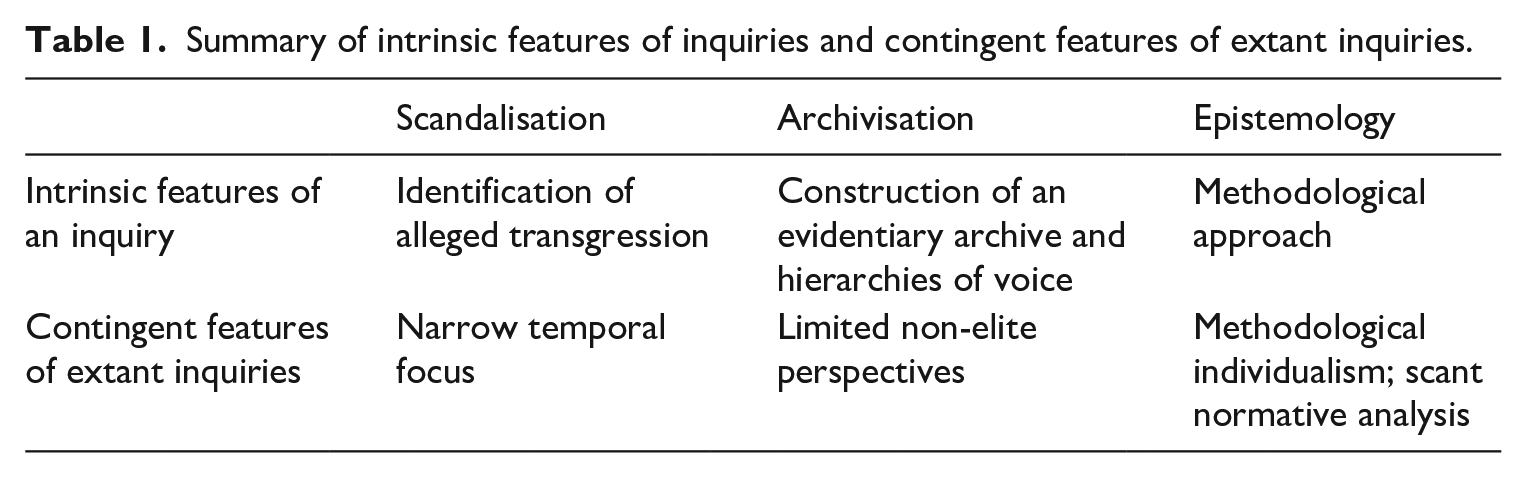
We begin by examining the purpose of inquiries, especially their role in (re)establishing state legitimacy and trust through the production of authoritative knowledge. We then make three key claims about necessary and extant features of inquiries. These are summarised in Table 1, below. First, we argue that inquiries are shaped by scandalisation (the ‘what’). Scandalisation focuses attention on an alleged breach of norms or values, but inquiries often employ a narrow temporal focus that excludes important systemic factors. Second, we consider how the identification, collation, and preservation of an archive of evidence shape the facts and lessons that can be learnt. We have termed this process archivisation (the ‘who’). We argue that, through a focus on high politics, (de)classified evidence, and establishment voices, inquiries overlook structural reflections on Britain’s use of force and its imperial continuities. Finally, we discuss the epistemological processes of inquiry (the ‘how’). We discuss the limitations of the juridical approach used in many inquiries and the relative absence of sociological or normative analysis. We suggest alternative methods and emphasise the need for candid methodological reflexivity to uphold democratic principles and enhance learning.
Summary of intrinsic features of inquiries and contingent features of extant inquiries.
What are inquiries for?
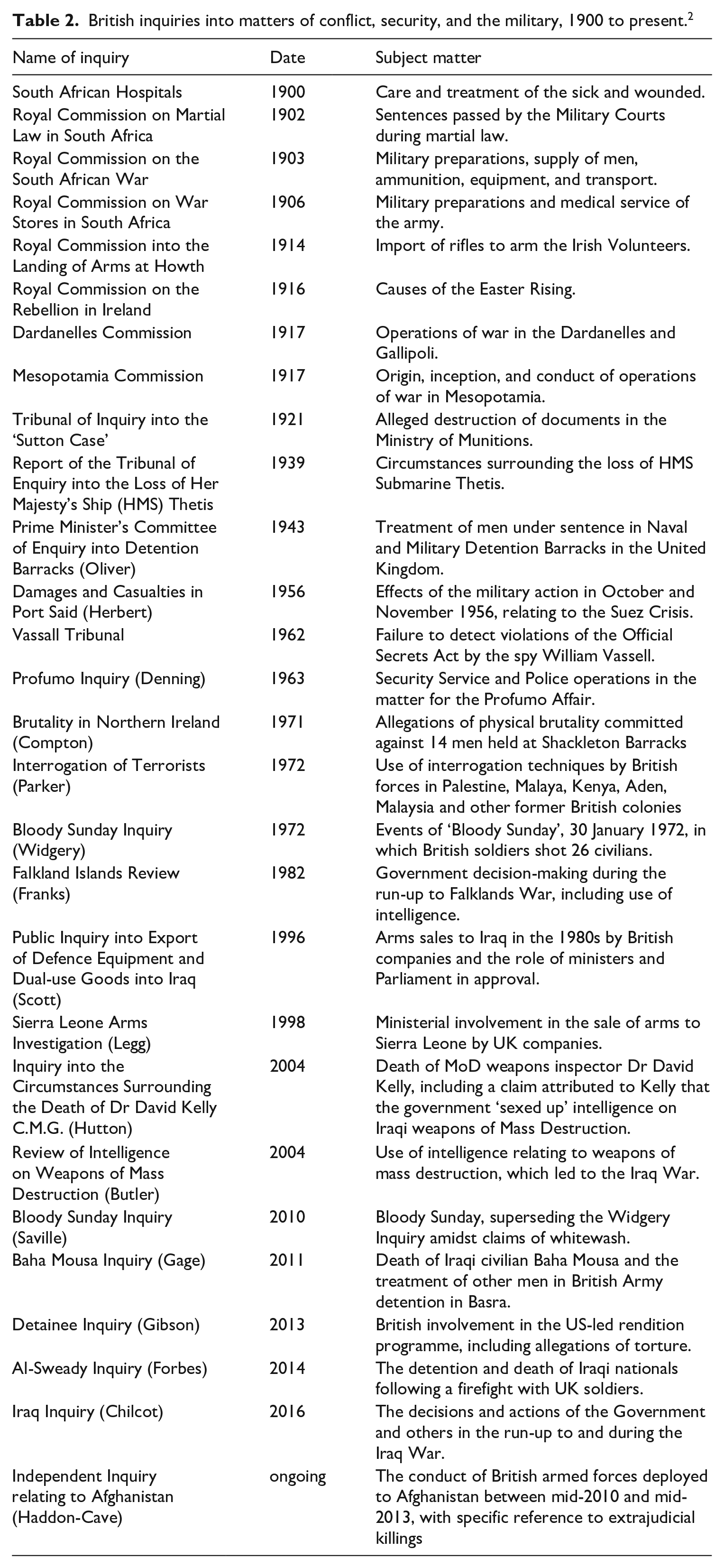
Public inquiries take different forms but simply defined, they are ‘temporary working groups created, mandated and made independent by governments in order to fact-find, hold actors to account or develop policy lessons’ (Stark, 2019a: 397). These functions serve a deeper political function: to recover the legitimacy of the state and its institutions as a force for good (Gilligan, 2003). While it is expected that the use of military and security apparatus will produce substantial harm or loss of life (including civilians, enemy combatants, and service personnel), the legitimacy of such practices stems from a belief that they are proportionate, necessary and in the public interest (Freedman, 2015: 74). As shown in Table 2 below, since the early twentieth-century, numerous inquiries have been appointed to investigate suspicions that Britain breached national or international norms. These norms include standards of equipment or care for soldiers (for instance, the Royal Commissions on the South African War, 1903 and 1906; the Mesopotamia Commission, 1917; and the Iraq Inquiry, 2016), mistreatment of prisoners in detention (for instance, the Oliver Report, 1943; the Compton Inquiry, 1971; the Gibson Inquiry 2013), mis-selling of arms (for instance, the Scott Inquiry, 1996; the Legg Inquiry, 1998), or the use of uncontrolled or unlawful force (for instance, the Baha Mousa, 2011 and the new Haddon-Cave Inquiry on Afghanistan). Alleged violations of these norms can have profound political ramifications, especially if the transgressions could indicate systemic rather than isolated incidents (Williams, 2023: 6). The nation may experience a sense of shame and reputational damage, affecting political and diplomatic relations (Verleye, 2021). Without proper scrutiny of alleged wrongdoing, moreover, it becomes difficult to insist that other, often non-liberal states, adhere to the same norms.
British inquiries into matters of conflict, security, and the military, 1900 to present. 2
An inquiry is one way in which a state can rescue its status as a force for good, fulfilling the message that its security and military apparatus is justified either ‘with the point of view of the defendant’, or as ‘protectors’ (Young, 2003: 8). In 2011, then-Secretary of State for Defence, Liam Fox (2011), presented the Baha Mousa public inquiry report to parliament and remarked upon the importance of the inquiry for Britain’s international reputation: To represent Britain, in war as well as in peace, is to represent our inherent democratic values, the rule of law and respect for life. When those values are transgressed, it is vital that we get to the bottom of what has happened, are open about the issues and their causes, ensure that what reparations we can make are made and do all that we can to prevent it from happening again. Only in that way can we ensure that those values hold firm in how we think of ourselves and in how others perceive us.
Fox’s comments also illustrate how an inquiry is an apparatus of ‘crisis management’ (Phythian, 2011: 69). Inquiries recover reputation by representing ‘failure as temporary, or no failure at all’: a deviation from an otherwise orderly political and administrative system (Burton and Carlen, 1978: 48). This is achieved by explaining how the wrong could have been prevented or mitigated, thereby creating a sense of control (Cagri, 2009). As we established earlier, scholarship is divided on whether inquiries deliver democratic accountability or are instead processes of social control that reproduce elite interests. Yet whether one is optimistic or pessimistic about inquiries, this underlying function of an inquiry remains: draw a line between those persons, practices, and/or policies that are complicit in a wrong and those that are not, through an act of ‘authoritative sensemaking’ (Brown, 2004). Following similar efforts in transitional justice (Nagy, 2008), our goal is to subject this sensemaking to critical reflection, rather than submit to a totalising critique of inquiries as irretrievably bound to foreclose accountability. The remainder of this article argues that this process of authoritative sensemaking depends on three discrete elements, as introduced earlier: scandalisation, archivisation, and epistemology. Each element is a type of line-drawing that is intrinsic to the methodology and conclusions of an inquiry.
The ‘what’ of inquiries: Scandalisation
Public inquiries investigate scandals (Greer and McLaughlin, 2017). We use ‘scandal’ to mean an alleged transgression of social norms, values, or moral codes that become publicised and a matter of concern (Crosbie and Sass, 2017). Inquiries are not established to investigate apparent tragedies; that is, losses or harms that are commonly accepted as unforeseeable or unavoidable misfortunes (Johnson et al., 2022). Instead, a scandal suggests an unexpected malfunction or malpractice within social and political order that could and/or should have been avoidable. Inquiries are only appointed when there is at least the suspicion of such a failure by state actors (Thomas and Cooper, 2020).
This reliance on scandalisation as a condition for an inquiry is reflected in the complaint that inquiries are ‘left-censored’; that is, inquiries are only ever appointed to investigate single cases of failures, which prevents the capacity to learn lessons by comparison to other cases (Perrow, 1999 [1984]). For example, there have been several calls for a public inquiry into the United Kingdom’s overall role in Afghanistan (beyond the specific failures of the 2021 withdrawal or alleged extrajudicial killings – both of which have been the subject of parliamentary and statutory inquiries, respectively). Some high-profile figures – such as former Chief of the General Staff Richard Dannatt (2021) – have called for an inquiry so that the United Kingdom’s strategy and operations over a 20-year period can be given a ‘real audit’. Others have disagreed with this view, including former Chief of the Defence Staff Nick Carter (2021), on the basis that the invasion of Afghanistan was not contested or suspicious to the same degree as the Iraq War. This reluctance to consider an Afghanistan inquiry (or even a comparative investigation of the United Kingdom’s military interventions since 9/11) except in the absence of a clear scandal makes some forms of learning less likely. Specifically, extant inquiries may learn the lessons required to avoid the recurrence of a specific past event but not the development of new strategies to address a future unknown crisis (Elliott and Macpherson, 2010). It is this latter form of strategic imagination that may be better achieved through a comparative inquiry. Royal Commissions were a widely used method to investigate broad policy problems that exceed a single scandalous event, but while commonplace until the mid-twentieth century, these have fallen entirely into disuse in recent decades.
Inquiries engage in a process of scandalisation setting the boundaries of what went wrong: line-drawing in time and space and delineating between different levels of actors. This begins as political discourses influence an inquiry’s terms of reference: What was the alleged wrong? When did it happen? Against whom or what was it committed? This is a necessary part of any inquiry, providing an investigation with a manageable scope. Counter-intuitively perhaps, this process of scandalisation does not only identify a wrong but also reaffirms what is right – with significant implications for accountability and future state interventions (Johnson, 2017: 712). The act of establishing what is in the scope of an inquiry (the time period, the actors, the types of decisions under scrutiny) everything outside of those terms as acceptable (or at least within the terrain of normal political debate). This process has been described by Hilary Charlesworth (2002) as ‘crisis orientation’ whereby a narrow agenda is set for scrutiny, excluding longer histories that precede and follow the event. While an inquiry provides a hyper-visible site of scrutiny, it is important to reflect on what is left out.
The risks of temporal narrowing were exemplified by the Saville ‘Bloody Sunday’ inquiry held to investigate the murder of 13 people and the injury of the same number. The Saville Inquiry overturned the findings of the rushed and highly controversial 1972 Widgery inquiry, which concluded that British soldiers opened fire after coming under attack. Saville concluded that none of those who were killed or injured posed a threat of causing death or serious injury to the British soldiers. The inquiry was widely regarded as successful: positively received by victims’ families and the Coalition Government; credited as giving families closure with a formal apology from Prime Minister David Cameron met by spontaneous cheers at the site of the killings (Bentley, 2021); and a critical step in peace process leading to the Belfast (Good Friday) Agreement. Yet, these achievements were underpinned by a narrative of Bloody Sunday as a localised failure, caused by complex situational dynamics on the day.
The inquiry focus was limited to the specific instance of violence on 30th January 1972 and Operation Forecast (the codenamed operation to prevent rioting that might result from a protest march). As Kate Kenny and Niall Ó Dochartaigh (2021: 393) have recently argued, this located the wrongdoing within ‘an essentially responsive move, driven by operational concerns, that is, by concerns about how the event might unfold on the day of the march, rather than relating to the government’s overall policy on security’ (emphasis original; see also Bennett, 2023; Ó Dochartaigh, 2010). Specifically, the inquiry did not accord significance to divisions among senior political and military figures on whether British security policy in Northern Ireland should pursue restraint (alongside Nationalist calls for political transformation) or an intensification of repression (such as an intensification of militarisation). This institution heavily influenced the decision of then-Commander of Land Forces in Northern Ireland General Robert Ford to choose 1 Para for Operation Forecast despite its reputation for excessive force (Kenny and Ó Dochartaigh, 2021: 392).
The situational focus of the inquiry has had important and adverse consequences. It precluded an opportunity to interrogate the interactive nature of military strategy, specifically counter-insurgency (COIN) strategy with its attendant principles such as minimum force and civil-military cooperation. The strategy and tactics employed by the British in Northern Ireland were drawn from decades of colonial aggression and would subsequently be employed in Iraq and Afghanistan (Drohan, 2017). The British Army has claimed a global reputation of expertise and success in COIN, yet researchers have persistently argued that theoretical principles, such as ‘minimum force’, have failed to match historical analysis (Thomas and Curless, 2023). For some, this can be traced to specific weaknesses in operational planning or leadership (Edwards, 2010). For others, COIN is an intrinsically flawed approach that often relies on violent coercion in contrast to its professed emphasis on ‘hearts and minds’ (Bennett, 2007; Porch, 2011). This critique of Saville is markedly different from the usual complaints of whitewash that often follow a public inquiry: the point is not that Saville misattributed blame to Ford and 1 Para, but that blaming those individuals ‘cannot adequately explain why events unfolded as they did’ (Kenny and Ó Dochartaigh, 2021: 404). As Patricia Owens (2003) and Neta Crawford (2013) have argued, explaining the unintended killing of civilians in war as the failure to follow standard operating procedures and doctrine can foreclose interrogation into whether those elements may themselves systemically facilitate such ‘mistakes’. A narrow temporal focus makes this moral logic more likely.
Saville’s temporal focus was partly the result of the inquiry’s legalistic format (Hegarty, 2002). This is a point of epistemology that we address below. Other inquiries, however, have investigated specific transgressions with attention to both situation and systemic institutional causes. The Baha Mousa inquiry led by William Gage (2011) investigated how in 2003 an Iraqi civilian died in British Army custody in Basra. The inquiry found that, in addition to unlawful physical assault, Baha Mousa had been subjected to a series of interrogation and conditioning techniques that had been banned by the UK government since 1972 and, by modern standards, would be considered torture (Farrell, 2022). The inquiry created specific ‘modules’ to investigate how these techniques found their way into British Army training through an institutional pathology of ‘corporate memory loss’ (Bennett, 2012). The investigation had some important limitations. Crucially, by describing the ban on these techniques as a ‘lost’ doctrine, Gage (2011: 508) was reluctant to map the cause or responsibility for this serious systemic failure beyond a conclusion that it would be ‘unnecessary and inappropriate to blame or apportion blame to any individuals’. This reflected a common reluctance in judge-led inquiries to determine the causes of institutionalised or corporate wrongdoing (Cooper and Thomas, 2023). Nonetheless, the Baha Mousa inquiry demonstrated that it was necessary to situate a discrete transgression within a more complex institutional context.
The ‘who’ of inquiries: Archivisation
Another form of line-drawing is archivisation: the construction of an archive of evidence for an inquiry. The idea of inquiry as excavation (unveiling of secret information from a dusty or digital government archive) should be treated with caution (Dolan, 2021; Ferrara, 2021). Exposure is never neutral. No matter how transparent an inquiry’s hearings and records are, archives necessarily impose a hierarchy in terms of who and what is heard. Extensive scholarship on international courts and commissions has shown how archivists are both record-keepers and gatekeepers in the constitution of public memory (Allen, 2020; Redwood, 2021). Archivists have an ‘invisible power’ to preserve, organise, and release documents, influencing knowledge production and ‘truth-telling’ (Schwartz and Cook, 2019: 3–4). Inquiry practitioners serve an analogous position to archivists by categorising, preserving, and amplifying documents to shape public understandings of the past and influencing whose perspectives are included, emphasised, or legitimised in the historical record. Inquiries have agency and discretion over which voices or narratives are preserved in societal memory and the production of ‘new social realities’ (Stoler, 2002: 104). This complicates the presumption that commissions of inquiry can be sites of apolitical truth. Archives are also part of an inquiry’s legacy, with its selection of voices amplified by historians who rely upon inquiry testimony or documents to construct their analysis (Chiam, 2021; Lambert, 2022: 10).
Archiving is a difficult task, not least because inquiry staff are faced with a mass of documentary evidence including both official records (with time-consuming processes of security assessment) and rafts of submissions from outside experts, campaign groups, family members and so on. Often this information is classified (and not yet assessed to be declassified) or provided in confidence. Filing decisions are not neutral, as officials decide where time should be spent on the labour of archiving and, crucially, where it should not (Robertson, 2021). An inquiry committee can quickly find themselves in a position, described by Hannah Arendt (1972: 10), in which they are unaware of some perspectives and voices: not because some invisible hand deliberately leads them astray, but because they work under circumstances, and with habits of mind, that allow them neither time nor inclination to go hunting for pertinent facts in mountains of documents, 99½ per cent of which should not be classified and most of which are irrelevant for all practical purposes.
The idea of an impartial inquiry assumes there are ideal conditions for the ‘emergence and conveyance of truth’ (Brothman, 2002: 339). But amid these pressures, bureaucratic processes of archiving are affected by staff’s preconceived values, moral assumptions, or political philosophy to legitimise some forms of record as ‘facts’. These decisions of preservation affect the range of voices and items included within the historical record and may reflect societal prejudices of race, gender, and class. For example, of the hundreds of witnesses invited to give evidence to the Chilcot Inquiry, only seven were women – which is an indication of the gendered representation of Whitehall institutions, but also an amplification of a gendered outlook. Similarly, inquiries frequently do not preserve the voices of victims or their families in the same way as establishment documents and internal reports (Schwartz and Cook, 2019: 1). While underrepresented voices can be read ‘along the grain’ within state archives (Stoler, 2008), these absences can reproduce (post)coloniality and patriarchal thinking by entrenching a hierarchy of experiences of who is listened to and valued in conflict and security discourse (Redwood, 2020: 280).
Our argument is that it is important to reflect on how inquiry archives are composed mainly of high politics, establishment voices, and classified evidence and how this produces partial narratives of events. This is a long-standing trend: over a century ago, the Mesopotamia Commission (1916–1917), or the ‘first Iraq Inquiry’ (Iraq Inquiry, 2016b: 224), relied almost exclusively on the statements and testimony of high-level military and medical officials to investigate the circumstances that led to the suffering of British and Indian Army troops during the Mesopotamia Campaign of the First World War. When Britain’s involvement in modern-day Iraq was once again under scrutiny during the Iraq ‘Chilcot’ Inquiry, the deference to an expert or elite authority reappeared. As Charlotte Peevers (2016: 249) has argued, ‘By documenting only those views deemed “expert” or “experienced,” far more wide-ranging debate was omitted from the official history of Iraq War policy-making’. Elite perspectives are replete in the memos and emails of classified archives and great efforts are made by inquiries to reveal this material to the public – including pages of material that is entirely redacted (Thomas, 2020). This revelation of declassified material often generates greater public trust in its methods and findings (Hegasy, 2019); its concealment is understood as proof of value. Yet what is classified is not always of higher value to understanding and learning. As Ann Stoler (2002: 108) warns, the labelling of something as a state secret suggests ‘privileged knowledge, and designated privileged readers while reminding the latter what knowledge should be coveted, and what was important to know’. This focus can limit the potential for lesson-learning, even if the inquiry’s focus (or scandal) is elite decision-making.
Overreliance on a documentary record of high politics can shield the state’s security narratives from critical questioning. For instance, both archives of the Iraq ‘Chilcot’ Inquiry (2009–2016) and the Butler Review (2004) into intelligence on Iraqi weapons of mass destruction feature declassified Joint Intelligence Committee reports on the threats faced by Britain: analyses of rogue regimes, pseudo-psychological reports of Saddam Hussein, and projections of terrorism in the wake of 9/11. Such reports were found by the inquiry to be flawed due to a tendency to employ worst-case estimates, caused by a misperception of Iraq’s obstruction of the UN weapons inspectors and a tendency to be over-cautious after 9/11. A more complex explanation of this failure requires moving beyond a forensic analysis of elite and institutional archives towards a historical and sociological analysis of the West’s long-standing cultural and racial presuppositions about Iraq. As Oliver Kearns (2023: 139) has recently argued, the flawed intelligence assessments of the early 2000s relied on well-established and unchallenged cultural assumptions that encouraged greater Western interventionism and global policing, such as general dismissal of Ba’athist politics, Arab xenophobia, and of the Iraqi state as driven by an irrational geopolitical strategy. Irrespective of specific failures between 2000 and 2003 (when the Iraq Inquiry (2016a: 42) notes that concerns about proliferation and mass-casualty terrorism became ‘fused’), these cultural theories were constitutive of a political rationale for an active Western role in the Middle East yet went largely unexamined.
These alternative voices are often displaced. For example, the Iraq Inquiry was criticised for failing to consider the human cost of the war beyond superficial attention, focusing on the overall casualty numbers rather than the personal experiences of those affected and lasting – generational – effects (Williams, 2023: 12). No Iraqi witnesses or testimonies were presented. The Iraq Body Count (IBC) – a prominent organisation that has attempted to track civilian casualties linked to the conflict – were not afforded an opportunity to address the inquiry. The IBC (2015) subsequently responded that: Despite the freedom that should have been afforded it by a broad remit, Chilcot’s Inquiry cleaves to the tradition of ‘a history of kings and queens’, taking scant interest in the ordinary people the war affected the most. Is such narrow focus really necessary in the 21st century? . . . the Chilcot Inquiry has evidently been given one so broad and indeterminate that it has been able to obsess minutely over the ‘war at home’ to the detriment of everything else. Indeed, one would almost think that the Iraq war largely took place in Britain.
Judging the true costs of the war is an important question and one that bears heavily on any assessment of the conflict. Such a matter requires an expansive consideration of harm but as Andrew Williams (2023: 12) notes, ‘questions of harm and its various manifestations (past and future, physical and psychological) were not open to analysis’ and ‘failure to consider obligations to hear accounts of harm (in whatever context) amounts to an “epistemic violence” in its own right’. While the Inquiry carefully preserved its Joint Intelligence Committee (JIC) reports or the transcripts of hearings with politicians and officials, the notes from highly publicised meetings with veterans, veterans’ families, academics, and representatives of regional government in Iraq were not retained at all, thereby diminishing the opportunity for alternative political standpoints and insights on the terms of reference. As addressed earlier, this exclusion is repeated by historians, thus reproducing these silences beyond the generation of the inquiry. It is also crucial to note that regardless of the limitations of any archive, it must be carefully maintained for future public use. An exploration of the latest archive of the Iraq Inquiry by the British National Archive leads to many broken or ‘dead’ links, preventing public access from thousands of declassified records relating to the invasion. 3 This is part of a pattern in state record-keeping that has suffered at the mercy of climatic shifts, age, digital ignorance, human carelessness, or even intentional destruction (Moss, 2005; Sato, 2017).
The ‘how’ of inquiries: Epistemology
The final line-drawing practice of an inquiry is its theory of knowledge (or epistemology) that shapes how the scandal is explained and how the voices of the archives are interpreted. It is remarkable that the epistemological approaches of inquiries are rarely discussed. An inquiry is an exercise in social research, and this means that it must make methodological choices. Yet, as Walshe (2019: 214) notes, ‘inquiries seem to be largely or even wholly atheoretical endeavours’, betraying ‘a largely implicit underlying belief in the existence of an objective truth that can be discovered’. An event can be explained in myriad ways, so the methodology chosen should be the best fit for what an inquiry has been tasked to explain (Jackson, 2011). Transparent reflection on the methodological commitments of an inquiry enables constructive criticism and better lesson learning. Conversely, trust in an inquiry will be undermined if its methodological underpinnings are opaque. Reflexivity should also extend to the positionality of inquiry members: their social position and intersectionality, 4 relationship to the object of study, 5 and their assumptions or biases that might influence their conclusions in a way that would differ from another inquiry team (Walshe, 2019: 212).
A clear example of an epistemological preference is the tendency to appoint quasi-judicial inquiries. Statutory inquiries as well as many non-statutory inquiries are led by a judge. Out of 76 inquiries undertaken between 1990 and 2022, 53 were chaired by current or retired judges (Cooper and Thomas, 2023: 306). The judicial style of inquiry is widely considered the ‘gold standard’, stemming from a long-standing belief that the legal approach is the most rigorous and unbiased method for establishing facts (Cooper and Thomas, 2023: 307). This preference is partly influenced by the erosion of public trust in government and parliament, which are often the subjects of such inquiries. It also reflects a global trend in the judicialisation of politics whereby courts and judicial means are being relied upon, often inappropriately, to address questions of ethics, politics, and policy (inter alia Forster, 2012; Hirschl, 2008; Williams, 2018).
The juridical approach is well-suited to investigate fine-grained behaviour in a discrete event but less suited to complex sociological and structural issues. This is because the juridical approach relies on methodological individualism, explaining events through questions of individual responsibility: what did a person do? What knowledge, beliefs, and intentions did they have? Were they, and should they have been, capable of acting differently? This generally excludes cultural assumptions, systemic pressures, and ideologies that can cause institutionalised (mis)behaviour but are not reducible individual(s) malpractice (Cooper and Thomas, 2023). This exclusion was exemplified by the Hutton Inquiry’s (2004) investigation of whether a British intelligence dossier on Iraq had been ‘sexed up’. Diana Coole (2005) forcefully demonstrated how Law Lord Brian Hutton deliberately eschewed an important sociological investigation of how British politics had been captured by a culture of ‘spin’ in favour of a black and white determination of whether specific individuals in the British government intentionally lied about Iraqi weapons of mass destruction (WMD). As Raymond Michalowski (2010: 21) puts it, many scandals arise from complex processes that defy ‘the mens rea straitjacket that requires individual blame to be assigned to deliberate miscreants’. That juridical inquiries are unsuited to socio-political issues is a limit well understood by legal practitioners (Beatson, 2014). Yet many inquiries are appointed precisely because the scandal involves such issues.
The significance of methodological individualism can be illustrated by returning to the Saville Inquiry on Bloody Sunday. Framing the killings as a consequence of miscommunication and misbehaviour by specific soldiers, specifically members of 1 Para, produced what Kevin Hearty (2021: 664) describes as ‘trigger puller’ truth: a legalistic account that ‘is ultimately only a very small piece of a much larger jigsaw [of] wider contextual issues and structural processes that go beyond whether X did or did not do Y to Z’. As Louis Blom-Cooper (2017: 1) has noted, ‘the vital concern about systems and services allotted to social problems was relegated to the identification of individual blameworthiness’. This narrow focus could not accommodate a collective ‘folk memory’ of the larger pattern of British army-led violence and unlawful abuses against Catholic Republicans in Northern Ireland (Conway, 2003). We noted above that this narrowing excluded consideration of military and political doctrine.
It also produced a political schism between those that used the inquiry’s findings to pursue criminal justice and the substantial public opposition to the ‘witch hunt’ against British Army veterans (Richards, 2023). The Saville Inquiry’s findings led to the prosecution of ‘Soldier F’ – one of those named in the inquiry report as having fired his weapon without justification and giving a false account of the circumstances. The decision to focus on a ‘bad apple’ has attracted criticism for neglecting how an environment of impunity existed at the time, or the consequential accountability of political and military leaders who advocated for a more aggressive approach (McGovern, 2019). At the same time, the prosecution is criticised by swathes of the public and political actors who are sympathetic to the narrative of ‘elderly former British soldiers being “hounded” while “terrorists” are released early from prison, avail of “on-the-run” comfort letters and take up well-paid government posts’ (Hearty, 2020: 229). The prosecution is one of several examples of service personnel subject to investigation and, in some cases, prosecution for criminal offences that, critics argue, should be understood in the context of wider systemic failings. These include the case of ‘Marine A’ (Walklate and McGarry, 2016) and the workings of the Iraq Historic Allegations Team (Williams, 2018). The clearest sign that the government is learning from such episodes is the legislative action to limit the circumstances under which British soldiers can be prosecuted – embodied in the Overseas Operations Act 2021 – rather than an attempt to understand the background conditions that contributed to such killings. The latter has been highlighted as lacking scrutiny in Northern Ireland, by the UN Special Rapporteur (De Greiff, 2016: 9) and in Iraq, by the International Criminal Court (ICC) (2020). The Act restricts the scrutiny of some military wrongdoing if 5 years have elapsed since the alleged wrong – a decision that the UN warned would undermine the United Kingdom’s commitment to international human rights obligations. The government explains that the act is required to take into account the ‘uniquely challenging context of overseas military operations, and the exceptional demands and stresses to which Her Majesty’s forces are subject on such operations’ (MoD, 2021). It is precisely these contexts and demands that may lack proper scrutiny.
It is important to consider methods that can escape this dichotomy of individual blame versus excuse and invite scrutiny of the policies, patterns, and processes that can provide moments of transgression. This requires an acceptance of knowledge claims that may not pass the scrutiny of the adversarial questioning and evidentiary thresholds of the courtroom. If the goal of an inquiry is not to reduce accountability to individuals, however, it is reasonable to depart from these high thresholds. Truth commissions have long acknowledged the importance of narrative or anecdotal accounts from witnesses to wrongdoing. Such accounts, as well as other techniques including documentaries and video evidence, social media posts, or satellite data can offer an effective means of understanding the context and experience in which conflict and security controversies occur (Williams, 2023: 16). Such methods are important not to implicate an individual but to reveal these broader circumstances and locate unrecognised forms of harm or wrongdoing, as well as their structural and cultural roots. Such methods are also employed by various counter-forensics groups – that is, civil society organisations that produce various scientific and aesthetic means to produce and present evidence in the pursuit of public accountability. 6 These approaches provide opportunities not only to describe what happened, but how and why. This, in turn, creates opportunities for ‘value-oriented’ learning in an inquiry, which centre ‘lessons orientated towards values, assumptions and cultural norms’ (Stark, 2019a: 402). Such lesson learning, which inevitably challenges the status quo, is often lacking in inquiries because alternative policy approaches appear unclear or lack practical steps for implementation (Stark, 2019a: 414). This is precisely what can be gained from greater inclusion and methodological clarity and diversity in non-statutory inquiries or Royal Commissions.
The limitations of a juridical approach were well understood during the appointment of the Iraq ‘Chilcot’ Inquiry. The inquiry was explicitly designed to avoid Saville’s legalistic, individualist, and adversarial features (O’Donnell, 2009), attracting significant political and media criticism for ‘avoiding blame’ (Thomas, 2017). Lawrence Freedman (2021), member of the Iraq ‘Chilcot’ Inquiry, has spoken on the benefits of this non-legal approach: Everybody lawyers up if you’ve got a judge . . . You have to have witnesses feeling that they can respond to the questions . . . we didn’t find that a problem in Chilcot . . . one of our witnesses said, ‘actually, with you, I’ll say what I think’, He was involved with another judge-led inquiry, and said, ‘there I was told that must say: “yes”, “no”, or “I can’t remember”’. You don’t want that; you want people to feel able to unload themselves.
The Chilcot Inquiry uncovered systemic failings, such as a reluctance among both officials and politicians to challenge Tony Blair’s policy, in deference to his political leadership. This lesson was captured in The Good Operation – a Ministry of Defence handbook that includes 10-step ‘Chilcot Checklist’ to empower officials to challenge policies that could lead to ‘irrational or dysfunctional outcomes’ (MoD, 2018).
In another respect, however, the Chilcot inquiry demonstrated a different epistemological limitation: a reluctance to engage in normative questions about foreign policy and grand strategy. Irrespective of how politicians and officials work to avoid ‘groupthink’, evidence heard during the inquiry demonstrated there remains a fundamental vulnerability with the Doctrine of the International Community and Laws of War more generally. That is, concepts such as ‘last resort’ and ‘imminent threat’ can be stretched to justify the anticipatory use of military force, thereby justifying combat operations that have ‘dysfunctional’ outcomes in the long-term. This problem exists beyond the confines of the Iraq War (Badalič, 2021). The problem has attention from scholarship (Ralph, 2011; Thomas, 2017), but this is not the same as substantial debate in the public sphere. Tony Blair (2016) complained that such questions were not given attention during a lengthy press coverage: ‘I understand all the criticisms that the report makes of the process . . . but there are real lessons of political strategy and military strategy’, Blair said, what sort of alliances should Britain be constructing in the world today? How does Britain make sure that it leverages its power in the most effective way to defeat this terrorism . . . Where does this report tell us what we should do, as decision-makers?
In – supposedly – post-colonial Britain, these are important questions across the political spectrum.
Some inquiry practitioners argue that an inquiry should not advocate for policy but provide a comprehensive account that can inform subsequent public and parliamentary debate (Butler cited in Kearns, 2023: 8). This claim should be treated with caution because it overlooks how an inquiry’s account is already constrained by scandalisation and archivisation. It also overlooks, as Jonathan Sumption (2019) recently argued, a political sphere that is increasingly unwilling to address substantive matters of ethics – preferring to outsource such questions to courts and, of course, inquiries. Tony Blair’s decision to take part in the invasion of Iraq was a political judgement, noted as fact by Chilcot but not evaluated. When pressed on the morality of the government’s decision-making, Chilcot remarked, ‘I am not an ethicist!’ (BBC, 2017). Fellow inquiry member, Lawrence Freedman (2017: 104) has similarly remarked that, ‘the only fair test when evaluating judgements is to ask whether a decision was reasonable given what was known at the time’. This indicates a fundamental paradox with inquiries: to make a determination on this judgement would be a political statement which would go against the non-political character of the inquiry and its committee members upon which claims to neutrality and trustworthiness depend (Rangwala, 2024). As the decision to participate in the Iraq invasion was primarily an ethical and political judgement, excluding such assessment from inquiries is bound to be frustrating and, ultimately, inadequate for meaningful lesson-learning. Inquiries practitioners need the capacity to engage in the analysis of moral questions (Williams, 2023: 12). Otherwise, an inquiry report of 1.2 million words can still fail to be authoritative. This is perhaps what Barkawi and Brighton (2013: 1117) mean when they say that ‘the root of the crisis in strategic thought is more fundamental than anything that might be addressed through public inquiries’. Without a venue for political judgement and imagination, the question of what British grand strategy in the Middle East and elsewhere should have been, or should be now, remains underexplored.
Conclusion
All inquiries involve processes of scandalisation, archivisation, and epistemology. The contingent enactment of these processes has resulted in inquiries that are too limited in scope, too focused on the experiences of political elites or government agents, and too concerned with a factual account of individual responsibility at the expense of sociological or ethical thinking. ‘The problem with inquiries’, a former Cabinet Secretary remarked, ‘is all they tell you is how to fight the last war’ (The Economist, 2023). Our analysis of inquiries largely supports this complaint but, importantly, explains why this happens and how it can be avoided. At their best, inquiries have given definitive findings on specific factual questions: no person ‘threw or threatened to throw a nail or petrol bomb’ at soldiers on Bloody Sunday; intelligence ‘had not established beyond doubt’ that Iraq had continued to produce WMD. But such inquiries have been less well-equipped for the investigation of systemic behaviour, ideological scrutiny, and the morality of customary doctrine – and it is through such means that grand strategy of ‘the next war’ is considered. 7 If inquiries into issues of conflict and security are not going to be a matter of ‘file and forget’, the following questions should be considered:
What is the scandal under investigation? (a) What is the temporal scope of the transgression? What historicisation is required? (b) What should be investigated beyond the immediate individuals, event(s), or allegations? What organisational, policy or doctrinal, political, or cultural practices played an important role? (c) What can be learned from comparison to ostensibly successful operations or policies?
2. Whose voices and experiences should be included in the archive? (a) What is the value of non-elite or non-state evidence? What alternative standpoints can be included from international, regional representatives, civil society actors, or community leaders? (b) What important perspectives are already publicly available? What can open-source information add or balance against classified archives? (c) How are voices and experiences retained? How is the archive protected for future use?
3. How will the inquiry investigate? (a) How is the inquiry team reflexive about its positionality? (b) What kind(s) of judgement is the inquiry required to make? (e.g. factual, legal, political, ethical) (c) What methods and methodologies are best suited for these judgements? How is the choice of methods transparent?
Without critical thought and reflexivity, inquiries can rehabilitate business as usual. Ultimately, it is helpful to return to an ostensibly simplistic critique of inquiries: their cost. Inquiries are frequently criticised for the time and money costs: Saville, £191 million and 12 years; Gage £25 million and 3 years; and Chilcot £13 million and 7 years for arguably one the most complex and historically nuanced inquiry attempted. Yet there is a substantial cost of not taking the time and money to ask difficult questions, in terms of the stability and legitimacy of international order and justice. Such questions demand both receptiveness to structural flaws in strategy, ideology, and doctrine – as some inquiries have achieved – and methodological innovation to consider how complex social learning can be instrumentalised to address such flaws. The last two decades of inquiries have demonstrated a profound need to reflect on Britain’s grand strategy and its role in the world especially regarding foreign and security policy. Without a greater degree of reflexivity about how inquiries produce knowledge, inquiries will give the impression of moving on while allowing the past to be repeated.
Footnotes
Acknowledgements
Earlier versions of this manuscript were presented at the 2021 Millennium Conference, the 2022 GUARDINT conference at Kings College London, and the Warnings from the Archive workshops held at the University of Exeter in 2021 and 2022. The authors would like to acknowledge the insightful comments and reflections of participants at these events. They also thank members of the University of Exeter’s Centre for Advanced International Studies, including Gregorio Bettiza, Stephane Baele, Irene Fernandez-Molina, John Heathershaw, and Bice Maiguashca for providing invaluable feedback on earlier drafts of this manuscript. They also appreciate the contributions of the anonymous reviewers and the editorial team of BJPIR for helping to refine the contribution of this article.
