



Abstract
This article brings feminist critiques of capitalism into conversation with race-conscious International Political Economy to highlight the place of social reproduction in the colonial global economy. It does so by taking a provincial perspective, using Royal Leamington Spa as a case study to reveal how the provision of care for the elderly and the ill sustained colonial elites across the life course, while religious and educational practices helped transmit cultural values across generations and reproduce imperialism as an institutionalised social order. Whereas the finance houses of London, the factories of Manchester, and the ports of Liverpool and Bristol constitute nodal points for imperial circuits of capital, the spa town condenses the everyday practices through which bourgeois metropolitan empire was lived and made liveable. These findings point to a functional differentiation of economic space within the metropole and offer a critical reinterpretation of Middle England as a Whitened site of middle-class respectability.
Keywords
Introduction
In recent years, the field of International Political Economy (IPE) has been subject to a series of critical interventions stressing the racial logics and legacies of European colonialism (Anievas and Nișancioğlu, 2015; Bhambra, 2021; Halperin and Palan, 2015; Hobson, 2020; Tilley and Shilliam, 2018). One of the core arguments of this literature is that extant scholarship has paid insufficient attention to the role of colonialism in the historical development of capitalism and globalisation. This has led to a misplaced emphasis on exploitation in the capital-labour relation over expropriation in the metropole-colony relation, and a tendency to either ignore Western empire or launder it as a benign civilising mission. The upshot is that too much IPE remains race-blind: able neither to historicise the racial inequalities that exist between and within countries today nor to articulate a politics to redress these through new forms of recognition, reparation, and redistribution (see Best et al., 2021).
To help rebuild IPE as a race-conscious field, alternative histories of the modern world system have thus been advanced. One of the most compelling has been Gurminder Bhambra’s (2021) account of the colonial global economy. Challenging the presumption that capitalism developed as an internally driven process within the nation-states of the West, this foregrounds the colonial relations and racial hierarchies of imperial states in the establishment and evolution of capitalism (see also Bhambra, 2014, 2022). So instead of a conventional history that tells us how liberal capitalism was transformed by class compromise into social democratic capitalism, Bhambra gives us a regime of state-managed colonialism in the 19th century followed by the racialised amelioration of labour exploitation for (White) workers within imperial metropoles in the 20th century. In short, she shows how the foreign warfare and domestic welfare which produced the core of the capitalist world system were predicated upon extractive systems of taxation, monopolisation, and resource appropriation forced upon its colonies. This brings into question contemporary claims about the welfare states and living standards of ‘developed countries’ being imperilled by (non-White) immigration and a breakdown in working-class solidarity caused by an identity politics attentive to race and other social differences. On Bhambra’s reading, these conclusions are only tenable if the colonial provenance of inherited wealth and the racial basis of its nationalist redistribution are conveniently forgotten.
Another important contribution to this literature is Robbie Shilliam’s (2018) study on class formation in (post)colonial Britain. In this, he shows how the racialised distinction between the deserving and undeserving poor has long been articulated by a political elite cognisant of colonial-metropole relations. In the 19th century, for instance, the ‘residuum’ in the urban slums of London were analogised or Blackened as savages and slaves, prompting eugenic concerns about the degeneration of working-class stock and their waning military fitness in imperial conflict. This in turn provided the impetus for national insurance legislation intended to reproduce the patriarchal family and industrious labour perceived in the countryside within the supposedly immoral urban milieu of Britain’s towns and cities. Pulling this forward into the 21st century, Shilliam reveals the same techniques of governance at work in the way Brexit Leave campaigners constructed the ‘white working-class’ as a deserving constituency being ‘left behind’ in multicultural Britain. For him, this occluded the facts that White privilege had diminished rather than zero-sum declined, and that ethnic minority groups were themselves disproportionately working-class. As he concludes, these two features were tragically exposed by the Grenfell Tower fire in 2017 which revealed, in one of London’s richest boroughs, a deep-seated history of dangerous and discriminatory housing provision to a racialised underclass.
Taken together, what Bhambra and Shilliam clarify are the racial lines along which capital accumulation in the colonial global economy was socialised and how that colours contemporary policy debates. This article extends these insights in two ways. The first is to bring the feminist concept of social reproduction to bear on race-conscious IPE. Despite an interest in policy areas like welfare and housing, research on the colonial global economy has yet to provide historicised accounts of how life under capitalism was reproduced within imperial states that draws directly on this rich body of scholarship. The second is to locate social reproduction in the colonial global economy outside London. In recent IPE and International Relations (IR) literature on the British metropole, examples featuring the capital city abound. They include studies on the link between plantation slavery and the design of financial instruments in London (Dannreuther and Kessler, 2017); the re-emergence of the City of London at the centre of an imperial financial geography of tax havens (Palan, 2015); the role of racialised and imperial urban governance in the making of London as a global city (Danewid, 2019); and the meaning of London’s built environment as a symbolic home to the Anglosphere (Kenny and Pearce, 2018). By taking a provincial case study, the article suggests that we can better understand how the colonial global economy ‘took place’ beyond the urban growth poles of imperial Britain, and, on that basis, critique the contemporary racial politics attached to provincial imaginaries like Middle England.
The article begins by unpacking the concept of social reproduction, paying particular attention to its temporal and spatial dimensions. The next section details the methodological approach. It explains the advantages of taking a provincial perspective on the colonial global economy, justifies the case study of Royal Leamington Spa as an instantiation of modern-day Middle England, and outlines the archival and ethnographic data sources cited. The penultimate section provides the main analysis, showing how Leamington served as a place of care for colonial elites and cultural preservation for imperialism. The conclusion teases out the implications for IPE in racialising social reproduction, spatialising the metropole, and historicising White innocence.
Feminist theorisation of social reproduction
Within feminist political economy, the concept of social reproduction emerged out of Marxist debates in the 1970s that questioned how capitalism was able to reproduce itself as a system despite being unable to internalise the costs of vital tasks like nurturing a healthy labour force. Put simply it was asked, ‘if workers produce commodities, then who produces the worker?’ (Bhattacharya, 2017). Answers centred on the externalisation of costs onto women via domestic work in the home. It was this work – unseen, uncounted, unpaid – that feminists sought to bring within the ambit of capitalist critique. This was pursued theoretically in conceptions of an ‘expanded mode of production’, which challenged narrow understandings of capitalist production by arguing that the ‘production of goods and services and the production of life are part of one integrated process’, as well as politically in campaigns like Wages for Housework (Luxton, 2006: 36). While social reproduction was initially located within the home, it soon escaped these confines. As noted by Catherine Hoskyns and Shirin M. Rai, along with unpaid domestic work, the concept of social reproduction came to encompass other ‘background activities’ on which capitalism depends, namely, biological reproduction; the provision of sexual, emotional, and affective services required to maintain family and intimate relationships; voluntary work directed at meeting needs in the community; and the reproduction of culture and ideology (Hoskyns and Rai, 2007: 300).
These activities are said to operate on both a daily and intergenerational basis, giving social reproduction what might be called a ‘two-speed temporality’. On the one hand, there is a concern with the routine tasks and coping mechanisms of everyday life, undertaken so that individuals, families, and other interpersonal groups can reproduce themselves and survive from one day to the next. On the other hand, there is an enquiry as to how labour power and society at large is sustained across the life course and reproduced over time. This involves both biological reproduction and cultural/ideological reproduction, the latter understood as the transmission of ‘historically derived values, norms, skills and knowledge as well as the construction of identities and subjectivities’ (Steans and Tepe, 2010: 809). As elaborated by Nancy Fraser, central to the replenishment of the proletariat and the basic legitimacy of capitalism is the work of ‘socializing the young, building communities, and producing and reproducing the shared meanings, affective dispositions, and horizons of value that underpin social cooperation, including the forms of cooperation-cum-domination that characterize commodity production’ (Fraser and Jaeggi, 2018: 31). This intergenerational concern draws attention to the institutional arrangements of welfare: schools and educational funding that enable children to be brought into capitalism’s productive relations as bearers of labour power; medical facilities and insurance systems that maintain a healthy workforce; and care homes and pensions for the elderly who are no longer able to rely on waged labour to support themselves (Bhattacharya, 2017).
Thinking about the institutional sites of social reproduction also takes us from the temporal dimension of the concept to its spatial dimension. Marxist feminists have argued that capitalism, unlike other social systems, necessitates a divide between commodity production and social reproduction. For Nancy Fraser, this divide was cemented in the imperial metropoles during the long 19th century when work was split into two distinct spheres separated spatially: the factory versus the home (Fraser and Jaeggi, 2018: 83). As noted above, while feminist political economy has been at pains to point how much essential work remains in the home, it has also recognised that social reproduction can take place in a range of institutions including those of the market (Prügl, 2020). For instance, feminist scholarship has articulated caregiving as existing along a continuum from unpaid work within the family and charities to waged labour within public services and commercial care providers (Bakker, 2007: 548). This continuum of commodification also goes for cultural reproduction. ‘Family values’ can be reproduced informally within the home but also packaged up and sold for profit by the media and entertainment industry. A related point is that the distribution of socially reproductive work is not fixed but subject to political contestation over where it should be located; what Fraser has called ‘boundary struggles’ (Fraser and Jaeggi, 2018). For example, studies on the care crisis in the UK have shown how cuts in public services and bankruptcies of commercial care providers have displaced caring responsibilities onto (female) family members and community volunteers, underpinned by gendered and racialised assumptions about the willingness of groups like women and Asian families to take this work on (Akhter et al., 2022; Dowling, 2022).
We can also think of the spatiality of social reproduction in terms of the core-periphery geography of the world system. This has been taken up in studies of global care chains that have traced the migration of maids, nannies, and other domestic workers into households in richer parts of the world, and the knock-on effects of the wages remitted home and the care deficits left behind. As well as showing how social reproduction operates transnationally, this scholarship has also made the case that women who undertake this relatively low-paid and unprotected labour are made exploitable and expendable through processes of racialisation (see Yeates, 2012). The recognition of racial hierarchy in global care chains and other forms of migrant labour in the Global North has been one reason for the engagement with Black feminist literatures, which have long argued that ‘gender, sexuality, race, class and nation . . . mutually construct one another’ as systems of oppression experienced in the everyday (Collins, 2000: 47).
Yet despite the integration of intersectional perspectives into the analysis of social reproduction at the world scale (Ferguson, 2008), there have been few studies historicising global capitalism through these lenses. One of the most provocative remains Maria Mies work on the split between factory and home in the 19th century. Mies (1986) posited that while the colonial trade in luxury goods hastened the domestication and objectification of women, the colonisation of territory by ‘Big White Men’ prompted ‘little white men’ in the metropole to colonise the family through imposition of a breadwinner-housewife model. In short, colonisation caused ‘housewifisation’. Nevertheless, this remains a somewhat isolated and schematic account, tied empirically to the German context. As such, just as race-conscious IPE could benefit from an injection of social reproduction theory, so too could the latter gain from the historical approach advanced within the literature on the colonial global economy.
Provincialising the metropole
To apply these insights from the feminist literature on social reproduction – namely, the emphasis upon children and the elderly when thinking intergenerationally, the existence of socially reproductive work outside the home by charitable and commercial providers, and the situation of social reproduction in the metropole-colony relation – I now consider methodology. An important starting point is the spatial turn in British imperial history, in which scholars rejected the idea of metropole and colony as discrete spatial containers and instead re-conceptualised them as mutually constructed entities. As taken up by feminist and postcolonial historians, this was used to investigate how empire was lived across everyday practices within the imagined boundedness of the metropolitan home, challenging the ‘common-sense geographical history of an island nation mostly untroubled by its imperial project’ (Hall and Rose, 2006: 26). In disrupting the island nation narrative, such work also contested state-centric accounts of a British Empire controlled by upper-class elites in London. Rather, a polycentric governance was highlighted in which ‘complex webs or networks of association – “imperial circuits” – connected private, provincial, and local interests in Britain with their overseas contacts, communities, and projects’ (Thompson, 2008: 54). It is worth recalling in this context that in 19th century Britain, the state was more decentralised and its population in England more dispersed: central government spending as a percentage of gross domestic product was around one third of what it was in the 20th century, while most people lived outside its 40 largest towns and cities (House of Commons, 2018: 4; Chandler, 2007: 76). Finally, this literature also brought the politics of imperial historiography to the surface. Deliberately undermining those insular versions of British history that made racial outsiders of mid-20th century immigrants by rendering Black and Asian former subjects of empire ‘out of place within the British Isles’, this critical group of scholars instead offered alternative understandings of Britain as ‘always already’ constituted by imperial flows of people, capital, commodities, and culture (Lester, 2016: 121).
One site bringing together these themes has been the English country house (Barczewski, 2014; Dresser and Hann, 2013; Finn and Smith, 2018). Disrupting their conventional depiction as quintessential sites of Englishness and Whiteness – consider the popular TV programme Downton Abbey as one recent example – these studies have shown how country houses were in fact built and furnished through imperial flows of capital and plunder, and not infrequently staffed with African and Indian servants. Going further into what she calls ‘the colonial countryside’, Corinne Fowler has taken in literary representations of moorland, rurality, and country gardens too. For her, these spaces are similarly ‘misconceived when, both deliberately and by more unwitting amnesia and ignorance . . . [they] are removed from their complex global histories’ (Fowler, 2020: no pages). What is at stake here is that by stripping such spaces of their imperial history, they become sealed off from the hybridity and violence of colonial encounters. Thus decontextualised, they can be suffused instead with ‘white innocence’: a quality that speaks of purity and virtue, while silently disavowing responsibility for harm or receipt of privilege (see Wekker, 2016). When this innocence is questioned, the backlash can be fierce. Consider the clamorous response to Fowler’s work with the National Trust acknowledging the colonial links of its country houses, which many right-wing commentators and politicians painted as a project by ‘woke campaigners’ to rewrite history as ‘anti-British’ in an emotional register of guilt and shame (Heffer, 2022; see also Davies and MacRae, 2023).
Reaffirming Doreen Massey’s point that ‘[t]he identity of places is very much bound up with the histories which are told of them, how those histories are told, and which history turns out to be dominant’, what this literature therefore demonstrates is the methodological value of exploring case studies that are situated in Whitened spaces disassociated from Britain’s imperial past (Massey, 1995: 186). This article starts from a similar premise, but steps into that missing middle between the city and the countryside by looking at provincial England.
The provincialising move has been a key part of the postcolonial critique of Eurocentric history. As set out by Dipesh Chakrabarty (2000), this sought to decentre cliched ideas about Europe that had embedded themselves in everyday habits of thought by looking to the margins – in his case, the subaltern peoples of South Asia – to renew shared knowledge along more egalitarian lines. Bhambra (2010) took up this concept in her earlier sociological work provincialising cosmopolitanism, as did John Hobson when he argued in Multicultural Origins of the Global Economy that imperial power must be provincialised to avoid presenting the expansion of the West as a totalising project that confines non-Western societies to the status of helpless and passive victims (Hobson, 2020: 395). In a sympathetic engagement with Bhambra’s later work, Bolaji Balogun also draws on this approach. He shows how the economic circuits of the colonial global economy did not revolve entirely around a Western European pivot but were also constituted through exchanges with the Polish-Lithuanian Commonwealth, contesting the presumption that Eastern Europe was ‘detached, non-complicit and irrelevant to transatlantic narratives of slavery and empires’ (Balogun, 2022: 460).
In all these examples, ‘the provincial’ functions as a verb metaphor: the ideas and practices of Eurocentric history are stripped of their presumed universality to make intellectual space for other epistemologies and experiences to be accommodated. In short, Europe, or the West, are treated as if they were a province. Here, I adopt a more literal usage of the provincial, following its conventional definition as a territorial unit that lies beyond the administrative centre of the state. In 19th century Britain, it was the cities, towns, and villages outside ‘metropolitan London’ that fell into this category. This optic was reproduced in the classic 1968 text Provincial England by W.G. Hoskins, the founding father of English local history, though towards the end of the 20th century many of England’s larger urban conurbations like Greater Manchester had joined the ranks of the metropolitan (Rodger, 2014). The meaning of provincial has thus evolved to take on more of a cultural dimension, conjuring up communities that are insular, traditional, rustic, and conservative. It is for this reason that I use Middle England to explore the provincial, since it resonates with both criteria of being outside the metropolis and behind metropolitan culture. Moreover, as I now show, it also takes us a site of continued importance to the racial constitution of Englishness.
Middle England via Royal Leamington Spa
So, where exactly is Middle England? While it certainly has its coordinates in the geographical imagination – commuter belts, market towns, the home counties, suburbia – few people have sought to delineate it on a map. Rather, Middle England has functioned more as an ideal type of provincial life, akin to the role played by Middle America in US political discourse. Charting the ‘strange birth’ of Middle England, which as shown in Figure 1 suddenly emerged as a media reference point in the 1990s, Joe Moran (2005) concluded that it was essentially a rhetorical strategy undertaken by political parties to speak to a nominally homogeneous but carefully targeted ‘people’ within the electorate. Birthed under the Conversative government of John Major and maturing under the Labour government of Tony Blair, Middle England drew on articulations of the middle-class as politically moderate, socially conservative, economically industrious, and beleaguered by tax. An extension of this argument was provided by Jack Holland (2012) who demonstrated how this constructed political constituency was used by Blair and his party advisers to strategically frame policy, making sure it appealed to the Middle Englanders who they believed could deliver crucial swing votes in marginal seats.
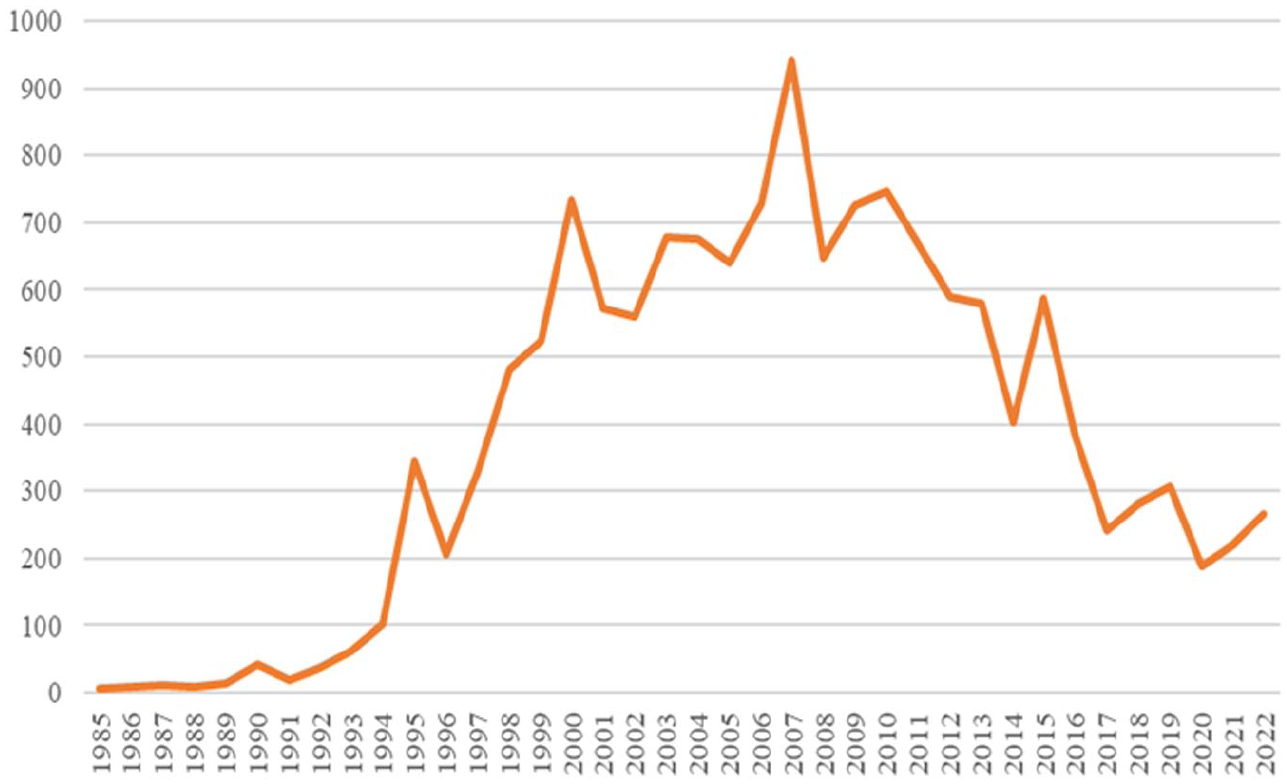
Citations of ‘Middle England’ in major UK print newspapers, 1985–2022.
On this view, Middle England is an ideational site where arguments about the identity and deservedness of the middle-class are played out. But as Arun Kundnani has stressed, these arguments are also deeply raced and gendered. Subtended by right-wing columnists in the 1990s, Middle England was the place to be defended against the encroachment of urban crime, foreign threats, and moral decay so scandalously covered in the rest of their newspapers. Readers were assured that policies promoting traditional family values, proper education, and controlled immigration would help maintain an upstanding way of life (Kundnani, 2000: 7). In this context then, Middle England can be read as a cypher for xenophobic English nationalism, a refuge for reactionary politics that reproduces racialised forms of belonging and behaviour around a Whitened notion of respectability.
Despite its waning use in the media since Blair left office and more recent displacement by post-Brexit imaginaries of the working-class provincial like ‘left behind Britain’ and the ‘crumbling Red Wall’ of traditional Labour seats, Middle England has not disappeared. It was given a cultural salience in the 2018 novel Middle England by Jonathan Coe, which set this as a battleground of the Brexit referendum ultimately captured by provincial Leave voters (see Dorling, 2019 for an academic version of this argument). Politically meanwhile, its utility as an electoral signpost to the centre ground has been recouped since 2020 under Keir Starmer’s leadership of the Labour Party. When asked if Labour was now the party of Middle England, Starmer has affirmed, ‘Absolutely, yes it is, and it must be . . . Have we got to focus on winning votes in the Red Wall? Yes, but we’ve also got to focus on winning votes in the Blue Wall’ (cited in Newman, 2021). And lest we forget Kundnani’s point, note how Conservative MP and renowned ‘culture warrior’ Oliver Dowden has enrolled the hallmarks of Middle England into his vision of national values. Speaking at the Conservative Party spring conference, he told the audience: As I walk with my children through the calm suburbia of Hertfordshire, its values so derided by the Left, I actually reflect on the great fortune we have to live in a nation defined by stability, security, and yes, Conservatism. For me, the privet hedges of suburbia are the privet hedges of a free people. And I will make it my mission as Chairman to defend those values and those freedoms. (Dowden, 2022)
To excavate the imperial history of social reproduction in Middle England, I provide a case study of Royal Leamington Spa. This is a mid-sized town in the county of Warwickshire which political reporters have described as ‘a peaceful and prosperous patch of Middle England’ redolent of the centre ground (Chaffin, 2018; see also Ashcroft, 2019). After decades of returning Conservative MPs in the general election, the Warwick and Leamington constituency was noted for its swings to Labour under Blair in 1997, then to the Conservatives under Cameron in 2010, and somewhat surprisingly, back to Labour under Corbyn in 2017. The association with Middle England has also been made in popular culture. Leamington has featured in travelogues and comedy sketches about Middle England (Bridges, 2014; Maconie, 2010) and was used for many of the outdoor scenes in Keeping Up Appearances, a long-running BBC sitcom about the fragile middle-class identity of Hyacinth Bucket (‘It’s pronounced Bouquet!’). Furthermore, its Royal prefix gives the town an ongoing association with the monarchy, support for which tends to be another characteristic ascribed to Middle Englanders.
Data were sourced from a range of archival sources, among which the Leamington Spa Courier was most important. Every copy from 1828 to 1954 has been scanned by the British Newspaper Archive (BNA) and can be searched using optical character recognition software. Following the historiography cited above, a central method was to check if seemingly local developments could be situated within imperial flows. Inputting keywords like ‘colonist’ and ‘India’ provided stories to follow, while more specific searches on individuals and institutions were conducted to find information otherwise absent from the history books. The BNA and other online archives also provided access to newspapers in the colonies and dominions, which were searched for ‘Leamington’ to understand how the town was seen from, and connected with, other parts of the British Empire. Finally, cross-references were made with the Legacies of British Slavery database. This contains information about the slaveowners compensated by the British government upon the abolition of slavery in 1833 and was used to help trace the sources of wealth generated through transatlantic slavery that materialised in the town. Further biographical details on these key beneficiaries are provided in Appendix 1 (Kirk, 2020, personal communication).
The other reason for choosing Leamington is because for the last 14 years, it has been my hometown. As such, the case study draws not only on archival research but also the rich contextual information that comes from living within a particular area and learning from residents and visitors about their sense of place. The genesis of this article in fact comes from a walking tour of Leamington that I designed as part of my department’s Colonial Hangover outreach initiative and now run on behalf of the local history group. The walking tour uses the built environment – public buildings, residential properties, statues, sculptures, and sarcophagi – to invite reflection about our ongoing and largely unwitting encounters with the legacies of British imperialism. In this sense, the article also hopes to respond to Olivia Rutazibwa’s call for scholars to ‘denaturalise the colonial erasures and amnesia in our everyday, like seemingly innocuous street and place names’, since for her, the key to understand how racialised violence ‘continues or mutates in the present is there, hidden in the banality of plain sight’ (Rutazibwa, 2020: 231).
Imperial Leamington
This idea of a hidden history is apt. Unlike self-consciously imperial cities like Bristol, Liverpool, and London, the history books of Leamington rarely mention the British Empire. Neither does it feature in the permanent exhibitions of the town’s museum, despite this being housed in the Royal Pump Room originally developed by Bertie Greatheed, a local landowner whose inherited family wealth included a slave plantation in St Kitts.1 Rather, the conventional story of Leamington is narrated within a national history of England, organised around the birth and maturity of the spa town (see Cave, 1988; Drew, 1978). The story runs thus: the commercialisation of the mineral-rich spring waters in the humble village of Leamington Priors began in the late-18th century with the construction of bath houses for visitors to ‘take the waters’. To attract aristocratic patrons, the town expanded accordingly. Lavish town houses and hotels were designed in the regency style, public gardens created for promenading, and assembly rooms, reading rooms, theatres, and picture galleries built for entertaining. Echoing the success of other spa resorts like Bath and Cheltenham, Leamington provided visitors with the pleasures of urban life in a rural setting devoid of industrial pollution; urbs in rure as it was sometimes known (Drew, 1978: 43). It also fulfilled that other paradoxical requirement of the spa town, which was to allow the social elite to engage in conspicuous consumption while maintaining propriety (Adams, 2015). Cementing this reputation for respectability, in 1838 Queen Victoria gave her permission for the town to assume regal status and change its name to Royal Leamington Spa. Retelling this history today, a 7-metre statue of Queen Victoria stands at the centre of the town, overlooked only by Hygiea, the Greek goddess of health, who is pictured in a mosaic at the top of the Town Hall.
From the mid-19th century, the spa resort began to succumb to competition from seaside resorts and foreign travel, and the numbers of aristocratic visitors to Leamington went into decline. However, as the forerunner to the town council remarked in its report of 1850, ‘Health and cleanliness are the staple commodities which Leamington has to sell’ and a second market for these was found in the middle-classes (O’Shaughnessy, 1979: 33). The housing created for tourists coming for the season was converted to commercial and permanent residential properties, while the inherited environment of pump rooms, parks, and gardens offered an ambience of ‘respectable recreation’ (Adams, 2015: 215). During this period, the view of Leamington as a cosmopolitan outpost reflecting the splendour of London also gave way to a more provincial perspective in which the town was placed at the heart of old England. This had both a geographical basis – there was a specific tree, the Midland Oak, that local opinion held to be at the very centre of England – and a historical basis. The town’s association with Queen Victoria was linked together with the castles at Warwick and Kenilworth and with William Shakespeare at Stratford-upon-Avon to situate Warwickshire in a national narrative reaching back to the early modern era, an idea rendered visually in Image 1. This emphasis on the town’s past and its presentation as ‘Leafy Leamington’, a salubrious if sedate part of the country, persisted well into the 20th century. As one guide published by the Borough Council put it: ‘One must not forget that in visiting Leamington, one is also visiting Warwickshire, a county teaming with literary and historic associations which have contributed so nobly and romantically to all that is worthy in England’ (Nunn, 1959: 6).
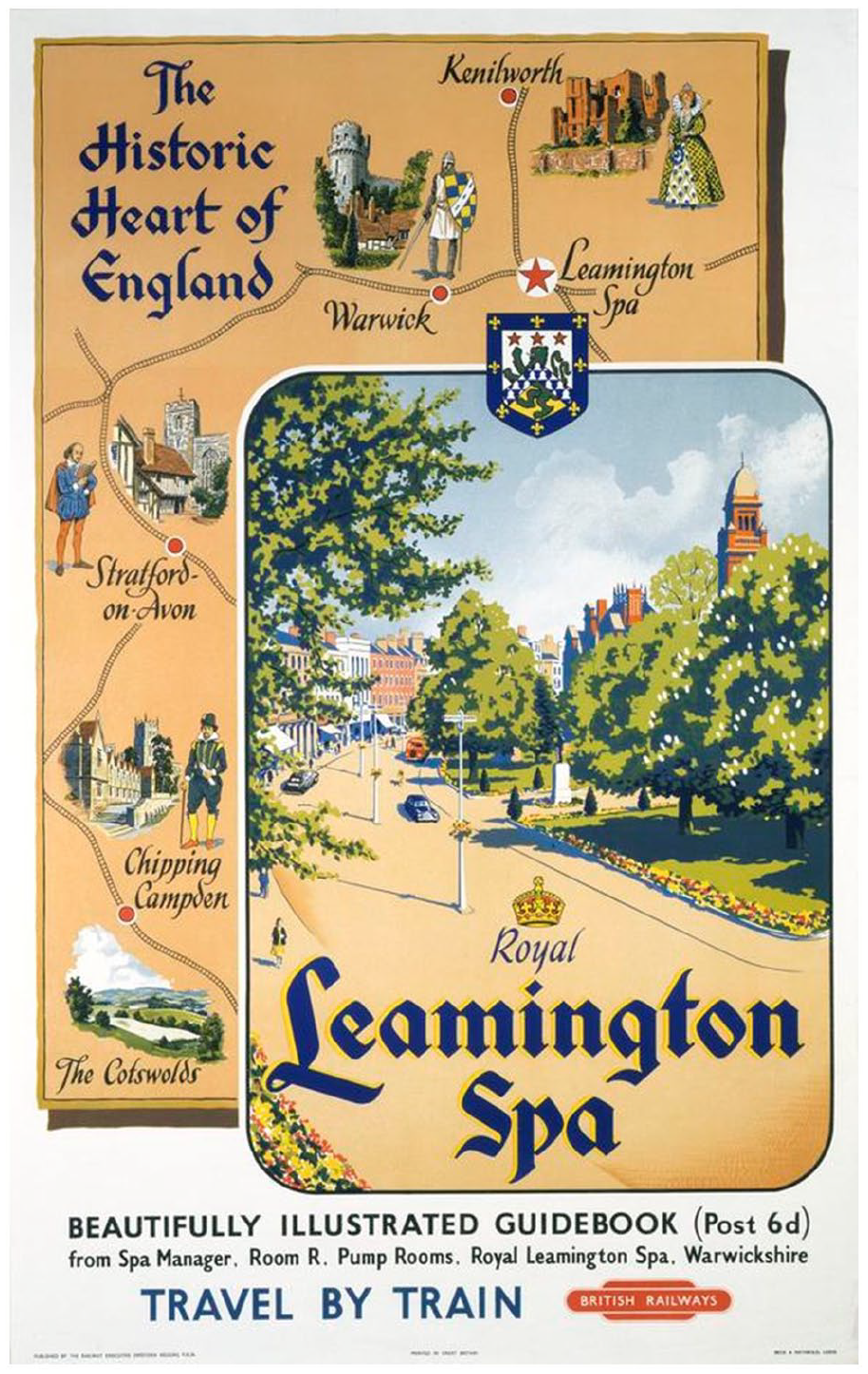
A British Railways poster from 1949 (Science Museum Group, 1979).
Care: Retirement and recuperation
The previous sub-section recapitulated the conventional history of Leamington as it runs from the 1780s to the 1940s and suggested that it presents that town as a site of Englishness untouched by empire. Bringing together the academic literatures discussed above, the remainder of this section upends that history to locate Leamington as a site of social reproduction in the colonial global economy, starting with its role in providing care to colonial elites.
By the time Leamington assumed regal status in 1838, the UK Slavery Abolition Act was already 5 years old. Nevertheless, I have identified 23 slaveowners who spent time in the town. Excepting the Greatheed family, the earliest of these was Mary Bromley Rose. She had come from Jamaica and was reported to have led a ‘useful though retired life’ in Leamington before she died in 1818 (London Morning Post, 17 December 1818: 4). Like Bromley Rose, the majority of the slaveowners connected to Leamington are relatively obscure figures. The exception is John Gladstone, a merchant and plantation owner based in Liverpool whose son William would later become Prime Minister. Gladstone Senior came to Leamington repeatedly between 1829 and 1837 with his wife and daughter who were receiving treatment from the renowned physician Dr Henry Jephson, after whom Leamington’s public gardens are now named. The family spent significant sums on medical bills and accommodation, staying for the season in rented town houses or hotels. Gladstone himself was drawn into the town’s social circuit, attending balls and donating to appeals, and also arranged for a regular mail coach to bring letters from Manchester and Liverpool, presumably to aid management of his business. In 1833, the local newspaper declared the town ‘indebted . . . to the indefatigable exertions of that steady friend to Leamington, J. Gladstone, Esq’ (Leamington Spa Courier, 2 February 1833: 2). That same year, he reaped the benefits of his lobbying efforts for compensation, receiving £105,000 from the British state after the emancipation of his 2508 enslaved workers in British Guiana and Jamaica (calculated from Legacies of British Slavery, 2022a).
These twin themes of retirement and recuperation account for the presence of most of the slaveowners in Leamington, who moved there later in life and typically show up in the archive only because they were named on a census or died there. There were surely many more who brought their wealth to the town as seasonal visitors or as travellers needing a layover, and this is before we consider the relatives of slaveowners. One example of this more nebulous group is Walter Maynard Mills, who in the St Kitts Slave Register of 1831 signed for 102 enslaved people owned by an Anne Mills. After becoming a plantation owner himself in the post-emancipation period, Mills then relocated to Ontario and finally retired on his investments, building a house on the outskirts of Leamington where he lived with his wife, three daughters, and two servants. Another example is Millborough Batty Sandieman who died in Leamington in 1875. She is notable as the daughter of a slaveowner father and a ‘free woman of colour’ in Jamaica, thereby disclosing the presence of biracial people in Leamington much earlier than is normally dated (Legacies of British Slavery, 2022b; see also Sarah Foxwell in Appendix 1, a one-time slaveowner who had similar biracial heritage and lived in Leamington in the 1840s).
For similar reasons but in greater numbers still, this group was joined by military officers, medics, and bureaucrats returning from service with the East India Company, and after this was effectively nationalised in 1858 following anti-colonial uprisings, the British Raj. It is important to note here that the salaries paid to those working for the East India Company were ‘exceedingly high and regardless of rank all employees received an annual pension of £1000 so long as they had completed between 25 and 35 years of service’ (Bhambra, 2021: 8). Seeking to attract this spending power, spa towns had long been sold to colonists as places to restore their physical and mental health after a long period in the tropics. An early booster of the spa at Leamington, James Bisset, wrote in his travel guide how the waters were especially good for curing ‘visceral obstructions, particularly such as have arisen from a residence in hot climates’ (Bisset, 1814: 3). Over a century later, this marketing message was still apparent. Adverts placed in English-language newspapers in India summarised its appeal: Royal Leamington Spa. The Beauty-spot of the Midlands. Ideal for retired Anglo-Indians. Hunting with three packs of hounds, Golf, Rent and Rates moderate. The Spa ‘cure’, specially beneficial in complaints affecting the liver. Good schools. – Write Town Clerk, for particulars. (The Times of India, 1924: 18)
Hints of the mental burdens carried by those seeking solace in Leamington can also be found. Martin Gubbins was a financial official involved in the infamous Siege of Lucknow in 1857 in which the Indian soldiers of the East India Company rebelled against their employer and briefly captured the city, leading to wider revolts across north India. After publishing his account criticising the decisions taken by the commanding officer, he sank into depression and moved to Leamington to live with his brother. A month later, he hanged himself.
A final group to seek out the salubrious surroundings of Leamington came from Australia. Many had acquired wealth through sheep farming, cattle ranching, and gold mining; activities intimately tied up with settler colonialism and the violent displacement of Aboriginal people from the land. One such example is the pastoralist John Gardiner, known as one of the first ‘Overlanders’ because of his pioneering journey droving cattle from Sydney to Melbourne. Gardiner sold up his 6000-hectare ranch in 1853 and retired to Leamington, where he built a villa to live with his second wife and sister, and which still stands now as the Episode Hotel.
The recuperative appeal of Leamington to colonial elites was well recognised at the time. An 1866 book called The Tropical Resident at Home wrote of the ‘little communities of old Indians and Colonists’ that resided in spa towns like Bath, Cheltenham, and Leamington (Waring, 1866: 49). It was also captured culturally. In Charles Dickens’ 1848 novel Dombey and Son, the titular character Paul Dombey stays in Leamington for several weeks, accompanied by his London associate Major Joseph Bagstock, as he seeks to recover from the premature death of his son. Both characters are intimately tied to empire. Dombey is the head of a colonial trading company, while Bagstock is a retired military officer who served in the East and West Indies. Bagstock also brings with him his long-suffering servant, a person of colour known only as ‘the Native’ shown dressed up in livery in Image 2. Leamington’s other prominent literary association is John Betjeman’s 1932 poem Death in Leamington which describes the stoic response of a nurse to the quiet demise of her elderly patient. Although the poem does not explicitly mention empire, it was nonetheless assumed that it referred disparagingly to ‘retired Anglo-Indians and suchlike, dying slowly of pomposity and boredom’ in their private lodgings in the town (Leamington Spa Courier, 12 October 1951: 4; see also Vesey-Fitzgerald, 1962).
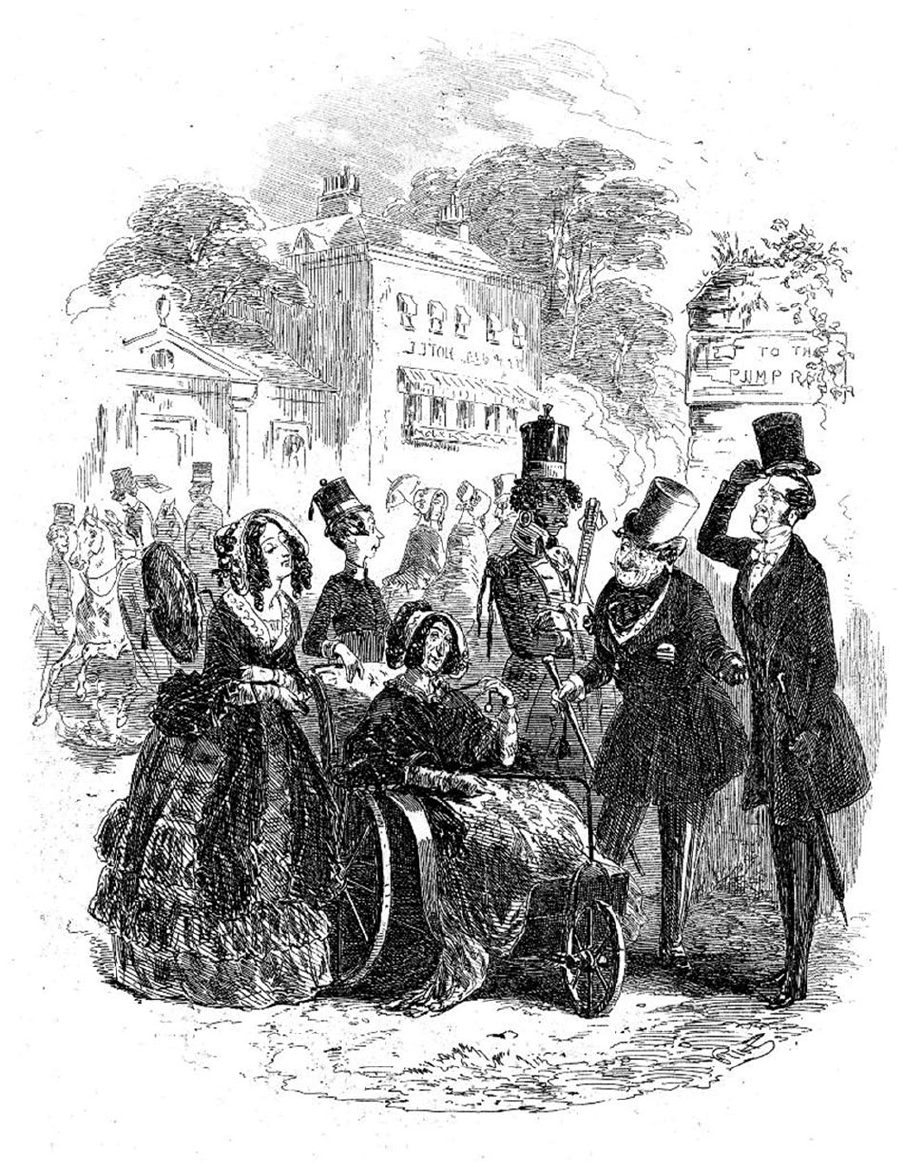
‘Major Bagstock is delighted to have that opportunity’ by Phiz from Dombey and Son (Allingham, 2015).
The gendered nature of the care offered to colonial elites in the form of retirement and recuperation is registered in employment and demographic statistics. In 1841, the census recorded 1899 females and 553 males in domestic service. This was by far the biggest occupational group and accounted for almost one fifth of the town’s population (Drew, 1978: 105). Echoing the presence of the Native in Dombey and Son, newspapers from the 1850s and 1860s also mention the presence of ayahs in Leamington. These were Indian women employed as nursemaids and nannies to British families in south Asia, who on occasion also accompanied children on journeys ‘back home’. Again, this points to a more racially diverse population in Leamington than is often assumed of the period, as well as to the later trend for recruiting migrant care workers who today form a substantial part of the UK care workforce.
That same 1841 census also recorded 7600 women residents compared to 5264 men (Chaplin, 1968). This difference can be attributed partly to the large number of domestic workers in the town and partly to household structures. Owing to its reputation for propriety, Leamington was seen as a suitable place for widows and unmarried women to settle and for daughters to be raised. One example concerns Andrew Low II, a transatlantic emigrant to Georgia in 1829 who went on to become one of the biggest traders of slave-grown cotton between Britain and the USA. Low’s two daughters Amy and Harriet had been sent to boarding school in Leamington, and, after the American Civil War had finished – during which time Low assisted the slave-supporting Confederacy – the whole family relocated to Leamington, partly so that Low could find good marriages for his children. Reflecting this gendered history as a place of care and courtesy, Leamington would later be satirised in the national press as ‘the Aunt of the Midlands’ (The Times, 20 August 1921: 6). A local newspaper columnist agreed, writing that ‘The surplus women of Leamington have their function also – to act as aunts to those who otherwise would not be “mothered”’ (Leamington Spa Courier, 2 September 1921: 4).
A final point about social reproduction relates to its funding and management, for many of the colonial elites who came to Leamington were not just residents and patients but also donors and practitioners. Take the Midland Counties Home for Incurables, a philanthropic institution providing palliative care that was established in Leamington in 1874. This was championed by Arthur Hodgson, who had amassed a large sheep run on colonised land in Queensland and returned to England as a wealthy and politically active public figure.2 The home involved many former military personnel in its governance, including some like James Lancaster Ranking, a Surgeon-General in the Madras Army, who also attended in a medical capacity. And it was supported financially by bequests from people like William Blackburne, who commanded the garrison that helped secure Malta as a British crown colony and died with an estate worth £212,843. Similar connections can also be found at the Warneford Hospital, which provided remedial care. When it was founded in 1830 with Charles Bertie Percy as its patron – the grandson-in-law of Bertie Greatheed and inheritor of his slave plantation – five of the eight members of its management committee were of military rank. Regular bequests and subscriptions can again be found from military officers and their wives, as well as from beneficiaries of slavery (see Stephenson, 1993). When Andrew Low II died in Leamington aged 74, he left £60,000 to each of his daughters, who then funded a bed at the hospital in his memory. Both the home and the hospital survived into the 20th century and were incorporated into the National Health Service, providing a tangible example of Bhambra’s argument that foreign warfare paved the way for domestic welfare.
Culture: Religion and education
Having looked at the provision of care for the elderly and the ill, this section turns to cultural reproduction carried out through religion and education and shows how these, too, were entwined with empire. In the early 19th century, there was a rapid building of churches and chapels in Leamington, which was deemed necessary to meet the spiritual needs of its growing population and maintain its sense of propriety. By 1851, there were over 7600 seats available for worship, enough for almost half the town to attend service at any one time (Drew, 1978: 68). As with the health facilities, many relied on investments and donations from those with imperial wealth. The huge redevelopment of All Saints parish church in the 1840s was paid for in part with the private funds of vicar John Craig who had been significantly enriched through marriage to Jane Helena Johnstone, the daughter of plantation slaveowners in Jamaica. The nearby catholic church of St Peter’s was likewise built, thanks to a gift of at least £3000 from Ellen France, daughter and niece of Liverpool merchants importing plantation commodities (see Appendix 1 for more on these two cases). Further examples abound: St Mark’s church was built on land gifted by Bertie Greatheed’s mother Lady Bertie Percy; the presbytery of St Peter’s chapel was paid for by Major and Mrs Bishop of the East India Company; building works at St Paul’s, St John’s, and All Saints churches were funded by the West India merchant Frederick Manning; and the expansion of Spencer Street church and Sunday school was financed by one of its founders, John Fairfax, who had emigrated to Australia and made his fortune as proprietor of the Sydney Morning Herald.
More striking still to the contemporary observer is the number of missionary societies established in Leamington. Branches of the Baptist Missionary Society, Church Missionary Society, London Missionary Society, and Society for the Propagation of the Gospel in Foreign Parts were all formed in the 1830s. By the 1880s, they had been joined by branches of the Melanesian Mission, the South American Mission, and the Zenana Missionary Society. Although nominally headed by clergymen, many of the societies depended on the organisational work of women. The local branch of the Zenana Missionary Society, which sought to convert women in India and China, was led by Miss Harriet Lloyd, who was also secretary of the Society as a whole and first editor of its magazine India’s Women. Among other things, the magazine featured correspondence from the English schoolgirls that Lloyd had recruited as members of a Christian Union to support missionary activity and help ‘bring the blessed Gospel light into those sad dark homes’ of Hindu India (Lloyd, 1881: 64). In subsequent years, the Leamington branch would be one of the largest contributors to the Society’s central fund in London.
These missionary branches in Leamington all carried on into the 20th century, performing the two-way role of raising money to fund Christian evangelism overseas and reaffirming the moral righteousness of their members at home in doing God’s work. Given the overlap between missionary activity and colonial rule, the societies also became bound up with a justification of British imperialism, presenting it as a means of spreading spiritual enlightenment among the heathen and reproducing at a local level the cultural beliefs underpinning the civilising mission of empire. For example, one of the Zenana Missionary Society’s high-profile speakers was Cornelia Sorabji, a barrister and social reformer who was the first female and first Indian to study law at Oxford University. While rejecting the idea that the British legal code should be transplanted to India, she nevertheless saw the British Raj as a progressive development that had provided equality under the law, basic education and healthcare, and greater freedom for women. As she told her audience in Leamington, ‘We in India love British rule’ (Leamington Spa Courier, 19 October 1917: 3).
There was also a redistributive dimension to religion, since many relief funds for local, national, and colonial causes were channelled through the churches and missionary societies. As Bhambra (2022) notes, however, these charitable welfare initiatives were hardly equalisers of imperial wealth, and in many cases, deepened the racialised divisions in social reproduction evident across empire. To take an example from Leamington, in 1857 a group of physicians, missionaries, and military officials headed by Henry Jephson sought to raise funds following the anti-colonial uprisings known as the ‘Indian Mutiny’. In language evoking Wekker’s idea of White innocence, the group called for ‘the relief of our fellow countrymen who have become victims to the unheard-of atrocities of the rebel army, and of the rabble abettors of its cruelty to helpless women and children, and our unarmed fellow subjects in the East’ (Leamington Spa Courier, 19 September 1857: 2; italics added). Within 5 months, they had raised £1480 to be sent to the central fund in London for the basic needs and repatriation of Britons, but with nothing earmarked for the countless more casualties of the East India Company’s reprisals. By contrast, in 1861, shortly after direct rule had been established in India, residents of Leamington were asked to contribute to an Indian famine relief fund. Despite being told that only ‘the helping hand of charity’ stood between life and death for 1.5 million men, women, and children, just £600 was raised across the whole of Warwickshire (Leamington Advertiser, 2 May 1861: 3).
Educational provision provides a second example of how cultural reproduction was carried out in a manner which upheld the colonial global economy. Along with Malvern, another spa town, Leamington was renowned as a centre of private schooling in the 19th century, hosting an average of 20 schools from 1835 to 1904 (Leinster-Mackay, 1971). These frequently provided boarding and tutoring to children whose parents lived in the colonies, enabling families to stretch themselves across imperial space and socialise the next generation into English culture. Records from Leamington College for Boys, whose principal benefactor was Henry Jephson, show pupils from Canada and the West Indies in attendance during the mid-19th century, while adverts targeting Anglo-Indians were placed by governesses and the Leamington High School for Girls from the late-19th century onwards (Leinster-Mackay, 1971).
The education was also one that readied children for empire. When it opened in 1844, Leamington College for Boys offered a ‘complete Course of Instruction . . . for those who are intended for the Army, Navy, India &c’ (Leamington Spa Courier, 6 April 1844: 2). Its most successful period of 1870–1890 came under the leadership of Joseph Wood, who was appointed as Headmaster after his success at Cheltenham College in helping pupils pass the Indian Civil Service examination. Evidently, this was not just down to professional duty, but also an imperial cast of mind. After the visit of the Colonial and Indian Exhibition to Leamington in 1886, Wood wrote a letter of thanks to Mayor Samuel Wackrill praising the event as an: inspiriting [sic] reminder . . . of the unity of sentiment which binds the old country to Greater Britain. For three whole days our little town was lifted high above its little provincial self, and seemed within hearing of the ‘great wave that echoes round the world’. (Leamington Spa Courier, 17 July 1886: 5)
His charges at the College reflected this outlook. When Wood left to take up a position at Harrow, the local newspaper recorded that boys ranching in the far West, or soldiering in the far East, or trying their fortunes in our African or Australian colonies – these have been educated under his careful hand, and to them his loss to the School will be irreparable. (Leamington Spa Courier, 5 November 1898: 5)
When the College closed in 1902, the local MP and Secretary of State for the Colonies, Alfred Lyttelton, made a speech lamenting its loss. For him: It was much to be desired that there should be in Leamington, not only for girls, but also for boys, a school which inspired the youth with a public spirit and prepared them for the duties that they had to discharge as citizens of this great Empire. (Leamington Spa Courier, 27 October 1905: 2)
The Boys’ College would not re-open until 1922 but Lyttelton’s desire was met another way as Leamington’s Borough Council became an early adopter of Empire Day. This was an annual exercise in imperial citizenship which in Leamington involved the council giving a day’s holiday to children in both private and charitable schools in return for their participation in public affirmations of the British Empire. By 1912, this had grown to a pageant of 3000 children in Victoria Park, dressed up to represent the various peoples of the dominions and colonies. Echoing Lyttelton’s word, in his address at the pageant Mayor William W. Donald told pupils ‘that they had not only their duty to perform to themselves, and their native land, but to the Empire’ (Leamington Spa Courier, 24 May 1912: 4). There were echoes here of another intergenerational appeal involving Queen Victoria, photographed in Image 3. In 1902, when her statue was unveiled – inscribed with ‘Queen Empress’ on the plinth and wearing the Star of India on her robes – Mayor William Davies foretold of its intended effect on the town’s children: ‘To the young it would speak and remind them that they were the sons and daughters of the greatest Empire the world had ever seen, and of the great heritage which they possessed’ (Leamington Spa Courier, 17 October 1902: 7).
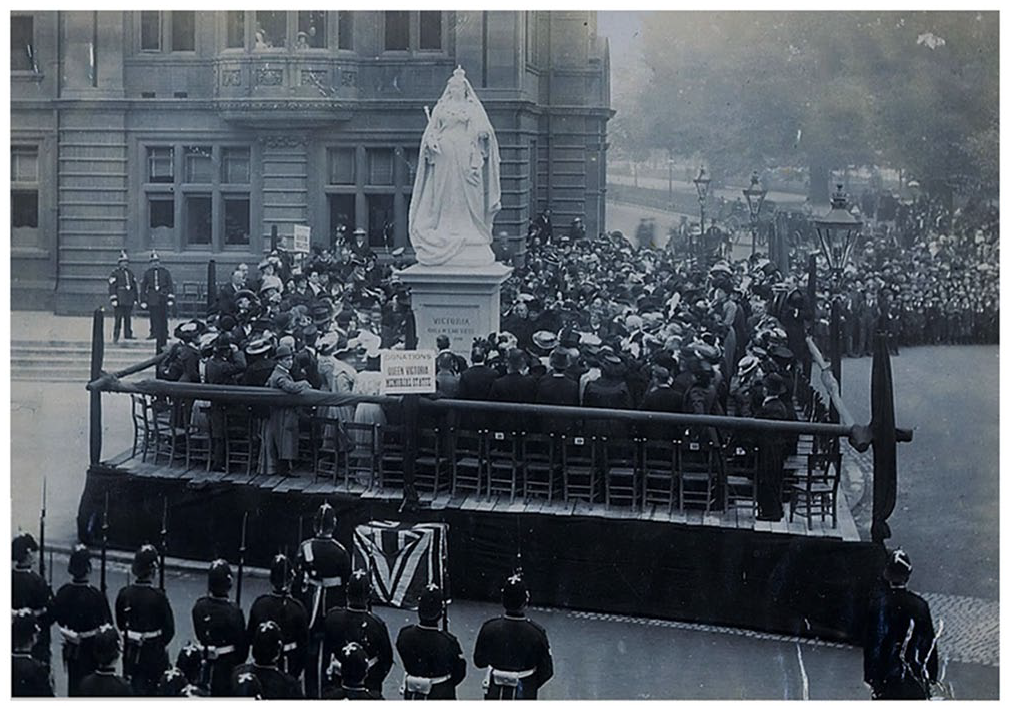
Unveiling of Queen Victoria statue outside Leamington Town Hall, 1902 (Windows on Warwickshire, n.d.).
A final point to note is how these religious and educational practices bore political consequences. The most obvious expression was in the Primrose League: a mass movement of the late-19th century whose members were to declare their dedication to ‘the maintenance of Religion, of the Estates of the Realm [established state institutions], and of the imperial ascendancy of Great Britain’ (Cooke, 2010: 24–25). Membership in Leamington quickly reached over a thousand and the branch became influential in mobilising voters behind Liberal Unionist and Conservative Party candidates, first in council elections and then in parliamentary elections.
As with the missionary societies, while men were often placed in the titular roles – and, again, former colonial officials featured prominently – the work of women was crucial. At its height in 1911, the local branch had 23 women and 2 men on the Executive Council, with women also accounting for around two thirds of the membership. Unable to vote themselves, the Primrose League offered women the chance to participate in the political sphere, albeit within the constraints of gendered expectations of the time. In speeches reported in the local newspaper, politicians and party officials cast the League’s women as carriers of tradition and a bulwark against the appeals of Radical liberals, providing another instantiation of the historic role of women as ‘central participants in the ideological reproduction of the collectivity and as transmitters of its culture’ (Rai, 2002: 13). The local branch was thus credited with aiding the electoral victories of Alfred Lyttelton (MP from 1895 to 1906), Ernest Pollock (MP from 1910 to 1923), and the future Prime Minister, Anthony Eden (MP from 1923 to 1957), establishing a Conservative dominance of the Warwick and Leamington seat that would last almost a century. Indeed, Eden subsequently became President of the Leamington branch of the Primrose League, and, keen to sustain his base of support, in 1924 also established a local branch of the Junior Imperial League. In a fitting bookend, though, it was his conviction in Britain’s imperial power that also ended his political career, after he was forced to resign as Prime Minister in 1957 following the failed attempt to depose President Nasser in Egypt and seize control of the Suez Canal.
Conclusion
Bringing feminist critiques of capitalism into conversation with race-conscious IPE, this article has drawn attention to the place of social reproduction in the colonial global economy. It did so by taking a provincial perspective, using Royal Leamington Spa as a case study to reveal how the provision of care for the elderly and the ill sustained colonial elites across the life course, while religious and educational practices helped transmit cultural values across generations and reproduce imperialism as an institutionalised social order. If the finance houses of London, the factories of Manchester, and the ports of Liverpool and Bristol are important nodal points for imperial circuits of capital, then the spas of Leamington, Bath, and Cheltenham condense the everyday practices through which bourgeois metropolitan empire was lived and made liveable. By disclosing these practices, the article also challenged those provincial imaginaries like Middle England, whose parochial accounts of national history and racialised notions of middle-class respectability rely on a disavowal of their imperial heritage. In the case of Leamington, we saw how its narrative of place was Whitened through acts of omission and commission, from the reluctance to recognise local links to colonial expropriation to the celebration of Queen Victoria as a personification of beneficent British rule.
Three broader implications for IPE arise from these findings. The first relates to the racialisation of social reproduction and possibilities for grounding this in a deeper historical context. Understanding how commodified services in the 19th century like private healthcare and domestic staff were in part funded by colonial expropriation and provided by colonial subjects can shed light on how today’s global care chains came into being and might evolve in the future. The focus here on colonial elites also brings the role and needs of the bourgeoisie to the fore, which feminist theory has tended to neglect in favour of formulations that privilege the social reproduction of either the proletariat or the general population (Luxton, 2006: 25). My argument that the colonial global economy developed via a capitalist class that was intimately tied to state-managed imperialism and thus required specific forms of social reproduction – cures for foreign ills, boarding schools for family members, belief in a civilising mission, and so on – suggests that we might uncover similar racialised practices needed to reproduce the latest stage of capitalism.
The second implication concerns the spatialisation of the metropole and the geographical diversity this could unlock. Recall that in the IPE literature, studies on the British metropole tend to converge empirically on metropolitan London, perhaps reflecting the word’s origins in the Ancient Greek metropolis meaning ‘mother city-state’. I made the case here for looking beyond London to provincial England in order to reveal other aspects of the colonial global economy. At the same time, we should not lose sight of the fact that this remains within the national and geographic core of the imperial state, and in this wider sense is far from peripheral. This in-between position might thus be captured through the concept of the sub-metropolitan. In the same way as sub-imperial states are said to intermediate core-periphery relations within an international division of labour, so too might sub-metropolitan towns hold a dependent role within an intra-national division of labour. In Leamington’s case, this role was as a provider of commodified and charitable social reproduction, the legacies of which can be seen today in the town’s concentration of care homes, retirement complexes, private schools, and churches.
The final implication involves the historicisation of White innocence and the political ambitions of race-conscious IPE. If Whitened narratives of place have been important for the reproduction of the English/British nation and its racialised exclusions, then reconstructing these to reflect hidden histories of expropriation and excluded experiences of resistance can offer one form of reparation (Bergin and Rupprecht, 2018). To this end, the research that went into this article has also been used in a community project documenting Leamington’s imperial history and the lives of migrants who moved to the town. Based on conventional stories of post-war Britain, one could be forgiven for thinking that mid-20th century immigration from the Commonwealth left places like Leamington largely untouched. Yet as highlighted in this project, it was here that the radical Black People’s Alliance formed in 1968 in response to White supremacist attacks in the town, alongside a range of other more moderate anti-racist initiatives involving people of colour (see Bolitho et al., 2023). As well as being reparative, the reconstruction of such histories might also foster progressive racial politics in the present day. In studies on racialised neoliberal capitalism, it is common to find hopes for resistance pinned on the young generations of city dwellers who have learnt to ‘handle the lived realities of multi-ethnic life in urban Britain’ (Virdee, 2019: 24). On such readings, the potential for change outside these places appears derivative at best, unlikely at worst. Historical accounts that speak to the need and agency for provincial England to redress its own racial inequalities might help produce the subjectivities to act on this imperative there too.
Footnotes
Appendix 1
Slave-owners in Leamington, 1774–1880.
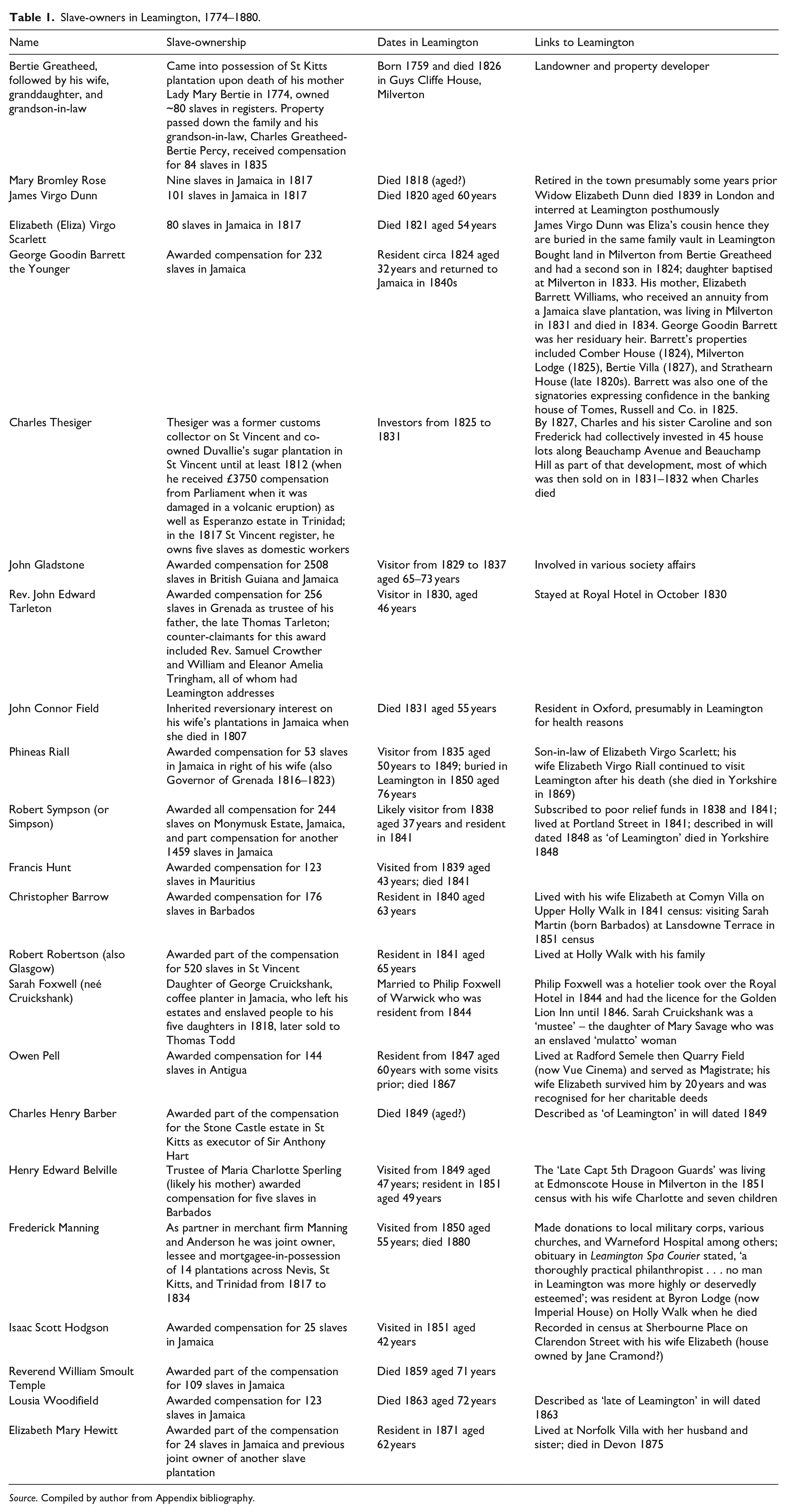
| Name | Slave-ownership | Dates in Leamington | Links to Leamington |
|---|---|---|---|
| Bertie Greatheed, followed by his wife, granddaughter, and grandson-in-law | Came into possession of St Kitts plantation upon death of his mother Lady Mary Bertie in 1774, owned ~80 slaves in registers. Property passed down the family and his grandson-in-law, Charles Greatheed-Bertie Percy, received compensation for 84 slaves in 1835 | Born 1759 and died 1826 in Guys Cliffe House, Milverton | Landowner and property developer |
| Mary Bromley Rose | Nine slaves in Jamaica in 1817 | Died 1818 (aged?) | Retired in the town presumably some years prior |
| James Virgo Dunn | 101 slaves in Jamaica in 1817 | Died 1820 aged 60 years | Widow Elizabeth Dunn died 1839 in London and interred at Leamington posthumously |
| Elizabeth (Eliza) Virgo Scarlett | 80 slaves in Jamaica in 1817 | Died 1821 aged 54 years | James Virgo Dunn was Eliza’s cousin hence they are buried in the same family vault in Leamington |
| George Goodin Barrett the Younger | Awarded compensation for 232 slaves in Jamaica | Resident circa 1824 aged 32 years and returned to Jamaica in 1840s | Bought land in Milverton from Bertie Greatheed and had a second son in 1824; daughter baptised at Milverton in 1833. His mother, Elizabeth Barrett Williams, who received an annuity from a Jamaica slave plantation, was living in Milverton in 1831 and died in 1834. George Goodin Barrett was her residuary heir. Barrett’s properties included Comber House (1824), Milverton Lodge (1825), Bertie Villa (1827), and Strathearn House (late 1820s). Barrett was also one of the signatories expressing confidence in the banking house of Tomes, Russell and Co. in 1825. |
| Charles Thesiger | Thesiger was a former customs collector on St Vincent and co-owned Duvallie’s sugar plantation in St Vincent until at least 1812 (when he received £3750 compensation from Parliament when it was damaged in a volcanic eruption) as well as Esperanzo estate in Trinidad; in the 1817 St Vincent register, he owns five slaves as domestic workers | Investors from 1825 to 1831 | By 1827, Charles and his sister Caroline and son Frederick had collectively invested in 45 house lots along Beauchamp Avenue and Beauchamp Hill as part of that development, most of which was then sold on in 1831–1832 when Charles died |
| John Gladstone | Awarded compensation for 2508 slaves in British Guiana and Jamaica | Visitor from 1829 to 1837 aged 65–73 years | Involved in various society affairs |
| Rev. John Edward Tarleton | Awarded compensation for 256 slaves in Grenada as trustee of his father, the late Thomas Tarleton; counter-claimants for this award included Rev. Samuel Crowther and William and Eleanor Amelia Tringham, all of whom had Leamington addresses | Visitor in 1830, aged 46 years | Stayed at Royal Hotel in October 1830 |
| John Connor Field | Inherited reversionary interest on his wife’s plantations in Jamaica when she died in 1807 | Died 1831 aged 55 years | Resident in Oxford, presumably in Leamington for health reasons |
| Phineas Riall | Awarded compensation for 53 slaves in Jamaica in right of his wife (also Governor of Grenada 1816–1823) | Visitor from 1835 aged 50 years to 1849; buried in Leamington in 1850 aged 76 years | Son-in-law of Elizabeth Virgo Scarlett; his wife Elizabeth Virgo Riall continued to visit Leamington after his death (she died in Yorkshire in 1869) |
| Robert Sympson (or Simpson) | Awarded all compensation for 244 slaves on Monymusk Estate, Jamaica, and part compensation for another 1459 slaves in Jamaica | Likely visitor from 1838 aged 37 years and resident in 1841 | Subscribed to poor relief funds in 1838 and 1841; lived at Portland Street in 1841; described in will dated 1848 as ‘of Leamington’ died in Yorkshire 1848 |
| Francis Hunt | Awarded compensation for 123 slaves in Mauritius | Visited from 1839 aged 43 years; died 1841 | |
| Christopher Barrow | Awarded compensation for 176 slaves in Barbados | Resident in 1840 aged 63 years | Lived with his wife Elizabeth at Comyn Villa on Upper Holly Walk in 1841 census: visiting Sarah Martin (born Barbados) at Lansdowne Terrace in 1851 census |
| Robert Robertson (also Glasgow) | Awarded part of the compensation for 520 slaves in St Vincent | Resident in 1841 aged 65 years | Lived at Holly Walk with his family |
| Sarah Foxwell (neé Cruickshank) | Daughter of George Cruickshank, coffee planter in Jamacia, who left his estates and enslaved people to his five daughters in 1818, later sold to Thomas Todd | Married to Philip Foxwell of Warwick who was resident from 1844 | Philip Foxwell was a hotelier took over the Royal Hotel in 1844 and had the licence for the Golden Lion Inn until 1846. Sarah Cruickshank was a ‘mustee’ – the daughter of Mary Savage who was an enslaved ‘mulatto’ woman |
| Owen Pell | Awarded compensation for 144 slaves in Antigua | Resident from 1847 aged 60 years with some visits prior; died 1867 | Lived at Radford Semele then Quarry Field (now Vue Cinema) and served as Magistrate; his wife Elizabeth survived him by 20 years and was recognised for her charitable deeds |
| Charles Henry Barber | Awarded part of the compensation for the Stone Castle estate in St Kitts as executor of Sir Anthony Hart | Died 1849 (aged?) | Described as ‘of Leamington’ in will dated 1849 |
| Henry Edward Belville | Trustee of Maria Charlotte Sperling (likely his mother) awarded compensation for five slaves in Barbados | Visited from 1849 aged 47 years; resident in 1851 aged 49 years | The ‘Late Capt 5th Dragoon Guards’ was living at Edmonscote House in Milverton in the 1851 census with his wife Charlotte and seven children |
| Frederick Manning | As partner in merchant firm Manning and Anderson he was joint owner, lessee and mortgagee-in-possession of 14 plantations across Nevis, St Kitts, and Trinidad from 1817 to 1834 | Visited from 1850 aged 55 years; died 1880 | Made donations to local military corps, various churches, and Warneford Hospital among others; obituary in Leamington Spa Courier stated, ‘a thoroughly practical philanthropist . . . no man in Leamington was more highly or deservedly esteemed’; was resident at Byron Lodge (now Imperial House) on Holly Walk when he died |
| Isaac Scott Hodgson | Awarded compensation for 25 slaves in Jamaica | Visited in 1851 aged 42 years | Recorded in census at Sherbourne Place on Clarendon Street with his wife Elizabeth (house owned by Jane Cramond?) |
| Reverend William Smoult Temple | Awarded part of the compensation for 109 slaves in Jamaica | Died 1859 aged 71 years | |
| Lousia Woodifield | Awarded compensation for 123 slaves in Jamaica | Died 1863 aged 72 years | Described as ‘late of Leamington’ in will dated 1863 |
| Elizabeth Mary Hewitt | Awarded part of the compensation for 24 slaves in Jamaica and previous joint owner of another slave plantation | Resident in 1871 aged 62 years | Lived at Norfolk Villa with her husband and sister; died in Devon 1875 |
Source. Compiled by author from Appendix bibliography.
Appendix Bibliography
Acknowledgements
I would like to thank the two journal reviewers, members of the Leamington History Group, participants at the BISA IPEG Annual Workshop, and the many colleagues at Warwick, who all provided feedback on this paper.
Funding
The author received no financial support for the research, authorship, and/or publication of this article.
