



Abstract
Social media communication makes visible the linkages between governments’ actions to diplomatic events and domestic audiences’ reactions. This study analyses tweets that discuss the recent diplomatic crisis between Japan and Korea. Through the detection of clusters of Twitter users and the content analysis of the tweets in the two countries, this study shows the public’s interpretation of a crisis widely differs by their stances towards their country’s government. The analysis finds that the clusters are aligned with their pro- and anti-stances towards the current government and that pro-government clusters tend to interpret the diplomatic crisis through a historical perspective, while anti-government clusters interpret it as a matter of present-day politics. Furthermore, we find strong negativity in the tweets discussing the opponent online groups, especially by the anti-government cluster against the pro-government online camp. These findings suggest that a diplomatic crisis may create or deepen domestic polarisation.
Introduction
Does a diplomatic crisis increase or decrease political unity among people in a country? According to the literature of the rally-round-the-flag effect, an external threat is expected to cultivate in-group solidarity among the public partly due to their emotional reactions towards a threatening enemy (Baum and Potter, 2008; Lai and Reiter, 2005; Mueller, 1970). Threat invokes nationalistic sentiment and patriotism. It also leads citizens’ anger and abhorrence against an out-group adversary (Lambert et al., 2010), leading to their support for punitive responses and political intolerance (Feldman and Stenner, 1997). However, despite the well-established theoretical account and empirical investigation on the rally-effect, there have been cases that suggest an external threat may undermine the unity of the public.
One such case is an intense diplomatic crisis between Japan and South Korea (hereafter, Korea) that flared up in 2019. This crisis started when Korean Supreme and High Courts issued rulings that order Japanese companies to compensate for wartime forced labour of Korean workers. These rulings triggered Japan’s export restrictions on materials that are vital to Korean industries, Korea’s export restrictions in return, and Korea’s suspension of an important security agreement with Japan. Facing these tit-for-tat retaliatory actions between the two governments, public attitudes on the crisis have not been uniform. Rather, people in both Japan and Korea have been divided between those who support the government and those who oppose it. Why in time of a diplomatic crisis does a domestic division emerge?
This article approaches this puzzle by refocusing on the heterogeneity among citizens’ interpretations of foreign affairs. We examine how a diplomatic crisis, particularly one that is rooted in a country’s historical past, affects an existing domestic polarisation. For instance, in Korea, there has been a left–right ideological cleavage in people’s understanding of Japan’s colonial rule. The Korean left camp tends to take a hard-line stance against Japan and it often accuses the right camp of having benefitted from the Japanese occupation as pro-Japan traitors (Yi et al., 2019). We explore the possibility that a diplomatic crisis may intensify an existing domestic cleavage.
To explore people’s interpretation of a diplomatic crisis, we use a large corpus of Twitter data. Not only has Twitter been widely used as a tool of political communication both in Japan and Korea, but Twitter data also allow us to directly measure people’s reaction towards issues since tweets are people’s voluntary actions, where Twitter users are expected to reveal their true preferences. 1 In addition, the content of Twitter renders the narratives of domestic politics and international relations visible. Our paired analysis of Twitter in Japan and Korea enables us to examine how the domestic public simultaneously reacts to the other country as well as opposing domestic camp.
Our analyses of Twitter data provide three distinctive findings. First, we found several clusters of Twitter users in the patterns of information sharing in both Japan and Korea, and major clusters differ in their support for the government policies. Second, compared to the clusters of anti-government, the pro-government clusters tend to discuss the above-mentioned diplomatic crisis in connection to history rather than connecting to the aspects of present-day politics. Third, the degree of negative sentiment in tweets is highest when the pro-government Twitter users talk about the anti-government users in both countries. Overall, our findings imply an interpretative polarisation among the online public as to the government’s foreign policy, wherein different groups in a society contextualise the same topic in starkly different ways (Kligler-Vilenchik et al., 2020).
Our analyses contribute to the studies of public opinion in foreign policy analysis. First, we draw attention to the emergence of domestic polarisation in times of diplomatic crisis. Contrary to the theoretical and empirical development of the rally-effect in the various types of crisis, not enough attention has been paid to the opposite domestic consequence of a crisis (see Bak et al., 2020 for an important exception). Our findings indicate that a diplomatic crisis can intensify domestic polarisation rather than bring cohesion. Second, our research adopts innovative empirical approaches to investigate how people react to diplomatic crisis. While opinion polls and survey experiments have been widely employed to study public opinion on foreign affairs, we use social media data to directly measure people’s individual attitudes and behaviours towards the issues.
The remainder of the article will proceed as follows. First, we discuss how an external threat may lead to polarised interpretations of an international event among the population and how the polarisation relates to their pro- or anti-government stances by looking at the example of the recent Korea–Japan diplomatic crisis. In the following section, we describe our tweet data and methodologies for online community detection and content analysis of tweets. The methods of quantitative text analysis are used for classifying the features of language as data into quantities of interpretations, which are usually hidden in communicative trace data (Jungherr et al., 2017), by employing the methods of continuous scaling of texts in the dimension of present versus past as well as of sentiment polarity. We then present the results of the empirical analysis with a detailed interpretation of the aspects of the results. The last section concludes with a summary of the findings and implications for future research.
Diplomatic crisis and polarised public reaction
Contrary to the good amount of our understanding of the rally-effect in times of a crisis, what has been explored little is the possibility that an external threat causes a division of a society. There are several reasons to believe that a diplomatic crisis may trigger domestic polarisation.
First, a diplomatic crisis can resurface societal divisions that has already existed in society by highlighting the boundaries of in- and out-groups (Erlich and Garner, 2021). Especially, a crisis that has its root in a country’s historical past has the potential to polarise people’s views on the crisis because historical memories and attitudes to historical remedies vary in a society (Lee, 2003). For instance, in the case of Korea-Japan relations, the domestic cleavage has existed in both countries regarding Japan’s colonial occupation from 1910 to 1945. In Korea, the left camp tends to take a hard-line stance against Japan, and it often accuses the right camp of having been collaborators with imperial Japan and having settled for inferior remedial negotiations in the process of normalisation. In Japan, the extreme right conveys anti-Korean sentiments and hate speech (Ito, 2014). A hard-line stance of the government against a foreign counterpart in time of a crisis may exacerbate an existing cleavage by inciting highly nationalistic individuals while distancing others. On this point, Stein (1976) argues that if a group lacks solidarity to begin with, then it can disintegrate in the face of outside conflict.
Second, a diplomatic crisis is often used by national leaders to boost their popularity, which may widen a domestic cleavage. By describing other countries as an enemy, leaders can increase the alignment between their partisanship and nationalist values (Jost et al., 2022: 569). As seen in the appearance of anti-Americanism in political campaigns (Blaydes and Linzer, 2012; Jhee, 2008; Krastev, 2004) and in East Asian relations, rhetorical and performed hostility against other countries can benefit an electoral success. However, in an already polarised society, a leader’s hostile stance against a foreign counterpart can ignite negative evaluation and sentiment against the leader among those who oppose him or those who feel sympathy towards the foreign counterpart. In such a circumstance, a leader cannot weaken the domestic oppositions by presenting a foreign country as a threat.
Third, since a diplomatic crisis is accompanied by substantive material costs such as declined trade and tourism, individuals whose pocketbooks are most likely to be harmed by the crisis should be less likely to support the government’s confrontational attitude towards a counterpart (Allen, 2008; Kirshner, 1997). In a context of trade war, which is one type of a diplomatic crisis, some studies have shown that people whose families were hurt by a foreign country’s economic sanction were more likely to view trade war as harmful to their own country and to blame their national leader for the financial malaise (Kim and Margalit, 2021: 32). Similarly, in the context of contentious rivalrous relations, a threat from a rival may disrupt an internal political unity of a country by inciting the dissent of domestic out-groups who are reluctant to support their government or concede their resources (Bak et al., 2020). Therefore, to those who are suffering from a crisis, an offensive stand of the government may not be perceived as an appropriate way to manage a crisis.
In this way, a diplomatic crisis may intensify an existing cleavage by heightening in-group solidarity among the pro-government members and increasing bias against the anti-government (or out-group) members. We expect that the supporters of the government share the government’s official positions while the opponents criticise the government and its handling of a crisis. Our arguments lead to the following observed implications:
Research design
Case: The Japan–Korea diplomatic confrontation in 2019
We explore the above-mentioned implications in the context of an intense diplomatic conflict that occurred between Japan and Korea in late 2018. It was the worst diplomatic crisis between the two countries in several decades (Johnson, 2019). The crisis emerged when Korean Supreme and High Courts issued landmarking rulings that ordered three Japanese companies to compensate for wartime forced labour of Korean workers.
Siding with the Japanese government’s long-held position that all colonial-era compensation issues were fully settled by the 1965 normalisation treaty, these Japanese companies refused to comply with the rulings, which led a group of former labourers to request a court order for seizing the companies’ assets to be sold as compensation. Some of the assets in Korea were subsequently seized, and one of the district courts began legal proceedings to sell the parts of seized assets in May 2019.
In the following chain reactions between the governments, a trade war broke out. In July 2019, Japan tightened export controls on the export to Korea of certain chemicals that are vital to the production of semiconductors, which is a major industry in Korea, citing national security concerns. Then in August 2019, Japan escalated the dispute by approving the removal of Korea from the ‘White List’ of trusted export counterparts. Although the Japanese government insisted that these measures stemmed from national security concerns, it was considered that they were retaliatory actions against the Korean court decisions. Indeed, the Korean government frequently narrated Japan’s trade measures as a trade retaliation against the court rulings and as an aggressive attack (Deacon, 2022: 799). In turn, the Korean government criticised the current and historical actions of Japan and reacted in likewise manner. From August to September 2019, the Korean government removed Japan from their ‘White List’ of countries with fast-track trade status. The public and societal reactions seemed to be accordingly hostile in Korea. In August 2019, Korean citizens initiated a nationwide boycott of Japanese-made products (Kang, 2019).
This trade war further escalated when the Korean government announced that it would terminate the General Security of Military Information Agreement (GSOMIA), a trilateral agreement between Korea, Japan, and the United States (Cha, 2019). The renewal of GSOMIA was a controversial issue in Korea since it relates to the trilateral US–Korea–Japan military agreement, mirroring the hawkishness of the rightists towards the East Asian security architecture that stems from the Cold War (Cha, 2019). Eventually, in November, Korea suspended the effect of the termination notice in response to the request from the United States, but the Korean government has been taking the position that the notice could be invalidated at any time, and the situation remained unstable.
On the level of political elites, the conflict was carried out between the leftist Korean government (led by President Moon Jae-in known for his past as a human rights activist) and the rightist Japanese government (led by the hardliner Prime Minister Shinzo Abe).
Data collection
Tweets used in this research were collected using Twitter Streaming API. 2 For our purpose of thoroughly identifying the existing online narratives for the recent diplomatic issues between Japan and Korea, it was important to collect as many tweets as possible that discuss the Korea–Japan conflict, and thus, we used catch-all criteria for searching tweets: To collect Korean tweets, we fed the search term ‘Japan’ and language Korean, and to collect Japanese tweets, we fed the term ‘South Korea’ and language Japanese. Our Twitter collection covers 20 April 2018 to 31 December 2019. We subset the collection of tweets by searching tweets that contain three key issues: (1) Forced Labor, (2) Export regulation, and (3) GSOMIA. 3 After selecting the tweets, we removed tweets with duplicate texts to minimise the influence of bots. 4 Table 1 shows the number of tweets included for each issue. 5
Composition of tweets and keywords.
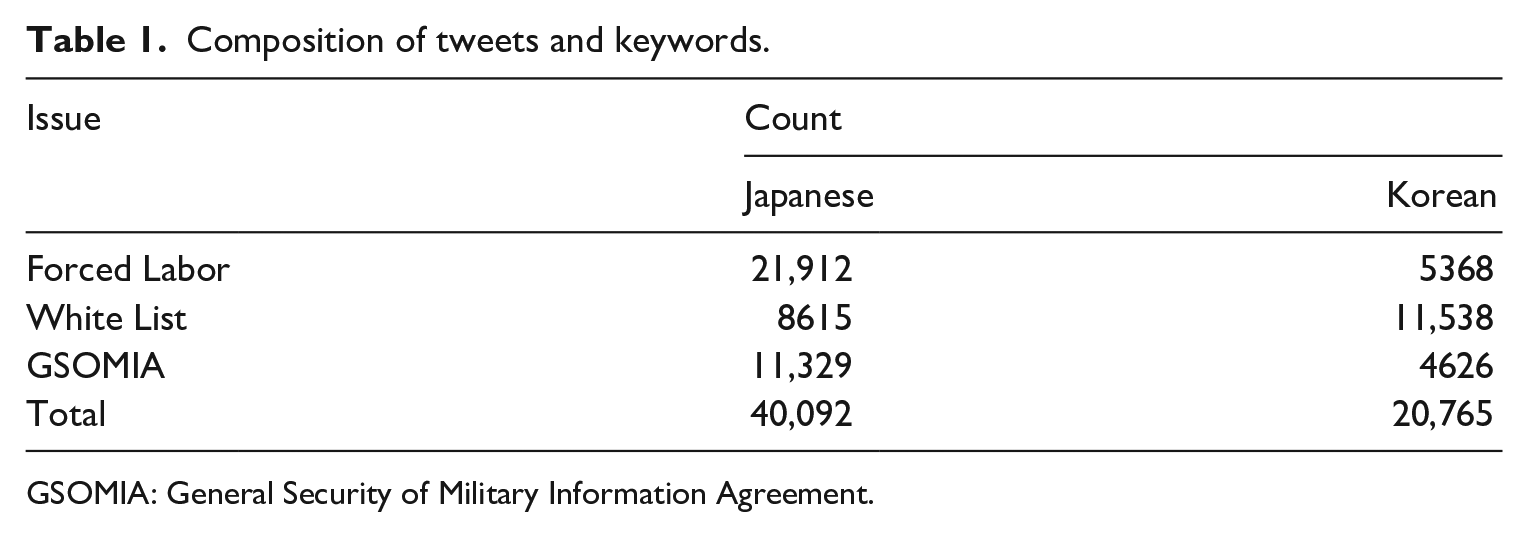
GSOMIA: General Security of Military Information Agreement.
A pattern emerges: The recipient of the provocative action by the other side tends to produce more tweets. In the case of the forced labour issue, the volume of Japanese tweets is much larger than the number of Korean tweets, while for the White List issue, the number is larger for Korean tweets than Japanese tweets.
Categorising the Twitter users
The first analysis of classifying Twitter users is carried out with the community detection algorithm applied to the retweet network. Community detection is one of the major topics in research on online social networks, as the information on a platform is communicated through the network of users (Conover et al., 2011; Guerrero-Solé, 2017). There are several types of information that can be used to detect the communities such as the followership information, contents of information transmitted from accounts, and interactions between Twitter accounts (Darmon et al., 2015). Using followership networks (e.g. Barberá, 2015; Garcia et al., 2017) is one of the popular approaches and is particularly useful when most of the followee accounts have been created for a specific purpose or have common traits (e.g. members of legislatures accounts). However, as this is not the case for the present study, we use a piece of information that directly taps into the communication on Twitter through user interaction, which is the retweeting behaviour of users. In particular, the key information we utilise is the accounts that retweet from multiple accounts: Twitter accounts that have frequently retweeted each other’s tweets are likely to have similar tendencies. The advantage of using a retweet network is intuitively evident as retweets are a form of information sharing, and Twitter users tend to retweet when they agree with the contents of a tweet to some degree. This approach has been proven to be effective. For instance, Conover et al. (2011), who analysed political tweets in the 2010 midterm election in the United States, were able to detect two ideologically polarised communities of accounts from retweets while the analysis of mentions produced a dominant cluster. Also, Guerrero-Solé (2017) exclusively focuses on retweets in analysing the structure of political discussion for Catalan independence.
We construct the retweet networks for Japan and Korea, especially focusing on the co-retweet network where vertices are retweeted accounts and an edge between two accounts is formed when there are Twitter accounts that retweet both accounts weighted by the number of accounts retweeting both accounts. To these networks, we employ an algorithm for modularity optimisation to achieve high density in intra-community connections while keeping the inter-community connections sparse. 6 After trying several modularity-optimisation algorithms for community detections, such as Louvain, fast-and-greedy, infomap, and label propagation, we chose the Louvain algorithm based on the highest modularity scores for both Japan and Korea. After clustering the users, we manually interpret the types of clusters and judge the members’ positions towards the government by looking through the key members in each cluster and assessing what constitutes that cluster by reading their user descriptions and tweets in the corpus.
Content analysis of tweets
Analysing the content of tweets is the second step of our empirical investigation. The purpose of content analysis is to determine whether and how the communities of Twitter accounts are different in terms of their attention and sentiment polarity across diplomatic issues. This is essentially a scaling task to map documents onto a few dimensions, rather than a classification task. 7 In particular, we apply scaling methods to the tweet texts to calculate their scores in two relevant dimensions: the first is the dimension of the attention of tweets in the present-day politics versus history dimension, and the second is the sentiment polarity in a positive or negative direction. We chose the dimension of present versus history because while the crisis has historical roots, in the process of escalation, it has taken on the connotation of being a political issue today. Therefore, we believe that the polarisation of opinion between anti- and pro-government audiences can be observed in this dimension.
Text scaling is a method for extracting meaningful dimensions through the reduction of dimensions from the patterns of word usage. A handful of scaling algorithms, in both supervised (e.g. Laver et al., 2003) and unsupervised (e.g. Slapin and Proksch, 2008) variants, have been proposed in social sciences.
As we have concrete targets in extracting information, which are present-past and positive-negative, supervised scaling methods thus would be useful in our research. In particular, we need a method that allows versatile decisions on the meaning of the extracted dimensions, while dealing with the extreme sparsity of the input document term matrix. One such method is Latent Semantic Scaling (LSS) developed by Watanabe (2021). The method is the combination of Latent Semantic Analysis (LSA) through singular value decomposition of a document-feature matrix and distance calculation from the list of supplied words. A list of words, called ‘seed words’, are a relatively small set of words with polarity scores assigned ad hoc. All other words are scaled as the mean cosine similarity of word-vectors between the current word and seed words multiplied by the polarity score of seed words. The scores of documents are calculated as the average of word scores weighted by the word frequencies in a document, in a manner similar to Wordscores by Laver et al. (2003). 8 The advantage of this methodology is the relatively small cost of human coding, and the word-vector extraction is domain-specific. 9
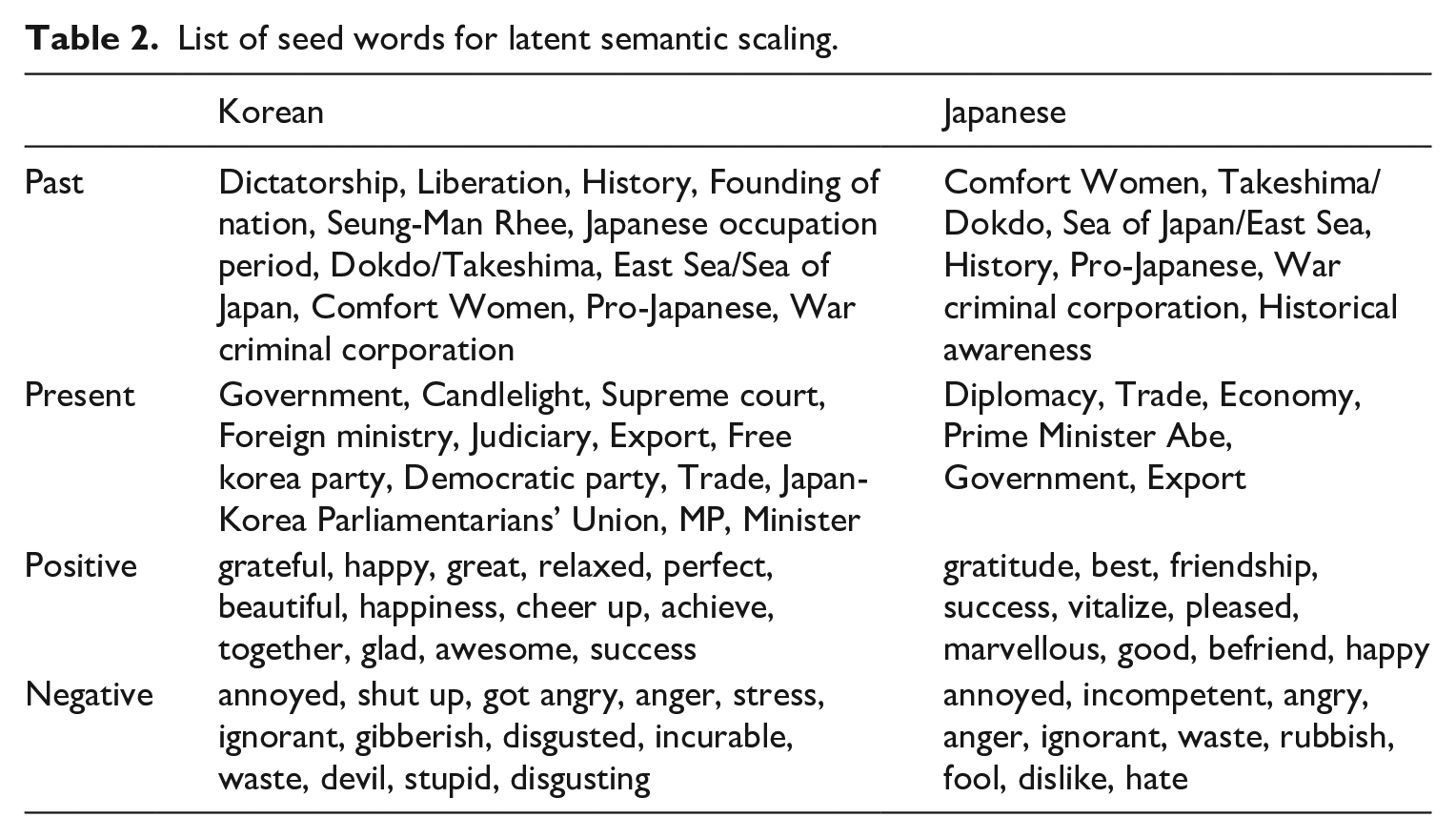
In our analysis using LSS, we prepare two sets of seed words, corresponding to the two dimensions we are interested in. By applying the LSS algorithm separately for each dimension in each corpus, we obtain predictive scores in both dimensions for each tweet. The seed words in the historical end include historical issues between Korea and Japan, such as comfort women compensation and the Dokdo/Takeshima territorial dispute, and words surrounding current politics, the opposite end in the dimension, include general political and economic terms, such as government, the foreign ministry, trade, and import. For the negative–positive dimension, we select words from sentiment polarity dictionaries in the respective languages (Do and Choi, 2015; Takamura et al., 2005). The following is the full list of seed words in their English translations (Table 2). 10
List of seed words for latent semantic scaling.
Results
Clustering Twitter accounts
We first identify clusters of Twitter accounts through clustering in retweet networks. We construct network graphs of the authors of tweets in our corpus, separately for Japanese and Korean tweets. The graph is undirected: the vertices are retweeted Twitter accounts, and the edges are the co-retweeting, where two vertices are connected when a user retweeted the tweets from these two vertices. The weight of edges is the number of co-retweeting accounts. After isolated vertices are removed from the graph, 2724 (Japan) and 2408 (Korea) Twitter accounts are included in the graphs. Small clusters with less than one hundred members are not discussed.
For Japanese Twitter users, five clusters are detected. The following Table 3 shows the detected clusters, with a short description of the members of a cluster, and a sample of these accounts’ user descriptions, in descending order of the cluster size. Among five clusters, two are the clusters of politically motivated Twitter accounts, another two are news media and news sharing, and the last one is a collection of mostly non-political Twitter accounts with occasional tweets to comment on the news that was topical at the time.
Cluster members and examples in Japanese tweets.
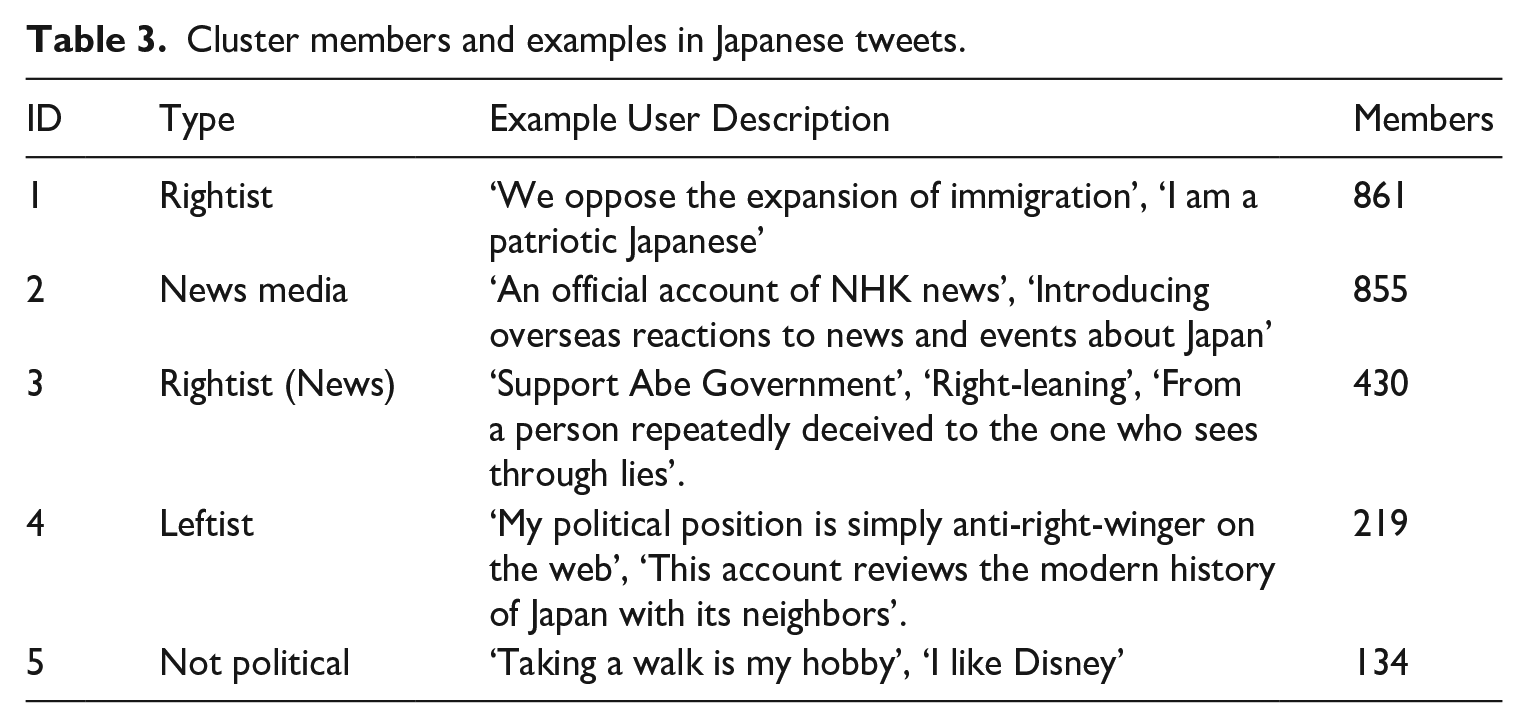
Each of the two politically active clusters seems to take completely opposite positions. The first community, which we call the ‘Rightist’, includes a large number of Twitter accounts supporting the government. In the descriptions of the users, we can frequently find statements defaming Korean people and urging Japan to break diplomatic ties with Korea. Other characteristics of this cluster are (1) displaying strong xenophobic sentiments, especially towards Korea; (2) expressing respect and loyalty to Japan’s Imperial Family; and (3) portraying the opposition parties and left-leaning media as ‘anti-Japan’. Cluster 4, the other politically active group which we call ‘Leftist’, takes the opposite position in being critical towards the current government, and sympathetic towards the argument by Korea. Another characteristic of this group is that they consider themselves the counter-group against the right-wing, especially the one on the Internet.
Among the two communities for news sharing, one is politically motivated. The larger Cluster 2 contains news outlets, news aggregators, and writers who comment on news, and does not have a clear political leaning. In contrast, the smaller Cluster 3, which also contains news aggregators and commentaries, has a strong political stance in support of the government and shows antagonism against Korea. This community is similar to Cluster 1 in their political position but is distinctive in their strong suspicion of the liberal media’s “lies” and also in disseminating the news that fits their political beliefs.
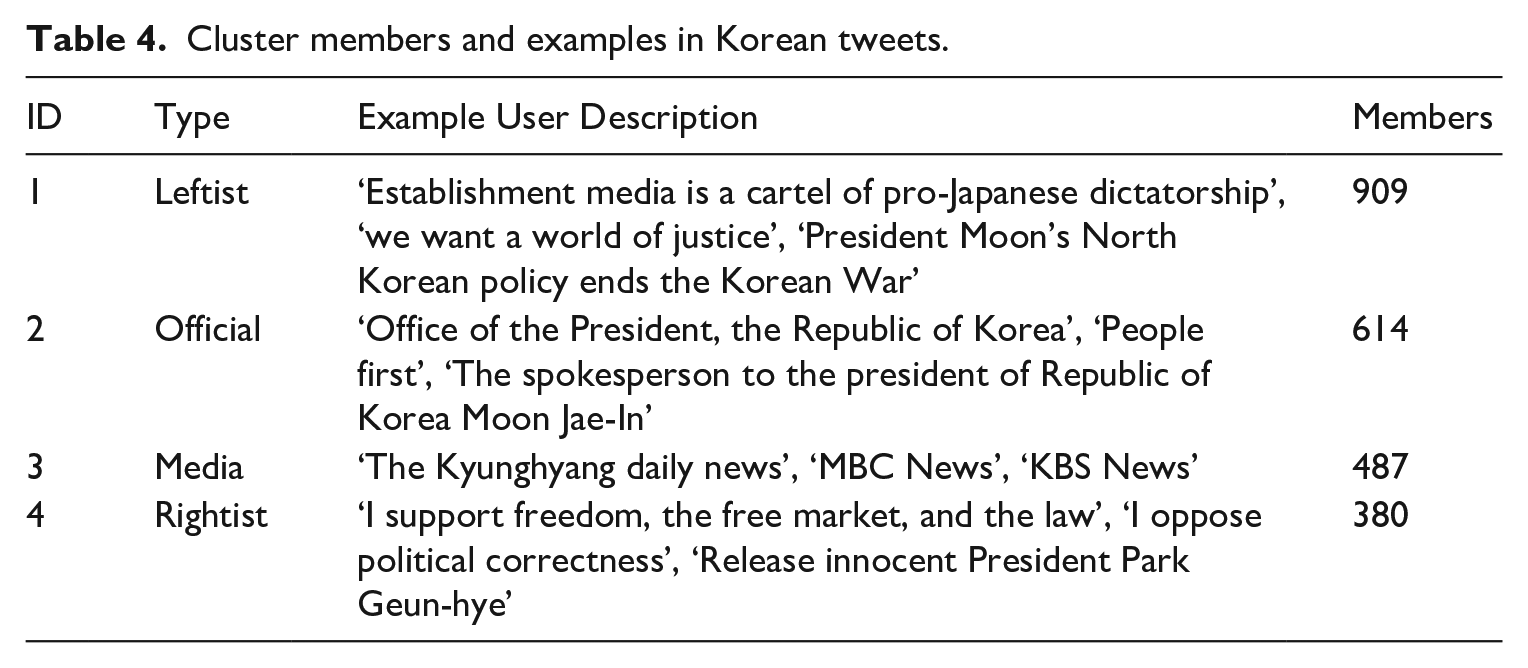
In the network of Korean Twitter users, four large clusters are detected (Table 4). The largest cluster, Leftist, can be understood as a community of ardent supporters for President Moon and his government, while strongly rejecting conservative politicians, former conservative presidents, and the conservative media. The second largest cluster, Government, is similar in the sense that many official accounts of governmental bodies can be found here, which can be understood as pro-Moon in line with the president and his composition of the cabinet. Their language is more moderate than the first cluster and may not be an official government actor, just a moderate person. The third cluster, Media, consists mostly of media accounts that are both mainstream and more independent, which leads to more diverse language than is common for mainstream media. Finally, the smallest cluster, Rightist, assembles the Twitter users that advocate the typical conservative-rightist positions, such as the free market and opposition against the liberal government.
Cluster members and examples in Korean tweets.
The following is the visualisation of the co-retweet network, for both Korea and Japan. We select tweet authors with enough connection to other authors (10 or more sharing users with other accounts). The shape of the vertices indicates the cluster affiliation. The layout of the graph is determined by the Large-Graph-Layout algorithm. Figure 1 shows the results from Japan, and we draw the same network figure for the Korean Twitter community in Figure 2. The two countries have shown stark contrast in terms of the separation of clusters. For Japan, the Leftists cluster is relatively isolated from other communities, but other clusters are mixed with each other. Almost none of the Leftist accounts has a meaningful number of Twitter accounts that retweet both Rightists and Leftists. Even the media community does not have much connection with the Leftist community.
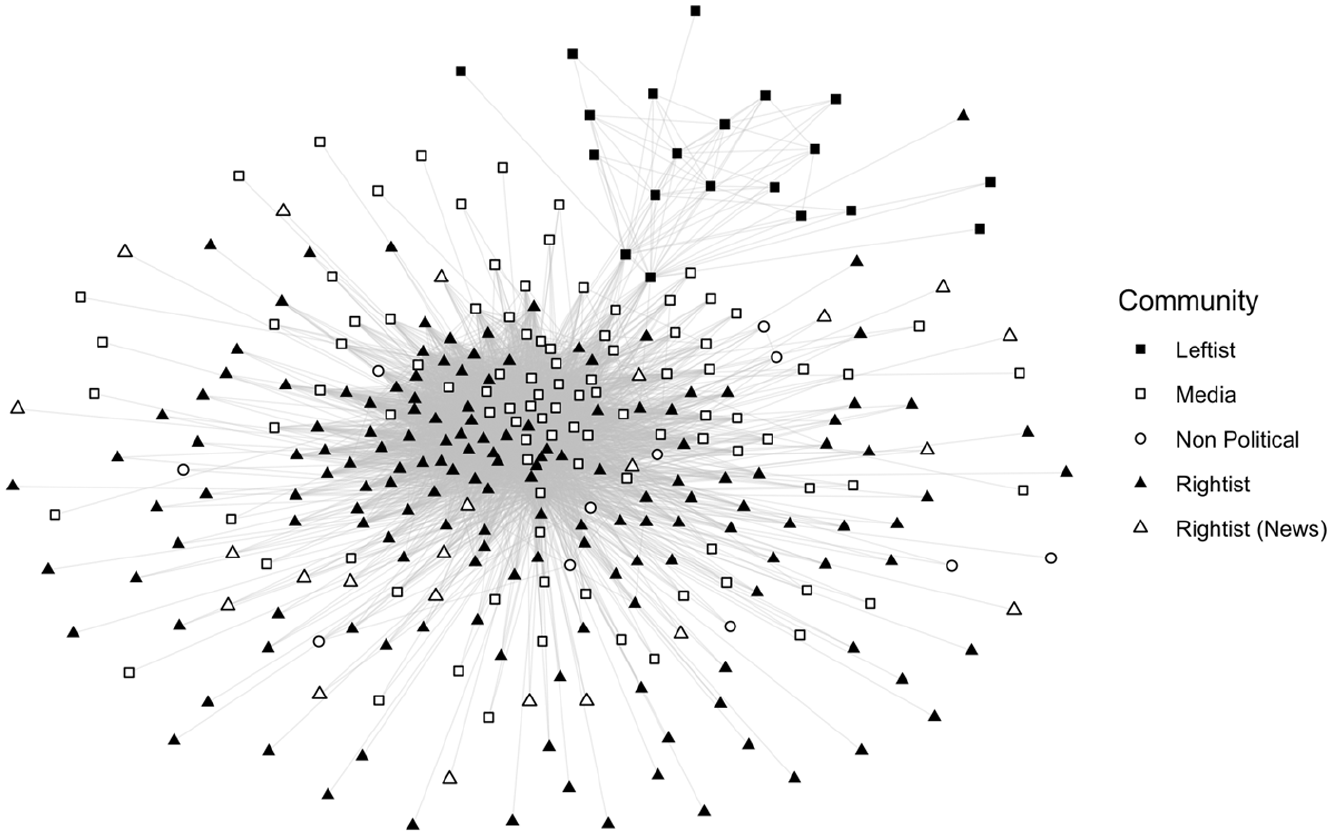
Retweet network of Japanese tweets.
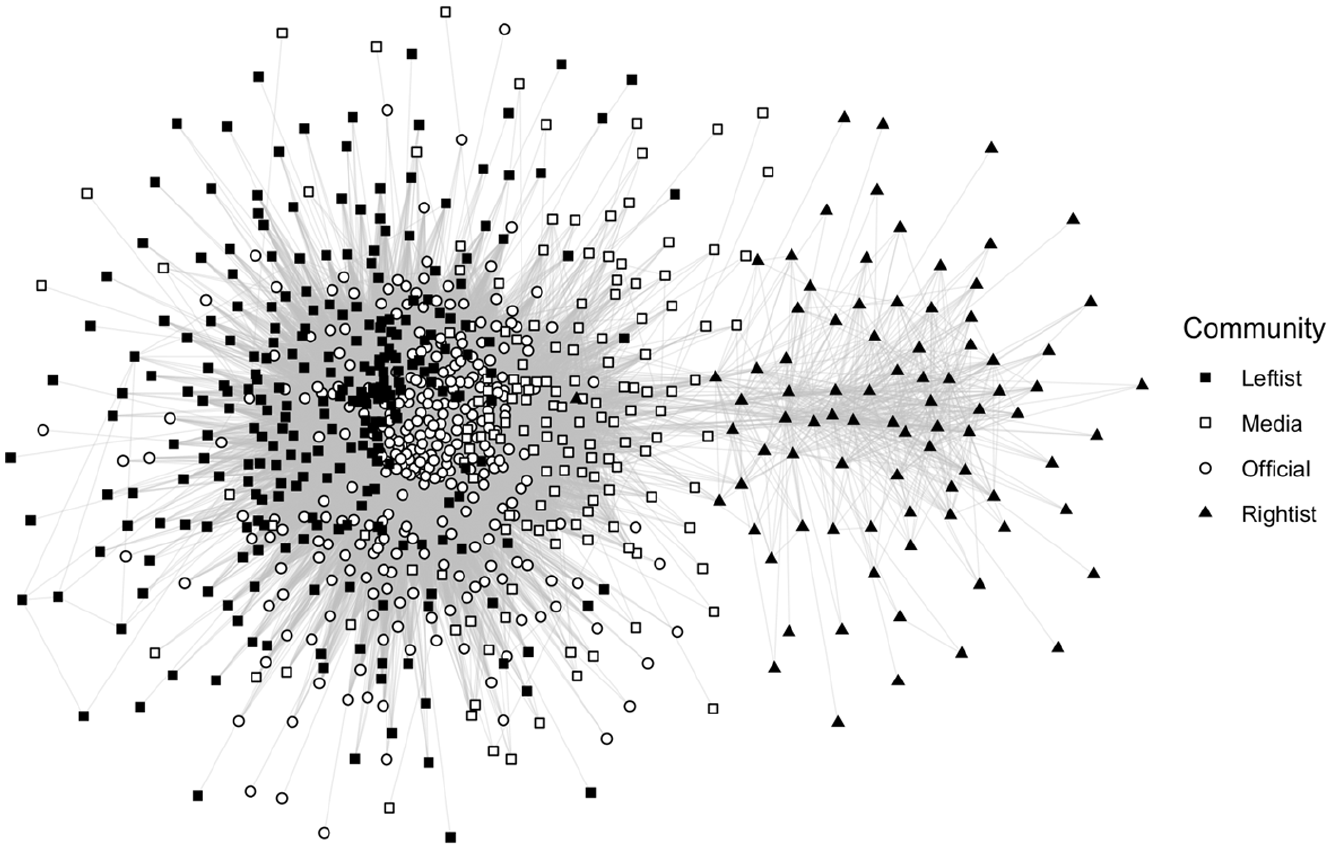
Retweet network of Korean tweets.
In the Korean network, (1) the Rightist cluster is relatively isolated, (2) the Official cluster is closely related to the Leftists, and (3) the Media cluster is also, to a lesser degree, related to the Leftist cluster. On a closer look at the accounts that are classified into these clusters, it becomes evident that the similarity of language and terms leads to communities like these. While the Official and Media clusters are not entirely composed of government and media accounts, the similarity in their argument on these issues would have put them in the same cluster based on the co-retweet information. The results show that the clusters supporting the administration under President Moon, such as the Leftist and Government, share many of the retweeters and form a cohesive group, while the Rightist cluster has its own set of retweeters and forms an isolated group as anti-government.
These two figures indicate remarkable differences between Japan and Korea. First of all, the number of accounts with ties to other accounts is much larger in Korea. This means that a larger number of Twitter citizens are actively sharing information on these issues. Also, the separation between the dominant community from the dominated community (in the Korean case, the dominant group is the Leftist) is clearer in Korea than in Japan. This finding suggests that Korea–Japan relations are a more polarising issue in Korea than in Japan and that any existing polarisation in Korean politics is fortified by the presidential political system that leads to more homogeneity between specific political positions, media, and government. In the following analysis, we call the Rightist clusters (1 and 3) in Japan ‘pro-government’ audiences and call the Leftist cluster 4 ‘anti-government’ audiences, while we call the left-leaning clusters (1, 2, and 3) in Korea ‘pro-government’ and the cluster 4 ‘anti-government’.
Scaling tweets on histo-political dimension
Now that we have detected the relevant clusters in two countries, we conduct the scaling of tweets in the dimensions of attention (present vs past) and sentiment polarity. We estimate two models of LSS for each language. After calculating the scores for individual tweets in these dimensions, we classify the tweets using a threshold of the absolute value of 0.3. 11
Figure 3 shows the proportion of tweets that focus on the history in the present versus past dimension for each sub-category of tweets. In terms of the difference between the pro- and anti-government audiences, the results from the Korean tweets are more consistent: In all three issues, the pro-government audiences are consistently more focused on the past than the anti-government audiences. In terms of the difference between sub-aspects of the crisis, the Forced Labor and GSOMIA display more historical focus than the White List. This is intuitive: The supporters of the Liberal Government oppose the historical settlements that were forged in the 1960s under the authoritarian regime. Because of the difference in the historical perception, the contents of the argument tend to differ between the anti- and pro-government audiences even when they talk about historical aspects. For example, a quote of a typical argument from the pro-government audiences is, ‘Territorial dispute, comfort women, and forced labor. The world is watching North and South Korea. Let’s reveal Japan’s sins’. While its anti-government counterpart is, ‘What use is a reparations rule that will never be paid? Domestic law won’t apply in Japan. Go to the Court of International Law’. 12
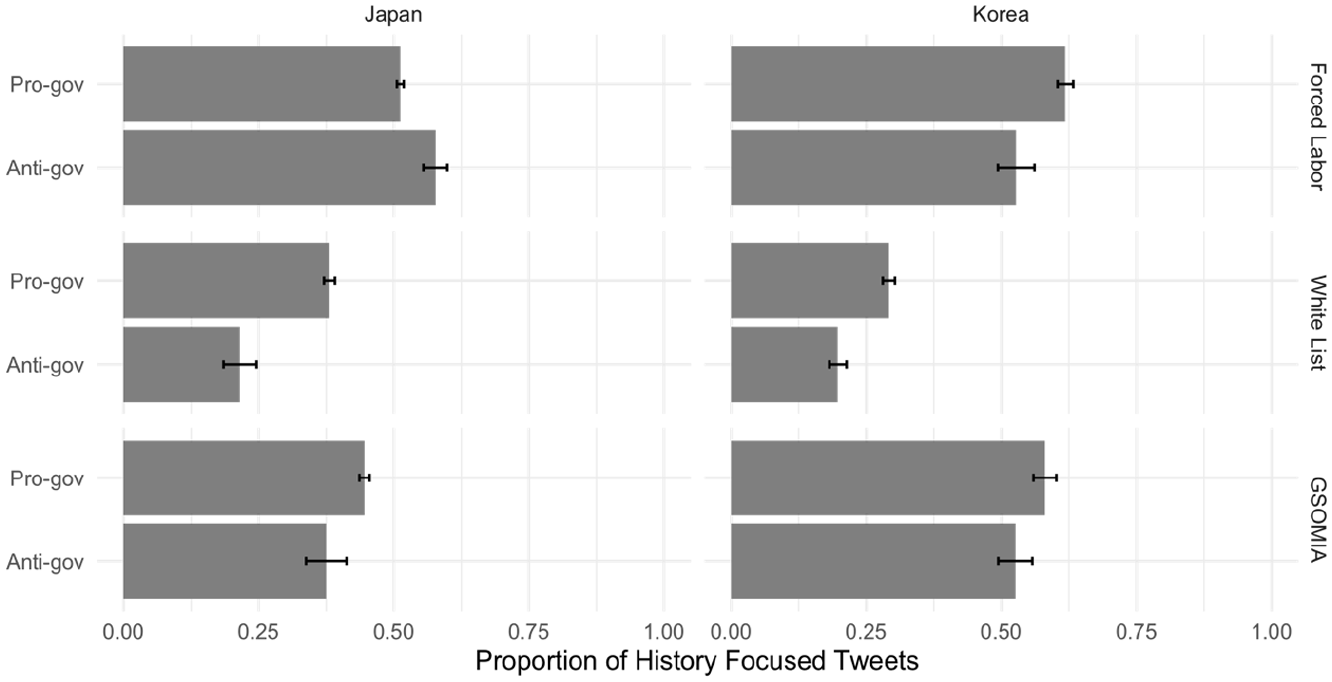
Proportion of tweets focusing on the past.
The results from the Japanese tweets are more nuanced in comparison. While the pro-government audiences are more focused on the past for the later two issues (White List and GSOMIA), the anti-government audiences are more focused on the past regarding the earliest issue of Forced Labor. This is also a predictable result. The Leftists who are against the conservative government in Japan are in general more sympathetic to the claims by the Korean people on the compensation for the damages during the colonial period, and that reflects how these two camps discuss the past. The anti-government audiences accuse the Japanese government of never accepting responsibility (e.g. ‘The Japanese government should face up to the history of human rights abuses committed by the Japanese government and companies against at least 700,000 Korean forced laborers’), while the pro-government users blame the other side for the unresolved issues (e.g. ‘One thing that struck me when I talked to Koreans is that the Korean public is not even aware of the existence of the Japan-Korea Basic Treaty’.)
Overall what we see here is the general tendency of the pro-government audiences to discuss these issues, especially later two issues without a direct link to the history, from historical aspects of both countries. While the historical issue of Forced Labor and the present-day politics of the White List are discussed in a similar manner by Japanese and Korean Twitter users, how they interpret the GSOMIA is different. Korean Twitter users tend to link it with history, a tendency that is common to both camps. In contrast, Japanese Twitter users think of this more as present-day politics, while the pro-government audiences discuss it from a more historical aspect than the anti-government audiences do. The difference is due to how the two governments framed the issue, which is the precondition that draws reactions from Twitter users. The Korean government insisted that the attempt to terminate GSOMIA was due to the ill treatment of bilateral history by the Japanese government, while the Japanese government reportedly portrayed the decision as an irrational response to the White List exemption. For this reason, the Korean Twitter users in both camps discuss the issue with a deeper connection to history than in Japan.
Sentiment polarity of tweets
After identifying the positive and negative tweets with LSS, we evaluate the proportions of negativity by clusters and focus across sub-issues of Forced Labor, White List, and GSOMIA (Figure 4). For Japan, the results are clear in the more recent two issues: the anti-government audiences are more negative than the pro-government audiences, especially when they talk about these issues in historical contexts, although the differences between anti- and pro-government audiences are not statistically significant in the issue of GSOMIA. The anti-government Leftists, who perceive that the Japanese government’s inaction to the colonial-era compensation issue is the fundamental cause of the problem, did not want the escalation of the matter by the provocative action of the Japanese government, while the pro-government Rightists, who are angry about the Korean court ruling on the Forced Labor issue, welcome the escalation as a form of retaliation. As for the past–present differences, these issues are less past-oriented in comparison with the Forced Labor issue by both camps; however, when discussed in the historical context, the anti-government audiences tend to be more negative.
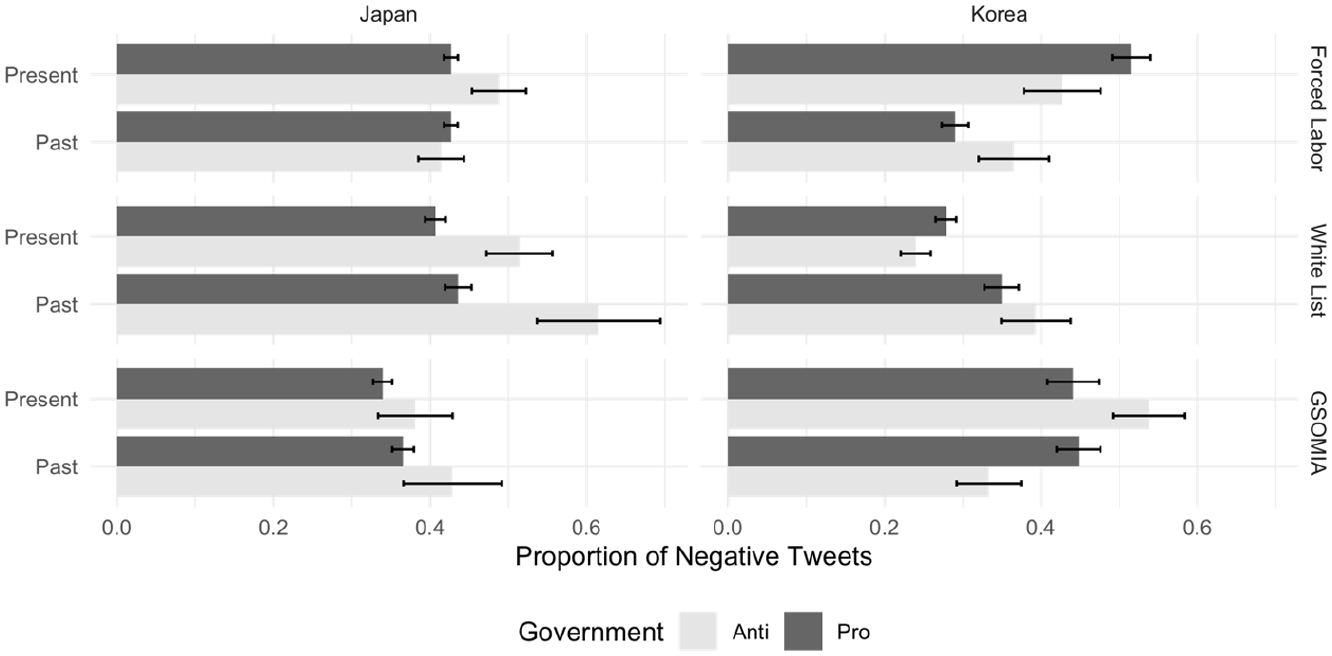
Proportion of negative tweets by issue and focus.
In the Korean tweets, both the anti- and pro-government audiences are the most negative about the historical issue of Forced Labor. The difference is that the anti-government audiences focus negativity on the past, while the pro-government audiences focus on present-day politics. The supporters of the Liberal government reflect the government’s position, while the opponents convey that the tensions ignited by the government lack legitimation. The strong negativity of both groups of clusters underlines that Korea–Japan conflict relations carry historical resentment towards Japan regardless of political stances. Second, in the past focused Tweets on the White List issue, the anti-government audiences’ negativity is higher than the pro-government audiences, perhaps overshadowed by the perceived lack of legitimacy mentioned above. In contrast, the pro-government clusters display more negativity about the present aspect of the White List issue, which reflects the reaction of the government they support. Finally, the negativity from the anti-government cluster on GSOMIA is high in the tweets focusing on the present as the issue is initiated by the Korean government. Overall, for the inherently historical issue (Forced Labor), the pro-government cluster stresses the political aspect more negatively but stresses the historical issue more negatively for the issue with more political focus (especially GSOMIA). All three issues are both political and historical to some degree, but the differences in the opinions possessed by clusters reflect how these issues were unfolded by the Korean government: the inherently historical Forced Labor issue was politicised and the White List issue with strong political implications is historicised, while both decisions legitimise the trade war.
The intricacy of the sentiment polarity outcomes can be disentangled by looking at the target of the tweets: the negativity or positivity might be determined by the pro- or anti-government audience’s sentiment towards specific groups or entities. For example, anti-government audiences in Japan could be more negative than pro-government audiences when the intended target of the discussion is the Japanese government. Our final set of results addresses this possibility.
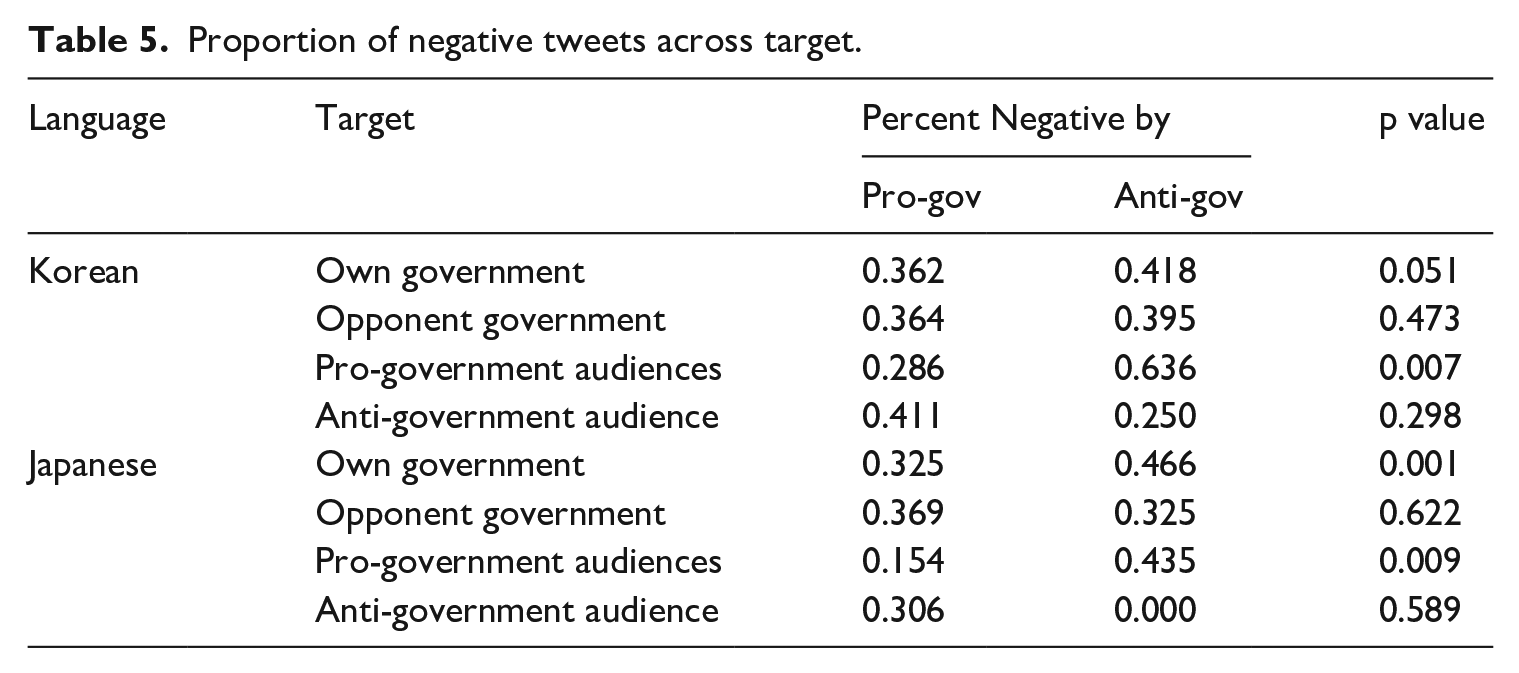
We create a dictionary of words for four categories of targets mentioned frequently in the corpus and calculate the proportion of negative words among tweets that mention these targets. The four targets are the Japanese government (e.g. Prime Minister Abe), the Korean government (e.g. President Moon), and Internet Leftists and Rightists (including some derogatory words used by the opposite camps to mention the other side). 13 After selecting the tweets for each target through dictionary matching, we calculate the proportion of negative tweets. Table 5 shows the results, with the last column being the p value from Fisher’s exact test for the distributional differences between anti- and pro-government audiences. The results from both the Japanese and Korean tweets show the similarity across the country. The negativity of anti-government audiences against the government and its supporters is high in both countries, which implies that a narrative backlash against the government policy is apparent in the online sphere. Most notably, we can see that the proportion of negative tweets from anti-government audiences against their countries’ governments is high in the data and this is much more salient than that from pro-government audiences. That is not necessarily the case for the opponent government: pro- and anti-government audiences in Japan are equally negative towards the Korean government and that is the same for Korean audiences towards the Japanese government. This difference in negativity towards their own government is also reflective of a difference in negativity towards the government’s supporters. Anti-government audiences are strongly negative towards pro-government audiences. In contrast, the attitude of pro-government audiences towards anti-government audiences, while also negative, is less noticeable. All in all, anti-government groups are most negatively vocal on the Internet, especially when they talk about pro-government groups.
Proportion of negative tweets across target.
Conclusion
By examining online communication data from Korean- and Japanese-speaking tweets, this article presented a contrast of narratives on a diplomatic crisis. Unlike the conventional expectation of the rally-effect, our findings suggest that a diplomatic crisis can intensify the existing societal cleavage rather than heal it. Twitter audience interpreted a crisis in a very different way, in which the pro-government online audiences tend to interpret both export restrictions and renewal of GSOMIA in connection to historical issues, instead of ongoing economic and security issues. Not only this potential interpretive polarisation, but the findings also showed negative sentiments targeting domestic audiences. Anti-government audiences are negative about the government but also about the government-supporting groups and their interpretations of the diplomatic crisis.
Our study has the following broader implications. First, citizens can be polarised when discussing a diplomatic crisis. This is possible because the utility of histo-political narratives for political elites is evident when they implement a foreign policy that is known to boost support. In the present case, pro-government audiences reproduce and support the government’s narrative while anti-government audiences only see the historical or political flaws in the opposing audience. In this manner, the existing narratives on bilateral relations are reproduced and strengthened by domestic polarisation.
Second, at the same time, domestic polarisation in times of crisis may provide a source of prolonging diplomatic deadlock, partly because the government needs to face two reinforcing criticisms from a foreign country and internal opposition simultaneously.
Third, our case study of two democracies with highly advanced information technologies foreshadows hyper-partisan online affect in the future of democracy, both offline and digital. Historical narratives have the trait of clustering into online communities that affirm beliefs (Boutyline and Willer, 2017) as Twitter users follow similar political elites (Barberá and Rivero, 2015; Spohr, 2017). Those users are less likely to interact with different clusters (Bright, 2018) because they share news and misinformation that use emotional language (Bakir and McStay, 2018) while demoralising or mocking ideological opponents (Brady et al., 2017). This study shows that these traits are also found, in a even more intensified manner, in the clusters that think alike of current bilateral relations and domestic polarisation. Among those narratives of dissent regarding historical struggle, opinionated clusters on social media can become an online social movement and even lead to social movements in the real world (Harlow, 2011; Howard et al., 2011; Lee and Chan, 2016).
Finally, our analysis presents some utility of using social communication data to investigate whether and how people react to a diplomatic crisis. With an advancement of online communication tools, citizens not only can receive ample information about their country’s foreign policies but also express their opinions and communicate with like-minded people using social networking platforms, which largely increases the role of the public in foreign policymaking (Baum and Potter, 2019; Cull, 2013). Reflecting this reality, online communication data enable us to overcome the comparative study of narratives that is not measurable via standard data sources. Text data enable in-depth content analyses of different sub-narratives over a long time. This article suggests that studying popular opinions held by domestic audiences, especially through the analysis of texts created by them is a promising approach to understanding the domestic consequence of a diplomatic crisis. Moreover, this study highlighted the links between online narratives and polarisation that have been understudied in non-Western contexts.
We believe, however, that our study is only an initial step towards a complete understanding of the negative impact of a diplomatic crisis on national unity and stability. Obviously, our exploratory analysis cannot conclude that the present crisis causes a repolarisation in online sphere. Since our attention was on a diplomatic crisis that occurred between Korea and Japan over trade and security issues, future research must pay attention to whether a crisis can lead a domestic polarisation in other countries over more intense conflict, such as war. Finally, the extent to which public-level polarisation influences the actual elite-level diplomacy remains a matter of debate.
Supplemental Material
sj-docx-1-bpi-10.1177_13691481231172346 – Supplemental material for The social media audience of diplomatic crisis
Supplemental material, sj-docx-1-bpi-10.1177_13691481231172346 for The social media audience of diplomatic crisis by Akitaka Matsuo, Oul Han and Naoko Matsumura in The British Journal of Politics and International Relations
Footnotes
Funding
The author(s) received no financial support for the research, authorship, and/or publication of this article.
Supplementary Information
Additional supplementary information may be found with the online version of this article.
Contents
Table A1. List of Keywords and Number of Tweets. Figure A1. Retweet Network of Japanese Tweets (Coloured). Figure A2. Retweet Network of Korean Tweets (Coloured). Table A2. List of Seed Words in the Original Language for Latent Semantic Scaling. Figure A3. Word scores (History versus Politics, Japanese). Figure A4. Word scores (History versus Politics, Korean). Figure A5. Word scores (Sentiment Polarity, Japanese). Figure A5. Word scores (Sentiment Polarity, Korean). Table A3. Example Tweets for the History-Politics Dimension. Table A4. Terms to Identify the Target of Tweets. Table A5. Example Tweets for Negative tweets Across Target.

Notes
References
Supplementary Material
Please find the following supplemental material available below.
For Open Access articles published under a Creative Commons License, all supplemental material carries the same license as the article it is associated with.
For non-Open Access articles published, all supplemental material carries a non-exclusive license, and permission requests for re-use of supplemental material or any part of supplemental material shall be sent directly to the copyright owner as specified in the copyright notice associated with the article.
