



Abstract
Centre–left political parties are undergoing an identity crisis. This article is a comparative analysis of how the three sister labour parties in the United Kingdom, Australia and New Zealand are refurbishing their agendas. We integrate Barrientos and Powell’s framework, with Freeden’s concept of ideological morphology, to systematically map the three parties across three main domains: their discourse and values, their political economy, and their social policy agendas. We then apply four different analytical frames to better understand the ideological and policy trajectories of our cases. These frames comprise ‘values, not ideology’, ‘quietism’, ‘third way’, and ‘thin labourism’. We argue that the frame of ‘thin labourism’ best captures the recent developments of these modern labour parties. In sum, the parties are still rooted in a recognisable centre–left tradition, but they operating from a narrower base of core values.
Introduction
Centre–left parties face an identity crisis (Bailey et al., 2014; Benedetto et al., 2020; Keating and McCrone, 2015; Manwaring and Kennedy, 2017). Two decades after the heyday of the ‘third-way’ era, these parties seek to redefine their ideological and policy agendas in the face of structural decline in their electoral support, and – in many places, including the United Kingdom, Australia, France, and the Netherlands – prolonged periods out of office. This includes the labour parties – characterised by formal institutional links with the trade unions. As with centre–left parties more generally, the ideological contours of these labour parties have become less clear.
This article examines how recent leaders have sought to renew the ideologies and identities of their respective labour parties. Are they adopting new values and ideas, or rediscovering older ones, and what is lost from their traditional policy and ideational armoury? We ask what does contemporary ‘labour’ stand for? To address these questions, we present a comparative analysis of three sister labour parties – the British Labour Party, the Australian Labor Party (ALP), and the New Zealand Labour Party.
A comparison of the three labour parties is timely and fruitful for several reasons. All three of our cases underwent significant renewal and change in the 1980s and 1990s and adopted – to varying degrees – elements of ‘third-way’ politics (Battin, 2004; Castles and Pierson, 1996; Johnson, 2019; Scott, 2001). However, the recent COVID emergency saw new and significant pressures on centre–left parties, especially where their centre–right competitors adopted traditional policy tools of the left (Chohan, 2022; Vampa, 2020). A key issue is to examine how leaders have sought to renew their ideational and programmatic agendas as part of the three labour parties’ responses to these old and new challenges.
The article has two main parts. First, we systematically map out and compare the three parties, across three broad dimensions: (1) their discourses and values, (2) their approaches to political economy, and (3) approaches to social and welfare policy. Following that, we adopt four analytical frames to better understand the ideological and policy positioning of the three parties:
‘Values (not ideology) and populism’;
‘Quietism’;
‘Third way in all but name’;
‘Thin’ labourism.
We argue that the fourth frame of ‘thin labourism’ best captures the policy and ideological orientations of the three parties. The core contribution offered here is that, to date, there has been no systematic ideological understanding of the current directions of these three emblematic labour parties. Moreover, understanding the policy change and directions of these ‘labour’ cases brings crucial insights into the broader crisis of the centre–left, and the ongoing policy adaptations and changes taking across this party family (Bailey et al., 2014; Benedetto et al., 2020; Judt, 2009; Manwaring and Holloway, 2022).
Method
We use a comparative case study research design (Teune and Przeworski, 1970; Yin, 2014), using the framework developed by Barrientos and Powell to facilitate systematic comparisons between similar centre–left parties (in their case, different ‘third-way’ parties). These three labour parties are clearly identifiable within the long-standing family of centre–left parties, especially those formed at the turn of the 19th century, and we select our cases primarily on ideological, policy, and cultural grounds, following Mair and Mudde’s (1998) work on the study of party families. While there are some systemic and contextual differences (e.g. differing electoral systems, federal versus unitary states), the three cases are based in advanced industrial societies, and crucially, have been part of a historic two-party system. Moreover, all three cases share formal institutional links with trade unions, which make for a stronger comparison than with, say, the Spanish PSOE, the French PS, or the German SPD. These are English-speaking parties with long-standing cultural and colonial links, along with widespread policy transfer and personnel links between the three parties (e.g. O’Reilly, 2007; Schulman, 2015). For instance, Jacinda Ardern was a policy advisor in Tony Blair’s No. 10 Policy unit. Moreover, as ‘labour’ parties we observe how the parties share some common ideological background, and indeed, a core aim of our comparative approach is to track and map differences across the three groups. As we outline, we see the three parties as shifting towards a ‘thin labourist’ approach, but with some significant differences.
Barrientos and Powell’s framework enables a rigorous comparative analysis across key dimensions. Data are drawn from key speeches delivered by the party leaders, and supported by key policy pronouncements, including relevant manifestos. These include 18 speeches made by Keir Starmer since he assumed the leadership, 23 by Anthony Albanese, and 44 by Jacinda Ardern.
To locate and understand the ideological contours of our cases, we employ Freeden’s concept of ideological ‘morphology’ as an organising approach (Freeden, 1996, 2003, 2006, 2013; Freeden et al., 2013). ‘Morphology’ describes the cluster of interlocking core and adjacent values we expect to find in common ideological traditions. Freeden’s morphology of socialism and social democracy gives specific prominence to the core values of equality, communities, work, welfare, social liberalism, and a critique of capitalism, which organises our comparative mapping of the three parties’ ideologies. We apply Freeden’s morphological approach not as a benchmark (i.e. the ideology of a party can only be defined as ‘social democratic’ if all values are present) but rather as a guide to identify common values across the three cases. Freeden (2017) subsequently makes an important distinction between thick and thin ideologies, where the latter comprise fewer core and peripheral concepts and offer a less coherent political strategy.
We link this morphological approach with several dominant traditions across the parties. We differentiate between three broad (and necessarily stylised) traditions: ‘traditional’ social democracy, the third way, and labourism (e.g. Bailey, 2009; Bramston, 2011; Crouch, 2017; Wright, 2006). There are, of course, multiple and contested definitions of these terms (e.g. see Wright, 2006: 14). Labourism, broadly put, refers to the concepts and practices which seek to more narrowly improve the everyday material conditions of working people. Following Beilharz (1985: 210), the labourist tradition is ‘. . . where the essential focus is on concrete demands of immediate advantage to the working class and organised labour . . . Labourist politics . . . takes place on, and accepts, the terrain of capitalist social relations’. 1 ‘Traditional’ social democracy is oftentimes defined by its commitment to Keynesian demand management, linked to redistributive measures for low-income groups, often buttressed by a strong welfare state. The third way refers to the shift of many centre–left parties to embrace a more globalised and inter-connected economy, and the use of new sets of social policy approaches, such as ‘social investment’. Bailey (2009) offers a useful schematic comparison between ‘traditional’ and ‘new’ (third way) social democracy, and we broadly follow his schema for these two latter traditions. 2 We emphasise two categorical issues here. First, these are deliberately stylised definitions and do not reflect the diversity of how centre–left politics has been practised (e.g. there have been multiple ‘third ways’ (Duffek et al., 2001). Second, there is overlap between these three broad traditions. However, as we set out here, it is the ‘labourist’ tradition and its underpinning values that links most closely with our cases (Beilharz, 1985; Davis, 2004; Irving, 1994; Schulman, 2015).
As with all methodological approaches, there are limits in the knowledge claims we make about our cases. Most evidently, the party and the party leaders are at different stages of the political ‘life-cycle’, with notably the New Zealand Labour party at the time of writing in its second term of office, and in the period of our study – the other two cases (were/are) in opposition. New Zealand’s proportional representation system also has a different impact, with Jacinda Arden governing in coalition in her first term (2017–2020). Most critically, we are offering a specific time-limited study of the parties, which covers the period from 2017 to December 2021. In both the UK and Australian cases, the ideological and policy agendas are still emerging and developing. However, despite this relatively short window of comparison, we can make meaningful observations about the emerging and changing ideological and policy contours of the parties. We also note that contextual factors are important for understanding our cases. We do not claim to offer definitive statements about the ideological orientations of the parties, nor do we suggest that they are currently fixed and unchanging. However, we do provide key insights about the processes of ideological renewal and stagnation.
Discourse – values, themes, ideology
We adapt the comparative framework set out by Barrientos and Powell (2018), which has been successfully applied elsewhere (Manwaring and Robinson, 2020), and which offers a ‘route map’ of third-way centre–left parties to compare different labour and social democratic parties. Barrientos and Powell disaggregate centre–left parties into observable sub-units for political analysis, including their ideological and policy agendas across the key dimensions of discourses, policy goals, and policy means. Thus, we focus on discourse/values, political economy, and social/welfare policy. Thus, we now look at individual party leaders and examine how their discourses projected their core values. The salience of key words/phrases from all three leaders’ speeches is outlined in Figure 1.
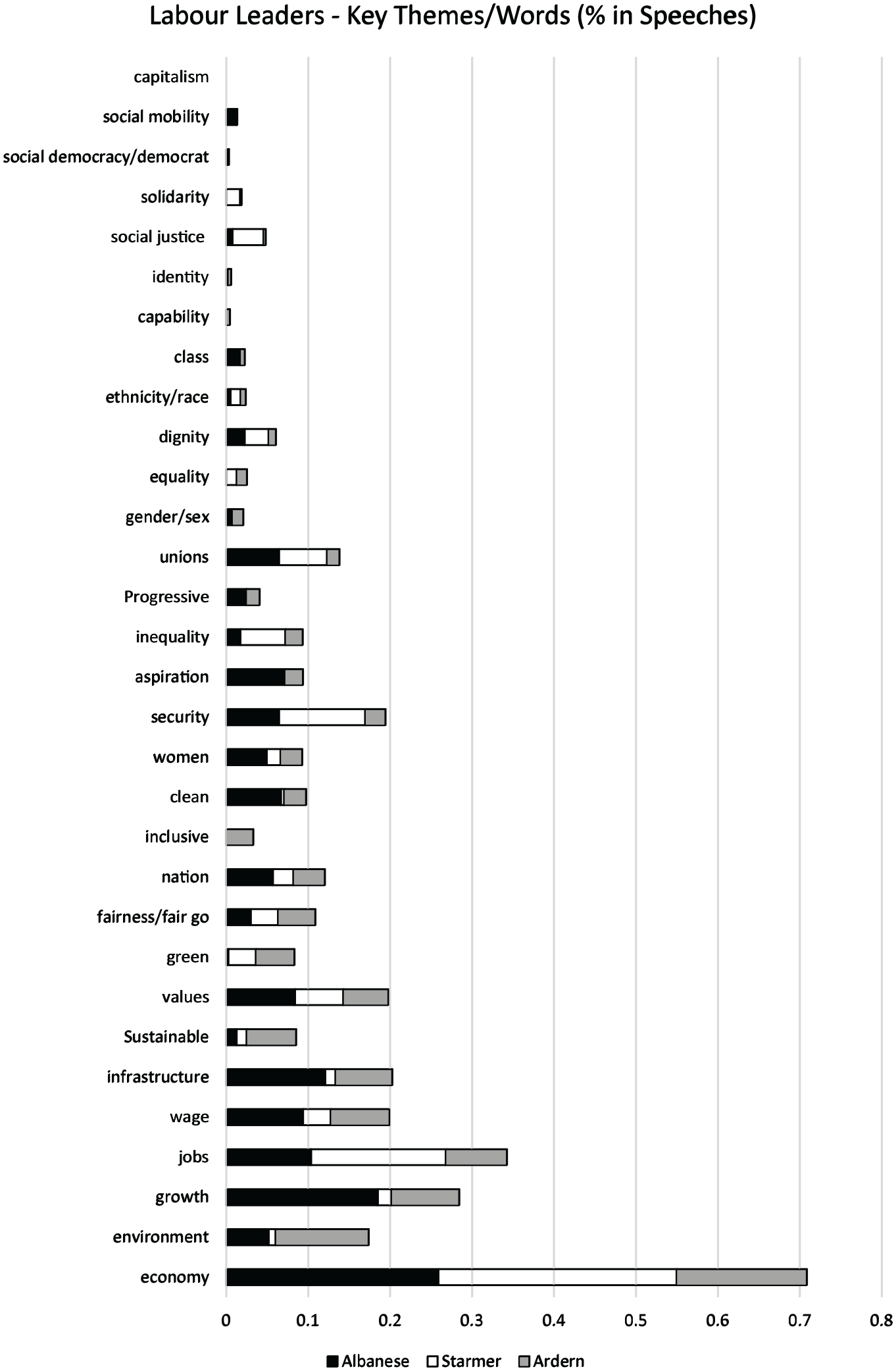
Labour leader speeches – key words (% in speeches).
Jobs and security under Albanese
After Anthony Albanese became leader of the ALP in 2019, he set out his core values and agenda for Labor through a series of ‘vision statements’. In the first, Albanese argued that ‘Labor values are enduring values of fairness, security and power of government’ (Albanese, 2019c). The early vision speeches largely focused on economic issues, with Albanese arguing that ‘Labor is resolutely pro-growth’ and that ‘a strong economy and an inclusive society go hand in hand’ (Albanese, 2019c). A common trope was that Labor ‘supports wealth creation as well as its fair distribution’ (Albanese, 2019e). The focus on growth, productivity, and wealth creation was pitched to fend off persistent claims that Labor was ‘anti-business’. Allied to economic growth was a focus on ‘fairness’ – a value often appealed to, but never clearly defined, in Albanese’s speeches – and, to a lesser extent, ‘social mobility’ and ‘progressive’ politics (Albanese, 2019b). Albanese outlined Labor’s overall approach: Labor must always be a progressive party, of modernisation, of aspiration, of growth, of jobs. (Albanese, 2019d)
Four main themes underpinned these vision speeches: aspiration, security, nation-building, and jobs/workforce protection. Albanese’s focus on the economy and growth was framed alongside his strong support for workforce protection, labour rights, and jobs growth, forming a set of clear and consistent interlocking values, situated within the ALP’s ‘labourist’ tradition (Beilharz, 1985; Irving, 1994). ‘Aspiration’ is well established in Australian political discourse, personified by former Liberal Prime Minister John Howard’s appeal to the ‘battlers’ (Dyrenfurth, 2005). Albanese has attempted to reclaim this and has argued that ‘. . . it’s one of the great ironies . . . that Labor has been labelled anti-aspirational’ (Albanese, 2019a). Albanese also sought to claim the idea of ‘security’, applied to different contexts, not just job security. The third of these values – ‘nation-building’ has echoes of the one-nation rhetorical strategy attempted by Ed Miliband as British Labour leader (Hunt, 2013).
Figure 1 shows the common themes employed and any values marginalised or ignored. It is notable that themes of community/collectivism or solidarity (‘mateship’ in the Australian context) are largely absent. While class has been referred to by Albanese, this was in the context of arguing that Labor’s historic mission has gone beyond this. Moreover, there is no sustained critique of the market or of capitalism. Albanese has cited Thomas Picketty’s work on inequality but, while Labor gives attention to inequality, the party is silent on the forms and types of equality that it might pursue in office. Nor has Albanese engaged with ‘identity politics’ – the political claims made on behalf of specific demographic groups or communities of interest (Fukuyama, 2018; Martin Alcoff et al., 2006). While there are policy pledges on gender equality in the speeches, by and large Albanese does not directly engage with the politics of ‘identity’, even if the ALP does have some underpinning strategies, for example, on Indigenous reconciliation. In the post-materialist vein, there is a consistent thread to deal with climate change, but as a rhetorical strategy Albanese prefers ‘clean energy revolution’.
In sum, we distil Albanese’s core discourse/themes as
Pro-economic growth;
Nation-building and infrastructure;
Fairness;
Jobs and wages;
Security;
Aspiration.
Starmer’s Quietism
Keir Starmer became leader of the UK Labour Party in April 2020, provoking a vigorous and ongoing debate about his ideological and policy agenda (Bagehot, 2020; Fielding, 2021; Finlayson, 2020; Goes, 2021; Mason, 2021). A key issue for Starmer, especially following the UK’s exit from the European Union and the devastating 2019 general election defeat, is how to re-calibrate Labour’s agenda. Under the previous leader Jeremy Corbyn, Labour’s 2017 and 2019 manifestos shifted to a more ‘traditional’ social democracy under the slogan of ‘for the many, not the few’, with a distinctive and more assertively framed policy agenda (Dorey, 2017; Manwaring and Smith, 2020). This provides the benchmark for any analysis of the subsequent direction under Starmer.
In a pre-leadership speech, Starmer (2017) set out Labour’s ‘approach’ as ‘democratically legitimate and economically sensible’, with core values to include internationalism, cooperation, solidarity, and human rights. Given that Starmer is the newest of the three leaders in this study, we might expect his vision to be more embryonic than those of Albanese and Ardern. In key speeches, he has set out some guiding values and themes. In his September 2020 ‘Labour Connected’ Speech, Starmer (2020b) highlighted:
decency;
fairness;
opportunity;
compassion;
security.
Of these, the main theme which re-emerges elsewhere is ‘security’ (Starmer, 2020a, 2021a, 2021b, 2021c). Not unexpectedly, though, the general focus is on economic growth. Like Albanese, Starmer invokes the period of post-war reconstruction to address the disruption caused by the COVID-19 pandemic.
In contrast to Albanese, Starmer (2021a) links security with an explicit focus on tackling inequality. The figure shows some parallels with Albanese on the types and salience of key terms. Starmer strongly emphasises rebuilding the economy, jobs, improved working conditions, and ‘security’ (Starmer, 2021b). Similarly, he stresses fairness, inequality, and social justice, but without clear policy articulation. Like Albanese, Starmer references his working-class background, but class as a core value is absent. In general, Starmer places tackling inequality much closer to the heart of his vision than Albanese, who emphasises ‘aspiration’ and ‘fairness’. Given the Johnson government’s generally inept handling of COVID-19, it is not surprising Starmer talks a lot about ‘competence’ – introducing an element of ‘valence’ politics by offering a more competent alternative government.
Some of the ‘traditional’ social democratic values that re-emerged under Corbyn are missing or marginalised by Starmer. There has been little critique of the capitalist market economy, even in coded language. Like Albanese, Starmer avoids direct engagement with identity politics, but there is some focus on tackling gender discrimination. Again, like Albanese, there has also been an emphasis on green/clean policy and the need ‘for an economy that’s healing the climate crisis’ (Starmer, 2020b) as well as a connecting thread on nation (building). Indeed, in a pitch to the ‘red wall’, Starmer argued that ‘we’re proudly patriotic. And we are proudly internationalist’ (Starmer, 2021c). In his Labour Connected speech, he proclaimed, ‘We love this country as you do’ – again addressing public concerns that Labour has abandoned some of its so-called ‘traditional’ – and often very patriotic – voters.
Overall, there are strong thematic links with Albanese’s vision. Starmer has developed a narrower focus on ‘security’ and ‘inequality’, but he draws on other values to enrich the vision. We should note that, as of late 2021/early 2022, Starmer is still re-calibrating his approach, so we offer only an overview of his agenda as a work in progress (Savage, 2021).
Ardern ‘putting people first’
In her maiden speech to the New Zealand House of Representatives in 2008, Jacinda Ardern described herself as a social democrat, but not a radical, and highlighted ‘the values of human rights, social justice, equality, and democracy, and the role of communities’ (Ardern, 2008). In her 2017 campaign-launch speech, Ardern drew on the Labour legacy, especially the transformative first Labour government and Prime Ministers Michael Savage and Peter Fraser, praising the latter’s commitment to free education. Like Starmer and Albanese, Ardern is pro-growth, but ‘a successful economy is one that serves its people. Not the other way around’ (Ardern, 2017).
Ardern rejects protectionist nationalism and supports an open rules-based international system for trade and migration, inclusive of all countries. Her acceptance of free trade, global economic integration, and multilateralism places her close to the third way-style politics of her predecessor Helen Clark, but Ardern has not used that term (Ardern, 2021).
Ardern avoids direct criticism of capitalism, and takes trouble to understand small business, agriculture, and international trade. Nonetheless, economic growth is not an end in itself. Consequently, from 2019 the Labour government’s budgets have been styled ‘wellbeing budgets’, and child poverty measures implemented within an amended Public Finance Act. In her responses to national tragedies, moreover, Ardern’s embrace of victims, and avoidance of blame or division, have demonstrated a relational ‘ethics of care’ (Gilligan, 1982; Held, 2005). In explaining her government’s COVID-19 elimination objective in 2020, she recognised the importance of economic recovery, but stated that ‘the best response for us was one that put our people first’ (Ardern, 2020).
Ardern’s pro-growth and socially inclusive agenda includes a strong pitch on environmental issues, connecting the nuclear-free policy of the fourth Labour government (1984–1990) with the present by saying climate change is ‘My generation’s nuclear-free moment’ (Ardern, 2017). Like Starmer and Albanese, she has not overtly pushed identity politics. Figure 1, while covering a longer period (and more speeches), demonstrates a strong use of common labourist terms, with a focus on the economy, growth and jobs. One notable difference is that ‘sustainability’ has been a much stronger thread in her discourse. In sum, Ardern’s core themes are:
People-oriented growth;
Child poverty reduction;
Wellbeing;
Inclusiveness;
Community.
We now turn more explicitly to the policy tools, mechanisms, and goals that underpin these three contemporary labour parties focusing on political economy, and then broader welfare and social policy.
The political economy of contemporary labour
In this section, we map the emerging ideological and policy contours of the contemporary labour parties in Australia, the United Kingdom, and New Zealand, focusing on any significant or signature policy announcements (or reversals) and noting linkages to past policy histories (for full details – see Appendices 1–3).
Clearing the policy decks in Australia
The 2016 and 2019 federal elections saw the ALP offer detailed suites of policies, particularly around tax and spending, characterised as a form of ‘technocratic’ social democracy that sought to embed ambitious spending goals using tax concessions and changes – often through indirect taxation – while leaving the main tax architecture (e.g. income tax) intact. The ALP’s review into the 2019 defeat identified this big policy agenda as being at fault; hence Albanese withdrew some of the more controversial proposals (Emerson and Weatherill, 2019). In his second vision speech, Albanese addressed economic policy with emphasis on wealth creation and growth allied to distributional goals (Albanese, 2019e). Following the model of former Labor Prime Minister Kevin Rudd’s ‘fiscal conservatism’, he argued that ‘Labor’s reform agenda must also be complemented by sound fiscal policy’ and asserted the importance of prudent management (Albanese, 2019e).
In his vision speeches, Albanese mapped the four stages of Labour’s ‘renewal project’ – review, vision, platform, and policy. By December 2021, the ALP entered the platform and policy phases – first by removing troublesome policies. There were three key reversals of existing policy:
reversal of the planned 50% cut in capital gains deductions;
reversal of policy to limit negative gearing only to new properties;
reversal of Labor’s ‘franking credits refund’ policy.
All these changes reflect a significant retreat from using tax instruments to deliver greater economic fairness. Moreover, Labor signed up to stage three of the Coalition’s tax plan, which scrapped the 37% income tax bracket and meant those earning AU$ 45,000 to 200,000 per annum will be taxed at 30% from 2024 (Australian Council of Social Services, 2019). Labor has been badly wedged on this issue since the Coalition sold this regressive measure as a ‘tax cut’, but Albanese’s acceptance of government policy represented a significant retreat from a recognisably ‘traditional’ social democratic economic approach. It was not yet clear how Labor might subsequently expand or change the overall tax base. In contrast, Labor put a stronger emphasis on worker protection through proposed legislation to criminalise ‘wage theft’ (a significant issue in the economy, including the university sector) and to protect ‘job security’. These could prove important measures that appeal to both labour market ‘insiders’ and ‘outsiders’ (Rueda, 2006).
Legacy issues for Starmer
UK Labour also has a difficult policy legacy to recalibrate. Its 2019 manifesto proposed a high-tax/high-spend budget, with ‘traditional’ social democratic measures, including re-nationalisation across several key sectors. At the time of writing, Starmer was behind Albanese on the policy development front, especially in terms of political economy. Initially, Starmer’s policy agenda was built around ‘ten key pledges’, including measures on economic justice, common ownership, and workers’ rights. The details are outlined in Appendix 3. The main measures include:
increasing the income tax rate for the top 5% of earners;
reversing ‘Tory cuts’ in corporation tax;
ending the pay freeze for key works, and extending the furlough scheme;
committing to common ownership in Rail, Mail, Energy, Water, and ‘end outsourcing’ in the NHS and local government.
By December 2021, however, there were indications that Starmer would step away from these pledges. Given the COVID-19 and post-Brexit climate, Starmer signalled that ‘in the long run corporation tax should go up; now is not the time to do it’ (Starmer, 2021d) and he supported pro-business measures such as extending the business tax-relief rate, and the VAT cut for hospitality and leisure sectors. By contrast, post-COVID reconstruction initiatives such as the ‘British Recovery Bond’ and regional banks are Keynesian policy levers. Thus, we observe a hybrid strategy, incorporating a residual Corbyn/McDonnell-ite dimension – part fiscal conservative, part social democratic. It remains unclear how far into these latter ideological traditions Starmer will push his overall economic strategy.
Gradualism and recovery in New Zealand
In March 2017, the New Zealand Labour and Green parties signed a set of ‘budget responsibility rules’, aimed to deliver consistent budget surpluses (excepting a major economic shock), to reduce net public debt to 20% of GDP, to maintain spending within the recent historic range (30%–34% of GDP) and to ensure a progressive tax system. By international standards, this was a conservative fiscal programme that remained in place until the COVID-19 lockdown in March 2020 necessitated emergency appropriations. The Budget of May 2021 projected deficits until the 2024/2025 fiscal year, but net Crown debt would stay under 50% of GDP (NZ Treasury, 2021).
To develop its fiscal agenda, the government set up a tax working group, which reported in February 2019. A key finding was that, unlike most other developed countries, New Zealand does not normally tax capital gains as an ‘unearned increment’, and that this unfairly favours the wealthy. Hence, taxation of capital gains should extend, at the least, to residential rental investment properties (but exclude the family home). Five years after purchase, a property investment was no longer considered speculative, and hence capital gain was no longer taxable. The working group argued that a more comprehensive capital gains tax would reduce an investment bias towards residential property, put a brake on rising house prices, and address a major inequity. This recommendation was blocked in cabinet by Winston Peters (leader of the junior coalition party New Zealand First) in the first term of office.
In Labour’s second term (2020–present), having won a single-party majority, the government announced an increase in the capital gains tax period from 5 to 10 years. In effect, this extended an existing partial capital-gains tax. But Labour went further to make interest payments from mortgages on property investments no longer tax-deductible against rental income, causing outcry from property investors. Furthermore, the Labour government introduced a new top tax rate of 39% on income over NZ$ 180,000. This would affect only an estimated 2% of earners initially but was a new step in extending progressive taxation (Ardern et al., 2021; Robertson and Parker, 2020).
By December 2021, the record of the Ardern government, from a social-democratic viewpoint, has been relatively conservative and only mildly redistributivist. In the meantime, poverty and inequality, including gender inequality, had risen during the pandemic (Edwards, 2021). The Ardern government had revealed itself to be cautious and gradualist on taxation.
Welfare/social policy for contemporary labour
In this final section of the mapping, we identify the three contemporary labour parties’ welfare and social policy strategies.
Welfare and social policy in Australia
By December 2021, the ALP’s social and welfare policy agenda remained undeveloped, but there were significant announcements addressing traditional social-democratic concerns. Like Starmer, Albanese advocated a National Reconstruction Fund as stimulus in the post-COVID era, along with a commitment to an AUD$10 billion National Housing Fund. Another key announcement was an ‘Australian Skills Guarantee’ on major Commonwealth projects (Albanese, 2019c). While these are significant investments, they are offset against the reversal of previous key policy pledges.
To date, there have been two key social policy commitments – first, a potential ‘flagship’ shift towards universal childcare, by increasing the childcare subsidy to 90% and removing the annual subsidy cap and, second, a pledge to introduce a UK-style legal duty to promote gender equality, linked to legislation on reducing the gender pay gap (Albanese, 2019c, 2019e). Both are significant policy measures, with universalist and progressive appeal. Like other centre–left parties, the ALP has maintained a steady focus on gender inequality.
The one policy area that Labor remained reluctant to talk about was any significant overhaul of the Australian welfare state (Henrique-Gomes, 2022) and the under-funding of the Newstart programme (the benefit rate of which has not increased in nearly 25 years). A 2019 ALP pledge to hold a Commission to review it has been dropped.
Post-universal credit Britain
As noted above, the contours of a ‘Starmerist’ approach to welfare and social policy is not yet apparent. Reflecting the Corbyn legacy, Labour pledged to end the highly polarising and gruellingly punitive Universal Credit scheme introduced by the Conservatives – along with its sanctions regime. In the interim, Starmer pledged to keep or support the Conservatives’ temporary £20 increase to universal credit.
In line with governments in many other developed countries, including New Zealand, Starmer pledged that Labour would introduce a new national goal for well-being. This reflected recent debates about shifting away from crude metrics on GDP and growth. It was unclear whether ‘wellbeing’ would mean reconfiguring Britain’s welfare state or reverting to a third-way focus on social inclusion/exclusion. The only other notable policy commitment was Labour’s pledge to keep Corbyn’s proposed abolition of tuition fees. Of the three leaders in this study, Starmer’s approach to welfare and social policy remains the least developed.
Targeting child poverty in New Zealand
In 2019, a report by a government-appointed welfare expert advisory group (WEAG, 2019) recommended shifting social policy away from a safety-net approach and towards ‘restoring dignity’ with meaningful participation in communities. Since 1991, New Zealand’s system had become increasingly work-conditional, targeted, and sanctions-driven, with benefits inadequate for basic needs. Recommendations included increases in main benefits of up to NZ$100 per week for single persons.
However, a Child Poverty Action Group (2020) ‘stocktake’ on the WEAG (Welfare Expert Advisory Group) recommendations found no evidence of implementation in 23 out of 42 key recommendations. Only 4 of the recommendations were rated ‘fully implemented’. Naturally, the government’s own assessment of progress was more sanguine. Benefits were raised in the 2021 Budget, which the government claimed meant ‘Between 19,000 and 33,000 children . . . lifted out of poverty on the after-housing-costs measure in 2022/23’ (Ardern and Sepuloni, 2021). But core benefit levels increased by only NZ$20 per week in 2021, with additional increases raising this to between NZ$32 and NZ$55 per person in total in 2022 – well below the group’s recommendation for ‘income adequacy’. Hence, far from being transformative in social policy, the Ardern government was cautious if not outright timid. However, they did propose a new social unemployment insurance scheme, modelled on New Zealand’s universal no-fault accident compensation, which would give laid-off workers income replacement at 80% of former earnings for a limited period (Duncan, 2021; Robertson, 2021).
Some less costly policies have addressed women’s wellbeing, for example, free access to period products in schools (announced in June 2020) and a Labour MP’s private member’s bill making miscarriage or still-birth grounds for bereavement leave for up to 3 days for the mother and her partner or spouse. Housing, however, has been the biggest social and economic issue, as reflected in polls (IPSOS June 2021). Ardern had said in her opening campaign speech in 2017 that a home is a ‘right’ (Ardern, 2017), but her government’s approach to this has been piecemeal, and not especially effective. While the government has built new state-owned homes and some ‘affordable’ homes for sale, it has not overcome the fundamental problem of under-supply. House prices and rents remain an outstanding social and economic problem.
Making sense of contemporary labour: Four frames
To better understand the policy and ideological contours of our cases, we adopt four analytical frames, derived from wider scholarly debates about the ideological and policy positioning of centre–left parties:
Values (not ideology) & populism;
Quietism;
Third way in all but name;
Thin (or attenuated) labourism.
Values (not ideology) & populism
Following previous scholarship on the ideological trajectory of Starmer’s Labour Party, one view is that contemporary labour defines itself through a set of generic values and, as a result, is shifting away from a distinctive ideological agenda towards a narrative of values such as ‘compassion’, ‘decency’, and ‘security’ (Bell, 2021; Finlayson, 2021a, 2021b). We see similarities here with Albanese and Ardern who employ values such as ‘aspiration’ ‘inclusion’, and ‘dignity’ to frame their overall agenda. Bell (2021) argues that Starmer is shifting to a more populist agenda – especially with more hardline criminal justice policy messaging – but our comparative analysis suggests little clear evidence of a shift to populism, either as a performative politics (Moffitt, 2020) or as an ideological project (Mudde, 2004; Taggart, 2004). While the three labour leaders all appeal to generic values (e.g. ‘dignity’), several of these can be linked back to some of the recognisably core or adjacent values in the social democratic morphology, such as work, labour, and equality. ‘Security of work’, for example, is an issue flagged by all three leaders. Although some scholars see an absence of a clear ideological agenda, we argue that the use of values reflects a ‘thin’ or attenuated form of Labourist politics. So, in sum, the ‘values’ frame gives some insights, but does not adequately locate the residual ideological morphology of the cases.
Quietism
A second, related frame, is also derived from scholarship on Starmer (Goes, 2021: 176). The core claim here is that Starmer’s project is directed at winning over socially conservative voters, and downplays any socialist ideology with a ‘reluctance to add an ‘ism’, to his agenda’. Eunice Goes’ (2021: 177) draws on Dommett’s (2016) work on ideological quietism, and claims that Starmer seeks to downplay ‘ideological distinctiveness . . . and to emphasise . . . competence and pragmatism’. However, this frame tells us more about what Starmer’s project is not – not what it is. 3
We see two main limitations with this approach. One alternative way to think about ideology and rhetoric would be to consider the converse of quietism – namely ‘noisism’. We would expect ‘noisism’ to entail explicit advocacy of a strong and clearly defined ideological position (e.g. Jeremy Corbyn’s ‘radical politics’ (Goes, 2021: 182). Yet, embedded within Goes’ critique is an argument that if Corbyn’s agenda was radical (and by extension – noisy), any subsequent centrist leader (such as Starmer) was likely to be ‘quieter’ by definition. Ideological quietism does not tell us enough about the underpinning ideological values and concepts that Starmer employs. We agree with Goes that Starmer is clearly seeking to place some ideological distance between his agenda and Corbyn’s, and he appeals to different parts of Labour’s history and achievements.
Goes’ critique, however, sets ‘socialism’ as the benchmark from which Starmer (2021a: 179, 180) deviates. In key speeches, Starmer ‘. . . did not utter the word socialism a single time’ (Starmer, 2021a-d: 180). This is analytically problematic, and arguably sets the benchmark too high to understand what ideological content there is in his agenda. It is notable that the labels ‘socialist/socialism’ have 35 mentions in Goes’ article, social democratic/democracy has 3, and labourism none. Furthermore, contrary to Pierson (2001), Goes underestimates the variety of the centre–left’s ideological traditions (social democratic, social liberal, third way, etc.).
If we link quietism to the Australian and New Zealand cases, we find further limitations. For the ALP, there might be some evidence of ‘quietism’ as Albanese jettisoned previously key policies but, despite the haziness of his ‘vision’ statements, there is a consistent appeal to ‘Labor values’. These values might be poorly articulated, or struggle to cut through in the COVID era, but they are not ‘quietism’. Likewise, in 2017, Ardern’s Labour campaign pitch was notably ‘noisy’ in some respects, especially on housing as a right and child-poverty reduction. Even after the 2020 election win, the constraints of office may have made her ideological appeals ‘quieter’, but ‘quietism’ does not help us understand what ideological content there is. So, on one reading, all three leaders have engaged in forms of ‘quietism’, but this does not give us enough analytical traction in all three cases.
‘Third way in all but name’
Suitably, a third analytical frame lies in the long shadow of the third way. In all three countries, strong variants of third way politics played out in the past. Its definitional slipperiness and elasticity notwithstanding, under a stylised account of social democracy (Bailey, 2009; Przeworski, 2001), we can chart a shift from a ‘traditional’ model of social democracy to a third way one, with key features including:
shift to globalised and open economy;
greater embrace of financialisation, and looser financial regulation;
focus on equality of opportunity (and social inclusion);
shift to the ‘social investment’ state;
enabling state and ‘radical centre’.
Despite the variety of ‘third ways’, and its conceptual intractability, we argue that the three parties are no longer recognisably third way, either in discourse or policy, although still shaped and influenced by their neoliberal and third way legacies.
Some of the differences are starker than others. First, Starmer’s 10 key pledges (rather than his discourse) indicate a policy agenda that has clearly shifted away from British third-way debates. Admittedly, there has been a significant stepping back from this initial agenda but Starmer is still working out which parts of New Labour’s legacy he wishes to engage with, and which parts to either adopt or reject. Albanese and the ALP retain a strong imprint of neoliberal politics, as much of the economic settlement of the Hawke-Keating era remains in place. While Albanese critiques ‘trickle down economics’, his agenda is not transformative like the third way, and indeed he argues that ‘we have now reached the limits of the Hawke-Keating reforms’ (Albanese, 2019e). Similarly, in New Zealand, Ardern’s government operates within neoliberal constraints, such as central-bank independence, and is not seeking to structurally alter the political economy. So, the third-way influence in Australia and New Zealand is apparent, and yet what makes the third-way label unsatisfactory is that none of these parties display the kind of ambitious programmatic policy innovation that came with the third way. So, while the third way gives us some clues about the tactical and identity struggles facing the parties, substantively they have moved on.
Thin (or attenuated) labourism
In our final frame, we suggest that a new ‘thin labourism’ better characterises the ideological contours of these three parties. Freeden (2013) identified the following core values of socialism:
Group (collectivism);
Equality;
Work/labour;
Welfare;
History.
Freeden links these to adjacent values such as democracy, power, liberty, the state and nationalisation, and peripheral values like trade unionism. In Heywood’s (2021) account, the core values or themes are community, cooperation, equality, class politics, and common ownership. We use the term ‘thin’ because, following Freeden, these rely on narrower values rather than ‘thick’ ideologies (Freeden, 2017).
During the period covered by this study, the three labour parties operated within a broader social democratic space, committed to a mixed economy with state regulation, but mostly within a specific labourist tradition – focused on securing, by largely incremental steps, improvements, and gains for workers. Ardern’s pledge to lift the minimum wage, and Starmer and Albanese’s focus on tackling job (in)security are emblematic of this. But there are three main sets of differences from earlier iterations of the labourist tradition. First, the new contemporary ‘thin’ labourism is far less class-based, both in discourse and policy goals, than its antecedents. Second, trade unionism as an adjacent value is largely downplayed as part of this new, thin, labourism. While the three party leaders acknowledge and value trade unions, labourism’s past reliance on mass broad-based union membership is largely over. The third set of differences is in the diminishing range of values that the three labour parties evoke. Under thin labourism, some traditional values are marginalised or ignored. So, except for Starmer, the pitches to ‘equality’ are made on a more generic ground of fairness, class politics are off the agenda, and there is no critique of the market economy. Other traditional values such as collectivism are also excluded as organising themes. So, to differing extents, Albanese, Starmer, and Ardern seek to pursue a broad vision of social justice but they work from a smaller attenuated base of core values. The three leaders draw on other ideological morphologies to buttress some of this vision. These include nationalism for Starmer and Albanese, feminism and the ‘ethics of care’ for Ardern, and a shift towards a technocratic environmentalism in all three cases.
Conclusion
The three labour parties in this study seem to be operating broadly similar agendas, although of course, under different political circumstances, and at different points of policy development and ideological reconstruction. The parties are making appeals based on key values – security, aspiration, and the like -– and we can map these onto elements of a key centre–left political tradition – labourism. The parties are operating from what we call a new ‘thin labourism’ – which is a relatively ideologically clear agenda, with historical precedent, but operating from an attenuated value-base. These leaders then seek to buttress this with ideological injections from nationalism, feminism, and environmentalism, or appeals to generic values. Such hybridity is nothing new, but what is arguably different from the pre-third way era is the thinning core of the three parties’ agendas. The shift to ‘thin’ Labourism arguably serves a number of purposes, such as giving the party leaders ideational and policy room to manoeuvre, especially in the transition from opposition to government. The approach also has a useful ‘catch-all’ dynamic, which means the party leaders can make cross-class electoral appeals, while also seeking to re-engage former disaffected or ‘heartland’ voters.
However, the shift to ‘thin labourism’ presents dilemmas. First, a ‘small-target’ strategy might well have electoral appeal if allied to valence or competence (see Green, 2007) – for example, after Johnson’s and Morrison’s poor handling of the COVID outbreak – but the thinning of social democracy might come at a cost. This is most evident in Ardern’s government, which has been accused of failing to sufficiently redress structural inequalities. If the centre-left are unwilling to critically engage with the instabilities and inequalities that arise from the capitalist economy, then thin labourism may leave the parties with a reduced armoury of policy tools to tackle structural disadvantage. In addition, while the new thin labourism has a strong focus on climate change, its pro-growth agenda and its reluctance to transform political economy make it hard to achieve stretching emissions targets.
The case of the ALP might be the most instructive here. Driven by a fear of electoral retribution, they have shifted away from the policy tools for redistribution described earlier. Albanese identifies key structural problems in the Australian economy (e.g. stagnant wage growth, chronic low inflation), but these are blamed on the Coalition’s economic mismanagement rather than the Australian growth model or anything intrinsic to capitalist market economies in the round. The ALP managed a narrow win at the 2022 federal election which was built upon a generalised labourist politics, evoking ‘aspiration’ and offering voters some incremental benefits, but it remains unable – even through third-way means – to offer policy innovations or solutions. It cannot or will not reactivate core values of the social democratic tradition.
To conclude, the three labour parties during the period studied were not ideology-free zones, were not necessarily ‘quiet’, were not third way, were not expressly populist, were not purely driven by generic values, nor, finally, had they necessarily ‘betrayed’ previous traditions. They did express some core values, along with a set of different adjacent values. They are operating, however, from a much smaller value-base and with far more limited political ambition.
Footnotes
Appendix 1
Discourse and policy: New Zealand Labour Party.
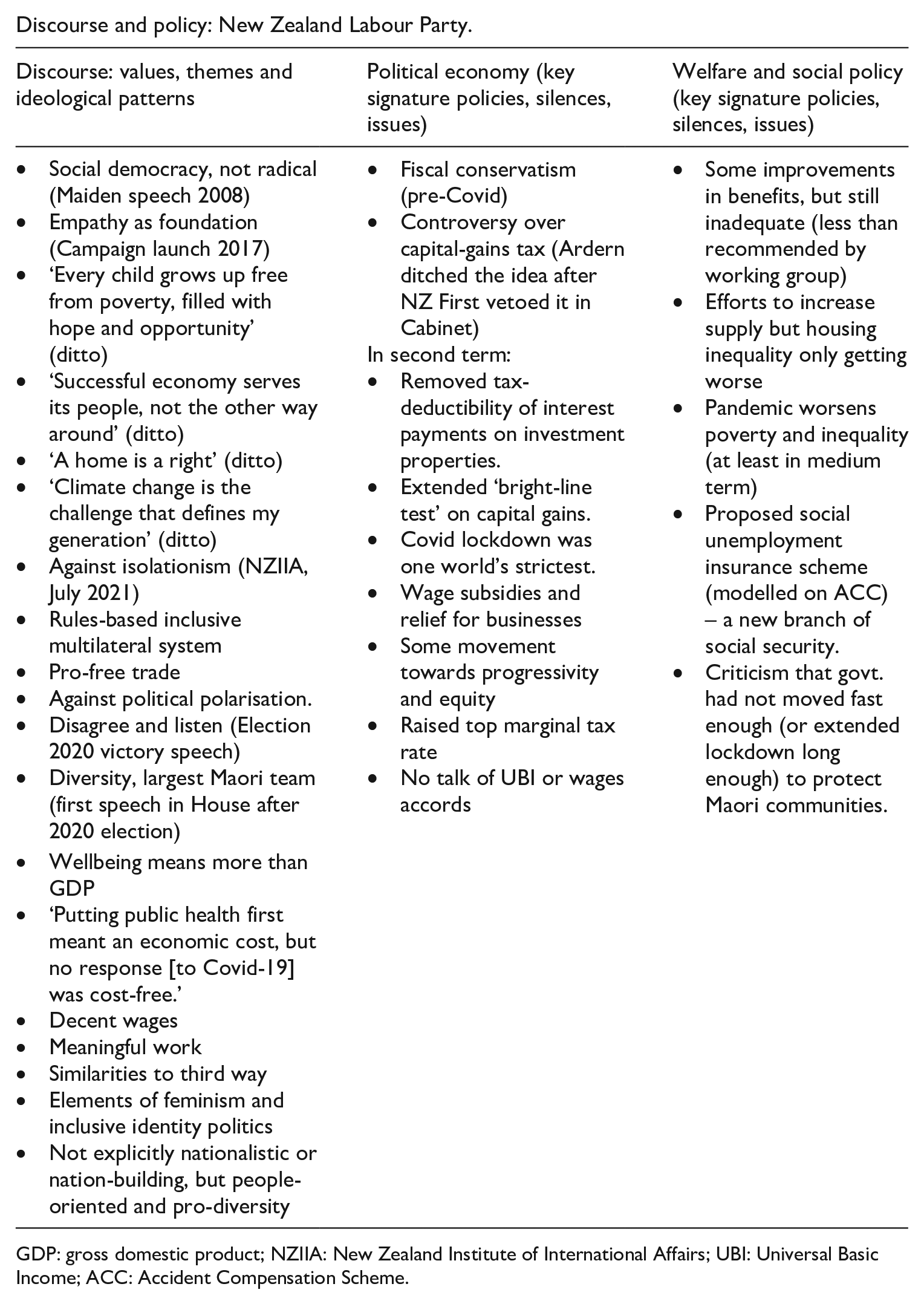
| Discourse: values, themes and ideological patterns | Political economy (key signature policies, silences, issues) | Welfare and social policy (key signature policies, silences, issues) |
|---|---|---|
| • Social democracy, not radical (Maiden speech 2008) • Empathy as foundation (Campaign launch 2017) • ‘Every child grows up free from poverty, filled with hope and opportunity’ (ditto) • ‘Successful economy serves its people, not the other way around’ (ditto) • ‘A home is a right’ (ditto) • ‘Climate change is the challenge that defines my generation’ (ditto) • Against isolationism (NZIIA, July 2021) • Rules-based inclusive multilateral system • Pro-free trade • Against political polarisation. • Disagree and listen (Election 2020 victory speech) • Diversity, largest Maori team (first speech in House after 2020 election) |
• Fiscal conservatism (pre-Covid) • Controversy over capital-gains tax (Ardern ditched the idea after NZ First vetoed it in Cabinet) In second term: • Removed tax-deductibility of interest payments on investment properties. • Extended ‘bright-line test’ on capital gains. • Covid lockdown was one world’s strictest. • Wage subsidies and relief for businesses • Some movement towards progressivity and equity • Raised top marginal tax rate • No talk of UBI or wages accords |
• Some improvements in benefits, but still inadequate (less than recommended by working group) • Efforts to increase supply but housing inequality only getting worse • Pandemic worsens poverty and inequality (at least in medium term) • Proposed social unemployment insurance scheme (modelled on ACC) – a new branch of social security. • Criticism that govt. had not moved fast enough (or extended lockdown long enough) to protect Maori communities. |
| • Wellbeing means more than GDP • ‘Putting public health first meant an economic cost, but no response [to Covid-19] was cost-free.’ • Decent wages • Meaningful work • Similarities to third way • Elements of feminism and inclusive identity politics • Not explicitly nationalistic or nation-building, but people-oriented and pro-diversity |
GDP: gross domestic product; NZIIA: New Zealand Institute of International Affairs; UBI: Universal Basic Income; ACC: Accident Compensation Scheme.
Appendix 2
Discourse and policy: Australian Labor Party.
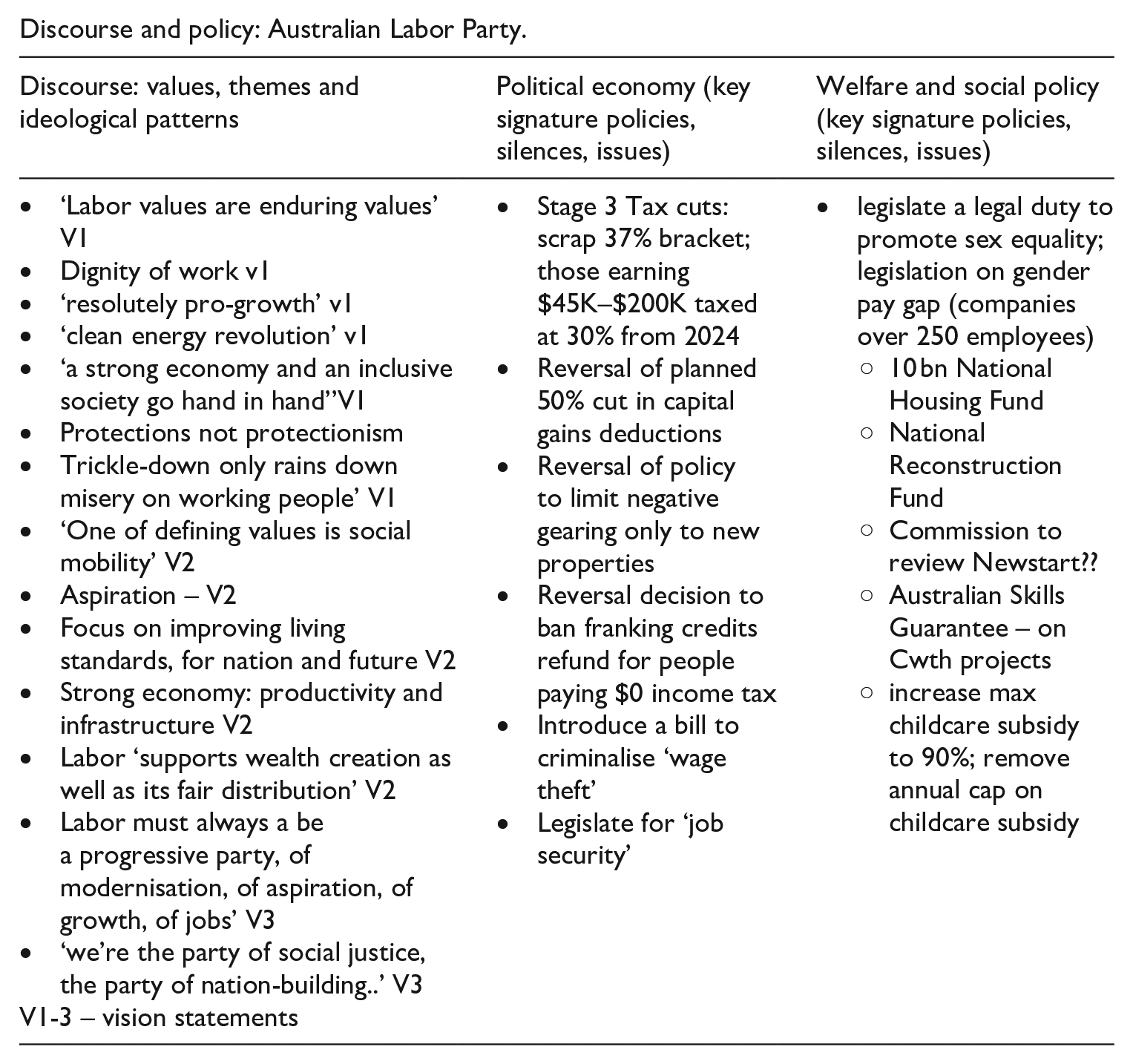
| Discourse: values, themes and ideological patterns | Political economy (key signature policies, silences, issues) | Welfare and social policy (key signature policies, silences, issues) |
|---|---|---|
| • ‘Labor values are enduring values’ V1 • Dignity of work v1 • ‘resolutely pro-growth’ v1 • ‘clean energy revolution’ v1 • ‘a strong economy and an inclusive society go hand in hand’’V1 • Protections not protectionism • Trickle-down only rains down misery on working people’ V1 • ‘One of defining values is social mobility’ V2 • Aspiration – V2 • Focus on improving living standards, for nation and future V2 • Strong economy: productivity and infrastructure V2 • Labor ‘supports wealth creation as well as its fair distribution’ V2 • Labor must always a be a progressive party, of modernisation, of aspiration, of growth, of jobs’ V3 • ‘we’re the party of social justice, the party of nation-building..’ V3 V1-3 – vision statements |
• Stage 3 Tax cuts: scrap 37% bracket; those earning $45K–$200K taxed at 30% from 2024 • Reversal of planned 50% cut in capital gains deductions • Reversal of policy to limit negative gearing only to new properties • Reversal decision to ban franking credits refund for people paying $0 income tax • Introduce a bill to criminalise ‘wage theft’ • Legislate for ‘job security’ |
• legislate a legal duty to promote sex equality; legislation on gender pay gap (companies over 250 employees) ○ 10 bn National Housing Fund ○ National Reconstruction Fund ○ Commission to review Newstart?? ○ Australian Skills Guarantee – on Cwth projects ○ increase max childcare subsidy to 90%; remove annual cap on childcare subsidy |
Appendix 3
Discourse and policy: UK Labour Party.
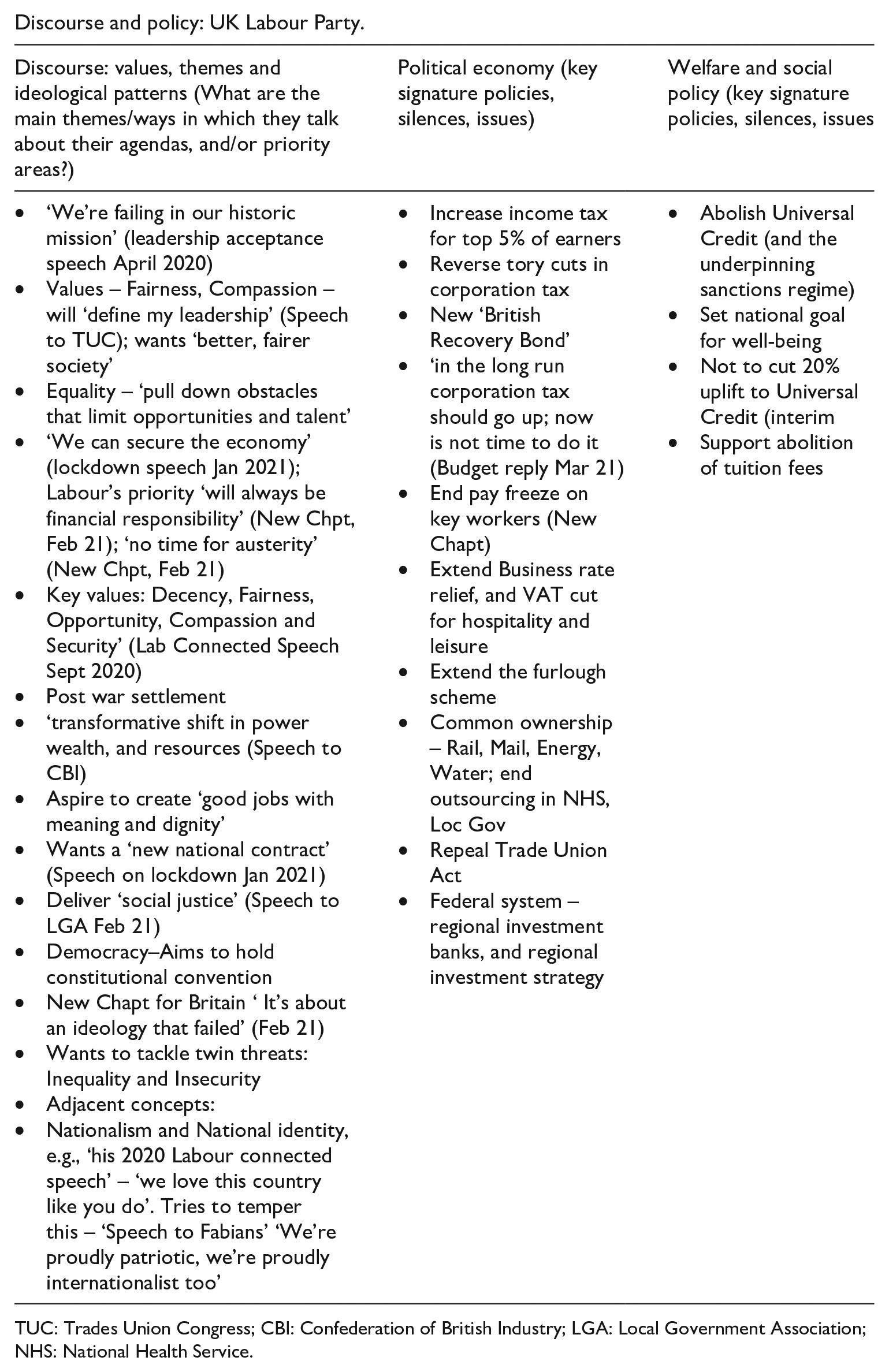
| Discourse: values, themes and ideological patterns (What are the main themes/ways in which they talk about their agendas, and/or priority areas?) | Political economy (key signature policies, silences, issues) | Welfare and social policy (key signature policies, silences, issues |
|---|---|---|
| • ‘We’re failing in our historic mission’ (leadership acceptance speech April 2020) • Values – Fairness, Compassion – will ‘define my leadership’ (Speech to TUC); wants ‘better, fairer society’ • Equality – ‘pull down obstacles that limit opportunities and talent’ • ‘We can secure the economy’ (lockdown speech Jan 2021); Labour’s priority ‘will always be financial responsibility’ (New Chpt, Feb 21); ‘no time for austerity’ (New Chpt, Feb 21) • Key values: Decency, Fairness, Opportunity, Compassion and Security’ (Lab Connected Speech Sept 2020) • Post war settlement • ‘transformative shift in power wealth, and resources (Speech to CBI) • Aspire to create ‘good jobs with meaning and dignity’ • Wants a ‘new national contract’ (Speech on lockdown Jan 2021) • Deliver ‘social justice’ (Speech to LGA Feb 21) • Democracy–Aims to hold constitutional convention • New Chapt for Britain ‘ It’s about an ideology that failed’ (Feb 21) • Wants to tackle twin threats: Inequality and Insecurity • Adjacent concepts: • Nationalism and National identity, e.g., ‘his 2020 Labour connected speech’ – ‘we love this country like you do’. Tries to temper this – ‘Speech to Fabians’ ‘We’re proudly patriotic, we’re proudly internationalist too’ |
• Increase income tax for top 5% of earners • Reverse tory cuts in corporation tax • New ‘British Recovery Bond’ • ‘in the long run corporation tax should go up; now is not time to do it (Budget reply Mar 21) • End pay freeze on key workers (New Chapt) • Extend Business rate relief, and VAT cut for hospitality and leisure • Extend the furlough scheme • Common ownership – Rail, Mail, Energy, Water; end outsourcing in NHS, Loc Gov • Repeal Trade Union Act • Federal system – regional investment banks, and regional investment strategy |
• Abolish Universal Credit (and the underpinning sanctions regime) • Set national goal for well-being • Not to cut 20% uplift to Universal Credit (interim • Support abolition of tuition fees |
TUC: Trades Union Congress; CBI: Confederation of British Industry; LGA: Local Government Association; NHS: National Health Service.
Appendix 4
Funding
The author(s) received no financial support for the research, authorship, and/or publication of this article.
