



Abstract
As discussions of a ‘new cold war’ between China and the West intensify, it has never been more important to understand how China engages internationally. Crucially, as of 2022, China has established 110 ‘strategic partnerships’, without stipulating any formal treaty of alliance, but we know little about strategic partnerships and how China uses them, despite their centrality as a foreign policy tool. Departing from the assumption of the state as a unitary and monolithic actor in international affairs, this article proposes a new framework of strategic partnerships which incorporates sub-state entities as well as an ideational component, highlighting the image-building purpose that these partnerships serve. Empirically, the analysis focuses on the evolution of the Sino-Italian strategic partnership, drawing on a critical discourse analysis of 1294 news articles published as part of the agreement between the Chinese and Italian news agencies Xinhua and ANSA.
Keywords
Introduction
Discussions about a new Cold War have become increasingly frequent in recent years, as a result of the intensifying competition between the United States and China. The potential re-emergence of two blocks, ‘one that looks to Washington and one that looks to Beijing’ (Rachman, 2020) has gained traction in public discourses, so much so that during his speech at the World Economic Forum in Davos in 2021, Chinese President Xi Jinping himself warned against building ‘small circles or start a new Cold War’ (Xinhua, 2021). Along similar lines, in the academic and policy debates, there has been a resurgence of the concept of ‘spheres of influence’ (Allison, 2020; Insisa and Pugliese, 2020; Zala, 2020). Defined by dynamics of control and exclusion (Jackson, 2020: 255; Kaufman, 1976: 11) between a nation that has superior power and those deemed less powerful (Etzioni, 2020) in a determined geographical region (Keal, 1983: 15), spheres of influence have thereby resurfaced as an attempt to interpret the current geopolitical dynamics, either in regional or global settings.
However, since the end of the Cold War, the ways in which diplomacy occurs have significantly evolved and transformed, which means that conventional approaches to spheres of influence need recalibrating. In a multi-nodal and interdependent world, the international alignments, which dominated the Cold War period and took the shape of more rigid and static alliances that would then form geographically bounded ‘spheres of influence’, have left space to more flexible arrangements (Strüver, 2017). It is against such backdrop that since the mid-1990s, and more prominently in the early 2000s, there has been the emergence of a new form of bilateral interactions, that of ‘strategic partnerships’ (SPs). As Thomas Wilkins (2012: 68) noted, ‘with its more informal and multidimensional nature, the strategic partnership is therefore emblematic of the new, Twenty-First Century alignment archetype’.
Existing scholarship has provided helpful definitions (Kay, 2000; Parameswaran, 2014; Wilkins, 2008) and explanations regarding partnership onsets, choice of partners and potential benefits (Strüver, 2017), as well as how SPs represent a new form of alignment that differs from alliances, security communities and coalitions (Nadkarni, 2010; Wilkins, 2012). While some argue that SPs were initially used by the United States as a tool to maintain their primacy in the immediate wake of the Cold War (Kay, 2000), others have noted how SPs are instead a form of a new security practice signalling the emergence of new forms of security governance (Envall and Hall, 2016), especially in the Asian context. With 110 SPs established, including with 5 regional organisations, China is the country that has used this tool more extensively in its conduct of foreign policy (Papageorgiou and dos Santos Cardoso, 2021). Yet, little attention has been paid to how China deploys SPs in its foreign policy beyond Asia. It is within this context that this article proposes to offer a contribution to the understanding of SPs, their multi-level nature and the tools deployed within this form of engagement in international relations.
To this end, this article’s original contribution is threefold: first, the discussion foregrounds the multiplicity of levels (national, provincial and local) and actors involved in SPs, bringing into the analysis the role that sub-state entities (businesses, media, local communities) play. The literature on SPs has been focused almost entirely on the state, thereby neglecting the multi-level nature of these bilateral arrangements. In particular, there is no discussion of the multi-level and omni-channel interactions that occur within a SP. Rather than viewing engagement with the international as the sole preserve of the state, there is a need to integrate other actors and scales of the state into our understanding of SPs. More broadly, this also points towards a different approach to that outlined by scholars deploying spheres of influence to understand contemporary international relations. The notion of a power bloc assumes a centrality of power which is unproblematically projected outwards. A different ontology, one advanced through a deeper analysis of bilateral partnerships, would be a relational view of power which incorporates different actors, scales and levels of influence that come into play within this form of engagement. This is particularly important in the case of China, that is characterised by a decentralised system – where a host of actors are able to experiment and adapt – coupled with oversight from the top (Ang, 2016; Cabestan, 2021; Jones and Zeng, 2019).
Second, the article argues that it is key to incorporate an ideational component into the framework of SPs, as it helps recalibrating existing understandings of their purpose. Rather than seeing them exclusively as a form of loose bilateral security and economic engagement, SPs are an important tool that Beijing is deploying to build its image abroad, with the aim to enhance China’s international status. To substantiate this point, the analysis draws on 1294 newspaper articles published between 10 March and 10 April 2020 (the first month of lockdown in Italy) as part of the media partnership between the Italian news agency Agenzia Nazionale Stampa Associata (ANSA) and the Chinese state-run Xinhua.
Third, the analysis shows that SPs are best understood as constantly evolving bilateral arrangements that provide a host of political, economic and cultural touchpoints, that can be repurposed and evolved according to the needs of the moment. China’s so-called ‘mask diplomacy’ in Italy during the COVID-19 pandemic is a case in point. Connections previously established under the aegis of the Sino-Italian ‘comprehensive strategic partnerships’ which began in 2004, ranging from government departments to Chinese diaspora and associations, provided helpful springboards for medical supplies and expressions of solidarity to reach deep into the Italian social, economic and political fabric.
To develop these arguments, the article proceeds as follows: first, the analysis provides a critical engagement with the extant literature, in order to detail the contribution that this article makes to the works on SPs highlighting the multi-level nature of SPs, as well as their aim to build China’s international status. Second, the empirical sections explore the Sino-Italian SP by showing how some of the seeds that were sown throughout the years under the aegis of the ‘comprehensive strategic partnership’ established in 2004, evolved and were repurposed at the time of need, most notably during the first wave of the COVID-19 pandemic. In doing so, the analysis details both inter-governmental interactions, as well as businesses, community and media level ones, in order to map how SPs represent a foreign policy tool through which a number of political, economic and social touchpoints are developed.
Strategic Partnerships: Evolution and gaps
The term strategic partnership first appeared in Chinese foreign policy shortly after the end of the Cold War, when China and Brazil established the first SP in 1993 (Zhongping and Jing, 2014). This was followed in 1996 by the establishment of a SP between Russia and China (Wilkins, 2008). Beyond China, SPs began to gain traction in other parts of Asia and the West in the early 2000s, with countries ranging from the United States to India, as well as regional organisations such as the European Union (EU), starting to use them in their conduct of foreign policy. 1 Pan and Michalski (2019: 272) identified three approaches – conventional, relational and functional – associated respectively with the way in which the United States, China and the EU interpret and deploy SPs.
While not unique to China, what makes Beijing’s approach to partnership diplomacy an ideal case is the fact that building a ‘global network of partnerships’ is a goal at the very heart of China’s foreign policy outlook in recent years. In November 2014, at the ‘Central Conference on Work Relating to Foreign Affairs’ Xi Jinping noted that China ‘should make more friends while abiding by the principle of non-alignment and build a global network of partnerships’ (Ministry of Foreign Affairs of the People’s Republic of China, 2014). Along similar lines, in March 2017, at the China Development Forum, Foreign Minister Wang Yi outlined that the world was now more interdependent than it has ever been and that ‘old thinking such as the balance of power, zero-sum games are hard to keep up. What we need is a new way for state-to-state interaction. This is the current background of China’s pursuit of partnership’ (Ministry of Foreign Affairs of the People’s Republic of China, 2017). Notwithstanding their importance as a diplomatic practice in the post–Cold War era, the International Relations (IR) literature on the topic has only recently started analysing, both conceptually and empirically, SPs.
Most of the extant scholarship has interpreted SPs as a form of interstate alignment. Thomas S. Wilkins (2012: 56), one of the first scholars to provide a conceptualisation of SPs, characterises them as a ‘relationship between two or more states that involve mutual expectations of some kind of policy coordination on security issues under certain conditions into the future’. Along similar lines, other scholars contend that the best definition for partnerships is that of ‘interest-driven alignments’ (Strüver, 2017: 60), and that SPs are ‘a mechanism that promotes and enhances two states to align their foreign and security policy and practice’ (Iwami, 2021: 3). While policy alignment, especially in the security and economic realms, might be the ultimate aim for some partnerships (e.g. Australia–Japan) that are characterised by a high degree of convergence, there are also instances where the focus is not on a foreign policy alignment tout-court, rather on specific functional areas that are of interest to the two parties involved. To reflect the multiple forms that SPs can take, Prasanth Parameswaran (2014: 263–264) has defined SPs as ‘a loose but structured framework of collaboration between parties to address common challenges and to seize opportunities in several areas’.
Regardless of whether one takes the view of SPs as a comprehensive form of alignment, or as a more selective, issue-based one, there seems to be a general consensus in the literature around Wilkins’ (2012: 68) 4-point characterisation of SPs as being: (1) organised around a ‘system principle’ (e.g. promoting multipolarity) and based primarily on common interests and not always underwritten by shared values; (2) goal-driven rather than threat-driven. In this context, no state is identified as a threat, although the partnership might include an aspiration to cooperate on joint security issue-areas; (3) informal and with low commitment costs, thereby allowing a greater degree of flexibility; (4) driven by economic and security concerns. While building on Wilkins’ characterisation with regard to the four key components of an SP, this article argues for a reconsideration of the way in which SPs work around two main areas: actors and purpose.
First, as far as the key actors in a SP are concerned, Wilkins (2008: 364) argued that SPs are ‘a top-down or elite-driven process’ operating at the ‘supra-state’ or ‘trans-state’ levels (Wilkins, 2012: 59). Such a focus on states has prevented the inclusion of other scales of analysis. As the recent literature on China’s rise has shown (Jones and Hameiri, 2021), there is a need to drop the assumption of the state as unitary actor and to embrace a more holistic, yet multi-scalar view, of how states operate internationally, by looking at the multiplicity of actors that are part of bilateral interactions. From city mayors to business leaders, the range of players involved in generating international outcomes has grown and transformed significantly in the past 20 years. For these reasons, this article’s proposed theoretical framework includes in its conceptual paradigm a host of actors (i.e. diasporas, state-owned enterprises, provincial governments) that are central to understanding how China engages with partner countries. In addition to mapping the full reach of Chinese foreign policy, this is a key analytical leap forward in our understanding of the importance of sub-national entities and actors in diplomacy more generally.
Second, existing works have provided explanations regarding the aims that SPs seek to achieve, but only a few have accounted for non-material aims. Wilkins (2012: 68) notes that SPs are primarily driven by economic and security concerns, while other scholars have advanced the argument that SPs serve as a defensive mechanism to alleviate US pressures, to promote cooperation with neighbouring countries and to contribute to China’s modernisation (Li and Ye, 2019: 79). In addition, SPs can also have defensive (protecting core interests) and assertive (shaping the world in line with long-term interests) aims (Zhongping and Jing, 2014: 12–13). Finally, SPs can ‘contribute to the legitimacy of individual Chinese foreign policies, as well as to China’s international status aspirations’ (Strüver, 2017: 59) and can be seen as a tool deployed to enhance an actor’s status and prestige globally (Michalski and Pan, 2017). On this point, Anna Michalski (2019: 7) correctly notes that among the various functions that SPs can perform, it is important to consider their use as ‘role enhancing arenas’, designed to cater to an actor’s ambitions regarding their position in the international system and wider non-material interests such as status, identity and prestige.
As this survey of the literature has demonstrated, with few exceptions, only a handful of studies have analysed the non-material element that SPs serve. Given the emphasis that the Chinese Communist Party places on the creation and maintenance of a positive international image (Brazys and Dukalskis, 2019; Brown and Bērziņa-Čerenkova, 2018), it is crucial to incorporate such a non-material dimension into the framework of SPs and to therefore investigate this further. This is because cultivating a positive image abroad has become a key component of Chinese foreign policy and public diplomacy, and a tool which rising powers more broadly deploy in their international relations. Investing resources in the ideational component serves primarily two purposes: first, it strengthens domestic stability and legitimacy, and it ensures that the domestic system is looked upon favourably abroad (Yang, 2020). Put differently, demonstrating to a domestic audience that a set of internal rules and values are respected abroad has important implications not only for projecting a model to foreign audiences but also for the credibility and legitimacy of a regime in the eyes of its own citizens (Owen, 2010). This is particularly important in the case of China, where domestic legitimacy is one of the key concerns of the Chinese Communist Party. Second, against a backdrop in which image and status have become key in Beijing’s promotion of its vision and values (Foot, 2020: 12), the ideational component enables the creation of an external environment ‘that is more conducive to the realization of a country’s foreign policy goals’ (Brazys and Dukalskis, 2019: 561). This might entail both a proactive attempt at shaping the world order according to a country’s views and interests, as well as trying to counter a negative image or perception through ‘stigma management’ (Adler-Nissen, 2014). The analysis presented in the ensuing sections shows how the ideational component built within an SP serves both the stigma management aim and the more systemic attempts at shaping international norms and values.
Methodology and case selection
In order to demonstrate how China deploys SPs as a diplomatic tool in its foreign policy, this article delves into the evolution of the Sino-Italian SP over the past two decades. Italy was selected as an exploratory ‘typical’ case study (Seawright and Gerring, 2008), given the country’s centrality in wider Sino-European debates. Italy was the first G7 country which signed a Memorandum of Understanding (MoU) with China on the Belt and Road Initiative (BRI) during President Xi Jinping’s visit to the country in March 2019. The BRI represents Xi Jinping’s foreign policy signature initiative, and it involves the world’s largest infrastructure financing programme across Asia, Europe, the Middle East and Africa. For many scholars and policy analysts, the BRI has come to epitomise China’s challenge to the US-led liberal international order (Callahan, 2016; Mearsheimer, 2021). As such, Italy’s decision to become the first member of the G7 to sign an MoU on the BRI has put Rome under the spotlight and at the centre of the wider Sino-US global competition, and it is therefore important to investigate the China–Italy partnership further. 2
The data collection strategy relied on primary and secondary data available in English and Italian. To the best of my knowledge, this is the first scholarly article that draws on the wealth of data provided by the media partnership between ANSA and Xinhua, in order to illuminate the status building attempts on the part of China in its relations with European partners. In addition to the 1294 articles published on the ANSA website and included in the empirical analysis, the sources used in the article included joint communiques of official meetings between the two sides from 2004 to 2021, primary accounts and media reports of ‘face mask’ diplomacy in various parts of Italy, as well as statements of government officials and policymakers made in national and international press outlets. These findings were triangulated with secondary evidence collected from the academic literature and relevant policy reports.
The China–Italy SP: From a ‘comprehensive strategic partnership’ to ‘face mask’ diplomacy
Established as a ‘comprehensive strategic partnership’ in 2004 (China.org.cn, 2004), the bilateral ties have evolved considerably since then (Andornino, 2020; Casarini, 2019). Italy’s motivations behind the SP are primarily economic, and China has been seen by Italian policymakers and businesses through a three-fold lens: (1) as a potentially profitable export market; (2) as competitor in the manufacturing sector; and (3) as a potential source of investments, especially following the financial crisis in the Eurozone (Dossi, 2020). These three factors are key to understanding the signing of the MoU on the BRI in March 2019, spearheaded by the Five Star Movement, one of Italy’s governing parties between 2018 and 2022 (Pugliese et al., 2022). As the then Italian Foreign Minister, Mr Luigi Di Maio, claimed in an interview, ‘in order to help our businesses export the “made in Italy” brand, we have reinforced our relations with a strategic commercial partner like China’ (SkyTg24, Di Maio, 22 April 2020: 3:40–3:49). However, the export boom that Italy’s policymakers claimed would come after the memorandum did not materialise. Between 2019 and 2021, Italy’s market share in China’s imports has remained stable, from 1% in 2019 to 1.1% in 2021. While Italy’s exports went up from 12.96 billion euros in 2019 to 15.69 billion euros in 2021, so have the imports from China, which rose from 31.66 in 2019 to 38.52 billion euros in 2021, increasing the trade deficit of around 4 billion euros (Ministero degli Affari Esteri e della Cooperazione Internazionale, 2022). For its part, China sees Italy as a bridge between the Mediterranean basin and Europe, two important regional contexts in China’s global outreach. Not only is Italy a potentially key logistic hub in the Mediterranean region, but the asset-rich Italian economy – the second manufacturing economy in the Eurozone – coupled with the financial difficulties the country has faced in the wake of the Eurozone crisis has made Italy an ideal destination for Chinese investments in the country (Andornino, 2015; Dossi, 2020).
The operative arm of the SP is represented by a joint government committee – the first of its kind between China and a EU country at the time of its establishment in 2004 – headed by the two foreign ministers, which over the years has provided the first point of call for bilateral relations. This has encouraged the development of ties beyond the government to government level, including (1) regional and territorial levels; (2) financial and economic realms; (3) cultural and people-to-people exchanges, including public opinion. As the Chinese side emphasised at the fifth joint meeting of the China–Italy Government Committee in October 2013, this inter-governmental body was going to strengthen functions, and give full play to its role in political guidance; pool resources to raise the level of cooperation in key areas; build brands, and enrich bilateral cultural and people-to-people exchanges; innovate ideas, and strengthen public opinion foundations on both sides. (Ministry of Foreign Affairs of the People’s Republic of China, 2013)
It is important to provide evidence of these three aspects as they are the ones that have been most prominently repurposed and deployed during the first wave of the pandemic, thereby highlighting the fluidity and flexibility of SPs.
As for the territorial dimension, at the fifth meeting of the joint government committee, the write up in Italian included details about the two sides agreeing ‘to further develop the territorial partnership between Italian Regions and Chinese Provinces’ (Ministero degli Affari Esteri e della Cooperazione Internazionale, 2013). Such an initiative was going to be the continuation of the ‘Ministry of Foreign Affairs-Regions-China Programme’, aimed at ‘starting ex novo or consolidating the partnerships between Italian regions and Chinese Provinces/Municipalities’ (Direzione Generale per i Paesi dell’Asia, dell’Oceania, del Pacifico e Antartide, 2010). These dynamics are part of a much wider trend, whereby China by the end of 2019 had built sister city partnerships with more than 2600 cities in 138 countries in the world (CGTN, 2019). According to Li Xiaolin, the President of the Chinese People’s Association for Friendship with Foreign Countries, ‘friendship city relations have become one of the important channels to implement the BRI’ and they also ‘play an important role in boosting cooperation and exchanges among Chinese and foreign cities’ (China Daily, 2019). Such an emphasis on building sub-government, local networks proved to be particularly helpful during the first wave of the pandemic, when these pre-existing linkages provided the initial springboards for medical supplies.
Regarding the enhanced cooperation in the financial and economic sectors, this represents one of the regular staples in joint communiques of both the joint government committee and official state visits from Presidents and Prime Ministers. During his visit to Italy in December 2004, then Chinese Premier Wen Jiabao suggested ‘to accelerate steps towards economic and trade cooperation and expand mutual investment and trade’ (Ministry of Foreign Affairs of the People’s Republic of China, 2004), a message that Wen Jiabao reiterated during his meetings with Italian authorities in the years to come.
3
During President Xi Jinping’s visit to Italy in March 2019, one of the MoUs that was signed was between Intesa SanPaolo, one of Italy’s largest banks that has been operating in China since the early 1980s, and the Municipality of Qingdao, for the development of a wealth management Pilot Zone. In December 2019, Intesa received the Fund Distribution Licence and became the first foreign bank to offer wealth management services in China (Intesa Sanpaolo, 2019). During the same year, the ‘China-Italy Finance Dialogue’ was established. The first joint declaration noted that within the framework of the China-Italy Comprehensive Strategic Partnership, the dialogue serves the purpose of promoting bilateral exchanges and mutually beneficial cooperation, deepening engagement and fostering mutual benefits in economic and financial areas and promoting a closer China-Italy bilateral relationship. (Ministero dell’Economia e delle Finanze, 2019)
Finally, on the people-to-people dimension, this has been another recurring theme that permeates official statements. For instance, at the seventh joint meeting of the government committee held in Rome on 5 May 2016, the Chinese Foreign Minister Wang Yi noted how the government committee should serve as an ‘aggregator in people-to-people and cultural exchanges’ as well as ‘rooting the public opinion foundation of bilateral relations’ (Embassy of the People’s Republic of China in the Sultanate of Oman, 2016). In an op-ed titled ‘East Meets West – A New Chapter of Sino-Italian Friendship’ published in the leading Italian newspaper Corriere della Sera ahead of his visit in March 2019, Xi Jinping expressed the desire to ‘strengthen our comprehensive strategic partnership’ and to plan more cooperation ‘governments, parliaments, political parties and subnational entities’. He also added that China hoped to ‘work with Italy to promote closer people-to-people ties’ (Xi Jinping, 2020). In January 2020, in a congratulatory letter sent at the opening of the China–Italy year of culture and tourism in Rome, the Italian President Sergio Mattarella called on both countries to ‘push for high-quality people-to-people exchanges’ (China Daily, 2020). The three dimensions – territorial, financial and people-to-people – just outlined have played a pivotal role during the first wave of pandemic in March 2020, when Italy became the epicentre of the global health crisis, as the next section details.
Strategic Partnerships in action: the case of ‘Face mask’ diplomacy
China’s outreach to countries globally was dubbed as ‘mask diplomacy’, a high-profile public diplomacy initiative closely linked to Beijing’s global reputation (Wong, 2020). As the empirical analysis below demonstrates, mask diplomacy is best characterised as actions by a diverse set of Chinese actors, in collaboration with the elites and publics in recipient countries that are often keen on China’s aid, deployed through multiple parallel channels including, but certainly not limited to, the state. China’s mask diplomacy in Italy reveals much about the multi-level interactions that occur within an SP. It also showcases how prior connections forged by local actors can be repurposed and can evolve. As such, the ability of SPs to serve as agile instruments comes to the fore.
High-level exchanges and the Chinese Embassy’s active role
In the first week (9–16 March 2020) of national lockdown in Italy, the Chinese President had direct calls with both the Italian President of the Republic and Prime Minister. In Xi Jinping’s conversations with Italian leaders, he highlighted that ‘mutual support and win-win cooperation have always been the main theme of the China-Italy comprehensive strategic partnership’ (Xinhua 2020). He also conveyed the message that ‘China is ready to stand by its Italian counterpart and to contribute to international cooperation in the fight against the pandemic and to create the Health Silk Road’ (Embassy of the People’s Republic of China in the Republic of Italy, 2020). As for the public activism of the Chinese Ambassador in Rome, by analysing the interviews and editorials published in the media, clearly emerges the desire to project China’s image around a number of key themes, including (1) the effectiveness of the measures deployed against the pandemic, emphasising President Xi Jinping’s role in steering the country’s response; (2) China as a responsible global partner that has shared information with other countries and international organisations during the pandemic. Interestingly, China’s generosity was framed as Beijing ‘giving back’ to Italy the support that the latter offered during the devastating 2008 earthquake in Sichuan. With regard to the effectiveness of China’s measures, in an interview on 2 March, the ambassador argued that [. . .] the preventive and control measure of the Chinese government are correct and effective and this is the proof of China’s tangible contribution to the entire world [. . .] something that is fully recognised by the World Health Organisation (WHO) and by the international community.
In the same interview, he also noted how ‘Chinese measures have allowed the entire world to gain precious time to defeat the pandemic and they have also provided precious experience for other countries’ (Napolitano, 2020b).
As far China’s role as a responsible power is concerned, in an op-ed penned for the Italian daily La Stampa, the opening paragraph included a reference to Xi Jinping’s guidance to the Chinese people, as well as China’s sense of responsibility. In the Ambassador’s words, ‘China has kept acting as a responsible power, playing an important role in the global fight against the virus’ (Junhua 2020). He then went on to note that ‘currently we have established communication mechanisms with the WHO, European Union (EU), African Union (AU), Association of Southeast Asian Nations (ASEAN) and other organisations’. He concluded his editorial by stressing that China was ‘ready to promote global health governance’ and willing to actively establish the ‘Health Silk Road’. Along similar lines, in an early April interview, the Ambassador reiterated the message that ‘China has always had an open, transparent, and responsible approach’ (Napolitano, 2020a). While these high-level exchanges are in line with what previous works on SPs would expect given the preeminent focus on the state as a key actor, the empirical evidence in the ensuing sections provides insights into the multiple scales and sub-national entities involved in these developments. Importantly, while the policy of donating health supplies globally was primarily developed by China’s Ministry of Foreign Affairs and Ministry of Commerce, this has not been centralised around a single actor, but it is rather a reflection of the decentralised nature of Chinese foreign policy and the ability to mobilise sub-state actors in the conduct of public diplomacy.
Province–region and city-to-city diplomacy
Actively promoted under the previously mentioned ‘Programma MAE-Regioni-Cina’ (Ministry of Foreign Affairs-Regions-China Programme), the range of regional and city partnerships, established over the years under the aegis of the wider Sino-Italian SP, proved to be particularly useful for the distribution of medical aid during the COVID-19 pandemic. Invariably, regions and cities became the immediate touchpoints for Chinese medical supplies. For instance, during the first weeks of lockdown, the Guangdong province was particularly active in sending medical supplies to a number of Italian regions, including Emilia-Romagna in the North and Puglia in the South. As for the former, and crucially for the argument presented here about the importance of a multi-level understanding of SPs, Guangdong and Emilia-Romagna signed an agreement in 2015 to become sister regions, which also included an agreement between Ferrara and Heyuan to become twin cities. It is against such backdrop of already developed ties under a pre-existing SP that Chinese provincial authorities were able to reach out to their Italian counterparts and to donate 200,000 surgical masks, accompanied by the message: ‘we are waves of the same sea, leaves of the same tree, and flowers from the same garden’ (Regione Emilia-Romagna, 2020). Likewise active were city-to-city linkages during the first wave of the pandemic. Some examples include the donations of 60,000 masks to the city of Recanati, in the Marche region, from the city of Xiancheng, as well as donations from Nanjing (which donated 150,000 masks and is twinned with Florence), Ningbo (10,000 gloves and 2000 protective vests) and Changsha (60,000 masks) to the city of Florence (Ancona Today, 2020; Nardella, 2020).
Businesses, banks and an active Chinese diaspora
Importantly for the argument presented here about evolving SPs as a foreign policy tool, one of the donations from Chinese businesses and state-owned enterprises (SOEs) came from the China Communications Construction Company (CCCC) that has donated 10,000 masks to the Port of Trieste. Only 1 year before, during President Xi Jinping’s visit to Italy in March 2019, the Italian port was among the signatories of the MoU on the BRI that was followed in November 2019 by the signing of a more specific, bilateral one between CCCC and the Port (Ghiretti, 2020). The article from the local newspaper reporting the donation enthusiastically noted how the ‘agreement now reveals not only its economic, but also sanitary, implications’ (Trieste Oggi, 2020). Other prominent donations from Chinese businesses included those from the Alibaba Foundation and the Jack Ma Foundation (1 million masks and 100,000 test kits to the Italian Red Cross), Xiaomi (face masks), the Bank of China Milan branch (50 ICU ventilators to the Red Cross in Milan) and Suning Group, owner of one of Italy’s top football clubs Inter Milan (300,000 face masks) (Croce Rossa Italiana, 2020; Inter.it, 2020; La Repubblica, 2020; Newsweek, 2020).
Reflective of the deep linkages that go beyond state-to-state exchanges and that involve local scales, donations from the Chinese diaspora in Italy were among the first medical supplies to be handed out. These early donations from Chinese communities were intended to provide support to a number of organisations, ranging from hospitals to the police. One of the very first donations of around 50,000 face masks came from the Chinese diaspora in Prato, a Tuscan city where Chinese businesses thrive, especially in the garment, textile and apparel sectors (La Nazione, 2020). Prato is home to 26,861 Chinese, and it has the largest Chinese population in Italy after Milan (Ufficio Statistica, Comune di Prato, 2021). The Chinese diaspora in both cities, and Italy more generally, originates from Wenzhou, a city in East China’s Zhejiang province. Given these pre-existing ties, Zhejiang province was the one that provided one of the first medical teams to be deployed in Italy to help local doctors in Milan during the very early days of the outbreak. In reporting the news, the Chinese state-run Global Times noted that ‘the region around Milan has big Chinese communities from Zhejiang Province’ and that the medical team was bringing medical supplies including ‘60,000 test kits, ICU facilities, portable color ultrasound equipment, nine tons of protective materials, and medicines’ (Global Times, 2020).
The ANSA–Xinhua media partnership: Building China’s image abroad
Against the backdrop of the Sino-Italian SP, one of the most important, yet understudied, components that were established during President Xi Jinping’s visit in March 2019 has been the media partnership between the Italian news agency ANSA and its Chinese counterpart Xinhua. Such a deal is part of China’s wider push to build a positive image abroad by establishing media partnerships across the globe, in line with President Xi Jinping’s address at the 19th National Congress of the Communist Party of China in October 2017, in which he highlighted the need to ‘strengthen the penetration, guidance, influence, and credibility of the media’ (Xinhua, 2017).
The ANSA–Xinhua deal consists of a content-sharing agreement, whereby ANSA hosts on its website Xinhua’s content, translated into Italian, with editorial responsibility for the information provided resting with Xinhua. Such a deal is important as it represents the follow-up to years of loose official bilateral statements about having closer people-to-people and public opinion ties, and it embodies the quintessential non-material component of SPs that China deploys to build its image and status abroad. Circling back to the framework previously outlined in the article, in the data of the Sino-Italian media partnership, we find evidence of both the defensive ‘stigma management’ as well as of the attempts at projecting China’s views and models, as Figure 1 shows.
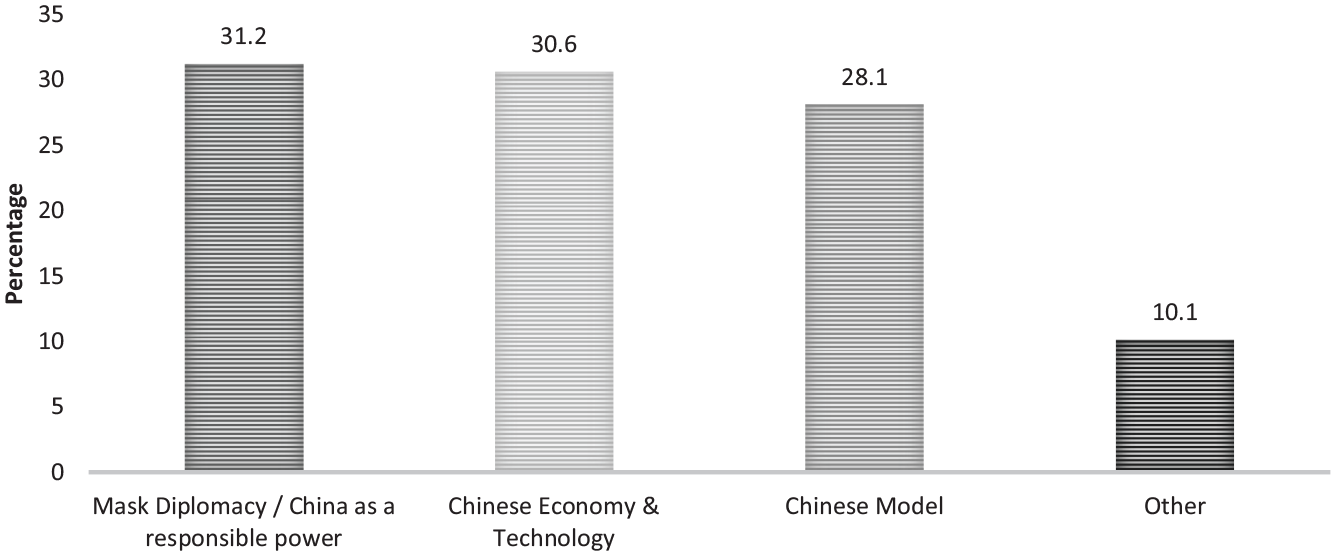
ANSA–Xinhua media partnership themes – 10 March–10 April 2020.
The data presented in Figure 1 are based on an analysis of 1294 news articles that were published in Italian as part of the content-sharing agreement between the news agencies in the first month of lockdown in Italy, between 10 March and 10 April 2020. The articles were coded around the themes emerging from both the title and the article’s content. After filtering for those articles that were either repeated or that were coded as ‘miscellaneous’, a total of 852 articles were included in the analysis. A year-on-year comparison was also conducted, in order to assess the variation (if any) in the number of articles as well as in the type of themes that were published within the ANSA–Xinhua partnership.
Only 37 articles out of the 1294 analysed were dealing with Chinese culture (less than 3%), whereas those looking at China’s economy and technology were around 30% of the total. More generally, during the first month of lockdown in Italy, the bulk (311 articles in total) of the Xinhua stories that were run on ANSA’s website were related to China’s so-called ‘mask diplomacy’, including pieces that were aimed at conveying the message that China acted responsibly and transparently from the very beginning of the COVID-19 pandemic. An article on 11 March 2020, the second day of lockdown, reported that Chinese Foreign Minister Wang Yi announced that ‘even the [Chinese] cities and provinces, like Chinese businesses that enjoy relationships of friendship and twinship with their Italian counterparts will offer their support and aid to Italy’ (ANSA, 2020a) given Italy’s role as a ‘strategic global partner’ (ANSA, 2020b). In the data compiled and analysed, 83 articles were specifically mentioning the medical supplies and teams that China provided to Italy, including businesses, diasporas and city governments.
As pressure was mounting on Beijing around allegations of concealing information about the COVID-19 outbreak in the very first phases, between 19 and 20 March, there were eight articles titled ‘The 75 days of China’s war to the coronavirus’, that provided a timeline of the pandemic in China, including the chronology of the measures adopted by Beijing to halt the spread of the virus. The first of these pieces emphasised that this was a period ‘that transformed China into the pioneer of drastic measures that proved to be effective and that are now taken as an example by the rest of the World’ (ANSA, 2020c). The day after, on 20th March, three articles titled ‘China publishes investigative report on Li Wenliang’, reported updates on the investigation related to Li Wenliang, the doctor who first raised the alarm about the new coronavirus at the end of December and died from the disease on 7 February. As further evidence of China’s attempts at building its image abroad, a number of posts reported China’s ‘transparency and high sense of responsibility for global public health’ as well as the ‘openness and timeliness’ of China’s intervention to stop the spread of the virus. On this note, 28% of the articles aimed at presenting China as a model to follow for the rest of the world, both for the effectiveness of Chinese measures against COVID-19 and for the reopening of the Chinese society in the immediate wake of what was presented as the end of the pandemic in China.
A year-on-year comparison reveals the massive variation in both the number of articles that were published as well as in the themes that were covered, as further evidence of China’s focus on projecting a positive image abroad. Between 22 March 2019, when the agreement between news agencies was signed, and 22 April 2019, only 42 articles were published, out of which 26 looked at China’s economy and technological advances, 5 promoted the BRI and its benefits, and only 2 dealt with Chinese culture. 4
In line with the relational approach outlined earlier in the article, it is important not only to analyse what is the desired message projected, but also what partner countries make of the ideational component within an SP. Starting from the general public, according to a 2021 Pew Survey, 60% of Italians had negative views of China (Spring, 2021 Global Attitudes Survey). However, with 38% favourable views, Italy was in the top three European countries (following Greece and Spain) that were seeing China more positively. An SWG poll during the first wave of the pandemic returned similar results. When asked ‘Who should Italy look more to develop their international alliances outside of Europe?’ 36% of Italians indicated China, while only 30% chose the United States (De Palo, 2020). These responses were, in part, the result of the messaging from the ANSA–Xinhua partnership, coupled with a generally positive reporting of China’s medical supplies to Italy in the very early stages of the pandemic. Besides public perception, China’s core messaging was starting to appear among, and be reproduced by, political elites too. The Beppe Grillo blog – the most important publication of the 5 Star Movement, one of Italy’s ruling parties between 2018 and 2022 – is a case in point. A number of articles during the first wave of the pandemic were in line with the core messaging coming from Xinhua that was discussed above. For instance, in February 2020, one article emphasised China’s ‘great sense of responsibility towards the international community’ in dealing with COVID (Parenti, 2020b). As we have seen before, this was a key message that China sought to deliver to European countries, including Italy. Similarly, and again in line with the ‘Chinese model’ theme outlined above, in another article, the same author noted how ‘the Chinese response to the epidemic was a lesson in rapidity and efficacy [. . .]. China has tackled the problem and started working with the international community from the very beginning’ (Parenti, 2020a). To be sure, not all political parties were so keen on embracing China’s face mask diplomacy. Giorgia Meloni, the leader of the right-wing party ‘Fratelli d’Italia’, in an interview in April 2020 declared that ‘China is engaged in a sympathy and soft power operation to make people forget that the Coronavirus has spread all over the world due to the delays of the Chinese authorities’ (Bechis, 2020). Similar concerns were shared by other parties across the political spectrum and, more generally, Italy’s relations with China have significantly cooled down during Mario Draghi’s stint as Prime Minister between February 2021 and July 2022.
The analysis of the media partnership presented here provides key insights into two aspects: first, the importance of understanding SPs as multi-channel forms of interaction that evolve over time and that can be repurposed according to the need of the moment. Second, the analysis of the main themes projected by Xinhua on ANSA’s online platform is indicative of the image-building component that these partnerships have, as demonstrated by the very significant variation in both content and number of articles emerging from the year-on-year comparison. Third, the uptake of some of China’s narratives shown above is indicative of the effects of the ideational component within an SP and of the importance of incorporating this non-material dimension into the SP analytical framework, as this article has argued.
Conclusion
The aim of this article was to foreground the importance of SPs as a new form of diplomatic exchange characterising contemporary international relations, as opposed to the state-centric and rigid camps of international alignment that were a key feature of ‘bloc politics’ until the early 1990s. To this end, through an analysis of China’s partnership diplomacy with Italy during the COVID-19 pandemic, the article has argued for the need to have a framework of SPs that captures the multi-scalar and multi-actor nature of current international politics. This has broader implications for IR theory, as it represents an attempt at moving beyond state-centric understandings of how international relations operate, and to account for the more flexible and multi-scalar nature of bilateral engagements at a time of significant global change. In addition to foregrounding the importance that sub-state actors play, the article has proposed to incorporate into the SP framework their aim as image and status building instruments. This represents an important contribution as, to date, the main focus of the literature has been on the economic and security dimensions around which SPs are articulated. Beyond SPs, this has wider ramifications in the case of China, since Beijing has sought to cultivate its image abroad through the development of media partnership, as in the case analysed in the article, but also via Confucius Institutes as well as a proactive role of Chinese diplomats, through what has become known as ‘Wolf Warrior’ diplomacy. Beyond the specificities of the case analysed here, SPs are a tool which is becoming increasingly used and important in foreign policy. By recalibrating existing approaches to SPs, this article has shed light on the multi-level nature of SPs as a foreign policy instrument. More broadly, the analysis has foregrounded the role that key actors across various scales play in contemporary international relations.
Footnotes
Acknowledgements
The author would like to thank the two anonymous reviewers for the useful comments as well as Luca Trenta for his invaluable feedback and insights on earlier drafts. This article was developed during a visiting fellowship with the ERC-funded “Re-orienting development: the dynamics and effects of Chinese infrastructure investment in Europe” (REDEFINE) project (grant ref: 885475) and I am grateful to the REDEFINE team, and in particular to the Principal Investigator Giles Mohan, for their support and feedback on drafts of the paper. The article has also benefitted from feedback (particularly from Indrajit Roy and Jonas Wolff) received at the 2022 annual conferences of the International Studies Association (ISA), Political Studies Association (PSA) and Development Studies Association (DSA).
Funding
The author(s) received no financial support for the research, authorship and/or publication of this article.
