




Abstract
Despite the growing literature on Brexit, specifically, and conflicts of sovereignty, more generally, there has been insufficient research on how the concept of sovereignty has been used in citizen campaigns and street protests across the United Kingdom – a form of ‘counter-democracy’ through which people attempted to oversee the post-referendum political process. Combining qualitative content analysis of campaign websites with a discourse-network analysis of media articles on Brexit protests, this article shows that claims to sovereignty were mobilised not only in conflicts between the United Kingdom and the European Union, but also in conflicts between different institutions within Britain itself. Both ‘Leavers’ and ‘Remainers’ appealed to popular and parliamentary sovereignty at different points in time, pragmatically adapting their framing according to changing circumstances but also as a result of a dynamic series of interactions with each other, including denying, keying and embracing their opponents’ frames. Crucially, conflicts around different institutionalisations of popular sovereignty did not demand system change, a rhetoric familiar from other protests of the 2010s such as Occupy Wall Street with its emphasis on ‘We are the 99%’. To the contrary, pro- and anti-Brexit mobilisations remained firmly focused on Brexit policy itself. They problematised the split between ‘Remainers’ and ‘Leavers’ within the United Kingdom, between 48% and 52%, and thus, on a deeper level, the tension between the political principle of popular sovereignty and the sociological reality of a split country. Finally, the more Leavers opposed Remainers, the more movements and parties on each of these two sides aligned. Politicians featured prominently in campaigns and as speakers at protest events, contributing to close cooperation between protesters and parties, and precluding anti-systemic discourses around popular sovereignty that would target parties and institutions altogether.
Sovereignty claims in pro- and anti-Brexit mobilisations
Debates around Brexit have played out on the benches of the House of Commons, in the Supreme Court, in election campaigns and on prime time TV. Still, some of the most defining images of the period featured also citizens mobilising across the country – protesting in front of Westminster wrapped in European Union (EU) flags or marching under the rain to support Brexit. For many, both supporters and opponents of Brexit, protests, marches and campaigning have been a key way to socialise, voice their opinions and demonstrate their political engagement in the increasingly polarised political environment after the referendum. Some Brexit-related mobilisations attracted hundreds of thousands of people, overshadowing most other UK mobilisations from the 2010s, such as for example earlier protests against the Transatlantic Trade and Investment Partnership (TTIP) (Rone, 2020). Yet, with a few important exceptions (Brändle et al., 2018, 2022; Davidson, 2017), pro- and anti-Brexit mobilisations have so far attracted little academic attention in the field of social movement studies.
This article aims to address this gap by exploring both pro- and anti-Brexit mobilisations and, more specifically, their use of the concept of ‘sovereignty’ in light of Brexit’s recent characterisation as the ‘sovereignty referendum’ (Hobolt et al., 2020). There is ample existing research on sovereignty claims in UK Parliament and media (Baldini et al., 2020; Rone, 2021; Todd, 2016) but still no research on how non-institutional mobilisations on Brexit understood and used the concept of sovereignty.
This is particularly surprising considering that protest, petitions and other non-institutional forms of organising democratic distrust are themselves a key way to express popular sovereignty beyond legal and political institutions (Rosanvallon, 2008). In the situation of political impasse and a crisis of the party system following the 23 June referendum (Bickerton and Brack, 2022), both mass street protests and legal challenges against executive overreach mounted by campaigners such as Gina Miller could be interpreted as expressions of ‘counter-democracy’ defined by Pierre Rosanvallon (2008: 8) as ‘a form of democracy that reinforces the usual electoral democracy as a kind of buttress, a democracy of indirect powers disseminated throughout society’. According to Rosanvallon (2008), popular sovereignty has been expressed, on the one hand, in the democratic right to vote periodically and the corresponding liberal democratic representative institutions, and on the other hand, in various non-institutionalised democratic functions to hold institutions into account, including oversight, prevention and judgement. Counter-democracy does not ‘oppose’ democratic institutions but complements them and can be an important corrective pushing for institutional reform.
Indeed, popular mobilisations in the 2010s, such as Indignados in Spain or anti-austerity protests such as Occupy in the United States and the United Kingdom, not only criticised concrete austerity policies, for example, but also put forward broader demands for institutional overhaul, ‘real democracy now’, and more power to the people (Bailey, 2014, 2020; De Nadal, 2021; Della Porta, 2013; Gerbaudo and Screti, 2017; Rone, 2020). At first sight, it might seem that similar developments took place in Britain in the aftermath of the Brexit referendum. To be sure, there were cases of pro-Brexit actors invoking ‘popular sovereignty’ in right-wing media to oppose ‘unelected out-of-touch’ Lords or judges criticised as ‘enemies of the people’ (Rone, 2021). Nigel Farage even toyed with the idea of ‘making referendums binding’ (Freeden, 2017: 8). In this context, it is not a surprise that many scholars analysed pro-Leave mobilisations through the prism of ‘populism’ (Clarke and Newman, 2017; Freeden, 2017). Sovereignty was invoked by Leavers to argue that part of the people was ‘the people’, utilising ‘the culturally prevailing legal and political fictions of sovereignty as ‘one and indivisible’’ (Freeden, 2017: 8). Still, such analyses overlook two key trends. First, as debates over Brexit progressed in the aftermath of 2016, both pro-Leave and pro-Remain mobilisations started invoking the concept of sovereignty and ‘the will of the people’. Leavers insisted that the ‘People are sovereign’ with the aim to defend the result of the referendum, while Remainers would pragmatically claim that ‘People are sovereign’ to promote a second referendum, the so-called ‘People’s vote’. Ultimately, both pro- and anti-Brexit players instrumentalised the concept of ‘sovereignty’ in their campaigning to pursue very concrete goals related to the substance of Brexit policy.
In addition, unlike other protests from the 2010s that started with more narrow demands and ended up demanding system change, both pro-Brexit and anti-Brexit popular mobilisations often sided with particular institutions (such as parliament or government) and only rarely demanded system change or challenged political institutions tout court. One reason for this might lie in the campaign form, which facilitated interactions between bottom-up protesters in the United Kingdom and party politicians. Political actors from both the government and Opposition were among the key actors making sovereignty claims in Brexit-related mobilisations – both on the streets and in mainstream media. These actors’ role might have precluded more radical bottom-up discourses, staying on point and channelling discontent to the specific topic of Brexit policy instead. Party–movement interactions (Borbáth and Hutter, 2021; Hutter and Weisskircher, 2022; Pirro, 2019) were thus among the factors shaping sovereignty claims in Britain. This is interesting also because it shows an important departure from the rather low share of participation of parties in protests in the United Kingdom from 2000 to 2015 (Borbáth and Hutter, 2021: 6).
Finally, in line with recent findings on ‘Brexit’s politics of division’ within online campaigning in the United Kingdom (Brändle et al., 2022), this article reveals a very strong polarisation between pro- and anti-Brexit protesters. Still, rather than not talking to each other at all, protesters from both sides actually shared a number of claims on sovereignty (for example, ‘the People are sovereign’, ‘Parliament is sovereign’) but interpreted them in completely different ways. Drawing on social movement theory on movement–counter-movement interactions, we argue this was the result of both changing perceptions of how different institutions responded to one’s demands on Brexit, as well as of relational framing dynamics between supporters and opponents of Brexit. Actors ‘denied’, ‘keyed’ or ‘embraced’ (Benford and Hunt, 2003) each others’ frames in a relational framing process that we explore in more detail later.
The article proceeds as follows. In the theoretical section, we introduce the literature on conflicts of sovereignty in the United Kingdom, as well as social movements’ theories on movement–party and movement–counter–movement interactions. We then move on to discuss methodology and data collection strategies. In the third section, we present an overview of key mobilisations. We explore examples of sovereignty claims in order to show how the interpretation of particular claims resulted from changing perceptions of whose demands institutions are responsive to, but also from interactions between movements and counter-movements as well as between protest players and institutional politics players. We conclude by arguing that sovereignty claims were used by popular mobilisations above all pragmatically and instrumentally, as part of complex ‘sovereignty games’ (Adler-Nissen and Gammeltoft-Hansen, 2008) to justify Britain leaving or staying in the EU.
Theoretical framework
Conflicts of sovereignty in the United Kingdom
In an influential analysis of conflicts of sovereignty in the EU, Brack et al. (2019) have argued that apart from the expected vertical conflict between state and supranational sovereignty, recent years have seen the rise of horizontal conflicts of sovereignty within states but also at the supranational level, between executives and the legislature. The authors outline four main types of sovereignty claims, namely, claims to national sovereignty, supranational sovereignty, but also popular sovereignty, as well as parliamentary sovereignty (Brack et al., 2019). Following Werner and De Wilde (2001), Brack et al. (2019: 823) explore sovereignty claims as ‘speech acts’, that is, claims ‘to ordering power made by various, often competing actors’. The recent proliferation of sovereignty claims by a variety of actors can be interpreted as the result of a destabilisation of the post-World War II consensus on ‘shared’ or ‘pooled’ sovereignty. This destabilisation consequently led to an uncertainty over ‘who rules’ and opened the doors for multiple contending interpretations (Bickerton et al., 2022).
This type of analysis is particularly relevant for the case of Brexit, where numerous authors have emphasised that rather than a simple conflict between the United Kingdom and the EU (Börzel, 2018; Conti and Di Mauro Memoli, 2018), what was observed in debates was also a horizontal conflict of sovereignty about who rules within the United Kingdom (Bickerton, 2019; Bogdanor, 2016; Lord, 2020; Rone, 2021). This claim has been confirmed also in a recent empirical analysis of Brexit’s ‘politics of division’ as explored in online social campaigning. The study found that the EU was ‘rather marginal in these debates on both sides’ and that there was ‘strong polarisation and contestation over Brexit as a national-democratic rather than EU issue’ (Brändle et al., 2022).
At the same time, Bickerton and Brack (2022) convincingly show that despite the Brexit rhetoric of ‘Parliament Vs the People’, for example, the normative ideal of popular sovereignty ( ‘government by consent of the governed’) was never challenged in debates on Brexit. According to their analysis, the real conflict seen around Brexit was primarily about the institutionalisation of this principle, ‘in the relations between the executive, the legislature and the judiciary’ (Bickerton and Brack, 2020, abstract) within the United Kingdom. Bickerton and Brack (2022: 6), following Gordon (2019), argue that ‘the opposition between popular and parliamentary sovereignty is a non sequitur’, since in contemporary United Kingdom, parliamentary sovereignty is ‘the institutionalization of the normative ideal of popular sovereignty’.
While indeed popular sovereignty as a foundational political principle was never questioned in debates around Brexit, we argue that apart from the institutionalisation of popular sovereignty, what also became problematised in pro- and anti-Brexit mobilisations was the very question of ‘Who are the people?’, that is, what the term ‘popular’ stands for. Brexit sovereignty conflicts emerged from the tensions between the unquestioned political principle of popular sovereignty and the sociological reality of a United Kingdom split over exiting the EU. Mobilisations on Brexit made explicit what Rosanvallon (2008: 291) calls the ‘gap between the abstract unity of a sovereign defined by terms such as “people” and “nation” and the actual diversity of social conditions’. The ultimate uncertainty around ‘What is a people?’ (Badieu et al., 2016) came to the fore in debates whether the millions of people protesting against Brexit count more than the 17.4 million people who had voted Leave. How sovereignty becomes institutionalised became an issue mainly because different institutions were seen at different points in time as representing and responsive to different sociological groups: those with pro-Remain and those pro-Leave identities (United Kingdom in a Changing Europe, 2019).
Movement and counter-movements and party–movement interactions
Considering that pro- and anti-Brexit social movements did not exist in isolation from each other, we approach their sovereignty claims by drawing on the long tradition of studying interactions between movement and counter-movement framing (Ayoub and Chetaille, 2020; Benford and Hunt, 2003; McCaffrey and Keys, 2000; Esacowe, 2004). Interactionist perspectives to movement framing can contribute to the conflicts of sovereignty approach by emphasising that pro- and anti-Brexit mobilisations transformed their claims in relation not only to perceived changes with regard to which institutions represented their position best but also in relation to challenges by opposing players in a continuous, interactive and malleable process of dialogue (Esacowe, 2004) or competition (McCaffrey and Keys, 2000).
When challenged by opponents, movements can respond in several ways: by ‘ignoring (so not to legitimize the counterframe), keying (restating claims of opponents to give them new meaning), embracing (taking on the countermovement’s identity attributions), distancing (from the countermovement’s framing) and countermaligning (reframing disparaging claims against them by discrediting opponents)’ (Benford and Hunt, 2003, quoted in Ayoub and Chetaille, 2020: 23). This approach to framing as entailing dynamic sequences of interactions helps us understand better how both pro- and anti-Brexit mobilisations ended up arguing passionately for parliamentary and popular sovereignty at different points in time while aiming to achieve completely different goals by invoking them.
Furthermore, the focus on movement and counter-movement framing in pro- and anti-Brexit mobilisations should be expanded by drawing on the growing literature on party–movement interactions (Borbáth and Hutter, 2021; Hutter and Weisskircher, 2022; Kitschelt, 2006; Pirro, 2019; Weisskircher and Berntzen, 2018). This literature has increasingly paid attention to the dynamic interactions between movements and parties across the political spectrum. Some studies have drawn on protest event analysis to compare country cases (Borbáth and Hutter, 2021; Hutter and Weisskircher, 2022) accurately, while others have explored in detail interactions between far-right parties and movements in a single country (Kanellopoulos et al., 2017; Pirro, 2019; Weisskircher and Berntzen, 2018). This social movements’ literature on party–movement interaction is particularly relevant for Brexit-related mobilisations since politicians have been crucial as spokespersons of post-referendum campaigns and as key speakers at protest events. Smaller parties such as the Brexit party or the Liberal Democrats supported respectively pro-Brexit or anti-Brexit campaigns. The bigger Labour and Conservative Parties were split on the issue of Brexit – thus, individual politicians from both parties joined protest campaigns, either pro- or anti-Brexit ones, depending on their personal convictions. What this article will aim to do is to explore the significance of this overlap and collaboration between institutional politicians and protesters in terms of making claims about sovereignty.
One important caveat is needed before we proceed. To be sure, beyond claims making, there is a ‘deep meaning’ of sovereignty with institutional and political basis to it. In fact, Brexit revealed important and substantial changes that had taken place precisely at this ‘deep’ constitutional level during United Kingdom’s membership of the EU (Bickerton, 2019; Bogdanor, 2016; Lord, 2020). Furthermore, Brexit led to new tensions between Westminster and the devolved parliaments indicating a potential strengthening of the central over devolved administrations (Baldini et al., 2018; McHarg and Mitchell, 2017). Still, the sovereignty claims of popular mobilisations we analyse did not simply ‘describe’ these deep constitutional shifts. Sovereignty claims as encountered in Brexit mobilisations acquired their meaning not as a result of reflecting objective constitutional realities but as a result of rhetorical and often instrumental usage by actors trying to influence Brexit policy.
Data collection and methodology
In order to explore how pro- and anti-Brexit protesters and campaigners framed sovereignty in popular mobilisations we use discourse-network analysis (DNA) – a combination of network analysis and qualitative content analysis originally developed by Philip Leifeld (2020). The DNA method has been applied to study topics as diverse as German pension politics and privatisation discourses (Leifeld, 2016) or debates on climate change (Ghino and Steiner, 2020). Following Leifeld and Haunss’ research on the mobilisation against the Software-Patents directive (Leifeld and Haunss, 2010), this article applied the method of DNA to studying controversies around Brexit in campaigns and protest mobilisations, rather than parliamentary debates, for example.
We collected LEXIS-NEXIS media data searching the database with the following search terms: ‘sovereign* AND protests AND anti-Brexit OR pro-Brexit’ as well as ‘sovereign* AND campaign AND anti-Brexit OR pro-Brexit’. We searched for media articles from the date of the Brexit referendum – 23 June 2016 – to Britain’s exit from the EU on 31 January 2020. We got 621 results, which we then read removing all irrelevant articles, including duplicates, articles that mentioned non Brexit-related protests and some articles that referred to referendum campaigns from before June 23 but not to protest campaigns after the referendum. We ended up with 73 relevant articles at both the national and local level. 1 This small number of relevant articles reflects to a certain extent the lack of salience of protests, but more importantly it reflects the ways in which protests are reported – many articles had photos from protests or commented on protests but only a few gave voice to protesters and campaigners themselves.
This finding led us to a decision to complement and triangulate the data from media articles with a closer in-depth analysis of the official websites of four key campaigns identified after a scoping analysis assessing their reach, media prominence, and role in protest organisation – the pro-Brexit Leave means Leave and Leave.eu and the anti-Brexit Open Britain and Best for Britain. The websites we analysed were all dedicated to Brexit-related campaigning, represented particular campaigns and were thus comparable. They were accessed thanks to the Internet Archive, analysing one snapshot per month of the websites’ title pages and events pages for the same time period – from 23 June 2016 to 31 January 2020. We identified instances of sovereignty claims and analysed how sovereignty was framed and if frames changed over time.
Drawing on both the media and website data, and triangulating with information from the BBC and The Guardian (to double-check data on protest attendance and party participation), we created an overview chronology of pro- and anti-Brexit mobilisations in the period 2016–2020. Furthermore, we performed a discourse-network analysis of the relevant media articles, using the DNA software. When coding statements, we used deductive content analysis (Hsieh and Shannon, 2005) assigning to protesters’ discourses one of the four types of sovereignty outlined by Brack et al. (2019), that is, national, supranational, popular and parliamentary sovereignty. We quickly realised that while different actors might all talk about ‘popular sovereignty’, what they mean by this is diametrically different. Thus, we re-coded the data elaborating on the initial typology. For example, instead of coding a statement simply as ‘popular sovereignty’, we coded it as ‘people are sovereign Brexit’ to designate that protesters claimed that people are sovereign and the Brexit result should be respected. Alternatively, we coded as ‘people are sovereign People’s vote’ all statements that claimed that people are sovereign, therefore there should be another referendum. We created lists of key statements in each coding category and draw on them to present relevant statements in the next section. Finally, we exported the DNA data and visualised the resulting network in Gephi, using the Fruchterman–Reingold layout algorithm. We assigned nodes different sizes depending on their degree – how often they were used (when it comes to statements) or how often they appeared (when it comes to organisations). We discuss our findings in the next section.
Conflicting interpretations of sovereignty in Brexit-related mobilisations
Dynamics of Brexit protests and movement–party interactions
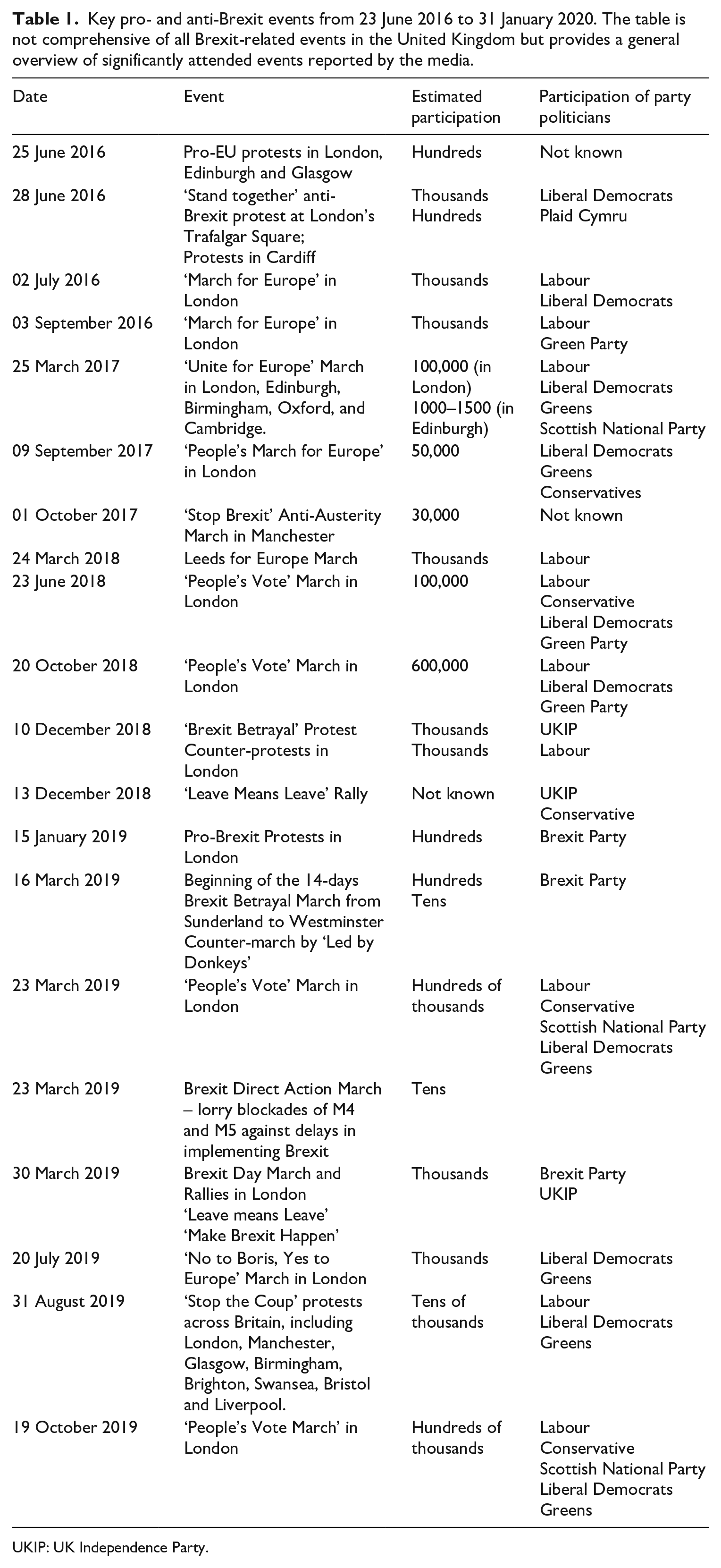
The chronology of Brexit-related protest events (see Table 1) reveals that throughout the whole period observed – June 2016 to January 2020 – there were clearly more and better attended anti-Brexit protests as compared to pro-Brexit ones. This is not a surprise considering the result of the Brexit Referendum – the mobilisation of protests took place in opposition to what was going to become a priority for Prime Minister Theresa May (2016–2019), and subsequently Boris Johnson (2019). Pro-Brexit protests took place predominantly in the later years of the period observed when fears that the referendum would not be honoured and a ‘Brexit betrayal’ would take place intensified.
Key pro- and anti-Brexit events from 23 June 2016 to 31 January 2020. The table is not comprehensive of all Brexit-related events in the United Kingdom but provides a general overview of significantly attended events reported by the media.
UKIP: UK Independence Party.
The first spontaneous big anti-Brexit protests took place in the immediate aftermath of the Referendum. They were followed by a number of ‘People’s Marches for Europe’ in 2016 and 2017. In 2018, the big campaign for a second referendum, the so-called ‘People’s Vote’, started gaining strength and organised a number of protests attended by hundreds of thousands over the years. In March 2019, just before the first official Brexit date, a pro-Brexit ‘Brexit Betrayal’ March took place with protestors marching through the United Kingdom to express their disappointment with the delays in implementing Brexit. The march culminated in two parallel London events: ‘Leave means Leave’ and ‘Make Brexit Happen’, organised by the Brexit Party and the UK Independence Party (UKIP), respectively. In September 2019, anti-Brexit protesters also took to the streets to protest against Boris Johnson’s attempted prorogation of parliament, with which he attempted to avoid parliamentary oversight of key decisions on Brexit. Finally, close to a million attended the ‘People’s Vote’ March in London in October 2019, just months before the general election that gave the Conservatives a landslide victory in December the same year.
Importantly, the biggest protests on both the pro-Remain and the pro-Leave side were organised by campaigns involving politicians. On the Remain side, a key campaign, launched in 2017 to stop Brexit, was Best for Britain, supported by politicians such as George Turner and Nick Clegg from the Liberal Democrats, David Lammy and Chuka Ummuna from Labour (until Ummuna split to form The Independent Group), and Caroline Lucas from the Greens. Another crucial anti-Brexit group was Open Britain, the successor of the official Remain campaign ‘Britain Stronger in the EU’. Open Britain was established by PR consultant Roland Rudd (brother of conservative Home Secretary Amber Rudd) and had on its board figures such as Peter Mandelson, the former spin doctor for Tony Blair. In 2019, Rudd removed from their positions James McGrory and Tom Baldwin as campaign manager and head of communications respectively, causing dramatic infighting and splits within the campaign (Bush, 2019). Before this development, Open Britain had been the biggest organisation behind the People’s Vote marches attended altogether by millions of citizens and was supported initially by conservative MP Anna Soubry, Nicky Morgan, and Dominic Grieve, who later cut ties with the campaign.
On the Leave side of the political spectrum, there was the Leave.EU campaign, the heir of the unofficial referendum Leave campaign with the same name, led by businessman Arron Banks, and the Leave means Leave campaign, co-founded by businessmen Richard Tice and John Longworth. Both campaigns had at different stages been supported by Nigel Farage who left UKIP after the 2016 referendum and founded in 2018 the Brexit party, currently renamed Reform UK. Leave.eu was actively engaged in digital campaigning and pioneered a mass grass-roots campaign urging UKIP members to join the Conservatives and deselect Tory MPs who supported Remain.
Ultimately, the campaign form served as a bridge between the electoral and protest arena, or between legal democratic institutions and various expressions of counter-democracy (Rosanvallon, 2008), including protests, legal cases, and petitions. Brexit-related campaigns gathered through crowd-funding massive financial contributions from everyday citizens. They also gathered, often controversially so, a lot of personal data on citizens that allowed them to build massive ‘mobilisation machines’. Politicians gave legitimacy and public support to these campaigns while, in turn, making use of their mobilisation potential to further their own political visions.
When it comes to making claims about sovereignty, this tight connection between politicians and protesters has been reflected in a shared discursive space. Politicians shared frames with protesters at events where they made speeches, but crucially also through campaign websites, leaflets, and posters, whose messaging was carefully coordinated by campaign leaders and communication directors to secure coherent framing. We argue that this shared discursive space precluded system-challenging use of sovereignty claims by protesters and campaigners who complemented and oversaw existing legal and political institutions rather than opposing them or proposing significant alternatives.
Discursive networks and relational framing
When it comes to the question of how pro- and anti-Brexit protesters framed sovereignty, we found, first, that there was a strong polarisation of discourse with two clear clusters of organisations opposing each other. Figure 1 visualises the discursive networks in debates on sovereignty by Brexit protesters and campaigners. There are two clear clusters of organisations and sovereignty claims with practically no overlap between them: on the right, we see the pro-Leave cluster of organisations, and on the left – the pro-Remain cluster. Remarkably, both sides made the same claims – ‘People are sovereign’ and ‘Parliament is sovereign’ – but interpreted them in completely different ways that suited their strategic goals.
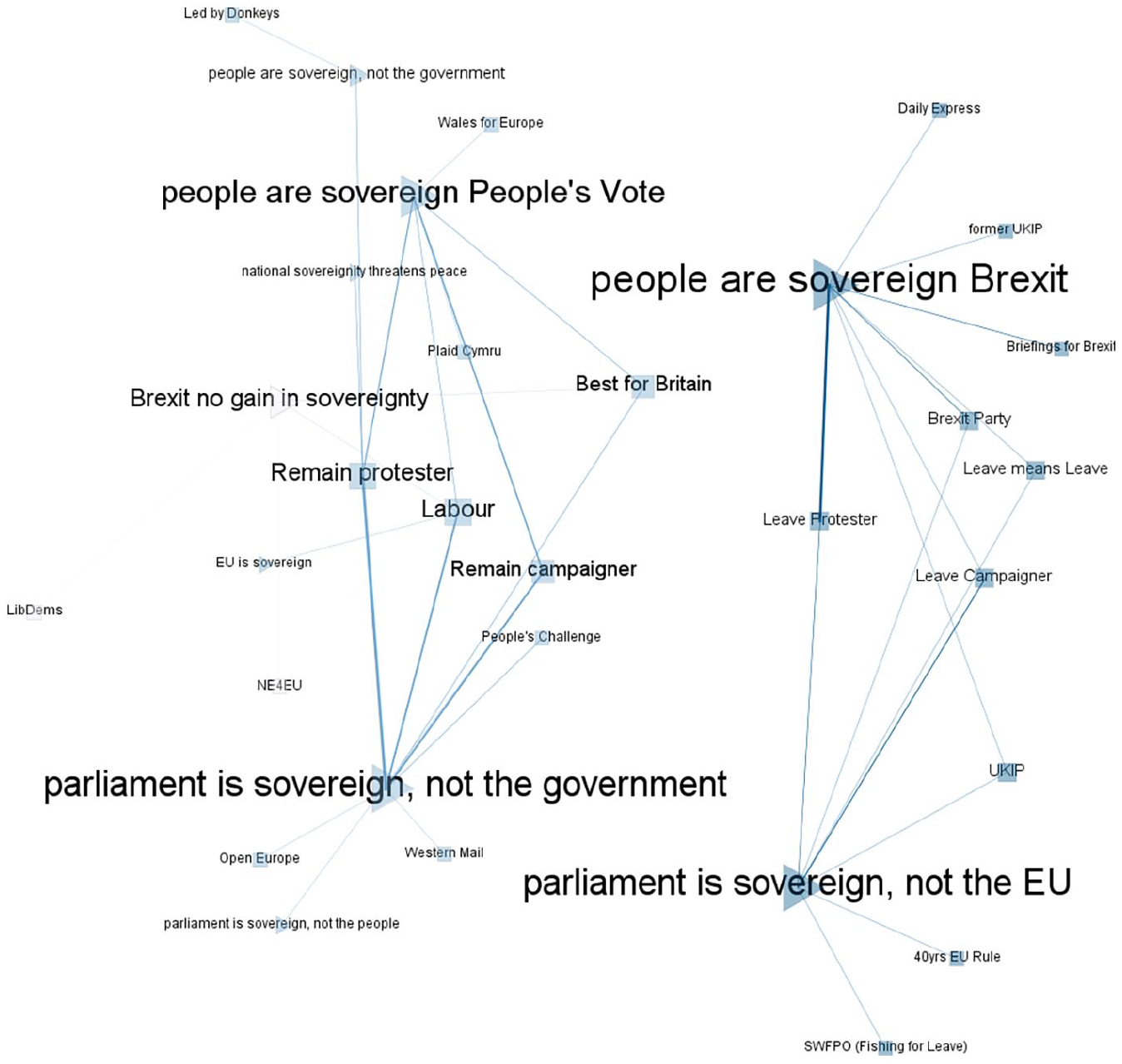
Discursive networks in pro- and anti-Brexit protesters.
The analysis of campaign websites revealed that the two opposing camps made sovereignty claims in relation to each other and changing circumstances over time: in the immediate aftermath of the referendum, neither parliamentary nor popular sovereignty was a priority for anti-Brexit campaigners who focused much more on the economic consequences of Brexit. Still, considering that parliament was dominated by pro-Remain MPs in the aftermath of the 2016 Referendum, pro-Remain anti-Brexit campaigners swiftly embraced parliamentary sovereignty. More specifically, they supported the challenge Gina Miller brought to the Supreme Court in 2016, insisting that the government could not initiate withdrawal from the EU without the consent of Parliament. Later, anti-Brexit campaigners embraced popular sovereignty as well – especially since the launch of the ‘People’s Vote’ campaign in April 2018. The campaign argued that British people should be given the right to vote in a referendum (again). Such a second referendum was expected to either reverse Brexit or opt for softer versions of Brexit. Ultimately, the Remain camp initially ignored sovereignty frames, focusing on other topics instead. This was then followed by an active exercise of keying – restating sovereignty frames to give them a new meaning: in relation to both parliamentary and popular sovereignty. Remainers attempted to embrace identifications with parliament and the people instead of leaving them to the Leave camp. They were of course challenged by Leavers in the process who insisted they – Leavers – (and in some cases – the government) were the ones who defended the people’s will against ‘betrayers in Westminster’. 2 In what follows, we will explore more closely the key sovereignty claims put forward by pro- and anti-Brexit mobilisations.
Key players and frames in pro- and anti-Brexit mobilisations
The most prominent collective players in the cluster of pro-Brexit organisations and frames are the Brexit Party, UKIP, Leave means Leave, and the general categories of Leave Protester and Leave Campaigner that we used for protest attendants unaffiliated to political parties, as well as for campaign spokespersons, respectively (see Figure 1, right). In the bottom left of our discourse-network graph (Figure 1), we see the second most common statement in thе pro-Leave cluster: ‘parliament is sovereign, not the EU’. This was one of the original pro-Brexit claims and it can be clearly recognised in the About Section of the Leave.EU campaign, which stated, By voting to leave the EU, we are taking back control of our sovereignty, we will be able to put in place our own policies and laws on immigration and our economy, including industry and energy. Agriculture and fishing will also benefit from falling under national administration for the first time in over forty years. We will now be able to take back control of our country.
While pro-Brexit protesters opposed parliament as consisting of pro-Remain MPs in a number of cases after 2016, the demand that Britain made its own laws remained relevant up to the very moment of Brexit. Speaking at the big rally celebrating United Kingdom’s exit from the EU on 31 January 2020, Brexit party politician Ann Widdecombe celebrated regaining control over trade, laws and borders and emphasised that we don’t need anybody to prop us up or to tell us what to do and of course we want to cooperate and have good relations, but there is a difference between a sovereign state and a superstate and we will never be part of their superstate.
3
Statements such as the one above point to the classical vertical conflict between national and supranational sovereignty. British parliamentary sovereignty was in national this context interpreted as a synonym of state sovereignty and was invoked in a number of contexts by pro-Brexit citizens and politicians speaking at protests.
Still, the most commonly used frame by pro-Brexit players was ‘people are sovereign Brexit’, which is the code we used for statements claiming people are sovereign therefore the Brexit result should be respected. This frame was familiar from the Leave campaigns prior to the referendum but acquired new importance after the referendum. While before the referendum the pro-Leave campaign had mobilised to defend UK parliamentary sovereignty vis-a-vis the EU, after the Referendum, pro-Leave players started opposing parliament, not as an institution more generally, but in its concrete composition as dominated by Remainers. The Leave.eu campaign even started ‘The Blue Wave’ – a grassroots initiative in which pro-Brexit citizens were urged to join the Conservative Party and deselect pro-Remain MPs – proclaiming, ‘The people are now pitted against Parliament. Deselection is the 17.4 m’s weapon against our betrayers in Westminster, one we must wield with real intent, as the nasty Remainers have done so ruthlessly since June 2016’. 4 The deselection campaign could boast with several successes: anti-Brexit conservative MPs such as Nick Bowles, Philip Lee and Dominic Grieve lost votes of no confidence in their local constituencies after they were accused of not supporting Brexit. While they were ultimately not deselected, these incidents played a role in their career trajectories, with Philip Lee switching later to the Liberal Democrats and Nick Bowles becoming an Independent Conservative. Dominic Grieve in turn lost the Conservative whip in September 2019 because of joining a rebel Conservative group that did not support Boris Johnson’s Government.
After the failure of Britain to leave the EU on the initially designated date – 29 March 2019, pro-Brexit citizens were outraged and took to the streets. On March 2019, the Independent reported from the Brexit Day protests, quoting Mike Whittby, a 66-year-old protester from North Wales, who commented, ‘Parliament is committing treason because they are trying to usurp the democratic process. Parliament is not sovereign – the people are sovereign’.
5
Clearly, for pro-Brexit protesters, the question of popular sovereignty was strongly intertwined with the question of respecting democracy and the will of the people. The Leave means Leave campaign stated in a post about its March to Leave event: Over 17 million people voted Leave in the EU referendum, many for the first time, with the vote receiving the highest turnout in British history. Failing to deliver a true Brexit will permanently damage the British people’s faith in democracy.
6
Thus, the original frame of the UK parliament versus the EU was increasingly replaced in pro-Brexit discourse with a frame about UK People versus UK parliament. Still, considering the continuing support of Brexiteers for UK Parliamentary sovereignty as opposed to ‘laws made in Brussels’, this switch can be interpreted above all in pragmatic rhetorical terms: now that the parliament was seen as obstructing Brexit, pro-Brexit groups turned to defend the government as expressing the ‘will of the people’. Rather than a full-blown ‘populist’ revolt against all institutions, claims to popular sovereignty were made above all in relation to achieving the desired exit of the United Kingdom from the EU.
Moving to the left of the figure, one can see the anti-Brexit cluster of frames and organisations with key collective players being Labour, Remain Protesters, Remain Campaigners, the campaigns Best for Britain and People’s challenge, as well as the Liberal Democratic Party. The key frame for this cluster – ‘parliament is sovereign’ – is a direct response to pro-Brexit players pitting people against Parliament in the aftermath of the referendum. This frame was put forward first during the 2016 legal case R (Miller) v Secretary of State for Exiting the European Union. At the centre of the case was the conflict whether parliament should give consent to government to trigger Article 50 to exit the European Union. Pro-Remain protesters seeing that a considerable number of MPs were pro-Remain started actively defending parliamentary sovereignty vis-a-vis the executive at this point.
What is more, the sovereignty of parliament became a key rallying cry for those mobilising against Brexit also in late August and September 2019 when newly appointed PM Boris Johnson attempted to prorogue parliament in order to avoid oversight of key government decisions on Brexit. Commenting on Johnson’s attempted prorogation, protesters Rory and Margaret noted, It’s the most flagrant attack on democracy that I can remember. It’s bad enough that [Boris Johnson] was elected leader by a handful of people, but what was this “taking back control” all about? And sovereignty of parliament? Parliament has just been overruled. I think it’s an absolute outrage.
7
Commenting on the same case, 54-year-old citizen Jane Keane emphasized, ‘My understanding is parliament is sovereign not Boris Johnson’ (see Note 7). The Best for Britain campaign responded to prorogation by urging its supporters to ‘Support the People’s Parliament’. 8 Calling parliament ‘The People’s Parliament’ was an example of keying – an attempt by anti-Brexit players to strategically reframe and go beyond the purported opposition between People and parliament, put forward by pro-Brexiteers.
Anti-Brexit protesters furthermore actively tried to reframe ‘popular sovereignty’ and embrace the identification with the ‘people’. Commenting on Johnson attempted prorogation of parliament, Amelia Womack, deputy leader of the Greens, for example, said at the mass anti-prorogation rally at London’s parliament square, ‘We’re here to stand against Boris Johnson’s coup. We have a representative democracy and by suspending parliament, you are removing people’s democratic right’. 9 Anti-Brexit players claimed for themselves the right to call themselves ‘the people’ as well. Still, the most potent and salient act of reframing and embracing popular sovereignty by anti-Brexit mobilisations was to be encountered in the concept of ‘People’s vote’ designating in fact a second referendum.
The second most frequently used statement in the anti-Brexit camp was thus ‘people are sovereign People’s vote’. This reframing of referenda as something positive and desired was not easy since remainers had often attributed the result of the 2016 referendum to disinformation, fake news and foreign meddling (Rone, 2021). The way for anti-Brexit players to go beyond their initial scepticism of referenda was to claim that this would be a ‘different kind of people’s vote’. In its Road Map to the People’s Vote, Best for Britain stated, In 2019, a different kind of people’s vote campaign must be fought, without the mistakes of the past. We cannot have a re-run of the 2016 vote. It must be a vote the like of which Britain has never seen before: with more stringent rules on digital campaigning, and citizens’ assemblies used to inform and encourage debate.
10
The fact that a second referendum could potentially overturn the decision of the first one was perceived not as anti-democratic but as the logical result of doing the referendum ‘without the mistakes of the past’.
Pro-Brexit actors responded to this appropriation by trying to, in turn, key the notion of ‘People’s vote’. For example, Leave.EU commented on Johnson’s 2019 attempted prorogation of parliament in a post with the telling title ‘Boris goes prorogue to save British democracy’, and their chairman tweeted, ‘Parliament has blocked the People’s Vote long enough’. ‘The People’s Vote’ as used in this quote is a clear attempt to key the anti-Brexit ‘People’s vote’ frame and refer to the original Brexit referendum that had to be respected, and not repeated.
A third, less frequent but still prominent, frame in the pro-Remain camp has been ‘Brexit – no gain in sovereignty’ – formulated as a direct response and a form of denying one of the earliest claims of the pro-Leave campaigns: namely that Brexit would enhance British sovereignty. Mark Malloch-Brown, the chairman of the anti-Brexit Best for Britain group, insisted that the Brexit process was ‘another example of how we are so keen to get our sovereignty back that we end up giving it away at every turn’. 11 Such statements point to the widely held belief among pro-Remain players that the United Kingdom had actually gained sovereignty from being member of the EU because the key challenges of the contemporary world – terrorism, climate change and so on require coordinated actions and supranational sovereignty to be solved. Statements about the United Kingdom losing sovereignty by staying on its own and de facto gaining sovereignty by joining other EU countries can be traced all the way back to debates around the first referendum about whether the United Kingdom should join the European Communities (Todd, 2016). Interestingly, while this position was certainly present in the public debate, it was less relevant in our sample in comparison to the already mentioned defence of Parliament’s role within the UK polity and the reframing of popular sovereignty to legitimise a second referendum presented as ‘People’s vote’.
In all these statements by protesters, claims about the EU, national sovereignty, the will of the people, or the role of parliament overlap and enter in complex interactions with claims about different possible expressions of popular sovereignty. Does parliament represent best the will of the people through the classic democratic mechanisms of mediation and representation? Or do referenda express the ‘People’s will’ most clearly? Do the more than 17 million votes for Brexit trump the mandate of democratically elected UK MPs to represent the British population? Should protests be taken into account at all? Such debates about different possible expressions (both institutional and non-institutional) of popular sovereignty ultimately point to the deep tension between the ideal of ‘popular sovereignty’ and the practical matters of how it is expressed and what follows from it. What is more, mobilisations around Brexit revealed clearly the abyss between the concept of the ‘people’ as a singular unitary entity and the sociological reality of the United Kingdom as a country split over Brexit.
Conclusion
To begin with, the analysis of sovereignty claims by Brexit-related mobilisations reveals that the simple four-fold typology offered by the novel Conflicts of Sovereignty framework (national, supranational, popular and parliamentary sovereignty) should be complicated further to understand debates in the Brexit context. Our analysis has indicated that there can be multiple meanings associated with each type of sovereignty claim depending on the pragmatic uses it is mobilised for. In the Brexit case, the biggest conflicts seem to have been between different understandings of what parliamentary and popular sovereignty might entail. Would parliamentary sovereignty mean opposing the EU or opposing domestic executives? What follows from popular sovereignty: quick Brexit or a second referendum? Pro-Brexit and anti-Brexit mobilisations gave very different answers to these questions.
This observed multiplicity of meanings can be explained by changing perceptions on which institution seemed most responsive to the policy preferences and demands (no Brexit, soft Brexit, hard Brexit) of different sociological groups in a country split over Brexit. But the multiple conflicting interpretations of the same type of sovereignty claims result also from processes of relational framing that help us understand how pro-Brexit and anti-Brexit mobilisations adapted their frames over time in response to each other.
Third, the closer look at Brexit-related protests and campaigns reveals that party politicians shared frames with protesters and were active in attending and speaking at Brexit-related events. The Brexit case, thus offers a novel perspective on the importance of politicians as partners of movements when it comes to framing: a phenomenon that social movement studies have not explored in detail so far, neither in the UK context nor more generally. We argue that this important role of politicians can explain to a certain extent why popular mobilisations on Brexit invoked popular sovereignty so often but rarely challenged the British political system and institutions tout court. Sovereignty claims were instrumentalised and mobilised as rhetorical weapons in conflicts that were ultimately over the concrete substance of Brexit policy.
To what extent are the findings of this article UK-specific and to what extent are they generalisable? To begin with, more research is needed to establish whether social movements adapt their discourses on sovereignty in relation to counter-movements only in the United Kingdom or in other country contexts as well. We have some reasons to suspect that European progressive left wing movements and parties are no longer ignoring or denying the sovereignty frame but increasingly keying it and even embracing it in response to the rise of the far-right (Gerbaudo, 2021; Gerbaudo and Screti, 2017). Furthermore, we need to explore in more detail the discursive connections between parties and social movements when it comes to framing sovereignty. The rise and political success of new parties with strong social movement roots and connections such as the AfD in Germany, Podemos in Spain or Movimento Cinque Stelle in Italy give all reasons to suspect that similar overlaps in framing might be observed there as well, despite existing tensions between social movements and parties (Weisskircher and Berntzen, 2018).
What we can be sure about though is the increasing prominence of frames related to popular sovereignty. This has been already established in other European contexts such as France, Germany and Belgium, as well as the EU in general (Borriello and Brack, 2019; Crespy and Rone, 2022; Gerbaudo and Screti, 2017). The complex politicisation of sovereignty by movements and parties alike is here to stay. It is up to us to understand better the dynamic ways in which these actors interact with each other and under what conditions claims to popular sovereignty have the potential to change constitutional settlements versus indicating, more modestly, simply a change in protest rhetoric.
Footnotes
Acknowledgements
I would like to thank Adam Fagan and Stijn van Kessel for their detailed and extremely useful feedback on this paper.
Funding
The author(s) disclosed receipt of the following financial support for the research, authorship, and/or publication of this article: This work was supported by the Fonds de la Recherche Scientifique (FNRS) and the The Philippe Wiener – Maurice Anspach Foundation.
