




Abstract
Selective industrial policy in the United Kingdom is conventionally believed to have vanished prior to the global financial crisis. This article, in contrast, argues that industrial policy remained an intrinsic, if seldom acknowledged, element of neoliberal statecraft. The basis of this is a subterfuge, conceptualised here as a ‘dual industrial policy’, which we explore via an empirical focus on the Thatcher governments. Throughout this time, actions explicitly endorsed by governments as industrial policy generally corresponded with neoliberalism’s hostility to intervention. These conveniently distracted attention from a second set of policies which, although never codified by government as industrial policy, were intended to affect the allocation of resources between economic activity. Analysis of official government publications and expenditure reveals that industrial policy expenditure under Thatcher was far higher than customarily reported. The United Kingdom’s approach has important implications for debates about neoliberal resilience, especially neoliberalism’s capacity to conscript apparently contradictory ideas.
Introduction
Echoing developments elsewhere (UNCTAD, 2018), UK industrial policy has undergone a seemingly remarkable renaissance in recent years. This reflects the fallout from the 2008 global financial crisis which compounded long-standing concerns about the competitive challenge from emerging economies, the erosion of manufacturing industry, and the propensity of the market mechanism to pinpoint and propel new sources of growth and employment (Aiginger and Rodrik, 2020).
Academic analyses broadly accept that since 1979 UK governments have adopted a largely neoliberal approach to economic intervention. Industrial policy was of a supposedly horizontal nature aimed at improving the efficiency and competitiveness of the overall business environment. Consequently, the resurrection of industrial policy since 2008, specifically the willingness to engage in vertical or selective industrial policies that channel resources towards chosen economic sectors, has been widely interpreted as a novel development in UK economic policymaking, albeit one that is an element of statecraft concocted to camouflage the continuity of neoliberal ideas and the interests and institutions that nourish them (Berry, 2019; Lavery, 2019). This article is sympathetic to this view; however, it argues that selective industrial policy has throughout been an indispensable, if neglected, aspect of the United Kingdom’s neoliberal model (Silverwood and Woodward, 2018). By putting neoliberal ideas in the spotlight, successive governments have cast the persistent role of industrial intervention into the shadows.
Focussing specifically on the Thatcher governments (1979–1990) this article argues that the United Kingdom has had a ‘dual’ industrial policy since 1979. With government intervention in the market mechanism regarded as a damnable heresy, industrial policy under Thatcher was supposedly confined to horizontal interventions that delivered an institutional environment conducive to enterprise and the operation of market forces (Crafts and Hughes, 2012: 27–28; Owen, 2012: 24–26). The reality was less straightforward with the Thatcher administrations continuing to engage in significant selective intervention, not least to mitigate the effects wrought by the broader neo-liberal turn in the economy.
The state, neoliberalism, and dual industrial policy
Among the myriad definitions of industrial policy (see Aiginger, 2007), most coalesce around the suggestion that it refers to government ‘policy aimed at particular industries (and firms as their components) to achieve the outcomes that are perceived by the state to be efficient for the economy as a whole’ (Chang, 2003: 112; see also Tyson and Zysman, 1983).
Although widely accepted, such definition of industrial policy is limited, not least because ‘if industrial policy is defined only as those policies with an explicit selective orientation, then interventions with an important impact on industry may thereby be missed’ (Warwick, 2013: 16). In justifying his definition, Chang (2003: 110–112) explains that for ‘industrial policy’ to be analytically useful it must be specific and discriminatory, thus excluding policies aimed at the provision of public goods, and those ‘policies aimed at categories other than industry’ such as regional policy. While accepting the first exclusion, the second is highly problematic, especially in the UK context, where regional policy has been a central mechanism through which UK governments have orchestrated industrial policy (Pemberton, 2017). Likewise, an exclusive focus on macroeconomic aims excludes measures implemented to secure less overarching objectives, a particular difficulty in the UK context which for much of its history has been ‘characterised by the absence of a coherent industrial strategy’ (Cowling and Sugden, 1993: 83).
Consequently, much writing on UK industrial policy conceives industrial policy more broadly. Crafts (2010), for instance, defines industrial policy in a UK context as ‘any public-sector intervention aimed at changing the distribution of resources across economic sectors and activities’. In a similar vein, Wren (2001: 850–851) borrows El-Agraa’s (1997: 1504) definition of industrial policy as ‘any state measure designed primarily to affect the allocation of resources between economic activities’. These definitions include policies targeted at specific firms or economic sectors, but exclude those that affect all economic agents, such as the provision of public goods. Second, the definition captures measures which, although they may have broader social repercussions, contain elements specifically intended to target certain economic sectors. Indeed, the analytical separation between industrial policy and alternative policy areas has been said to ‘hide and obscure the nature of [UK] industrial policy’ (Coates, 1996: 21). For instance, the boundaries between horizontal and selective variants are blurred, with much horizontal industrial policy working to the benefit of specific economic sectors, and much selective industrial policy, such as those directed at science and technology sectors, achieving macroeconomic objectives (Cowling et al., 1999: 20). What counts is the ‘intention of the policymaker to impact the industrial sector’ (Wren, 2001: 850).
A central contention of this article is that the Thatcher governments, far from extinguishing selective interventions, retained them as an integral, if admittedly diminished, component of what we conceptualise as a dual industrial policy. Operating in the foreground, the first strand of this dual industrial policy consists of actions explicitly codified as industrial policy in publications, speeches, legislation, and other outputs emanating from officials and ministers of government departments. Corresponding with the neo-liberal credo, these statements and policies regularly inveighed against ‘picking winners’, espoused markets as efficient allocators of resources empowering entrepreneurs to expedite economic modernisation, and emphasised horizontal interventions designed to fix market failures and enhance the overall competitiveness of the British business environment. Simultaneously, however, a second, frequently unarticulated strand to UK industrial policy operated in the shadows. This uncodified industrial policy was more pragmatic and interventionist with substantial state support syphoned surreptitiously to selected firms or sectors such that the allocation of resources between different economic activities was altered. By banishing these interventions to the backwaters of Treasury expenditure reports and obscure command papers, dispersing them across government departments, and cloaking them in oblique nomenclature, the Thatcher governments and their successors have disguised the scale and scope of selective industrial policy behind the convenient veil of the free market.
Computing the value of industrial policy is fraught with difficulty, and few have attempted to do so. Based exclusively on codified industrial policy implemented by the Treasury and Department of Trade and Industry (DTI), Wren (1996: 325–326, 328, 330–331) calculated the net value for ‘total assistance’ to industry from 1979 to 1990 at £29.086 billion (1980 prices). Our calculations, also including uncodified industrial policies, suggest the aggregate net value for industrial policy of £71.720 billion (1980 prices) (see Table 2 in the supplementary material).
The value of industrial policy has been calculated from the Treasury’s ‘government expenditure plans’ of the period, with expenditure only included within our totals where it met two stringent criteria. First, expenditure was only included after forensic documentary analysis of the government expenditure plans demonstrated, in the Treasury’s own words, ‘intent’ on the part of policymakers to ‘affect the allocation of resources between economic activities’. For example, expenditure on ‘civil defence’ and ‘arterial drainage, flood, and coast protection’ by the Ministry of Agriculture, Fisheries, and Food (MAFF) (HM Treasury, 1990a) were excluded because there was no ‘intent’ in these policies to ‘affect the allocation of economic resources’. Likewise, the Department of Transport’s (HM Treasury, 1990d) policies to provide ‘rural bus grants’, ‘road safety’, and ‘driver and vehicle licensing’ were excluded because their intention was to provide a public good and not to divert resources between specific economic activities. Second, expenditure was only included where a reliable and consistent financial dataset could be constructed across the entire period. For example, attempts to promote UK exports by ‘tying’ some bilateral aid to the purchase of UK goods and services are excluded owing to the lack of complete statistics for the early part of the period.
In making our argument, this article seeks to make a conceptual, empirical, and theoretical contribution. Conceptually, the notion of a dual-industrial policy is introduced to decipher the contradictory nature of the policies pursued by the Thatcher administrations and the consensus bequeathed to their successors. Moreover, this approach provides a lens through which to interpret the ambiguities of the United Kingdom’s post-crisis industrial policy, not least the coexistence of neoliberal ideas with the penchant for selective industrial intervention. Empirically, we demonstrate that existing research understates industrial policy expenditures undertaken in the 1980s. Theoretically, following Berry (2019), the article sheds light on the debate about the resilience of the neoliberal growth model that the events of 2008 supposedly delegitimised. The United Kingdom’s dual industrial policy exemplifies Schmidt and Thatcher’s (2014a) notion of ‘hybridisation’ whereby neoliberal ideas are conjugated with apparent rivals as governments struggle to suppress the consequences of exposing economies and societies to the caprices of free markets. In this sense, neoliberalism in the United Kingdom takes the form of a ‘bricolage’ of seemingly incompatible ideas, rather than a coherent policy paradigm (Carstensen, 2011).
UK industrial policy under Thatcher
For critics, most notably the apostles of the neoliberal creed, the travails of UK industrial policy illustrated the folly and futility of government meddling in the market. By propping up ailing firms and ‘crowding out’ private investment, excessive industrial intervention was claimed to have stifled structural and technological change and led to a sclerotic and uncompetitive business environment (Crafts, 1996, 2012). For the neoliberals, the antidote was to instil within British industry an enterprise culture where the heroic entrepreneur, given freedom to take risks in the pursuit of profit, would be the prime agent of innovation and guarantor of prosperity, and the market would determine the allocation of resources. Neoliberals sought not only to create a market economy but also a market society by imposing a moral framework rooted in risk taking and individual responsibility for choices made in the marketplace. In the process, citizenship was reengineered around consumerism and entrepreneurship. Reflecting the contradictory nature of neoliberal statecraft, ensuring that the enterprise culture took root required systematic state intervention including the provision of an institutional framework to fix market failures and secure property rights, a paradox encapsulated in Gamble’s (1988) aphorism ‘the free economy and the strong state’.
After an initial period characterised by Sir Keith Joseph as ‘modifying the inheritance’ (quoted in Grant, 1982: 88), the accepted view is that the Thatcher administrations zealously prosecuted a neoliberal agenda in the field of industrial policy. Rejecting any ‘notion of sectoral industrial policy in which the state could play a developmental role beyond the promotion of enterprise’ (Hughes, 1992: 311), the Thatcher governments enacted swingeing cuts to industrial assistance. Yearly expenditure on trade and industry fell in real terms from £2.322 billion in 1979–1980 to £1.714 billion in 1989–1990 (Johnson, 1991). Regional policy, another conduit for industrial support, was also heavily attenuated with the geographical areas eligible for support shrinking in parallel with annual expenditure which declined from an average of £1.8 billion per annum in the 1970s to £242 million by the latter half of the 1980s (Martin and Taylor, 1992: 149).
The accent of officially codified industrial policy likewise switched away from central government intervention in firms or sectors towards measures to benefit the entire economy by enshrining an environment for efficient market operations. The Thatcher administrations championed privatisation, liberalisation, and deregulation as means to strengthen the market’s role in allocating resources and inject competition and flexibility into the United Kingdom’s labour, financial, and product markets. For all the rhetoric of deregulation, the need to ensure free and fair competition by preventing abuse of market power, mitigating externalities, and deterring and detecting malpractice, entailed an expansion in the number, remit, and authority of regulatory agencies governing market transactions (Moran, 2003). In short, the emphasis changed from interventions that distort market signals to those that assist their communication.
The Thatcher government’s ideological predispositions also enfeebled the institutional architecture of industrial policy. Bodies previously central to the implementation of industrial policy were repurposed (e.g. The National Enterprise Board), neutered (e.g. the National Economic Development Council), or discarded (e.g. Industrial Training Boards). The lead government ministry, the Department of Industry (from 1983 the Department of Trade and Industry) was similarly diminished (Davis and Walsh, 2016: 671–677). Endowed with tougher tools to discipline departmental budgets and a disdain for industrial intervention, the Treasury imposed drastic cuts on the DTI as it resolved to ‘remake the DTI in its own image’ (Davis and Walsh, 2016: 666). Headed by a succession of Thatcherite loyalists, the DTI’s interventionist instincts were steadily supplanted by the Treasury’s neoliberal prescriptions, something neatly encapsulated by the title of the 1988 DTI White Paper DTI – The Department for Enterprise (HM Government, 1988).
Ordinarily this concerted attack on its ideational and institutional foundations is rumoured to have ‘killed forever’ (Jones, 2018) selective industrial policy in the United Kingdom. That there was a retrenchment of industrial policy during the 1980s is irrefutable, but, as a smaller, less voluble literature attests, reports of its demise are greatly exaggerated.
In Thatcher’s first 3 years, the sum devoted to industrial policy doubled, and her governments, among other things, bailed out British Leyland to the tune of £990 million, rescued Harland and Wolff’s Belfast shipyard, wrote off £3.5 billion of state-owned British Steel’s capital, and guaranteed bank loans worth £200 million for International Computers Limited. Headline falls in industrial policy expenditure notwithstanding, the Thatcher governments continued to disburse sizable support to the automobile (Pardi, 2017), aerospace (Pourvand, 2013), defence (Johnson, 1991: 184), and property (Lee, 2010: 625) sectors among others.
Direct capital injections were complemented by fiscal and financial inducements including increasingly generous export credit terms, incentives to encourage inward and outward investment, the provision of freeports and enterprise zones, and sundry mechanisms to channel savings to chosen firms or sectors through tax breaks or supplementing the lending functions of private capital markets (see El- Agraa, 1997). Within the confines of stricter international rules, not least the then European Community’s (EC’s) Common Market, procurement rules plus a range of trade and regulatory instruments were invoked to support British firms (Brittan, 1989). Elsewhere the deregulation of financial services, most notably the Big Bang, was ‘a classic example of policy developed to boost the performance of a specific industry’ (Willets, 2017). Indeed, many supposedly neutral policies were, in practice, selectively applied for the benefit of certain firms or industries. For example, the Treasury secretly re-wrote passages of the 1984 Finance Bill to ensure Nissan kept their capital allowances after completion of their assembly plant in County Durham but prevent other inward investment projects from benefitting. Reflecting on the Thatcher effect on industrial policy Edgerton and Hughes (1989: 423) note a number of policies conflict with the notion that industry knows best and should be left to make its own decision: while presenting a policy for enterprise which breaks with the past, they are unable to keep consistently to their new goals, resulting in contradictory justifications for certain industrial policies.
The apparent continuity of industrial policy under the Thatcher governments could be dismissed as mere path dependence, a ‘policy legacy’ (Weir and Skocpol, 1985) or ‘powerful residual’ (Clarke, 2007) from the Keynesian era. As such, evidence of the Thatcher government’s propensities for industrial policy are treated as exceptions within the wider history of neoliberalism in Britain, nothing more than ‘brief flurries of more interventionist policies associated with particular Ministries and departments’ (Gamble, 1988: 126). As the next section outlines in greater detail, however, the extent of industrial intervention under Thatcher makes this difficult to sustain. As the 1980s wore on, the Thatcher governments continued not only to disburse industrial policy across a wide range of economic sectors, but also engaged in a purposeful re-direction of state support towards technological innovation to shore up the neoliberal growth model (Gamble, 1988: 126). The Thatcher governments were ‘a médecin malgré lui, continuing to dispense various nostrums to business by means of an industrial policy the existence of which it was barely willing to acknowledge’ (Johnson, 1991: 215–216) making ‘remarkably little difference to the broad lines of [industrial] policy’ other than providing ‘less money’ and causing ‘the demoralization of civil servants’ (Johnson, 1991: 183).
Dual industrial policy under the Thatcher governments
In this section, we demonstrate that previous assessments underreport the degree of industrial policy undertaken by the Thatcher governments. Existing analyses fixate upon actions categorically codified by the Thatcher governments as industrial policy. Concomitantly, they ignore a multitude of measures pursued by the Thatcher administrations which, though they clearly meet the definition of industrial policy, were never acknowledged as such. Figure 1 1 shows how industrial policy expenditures occurred across a wide-range of government departments in the 1980s (see Table 1 and 2 in the supplementary material). Indeed, the DTI, supposedly the wellspring of industrial policy, was outspent by the MAFF 2 and Department of Employment. Figure 2 shows the value of industrial policy as a percentage of total public expenditure (see Table 3 and 4 in the supplementary material). Rather than an aberration, it illustrates that the rise in spending on industrial policy in the recession of the early 1980s was sustained, only falling marginally beneath the level spent in 1979–1980 (6.07%) in 1987–1988 (5.8%), and 1988–1989 (6.01%) (see Table 2 in the supplementary material).
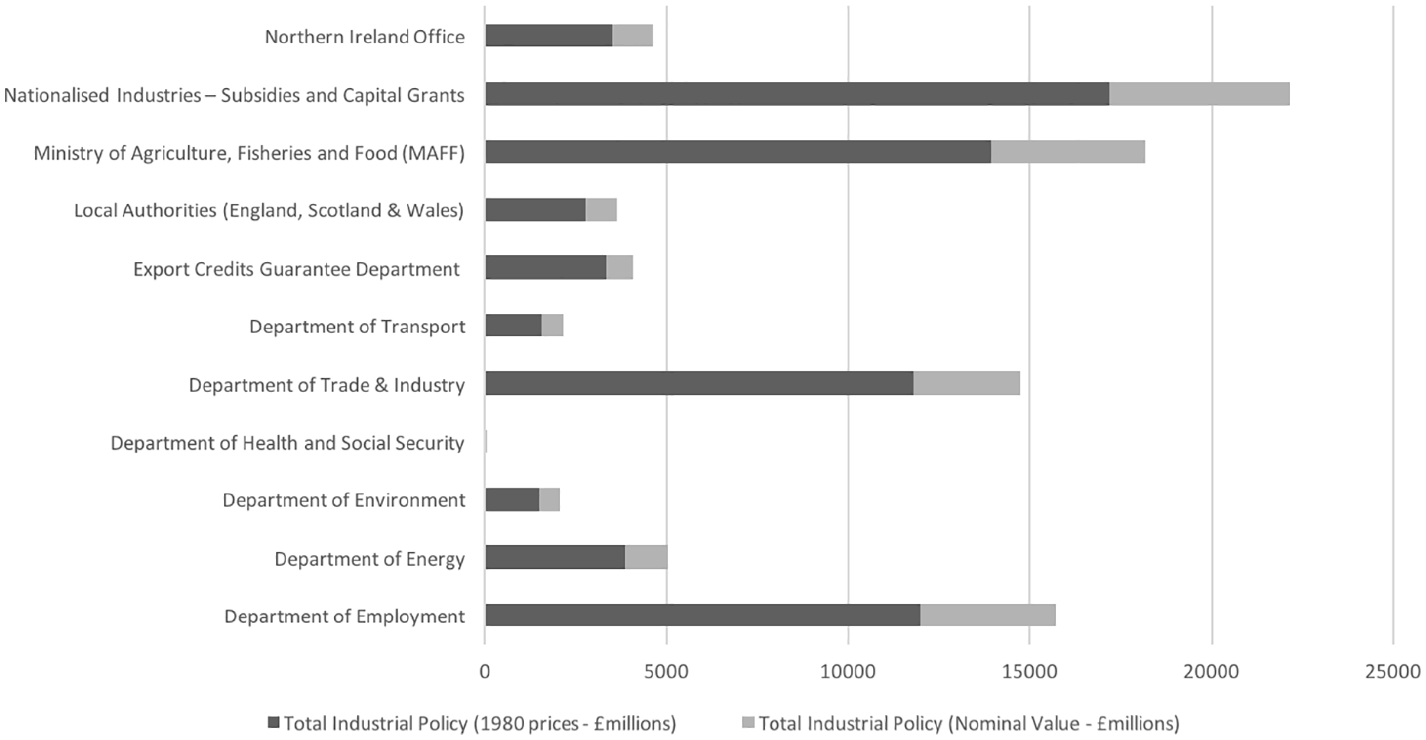
Industrial policy by government department, 1979–1990.
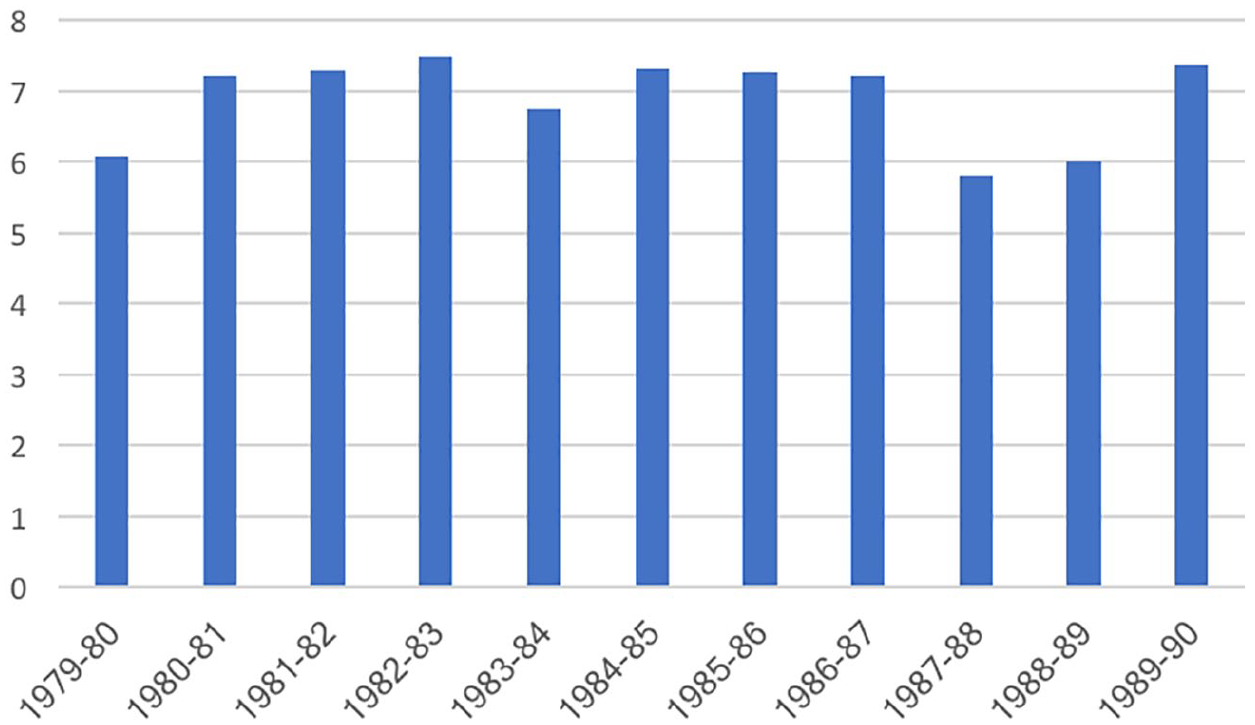
Industrial policy as a percentage of total public expenditure (1980 prices).
Codified industrial policy expenditures declined precipitously (see Tables 5 and 6 in the supplementary material), with spending by the DTI (see Tables 11 and 11a in the supplementary material) and on the Export Credit Guarantee Scheme (see Table 13 in the supplementary material) falling from £1.114 billion (1979–1980) to £643 million (1989–1990) and from £411 million (1979–1980) to £218 million (1989–1990) respectively. Diminishing expenditure on codified industrial policy no doubt contributes to the perceptions of the period as a time when spending on industrial policy was decimated. This decline in spending on codified industrial policy however was offset by rises in uncodified industrial policy operating in the shadows. The Department of Transport oversaw a five-fold rise in industrial policy expenditure (see Tables 12 and 12a in the supplementary material), with the Department of Environment (264.8%) (see Tables 9 and 9a in the supplementary material), Department of Employment (60.8%) (see Tables 7 and 7a in the supplementary material), and Northern Ireland Office (69.7%) (see Table 17 in the supplementary material) posting their own dramatic increases. Elsewhere, spending on industrial policy by the Department of Energy (DoE) (see Tables 8 and 8a in the Supplementary material), MAFF (see Tables 6 and 15a in the supplementary material), and Local Authorities (see Tables 14 and 14a in the supplementary material) rose until the middle part of the decade, before dropping back to approximately their 1979–1980 level by the end of Thatcher’s premiership.
The agriculture and energy sectors, and government support for exports, exemplify how uncodified industrial policy remained integral to the neoliberal economic toolkit, and how it was amalgamated with neoliberal economic ideas to produce new directions for industrial policy.
From the outset, the Thatcher administrations adopted a contrarian stance conceptualised here as dual industrial policy. One thread of this are actions explicitly endorsed or codified as industrial policy in official government outputs. Dispensed largely, although not exclusively, by the Treasury and the DTI, codified industrial policy tasked the state with responsibility for creating prosperity for ‘all of the people . . . rather than just individual sectors, industries, or companies’. To this end, the DTI’s role was to nourish a ‘climate which promotes enterprise’ by implementing industrial policies to encourage competition, privatise and deregulate markets, and inspire confidence through provision of consumer and investor protections’ (HM Government, 1988). Hewing closely to free market principles, these codified statements were nevertheless interwoven with a second, uncodified thread of industrial policy. Referred to euphemistically as ‘structural measures’, ‘market support’ or ‘research and development’ (HM Treasury, 1990a), among others, uncodified industrial policy syphoned substantial state support towards chosen economic activities, necessarily altering the balance between economic resources in the economy. Much of this activity was quietly implemented away from the Treasury and DTI by non-economic government ministries, local authorities, and quasi-public institutions. The inclusion of these activities not only elevates the true amount of industrial policy expenditure by the Thatcher governments but also divulges an innate reliance on industrial intervention in a supposedly neoliberal economy.
Between 1979 and 1990, MAFF implemented uncodified industrial policy worth £18.180 billion (£13.930 billion 1980 prices) (see Tables 15 and 15a in the supplementary material). The most munificent policies were administered by the Intervention Board for Agricultural Produce (IBAP) responsible for day-to-day operation of market support measures, under the direction of UK Agriculture Ministers, from the EC’s Common Agricultural Policy (National Audit Office, 1990). IBAP distributed £12.376 billion (£9.308 billion 1980 prices) of financial assistance to agriculture through three schemes of market support. Intervention schemes supported market prices through purchase of key agricultural commodities. Internal market measures meanwhile involved 45 different schemes ‘to regulate and support the market’ (HM Treasury, 1990a: 8), and external trade protection was offered via the imposition of tariffs on agricultural imports from outside of the EC.
The MAFF implemented further uncodified industrial policies, under the guise of ‘domestic agriculture policy’, where policies were variously described by the Treasury as ‘structural measures’, ‘national market support’, ‘support for fishing’, and ‘departmental research, advisory services, and administration’. The intentions of domestic agriculture policy included to ‘encourage the development of efficient and competitive food and drink manufacturing’ (HM Treasury, 1990a: 4). Delivering a rationale for subsidies not conferred on many other economic sectors, Thatcher (1978) defended the industrial policy directed towards domestic agriculture telling farmers that subsidies were legitimate because ‘our farmers are being asked to compete not on equal terms, but against heavily subsidised competitors’. Collectively, these interventions ensured little ‘neoliberal’ (Grant, 2005) transformative impression was left on the industry by 1990.
Under the heading of structural measures, MAFF proffered numerous grants to domestic agriculture intended to allocate resources towards specific sectors and activities. The Hill Livestock Compensatory Allowance, for example, was paid to farms breeding cattle and sheep to ensure the ‘continuation of livestock farming in the hill and upland areas’ (HM Treasury, 1990a: 15–16). In effect, MAFF were providing subsidy to an economic activity that was otherwise proving unprofitable. Despite substantial declines in the overall value of national market support price guarantees on wool and potatoes survived. MAFF also provided support for specific national markets, including the organic food sector (Tomlinson, 2008). Between 1979 and 1990, £360 million (£288 million 1980 prices) of ‘support for fishing’ was underpinned by grants available for construction and improvement of the UK fishing fleet and R&D supported by five MAFF-operated laboratories (HM Treasury, 1990a: 22–24).
Agricultural R&D expenditure is a good example of the hybridisation of neoliberal economic ideas and uncodified industrial policy during the Thatcher period, with attempts to legitimise the latter made by appeal to the former. Directed specifically towards R&D in domestic agriculture, uncodified industrial policy ‘to support the strategic research needed to underpin the commercial development of new technologies’ was justified by the explanation that this would smooth out ‘imperfections in market mechanisms . . . [because] this work will not be undertaken by industry’ (HM Treasury, 1990a: 17). Uncodified industrial policy on agricultural R&D was labelled by the Treasury as spending on ‘departmental research, advisory services, and administration’ and ‘other agriculture and food services’. Expenditure on these activities amounted to £3.102 billion (£2.370 billion 1980 prices) between 1979 and 1990.
Only exceptionality (see Owen, 2012) is the energy sector considered a recipient of industrial policy. Nonetheless, from 1979 to 1990 the DoE expended £5.042 billion (£3.856 billion 1980 prices) (see Tables 8 and 8a in the supplementary material) on support to the energy sector. Nuclear energy was the biggest positive beneficiary of industrial policy, prompted by the desire of the Thatcher government to promote a new energy sector with which to replace the coal industry (Helm, 2003: 52). Despite the political favour granted to nuclear energy during the 1980s, the ‘redundant mineworkers’ scheme’ (RMS) at £2.339 billion (£1.671 billion 1980 prices) was still the DoE’s costliest uncodified industrial policy providing ‘social, operating and deficit grants’ to the coal industry (Lawson, 2010: 102).
Rather than labelling the DoE’s support for the nuclear industry as industrial policy, the Treasury instead referred to this as ‘nuclear research and development’. Carried out by the UK Atomic Energy Authority (UKAEA), this support, including R&D assistance in nuclear safety, fast reactor and fusion technology, and radioactive waste management, amounted to £2.047 billion (£1.661 billion 1980 prices) between 1979 and 1990. Elsewhere the UKAEA absolved the nuclear industry of the costs involved in the ‘decomission[ing] . . . [of nuclear] plants and manage[ment] of its radioactive waste in a safe and environmentally acceptable manner’ (HM Treasury, 1990b: 12–15). In essence, the DoE was defraying the cost of tasks critical to the production of nuclear energy.
The oil, gas, coal, and renewable sectors meanwhile received £415 million (£326 million 1980 prices) under the heading ‘non-nuclear research and development’. Backing for oil and gas R&D aimed to achieve ‘advanced offshore technological capability’ so that the industry could ‘compete . . . on the UK Continental Shelf and in world markets’. The Offshore Energy Technology Board identified four priority areas where R&D ‘could open up new market opportunities for UK companies’ of subsea production (81 projects at a cost of £6.721 million, 1984–1989), exploration technologies (14 projects at a cost of £2.073 million, 1984–1989), drilling and production technologies (19 projects at a cost of £3.660 million, 1984–1989), and topsides weight and cost reduction (6 projects at a cost of £346,000, 1984–1989). The intention of assistance for renewable energy meanwhile, as described by the Treasury, was to ‘promote the commercialisation of those technologies which are economically attractive’ such as solar energy and biofuel technologies and to mitigate risks associated with ‘those technologies currently classed as promising but uncertain’ such as wind, tidal, geothermal, and inshore wave energy (HM Treasury, 1990b: 5–9).
Ordinarily the prevailing narrative surrounding the Thatcher governments’ privatisation and subsequent re-regulation of the energy market drowns out discussion of industrial policy (Helm, 2004), but it exemplifies how seemingly contradictory ideas about industrial policy were reconciled. The rhetoric of privatisation traditionally emphasised the neoliberal virtues of competition and efficiency but, as Secretary of State for the DoE, Peter Walker (1991: 190) subsequently claimed, part of the rationale for privatisation of British Gas as a private sector monopolist was to create ‘a powerful British company’ that could ‘compete around the world’. A further example of hybridisation within industrial policymaking of the period is therefore uncovered in which codified industrial policy in the form of privatisation was used as a cover for intervention to boost the competitiveness of a specific firm or sector. Such an amalgamation of neoliberal economic ideas and uncodified industrial policy is further evidenced in the 1989 Electricity Act, which transferred electricity suppliers from public to the market realm. Realising that ‘no private sector company would ever build a nuclear station without some artificial inducement’ (Lawson, 2010: 149), the Treasury inserted into the legislation the Non-Fossil Fuel Obligation (NFFO). This obligated the newly liberated electricity providers to purchase a portion of their supply from nuclear or renewable sources, guaranteeing ‘Britain’s ailing nuclear industry a market at premium prices’ (Gipe, 1995: 42–44). Likewise, guaranteed prices for renewable energy under the NFFO was indispensable to the growth of the nascent wind energy industry (Walker, 1997).
The DTI’s Export Credits Guarantee Department (ECGD) sought to encourage UK firms to export ‘by providing credit insurance and other forms of assistance’ (HM Treasury, 1990c: 24). Direct expenditure by central government on the ECGD equated between 1979 and 1990 to £4.063 billion (£3.328 billion 1980 prices) (see Table 13 in the Supplementary material). This direct expenditure secured the underwriting of £20.9 billion worth of exports between 1983–1984 and 1989–1990 through Fixed Rate Export Finance (FREF).
The ECGD provides another example of the hybridisation seemingly contradictory ideas and policies. During the 1980s, the DTI introduced several new schemes to assist UK firms operating in international markets, especially with the promotion of exports. These uncodified industrial policies, in support of a specific form of economic activity, sat comfortably with neoliberal ideas to promote the competitiveness of British firms in world markets. Introduced in 1980, the Exchange Risk Guarantee Scheme (ERGS) sought to insure UK exporters against foreign exchange risk. As of March 1990, £970 million of loans were guaranteed under the ERGS, on which the cumulative expenditure loss to the Treasury stood at £92 million (Joint Report by the Secretaries of State for Trade & Industry, Scotland, and Wales, 1990: 2). Introduced in 1986, an additional £1.694 billion of overseas contracts were guaranteed by the Tender to Contract and the Forward Exchange Supplement, which helped UK firms tendering contracts in foreign currencies to hedge against exchange-rate oscillations (HM Treasury, 1983: 20, 1984: 32, 1985: 74, 1990c: 25, 1991: 24).
Industrial policy and neoliberal resilience in the United Kingdom
The global financial crisis which began in 2007–2008 was the type of seismic event that many political economists thought should have shaken the neoliberal paradigm, commonly cited as the chief culprit, to its foundations. Far from being a watershed moment, however, the crisis provided only a brief interregnum before neoliberal norms were reasserted. This has stimulated a lively debate about the sources of neoliberal resilience (Blyth, 2013; Schmidt and Thatcher, 2014a, 2014b). Against this backdrop, the case of UK industrial policy since 2008, exhibiting a predilection for selective intervention supposedly incompatible with the ‘neoliberal coordinative discourse’ (Craig, 2015) that triumphed before the global financial crisis, sits ‘awkwardly . . . alongside a political economy literature which emphasises continuities in economic policy practice’ (Berry, 2019: 2).
To square this circle, it has been suggested that the apparent gesture towards selective industrial policy, far from being a disavowal of the neoliberal consensus, is an example of ‘a politically and intellectually non-disruptive form of policy innovation’ (Bentham et al., 2013). Berry (2019) argues the return of selective industrial policy is merely a subterfuge serving to sustain the neoliberal stranglehold. The ‘receding’ of neoliberalism inferred by industrial policy pronouncements is outweighed by a ‘reseeding’ of neoliberalism occasioned by the policy’s implementation via institutional mechanisms, spearheaded by the Treasury, prejudicing the state’s interventionist capacity. We are sympathetic to the sentiment that the United Kingdom’s elites are seeking to safeguard neoliberalism, where we depart from this analysis is in the nature of the deception. Existing analysis rests on the notion that the turn to selective intervention, for all its inhibitions, marks a departure from the pre-crisis consensus. In contrast, we submit that this reflects the preservation of the ‘dual’ industrial strategy pursued by UK governments since 1979 of which selective industrial policy was an intrinsic, if implicit, part. Far from being antithetical to the neoliberal project, selective industrial policy is crucial to its resilience, operating as part of a portfolio of ‘flanking mechanisms’ (Jessop, 2002) employed by policymakers to negate the deleterious social and economic repercussions of attempts to spread market relations into new spheres of life. The economic recession of 1980–1981 left in its wake accelerating deindustrialisation, spiralling unemployment, worsening spatial inequalities, and simmering social unrest. To compensate for this and placate public opinion, the Thatcher governments chose to quietly supplement neoliberalism with industrial policies grounded in non-market logics.
The United Kingdom’s dual industrial policy consequently speaks to neoliberalism’s knack for adapting to hostile terrain by assimilating and relabeling ostensibly paradoxical ideas and policies (Schmidt and Thatcher, 2014b). The shrewd deployment of language enabled UK governments to hide the selective parts of their industrial policy in plain sight, shielding from public consciousness the uncomfortable truth that the flourishing of certain economic sectors owed as much to state agency as entrepreneurial acumen. The case study highlighted how interloping neoliberal ideas, rather than decimating existing beliefs, interbreed with them to produce hybrids. Like their counterparts in the natural world, these mongrel offspring possess hybrid vigour that boost their survival prospects.
The hybridisation of neoliberalism in the Thatcher era took two specific forms in industrial policymaking each of which has contributed to neoliberalism’s resilience in the United Kingdom. The most straightforward of these was the perpetuation, alongside the newfound deference to horizontal interventions, of industrial policies (of the type that were traduced by the Thatcher governments in political rhetoric and official documentation) that favoured certain economic activities over others. These selective industrial policies were a mixture of those inherited from previous governments (often at sometimes drastically lower levels of funding) and those newly originated from within government departments. In this instance, codified and uncodified industrial policy played relatively discrete roles within politics and policymaking. Codified industrial policy invoked neoliberal ideas to establish a ‘technical rule’ for industrial policymaking, namely that no industry would benefit from favourable state-led intervention. This ‘technical rule’ for industrial policymaking was used by the Thatcher governments to withhold state support from industries and related communities to whom they did not wish to grant it, but also afforded space for technocratic exceptions (Best, 2018) in which uncodified industrial policy could be deployed under the radar to manage some of the tensions involved in neoliberal economy.
The second form of hybridisation speaks to the messy reality of the practical life of ideas (Best, 2020) with a more intertwined interplay between codified and uncodified industrial policy in three ways. First, as discussed in the case of R&D spending in domestic agriculture, uncodified (selective) industrial policies were justified by appeal to codified (neo liberal) economic ideas. Second, as discussed in the context of energy privatisation, codified industrial policy could be designed in such a way to ‘assist’ certain economic sectors. Third, as the discussion of export credits reveals, uncodified industrial policies were retained where they served the objectives of codified industrial policy more broadly. Consequently, seemingly contradictory economic ideas were amalgamated into new forms and directions for industrial policy.
If the dual industrial policy artifice was pioneered by the Thatcher governments, it was arguably perfected by her successors. The Major, Blair, and Brown administrations publicly persevered with neoliberal industrial policies, diligently extending the frontiers of the market through the increasingly aggressive rollout of the Private Finance Initiative and the privatisation of British Rail, electricity generation, the remnants of British Coal, and many municipal airports. This stance was corroborated by a series of White Papers that ‘broadened the scope of industrial policy, but . . . reduced its content’ to the point where it was effectively folded into competitiveness policy (Crafts, 2007). Beneath this veneer, however, UK governments maintained a parallel industrial policy that prioritised chosen economic sectors and firms. Emulating their predecessors, extensive support was forthcoming for the agricultural (Lowe and Ward, 2002), energy (Pearson and Watson, 2012), automotive (Bailey and De Rutyer, 2012), and financial services sectors. Thus, in the three decades leading up to the global financial crisis, selective industrial policy remained part of the United Kingdom’s economic policy repertoire, but much of this activity took place outside the confines of industrial policies formally declared by these governments.
In 2008, global financial crisis supplied the political oxygen necessary for the embers of industrial policy to catch aflame. The turn to industrial policy initially appeared to signal a radical departure by politicians and policymakers eager to show the electorate that they were responding forcefully to the most serious economic downturn since the 1930s. In reality, the willingness of UK politicians and policymakers to commandeer industrial policy as a centrepiece of their response reflected its status as a tried and tested thread for stitching the fraying fabric of neoliberalism. It was the May government (2016–2019) who betrayed the tension at the heart of dual industrial policy. Borrowing from the neo-liberal playbook, May’s industrial strategy averred that ‘competition, open financial markets, and the profit motive’ (HM Government, 2017: 21) were the bedrocks of the United Kingdom’s success and therefore the government’s role is to ‘ensure that the British business environment is shaped by competition’ (HM Government, 2017: 165). Nevertheless, having insisted that ‘the role of the government is not to pick favourites and subsidise or protect them’ (HM Government, 2017: 165), the document then proceeds to do precisely that through a series of ‘sector deals’ designed to nourish sectors of strategic value. Steeped with reverence for the entrepreneur the strategy nonetheless concedes that state intervention is necessary to entice investors into projects involving significant market risk. In noting that governments ‘can make long-term investments that no single commercial or academic player can take alone’ and ‘[a]n industrial strategy that avoids risk is no industrial strategy at all’ (HM Government, 2017: 22) the strategy accepted that risk taking is legitimate venture for government.
The duality of UK industrial policy was perpetuated by the government of Boris Johnson. The Treasury’s (HM Treasury, 2021) Plan for Growth, part of a wider scheme to ‘level-up’ economic growth makes the usual references to infrastructure, skills, and innovation as ingredients for a competitive business environment. Alongside this, the document presents repurposed versions of the industrial policies seen in previous decades, with examples including schemes to direct economic resources towards small and medium-sized businesses, the creation of freeports, and support for the offshore wind and hydrogen sectors. The Plan for Growth is supplemented by the announcement of a new system of Subsidy Control, which will disperse state aid to firms and economic sectors. Under this system, state aid would ‘facilitate strategic interventions to deliver government priorities’ while ‘maintain[ing] a competitive and dynamic market economy . . . the Government does not intend to return to the 1970s approach of government trying to run the economy or bailing out unsustainable companies’ (BEIS, 2021: 9).
All that really changed after 2008, therefore, was the explicit acknowledgement of the duality implicit in UK industrial policy since 1979. For instance, many of the industries touted as potential beneficiaries of state assistance in industrial policy documents over the last decade (see, for example, Department for Business Innovation and Skills, 2012; HM Government, 2017) including nuclear, automotive, aerospace, and construction sectors are almost carbon copies of the Thatcher era. We posit that prior to 2008, paeans to the sanctity of the market were a conjuring trick designed to distract attention from selective industrial policy practices. The public incorporation of selective intervention into post-crisis industrial policy has facilitated a second subtly different subterfuge. By placing a handful of carefully chosen sectors in the spotlight, the industrial strategies promulgated since 2008 conveniently places an array of uncodified industrial policy interventions deeper in the shadows.
Conclusion
In re-examining history of the UK industrial policy since 1979, this article suggests that reports of its demise are greatly exaggerated. Indeed, operating largely in the shadows, we have demonstrated that selective industrial policy remained intrinsic to Thatcher’s neoliberal statecraft. In doing so, this article makes a three-fold contribution. First, and conceptually, it has introduced the notion of a dual industrial policy to illuminate the idiosyncratic nature of UK industrial policy since 1979. By obsessing over official statements, most analyses of UK industrial policy over the past four decades have acquiesced in a state orchestrated masquerade which insists that selective industrial intervention has vanished. To reiterate, this is not to refute changes in the contours of industrial policy, nor that it became imbued with a more neoliberal complexion, but to suggest that this overall trend is only one part of the story. The United Kingdom’s free market revolution exposed many sectors of its economy to the rigours of international competition, diminishing or destroying many of them in the process, but this existed alongside more interventionist approaches, operating under other monikers, which amount to selective industrial policy by other means. Second, and empirically, by gazing beyond overt expressions of industrial policy by ‘economic’ ministries, the article has revealed that the United Kingdom’s industrial policy expenditures under the Thatcher governments were just under two and a half times higher than previously estimated. Building on previous observations that industrial policy is prepared and executed by a network of government agencies and departments (UNCTAD, 2018: 138), this article suggests the need to widen of the terrain over which industrial policy scholarship should roam. Third, and theoretically, the case of UK industrial policy yields important insights for the debate about neo-liberal resilience. The UK’s dual industrial policy lends credence to the view that neoliberalism’s resilience is tied to its mutability, specifically its ability to conscript seemingly contradictory ideas that enable it to survive and reproduce even in the most inhospitable environments. To subdue the economic and social fallout from the application of the neoliberal paradigm, the United Kingdom’s governments have repeatedly resorted to selective industrial policy. Importantly, to maintain the neoliberal façade, the assistance rendered to these firms and sectors was relabelled to avoid politically toxic references to ‘industrial policy’. These machinations repeated themselves in 2008 when, in order to avoid making any real policy concessions, UK policymakers passed off the rehabilitation of industrial policy as substantive change with the pre-crisis economic status quo. In reality, elites had merely deigned to perpetuate, and make visible to the electorate, a key component of economic statecraft that had sustained the neoliberal project from the very beginning.
Supplemental Material
sj-docx-1-bpi-10.1177_13691481221077854 – Supplemental material for What we do in the shadows: dual industrial policy during the Thatcher governments, 1979–1990
Supplemental material, sj-docx-1-bpi-10.1177_13691481221077854 for What we do in the shadows: dual industrial policy during the Thatcher governments, 1979–1990 by Richard Woodward and James Silverwood in The British Journal of Politics and International Relations
Footnotes
Acknowledgements
We would like to thank Scott Lavery, Anthony Payne, Brendan O’Rourke, Stephen McBride and the two anonymous reviewers for their perceptive comments on earlier versions of the article.
Funding
The author(s) received no financial support for the research, authorship, and/or publication of this article.
Notes

Supplementary information
Additional supplementary information may be found with the online version of this article.
References
Supplementary Material
Please find the following supplemental material available below.
For Open Access articles published under a Creative Commons License, all supplemental material carries the same license as the article it is associated with.
For non-Open Access articles published, all supplemental material carries a non-exclusive license, and permission requests for re-use of supplemental material or any part of supplemental material shall be sent directly to the copyright owner as specified in the copyright notice associated with the article.
