




Abstract
Populists in power often resort to the politicisation of foreign policy to generate domestic support. This article explores this process. First, it conceptualises populist politicisation of foreign policy. Second, it develops expectations on how such politicisation will take place: the distinctive features of populism (the intensity of populist discourse, the relative weight of anti-elitism and people-centrism, and a transnational understanding of the ‘people’ or the ‘elite’) will have an impact on how foreign policy is politicised. The empirical analysis focuses on selected public speeches and tweets by two populist leaders from the Global South: Recep Tayyip Erdoğan and Narendra Modi. The analysis reveals huge differences: the more populist Erdoğan emphasises anti-elitism and extensively resorts to the politicisation of Turkish foreign policy by constructing foreign threats. Modi is less populist and his discourse emphasises people-centrism; as expected, he only marginally politicises foreign policy, highlighting the greatness of the Indian nation.
Introduction
In recent years, we have seen the formation of populist governments all over the world. Besides the extensive existing works on the domestic drivers and consequences of populism, a growing literature has addressed populism’s implications for international affairs. This includes the impact of populist-government formation on individual countries’ foreign and security policies (e.g. Chryssogelos, 2017; Destradi and Plagemann, 2019; Taş, 2020a; Verbeek and Zaslove, 2017; Wehner and Thies, 2020). While some studies have started theorising under what conditions populism impacts foreign policy or what constitutes a genuinely ‘populist’ foreign policy, the links between populism’s domestic and international dimensions remain unspecified. In particular, we have relatively little systematic knowledge about the role foreign policy plays for populists’ efforts to mobilise support and, vice versa, the extent to which foreign policy is politicised by populist leaders and parties. This is surprising given widespread presumptions that populists from Donald Trump to Viktor Orbán habitually employ foreign threats and foreign policy as mobilising devices. Moreover, the Comparative Politics literature tells us that populists, once voted into power, tend to keep mobilising and polarising as they face a substantial dilemma: they themselves have become the much-despised ‘elite’ and need new ways to generate popular support. As a result, they are permanently on the campaign trail (Müller, 2016: 41).
Foreign policy topics might be particularly suitable to generate popular support. Electoral cycles co-determine the conduct of foreign policy in democracies, often favouring short-term considerations over long-term strategy (Quandt, 1986). The literature on the ‘rally-around-the-flag effect’ tells us that foreign policy issues and potential threats from abroad can be easily used for domestic political mobilisation (Tir, 2010). More generally, political leaders play ‘two-level games’, seeking to satisfy domestic supporters while negotiating international treaties (Putnam, 1988) or revising their countries’ grand strategies (Chryssogelos and Martill, 2021). In the case of populists in power, we might expect such links between foreign and domestic issues to be even stronger. This is so because, according to many, populism often emerges in response to distinctively international factors, 1 first and foremost the negative consequences of globalisation – real or perceived. Indeed, populism is often described as a backlash against the increasing influence of ‘international bureaucracies’ (Chryssogelos, 2019) or resentment towards Westernisation (Holmes and Krastev, 2019).
On the other hand, populism is also often portrayed as an inward-oriented strategy concerned with fighting domestic ‘enemies of the people’ rather than with the conduct of world politics. Populism, as the opposite of cosmopolitanism (Ingram, 2017), may suggest disengagement and ignorance of international issues instead of raising awareness thereof. Indeed, anecdotal evidence suggests a wide variation in the ways and extent to which populists politicise foreign policy (see below). Overall, while politicisation seems to be an important feature of the foreign policy of populist governments, there are also indications that it might be an uneven occurrence and one that certainly deserves greater scrutiny.
With few exceptions limited to the European context (e.g. Chryssogelos, 2019), the study of populist politicisation of foreign policy is uncharted territory in both theoretical and empirical terms. Thus, in this article we explore to what extent and how populists politicise foreign policy. Specifically, we ask whether and how the distinctive features of populism impact on how foreign policy is politicised. To that end, we link the literatures on populism and on politicisation and we outline a conceptualisation of populist politicisation of foreign policy. Moreover, we develop expectations about how populism’s intensity, the relative weight of its constitutive dimensions (anti-elitism and people-centrism), and the distinctive way in which the ‘people’ and the ‘elite’ are defined affect the politicisation of foreign policy. As the populist politicisation of foreign policy can have varying intensities, it is a continuous concept. Moreover, we expect a prevalence of people-centrism versus anti-elitism in populist discourse to lead to different subtypes of politicisation. Our empirical analysis focuses on the foreign policy discourses of two populist leaders who employ populist discourse to different degrees: Turkey’s Recep Tayyip Erdoğan and India’s Narendra Modi, respectively. These two case studies from the Global South promise insights into the populist politicisation of foreign policy outside the denser institutional framework of international politics in Europe, which has predominantly been the focus in the literature on politicisation so far (Hurrelmann et al., 2015). The analysis of public statements by Erdoğan and Modi shows that the two leaders emphasise different dimensions of populism and that this corresponds to a variation in the politicisation of foreign policy both in scope and content. Erdoğan’s more intense and anti-elitist politicisation feeds into a discourse describing Turkey as an underdog in international politics; by contrast, Modi’s politicisation of foreign policy is less intense and it is explicitly framed in people-centric terms, highlighting the strength of the Indian nation rather than its victimisation. In the concluding section, we outline avenues for further research focusing on the context conditions that might contribute to shaping the populist politicisation of foreign policy.
Conceptualising populist politicisation of foreign policy
The term ‘populism’ has been debated extensively in the Comparative Politics literature. In line with the now widely established ‘ideational’ approach, we understand populism as a ‘thin-centred ideology’ (Mudde, 2004: 544): a coherent but narrow set of ideas that typically coexists alongside a ‘thick ideology’ like socialism or ethnonationalism. Mudde (2004: 543, emphasis removed) defines populism as an ideology that considers society to be ultimately separated into two homogeneous and antagonistic groups, ‘the pure people’ versus ‘the corrupt elite’, and which argues that politics should be an expression of the volonté générale (general will) of the people.
Anti-elitism and people-centrism are therefore the core defining elements of populism. As highlighted in the recent literature, populism should not be understood in binary terms. For example, Hawkins et al. (2019) show that populist actors can resort to populist discourse to different degrees. The two cases we look at in more detail below illustrate this.
Like populism, ‘politicisation’ is a much-debated concept. Arguably, like other public policies, foreign affairs are always subject to politicisation, and existing discussions have revolved around the question of whether leaving foreign policy to professionals or making it the subject of broader debates within society is beneficial or detrimental to the ‘national interest’ or to democracy at large (for a position advocating for greater politicisation, for instance, in the European Union (EU), see Habermas, 2001). The politicisation of foreign policy is therefore not a phenomenon confined to populists in power, and there are strong differences in the degrees to which foreign policy in general or individual foreign policy issues are the object of public debate and, thereby, are politicised.
Conceptually, we follow Michael Zürn (2019: 977–978) in arguing that ‘[politicization], in the most general terms, means the demand for, or the act of, transporting an issue or an institution into the sphere of politics – making previously unpolitical matters political’. More specifically, with regard to national foreign policy discourse, politicisation creates or makes visible a link between foreign policy and domestic politics. This can be observed by looking at three components of politicisation vis-à-vis a given foreign policy issue: (a) if awareness of it is high or on the rise, (b) if it is used for the mobilisation of political support, and (c) if political actors use it in contestation of the policies of political opponents, rather than merely those of technocratic actors within the bureaucracy (cf. Zürn, 2014: 50–51; also see Hackenesch et al., 2021: 5–7). 2
These three components are interrelated. The higher the awareness of a certain foreign policy issue, the more attractive it is as a field for political mobilisation. After all, awareness itself is a function of an issue’s high salience to voters. However, voter salience varies dramatically across bilateral relations and foreign policy issue areas (cf. Narang and Staniland, 2018: 417–419). While there is room for manipulation by political leaders, so far we know very little about the conditions under which ‘playing the foreign policy card’ (Narang and Staniland, 2018: 419) in political campaigning is indeed a successful strategy, particularly so outside European or US contexts. Yet, mobilising voters around foreign policy issues not only hinges on their salience. In peace times at least, such issues must also allow for significant and comprehensible (e.g. non-technical) differences between opposing domestic political camps. Like its three components, politicisation is a continuous concept (Goertz, 2006: 34) – a specific foreign relation or policy as well as a country’s foreign policy generally can be more or less politicised. The comparison between our two cases illustrates this.
As said, so far there is very little research defining populist as opposed to non-populist foreign policy politicisation. A useful exception is Chryssogelos (2019), who also relies on Zürn’s conceptualisation of politicisation. With reference to Greek foreign policy during the Eurozone crisis, he further distinguishes between what he calls ‘nationalist’ and ‘societal’ politicisation. Whereas the former denotes the conventional, non-populist opposition to specific policies adopted under EU pressure, the latter describes a specifically populist politicisation that ‘challenges the very legitimacy of internationalised state elites and the state’s membership of the EU as such’ (Chryssogelos 2019: 609). Accordingly, societal politicisation is not only more radical but also more unpredictable, erratic, and ‘contingent on factors like the ideological outlook of governing parties or short-term tactical considerations of politicians dealing with more energised, vigilant and suspicious electorates’ (Chryssogelos 2019: 617). Hence, non-populist politicisation may simply reflect the growing salience of international politics in a globalised world with more domestic interest groups invested more heavily in foreign affairs. By contrast, populist politicisation necessarily includes the opposition to foreign elites or their domestic affiliates, as well as references to the pure and virtuous ‘people’, and it may challenge the conventional conduct of international affairs in more fundamental ways.
To conclude, based on the previous discussion of the concepts of populism and politicisation, we understand populist politicisation of foreign policy as the process by which a political actor 3 promotes awareness of, mobilises with, and contests alternatives to his or her foreign policy course in domestic politics by deliberately framing those foreign policy issues in anti-elitist and people-centric terms.
How populists politicise foreign policy
Populist politicisation of foreign policy can take place to different degrees and in different ways. Think of Hugo Chávez, who made anti-Americanism a core element of his populism, leading to a strong politicisation of Venezuelan foreign policy and particularly of relations with the United States. Viktor Orbán radically restructured Hungary’s foreign policy machinery by exchanging technocrats within the Ministry of Foreign Affairs with outspoken party loyalists (Visnovitz and Jenne, 2021). By contrast, other populists in power – Mexico’s Andrés Manuel López Obrador being one example here – have been less liable to politicise foreign policy. Moreover, some populists have tended to politicise foreign policy by generating fears, for example, of uncontrollable migration waves in the case of Italy’s former Interior Minister Salvini, while others like Rodrigo Duterte in the Philippines have not necessarily resorted to similar fearmongering while politicising foreign policy. How can we make sense of these variations in the populist politicisation of foreign policy?
As the examples above show, populist politicisation of foreign policy takes place to different degrees. We expect the intensity of politicisation to depend on the intensity of populist discourse. Theoretically, parts of the literature on populism argue that there is a close relationship between populism and politicisation. While Pappas (2019) regards the politicisation of popular resentments as a central mechanism of populism, Brubaker (2017: 367) considers ‘the antagonistic re-politicization of depoliticized domains of life’ one of its inherent elements. Indeed, foreign policy can be particularly suitable for populist politicisation. External notions of threat may be linked to the identification of domestic elites, thereby using foreign affairs for mobilisation purposes (Breeze, 2019). Populism’s reliance on anti-elitism also makes targeting supranational or foreign elites such as EU bureaucrats or Western corporations an attractive strategy. Moreover, to some authors, populism is a riposte to ‘liberal internationalism’ per se (Jahn, 2018: 44), which would naturally lead populists to demonise foreign actors – from international institutions to individual countries, and the ‘West’ at large. Foreign policy issues also offer incumbents the opportunity to speak in the name of the people and the national interest vis-à-vis other countries. Whoever then dares to question their policies challenges not only the political leader but also the ‘national interest’ as well as the popular will. Therefore, foreign policy may provide particularly fertile ground for populist rulers to emphasise the ‘indivisibility of the people’.
Empirical research from the past few years shows that populists tend to centralise and personalise foreign policy-making (Destradi and Plagemann, 2019). We expect such centralisation and personalisation to also contribute to the populist politicisation of foreign policy. In fact, centralisation tends to benefit ideological hardliners over technocratic moderates – a recipe for making foreign policy more ‘political’. Personalisation, in turn, changes the ‘accountability environment’ of foreign policy (Narang and Staniland, 2018): Leaders who personalise foreign policy-making will be held more directly accountable for their respective courses of action. It is easy to see how personalisation may also increase politicisation, as the involvement of the populist leader raises awareness and, depending on the individual in question, may be used for mobilisation purposes – as, for instance, in the Trump administration’s conduct of relations with Mexico. More generally, many of the issues populists problematise (e.g. migration or the influence of multilateral organisations like the EU over domestic policy-making) can only be resolved by way of resorting to foreign policy. Hence, a populist capture of a selection of foreign policy issues appears almost unavoidable. There are therefore a range of theoretical arguments that lead us to expect that the more populist a government is, the more it is prone to politicise its foreign relations.
The second aspect we are interested in concerns the way in which populist governments politicise foreign policy. To find out, one possible avenue is to look in greater detail at the features of populist discourse itself. While anti-elitism and people-centrism are two sides of the same coin, they can be emphasised to different degrees by populist leaders. In our endeavour to study the different facets of populist politicisation of foreign policy, we therefore highlight the multidimensionality of populism and suggest dissecting its two constitutive components (anti-elitism vs people-centrism) and their respective effects (see also Meijers and Zaslove, 2021). Depending on which element prevails, we expect populist politicisation of foreign policy to take different forms. In particular, if anti-elitism dominates, this might imply a populist leader’s efforts at generating awareness, at mobilising followership, and at contesting domestic opponents’ foreign policies by resorting to a narrative of oppression at the hands of ‘elites’, taking an ‘underdog’ approach to international relations along with adopting a fearmongering siege mentality (Taş, 2020b). By contrast, if populists prioritise people-centrism over anti-elitism and thereby primarily highlight the virtues of the ‘true people’ as opposed to the elite, we can expect them to underscore the greatness and strength of their nation when they talk about foreign policy. Correspondingly, populists who privilege people-centrism can be expected to politicise foreign policy in more ‘positive’ terms, by adopting a foreign policy discourse focused on emotions of hope and aspirations to global standing (Taş, 2020b). These populist leaders will generate awareness, mobilisation, and contestation of foreign policy issues by highlighting the greatness and the achievements of their ‘people’ in world politics. Through our explorative research we account for such different emphases on individual components of populism and we assess to what extent they are reflected in different discursive strategies of foreign policy politicisation.
Finally, our research explores to what extent the very definition of the ‘people’ versus the ‘elite’ might lead to different ways of politicising foreign policy. As the literature on the ideational approach to populism has shown, the ‘people’ and the ‘elite’ are discursively constructed by populist leaders and filled with meaning in each specific case. For Trump, the Washington establishment was the elite that had betrayed the hard-working American people; for Duterte, it was ‘imperial Manila’. Similarly, the ‘people’ can be defined in nativist terms, or by excluding specific minorities (from religious ones to social groups like drug addicts in the Philippines); or it can rather be understood in transnational terms, as in the case of left-wing populist leaders in Latin America. We argue that specific understandings of the ‘people’ and the ‘elite’ will lead to different ways of politicising foreign policy. Populist leaders who conceive of the elite and/or of the people in transnational terms will be more prone to politicise foreign policy as compared to those who primarily see the elite and the people as domestic actors. If the source of all evils is located abroad (as in the case of the United States for left-wing populists like Chávez), the politicisation of foreign policy will be an almost immediate consequence. Similarly, if the ‘people’ whose will a populist government claims to embody is scattered beyond national borders, this very claim of representation will lead to a deep connection between domestic politics and foreign policy.
Case selection and methodology
Considering the pivotal role of individual leaders in the supply side of populism, we focus on populist leaders as agents of politicisation – asking whether and how they transport foreign policy issues into the sphere of domestic politics. Adopting a most similar systems design, we empirically explore and compare two cases of populist leaders from so-called emerging powers in the Global South: Erdoğan in Turkey and Modi in India. Both politicians are widely referred to as populists following the ideational understanding of populism adopted in this article (Destradi and Plagemann, 2019; Göksel, 2019; McDonnell and Cabrera, 2019; Öniş and Kutlay, 2020; Taş, 2020a, 2020b). Both endorse thick ideologies of the religious right: Muslim nationalism in the case of Erdoğan and Hindu nationalism in that of Modi (Jaffrelot, 2021; White, 2013). Both leaders have also habitually expressed a sense of foreign policy exceptionalism based on their countries’ supposedly superior cultural-religious heritage (Nymalm and Plagemann, 2019). Despite these similarities, a comparative analysis by Team Populism shows that Erdoğan and Modi resort to populist discourse to different degrees. On a scale of 0–2, Erdoğan’s discourse has a score of 1.5 (between ‘populist’ and ‘very populist’) for the years 2014–2018, while Modi’s discourse has a score of 0.5 (‘moderately populist’) for the years 2014–2019 (Lewis et al., 2019). 4 This divergence in the intensity of populism between two otherwise similar cases makes them particularly suitable for testing the explanatory power of our expectations on the intensity and the features of populist politicisation of foreign policy.
For our empirical analysis, we chose the method of qualitative content analysis, which allowed us to systematically assess the two leaders’ public discourses while ensuring validity and reliability (Schreier, 2012). We generated our own text corpus, collecting speeches directed at home audiences since we were interested in whether and how references to foreign policy were brought into the realm of domestic affairs. The longitudinal range of the qualitative data spans from 2014 to 2019. In 2014, not only Modi ascended to power in India, but also Erdoğan’s populism intensified in the aftermath of the anti-government Gezi Protests. Besides speeches, we also analysed selected tweets (see below) as research on populism has shown that populist discourse may vary across media and formats (Hawkins et al., 2019).
Our text corpus consists of two sets of speeches and tweets by Erdoğan and Modi. Upon becoming prime minister in 2014, Modi introduced his monthly Mann ki Baat (MKB – Inner Thoughts) radio speeches. These represent Modi’s attempt to speak directly to and with the people, for example, by responding to individual citizens’ concerns communicated ‘directly’ to him via mail, email, telephone, or his ‘NaMo App’. These regular radio addresses were targeted at the majority of Indians of all ages and backgrounds. We included in our text corpus all MKB speeches given until the end of 2019. Besides these monthly speeches, we compiled Modi’s annual Independence Day speeches in the same period. 5 Finally, we also selected foreign policy–related tweets from Modi’s personal Twitter account. As Modi is a prolific twitterer, for pragmatic reasons we narrowed down the data around four specific episodes, 6 each of which involved security challenges related to India’s arch-enemy Pakistan, arguably the most pressing foreign policy issue for India with high domestic salience (2–21 January 2016 after the attack in Pathankot; 18 September–4 October 2016 after the attack in Uri; 14 February–15 March 2019 after the attack in Pulwama in Kashmir; and 5–31 August 2019, following the revocation of the autonomy of Jammu and Kashmir).
Similarly, the Turkish case study relies on two sets of speeches as well as on tweets by Erdoğan. The first set of textual data includes Erdoğan’s annual speeches at the opening session of the new legislative year for the Grand National Assembly of Turkey. The second set covers a random selection of Erdoğan’s addresses at the weekly party-group sessions in parliament and weekly mukhtar (head of neighbourhood) meetings at the Presidential Palace (one for every month). 7 Both annual and weekly speeches are regularly broadcast live via numerous pro-government television channels simultaneously, reaching millions of viewers. These two sets are enriched with a collection of Erdoğan’s tweets in the same time period. While Erdoğan once called Twitter the worst menace to society, he later took control of his account on the platform – personally posting his first tweet on 9 February 2015 (Hürriyet Daily News, 2015). The focus of the analysis is on tweets related to the Syrian civil war, arguably the most salient foreign policy and security issue in the years 2014 to 2019. With tweets on Syria and Pakistan we chose two foreign and security issues that already possess high salience and visibility in Turkish and Indian public debates, respectively. Thus, in contrast to the analysis of speeches, findings from our Twitter analyses say little about whether populists turned previously un-politicised foreign policy issues into politicised ones. However, including social media data was important for our exploration of degrees and varieties of politicisation, and we presumed particularly instructive findings in matters of high voter salience. Moreover, the importance of social media for populist leaders can be seen in the sheer number of tweets both leaders send out.
The research rests on computer-assisted (MaxQDA) manual coding, which is time-intensive but particularly useful when dealing with both manifest and latent meaning within qualitative data. To keep coding reliable, consistent, and accurate, we not only generated our coding guidelines and held two training sessions, but also checked each other’s coding at both preparation and organisation phases to minimise cognitive biases. Based on the above-mentioned theoretical considerations, our codes were generated deductively. Specifically, our coding proceeded in three steps. First, we coded for foreign policy–related content (code: FP). Second, within the sections on foreign policy, we coded for populist content (code: PFP). In line with our understanding of populism outlined above, the main node of populist foreign policy has two interrelated but analytically distinct sub-categories: anti-elitism (any statement targeting an evil or corrupt elite; code: PFP anti-elitism) and people-centrism (any claim to speak in the name of the ‘people’ or unified ‘we’, depicting belief in the popular will; code: PFP people-centrism). In a third step, we coded for the politicisation of foreign policy. As outlined above, politicisation entails three distinct sub-categories: awareness, mobilisation, and contestation. We accounted for attempts to raise the public’s awareness of foreign policy by looking for an intensification of references to the latter over time. 8 We coded mobilisation as calls for mass support for the government’s foreign policy efforts or calls to domestic actors for supporting the nation against foreign enemies and/or their domestic affiliates (code: P mobilisation). For contestation, we look for instances in which the leaders evocate cleavages between their government’s foreign policy and that of past governments and/or the positions of domestic political opponents (code: P contestation).
Erdoğan and the politicisation of foreign policy
Throughout the two decades and counting of Justice and Development Party (AKP) rule, populism in Turkey has taken on different hues. Especially after 2015, when the Kurdish peace process fully shattered, the notion of the people in the AKP’s populism exclusively referred to the Muslim/Sunni Turkish nation (Taş, 2020b). Gradually, the can-do spirit arising from the people-centrism in early AKP populism ‘to make Turkey great again’ would be replaced by a predominantly anti-elitist discourse and a concomitant narrative of victimhood depicting the Muslim Turkish nation as under assault from Western powers and their domestic collaborators (Özpek and Yaşar, 2018). After the 2013 anti-government Gezi Protests, the AKP resorted to such an increasingly conspiratorial populist discourse. To consolidate its conservative base amid growing social discontent, the government began depicting Turkey as being in a liberation war against imperialist Western powers, crusaders, and global financial lobbies, all combined under the umbrella term ‘mastermind’ (‘üst akıl’) – a ubiquitous conspiratorial power determined to divide and conquer the country, using its domestic pawns.
Our analysis of Erdoğan’s speeches confirms this broad assessment. In total, 19.9% of the total text corpus (150,147 words) referred to foreign policy (FP), and of those statements 39% was framed in populist terms (PFP). In turn, anti-elitism represented 75.6% of populist foreign policy statements. Our qualitative analysis of the text corpus plus the Twitter data reveals that, blaming the invisible, anti-elitism clearly entails an international dimension, which automatically contributes to populist politicisation of foreign policy. According to Erdoğan, the Turkish nation shows ‘its loyalty to its future and independence in the face of the attempts by others [i.e., Western powers] to bring us to our knees by employing various terrorist organizations such as the PKK, DAESH and FETO’ (Erdoğan, 1 October 2019). Within the data considered here, all of Turkey’s foreign policy initiatives were presented in such a Manichean framing that renders the multiplicity of actors and events into the binaries of the oppressed, good people and the oppressive, evil international elite. Its operations in Northern Syria, for instance, were defended as ‘fighting against oppressors and terrorists’ (Erdoğan, Twitter 16 October 2019). For Erdoğan, Turkey had ‘to crush the head of the snake’ (Erdoğan, Twitter 21 January 2018) for its own survival and be present wherever needed for both its own future and that of its sister nations.
While manufacturing the ‘elite’ as an outside actor renders foreign policy more relevant to domestic politics, the increasing politicisation has taken the form of a victimhood narrative. When it comes to the individual components of populist politicisation of foreign policy, generating awareness was not reflected in a growing number of references to foreign policy over time in the years 2014–2019. In qualitative terms, however, we see a growing urgency in Erdoğan’s discourse, clearly aiming at building awareness around the country’s ‘war of liberation’ on multiple fronts – from Libya to Syria. Framing the Syrian war as another plan of imperialist powers to divide and conquer the Middle East, Erdoğan argued that ‘Very insidious, evil and bloody games are being played over both our region and country today, too. The thing I call “[master]mind” is confronting us every day with new tricks’ and ‘Our War of Independence was the answer our nation gave to this scenario’ (Erdoğan, 14 December 2016). According to this narrative, Turkey’s fate was tied to the region as a whole and its military operations abroad became part of its struggle for independence. The ontological insecurity deliberately cultivated by such tensions around ‘the survival of the nation’ (milletin bekası) demands a strongman willing to break the rules. Moreover, this emphasis on existential foreign threats relates to the challenges to AKP rule at home since the 2013 Gezi Protests. Citing tensions abroad performs a diversionary function then, distracting from a faltering economy and the wider loss of popular support – which eventually led to the AKP losing both its absolute majority in parliament and a number of major municipalities in the 2019 elections.
When it comes to mobilisation, the data confirm our expectations: in the speeches, in 13.6% of paragraphs referring to populist foreign policy, Erdoğan resorted to mobilisation. He discursively assigned his people the historic mission of defending their country, the last fortress of Islam. Accordingly, being the heir to Ottoman civilisation brings great responsibilities for those living in former Ottoman territories (Erdoğan, Twitter 01/10/2019). Thereby the people versus elite dichotomy is extended beyond national boundaries, depicting Turkey as a protector of oppressed nations against cruel global-elite powers: There is great affection as well as hope with respect to our country in regions where we have close historical, cultural and social ties. It is possible to respond to such affection with some words of thanks, but hope translates into bigger responsibilities for us. Therefore, we cannot turn our backs on Iraq, Syria, the Caucasus, Central Asia, the Balkans and Eastern Europe. Neither do we have the right to turn a blind eye to North Africa, Central Africa and South Asia. (Erdoğan, 1 October 2017)
Such a call for duty alongside emotive language echoes well among Erdoğan’s audience. Responding to the exaltation of martyrdom in his speeches, for instance, his supporters cheered ‘Chief, take us to Afrin’ to show their readiness to fight in Syria. In one of those speeches, a 6-year-old girl in military uniform took the stage on the invitation of Erdoğan, who said: ‘If she's martyred, they'll lay a flag on her, God willing [. . .]. She is ready for everything, isn't she?’ (BBC, 2018). Contesting the contractual citizenship model of modern nation states, this securitised agenda calls for the people working for the survival of their state (rather than vice versa). Per this rationale, Erdoğan rhetorically declared ‘national mobilization’ against all terrorist organisations at home and abroad and suggested every citizen cooperate with the security forces (Erdoğan, 14/12/2016).
Finally, foreign policy issues are frequently used in antagonisms drawing the lines of inclusion and exclusion and creating the political frontiers at home (contestation, which was coded in 15.9% of paragraphs referring to populist foreign policy in Erdoğan’s speeches). Whoever dares to challenge Turkey’s military interventions in the region is thus accused of not belonging to the people and collaborating with the imperialist powers. Referring to Turkey’s Liberation War (1919–1922), Erdoğan drew a parallel between the current opposition and those who defended the Treaty of Sèvres (1920) – the peace agreement envisaging the division of the Ottoman Empire along ethnic and religious lines (Erdoğan, 14 January 2020). Such de-contextualised historicising asserted that history in the form of a fight of good versus evil repeats itself. In other instances, Erdoğan accused the opposition parties CHP, HDP, and the Good Party of supporting Kurdish terrorism because of their divergent approaches to the ‘Syria Question’ (Erdoğan, 5 February 2019).
While anti-elitism has informed much of Turkey’s foreign policy discourse, ranging from the Syrian war to relations with the EU to the Eastern Mediterranean gas dispute, 9 Erdoğan has adopted different narratives in other policy fields. For instance, Turkey’s Africa policy was largely framed in terms of people-centrism, which depicts the Turkish nation as a blessing for the continent without colonial past or ambitions. Within this ‘Turkey is not like others’ approach, Erdoğan repeatedly argued that Turkey views Africa ‘from a humanitarian and conscientious perspective, not from the perspective of politics, strategies or interests’, as they both ‘share a common fate’ (i.e. European imperialism) (Erdoğan, 28 October 2020). Accordingly, Turkey then re-enacts its past Ottoman role as ‘virtuous power’ on the African continent. Apart from these diverse forms of politicisation, Turkey’s foreign policy towards China, for instance, does not exhibit any kind of politicisation at all. Despite the dominant religious and nationalist motifs in Erdoğan’s discourse, the Chinese suppression of Uyghurs, a Muslim Turkish minority, has not even been addressed – one early explicit exception in 2015 aside (Erdoğan, 9 July 2015).
Modi and the politicisation of foreign policy
The analysis of Modi’s speeches and tweets shows entirely different results as compared to the Turkish case. Of the total text corpus of 215,964 words, only 4.6% were devoted to foreign policy issues. Of those statements, 37.1% were framed in populist terms. When it comes to the two components of populism, Modi clearly emphasised the people-centric dimension. The radio speeches were declaredly apolitical (MKB, November 2018), focusing on a broad range of topics related to everyday life of ordinary people – from weather conditions to school examinations. Throughout his speeches, Modi highlighted national unity and the beauty of India’s cultural diversity – even resorting to the trope of ‘unity in diversity’ (e.g. MKB, 12/2018). In line with people-centrism and the claim to embody the popular will, Modi defined himself as ‘the Pradhan Sewak – the Chief Servant of the people’ (MKB, 05/2017) and claimed: I am merely an instrument. It is not one single person who makes that address, but it is the collective voice of 1.25 billion of my countrymen that resounds from the Red Fort. I try to give words to their dreams [. . .]. (MKB, 08/2017).
Importantly, such people-centrism was only rarely accompanied by explicit anti-elitism in text segments referring to foreign policy. Of the statements coded as PFP, 89.8% contained references to people-centrism, and only 10.2% to anti-elitism. The latter were framed in very moderate tones, as in this statement trying to depict Modi as a common man and a pilgrim instead of a diplomat: I had the opportunity to visit South Africa for the first time some time back. During a foreign visit, diplomacy is practiced, there are trade deliberations, discussions about security and as is customary, many MoUs are concluded. But for me the visit to South Africa was more like a pilgrimage. (MKB, 07/2016)
On his Twitter account, in contrast, Modi was more openly anti-elitist, as in the following example: India is united when it comes to fighting terrorism. India is proud of our armed forces and the nation trusts the forces. 130 crore Indians have seen through the dirty politics of a handful of Opposition parties on national security! (Modi, Twitter 8 March 2019)
Anti-elitism was at times framed in terms of deliberate conspiracies, such as ‘the conspiracy of keeping the farmers poor as always’ (MKB, 03/2015), while corruption and ‘black money’ were presented as evils against which to fight a ‘war’ (MKB, 12/2016). However, both the ‘people’ and the ‘elite’ were always conceptualised in domestic terms. Moreover, in most speeches Modi put emphasis on being constructive and not divisive, painting the picture of a unified and strong India rather than highlighting differences and tensions. While observers agree that Modi’s government has promoted a divisive discourse and a majoritarian Hindu culture to the detriment of minorities (e.g. Jaffrelot, 2021; Varshney, 2019), this is barely reflected in the prime minister’s radio addresses; instead, such discourse takes place through other channels (see below).
As outlined above, foreign policy consistently played a marginal role in Modi’s radio addresses, with no increased efforts to raise awareness during the period analysed (the references to foreign policy in Modi’s MKB speeches stagnated over the period analysed). The most frequently mentioned foreign policy issues were India’s promotion of the International Day of Yoga (e.g. MKB, 03/2017), Indian successes in space technology and its international collaborations in this field (e.g. MKB, 06/2017), or India’s contributions to United Nations peacekeeping operations (e.g. MKB, 10/2017). Other issues mentioned in Modi’s radio speeches included things like the launch of a ballistic interceptor missile (MKB, 02/2017) or brief references to the visits of foreign dignitaries.
Foreign policy issues were nevertheless related to the populist elements in Modi’s discourse, as they were frequently presented as achievements or attributes of the people, in line with the ‘strength of the nation’ frame. By contrast, Modi never resorted to ‘underdog’ rhetoric. Indian culture was presented as a model emulated in other parts of the world, for example, in references to global Diwali celebrations (MKB, 10/2016). Moreover, Indian initiatives in different fields of global governance were presented as a natural consequence of the country’s core values – such as its peace-loving tradition (UN peacekeeping, MKB, 10/2017) or its respect for the environment (climate change mitigation, MKB, 05/2018).
While on domestic issues – from agriculture to sanitation – Modi’s radio speeches are full of exhortations and calls for action, references to foreign policy include only few elements of mobilisation (20.3% of populist statements on foreign policy in Modi’s speeches) and contestation (only 3% of populist statements on foreign policy in Modi’s speeches). Even after high-profile incidents such as an attack by Pakistan-sponsored militants on an Indian military base in Uri, Kashmir, in 2016, Modi in his radio address did not explicitly attack Pakistan but called for ‘constructive’ contributions by the population: We recently lost 18 brave sons of our country in a terrorist attack in Uri Sector in Jammu and Kashmir [. . .]. There are strong emotions of widespread grief as well as anger across the country. [. . .] The guilty will certainly be punished. [. . .] I shall also like to add that the anger in the hearts of our countrymen is of a very high value. It symbolises our national consciousness. [. . .] Now, if all of us [. . .] make some constructive contribution imbued with the feeling of patriotism, our country will most definitely scale greater heights. (MKB, 09/2016)
Overall, therefore, the Indian case reveals that a relatively moderate populist discourse, with the ‘people’ and the ‘elite’ defined in domestic terms and an emphasis on people-centrism, was accompanied by an only extremely limited politicisation of foreign policy in the prime minister’s public addresses. The few foreign policy issues that were addressed were framed in terms of the strength of the nation, and Modi did not resort to an underdog discourse. Instead, he highlighted the achievements of India and the value (and moral superiority) of the country’s traditions.
Analysis: Variation in the populist politicisation of foreign policy
Our empirical analysis had the goal to explore the features of populist politicisation of foreign policy. Our empirical analysis indeed reveals interesting differences in the politicisation of foreign policy by populist leaders, which can be drawn back to the distinctive features of populism in the two cases, especially its intensity, the relative weight of its constitutive components (anti-elitism vs people-centrism), and the way in which the ‘people’ and the ‘elite’ are defined. As emerges from the analysis above, the two leaders differ in the extent to which they politicise foreign policy in public discourse. First of all, foreign policy issues take up very different shares of the text corpus of Modi’s versus Erdoğan’s speeches (Figure 1).
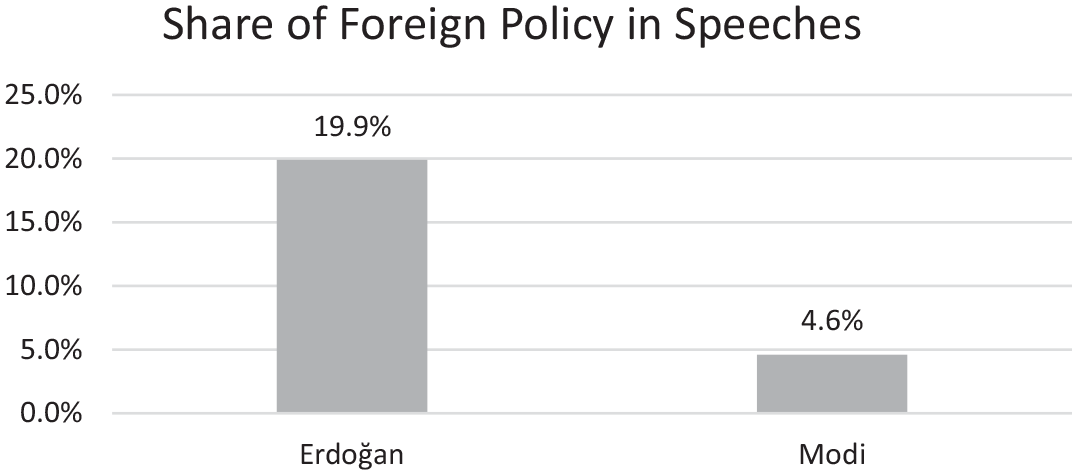
Share of foreign policy issues (FP) in speeches analysed.
Moreover, the qualitative analysis reveals that the kinds of issues addressed differ in a fundamental way. Despite ongoing conflicts with a nuclear-armed arch-enemy (Pakistan) and a regional rival (China), in the case of India, foreign policy issues were addressed in an almost apolitical and consistently positive way. By contrast, Erdoğan’s references to foreign policy were expressed in nearly apocalyptical tones entailing a high degree of mobilisation and contestation and thereby a much more pronounced politicisation. We found the differences so striking that we expanded the analysis of the Indian case beyond Modi’s supposedly ‘apolitical’ radio addresses and also coded his yearly Independence Day speeches. Here too we found few references to foreign policy, and practically no politicisation. This does not mean, however, that Modi refrains from politicising foreign policy altogether. In fact, his much more combative speeches at election rallies frequently include the politicisation of foreign policy issues, as was the case shortly before parliamentary elections in 2019: I am astonished that when the entire nation is standing with the Indian army, there are a few people who are suspecting the army itself. On one hand, the entire world is supporting India in the war against terrorism, while a few parties doubt our fight against terrorism. These are the same people whose statements and articles are being used by the Pakistani Parliament, radio and television channels against India. These people have turned into anti-national from being anti-Modi. They are harming the nation. (Modi, 2019)
Another sphere of politicisation that is not reflected in our data is Modi’s proactive cultivation of India’s diaspora (Plagemann and Destradi, 2019) – arguably a group that had been marginalised in India’s foreign policy establishment but now forms a strong part in the societal coalition that sustains Modi’s power (also see Chryssogelos and Martill, 2021). Nonetheless, the relative irrelevance of foreign policy issues in Modi’s speeches to the widest audiences is telling. Thus, we find substantial support for our expectation that the more populist a leader’s discourse is, the more he or she politicises foreign policy.
Besides differences in the intensity of populism, the relative weight each leader accords to the two constitutive elements of populism, per the ideational understanding of it, also clearly differs (Figure 2).
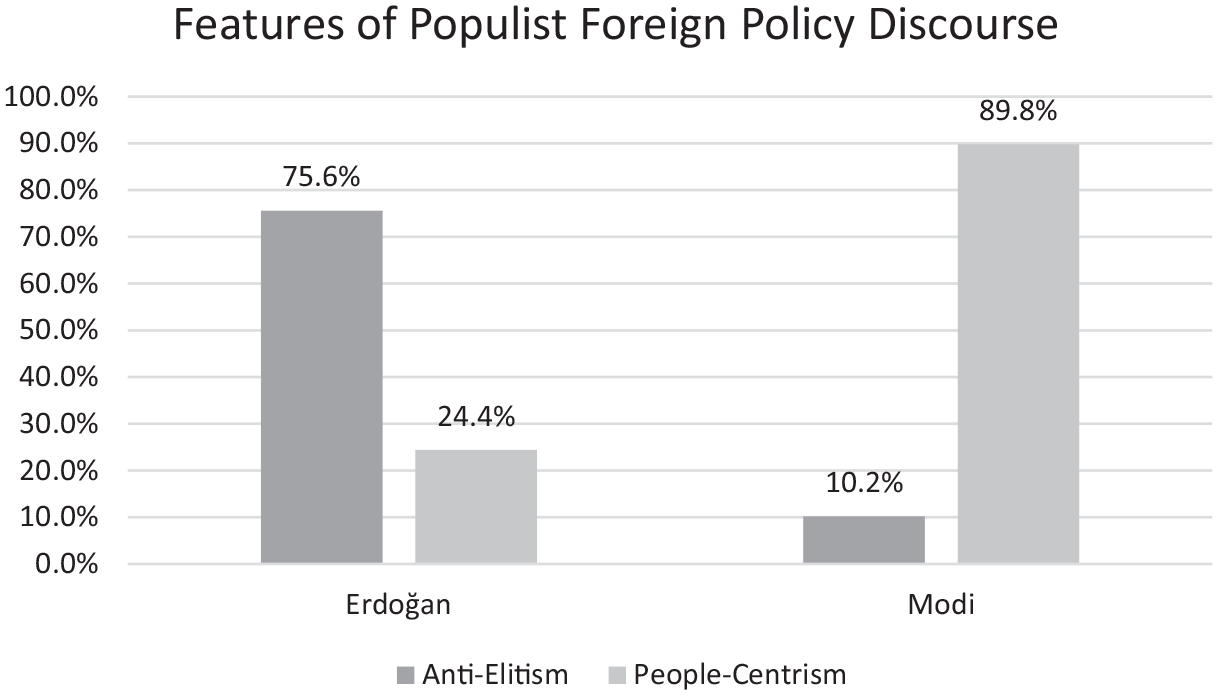
Shares of anti-elitism and people-centrism in statements coded as PFP.
Modi’s emphasis on people-centrism highlights his country’s strengths and greatness, rather than foreign adversaries or threats. Whereas references to fraught relations with China or Pakistan – or to any other imminent foreign policy issue – are virtually absent, Modi habitually mentions the International Day of Yoga as a major example of India’s rich contribution to the world. Tellingly, ‘China’ and ‘Pakistan’ are mentioned a mere seven times each in the entire MKB corpus. By contrast, ‘Yoga Day’ is mentioned 42 times and discussed in much greater detail. Modi’s Independence Day speeches also follow this pattern.
Overall, Erdoğan exhibits a populism that is both more intense and more anti-elitist, while also articulating a foreign policy discourse that stresses Turkey as a victim of malign foreign forces. In his conspiratorial rhetoric, Erdoğan uses ‘the mastermind’ as an all-encompassing term capturing Western imperialists, transnational lobbies and actors like investor George Soros, against all of whom Turkey is fighting a ‘war of liberation’ (Erdoğan, 30 October 2019). With this narrative of wronged Turks against the Western imperialist elite, he taps into the persistent ‘Sèvres Syndrome’: the popular belief that Western powers are seeking to bring down and invade Turkey (Erdoğan, 14 December 2016). Adopting an ‘underdog’ approach to foreign relations, he generates fear among his followers. Thriving on a shared feeling of insecurity, he intensifies latent public fears in order to create a sense of ‘we-ness’ and consolidate his base. Thus, the findings also support our expectations with regard to how the features of populism will shape the way foreign policy is politicised.
Finally, the very framing of the ‘elite’ and the ‘people’ matters in shaping the populist politicisation of foreign policy. In the case of India, the elite is defined in domestic terms and the ‘people’ is primarily understood as a national community unified by a Hindu religious identity (even though the Indian diaspora also matters in Modi’s understanding of the people). This might contribute to the much lower degree of populist politicisation of foreign policy as compared to the case of Turkey. By contrast, the AKP’s populist discourse conceptualises the elite primarily in international/transnational terms. Meanwhile, the people is understood as a monolithic entity, epitomised in Erdoğan’s infamous Rabaa motto (‘one nation, one flag, one homeland, one state’), pitted against an international elite. The clearly international connotations of anti-elitism in Turkey facilitate a more pronounced populist politicisation of foreign policy.
Conclusion: Avenues for further research
Examining two prominent cases of populism from the Global South underscores the multidimensionality of populism, understood in ideational terms, and suggests that dissecting its constitutive components (anti-elitism and people-centrism) and their respective effects is a fruitful exercise (Meijers and Zaslove, 2021). While populism itself is a politicised concept, this article sought to conceptualise the populist politicisation of foreign policy.
Populist politicisation can be conceptualised by its difference in degree that can be scaled on a continuum across its two subtypes classified here as anti-elitist and people-centric. Contrary to the bulk of academic studies considering politicisation as an either-or concept, we found that the degree of populist politicisation varies depending on the intensity of populist discourse. Moreover, the prevalence of one of the features of populism (anti-elitism vs people-centrism) ultimately leads to different types of politicisation (underdog discourse vs ‘strength of the nation’ narrative). Future research will need to delve deeper into the peculiar conditions under which populists are more or less prone to politicise foreign policy. The two case studies provide some interesting preliminary insights in this regard.
One possible factor that mitigates populists’ tendency to politicise foreign policy is the salience of foreign policy for the general public, which tends to be lower in India than it is in Turkey. Correspondingly, future research needs to explore to what extent the salience of foreign policy to voters as well as individual voter segments plays a role in inducing populists to politicise it or not. Furthermore, our two cases hint at the importance of regional contexts. For India, bordering two nuclear-armed regional rivals, Pakistan and China, demands a delicate handling of the situation. Given the power asymmetry between the two countries, politicising relations with China is risky for an outspokenly nationalist leader.
Future studies on the populist politicisation of foreign policy also need to explore whether a government’s duration in office has an impact. Interestingly, Modi resembles the early Erdoğan in his pragmatism, along with a proactive foreign policy conveying the message that his country is ready to assert itself to take regional and global responsibilities. Following his re-election as prime minister in 2007, Erdoğan incrementally adopted a more ideologically restrictive discourse. As argued by Pappas (2019) and others, populists enganger democracy. While this might be less prominent when winning power for the first time, their more radical streaks may come out gradually – potentially playing out in foreign policy as well as other domains.
In addition, our analysis points to the need to better understand the variety of forms of political communication adopted by populist governments. Modi has repeatedly demonstrated his ability to diversify his message according to his target audience (Mahapatra and Plagemann, 2019: 3). Politicisation of foreign policy issues in the more combative election rallies fits with Modi’s sophisticated communication strategy. Moreover, Modi’s own messaging should be seen in the context of the discourse of the wider Hindu-nationalist environment in India, in which the more radical and divisive messaging has been left to political allies, local politicians, and a capillary network of Hindu-nationalist organisations operating in social media as well as offline (Jaffrelot, 2021).
Finally, future research needs to address the consequences of politicisation for the actual foreign policy practice of populist governments. In the two cases analysed, the formation of a populist government had very different impacts on respective foreign policies. Whereas Modi so far has not radically transformed his nation’s foreign relations regionally or globally, Turkey’s foreign policy under Erdoğan has changed substantially. Thus, the ways in which populist politicisation of foreign policy impacts foreign policy outcomes need to be systematically examined.
Footnotes
Acknowledgements
Earlier versions of this paper were presented at IB Sektionstagung in October 2020, at the Jour Fixe of the Chair of IR, University of Freiburg, in December 2020, and at the Special Issue authors’ workshop in March 2021. We are grateful to the participants, and especially to Kai Oppermann, Egecan Hüsemoğlu, Angela Geck, Konrad Ringleb, and an anonymous reviewer at the Special Issue workshop, as well as to the anonymous referees during the review process, for their helpful feedback. We also would like to thank Sangeeta Mahapatra and Lukas Schmid for excellent research assistance.
Authors’ note
Authors are listed in alphabetical order.
Funding
The author(s) disclosed receipt of the following financial support for the research, authorship, and/or publication of this article: Sandra Destradi and Johannes Plagemann’s work on this article builds on research conducted in the context of the project ‘Populism and Foreign Policy’ funded by the German Research Foundation (grant DFG-DE 1918/3-1 and DFG-PL 797/3-1).
