




Abstract
This article examines the ways in which third countries can engage with, and respond to, European Union policy-making processes. A novel analytical framework based on the concept of network resilience which consists of an institutional, political and policy dimension is operationalised to understand third country access to European Union policy-making. Empirically, the article examines the experiences of three non-European Union countries, Iceland, the Faroe Islands and Norway in the context of the European Union’s Common Fisheries Policy. The article concludes by presenting a research agenda based on an in-depth analysis of network resilience and reflects on what the findings mean for future research, particularly within the context of understanding the development of UK–EU post-Brexit relations.
Keywords
Introduction
The European Union’s (EU) policy decisions often have spillover effects on third countries (Bretherton and Vogler, 2006). Many non-EU countries have treaties and agreements with EU institutions, and these facilitate channels for policy exchange and dialogue to manage the impact of EU policy. Yet, the extent to which third countries have access, or indeed have the strategies and tactics in place to engage with EU policy processes, are diverse and often obscured due to a lack of formalised policy spaces (Kux and Sverdrup, 2000; Lavenex, 2015; Stead, 2014). Policy stakeholders must be agile in order to navigate changing policy environments and power dynamics. In this respect, third country actors need to develop network resilience to be successful.
This article examines how third countries build network resilience in EU policy processes in the context of fisheries policy based on the experiences of policy actors in Iceland, Norway and the Faroe Islands. Fisheries is a salient policy area to examine network resilience because policy actors need to balance the territorial sovereignty of fishing waters with economic concerns (in terms of access to export markets) and environmental necessities, which require countries to cooperate internationally (Wincott, 2017). This dynamic requires policy actors to invest in resilient networks in order to manage the interests of different political and industry stakeholders. As the largest single economic market, and a major international policy actor in relation to environmental policy, the EU has a major impact on third countries, particularly those with which it shares borders and, in the case of fisheries policy, marine resources.
Against this background, the research questions that underpin this research are as follows: What have been the policy experiences of Iceland, Norway and the Faroe Islands in EU policy-making for fisheries? What learning can be drawn from these experiences in terms of third countries’ network resilience in their relations with the EU, and how do these apply to the Brexit context in the United Kingdom? To answer these questions, this article develops a novel threefold framework, consisting of an institutional, political and policy dimension to capture different dimensions of network resilience. This framework is then applied to the experiences of the three countries. The study includes 21 semi-structured qualitative interviews with key policy stakeholders.
The research findings elucidate the strategies deployed by third countries to sustain their network resilience in the face of macro-governance changes. The article provides lessons about understanding how other third countries interface with EU policy processes. As a result, the framework advanced by the article serves as a useful tool for future analyses of EU-third country relations, however it is also particularly pertinent in the case of Brexit.
Indeed, it remains in the interests of the United Kingdom to continue to build on their policy record over decades of being a key ‘uploader’ or ‘pace-setter’ in EU affairs (Burns et al., 2019; Connolly, 2014; James and Quaglia, 2020). Leaving the EU means that the United Kingdom is largely outside of the jurisdiction of the EU. Yet, EU decisions can still have an impact in the United Kingdom. This necessitates the need to work through and via more informal policy channels in order to ensure network resilience. There are several important features of fisheries policy which support a continued high level of integration between the United Kingdom and EU policy. In order to ensure legal continuity, the United Kingdom has repealed the European Community Act 1972 and temporarily transferred all EU legislation, including the Common Fisheries Policy (CFP), into UK law. These can be amended but they do serve to ensure some continuity in the short and medium term. Furthermore, the United Kingdom is required to fulfil its international obligations under United Nations Convention of the Laws of the Sea (UNCLOS) III, again ensuring continuity with previous principles. More generally, despite strong voices from within certain parts of the catching sector for full autonomy (Huggins et al., 2018), there is recognition that cooperation and negotiations between the United Kingdom, EU and other third countries need to continue and therefore a partnership between the United Kingdom (as a third country) and the EU will need to develop (Huggins et al., 2020; Phillipson and Symes, 2018).
In preparation for an examination of the policy experiences of third countries, the article considers the different dimensions of network resilience which provide the basis for the analytical framework. The empirical section of the article presents the experiences of Norway, Iceland and the Faroe Islands and how these third countries engage with, and respond to, EU decision-making processes in the context of fisheries governance. Next, we consider how the United Kingdom can learn policy lessons from these third countries in order to establish resilient networks with the EU. The theoretical implications, and avenues for future research, are considered within the ‘Conclusion’ section.
Understanding network resilience in third countries
Studies have examined the degrees of access and influence of third countries on EU policy processes (e.g. Hofmann et al., 2019; Lavenex, 2015; Leruth et al., 2019; Leuffen et al., 2012; Müller and Slominski, 2016). Resilience within, and between, networks as a response to EU policy processes is implicit within this work but no explicit conceptual framework has been developed in this field. This is surprising given that resilience and adaptability are key criteria for judging the success of policy networks (Agranoff and McGuire, 2001; Bevir and Richards, 2009; Ranchod and Vas, 2019). Bakker et al. (2012) provide an overview of the definitions of resilient networks and conclude that the most common elements of the definitions are the ability of networks to remain operational in the midst of perturbations or shocks and have ‘rebounding capacities’ in the face of exogenous change. In order to conceptualise these rebounding capacities, we propose a framework consisting of three interlocking dimensions (see Table 1) to capture network resilience for third countries. Our central argument is that an assessment of third countries’ access to EU policy-making processes requires a focus on all three dimensions.
Conceptual framework network resilience.
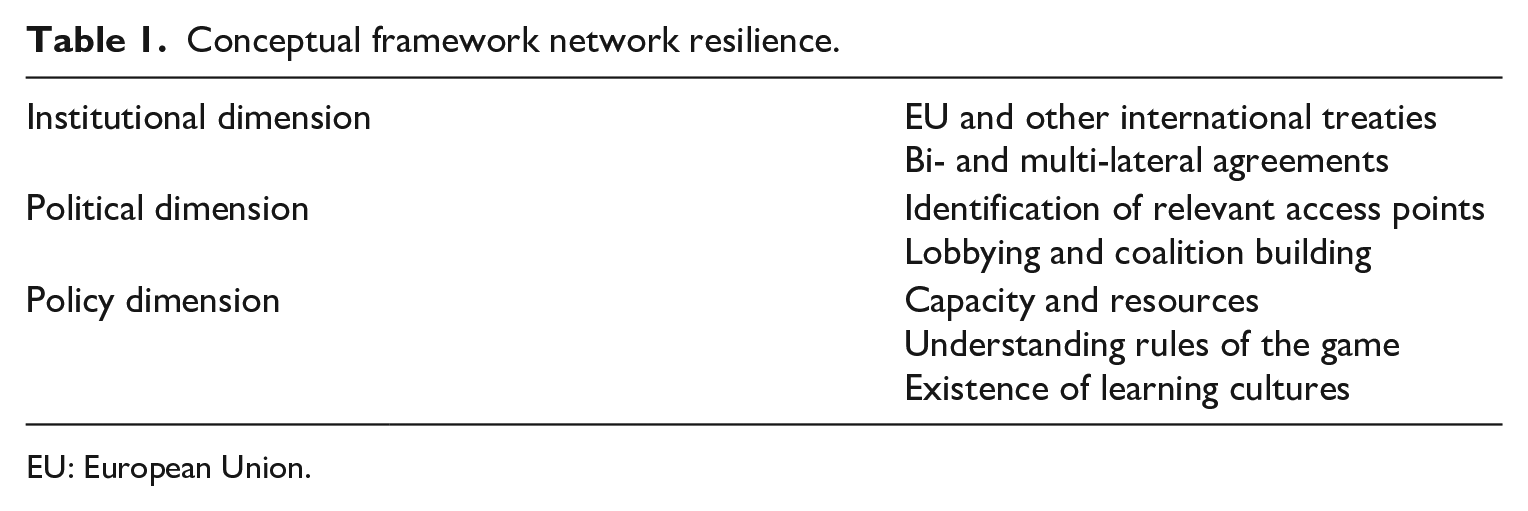
EU: European Union.
First, we identify a formal institutional dimension which consists of formal treaties and agreements. The EU’s impact on third countries’ domestic policy processes is contingent upon the nature of the policy competencies afforded to the EU by its treaties and the resource capacities it has for implementation (Bretherton and Vogler, 2006). Formal treaties and international agreements between the EU and third countries are the primary step to establishing a formal framework and determine access and policy influence through which network resilience can be built (Hofmann et al., 2019). These treaties and agreements structure interactions between third countries and the EU, and may afford third country access to policy processes. The extent to which treaties between the EU and third countries are in place depend on several factors, which can include economic ties, geographical proximity, cultural links and common policy challenges. However, as a consequence of the dispersed nature of the EU’s policy process, a ‘dense web of trans-governmental ties has developed which links EU agencies and bodies to those of third countries’ (Lavenex, 2015). These ‘web-like’ relationships reflect the fragmented decision-making processes in the EU, which offer third countries opportunities to engage in the EU’s policy agendas beyond its core institutions (Noutcheva, 2018).
The institutional dimension sets out the formal structures and relationship between the EU and third countries, yet the second political dimension refers to the ability to exploit these formal and other informal access points to influence policy-making at the EU level, and the willingness to pursue these opportunities to achieve third countries’ political objectives. This dimension emphasises opportunities to influence and the strategies to capitalise on these, which often go beyond formal institutional structures. Notionally, the policy network literature provides useful insights for understanding how third countries are integrated with EU actors. For example, transnational epistemic networks operate both at the domestic and EU levels through looser institutionalised channels, with networks at the national level needing to navigate their way through formal and informal policy channels (Bach et al., 2016). Furthermore, in part driven by a desire for relevant policy expertise and the need to legitimise policy-making, the EU has become fertile ground for lobbying, and third countries are no exception (Korkea-Aho, 2016). For example, recent literature has highlighted the role of third country lobbying in EU energy policy (Gullberg, 2015; Hofmann et al., 2019) and by local and regional authorities (Panara, 2021). Given the number of actors seeking to influence EU policy and the resource costs involved, networking and coalition building with link-minded actors and ‘good friends’ are central to lobbying and influence by third countries (Gullberg, 2015).
The policy dimension refers to the internal functioning of networks so that they can mobilise themselves to be in a position to influence decision-making by having the capacities, policy knowledge and abilities to learn on an ongoing basis. Resilient networks require capacities to be able to resource what they aim to do and maintaining resources is a key task for network leaders. The literatures concerning governance capacities indicate that not only are capacities crucial for effective implementation of policy, but they are key for putting in place the right expertise and systems to maximise the potential that networks can respond flexibly to ongoing circumstances and negotiate hierarchies (Connolly et al., 2020; Mukherjee et al., 2021). The ability of networks to respond flexibly is inextricably linked to the nurturing of policy knowledge. As noted earlier, the epistemic community literature has shown how the mobilisation of knowledge is needed to foster transnational change and learning (Adler and Haas, 1992) but it is also important for networks to identify what types of knowledge are needed (and when) as well as how best deploy knowledge. In the policy capacities literature, knowledge is considered as being the ‘critical capacity required for the sustained functioning of policy systems’ (Mukherjee et al., 2021: 247) because knowledge allows actors to comprehend the ‘rules of the game’ (North, 1991), which are essentially the written (and often unwritten) norms and social or political codes for navigating policy contexts. For networks to be resilient there needs to be in-built network technical and political knowledge about the subject of the policy, where conflicting interests might arise, and how to maximise competitiveness when it comes to securing policy outcomes (Van Waarden, 1992). From a third country perspective, given the dense information availability at the EU level, it is imperative to identify knowledge channels in relation to EU policy and build capacities to capitalise on these.
Correspondingly, learning cultures are relevant for institutional, political and policy perspectives on network resilience given that all dimensions require investment in the absorptive capacities of networks (Cohen and Levinthal, 1990), which creates an environment where network strategies are able to respond, effectively, to the uploading and downloading of governance imperatives within multi-level governance contexts. In short, Howlett and Ramesh (2014: 324) are convincing when they argue that networks ‘will fail when governments encounter capability problems at the organisational level such as a lack of societal leadership, poor associational structures and weak state steering capacities’. From the point of view of third countries outside of the EU, networks need to be agile and resilient when seeking to achieve gains in the EU policy-making environment. EU policy influence on third countries has meant that these countries, particularly smaller countries, have had to become ‘adaptive outsiders’ (Kux and Sverdrup, 2000) and, by necessity, need to be selective with regard to where they invest resources and build up capacities in attempting to influence in order to safeguard their interests.
Study context, policy landscape and approach
EU fisheries policy is an illuminating case for exploring the network resilience of third countries. Fisheries governance requires management across borders and, as such, the fostering of cooperative policy approaches. Even though fish stocks could be regarded as a natural resource belonging to no single state, the reality is that market forces produce inter-state competition. Fishing sectors are closely associated with national economic interests, linked to questions of sovereignty. Thus, fisheries is a policy field whereby tensions can exist between cooperation at the political and bureaucratic level and an intergovernmental approach to economic relations. Such a policy environment can be expected to require both formal and informal mechanisms to facilitate relations between the EU and third countries and require resilient networks.
Since the 1970s, fisheries management practices have undergone a process of internationalisation in regulatory governance (Garcia et al., 2014). The UNCLOS sets a framework for international fisheries cooperation which legally obliges the EU and third countries to cooperate on shared fishing stocks. However, major concerns regarding fisheries management practices remain (Caddy, 1999; Garcia et al., 2014). Scientific evidence has become a key component of managing fishing stocks and the scientific community which operates within the international framework of the International Council for the Exploration of the Sea (ICES) has become an influential policy actor. European integration has further advanced these processes. The introduction of the CFP in 1970s provided a common framework for Member States to adhere to a common set of standards. In short, the CFP meant that Member States transferred full responsibility for fisheries to the EU. As a major economic market for fish exporting, the EU’s decisions impact on third countries. It is, therefore, crucial for third countries to engage with EU decision-making processes, to stay up to date and where needed attempt to influence EU decision-making to achieve favourable political and economic outcomes.
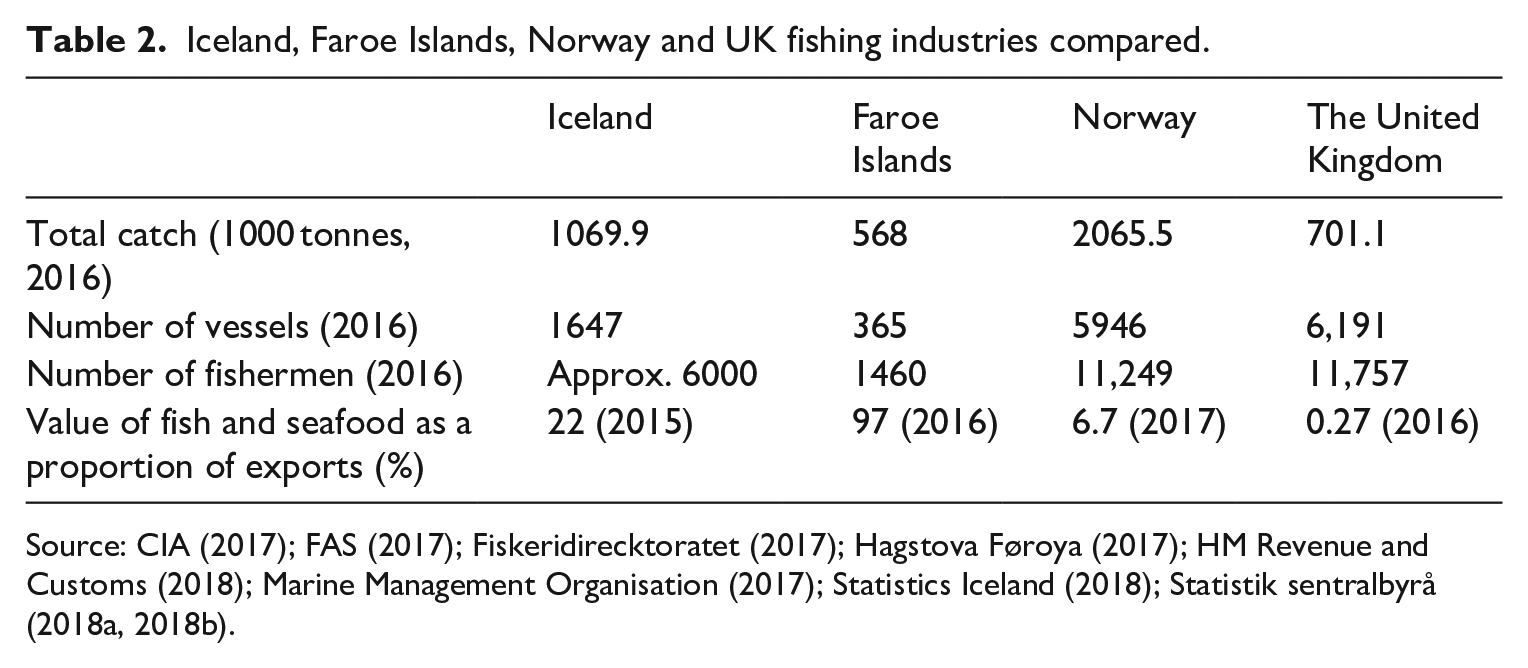
Turning to our case studies, fishing is a major component of the economies of Norway, Iceland and the Faroe Islands (see Table 2). None of these countries are part of the EU but have, in the case of the Iceland and Norway, formal relationships with EU institutions through their European Free Trade Association (EFTA) membership. The Faroe Islands are an autonomous Danish region but are not EU members. All three countries are highly dependent on access to EU markets for their fish products and share sea borders with the EU. As such, we would expect the administrations of these countries to develop formal and informal relations with EU actors and exploit access points to influence EU policy processes.
Iceland, Faroe Islands, Norway and UK fishing industries compared.
Data collection for the study consists of two parts. First, a documentary and secondary source analysis identified EU access points and this elucidated the governance frameworks in which third countries operate as well as shaping the interview questions. Second, 21 semi-structured interviews with policy officials, scientists, industry representatives and other stakeholders from Norway, Iceland and the Faroe Islands were conducted (a full list of interviews undertaken is available in Appendix 1). Most interviews focused on a wider range of issues of policy learning but included questions in relation to access points to policy networks and engagement strategies at the European level. More targeted interviews with representatives from the Missions (essentially policy embassies) to the EU of each country were focused on EU access.
The next section of the article considers the formal institutional framework which provides the interface for third countries and the EU.
The institutional dimension of fisheries policy network resilience
The institutional dimension of network resilience is underpinned by bi-lateral and multi-lateral agreements and treaties which provide opportunities for formal engagement with EU policy processes. However, the formal arrangements have their limitations as fisheries are not directly covered in these treaties. The wider international institutional framework for fisheries also serves as an access point for third countries.
The European Economic Area (EEA) agreement forms the basis of cooperation between Norway and Iceland with the EU. The EEA covers three out of four EFTA countries: Iceland, Norway and Liechtenstein. There have been talks in the past between the Faroe Islands and EFTA about a future membership (EUobserver, 2007), however, as the Faroe Islands are an autonomous region within the Kingdom of Denmark, and not a fully sovereign state, it could not join the EEA agreement as Denmark is already a signatory to that agreement. The Faroe Islands have a separate bi-lateral trade agreement with the EU.
EEA signatories are required to adopt EU rules in almost the same way as EU member states but they do not have access to the formal legislative processes in the EU. The EEA agreement does give them the right to information and consultation on relevant policy processes (Wallis and Jones, 2004). The Faroe Islands–EU bi-lateral agreement stipulates that a committee meets annually to discuss trade issues, in practice the committee largely focuses on fish products. The EEA agreement affords Norway and Iceland access to working groups within the European Commission which focus on technical implementation of policy. However, the EEA countries do not have access to the Council (which is where the high-level policy debates take place). The Faroe Islands have no access to Commission working groups. The committees in the Commission often require technical expertise but they are ultimately advisory and do not take decisions.
This serves to highlight some of the limitations of the institutional dimension to network resilience when trying to influence the EU. For example, as important stakeholders in terms of fisheries in the North Sea and north Atlantic, EEA members and other third countries may also be invited to contribute to specific topics in the European Parliament’s Committee on Fisheries (PECH) committee. However, such invitations are at the discretion of the Committee members and there is no obligation to take any specific contribution into account. For example, a Norwegian representative noted that: We were asked to come with our opinion to the EU parliament, they were working on a management plan for the North Sea . . . it looked like they were at least open to the Norwegian ideas and then you are able to influence, but you know, even though they listen to you doesn’t necessarily mean that they had to agree or want to take into account. (Interview 19)
Notably, fisheries policy itself is not part of the EEA treaty and Iceland and Norway as well as the Faroe Islands are not part of the CFP. However, access to the single market including for fish products are part of the EEA agreement and as such the EEA agreement provides a framework for engagement where fisheries related issues can form part of the discussion. However, there was a recognition that it was difficult to make changes within the EEA framework, not only because of the complexity involved, but also due to a lack of political will: [The EEA is] the only track that we have today to try to improve market access, unless you go into the EEA agreement . . . which nobody wants to do; that means in reality it’s hard to move the basic parameters of our arrangements on trade. (Interview 9)
More broadly, Norway and Iceland have much less access to fisheries policy discussions compared those policy areas that are a part of the EEA agreement. They do not have to be consulted or informed about EU fisheries policy and there is no formal framework through which EEA countries can put issues on the agenda with the EU. For example, in the context of energy policy, EFTA working groups formulate a clear agenda around which discussions with the Commission can take place. EEA countries have to adopt EU policies in these areas so regular meetings are scheduled whereby the EU can inform EEA countries regarding what policy proposals are in the pipeline (Interview 18). Such formal arrangements are absent in the case of fisheries policies as the EEA countries are not required to adopt EU policies in this area. The absence of formal structures to meet and discuss issues can lead to information gaps in comparison with other policy areas.
Furthermore, since the EFTA takes responsibility for scrutinising and coordinating policy areas under the EEA agreement, the treaty facilitates a highly coordinated approach between member countries. Issues are discussed as part of EFTA meetings and, in most cases, joint positions are reached which can subsequently be presented to the EU institution. As fisheries policy is not part of the EFTA framework there is no coordination between its members, which can weaken the position vis-à-vis the EU (Interview 18). These limitations highlight the need to look beyond the institutional dimension and account for developing more informal relationships to facilitate access and influence EU policy (see further discussion in ‘ The political dimension of fisheries policy network resilience’ section).
The formal framework for negotiations between EU and third countries on fisheries takes place as part of the bi-lateral annual meetings. The agreement with Norway is the largest fishing agreement in northern Europe. It is based on a fisheries agreement reached in 1980 and supplemented by an exchange of letters in 1992. Fisheries relations with the Faroe Islands are covered by the 1980 fisheries agreement. The fisheries agreement with Iceland was signed in the context of the EEA Agreement (1992) but became dormant in 2014. However, a new agreement was found in 2017 which maintains Iceland’s participation in the EEA (but with agriculture and fisheries excluded). These agreements are managed through annual consultations between the EU and the third country on a bi-lateral basis. The annual consultations traditionally cover the following two main issues: the setting of total allocated catch (TAC) quotas for jointly managed joint stocks in the North Sea and the exchange of fishing opportunities. Interviewees noted that this institutionalised framework offers not only an annual access point for formal negotiations, but also provides opportunities throughout the year to follow up on technical issues: ‘between each negotiation round you have . . . a lot of complex cooperation to follow up the agreement . . . between researchers and the directorate and the experts and so on’ (Interview 19). This highlights the need to ensure responsiveness and integration between networks when engaging with the negotiations.
Further formal negotiations and discussions between EU representatives and third countries take place within the international organisations responsible for fisheries management. Indeed, Regional Fisheries Management Organisations (RFMOs), such as the North East Atlantic Fisheries Commission, the Northwest Atlantic Fisheries Organization and the North Atlantic Salmon Conservation Organization, are tasked with the management of fisheries in international waters. Furthermore, the UN Food and Agriculture Organisations play an important role in developing sustainable fisheries at a global level. The representatives of the European Council and Commission as well as representatives of Norway, Iceland and Faroe Islands 1 take part in these meetings and contribute to the decisions on long-term conservation and the sustainable use of certain fish stocks in different parts of the world.
The political dimension of fisheries policy network resilience
The various structures described earlier, and indeed beyond the area of fisheries policy, mean that Northern Europe can be described as institutionally dense in terms of various governance organisations that manage international cooperation (McMaster and van der Zwet, 2015). However, as also outlined earlier, there are limits to this institutional dimension for third countries in terms of influencing EU policy. In this respect, third countries need to deploy range of political strategies in order to access EU policy. Coalition building and the close relationship between Nordic countries play an important role. Furthermore, the multi-level aspects of network resilience are an important feature for third countries, particularly through their engagement in regional organisations.
For Norway, Iceland and the Faroe Islands frameworks such as the Nordic Council, and also the Arctic Council, provide important access points to Member State representatives. However, such tactics of lobbying individual states within the Nordic framework is limited as they do not always hold similar positions (Jónsdóttir, 2012). While the Faroe Islands are an autonomous part of the Kingdom of Denmark, and fully independent on all issues related to fisheries, it is careful to exploit possible access points through the Danish government: We don’t want Denmark to integrate our views into their position as an EU member state because we’re outside the EU, we want to remain a third country and have the opportunity to maybe even confront or criticise what the EU does, rather than risking being told ‘well you had your chance to influence that and you didn’t so it’s too late’. (Interview 1)
Nevertheless, being part of Denmark does provide an access point for information: The EU is in the process of revising its common position on the IWC, International Whaling Commission, and that process is going on and, I mean, we’re informed about that by Denmark and have an opportunity to say what we think. (Interview 1)
This highlights a multi-level aspect to this dimension, and access across the different levels of government forms an important part of forming a resilient network. Norway’s approach offers an example here. First, while there is an acknowledgement that formalised mechanism to interact with the EU exist under the institutional dimension, it is also recognised that direct engagement with the EU institutions, outside of these formal arrangements, has an important role to play. In particular, developing direct relationships with the European Commission and increasingly the European Parliament are seen as especially important: we have the formal negotiations, but we also try to influence through other channels. For instance at our Embassy in Brussels . . . we have one person in Brussels that are working to promote Norwegian views towards the Commission, towards the parliament. The parliament has of course been getting more important because of the co-decision, they now have the right to influence very detailed regulations like technical regulations and management plans. (Interview 7)
Second, third country actors seek influence policy bilaterally: even though we negotiate with the Commission, we also have contacts, meetings, dialogue with member states in addition to that, mainly the Netherlands, Sweden, Denmark and then the UK. (Interview 7)
Third, third country stakeholders engage with EU partners on fisheries related issues at the local and/or regional level through organisations such as the Conference of Peripheral and Maritime Regions (CPMR) and the North Sea Commission (NSC). The CPMR includes maritime regions from across Europe, including Norway. The organisation operates at a local and regional level (depending on constitutional arrangements in the participating state) but has close contacts with national governments and EU institutions. It focuses on a wide range of policy issues which include maritime policy. The NSC is a sub-committee of the CPMR. Through the NSC, third countries have been involved in establishing a Regional Advisory Council for the North Sea, which brings together scientists and industry. Some regard membership to the NSC as an effective way to follow European policy and European politics and try to influence some of the debates, while other councils join because they see it as a way to find partners among other countries in order to build projects together or to exchange information and experiences (Interview 21). The scale of multi-level engagement between EU and third countries varies considerably and interviewees noted that the collaboration in the North Sea could be strengthened. In particular, they emphasise that the multi-level framework is underdeveloped in comparison to that in the Baltic Sea region which provides more access to the national and European level.
The use of associations and networks such as the CPMR also emphasises the importance of coalition building with other third country and EU actors. Indeed, the dominance of the EU in terms of its economic market means that third countries often have to develop coalitions and work across networks in order to share information and develop responses to EU policy initiatives. For example, the EU fisheries control regulation 1224/2009 (EC, 2009) requires the traceability and availability of production information on unprocessed fish and aquaculture products throughout the supply chain. The introduction of this regulation required third countries that fished to export to the EU to develop a monitoring system that could trace catch through the supply chain. In order to respond to this effectively, third countries organised a series of informal learning forum (under the name of Friends of Fish) which included countries such as Norway, Iceland, Canada, the United States, Australia, Japan and New Zealand to exchange knowledge on how to best implement these requirements (Interview 18). The forum has continued to discuss EU technical requirements and now invites the Commission Directorate General for Maritime Affairs and Fisheries to meetings in order to increase understanding and communication. The Friends of Fish initiative demonstrates the self-starting nature of coalition building of third countries at the bureaucratic level.
The need for coalition building goes beyond networking with other third counties and extends to industry and scientific actors. Indeed, the role of industry in the policy process is also considered important and third countries have taken steps to integrate industry representatives as part of European networks. In Norway, industry is considered an equal partner in the policy-making process and fully consulted. Representatives are also part of the international delegations and can be considered highly integrated. Yet, the domestic industry in the Faroe Islands has long been a dominant actor, with the Faroese government being accused of prioritising the voice of industry over that of the scientific community (Hegland and Hopkins, 2014). Internationally, Faroese industry representatives have a weak presence. Faroese officials have encouraged a more active presence of industry in Brussels but there is little capacity and interest from industry associations (Interview 1). In Iceland, industry has also attempted to strengthen international links and has associated member status of the Association of National Organisations of Fishing Enterprises in the European Union.
Third countries can undertake targeted lobbying exercises where proposed regulations directly impact their interests. For example, when the EU introduced a proposal that gave the Commission the competence to impose sanctions against non-co-operating fisheries countries, the Faroe Islands drafted a paper to express their concerns and took this to Member States. Another example is Iceland, which undertook a targeted lobbying effort in relation to a fishmeal ban on livestock feed at the time of the foot and mouth crisis. Icelandic authorities, by working with other stakeholders, were successful in convincing several Member States and this helped to establish an exception for fishmeal (Thorhallsson and Ellertsdottir, 2004). As part of this process, third countries may have access to EU institutions and officials on an ad hoc basis, particularly when there are issues that are politically sensitive and require immediate attention. A Faroese official notes that: If we had something we need to bring up I know where to, you know, you contact the Cabinet of the Commissioner and you push for a meeting. In fact I find when it is necessary to have a meeting at that level it’s not a difficult thing to do. (Interview 1)
What is evident in these cases is that integration within networks and external network coalition building across multiple levels within the policy system are important factors to achieving third country objectives. The article will now turn to discuss the policy dimension in more detail.
The policy dimension of fisheries policy network resilience
In terms of network resilience, it is important for third countries to understand the inner workings of EU policy development and, as an outsider, having foresight and intelligence beyond the formal frameworks and agreements is necessary. As one Faroese representative stated: We follow what’s going on in the Parliament in the fisheries area, keep an eye on things but it’s not often there’s something in the pipeline that’s going to have a direct impact on us, but it’s more a question of following the sort of general discussions on approaches and principles and things, particular . . . how EU policy develops and it’s going to impact; what the EU is saying in international organisations where we interact with them. (Interview 1)
However, interviewees noted that although they may engage with EU actors on a regular basis, they can feel like ‘outsiders’. An interviewee notes that ‘when you meet other attachés from other member states, you can definitely feel that you’re not part of the group’ (Interview 19) and ‘they’re sort of self-centred here in Brussels’ (Interview 20). Moreover, a theme that emerged from the interviews was a strong sense that the policy culture in the EU can be quite different from third countries which is not always well understood by domestic actors that are not directly involved in negotiations, with the result being that those tasked with lobbying and engaging with EU institutions feel frustrated. For example, an Icelandic official noted that: [I]n Iceland we are just over 300,000, the administration is small and when we want things done, you know, ‘do you know someone there you could call him?’ you know, things happen at a different pace in Reykjavik, here it’s a huge wheel to spin, things happen very slow here in Brussels. (Interview 20)
In short, the outsider status and a different policy culture can form a barrier to engagement, even if there is a functional imperative to cooperate. The lack of institutional access points for third countries to contribute to the CFP processes means that policy actors require adaptive strategies for engaging and influencing processes, and policy thinking, that takes place within the EU. Part of this process involves identifying and exploiting access points.
The public policy literature shows how lesson learning is key to fostering trans-border policy networks (Stone et al., 2020). With this in mind, policy networks require access to information in order to stimulate learning across boundaries. Interviewees for this study generally regarded information gathering in the EU as a double-edged sword. On one hand, the EU is regarded as fairly transparent when it comes to sharing documents. Yet, on the other hand, the timeliness and quantity of information that is available can be problematic. For instance, information is often published post-decision-making, which can serve to lead to little or no room for influence or consultation (Interview 18). Compounded with this is that there is such a wealth of ‘grey policy literature’ that it can lead to information overload, particularly for actors that are not part of the institutionalised policy process (Curtin and Meijer, 2006). Furthermore, and as noted earlier in the article, smaller third countries often lack resources and the capacities to mobilise themselves to maintain a strong degree of policy focus. Representatives in Brussels note that they often have to cover multiple policy areas which makes monitoring EU policy processes evermore challenging. For example, an Icelandic official noted that ‘If I had the pleasure of only doing fish as my sole object here in Brussels I would much more enjoy life and be able to communicate, to build bridges and so on’ (Interview 18).
The scientific community is one of the most prominent policy actors both in the EU and in third countries for knowledge exchange and coalition building. Since the 1950s, fisheries management has transformed in terms of scientific inputs in setting fisheries quotas and regulating other aspects of fisheries (such as area closures and fishing practices; Garcia et al., 2014). Norway, Iceland and the Faroe Islands all have significant capacity in terms of gathering data to inform policy and marine researchers feed into the ICES advice on fish stocks and this plays an important role in negotiations and setting quotas (Connolly et al., 2020). Furthermore, Norwegian, Icelandic and Faroese researchers are able to participate in Horizon 2020 projects affording opportunities for exchanging best practice and knowledge. Such initiatives can inform coalition-building networks for learning which are established based on expertise and knowledge. For example, Norway, Faroe Islands and the United Kingdom (Scotland) work closely on aquaculture practices together with countries such as Chile and Canada (Interview 19). This cooperation takes place outside an EU framework even though it involves fisheries as a policy area, and the cooperation is not based on formal competencies but, rather, it is based on expertise. This serves as a reminder of the importance of global knowledge-based networks in generating coherence in public policy across domains in areas of mutual interest (Stone, 2004; Stone et al., 2020).
There are various ‘softer’ efforts to develop relationships that can be undertaken and that are referred to by interviewees. For example, during the EU Sea Food week in 2017, the Faroe Islands together with North of Norway organised a seminar to which EU officials contributed. Such activities are considered very important in order to create a culture of understanding and trust and open communication channels as illustrated by the following quote from a Faroese official: I think is really important that we do engage with the EU, the system in a way that’s constructive, where we can do things together and we can shed light on issues that we have in common and, you know, basically get to know each other better. (Interview 1)
Such efforts represent attempts to establish a broader and more enabling relationship in which their interests are better heard in the EU policy networks.
Brexit implications
The analyses of how Norway, Iceland and Faroes Islands interact with EU policy processes are particularly insightful for studying the implications for post-Brexit EU–UK relations. The United Kingdom will need to reflect on the extent of future network resilience for UK fisheries policy in terms of seeking influence as an outsider from EU decision-making processes. In this section, we will discuss the findings and place them in the context of the United Kingdom leaving the European Union and the need for the United Kingdom to build resilient networks.
In terms of the institutional dimension, the analysis has shown that the third countries have limited formal institutional links to EU policy processes in relation to fisheries policies. Yet, third countries benefit from stable treaty frameworks and agreements with the EU even though they do not directly cover fisheries. The UK–EU Trade and Cooperation Agreement (TCA), which was signed in December 2020, was drafted under intense political pressure (as opposed to the agreements that the three case study countries have). It does include fisheries provisions (see Stewart, 2020) but these, together with several other parts of the TCA, remain contentious. As such, the institutional basis to conduct stable negotiations and that provide access to policy networks are currently weak. That said, the United Kingdom remains part of the wider international agreements and treaties that manage fishing stocks. These agreements provide a basis for continuity as well as an access point for engagement with EU actors.
Although the institutional dimension provides the basis for resilient networks, the case studies demonstrate that more informal aspects of the political and policy dimension are important for network resilience. In terms of the political dimension, the analysis demonstrates the multi-level nature of policy engagement with the EU, which includes negotiations at the EU-level but also bi-lateral discussions with EU member states. The immediate post-Brexit period is indicative of the multi-level challenges that third countries face. For example, the late-2021 tensions with France over access to waters around Jersey have an EU, national and sub-national dimension. Although it is beyond the scope of this article to provide a full analysis of these events, it is important to note that each of these levels have different (although sometimes overlapping) political drivers. The EU considers the fisheries tensions within the wider challenges related to the TCA whereas France, at least at the national level, is largely concerned with domestic political drivers (especially since 2021 was an election year). At the local level, there are economic considerations that are the main drivers. Identifying and nurturing political relations at all these levels will be crucial to establish a resilient network.
For the United Kingdom, domestic politics is also an important factor. The political salience of fisheries in the constitutional debate is important, particularly in Scotland which has the largest fishing sector in the United Kingdom (Huggins et al., 2020; McAngus et al., 2018). The Scottish National Party has been accused of taken two seemingly contradictory positions on fisheries policies. It has a record of outright opposing the CFP, calling for a decentralisation of fisheries powers to the EU’s fishing nations (Hepburn and Mclouglin, 2011), while also supporting continued EU membership – both as part of the United Kingdom or as an independent country, which requires full compliance with the CFP. What is important in the context of network resilience is that the UK government dominates the formal institutional dimension of network resilience, particularly in terms of influence in regional and international fisheries governance organisation, but that the Scottish government has more room to manoeuvre in terms of the policy and political dimension. The Scottish Government developed a strategy for establishing closer relationship with other Nordic countries, informal coalition-building processes are an important feature of this strategy (Scottish Government, 2019). This approach is likely to lead to tensions domestically with the UK government but finding access through Nordic countries to policy networks may offer opportunities to build resilient networks.
In terms of the policy dimension, the analysis shows that for Norway, Iceland and the Faroe Islands, a policy interface with the EU has a strong functional imperative that can foster collaboration on day-to-day issues (Lavenex, 2015). Research has suggested that the United Kingdom as a member state was successful, when it came to shaping policy at the EU level (e.g. Bulmer and Burch, 2005; Connolly, 2014). The United Kingdom has also been at the forefront of debates that aim to improve the effectiveness of the CFP. 2 Brexit has meant that the United Kingdom no longer has formal access to EU policy processes and this will, at least to some extent, require to be counter-balanced with informal access points. As a result, the United Kingdom will need to develop various capacities to build and maintain these informal access points (Connolly et al., 2020). Following the example of the case studies, this includes maintaining a ‘presence’ in Brussels to keep informal relationships open and gather information on policy proposals, to maintain knowledge of EU policy processes and ‘rules of the game’, and to maintain links with scientific communities. It will also be necessary for the UK government to consider whether there needs to be greater policy leadership capacities to build coalitions with other non-EU coastal states in order to interface with EU policy-making processes.
This research points to the fact that capacity, leadership and legitimacy are significant aspects of network resilience. These will strength test the preparedness of UK fisheries policy networks for future post-Brexit cooperation as a third country to the EU. A significant part of the future EU–UK interface will depend on the resilience of the networks and adaptive strategies employed by UK politicians and officials. This interface will need to be a structured relationship which is not solely based on putting out fires and dealing with policy problems. The experience from other third countries demonstrates that for a healthy partnership to emerge there needs to be access points that allow continuous engagement across different levels and involve a wide range of stakeholders. Furthermore, the multi-level nature of the UK state will have an important bearing on future relations; in particular, the significant presence of the United Kingdom’s devolved nations (Wales, Scotland and Northern Ireland) in the EU will provide scope for multi-level policy networks. Autonomous regions will seek to form different levels of integration in order to pursue their own political agendas (the case of the Faroe Islands is instructive in this context).
Conclusion
This article examines what lessons can be drawn from the experiences of Norway, Iceland and the Faroe Islands in terms of their relationship with the EU in the context of fisheries policies, and how these might apply in a post-Brexit UK. Empirically, the article demonstrates a degree of individual variability between each country in terms of network relationships between them and the EU policy processes. First, there is variability in terms spatial scale at which resilient networks are established. At the institutional level, the EU engages bilaterally with third countries on the national level but policy actors at different levels find access and cooperate at a local, regional, national, supra-national and global scale. Second, networks vary in terms of the type of access (formal or informal) that is available or required. Third, there is variation in the extent to which different actors are integrated in these networks (i.e. government, scientific, industry, etc.).
Conceptually, the article foregrounds the importance of ‘resilience’ within network analysis. We argue that the resilience of networks within the governance literature has been overshadowed by a focus on network formation and their impacts. This has been crucial for the advancement of the discipline, and this article considers such matters, but the attention given to the resilience of policy networks itself has been subject to less attention. Part of the explanation for this, it could be argued, is that resilience-based thinking has been the focus of sub-disciplines of politics such as crisis management and security studies (Coaffee and Fussey, 2015). That said, the increased focus on viewing the complexities of public policy from ‘systems’ perspectives (Cairney, 2012) warrants the need to understand how networks respond to changes within a governance system due to seismic political and economic changes (such as Brexit). This article has intended to advance discussions in this context by providing a three-level guiding framework for studying network resilience at institutional, political and policy levels. The three dimensions proposed in this article provide a framework to capture the dynamics of network resilience between the EU and third countries. This framework will, we argue, be an important tool for the future examination of how the UK government interface with EU decision-making processes in the future.
The article provides an analysis of these dimensions in three case study countries and subsequently reflects on these lessons in the context of UK fisheries policy. The qualitative difference between the United Kingdom and other third countries such as Norway, the Faroe Islands and Iceland is that the United Kingdom has been a major player (one of the ‘big three’ alongside France and Germany) in steering the trajectory of EU integration for several decades. Brexit opens up research pathways for examining the nature and contours of network disentanglement between the United Kingdom and the EU (see also Wincott et al., 2017). There is a requirement for network resilience on the United Kingdom’s side to cope with the expected fragmentations in policy relationships. The lessons from Iceland, Norway and the Faroe Islands are that networks need to be led, resourced and agile in order to build a culture of preparedness to tackle day to day issues and to also avert crisis situations across borders (Caschili et al., 2015). This requires careful leadership and management at the institutional, policy and political level. Networks need to be nimble in order to generate inclusivity with stakeholder groups (including industry) operating across different levels of government. Moreover, engagement with multiple instruments, and using formal and informal access points, is also of critical importance.
Footnotes
Appendix 1
Acknowledgements
The authors would like to thank the helpful and constructive comments from the reviewers. They dedicate this article to the memory of their friend and colleague, Dr Craig McAngus (1986–2020). Craig was the driving force behind this project, and they miss him dearly. They encourage their readers to look at the obituary:  .
.
Funding
The author(s) disclosed receipt of the following financial support for the research, authorship and/or publication of this article: This work was supported by the Economic and Social Research Council (ESRC), Grant Number ES/R001952/1.