




Abstract
Does partisan alignment affect sub-national political units’ performance? When testing for a partisan alignment effect, local authority planning processes represent a ‘hard case’. Formally, decision-making processes are insulated against political considerations, and there is a mis-match between national party commitments to expand house-building on the one hand, and pressure on local councillors from residents opposing new developments on the other. I find that, in general, partisan alignment brings an increased propensity to approve large residential planning applications. This suggests councillors’ willingness to ‘take one for the team’ by prioritising national over local interests. Consistent with ‘party politics of housing’ insights, inter-party variation sees an altered effect in left-wing constellations, which display lowered approval propensities. In addition to these substantive extensions to scholarship on partisan alignment effects, the insights presented into the drivers of variation in local authority planning outcomes contribute to the pressing tasks of understanding and addressing the chronic under-supply of new housing within the English housing system.
Keywords
Introduction
Partisan alignment effects have been widely studied in relation to inter-governmental resource transfers. From this literature, we know that central government often seeks to reward sub-national units controlled by the same party and to target resources towards electoral districts with narrower majorities (e.g. Bracco et al., 2015; Dixit and Londregan, 1998; John and Ward, 2001; Kleider et al., 2018; León-Alfonso, 2007; Migueis, 2013; Solé-Ollé and Sorribas-Navarro, 2008). In contrast, the effect of partisan alignment on policy performance is yet to attract significant attention. Given the importance of sub-national levels of governance in delivering key services and shaping policy outcomes (e.g. Baker and Eckerberg, 2008; Batley and Stoker, 2016; Potoski, 2008; Sellers and Lidström, 2007), it is of pressing importance that this oversight be addressed. In addition, the issue of inter-party variation in partisan alignment effects remains under-explored.
Through this article, I specifically explore variation in English local authority propensity to approve large residential planning applications. Local authority planning decisions are formally insulated from political pressures. As such, planning outcomes represent a hard case with which to test for a partisan alignment effect. 1 Tensions between national- and local-level party preferences present an additional potential inhibitor of a partisan alignment effect, with national-level advocacy for increased house-building coming up against local-level opposition to new developments. Given this context, the confirmation of a partisan alignment effect in this area is surprising. Overall, this finding suggests that the influence of intra-party discipline and local politicians’ desire for career advancement may be shaping planning outcomes.
My analysis covers observed planning application outcomes from 2009 to 2018. This time period saw Westminster governments under Labour, a Conservative-Liberal Democrat Coalition, and the Conservatives, and we see that the partisan alignment effect shifts with changes to the party in power. The overall partisan alignment effect is significant and positive across the whole cohort. However, we see a significant difference among left-wing constellations, where alignment in fact brings a reduced propensity to approve large residential planning applications. Previously, inter-party variation in partisan alignment effects has remained under-studied. The finding is coherent with scholarship on the ‘party politics of housing’, which suggests that left-wing parties stand to make national-level electoral losses from expansions of owner-occupation (an outcome that follows from higher levels of housebuilding, given that the preponderance of new build is used for owner-occupation). In this case, national left-wing governments’ fear of lost electoral support may be over-riding their proffered policy commitments to expanded house-building. This finding of inter-party variation in a partisan alignment effect represents a notable extension of the literature.
By focusing on housing and planning in England, I address the gap in existing literature on partisan alignment and policy outcomes through an important case study. It is widely acknowledged that the English housing system suffers from chronic under-supply of new housing (Wilson and Barton, 2018). Resultant upwards pressure on house prices and housing costs are recognised as contributing to the emergence of an inter-generational crisis; ‘Generation Rent’ is less able than previous cohorts to access owner-occupation, and will face increased housing vulnerability through their middle- and older-ages (Best and Martin, 2019). By highlighting political economic drivers of variation in local authority propensity to approve large residential planning applications, 2 I shed significant new light on the foundations of these dysfunctions and tensions. I also more broadly contribute to debates over the nature of central–local government relations within British politics, presenting evidence of sub-national autonomy within a literature that more typically offers a vision of a highly centralised state. While local authority decisions on large residential planning applications take place within an overarching national policy framework, there is significant variation in outcomes.
I develop my analysis of the drivers of variation in local authority propensity to approve large residential planning applications through the following structure. In the first section below, I situate the contributions made to scholarship on partisan alignment. Substantive contributions are made through my focus on policy outcomes in an area that typically privileges the study of fiscal transfers, and through my exploration of inter-party variation in the nature of the partisan alignment effect. In the second section, I lay the foundations for the empirical analysis by outlining the hypotheses regarding the expected partisan alignment effect on planning outcomes, and introducing control variables for the model drawn from a broad range of Political Science and Political Economy scholarship. In addition, through this second section, I provide information on the variety of forms taken by planning processes across English local authorities. I then in the third section provide an explanation of data sources and methods used, before in the fourth section presenting and discussing the results. The concluding section of this article offers a recap on the core insights developed and reflects on the relevance of these findings. Overall, I suggest that the evidence of politicised decision-making uncovered through this analysis of local authority planning outcomes warrants enhanced monitoring of outcomes delivered through this governance system. I also suggest that, given the existence of a partisan alignment effect in this formally insulated area of local government that features a disjuncture between central and local party preferences, it is important that other aspects of sub-national politics be probed for parallel evidence of politicisation.
Extending scholarship on partisan alignment: Policy outcomes and inter-party variations
Partisan alignment denotes a context in which two or more levels of a political system are under the formal control of the same political party (Solé-Ollé and Sorribas-Navarro, 2008: 2317). Within the field of party politics, the impact of partisan alignment on inter-governmental resource transfers has attracted significant attention. After first reviewing key contributions to this field, in the following paragraphs I outline the extensions I offer. In short, whereas existing scholarship privileges the study of partisan alignment effects in relation to financial transfers, I expand the focus of this field by demonstrating the existence of a partisan alignment effect in relation to a policy outcome. I also demonstrate inter-party variation in manifestations of the partisan alignment effect, in a field where inter-party variation remains under-explored.
In the main, studies of partisan alignment effects have focused on the relationship between party control and intra-governmental financial transfers. Historically, studies of intra-government transfers tended to create models of allocatively efficient distributions. The goal from such work was to answer the research question: ‘What distributive choices should governments make to ensure that their scare financial resources generate optimal productivity gains?’ (e.g. Dahlby and Wilson, 1994; Oates, 1972). One extension to this strand of scholarship came through attempts to add-in a consideration of governments’ political goals, thereby re-orienting the overarching research question towards: ‘What distributive choices should governments make to ensure that their re-election prospects are optimised?’ Focusing on this amended question, the contribution from Lindbeck and Weibull (1987) suggests, for example, that governments should target resources towards ‘marginal voters’; individuals who do not have a strong attachment to a given party, and therefore are in danger of not support the government’s party unless given an inducement to do so.
A broad range of scholarship has followed in the wake of this attention on the politics of fiscal distributional outcomes. Grossman (1994) and Levitt and Snyder (1995) find, in their studies of federal government grant distribution to state- and local-level governments in the United States, that alignment is positively associated with the volume of financial transfers. Worthington and Dollery (1998) and Migueis (2013) confirm broadly similar dynamics in Australia and Portugal, respectively. John and Ward (2001), when analysing transfers from central to local government in the United Kingdom through the 1980s and into the 1990s, confirm the existence of a partisan alignment effect in the United Kingdom. While debate remains over the factors that shape observed variation, it is now accepted that partisan alignment effects significantly shape intra-governmental fiscal transfers. 3
Solé-Ollé and Sorribas-Navarro (2008), in their study of transfers within Spain, provide a relatively uncommon example of a study that includes a period of time where partisan control has shifted in the upper level of government. Through their application of the differences-in-difference research design, Solé-Ollé and Sorribas-Navarro are able to robustly demonstrate the existence of a sizable partisan alignment effect on fiscal transfers, although cross-party variation in the partisan alignment effect is not probed. By deploying a panel-corrected standard errors (PCSE) data estimator, I here am able to probe the interaction between party control and partisan alignment effect.
It is readily acknowledged that, in contemporary politics, policy outcomes are contingent on interactions across multiple layers of governance (e.g. Baker and Eckerberg, 2008; Batley and Stoker, 2016; Dubash and Morgan, 2012; Levi-Faur, 2005; Majone, 1994; Marsh et al., 2003; Potoski, 2008; Sellers and Lidström, 2007
Planning outcomes in England: The expected partisan alignment effect
Within this article, I seek to explain variation in the outcomes of planning applications submitted to local authorities for permission to build large residential developments. 5 Within England, planning applications are governed through a process that brings together frameworks and processes under the control of the Westminster government and frameworks and processes under the control of local authorities. Formally, there is insulation at the local level to guard against planning decisions being shaped by political considerations, although there is broad agreement that this insulation remains imperfect. While local authorities’ preferences may diverge from those of the Westminster government, there are nonetheless intra-party dynamics that could be expected to incubate a partisan alignment effect. In the following paragraphs, I provide an overview of Westminster and local authority roles in planning decisions, and of the intra-party dynamics that may incubate a partisan alignment effect.
The planning system regulates the use of and modification to land and buildings and constitutes an important lever of state power. At the national level, the Ministry of Housing, Communities, and Local Government (MHCLG) oversees the National Planning Policy Framework (NPPF). The NPPF sets the general principles and guidelines that local authority planning decisions must adhere to. Where a party is dissatisfied by the outcome of a planning application, they may embark upon an appeal process that runs from the local authority up to the Ministerial level. Ultimately, an appeal can result in judicial review, under which a High Court judge has the power to quash, prevent, or require a local authority decision, or to clarify a legal point of order.
In addition to these pathways for appeals, the Planning Inspectorate (an executive agent of MHCLG) monitors local authority planning outcomes against a range of performance indicators. The Inspectorate can take action should an authority, for example, lose too high a proportion of appeals that have been brought against them, the underlying logic being that such a pattern demonstrates that the authority has an elevated tendency to inappropriately reject planning applications. 6 Across England, each year local authorities take decisions on around 8000 large residential planning applications, rejecting around 1500. 7 Around 50% of the rejected applications are appealed against, and typically around 40% of these appeals are upheld. 8
At the Westminster level, governments have for some decades displayed a frustration with what has been perceived as an overly-restrictive planning process and articulated a desire to see the system support increases to rates of house-building across the country. Indeed, there is broad consensus that the sustained under-supply of new housing within England and attendant pressure on housing costs and decreasing rates of owner-occupation constitutes a ‘housing crisis’ (Wilson and Barton, 2018). Reflecting this concern, central governments under all parties have, since the 1980s, delivered commitments to expand national housing supply through election manifestos and targets within relevant planning policy frameworks (Adams, 2011; Wilson, 2019). 9
There is a ‘party politics of housing’ literature that is of relevance to Westminster governments’ housing preferences. In particular, Ansell (2014) and Adler and Ansell (2020) show that expanding home ownership is associated with rising national-level support for right-wing policies; owner-occupiers have a ‘self-insurance’ asset that reduces their support for social insurance programmes, and given the falling real cost of their mortgage payments over time they have higher lifecycle income that reduces their support for redistribution. As such, while rhetorical commitment to expanded rates of housebuilding may be common to both left- and right-wing parties at the Westminster level, the former may fear an erosion of their electoral support from expanded owner-occupancy, while the latter may welcome an expansion to their base from such an outcome. While national data on the proportion of new-build housing that become owner-occupied are not collected, a large preponderance is used for owner-occupancy. 10 Following on from these party politics of housing insights, the higher the rate of house-building, the higher the likely electoral gains that are accrued by right-wing parties.
At the sub-national level, local authorities play the key role in the planning process. The structure of local government in England is complex, with some areas using a two-tiered and others a one-tiered structure. Within this variegated structure, primary control of decisions over planning applications rest with District Councils, Unitary Authorities, Meteropolitan Districts, and London Boroughs. 11 Most authorities operate under a ‘cabinet’ model, with significant decision-making power residing with a small number of executive councillors from the party in control of the majority of seats in an authority (or from a governing coalition). However, decisions on planning applications are required to be governed by Planning Committees; bodies composed by elected councillors, and whose membership is aligned with the political make-up of the authority as a whole (Coulson and Whiteman, 2012: 186; Local Government Association [LGA], 2013: 9). Formally, Planning Committees are designed to function as technocratic rather than political structures, with councillors sitting on the committee being required to put party-political considerations to one side and to make the decision as to whether to accept or reject a planning officer recommendation in accordance with materially relevant factors (LGA, 2013: 30; Weston and Weston, 2013: 186-90). In practice, however, it is widely acknowledged that Planning Committees can become politicised arenas.
Whereas in many other national systems developers’ rights are more fully codified, in the English model local authority planning committees enjoy relatively high degrees of discretion (Booth, 1996; Coehlo et al., 2017; Davies et al., 1989). A range of studies demonstrate that local activism can sway local authority planning committee outcomes (e.g. Toke, 2005; Van der Horst, 2007; Van der Horst and Toke, 2010), suggesting the existence of notable levels of agency on the part of planning committees. Indeed, it is commonly thought that political considerations influence outcomes (Flemming and Short, 1984: 965, Ball et al., 2008: 5). In this regard, Ball (2010: 12) describes planning committees as arenas in which ‘local planning principles and politics plays out’. 12 Given the space for politicisation at the local level, attention needs to be presented to the incentive structures presented to local councillors.
On the one hand, at the local level, it is known that local councillors face significant push-back against new developments from constituents wishing to preserve the existing natural and built environment (Sturzaker, 2011; Upreti and van der Horst, 2004). Counter-balancing this local-level pressure to reject large residential planning applications, intra-party dynamics may (under partisan alignment) push councillors towards increased approval rates. As noted above, Westminster parties have displayed a consistent support for increased rates of house-building in the United Kingdom (with the caveat that, in line with insights into the party politics of housing, such support may well be stronger from national-level right-wing parties). We know that councillors are likely to be heavily engaged in the local branch of their national party prior to standing as a councillor (Rallings et al., 2010). As such, councillors will likely be familiar with their party’s stated national-level goals and priorities and may be keen to support these priorities when the party is in power nationally. A desire to follow the established career trajectory of councillor-to-Member of Parliament, a trajectory documented by Allen (2014), may further enhance councillors’ willingness to ‘take one for the team’ by prioritising national above local party goals. 13
Taking the above into consideration, the following hypotheses can be generated in relation to partisan alignment effects on propensity to approve large residential planning applications:
H1: Where there is partisan alignment between the national and local levels, a local authority’s propensity to approve large residential planning applications will be increased.
H2: Left-wing partisan alignments will generate lower increases to a local authority’s propensity to approve large residential planning applications.
The intuition underpinning H1 is that all councillors, regardless of party membership, will be subjected to some intra-party pressure to prioritise national policy objectives. The intuition underpinning H2 is that in line with insights into the party politics of housing, such pressure will be lower within left-wing parties that stand to reap additional electoral payoffs from the overall increase in rates of owner-occupancy that follow from the completion of new-build developments. Beyond these central hypotheses, I turn to broader literature within Politics and Political Economy to identify additional factors that should be controlled for within the empirical analysis.
The first factor I identify as a control variable relates to sub-optimal market outcomes. Literature associated with the public interest theory of the state shows that governments are likely to try to correct outcomes they perceive to be imperfect or undesirable, stimulating market actors in response to situations of under-supply (Baron and Myerson, 1982; Baumol, 2004; Stigler, 1971; Stigler and Friedland, 1962). This body of scholarship often adopts an expansive conceptualisation of sub-optimal market performance, typically encompassing scenarios in which governments believe that overall welfare can be enhanced through intervention (Hantke-Domas, 2003: 166). In line with these insights, it is likely that councillors or housing officers may respond to evidence of sub-optimal outcomes from under-supply by becoming increasingly permissive towards applications for planning permission.
The second factor I identify to control for relates to the proximity of elections. An expansive literature on political cycles has grown since Nordhaus’ (1975) initial exploration of the interaction between elections and political cycles. Studies have shown that politicians seek to appease their electorate in the run-up to an election by delivering enhanced spending levels (Brender and Drazen, 2005; Schuknecht, 2000), with Blais and Nadeau (1992) and Viega and Viega (2007) demonstrating this dynamic specifically in relation to sub-national units. As noted above, we know that planning applications have the potential to generate significant and highly visible local opposition (Bell et al., 2005; Dear, 1992; Michaud et al., 2008; Pendall, 1999). As such, it is possible that councillors will become more adverse to approving planning applications in the run-up to a local election. It is also possible that, in the run-up to a national election, national parties may put enhanced pressure on aligned authorities to ramp-up approval rates in support of national policy commitments to expand housing.
The third control factor that I identify relates to geography, specifically to the location of a local authority on a rural-to-urban scale. Systematic differences in planning processes are likely to exist between rural, predominantly urban, and urban settings. National-level guidelines in the United Kingdom differentiate between types of activities that are typically permissible in rural and non-rural settings, and allow for some higher restrictions to be applied to new developments in rural areas (MHCLG, 2019: 17). 14 We also know that, in general, planning processes in predominantly urban settings can be tilted towards strategies of ‘containment’ that aim to limit the further expansion of urban concentration (Gallent et al., 2006: 457).
The fourth control factor that I identify is party control of a local authority. Goodchild (2010) suggests that, at the local level, right-wing councillors are likely to face greater pressure to block large residential planning applications. Such councillors’ supporters are likely to be both more politically engaged and to be home-owners and therefore may be expected to provide stronger pressure to reject applications that may disrupt the local environment and lower house prices (by increasing supply). Additional insights into these dynamics are provided by Coelho et al., (2017), Johnston et al. (2001: 200), and Berry and White (2014: 3)
Through the next section of this article, I review my operationalisation of variables used to test for H1 and H2 and to control for the additional factors noted above.
Data and methodology
For the dependent variable, I use Ministry of Housing, Communities, and Local Government (MHCLG) data on local authority planning outcomes. Data are available on the number of large residential planning applications received and the number of approvals granted from 2008/2009 through to 2017/2018. 15 This timeframe sets the overall parameters for the study. 16 The propensity to approve figure captures the percentage of applications received that were approved, such that a value of 100 denotes that all applications were approved. 17
To capture partisan alignment, I combined data on local authority control from The Elections Centre with corresponding data on Westminster party control to create a dummy variable. 18 Overall, for 2008/2009 to 2009/2010 (i.e. during the Westminster Labour government), a value of one is given where a local authority was under Labour control and a value of zero to all other cases. For 2010/2011 to 2014/2015 (i.e. during the Conservative-Liberal Democrat Coalition Westminster government), a value of one was given where a local authority was under Conservative or Liberal Democrat control and a value of zero to all other cases. For 2015/2016 to 2017/2018 (i.e. during the Conservative Westminster government), a value of one was given where a local authority was under Conservative control, and a value of zero to all other cases. I have operationalised party alignment as a contemporaneous independent variable. This reflects an assumption that through a given year, local councillors will be taking planning decisions taking account of their current (non-)alignment with the national government. In 2008/2009 and 2009/2010, the Labour Westminster government may have been pushing Labour local authorities to boost approvals, the Conservative and Liberal Democrat Westminster government pushing Conservative and Lib Dem local authorities through 2010/2011 to 2014/2015, and the Conservative Westminster government pushing Conservative local authorities through 2015/2016 to 2017/2018.
The Aligned Westminster election dummy variable captures cases in which a local authority was in alignment with central government in the year of a Westminster election. The intuition here is that councillors may be placed under enhanced pressure to support national party aims in the run-up to a national election. Labour-controlled authorities were coded as positive for the 2009/2010 observation year, to capture the potential influence from the incumbent Westminster Labour government in the 12 months leading up to the mid-2010 national election. Conservative and Liberal Democrat authorities were coded as positive for the 2014/2015 observation year to capture the effect from the Coalition incumbency through the 12 months to the mid-2015 election. Conservative authorities were coded as positive for the 2016/2017 observation, on account of the mid-2017 election. This variable is modelled as having a contemporaneous impact on approval propensity, to capture the likelihood that, in the 12 months leading up to a Westminster election, central governments may be ramping up pressure on aligned councillors to support national objectives by adopting a more permissive planning attitude through this time.
Data relating to the occurrence of a local election were derived from the Ministry of Housing, Communities, and Local Government Election Timetable. The Election Timetable provides information on the year in which elections are held in local authorities, and the proportion of seats up for re-election. 19 There is significant variation in the format of elections across types of local authorities; local authorities either hold one election every 4 years at which all seats are contested, one election every 2 years at which half of all seats are contested, or three elections at which one-third of seats are contested over a 4-year cycle. Using these data, I created a dummy variable to capture years when local elections took place. Where, for example, an election occurred in a given local authority in May 2009, a positive value is assigned to that case for the 2008/2009 observation. I have operationalised the election occurrence measure as a contemporaneous variable. The assumption here is that councillors may adjust their behaviour in the 12 month period leading up to an election.
Data on party control were derived from The Elections Centre reporting on local authority party control. To incorporate this factor into the model, I created a dummy variable for Labour control and a dummy variable for Liberal Democrat control. The variable is modelled as being contemporaneous with the outcome variable, under the intuition that party control in a given year effects approval propensity in that year.
I use two indicators to capture market sub-optimality arising from housing under-supply. From the Office for National Statistics (ONS), I use data on house price unaffordability. 20 The ONS unaffordability figure is a ratio of the mean annual income to the mean house price in a given area. 21 The higher the figure, the less affordable the local housing and the greater the market failure. A value of five for this variable, for example, captures a situation in which the average house price was five times the average annual income. I take this measure to capture housing need as experienced by relatively affluent populations, given that unaffordability is a problem experienced by relatively affluent individuals who are on the margins of home ownership and wish to access this mode of housing. From MHCLG, I use data on local authority housing waiting lists to capture unmet demand for affordable rental housing, 22 a source that captures housing need as experienced by less affluent populations. To account for variation in local authority population, this waiting list figure is expressed as a proportion of the total local authority population. 23 The intuition is that local councillors may respond to evidence local housing market failures (as evidenced by unaffordability of house prices and large housing waiting lists) by moving to boost supply through an increased permissiveness towards residential planning applications. 24 I operationalise these market failure-related variables with a 1-year time lag, on the assumption that councillors are likely to be acting on the basis of data from the previous year.
The UK government geographic typology of local authorities was used to incorporate a focus on rural–urban differences into the model. Specifically, the Department for Food, Rural Affairs, and Agriculture rural–urban classification (2009) was used as the basis of a fixed-effect variable. The classification labels local authorities as ‘predominantly rural’, ‘significantly rural’, and ‘predominantly urban’. To operationalise, I have recoded 1-3 rural-urban. 25
Results and discussion
Table 1 shows that the average propensity to approve large residential planning applications across the 2009–2018 period was 78.50, with a range running from 16.67 through to 100. Tables 2 to 4 show interesting variation across Labour, Liberal Democrat, and Conservative authorities, with respective approval propensities of 86.12, 75.80, and 75.74. Housing in Labour authorities is on average more affordable (with an income-to-price ratio of 6.70 compared to Liberal Democrat (7.92) and Conservative (7.73) authorities), and housing waiting lists are on average longer (3.33% of the population compared to Liberal Democrat (2.81%) and Conservative (2.30) authorities. Across all cases, there are 1251 cases of partisan alignment, of which 52 are Labour, 52 are Lib Dem, and 1147 are Conservative (see Tables 5 and 6 for overviews of variation across aligned and non-aligned authorities). 26
Descriptive statistics (all observations).
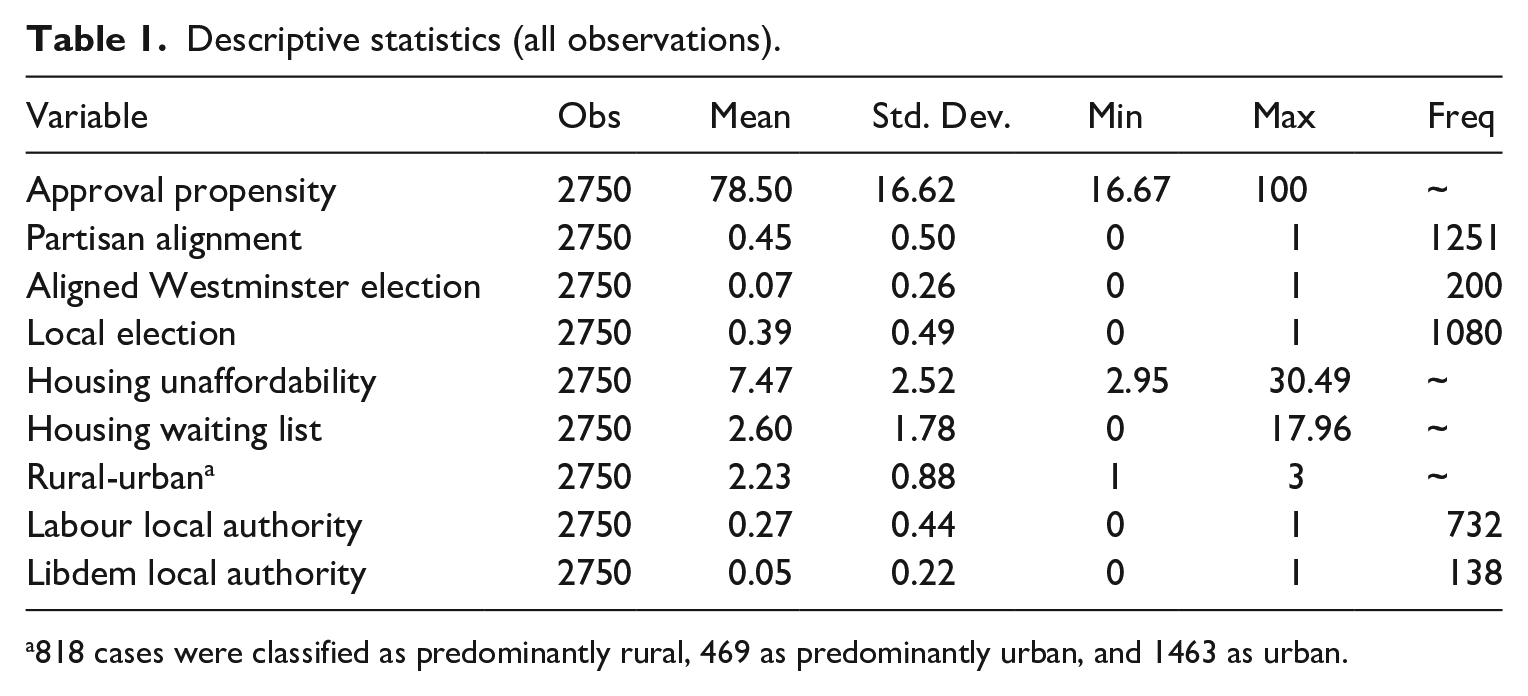
818 cases were classified as predominantly rural, 469 as predominantly urban, and 1463 as urban.
Descriptive statistics (Labour authorities).
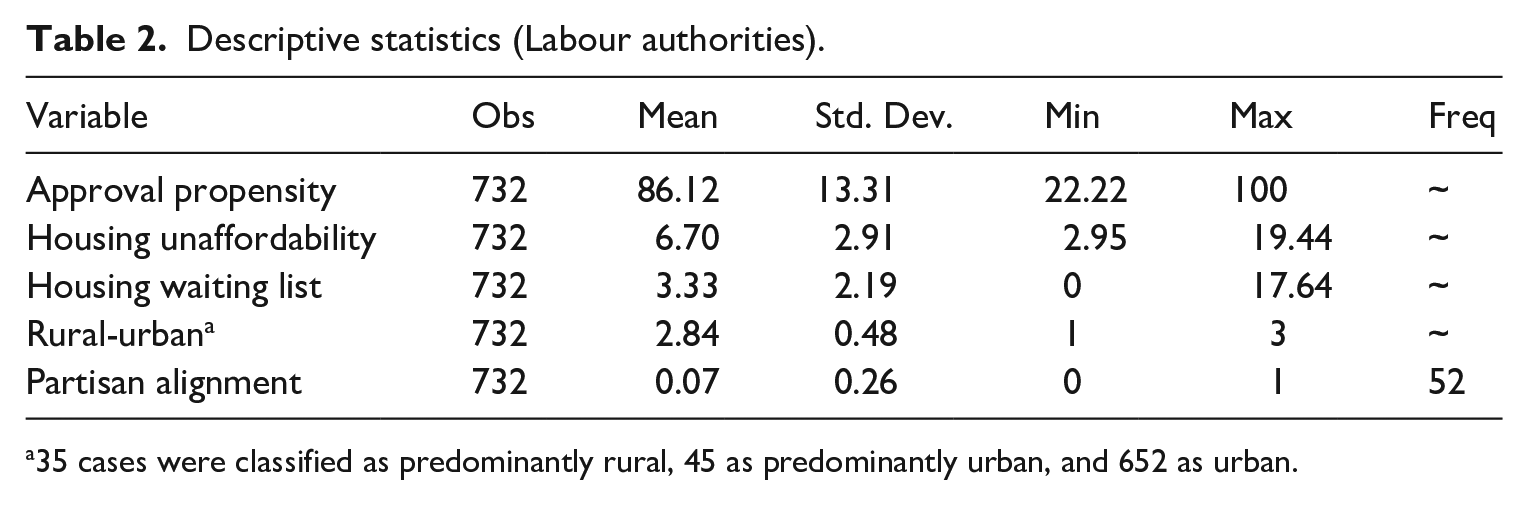
35 cases were classified as predominantly rural, 45 as predominantly urban, and 652 as urban.
Descriptive statistics (Lib Dem authorities).
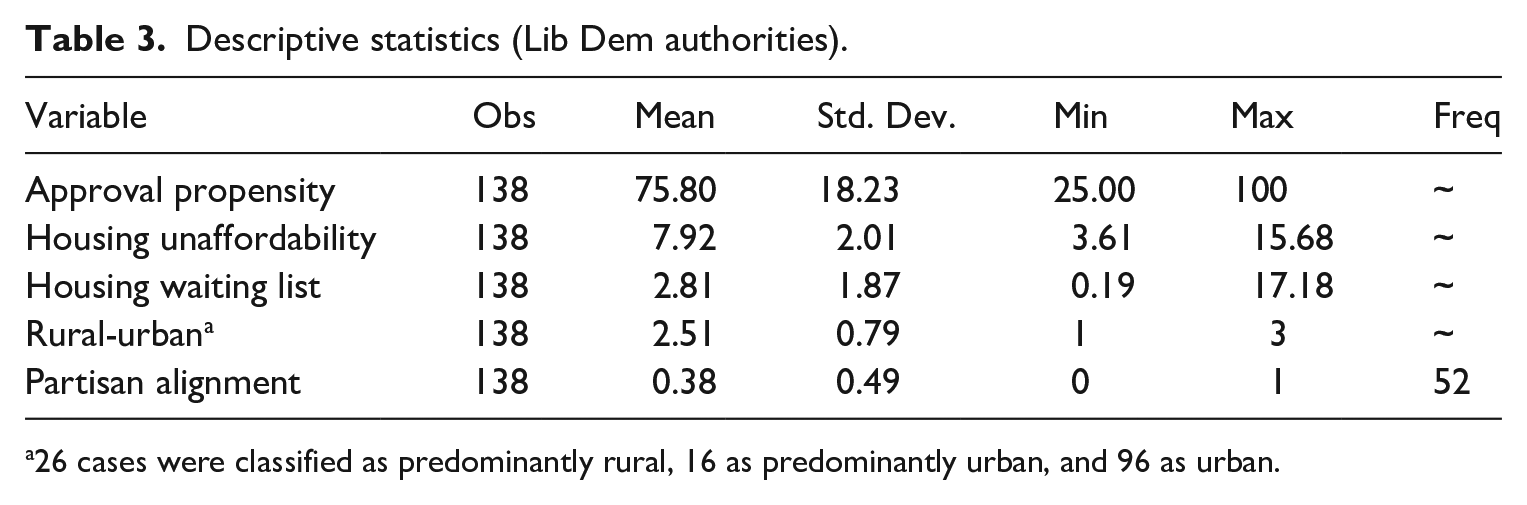
26 cases were classified as predominantly rural, 16 as predominantly urban, and 96 as urban.
Descriptive statistics (Conservative authorities).
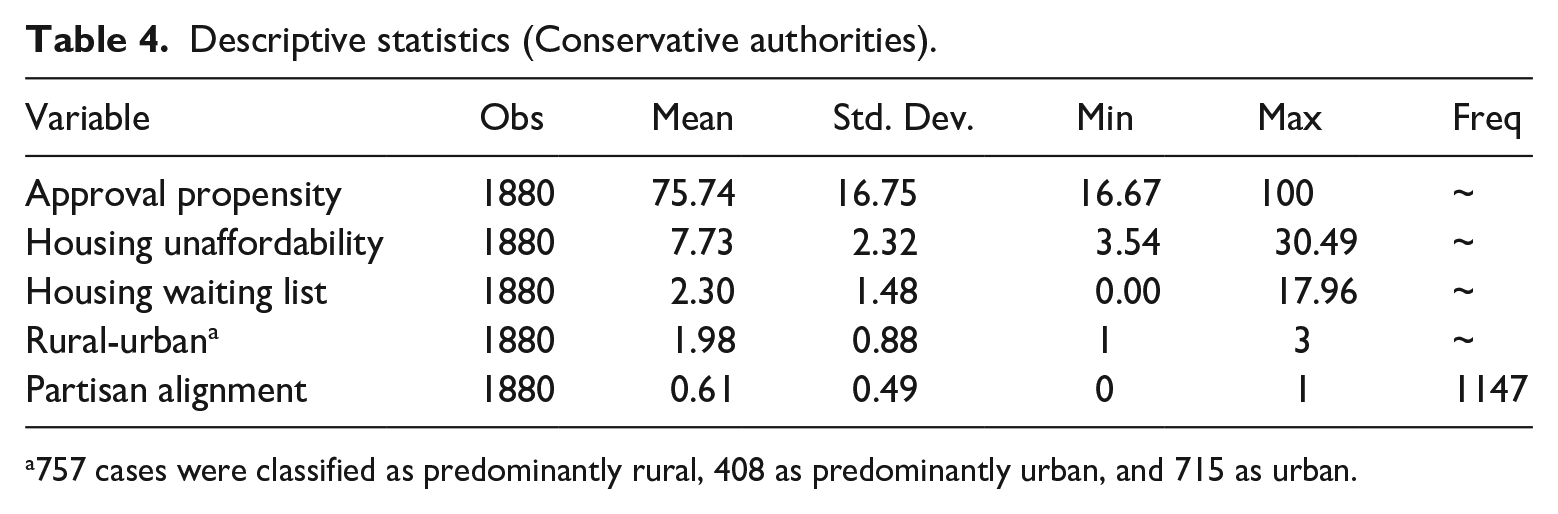
757 cases were classified as predominantly rural, 408 as predominantly urban, and 715 as urban.
Descriptive statistics (aligned authorities).
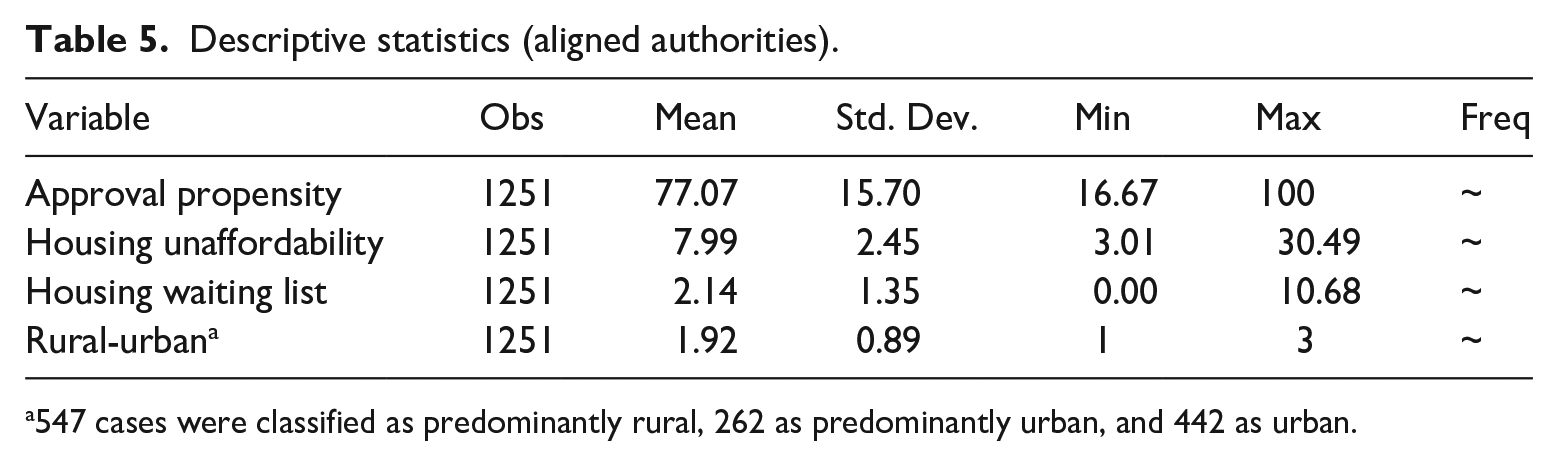
547 cases were classified as predominantly rural, 262 as predominantly urban, and 442 as urban.
Descriptive statistics (non-aligned authorities).
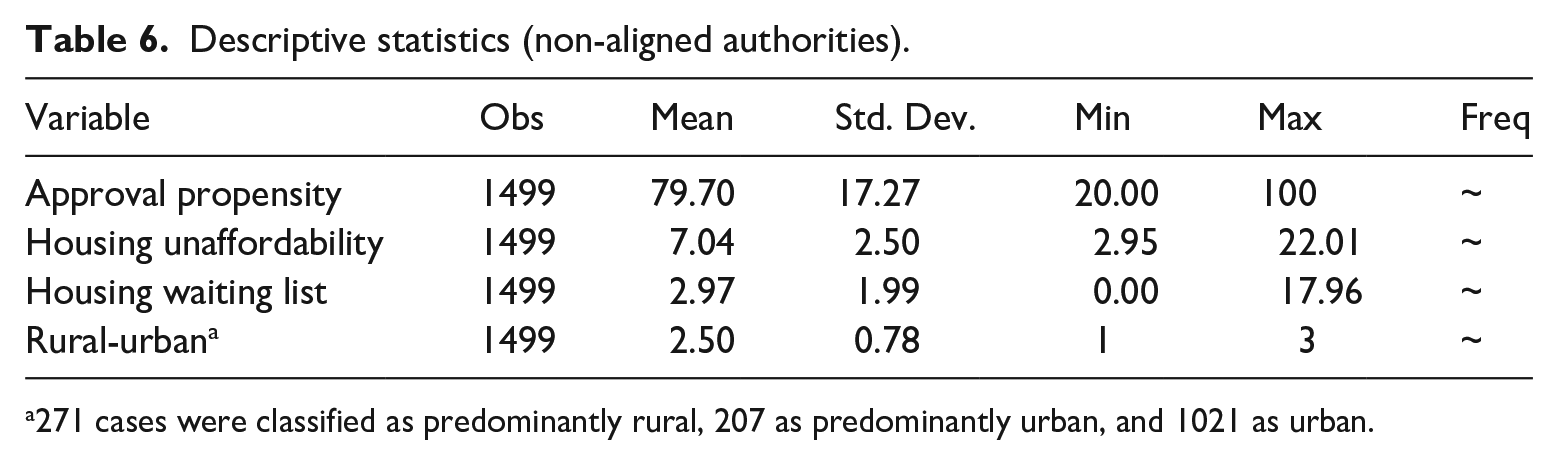
271 cases were classified as predominantly rural, 207 as predominantly urban, and 1021 as urban.
To explore the observed variation in local authority propensities to approve large residential planning applications, I ran an OLS PCSE model. The OLS PCSE model is appropriate for analysing time series cross-sectional data in which temporally and spatially correlated errors and heteroscedasticity may be present. Indeed, Beck and Katz (1995) demonstrate that the OLS PCSE model is superior to the alternative Generalised Least Squares estimator, which can generate extreme overconfidence in the significance of dependent variable effects. In addition to the variables noted in the section above, I included interactions between party control and partisan alignment in the model. Table 7 provides an overview of results, and Figure 1 provides a marginal effects graph.
Explaining variation in local authority propensity to approve large residential planning applications.
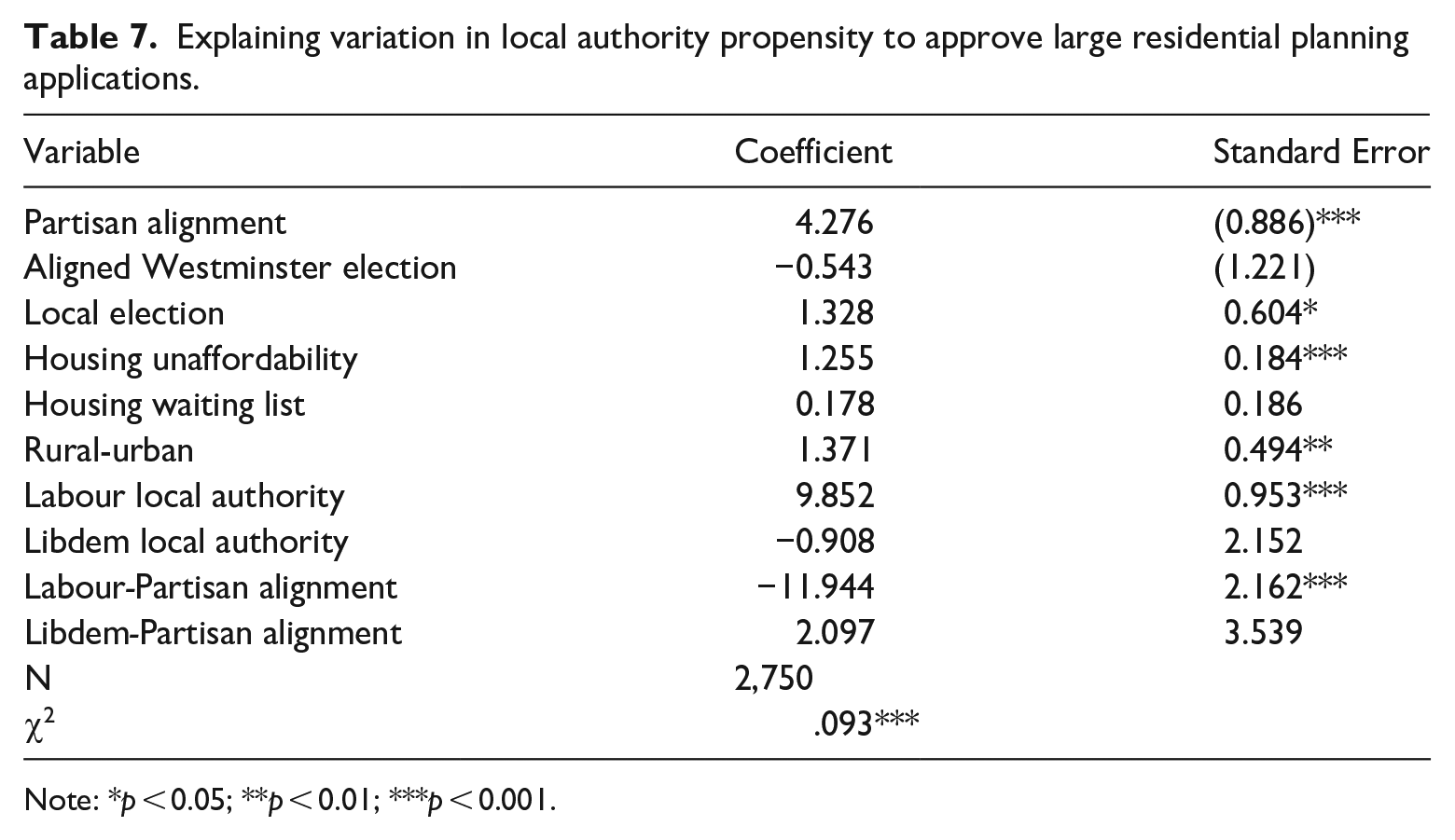
Note: *p < 0.05; **p < 0.01; ***p < 0.001.
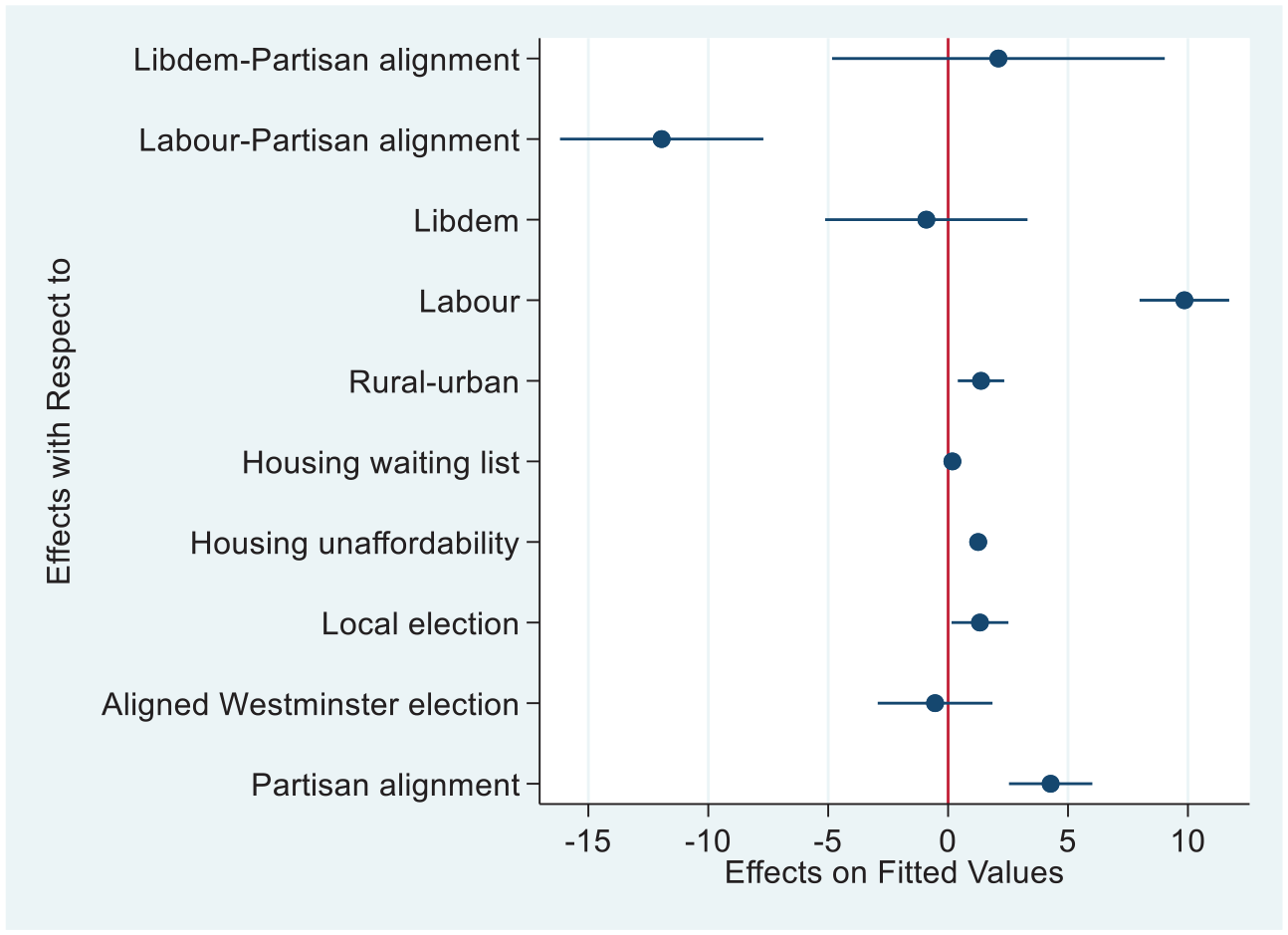
Marginal effects graph (average marginal effects with 95% confidence intervals).
Overall, the model is significant (p < 0.001) and explains around 9% of the observed variation (χ2 = 0.093). We see that partisan alignment exerts a significant effect on outcomes, with aligned authorities displaying an enhanced propensity to approve (B = 4.276, p < 0.001). This finding confirms H1 and suggests that local authorities are willing to ‘take one for the team’ by enacting decisions that may be unpopular locally but which support the party’s national policy programme.
To address H2 (which predicted that left-wing constellations would display a reduced alignment effect), it is necessary to probe for inter-party variation in this partisan alignment effect. In testing the interaction between party control and partisan alignment, I demonstrate that where an authority is controlled by Labour and is in alignment with central government, it displays a significantly reduced propensity to approve planning applications (B =-11.944, p < 0.001). This finding confirms H2. 27 Referring back to the insights from Ansell (2014) and Adler and Ansell (2020), it may be the case that the Labour central government in fact moved to prioritise protecting its medium-term electoral base ahead of its commitments to expanded house-building. 28 Beyond these headline findings, we also see that proximate local elections, sub-optimal housing market performance, and Labour control of a local authority also significantly effect local authority planning outcomes.
The finding of a significant and positive impact from local elections is surprising (B = 1.328, p < 0.05), given that the intuition was that authorities reduce approval propensity in the run-up to a local election so as to minimise electoral costs from giving the go-ahead to unpopular developments. One potential explanation of the observed relationship is that councillors may have a strategic interest in approving applications that fall in wards controlled by non-aligned colleagues. Councillors from the ruling party may therefore ‘dump’ increasing numbers of approvals into non-aligned wards to harm the electoral prospects of their competitors. This finding, however, requires further study to delve into the interplay between local authority-to-ward-level partisan alignment.
The finding of a significant and positive effect from housing unaffordability (B = 1.255, p < 0.001) suggests that local authorities are responding to the needs of relatively affluent populations, boosting approvals in situations in which housing is unaffordable. The housing needs of less affluent populations, as evidenced by higher housing waiting lists, does not have a significant influence on approval propensity. This finding holds across Labour, Liberal Democrat, and Conservative authorities, 29 which suggests that local authorities regardless of orientation may pay more attention to affluent population concerns. Given that more affluent groups display higher propensities to vote, and enjoy greater agenda-setting and lobbying power, 30 this finding fits with insights from existing literatures. Finally, the finding that Labour control exerts a significant and positive effect on approval propensity (B = 9.852, p < 0.001) confirms in reverse the insight from Goodchild (2010) that right-wing councillors face greater local opposition against proposed developments. With their less affluent electoral base being less concerned with protecting local property prices against the downwards pull from new supply, Labour councillors’ equilibrium propensity to approve is significantly elevated.
Conclusion
The chronic under-supply of new housing in England and attendant pressures on rental costs and house prices is generally held to constitute a national crisis. 31 Increasingly high rents and house prices have conspired to produce ‘Generation Rent’; a cohort that reached adulthood after the 2007 financial crisis and enjoys a lower capacity to access owner-occupied housing that earlier generations. The planning system, which developers must successfully navigate to gain permission to build new residential developments, is widely held to be contributing to restricted new housing supply and consequent pressures. Given this context, it is imperative that our understanding of the political economy of planning outcomes in England be extended.
Within the English housing system, there is a tension between the interests of central and local government. Central government has for many years been pushing for the system to supply more housing. Successive Westminster governments have since the 1980s placed increased housing supply as a prominent policy goal and from the mid-2000s have adopted targets for annual new-build rates of up-to 240,000 units per year at a time when actual supply has often fallen below 150,000. In contrast, local authorities themselves are often placed under significant pressure from residents to block new developments, and local campaigns can be vocal and well-publicised. While mechanisms are in place to insulate local authority planning committees from political pressure, these processes are often characterised as being shaped by political factors (e.g. Ball, 2010; Ball et al., 2008). Findings from this article serve to confirm this characterisation and reveal new insights into the manner in which central-local tensions are managed.
Through this study, I have demonstrated the existence of a partisan alignment effect within the English planning system. By establishing that partisan alignment exerts a significant impact on local authority propensity to approve planning applications, I extend scholarship on partisan alignment towards a focus on policy outcomes. I also substantively contribute to this scholarship by establishing the existence of inter-party variation in the partisan alignment effect. In this case, aligned left-wing authorities in fact displayed a reduced approval propensity. This finding fits with the expectations of work on the party politics of housing. New developments expand owner-occupancy, and left-wing national governments stand to lose electoral support with the expansion of owner-occupancy. As such, it may be a rational electoral strategy for a Labour national government to put pressure on aligned authorities to reduce their propensity to approve planning applications, even at the cost to the national policy objective of increased house-building.
The findings from this article suggest that the planning system in England displays politicisation not only in terms of the partisan alignment effect but also through the impact of partisan orientation and proximity to elections on observed outcomes. The existence of these multiple dimensions of politicisation highlight the need for further study of the determinants of planning outcomes and suggest potentially that action should be taken to ameliorate the impact of political factors on local authority decisions.
Given the entrenched nature of the crisis of under-supply within the English housing system, and the consequent pressure on housing costs and emerging inter-generational inequalities, it seems undesirable that partisan alignment, partisan orientation, and proximity to elections should influence outcomes for large residential planning applications. My findings serve to add force to Ball et al.’s (2008: 8) criticism of the unpredictability of planning decisions, and my analysis suggests that enhanced external scrutiny may be required on local authorities to guard against politicisation. Within the existing oversight structure for the planning process in England, the Planning Inspectorate plays an important role in monitoring and reporting on local authority policies and outcomes; as such, a more explicit focus within the Inspectorate on political factors may be required. Recent findings on the role of party politics in shaping local authority planning outcomes in relation to affordable housing, and on the tendency of planning outcomes to favour the interests of more affluent populations (Clegg and Farstad, 2019; Coelho et al., 2017), serve to reinforce my suggestion here that enhanced scrutiny of the planning process in England is required.
Supplemental Material
sj-xlsx-1-bpi-10.1177_1369148120985409 – Supplemental material for Taking one for the team: Partisan alignment and planning outcomes in England
Supplemental material, sj-xlsx-1-bpi-10.1177_1369148120985409 for Taking one for the team: Partisan alignment and planning outcomes in England by Liam Clegg in The British Journal of Politics and International Relations
Footnotes
Acknowledgements
Thanks are owed to Ignacio Jurado and Graeme Davies for guidance on dataset construction and analysis, and to members of the University of York Public Policy and Comparative Politics research group for comments on an early version of the paper.
Funding
The author(s) received no financial support for the research, authorship, and/or publication of this article.

Supplementary Information
Additional supplementary information may be found with the online version of this article.
Notes
References
Supplementary Material
Please find the following supplemental material available below.
For Open Access articles published under a Creative Commons License, all supplemental material carries the same license as the article it is associated with.
For non-Open Access articles published, all supplemental material carries a non-exclusive license, and permission requests for re-use of supplemental material or any part of supplemental material shall be sent directly to the copyright owner as specified in the copyright notice associated with the article.
