




Abstract
This article analyses the anti-populist strategy of La République en marche! (LREM) during the Yellow Vest protests by comparing it with the one used against the Rassemblement National (RN), France’s main populist party. It argues that while the political elites of LREM have ostracised and strongly demonised the RN to contain its progression, their reaction to the populist protest movement was more balanced and cautious. As they were facing ordinary citizens asking for more fiscal justice and direct democracy rather than radical right politicians of the RN, LREM behaved in a more conciliatory way and softened their rhetoric of demonisation. Overall, the article distinguishes two types of anti-populism: an adversarial one to face a populist party and an accommodative one to deal with a populist social movement.
Keywords
Introduction
Populism has been the subject of much scholarly research. Although academics have continuously underlined its vagueness over the last decades (Anselmi, 2017; Canovan, 1981; Laclau, 1977; Taggart, 2000), some of its most prominent traits have now been identified. Mudde and Rovira Kaltwasser (2017: 5–6) whose approach to populism is ideational provide a definition that summarises well what it consists of. They argue that it is a ‘critique of the establishment and an adulation of the common people’ and the belief that political decisions should be taken in consideration of ‘the volonté générale’’. Often a top-down phenomenon embodied by a charismatic party leader that electrifies the masses, populism is nonetheless polymorphous and can also be represented by a social movement (Taggart and Kaltwasser, 2016: 359). Populism emerges at a more grassroots level when citizens ask for a more bottom-up form of democracy that transcends partisan cleavages. As explained by Aslanidis (2017: 306–307):
populist social movements can be seen as non-institutional collective mobilisation along a catch-all political platform of grievances that divides society between an overwhelming majority of ‘pure people’ and a ‘corrupt elite’, demanding the restoration of popular sovereignty in the name of the former.
They, therefore, ‘mobilise against hegemonic structures by aiming to effect large-scale social change’, seek to challenge the ‘status quo’ and are characterised by ‘broad and heterogeneous constituencies’ (Özen, 2015: 535).
However, ‘anti-populism’ has attracted less scrutiny and as argued by Moffitt (2018: 5), ‘the few thinkers who have dedicated time and space to conceptualising the opposition to populism have come from outside the mainstream of populism studies’. A few authors have identified this lacuna and showed that the study of anti-populism is fundamental to understand the (re)construction of cleavages that has been gradually underway in Western Europe (Miró, 2018; Stavrakakis, 2014). Analysing anti-populism is also essential to understand the dialectical relation it forms with populism as both phenomena influence each other. Anti-populism is the political hostility to populism expressed by part of the political and academic establishment that sees it as a threat to democracy (Baggini, 2015; Grattan, 2016; Pappas, 2019: 259). Opponents of populism think that it ‘obstructs economic development (. . .) and therefore is outside of the common logic and sense’ (Karavasilis, 2017: 63). Therefore, those who nowadays criticise the state of the economy or denounce the flaws of current institutions are considered enemies by anti-populists (Miró, 2018; Stavrakakis, 2014). More generally, the sole use of the adjective ‘populist’ by mainstream parties or the media suggests revulsion and rejection as it is usually appended to words evoking peril or disaster (Taguieff, 2002: 39).
This article argues that anti-populism is also a critique or denigration of any actor who seeks to put the people at the centre of the political game and contest the monopoly of politics by professional politicians or technocrats. Anti-populists can be found among various sectors: politics, the media, business, trade unions, academia and even the entertainment industry. They are usually sceptical about the notion of ‘people’ that they see as fraudulent or demagogical and are reluctant to let ordinary citizens be more involved in politics on the grounds that it is too complex or that they lack expertise. For anti-populists, direct democracy is potentially dangerous, and the regular organisation of referenda can lead to instability or the repeal of laws that are deemed unquestionable. As a result, they see representative democracy as an impassable horizon. Another important trait of anti-populists is the tendency to compare populists with extremists who support verbal and physical violence.
Anti-populism is rarely called as such in the literature, but authors do discuss how traditional parties try to derail populists’ rise. Many use the strategy of cordon sanitaire that can take several forms. It usually means preventing mainstream parties from allying or negotiating with their populist counterparts (De Lange and Akkerman, 2012; Lucardie et al, 2017). It also implies ‘ignoring the radicals’, putting them in quarantine and waiting until they disappear from the political scene (Downs, 2001: 26). At the same time, it means ‘demonising’ the populist rival by undermining its image and creating voters’ repulsion (Saveljeff, 2011: 36). A mainstream party leader can also voluntarily embrace the most salient issues of the populist party to court its voters (Carvalho, 2019) and decrease its appeal. Another possible way for mainstream parties to undermine populists is to form with them a government coalition that will expose their incompetence and lead to their discredit or collapse (Aslanidis and Kaltwasser, 2016; Fallend and Heinisch, 2016). Overall, what appears in the literature is that anti-populism is both the repulsion for populism and the methods implemented to counter it.
However, the literature still lacks an analysis of how anti-populism fluctuates according to the type of populism that challenges traditional parties, and therefore does not differentiate the resistance of mainstream parties to populist parties from their opposition to populist forms of contentious politics. Taking France as a case study, this article fills this gap and analyses the reaction of La République en Marche! (LREM) to the populist movement of the Gilets jaunes (Yellow Vests) between 2018 and 2019 by putting it in parallel with its response to the Rassemblement National (RN), France’s main populist party. The article’s main argument is that the opposition of LREM members to the Yellow Vests was more moderate than its opposition to the RN since they knew they were facing unsatisfied fellow citizens with no party label rather than radical right politicians. Two sorts of anti-populism are therefore identified: adversarial anti-populism that relies on the electoral obstruction and hard demonisation of top-down populism (RN) and accommodative anti-populism based on the inclusion and soft demonisation of bottom-up populism – also called – street populism (Yellow Vests).
Methodology
To study LREM’s anti-populism, this article relies on critical discourse analysis (CDA), which role is as argued by Wodak and Meyer (2009: 3) to ‘demystify ideologies and power through the systematic (. . .) investigation of semiotic data’. CDA sets the idea that ‘text and talk play a key role in maintaining and legitimising inequality, injustice and oppression in society’ (van Leeuwen, 2018: 141). As such, the article looks at how asymmetric power relations are maintained via elite discourse and follows the idea of Fairclough (2010) who argues that to become widely accepted and penetrate society, ideology undergoes a process of naturalisation and is presented as common sense.
As argued by van Dijk (1993: 252), CDA does not seek to contribute to a specific theory or paradigm but is primarily interested is ‘pressing social issues’. CDA, therefore, gives more methodological flexibility and allows to write a more nuanced and critical explanation of the opposition to populism that is often presented by part of the politicians and the media in a moralistic way and as a necessity to safeguard democracy. As explained by Taguieff (1998), for anti-populists, framing populism as a danger and a pathology works as a shield against any critique or denunciation of the elites’ confiscation of media, economic and political power. This is precisely this aspect that CDA helps highlight in this article by showing that the demonisation of populism in the anti-populist discourse in some cases works as a perpetuation of elite power.
The article combines CDA with a comparative approach that led to the conceptualisation of two political categories: adversarial anti-populism and accommodative anti-populism but focusses more on the latter. In the first, anti-populism is about condemning the RN’s populism without much nuance and framing it as an unredeemable and non-Republican party. In the second, LREM negotiates its opposition to populism by proposing a discursive trade-off between ‘populists as partners’ and ‘populists as foes’. CDA allows to unpack the ambiguity of the accommodative anti-populist discourse that is more inclusive but validates the principle of asymmetric power and top-down political domination. CDA dissects the more insidious discursive strategies of LREM to delegitimise the Yellow Vest people as a political actor, and present elites as irreplaceable.
The article carries a critical examination of accommodative anti-populism by looking at all the elements of LREM’s discourse that legitimise elite political power and discredit the Yellow Vests via an accommodative stance: discursive concessions, conciliatory phraseology, amalgams, figures of speech, insinuations, tone and so on. It does so by using television and radio interviews, press conferences and social media declarations of key LREM representatives who frequently spoke to the media during the Yellow Vest protests: President Emmanuel Macron, Home Minister Christophe Castaner, Minister for Gender Equality Marlène Schiappa, LREM Spokesperson Aurore Bergé, Government Spokesperson Benjamin Griveaux, President of LREM group in the National Assembly Gilles Le Gendre, LREM Spokesperson Laetitia Avia, Minister of Public Accounts Gérald Darmanin and the Secretary of Minister of Education, Gabriel Attal. The data were systematically revised between 17 November 2018, date of the First Act of the Gilets jaunes demonstrations, and 25 April 2019, day of Emmanuel Macron’s presentation of a series of measures that served as a response to the movement.
Declarations that covered other topics or only briefly mentioned the Yellow Vests during the same period were excluded from the analysis. Some redundant data such as interviews extracts re-posted on social media were also ignored. In total, 143 data were extracted from the French government’s website www.viepublique.fr, the video-sharing platform YouTube and from LREM politicians’ Twitter accounts. They were all analysed via coding and translated into English by the author. They were complemented with other public declarations of LREM and RN prior to the Yellow Vest movement and archives from national newspapers: Le Monde, Le Figaro and Libération. Those were used for contextualisation of the social movement and to compensate for the lack of secondary sources on French anti-populism.
Adversarial anti-populism: Mainstream parties against the RN
France is a relevant case to discuss anti-populist strategies. On one hand, the Front National, a party founded in 1972 and headed by Jean-Marie Le Pen until Marine Le Pen became its President in 2011 and changed its name into RN in 2018, is categorised by researchers as radical right populist, neo-populist or national-populist (Lecoeur, 2003; Mudde and Rovira Kaltwasser, 2017; Mudde, 2007; Taguieff, 1984). The populist characterisation the RN is based on its pro-people and anti-elite stance (Shields, 2013; Stockemer and Amengay, 2015). Le Pen has proclaimed herself ‘the candidate of the people’ 1 as evidenced by her 2017 campaign slogan for the presidential election Au nom du peuple (In the Name of the People). She also said that ‘the people are always right and that no one is right against them’. 2
In addition to being a staunch supporter of the people, Le Pen has fiercely condemned the establishment, ‘the system’ (Albertini, 2017) and the ‘oligarchy’ 3 represented by private banks, mainstream parties and the media. She has asked for the direct participation of the people, declaring that ‘in a democracy nothing should be done without the people’, that it was not possible ‘to conceive the exercise of power differently than through the frequent use of referendum’ 4 and promising the creation of a ‘referendum of popular initiative’. 5 Moreover, she has advocated the proportional electoral system which she claims is more democratic and respectful of the people’s will. 6 In that sense, the RN has defended both the legitimacy of representative democracy and the establishment of mechanisms of direct democracy.
On the other hand, French mainstream parties have been forceful rivals of the RN. Indeed, centre-left Socialist Party (PS), centre-right Les Républicains (LR) 7 and centrist LREM have resorted to adversarial anti-populism over the years to contain its rise. Adversarial anti-populism is about performing electoral obstruction and setting the existence of two irreconcilable camps. Traditional parties have put aside their ‘programmatic differences’ (Godin 2013: 53) by supporting each other’s candidates when those faced the RN in the second round of an election (Morini, 2018; Schain, 1987). Known as Le front républicain (The Republican Front) or ‘flood barrier’ (Delporte, 2004; Mauger and Tafferant, 2017), this strategy is based on the mainstream parties’ conviction that the RN is an anomalous and extremist party that should not govern neither at the national nor at the local level (Cambadélis et al., 1992; Duret, 2004; Perrineau, 2014).
In 2002, centre-right candidate Jacques Chirac was elected President after isolating the RN and refusing to debate with his challenger Jean-Marie Le Pen. In the 2017 presidential election, LREM also benefitted from the Republican Front as following the first electoral round, defeated candidates François Fillon (LR) and Benoît Hamon (PS) asked voters to choose Emmanuel Macron to beat Marine Le Pen and the ‘extreme-right’. 8 Moreover, LR and LREM partly repeated this strategy in the 2017 legislative elections (Le Figaro, 2017). As for Macron, he has embodied the Republican Front, securing the bipolarisation of French politics and the existence of two antagonistic camps (Taguieff, 2017). Indeed, he presented himself as a progressive, liberal on the economy and pro-European candidate (Durovic, 2019; Hewlett, 2017), while Le Pen adopted a ‘sovereigntist’ agenda and vowed to protect the interests of the working-classes (Igounet, 2016: 39) and reduce mass immigration. Macron even publicly said that the presence of Jean-Marie Le Pen in the second round of the 2002 presidential election is what prompted him to get involved in politics (Le Figaro, 2016).
Adversarial anti-populism also entails hard demonisation. PS and LR have continuously attacked the RN since the 1980s and have expelled it from the French Republic understood as a symbolic and moral arena on the grounds that the party is hostile to ethnic and religious groups and associates immigration with criminality (Beauzamy, 2013; Stockemer, 2017). They have used depreciatory epithets, such as ‘xenophobic’ (Chirac cited in Villalba, 1998: 203) ‘Fascist’, ‘extremist’ 9 and ‘racist’ (Le Monde, 2010, 2012; Le Figaro, 2015), depicted Jean-Marie Le Pen as a devil and mostly resorted to moral arguments to discredit the RN (Hermet, 2001; Taguieff, 2014). Like the old-established PS and LR, LREM has since its creation in 2016, vilified the RN. Its members have accused it of being ‘racist’ (Le Figaro, 2018), a ‘fraud’ 10 and a ‘conspirationist’, 11 of keeping ‘out of the institutions’ 12 and not attending Parliament sessions. 13 LREM also insinuated that the RN executives were not credible as protectors of the deprived people since they ‘never worked in their life’ and simply inherited a family-owned enterprise. 14 Macron, at the time he was campaigning for the presidential election, claimed that the RN ‘soiled the Republic’ (Le Figaro, 2016) branding it an ‘enemy’, calling it ‘the party of the agents of disaster’, ‘the instrument of the worst’, ‘the French extreme-right’ 15 and the party of ‘hatred’. 16 He employed a strategy of ‘re-demonisation’, further condemning the RN’s political extremism (Le Figaro, 2017).
Overall, all mainstream parties, including LREM have been very antagonistic to the RN and have made it very clear that their ideology and values were incompatible with the Le Pens’. The RN was born as a far-right party, with neo-Fascist movements such as Ordre Nouveau being behind its creation, which explains why mainstream politicians has always condemned it very straightforwardly. Yet, the ‘Fascist’ and ‘extremist’ epithets must be interpreted critically. Indeed, they do not only serve to describe a historical reality but also aim at delegitimising a political opponent (Mareš, 2003; Taguieff, 2014) which in this case is populist.
The Yellow Vest movement: The rise of street populism
However, on 17 November 2018, the French political class witnessed for the first time, the rise of a bottom-up form of populism that is also called in this article ‘street populism’. Following a call on social media, around 280,000 demonstrators wearing a high-visibility vest took the streets and occupied roundabouts across France to denounce the rising price of fuel (Libération, 2018). Indeed, many Gilets jaunes lived in outer-urban or rural areas where owning a car is necessary to access workplaces and public services that have been transferred to more remote localities due to policies of territorial modernisation. The demonstrators soon asked for more fiscal and economic justice and demanded to be treated with dignity by the government that they thought was too contemptuous towards them (Libération, 2018, 2019). Like the RN, they idealised ‘the people’ and assailed those they identified as the predatory elites. Their protest signs showed the fracture between the ‘elites’ and the ‘people’ or between the ‘bottom’ and the ‘top’ (Le Figaro, 2018) as well as their defiance towards the political establishment and the mainstream media (Le Monde, 2018). Protesters also asked for an active role of the people in the decision-making process as evidenced by the flagship request of the référendum d’initiative citoyenne (RIC; referendum of citizen initiative).
The Gilets jaunes movement was socially and politically very heterogeneous. Protesters belonged to the working and middle class as shown by the presence of ‘workers, shopkeepers, farmers, low-scale civil servants and single mothers accumulating several jobs’ (Deléage, 2019: 6). They were right-wing, left-wing voters or non-voting citizens as well as persons who had never participated in a social movement before (Le Figaro, 2017; Le Monde, 2018). Like the RN, the Gilets jaunes defended the ‘people’ against the ‘elites’ and demanded more direct democracy. Yet, they also differed from it (see Table 1) since they were not a radical right party but a transpartisan movement with no vertical structure. 17 Unlike the RN as well, some of the street populists occasionally resorted to violence. The mobilisation was marked by acts of vehement unrest (vandalism, fires and road accidents) and fierce coercive response. Indeed, eleven people were killed while the number of persons injured by police forces oscillates between 2000 and 3000 (Le Figaro, 2019).
Top-down and bottom-up populism in comparative perspective.
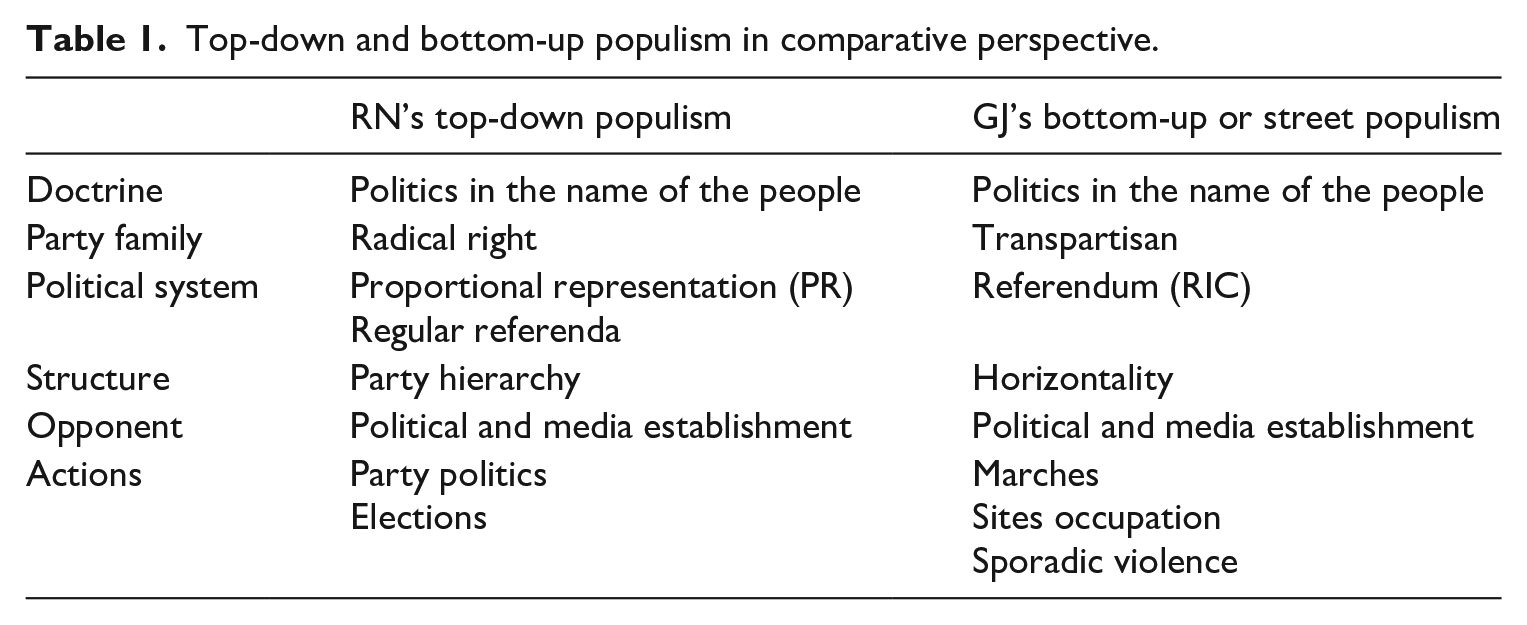
This article argues that the characteristics of the Yellow Vests’ populism forced the government to revise its anti-populist strategy. Because of the ideological diversity and sociological composition of the movement, ostracising and harshly demonising protesters as it has been done against the radical right RN was a less credible option. Also, it was less reasonable because LREM had to deal with the Yellow Vests’ acts of civil disobedience such as trying to reach the presidential Elysée Palace (Le Monde, 2019). Adversarial anti-populism could therefore aggravate the situation by provoking an escalation of violence in the country. For this reason, the government resorted to accommodative anti-populism: a combination of inclusion, conciliation and soft demonisation. Yet, by analysing the text more critically, it is possible to unveil that even in accommodative anti-populism, LREM sought to prevent the Yellow Vests from having access to more political power. This will be demonstrated in the final part of this article.
Accommodative anti-populism during the Yellow Vest protests
A strategy of inclusion and conciliation
The Yellow Vests movement meant that populist opponents of mainstream parties were not in the ballots but on the streets. Since they were ordinary citizens mobilising without a party label or a clear ideological line, using the method of exclusion and hard demonisation was riskier for LREM. Being too antagonistic could alienate part of the French population (even potential voters) since citizens strongly supported the movement according to the polls (Le Monde, 2018). In addition, this could increase violent civil unrest and threaten the continuity of Macron’s presidential term. One solution found by LREM was the postponement of reforms and the organisation of debates across the country. In December 2018, the increase in fuel taxes was suspended for 6 months as Prime Minister Edouard Philippe declared that ‘no tax should jeopardise the unity of the nation’. 18 Later that month, the government proposed to organise a national event to reunite LREM representatives, citizens and mayors to discuss a variety of topics. This initiative was called Le grand débat national (The Great National Debate).
One reaction of LREM was to narrow down the gap between elites and protesters. On one hand, they acknowledged the difficulties of the Yellow Vests by saying that many could not ‘make ends meet’ and deserved that ‘we fight for them’.
19
On the other hand, they recognised that the government had made the mistake of being too technocratic. Very importantly as well, they highlighted the common points between the Gilets jaunes’ demands and the programme of President Macron to show that both sides shared the same objective. This was illustrated by three declarations: one from President of LREM group in the National Assembly, Gilles Le Gendre, one from the Secretary of Equality between Men and Women Marlène Schiappa and another from Aurore Bergé, the LREM spokesperson:
It is more than a dismay, it is an exasperation, it is an anger that has been growing for years. (. . .) The Yellow Vests, I do not consider them opponents but victims, victims of a system that must be fixed.
20
When some people tell us that they are dying of hunger or do not know what they will put on the table on Christmas day for their family . . . whether the deficit is at 3,1 or 3,2%, yes, it is important, yes, it is a debt (. . .) but there is a scale of priorities. I prefer to do politics with my heart and for the people rather than with a calculator only.
21
You know, we are also capable to recognise that there are things that haven’t been the most relevant choices. [Indexing pensions on inflation] was too violent for the most vulnerable French.
22
In the three quotes, the speakers recognised the importance of street populists’ grievances over budget rigour and expressed some empathy towards protesters. Legendre used the word ‘victim’ to let the audience know that the Yellow Vests needed to be supported and not combatted. In this declaration, there was no doubt that some of the protesters’ demands were legitimate. In the second quote, words that expressed feelings and daily life such as ‘heart’ and ‘family’ were used, while the mathematical and cold aspect of technocratic politics was softened. Schiappa even chose the colloquial ‘crever’ rather than the more formal mourir. Both verbs mean ‘to die’ in French, but crever is stronger and fuller of imagery. This language served to highlight the seriousness of the protesters’ situation and express the sympathy of LREM towards them. As for Bergé, she admitted the mistakes of the government to improve its image and more generally that of LREM. Indeed, Macron and LREM have been criticised in France for being arrogant and out of touch with reality (Le Monde, 2018). The declaration of Bergé contrasted with the reputation of her party as it conveyed more modesty and showed that the protesters’ grievances were now being addressed. Moreover, LREM sought to show that the Yellow Vests’ claims echoed the party’s initial political project and that both sides pursued the same objective. As explained by LREM Deputy Laetitia Avia:
If you look at some elements of our programme, elements to make work pay better, elements to give more life to the relationship between citizens and politicians, these are the two pillars of the LREM programme, and these are the two points that are mainly found in the Yellow Vests’ claims.
23
However, behind their apologetic and inclusive language, LREM still firmly defended representative democracy and suggested that persons who resembled the Gilets jaunes were already present within the institutions. Consequently, the protesters’ wish of being better represented was already fulfilled after the 2017 legislative elections. As such, LREM tried to foster consensus between the two sides and convince street populists that there was no need to establish a more direct democracy. This was an implicit way of defending elite power and not making the Yellow Vests part of the decision-making process. This argument was formulated in another declaration of Avia published on her Twitter account:
The Yellow Vests want a citizen Assembly. This is the role of the National Assembly. We represent the people and every French person. The deputies of LREM are not professional politicians and mainly come from civil society.
24
Indeed, 56% of LREM elected deputies in 2017 had no previous experience in institutional politics (Le Figaro, 2017). As she reminded the audience of this fact, Avia attempted to bring LREM deputies and street populists together. At the same time, however, she tacitly said to the Yellow Vests that representative democracy – and thus elite decision-making – was the only game in town. The idea of a regular organisation of referenda, supported by both the Yellow Vests and the RN was ruled out by LREM during the protests. They justified this rejection by arguing that it could disrupt institutions. Likewise, LREM thought that granting too much decisional power to ordinary citizens could unravel and deconstruct some of the principles and rights that French society rested on. Populism was thus framed (although more indirectly than in adversarial anti-populism) as a danger to democracy and to the social and institutional order. When asked about the likelihood to consult citizens more often, Benjamin Griveaux, the Government Spokesperson and Marlène Schiappa gave the following answers:
I am committed to one thing, the stability of our institutions and the stability of policies that are conducted. If you set it [the referendum] at 70 000 [signatures], you have the possibility to undo every week what you did the previous week. (. . .) What makes our institutions, what makes the Fifth Republic strong, and this is how the General de Gaulle conceived it, is also the stability. (. . .) If we have to cancel every six months the policies that were implemented . . . frankly; it is also a principle of democratic responsibility and I am committed to representative democracy as well.
25
On the other hand, there are topics that will remain untouched. Abortion, death penalty, same-sex marriage. These are enshrined in our law; they are in accordance with the values promoted by the President of the Republic. He has carried a democratic, humanist, progressive project. These values are intangible.
26
We have often said that we do politics differently, but nevertheless in ‘doing politics differently’ there is ‘doing politics’. The President of the Republic was elected on a programme but also on values. We are a progressive government and we will not undo reforms that led to social progress: same-sex marriage, abortion and so on. I will make sure of this.
27
Both warned against the danger of consulting the people while insisting on the immutability of certain laws. According to them, giving the opportunity to citizens to directly decide on some matters instead of waiting for their representatives to act was perilous. As anti-populists, they thought that referenda were too unpredictable and would inexorably lead the country to a deadlock. Griveaux used an argument from authority as he mentioned the historical figure of Charles de Gaulle to oppose the idea. Besides, he explained that the validity of some laws could not be called into question because those were ‘intangible values’. In fact, he presented some policies as ‘natural’ phenomena that could not be reversed. Schiappa developed the same argument and her defence of the government’s programme equated to denying citizens the right to decide for themselves. Indeed, she presented some issues as simply being out of reach. Despite their efforts to ‘reunite’ both sides, LREM still considered that politicians were more reasonable and competent than the street populists, but also the best protectors of democracy and institutional stability.
In accommodative anti-populism, LREM chose to become the partners of the populists while in adversarial anti-populism this was not the case at all. LREM anti-populists have been consistently uncooperative towards the RN. They have not named the populist–anti-populist dichotomy as such, but they identified two camps: the ‘progressive’ one, which they belonged to and the ‘nationalist’ one (Fediunin, 2019) represented by Le Pen’s party. However, as LREM feared popular violence and discontent, this polarisation was not re-created against the street populists and consensus-building was chosen instead. Yet, even if some LREM elites expressed some thoughtfulness and regrets, there was according to them, no alternative to representative democracy. They still thought that politicians were the only actors endowed with the capacity to govern and decide, thus leaving little political space to the Yellow Vests.
Applying soft demonisation against street populists
While LREM representatives openly accused Marine Le Pen of ‘joining the Neo-Nazi’
28
or claimed that her campaign director Philippe Vardon was linked to the ‘Nazis’,
29
they were less blunt and more ambiguous when accusing the movement of extremism. Indeed, they partially or indirectly demonised street populists. LREM ministers and deputies created confusion around the identity of the Yellow Vests by tacitly conflating the ordinary – and respectable citizen with the casseur (troublemaker) and the extreme-right militant, which made it difficult to distinguish between the three. According to LREM, the ordinary citizen had legitimate claims related to social and fiscal justice and deserved assistance from the state. The rioter turned public space into a permanent zone of chaos while the extreme-right militant was xenophobic and homophobic. Two declarations, one from Aurore Bergé and the other from Benjamin Griveaux published on their Twitter account showed the thin line between the ‘authentic’ protester, the troublemaker and the extreme-right activist:
So, ‘we’ lynch the police (. . .) ‘we’ use codes of the 1930s to overthrow the Republic, ‘we’ behead the effigy of the President . . . Behind those ‘we’, a single face, cowardly, racist, anti-Semitic, putschist.
30
Everyone present on the Champs-Elysées yesterday was an accomplice. They either destroyed, vandalised, looted or they did not prevent it, or they sneered at unacceptable acts.
31
In the first declaration, Griveaux utilised the French pronoun on rather than nous. Both signify ‘we’ in English, but on is more impersonal. It indicates that the speaker refers to an action carried by others. In this case, on could be anyone, including persons wearing a yellow vest. Although the word ‘Nazi’ was not pronounced, it was suggested by the expression ‘codes of 1930s’ and the allusion to anti-Semitism. Such phrases could have a resonance for numerous citizens in France since the country has Europe’s largest Jewish and Muslim communities and an active network of institutional and civil society actors involved in anti-racist campaigns. Associations such as SOS Racisme and Union des étudiants juifs de France (UEJF; Jewish Student Union of France) have been very close to the PS for decades and have contributed to legitimise the anti-racist discourse in French politics and society, while LR has also embraced the fight against racism and discrimination (Gibb, 2003; Juhem, 2001; Marcus, 1995). In the second quote, the indefinite pronoun ‘everyone’ did not refer to a specific group as it could stand for tourists, passers-by on the Champs-Elysées and most importantly for the Gilets jaunes. Bergé insinuated that the Yellow Vests were the partners in crime of those who destroyed street furniture and restaurants on the avenue, as shown by the word ‘accomplice’ and that troublemakers and the Yellow Vests were potentially the same persons. Gérald Darmanin, the Minister of Public Accounts and Christophe Castaner, the Home Minister created a similar confusion when they discussed the protests that took place in November 2018:
Those who demonstrated were not the Yellow Vests, the brown plague is the one that demonstrated; I do not mistake at all those who were on the Champs-Elysées for the Yellow Vests that demonstrated all over France. (. . .) How do you call people who pull out cobblestones on the Champs-Elysées, throw them at police officers, beat up journalists (. . .)? You call them gentlemen who must be respected? These demonstrators are professional troublemakers who have nothing to do with the Yellow Vest movement, nothing to do with it. Wearing a yellow vest does not mean that you do not have a brown shirt underneath.
32
Go see our 17 injured police officers. Go see these three policemen who were injured after pétanque balls were thrown at them (. . .). But there are still people who are very peaceful in the Yellow Vests, but who today, in my opinion, are being swept away by those who are more radical.
33
The first quote clearly showed the three identities that blended each other. The good citizen who simply protested for his or her rights, the vicious rioter who attacked the police and the political extremist that Darmanin called ‘brown plague’, a metaphor for Nazism. Due to Darmanin’s convoluted declaration, it was difficult for the audience to really separate the Yellow Vests from the violent groups who participated in or infiltrated the demonstrations. Indeed, his declaration bore a contradiction. He denounced the presence of ‘professional troublemakers’ that he distinguished from the Yellow Vests, but claimed in the meantime that those who wore a yellow vest could be extremists, which deepened the confusion. As Darmanin said ‘brown shirt underneath’, a reference to the SS piece of clothing, he also intimated that the yellow vest was the disguise of extreme-right groups. This metonymy raised the spectre of the Third Reich and implicitly discredited the movement. As for Castaner, he validated the Yellow Vests as peaceful protesters but immediately nuanced this statement by saying that the ‘good Gilets jaunes’ were supplanted by violent individuals. Finally, President Macron further deepened the amalgam in the following quote:
For some to use the pretext of speaking on behalf of the people, but which one? From where? How? when, in fact, they are only the spokespersons of a hateful crowd; to attack elected representatives, police forces, journalists, Jews, foreigners, homosexuals, is quite simply the negation of France.
34
Like Bergé, Macron did not name the Yellow Vests but utilised the circumlocution: those speaking on behalf of the people, in order not to frontally accuse them. The President questioned the accuracy of the concept of people and underscored the potential dangerousness of those speaking in their name, as seen in the adjective ‘hateful’.
Expressing distrust towards the ‘people’ was also a strategy of soft demonisation as it contributed to deny legitimacy to the street populists. Macron talked about a ‘crowd’, a mass without a face that was out of control, and whose only goal was to attack minorities. As such, he produced misunderstanding and made the identity of the Yellow Vests fuzzy, building a thin line between the regular protester, the troublemaker and the extreme-right militant.
Soft demonisation also consisted in questioning the intelligence and credibility of the populist protesters. LREM’s language sometimes bore irony and expressed what is known in French as mépris (scorn). Before the Yellow Vest movement, some of President Macron’s phrases stirred controversy for they were deemed scornful towards the French ‘people’. Expressions such as ‘refractory Gauls’ (Le Monde, 2018), ‘the people who are nothing’ (Le Figaro, 2017), the ‘lazy ones’, 35 and ‘those who’d better go and find a job there instead of pissing around’ (Le Figaro, 2017) or the social welfare that ‘costs crazy money’ (Le Figaro, 2018). Three declarations of LREM betrayed a similar contempt towards street populists. The first one is from Emmanuel Macron. It was reported by the media in February 2019 and was pronounced during a speech in which he criticised the excessive importance that TV and radio programmes gave to the Gilets jaunes (Le Monde, 2019). The second one is from an interview of Gilles Le Gendre and the last one is a declaration from Marlène Schiappa published on Twitter.
Jojo the Yellow Vest who has the same status as a minister or an MP. There is a second mistake that was made and for which we all bear responsibility, including myself; it is probably that we have been too intelligent, too subtle, too technical when discussing purchasing power measures. (. . .) Obviously, this has not been understood.
36
On television, on the radio, all you have to do is put a yellow vest on to make your word sacred: you can spread any fake news without being refuted, you become ‘the people’. I do protest against this.
37
In the two first quotes, politics is a domain of expertise from which laypersons should be excluded. ‘Jojo’ stands for John or Jane Doe, but bears an ironical or comical connotation since it is also a clown’s name. It implied that protesters were not knowledgeable or credible enough to deal with political matters and it highlighted the fracture between the learned elites and the inept ‘populace’. Le Gendre even more straightforwardly assumed that ordinary citizens, including the Yellow Vests, did not have the intellectual capacity to understand political reforms. The contempt expressed was particularly unsettling as Le Gendre initially intended to make a public apology but eventually said that the street populists were not acute enough to grasp the content of governmental action. The last quote denounced the fact that the Gilets jaunes felt legitimate just because they wore an accessory and called themselves ‘the people’. Schiappa rejected the idea that the ‘people’ were inherently reliable and honest, which echoed the elite scepticism about this concept. The government’s arrogance was also apparent in the way it diminished the importance of the protesters. This was shown in the declarations of President Macron during a press conference and Aurore Bergé in a TV interview.
I recognise, I respect and value the Yellow Vests who took the streets at the beginning of this crisis (. . .) but I do not concede anything to those who destroy institutions, (. . .) want the riot and do not even demonstrate anymore. Those (. . .) who have these protest signs, very honestly, they can have them for a very long time, it does not move me. It does not move me.
38
I am not under the Yellow Vests’ orders. I do not wake up in the morning wondering if they will like this interview or the laws I will vote in the Parliament. I am here to talk to the French and say that there is a balance to find.
39
Even though Macron said that he understood the Yellow Vests’ struggles and complaints, his rhetorical concession was counter-balanced by a disdainful kind of language. He clearly stated that he was not impressed by the Gilets jaunes’ resilience and that despite the ‘protest signs’ full of derogatory slogans against the government, he remained unfazed. Bergé adopted a similar attitude. According to her, LREM did not have to obey street populists. Consequently, she preferred to speak to the ‘French’, as the Yellow Vests, while being part of the nation, were a less significant entity. Other ministers also sought to ridicule the Gilets jaunes while reaffirming the importance of state institutions, as shown by the declarations of Gabriel Attal, the State Secretary of the Ministry of National Education and Youth and Christophe Castaner:
The French prefer the Great Debate over Saturdays’ big damage. 800 000 contributions on the website www.grandebat.fr.
40
I systematically refused confrontation, and wanted us to protect demonstrators, including from themselves sometimes. When you see women and men invading an open highway and running in the middle of it, somehow you realise that they are putting themselves in danger. Yesterday, a motorcyclist was very seriously injured, we are worried about his vital prognosis; that is the reality we are facing.
41
Each time less mobilisation, a national mobilisation, even last week with 88,000 people, which is little compared with what we know in terms of demonstrations. I have in mind the last demonstration against the SNCF
42
reform, there were 322,000 persons (. . .). You know (. . .), the play drags on. There is hardly anyone left on the stage or in the room. For me, it is time to change play. What is of most interest to me is the First Act of the National Debate.
43
The declaration of Attal was sardonic and particularly playful in French as he used and alliteration and a rhyme: débat (debate) and dégâts (damage). It presented LREM as responsible actors who made constructive propositions and the Yellow Vests as a violent group uninclined to peaceful communication. Most importantly, the humorous tone aimed at decreasing the seriousness of the movement. In that sense, it differed from the crude adjectives such as ‘disgusting’ 44 used by LREM to stigmatise the RN. As for Castaner, he implied that street populists were reckless and had no sense of right and wrong since they literally threw themselves on the road as if they were lunatic. The idea that the government should ‘protect from themselves’ the protesters had a paternalistic connotation. It meant that the Yellow Vests lacked clear-sightedness and intelligence while elites were more rational and sensible. In the second quote, Castaner downplayed the importance of the mobilisation by comparing it to previous social movements and used the lexicon of theatre to ‘send off’ street populists. Taunting the Yellow Vests, he said that the ‘play drags on’, which meant that the movement had lasted too long and was becoming boring for both the participants and the audience. For LREM, it was time to move from irrelevant street populism to serious institutional debate.
In accommodative anti-populism, elites avoided the frontal accusation that they have tirelessly used against the RN. Instead, they subtly conflated rioters and political extremists with the Yellow Vests. Also, soft demonisation was apparent in the elites’ denial of the people’s intellectual and political capacity. LREM expressed its superiority over the street populists by being more condescending than accusatory. Yet, while antagonism was reduced, typical characteristics of anti-populism such as seeing the people as mediocre and dangerous were still observable. In that sense, LREM’s discourse oscillated between proposing a partnership with street populists and treating them as distant foes to prevent them from accessing decisional power and validate the role of elites (Table 2).
LREM’s anti-populist response according to type of populism.
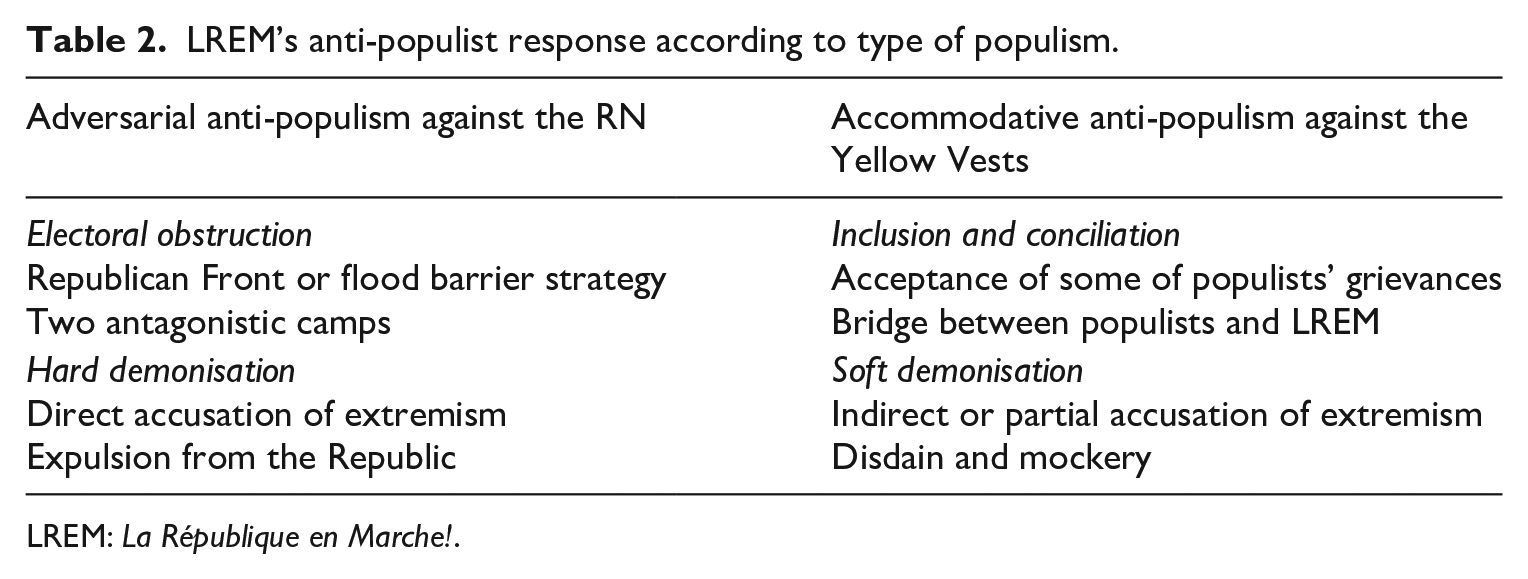
LREM: La République en Marche!.
Conclusion
France was used as a comparative case of anti-populism as mainstream parties in the country have had to deal with both top-down and street populism. Relying on CDA, the article particularly focused on accommodative anti-populism. It showed that during the Yellow Vests protests, LREM representatives made efforts to bring back the populist protesters to their camp and acknowledged both the legitimacy of some of their demands and the mistakes made by the government. Confrontation was softened and accusation rarely straightforward like in adversarial anti-populism. Indeed, the demonisation of street populists was indirect or partial as the lines between decent and extremist protesters were blurred, and while mockery and disdain towards the people were expressed in lieu of straightforward hostility. The article thus demonstrated that in response to a street populism that has no links with the institutional opposition to the incumbent government, mainstream parties can choose to drop adversarial anti-populism and resort to an accommodative anti-populism that is less binary and creates more proximity with the populist challengers. Yet, it was also shown that in accommodative anti-populism, elites’ distrust towards the people remained visible. Ordinary citizens were still framed as xenophobic, potentially factious and politically inferior, to justify the primacy of elite decisional power.
Overall, this article sought to fill a gap in the literature. Although the populist-anti-populist divide has been observable for years, anti-populism continues to be neglected. Denigrating populists and lecturing citizens who ‘do not vote well’ under the pretext that populism is morally wrong is anything but a marginal occurrence. In fact, the discourse of many politicians, journalists and part of organised civil society is filled with disparaging comments about populists. As many studies have shown already, populism exaggeratedly sanctifies the people and despises the elites. In parallel, fewer works have shown how anti-populists try to ban populists from the political scene by depicting them as actors who lack ethical and intellectual credentials. However, by not analysing anti-populism, researchers might indirectly contribute to its naturalisation and to the belief that populism is an aberrant political behaviour that it is normal to combat.
