




Abstract
This article applies insights from comparative federalism to analyse different models for managing future EU–UK relations. The argument is that the stability of the EU–UK relationship before as well as after Brexit is best understood by examining the presence of federal safeguards. Drawing on Kelemen, four types of safeguards are identified as the means for balancing centrifugal and centripetal forces. During the United Kingdom’s European Union membership, the strong glue provided by structural and judicial safeguards was undone by the weakness of partisan and socio-cultural ones. However, each post-Brexit scenario is characterised by weaker structural and judicial safeguards. The most stable outcome is an indeterminate Brexit that limits the incentive to politicise sovereignty and identity concerns by ending free movement of people and reducing the saliency of European Union rules. Such stability is nevertheless relative in that, from a comparative perspective, federal-type safeguards were stronger when the United Kingdom was still in the European Union.
Introduction
The UK government’s decision to accept the mandate of the 2016 Brexit referendum and withdraw from the European Union (EU) left unanswered the question of how exactly to disassociate from the single market. Historically speaking, British Euroscepticism excelled at finding flaws in the EU system, but as a reactive and negative creed it never articulated a coherent template for life outside supranational integration (Usherwood, 2018). Thus the vexing political process of finding an alternative relationship with the EU and then of accepting its constraints poses a further dilemma. That is, how politically sustainable are any of the spectrum of post-Brexit options, especially knowing that the strictures of EU membership already proved too much for UK voters? Hence this article sets out to explore the potential stability of different arrangements for organising EU–UK relations, which in conceptual terms is taken to be a debate concerning how far to establish differentiation outside the scope of formal EU membership (Leruth et al., 2019; Schimmelfennig et al., 2015; Schimmelfennig and Winzen, 2020).
Historically, the British state has been at the heart of developments in European politics for centuries (Sweeney, 2019). But this engagement was contingent and often fickle, as was the case during the United Kingdom (UK)’s membership of the European Economic Community (EEC) and then the EU (George, 1998; Wall, 2008). In this context, the political stability of different arrangements for managing UK–EU relations after Brexit cannot be taken for granted. 1 To this end, the analysis developed here expands on the existing EU differentiation literature, which has been accused of having an imbalance between overconceptualisation and undertheorisation (Holzinger and Schimmelfennig, 2012). Applied to the EU as a whole, differentiation as a field of study acknowledges a gamut of possibilities from the rolling back of integration to the possibility of greater centralisation arising out of crisis (Börzel, 2018; Leruth et al., 2019). One notable dimension that is missing in these treatments, however, is a theoretical framework for assessing the stability of these respective institutional arrangements based on the political dynamics they might encourage or stifle. In the absence of such work, it is hard to say if, and why, disintegration from a starting point of high interdependence, as is the case for the United Kingdom, is more stable than the constraints of EU membership.
To address this gap as it pertains to post-Brexit outcomes, the article draws on scholarship that examines the difficulties of finding political accommodation between different levels of government that share common rules and institutional structures, that is, comparative federalism. After all, a soft Brexit consisting of replicating membership of the single market akin to the European Economic Area (EEA) involves significant constraints on state sovereignty. This situation is akin to federalism, which entails a ‘change in the political status of every member of the federation . . . it establishes a new status for every member’ (Schmitt, 1992: 29). Fewer constraints apply in the case of shadowing certain EU rules through a free-trade agreement (FTA) that binds the exercise of authority over various policy areas in the form of regulatory alignment; fewer still would exist in the event no FTA is concluded. Nevertheless, the contention of this article is that insights from comparative federalism can be applied to understanding political dynamics pertaining to the spectrum of post-Brexit EU–UK relations. This is because the options available to the United Kingdom span a range from a ‘holding-together’ political arrangement to maintain close alignment to what can be equated to secession (Lustick et al., 2004). Whereas the former can be compared with institutionalised legal and political processes found in federations that seek to devolve power back to constituent units (Stepan, 1999), the latter constitutes the total breakdown of attempts to balance autonomy and common obligations under a shared legal–political architecture of enforcement.
Hence the argument developed here is that the stability of the UK–EU relationship before as well as after Brexit can best be understood by applying insights from the study of how certain safeguards play a role in the endurance (or not) of federal-type structures. The work of Daniel Kelemen (2007) scrutinising the durability of the EU as a federal-like system is of particular relevance for this purpose, even if applying the federal analogy to European integration is contested (Majone, 2006). Kelemen’s identification of four types of federal safeguard for sustaining a stable political order that both constrains unit autonomy and upholds common obligations can be productively applied to understanding key political dynamics that made UK membership of the EU unstable. As explained in section ‘Using comparative federalism to understand the United Kingdom’s EU withdrawal’, these factors include structural safeguards (institutions that provide for cross-unit political dialogue and decision-making); judicial safeguards (legal mechanisms to prevent cheating on common obligations or ultra vires federal actions); partisan safeguards (how far parties are committed to supporting federal arrangements); and socio-cultural safeguards (the extent of shared identity and political culture). The article contends that the weakness of partisan and socio-cultural safeguards in the UK context produced demands for differentiation (Schimmelfennig and Winzen, 2020) to accommodate preferences over sovereignty and identity that institutional and judicial safeguard mechanisms proved insufficient to satisfy.
Consequently, it is necessary to explore how UK demands for differentiation will interact with mechanisms to ensure both London and Brussels respect their mutual commitments, while also assessing whether greater stability might come from having no such commitments. Based on historical precedent, demands for differentiation are assumed to revolve around national sovereignty – in the form of maximising autonomy from EU rules – and protecting national identity, which is intimately connected to immigration policy (Schimmelfennig, 2018). The formal outcome of negotiations over the future EU–UK relationship, unknown at the time of writing, can result in a spectrum of outcomes defined by differing degrees of institutionalisation and accompanying legal obligations. Three such post-Brexit scenarios are identified in order to conduct the analysis: a soft Brexit, a hard Brexit, and an indeterminate Brexit that is not necessarily an intermediary position between these two poles, but which takes the form of at least a basic EU–UK FTA. 2 These outcomes, as outlined in section ‘Managing differentiated disintegration: Three options for the UK’, represent a spectrum of possibilities defined by greater or lesser institutionalisation and concomitant legal obligations, as well as varying economic costs arising from trade frictions. Section ‘Assessing the stability of three different post-Brexit scenarios’ then analyses the stability of each post-Brexit scenario on the basis of the compatibility between demands for differentiation coming from partisan and socio-cultural factors and the institutional and judicial mechanisms for managing such demands after EU withdrawal.
Using comparative federalism to understand the UK’s EU withdrawal
The EU is not a sovereign state and lacks core state powers in essential areas such as taxation and foreign policy. However, the EU’s divided system of government matches one of the key principles of federalism: the separation of powers between different territorial levels of government (Burgess, 2002). With the constitutionalisation of its legal system (Weiler, 1991) allied to the steady growth of its core state powers (Genschel and Jachtenfuchs, 2016), the EU is far more integrated than other regional blocs. Even without a formal federal constitution, therefore, it is possible to analyse the EU’s political dynamics by applying theories derived from federal states to explain institutional and policy outcomes (Börzel, 2005; Fabbrini, 2010).
Federal states are distinguished by virtue of having vertically divided institutions of government, with some powers exercised at the centre for the entire state (notably, foreign policy and major economic tasks) and others exercised by autonomous territorial units (Burgess, 2006). Typically, these territorial units not only control their own affairs but also play a role in decisions affecting the entire state, especially with regard to constitutional change. This is to prevent the federal centre from encroaching on the prerogatives of the units. As such, the comparative study of federal systems indicates that there are two major dilemmas facing such political systems: centralisation in the form of encroachments on unit autonomy and fragmentation, whereby the units shirk responsibilities or in other ways assert themselves at the cost of common obligations or goals (Bednar et al., 2001).
These same dilemmas have been present in the development of the EU, which is why many scholars have studied its institutional evolution and policy dynamics by applying theories from comparative federalism. The United States is a common reference point because of its lengthy history of constitutional development and jurisprudence covering the shifting boundaries between state and federal authority (Egan, 2015; Fabbrini, 2010). However, the federal lens struggles to explain certain important features of EU institutionalisation. Majone (2006) points out that within the EU system, member states represent not just their interests qua autonomous units, but also a preference for a certain type of decision-making process. Ceteris paribus, national governments can be expected to support an intergovernmental approach to decision-making, while the Commission, the Parliament, and the Court of Justice of the EU (CJEU) support the extension of supranationalism. The Commission itself is particularly hard to analyse using the tools of comparative federalism. It is less analogous, as Magnette (2006) explains, to national executives than to ‘domestic technocracy: as domestic politics need some technocratic input to avoid being dominated by short-term electoral concerns, international negotiations require some supranationality to correct the bias of state interests’ (p. 164).
Nevertheless, comparative federalism, in the form of Daniel Kelemen’s (2007) framework for explaining the durability of federal-like arrangements, has great explanatory power for understanding the nature of UK relations with the EU in the prelude to Brexit. Kelemen’s model identifies four crucial mechanisms, or safeguards, that help maintain the balance between units’ desire to maximise their autonomy and the centre’s desire to limit that autonomy and enforce common obligations. The operation of these four types of safeguards – structural, judicial, partisan, and socio-cultural – during the UK’s membership of the EU explains much about the instability of that relationship. As demonstrated below, there was a recurrent need to contain centrifugal forces undermining the UK’s willingness to meet EU commitments.
The operation of federal safeguards during UK membership of the EU
The idea of creating an institutional decision-making structure that could balance out centripetal and centrifugal tensions was a central concern of Publius when defending the vertical separation of powers in the proposed US Constitution. James Madison wrote that: we have seen, in all the examples of ancient and modern confederacies, the strongest tendency continually betraying itself in the members, to despoil the general government of its authorities, with a very ineffectual capacity in the latter to defend itself against the encroachments. (Hamilton et al., 2009: 235)
In the American case, the solution was to create a ‘compound republic’ that mixed different forms of political representation as both the states and the union had a claim to represent citizens; in addition, the bicameral legislature of the federal government combined both representation of the states and of the aggregate people. That is why Madison claimed in Federalist 39 that ‘the proposed constitution therefore is in strictness neither a national nor a federal constitution; but a composition of both’ (Hamilton et al., 2009: 187).
The EU decision-making system is arranged along similar lines: national governments defend their interests via membership of the co-legislature (the Council) and the European Council, which has agenda setting/crisis managing powers (Fabbrini, 2010). Member states’ representation in these institutions constitutes a structural safeguard that limits the unwanted extension of EU powers (Kelemen, 2007). The UK made full use of this type of safeguard in its four decades as an EEC/EU member. By wielding a veto on treaty change, UK governments were able to obtain opt-outs from a number of major policy initiatives, namely Economic and Monetary Union, the Schengen border-free area, and Justice and Home Affairs. This policy-wide treaty differentiation even allowed, in the case of Justice and Home Affairs, selective participation in preferred EU legislation, including the European Arrest Warrant and the Schengen Information System (Schimmelfennig, 2018). The EU’s regulatory agencies constituted another venue for exercising structural safeguards. For 6 years in a row (2011–2016), for example, the UK vetoed an increase in the European Defence Agency’s budget to rein in EU spending. Hence the United Kingdom, like all EU member states – but especially large countries with significant voting weight in the Council – was afforded strong structural safeguards to protect its interests, which it took ample advantage of.
Another important safeguard in federal-like systems comes in the form of judicial mechanisms to ensure that different parties observe common obligations, while also preventing power grabs from the centre. On one hand, unequal compliance with rules governing trade and economic interactions more generally could benefit some territorial units at the expense of others. On the other hand, constitutional constraints on majoritarianism protect the status and rights of territorial units from being subject to the tyranny of the majority. Within the EU system, member states benefit not just from impartial non-compliance monitoring by the Commission; they also have access to the very powerful CJEU for redress against potential competence encroachment as well as non-compliance by other countries. In addition, there is a highly integrated system of de-centralised enforcement whereby EU law is applied via national courts. In this fashion, the EU offers robust safeguards – also readily accessible to citizens and firms – against both legal over-reach by the EU and member state non-compliance, although the mechanism is more skewed towards the latter (Kelemen, 2007). As a member state, the United Kingdom made regular use of this strong judicial safeguard. It did so notably by litigating at the CJEU to protect the interests of the City of London by bringing a case against the European Central Bank’s (ECB’s) attempt – supported by France and Germany – to ‘relocate’ the clearing of euro-denominated derivatives to inside the eurozone (Howarth and Quaglia, 2013). The CJEU found in the United Kingdom’s favour that this was a distortion of single market rules, demonstrating the value of this form of judicial redress.
Partisan safeguards, as identified by Kelemen (2007), revolve around the nature of the party system and electoral competition. These features are important because the way in which political parties are organised in federations impacts centralising and decentralising tendencies (Filippov et al., 2004). Integrated party systems, where party financing and organisation are coordinated across territorial levels of government, support centralisation whereas decentralised party organisation, with separate parties contesting elections at different levels, favours territorial autonomy (Bednar, 2011). Historically, party systems in federations become more integrated as federal competences increase, especially fiscal powers (Chhibber and Kollmann, 2004). Yet in the course of its development, the EU has only experienced a limited expansion in its tax-raising powers, despite significant competence transfers in other policy areas. This helps explain the limited strength of European-level party organisation, leaving a great degree of autonomy to national parties within EU countries (Thorlakson, 2017). In such circumstances, partisanship in the EU is far more likely to produce a risk of fragmentation or disintegration than of centralisation (Kelemen, 2007).
In keeping with this logic, British party politics were regularly convulsed by the question of how far to transfer powers to Brussels. Both the Labour Party and the Conservatives were internally divided on this question at various times from 1973 to 2016. In 1975, an internally divided Labour government held a referendum on whether the United Kingdom should remain in the EEC (Saunders, 2018), while in 1983 it fought a general election with a manifesto pledge to leave the EEC. In the following decades, Labour reversed course and adopted a pro-European platform, albeit with grave reservations about the single currency (Daniels, 1998). The European question became increasingly difficult for the parliamentary Conservative Party to manage in the aftermath of the 1992 Maastricht Treaty. What had been a divide between Europhobes and Europhiles morphed into one between hard and soft Eurosceptics that debated the benefits of continued EU membership (Dorey, 2017). During David Cameron’s premiership, Tory backbenchers mobilised to force a referendum on the issue and also proposed unilateral changes to EU legal supremacy and migration rules (Dorey, 2017). Consequently, partisanship was never a strong mechanism for securing UK consent to EU obligations. Rather, when the EU was placed at the heart of British electoral competition it was as a way to contest treaty change, competence allocation, and even membership itself.
The fourth and final safeguard relevant for assessing the durability of a federal system concerns public attitudes towards the polity itself. This socio-cultural dimension reflects the potential tension between competing national and sub-national political identities. The existence of a strong shared identity is a powerful safeguard against secession because it limits demands for special status and recognition by a territorial unit (Kelemen, 2007). Conversely, the existence of a dominant overlapping identity reduces the obstacles to centralization. Applied to the EU, the existence of a common European identity and political community has long been seen as lagging behind economic and institutional integration (Fligstein, 2008). Moreover, strong and exclusive attachment to a national community is a key variable explaining lower support for the EU (Kuhn, 2015). This was particularly true in the case of the United Kingdom, where survey data consistently indicated some of the strongest hostility to a European identity among EU countries (Carl et al., 2019). Euroscepticism was not just a vote-winning ploy by British political elites; it was also a reflection of a comparatively weaker sense of European identity than elsewhere in Europe (Carl et al., 2019). In this way, socio-cultural attitudes were a weak safeguard against the United Kingdom choosing to go it alone.
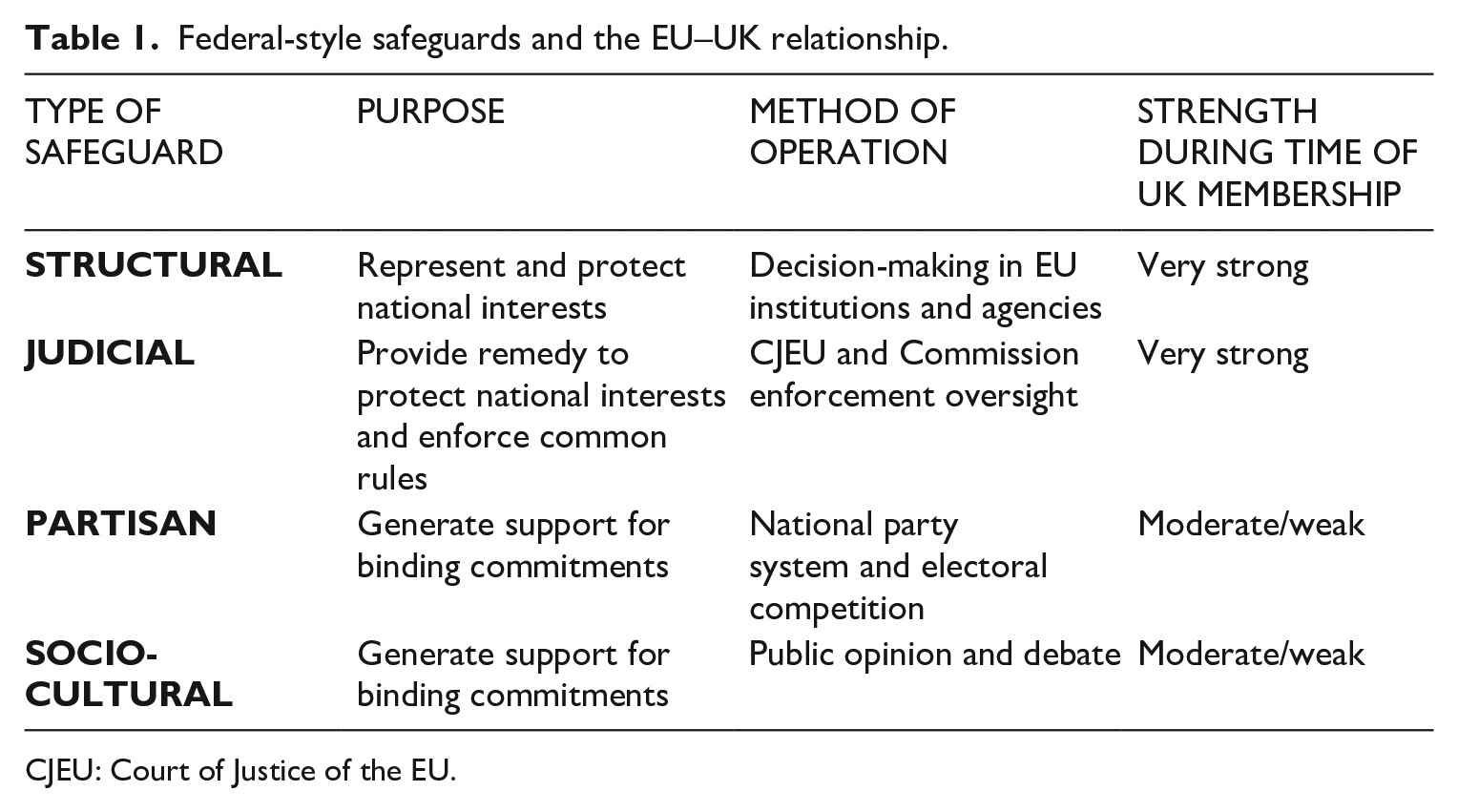
When considered together, as shown in Table 1, a mixed picture emerges regarding the operation of federal-type safeguards during the United Kingdom’s period of EU membership. Successive UK governments benefitted from the existence of strong structural and judicial mechanisms for protecting British interests. In particular, special arrangements including opt-outs and the UK budget rebate were created to accommodate the United Kingdom’s preferences on the back of using structural safeguards. This demand for internal differentiation was in turn a reflection of political dynamics stemming from partisanship and public attitudes, whose ability to generate acceptance of EU treaty obligations, such as legal supremacy or free movement of people, can be labelled moderate at best. The strong glue provided by structural and judicial safeguards was undone by the weakness of partisan and socio-cultural ones as UK voters in 2016 decided that privileging sovereignty and preserving national identity were more important than remaining in the EU. So began the search for a different kind of relationship with the EU, one characterised by differentiated disintegration, as explained below.
Federal-style safeguards and the EU–UK relationship.
CJEU: Court of Justice of the EU.
Managing differentiated disintegration: Three options for the United Kingdom
As shown above, the UK’s demand for greater internal differentiation became impossible to contain via structural and judicial safeguards. However, post-Brexit relations with the EU cannot be understood as part of the standard process for establishing external differentiation as a non-EU country. This is because external differentiation – the selective policy integration of non-member states – occurs most often in highly interdependent but weakly politicised policy areas. That is not the case in the aftermath of Brexit, a process driven by high politicisation of EU obligations and the delegitimisation of the EU system (Schimmelfennig, 2018).
External differentiation is commonly understood as a negotiated outcome between the EU and a third country over the degree of interdependence that requires common rules and institutions. In short, it involves ‘policy integration without [EU] membership’ (Schimmelfennig et al., 2015: 774). Agreements that fall within this category, such as membership of Schengen for Switzerland, or Norway’s integration into the single market via the EEA, are underpinned by acceptance of the legitimacy of the EU legal–political order. Where this legitimacy is contested by a third country seeking a looser relationship, Schimmelfennig and Winzen (2020: 138) categorise this as ‘external differentiated disintegration’. Such demands are rare because non-EU countries find themselves ‘in a situation of weak institutional and material bargaining power’ (Schimmelfennig and Winzen, 2020: 8) when seeking to gain satisfaction from Brussels. For instance, in departing the EU the United Kingdom switched bargaining positions. It went from using structural safeguards to secure policy opt-outs (e.g. on the Euro) as an insider, to an outsider approach of seeking to use bilateral contacts to prevent the formation of an unfavourable EU27 consensus.
The formal outcome of negotiations over a future EU–UK relationship, unknown at the time of writing, can result in a spectrum of outcomes defined by differing degrees of institutionalisation. The United Kingdom’s options for life outside the EU range from a hard exit, where World Trade Organization (WTO) trading rules apply in the absence of an FTA or any shared governance mechanism established by bilateral treaty, to a soft exit intended to retain membership of the single market. A ‘neither soft, nor hard’ option is possible, encompassing an FTA and potentially other treaties covering security or scientific cooperation. Such an outcome can be dubbed as an ‘indeterminate’ Brexit because it does not necessarily lie precisely at a mid-point between the two poles. An EU–UK association agreement is closer to a soft Brexit, while a very basic FTA, stripped of level playing field conditions, is closer in nature to a hard Brexit. Indeterminacy is thus used to capture the fact that different implications may follow from an EU–UK trade deal. Overall, the less institutionalised the relationship, the fewer binding commitments the United Kingdom (and the EU) will have to respect and vice versa. The looser the association with the EU, the greater the amount of costly trade friction (UK Government, 2018), meaning the harder the Brexit the greater the economic costs. This spectrum of options and their consequences is illustrated in Figure 1.
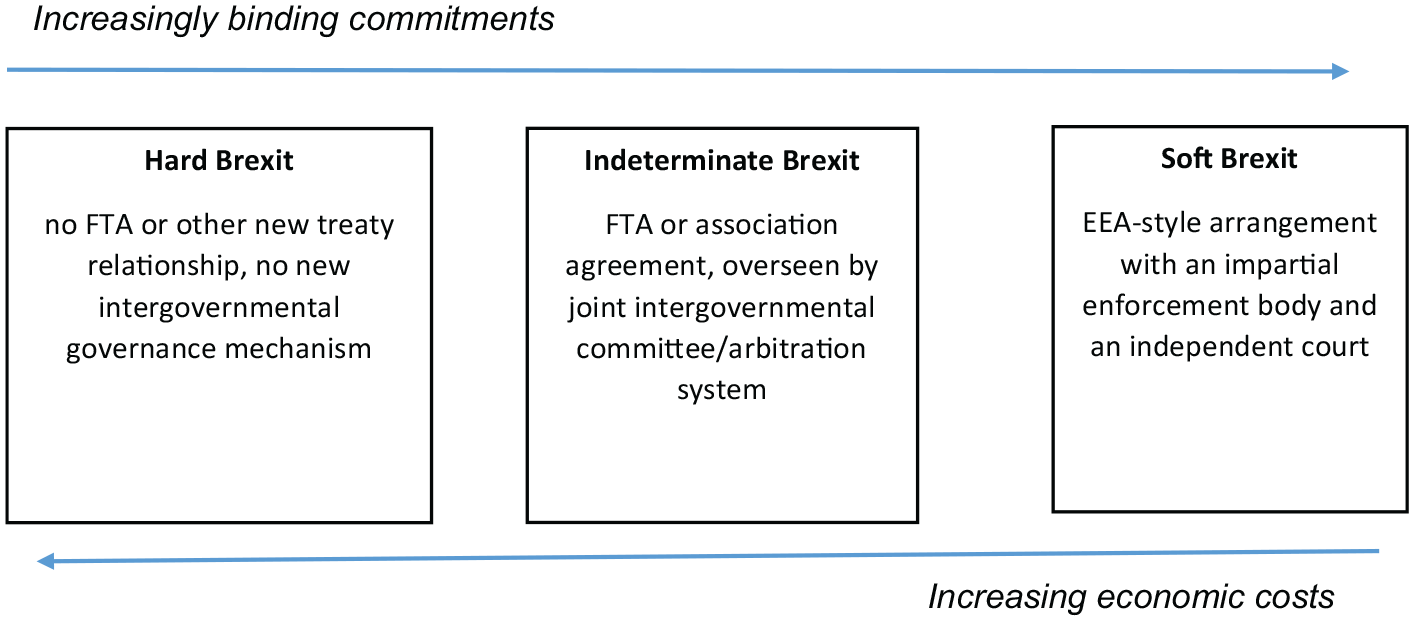
A spectra of options for post-Brexit EU–UK relations.
A soft Brexit would require an EEA-style treaty creating a robust legal and institutional framework for dynamic alignment between the United Kingdom and the ever-evolving single market. Particularly important here is the creation of an independent enforcement body to replicate the Commission’s watchdog role for monitoring state non-compliance. Under the terms of the EEA, this job is performed by the European Free Trade Association (EFTA) Surveillance Authority, which can bring infringement actions to the EFTA Court, just as the Commission litigates via the CJEU (Schewe and Lipsens, 2018). As explained by the President of the EFTA Court, the EU has a doctrine whereby granting full access to its internal market to a non-EU country ‘is only possible if they accept a non-national surveillance and court mechanism’ (Baudenbacher, 2016: 3). In addition, the EFTA Court follows CJEU jurisprudence to ensure a uniform legal interpretation of treaties and secondary legislation across the entire single market. Any attempt to maintain full alignment on single market rules thus requires accepting a form of homogeneous legal interpretation. A highly institutionalised and legalised relationship such as this entails accepting significant binding commitments, including an independent enforcement system. The payoff would be economic: a soft Brexit is the least costly alternative to EU membership, representing a negative impact of between 0.6% and 2.6% of UK GDP over 15 years (UK Government, 2018).
The hardest of Brexit scenarios entails the opposite kind of relationship: a fully de-institutionalised one without any joint governance arrangements established by bilateral treaty (beyond those contained in the Withdrawal Agreement, although in theory this treaty could be repudiated unilaterally). This outcome can be compared to state secession because it would be as if the United Kingdom had never been an EU member. In the absence of an FTA, UK–EU trade would be governed by WTO rules in largely the same way that the EU trades with Australia, for instance. The trade friction generated by such a break has been estimated by the UK government to have a negative impact of between 5% and 10% of GDP over 15 years (UK Government, 2018). In this scenario, it is possible to envisage some level of cooperation on mutual interests in areas such as data sharing, aviation, research, or security. However, this relationship – as in the case of EU–Australia relations – would not extend to a system of reciprocal rights and obligations overseen by a joint institutional architecture. This scenario may appear far-fetched, but it was accepted by both parties as the default setting for UK–EU relations should the Brexit negotiations prove inconclusive.
A half-way house solution for EU–UK relations would be to place trade relations on a more stable footing by concluding an FTA similar to that which governs trade between the EU and Canada. The economic cost of a UK–EU FTA deal is estimated over 15 years to involve a loss of 3.1%–6.6% of GDP compared with EU membership (UK Government, 2018). An arbitration mechanism could potentially be tacked on to provide a mechanism for dealing with trade disputes without having to resort to the adversarial WTO system. More ambitiously, but without creating the constraints of an EEA-style relationship, the United Kingdom could sign an Association Agreement with the EU as is the case for a country such as Ukraine. EU association agreements contain not just an FTA component but also provide an institutionalised mechanism for cooperating on shared policy interests in sectors such as the environment, defence, and energy, which is why the European Parliament (2018) has proposed this as a model for EU–UK relations. The indeterminacy of this arrangement lies in the fact that more or less use could be made of an association-type treaty depending on the political will of both contracting parties. Regardless of where the UK–EU relationship ends up being located on this spectrum of options, the question remains as to how durable any particular arrangement will prove in a context in which demands for differentiation are liable to remain powerful.
Assessing the stability of three different post-Brexit scenarios
Given that the United Kingdom’s membership of the EU proved unsustainable, it is necessary to assess whether any of the post-Brexit scenarios identified above might prove more stable. By applying the safeguard framework adapted from Kelemen’s work on comparative federalism, it is possible to analyse the political dynamics pertaining to the different post-Brexit options for the United Kingdom and compare these with the situation during EU membership sketched in section ‘Using comparative federalism to understand the UK’s EU withdrawal’. To this end, the analysis examines the presence and strength of the four federal-type safeguards in the three scenarios of a soft, indeterminate, and hard Brexit.
In the event of a soft Brexit, the United Kingdom would commit to being a ‘rule taker’ by continuing to follow single-market legislation, which in the case of the EEA framework includes the free movement of people. Based on the precedent of the EEA system, the United Kingdom would lose a great degree of the structural safeguards afforded EU member states. EEA countries have no formal representation within EU decision-making institutions and their participation in EU regulatory agencies comes devoid of voting rights. When legislation in EEA-relevant areas is proposed by the Commission, under Article 99, Norway, Iceland, or Liechtenstein can ask for an exchange of views in the Joint Committee that brings together their representatives and those from the EU (Schewe and Lipsens, 2018). The Commission also solicits informal advice from EEA country experts prior to initiating legislation (in practice, this means receiving comments on green papers). But EEA states have no formal say in deciding on EU rules that they need to mirror. The process of mirroring requires a decision of the Joint Committee, meaning EEA countries in theory have the right to reject the incorporation of new EU law. However, since 1994 Norway has exercised this right once, in 2011, in a decision that was reversed 2 years later. The potential for ‘decision shaping’ under the EEA system is thus very limited, resulting in a far weaker mechanism for protecting member state interests than that available to EU member states (Fossum and Graver, 2018).
The EEA mechanism does provide for strong judicial safeguards via the creation of the EFTA Surveillance Authority, which can bring cases of non-compliance to the EFTA Court. However, this arrangement does not provide a backdoor remedy to contest EU decision-making ex post. The EFTA Court is only competent to hear cases where surveillance procedures or competition decisions are disputed and in instances of disputes between two or more EFTA states (Schewe and Lipsens, 2018). Proponents of an EEA-style soft Brexit point to the way Article 112 provides a legal framework for a contracting party to take unilateral measures suspending the application of a particular aspect of single market regulation in emergency situations. Iceland did this in 2008 in order to introduce capital controls for the sake of managing the repercussions of the global financial crisis. Liechtenstein, which has a foreign-born population of more than 50%, is the only EEA country to have used these emergency powers to restrict immigration. Hence Article 112 appeals as an indicator of greater legal flexibility that, in a post-Brexit context, could allow the United Kingdom to pursue certain restrictions on free movement of labour, or be more flexible in other areas such as state aid, if and when the British government decided to trigger this provision. Yet, according to the EEA treaty, actions taken by a member under Article 112 have to be restricted in scope and duration. In addition, the measures are supposed to be agreed upon jointly via consultation with the EEA Joint Committee, as were the measures taken by Iceland and Liechtenstein. This same body would review emergency restrictions on single market rules every 3 months and countermeasures could be applied by the EU should there be no consensus on the validity of these actions.
In other words, emergency measures cannot be invoked unilaterally without the fear of retaliation by the EU. Article 102 specifies an institutional mechanism for remedying disagreements over the incorporation of the EU acquis using the EEA Joint Committee, as well as a procedure for suspending part of the agreement in a case where no solution can be found. In practice, this article has never been used to trigger a suspension of the EEA agreement, although there are notable delays in EFTA states’ domestic implementation of EU rules that have caused consternation in Brussels (European Commission, 2012). This non-use can be explained by the absence of direct confrontation within the EEA framework, which itself is a reflection of the asymmetry of economic power whereby the EU can absorb the costs from any suspension far more easily than the smaller EFTA states (Fossum and Graver, 2018). Creating an EEA-style relationship, therefore, would not enable the United Kingdom to access judicial remedies to make up for the inability to participate in EU rule-making.
Seen in this light, a soft Brexit scenario entails a weaker mechanism for containing continued United Kingdom demands for differentiation. But these demands can be expected to feature prominently under such an arrangement. There would still be the same electoral incentives to politicise sovereignty and immigration that, during the period of EU membership, made UK politicians contest single market rules and the very principle of legal primacy underpinning the EU treaty architecture. The change from rule maker to rule taker would also strengthen the validity of the democratic critique of this kind of system. In addition, acceptance of free movement of people would run contrary to the wishes of those Leave voters who in 2016 opposed EU membership on the basis of concerns about EU migration (Clarke et al., 2017).
The hardest Brexit outcome essentially means the United Kingdom would have no specific bilateral treaty commitments (bar those stemming from the Withdrawal Agreement, although even this treaty could be repudiated) towards the EU. Regulatory autonomy could thus be maximised in a hard Brexit scenario, although in practice the UK government might choose to align with another trade power, notably the United States. In the absence of treaty obligations and institutionalised cooperation there would be no structural or judicial safeguards necessary for protecting national interests. Such safeguards only have their place as part of an institutional architecture designed, in a federal spirit, to balance autonomy and the observance of common rules. A hard Brexit thus does not come with legal commitments to the EU that need to be sustained within party politics or public opinion generally.
Yet, partisan and socio-cultural support would still be relevant in this scenario precisely to justify the absence of any binding obligations towards the EU, especially in the face of much greater economic costs than any other form of Brexit. The lack of a UK–EU FTA and the potential for deregulation this creates in areas such as environmental protection or food hygiene standards would open up a likely space for political contestation. Survey data of UK public opinion since the 2016 referendum consistently show that a majority of voters favour the negotiation of an FTA with the EU above any other country (Vasilopoulou et al., 2019: 17). Any push to mitigate some of the costs stemming from UK–EU trade friction by concluding a trade deal with Washington would raise the issue of whether to adopt US regulatory standards, which are much looser than UK consumers have been used to. The resulting dilemma of how far to accept US negotiating demands could only rekindle the sovereignty debate that produced British demands for differentiation within the EU. During the 2019 general election, the Labour Party sought in this vein to politicise the spectre of a US trade deal negotiated by Boris Johnson – an issue on which Remain and Leave voters are particularly divided (Vasilopoulou et al., 2019). This example illustrates the fact that, as a political posture, the protection of sovereignty does not necessarily require the EU as an antagonist; another trade power can just as well fulfil this role.
In this scenario, therefore, the status quo – unlike in the event of a soft Brexit – would not suffer from an in-built tension between partisan and socio-cultural demands for differentiation and the inability of structural and judicial safeguards to achieve them. Rather, a hard Brexit would render an EU FTA politically highly salient as a way to avoid costly trade frictions and a means to stop regulatory alignment with the United States. The politics of differentiation would rumble on as the UK seeks to reconfigure its global trade posture. The absence of EU obligations does not spell the end of UK demands to protect sovereignty. Hence there is little reason to believe that a hard Brexit is a very stable political outcome, especially in comparison to an indeterminate Brexit founded on a UK–EU FTA.
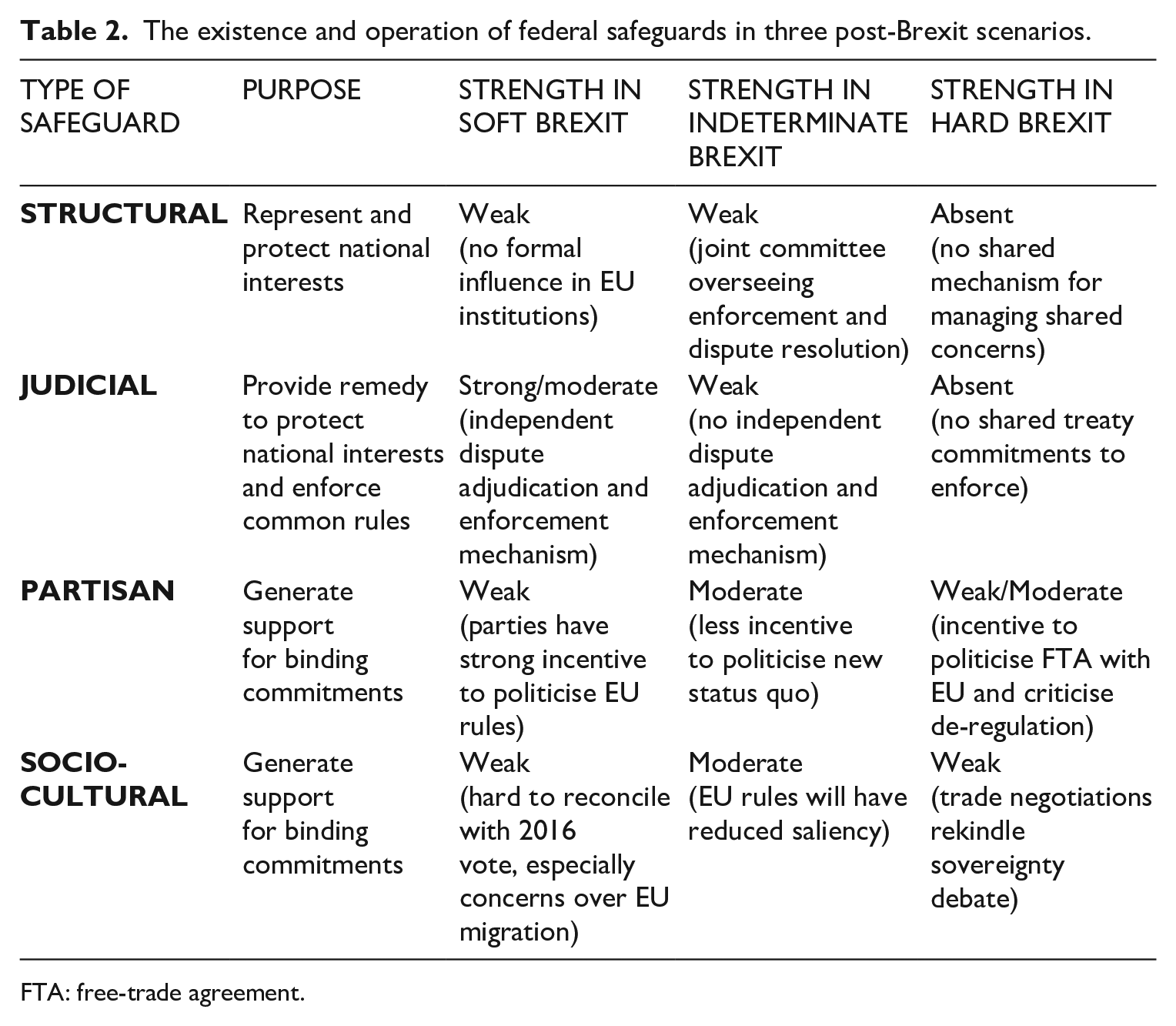
Naturally, an indeterminate Brexit outcome could still be the subject of politicisation: public opinion and trade negotiations are closely linked (Buisseret and Bernhardt, 2018). However, in comparison with the other two scenarios such politicisation would be less automatic, leading to greater overall stability, as captured in Table 2, which shows the strength of the four federal safeguards in each possible post-Brexit arrangement. This stability stems from the fact that the regulatory constraints of even a wide-ranging FTA are not of the same magnitude as those of an EEA-style arrangement, thereby reducing the saliency of EU rules, especially as an FTA does not involve free movement of people. Negotiating a successful trade deal with the EU would triangulate UK voters’ majority preference for such a deal (Vasilopoulou et al., 2019), while respecting UK voters’ antipathy towards free movement (Vasilopoulou and Talving, 2019: 814). Another advantage of this arrangement is that a trade deal with the EU covering agriculture would largely end the debate over whether to adopt US regulatory standards. This form of differentiated disintegration represents a significant departure from the economic status quo of EU membership, but would not necessarily be politically destabilising, because the 2016 referendum indicated a lack of popular support for the United Kingdom’s EU-based political economy (Siles-Brügge, 2019). On that basis, the partisan and socio-cultural safeguards of an indeterminate Brexit can be judged to be moderate in strength. By contrast, those partisan and socio-cultural safeguards are weak in a soft or hard Brexit, where the electoral incentive to contest EU–UK relations, and the sovereignty issue more generally, would be greater.
The existence and operation of federal safeguards in three post-Brexit scenarios.
FTA: free-trade agreement.
Structural safeguards would nevertheless be rather weak mechanisms for protecting UK demands for differentiation under an indeterminate Brexit. Such safeguards are by definition much weaker outside the EU, because formal representation in decision-making is a privilege of membership. An association agreement can provide for intergovernmental coordination and dialogue with the EU; however, the ability to influence EU decisions in such a setting is extremely limited and revolves around the blunt instrument of withdrawing cooperation. In the event of disputes between both parties that could not be resolved by arbitration, elements of the FTA could be suspended, but the EU, as an economy six times larger than the United Kingdom, would be better placed to absorb the economic impact. Under a bilateral trade agreement the United Kingdom would also be at the mercy of potential EU countermeasures should Westminster seek to change unilaterally the terms of trade in a manner the EU considers unfair, for example, by undercutting level playing field rules contained in the FTA. There is a precedent here in the EU–Swiss relationship, which is a complex bilateral arrangement involving multiple trade treaties. Swiss voters’ desire to curb EU migration, as expressed in the 2014 Mass Immigration Initiative, met with swift retaliation by the European Commission. Switzerland was excluded from participation in the €80 billion research funding programme Horizon 2020, forcing the Swiss government to compromise by watering down the restrictions proposed in the referendum (Schimmelfennig, 2018: 1170). Hence the Swiss example shows that there are only weak structural safeguards to protect even a strong bilateral relationship from the consequences of demands for differentiation the EU judges unsuitable.
Conclusion: The relative stability of indeterminacy
This article examined the political sustainability of different models for managing future EU–UK relations after Brexit, using insights from comparative federalism that explain how federal polities balance centrifugal and centripetal forces. This allowed the analysis to shed new light on the problems the United Kingdom faces in seeking to dissociate itself from the EU. The starting point was the application of Kelemen’s framework of four federal safeguards to understand the unstable political dynamics of the UK’s membership of the EU. This showed that centrifugal demands for differentiation came from party politics in a context of low levels of European identification and lukewarm public support for the integration project. Partisan and socio-cultural safeguards that could buttress the UK’s commitments to the EU were thus of moderate strength at best. By comparison, structural and judicial safeguards were very strong and used repeatedly to protect UK interests, thereby acting centripetally. However, the operation of these safeguards was incapable of defusing the demand to protect sovereignty and identity, claims that ultimately led to the pursuit of differentiated disintegration.
Differentiated disintegration is a novel departure in European integration and the central argument of this article is that tools from comparative federalism can help make sense of the potential (in-)stability of this nascent process. In the UK–EU case, differentiated disintegration can result in a spectrum of outcomes – a soft, indeterminate, or hard Brexit – defined by differing degrees of institutionalisation and economic costs. Compared with how the four federal safeguards operated during the United Kingdom’s EU membership, each post-Brexit scenario is characterised by weaker structural and judicial safeguards. This means UK governments will have fewer means at their disposal to protect national interests if these diverge from those of the EU. Equally, in the event of a hard or soft Brexit there is no reason to believe that the partisan and socio-cultural safeguards needed to support this outcome would be stronger than those that operated when the United Kingdom was a member state. In a soft Brexit scenario, which creates a high level of obligation without countervailing decision-making influence, there would be a more compelling logic to politicise sovereignty. Sovereignty issues would also remain highly salient under a hard Brexit that creates pressures to align with other trade powers. Therefore, the most stable outcome of the three is an indeterminate Brexit, because an FTA limits the incentive to politicise sovereignty and identity concerns by ending free movement of people and reducing the saliency of EU rules.
The political stability of an indeterminate Brexit is nevertheless relative in that the analysis presented here suggests that federal-type safeguards were stronger when the United Kingdom was still in the EU. The contrast with what happened to Switzerland after it sought to restrict EU migration reinforces the point that the stability of an indeterminate Brexit comes from moderating demands for differentiation not from structural or judicial safeguards. Thus the partisan and socio-cultural dimension of how the UK engages with the EU will be crucial for managing differentiated disintegration after Brexit.
