




Abstract
The external image of party leaders has often been analysed through their behaviour or reflection in the media. However, we know little about how party leaders are seen internally. This article addresses this gap in the literature and seeks to explain what determines the variation in party members’ perceptions of leadership styles. It builds on the transactional–transformational continuum and uses original survey data from a modified version of the Multifactor Leadership Questionnaire. The analysis includes 12 political parties with parliamentary representation from Bulgaria, Hungary and Romania between 2004 and 2018. The findings of the mixed-effects linear regression illustrate that in general older and active party members are more likely to see their leaders as transformational. The determinants of leadership style assessment differ greatly across political parties.
Introduction
Party leaders are of great importance to politics and to their political parties. In general, many transformations in contemporary democracies are triggered by party leaders. They pursue a series of actions ranging from voter mobilisation or the use of political power in their (or their party’s) best interest to policymaking for a higher quality of governance. In particular, within their parties, leaders are actively involved in the recruitment of political personnel; in adopting, setting and promoting the party policy agenda; in establishing connections with the electorate; coordinating the party and shaping its organisation; or becoming its public image (Cross and Pilet, 2016; Hazan and Rahat, 2010; Norris, 1997; Scarrow et al., 2000; Webb et al., 2012). Political parties grow less reliant on their organisational basis and more on the leadership figures. Whether it is the case of new parties, fringe parties or mainstream parties, leaders rise to prominence (Blondel and Thiébault, 2010; Bolleyer and Bytzek, 2017; Poguntke and Webb, 2005; Rahat and Sheafer, 2007). As a consequence, the continuity and stability of leaders ensure the persistence of their parties in the political arena (Deegan-Krause and Haughton, 2018).
These functions, abilities and orientations are collated under the broader concept of leadership style (Harmel and Svåsand, 1993). Over time, several theories and the empirical research testing them sought to identify the traits of party leaders. For example, the Leaders Motive Profile argued that leader effectiveness is associated with a high desire to acquire status and have an impact on others, concern for the moral exercise of power and power motivation greater than affiliative motivation (House et al., 1996; McClelland, 1975). The Charismatic Leadership Theory emphasises the existence of several traits such as self-confidence, strong motivation for influence, strong conviction for moral correctness, flexibility and social adaptability; all of which are conducive to leader charisma and effectiveness (House, 1991; Zaccaro et al., 1991). The Cognitive Resource Theory focuses on leaders’ intelligence and experience, and stress faced by leaders and followers to explain performance (Fiedler, 1995). Burns (1978) introduced the concepts of transactional and transformational leadership and set the stage for a research agenda along those analytic dimensions. The analysis of leadership styles continued either along the lines drawn by this dichotomy (Kuhnert and Lewis, 1987), or along broader interpretive frames focusing on the multiple roles of leaders (Blondel, 1987; Hermann, 1986).
There is extensive literature about how these features of political leaders are translated into behaviours; for a comprehensive review, see Passarelli (2015) and Gherghina (2020). Another strand of literature focuses on leadership images in media coverage. Since media sources are citizens’ principal source of political information, the ways in which leaders are portrayed through these sources is very important. For a thorough review of this literature, see Aaldering and Vliegenthart (2016). These approaches reflect how the values and the style of leadership are conveyed externally by the party. However, little is known about how these traits are perceived internally by those who ensure the survival and continuity of the party, that is, members.
This article addresses this gap in the literature and focuses on members’ assessment of party leadership styles. It seeks to explain what determines the variation in party members’ perceptions about leadership styles by looking at 12 political parties with parliamentary representation in three East European countries (Bulgaria, Hungary and Romania) between 2004 and 2018. It builds on the transactional–transformational continuum (Avolio and Bass, 1995; Bass, 1999; Burns, 1978) and uses original survey data from a modified version of the Multifactor Leadership Questionnaire (MLQ). The survey was conducted May–July 2018 on party members from different layers – ordinary members, leaders of local branches and national-level officials or parliamentarians – to ensure a broad coverage within each party.
The perceptions of party members about leaders matters for several reasons. Party members remain important assets for the party organisation and its enduring electoral survival. While it is true that party members are no longer a relevant source of income and personnel in campaigns, they continue to be essential for the functioning of political parties (Scarrow, 2015). As an indicator of this importance, many political parties in post-communist Europe keep a relevant membership roll which does not necessarily decrease over time (Gherghina et al., 2018). The way in which party members perceive leaders has an important mobilising effect. This mobilisation refers both to engagement in the internal life of the party through activities for various party units or acting as candidates for different offices, and for in the external life of the party during and outside election campaigns in the communication with other voters. Furthermore, the members’ perception is crucial if the leadership wants to remain in power and to be legitimate for its rank-and-file (Cross and Pilet, 2016; Ennser-Jedenastik and Müller, 2015). The legitimacy of leadership in the eyes of party members has relevant consequences such as high party cohesion (low internal conflict), electoral support if the party uses inclusive leadership selection procedures and a potential basis for negotiations with other parties. For example, the legitimacy conferred by party members can strengthen leaders’ positions in discussions around the formation of political coalitions or electoral alliances. High legitimacy means that the leaders speak on behalf of their party and indicates stability with little or no internal contestation; these features are usually valued by coalition partners.
The remainder of the article proceeds as follows. The first section reviews the literature on transactional and transformational leadership outlining its features. The second section formulates three testable hypotheses about the causes for variation in perception of leadership styles. The third section presents the research design with emphasis on the case selection, data collection, variable operationalisation and methodology. The fourth section includes the results of the analysis, while the conclusions summarise the key findings and discuss the major implications of this study.
Transactional and transformational leadership styles
The transactional and transformational styles are the opposite ends of one continuum that characterise the relationship of leaders and their followers. In its initial understanding proposed by Burns (1978), transactional leadership entails a focus on short-term goals achieved through an exchange of resources between the leaders and the followers: The leaders provide followers something they want and require something else in return. Transactional leadership is reactive and rests on the principles of positive and negative reinforcements, appealing directly to the self-interests of individuals. Transformational leadership is more visionary, moves beyond short-term goals and presupposes a leader–follower relationship based on an understanding of needs. The leaders proactively engage supporters, attempting to create a shared vision and sense of purpose within the organisation. This is a process in which ‘leaders and their followers raise one another to higher levels of morality and motivation’ (Burns, 1978: 20).
A debate emerged over the question of whether these two styles of leadership were mutually exclusive as leadership was contested and additional features were added or refined. Bass (1985) was the first one to argue that leaders can be both transactional and transformational rather than featuring only characteristics of one type. His argument was developed through a conceptualisation of behaviours associated to this type of leadership. These behaviours became the subject of further development and debates, and over time resulted in several dimensions of analysis (Judge and Piccolo, 2004).
Transactional leadership is commonly assessed through contingent rewards and management by exception with two separate versions – passive and active. Contingent reward refers to the degree to which leaders set up constructive rewards, clarify expectations and establish the rewards for their followers when meeting these expectations (Judge and Piccolo, 2004). Management by exception means that leaders take corrective action when the interaction with their followers raises problems; these can be real problems or only in the eyes of the leaders. The active version of the management by exception means that leaders take action before the real problems occur based on their observation of followers’ behaviour. The passive version means that leaders wait until the followers’ behaviour creates problems and act afterwards (Howell and Avolio, 1993). Taking into account these dimensions, transactional leadership can be defined as an asymmetric relationship between leaders and followers, with the former communicating expectations or requirements clearly. It is based on ‘the cultivation of influence through the process of social exchange, negotiation, and coalition building’ (Foley, 2013: 51).
Transformational leadership brings together several characteristics – the first of which is charisma. This broad concept reunites what Bass and Avolio (1997, 2000) label as two different components of transformational leadership: idealised influence and inspirational motivation. The idea of charismatic leaders emerged outside politics when Weber (1947) launched the idea that charismatic leadership matters for organisations. Subsequent theories of charismatic leadership were developed and applied to a broad array of organisations (House, 1977, 1991; House and Aditya, 1997; Kavanagh, 1974). Charismatic leaders act exemplary, motivate and inspire followers, are sensitive and supportive to followers’ input and have a comprehensive appeal through their vision and communication (Avolio and Yammarino, 2013; Boehm et al., 2015; House and Howell, 1992; Kirkpatrick and Locke, 1996). Another dimension of transformational leadership is intellectual stimulation. This includes questioning assumptions, promoting non-traditional thinking and taking the followers’ ideas into consideration (Bass, 1990; Bass and Avolio, 1990, 1994; Tracey and Hinkin, 1998). Furthermore, transformational leadership focuses on the development of followers through attention provided to their needs – called individual consideration. The emphasis lies on self-development and feedback to improve performance (Bass and Avolio, 1997; Judge and Piccolo, 2004; Tracey and Hinkin, 1998).
All these features clearly classify leadership styles as a spectrum rather than a dichotomy (Avolio and Bass, 1995; Bass, 1999; Lowe et al., 1996). One leader can possess transactional features and take transformational actions along the dimensions suggested above; the reverse is also possible. In essence, the two styles are related, but it remains unclear which one comes first, with arguments in the literature going in both directions. On the one hand, transformational leadership can be seen as the ‘parent’ of transactional leadership because it provides the frame of reference within which transactions take place (Covey, 1991). On the other hand, transactional leadership is seen as a necessary precondition for effective transformational leadership because it serves to develop the relationship between leaders and followers (Avolio, 1999). In line with this perspective, an earlier argument was that organisational culture could move in the direction of more transformational features while maintaining those transactional features that proved effective (Bass and Avolio, 1993; Howell and Avolio, 1993).
Since leaders can combine transactional and transformational features, there is variation on the position they occupy on the continuum between the pure forms of these styles. Accordingly, some leaders will be more transactional than others. To cover the complex nature of leadership styles, Bass and Avolio (1990, 2000) developed the MLQ (standard MLQ). The questionnaire includes 21 items that measure the range of leadership features highlighted above. Each item allows for an answer on a 5-point ordinal scale ranging from ‘not at all’ to ‘always’. If all 21 items are answered with ‘not at all’, then the leader is purely transactional, while the answers ‘always’ to all the items indicate that a leader is purely transformational. In reality, pure types are rare and most leaders are somewhere between the two, combining different characteristics. Much empirical research on leadership has utilised this questionnaire that is applied to leaders to capture their self-perceptions. In line with this approach, this article also uses the MLQ, but in a modified version that could be applied to party members. The questionnaire captures the opinions of followers about the style of their leader. Let us now turn to reasons that could explain the variation in members’ perceptions about their leaders.
Knowledge, age and ideology
The central argument of this article is that there are three potential sources that can influence the views party members have about their leaders: length of membership, ideological positioning and age. To begin with the length of membership, a long period spent in a party provides members access to information about how a political party operates, and how and what policies are produced. To a very large extent, politics in contemporary democracies is dominated by political parties and thus policies that are passed by parliaments or governments are first discussed within parties. This places members in a privileged position compared with ordinary citizens who are not enrolled in a party because they can better understand the decision-making process, participate and create expectations about the possibility to participate (Sanches et al., 2018).
In the most recent two decades, there has been a general tendency for many parties to adopt more rights for their members, to provide them an active role and power in the intra-party decision-making process (Gherghina, 2014; Gherghina and Von Dem Berge, 2018; Scarrow, 2015; Van Haute and Gauja, 2015). In particular, many parties focused on the adoption of internal democracy in which members are given a direct say in the candidate or leader selection processes (Adams and Merrill, 2008; Hopkin, 2001; Pennings and Hazan, 2001; Sandri et al., 2015; Scarrow and Gezgor, 2010).
According to this logic, those who are members for a longer period of time are more likely to know the leaders better and to become familiar with their leadership style. This is quite obvious for parties that organise primaries for leadership selection in which members participate in the selection process (Carty and Blake, 1999; LeDuc, 2001; Ware, 2002). The competition between candidates for the office brings more information to the party members – who are voters in this case – and makes them more likely to follow the actions of the person who gets elected as a leader. Members who vote with the winner would be interested in observing whether they were wrong, while members supporting a losing candidate would critically scrutinise the new leader to spot weaknesses. Longer membership brings with it more participation in internal competition and a general socialisation with the leaders. The length of membership can have an effect on the knowledge about leadership style also for those members who do not have the possibility to elect the leader because their parties do not have such a procedure. In their case, longer membership means a greater exposure to the actions of the party leaders and the possibility to see them throughout the full terms in office rather than a snapshot.
Moreover, long-time members are integrated in the political culture of the party and may associate the styles of leadership with the needs of the party. They can emit opinions based on information acquired. The long-term exposure of members to the internal life of parties and to the decisions taken by leaders over time provides a deeper understanding of the interactions between the party organisation and leaders. Long-term members are actively involved in the development of their party – since they witnessed a variety of processes – and are likely to identify leaders who can bring about change and handle challenges over longer periods of time. Those leading the party through a series of trials can be perceived as more transformational by the members who endure throughout both the agitated (e.g. electoral defeats, internal conflicts) and the calm periods.
Prolonged membership within the party allows members to acquire knowledge about leaders, see beyond their short-term actions and objectives and capture a full picture of the leader’s stances. Such members with longer experience in the party can understand that the motivation provided by leaders and their charisma are long-lasting rather than episodic. The measures taken when a party is formed and in its first years of existence are usually transformational. They do not necessarily continue along that path throughout the life of the party. When they continue, they are picked up by experienced members. Under these circumstances, party leaders appear more generally as being transformational in the eyes of long-term party members.
In contrast, members who have recently joined the party have limited access to a set of actions, may find it hard to see beyond short-term goals and may themselves be part of transactions with the leader. For example, in the candidate selection primaries organised by the Romanian social-democrats in 2004, some members were enrolled prior to the internal elections (Gherghina, 2013). These members were part of the transactions initiated by the leaders of their branches and their assessment of leadership styles could have been easily influenced by this fact. In light of all these arguments, it is expected that
H1. Long-time members are likely to perceive party leaders as transformational.
The second potential determinant of party members’ perception about leadership styles is age. The underlying logical mechanisms behind this effect refer to the patience and additional possibilities of obtaining information that older members have compared with younger members. Research on political participation shows that older people vote more frequently and one reason for that was because they are more patient (Fowler and Kam, 2006). When the decision to vote is taken along the cost–benefit axis, people decide to turn out when the benefits outweigh costs. Since at times benefits do not occur right away, people who are more patient are more willing to vote. A similar example comes from research on redistribution where patience is a key explanation for individual preference across socio-economic classes (Wang, 2018). Patience can be seen as intertemporal choice and refers to the calculations of payoffs at different moments in time (Frederick et al., 2002). It is a future orientation (Zimbardo and Boyd, 2008) in which patient individuals place greater value on the future benefits, while impatient individuals focus on the immediate benefits. Along similar lines, older party members may be more patient when assessing leadership styles. They can be more inclined to focus on the long-term transformational elements as opposed to the short-term transactional features.
Age may also influence members’ assessment of party leaders through the availability of resources. This argument follows the lines drawn by Verba et al. (1995) about how socio-economic status can lower the costs for voting. Older members have more time to spend on finding information, are better able to pay attention to what happens and to process the acquired information. Earlier research shows how old citizens are over-represented among party members in many countries (Cross and Young, 2004; Scarrow and Gezgor, 2010). Members who are retired from their jobs can invest more resources in the undertakings of the party. In doing so, they are exposed to a larger number of party activities and thus have more opportunities to analyse the behaviour of the party leader. As such, they are more likely to make a broader assessment of the leadership style, based on several pieces of information, as opposed to a narrow perspective, based on truncated information. The features of transformational leadership are arguably more difficult to identify without observing the behaviour of leaders for a longer period of time. For example, the individual considerations involve the development of followers through attention provided to their needs. This requires time and can be observed only by those who were members for that period of time. Consequently, the expectation is that
H2. Older members are likely to perceive party leaders as transformational.
The third determinant is the ideological orientation of the party members. The argument does not refer to the convergence in terms of positioning on the left–right axis of members and of their parties. It is simpler than that and reflects only the self-placement of members. Traditionally, the left–right positions have been used for analyses related to economic policymaking, legislative choice and political representation, electoral competition, voting behaviour and cabinet stability (Gabel and Huber, 2000: 94). There is a debate in the literature about the meaning of left and right in terms of ideology over time or across countries (Benoit and Laver, 2006; Inglehart, 1989; Kitschelt, 1992; Laver and Budge, 1992; Piurko et al., 2011; Sani and Sartori, 1983). In essence, the left–right dimension is a simplification of differences between parties in their positions over many policies. While this dimension is often used for its parsimony, its countless problems have been outlined by earlier studies (for a useful review, see Benoit and Laver, 2006). This critique is beyond the purpose of this article and instead it is relevant to see what categorises left and right. On the general left–right dimension, left usually corresponds to a more egalitarian, integration and redistribution-oriented perspective, with emphasis on the community and with a relatively strong state. The right usually refers to a more hierarchical structure in society, emphasis on the individual, fewer regulations and less state involvement.
Members position themselves on this one-dimensional axis according to their values and beliefs. Their positions are not solely related to politics and policies, but can also reflect the lenses through which they observe leadership. In line with their general values and beliefs, left-oriented members are more likely to have a closer look at how the leaders contribute to the party which is seen as a community and how they ensure the general integration of followers. The provision of long-term motivation to keep followers involved and equal opportunities is something that such members would emphasise. One empirical element that could have contributed to creating a sense of community around political parties is the existence of important successor parties in all three countries investigated here. The BSP (Bulgaria), MSZP (Hungary) and PSD (Romania) have their origins in the communist era. Their predecessors were single parties in these countries and membership could have been easily associated with community.
Right-oriented members may be more inclined to see the leadership from the perspective of intervening to address problems when they occur through corrective or rewarding measures. This could reveal the individual abilities to handle difficult situations but places less emphasis on the community. With this value in mind, we can infer that right-oriented party members could also find it easier to trade off the equality and integration of followers for the clear expectations and requirements communicated to them by the leader. This will ensure a swifter development based on transactions, but will ignore to a large extent the long-term prospects of a transformational leadership. Following these arguments, the expectation is that
H3. Left-oriented members are likely to perceive party leaders as transformational.
Controls
In addition to these three effects, the analysis will also control for the impact of several variables highlighted in the literature as relevant for members’ opinions. The first control variable is the position in the party since extensive research showed that members have different access to resources and decision-making within a party. There is a consensus about three different faces of the party organisation, each with its own features and functions (Katz and Mair, 1993): the party on the ground, the party in central office and the party in public office. The party on the ground is composed by ordinary members, and very few of these members have access to the full range of information and decisions. The party in central office comprises the national executive or executive committee with decision-making powers between two party congresses. The party in public office includes the parliamentarians and other high-level officials in the country. This article follows this line of thought and also uses three layers, but they are slightly modified according to the goal of enquiry. These layers consist of ordinary members, members holding office at the local level and members holding office at the national level (including parliamentarians). Members belonging to these layers have different opportunities to influence the leaders and their actions.
The second control variable is the involvement of members in party activities. Previous studies showed that the activity or passivity of members can influence what happens with the party (Mair and Van Biezen, 2001; Whiteley, 2011). Perceptions regarding leadership may be different as members who are actively involved in the life of the party have greater opportunities to observe the actions of the leader compared with members who are formally registered but inactive. The third control variable is education since this is a variable that usually influences the degree of political participation or citizen activism (Bovens and Wille, 2010; Verba et al., 1995). 1
Research design
To test these hypotheses, the article uses individual-level data from a survey conducted during May–July 2018 among party members from 12 political parties in Bulgaria, Hungary and Romania. These three countries were selected due to several common features: they are post-communist political systems, they have a handful of political parties in parliament, alternation in government is fairly regular and parties differ in terms of leadership change (e.g. some had the same leader from formation, while others change leaders on a regular basis). The analysis includes the parties that were present in parliament on a regular basis between 2004 (the starting point of this study) or the year of their formation and 2018 (or 2014 in the case of one Romanian party that merged). The questionnaire included 33 questions (all multiple choice with the exception of membership year and age) out of which 21 questions were the items of the MLQ modified so that members can assess leaders. In the original MLQ, leaders are asked to evaluate their own style. The limited number of party leaders and the possibility of a major bias in responses led to a change in the data collection method. This article uses a third-party assessment approach in which the classic self-perception MLQ is replaced by the opinion of party members from several layers of the party. The average time required to answer the survey was 7 minutes.
From each political party, a minimum of 50 members were targeted, distributed as follows: 35 ordinary members, 10 with local-level office and 5 for national-level office. While this number of 50 respondents may seem small, a survey among party members in these countries is a challenge. Members are suspicious and some parties want the approval of the leader to proceed, which in this case was not a very useful approach. The survey was carried out online and answers were recorded in three ways: (1) by respondents who received a link for the survey from the principal investigator; (2) by research assistants who met the members face-to-face; or (3) by research assistants who conducted the interview over the phone. When comparing the answers recorded with these methods there was no observable bias in terms of completion rate or skipping questions. The questionnaires in which less than half of the questions were answered were removed from the dataset. For most parties, the number of 50 was exceeded, Fidesz being the only one where the number was not reached. 2 The distribution of respondents was the following: Ataka (47); Bulgarian Socialist Party (BSP, 53); Movement for Rights and Freedoms (DPS, 67); Citizens for European Development of Bulgaria (GERB, 50); Fidesz (20); Jobbik (50); Politics Can Be Different (LMP, 54); Hungarian Socialist Party (MSZP, 56); Liberal Democratic Party (PDL, 53); National Liberal Party (PNL, 56); Social Democratic Party (PSD, 58); and Democratic Alliance of Hungarians in Romania (UDMR, 50).
These parties had 28 different leaders between 2004 and 2018. Whenever possible, the current leader of the party was not included; if the current leader had a term in office that ended in 2017 or at the beginning of 2018, members were asked in reference to that term in office. The unit of analysis is the opinion of a party member about one leader. When a party has several leaders, then several observations are recorded, for example, if a party has three leaders, then the data include three opinions of the same member about each leader. There was a total number of 1516 observations, which are nested at two different levels: first in political parties and then in party leaders. Consequently, the statistical analysis uses in its first step a mixed-effects linear regression model to control for this hierarchical structure of the data. The second step is represented by ordinary least squares (OLS) regression at party level to observe the differences.
Variable operationalisation
The dependent variable is the assessment of the leadership style. Each respondent had to answer 21 questions about the behaviour of leaders, with answers on a 5-point ordinal scale ranging from ‘not at all’ (coded 1) to ‘always’ (coded 5). For example, one item reads as follows ‘Expresses with a few simple words what we could and should do’. For each item, there is a score between 1 and 5 with purely transactional and purely transformational as the extremes. The dependent variable is the average of these scores. For example, the average of one Ataka member for the party leader Volen Siderov is 3.048, while the average of another member for the same leader is 4.381. According to the view of the second member, the party leader has more transformational features than the first member is perceived. Averages are used to avoid problems when a member skips one of the 21 items, that is, if they answer 20 items then the average is for those and it is comparable with the rest. Less than 10% of the respondents skipped items.
The first independent variable is the length of membership (H1) and it is recorded relative to the formation of the party. Members were asked about the year when they joined the party and the variable was calculated as the difference between year of party formation and the year indicated by respondents. The highest value is 0 and corresponds to joining the party in the year of its formation, while the lowest is −28 and corresponds to members who joined the party 28 years after its formation. The parties with an existence interrupted by communism and those who were the successors of the former communist parties (e.g. BSP, MSZP, PSD) have their post-communist emergence as a moment of formation. The second independent variable is age (H2) and is recorded in completed years at the moment of survey. The third independent variable (H3) is the left–right positioning of the members and they were asked to indicate on a scale from 0 (left) to 10 (right) where they would position themselves.
The first control variable is position in the party, recorded on a 3-point scale corresponding to the theoretical notions discussed before: (1) ordinary member – office holder or leader of a local organisation; (2) office holders in national-level party bodies; or (3) member of national/European Parliament. The second control variable is the degree of involvement in the activities of the party and it is self-reported. Respondents are asked how involved they currently are in party activities and available answers range from ‘not at all’ (coded 1) to ‘always’ (coded 5). The last control variable is education, which was recorded on a 5-point ordinal scale between primary (1) to postgraduate studies (5).
Analysis
Across the 12 investigated political parties, the average score provided by respondents for the transactional–transformational style of leadership is 3.58. Only 4% of the members had an average score of 1 (0.6%) or 5 (3.4%) for the leaders of their parties. These observations indicate leaders are rarely perceived at the extremes, as purely transactional or purely transformational. Instead, many members view leaders as a combination of features. Figure 1 presents the distribution of answers for the leadership style across the 12 political parties. There is great variation across political parties in general and within the same country. Equally important, the leaders of the same party are also perceived differently by the members. When there are more leaders in one party, the boxplots are ordered chronologically. For example, for BSP, the first boxplot represents the leadership style of Sergei Stanishev in his 2010–2014 term in office, the second is for Mihail Mikov (2014–2016) and the third for Korneliya Ninova (2016–2018).
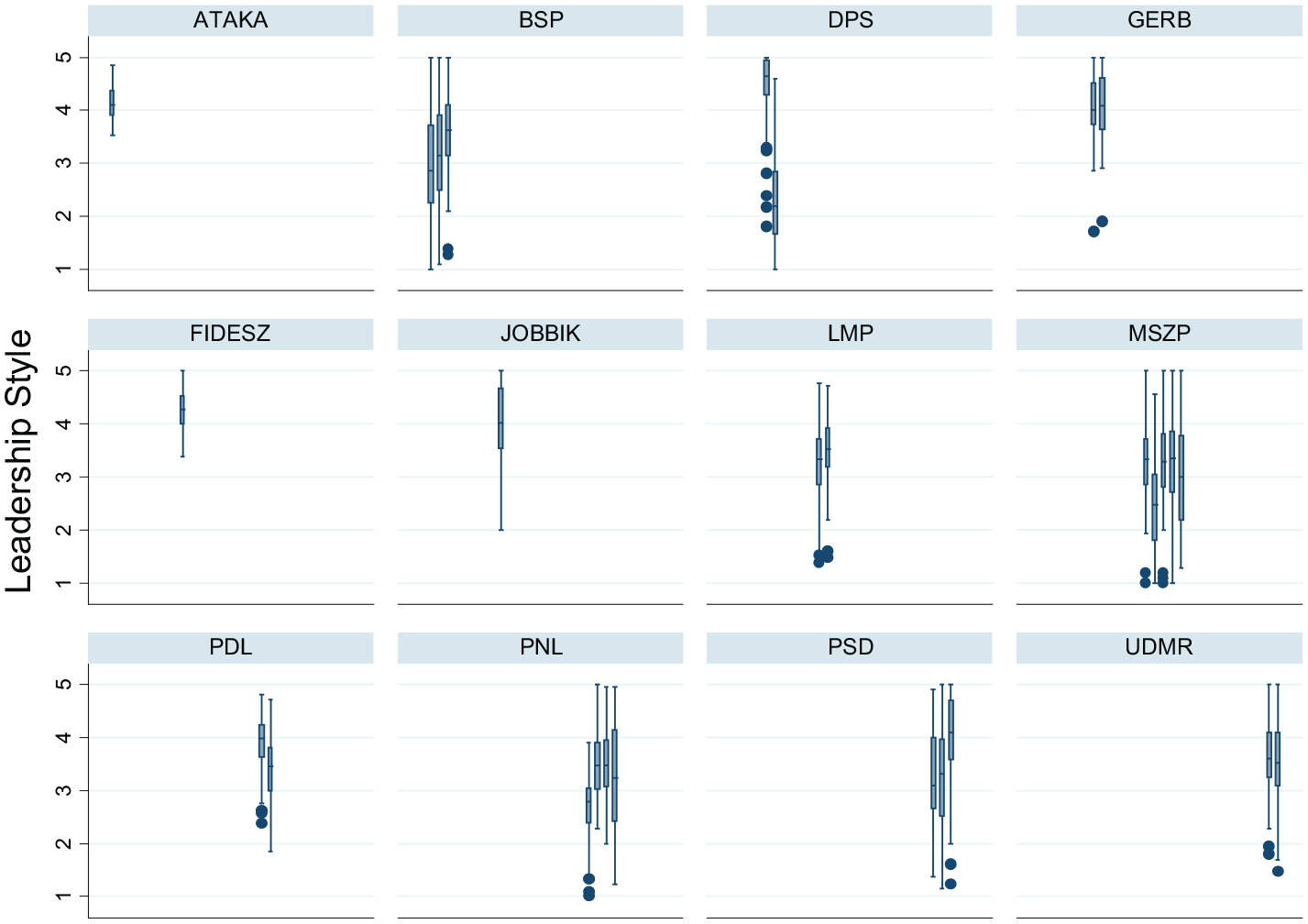
Leadership styles in 12 East European parties.
The dispersion of opinions also varies considerably across party leaders. At one end, there are semi-homogeneous assessments about the leadership style of several individuals: Siderov for Ataka (2013–2018), Orban for Fidesz (2013–2017) or Emil Boc for PDL (2011–2012). At the other end, the assessments are more divided about the leadership style of Lyutvi Mestan for DPS (2013–2015), Tobias József for MSZP (2014–2016) or Alina Gorghiu for PNL (2014–2016); all these are the last boxplots in the graphic representation of their parties. One explanation for this difference is the degree of contestation within the party. For example, Siderov is the founder of Ataka and its sole leader, who gradually built a cult of personality within the party. He has personalised the party and actively promotes the idea of a one-man show. Consequently, his image is rather unitary and there is little dissent with respect to his authority. To use an example from the same party system, Mestan became the DPS leader after a very long rule of Dogan, the founder of the party, and he was highly contested. The DPS central council dismissed him as party leader after less than 3 years in office and expelled him from the party because of his allegiance for the Turkish president. The divided opinions of members about him are the result of the internal struggles involving Mestan.
Table 1 includes the results of the bivariate correlations between each variable and leadership style at the pooled level. There is empirical support for the first two hypothesised relationships, with statistically significant coefficients at the highest level. The results indicate that longer membership in a political party is positively associated with more transformational assessments of the leadership style. The age of the members is also positively associated with transformational features, but the size of the coefficient indicates it is the weakest among the three independent variables. Left-oriented members are less inclined to assess the party leaders as being more transformational when compared with the right-oriented party members. Among the controls, education correlates highest as more educated party members have a mild tendency to assess party leaders as more transactional (–0.07, statistically significant at the 0.01 level). More involved members evaluate the leaders slightly more transformational compared with the passive members, while the position in the party appears to make no difference. In terms of value of the coefficients, the size of the controls is considerably smaller than that of the main effects.
Correlations between leadership style and other variables.
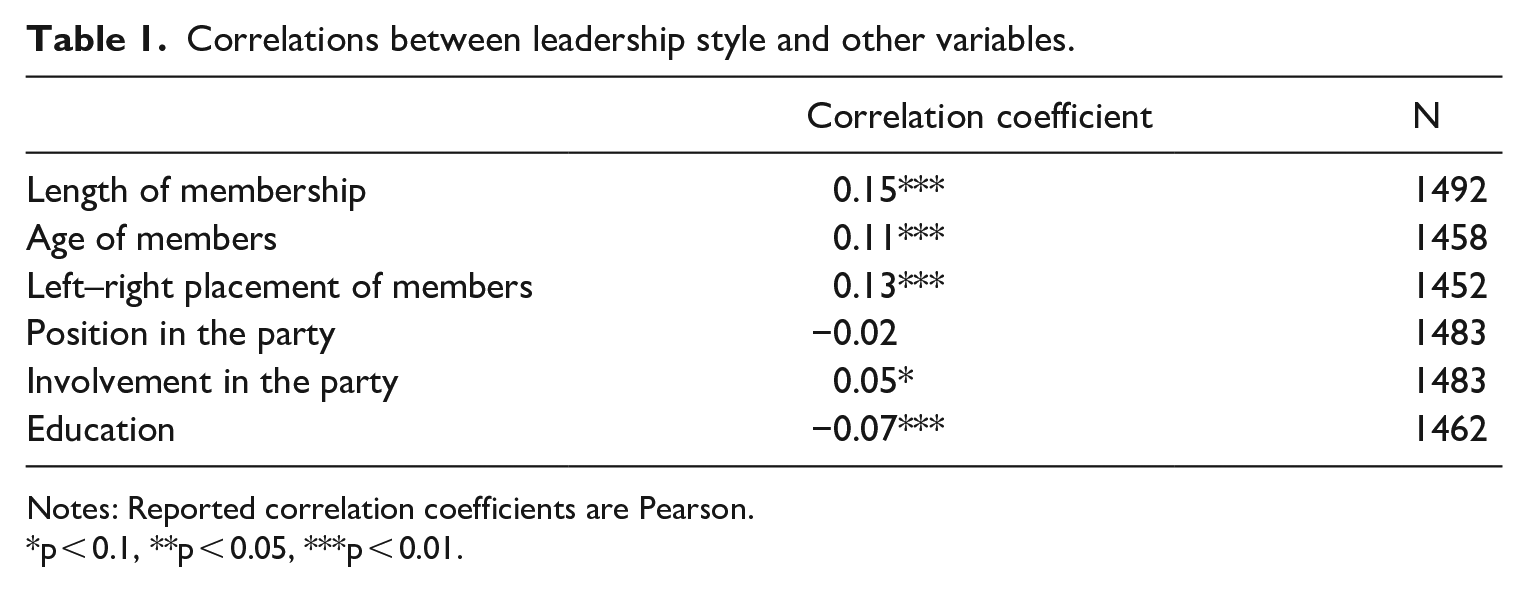
Notes: Reported correlation coefficients are Pearson.
p < 0.1, **p < 0.05, ***p < 0.01.
Table 2 shows the model parameter coefficients for the style of leadership. The data are collected at one level, but it is nested in parties and party leaders (the random effects). The statistical models use a restricted maximum likelihood (REML) to account for the loss in degrees of freedom resulting from estimating fixed effects. The first model includes only the main effects, while the second is complete and also has the controls. Model 1 tells a different story than the bivariate correlations. The predictor with the highest explanatory power among the three is the age of members, which is the only variable that is statistically significant. Length of membership has a positive impact on the assessment of leaders as more transformational, but lacks statistical significance. One possible explanation for this difference between the bivariate and multivariate analysis could be the control for party and leader-level variance in the regression analysis. Another possible explanation on the substantive side is that party members with a long presence in the party realise that politics go beyond grand claims and is more about delivery; accordingly, they may view their leaders in a more pragmatic, ‘transactional’ sense rather than viewing them as ‘transformational’. The correlation between length of membership and age is 0.46 (statistically significant at the 0.01 level) and could also partially explain the loaded explanatory power on one of the two variables.
Mixed-effects linear model for leadership style.
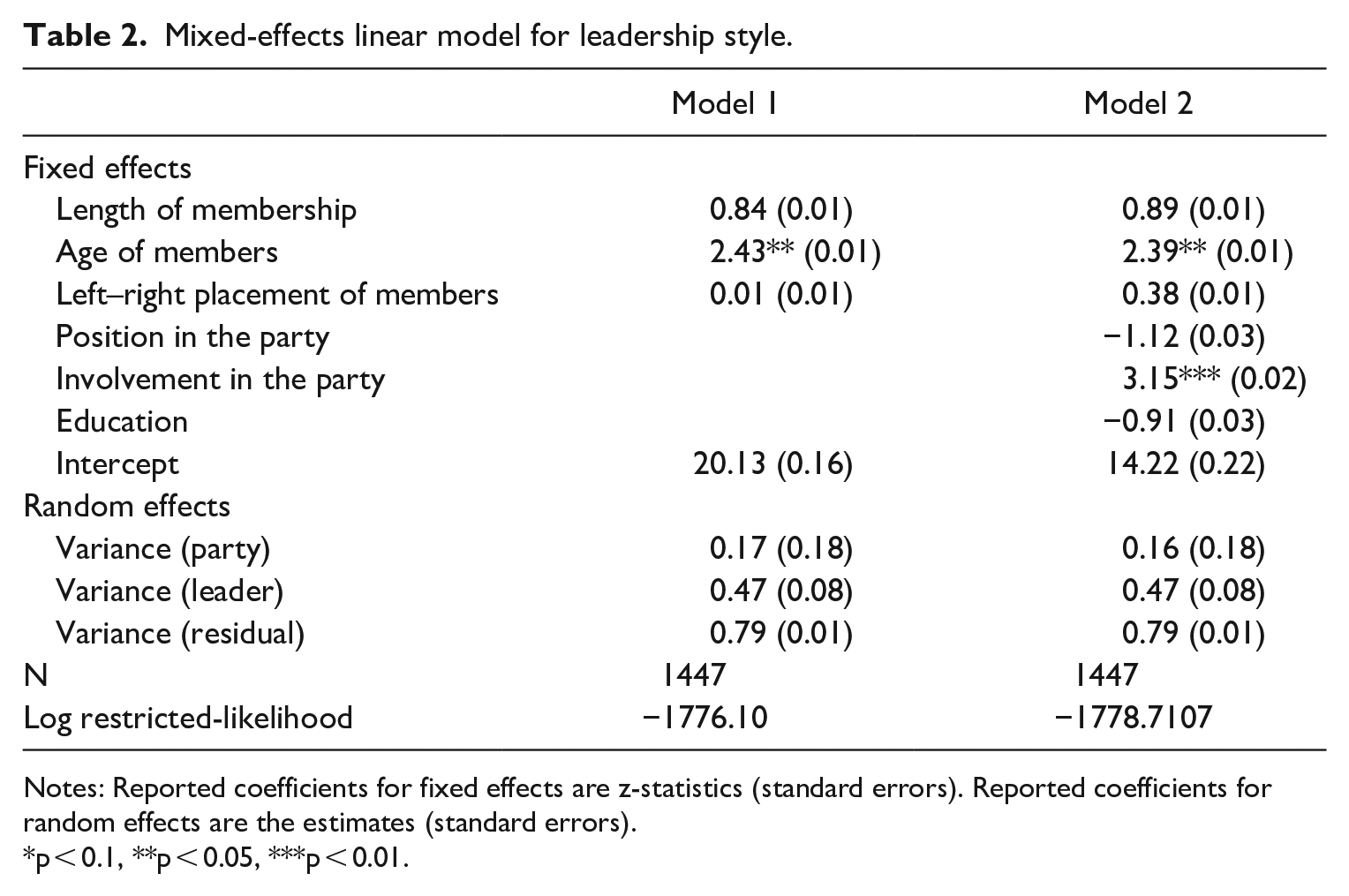
Notes: Reported coefficients for fixed effects are z-statistics (standard errors). Reported coefficients for random effects are the estimates (standard errors).
p < 0.1, **p < 0.05, ***p < 0.01.
There is strong empirical evidence for the effect of age with older party members assessing leaders as being more transformational. The theoretical section of this article argued that patience and resource availability (i.e. time) create the expectation that older members focus on the long-term transformational elements of leadership as opposed to the short-term transactional features. The empirical support across the investigated political parties has a substantive meaning when corroborated with the effect of involvement in the party (see below). In this sense, it is not only the availability of resources but how and if members decide to make use of them.
Model 1 finds no empirical support for H3 with left-oriented and right-oriented members being equally inclined to assess leaders as transformational. One possible explanation for this finding is that leaders and their actions are perceived similarly – although from different angles – by the left- and right-oriented party members. The left-oriented members view the party as a community and may look at the leaders’ actions as oriented towards the improvement of party life and the general integration of followers. The right-oriented members may look at leaders’ actions as an avenue through which their individual features (e.g. personality, abilities) can lead the party to flourish in the political arena. In this capacity, both types of members assess different elements of the leadership style but end up with similar assessments.
Model 2 introduces the controls, one of which provides strong explanatory power. The regression coefficient for involvement in the party shows that more active members have a tendency to assess leaders as transformational when compared with the more passive members. This finding strengthens and nuances the importance of the socialisation process illustrated by the positive effect of the length of membership. The engagement in party activities increases the exposure of members to the transformational features of leadership. What the leader does and stands for is more accessible to those members who (1) are in the party for a longer period of time, and (2) do not limit themselves to the formal status of membership.
The position in the party, although not statistically significant, has some explanatory power, with ordinary members assessing the party leader more transformational than members occupying positions at the national level. One possible explanation highlights the distance between grassroots efforts and how the attribution takes place. Ordinary members may have access to the results of actions, which they associate with the party leader, without being necessarily rooted in the leaders’ actions. For example, when a territorial branch is rewarded with an extra seat in the party congress due to good electoral performance in the previous local elections, members of that branch could perceive this reward as originating from the leader. In reality, the source of such a decision may be collective (e.g. the executive committee) and not related directly to the leader; all this information is available to higher ranked members and thus results in a difference in assessment between them and ordinary members.
Table 3 includes the OLS regression models conducted at party level, with control variables. The results indicate important differences across political parties. There is empirical support for H1 for Ataka and DPS in Bulgaria, and for PNL and PSD in Romania. The fact that members with longer participation in parties assess leaders as more transformational can be due to a socialisation process or the possibility of comparison.
OLS regression at party level for leadership styles.
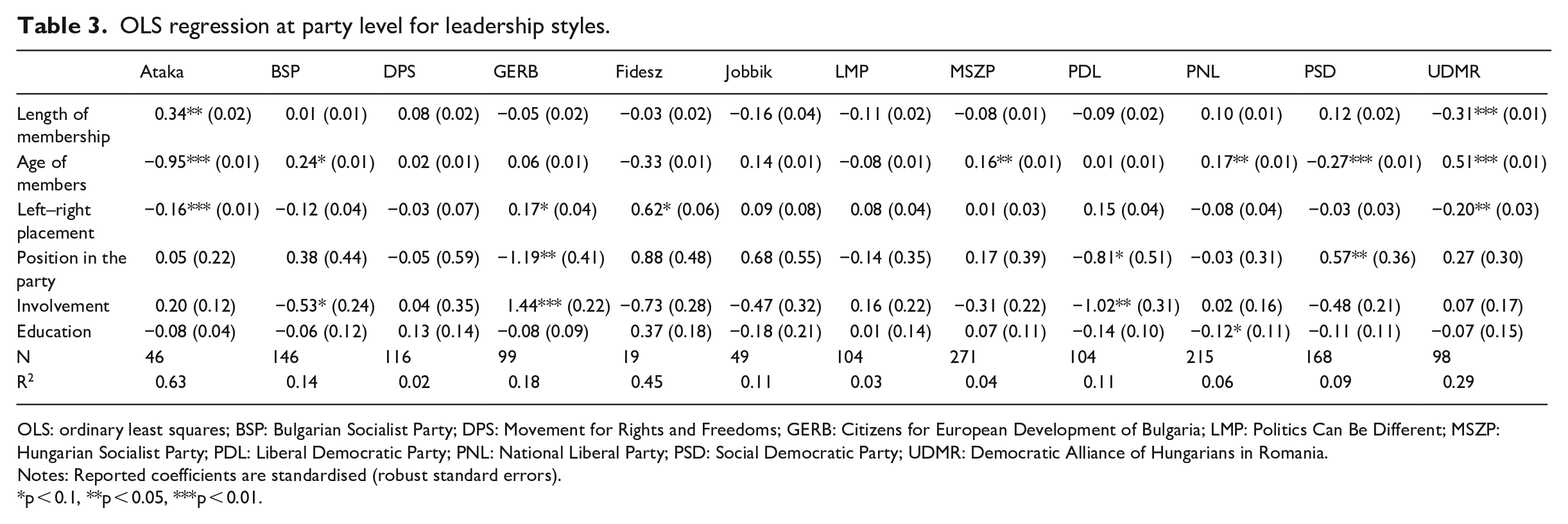
OLS: ordinary least squares; BSP: Bulgarian Socialist Party; DPS: Movement for Rights and Freedoms; GERB: Citizens for European Development of Bulgaria; LMP: Politics Can Be Different; MSZP: Hungarian Socialist Party; PDL: Liberal Democratic Party; PNL: National Liberal Party; PSD: Social Democratic Party; UDMR: Democratic Alliance of Hungarians in Romania.
Notes: Reported coefficients are standardised (robust standard errors).
p < 0.1, **p < 0.05, ***p < 0.01.
However, this effect is not universal and the UDMR is the case in which things happen counterintuitively. Newer members are more likely to identify leaders as more transformational. One possible explanation for this is that older members can have a memory of other earlier terms in office and weigh them as more transformational than the recent terms. In contrast, new members who join the party do not have many possibilities to observe the leaders’ behaviours over time and may be less exposed to their transformative features; instead, they can observe the short-term motivational or rewarding actions that are more transactional. This variable has no effect in the cases of BSP and Fidesz.
The age of members (H2) finds empirical support for BSP, MSZP, PNL and UDMR, but there are strong effects against the hypothesised relationship in Ataka and UDMR. One possible explanation for the negative effect of age on perceptions about the leadership style in these two parties can be the longevity in office. Ataka had one leader and the UDMR had two for their entire existence.
The left-oriented members (H3) are more inclined to assess transformational leadership styles in Ataka, BSP, PNL and UDMR, while more right-oriented members assess leaders to be more transformational in GERB, Fidesz and PDL. This distribution of members’ perceptions is not related to ideology since these parties cover a broad range of the political spectrum. For example, Ataka is considered to be radical-right, the BSP is a left-wing party, while the PNL is traditionally perceived as a centre-right party. One possible explanation for this difference of ideological effect on perception could be the broader ideological shift of the party. For example, while GERB has been a stable party, both Fidesz and PDL were rather volatile. Fidesz started as a liberal party and has gradually shifted towards the conservative right-wing position it occupies today. The PDL is a successor party and was a left-wing party until the mid-2000s when it gradually shifted towards centre-right. Its merger in 2014 with the liberals brought the transformation to an end. The members of these two parties could associate leaders with specific ideological turns. Since both parties shifted towards the right side of the ideological spectrum, the right-leaning members could see leaders driving the party’s ideological change as more transformational. This variable has no effects within the successor parties – with the partial exception of the PDL – although there were theoretical reasons to expect that this is the case due to their potential contribution to a sense of community.
Among the controls, the picture is as ambiguous as with the main effects. There are some parties in which ordinary members see leaders as more transformational (e.g. GERB, PDL), but also parties in which national-level office holders have this assessment (e.g. PSD, UDMR). More involved members in GERB assess the leaders as more transformational, while the same attitude is displayed by less involved members in BSP, Fidesz or PDL. Lower education appears to have a more consistent effect throughout.
Conclusion
This article aimed to explain what determines the variation in perceived party leadership styles. It analysed 28 party leaders of 12 political parties with parliamentary representation from Bulgaria, Hungary and Romania between 2004 and 2018. The results are nuanced and can be differentiated between the pooled and party levels. At the pooled level, the length of membership, age and right orientation of members are positively correlated with the assessment of leadership style as more transformational. The mixed-effects linear regression shows that only age among the three hypotheses has a strong positive effect. In addition, the active members are more likely to see their leaders as transformational. The determinants of the leadership style assessment differ greatly across political parties. There is empirical support for the hypothesised relationships in roughly half of the cases, but there is also evidence going in the opposite direction for a few others.
This study bears several theoretical, methodological and empirical implications for the study of party leadership. At the theoretical level, it bridges two bodies of literature on leadership styles and members’ evaluations. The transactional–transformational style of party leaders has an impact on how they rule, approach policy implementation when their parties gain access to the legislature and on democracy at large. Knowing how much leadership style matters, it becomes relevant to discover whether party members perceive their leaders as being exemplars of one of these styles. So far, the opinions of the members were used to capture opinions about particular functions of party leaders but never on the leadership style. The study identifies potential causes of leadership style assessment and proposes an analytical framework that could be applied successfully across other countries and parties. The analysis suggests several explanations for the variation in leadership assessment, which are conceptualised in a straightforward and replicable manner. In this sense, it provides a useful point of departure for further studies.
At the methodological level, the study proposes an adjusted version of the MLQ that furthers the research on party leadership styles. While much past research has focused on identifying the traits of leaders through their behaviour and self-assessment, little has addressed the perceptions of members. The questionnaire used in this article provides a standardised and reliable measurement of party leadership style that reduces the subjectivity of self-assessment. It reflects the opinions of those who are the subject of leaders’ decisions and who have greater access to more details than those available to the broader public. The respondents from different party layers increase variation in assessment and bring about more fruitful and informative answers. The article also illustrates how the same measurements are interchangeable across various political settings. The analysis is not confined to a specific country or political party and this broadens the analytical horizons beyond single-case studies.
At the empirical level, this is the first comparative study that investigates the assessment of party leadership styles by members. While members are often surveyed, they are usually asked about internal party democracy. The ways in which members perceive their leaders has been scarcely investigated and represents an important contribution to the body of literature. The analysis reveals the existence of several important trends across different parties and countries, which develop a pathway for future studies that can advance the research agenda on party leadership styles.
The limited explanatory potential of some variables in the statistical models open the door for further research. One possibility to more accurately identify the reasons behind the assessment of leadership styles would be a comprehensive analysis of some of the specific parties investigated here. The quantitative analysis revealed several important patterns, which could benefit greatly from thorough explanations using qualitative research. The mix of quantitative and qualitative approaches can provide both a better understanding of the broader picture as well as make sense of the particular trends identified within political parties. This could also capture the variables embedded in the political context, which were not available when comparing the survey results.
Footnotes
Acknowledgements
The author is grateful to Zachary Dickson for his careful reading and excellent suggestions on earlier versions of this article.
Funding
The author(s) disclosed receipt of the following financial support for the research, authorship and/or publication of this article: This work was supported by the Carnegie Trust for the Universities of Scotland, Research Incentive Grant RIG007422.
