




Abstract
One of the most important features of the multi-level governance research programme is the parallel conceptualisation of the vertical and the horizontal relationships within multi-level governance systems. Different systems of multi-level governance are characterised by the relationships between political institutions on the same level (Are there many task-specific organisations?) and by the relationship between different levels (On which level do we see political communities?). By conceptualising scale and community in a substitutive way as Hooghe and Marks in tendency do, some of the potentials are lost. I put forward the suggestion that treating the two dimensions as independent would allow for an even fuller picture of the dynamics of politics in multi-level governance systems.
Liesbet Hooghe and Gary Marks’ (2003) ‘Unraveling the Central State, But how? – Types of Multi-Level Governance’ was published in the American Political Science Review. It generalised their earlier work Multi-Level Governance and European Integration (Hooghe and Marks, 2001). Those two pieces together have more than 7800 Google citations (as of 28 January 2020) and they turned out to be the source of one of the most important political science research programmes of the last decades. It comes very close to the notion of a Lakatosian research programme consisting of a theoretical core and more specific theoretical statements that are formulated to explain the evidence as well as some auxiliary hypotheses that may be amended against the background of deviating observations (Lakatos, 1970). ‘Unraveling the Central State’ laid the ground for such a programme: the multi-level governance (MLG) research programme. The series of four volumes that Hooghe, Marks, and colleagues have published over the last years with Oxford University Press may turn out to be the pinnacle of this research programme (Hooghe et al., 2016, 2017, 2019a; Hooghe and Marks, 2016). However, it reaches far beyond Hooghe, Marks, and their co-authors of these four volumes: MLG became a thriving theme and approach with contributions from all the subfields of political science, from both sides of the Atlantic and with applications to various different issue areas. The list of authors who have worked in this research programme is large (see, for example, Enderlein et al., 2010). I am also a follower and have expressed my ‘likes’ more than once.
In this contribution, I want to argue that one of the most important features of the MLG research programme is the parallel conceptualisation of the vertical and the horizontal relationships within MLG systems. Different systems of MLG are characterised by the relationships between political institutions on the same level (Are there many task-specific organisations or one political system?) and by the relationship between different levels (On which level do we see political communities?). The most important argument states that when the territorial scale increases, community becomes weaker which constrains the scope of authority that can or will be shifted towards international organisations (IOs). Similarly, when the territorial scale decreases, community may become stronger and the scope of authority extends. This is a clear and strong statement, which stands in the tradition of Robert Dahl’s (1989) work on the size of democracies and receives strong empirical support. Yet, by conceptualising scale and community in a substitutive way as Hooghe and Marks in tendency do, my argument goes on, some of the potential of their approach is lost after all. I put forward the suggestion that treating the two dimensions as independent of each other would allow for an even fuller picture of the dynamics of politics within MLG systems.
I will proceed in three steps. First, I present the original conceptualisation of scale and community of governance institutions and discuss some of the findings concerning the hypotheses derived from it. While I do not question the thrust of the findings based on this conceptualisation, I point to some deviating observations. In the second step, I point to auxiliary assumptions and put forward two arguments explaining why a juxtaposition of the functionality of high scale and the scale limitations of community is too much of a shortcut. On this basis, I develop a typology of governance systems that takes the horizontal and vertical interactions between governance units as independent of each other. While I do not want to argue that they are in a fully orthogonal relationship, I want to conceptualise the relationship as independent – in the weak understanding of the term – so that one of them can rise without the other one declining. I put forward this argument to demonstrate that MLG is a progressive research programme.
Types of multi-level governance
The seminal distinction between the neatly labelled Type 1 and Type 2 governance sketches two ideal types of institutional arrangements in multi-level settings. Type 1 conceives MLG as well-arranged at a limited number of levels. At the core of it, it is an institution with a general-purpose jurisdiction, and all associated institutions usually have the same membership or constituency. Type 1, therefore, refers to a form of MLG with a system-wide architecture. Cooperative federalism within modern nation-states is an example. On the contrary, Type 2 lacks such an architecture; it is emergent and it consists of many task-specific institutions with intersecting memberships, and there is little coordination between these different sites of governance. Global governance is a prime example. Both types of MLG elegantly combine statements about vertical and horizontal institutional relationships.
There is no doubt that the ‘real world’ knows many forms of MLG that do not match these ideal types but represent some form of combination. While acknowledging this, Liesbet Hooghe and Gary Marks claim that there is a tendency for MLG to lean towards one of the two types. This claim is based on the juxtaposition or, to put it more mildly, the tension between community and scale. As they put it, ‘the tension between scale and community has profound implications for the basic set up of an IO, the range of policies it handles, and the authority it exerts’ (Hooghe et al., 2019b: Online Appendix: 1). As Hooghe and Marks argue, political institutions may be based on a sense of community and belonging. Community is the central glue for Type 1 governance. It is, however, usually limited in scale. Community requires borders, the smaller and the more homogeneous in cultural, economic, and political terms the unit is, the easier a sense of community can arise. Yet, there are collective goods to be reached on a scale beyond the usual size of communities. Social actors employ task-specific institutions to achieve these collective goods. Many task-specific institutions existing in parallel constitute Type 2 governance.
The two distinctions between Type 1 and Type 2 governance as well as between community and scale are neat and instructive. Much more than that, they represent the core of one of the productive research programmes in political science that very successfully bridges different subdisciplines such as Comparative Politics, European Studies, and International Relations. The four volumes in the Oxford University Press series ‘Transformations in Governance’ edited by Liesbet Hooghe, Gary Marks, and Walter Mattli are the coronation of this research programme. In their most recent book, A Theory of International Organization, they test some of the hypotheses derived from the scale-community theorem. To the extent that political institutions are driven either by community or by scale, ‘general purpose and task-specific governance can be conceived as equilibrium institutions that constrain how forward-looking manage the tension between scale and community’ (Hooghe et al., 2019a: 54). Given the substitutive relationship between the two types, we can, most fundamentally, expect a bimodal distribution of IOs concerning the scale and their membership. In addition, the authors formulate the expectation of a convex association between the scale of an IO’s membership and the extent to which it encompasses a community of people(s). Finally, general-purpose IOs can be expected to have less membership growth than task-specific IOs, while task-specific IOs can be expected to have less dynamic policy portfolios. Based on a data set about international organisations published as the third volume in the series with the title ‘Measuring International Authority’ (Hooghe et al., 2017), these hypotheses are tested and they receive strong support. The distribution of IOs along the features of scale and community is bimodal but also convex, and the relationship between Type 1 IOs and membership as well as between Type 2 and policy scope is much more stable over time than the other way around. All this surely amounts to a theory of IOs.
There can be no doubt that the distinction between scale and community as well as the one between Type 1 and Type 2 governance is a major theoretical contribution. Therefore, there is an ensuing discussion to build on this distinction instead of rejecting it. Two observations trigger this discussion. Most importantly, the convex relationship – there are more low-member, high-community IOs than high-member, low-community IOs – depends on counting each IO as one unit of analysis. The theoretical reasoning, however, seems to indicate that at least Type 1 governance refers to a political system and not to a single political institution. Seen this way, the unit of analysis for testing this theory should be political systems. In this perspective, the convex curve is a function of comparing 8–10 regional governance systems with one global governance system. Therefore, it does not appear too surprising that there are more IOs with a broader scale than on the global level. Second, the global political system consists of the United Nations in which in the General Assembly touches on many issue areas plus a set of special organisations within the United Nations family that focus on issue areas like health, food, and culture. Therefore, the question arises whether that does or does not come close to the notion of Type 1 governance. It then is admittedly only one case, but one case for one system that appears much more similar to regional governance systems than the theory would lead us to assume. These observations cannot justify a rejection of this scale-community theory. Yet, they may be used to further qualify and extend it.
The limits of this conceptualisation
In the remainder, I therefore adopt the distinctions by Hooghe and Marks but would like to question the substitutive relationship between Type 1 and Type 2 governance, suggesting a typology that takes the two dimensions as – to some extent – independent of each other. The questioning of the substitutive relationship builds on the critical discussion of two auxiliary assumptions of the scale-community theorem. One is the notion of community; the other refers to the relationship between IOs and political systems.
Hooghe and Marks argue for good reason that a sense of community requires borders and thus has limitations regarding space. Most theories agree on this. Even liberal theories based on the autonomy of individuals argue that borders are a necessary pre-requisite for establishing democratic processes, developing welfare systems, and a sense of belonging. Communitarians go further and assign normative dignity to community and borders. To grasp the concept of community, Hooghe et al. (2019a: 15) cite Michael Sandel: What marks community is not merely a spirit of benevolence or the prevalence of communitarian values, or even certain ‘shared final end’ alone, but a common vocabulary of discourse and a background of implicit practices and understandings within which the opacity of the participants is reduced if never finally dissolved.
Such a strong conceptualisation of community, however, comes close to seeing each individual as a member of only one community. To some extent, this contradicts the notion of multiple identities, which is the social foundation for thinking about MLG in the first place (see, for example, Risse, 2015). In most member states of the European Union, there are fewer individuals regarding their identity shaped merely by a nation than individuals who speak about double identity; the majority of those, however, sees, their national identity as primary and their European identity as secondary. To be sure, Hooghe and Marks open up to the possibility of multiple and overlapping identities by arguing that a sense of community is underlying not only national political systems but also regional multi-purpose IOs. Taking the notion of multiple identities seriously also means transgressing a binary yes/no understanding of community and introducing the idea that each individual is a member of different communities with varying ‘thickness’. In related work, Hooghe and Marks acknowledge this and distinguish between exclusive identities (nation only) and inclusive ones (more than one). This move implies that there may be a weak sense of community even beyond the level of regional integration. While KW Deutsch’s (1957) transnational security community may still be interpreted as a regional community (though this involves some stretching of the idea of the region already), there also are some signs of a rudimentary idea of the global community consisting of the recognition of common goods, a common space of justification, and the recognition of some need for global authority (see, for example, Zürn, 2018). At the same time, the sense of community varies a lot within nation-states, regardless of size. Arguably, people living in a small country like Belgium may have a weaker sense of national identity than, say, US-Americans. To the extent that multiple and overlapping communities of different thickness exist on different scales, the juxtaposition between scale and community is loosened, and there may exist other governance arrangements located between Type 1 and Type 2.
Another auxiliary assumption underlying the reasoning by Hooghe and Marks is to equate IOs with political systems in testing the theory. In theoretical terms however, especially Type 1 governance, but also Type 2 governance, at least implicitly seem to refer to political systems as a whole. While Hooghe and Marks characterise Type 1 governance as having a ‘system-wide architecture’ (Hooghe and Marks, 2010: 18), Type 2 governance contains (numerous) task-specific institutions with intersecting memberships within a system. Simultaneously, the unit of analysis against which the hypotheses of the scale-community theory are tested is IOs. Each IO, in this view, is built according to the logic of community (multi-task institutions) or based on the logic of scale (task-specific institutions). However, seen from the perspective of political systems, there can be many political – national or international – organisations that are all part of one political system. Each consolidated Western democracy, for instance, consists of hundreds of task-specific and some multi- or even general-purpose institutions. The decisive point is that political institutions that are part of one integrated political system not only interact with each other but that they also follow a system-wide logic as well as a certain division of labour. The decisive point of most political communities with a strong sense of belonging is that they know sites of coordination and, in this sense, contain one or more political centres. Non-integrated political systems associated with a weaker sense of community often have no or only weak political centres; they consist of loosely coupled spheres of authority (Zürn, 2018).
An extended typology based on a two-dimensional conception of scale and community
The hard core of the theory here is that governance confronts a tension between scale and community, between the functional benefit of governance at diverse scale and the desire on the part of those who are governed to rule themselves. (Hooghe et al., 2019a: 60)
I do not challenge this hard core, which is convincing and strong. I only question the auxiliary assumptions by which the tension translates into a substitutive and binary relationship according to which there are two equilibria of governance: high-community, low-scale and high-scale, low-community. There are two other auxiliary assumptions that I want to adapt. One is that I want to give up the implicit equation of IO with a political system. This allows for the possibility that one political system consists of many political organisations. The other is that I want to replace the previously mentioned binary yes/no understanding of community with one that builds on multiple identities. These changes still allow for the distinction between political systems with a community consisting of members with multiple identities and the special case in which the political system can rely on a dominant sense of identity (primary identity) on the side of the majority of its members. The following four types of governance still rely on the core of MLG theory but allow for more nuances (see Table 1).
Four types of MLG.
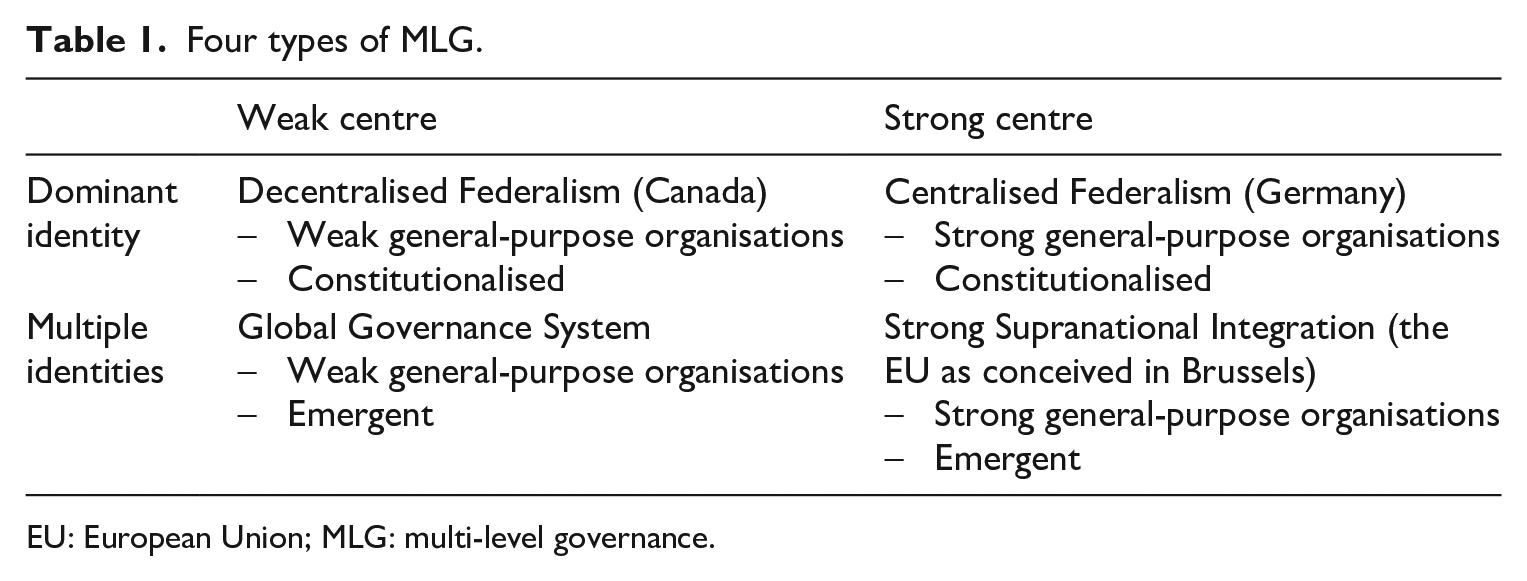
EU: European Union; MLG: multi-level governance.
The line between a dominant identity and multiple identities is the first distinction. It often – but not always – separates national political systems from institutions based on transnational communities. Even in the case of the EU, the citizens’ national identity is stronger than the European one throughout all member states – though with a strong presence of multiple identities in the majority of countries. Dominant identities make a constitutional moment and the set-up of a political system with system-wide architecture more likely. While all political systems are to some extent emergent and the constitutional moment is an abstraction, it is obvious that systems beyond the nation-state are more emergent than national ones with a constitutionalist moment.
The constitutional moment also affects the likelihood of a strong political centre that has a generalised responsibility, is able to coordinate different task-specific institutions, and can dominate the lower levels of governance. The history of federalism and the debates about different types of federalism (see, for example, Grande, 2002), however, shows that not all political centres in federal states are strong. Some have a limited portfolio of issue areas, others cannot decide without the integration of lower levels in the decision-making process, and some even lack the competence to coordinate policies. We can, therefore, distinguish between decentralised federalism, as in Canada, and centralised but coordinated federalism, as in Germany (Scharpf et al., 1976).
The global governance system clearly is a case of an MLG system that cannot rely on a dominant global identity. Yet, a significant part of most member states, and especially the elites working in the global governance system, often point to a sense of global belonging in their overall identity construction. It aligns with MLG theory that this system only has a weak general political centre – mainly the United Nations and the G20 meetings. This centre is weak regarding all three indicators: the issue areas governed by these multi-purpose organisations are limited, the role of the centre towards the decentralised governance units is relatively weak, and the ability of the political centre to coordinate different task-specific organisations is very much limited. Nevertheless, it still is a political system that has a rudimentary political centre. Moreover, the global governance system clearly is emergent and it never had a constitutive moment with identifiable constituent powers.
The emergent character also applies to the EU. It is mainly associated with multiple identities. At the same time, it is obvious that the EU is closer to a designed system given the attempt to come to a constitutional treaty. This observation is in line with the obvious fact that European identity plays a larger role in the EU than global identity within the global governance system. The centre of the EU consists of the Council, the Commission, and the Parliament. While this centre certainly is weaker than in some centralised federal states, the self-description of the EU elite working in Brussels and Strasbourg would describe themselves in terms of multi-task institutions that coordinate different policies and task-specific institutions. EU institutions also have primacy over national concerns regarding some issue areas.
The distinction between four types of MLG helps to grasp some of the empirics that Hooghe and Marks can hardly account for. First of all, it can allow for a general-purpose organisation on the global level. While the United Nations and the G20 summits fulfil the function of a political centre in a rudimentary sense, they are weak central organisations – not mainly because of the limited number of issues under their control, but because of a lack of competences to coordinate different task-specific organisations on the global level and dominance over lower level political organisations. Second, the EU has a much stronger political centre, but not because the number of general-purpose organisations in the EU is higher than it is on the global level. The decisive difference is rather in the competences of the political centre to coordinate as well as in its relationship to lower levels. If the data of the authority database would be controlled for political systems, the number of general-purpose organisations on the regional level would probably not significantly differ from the number of general-purpose organisations on the global level. In general terms, the scale can grow without the scope going down. Third, all political systems are dynamic both within the national realm and beyond. In this sense, the EU has gradually evolved from a weak system to one with a political centre that is significantly stronger than global governance. Since the late 1950s, both scale and community as well as the relative strength of the political centre have grown. In some cases, the relative power of the centre increased without an accompanying rise in a sense of community (see Schimmelfennig, 2015). Also, federal systems know dynamics that are independent of the scale and community tension. A stronger centralisation then may be the response to a declining sense of national community. There is no static relationship between scale and community as implicitly assumed by Hooghe and Marks; this relationship is dynamic, can change over time, and sometimes scale grows while community remains unchanged.
Be that as it may, the critique does not question the general tension between scale and community, which is at the core of the research programme that started with ‘Unraveling the Nation-State’. The tension shows, for instance, in the form of resistance in MLG systems without a strong dominant identity against centralisation as in the EU or in Belgium. Yet, instead of translating the tension into a substitutive relationship between scale and community, it can be loosened and opened up for dynamic processes by changing two of the auxiliary assumptions. The change of auxiliary assumption within a research programme helps to get a better grasp on parts of the empirics that are hard to account for by the substitutive relationship as well as on the historical dynamics of MLG that cannot be captured by a substitutive (and mechanistic, one may add) relationship. These changes in auxiliary assumptions are therefore a crucial element of a successful and progressive research programme. I am sure it will remain like this for some time to come.
