




Abstract
A key question facing scholars of party politics is the journey engaged individuals take to becoming party members. We argue that the existing literature largely outlines one aspect – motivation. In this article, we present an alternative position: that a membership journey is only complete when a motivation, process and trigger are present. We outline this utilising a case study of the Green Party of England and Wales including previously confidential internal party documents, membership figures, elite interviews, focus group research and participant observation to provide a different means to understand membership fluctuations. We present these findings as an exploratory and inductive reinterpretation of existing debates. However, we also suggest that the findings are of interest not just in the case of the Green Party, nor the United Kingdom, but to all those who study party membership.
Party membership has long been a crucial indicator of the democratic health of a party. It is given coverage by national newspapers, venerated by those who have members, and ignored by those without. They remain an important way by which the health of a party is judged. This has generated numerous studies of membership figures and attempts to understand and describe who party members are. Yet, less common within existing work is scholarship that focuses on what actually leads to the moment of affiliation. While the influence of factors such as family predilections, social encouragement and careerist motivations have been discussed as possible drivers of this decision, the actual impetus that prompts an individual to transform the idea of membership from theory into practice has remained opaque. This absence is somewhat surprising, as with membership numbers dropping in democracies around the world (Bardi et al., 2017; Mair and Van Biezen, 2001; Van Biezen et al., 2012; Van Biezen and Poguntke, 2014), parties are eagerly seeking new ways in which they can boost their membership.
To generate new insight on the process by which individuals come to join parties, this article uses unprecedented access provided to the Green Party of England and Wales (in terms of access to party staff and internal data) and engages with the existing literature to generate new and useful conceptual principles on the drivers of party membership. We offer a new framework to understand why individuals join parties, and what explains collective changes in party membership. Wider than just the special case of the Greens, the United Kingdom itself represents a second ‘special’ case. Here, membership of the established parties has trended both up and down in recent years, due to a variety of (intra and extra) party organisational factors (for a good summary, see Bale et al., 2019: 8–14). As such, the causal claims we make should be understood as highly contingent on this context.
What we currently know about party membership
The literature on party membership is exceedingly diverse and has tended to focus on three questions: who (joins political parties), what (do members provide) and why (join a political party) (see Aldrich, 2011; Cross, 2004; Katz et al., 1992; Van Haute and Gauja, 2015). The work of ascertaining just who party members are is generally done through single-country survey research (see Bale et al., 2019; Cross and Young, 2008; Seyd and Whiteley, 1992). The upshot of this research is that party members are not representative of their wider citizen populations. They tend to be male, highly educated and more well off than their respective populations. Indeed, such is this representation gap that Aberbach et al. (1981) noted a paradox (of sorts) – social discrepancies in those organisations that are tasked with representing the public at large increase the more those within parties are involved and have organisational responsibilities. These results hold up both in the aforementioned single-country case studies and attempts at more ostensibly comparative works (e.g. Scarrow and Gezgor, 2010; Van Haute and Gauja, 2015).
The second consideration is the question of what party members actually provide. Answers in this case tend to fall somewhere on the spectrum between purely functional (e.g. financial) concerns and the altogether more normative (e.g. the provision of democratic legitimacy). Many different approaches have been used to answer these questions. Scarrow (2015: 102), for example, draws a distinction between activities that take place primarily inside party organisations (providing volunteer labour, providing financial support, standing as candidates for public office, transmitting ideas and preferences into party debates) and activities that take place mainly outside of party organisations (providing electoral support, the communication of party ideas and enhancing political legitimacy). Granik (2005: 599) synthesises the work of the many scholars who have clarified these distinctions (see Duverger, 1954; Martin and Cowley, 1999; May, 1973; Milbrath, 1969; Scarrow, 1996; Seyd and Whiteley, 1992, 2002) to describe party members as ‘part supporter, part funder and part worker’.
Finally, scholars have focused on why people become party members and it is this question that this article is dedicated to addressing. Scholarship in this area can be summarised along either the supply-side or the demand-side. Supply-side explanations consider the role of party supporters and their calculations about whether it makes sense to join a political party, whereas demand-side explanations involve calculations by party elites regarding the net utility of engaging party members (see Scarrow, 2015: 15). Much of the work in this area categorises members and potential members as rational actors (broadly defined) that respond to a series of incentives and benefits. Clark and Wilson (1961) separate these benefits into three categories: solidary (social), material and political (purposive). Seyd and Whiteley (1992) develop a general incentives model (GIM) that adds psychological drivers such as altruism and solidarity. Granik (2005) suggests four models of explanation: civic voluntarism, social psychological, rational choice and general incentives. While Scarrow (2015: 157) categorises three distinct benefits parties provide for members: social and psychological (e.g. the provision of group identity, the provision of leisure activities, status), material (e.g. policy benefits, consumer discounts, education, training, patronage and general careerism) and political (e.g. to advance a cause or oust the current government and to influence party decisions). Poletti et al. (2019: 168) find that Seyd and Whiteley’s (1992) GIM ‘largely stands up well’ for contemporary analyses and restate six possible motivations for joining a political party:
expressive incentives (e.g. an attachment to the party’s principles, or a belief in the party’s leadership);
collective incentives (e.g. to support the party’s general policies, a specific policy that mattered greatly, or to oppose the policies of a rival party);
altruism (e.g. to support the democratic process, or to promote the interests of the nation);
social norms (e.g. the influence of family, friends or colleagues);
selective process (e.g. being able to engage in activities in which you would be mixing with other like-minded individuals);
selective outcome (e.g. to enhance their career).
In the aforementioned (largely quantitative) studies and innovative narrative-based approaches (see Garland, 2016, 2017) this framework of incentives has been shown to have an important causal pull. For example, Garland (2016: 43) shows that while collective ideological incentives are consistently placed at the top of member surveys, in interview-based research ‘selective incentives (either process or outcome ones) appeared to have a more influential role in prompting joining’. Finally, Whiteley et al. (2019) test both the GIM, but also relative deprivation theory introduced by Stouffer et al. (1949) and developed by Runciman (1966). Using data from the British Election Survey (BES) and the Party Membership Project (PMP) they find that in the case of the Labour Party: support for the leader, a yearning for a new style of politics and feelings of relative deprivation played a significant role in explaining Labour’s membership surge in 2015 (and beyond). Indeed, that ‘many “left-behind” voters (some well educated, some less so) joined Labour for the first time when a candidate with a clearly radical profile appeared on the leadership ballot’ (Whiteley et al., 2019: 80). Similarly, Dennison (2017: 63) argues those that joined the Green Party during the ‘green surge’ in late 2014/early 2015 were ‘motivated to join by ideological affinity’ inclusive of a ‘shared antipathy towards austerity, the current state of British politics and the major parties’. However, Dennison also shows – as we do below – that an important catalyst (trigger) behind this surge was the party’s exclusion from pre-election televised debates between party leaders.
The three streams of party membership
The process of becoming a party member, then, is not straightforward. As the literature demonstrates, a range of influences and beliefs appear to inform the membership journey. Seeking to understand this, we draw inferences from existing literature to identify three different factors that each inform the process of an individual becoming a member and which, when combined, lead to the moment an individual decides to join a political party. We argue that motivations, process and triggers can explain why people join, and accordingly provide fertile sites in which parties can concentrate recruitment efforts.
In introducing this, we first argue that motivation plays a significant role. As recognised in the literature précised above, individuals can possess a range of different traits that render them more likely to become party members. The social, psychological, material and political incentives reveal the kind of influences that lead an individual to be more disposed towards a party. As we later discuss, motivations for membership can be actively promoted by political parties themselves through efforts to demonstrate the appeal of membership, yet motivations are often latent and may be unrecognised by individuals prior to a moment of activation. What matters is that individuals are in some way disposed towards a party they may decide to join.
Motivations are not, however, enough. To understand the act of becoming a member we, second, argue that process is vital. This factor is perhaps the simplest aspect of membership as it describes the actual mechanics and organisational infrastructure that enable individuals in geographically diverse locations to join (often centralised) parties. While effective online membership systems do exist in the United Kingdom, historically this was not always the case (see Bale et al., 2019: 173–182). These processes are fundamental requirements for membership recruitment and therefore constitute an often-unrecognised part of the equation.
The final component directs attention to triggers. Triggers are the factors that lead an individual to act on their motivation and activate membership mechanisms. Triggers do not come in a single form and can be categorised as personal, local, national or international. Membership could therefore be triggered by a conversation with a friend who has just joined a party, by discussion at a local action day or party event (such as a county fair or university induction week), by a national event such as a general election or an international occurrence such as a global climate conference or strike. Importantly these triggers do not automatically lead to membership, and are often more likely not to produce this outcome.
This reinterprets much of the existing literature and recognises that while motivations are a vital factor, they also require activation and mediation in order to transform a desire for membership into the actual act of membership itself. In other words, we argue that motivations (that currently dominate existing accounts of ‘why’ people join parties) can be latent, and are often only realised when understood in the context of multi-stream activation. This argument represents an important extension of the literature, as well as a recent concern in other studies. As Bale et al. (2019: 88–89) suggest when discussing the Labour Party membership surge under Jeremy Corbyn: We are looking at a pattern in which, to use the terminology of the general incentives approach, ideological, expressive and collective policy incentives seem to feature most prominently. But we are looking, of course, at an event – a leadership contest – which, if seen as a high stakes occasion by enough potential members, can, almost in and of itself, encourage an influx of members . . . the episode is a useful reminder that, while incentives matter when it comes to joining, so, too, do triggers.
Methodological approach
To fully appreciate the value and traction of this idea, we now present new empirical data to support our claims. Taking each stream in turn, we outline why each is an important component of the membership process, and how, in combination, they can explain the activation of party membership. While asserting that this has the potential to be applied in other cases around the world, in the analysis that follows, we use detailed engagement with one specific case in the United Kingdom, presenting new data gathered from the Green Party of England and Wales to explain the membership process. This approach allows us to move from an attempt to describe and map individual membership journeys, to consider what may be driving fluctuations in national-level party membership figures.
The utilisation of a single case study is a clear limitation of the research, particularly with regard to generalisability. However, we suggest that this research continues in the rich tradition of the instrumental case study, as the kind of singular case study research undertaken ‘if a particular case is examined mainly to provide insight into an issue or to redraw a generalisation’ (Stake, 2005: 445). We therefore use our extensive data to derive a conceptual framework that takes an integrated approach to understanding the motivations, processes and triggers that can inform a membership decision and have structured our argument (and data) in such a way as to introduce these ideas. In this sense, we take our cues from Kreiss et al. (2018: 9) in utilising an ‘inductively derived analytical framework [which] can guide scholars’ pursuing qualitative studies of particular phenomena.
Moreover, at a time when gaining access to official party data and staff is becoming increasingly challenging, we were able to access hitherto unseen data from the Green Party, facilitating more detailed engagement with this specific case than would be possible if taking a more comparative approach. Studies of parties have traditionally used surveys and/or interviews – but parties are increasingly unwilling to provide interviews and access, with many staff signing non-disclosure agreements. These methodological issues are often only able to be circumvented with large-scale research grants which allow for the use commercial opinion polling companies to obtain representative samples of party members and supporters (for more on these challenges see Bale et al., 2019: 1–3). Our method has allowed us to meet this challenge head on – yet is not without its shortcomings.
For example, in electoral terms, the Green Party is still a minor party. However, the Green Party case – in membership terms – is particularly interesting. Over recent years, the party has witnessed significant membership fluctuation. Focusing on the period 2010–2018 (see Figure 1), we examine a period of membership increase (described as the ‘green surge’) and decline. We present previously unseen and detailed membership figures, documentary analysis of confidential internal party reports and action plans, off the record meetings and workshops, as well as data collected from 10 elite interviews with party staff (paid and voluntary), focus group research with local party members and supporters and participant observations at party meetings and campaign ‘action days’. This provides new insight into the way that motivation, process and triggers combine to drive membership at the individual and collective level. We also triangulated our argument ‘using multiple perceptions to clarify meaning’ (Stake, 2008: 133) with wider documentary evidence from the news media and further evidence garnered from other political parties, inclusive of 15 elite interviews with party staff from the Conservatives, Labour and the Greens and three further focus groups (consisting of approximately 65 participants) with partisan and non-partisan members of the public.
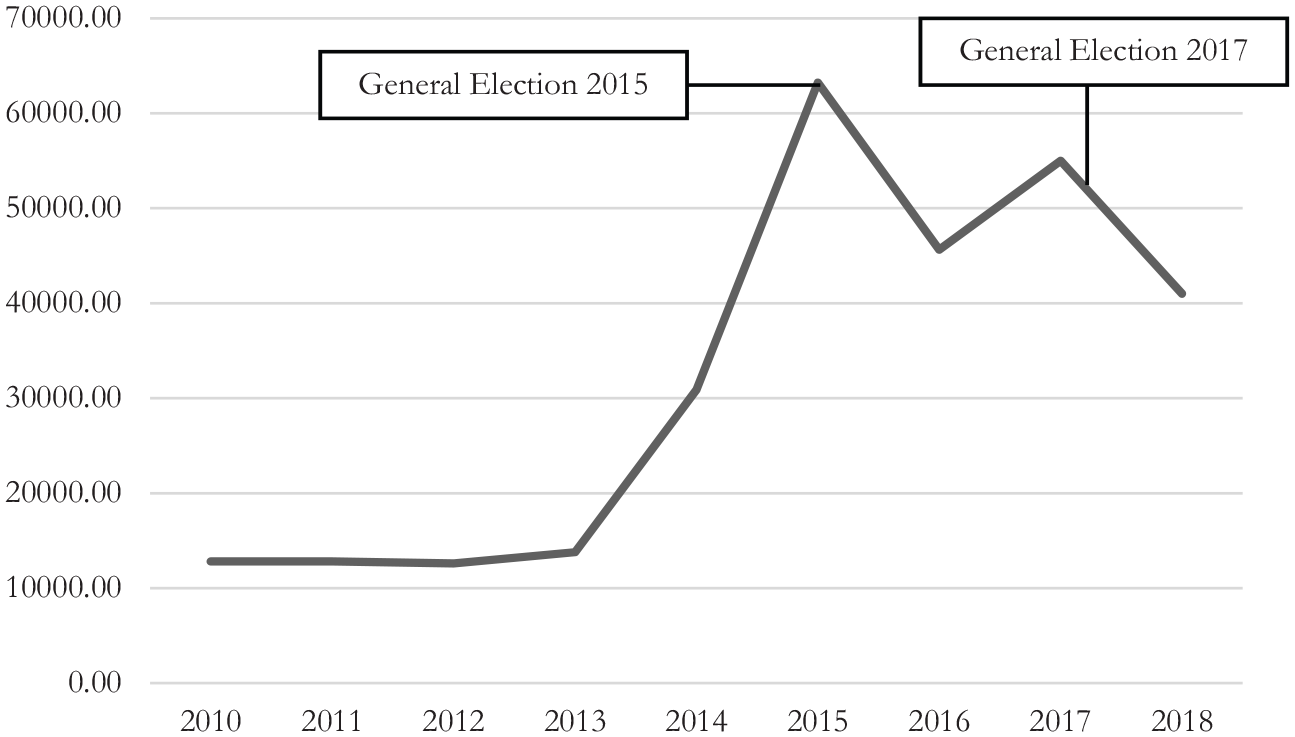
Total party membership (Green Party) 2010–2018.
Understanding activation: The motivations, processes and triggers behind membership decisions
Thinking about membership in these terms has particular value as a means of understanding individual-level decisions to become a party member. While the existing literature has enabled the classification and weighing of various membership motivations, these approaches tend to overlook the multi-faceted and complex stories that individuals tell about the process of becoming members. To demonstrate this point, we present three illustrative examples of the stories Green Party members told about their membership journey:
I’d been interested in politics since my mid-teens, living in rural areas. I thought that for anything to happen with respect to conservation and the protection of the environment, it had to be political . . . I thought of joining the Liberal Democrats who were then the Liberal Party and oddly enough, I failed to be able to do that. I didn’t make a huge effort, I must admit, but there were several people at my place of work who I knew were Liberal Party members and I thought it would be quite easy to drop a word and say, ‘How do you join?’ Anyway, I didn’t find any way of joining . . . I saw an advert for what was then the Ecology Party in the Ecologist magazine which I read regularly at the time and I thought, well, maybe that’s the route and that’s what I joined. Immediately I was contacted by other members in the Stockport area, including one person I knew from the place where I worked who said he had tried to form a group in Stockport, would I come along? That’s how I got drawn in. Although I voted Green for years, for me, the deciding factor was on the zero hour contracts - and I know that sounds like a really obscure thing, and it may be for a lot of people . . . but I was watching a debate during 2013, and the spokesperson for the Labour Party on Newsnight just wouldn’t condemn zero hour contracts . . . Then I looked at everything else and I said, ‘I agree with all of that’. It’d be really churlish not to join them really and I agree with all of these things. And that’s the thing, I think that there are lots of people out there that are used to compromising.
My involvement in the party was actually through trade union activism . . . From there, there were people who were in my local union branch of the college who were members of the Green Party. . . From 2010 onwards, I was involved in a Southend trades council, kind of campaign. Southend against cuts, I was doing a lot of anti-cuts campaigning and a lot more political stuff . . . Someone said, ‘You’d be really good standing as a candidate for the Green Party in the local elections’. And so, I did. I joined and got involved in some of the trade union campaigning within the party.
Each of these stories provides rich insight into the variety of factors that condition membership journeys. In each narrative, an underlying motivation is clear. Referencing an interest in politics, concern for the environment, affinity with green values or activist background, each interviewee demonstrated the presence of the expressive and collective incentives identified by Seyd and Whiteley (1992). The third story also reveals the influence of selective incentives, while the first hints at the potential for social norms and individual connections to influence the decision to become a member (although, in this case, work place ties did not reap dividends). And yet, as each story makes clear, alone these motivational factors were not enough, process and triggers also played a role. The first story demonstrates the importance of easily accessible mechanisms through which to join a party, and the barriers that can exist when individuals are not able to ‘find any way of joining’. While the Internet, as acknowledged by the participant, has made finding and accessing opportunities to join far easier, this story demonstrates that practical considerations can frustrate the process of signing up. As discussed further below, process issues can arise that help to explain individual and collective-level membership trends. Finally, the stories above reveal the presence of triggers. As Story 2 demonstrates, an expressive incentive for membership can lie latent for years before it is activated. In this case, a national news event and policy choice sparked a decision to join, while in the third story, it was a personal connection that triggered the individual to join. Triggers can vary in scale and scope, but in each case, a specific event or intervention occurred that led an individual to utilise available processes to enact their motivation.
We argue that these examples are not merely descriptive, but can also help to conceptualise and understand membership change at a collective level. To demonstrate this point, we turn now to consider trends in party membership in Great Britain to specifically interrogate how an understanding of motivation, process and triggers can help to account for collective membership change.
Triggers
Figure 2 shows the membership figures of the Conservatives, Labour, Liberal Democrats, the Green Party, the Scottish National Party (SNP) and UK Independence Party (UKIP). 1 What is evident is that over the period examined, there has been significant fluctuation in party membership levels – trends that are often masked by an overall focus on membership decline. In the Labour Party, we see membership hit an initial peak in 1997 at 405,000 members, before falling precipitously throughout the period of the New Labour government. Membership rises from 156,205 to 193,261 between 2009 and 2010 (likely in response to the 2010 general election defeat) before rising significantly in 2015. This is largely agreed to be explained as a result of the victory of Jeremy Corbyn in the Labour leadership election of 2015 and the subsequent leadership challenge in 2016 (see Bale et al., 2019: 87–88; Whiteley et al., 2019). Recent data on the Liberal Democrats demonstrates that party membership has expanded, boosted by approximately 14,000 members joining in ‘the two weeks since the [2017] general election was called’ (Liberal Democrat Voice, 2017). Likewise, the Green Party (of England and Wales) data reveal a spike in membership during the ‘Green-surge’ prior to the 2015 general election (see also Dennison, 2015). And yet, the trend is not always up. For the Greens, membership dropped to under 46,000 during 2016, only to experience a slight uptick in subsequent returns before falling again in 2018. Similarly, UKIP saw its membership decline after 2014, only to recover in 2017 before falling to 21,200 in the latest reported figures. However, in late 2018, it was reported that UKIP membership had risen by 15% with the arrival of 3200 members in July, following the release of Theresa May’s Chequer’s plan (Walker, 2018; see also Walker and Halliday, 2019). 2
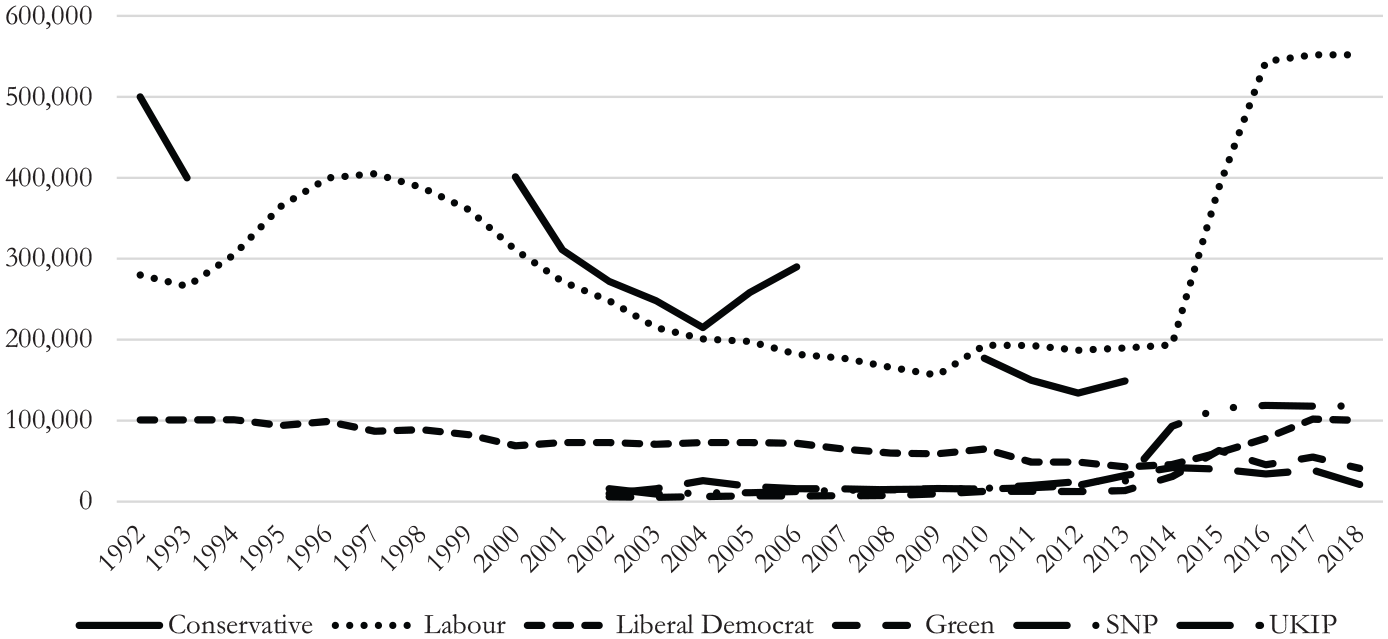
Total party membership (Conservative, Labour, Liberal Democrat, Green (England and Wales), SNP, UKIP) 1992–2018.
These data, therefore, demonstrate that over time people decide to join parties in different numbers and there can be interesting peaks and troughs in reported figures. However, studies have also shown that there are important methodological deficiencies in the measurement of party membership (Delwit, 2011; Kölln, 2016). For example, Kölln (2016: 446) shows that the vast majority of research in this area can be categorised by the use of aggregate country-level data and/or relatively few time points.
We therefore argue that an appreciation of motivation, process and trigger can help to understand these variations. Far from remaining constant, members join or leave all the time, resulting in a high variation in figures. This makes it important to understand why people join and also to begin to think about the consequences for questions of why people leave. To offer this argument we, once again, focus on Green Party data and specifically look at 2017. For these purposes, we present previously unseen data that offers increased insight into Green Party membership trends (see Figure 3). 3
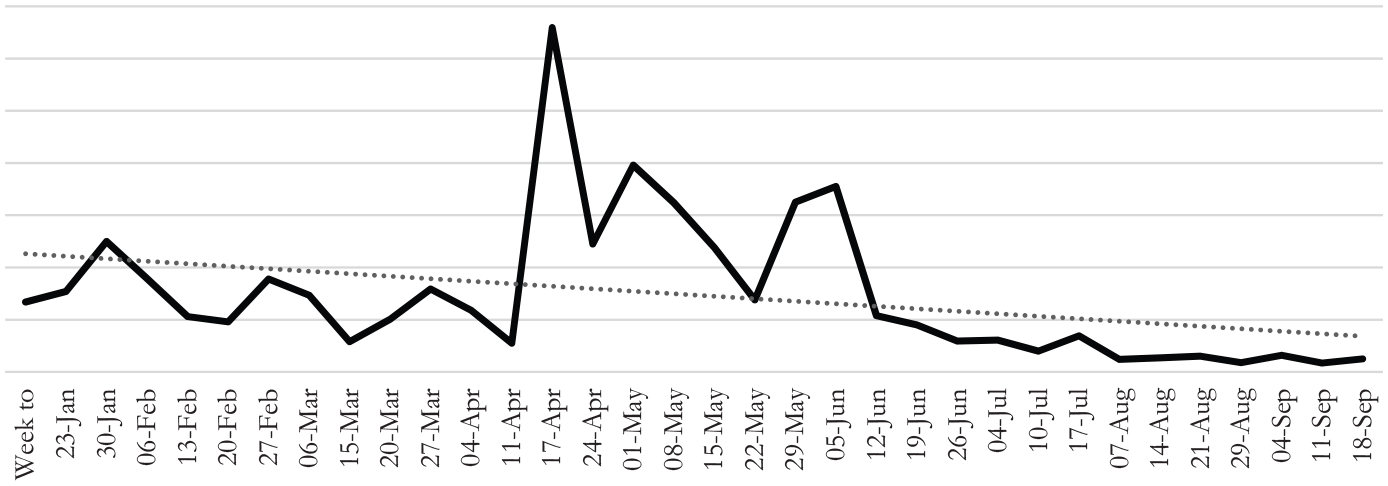
New Green Party membership subscribers by week in 2017.
What emerges most clearly is that aggregate level figures mask considerable week-on-week fluctuations in membership. Seeking to explain these variations, we highlight the importance of events – one form of the triggers identified above. For example, in 2017 a significant peak in membership is evident the week the General Election was announced, with a dramatic decline after it concluded in June.
So, while many events may well be an important trigger, it appears that general (in more than one sense of the word) events were more significant at the national level. Moreover, that these were occurrences the party had little control over. Reflecting on the calling of the 2017 snap general election, one interviewee noted: It was absolutely nothing that we did . . . calling the election, there was absolutely nothing . . . literally you could just see the announcement was made on television, people started joining. And I think that would probably be true of all political parties.
Elections therefore present an important membership trigger, and indeed Figure 2 signals that many parties (particularly Labour and the Greens) experienced a membership increase. This was also confirmed to us in a number of our interviews with party elites with access to internal (confidential) membership data (and our further focus group and interview research). And yet, in the aggregate figures, we do not see this confirmed for each party. There are two plausible explanations for this. First, it could be the case that certain party types experience the ‘electoral trigger’ (and indeed different kinds of trigger) differently. Second, this could be a representation of the aforementioned methodological deficiency when relying on aggregate-level figures (Kölln, 2016). If presented with data such as that provided to us by the Green Party, we might see that similar triggers cut across party family. That aside, our research also found that a range of different types of national event were seen to drive membership. As one interviewee noted: At the moment that’s the only thing that impacts on our membership levels. I can look through new joiner data and I can show you exactly when Trump got elected. I can show you exactly when Article 50 was triggered. I can show you exactly when the EU referendum took place, when the General Election in 2017 was. Even when the local elections in 2017 were. They all have their own little membership spikes . . . the only thing that does drive our recruitment is framed around external events.
This signals the importance of different kinds of national events as membership triggers, but interviews also showed that local events – such as a party leader coming to visit a constituency, or a local scandal or crisis – also drove membership. In seeking to understand why parties can suddenly witness a surge of new members, events are therefore useful explanatory factors, but we argue that the idea of a trigger is not synonymous with an event. The decision to become a member can be prompted by a range of triggers. Active recruitment strategies can therefore drive membership growth locally and nationally, triggered either by specific processes (such as a leadership election) or a more prosaic recruitment drive. Inter-personal prompts can also play a role, with individual conversations prompting a spread of membership (especially at times when a specific party gains grassroots traction or becomes the subject of much conversation). These kinds of triggers are commonplace, and yet it is harder to observe their effects within aggregate figures because they are often influential at the individual level. Events are therefore important for aggregate-level analyses, but they should not be treated as the only type of trigger.
We further found that the Green Party actively sought to capitalise on events. Indeed, our study found that they had made multiple attempts to create membership surges, effectively piggybacking on planned events to see if they could manufacture a rise in membership: We picked an external event. We picked, what did we pick? I think we picked Earth Hour, the week in the run up to Earth Hour, because it’s our turf. It’s a political idea that we already have reasonable ownership of, so people will readily associate us with it, and it gets coverage in the press. So, it’s something that people will potentially think, ‘Oh yeah, yeah. No, I can tie those two things up. And now I’ve got a thing saying I should join the Green Party’.
This suggests that an appreciation of triggers can help to unpick not only the individual and collective decisions that emerge around membership, but can also become a focus for potential recruitment, with parties able to manufacture or capitalise on existing triggers (and especially national events). And yet, a trigger alone is insufficient; what is also required is motivation and effective processes.
Motivations
Looking at the data on membership change, it appears that motivations to join a party can wax and wane. While factors such as ideological predisposition and familial ties remain largely constant, people’s views of the desirability of membership appear, from our data, to vary. Indeed, we found that context and political motivation were often highly intertwined. For the Greens, therefore, interviews found that the perceived motivation to join was often tied to their electoral fortunes and their position relative to other parties. Speaking with national figures, we found that: People who do sympathise with us, members of Greenpeace and members of Friends of the Earth . . . are members of the Labour Party, or the Lib-Dems. When challenged they say, ‘Yeah, but you lot can’t win, it’s all about winning’. In politics, if you’re not winning, you’re seen not to be getting anywhere.
The idea of the party’s potential success and relative standing compared to other left-wing parties was therefore felt. One interviewee cited the detrimental impact of the election of Jeremy Corbyn as Labour leader on people’s motivation to join the Greens, stating: I don’t want to use the word ‘enemy’ but the kind of membership-related enemy is Labour. But politically it is an ally. And then the actual enemy sits on the other end. So it’s weird.
Similarly, when the Green Party was not seen to be doing well nationally, it was felt that people were unlikely to join, whereas when national success was achieved, membership was a more attractive proposition (leading to membership rises). The impact of how people viewed a party was apparent at a local level as it became clear that where membership was seen to be useful, or influential, membership rose. Indeed, within the local party in Brighton (home to the Green Party’s only MP, Caroline Lucas), many members suggested Lucas herself as motivation to join the party and that, without an active local presence, they would not have joined (or in one case, re-joined) the Green Party. A local party survey of 288 members and supporters (62% members and 38% supporters) found that respondents ranked Caroline Lucas as the fifth most important reason for joining the Green Party (see Table 1). 4
How important was each of the following for your decision to join the Green Party? Average rating (0 = not at all important; 10 = extremely important).
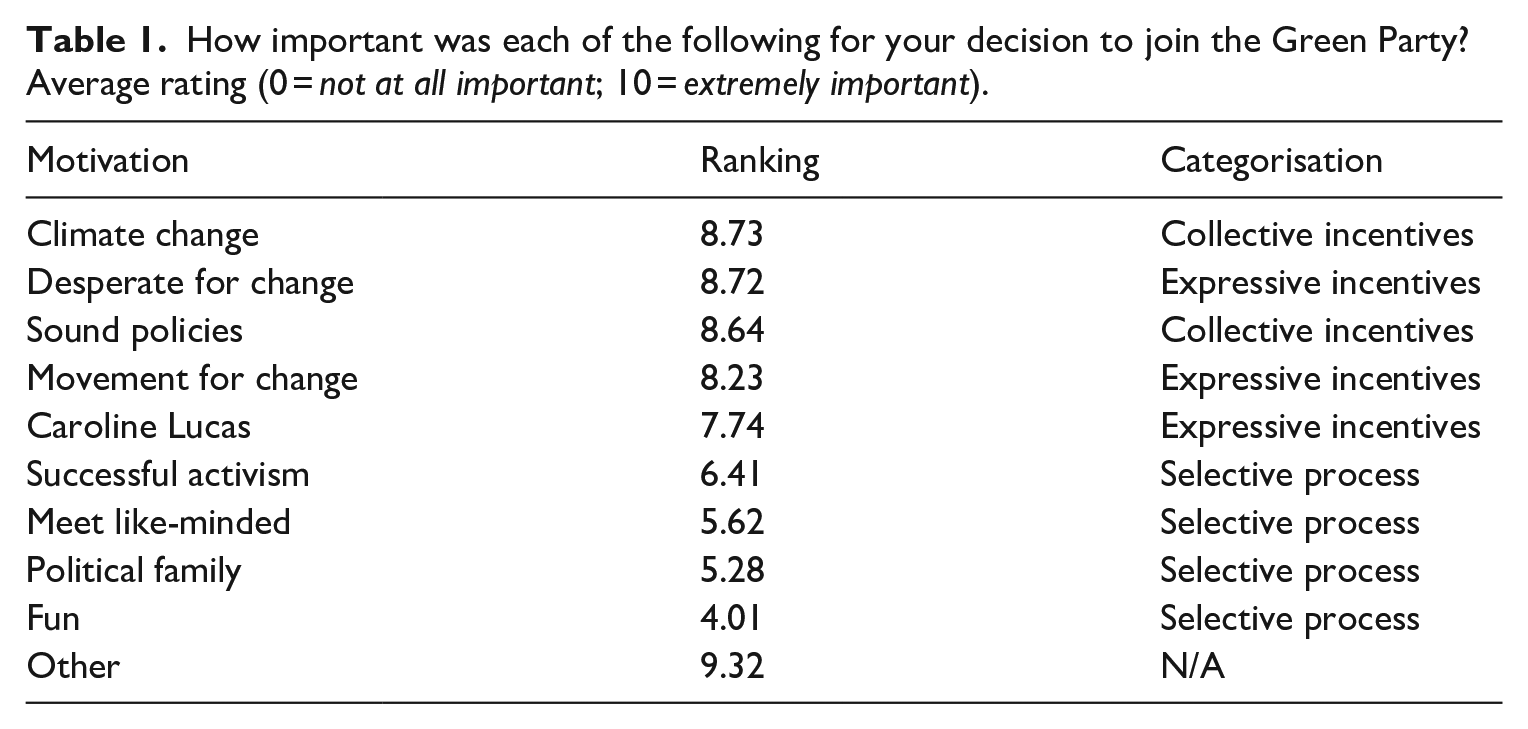
This suggests that the political context (nationally and locally) can affect motivations to join, and that changes in a party’s standing can help explain individual- and aggregate-level membership behaviour. That is, where the Greens are considered to have had successes (either in policy or electoral terms), we heard evidence from our interviews that membership was boosted by this.
Interestingly, for those we spoke to within the Greens, there was a feeling that the party had little capacity itself to affect these motivations. While the party devoted attention to offering an open and attractive view of membership, particularly emphasising the power given to Green members, interviewees commented: It’s tough because we don’t really know what the party can do . . . the message that’s not getting out there is that we are the same and a lot of the parties nick the Green Party’s ideas. Unless that gets out there in the media, it’s an uphill battle.
On this account, the party was aware of a need to tackle motivation issues, but was stymied by wider political debate in which the case for joining the Green Party was not often heard. While attempts to circumvent traditional media were made, the dynamics of the political system were seen to be significant in explaining (and driving) people’s motivations to join.
Effective process mechanisms
Finally, process can also play an important – but often overlooked – aspect of people’s decision to become members. In recent history, parties exhibit relatively developed membership joining processes. It often therefore only requires an individual to visit a party’s website and click on a link for people to join. However, our interviews revealed that these processes are not always infallible and can lead to problems. Discussing the internal Customer Relationship Management (CRM) system, interviewees described how a number of issues with the service had prevented people from joining between 2014 and 2017: We had 300 members in one week, and the CRM system crashed . . . there wasn’t enough, the system couldn’t cope with people coming in. And there were just no – the membership function itself was not well resourced (sic) . . . and nobody knew how to cope with all these people coming in.
Another Green Party employee with a working knowledge of the CRM system was, perhaps, a little less diplomatic in his assessment: I’d destroy it. It’s just horrible . . . It’s great for what it wants to achieve but as the party is wanting to grow . . . any old system, if you look at your phone, the old iPhone can’t do what your new iPhone does. It has to have a new system in place, one that can cope with demands.
Other process issues can also emerge if the system either does not work, or is designed in a way that does not embed and maintain the concept of membership. To take another example, at the time of the Green surge, the party did not have a direct debit system and hence many members joined on an annual basis, rather than through a system where their membership would automatically be renewed. While this did not affect the actual process of joining, it has had considerable legacy effects, as many people who joined in 2014 or 2015 have had to actively choose to remain a member rather than be automatically renewed – resulting in a significant decline in membership levels. This suggests that issues with national-level systems (especially when they occur in the context of a national event) can impact on aggregate-level membership figures.
Thinking again about the relationship between effective process mechanisms and party agency and capacity to exert control, it is interesting to note that the Green Party not only concentrate on maintaining effective membership processes, but also experiment with how to maximise the impact of these. Indeed, one interviewee described a recent experiment that members of staff ran out of the central headquarters, reflecting fairly basic ‘nudge theory’ (see Thaler and Sunstein, 2008): 46% of people who say they joined . . . did it by the website. And this is exactly how I did it, no contact with the local party. So . . . until last Thursday, we’ve had a two-week experimentation with our home page being entirely about joining. So, people go on the home page, that’s where there’s a ‘join’ and it’s all about a ‘join message’. You know, easy links, a suggested figure, which is not a membership rate figure . . . that worked quite well, not only did we have more new members, but we also had them paying substantially higher average membership. Now, we’ve switched it to an elections home page. The new membership has gone right off . . . so, the question is: is it a membership tool? There’s a lot of evidence, actually, that it is very successful, it’s good at doing that, there’s a lot of traffic to the site . . . it doesn’t cost much to join a political party does it, really, against other purchases? So, I think there’s a huge amount of impulse thing. And I think it’s capturing that impulse stuff . . . It’s not just events, but it’s actually in the first 30 seconds if you’ve got them.
Parties are therefore not impotent when it comes to building, maintaining and experimenting with process infrastructure to build capacity that might recruit more people. Indeed, we suggest that process is in many ways the easiest aspect of this to do successfully. As Bale et al. (2019: 176) argue, ‘simple efficiency does no harm’. In Seyd and Whiteley’s (1992) survey (pre-Internet era) the majority of Labour members said it was easy (or very easy) to join. Therefore, process – in this era – should be less of a barrier to entry. However, during our research, we still heard evidence of effective process mechanisms inhibiting joining. This may not just be the case for the Green Party. In 2018, it was reported that a ‘mystery shopping’ exercise was conducted in the Conservative Party, and of those applying to join ‘over half got no reply, 10 per cent were told the Party was closed to new members, and some were told that an interview must first be passed’ (Phibbs, 2018).
Therefore, triggers, motivations and process can also help to interpret and explain aggregate-level figures, helping us to understand not only why individuals join, but also what might explain changes in national-level membership figures. Our analysis has also demonstrated that parties can do much themselves to maximise membership increases, but that systemic factors can constrain party capacity to promote these strands. Having offered this overview, we now turn to discuss the implications of this research, considering what this approach might explain for parties interested in promoting membership increases.
Leaving political parties?
We have focused on the question of activation, but as evident in the data above, people are leaving parties in large numbers, to an extent that annual membership returns fail to capture. Extending our analysis, we suggest that this framework can help to explain why members leave political parties, asserting that just as the presence of a motivation, process and trigger explain why people join a party, so too the absence of these factors can explain why members leave. To consider this possibility, we again examine Green Party data and evidence of a decline in membership (and motivation) following the ‘Green surge’.
Looking at internal party reports, we found that members left in response to the new direction of the Labour Party. A (hitherto confidential) report sampled 15% of the members that left in 2016. The findings showed that 70% indicated they were leaving to join another political party, 60% to join Labour. A further 9.5% cited policy disagreements, 5.5% said they were leaving for financial reasons and 4.5% because they were disenchanted with politics in general. Similarly, the Green Party analysed the reasons given by 288 members when cancelling membership in the 5 weeks after the 2017 general election – 82% said that they were leaving to join another political party (75% to Labour). Policy disagreements were cited at 3.4%, financial reasons 2.1% and a disenchantment with politics in general, 1.7%.
In addition, we found evidence of a failure of process. One interviewee reflected: Of the 4,000, roughly speaking, members who joined in the weeks after the referendum, they joined on annual things. After 18 months, they would expire. So, 1,400 of those had expired . . . what we failed to do, is that we didn’t take that as a group and follow them on their journey. We didn’t say here are 4,000 to 4,500 members, now we’re going to actually segment them as a group, they joined in this spike. We’re going to communicate to them all the time about Brexit and what Caroline’s doing. We didn’t do any of that, they just merged in the general mass. So, 1,400 of those have fallen out.
This suggests that the process used to secure membership can lead to membership declines, as an absence of effective renewal processes or direct debit procedures can lead people to leave. Process and motivations therefore appear significant in explaining declines. Turning to triggers, the position here is less clear-cut. It can undoubtedly be the case that triggers prompt an individual to decide to resign from a party. These triggers can fall into the category of personal (e.g. a loss of income), local (e.g. a local party dispute), national (e.g. a decision to enter, or not, a coalition government) or international (e.g. a decision to enter, or withdraw from, an unpopular/popular treaty). And yet, as the discussion of process reveals, in certain instances, an active trigger is not required to leave a party, as the process by which joining occurred may not embed on-going membership. It therefore appears that these three factors have some explanatory power, yet the precise relationship between these variables can differ to the moment of activation. Differences in the process by which people joined a party might well require different combinations of motivation, process and trigger in order to leave. For this reason, we argue that this approach has additional value but that further theorisation is required to map the precise variations that account for the process of leaving a party.
Discussion
Throughout our research, we found that while parties are (at least superficially) interested in their membership figures, the attention devoted to addressing this issue is often piecemeal and fragmented. In our data collection, we uncovered evidence that parties in the United Kingdom often think about membership only at certain points of the year. For example, around elections parties turn off almost entirely to the need to attract members and give little attention to providing motivation, offering processes or capitalising on triggers to join. Within our case study (and through our wider triangulation), interviewees confessed to giving little thought to membership when an election was on. This is a mentality that - given the large numbers of people engaged at elections - demonstrates a significant missed opportunity to drive membership growth. This is unsurprising, electoral objectives of parties are widely recognised to dominate their activities and, as Scarrow (2015) outlines, members are frequently seen by leaders as a resource to be employed in intra-party contests. However, given that elections are the moments at which most people pay attention to parties, this demonstrates a missed opportunity. What emerges, therefore, is a need for parties to think more consistently about party membership, recognising the need to promote all three streams throughout the electoral cycle if membership numbers are to be increased. In terms of substantive strategies for boosting membership, this leads us to recommend that parties focus on:
promoting the multiple membership activation streams throughout the electoral cycle by, for example, integrating member recruitment into party campaigning and canvassing activities;
promoting and articulating the case for party membership by, for example, sharing membership stories and demonstrating the ‘value added’ of membership;
reviewing the effectiveness and implications of its process mechanisms by, for example, using ‘secret shopper’ projects where party staffers (or compliant non-members) are tasked with investigating just how easy it is to join the party;
capitalising on external events and orchestrating triggers for membership by, for example, running issue-focused membership recruitment campaigns.
By exploring these strategies, we argue that parties may be able to boost membership numbers and intervene to counteract the drivers that cause members to leave.
Conclusion
The aim of this article is to emphasise the scholarly importance, not just of testing existing theories but the generation of new conceptual frameworks. In this, we aim to highlight new and complementary explanations to existing studies. We recognise that the Green Party might well be considered a ‘double’ unique case study. They are a relatively minor party (especially in electoral terms) in the United Kingdom, and their membership has (traditionally) been born out of a more general environmental activism (for more on this, see Dennison, 2017; Dennison and Poletti, 2016). 5 Moreover, the United Kingdom finds itself in a unique situation in which both Labour and the Conservatives find themselves subject to considerable organisational change with regard to specific internal struggles around (among other things) the issue of Brexit.
In the first instance – the case of the Green Party – we accept this limitation and repeat our claim to generalisability which is, in utilising an instrumental case study, to (slightly) redraw a generalisation rather than anything more grandiose. Indeed, a study of this type could not, and is not intending to achieve anything more. In the second instance, we recognise that while certain motivations and triggers might be different for other parties, with different kinds of party members in the United Kingdom, the framework may still have some utility. Indeed, a recent large-scale study of parties argued precisely that differing triggers might have some effect on membership surges (for analysis of the Conservative Party, Labour, the SNP, UKIP, the Greens and the Liberal Democrats, see Bale et al., 2019: 88–91).
We therefore argue that the principle of ‘multi-stream activation’ provides a compelling means to understand a much-discussed element of the study of party politics. We suggest that evident in our case study are three conditions of party membership – motivations, process and triggers – that complete the membership journey. Motivation represents much of what has been outlined in the previous literature on party membership encompassing everything from Seyd and Whiteley’s GIM (1992) to the recent ground-breaking work undertaken by, for example, the Party Member’s Project (PMP) and Members and Activists of Political Parties (MAPP). 6 Process is what can also be defined as the effective mechanisms of party membership. These encompass the actual mechanics and organisational infrastructure that enable an individual to join a political party. Finally, we direct attention towards the importance of triggers. These are the (often exogenous) catalysts that cause an individual to act on a motivation and activate membership mechanisms. Triggers can come in four forms: personal, local, national or international.
Our argument represents an extension and reinterpretation of the existing literature. In recent years, scholars have been moving away from merely discussing decline, towards a greater understanding of (individual and collective level) fluctuations. This work provides another such contribution. We have also sought to reflect on the practical steps that parties (and indeed other membership organisations) can take in attempts to boost their membership figures. To be clear, we recognise the limitations of an instrumental case study of an (electorally) minor party in British politics. In this sense the work should not be read as a refutation of previous research, and the causal argument should be seen as highly contingent on this one (special) case. We instead present a different conceptual framework to better understand which steps make up the membership journey – perhaps creating space for further comparative work across party families and electoral contexts.
Footnotes
Acknowledgements
The authors would like to thank participants at the Elections, Public Opinion and Parties pre-conference workshop on party members at Royal Holloway (2018) and at the Centre for Elections, Media and Participation’s (fantastic!) ‘cake for comments’ initiative at the University of Exeter for their comments on initial drafts. The authors would also like to thank Pat Seyd and Luke Temple, the anonymous reviewers and Rebecca Dobson for her help taking notes at one of the focus groups.
Funding
The author(s) disclosed receipt of the following financial support for the research, authorship and/or publication of this article: This research was supported by an Economic and Social Research Council (ESRC) grant (ES/NO1667X/1).
